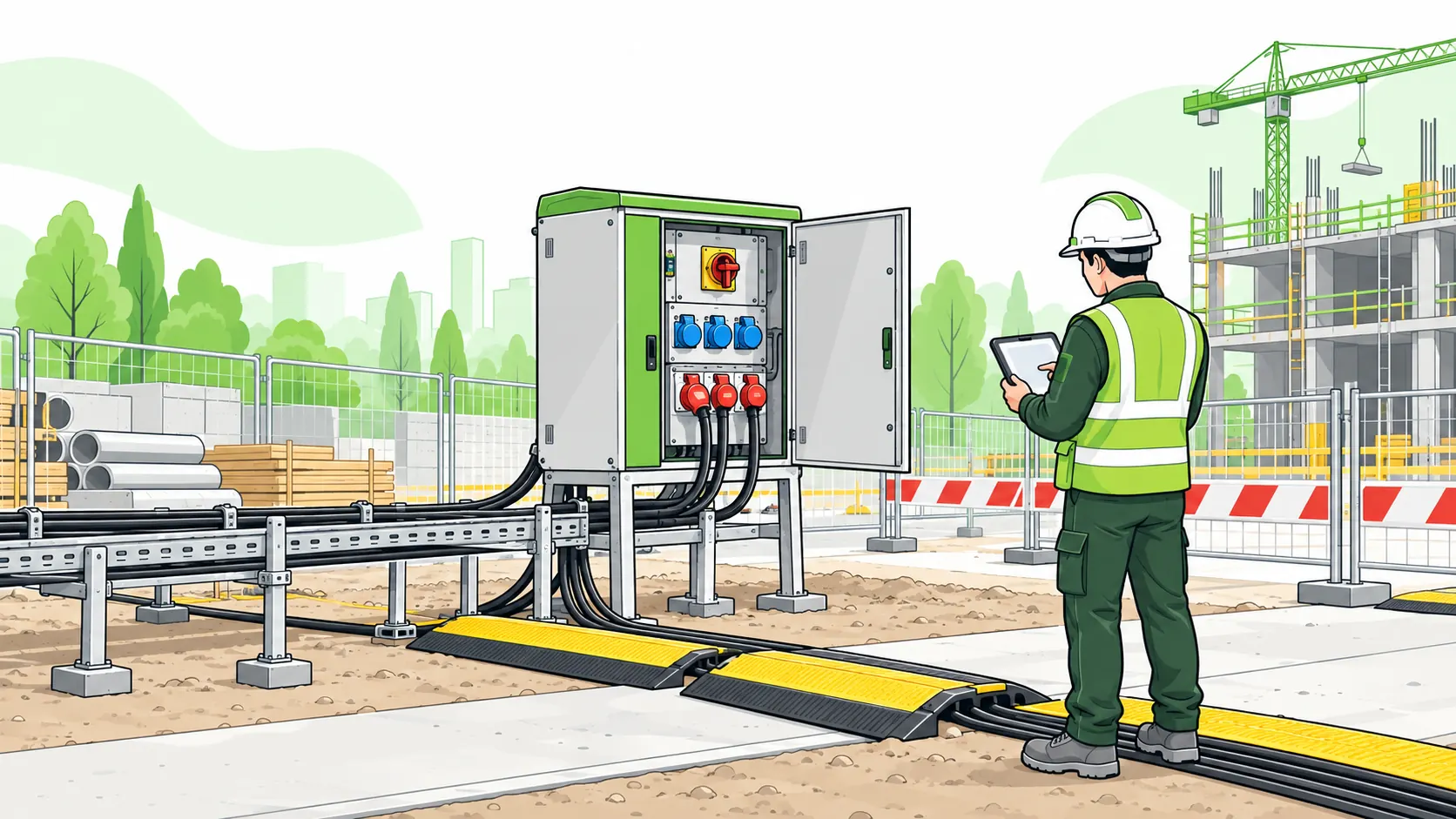
Temporary electrical installations on construction sites supply power and lighting before permanent wiring is available. Because sites are wet, changeable and damage-prone, they are tightly regulated — by OSHA and the NEC in the US, and by HSE guidance (HSG141) and BS 7671 in the UK. "Temporary" never means a lower safety standard.
Competent-person caveat: This article provides general HSE knowledge. Life-critical work such as designing, installing, energising or testing temporary site electrical systems must be planned and supervised by a competent person with relevant training, jurisdiction-specific authorization, and a site-specific risk assessment. The information here does not replace that.
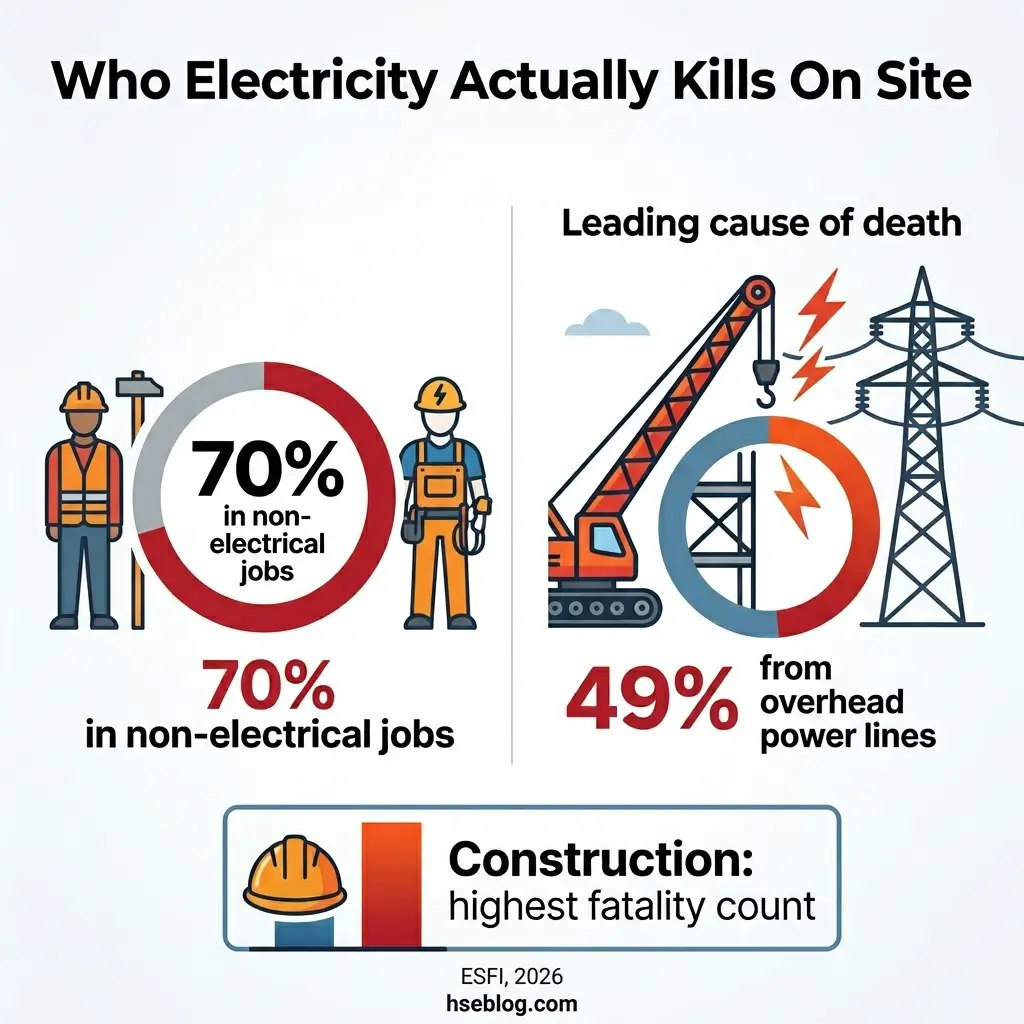
Electricity kills a disproportionate share of people who never considered themselves electrical workers. Across US workplaces from 2011 to 2024, 70% of electrical fatalities occurred in non-electrical occupations (ESFI, 2026) — labourers, plant operators and ground workers who came nowhere near a distribution board.
That single figure reframes the whole problem. Temporary electrical installations on construction sites aren't a niche concern for the site electrician; they sit in the path of everyone on the job, which is exactly why two of the world's major safety regimes regulate them so heavily — and why the rest of this guide treats US and UK practice as two live, parallel systems rather than picking one and ignoring the other.
What Counts as a Temporary Electrical Installation on a Construction Site?
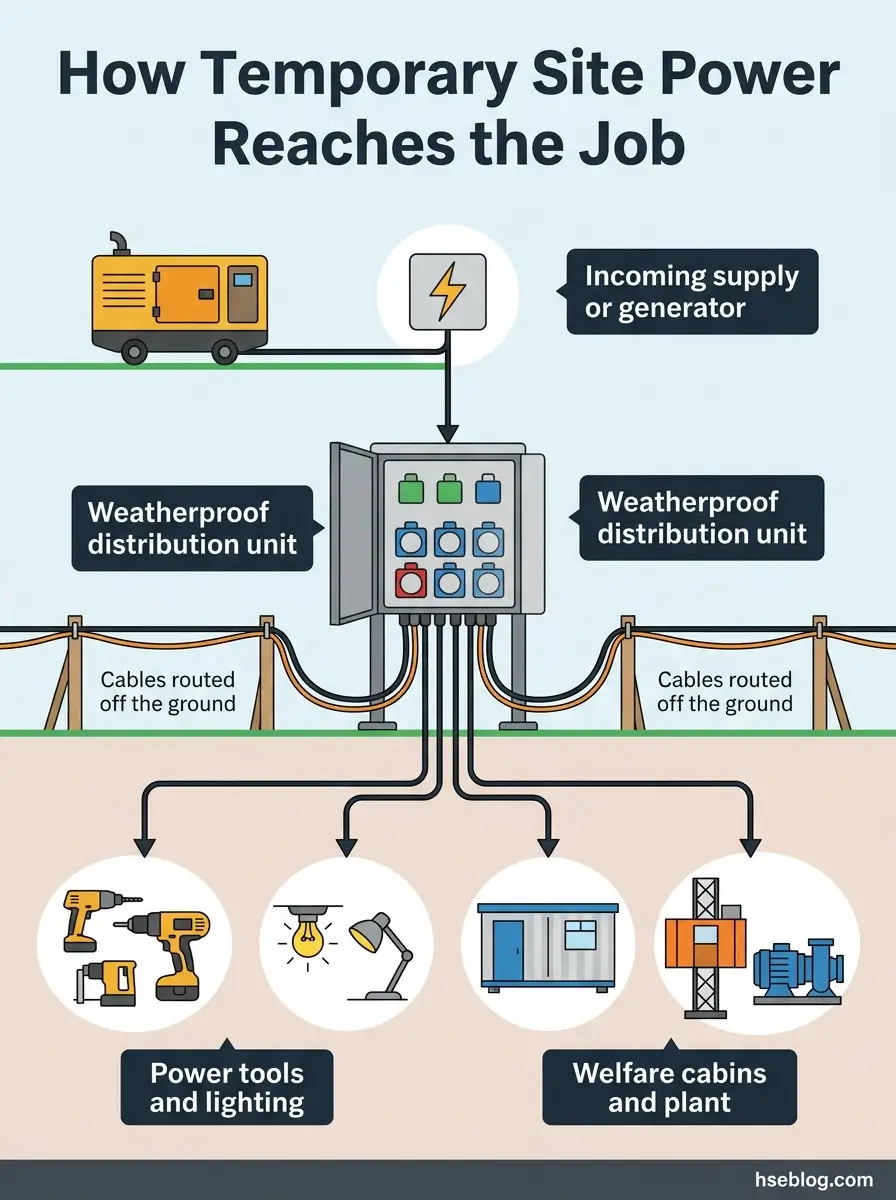
A temporary electrical installation is the power and lighting provided to enable building works, separate from the structure's permanent wiring. It exists because the job has to run before the finished supply does — and it comes down when the work is complete.
The defining feature is exposure. These systems live in the open, get moved as the build progresses, and absorb daily physical punishment that a fixed installation behind plasterboard never sees.
Typical loads on a live site include:
- Portable power tools — drills, saws, breakers, grinders drawing current through trailing leads.
- Task and area lighting — festoon strings, floodlights, and enclosure lighting in dark or below-ground spaces.
- Welfare and site accommodation — offices, drying rooms, canteens and toilets.
- Plant and lifting equipment — tower cranes, hoists, pumps, and powered access.
The regulatory definition of "construction" also decides which rules bite. OSHA's construction scope under 29 CFR 1926 reaches alteration and demolition, not just new build — so refurbishment crews running temporary power on construction sites are inside the same legal frame as a greenfield project.
Here's the misconception the rest of this article rebuts: people read "temporary" as permission to drop standards. Makeshift repairs, daisy-chained leads, and distribution boards sitting in mud are the visible symptoms. The harsh, shifting site environment actually demands a more robust installation than a fixed one — the opposite of how "temporary" is often treated.
Why Temporary Site Power Is So Dangerous: The Hazard Profile
Construction sits among the highest-rate industries for electrical death — a US construction electrical-fatality rate of 0.73 per 100,000 workers across 2011–2024, the highest absolute fatality count of any sector (ESFI, 2026). The hazard isn't abstract; it's a function of where and how the work happens.
Three things make a site uniquely lethal compared with a finished building:
- The ground itself. Wet, muddy footing gives current a low-resistance path to earth, raising the severity of any shock-to-earth contact.
- Constant mechanical damage. Cables get crushed by plant, tool bodies crack, and insulation fails where it's least visible.
- Multi-employer chaos. Several contractors each bring their own equipment, and no single party owns the whole installation.
The pattern in the published fatality record is the part that should reshape who gets trained. Electrical deaths fall hardest on workers who don't see themselves as electrically exposed — and the data backs it, with 70% of US electrical fatalities striking non-electrical occupations (ESFI, 2026). Inductions and toolbox talks aimed only at electricians miss most of the people actually dying.
One caution on the injury numbers: the 5,180 non-fatal electrical injuries with days away from work recorded for 2023–2024 represent a 59% rise on the prior biennium (BLS, 2026), but a jump that large warrants measured reading — reporting and measurement shifts can move biennial figures as much as real-world change does.
The US Regulatory Framework: OSHA and the NEC
US compliance rests on two interlocking documents: OSHA 29 CFR 1926 Subpart K is the legal duty, and the NFPA 70 National Electrical Code (Article 590) supplies the technical detail. One sets what you must achieve; the other sets how.
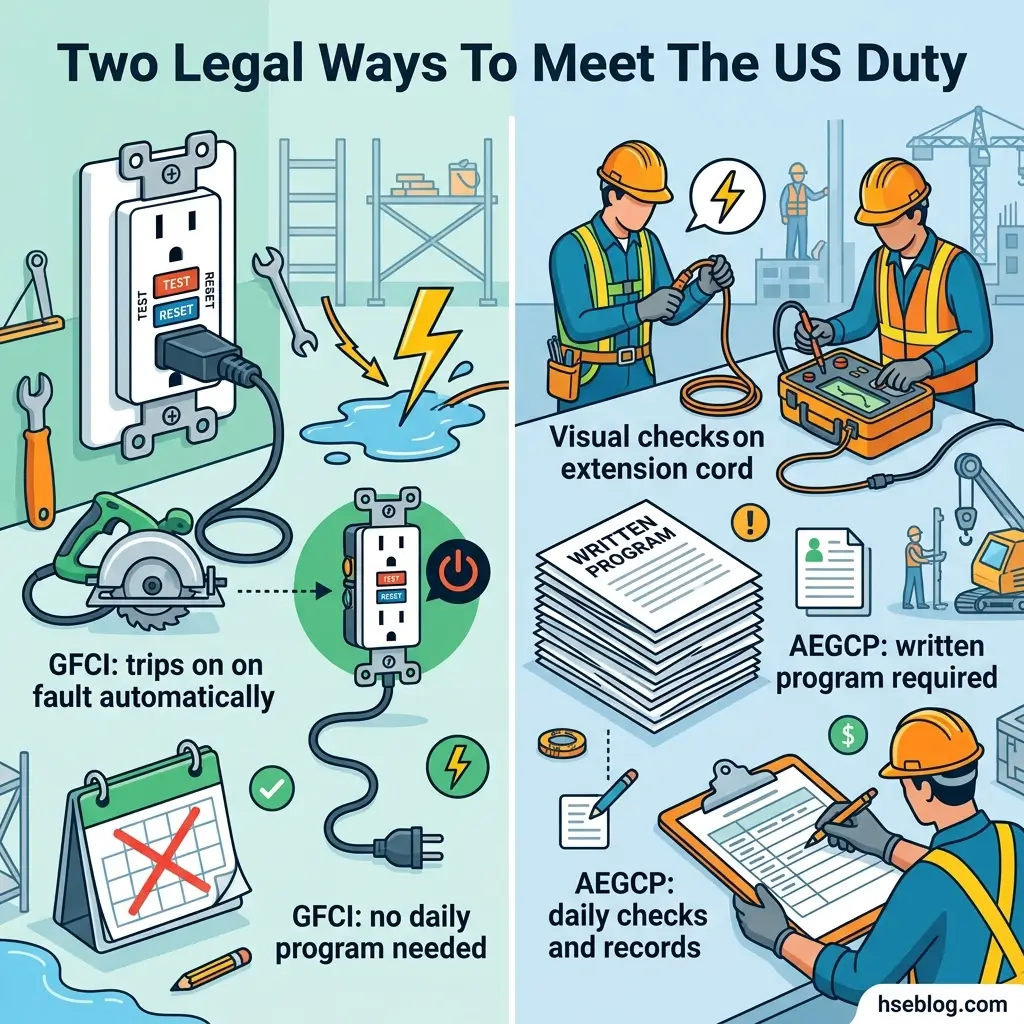
The heart of the US duty is a choice, not a stack of requirements. Under OSHA 1926.404(b)(1), the employer must provide ground-fault protection by either GFCIs on all 120V single-phase 15/20A non-permanent receptacles or an Assured Equipment Grounding Conductor Program — one is mandatory, both is not.
The wiring rules in 1926.405 are where citations actually land:
- Conductors must be protected from physical damage.
- Cables fastened at intervals no greater than 10 feet.
- No branch-circuit conductors lying on the floor.
- Temporary lights not suspended by their cords.
NEC Article 590 adds the equipment-level provisions, including 590.6 GFCI-for-personnel rules. Portable lighting used in wet or conductive enclosures — drums, tanks, vessels — must operate at 12V or less unless GFCI-protected, a clause that catches confined-space lighting more than open-air work.
Legal disclaimer: Regulatory content here reflects general HSE professional understanding of US and UK requirements as of 2026. It is not legal advice. Specific compliance questions, enforcement situations, or prosecution risk should be directed to qualified legal counsel in the applicable jurisdiction. NFPA 70 runs on a three-year cycle — the 2023 edition is current and a 2026 edition is imminent, so verify the edition adopted by the local Authority Having Jurisdiction.
GFCI vs the Assured Equipment Grounding Conductor Program (AEGCP)
For most sites, GFCI wins on simplicity alone. The AEGCP is a legitimate alternative, but it's administratively heavy: a written program, daily visual inspection before use, continuity and terminal-connection tests, and recorded results for every cord and tool.
The judgment call is straightforward in practice. GFCI protection trips on the fault and needs no daily paperwork trail, which is why it has become the default; AEGCP earns its place only on rare sites where GFCI nuisance-tripping genuinely disrupts critical equipment — and even then, someone has to own the records, which is where AEGCP usually collapses.
The UK Regulatory Framework: HSE, EAWR and BS 7671
UK practice answers the same hazard with a different instinct: rather than relying mainly on a device to detect and disconnect a fault, it designs the danger down at source. The current consolidated guidance is HSG141, Electrical Safety on Construction Sites, whose 2nd edition (April 2023) is the first major revision since 1995.
Three pieces of law sit behind it:
- Electricity at Work Regulations 1989 (EAWR) — systems must be constructed, maintained and used to prevent danger, and worked on by competent persons.
- CDM 2015 — design and management duties across the project lifecycle.
- PUWER 1998 — duties covering the work equipment itself.
The technical detail lives in BS 7671 Section 704 (construction and demolition installations), supported by BS 7375 (distribution on sites) and BS 4363 (site distribution assemblies).
One point most US-focused guides — and many thin UK ones — leave out: PME (TN-C-S) supplies generally must not be used to supply a construction installation, because the bonding requirements are difficult to satisfy reliably on a changeable site. That prohibition pushes UK sites toward TN-S or generator-derived supplies.
Reduced Low Voltage: Why UK Sites Run Tools at 110V
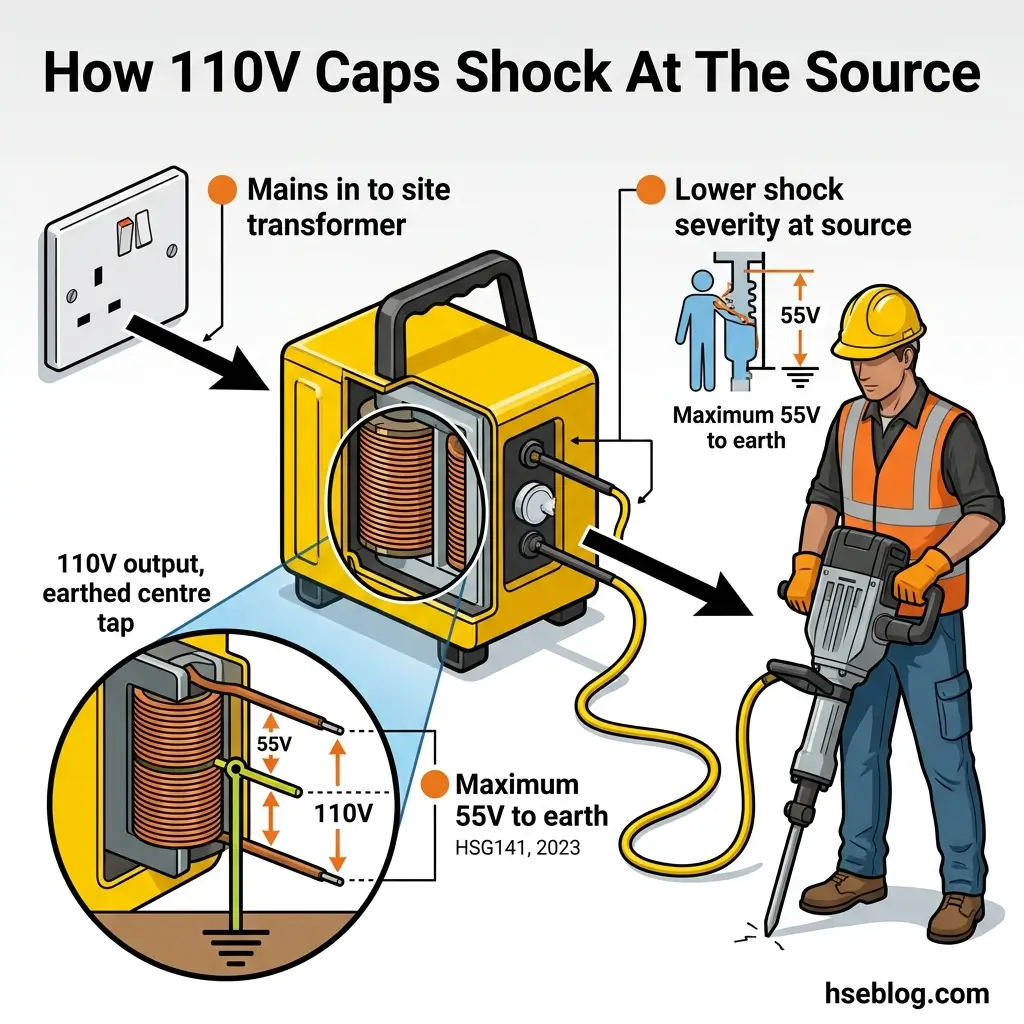
The yellow plug and the yellow transformer are the visible signature of the UK approach. Portable tools run on a 110V centre-tapped-to-earth (CTE) supply, where the winding's midpoint is earthed so the maximum voltage to earth is 55V rather than 230V (HSG141, 2023).
The mechanism is the whole point. Halving the voltage-to-earth roughly halves the current that would flow through a body in a fault — so the consequence of contact is reduced before any protective device even has to act. RCDs still feature as supplementary protection, but they're the backup, not the front line.
US vs UK Approaches Compared: Two Philosophies for the Same Hazard
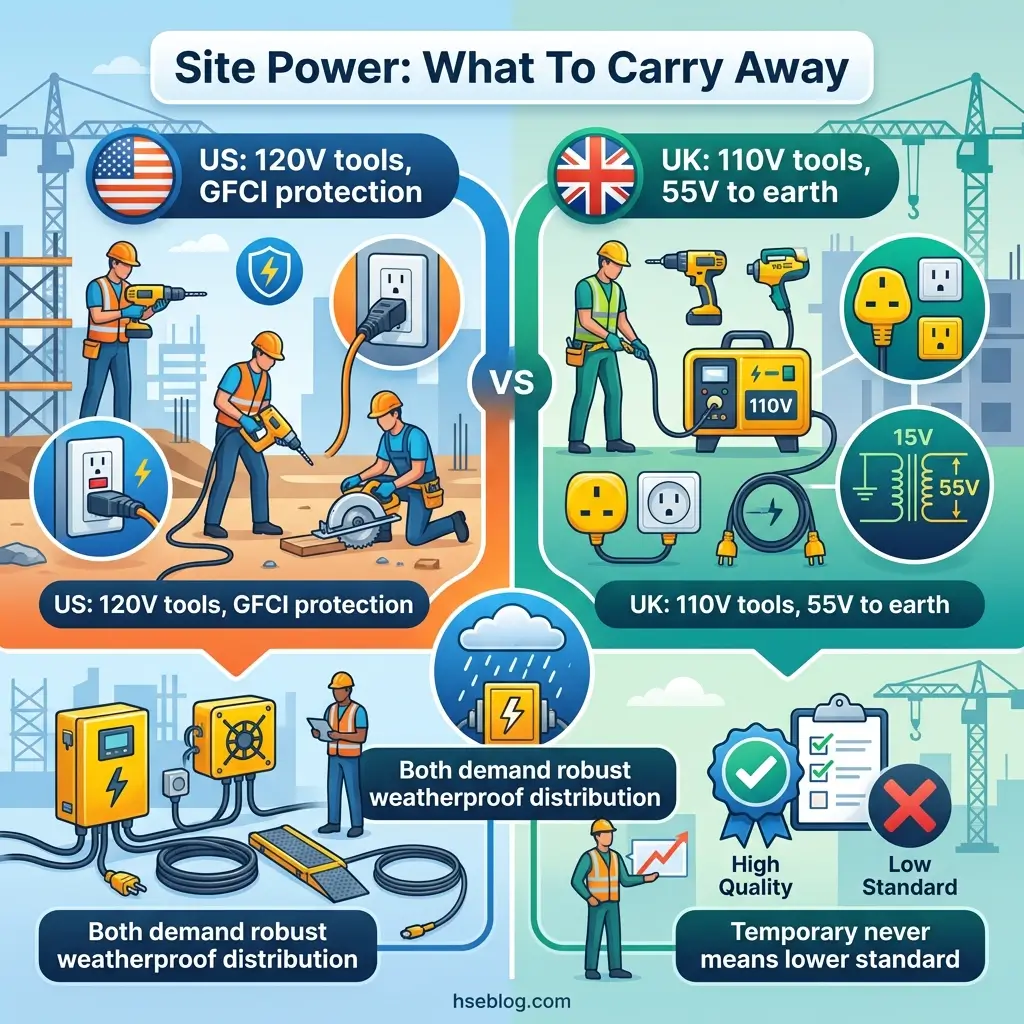
Neither regime is wrong — they're two different control strategies aimed at the same death. The US model is detect-and-disconnect: keep the tool at 120V and rely on a fast device to catch the fault. The UK model is reduce-the-source: cut the voltage to earth so the fault is less dangerous in the first place.
| Factor | United States | United Kingdom |
|---|---|---|
| Core philosophy | Device-based detection | Source-voltage reduction |
| Typical portable tool voltage | 120V | 110V centre-tapped-to-earth |
| Primary personnel protection | GFCI or AEGCP | 55V max to earth (CTE) |
| Residual-current backup | GFCI is the front line | RCD as supplementary (30mA additional protection) |
| Governing rules | OSHA 1926.404 / .405, NEC Article 590 | EAWR 1989, BS 7671 §704, HSG141 |
A note on the trip figures, since they're often confused: a UK RCD for additional protection operates at 30mA, while a US Class A GFCI trips at around 6mA — functionally related residual-current devices, but specified to different thresholds under different standards and not interchangeable on a spec sheet.
Where the two converge matters as much as where they differ. Both demand robust, weatherproof, mechanically protected distribution and competent oversight — the voltage philosophy doesn't excuse a board sitting in a puddle.
The applied judgement worth carrying: the hierarchy of control favours the UK's logic. Reducing the hazard at source ranks above relying on a protective device, so source-voltage reduction is the inherently stronger control even on a site where local law only mandates the device-based approach. The traveller's trap is assuming one transfers — a US 120V GFCI setup does not satisfy UK expectations, and 110V CTE kit is genuinely uncommon across US sites.
Designing and Distributing Temporary Site Power Safely
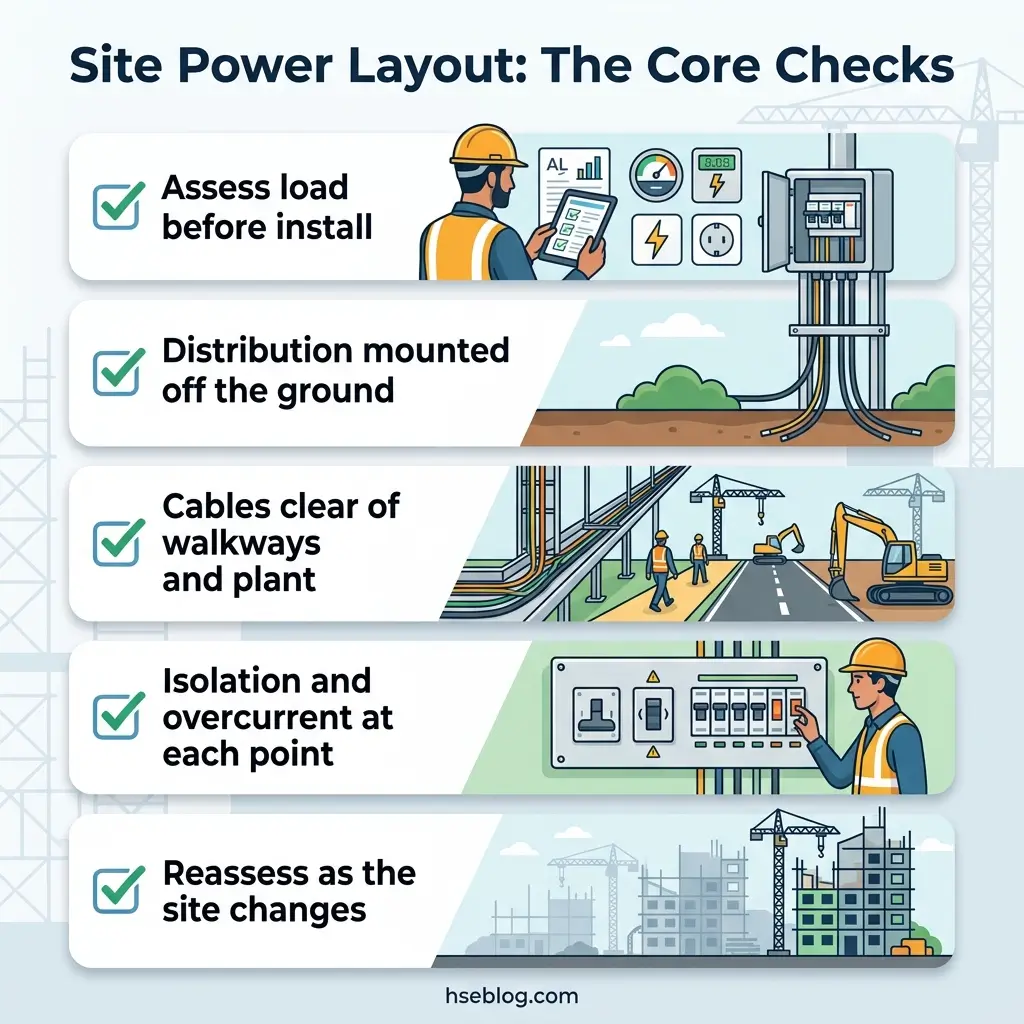
A compliant layout starts before anything is energised: assess the load, then plan the distribution around how the site will change shape. The single most common design failure is treating the first-day layout as permanent.
Practical principles that hold in both regimes:
- Assess load before install. Size the supply and distribution to the real demand to avoid overload as plant and tools multiply.
- Mount distribution off the ground. Boards and units raised clear of standing water resist ingress; enclosures carry an appropriate IP rating for the exposure.
- Route cables out of harm's way. Off walkways, protected at vehicle crossings, suspended or armoured where physical damage is likely.
- Build in isolation and overcurrent protection at each distribution point, so a fault on one circuit doesn't strand the whole site.
The failure mode I see repeated across the published record is set-and-forget. A layout designed for groundbreaking is rarely revisited, so distribution that was safe in month one ends up buried under spoil, overloaded by added cabins, or turned into a trip hazard by month six. Dynamic reassessment as the site evolves — not a one-time design — is what separates a compliant installation from a paper-compliant one.
Inspection, Testing and Maintenance Over the Installation's Life
The duty doesn't end at energisation — it runs for the life of the installation, and it's where competitors treat the subject as an afterthought. Three layers of checking keep a temporary system safe across a multi-month build.
- Daily pre-use visual checks. Users examine cords, plugs and tool bodies before each use — the duty that AEGCP formalises in the US and PUWER drives in the UK.
- Periodic formal inspection and testing. Intervals are risk-based, and construction tools sit at the high-frequency end because they take the most abuse; portable appliance testing (PAT) cadence reflects that.
- Documented records. The paperwork is the evidence trail regulators expect, and it's what proves a check actually happened.
Defective or damaged equipment comes out of service until repaired — no exceptions, regardless of how busy the programme is.
Here's where inspection regimes actually fail, and it isn't the testing. On shared sites, no single party owns the records across multiple contractors, so the tests get done but the trail fragments. Enforcement most often finds the paperwork gap, not the technical one — which means assigning record ownership is as important as scheduling the tests.
Roles, Competence and Who Is Responsible
"Temporary" never removes the duty to use competent people. Both regimes define a competent person as someone with the technical knowledge and experience to recognise the hazard and take corrective action — OSHA's competent-person standard and the UK's competence requirement under EAWR converge on that substance.
The complication is the shared site, where duties blur across employers:
- The principal contractor or host employer carries duties for the site as a whole, including the common installation everyone draws from.
- Each employer remains responsible for the safety of their own equipment and tools.
- Shared receptacles raise the practical question of who provides the ground-fault protection — a gap that must be resolved in writing, not assumed away.
Site induction has to cover the site-specific electrical risks and controls — what the supply is, what protection is in place, and where the hazards sit. A generic electrical safety briefing that ignores this particular site's distribution does little for the labourer plugging into it.
Overhead Power Lines and Buried Cables: The Hazards Beyond the Installation
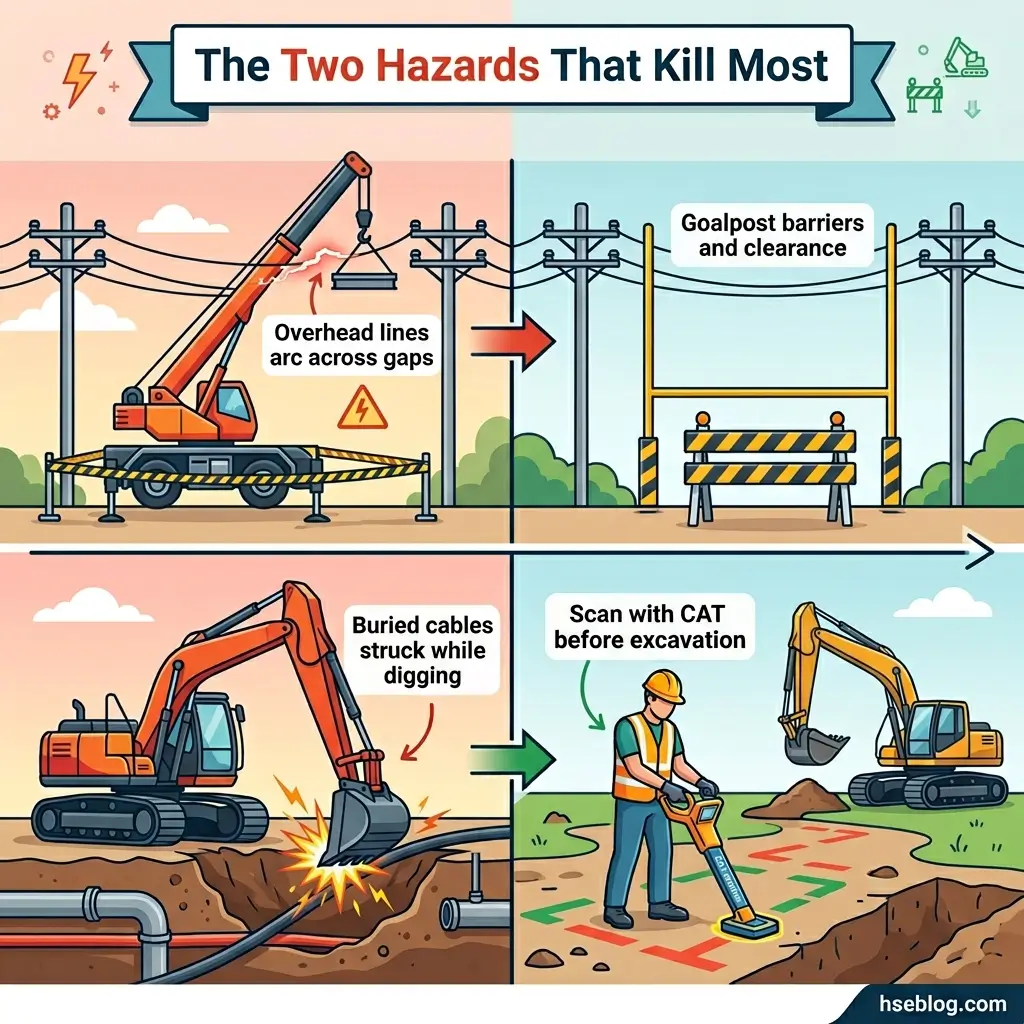
The two deadliest electrical hazards on site aren't strictly inside the temporary installation at all — and one of them dominates the fatality data, with overhead power line contact causing 49% of US workplace electrical fatalities (ESFI, 2026). Any honest treatment of site electrical safety has to address them.
Overhead power lines
- Arcing without contact. Current can jump an air gap to a crane jib, scaffold tube or ladder — you don't have to touch the line to be killed by it.
- Physical barriers and clearance. Goalpost barriers and defined clearance distances keep plant and people outside the danger zone; UK GS6 guidance sets out the approach.
- Visibility is no defence. These lines are usually in plain sight, yet they still dominate the deaths — which says the failure is in planning and exclusion, not perception.
Buried cables
- Locate before you dig. Cable avoidance tools (CAT) and signal generators are used before excavation begins, not after a strike.
- Don't trust the drawings. As-built records are routinely incomplete or wrong, so detection equipment governs, not paperwork.
Frequently Asked Questions
How long can a temporary electrical installation stay on a construction site?
For the duration of the construction work. The widely repeated "90-day limit" is a misreading — under the NEC, that 90-day cap applies to decorative and holiday-type temporary lighting, not construction-period power, which stays for the build and must be removed promptly on completion. UK practice is governed by the ongoing EAWR maintenance duty rather than a fixed clock, and local Authorities Having Jurisdiction can vary the detail.
Do generators on construction sites need GFCI protection?
Usually, but there's a narrow exemption. OSHA exempts receptacles on a two-wire, single-phase portable or vehicle-mounted generator rated 5kW or less where the circuit conductors are insulated from the generator frame and all grounded surfaces. Most other generator configurations — anything feeding general site distribution — still require GFCI or AEGCP protection under 1926.404(b)(1).
Why do UK construction sites use 110V instead of 230V?
To reduce shock severity at source. A 110V centre-tapped-to-earth supply caps the maximum voltage to earth at 55V rather than 230V, so a fault delivers far less energy through the body (HSG141, 2023). It's the HSE-recommended approach for portable site tools, and it's a UK and Commonwealth convention not mirrored in standard US practice.
Can ordinary domestic extension leads be used on a construction site?
No. Domestic leads and RCD adaptors aren't rated for site conditions — the moisture, crushing and constant flexing a build subjects them to. Purpose-built site distribution with proper IP-rated enclosures and protection is required, and daisy-chaining domestic leads multiplies the risk by stacking weak connections and untested protection in series.
Who is responsible for electrical safety when several contractors share a site?
Responsibility is layered, not single. The principal contractor or host employer holds duties for the common installation and the site as a whole, while each employer remains responsible for their own tools and equipment. For shared receptacles, the question of who provides ground-fault protection must be resolved explicitly in advance, since OSHA expects that protection to be provided regardless of which contractor plugs in.
What's the difference between an RCD and a GFCI?
They're functionally related residual-current devices with different names and specifications. The UK RCD for additional protection trips at 30mA under BS 7671, while the US Class A GFCI trips at around 6mA under the NEC. They protect against the same kind of earth-fault, but they're set to different thresholds by different standards and aren't interchangeable in specification terms.
Conclusion
The mistake that runs through nearly every serious site electrical incident is the same one this article opened against: reading "temporary" as a licence to relax. The harsh, shifting, waterlogged reality of a construction site asks for a more disciplined installation than a finished building ever needs — and the fatality data, weighted toward the labourers and plant operators who never see themselves as electrically exposed, shows what happens when that's forgotten.
If there's one change worth making, it's this: where you have a choice, control the hazard at source rather than trusting a device to catch it. The UK's 110V logic and the US's GFCI logic both keep people alive, but the hierarchy of control puts source-voltage reduction higher — so a contractor operating across both regimes should treat reduced low voltage as the stronger option, not merely the one the local rulebook happens to mandate.
Whichever framework governs your site, the test of a temporary electrical installation on a construction site is simple to state and hard to fake: is it still as safe in month six as it was on day one, and can you prove it? Get the ownership of inspection records and dynamic reassessment right, and most of the rest follows.