
TL;DR
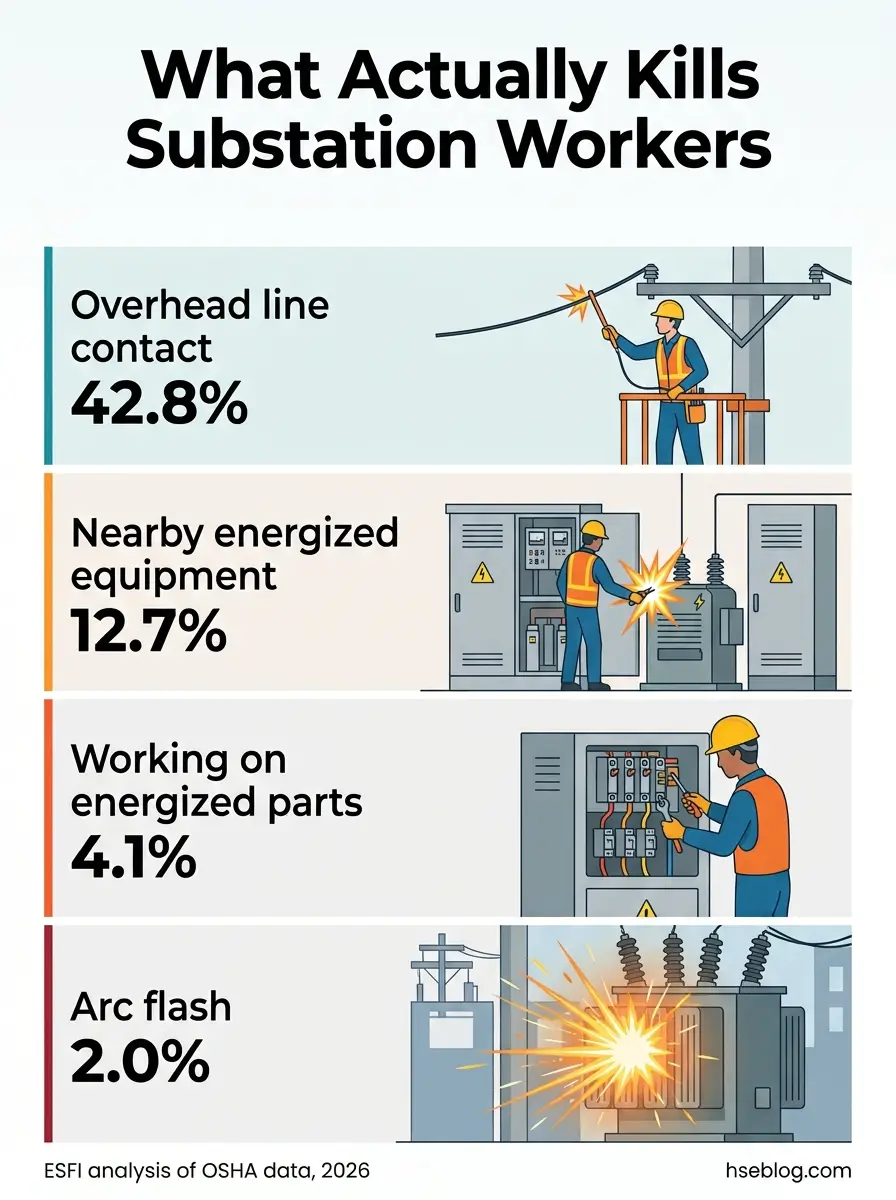
- Myth: Arc flash is the main way substations kill. Reality: contact with and proximity to energized parts cause far more electrical deaths; arc flash is a small share of fatalities but produces catastrophic, life-altering burns (ESFI, 2026).
- Myth: Being allowed inside a substation means being allowed to work on it. Reality: entry authorization and work authorization are separate competencies with very different training bars.
- Myth: One OSHA rule covers every substation. Reality: utility substations sit under 29 CFR 1910.269; facility substations sit under Subpart S and NFPA 70E.
- Myth: PPE is the primary protection. Reality: de-energization is the goal; PPE is the last layer, used only when a circuit cannot be proven dead.
Substation safety rests on controlling three linked electrical hazards: shock from contact with energized parts, arc flash from a fault’s thermal and pressure energy, and unauthorized or under-qualified access. Managing them means de-energizing wherever feasible, enforcing shock and arc-flash boundaries with correct PPE, and gating entry by verified competence — under OSHA, NFPA 70E, or the UK’s Electricity at Work Regulations 1989.
Between 2011 and 2024, 1,654 workers died from electrical contact in US workplaces, and electric power distribution ranks among the six industries responsible for nearly half of all such deaths (ESFI analysis of OSHA data, 2026). Arc flash — the hazard most substation crews name first — accounts for just 2.0% of those fatalities.
That gap between fear and data matters, because it shapes where crews spend their attention. Substation safety holds together only when shock, arc flash, and access control are treated as three distinct problems, each with its own mechanism, its own governing standard, and its own way of going wrong.
Why Substation Safety Follows Two Different Rulebooks
The first question on any substation is not “what PPE?” — it is “who owns this, and which regulation governs the work?” That answer decides everything downstream.
In the United States, two OSHA regimes split the field. Utility substations that generate, transmit, or distribute power for the grid fall under 29 CFR 1910.269 and, for construction, 1926 Subpart V. Facility substations — the ones stepping voltage down inside a plant, campus, or data center — fall under 29 CFR 1910 Subpart S, with NFPA 70E as the recognized method for complying with it.
| Question | Utility substation | Facility / industrial substation |
|---|---|---|
| Primary US work-practice rule | 29 CFR 1910.269; 1926 Subpart V | 29 CFR 1910 Subpart S (1910.331–.335) |
| Consensus safety standard | Utility practice; NESC (IEEE C2) | NFPA 70E (2024 edition) |
| Arc-flash method referenced | IEEE Std 1584b-2011 (1910.269 App E) | IEEE Std 1584-2018 |
| OSHA’s Nov 2024 arc-flash guidance applies? | No | Yes |
The distinction is not academic. When OSHA released its November 2024 arc-flash guidance, it applied to NFPA 70E workplaces — and explicitly did not change the separate rules governing utility transmission and distribution work under 1910.269.
A note on legal weight: NFPA 70E is not itself law. OSHA has never adopted it by reference, but treats it as the industry-recognized way to satisfy Subpart S and the General Duty Clause. A facility that ignores 70E and injures someone will still find it cited in the enforcement file.
The UK takes a different path entirely. The Electricity at Work Regulations 1989 apply to any substation regardless of who owns it, and rather than handing you tables, they set an outcome: justify any live work, isolate safely, and prove the system of work is safe.
Electric Shock: The Substation Hazard That Kills Most Often
Of the 1,654 US workplace electrical deaths recorded from 2011 to 2024, the large majority came from shock mechanisms — overhead line contact, contact with nearby energized equipment, and working on energized parts — not from arc flash (ESFI, 2026). In a substation, that means the exposed three-phase bus and energized switchgear remain the deadliest features in the yard.
This article provides general HSE knowledge. Life-critical work such as substation switching, isolation, or energized work must be planned and supervised by a competent person with relevant training, jurisdiction-specific authorization, and site-specific risk assessment. The information here does not replace that.
Shock in a substation arrives through more than one path, and each demands a different control.
Direct contact and approach boundaries
Touching an energized conductor is the obvious mechanism, but the boundaries exist to keep people back long before contact. NFPA 70E defines two shock protection boundaries for facility work:
- Limited approach boundary — the distance an unqualified person may not cross without a qualified escort and awareness of the hazard.
- Restricted approach boundary — the closer distance only a qualified person may enter, and only with a documented plan and correct insulating PPE.
For utility work, 1910.269 instead uses minimum approach distances (MAD), calculated from system voltage and other factors. Where the utility MAD figure and a facility boundary differ for comparable exposure, govern by the larger, more protective distance.
Step and touch potential
Shock does not require touching a conductor at all. During a ground fault, current flowing into the earth grid raises the voltage of the ground itself, so a person standing in the yard can take a lethal potential difference between two feet (step) or between a hand and the feet (touch).
The engineering answer is IEEE Std 80, the guide for AC substation grounding, which sizes the ground grid and specifies crushed-rock surfacing to hold these voltages within tolerable limits. This is why substations are floored in gravel rather than soil or concrete — it is a shock control, not landscaping.
Isolation as the real defense
The most reliable protection against shock is removing the energy and proving it gone. UK guidance HSG85 frames this as the core duty under the 1989 Regulations: isolate, secure, and verify before anyone works.
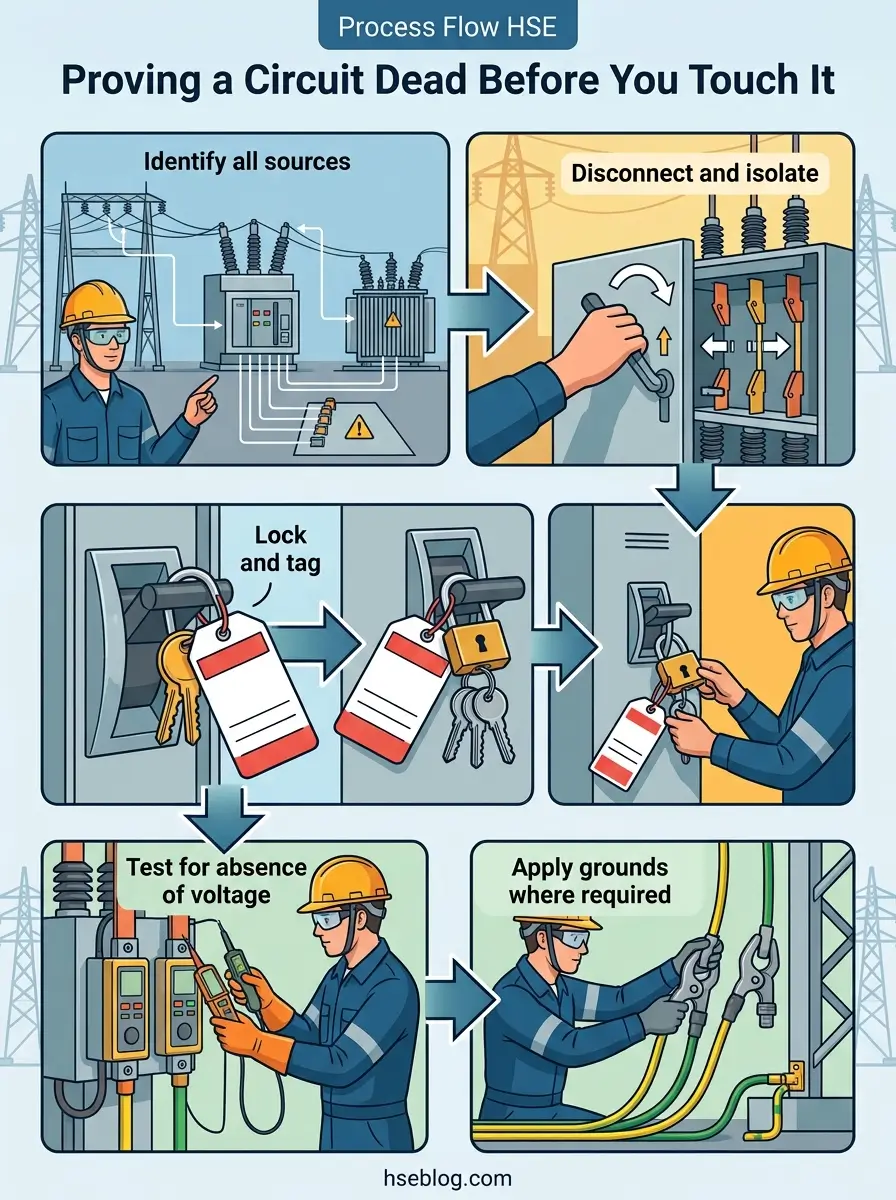
A point that trips crews repeatedly: under OSHA 1910.333(b), a circuit that has been switched off but not yet locked, tagged, and tested still counts as energized. “Off” is a claim; “verified dead” is a fact. Only the second one protects the person doing the work.
Arc Flash: How Energy Injures Without Any Contact
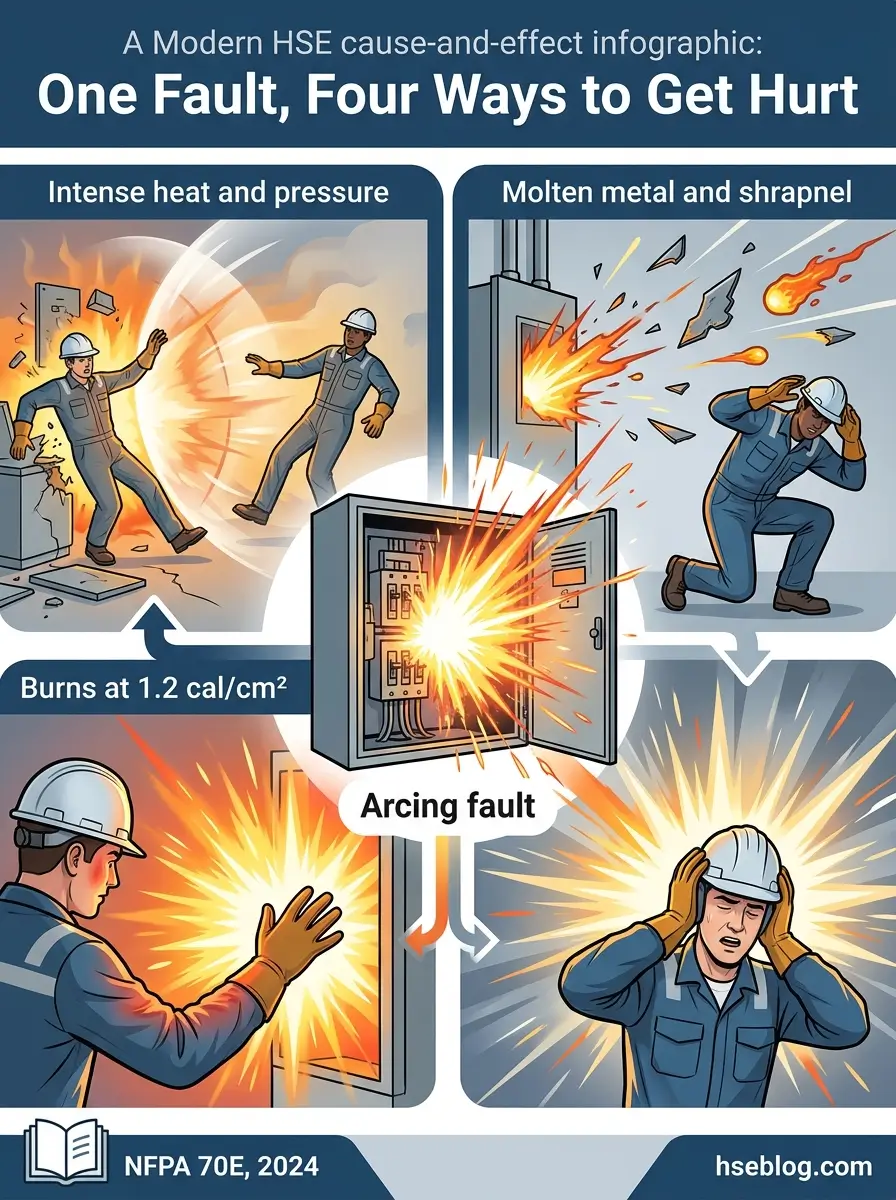
An arc flash needs no contact to maim. When a fault jumps across an air gap, it releases a burst of thermal energy, a pressure blast wave, molten metal, and intense light and sound — all in a fraction of a second, potentially across the room from where the person stands.
The severity is measured as incident energy in calories per square centimeter. NFPA 70E sets the arc flash boundary at the distance where that energy reaches 1.2 cal/cm² — the level at which unprotected skin is likely to suffer a second-degree burn, based on the Stoll burn-injury curve.
Working out that boundary and the required PPE follows a defined sequence:
- Model the system. Assemble the single-line diagram, fault currents, and protective-device settings for the substation.
- Calculate incident energy. Apply IEEE Std 1584-2018, the OSHA- and NFPA-recognized method built from more than 1,800 laboratory arc tests across 208 V to 15 kV systems (IEEE, 2018).
- Set the boundary and label the gear. Mark equipment with the incident energy and arc-flash boundary; NEC Article 110.16 requires the warning label.
- Select arc-rated PPE by task. Match the arc rating of clothing and equipment to the calculated energy — not to a guess about voltage.
That fourth step is where the November 2024 shift lands. OSHA’s updated arc-flash guidance, its first in nearly two decades, drove home that energized work at 50 V and above carries real arc risk and that low-voltage systems are routinely underestimated — a correction that matters wherever facility switchgear is treated as harmless because “it’s only 480.”
One honest caveat on the data: arc flash sitting at 2.0% of electrical fatalities does not make it a minor hazard. Many arc-flash victims survive with disfiguring burns and years of recovery, so the low death share reflects severity that lands short of fatal, not a low-consequence event.
The strongest arc-flash control is not better PPE at all. Remote racking and remote switching let a worker operate breakers from outside the arc-flash boundary, so if the equipment fails, no one is standing in front of it.
Who Gets Into a Substation — and Who Gets to Work Live?
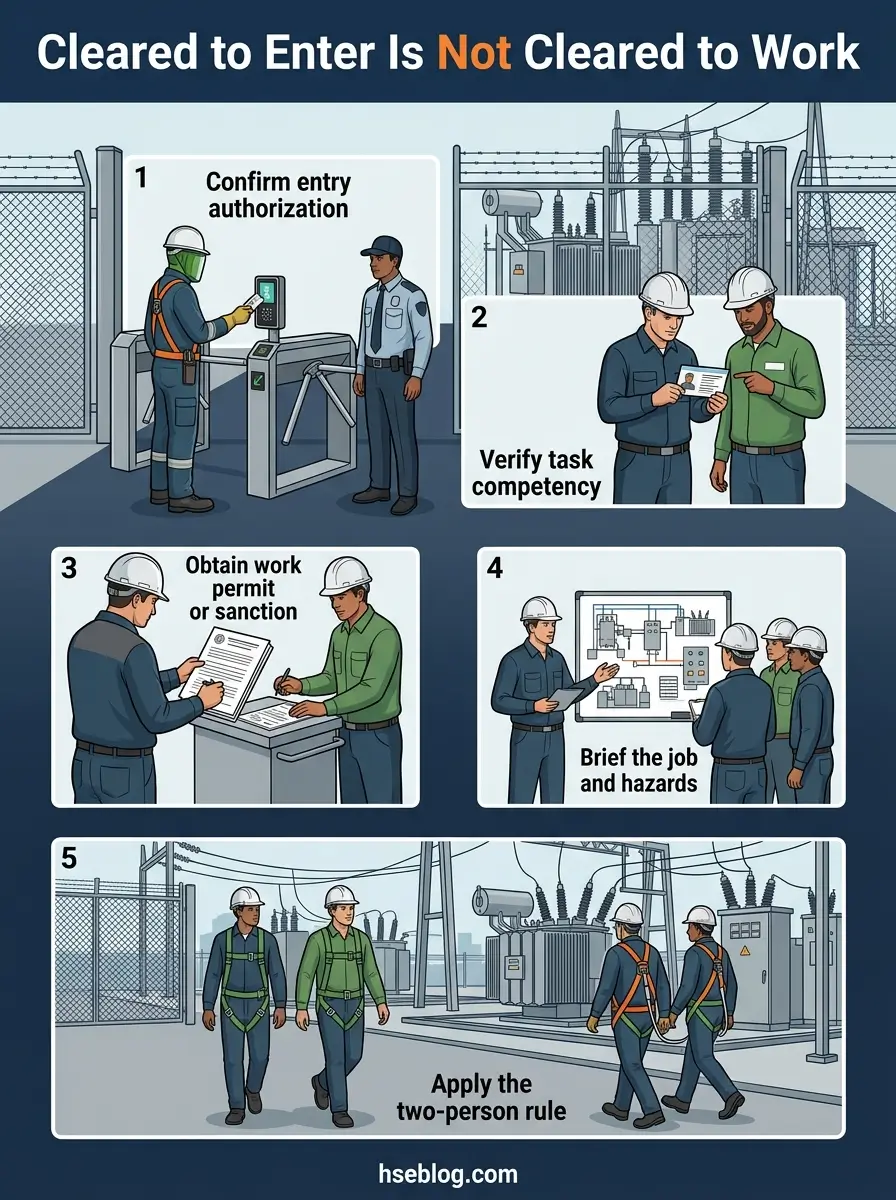
Being waved through the gate is not permission to touch anything. The failure that hurts people is the quiet assumption that access equals authorization — two competencies that sound alike and are worlds apart.
The published record and everyday practice both point to the same confusion:
- Qualified for entry means trained to recognize substation hazards and stay clear of energized parts. A meter reader, surveyor, or general contractor can reasonably hold this.
- Qualified to work on or near energized equipment means a far higher bar of training, demonstrated skill, and specific authorization. The gate never upgrades the first into the second.
The access sequence for a non-qualified entrant
Under 1910.269(u) and 1926.966 in the US, and the Electricity at Work Regulations 1989 in the UK, entry is gated by role, training, and a documented sanction to enter. A defensible sequence looks like this:
- Contact the controlling authority and request access.
- Confirm the reason for entry and the areas that are off-limits.
- Receive a briefing on live parts, boundaries, and escape routes.
- Enter under escort or under an explicit condition of no approach to energized equipment.
Gating live work
Where actual work on or near energized equipment is unavoidable, access controls tighten into a permit or sanction-to-work system, a job briefing, and — for high-risk tasks — a two-person rule. Physical controls back this up: locked perimeters, restricted keys, clear signage, and barriers that keep routine foot traffic outside the approach boundaries.
Layering Controls: De-Energize First, PPE Last
The safest substation task is the one performed dead, and every credible program treats de-energization as the default rather than the fallback. When people reach for PPE as their first line, the plan has already gone wrong.
Applied to substation hazards specifically, the controls stack in this order:
- Eliminate the energy. Establish an electrically safe work condition through isolation, lockout/tagout under 1910.147, and verified absence of voltage. If the work can be done dead, it must be.
- Engineer out the exposure. Use the IEEE Std 80 ground grid, guarding of live parts, remote racking and switching, and physical distance to keep people out of both the shock and arc-flash zones.
- Control it administratively. Apply permits, job briefings, the sensory pre-entry check for signs of arcing, and two-person working for high-risk tasks.
- Protect the person. Insulating gloves and tools for shock, and correctly arc-rated clothing for arc flash, as the final layer when energy remains present.
The judgment call crews face most often is whether to justify live work at all. Both US Subpart S and UK EAWR permit it only when de-energizing would introduce a greater hazard or is genuinely infeasible — and “it’s more convenient” has never met that test.
Regulatory content here reflects general HSE professional understanding of US and UK requirements as of 2026. It is not legal advice. Specific compliance questions, enforcement situations, or prosecution risk should be directed to qualified legal counsel in the applicable jurisdiction. For training, recognized pathways such as NEBOSH, IOSH, or OSHA outreach programs — plus employer-specific authorization schemes — are the route to competence.
Frequently Asked Questions
The Lesson the Numbers Keep Teaching
The pattern behind substation incidents is rarely exotic. It is a crew that focused on arc flash while the shock hazard did the killing, or an entrant who mistook a gate pass for a work authorization, or a breaker operated by hand when a remote racking system sat unused a few feet away.
The single highest-impact change in substation safety is not more gear — it is proving the circuit dead before anyone commits to the work, and defaulting to that on every task that can be done de-energized. Where energy genuinely must stay present, the discipline is knowing which rulebook governs, respecting both the shock and arc-flash boundaries, and letting only the right people, with the right authorization, get close.
Get those in order and the yard stops being a place where a routine job turns fatal — and becomes what it should be: energized, respected, and worked on terms that keep everyone in it alive.