
TL;DR
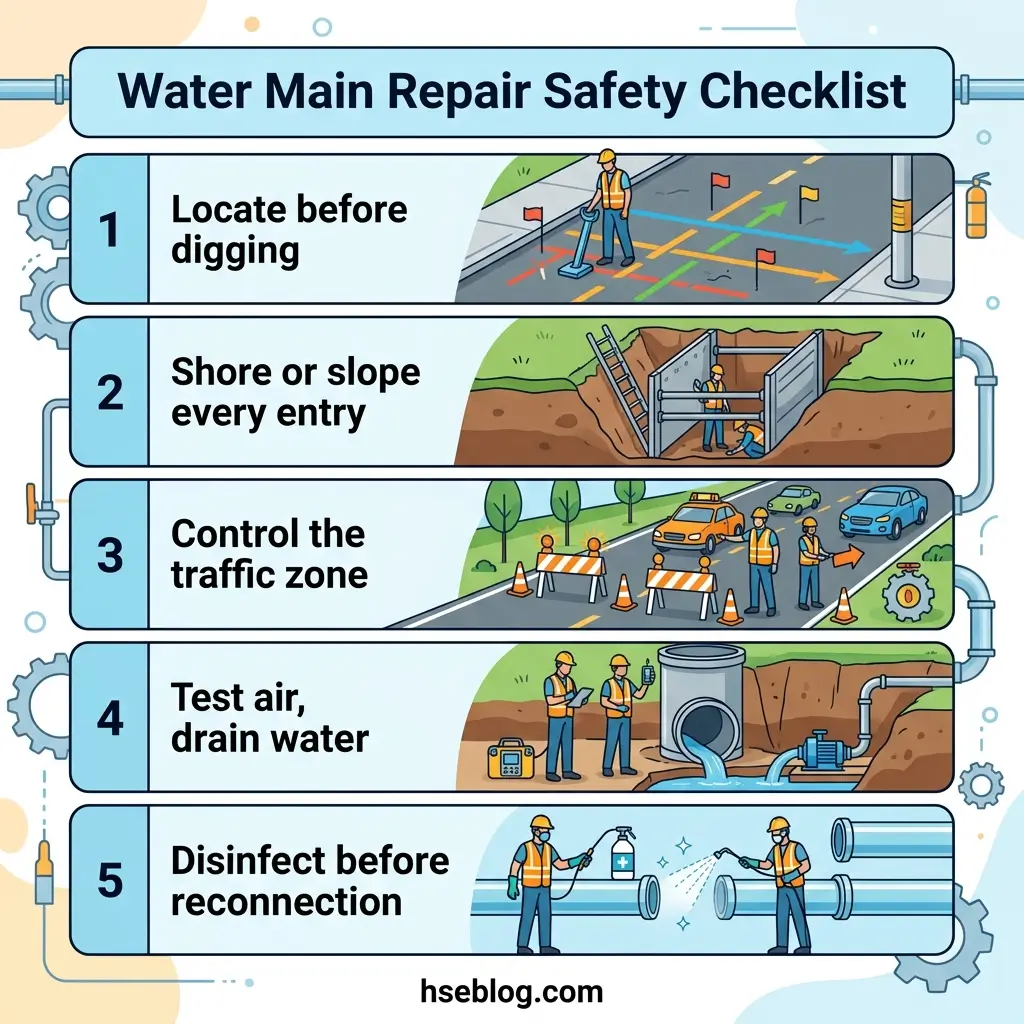
- Water main repair safety starts before the dig. Confirm every buried service through a utility locate; plans alone are never enough.
- Shore or slope every entry. US rules require a protective system at five feet, but disturbed soil around an old main often demands one shallower.
- Build a real work zone. Channelizing devices, buffer space, and high-visibility apparel keep passing traffic from reaching the crew.
- Test the air, drain the water. An adjacent sewer or gas line can leave a flooded trench oxygen-deficient or toxic before anyone notices.
- Disinfect before reconnection. A repaired main must be flushed, disinfected, and cleared of contamination before it goes back into service.
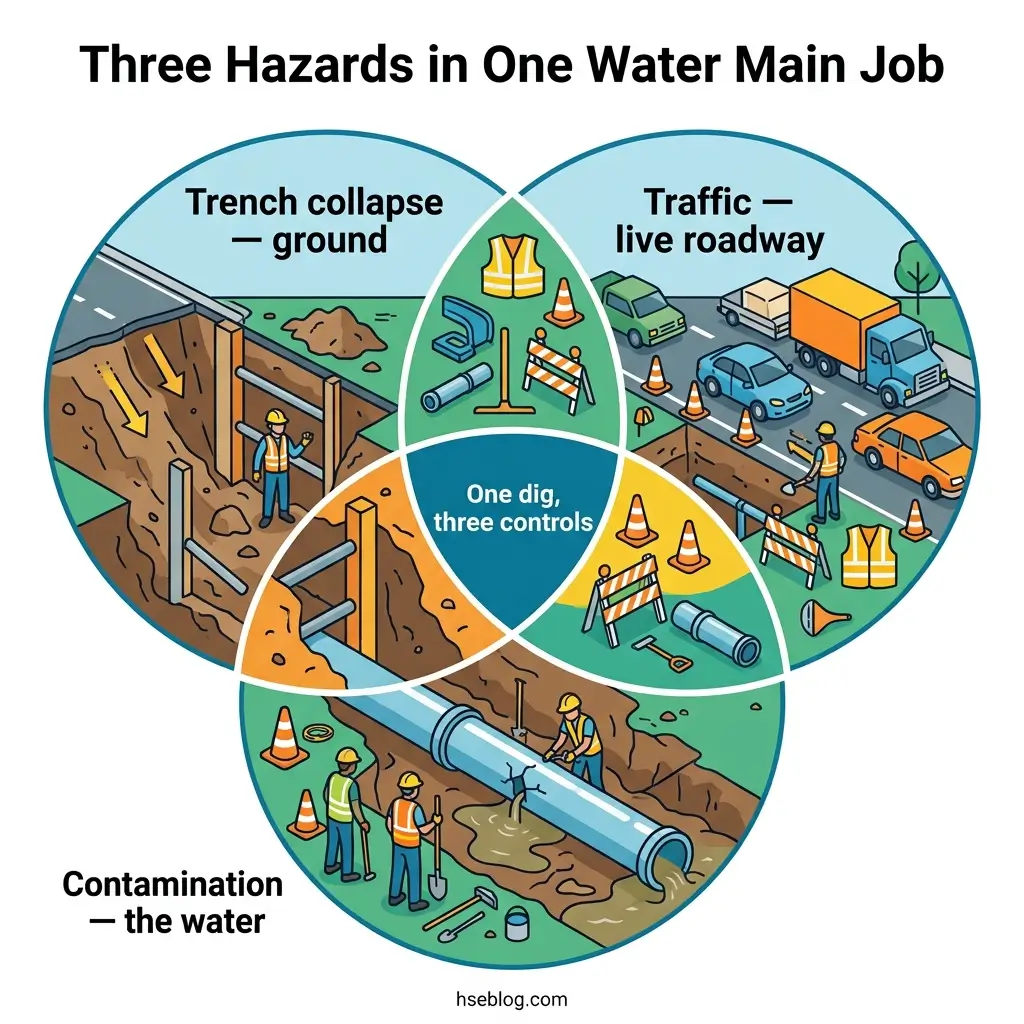
Water main repair safety means controlling three overlapping hazards on one job: trench collapse in disturbed, waterlogged soil; vehicles striking crews in live roadways; and contamination of the drinking-water supply once the main is opened. Each risk needs its own controls, competent supervision, and the specific standards governing excavation, work zones, and water disinfection.
In 2022, 39 workers died in trench collapses across the United States — the deadliest year for excavation work since 2005 (US Department of Labor/OSHA, 2023). A single cubic yard of soil can weigh as much as a car, and a buried worker has minutes, not hours.
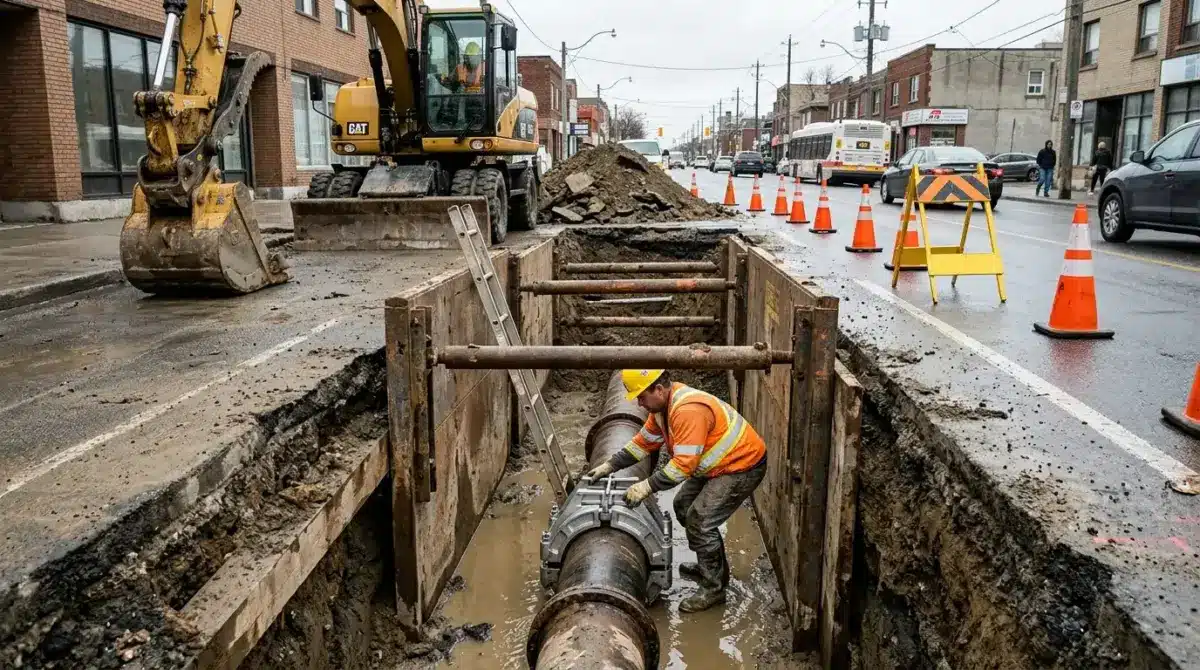
Water main repair puts crews into exactly those trenches, usually in previously disturbed, saturated ground beside a live road, with the added twist that the pipe being fixed carries drinking water. That combination is why water main repair safety has to hold three fronts at once: the ground, the traffic, and the water itself.
Why Water Main Repair Stacks Three Hazards at Once
A water main repair is not one hazard with two footnotes. It is three serious hazards sharing the same hole in the ground, and each one has killed people who treated the job as routine.
What makes this work distinctive is that the controls do not stand alone — a dewatering pump for the trench also protects the pipe from contamination, and a competent person’s soil call also affects how far vehicles can safely sit from the edge.
| Hazard | How it harms | Primary control | Governing framework (US) |
|---|---|---|---|
| Trench collapse | Soil buries or crushes the worker in seconds | Protective system + competent-person inspection | OSHA 29 CFR 1926 Subpart P |
| Traffic intrusion | A vehicle enters the work space and strikes the crew | Temporary traffic control + high-visibility apparel | MUTCD Part 6; 23 CFR 634 |
| Water contamination | Pathogens enter the trench or the potable main | Atmospheric testing, dewatering, disinfection | OSHA 1926.651(g); ANSI/AWWA C651 |
This article provides general HSE knowledge. Life-critical work such as excavation entry and work in occupied roadways must be planned and supervised by a competent person with relevant training, jurisdiction-specific authorization, and a site-specific risk assessment. The information here does not replace that.
Recognized training routes for this work include OSHA excavation and competent-person courses in the US, and NEBOSH or IOSH qualifications for those planning and supervising groundworks elsewhere.
Plan the Job: Locate Buried Services Before You Break Ground
Most water main failures sit in ground already crowded with other buried services, so the first safety task is not digging — it is finding out what else is down there. Striking a gas or electric line during a water repair turns one emergency into two.
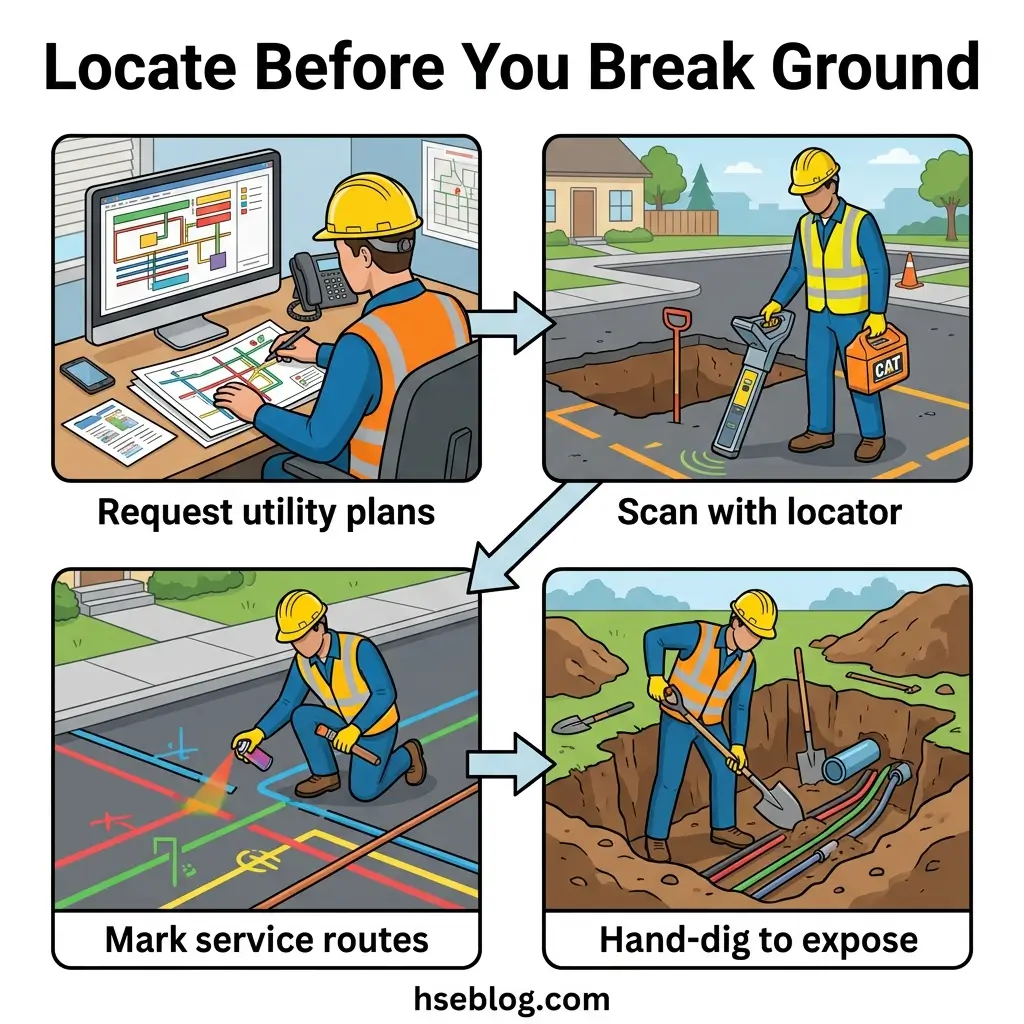
The locating sequence is deliberate, and skipping a step is where strikes happen:
- Request records from every asset owner. Contact each utility — electricity, gas, telecoms, water — and collate the plans into one picture rather than trusting a single source.
- Scan the ground with a locator. Use cable and pipe detection to trace routes on site, because plans can be wrong by a metre or more and some services never appear on any drawing.
- Mark the routes clearly. Paint or peg the located lines so every operator can see them before plant arrives.
- Expose services by hand or vacuum. Dig carefully within the marked zones to confirm depth and position before mechanical excavation goes anywhere near them.
British practice formalizes this in HSE guidance HSG47, which treats safe digging as a three-stage process — plans, then locators such as a CAT and Genny, then careful excavation — every time ground is broken (HSE, current guidance). The principle travels well regardless of which one-call system a country uses.
Trench Collapse: The Deadliest Risk in Water Main Repair
Trench collapse is the deadliest part of water main repair. Even after a sustained national push, OSHA recorded 13 trench-collapse deaths in 2024, down from the 2022 peak of 39 (OSHA, 2025) — and the ground around an old, leaking main is some of the least stable a crew will ever enter.
Why the soil around an old main is worse
The danger here is specific, not generic. A water main was buried once already, and the leak that brought the crew out has been softening the surrounding ground for days.
- Previously disturbed soil is unstable. Backfilled ground never regains the strength of undisturbed earth, which is why OSHA classifies disturbed material as the weaker Type B or Type C soil.
- Water destroys cohesion. A leak saturates the trench walls, and saturated soil slumps far more easily than dry ground.
- The trench keeps filling. OSHA prohibits work where water is accumulating unless it is controlled — typically by pumping monitored by a competent person, plus stronger support.
The protective systems that actually hold
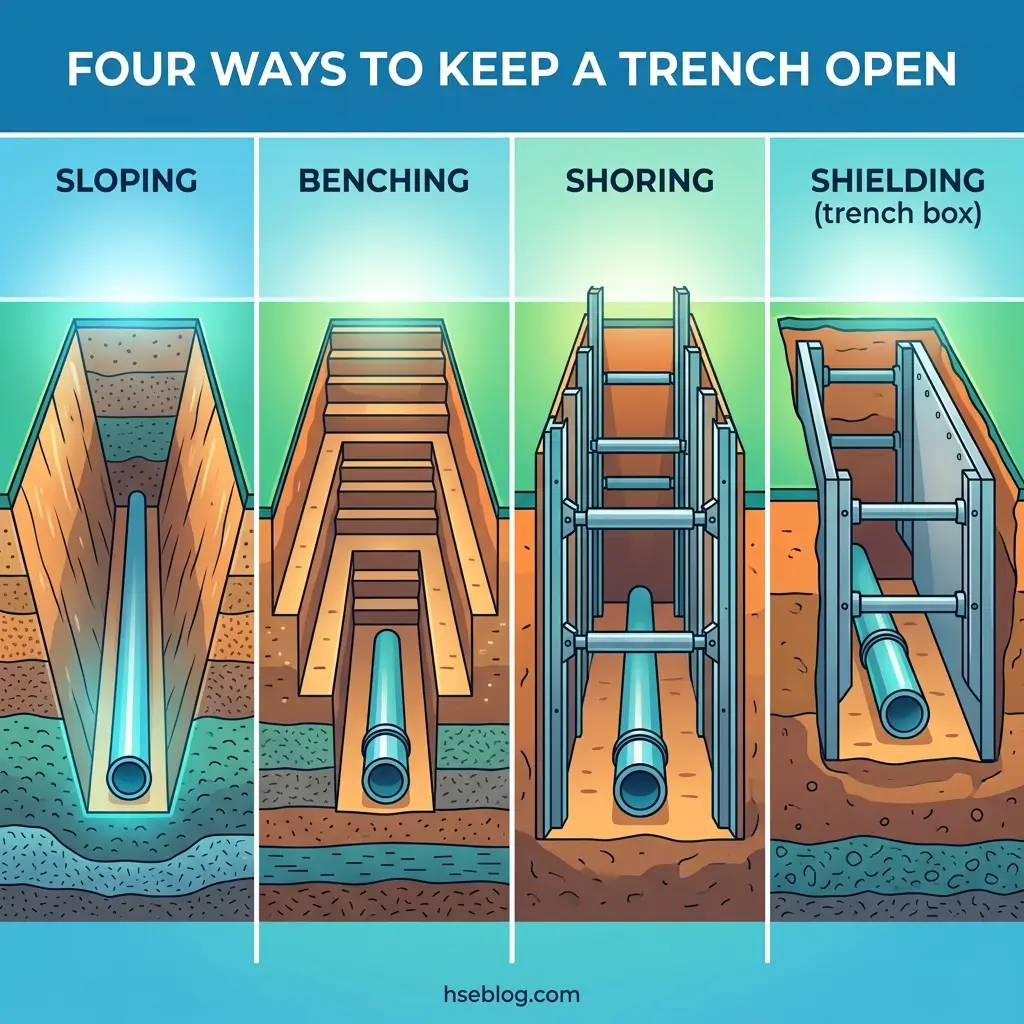
The choice is between four proven methods, and the competent person selects based on soil type, depth, and space:
- Sloping and benching cut the trench walls back to a safe angle so they cannot collapse inward.
- Shoring (hydraulic or timber) braces the walls in place.
- Shielding — the trench box — protects workers inside a rigid enclosure even if the walls move; it is the workhorse of utility work because it moves along the trench with the excavator.
Under OSHA’s excavation standard, 29 CFR 1926.652, a protective system is required for any trench five feet deep or greater unless it is cut entirely in stable rock, and past 20 feet the system must be engineered by a registered professional (US). The spoil pile stays at least two feet back from the edge, and a ladder for egress sits within 25 feet of workers in any trench four feet or deeper.
Britain draws the line differently: HSE guidance (HSG185) expects a risk assessment for every excavation regardless of depth, because people have been killed in trenches barely waist-deep (Great Britain). For shallow water main repairs, that no-threshold approach is the more conservative default.
Working Beside Live Traffic: Work Zones That Protect the Crew
The pattern in roadway work-zone deaths has been shifting, and it matters for how crews set up. A growing share of highway-worker fatalities now comes from a vehicle reaching a worker on foot rather than a crash into equipment (FHWA, work-zone safety data).
An average of 54 on-foot workers are killed by vehicles in US work zones each year (National Safety Council analysis of federal fatality data), and total work-zone fatalities have sat near 890 to 900 annually in the early 2020s before dipping about 6% from 2023 to 2024 (FHWA, 2026).
The controlling document changed recently, too. The FHWA published the 11th Edition of the MUTCD, including Part 6 on temporary traffic control, in December 2023 — its first major update since 2009 — and states had to adopt it or a conforming supplement by January 18, 2026 (FHWA, 2023).
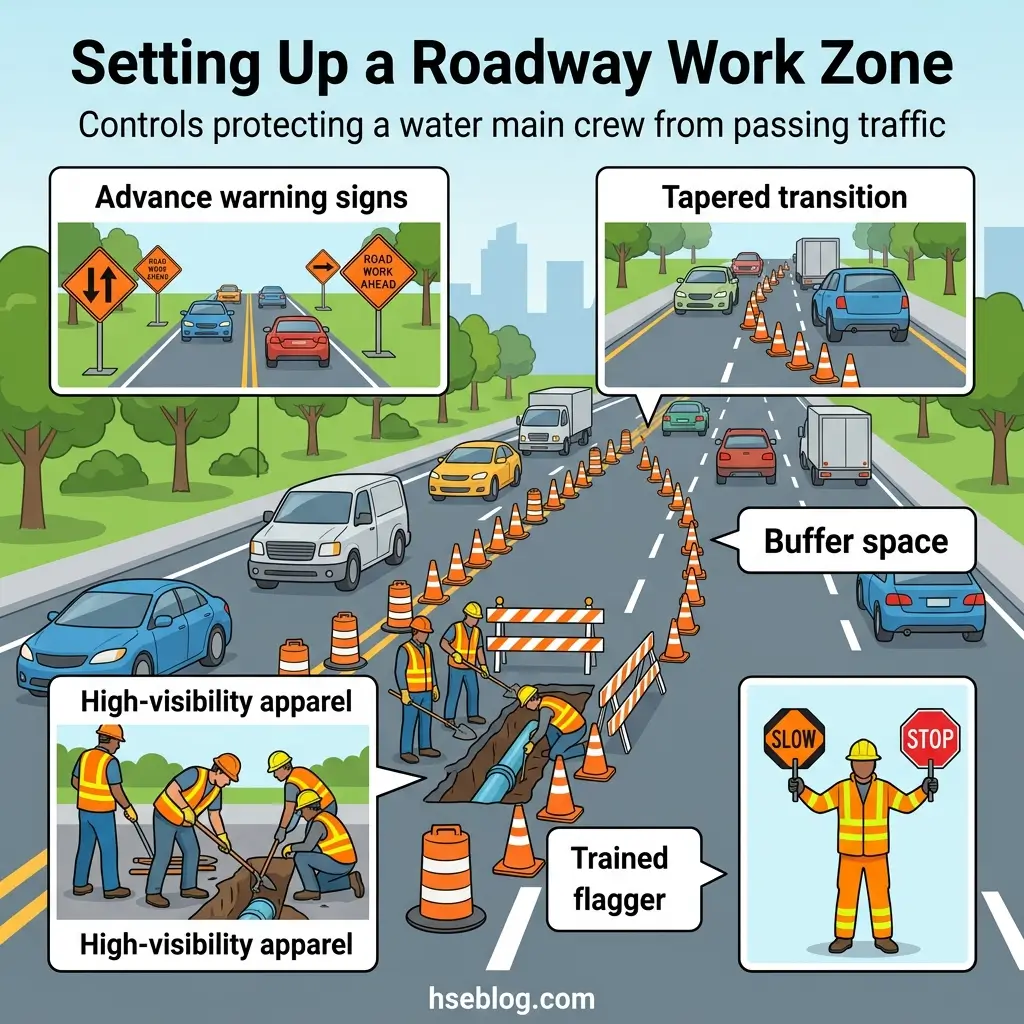
A compliant work zone is built in order, and each element buys the crew distance from traffic:
- Advance warning. Place signs far enough upstream that drivers can read, register, and react before the work area.
- Transition. Taper traffic out of the closed lane using channelizing devices, sized to the road’s speed.
- Buffer space. Leave an empty margin between traffic and the crew so a drifting vehicle has room to stop.
- Activity area. Keep workers inside this protected space, and use positive protection — barriers rather than cones — where speed and exposure justify it.
- Termination. Return traffic to normal flow with a clear downstream taper.
Two controls sit on top of the layout. Every worker wears high-visibility apparel meeting ANSI/ISEA 107, which US federal-aid highway rules (23 CFR 634) make mandatory within the right-of-way, and an internal traffic control plan manages the crew’s own reversing plant to prevent backovers.
Flooded Trenches and Hazardous Atmospheres
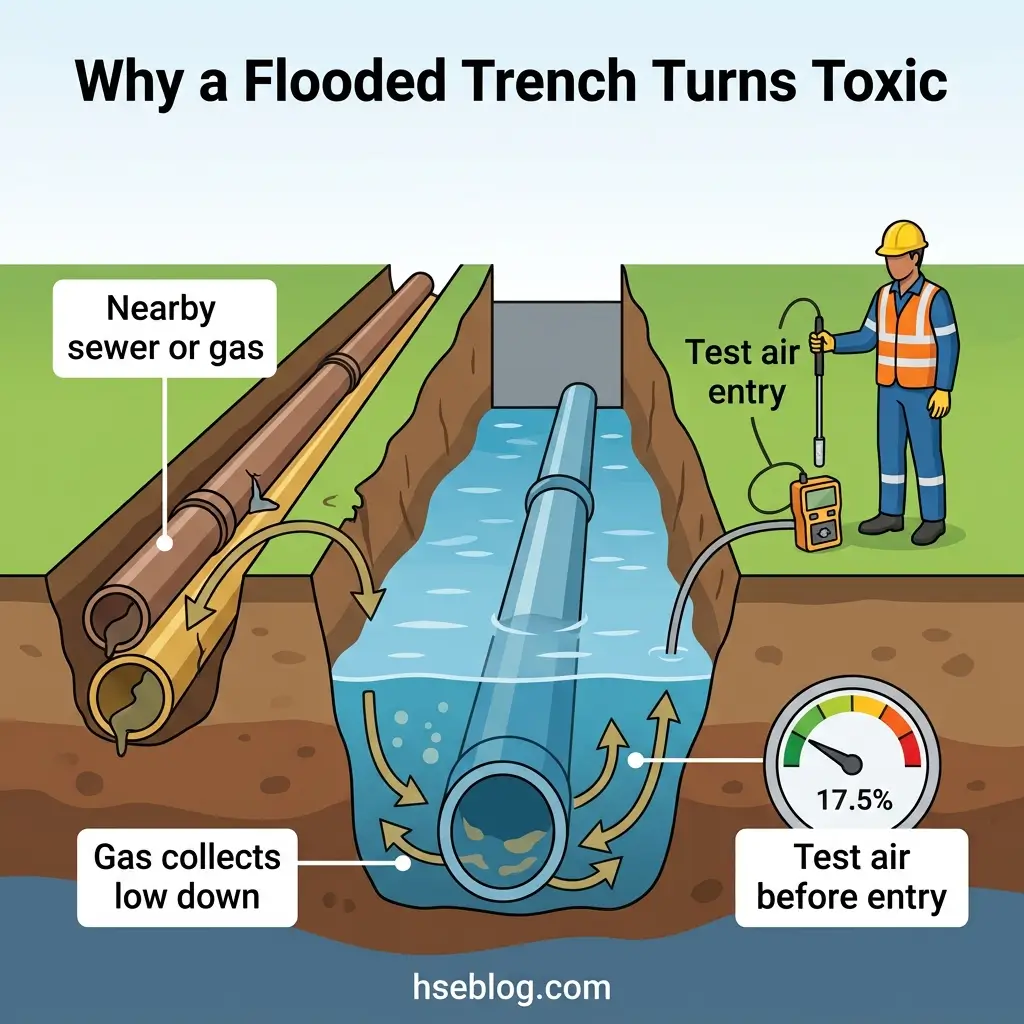
US rules require the air in a trench to be tested before anyone enters an excavation deeper than four feet where a hazardous atmosphere could exist — and a leaking main beside a sewer or gas line is exactly that situation (29 CFR 1926.651(g), US). The break that summoned the crew is also the thing filling the hole and, sometimes, poisoning the air in it.
- The standing water is a hazard in itself. OSHA bars work in accumulating water unless it is controlled, so dewatering runs continuously and a competent person monitors it.
- Adjacent sewers make the air dangerous. Decomposing sewage releases hydrogen sulfide, a heavier-than-air gas that pools at the trench bottom where the crew works.
- Oxygen can fall below 19.5%. Other gases displace it; a calibrated multi-gas detector checks the atmosphere before entry and while work continues.
- Rescue equipment must be on site and attended. OSHA has stated that a distant rescue squad cannot satisfy the requirement, because collapse or gas overcomes a worker in seconds.
- Valve vaults and chambers are confined spaces. Unlike the open trench, these enclosed structures fall under confined-space rules (OSHA Subpart AA) with their own permit, testing, and standby-attendant controls.
The distinction is worth holding onto: the trench itself is governed by excavation rules, not confined-space rules, but the moment the work moves into a chamber, a different and stricter regime applies.
Contamination Control: Protecting the Supply After a Repair
The moment a main is opened, the barrier between drinking water and the trench is gone. The practical rule crews work to is simple: keep contamination out during the repair, then prove the water is safe before anyone drinks it.
Keep contamination out while the pipe is open
Contamination is prevented mechanically, not hoped away. The current standard for the work, ANSI/AWWA C651-23, was revised in 2023 and adds expanded guidance on backflow prevention as a way to reduce contamination and chlorine risk (AWWA, 2023).
- Hold positive pressure. Keeping the leaking main pressurized until the repair point is fully exposed stops contaminated groundwater from being drawn in.
- Keep the trench dewatered. A dry excavation around the break removes the reservoir of dirty water sitting against the open pipe.
- Keep materials sanitary. Pipe, fittings, and tools that will touch potable water are kept clean and swabbed with a chlorine solution.
Prove the main is safe before it goes back
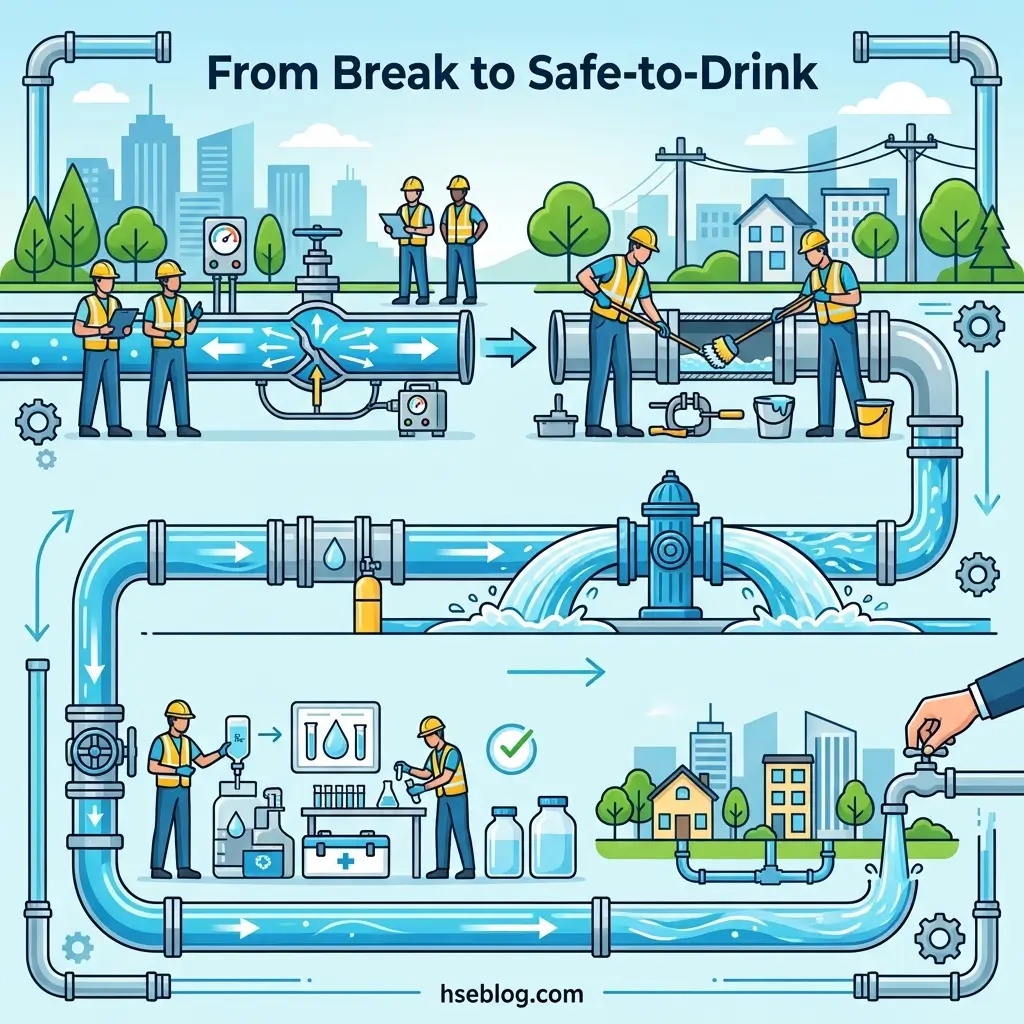
Disinfection is well understood: US EPA guidance on new and repaired mains reports that a 25 mg/L chlorine dose over a 24-hour contact time achieves better than 99.99% (4-log) inactivation of bacteria (US EPA). The return-to-service sequence turns that science into a checklist:
- Hold positive pressure until the repair site is exposed and the trench is dewatered.
- Repair the section, keeping every surface that touches potable water clean and swabbed.
- Disinfect the repaired length, then flush it to the target chlorine residual.
- Sample for total coliform bacteria; the main returns to service only after results clear.
- Where pressure was lost or contamination is suspected, issue a boil-water notice with the water regulator until testing confirms safety.
Frequently Asked Questions
Where Water Main Repair Safety Is Actually Won
The job is won in the sequence, not in any single control. Locate the ground before you break it, and shore or slope every entry as if the soil will move — because disturbed soil around an old main usually can.
From there, build a work zone that assumes a driver will drift toward the crew, test the air and drain the trench before entry, and treat the opened main as contaminated until disinfection and sampling say otherwise. None of these steps is negotiable, and none substitutes for another.
The crews who get water main repair safety right are rarely the fastest on the day. They are the ones who still have a competent person willing to stop the dig when the ground, the traffic, or the water stops behaving.