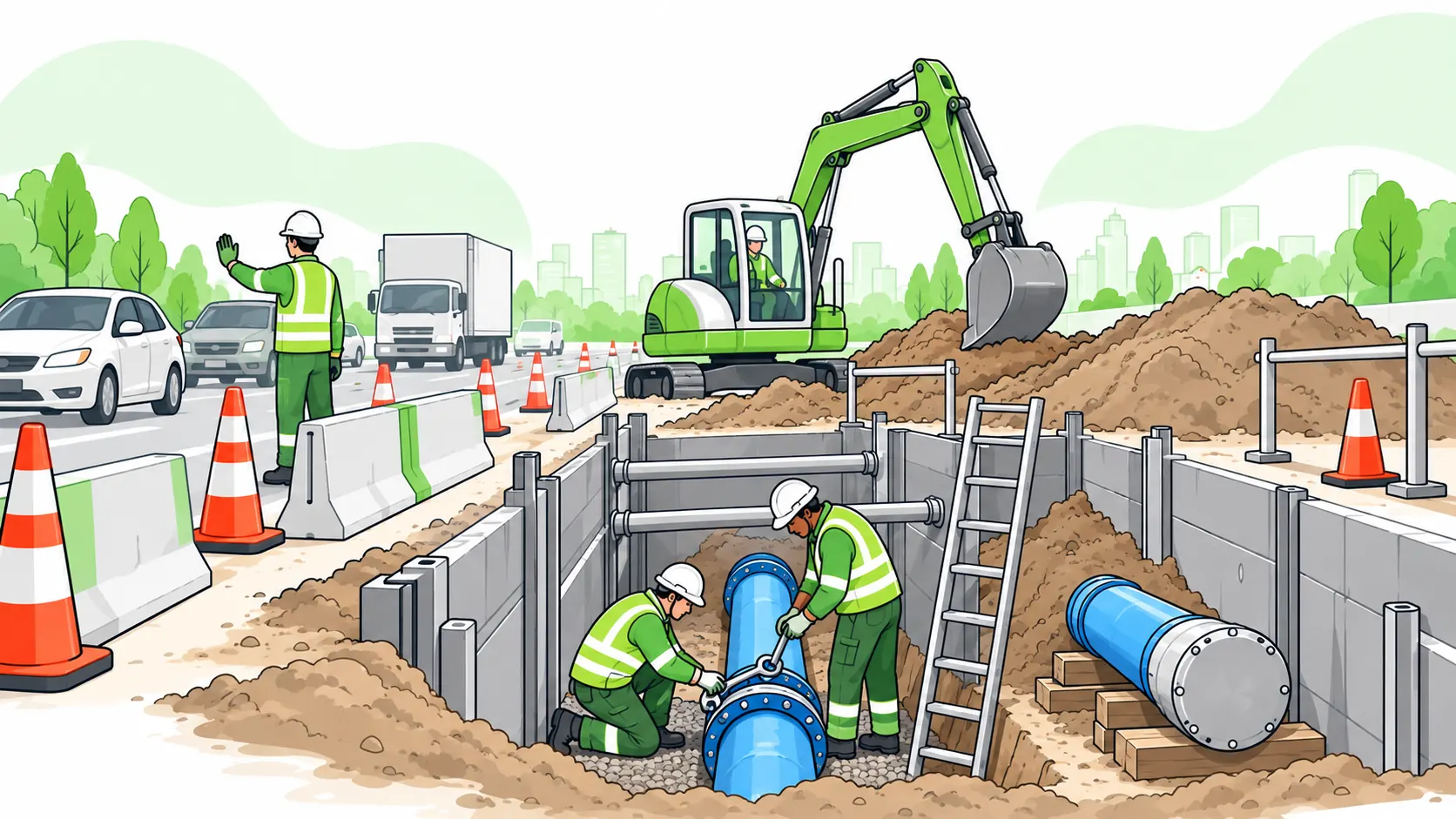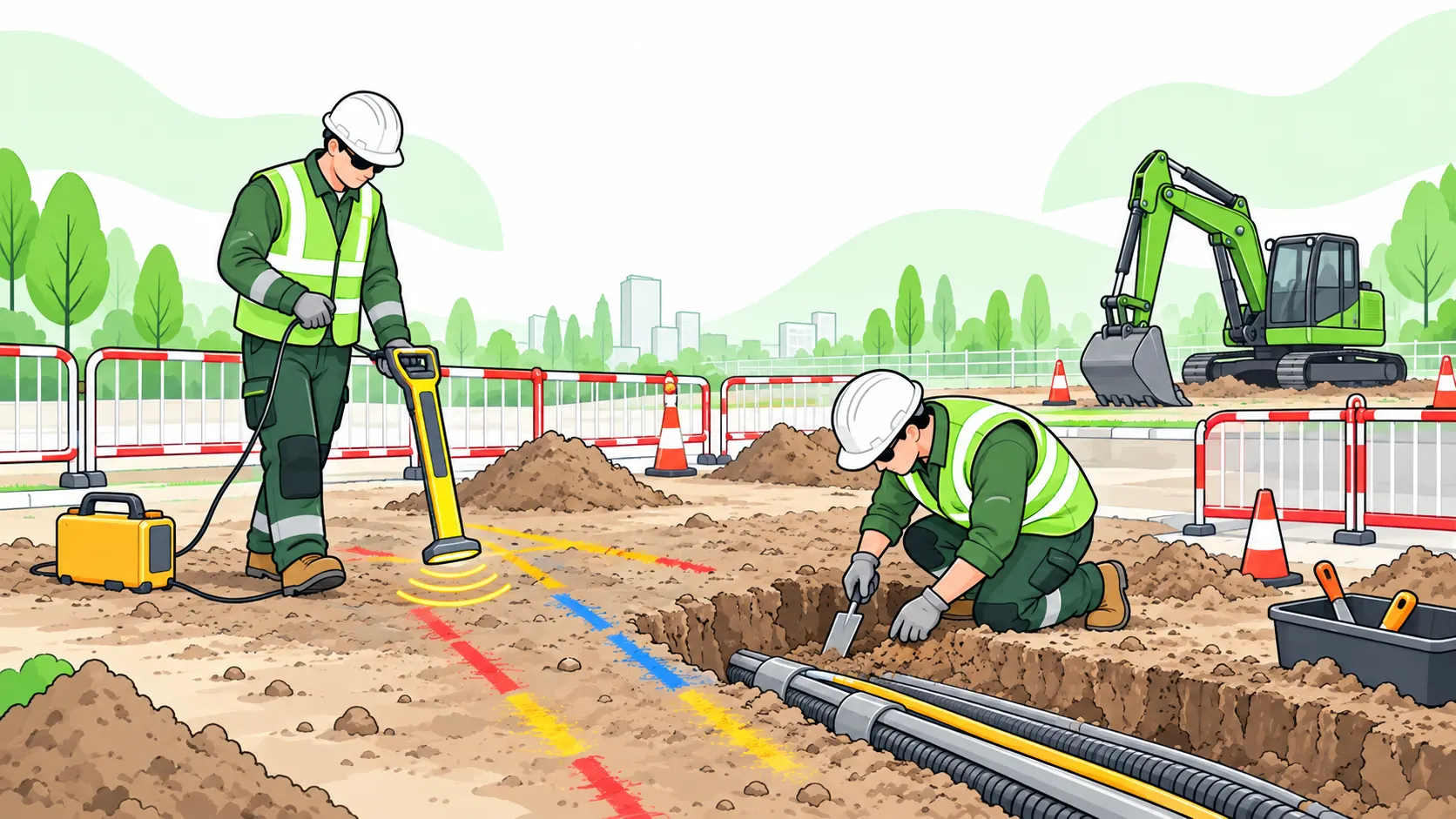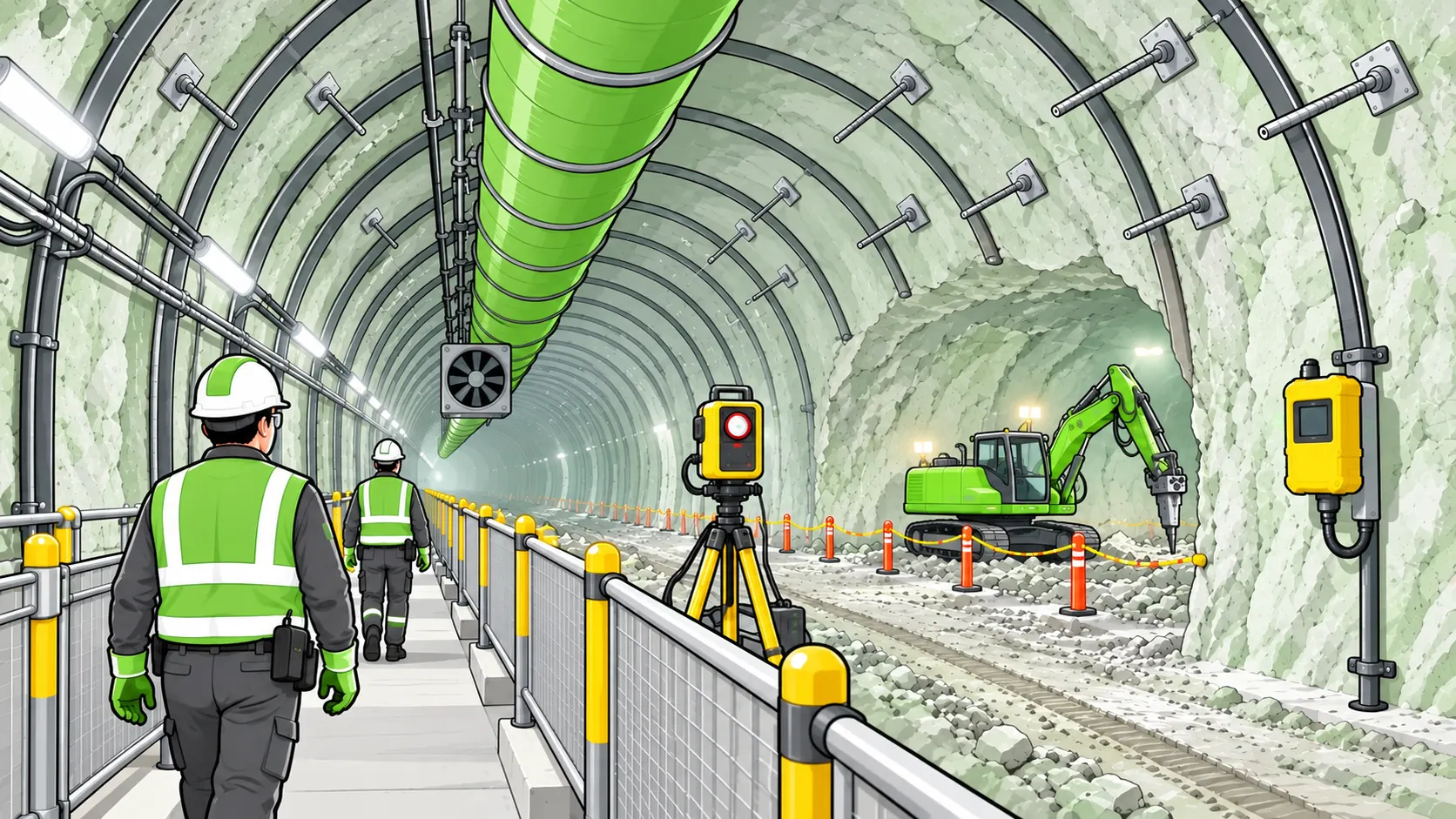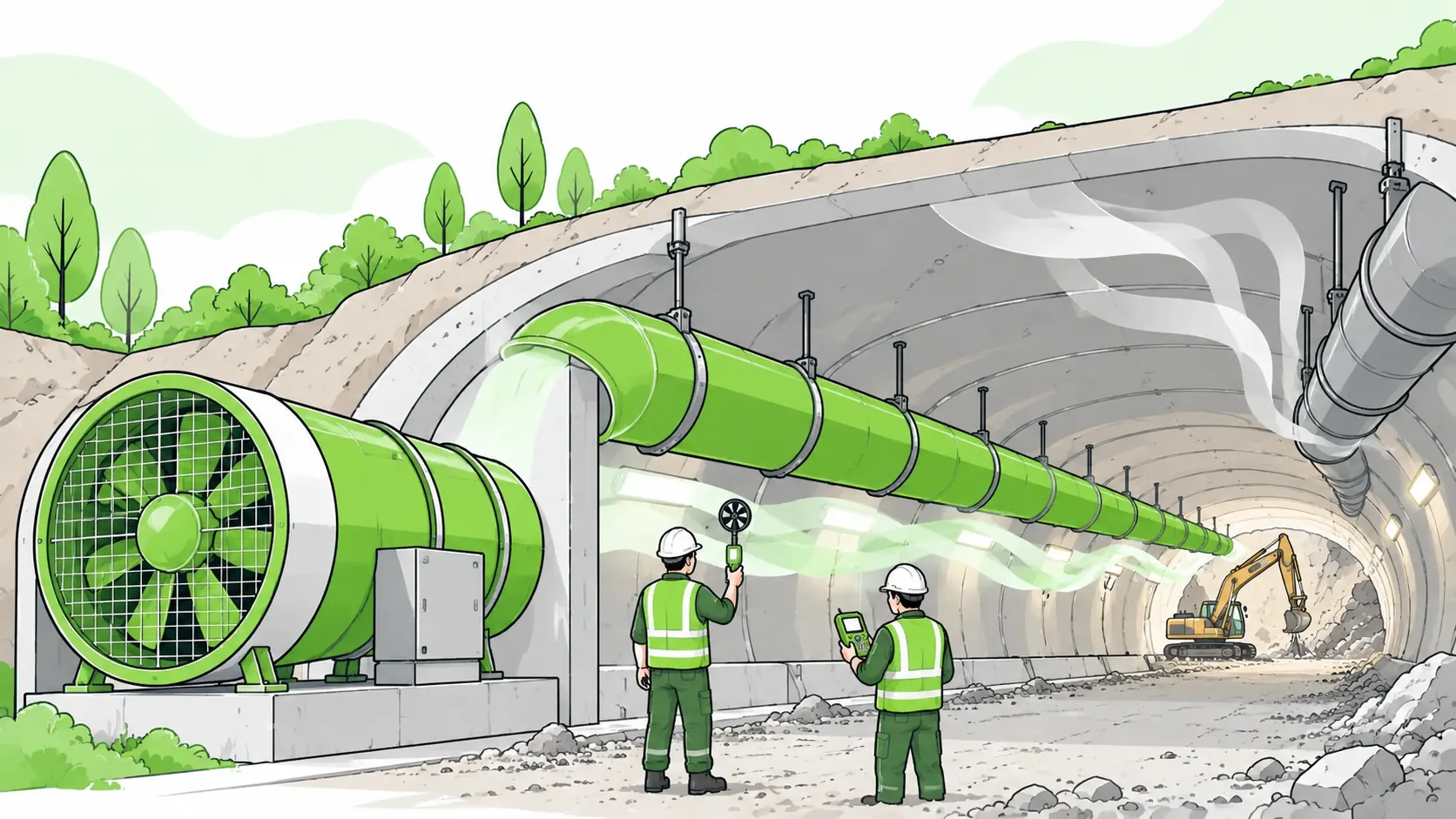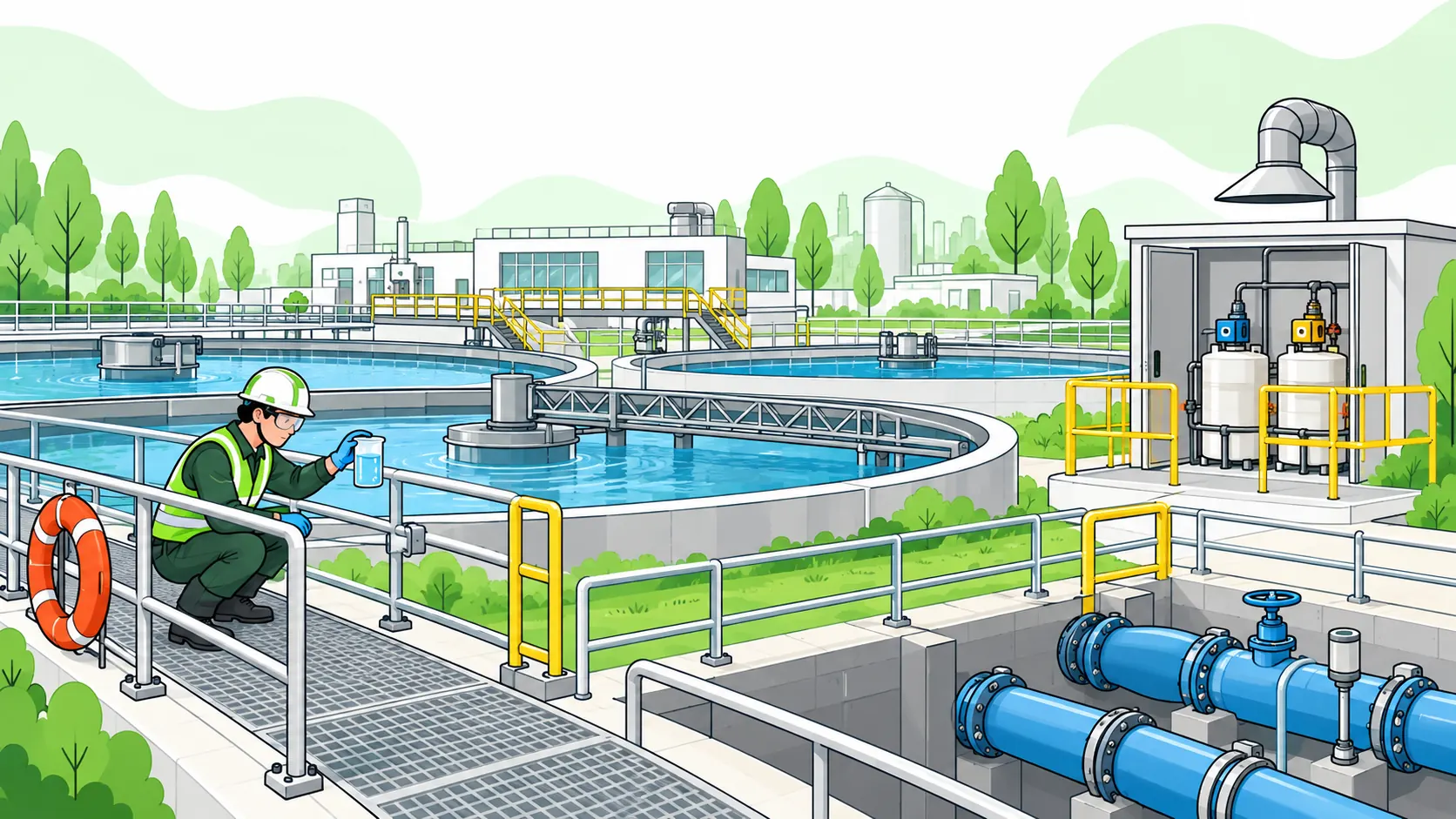
Water industry safety hazards fall into five classes: atmospheric and gas hazards (hydrogen sulfide, methane, chlorine, oxygen deficiency), chemical handling, biological exposure, physical and mechanical risks, and confined-space entry, which amplifies all the others. Distribution crews face added field hazards: trench collapse, traffic struck-by, lone working, and drowning near open water.
The phrase "water industry safety" tends to summon a single image — a wastewater operator lowering a gas monitor into a manhole. That picture is accurate, but it quietly erases most of the sector. Clean-water treatment, wastewater treatment, and the buried distribution network each carry their own hazard signature, and the crew repairing a burst main on a live carriageway is exposed to mechanisms the plant operator never meets.
This article maps water industry safety hazards by class across both worlds — treatment and distribution — and references controls to named standards in two regulatory regimes. Where US and UK rules diverge, the stricter benchmark is treated as the one to design around.
Why Water Industry Safety Spans Two Very Different Worlds
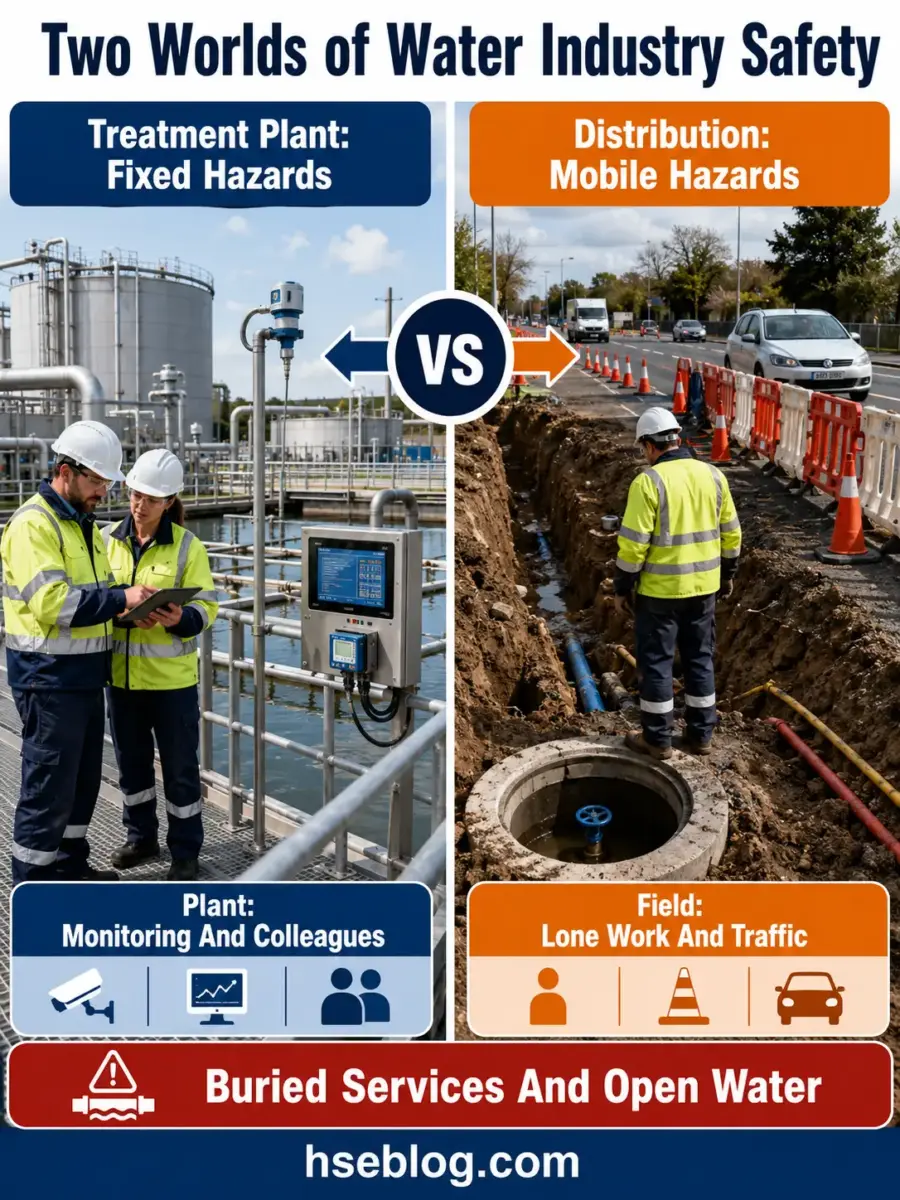
The water industry is not one workplace; it is at least three. Treatment (clean and waste), transmission and distribution, and collection each generate a different hazard profile, and the controls that protect a fixed plant do not automatically protect a dispersed field crew.
The fixed-plant environment is, in safety terms, the easier one to govern. Hazards sit in known locations, monitoring is permanent, and an attendant is usually within reach.
The distribution and collection network is the opposite. Work is mobile, often solitary, frequently below ground, and almost always within reach of the public and live traffic.
That structural difference is where most "water industry safety" coverage fails. It collapses the whole sector into wastewater gas detection and never assesses the field.
A few distinctions are worth fixing before going further:
- Mobility. Plant hazards are stationary; distribution hazards travel with the job, from one chamber or excavation to the next.
- Isolation. A plant has colleagues and alarms; a lone field technician in a remote valve chamber has neither unless equipment provides them.
- Public interface. Distribution crews work on highways, in footways, and beside open water, adding traffic and members of the public to the risk picture.
- Buried services. Excavation introduces a hazard a plant rarely has — striking live gas, electricity, or fibre while digging.
A consistent framing error follows from ignoring this split: "water industry safety" gets treated as a synonym for "wastewater plant gas detection," and the distribution field crew — statistically exposed to excavation, traffic, and lone-working risk — ends up under-assessed. The hazard map has to cover the dispersed network as seriously as it covers the plant.
What Are the Main Hazards in Water and Wastewater Treatment?
Treatment-plant hazards group into five classes, and confined space is the one that turns the other four lethal. The classes are atmospheric/gas, chemical handling, biological, physical/mechanical, and the confined-space amplifier that traps and concentrates the rest.
A useful way to read the table below is to notice which hazards belong mainly to clean-water versus wastewater contexts, because the chemical and biological profiles differ sharply between them.
- Atmospheric and gas hazards — hydrogen sulfide and methane dominate wastewater and digesters; chlorine, ammonia, and sulfur dioxide cluster around disinfection; oxygen deficiency or enrichment appears wherever a space is sealed or inerted.
- Chemical handling hazards — gas chlorine, sodium hypochlorite, sulfuric acid, sodium hydroxide, and ozone carry corrosivity, reactivity, and incompatibility risks across both clean and waste streams.
- Biological hazards — sewage pathogens, bloodborne pathogens, and leptospirosis concentrate on the wastewater and collection side.
- Physical and mechanical hazards — screens, presses, and conveyors create caught-and-crush points; wet floors drive slips; pumps and blowers add noise; electrical risk rises wherever water and power share a space.
- Confined space — not a separate hazard so much as a multiplier that holds all of the above in a poorly ventilated box.
The pattern worth flagging here is convergence. Chemical and atmospheric hazards are often managed in isolation, when the real danger is what happens when they meet inside a confined space — the space does not create the hazard, it concentrates and traps it.
Atmospheric and Gas Hazards: Hydrogen Sulfide, Methane, and Chlorine
The gases that actually kill in this sector are a short list, and their behavior is the reason. Between 2011 and 2017, hydrogen sulfide inhalation killed 46 US workers, and 36 of those deaths occurred in confined spaces (US Bureau of Labor Statistics, via OSHA, 2019).
Hydrogen sulfide (H₂S) is acutely toxic and heavier than air, so it pools in the low points — sumps, channels, manholes — where workers reach. At high concentration it deadens the sense of smell within seconds, removing the "rotten egg" warning exactly when exposure is most dangerous. OSHA's hydrogen sulfide overview is a sound primary reference for the exposure framing.
Methane is the explosive counterpart. Every one of the 9 fatal single-inhalation methane deaths recorded in US workplaces from 2011 to 2017 happened in a confined space (US Bureau of Labor Statistics, 2019) — a near-perfect illustration of how confined geometry, not the gas alone, produces the fatality.
Carbon monoxide deserves a mention for scale: it caused 116 fatal single-inhalation injuries over the same period, the most of any single chemical (US Bureau of Labor Statistics, 2019), and turns up around combustion-driven plant and generators.
Exposure limits for H₂S diverge enough between standard-setting bodies that program design should default to the strictest:
| Reference | Limit | Body (jurisdiction) |
|---|---|---|
| OSHA PEL | 20 ppm ceiling; 50 ppm 10-minute peak | OSHA (US) |
| NIOSH REL | 10 ppm ceiling (10 minutes) | NIOSH (US) |
| ACGIH TLV | 1 ppm 8-hour TWA; 5 ppm STEL | ACGIH |
| IDLH | 100 ppm | NIOSH (CDC) |
The OSHA PEL is widely regarded as outdated; the ACGIH 1 ppm 8-hour TWA is the most protective benchmark and the sensible one to design alarms around. For chlorine, OSHA sets a 1 ppm ceiling under Table Z-1, while ACGIH and NIOSH values are lower still — again, use the stricter figure when configuring detection and respiratory protection.
Chemical Handling: Gas Chlorine, Hypochlorite, and Process Chemicals
Disinfection chemistry is where a water plant most resembles a process facility. Gas chlorine in particular can pull the site into formal process-safety territory.
Holding gas chlorine above a threshold quantity triggers obligations under 29 CFR 1910.119 (US) — process hazard analysis, mechanical integrity, and emergency planning — and intersects with EPA's Risk Management Program. That is a different regime from the everyday handling of liquid hypochlorite.
The handling hazards worth controlling deliberately:
- Incompatibilities. Hypochlorite mixed with acid liberates chlorine gas; SDS-driven segregation of storage is the basic control.
- Corrosivity. Sulfuric acid and sodium hydroxide cause severe burns and demand splash protection and emergency washing.
- Reactive release. Ozone generation creates a toxic gas on-site rather than storing it, shifting the hazard to leak detection and ventilation.
- Dosing-system failure. Overdosing and uncontrolled release are managed through interlocks, containment, and gas detection at the storage point.
The practical reading on most sites: chemical controls are documented from the SDS upward, but the highest-leverage decision is often the choice of chemical itself, which the hierarchy-of-control section returns to.
Biological Hazards and Occupational Health Risks
Content covering biological exposure, leptospirosis, and health surveillance below is for HSE practitioner reference. It is not medical advice. Workers with specific symptoms or exposure concerns should consult an occupational physician or qualified medical professional.
Wastewater and collection work carries an infection risk that clean-water work largely does not. Exposure routes are ingestion, inhalation of aerosols, and entry through cuts or mucous membranes during contact with sewage and contaminated water.
Bloodborne pathogens — HBV, HIV — fall under a written exposure control plan where workers contact sewage or contaminated fluids, a requirement set out in 29 CFR 1910.1030 (US). Leptospirosis (Weil's disease) is the named occupational infection of this sector, contracted from water carrying rodent urine.
The UK equivalent guidance, HSE's working with sewage advice (INDG198), sets out the practical controls and the case for health monitoring. Two controls do most of the work:
- Hygiene and barrier protection — covering cuts, gloves, eye protection, no eating or smoking in contaminated areas, and washing before breaks.
- Health surveillance and vaccination policy — baseline monitoring, awareness of flu-like early symptoms, and a clear route to occupational health.
Confined Space Entry: The Highest-Consequence Hazard in the Water Industry
This article provides general HSE knowledge. Life-critical work such as permit-required confined space entry must be planned and supervised by a competent person with relevant training, jurisdiction-specific authorization, and a site-specific risk assessment. The information here does not replace that.
Confined space is the single highest-consequence hazard class in the sector because it concentrates atmospheric, engulfment, and chemical risk in one badly ventilated location. The fatality data already cited makes the point: the H₂S and methane deaths between 2011 and 2017 clustered overwhelmingly inside confined spaces (US Bureau of Labor Statistics, 2019).
A permit-required confined space, under OSHA's definition in 29 CFR 1910.146 (US), is one with limited entry and egress, not designed for continuous occupancy, that contains or may contain a hazardous atmosphere, engulfment risk, or other serious hazard. OSHA's permit-required confined spaces standard is the authoritative source for the entry and permit requirements.
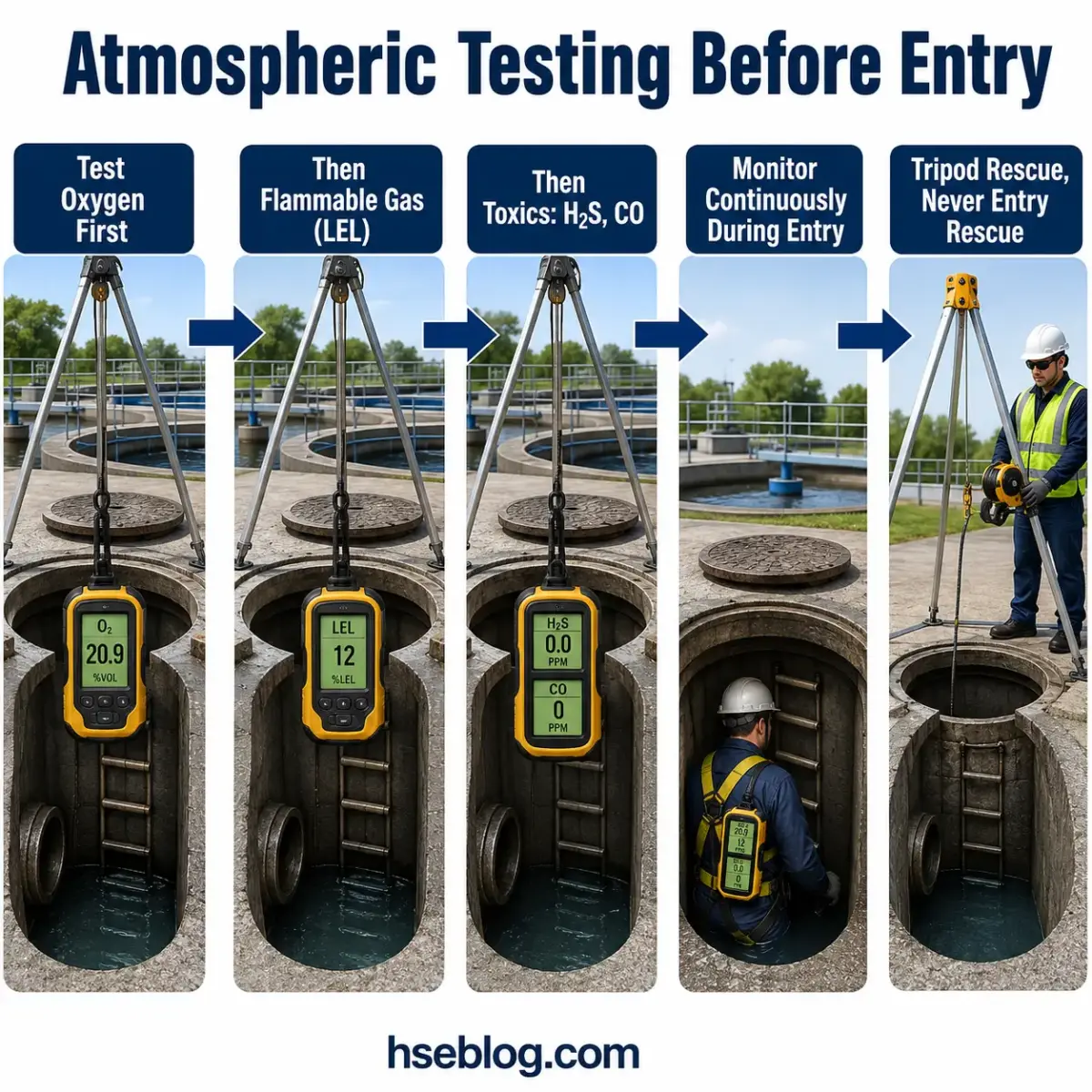
The entry logic follows a fixed order, and the order is not arbitrary:
- Test oxygen first. Every other reading depends on it, and many sensors behave unreliably in a depleted or enriched atmosphere.
- Test flammables (LEL) second. Methane and other combustibles are screened before anyone introduces an ignition source.
- Test toxics third. H₂S, CO, and other contaminants are measured against the strictest applicable limit.
- Continue monitoring during entry. Atmospheres change as work disturbs sludge or sediment, so testing is continuous, not a one-time gate.
- Ventilate and set up rescue before entry. Forced ventilation and a non-entry rescue arrangement are in place before the entrant goes down.
The behavioral failure that produces multiple fatalities deserves a plain statement. The dominant pattern in confined-space deaths is the rescuer cascade: a worker collapses in a toxic or oxygen-deficient atmosphere, a colleague enters to help without an air supply, and the rescuer becomes the second casualty — sometimes followed by a third.
Competitors cite this as a statistic and stop. The mechanism is what matters: the instinct to rescue overrides the discipline to wait, which is precisely why non-entry rescue using a tripod and winch — with the entrant already in a retrieval harness — is the only acceptable default. The judgment call is between a planned non-entry retrieval and a spontaneous entry rescue, and the balance always favors non-entry, because every entry rescue starts by repeating the conditions that dropped the first person.
Engulfment is the separate mechanism in this sector. Sludge, sediment, and inrushing water can bury or drown an entrant independently of any atmospheric hazard, which is why isolation of inflows and assessment of accumulated material belong in the permit alongside gas testing.
Hazards in the Water Distribution and Collection Network
Distribution work fails most often when it is risk-assessed as "just a repair" with controls borrowed from the plant. The field crew has no attendant, meets variable atmospheres in chambers and manholes, and works against a live-traffic interface — none of which a plant-based assessment accounts for.
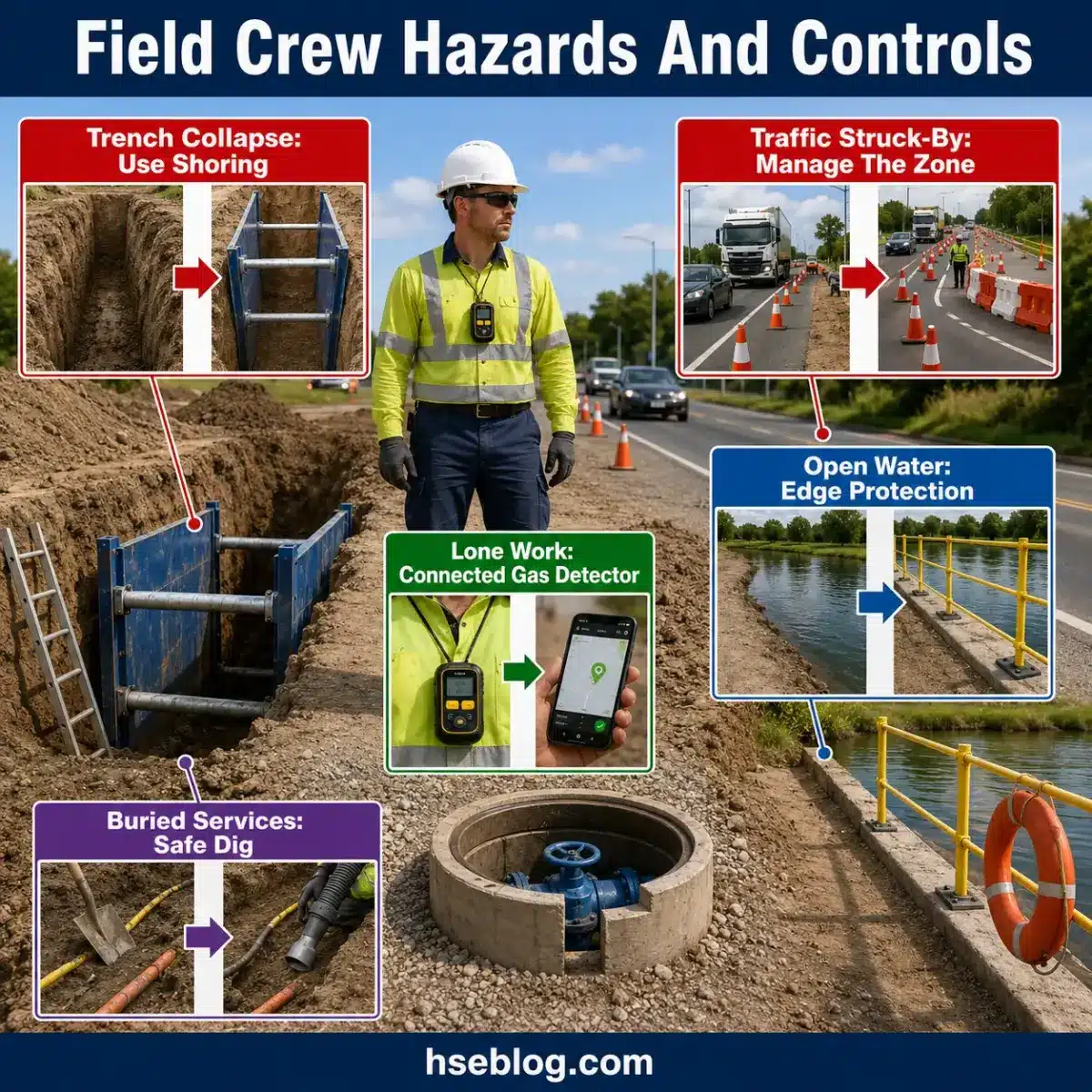
The hazards specific to the dispersed network, each with its control direction:
- Excavation and trench collapse — mains repair and replacement means working in trenches that can bury a person in seconds. Control: shoring, battering, or trench boxes, with confined-space protections applied where the excavation qualifies, under 29 CFR 1926 Subpart AA (US) for sewer and main construction.
- Traffic and struck-by during roadworks — working in or beside a live carriageway is a leading field hazard. Control: a designed traffic management plan, high-visibility PPE, and physical separation between workers and moving vehicles.
- Lone working and isolation — a technician in a remote chamber may be unmonitored for hours. Control: personal multi-gas detectors with real-time connectivity and a check-in regime that triggers escalation when a worker goes silent.
- Drowning and open water — reservoirs, intakes, and treatment basins present a fall-and-drown risk. Control: edge protection, rescue equipment, buoyancy aids, and never working alone over open water.
- Buried-service strikes and stored hydraulic energy — digging can hit live utilities, and pressurized mains store energy that releases violently (water hammer). Control: service plans, safe-dig techniques, and depressurization before breaking into a main.
The principle that ties these together: the assessment has to travel with the job, not sit in a plant file. A chamber on a side road is a confined space whether or not the paperwork calls it one, and the field permit has to reflect the conditions actually found on arrival.
The Hierarchy of Control Applied to Water Industry Hazards
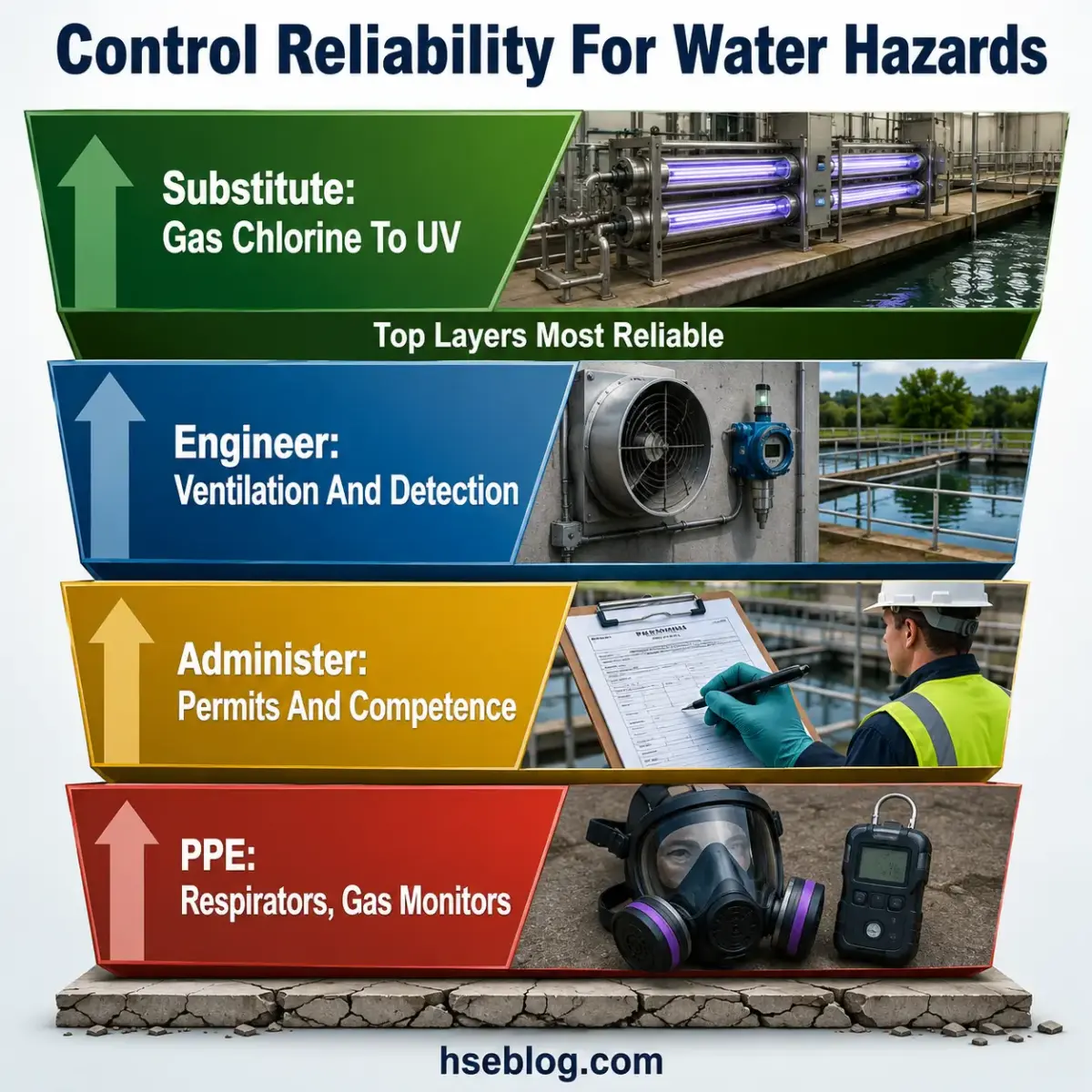
The hierarchy of control is the framework that ties this whole taxonomy together, and the common error is starting at the bottom of it. Reaching first for respirators and gas monitors while leaving an available substitution unexamined is the single most expensive mistake in water-industry risk management.
The reliable layers sit at the top, and they apply to specific water-industry hazards as follows.
Elimination and Substitution — the layer most often skipped
The sector's quiet trend toward sodium hypochlorite and UV disinfection in place of gas chlorine is a substitution-level control, not merely an operational preference. Removing gas chlorine from a site can eliminate the process-safety regime around it entirely, which is a far stronger control than any amount of PPE protecting workers from a hazard that no longer needs to exist on site.
The reason this option is so often left unexamined is honest: it carries capital cost, and a PPE-first mindset treats that cost as someone else's problem.
Engineering Controls — the dependable middle
- Ventilation that dilutes and removes atmospheres before and during confined-space work.
- Fixed and portable gas detection that warns before a limit is reached rather than after.
- Machine guarding on screens, presses, and conveyors that removes the caught-and-crush point.
- Containment and interlocks on chemical dosing systems.
These work because they do not depend on a person behaving perfectly under pressure.
Administrative Controls and PPE — the fragile layer
Permits, training, competence, and PPE are necessary, but they fail under fatigue, time pressure, and habit. The linchpin here is the competent person — someone with the training, experience, and authority to plan the work and stop it. Recognized pathways such as NEBOSH, IOSH, and OSHA outreach training exist precisely to build that competence, and a program that rests on PPE without competent supervision is resting on its weakest layer.
Regulatory and Management-System Framework: US and UK Side by Side
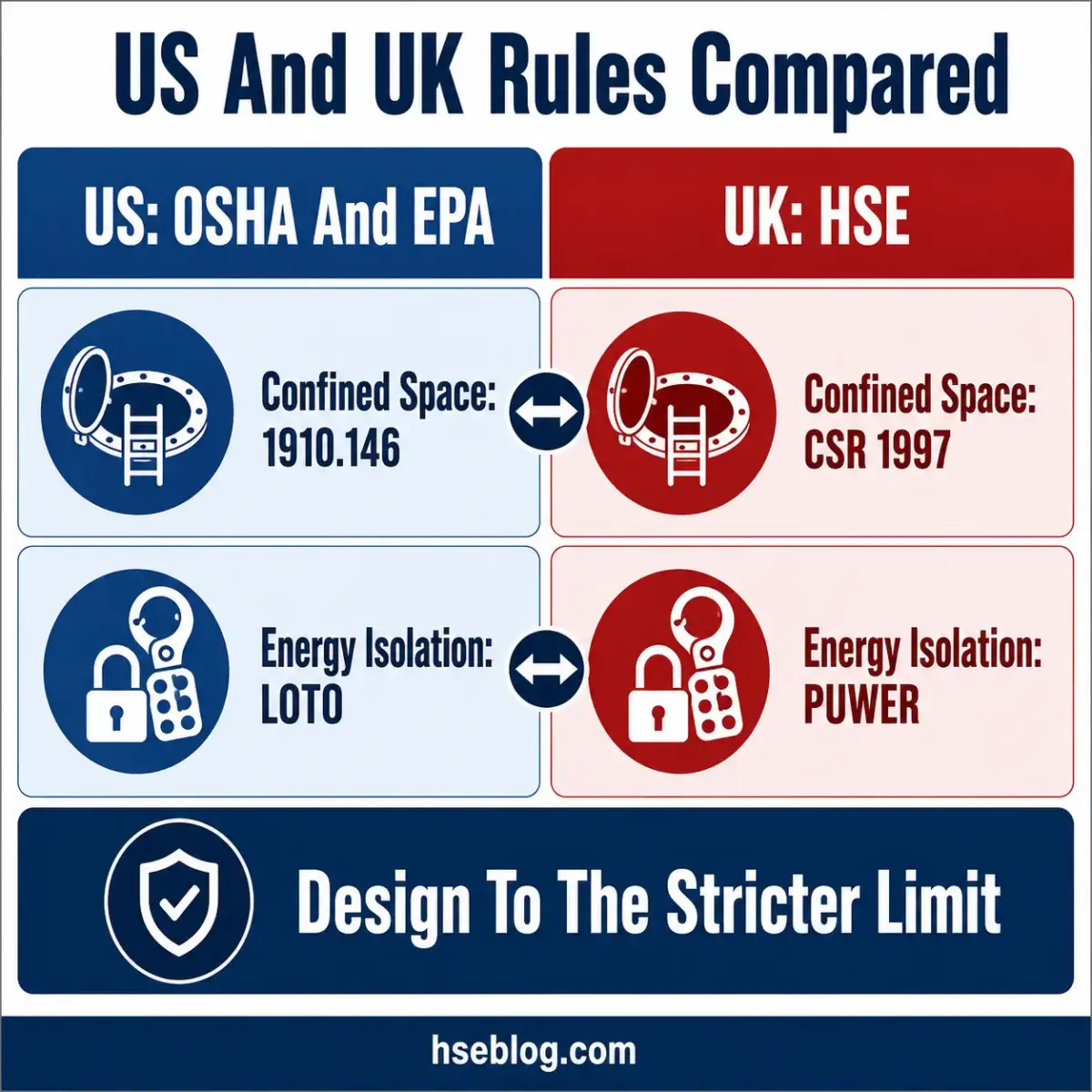
Both regimes pursue the same intent through different instruments, and a utility operating across borders must satisfy whichever applies in the jurisdiction of the work.
Regulatory content here reflects general HSE professional understanding of US and UK requirements as of 2025. It is not legal advice. Specific compliance questions, enforcement situations, or prosecution risk should be directed to qualified legal counsel in the applicable jurisdiction.
The instrument differs hazard by hazard, but the duty rarely does:
| Hazard area | US standard (OSHA/EPA) | UK standard (HSE) |
|---|---|---|
| Confined space entry | 29 CFR 1910.146 (permit system); 1926 Subpart AA (construction) | Confined Spaces Regulations 1997 + ACOP L101 |
| Hazardous energy isolation | 29 CFR 1910.147 (lockout/tagout) | Safe isolation under PUWER 1998 / MHSWR 1999 |
| Sewage and bloodborne exposure | 29 CFR 1910.1030 | Working with sewage (INDG198); COSHH 2002 |
| Air contaminant limits | 29 CFR 1910.1000 Table Z-1 | COSHH 2002; workplace exposure limits (EH40) |
| Gas chlorine process safety | 29 CFR 1910.119 (PSM); EPA RMP | COMAH 2015 (where thresholds met) |
| Management system | ISO 45001:2018 (voluntary) | ISO 45001:2018 (voluntary) |
Read the differences practically. OSHA's confined-space approach is built on a permit system and prescriptive testing; the UK Confined Spaces Regulations 1997, with ACOP L101, start from a duty to avoid entry where reasonably practicable and impose a safe system of work and emergency arrangements where entry is unavoidable.
Where exposure limits diverge, the stricter governs program design — the H₂S table earlier is the clearest case. Above the national rules, ISO 45001:2018 (international) provides the risk-based management-system framework that lets a utility run one coherent OHS system across sites, with the ILO's occupational-hazard framing underpinning it.
Frequently Asked Questions
Why is hydrogen sulfide so dangerous in wastewater?
H₂S is heavier than air, so it accumulates in low spaces like sumps, channels, and manholes where workers reach in. At high concentration it paralyzes the sense of smell within seconds, so the "rotten egg" warning disappears exactly when exposure becomes most dangerous. NIOSH sets its IDLH at 100 ppm (NIOSH/CDC), above which exposure can cause irreversible harm or death.
Do water distribution workers need confined space training?
Yes. Manholes, valve chambers, and vaults meet the confined-space definition even out in the field, away from any plant. The common misconception is that confined space is a "plant" issue; in reality a roadside chamber with limited egress and a possible hazardous atmosphere is a permit space, and the crew entering it needs the same competence, testing, and rescue arrangements a plant entry would demand.
What is leptospirosis and how do water workers get it?
Leptospirosis, also called Weil's disease, is a bacterial infection caught from water contaminated with rodent urine, entering through cuts or the mucous membranes of the eyes, nose, and mouth. It is a recognized occupational risk in sewage and collection work, which is why HSE's INDG198 guidance (UK) calls for hygiene controls and health monitoring. This is general HSE information, not medical advice — see an occupational physician for symptoms or exposure concerns.
What's the difference between OSHA and HSE rules for water industry confined spaces?
The intent is parallel; the instruments differ. OSHA uses a prescriptive permit system under 29 CFR 1910.146 (US), built on atmospheric testing and attendants. The UK Confined Spaces Regulations 1997, with ACOP L101 (UK), begin from a duty to avoid entry where reasonably practicable and require a safe system of work where entry is unavoidable. This is not legal advice; the jurisdiction of the work governs.
Are PFAS a safety hazard for water treatment workers or just a water-quality issue?
For workers, PFAS is primarily a treated-water-quality and public-health regulatory matter rather than an acute occupational hazard like H₂S or chlorine. EPA's drinking-water rules set the obligation on the utility, not a direct injury risk to operators. In 2025, EPA retained its 4 ppt limits for PFOA and PFOS while moving to extend the compliance deadline to 2031 and proposing to rescind limits for several other PFAS (US EPA), with further rules proposed into 2026.
What PPE do water and wastewater workers need?
PPE is task-driven and sits last in the hierarchy of control, not first. Typical needs include connected multi-gas detectors for atmospheric work, respiratory protection sized to chlorine or H₂S exposure, gloves and eye protection against biohazards, and buoyancy and rescue gear near open water. The point is to choose PPE for the specific task while still treating elimination, substitution, and engineering controls as the stronger protections.
What the Industry Keeps Getting Wrong
The recurring failure in water industry safety is not ignorance of any single hazard — it is scoping. Treat the sector as a wastewater plant and you protect the operator at the manhole while the field technician repairing a main, with no attendant and a live carriageway at his back, is assessed as if he were standing inside a controlled facility.
If there is one highest-impact change, it is to stop reaching for PPE first. The strongest controls in this sector are decisions made before anyone puts on a respirator: substituting gas chlorine for hypochlorite or UV, engineering ventilation and detection into the work, and putting a genuinely competent person in charge of the permit. These also happen to be the ones that survive a tired crew at the end of a long shift, which is exactly when the rescuer cascade begins.
The sector is also widening what "safety" means — EPA's 2025 cybersecurity and emergency-response toolkit for water and wastewater utilities (US EPA) signals that operational-technology resilience now sits alongside the physical hazards covered here. The hazard map is no longer just gas, water, and traffic; but the same discipline applies. Assess the work that is actually in front of the crew, control it at the most reliable layer available, and design to the stricter of the two rulebooks where both apply.