
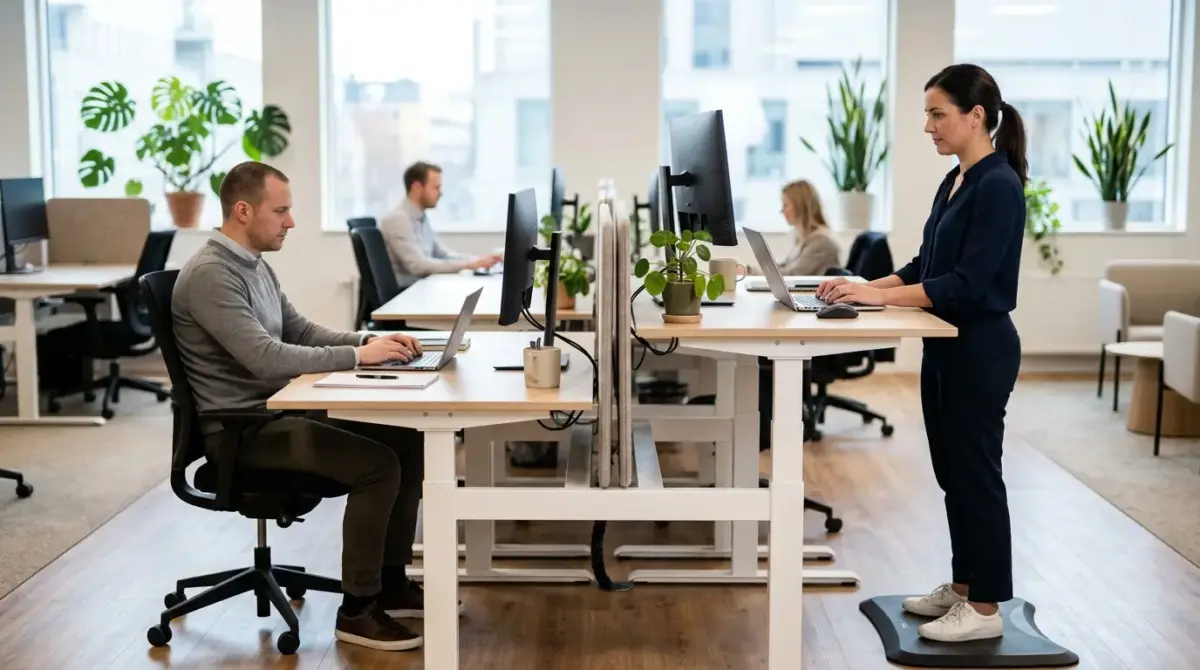
Neither sitting nor standing is healthy in excess. Prolonged sitting raises the risk of heart disease, type 2 diabetes and back pain, while prolonged standing drives leg fatigue, varicose veins and other circulatory problems. For standing vs sitting at work, the protective factor is regular movement and posture variation — not the chair or the desk alone.
The standing desk was marketed as the cure for sitting all day. A 2024 study of more than 83,000 adults found it does not reduce heart-disease risk — and that standing longer brought more circulatory problems, not fewer (International Journal of Epidemiology, 2024).
That matters because the standing vs sitting at work debate has been framed as picking a winner. The real health risks of each trace back to one thing — holding a single posture too long — so this piece compares both and shows what actually helps.
Standing vs Sitting at Work: Why Static Posture Is the Real Risk
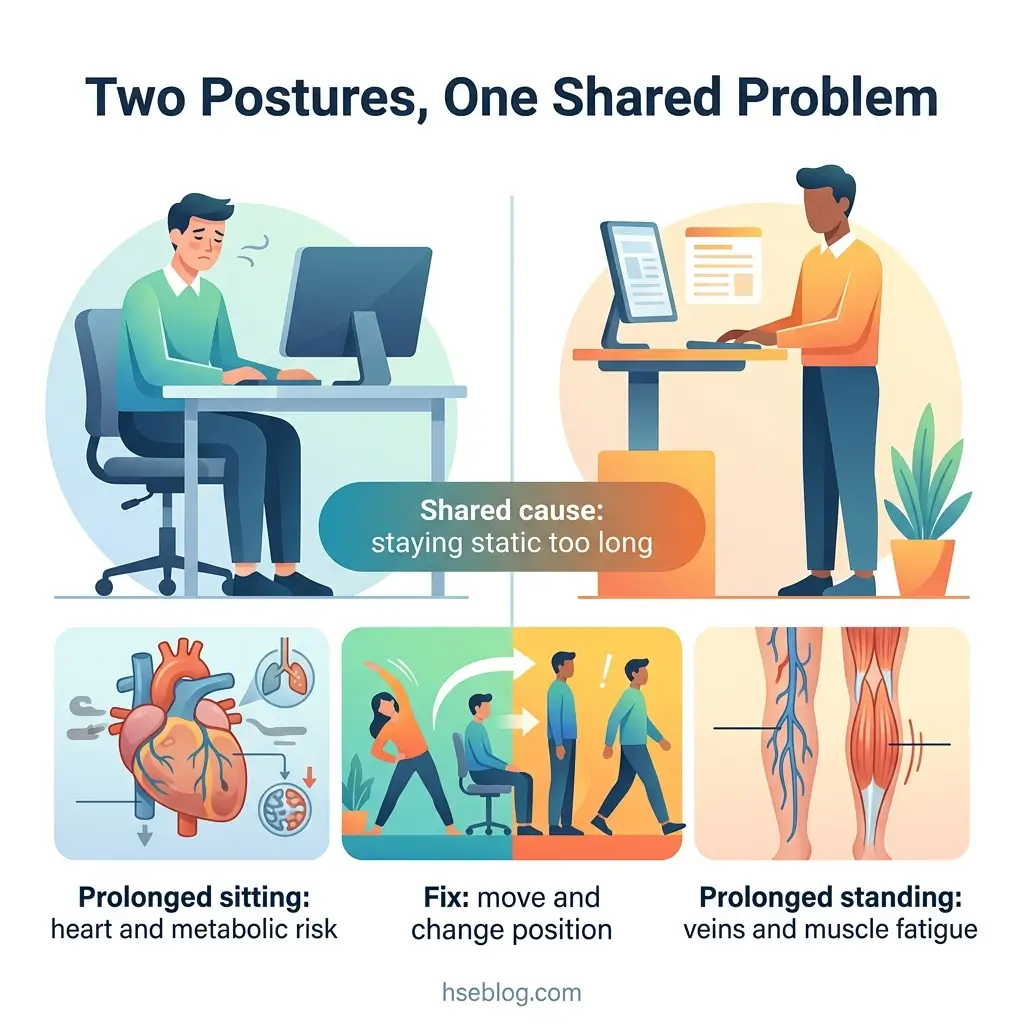
The honest answer to the standing vs sitting at work question is that neither posture is inherently harmful. Harm builds when the body stays locked in either one for hours.
Both postures load the body in fixed ways. What tissue needs is change — muscle contraction, blood movement, a shift of weight.
- Sitting’s problem is inactivity — long, unbroken sitting slows metabolism and blood flow.
- Standing’s problem is static load — an upright posture strains postural muscles and pools blood in the legs.
- The shared fix is movement — regular position changes matter more than which desk you own.
This reframing is backed by recent data. A 2024 analysis of more than 83,000 adults found that standing more did not improve heart health, and pointed the benefit toward moving instead (International Journal of Epidemiology, 2024).
This article is for HSE and general reference. It is not medical advice. Anyone with existing heart, circulatory or musculoskeletal conditions, or who is pregnant, should discuss sitting and standing at work with an occupational-health professional or clinician.
The Health Risks of Prolonged Sitting
Sitting for most of the day is linked to some of the most common chronic diseases. People who sit a lot have higher rates of type 2 diabetes, heart disease and some cancers, and shorter lifespans.
Why sitting harms the body
Muscle inactivity is the mechanism. When large leg and postural muscles stop contracting, the body clears fat and glucose from the blood less efficiently, and circulation slows.
Posture adds a second layer. Hours of sustained flexion load the neck and lower back, which is why desk-based roles report so much musculoskeletal discomfort.
What the newest data shows
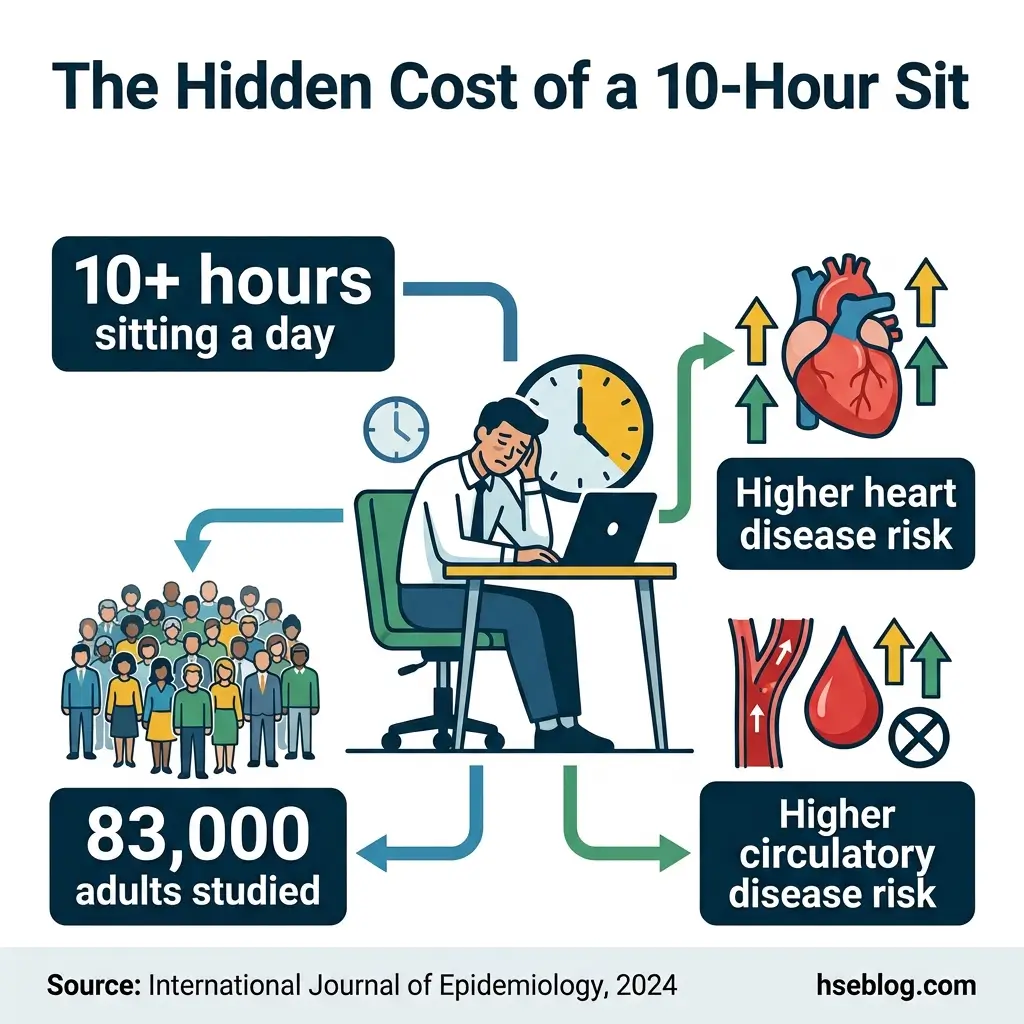
The evidence has sharpened recently. In the 2024 UK Biobank cohort, sitting more than 10 hours a day was associated with higher risk of both cardiovascular and orthostatic circulatory disease (International Journal of Epidemiology, 2024).
That study measured posture with wearable devices rather than self-report, which makes the signal harder to dismiss. Total stationary time — sitting and standing combined — was the clearest driver of raised heart and circulatory risk (International Journal of Epidemiology, 2024).
The Health Risks of Prolonged Standing
Standing carries its own, different set of risks — and they are easy to miss because standing feels active. Static standing is not the same as moving.
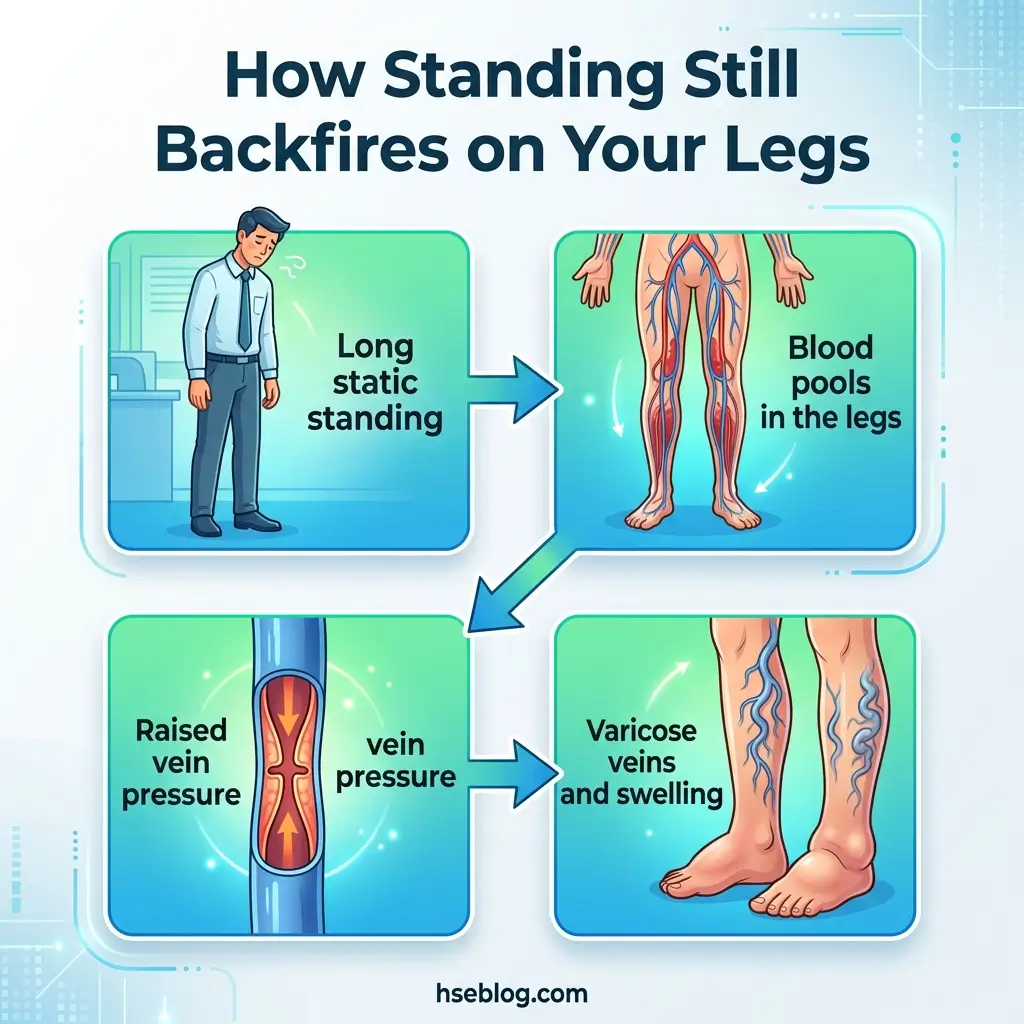
The Canadian Centre for Occupational Health and Safety explains the mechanism: keeping the body upright takes constant muscular effort, which reduces blood supply to the loaded muscles and pools blood in the legs and feet (CCOHS). Over time, that pooling can progress to painful, chronic conditions.
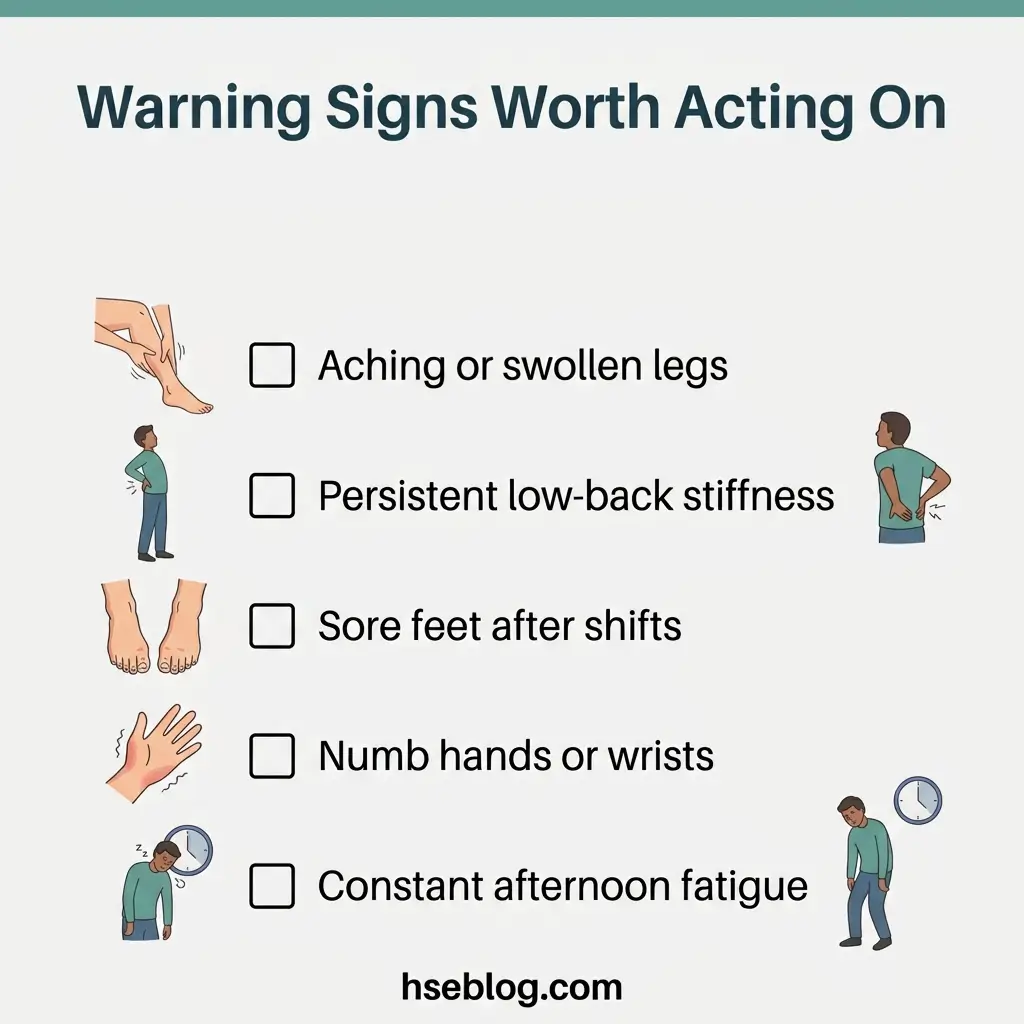
- Lower-limb fatigue and pain — legs, feet and the low back tire under sustained load.
- Venous problems — pooled blood raises vein pressure, contributing to varicose veins and chronic venous insufficiency.
- No cardiovascular payoff — standing time was not associated with lower major heart-disease risk (International Journal of Epidemiology, 2024).
- Circulatory risk with excess — standing beyond two hours a day was linked to an 11% higher risk of orthostatic circulatory problems for every additional 30 minutes (International Journal of Epidemiology, 2024).
Who faces the highest standing risk
Some workers carry more of this load than others. The European Agency for Safety and Health at Work lists retail, assembly, hospitality and healthcare roles among the most exposed, and flags pregnancy as a specific concern, with prolonged standing associated with preterm birth in some research (EU-OSHA).
Sitting vs Standing at Work: A Side-by-Side Look
Put the two postures next to each other and the picture is not “good versus bad.” It is two different risk profiles that both worsen without movement.
| Factor | Prolonged sitting | Prolonged standing |
|---|---|---|
| Main systems affected | Metabolic and cardiovascular | Circulatory (venous) and musculoskeletal |
| Early symptoms | Stiff neck and back, low energy | Sore feet, aching legs, low-back fatigue |
| Longer-term risks | Type 2 diabetes, heart disease, some cancers | Varicose veins, chronic venous insufficiency |
| Effect on major heart risk | Rises with sitting time (IJE, 2024) | No reduction; not a substitute for activity (IJE, 2024) |
| Most-exposed roles | Office, driving, screen-based work | Retail, assembly, healthcare, hospitality |
| What helps most | Standing and moving breaks | Sitting breaks, movement, mats, footwear |
The two columns share one lesson. Whichever posture dominates your day, the fix is not the opposite posture — it is breaking the stillness.
What Actually Reduces the Risk: Move and Alternate
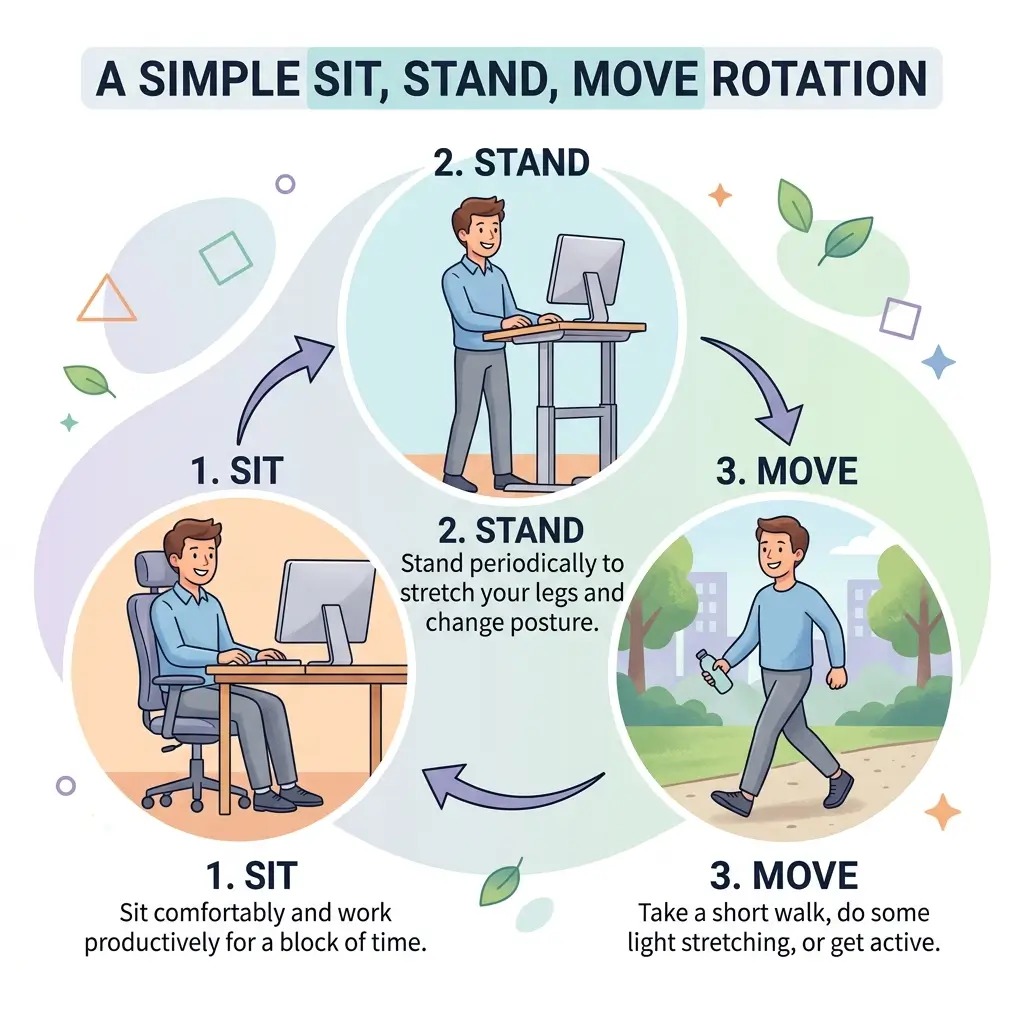
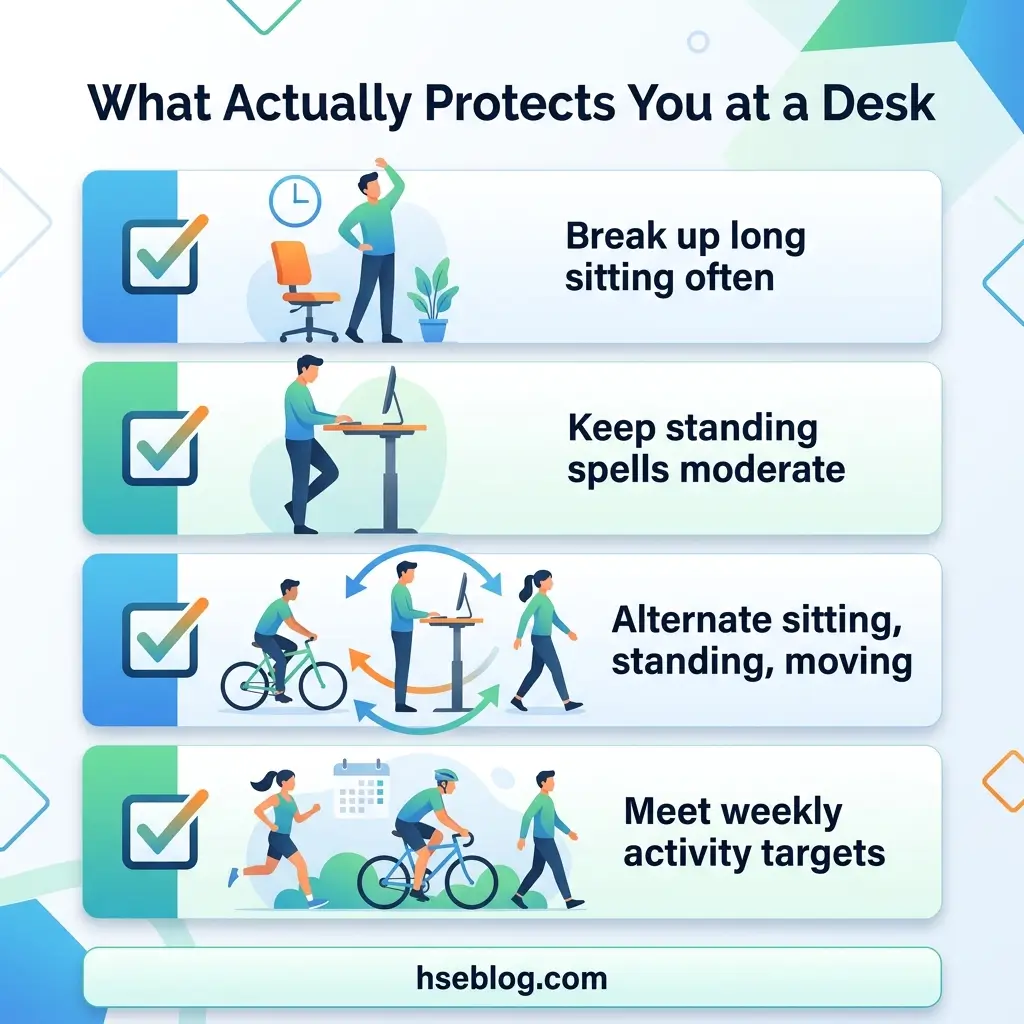
The most protective change is not choosing a posture — it is refusing to hold one. Alternating between sitting, standing and moving beats any single position.
- Break up long sitting — stand or walk for a few minutes at regular intervals rather than sitting for hours unbroken.
- Keep standing spells moderate — long static standing has its own costs, so shift before fatigue sets in.
- Add real movement — light walking or simple leg movements do more than static posture change alone.
- Meet weekly activity targets — the WHO’s 2020 guidelines recommend 150–300 minutes of moderate activity a week, and more for people who sit a lot (WHO, 2020).
The equipment matters less than how it is used:
- Treat a sit-stand desk as a tool, not a cure — it helps only if it prompts genuine variation, not a full day standing still.
- Support standing — an anti-fatigue mat and supportive footwear reduce lower-limb strain.
- Support sitting — a well-set chair, a screen at eye level and a footrest cut neck, back and wrist load.
- Use sensible ratios — EU-OSHA’s OSHwiki cites guidance such as sitting around 60%, standing 20% and moving 20% of the day, and not standing more than 15–30 minutes at a stretch.
Here is the judgment call worth naming. A sit-stand desk earns its cost only if it is used in standing mode regularly; left permanently up or permanently down, it is just furniture that trades one static posture for another.
How Do the Rules on Desk Work Differ by Country?
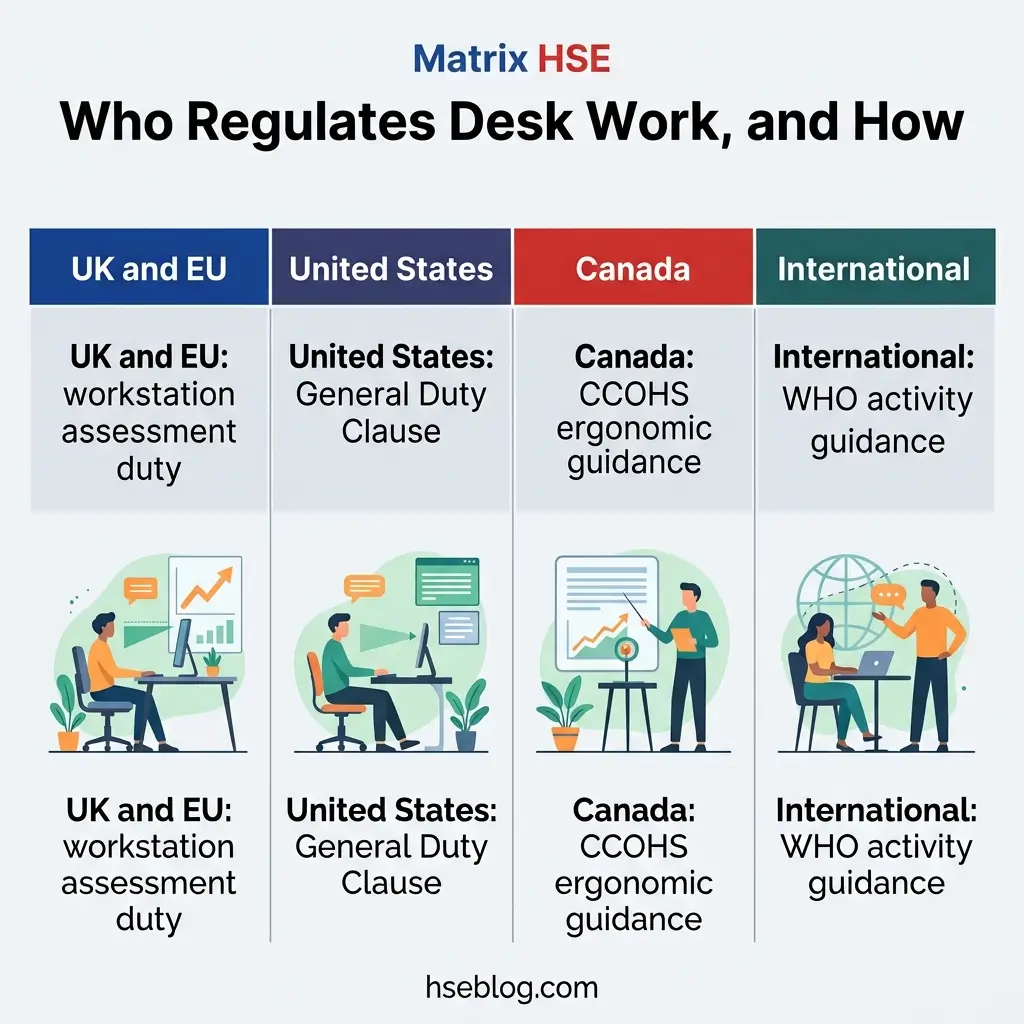
Legal duties around desk work vary sharply by country, and the differences matter for compliance. There is no single global rule, so the standard that governs you depends on where you operate.
The points below reflect a general HSE reading of each jurisdiction as of 2026 and are not legal advice. Confirm current duties with a qualified adviser in the applicable jurisdiction.
United Kingdom and the EU
Employers here carry specific, enforceable duties. The Health and Safety (Display Screen Equipment) Regulations 1992 (amended 2002), which transpose EU Directive 90/270/EEC, require employers to make a suitable and sufficient workstation assessment (Regulation 2), plan work so screen use is broken by breaks or changes of activity (Regulation 4), and provide eye tests on request (Regulation 5), all enforced by the HSE in Great Britain.
Read practically, Regulation 4 does not mandate a standing desk. It requires that the work be interrupted — a change of task or a short break counts just as well as a change of posture.
United States
The contrast is stark. There is no dedicated federal ergonomics standard; the rule issued in 2000 was repealed in 2001 under the Congressional Review Act, so OSHA now addresses ergonomic hazards through the General Duty Clause, Section 5(a)(1), which requires employers to keep workplaces free from recognized serious hazards (OSHA).
Elsewhere
Other frameworks lean on guidance rather than prescription. Canada’s CCOHS publishes detailed ergonomic advice on both sitting and standing, while the WHO’s activity guidance applies internationally as a public-health benchmark rather than an enforceable workplace rule.
Frequently Asked Questions
The One Change That Matters Most
The mistake in the standing vs sitting at work debate is treating it as a choice between two chairs. The body does not reward the posture; it rewards the movement between postures.
A standing desk bought and left in standing mode all day trades one set of problems for another. The change that pays off is smaller and duller: interrupt long sitting, keep standing spells short, and put real movement into the day.
Offices that measure success by desks purchased miss the point. The ones that build short, frequent movement into how work actually flows are the ones whose people feel it — in their legs, their backs and their hearts.