
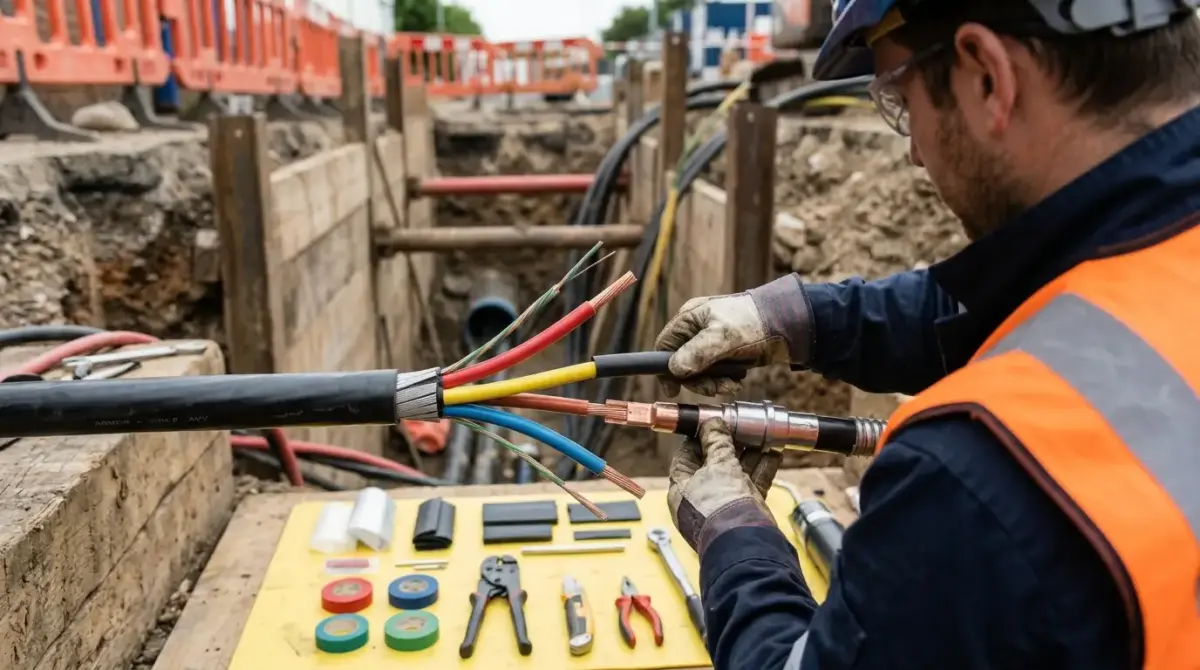
TL;DR — What crews most often get wrong about cable jointing safety
- Myth: arc-rated clothing protects you from electric shock. Reality: it only limits burns from an arc’s heat. It does nothing to stop current passing through your body.
- Myth: once a cable is isolated, it’s safe to cut. Reality: jointers positively identify and spike the cable first, because the wrong cable or a back-feed still kills.
- Myth: jointing is just a low-voltage electrician’s task. Reality: much of it is medium- and high-voltage work needing a trained, authorised competent person.
- Myth: PPE is the main safeguard. Reality: PPE is the last layer. Isolation, proving dead, and a safe system of work do the real protecting.
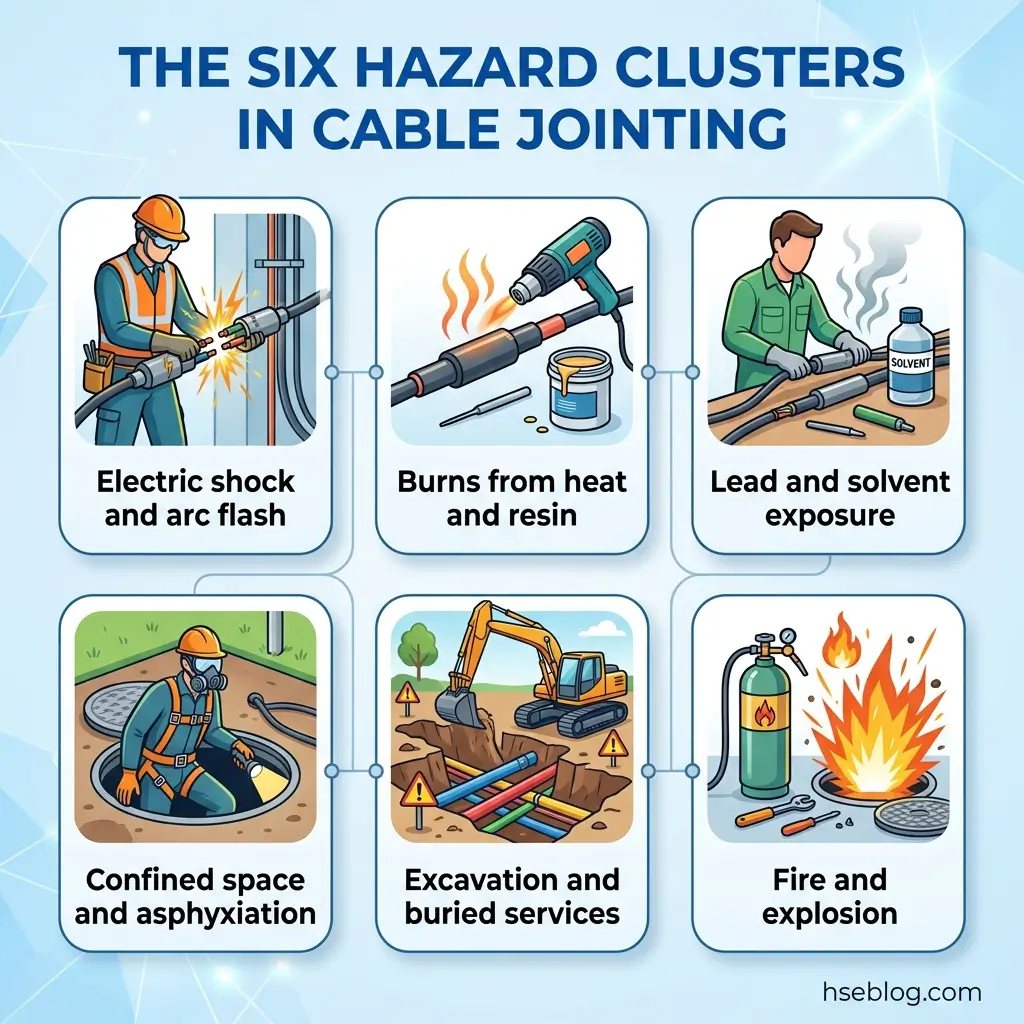
Cable jointing safety depends on controlling several hazards at once: electric shock and arc flash, burns from heat and resins, lead and solvent exposure, and confined-space and excavation risks. The core controls are safe isolation, proving dead and spiking before cutting, a competent-person safe system of work, and PPE matched to each specific hazard.
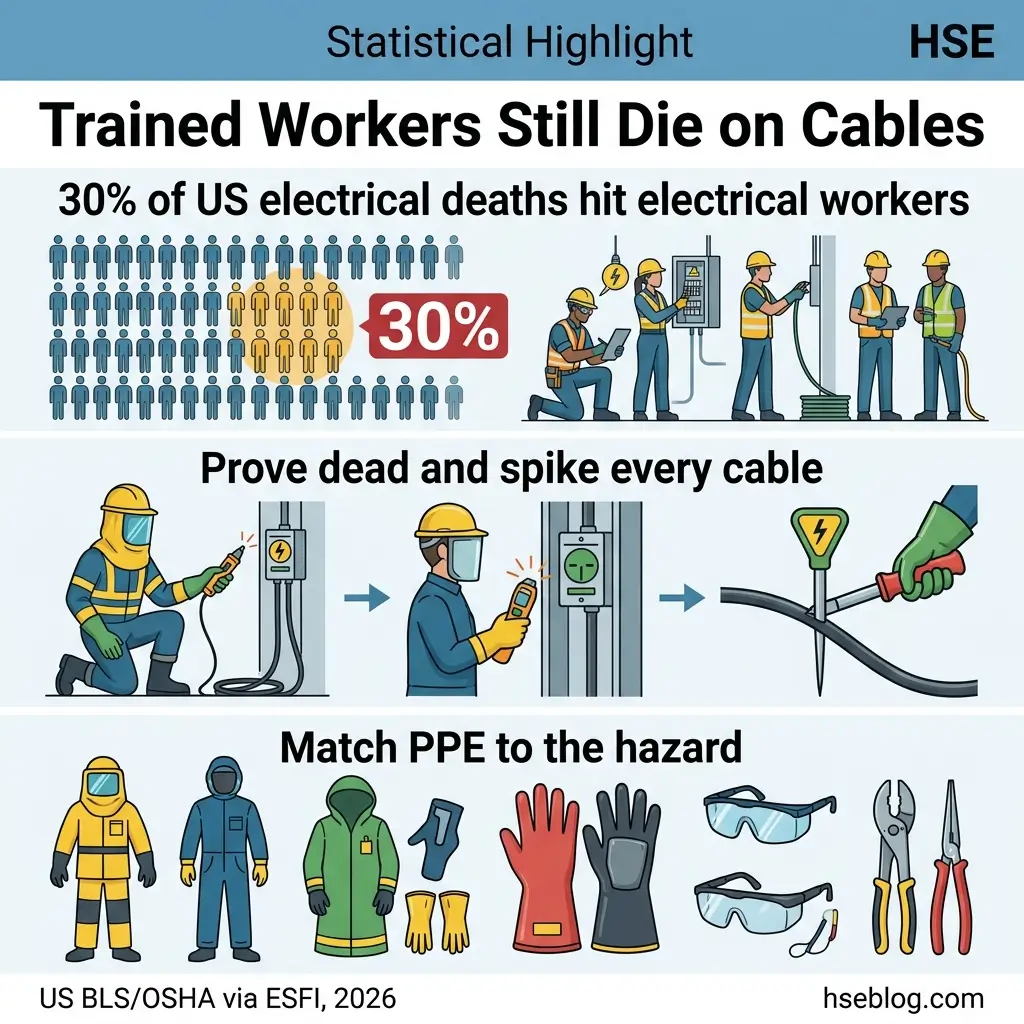
Contact with electricity still kills the people who work with it for a living. Around 30% of US workplace electrical fatalities between 2011 and 2024 struck workers in electrical occupations — the trained, not the untrained (ESFI analysis of US BLS/OSHA data, 2026).
Cable jointing concentrates that danger. A single joint can put a worker within reach of a live conductor, a gas flame, lead fume, and an oxygen-deficient hole in the ground — sometimes inside the same hour. This article sets out the main hazards of cable jointing and the PPE requirements that match them, along with the legal duties and safe systems of work behind them.
This article provides general HSE knowledge. Cable jointing on live or recently isolated conductors must be planned and supervised by a competent person with relevant training, jurisdiction-specific authorisation, and a site-specific risk assessment. The information here does not replace that. Recognised competence routes include City & Guilds and utility jointer apprenticeships, NEBOSH and IOSH qualifications for supervisors, and, in the US, OSHA outreach and 1910.269 qualified-worker training.
Why Cable Jointing Concentrates So Many Hazards
Cable jointing is the controlled joining or terminating of power cables, and it pulls electrical, thermal, chemical, and confined-space risks into a single task. Few other trades stack this many unrelated hazards on top of each other in one work area.
The exposure changes with the cable and the location. A jointer may work on any of these:
- Low-voltage (LV) cables up to 1 kV — service connections, distribution mains, the everyday bulk of the work.
- Medium- and high-voltage (MV/HV) cables at 11 kV, 33 kV and above — where a single mistake carries lethal fault energy.
- Paper-insulated lead-covered (PILC) cables — older network stock with a lead sheath and oil-impregnated paper insulation.
- Polymeric cables (XLPE/EPR) — modern cross-linked or rubber insulation that dominates new installations.
The setting adds its own hazards: jointing bays, street footway boxes, deep excavations, underground manholes and vaults, and substation floors.
From lead sheaths to polymeric cables
As of 2026, most new network is polymeric, and heat-free “cold-shrink” jointing has replaced much of the torch and molten-metal work. Legacy PILC cable is still widespread, though, which is why lead exposure has not left the trade — it has only become intermittent, and intermittent hazards are the ones crews stop preparing for.
Electrical Hazards: Shock, Back-Feed, and Arc Flash
The electrical hazards kill quickest: direct shock, unexpected re-energisation, induced voltage, and arc flash. The recurring fatal failure across the incident record is simple to state and hard to prevent — a worker cuts into a cable that turns out to be live, or a cable that becomes live again while they work on it.
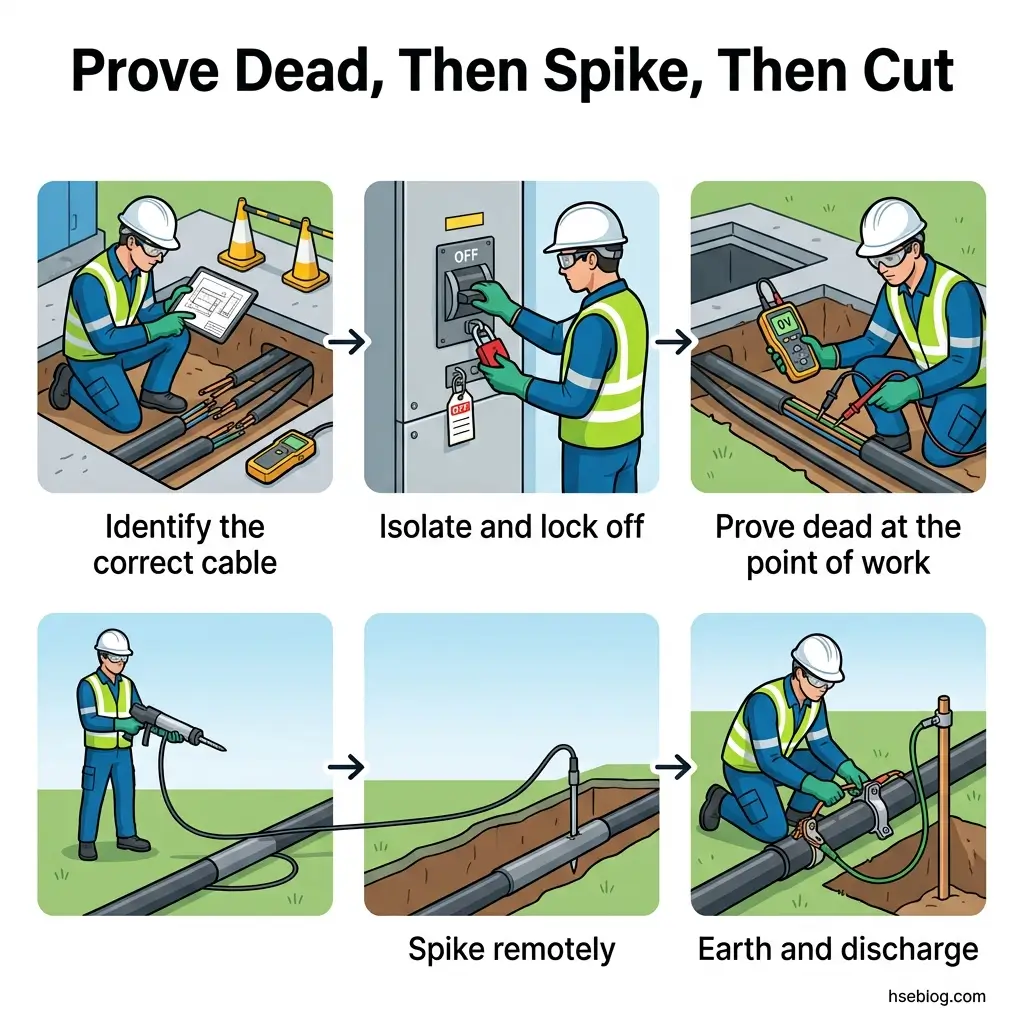
That is why jointers never rely on isolation alone. The sequence that confirms a cable is genuinely safe to cut runs like this:
- Identify the correct cable using records, tracing and phasing — not appearance, which is unreliable underground.
- Isolate and lock off every source of supply, and control the point of isolation with a permit-to-work on HV systems.
- Prove dead at the point of work with a voltage indicator and proving unit meeting the relevant test-equipment standard (in the UK, HSE Guidance Note GS38).
- Spike the cable remotely, driving an earthed pin through it to force a fault on any cable still live — the definitive proof before a hand goes near it.
- Apply earths and discharge stored charge, because a long cable holds a dangerous capacitive charge even after isolation.
Back-feed is the trap that catches experienced crews. A cable can be re-energised from a parallel circuit, a standby generator, or an embedded generator that was never part of the isolation — the current does not care that a permit was signed somewhere upstream.
Induced voltage is the second surprise. A “dead” cable running alongside live circuits can carry enough induced voltage to injure, which is why earthing at the point of work matters as much as isolation.
Arc flash is the violent failure mode. If a live cable is cut or a nearby fault develops, the resulting arc reaches temperatures near 19,000°C (OSHA), throwing a pressure wave, molten metal and intense ultraviolet light in a fraction of a second. The HSE’s HSG85 guidance treats this energy as the reason dead working is the default; in the US, NFPA 70E requires an incident-energy assessment so that arc-rated PPE is matched to the actual fault level rather than guessed.
The Hazards That Get Underestimated: Burns, Fumes, Lead, and Confined Spaces
Across the incident record, it is often the non-electrical hazards that catch competent crews off guard. Each one below has its own mechanism and its own control:
- Burns. Gas torches for heat-shrink joints, molten solder and wiping metal, and the heat of a curing resin exotherm all cause serious burns. Substituting cold-shrink and mechanical connections removes much of this exposure.
- Chemical exposure. Two-part jointing resins historically contained isocyanates (MDI), a respiratory sensitiser; solvent cleaners and degreasers add skin and inhalation risks. Newer MDI-free resin kits have reduced, not eliminated, the need for COSHH controls in the UK and hazard-communication controls under OSHA.
- Lead. Working on PILC cables — sheath handling and the traditional “lead wiping” technique — releases lead fume and dust, a cumulative neurotoxin. In Great Britain this falls under the Control of Lead at Work Regulations 2002, which can trigger blood-lead health surveillance.
- Confined spaces. Manholes, vaults and jointing bays can be oxygen-deficient, hold flammable or toxic gas, or flood. UK entry is governed by the Confined Spaces Regulations 1997; US entry to enclosed spaces with electrical equipment is covered by OSHA 1910.269(e) and (t).
- Excavation and buried services. Digging to reach a joint risks striking other live cables and gas mains, and risks trench collapse. Safe-digging practice — service plans, cable-avoidance tools (CAT and Genny), and trial holes — is set out in HSE guidance HSG47.
- Fire and explosion. A gas torch used in a manhole where flammable gas has accumulated is a well-understood ignition scenario, which is why atmospheric testing precedes any hot work below ground.
A note on the health hazards above: content covering lead exposure and health surveillance is for HSE practitioner reference. It is not medical advice. Workers with symptoms or exposure concerns should consult an occupational physician.
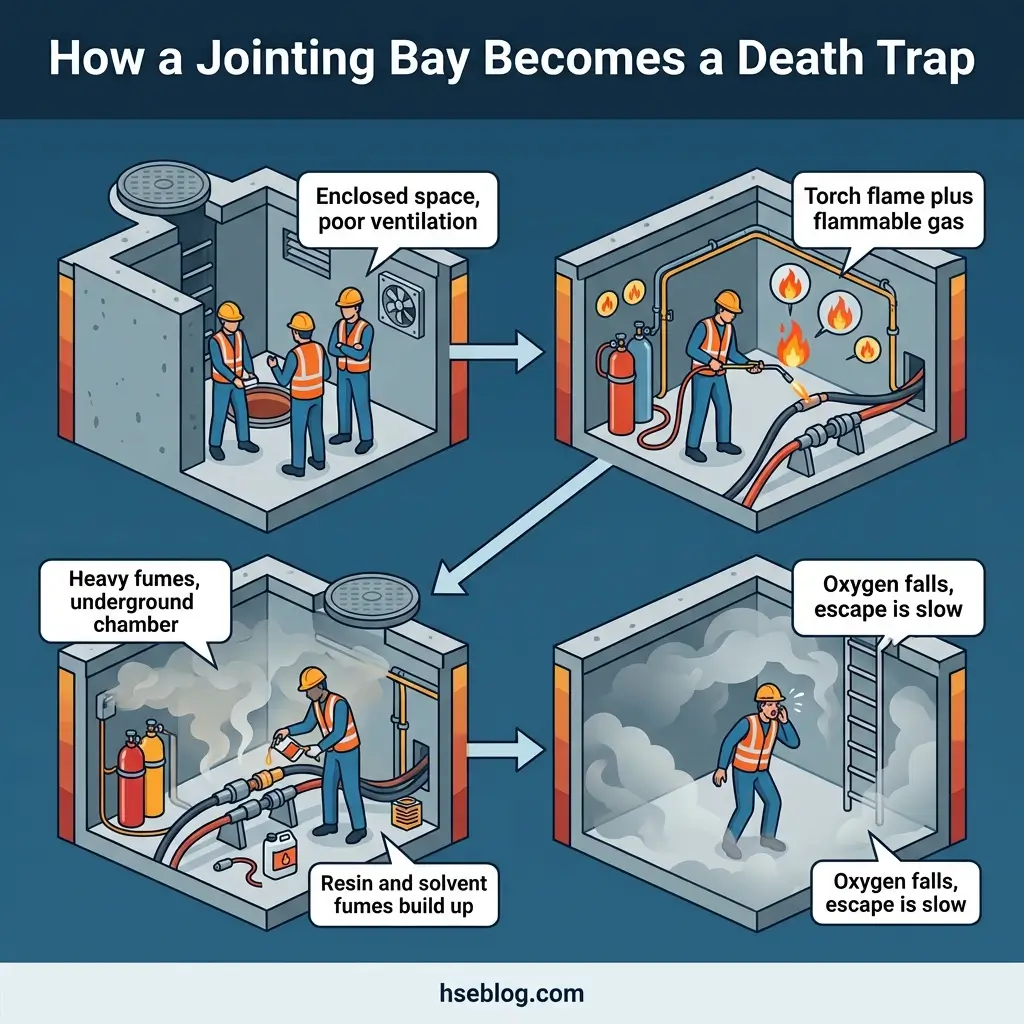
The judgment call worth naming is when an enclosed space stops being routine. Under OSHA 1910.269, a manhole with only electrical hazards can be entered by qualified staff without a full permit — but the moment a flammable atmosphere, engulfment risk or non-electrical hazard is present, permit-required confined-space rules apply. Treating every borderline bay as routine is how crews walk into an atmosphere that a two-minute gas test would have flagged.
PPE Requirements for Cable Jointing
PPE is the last line of defence, and each item must be chosen for the specific hazard it addresses — not bought as a generic bundle. The table below maps the core PPE for cable jointing to the hazard it controls and the standard that governs it.
| PPE item | Hazard it controls | Governing standard | Key requirement |
|---|---|---|---|
| Arc-rated clothing | Arc-flash burns | IEC 61482 (int.) / ASTM F1506 (US) | Arc rating (cal/cm²) must exceed the assessed incident energy |
| Arc face shield or flash hood | Face and eye arc burns | IEC 61482 / NFPA 70E | Rated as a system with the clothing |
| Insulating gloves | Electric shock | IEC 60903 (int.) / ASTM D120 (US) | Class matched to voltage; worn with leather protectors; retested |
| Insulating matting | Shock during switching | Rated insulating mat to relevant standard | Correct voltage rating; kept dry and undamaged |
| Safety footwear | Impact, penetration | EN ISO 20345 (UK/EU) | Toe and midsole protection |
| Respiratory protection | Lead fume, resin/solvent vapour | Selected against the specific contaminant | Used with local exhaust ventilation, not instead of it |
Two points cause more harm than any equipment gap.
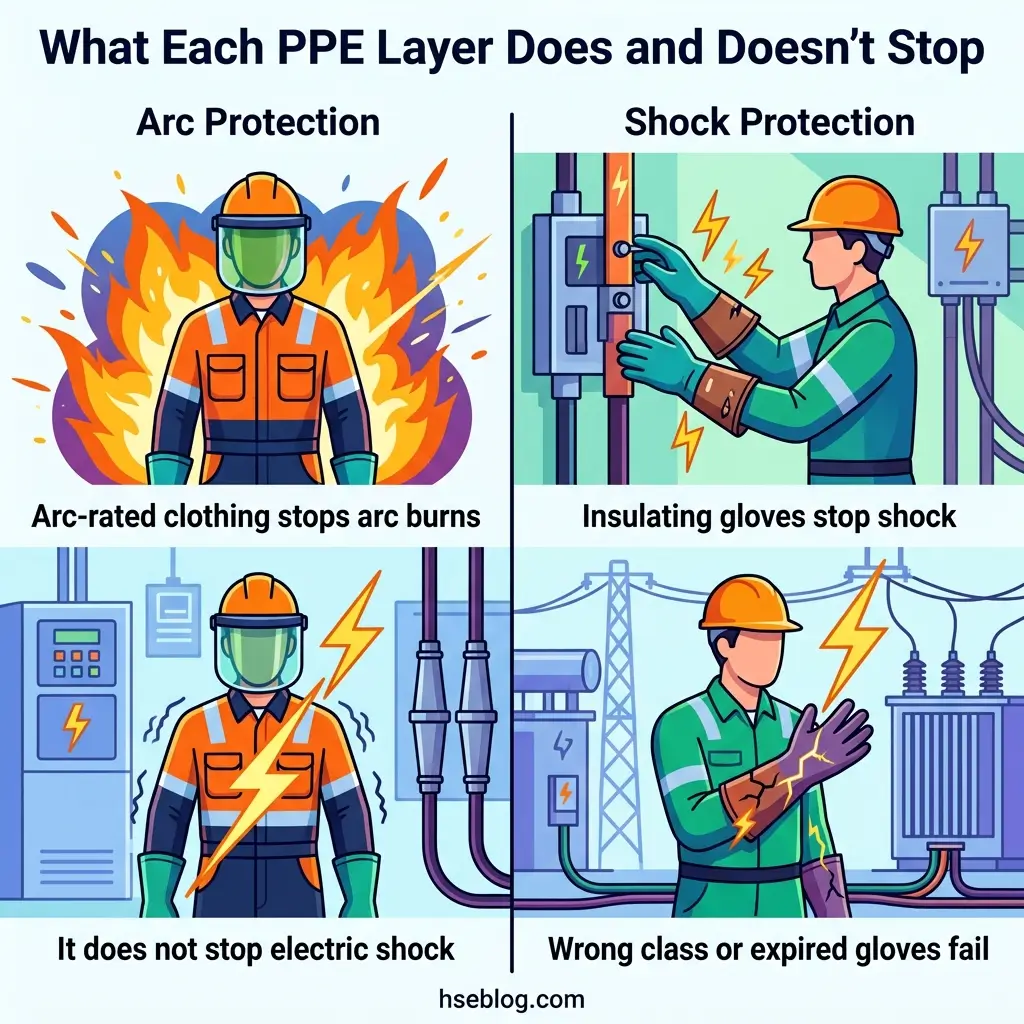
Arc-rated clothing does not protect against electric shock. The IEC 61482 standard explicitly covers only the thermal effects of an arc — a worker in a full arc suit can still be electrocuted by contact with a live conductor. Arc protection and shock protection are separate problems solved by separate equipment.
Insulating gloves only work when they are the right class, in date, and protected. IEC 60903 sets six classes by maximum working voltage:
- Class 00 — up to 500 V
- Class 0 — up to 1,000 V
- Class 1 — up to 7,500 V
- Class 2 — up to 17,000 V
- Class 3 — up to 26,500 V
- Class 4 — up to 36,000 V
Gloves must be worn over-tested (typically re-tested every six months) and fitted with leather protector gauntlets against mechanical damage. Time-expired, untested or over-voltage gloves are a common and dangerous shortcut.
One legal point matters for how jointing crews are staffed. Since 6 April 2022, the Personal Protective Equipment at Work (Amendment) Regulations 2022 extend the employer’s PPE duty in Great Britain to “limb (b)” workers — the casual and contract labour common on jointing jobs. In the US, the equivalent obligations sit in OSHA 1910.137 and 1910.335.
Legal Duties and the Safe System of Work
Under the Electricity at Work Regulations 1989, dead working is the default and live working is the exception you must justify. The regulations set the duties; HSG85 is the practical code that explains how to meet them.
Dead by default, and when live work is allowed
Three regulations do most of the work here. Regulation 13 requires precautions to stop equipment made dead from becoming live while people work on or near it. Regulation 14 permits live working only when three conditions are met at the same time: it is unreasonable to work dead, it is reasonable to work live, and suitable precautions prevent injury.
Regulation 16 fixes competence as a prerequisite for anyone doing the work, and the dutyholder throughout is the employer. In practice, the greater the risk, the harder Regulation 14 is to satisfy — which is why routine jointing is almost never justified as live work, and why auditors test the system by asking to see the proving-dead and spiking records, not the risk assessment on its own.
The US framework reaches the same destination differently. OSHA 29 CFR 1910.269 requires lockout/tagout under paragraph (d), de-energising and grounding of lines under paragraph (m), and — for underground work — enclosed-space precautions and a trained attendant on the surface under paragraphs (e) and (t).
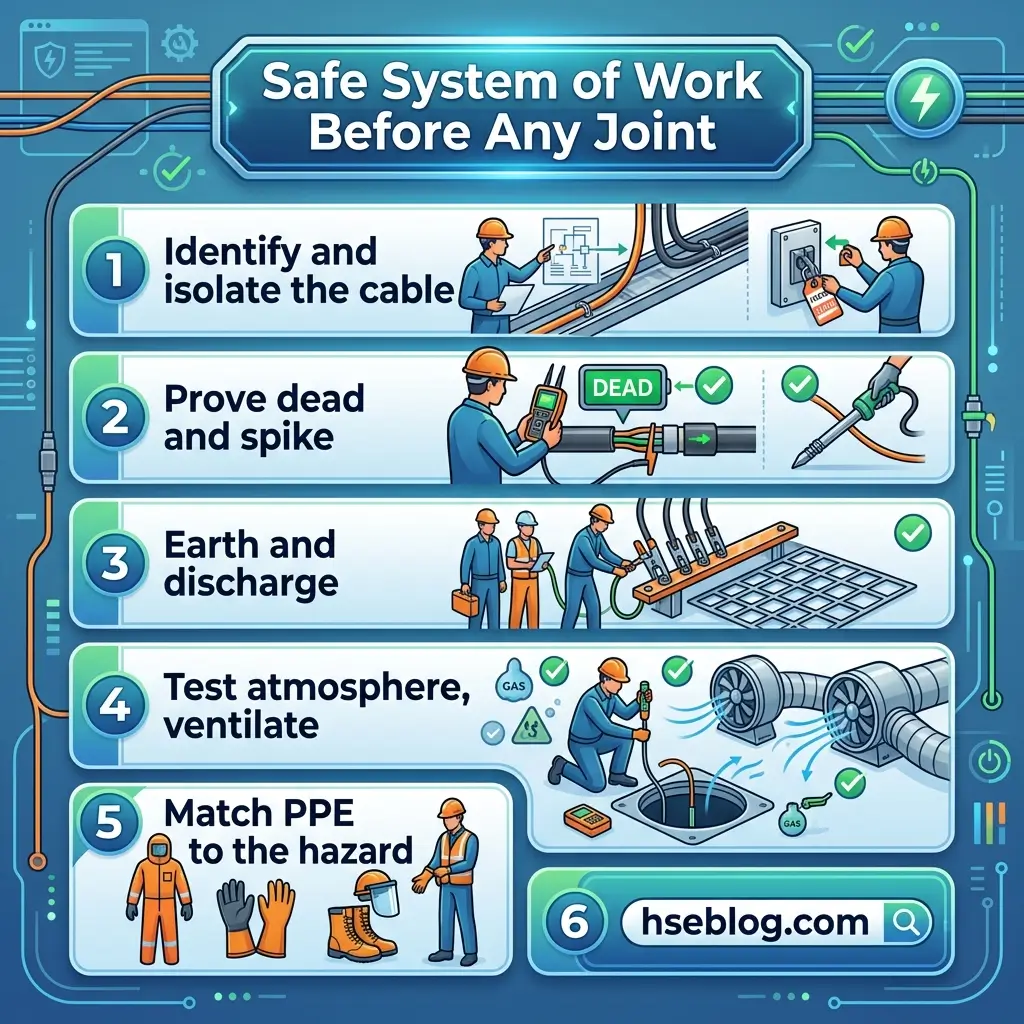
A defensible safe system of work for any joint runs in this order:
- Positively identify the cable.
- Complete the risk assessment and permit-to-work.
- Isolate and lock off all sources.
- Prove dead with compliant test equipment.
- Spike the cable before cutting.
- Apply earths and discharge stored charge.
- Test the atmosphere and ventilate any confined space.
- Issue and check hazard-matched PPE.
- Confirm rescue arrangements before entry.
Regulatory content here reflects general HSE professional understanding of Great Britain requirements as of 2026, with US references as noted. It is not legal advice. Specific compliance questions, enforcement situations or prosecution risk should be directed to qualified legal counsel in the applicable jurisdiction.
Where Cable Jointing Safety Actually Breaks Down
In practice, the same handful of failures recur behind serious jointing incidents, and none of them are exotic. Recognising the pattern is more useful than memorising the standards:
- Wrong cable, cut or spiked. Misidentification, thin records, or trusting appearance underground. This is the archetypal jointing fatality.
- Isolation defeated or re-energised. An overlooked generator, a parallel circuit, or a lock removed by someone who “needed the supply back.”
- Skipping the spike under time pressure. The step that feels redundant right up until the one time it isn’t.
- Entering a confined space without testing. No gas test, no ventilation, no attendant — an atmosphere problem that was entirely detectable.
- Torch work in a flammable atmosphere. Hot work below ground before the air was proven safe.
- PPE mistaken for a safe system. Treating arc clothing as shock protection, or reaching for over-voltage, expired, or unprotected gloves.
The thread running through all of them is the same: the electrical fundamentals were skipped, and equipment was asked to do a job that only procedure can do.
Frequently Asked Questions
The One Change That Prevents Most Jointing Deaths
The lesson the incident record keeps repeating is that fatal jointing failures are procedural, not technical. Crews rarely die because a standard was too weak; they die because a cable was cut before it was positively identified, proved dead and spiked. If a jointing operation improved only one thing, that discipline would be it.
The PPE lesson sits alongside it. Arc-rated clothing and insulating gloves are the last layer — in date, correctly classed, and matched to the hazard — never the thing that makes unsafe work safe. Cable jointing safety is won upstream, in the isolation and the safe system of work, long before anyone opens a kit.
As of 2026, the shift to heat-free jointing and MDI-free resins has genuinely cut the burn and chemical exposure that older methods carried. The electrical fundamentals have not moved an inch — the cable that killed a jointer in 1990 kills the same way today, and it still answers only to identification, proving dead, and the spike.