
TL;DR
- If you run any Class 3B or Class 4 laser, then you are expected to designate a Laser Safety Officer with authority to enforce controls (ANSI Z136.1-2022, US).
- If OSHA inspects a US laser workplace, then it applies no dedicated laser standard — inspectors measure you against ANSI Z136.1 through the General Duty Clause (OSHA, 2026).
- If the same work happens in Great Britain, then a risk assessment sets the trigger, not a class number alone, under the Control of Artificial Optical Radiation at Work Regulations 2010 (HSE).
- If your LSO holds the title but not the authority, then the program is decorative — delegated authority from management is the role’s load-bearing requirement.
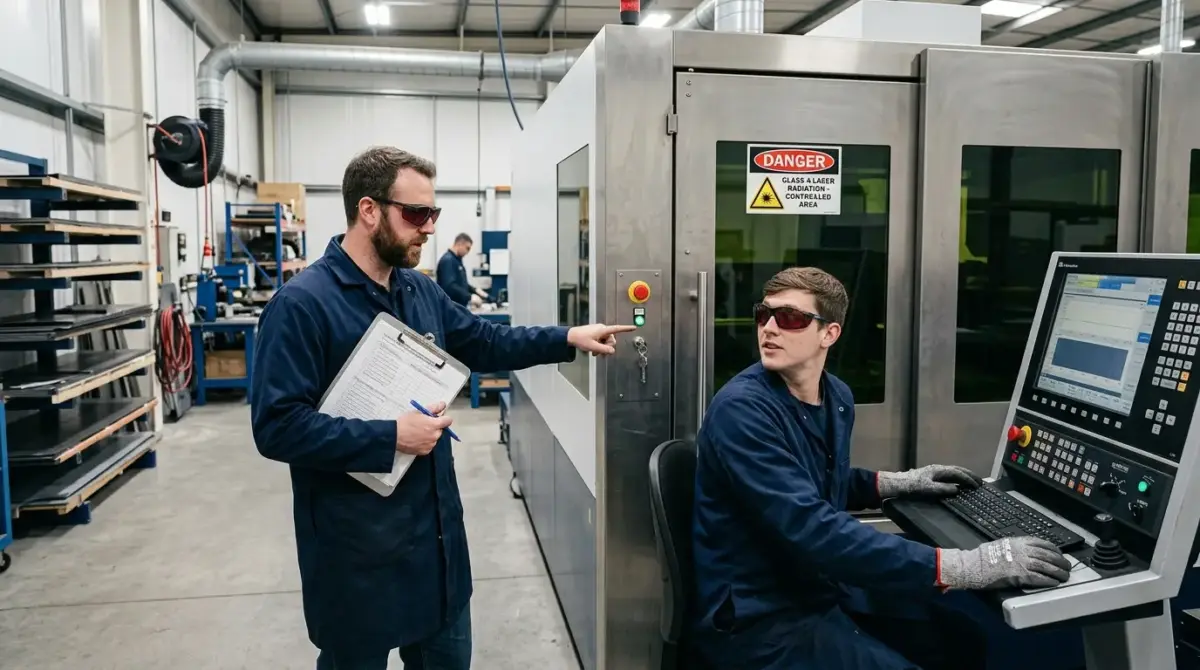
A Laser Safety Officer is the individual an organization designates to evaluate laser hazards and enforce the controls that keep beams away from eyes and skin. Under ANSI Z136.1, the Laser Safety Officer roles and responsibilities span classification, hazard-zone calculation, eyewear selection, training, and incident response for Class 3B and Class 4 systems.
Plenty of competent engineers assume that because the United States has no comprehensive federal laser standard, nobody is legally obliged to appoint a Laser Safety Officer. That reading is wrong, and it gets expensive fast. OSHA has openly acknowledged that it never issued specific criteria for employee laser use, yet its inspectors still cite employers — using the General Duty Clause and treating ANSI Z136.1 as the benchmark when evaluating laser workplaces. LegalClarity
The stakes are biological and permanent. A misdirected Class 4 beam can destroy retinal tissue faster than the blink reflex can close the eye, and the same energy that cuts steel will ignite drapes, fumes, or skin. This article sets out what a Laser Safety Officer actually does, when the role is legally required, the duties it carries across jurisdictions, and where these programs quietly fail.
This article provides general HSE knowledge. Life-critical laser work — Class 3B and Class 4 beam alignment, servicing, and controlled-area entry — must be planned and supervised by a competent person with relevant training, jurisdiction-specific authorization, and a site-specific risk assessment. The information here does not replace that.
What a Laser Safety Officer Actually Does
The Laser Safety Officer is the designated authority who turns a written safety policy into enforced practice wherever hazardous lasers operate. The role exists because laser hazards are technical, invisible, and unforgiving — informal judgment is not a reliable substitute for someone accountable.
ANSI Z136.1 frames the LSO around two words that carry the whole role: authority and evaluation. The standard defines the LSO as someone with the authority to monitor and enforce the control of laser hazards and to effect their knowledgeable evaluation and control. A useful way to read the standard: wherever it lists an LSO duty, it means the LSO either performs the task or ensures the task is performed. RliRli
That distinction matters on real sites. The LSO is:
- An owner of outcomes, not necessarily a calculator. The LSO need not personally compute every exposure limit; they must ensure the analysis happens and that controls follow from it.
- An enforcer with backing. The role only works when management has visibly delegated the power to stop unsafe work.
- A single accountable point. When classification, eyewear, training, or an incident is in question, the answer routes to one named person.
A common misconception is that the LSO must be the most technically brilliant laser user in the building. The opposite is closer to the truth — appointing the chief laser scientist or laser surgeon as LSO is widely discouraged in the profession, on the logic that you do not make the race driver the traffic cop. Respect, independence, and authority outrank raw optical expertise.
When Is a Laser Safety Officer Required?
The trigger is hazard class, and the line falls between the lower classes and the dangerous ones. Class 1, 1M, 2, 2M and 3R lasers generally do not require a permanently designated LSO, while Class 3B and Class 4 systems do. Gentec-EO
In US practice, the expectation crystallizes around these situations:
- Any Class 3B or Class 4 laser is in operation, maintenance, or service. This is the core trigger under ANSI Z136.1, regardless of industry.
- An open beam path exists where personnel could be exposed during alignment, processing, or research.
- An embedded Class 3B or 4 laser is serviced inside an otherwise enclosed Class 1 product — the moment the housing comes off, the higher-class hazard is live.
- A laser is built in-house or modified after purchase, because modification can change the class and invalidate the manufacturer’s label.
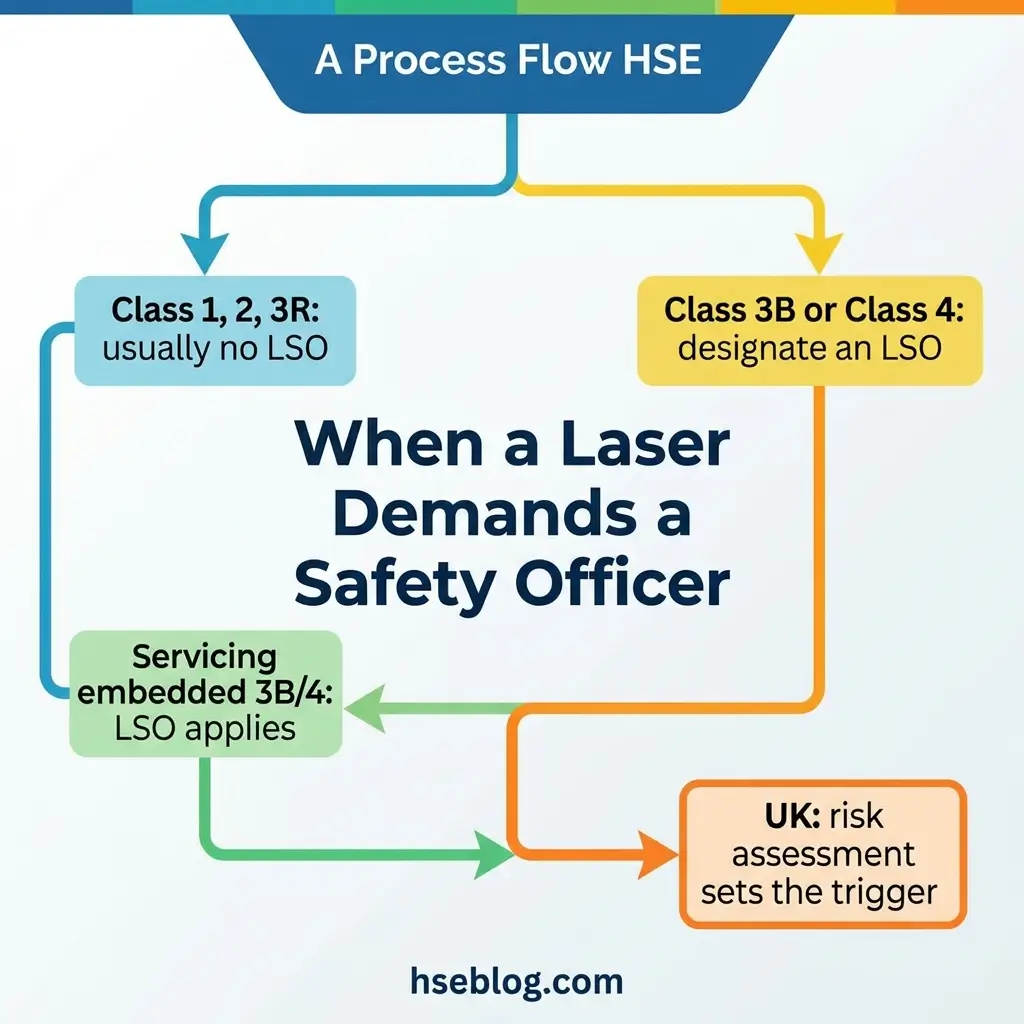
Jurisdiction changes the logic. Great Britain does not key the duty to a US class number; instead, the Control of Artificial Optical Radiation at Work Regulations require employers to protect workers from hazardous sources of artificial optical radiation through risk assessment, with a competent person appointed to manage it. The destination is the same — competent oversight of dangerous beams — even where the regulatory path differs. HSE
The Core Responsibilities of a Laser Safety Officer
Strip away the jargon and the LSO’s job is to interpose engineered, administrative, and procedural controls between a hazardous beam and the people near it. The duties cluster into four working areas.
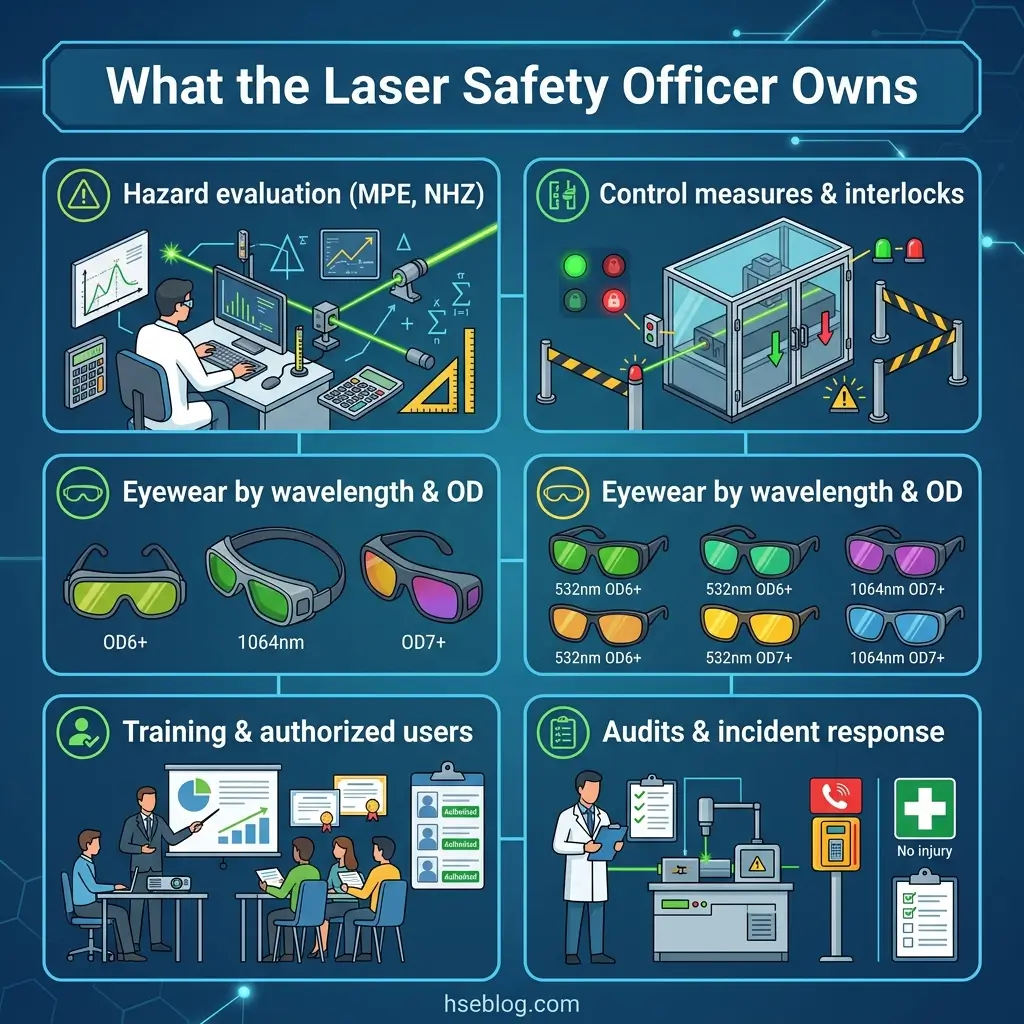
Hazard evaluation and classification
This is the analytical heart of the role. The LSO confirms each system’s class, then drives the hazard analysis that produces the numbers controls depend on:
- Maximum Permissible Exposure (MPE) — the level a person can be exposed to without injury to eye or skin.
- Nominal Hazard Zone (NHZ) — the region within which beam, reflected, or scattered exposure can exceed the MPE.
- Optical Density (OD) — the attenuation any protective eyewear must deliver at the laser’s specific wavelength.
Control measures and the laser controlled area
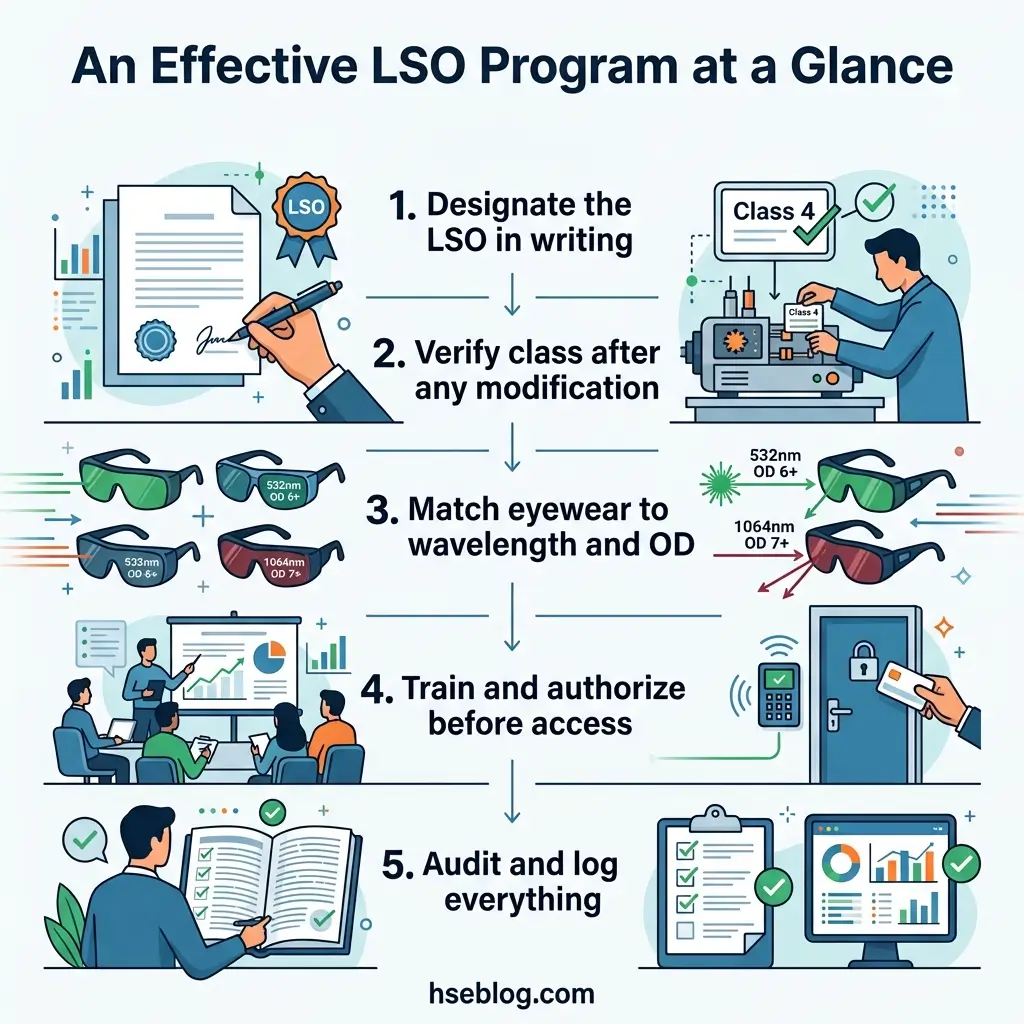
The LSO selects and verifies controls in priority order — engineering first, then administrative, then PPE. In practice that means beam enclosures, interlocks, and a defined laser controlled area before relying on eyewear and signage.
Eyewear, training, and authorized users
Protective eyewear is selected by wavelength and OD, not by appearance, and the latest equipment-testing guidance was reissued as ANSI Z136.7-2025. The LSO also defines who is authorized to operate or enter, and ensures every operator and support worker is trained before going near the beam.
Surveillance, audits, and incident response
The LSO keeps records, runs periodic audits, and owns the response when something goes wrong — including referral pathways after a suspected exposure. A worker with eye symptoms or a known exposure should be evaluated by an occupational physician or ophthalmologist; that referral is part of the program, not a substitute for medical advice.
How the Law Backs the LSO Role Across Jurisdictions
No single global statute creates the LSO; instead, a web of standards and regulations converges on the same competent-oversight requirement. The mechanics differ enough that jurisdiction must always be stated.
| Jurisdiction | Primary instrument | How the LSO duty bites |
|---|---|---|
| United States | OSH Act §5(a)(1) General Duty Clause; ANSI Z136.1-2022 | No dedicated laser standard; OSHA enforces recognized hazards against ANSI as the abatement benchmark |
| US construction | 29 CFR 1926.54 | Specific, enforceable rules for laser operators and eye protection on construction sites |
| US products | FDA/CDRH 21 CFR 1040.10 & 1040.11 (FLPPS) | Manufacturer classification and labeling before a laser enters commerce |
| United Kingdom | CAOR Regulations 2010 (SI 2010/1140) | Employer risk assessment and control; competent person appointed |
| European Union | Directive 2006/25/EC | Member-state duty to assess exposure and provide training |
The US picture rewards a closer look. OSHA does not have a comprehensive laser standard, though 29 CFR 1926.54 applies to construction, and that construction rule is concrete: it requires that only qualified and trained employees operate laser equipment and that anti-laser eye protection be provided wherever exposure could exceed five milliwatts. For everything outside construction, OSHA leans on its Technical Manual and field enforcement, citing recognized hazards through the General Duty Clause. Occupational Safety and Health Administration
The current consensus document is ANSI Z136.1-2022, which replaced the 2014 edition. It is a horizontal standard, meaning the vertical members of the series take precedence within their scope — and the healthcare member, ANSI Z136.3, was revised in 2024 and harmonized with Z136.1, tightening expectations for medical laser safety officers. In Great Britain, the HSE’s guidance on lasers frames the same duties through the lens of reasonably practicable risk reduction rather than a class threshold. LegalClarity
Regulatory content here reflects general HSE professional understanding of US, UK, and EU requirements as of 2026. It is not legal advice. Specific compliance questions, enforcement situations, or prosecution risk should be directed to qualified legal counsel in the applicable jurisdiction. Regulatory content was reviewed for currency in 2026.
Competence, Authority, and Certification
The single biggest predictor of a working laser safety program is not the LSO’s optical mathematics — it is the authority management actually delegates. A title without the power to halt unsafe work produces a paper program and exposed eyes.
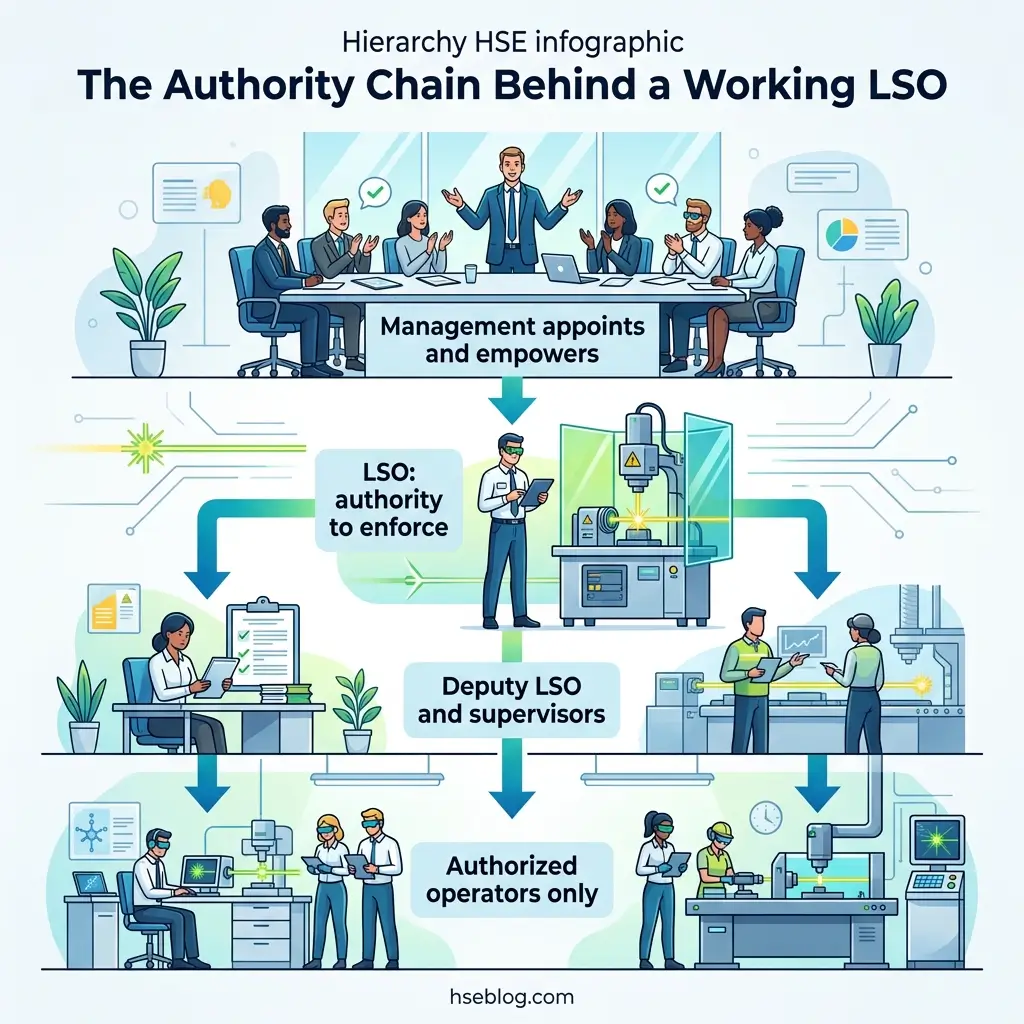
What management must provide for the role to function:
- Documented appointment. The LSO should be designated in writing, with the authority to enforce controls without waiting on approval.
- Time and resources. Oversight, audits, and training cannot run as an afterthought squeezed between other duties.
- Access to expertise. The LSO may bring in specialists for MPE, NHZ, and OD calculations — the role demands judgment to apply the results, not to derive every formula alone.
The role can be full-time, a collateral duty, or an external appointee, scaled to the hazard. Certification is available but voluntary: the Board of Laser Safety offers the Certified Laser Safety Officer (CLSO) credential, valid on a three-year cycle maintained through continuing-education points. It strengthens credibility and is not a legal prerequisite to serve as an LSO.
Training expectations are also shifting. Writing in Lab Manager (2025), an ANSI committee member noted that refresher training is moving from a recommended to an expected practice, with a three-year interval often cited — a signal worth building into program design now rather than after the next audit.
Where Laser Safety Officer Programs Break Down
The published and enforcement record points to the same handful of failure modes, year after year. None of them are exotic; all of them are preventable by an empowered LSO.
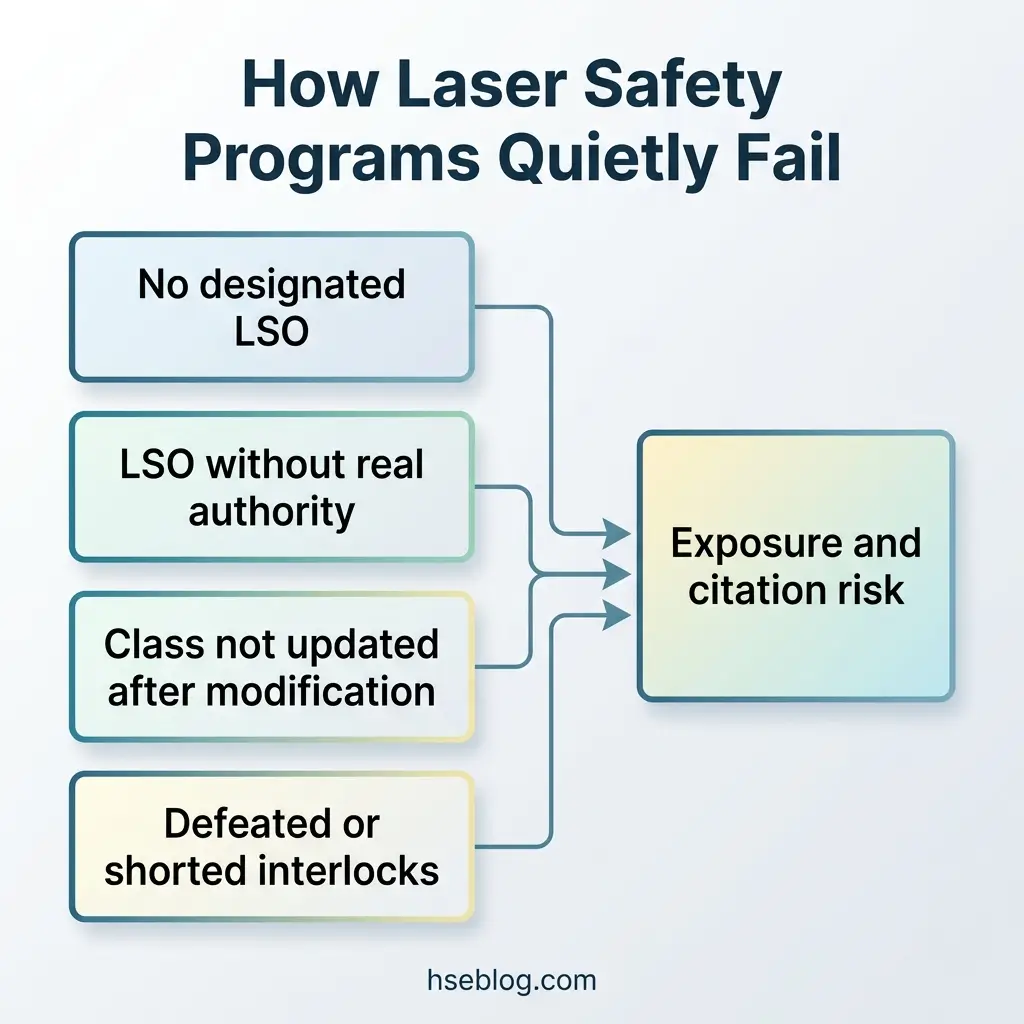
The recurring patterns:
- No LSO where one is required. Running a Class 4 laser with no designated officer is the kind of single deficiency OSHA treats as a recognized-hazard violation under the General Duty Clause.
- A figurehead LSO. The role exists on the org chart but cannot stop a production run, so controls erode under schedule pressure.
- Stale classification. A laser is modified, its class changes, and nobody reclassifies it — so the controls no longer match the hazard.
- Defeated engineering controls. Interlocks shipped in a shorted state are never properly configured, and the first line of protection is silently absent.
- Wrong-point hazard testing. Reflective and scattered-beam risks go unassessed at the working position, where the real exposure lives.
Frequently Asked Questions
Conclusion
The industry’s most common mistake with Laser Safety Officer roles and responsibilities is treating the appointment as a compliance signature rather than a transfer of power. A facility can write a flawless laser safety policy, buy the correct eyewear, and post every placard — and still injure someone if the LSO cannot stop a run when the controls fail.
The highest-impact change costs nothing and changes everything: give the LSO real, documented authority and the resources to use it. Hazard classes, NHZ calculations, and OD selections are solvable technical problems; an unempowered safety officer is not. Get the authority right, and the rest of the program finally has somewhere firm to stand.