
TL;DR
- Match the wavelength first. Eyewear must block the exact nanometre(s) your laser emits — a green-laser filter does nothing against a 1064 nm beam.
- Then match the optical density. The OD must drop the beam below the maximum permissible exposure under worst-case conditions, not just “look dark.”
- Check the operating mode. Continuous-wave, pulsed and ultrashort-pulse lasers can defeat a filter rated only for one of them.
- Confirm the standard marking. ANSI Z136 (US) and EN 207 / EN ISO 19818‑1 (Europe, UK, Canada) carry the wavelength, OD and damage data on the lens.
- Treat eyewear as the last layer. Enclosures, interlocks and beam controls come first; PPE only catches what they miss.
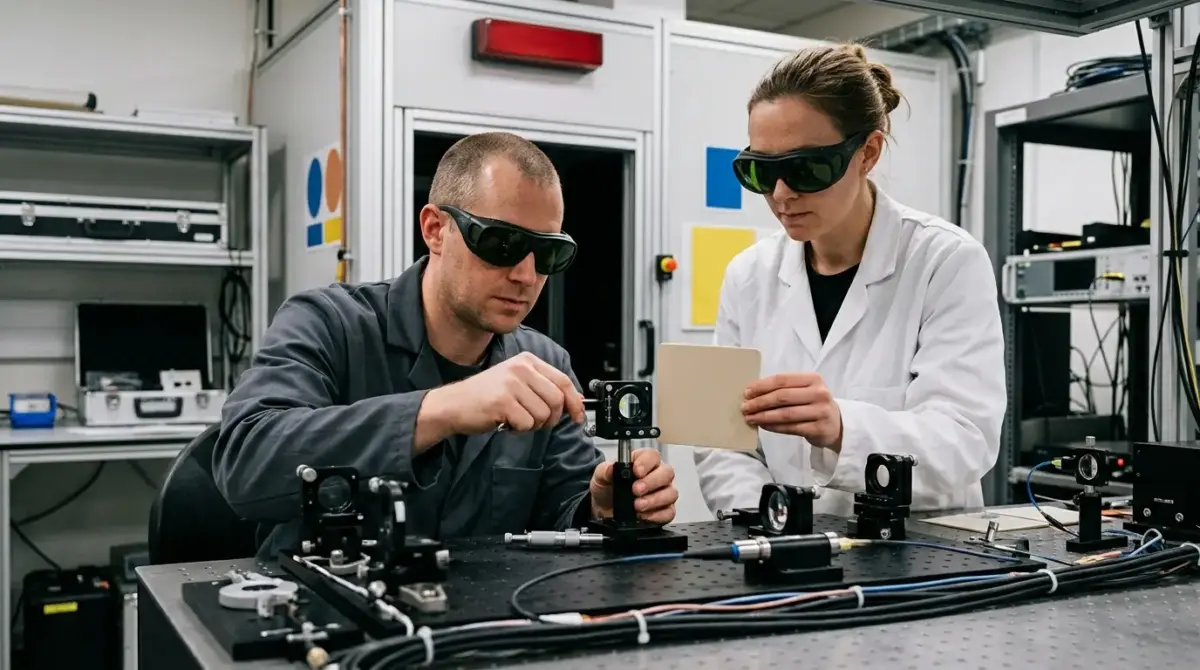
Laser eye protection is wavelength-specific PPE that attenuates a beam below the maximum permissible exposure for the exact wavelengths in use. Correct selection depends on wavelength, required optical density, operating mode and hazard class — never on brand, tint, or how dark the lens appears. Eyewear is the final control layer, not the first one.
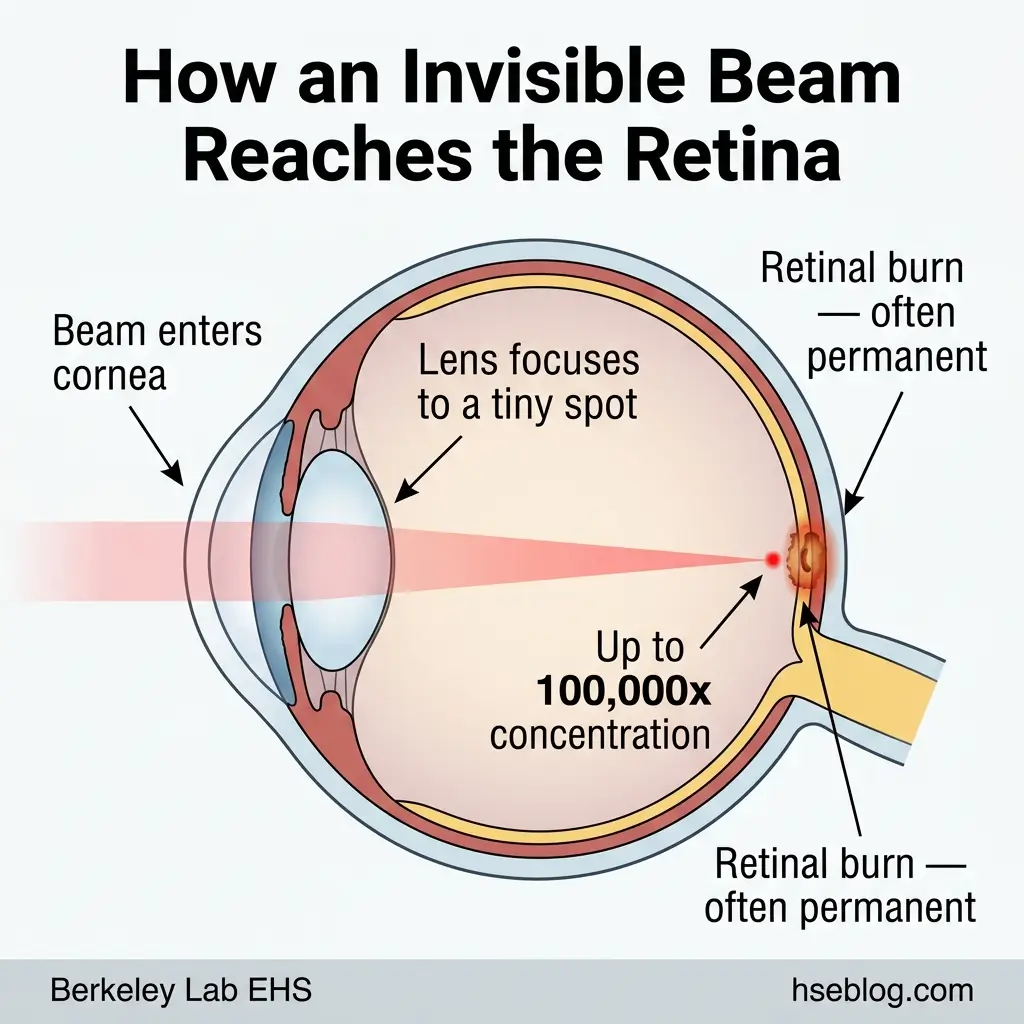
The human eye is an excellent lens, and that is precisely the problem. A collimated beam in the 400–1400 nm band passes through the cornea and lens and is focused onto a spot on the retina only 10–20 microns across, concentrating the energy that arrives at the cornea by up to 100,000 times (Lawrence Berkeley National Laboratory EHS). A beam that feels harmless on the back of your hand can scar the retina before you finish blinking.
That focusing effect is why laser eye protection sits in a stricter category than ordinary safety eyewear. This article covers how laser energy injures the eye, when eye protection becomes mandatory by hazard class, how optical density and wavelength drive selection, how to read ANSI and European markings, and the recurring mistakes that put trained people in front of a beam without the right filter.
Why Laser Eye Injuries Behave Differently to Other Hazards
The location of the injury is decided by wavelength, and that single fact shapes every protection decision. Where the energy lands in the eye depends on which tissue absorbs it, so two lasers of identical power can damage entirely different structures.
The published clinical and physics literature divides the spectrum into consistent bands:
- Ultraviolet (180–400 nm): Mostly absorbed at the cornea and lens, causing photochemical damage — photokeratitis (the same “welder’s flash” mechanism) and, with chronic exposure, cataract formation.
- Retinal hazard region (400–1400 nm): The cornea, lens and vitreous are transparent here, so the beam reaches and burns the retina (American Academy of Ophthalmology). Damage to the macula can mean permanent loss of central vision.
- Far infrared (above 1400 nm): Absorbed by tears and corneal water, producing surface corneal burns rather than retinal injury.
The invisible window that catches experienced people
The most dangerous part of the retinal hazard region is the slice you cannot see. Visible light from 400–700 nm at least triggers the aversion response — the blink-and-turn reflex that limits exposure to roughly 0.25 seconds (Oregon State University EHS).
Near-infrared beams from 700–1400 nm reach the retina with the same focusing penalty but provoke no blink, because the eye registers nothing. A 1064 nm Nd:YAG beam can deposit a retinal lesion with zero warning, which is why high-power solid-state and fibre lasers demand eyewear even for momentary exposure.
When Eye Protection Becomes Mandatory by Hazard Class
Eye protection is not required for every laser — it is driven by classification and by whether the accessible beam exceeds the maximum permissible exposure (MPE). Class is the first screen; the MPE and nominal ocular hazard distance refine it.
The thresholds differ slightly between the US classification under ANSI Z136.1‑2022 and the international scheme in IEC 60825‑1, but the practical rule converges:
| Laser class | Typical hazard | Eye protection expectation |
|---|---|---|
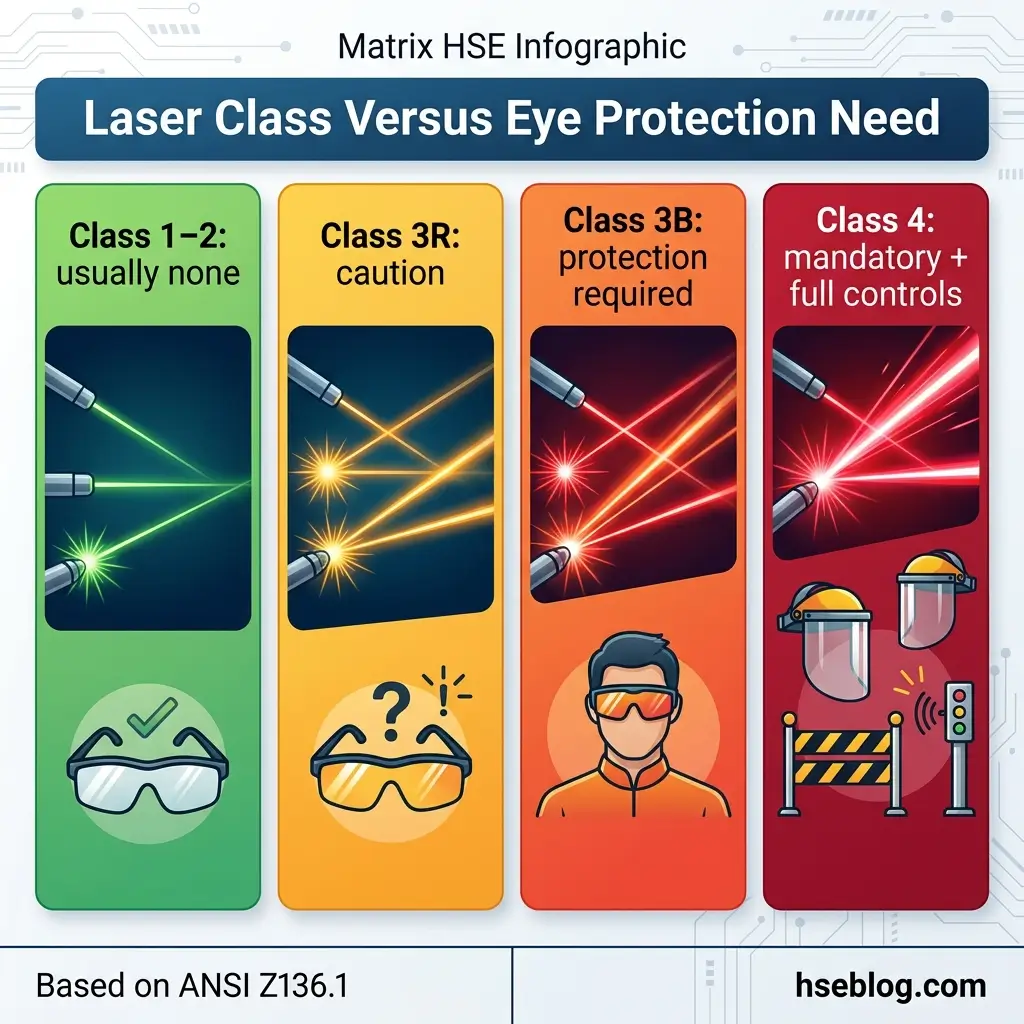
| Class 1 / 1M | Safe under normal use (1M unsafe with optics) | Not normally required; 1M caution with magnifiers |
| Class 2 / 2M | Visible, aversion response protects | Generally not required for momentary viewing |
| Class 3R | Low risk, may exceed MPE | Caution; protection for deliberate intrabeam viewing |
| Class 3B | Hazardous on direct/specular reflection | Eye protection required in the controlled area |
| Class 4 | Hazardous from direct, specular and diffuse reflections; fire and skin risk | Eye protection mandatory; full control programme required |
Most industrial cutting, welding, marking, research and aesthetic systems fall into Class 3B or Class 4. Under ANSI Z136.1, those systems require a Laser Controlled Area, a designated Laser Safety Officer, and eyewear selected to keep exposure below the MPE in the worst foreseeable case.
This article provides general HSE knowledge. Life-critical work such as Class 3B/4 laser operation and beam alignment must be planned and supervised by a competent person — typically a trained Laser Safety Officer under ANSI Z136 or a Laser Protection Adviser under UK/EU practice — with jurisdiction-specific authorisation and a site-specific risk assessment. The information here does not replace that.
Optical Density: The Number That Actually Does the Protecting
Optical density (OD) is the measure of how much a filter attenuates a beam at a specific wavelength — and it is meaningless without that wavelength attached. OD is defined as the base-10 logarithm of the inverse of transmittance, so each whole number is a tenfold reduction in energy reaching the eye.
That logarithm matters more than most buyers realise.
Reading OD in practice
- OD 3 blocks 99.9% of the beam (one part in a thousand passes).
- OD 5 blocks 99.999% (one part in a hundred thousand).
- OD 7 blocks over 99.99999% — about one part in ten million reaches the eye.
The correct OD is not a preference; it is calculated. You determine the laser’s irradiance or radiant exposure at the eye, compare it to the MPE for that wavelength and exposure duration, and the gap dictates the minimum OD required.
The trade-off nobody should ignore
Higher OD is not automatically better, and that is the misconception that quietly degrades safety. Pushing OD higher usually lowers visible light transmission (VLT), so the operator sees less of the workspace.
When eyewear is too dark, people lift it to see — and a filter on the forehead protects nothing. The judgment call is to specify the lowest OD that still keeps exposure below the MPE, preserving enough VLT that the eyewear stays on the face throughout the task.
Selecting Laser Safety Eyewear: A Working Method
Selection follows a fixed sequence, and skipping any step is where most procurement errors originate. Wavelength and OD are necessary but not sufficient — operating mode and frame integrity carry equal weight.
Work through these in order:
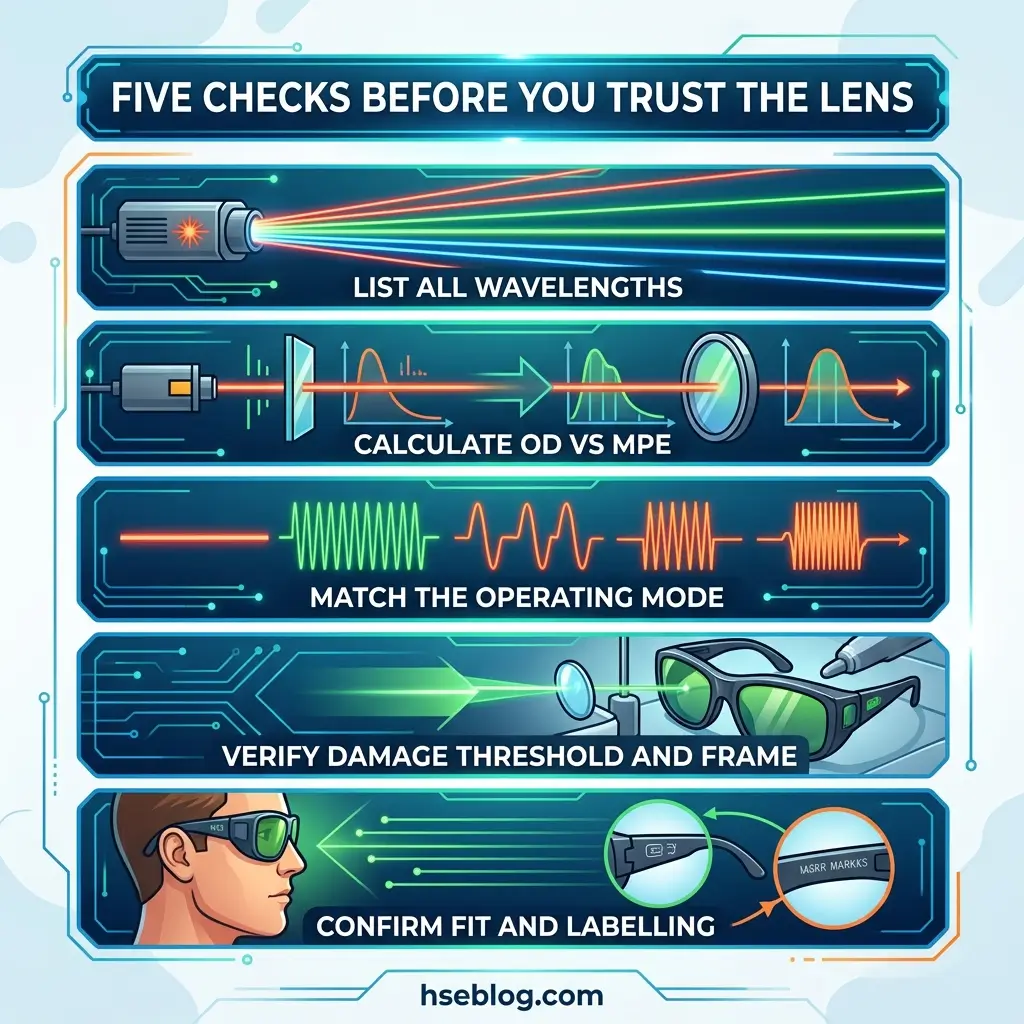
- List every wavelength in use. Include alignment beams, pilot lasers and harmonics. Multi-wavelength systems often need filters validated across two or more bands, and a single pair rarely covers a frequency-doubled laser and its fundamental at once.
- Determine the required OD per wavelength. Calculate from the beam’s power/energy density against the MPE for the relevant exposure time. Tools such as the LIA OD calculator support this, but the LSO owns the result.
- Match the operating mode. Continuous-wave, pulsed, and ultrashort-pulse beams stress filters differently. A lens that holds against CW exposure can fail under a Q-switched or mode-locked pulse train.
- Confirm the damage threshold and frame. The filter and frame must survive a direct hit without burning through. European testing makes this explicit, as covered below.
- Check fit, VLT and labelling. No gaps at the temples or brow, adequate visibility for the task, and the wavelength/OD printed legibly on the lens. ANSI Z136 requires that labelling.
A practical interpretation that auditors test repeatedly: eyewear rated correctly on paper but stored scratched, crazed or sun-bleached has lost OD it can no longer prove. Filters degrade, and dielectric coatings in particular can lose attenuation when damaged — inspect before each use and retire anything compromised.
ANSI Z136 Versus EN 207: Reading the Markings Correctly
The two dominant frameworks protect against the same injuries but prove it in different ways — and confusing them leads to under-specified eyewear. ANSI Z136 (US) selects primarily on optical density; the European system tests the eyewear by hitting it with a laser.
Under EN 207, a filter and frame must withstand a direct hit for at least 5 seconds (continuous wave) or 50 pulses (pulsed mode) without the energy behind the lens exceeding Class 1 limits (EN 207). That direct-hit philosophy is the core difference from an OD-only specification.
| Feature | ANSI Z136 (US) | EN 207 / EN ISO 19818‑1 (EU, UK, Canada) |
|---|---|---|
| Primary metric | Optical density (OD) at wavelength | LB/scale number combining OD and damage threshold |
| Damage testing | OD-based, worst-case exposure | Mandatory direct-hit test by an approved body |
| Self-certification | Allowed within the programme | Not permitted — independent notified body only |
| Marking | Wavelength + OD | Wavelength range, mode code, scale number, CE mark |
| Alignment eyewear | Within Z136 guidance | Separate standard: EN 208 |
A freshness signal worth flagging: since 2021, EN ISO 19818‑1 has been adopted in Europe and Canada and is progressively replacing EN 207 and EN 208 during a transition period (Laser Protection Adviser, 2024). The new standard swaps the old D/I/R/M mode codes for C, P, S and U — continuous, pulsed, short-pulsed and ultra-short-pulsed — and lists optical density per wavelength, so expect both marking systems on the market for now. The US labelling standard was likewise refreshed as ANSI Z136.7‑2025.
The operational takeaway: read the full marking, not just the OD. A lens marked only with a tint or a vague “laser” label, with no wavelength range and no standard reference, is not selectable evidence — it is a guess.
Alignment, Reflections, and the Failure Patterns That Keep Recurring
The same scenarios appear across the published incident record, and beam alignment leads the list. ANSI Z136.1 itself notes that the highest ocular hazard often exists during alignment, when beams are open and guards are removed.
Reviewing how laser eye injuries cluster, a consistent set of failure modes emerges:
- Wrong wavelength filter. Operators grab “the laser glasses” from a shared drawer without checking the marking against the laser in use — fatal when a lab runs several wavelengths.
- Specular reflections off tooling. A flat optic, a watch, or a polished fixture redirects a Class 4 beam. A 4% Fresnel reflection off an uncoated optic can still exceed the MPE.
- Alignment with the wrong eyewear. Full EN 207 protection can render a visible beam invisible, so people remove protection to see the dot — exactly the moment they are most exposed.
- Filter degradation. Scratched, heat-stressed or aged lenses lose OD that the marking no longer reflects.
Where alignment eyewear fits — and where it does not
EN 208 alignment eyewear exists for one narrow purpose: attenuating a visible beam (typically 400–700 nm) enough to see and align it safely, while still allowing the dot to remain visible. It deliberately provides less attenuation than full protection.
The misconception is treating alignment glasses as everyday eyewear. EN 208 protection must never substitute for EN 207 / EN ISO 19818‑1 protection during normal high-power operation — it is a tool for a specific task, not a general-purpose filter.
Content here that touches on eye injury and symptoms is for HSE practitioner reference. It is not medical advice. Anyone with a suspected laser exposure — sudden floaters, a blind spot, headache, or watering after working near a beam — should be assessed promptly by an occupational physician or ophthalmologist.
Frequently Asked Questions
Conclusion
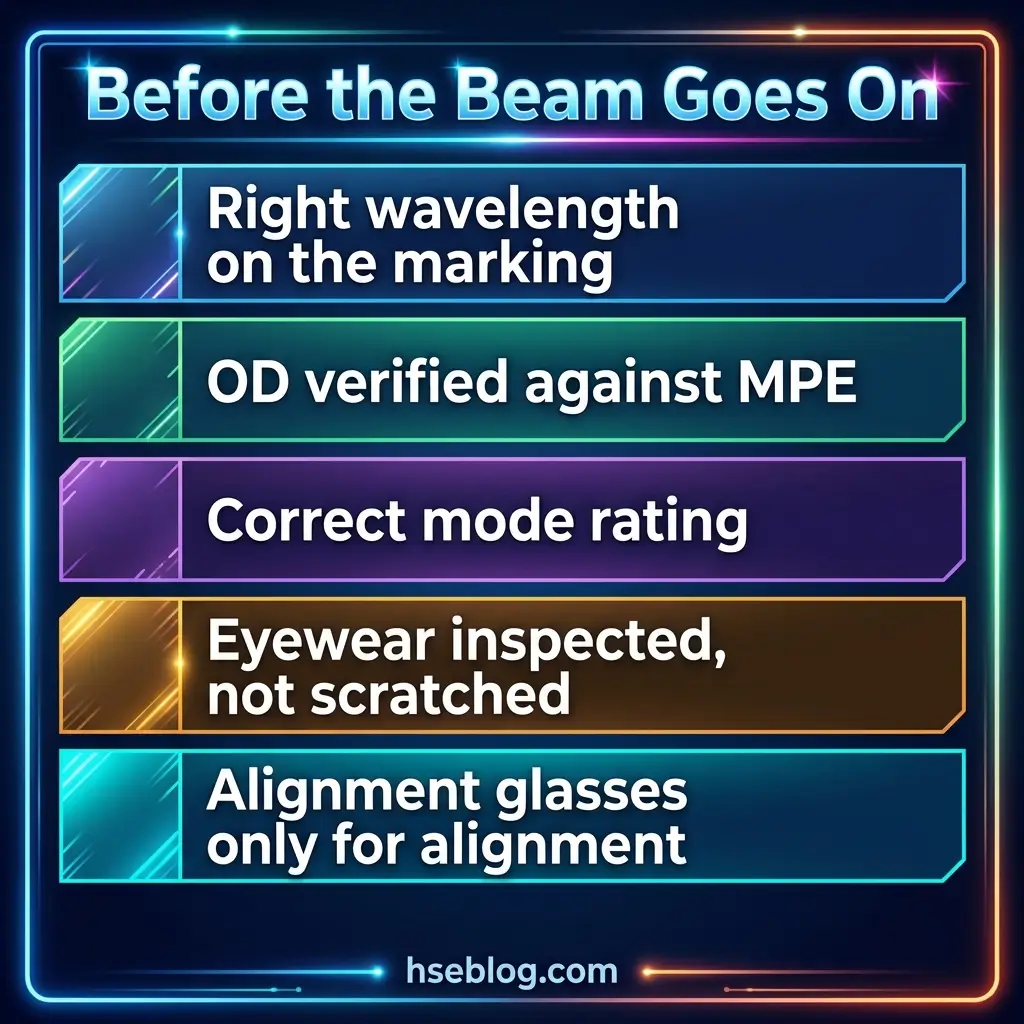
Effective laser eye protection comes down to a short list of non-negotiable decisions. Confirm every wavelength your system emits, calculate the optical density needed to clear the MPE rather than guessing by tint, verify the lens is rated for your operating mode, and read the full ANSI or EN ISO 19818‑1 marking before anyone puts the eyewear on.
Build those decisions into the wider control programme, because the lens is the last line, not the first. Enclosures, interlocks, beam stops and a competent person directing the work remove most of the exposure before eyewear ever has to perform — and the eyewear only earns its place when it is selected correctly, fits without gaps, and stays uncompromised on the face.
The retina does not heal the way skin does, so the margin for a wrong filter is unforgiving. Match the wavelength, calculate the OD, respect the operating mode, and inspect the lens every time — that discipline is what keeps an invisible beam from becoming a permanent diagnosis.