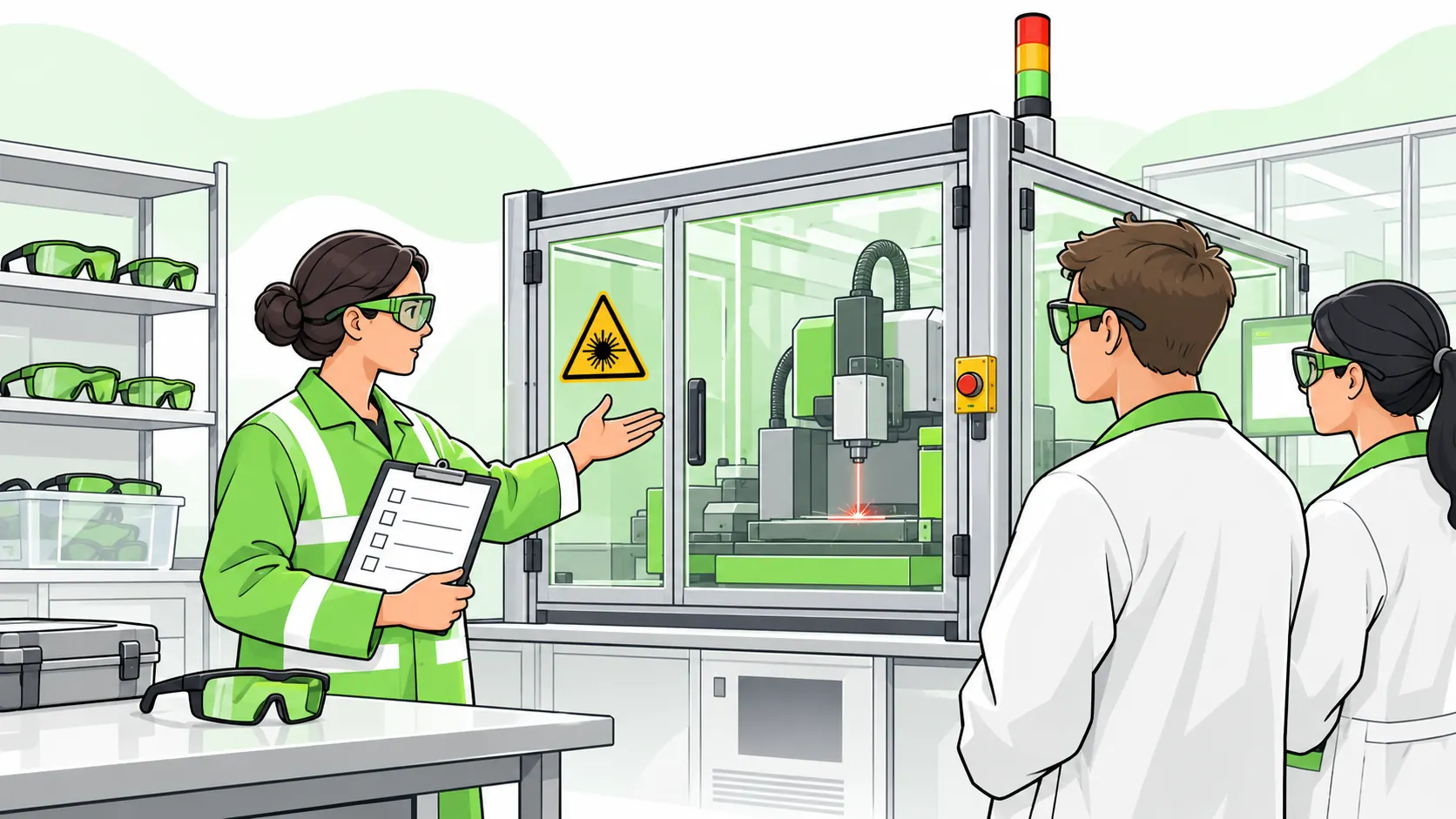
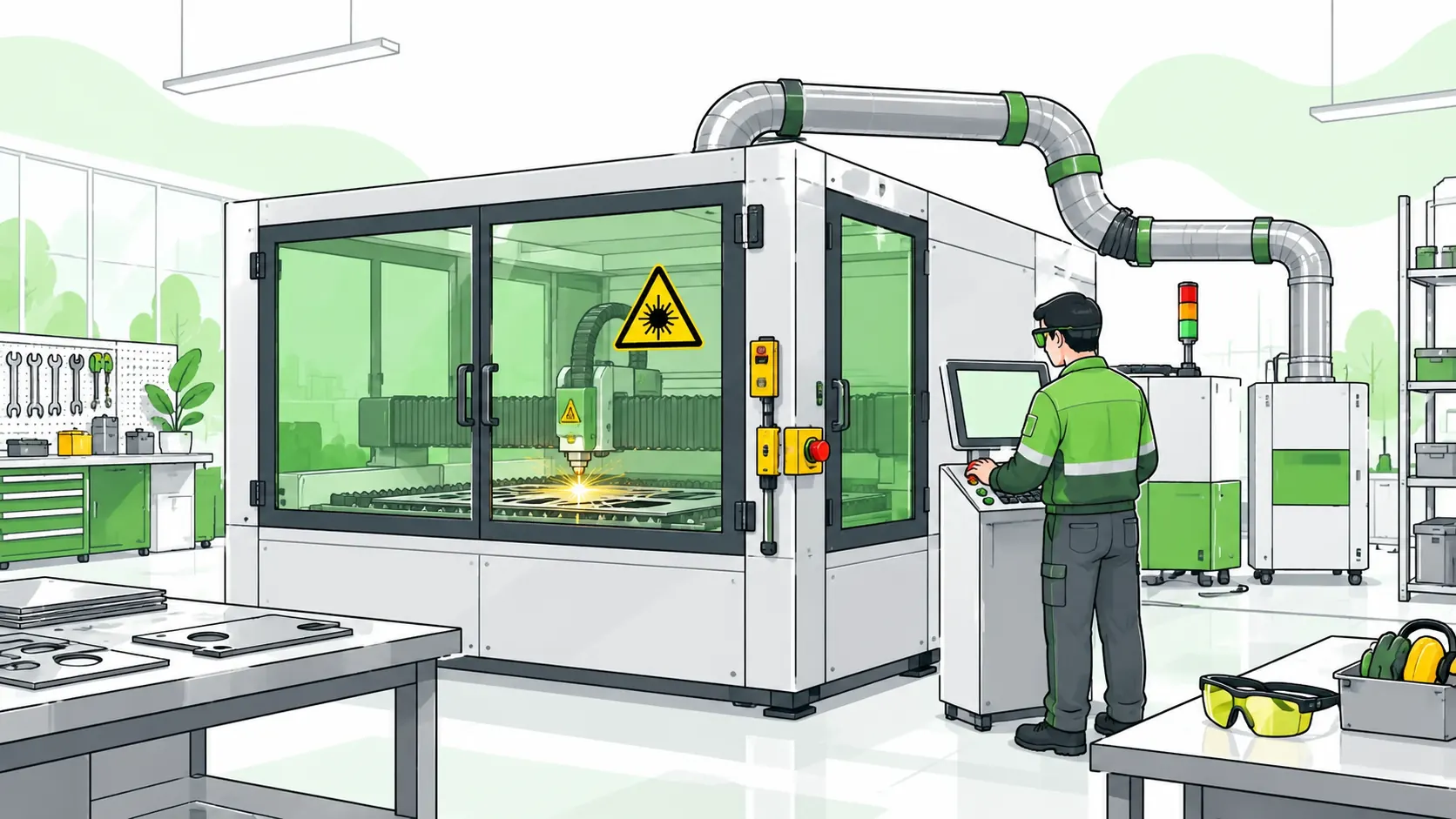
Laser safety is the set of engineering controls, administrative procedures, and personal protection used to prevent injury from laser radiation. It classifies every laser by hazard — from Class 1 to Class 4 — then matches controls to that class, protecting the eyes and skin from beams and from non-beam dangers like fire, fumes, and electrocution.
A laser does something ordinary light cannot. It concentrates energy into a narrow, single-colour beam that barely spreads over distance, and your eye treats that beam like any other light — focusing it to a pinpoint on the retina until a source measured in milliwatts can scar tissue you will never grow back.
That focusing effect is why laser safety is treated as a serious occupational discipline rather than a labelling exercise. This guide explains what laser safety is, how the seven laser classes work, how beams and non-beam hazards actually injure people, the controls that hold up in practice, and which regulations bind you depending on where you operate.
What Laser Safety Actually Means
Laser safety is the discipline of preventing harm from laser radiation by classifying the hazard first and controlling it second. The order matters, because you cannot choose the right protection until you know what class of laser you are dealing with.
Three properties make laser light behave unlike a lamp or the sun:
- Collimated — the beam stays tight and travels long distances without losing much intensity.
- Coherent and monochromatic — a single wavelength, in phase, which means the beam can be focused to a tiny, intense spot.
- Focusable by the eye — for visible and near-infrared light, the lens of the eye concentrates the beam onto the retina, pushing the intensity far above whatever reached the cornea.
The practical consequence is what catches people out. A beam that looks dim can still blind, and an invisible near-infrared beam gives no warning at all because the blink reflex never fires.
Lasers now sit in far more workplaces than most risk registers acknowledge — metal cutting, welding and marking, surgical and aesthetic medicine, research optics, fibre communications, surveying, and entertainment. Each setting inherits the same core question: what class is this, and what does that class demand?
The Seven Laser Classes, From Harmless to Hazardous
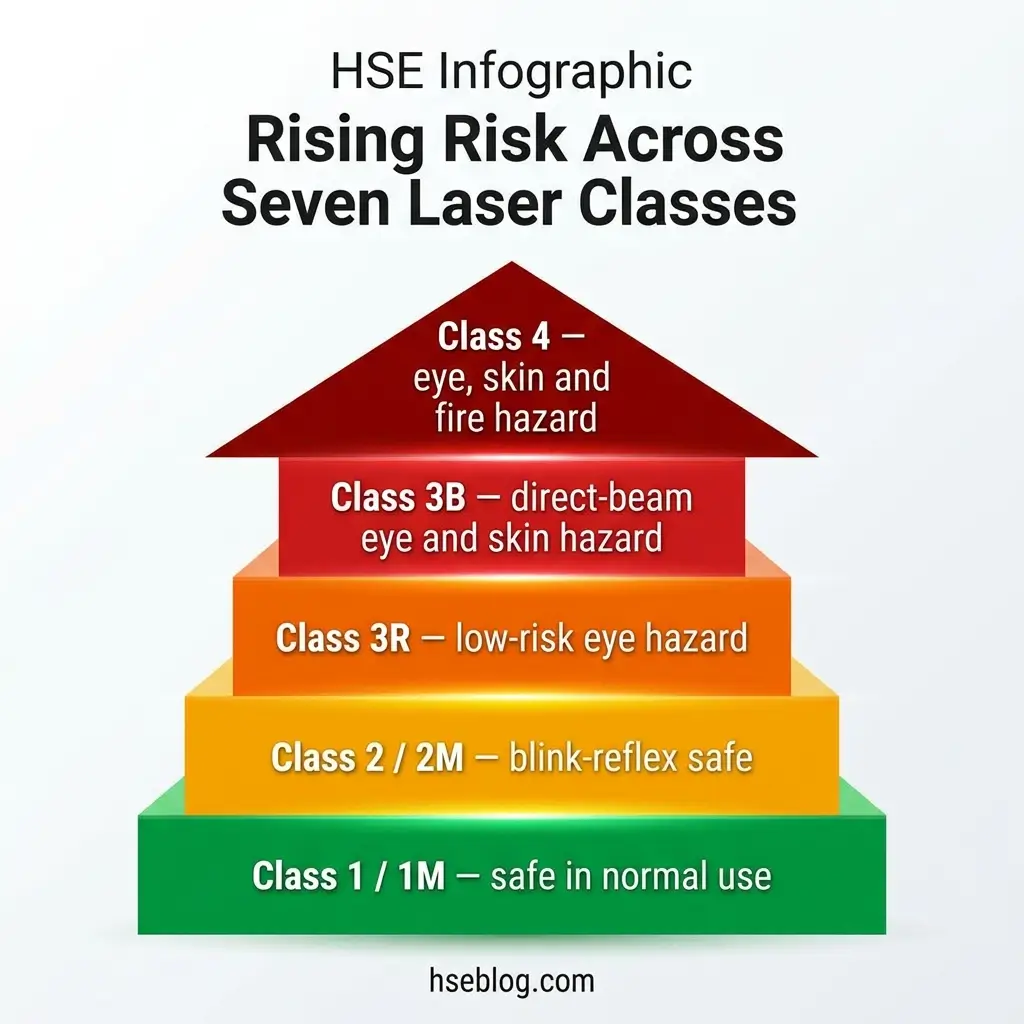
Every laser product is assigned to one of seven classes — 1, 1M, 2, 2M, 3R, 3B, and 4 — based on the most hazardous level of light a person could be exposed to (IEC 60825-1; ANSI Z136.1, 2022). The class is a shorthand for how badly the laser can hurt you and how much control it needs.
Classification is built on the Accessible Emission Limit, the maximum light reachable during normal use, which is tied to the Maximum Permissible Exposure for the eye. The power figures below apply to visible continuous-wave beams; the exact limits shift with wavelength, pulse duration, and beam divergence.
| Class | What it means | Visible CW power (approx.) | Typical example | Main risk |
|---|---|---|---|---|
| 1 / 1M | Safe in normal use; 1M unsafe with magnifiers or optics | Enclosed or very low | Laser printers, CD/DVD players, fibre systems | None in normal use |
| 2 / 2M | Visible only; safe because the blink reflex limits exposure to 0.25 s | ≤ 1 mW | Barcode scanners, some pointers | Eye, only if blink reflex is defeated |
| 3R | Low risk but exceeds safe exposure if you stare; worse with optics | 1–5 mW | Laser pointers, alignment lasers | Eye (intrabeam) |
| 3B | Direct beam is an immediate eye hazard; high end burns skin; diffuse reflections usually safe | 5–500 mW | Light-show projectors, many industrial and research lasers | Eye + skin (direct) |
| 4 | Direct, reflected, and diffuse light all hazardous; ignites materials | > 500 mW (0.5 W) | Cutting, welding, and surgical lasers | Eye + skin + fire |
(Class data: U.S. FDA / OSHA Laser Hazard Classes; ANSI Z136.1, 2022.)
Two points trip people up in practice. First, older US Roman-numeral classes (I–IV) map onto the IEC numbers, so a single product may carry both labels (OSHA). Second, an "enclosed Class 1" machine frequently contains a Class 4 engine — perfectly safe sealed, genuinely dangerous the moment a service panel comes off.
Distance is not safety either. A 3.5 W handheld blue laser can remain an eye hazard out to roughly 280 metres (PMC/NIH, 2016), which is why "it was far away" is not a defence.
The current edition of the US consensus standard, ANSI Z136.1-2022, reworked its exposure limits and added new definitions, including a reworked treatment of how degraded optics affect classification (LIA, 2022).
How Laser Beams Injure the Eyes and Skin
Across the published injury record, the eye is the organ that pays first, and the wavelength decides exactly where the damage lands. The same beam that a thick glove would stop can pass straight through to the retina.
Content on eye injury and health surveillance here is for HSE practitioner reference. It is not medical advice. Anyone with a suspected laser exposure should consult an occupational physician or ophthalmologist.
The eye: damage by wavelength
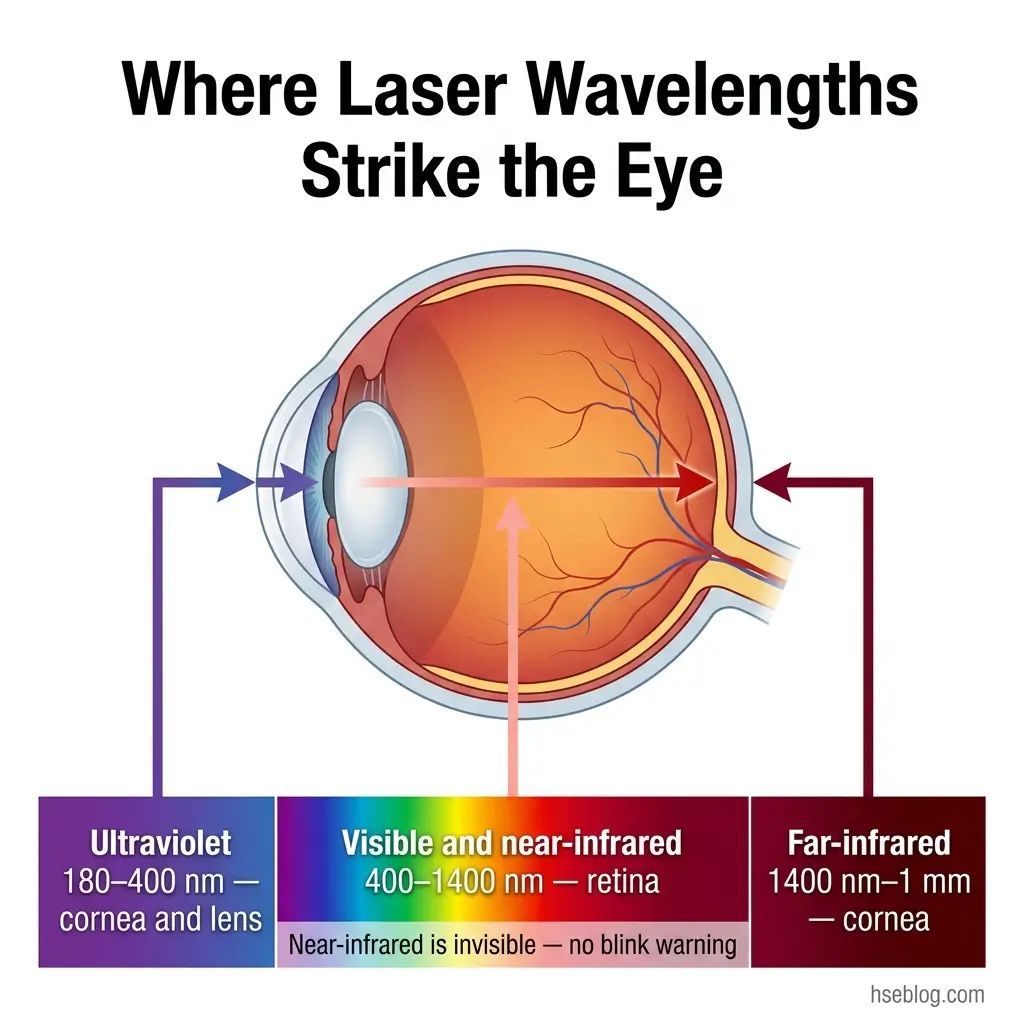
- Ultraviolet (180–400 nm) — absorbed by the cornea and lens, causing photokeratitis (the "arc-eye" sensation welders know) and, over repeated exposure, cataract.
- Visible and near-infrared (400–1400 nm) — the retinal hazard region; the eye focuses the beam onto the retina, where even a brief hit can burn a permanent blind spot. Near-infrared is invisible, so there is no aversion response to trigger.
- Far-infrared (1400 nm–1 mm) — absorbed at the corneal surface, producing corneal burns rather than retinal injury.
The skin
- Class 3B and 4 direct beams cause thermal burns.
- Ultraviolet output adds photochemical damage, and UK and EU guidance notes that skin effects can extend to skin cancer over the long term.
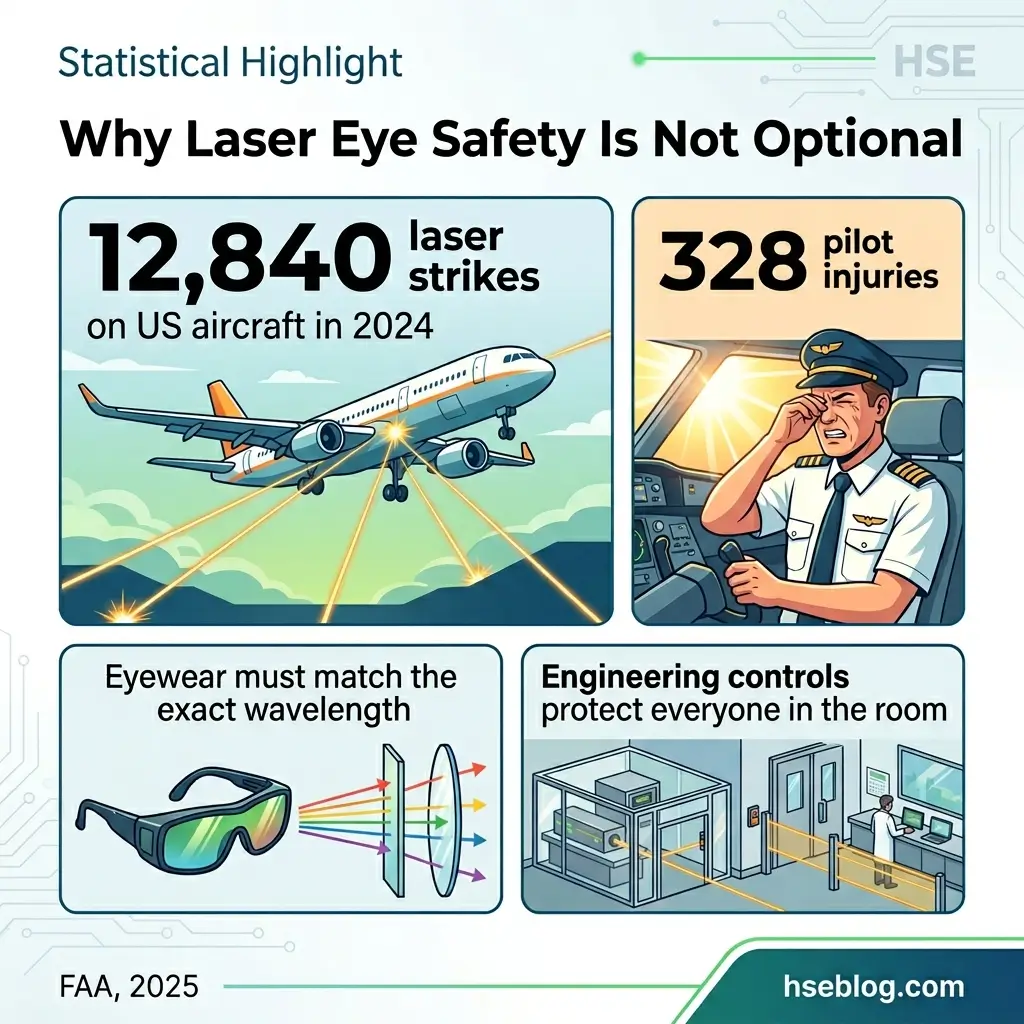
The ocular threat is not theoretical. Pilots reported 12,840 laser strikes in 2024, down about 3% on the previous year, with 328 injuries logged since 2010 (FAA, 2025) — proof that even a beam too weak to burn can cause flash blindness at the worst possible moment.
The Hazards That Have Nothing to Do With the Beam
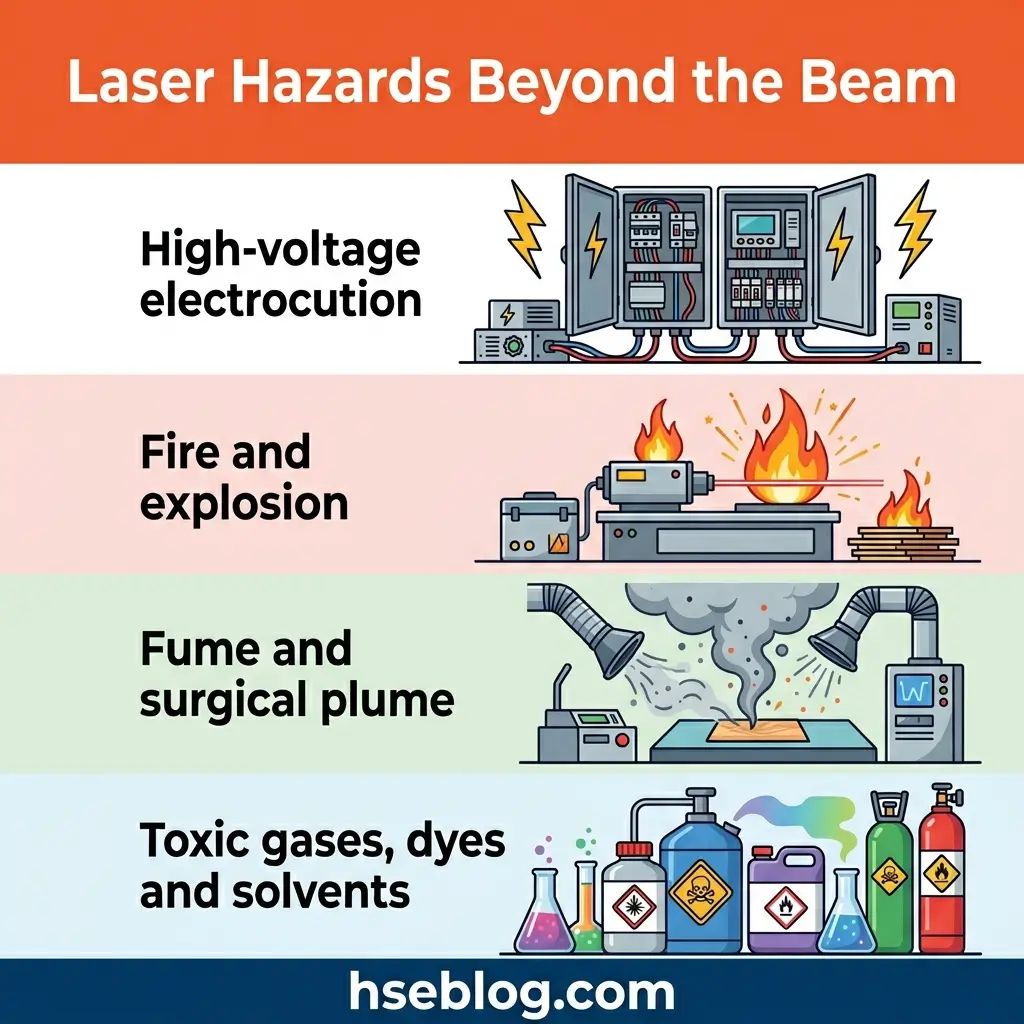
The beam gets the attention, but some of the most serious laser incidents never involve light hitting an eye. The 2022 revision of ANSI Z136.1 rewrote its entire non-beam hazards section for exactly this reason (LIA, 2022).
- High-voltage electrocution — large lasers run on high-voltage power supplies, and industry guidance has long flagged these as a cause of laser-related fatalities, entirely separate from the beam.
- Fire and explosion — Class 4 beams and their reflections ignite solvents, surgical drapes, and plastics, which is why a dedicated fire standard (NFPA 115) exists at all.
- Laser-generated air contaminants and surgical plume — cutting, welding, and surgical lasers vaporise material into fumes that can carry carcinogens and, in surgery, viable cellular particles; OSHA addresses surgical plume directly.
- Process gases, dyes, and solvents — assist gases and dye-laser chemistry bring their own toxic and flammable risks alongside the optics.
The lesson for anyone drafting a laser risk assessment is simple. The beam is one chapter of that document, not the whole thing.
Controls That Actually Keep People Safe
Controlling a laser follows the same logic as any serious hazard — remove or contain the danger by design first, and treat eyewear as the last line rather than the first. Relying on glasses to fix an uncontrolled Class 4 beam is the wrong way round.
This article provides general HSE knowledge. Life-critical laser work — Class 3B and Class 4 operation, alignment, and servicing — must be planned and supervised by a competent person, typically a designated Laser Safety Officer, with relevant training, jurisdiction-specific authorisation, and a site-specific risk assessment. The information here does not replace that.
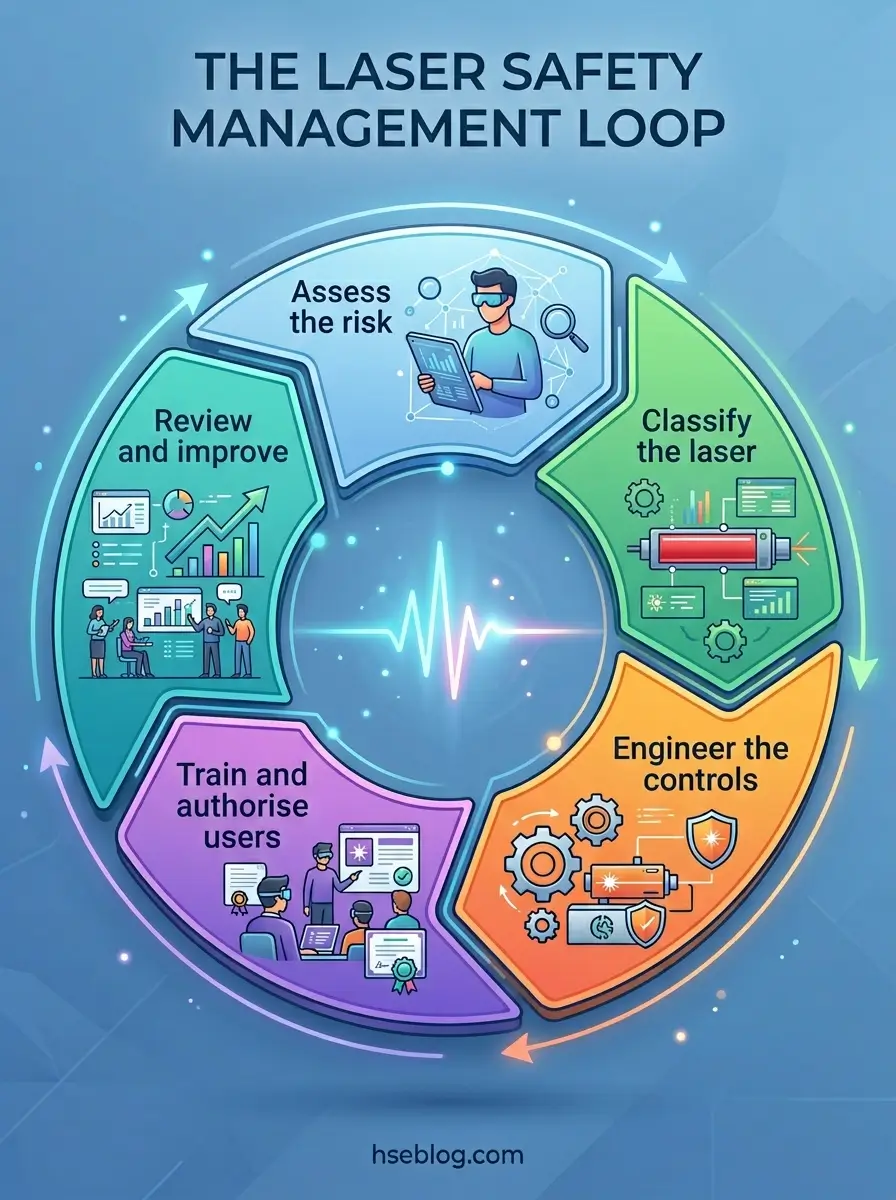
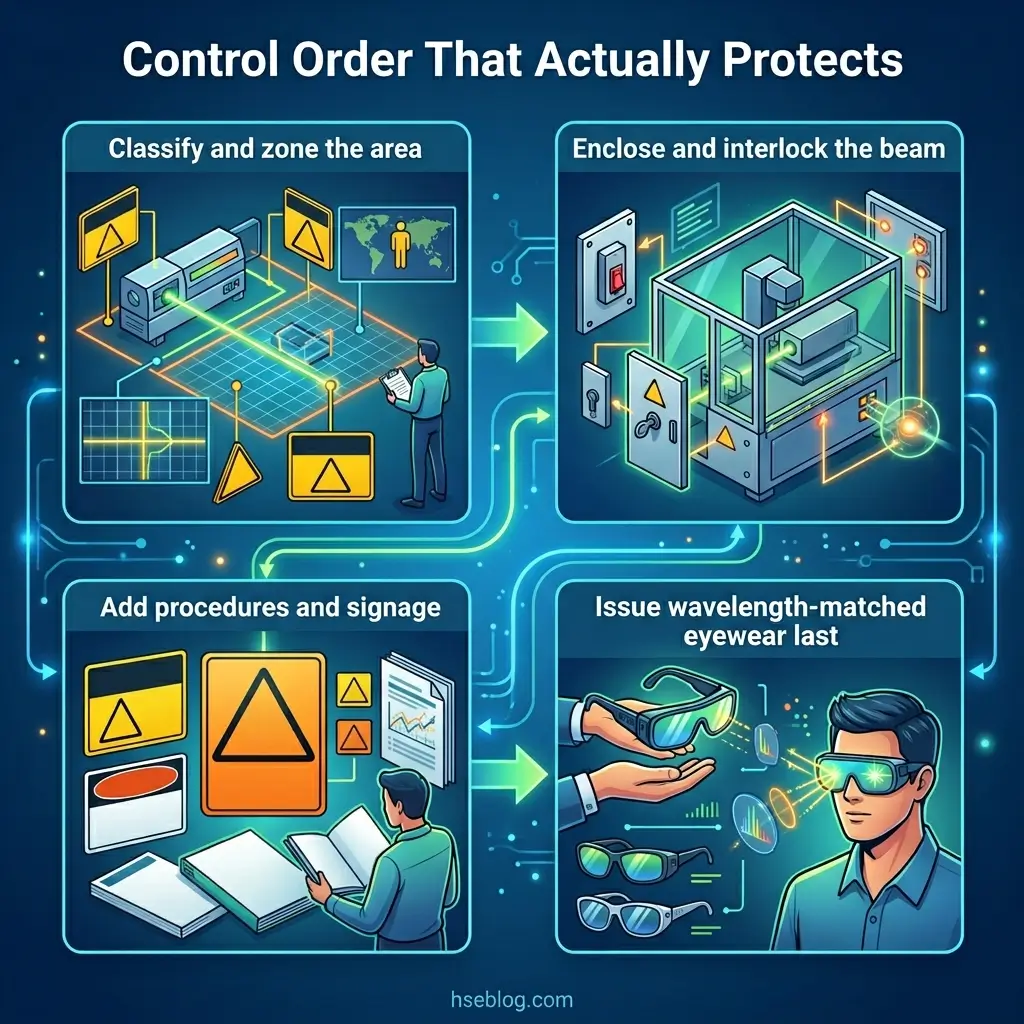
The order that protects people looks like this:
- Classify the laser and define the controlled area.
- Engineer the hazard out — enclose, interlock, attenuate.
- Add administrative controls — procedures, signage, training.
- Issue wavelength-matched protective eyewear as the final layer.
Engineering controls
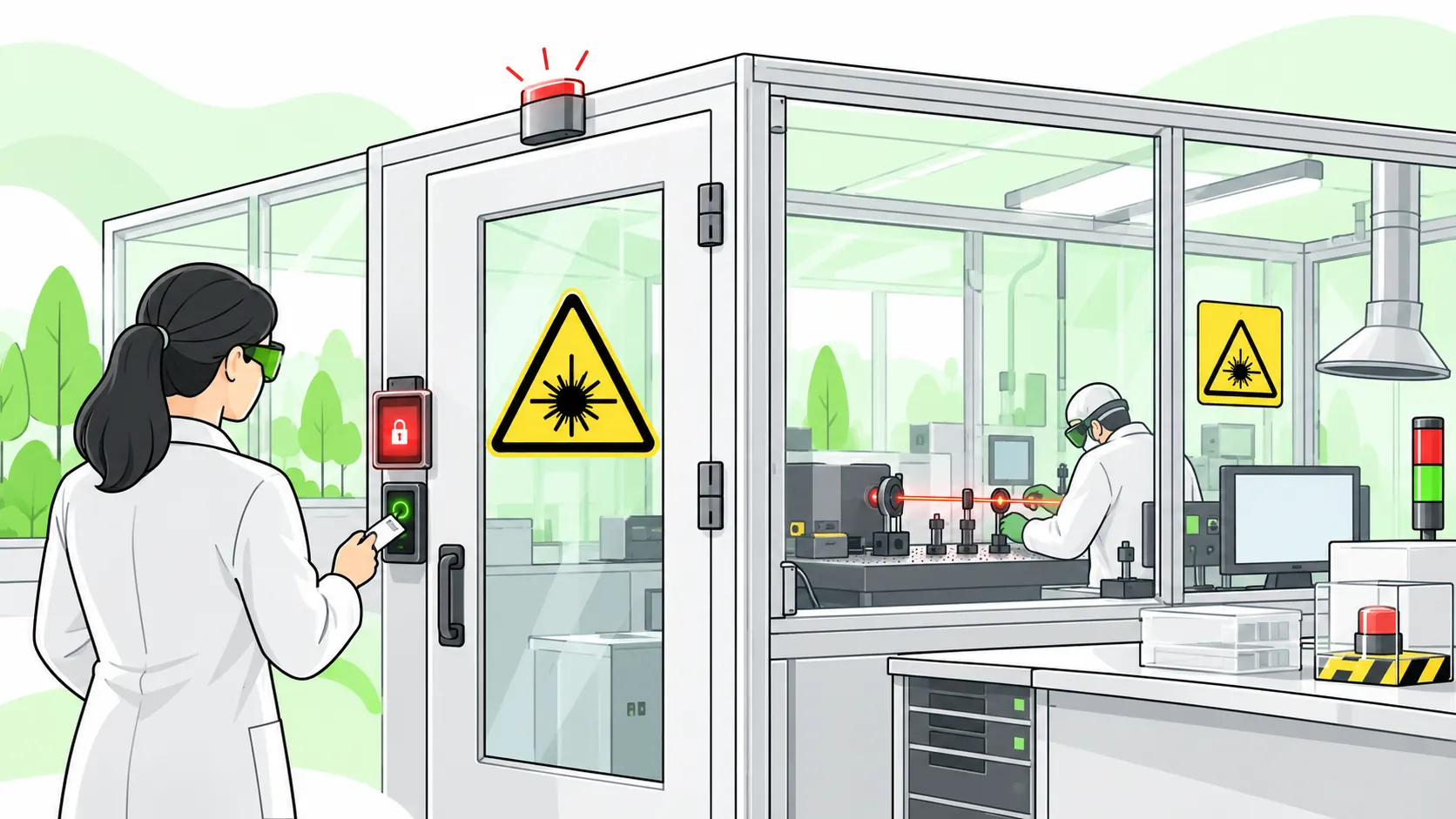
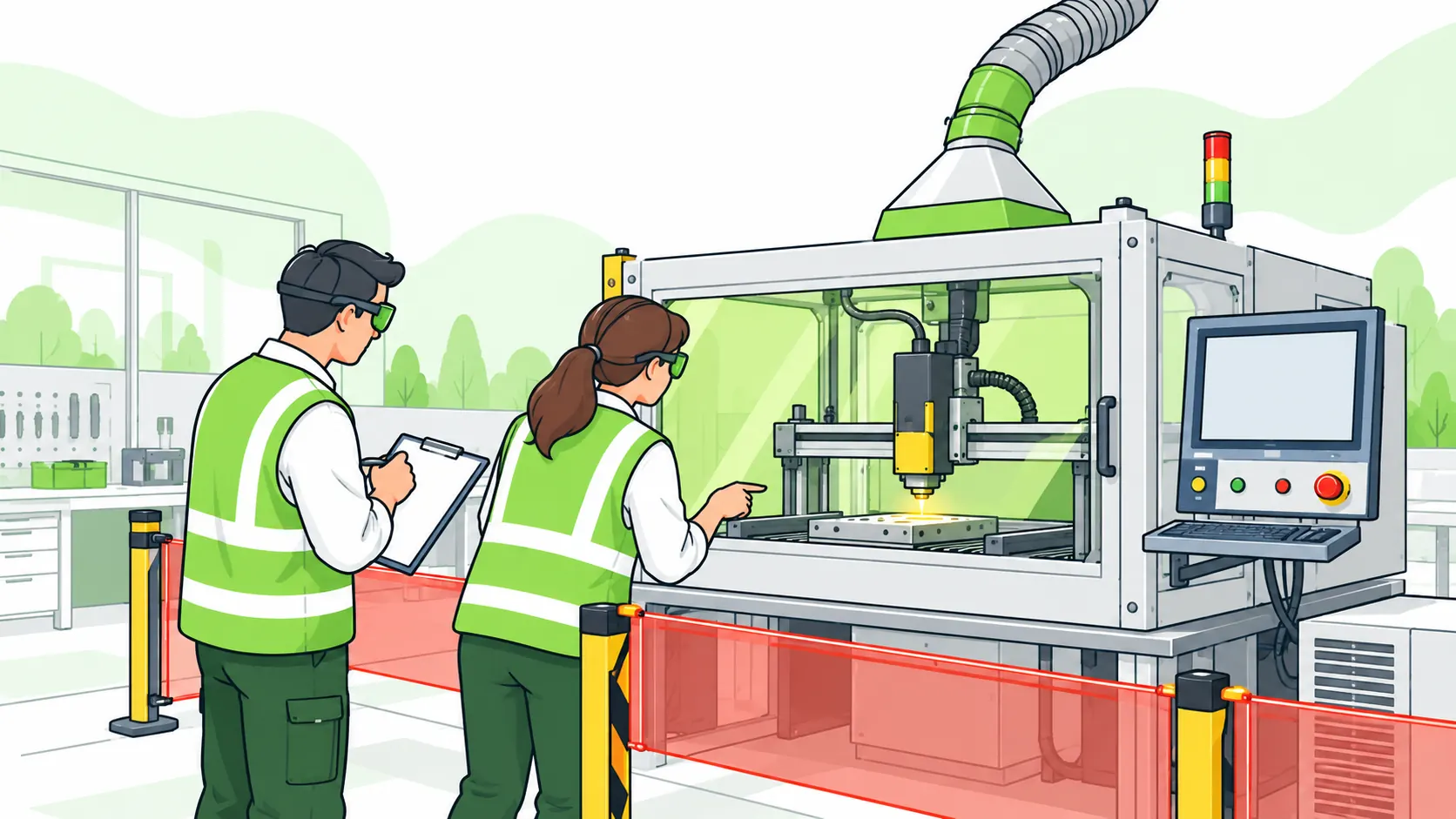
- Protective housing and interlocks — enclosing a Class 4 engine can make the overall product Class 1, and interlocks shut the beam down the instant a housing or door opens.
- Beam stops, shutters, attenuators, and key control — Class 3B and 4 systems require a key switch and a remote interlock connector.
- Matte surfaces and enclosed beam paths — these kill mirror-like reflections, and for Class 4 work the diffuse reflections must be controlled too.
Administrative controls
- A Laser Safety Officer — the consensus standard calls for an LSO to evaluate and control hazards wherever Class 3B or 4 lasers are in use.
- Controlled-area access, written SOPs, and signage — standardised danger-sign formats, restricted entry, and documented alignment procedures.
- Medical surveillance — baseline and post-incident eye examinations where the jurisdiction requires them.
PPE and the wavelength trap
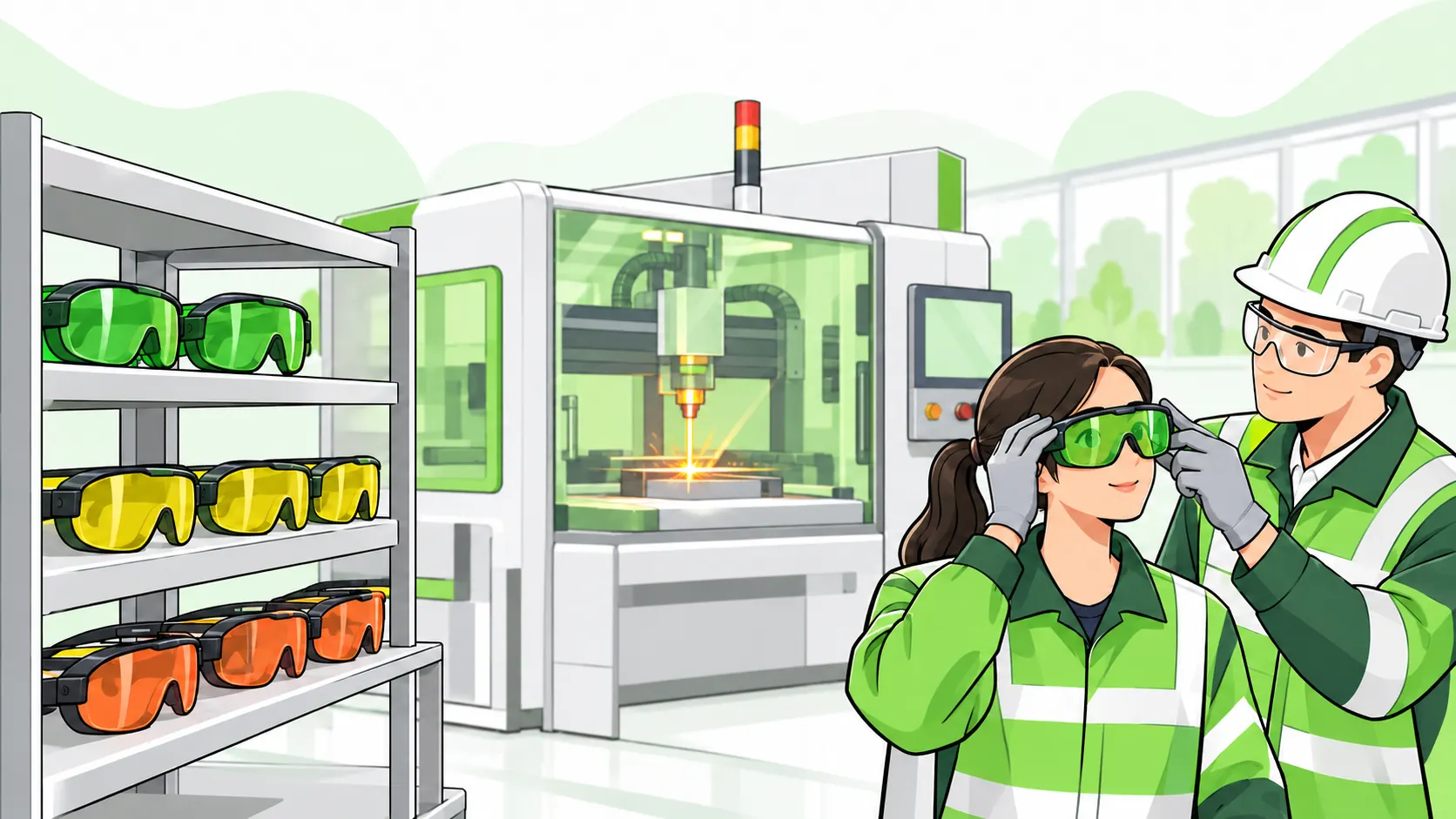
- Eyewear is wavelength-specific — a filter must match the laser's wavelength and provide the correct optical density; glasses that block green light will do nothing against a 1064 nm beam.
- Skin cover and barriers — protective clothing and flame-resistant curtains around Class 4 systems.
One pattern dominates the incident record: alignment is where eyes get hurt. Injuries cluster around alignment tasks, often because someone removed their eyewear to see the beam — which is why a competent programme treats alignment as the single highest-risk activity in the room.
Which Laser Rules Apply Depends on Where You Work
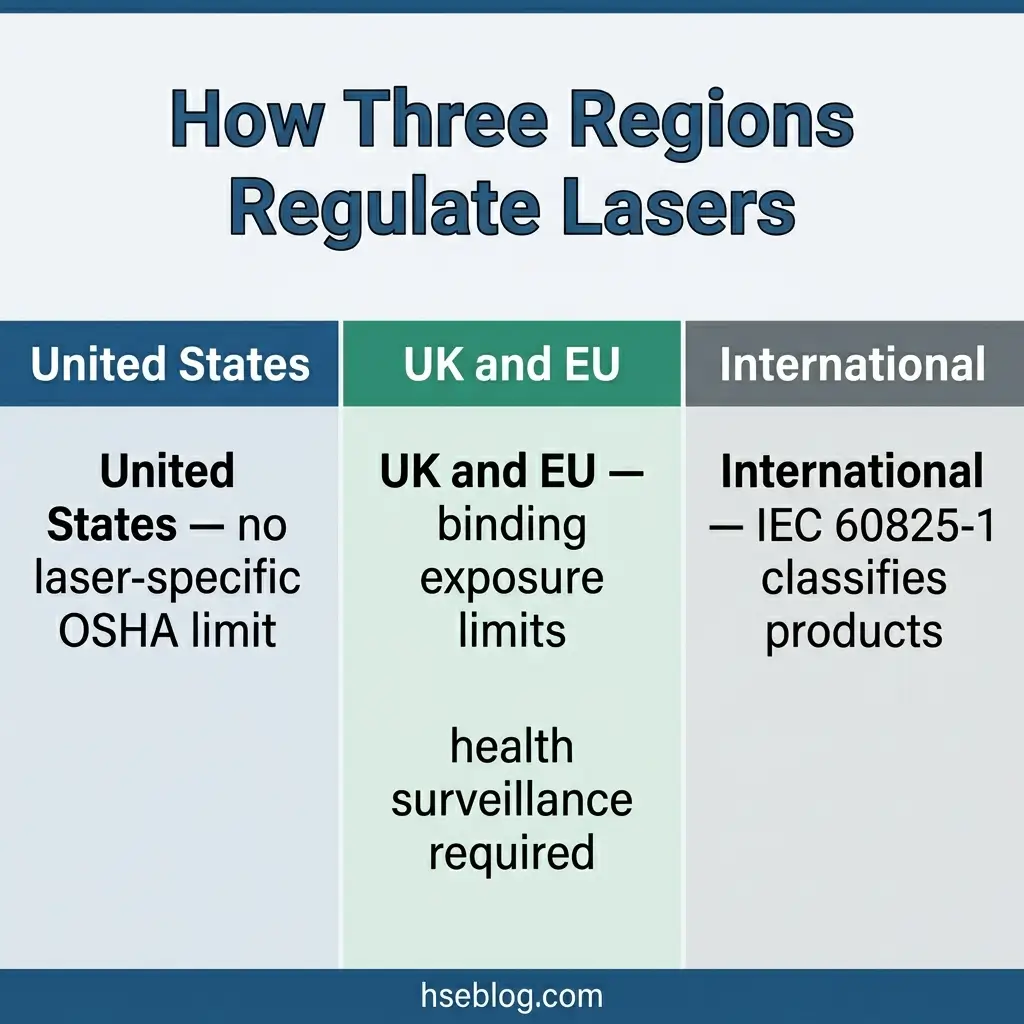
There is no single global laser law, and the gap between regions is wider than most people expect. In the United States no OSHA standard targets lasers directly, while in the United Kingdom and the EU, laser exposure limits are legally binding.
The contrast breaks down like this:
- United States — OSHA leans on general PPE rules (29 CFR 1910.132 and 1910.133 for eye and face protection) plus its General Duty Clause; the FDA's device centre regulates how laser products are built under 21 CFR 1040.10, mandatory for products made since 2 August 1976; ANSI Z136.1 is voluntary but is the benchmark OSHA points to (OSHA; FDA/CDRH).
- United Kingdom — the Control of Artificial Optical Radiation at Work Regulations 2010 make exposure limit values legally enforceable and require risk assessment and health surveillance, enforced by the HSE.
- European Union — Directive 2006/25/EC sets binding exposure limit values for laser radiation and mandates health surveillance carried out by a doctor (EU-OSHA).
- International — IEC 60825-1 supplies the classification framework, covering 180 nm to 1 mm, that nearly every national system is built on.
| Jurisdiction | Core instrument | Binding exposure limits? | Key duty |
|---|---|---|---|
| United States | OSHA 1910.132/.133 + General Duty Clause; FDA 21 CFR 1040.10; ANSI Z136.1 (voluntary) | No laser-specific limit | Provide PPE, build compliant products, follow consensus practice |
| United Kingdom | Control of Artificial Optical Radiation at Work Regs 2010 (HSE) | Yes (Annex II values) | Assess, control to limits, health surveillance |
| European Union | Directive 2006/25/EC | Yes | Assess exposure, apply limits, medical health surveillance |
| International | IEC 60825-1 | Classification basis | Classify and label products |
(Sources: OSHA; FDA/CDRH; UK legislation.gov.uk; EU-OSHA; IEC.)
Where this lands for a working programme: a US operation has no legally binding laser exposure limit, so the stronger and more defensible course is to adopt ANSI Z136.1 in full, and for any multinational site, to take the UK/EU exposure-limit and health-surveillance model as the baseline.
Regulatory content here reflects a general HSE understanding of these requirements as of June 2026 and is not legal advice. Specific compliance or enforcement questions should be directed to qualified legal counsel in the applicable jurisdiction.
For competence, the recognised routes are NEBOSH and IOSH qualifications for general HSE capability, OSHA outreach training in the US, and dedicated Laser Safety Officer courses for anyone taking on the LSO role.
Frequently Asked Questions
What is the difference between a Class 3R and a Class 3B laser?
Class 3R lasers (roughly 1–5 mW visible) carry a low injury risk and only become hazardous if you deliberately stare into the beam or use optics. Class 3B lasers (up to 500 mW) are an immediate eye hazard from the direct beam, can burn skin at the upper end, and require a key switch, interlock, and controlled area.
How do I choose the right optical density for laser eyewear?
Match the eyewear to two things: the exact wavelength your laser emits, and the optical density (OD) needed to bring the beam below the maximum permissible exposure. A higher OD blocks more light. Eyewear rated for one wavelength offers no protection at another, so generic "laser glasses" do not exist — selection is laser-specific (ANSI Z136.1).
Is a Class 1 laser always completely safe?
In normal use, yes. The catch is that many Class 1 machines are Class 4 lasers inside a sealed enclosure, which becomes hazardous during maintenance once interlocks are defeated. Class 1M is also only safe without magnifying optics, since lenses or microscopes can refocus the beam back into a hazardous range.
Who needs a Laser Safety Officer?
Any workplace operating Class 3B or Class 4 lasers should appoint a Laser Safety Officer under ANSI Z136.1 in the US. The LSO evaluates hazards, approves procedures, oversees training, and authorises controlled areas. In the UK and EU, the legal duties sit with the employer, but the same competent-person function is needed to meet exposure-limit and risk-assessment obligations.
Are laser pointers dangerous, and is pointing one at an aircraft illegal?
A legitimate sub-5 mW pointer is low risk, but high-power "pointers" sold online can reach Class 3B or 4 and cause real eye injury. Aiming any laser at an aircraft is a federal crime in the US, carrying FAA civil penalties and possible imprisonment, and pilots reported 12,840 such strikes in 2024 (FAA, 2025).
Does OSHA have a specific standard for lasers?
No. OSHA has no dedicated laser regulation and instead enforces laser safety through its personal protective equipment standards (29 CFR 1910.132 and 1910.133) and the General Duty Clause. It directs employers to the ANSI Z136 series as the recognised consensus practice, and the FDA separately governs how laser products are manufactured.
The Habit That Separates Safe Laser Work From Luck
The recurring mistake in laser safety is treating protective eyewear as the primary defence. Glasses are the last layer, and they only work when their optical density matches the exact wavelength in use — a green-rated lens is useless against an invisible near-infrared beam.
The single change that prevents the most harm is to control by design. Classify the laser, enclose and interlock the beam, and supervise Class 3B and 4 alignment as the most dangerous task on site. Engineering controls protect everyone who walks through the door; eyewear only protects the person wearing it, correctly, at that exact moment.
The beam is also not the whole hazard — the power supply, the plume, and the stray reflection injure people who never once looked at the source. Build the programme around the class and the wavelength, and laser safety stops being a label on a machine and becomes something that actually holds.