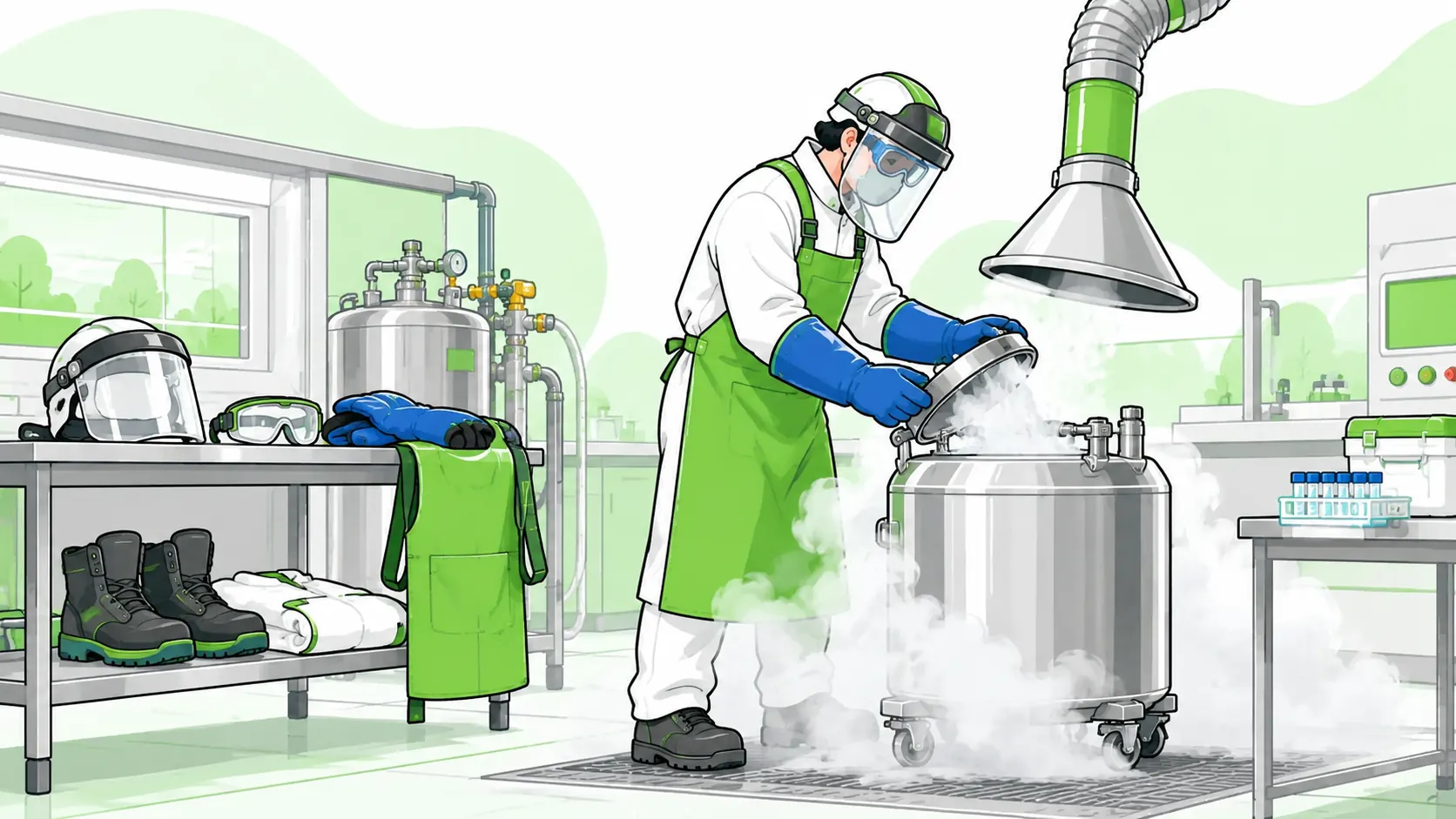
Cryogenic PPE protects against the extreme cold, splashes, and frozen surfaces involved in handling liquefied gases such as liquid nitrogen. The core kit is safety glasses with side shields, a face shield for splash work, loose-fitting cryogenic gloves, cuffless trousers, closed-toe non-mesh shoes, and an apron — all backed by atmospheric oxygen monitoring.
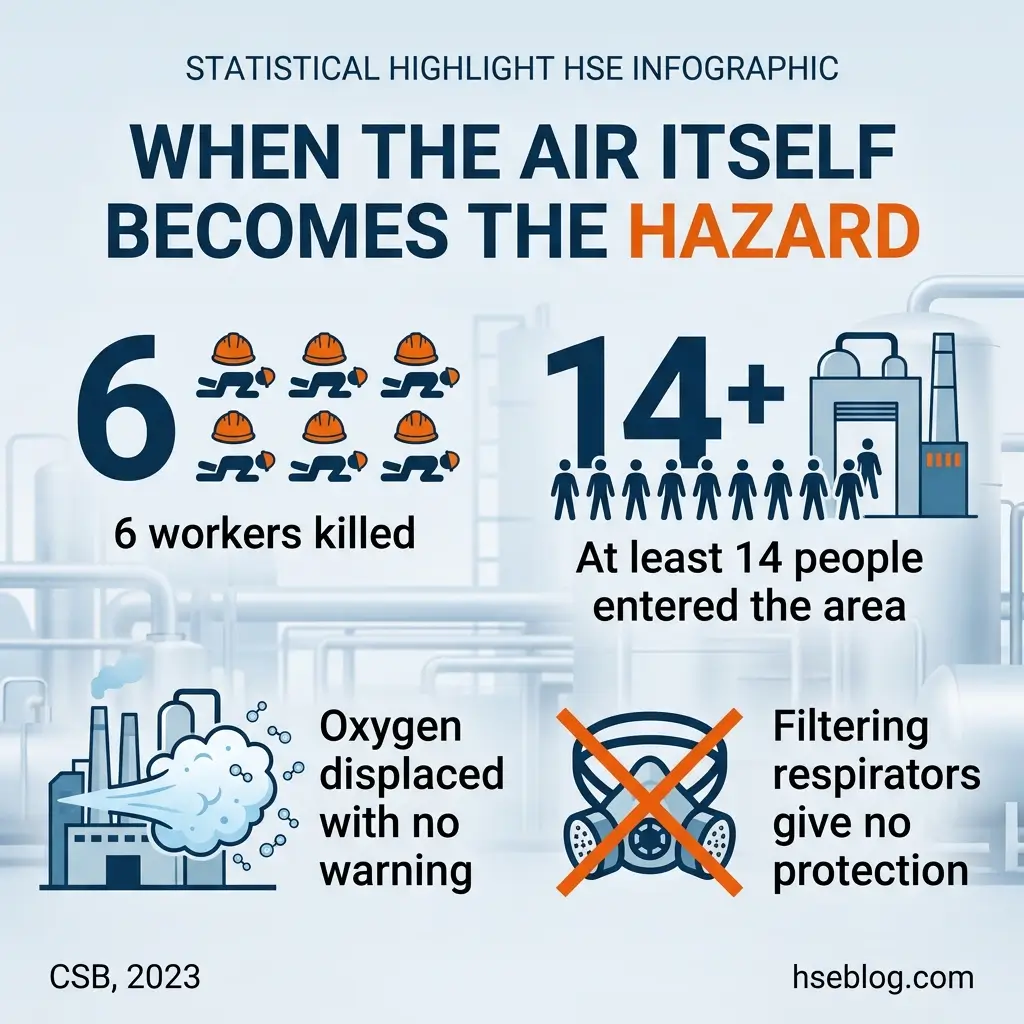
On 28 January 2021, a bent measurement tube let liquid nitrogen pour into a freezer room at a poultry plant in Gainesville, Georgia, where it vaporized into a cloud four to five feet high that displaced the oxygen near the floor. Six workers died and four more were seriously injured, several while trying to rescue colleagues, and the US Chemical Safety Board found the workforce lacked any equipment or PPE that would have enabled safe entry into that oxygen-deficient atmosphere (CSB, 2023). CSBFood Processing
That tragedy sits at the extreme end of a hazard that appears in laboratories, hospitals, food plants, and gas terminals every day. Choosing the right cryogenic PPE is part of the answer — but only part, and knowing both what it does and where it stops is what separates a controlled operation from a fatal one.
Why Cryogenic Liquids Demand Specialized PPE
Ordinary cold-weather gear is useless here, because cryogenic liquids behave nothing like a cold day. They boil at temperatures below −73 °C, and the common industrial liquids are far colder still: liquid nitrogen at around −196 °C, liquid oxygen at −183 °C, and liquefied natural gas near −162 °C.
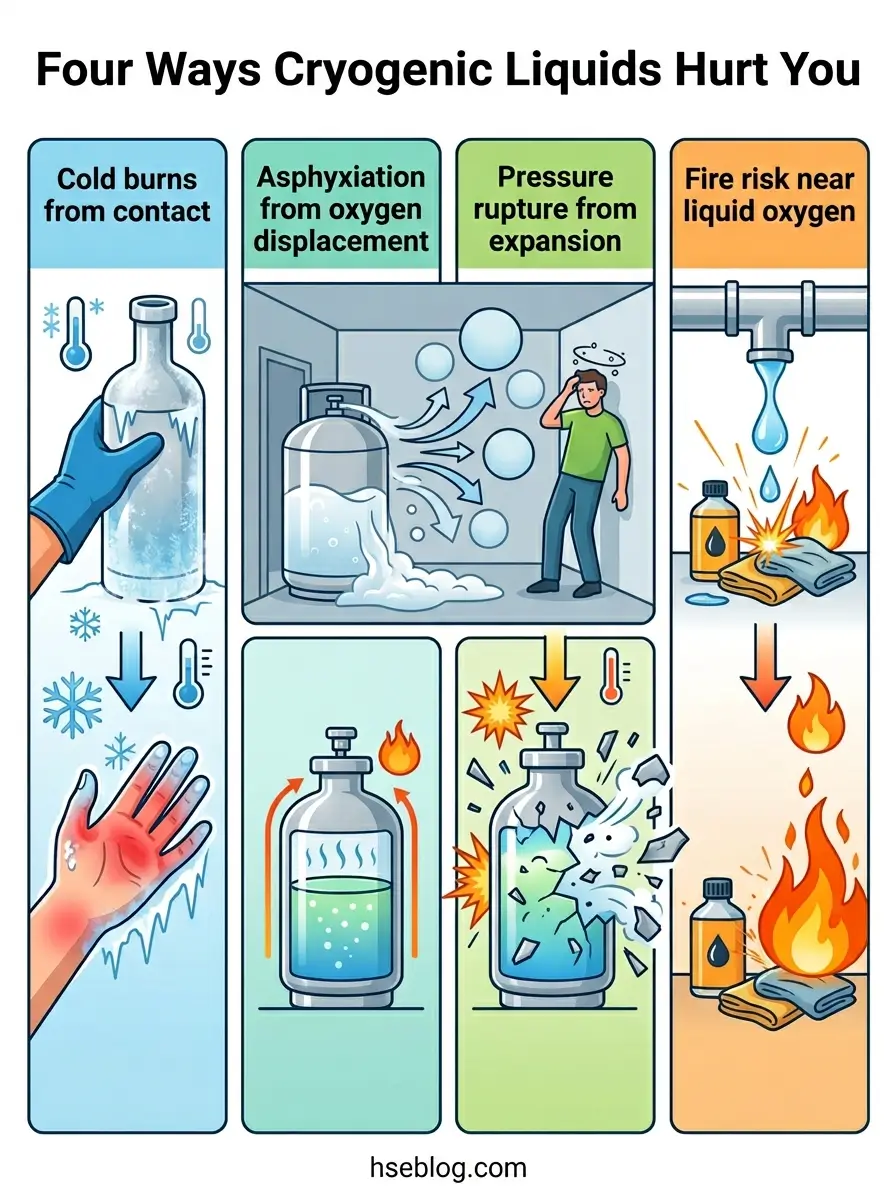
At those temperatures, the hazard is not discomfort — it is rapid, irreversible tissue damage and, in enclosed spaces, death. The threats fall into a few distinct families, and your PPE has to answer each one:
- Cold burns and frostbite. Direct contact with the liquid, the cold boil-off vapor, or a chilled surface freezes skin almost instantly. The most common cause of injury is actually contact with cold metal, not the liquid itself, and frostbite can be instantaneous if the skin is moist.
- Trapped liquid against skin. The worst burns happen when a splash is held against the body by a cuff, an elastic wristband, an absorbent sleeve, or a metal watch — the cold cannot escape, and neither can you, fast enough.
- Oxygen displacement. Every cryogen expands enormously as it warms. Liquid nitrogen expands roughly 696 times as it vaporizes (Wayne State University EHS), so a small spill can flood a room with inert gas and drive the oxygen down without any smell, color, or warning. Wayne
- Pressure and fire. Sealed or blocked containers can rupture as the liquid expands, and liquid oxygen vapor enriches the surrounding air, making clothing and other materials burn far more readily.
A note on competence. This article provides general HSE knowledge. Life-critical work such as cryogenic liquid transfer and entry into oxygen-deficient atmospheres must be planned and supervised by a competent person with relevant training, jurisdiction-specific authorization, and a site-specific risk assessment. The information here does not replace that. Recognized training routes include NEBOSH, IOSH, and OSHA outreach programs or their regional equivalents.
Cryogenic PPE by Body Region: What to Wear and Why
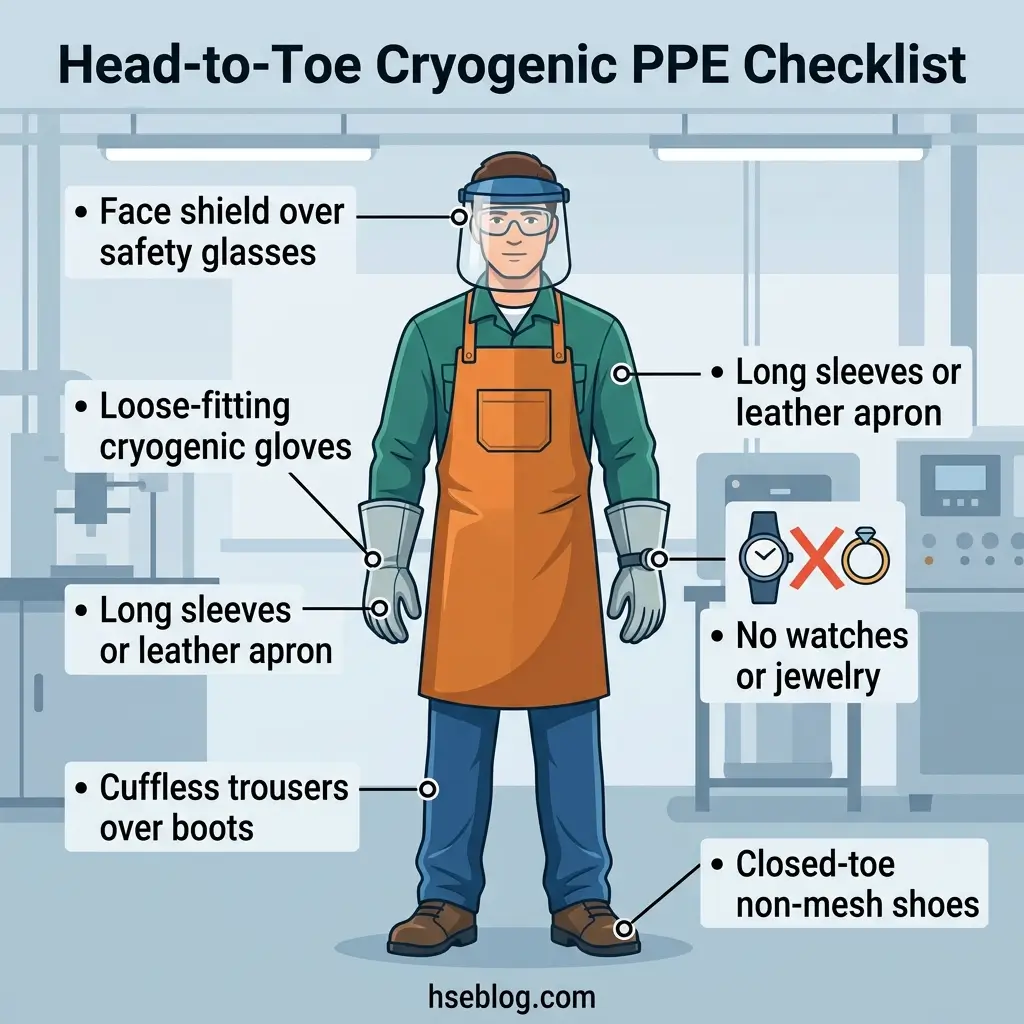
The honest answer to "what protection do you need" is task-dependent, but the baseline is consistent: cover every patch of skin, keep splashes rolling off and away, and make sure nothing can trap the liquid. The table below maps each body region to the protection and the reasoning behind it.
| Body region | Protection | Why it matters |
|---|---|---|
| Eyes (minimum) | Safety glasses with side shields, or non-vented goggles | A single splash can cause severe eye injury or blindness; side protection blocks low-angle splashes |
| Face (splash work) | Full face shield worn over glasses or goggles | The shield guards the whole face during pouring; the glasses stay on underneath as the splash backstop |
| Hands | Loose-fitting cryogenic gloves (EN 511 + EN 388) | Insulates against brief contact and accidental splash; loose fit lets you throw the glove off instantly |
| Torso/arms | Long sleeves or lab coat; leather or cryogenic apron for large volumes | Covers skin and deflects splashes when handling open dewars or bulk transfers |
| Legs | Long, cuffless trousers worn outside the boots | No cuff fold to catch liquid; the leg overhang stops spills running into footwear |
| Feet | Closed-toe shoes with no mesh or porous top | Mesh athletic shoes let cryogenic liquid soak straight through to the skin |
A few rules cut across every region. Remove watches, rings, and metal jewelry before you start — the metal can freeze to the skin and can wear holes in cryogenic gloves. Keep absorbent materials away from your hands and wrists, and pour below chest level on a steady surface so any splash starts low and travels down, away from your face. EHS
The Glove Problem: Why "Cryogenic Gloves" Don't Mean Immersion-Proof
Here is the single most dangerous misconception in this field: that a glove labeled "cryogenic" will let you reach into the liquid. It will not, and believing otherwise gets people hurt.
What the cold-glove standard actually covers
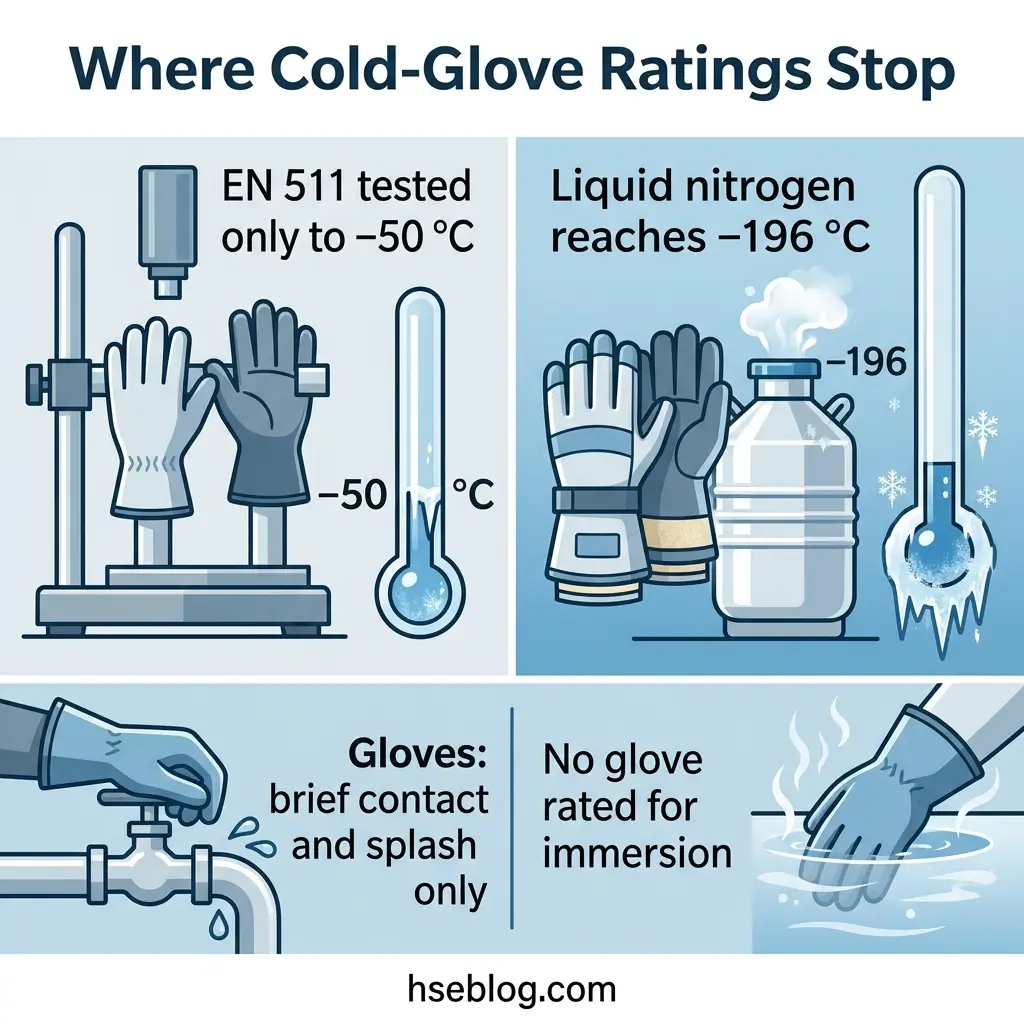
The European standard for cold-protective gloves is EN 511:2006, and its scope is the source of the confusion. EN 511 applies to gloves protecting against convective and contact cold down to about −50 °C. That is its ceiling — and liquid nitrogen sits roughly 146 °C colder than the lowest temperature the standard even tests for. Hazchem Safety
So a cryogenic glove certified to EN 511 (alongside EN 388 for mechanical strength and EN ISO 21420 for general fit) is genuinely useful, but only within its real design envelope:
- It protects against brief handling of very cold items and an accidental, momentary splash.
- It does NOT protect against submersion in the liquid or prolonged contact with a cryogenically cooled object.
- It fails completely once the outer layer absorbs moisture or the inner insulation gets wet, because the trapped cold then conducts straight to the hand.
The fit-and-failure traps practitioners keep seeing
Two patterns dominate the published guidance on cryogenic gloves. First, fit: gloves with elastic wrists are discouraged, because liquid nitrogen can absorb into the elastic cuff and cause burns, and they take longer to remove. A loose glove that drops off your hand in a hurry is safer than a snug one that seals the cold in. Berkeley Lab EH&S
Second, condition. Lawrence Berkeley National Laboratory's December 2025 PPE guidance notes that the most common damage found on cryogenic gloves is ripped seams, and that absorbent materials near the hands can soak up even a small splash and hold it against the skin. Inspect every glove for tears and split seams before each use, and treat a wet glove as no glove at all. Berkeley Lab EH&S
There is also a related misconception worth killing: leather welding gloves and chemical-resistant gloves are not substitutes. They are not effective against cryogenic splash or contact, even briefly. Loose leather gloves without gauntlets are sometimes used for handling cold piping where only surface contact is possible — but never for liquid.
What the Standards Actually Require
No single regulation hands you a cryogenic PPE shopping list. Instead, two regulatory systems — one American, one European — converge on the same outcome through different routes, and competent selection means reading both correctly.
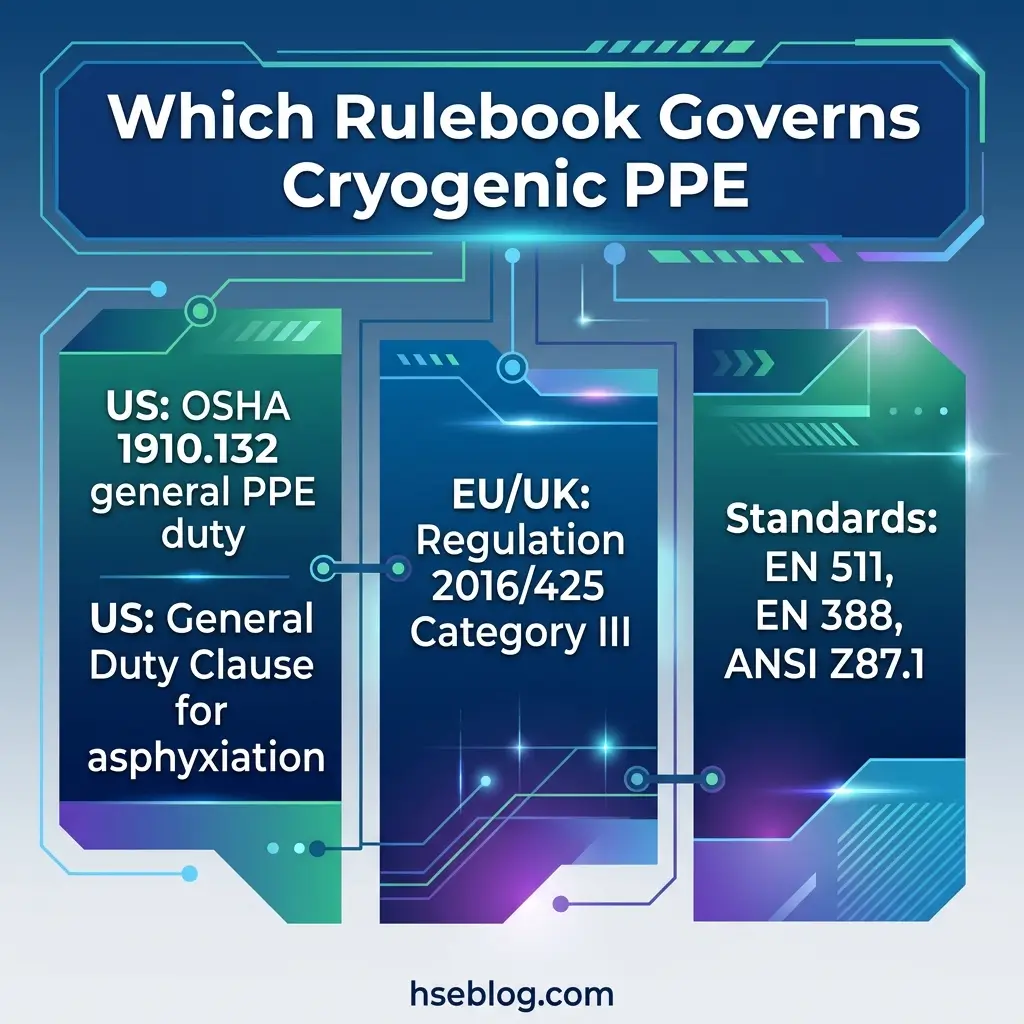
In the United States, there is no OSHA standard written specifically for cryogenic liquids. PPE selection runs through the general framework instead:
- 29 CFR 1910.132 (US, OSHA) — the umbrella PPE rule. The employer must assess the workplace for hazards, select PPE that protects against the hazards identified, and select PPE that properly fits each affected employee, with a written hazard-assessment certification. Occupational Safety and Health Administration
- 29 CFR 1910.133, .138, .136 (US, OSHA) — the specific duties for eye and face, hand, and foot protection, which reference ANSI consensus standards such as ANSI Z87.1 for eye and face devices.
- The General Duty Clause, Section 5(a)(1) (US, OSHA) — the catch-all that obliges employers to address recognized serious hazards, including cryogenic asphyxiation, where no specific standard exists.
The European route is more prescriptive about the product itself. Under Regulation (EU) 2016/425, PPE protecting against extreme cold is treated as complex, life-critical equipment.
- Category III classification (EU/UK) — cryogenic gloves and clothing fall into Category III, the class of PPE that protects against risks that may cause very serious consequences such as death or irreversible damage to health, which demands third-party certification and ongoing oversight of production. OSHwiki
- Essential requirements (EU/UK) — the Regulation states that PPE against cold must possess thermal insulating capacity and mechanical strength appropriate to the conditions of use, and flexible materials must retain the flexibility needed for the work. In Great Britain, the equivalent UKCA marking applies. EUR-Lex
Where the systems differ, the safer reading governs. The practical synthesis is straightforward: run a documented hazard assessment for the specific task, then select task-appropriate, certified, well-fitting PPE — and never assume a CE or Z87 mark alone tells you the kit is suitable for the cold you actually face.
The Hazard PPE Can't Fix: Oxygen Deficiency and Asphyxiation
Every item discussed so far protects the body from cold. None of it adds oxygen to the air you breathe — and that gap is where cryogenic work turns lethal. The asphyxiation cascade is brutally simple:
- A spill or release vaporizes. A litre of cryogenic liquid produces a large volume of gas — around 0.65 to 0.78 cubic metres per litre for liquid nitrogen, argon, or helium (EIGA, Doc 44) — enough to swamp a room. Eiga
- The oxygen quietly drops. The gas is colorless and odorless, and there is no choking reflex, because the body senses rising carbon dioxide, not falling oxygen.
- Collapse comes without warning. At about 6% oxygen, fainting occurs without any warning, and below that, death by asphyxiation can follow within a few minutes (EIGA, Doc 44). The minimum safe oxygen concentration for entry is 19.5%. Eiga
This is not a rare edge case. In the US, nitrogen asphyxiation caused 80 deaths between 1992 and 2002 and another 14 between 2012 and 2020, and almost half of those incidents involved contractors (AIChE Process Safety Beacon, 2021). A recurring, deadly thread runs through them: rescuers rushing in without breathing apparatus and becoming victims themselves. Aiche
That is exactly what unfolded at the Foundation Food Group plant, where the CSB's December 2023 final report recorded that at least 14 people entered the freezer room or its surroundings, and recommended that OSHA develop a dedicated standard for liquid nitrogen handling. The PPE lesson is sharp and specific:
- Filtering respirators are worthless here. A cartridge cannot manufacture oxygen; in an oxygen-deficient atmosphere it offers no protection at all.
- Entry requires supplied air. Only a self-contained breathing apparatus (SCBA) or an airline respirator makes entry into a known or suspected oxygen-deficient space survivable.
- Detection beats reaction. Portable or fixed oxygen monitors with alarms give the warning the human body never will, and they belong in any room where cryogens are stored or decanted.
Where PPE Sits in the Cryogenic Control Hierarchy
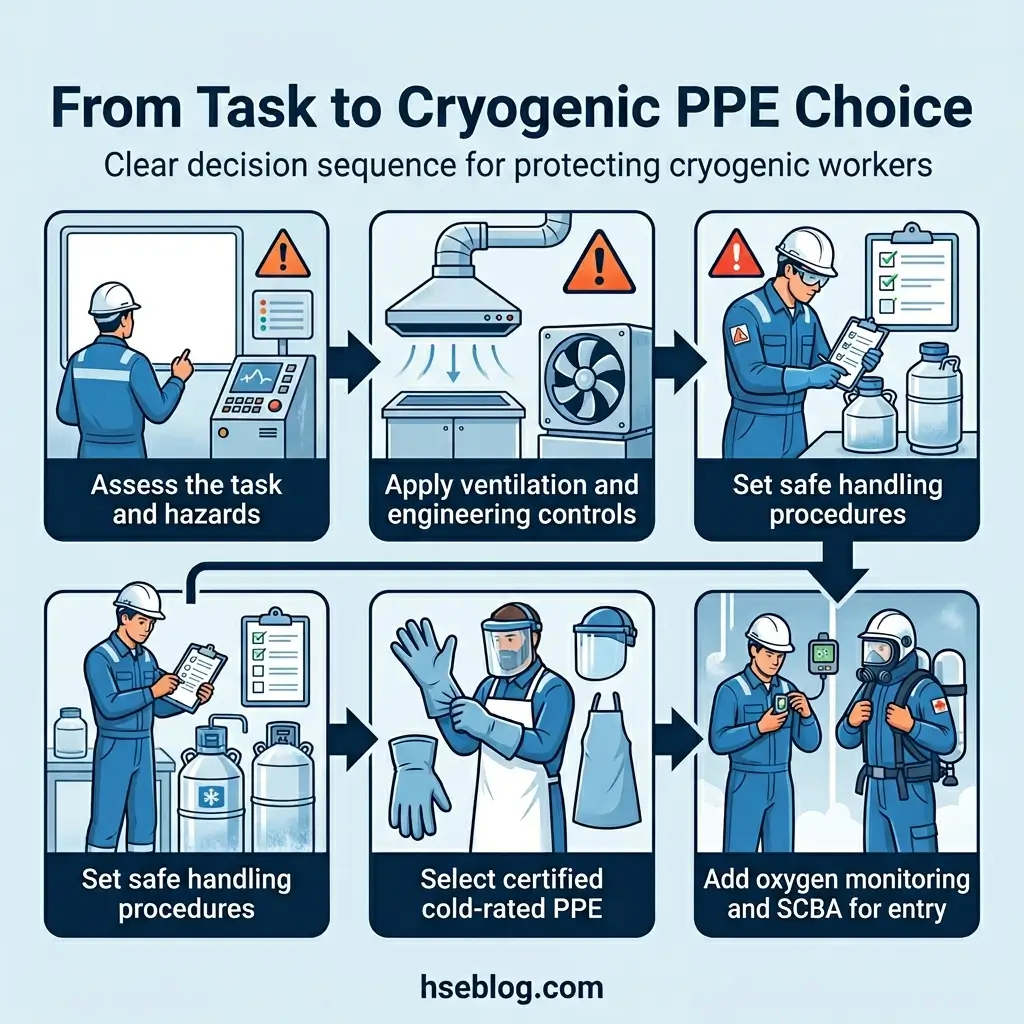
Reaching for PPE first is the most common planning error in cryogenic work. Protective equipment is the last line of defense, not the first, and treating it as the primary control quietly accepts a higher risk than necessary.
The stronger controls sit above it and should be exhausted before PPE is even specified:
- Engineering controls come first. Adequate ventilation, pressure-relief devices on every closed system, phase separators on decanting lines, and fixed oxygen monitoring remove or contain the hazard before it reaches a person.
- Administrative controls come next. Safe decanting procedures, transferring below chest height, slow filling to limit boiling and splashing, restricted access, and trained two-person working reduce the chance of exposure.
- PPE protects against what is left. It catches the residual splash, the unavoidable cold surface, the accidental contact — the risks the higher controls cannot fully eliminate.
The judgment call most teams get wrong is the face shield threshold. Safety glasses are the constant minimum, but the shield is not optional decoration — it becomes necessary the moment you pour above chest height, decant from a pressurized source, or insert a warm object into the liquid, all of which provoke violent boiling and splashing. When you are unsure whether a task crosses that line, treat it as if it does.
PPE selection, in the end, is the visible tail of an invisible process: a real hazard assessment, honest engineering and procedural controls, and only then the cold-rated kit that protects the person standing at the dewar. Get that order right, and the gloves and shields do the small, specific job they were designed for.
Frequently Asked Questions
Can you put your hand in liquid nitrogen if you're wearing cryogenic gloves?
No. Cryogenic gloves are rated for brief handling of cold items and accidental splashes only, not for submersion or prolonged contact with chilled objects. There is no commercially available glove certified for immersion in cryogenic liquid. If liquid gets inside the glove, the loose fit exists so you can throw it off immediately before serious burns develop.
What oxygen level is dangerous when working with cryogenic liquids?
The minimum safe concentration for entering a space is 19.5% oxygen. Below that, risk rises sharply, and EIGA guidance (Doc 44) notes that at roughly 6% oxygen a person can faint without any warning, with death possible within minutes. Because cryogenic vapor is odorless and colorless, only an oxygen monitor reliably detects a deficient atmosphere before collapse.
Do you need a respirator to work with liquid nitrogen?
For routine open-air handling, no — eye, face, hand, and body protection plus ventilation are the priority. A filtering respirator is useless against oxygen deficiency because it cannot add oxygen. Entry into a known or suspected oxygen-deficient space requires supplied air: a self-contained breathing apparatus or an airline respirator, used under a competent person's confined-space controls.
Are leather welding gloves acceptable for cryogenic work?
Not as splash or contact protection. Heat-protective and chemical gloves are not effective against cryogenic liquid, even briefly. Loose-fitting leather gloves without gauntlets are sometimes used only for handling cold piping where contact is limited to surfaces, never liquid. For any decanting or splash-risk task, purpose-made cryogenic gloves certified to EN 511 and EN 388 are required.
Is dry ice handling the same as liquid nitrogen handling?
The cold-burn precautions overlap — insulated dry gloves and eye protection are needed for both. The difference is the gas: solid carbon dioxide sublimates into CO₂, which is an asphyxiant and a toxic gas at higher concentrations, so ventilation and monitoring still apply. Never lower your head into a dry-ice chest, where dense CO₂ collects.
Does OSHA have a specific standard for cryogenic PPE?
No. The United States has no OSHA standard written solely for cryogenic liquids; selection runs through the general PPE rules (29 CFR 1910.132, .133, .138) and the General Duty Clause. The CSB's 2023 Foundation Food Group report recommended OSHA develop dedicated liquid-nitrogen requirements, but the general framework remains the governing basis today.
Conclusion
Specifying cryogenic PPE well comes down to a few firm decisions. Cover all skin with non-absorbent, cuffless layers; make the gloves loose enough to throw off in a second; treat the face shield as mandatory the moment splashing becomes likely; and inspect every glove for split seams before it touches a cold surface.
The deeper decision is recognizing what cryogenic PPE cannot do. It buys you protection against cold burns and splashes, but it adds nothing to the air you breathe — so in any enclosed space, an oxygen monitor and supplied-air entry equipment carry the load that no glove or apron ever will. The published fatality record, from the CSB's nitrogen-asphyxiation reviews to the Foundation Food Group investigation, repeats the same lesson: people die not because the gloves failed, but because the atmosphere was never controlled.
Run the hazard assessment, place the engineering and procedural controls first, and let the cold-rated kit do its narrow, vital job at the end of that chain. That sequence — not the kit alone — is what keeps the person at the dewar alive.