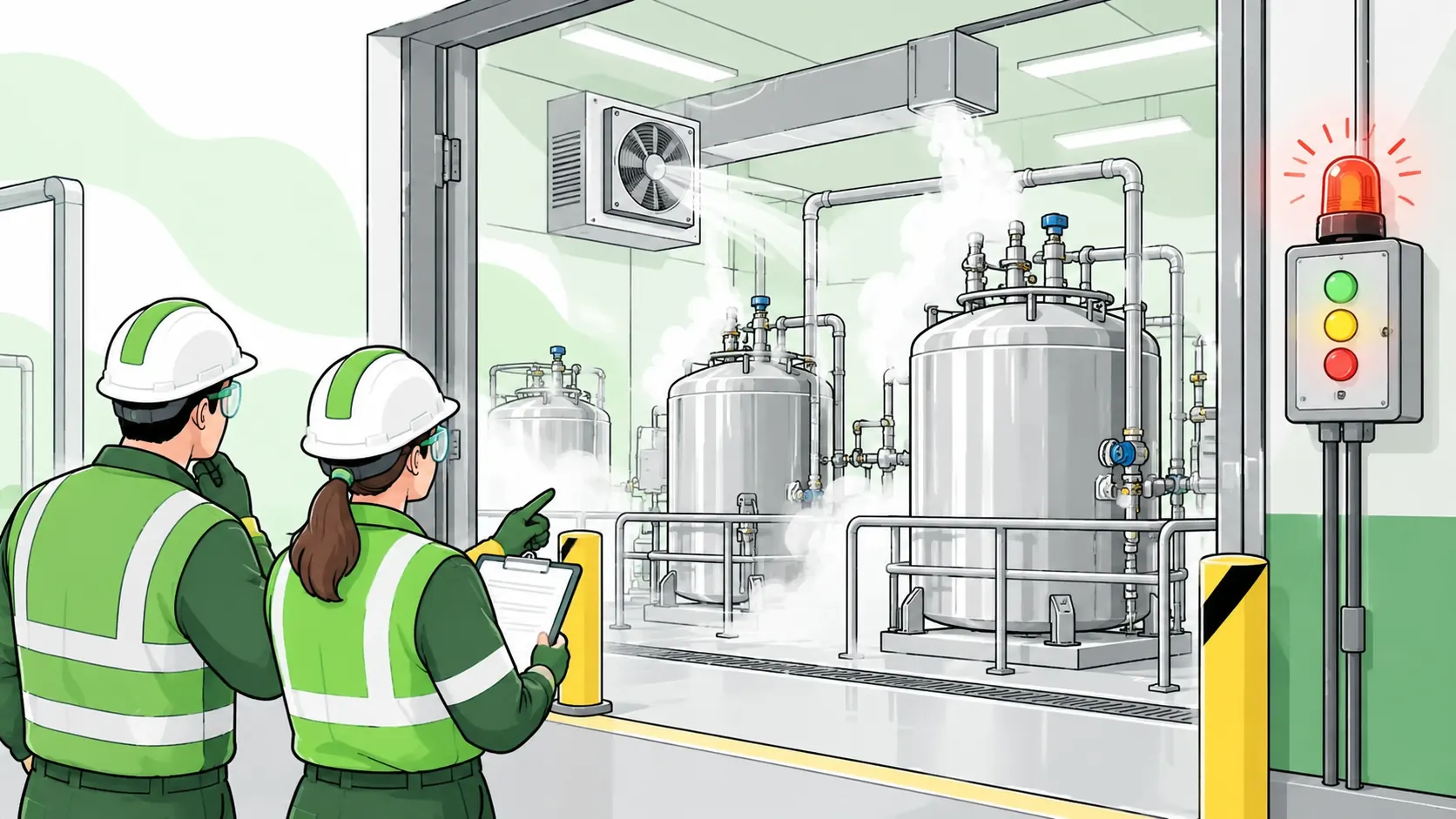
Oxygen depletion risks from cryogenic liquids arise because nitrogen, argon, and helium expand several hundred times as they vaporise, displacing breathable air. When oxygen falls below 19.5%, judgment and consciousness can fail within seconds — usually with no warning, because the body senses carbon dioxide, not the missing oxygen.
Why This Is Worth Two Minutes of Your Attention
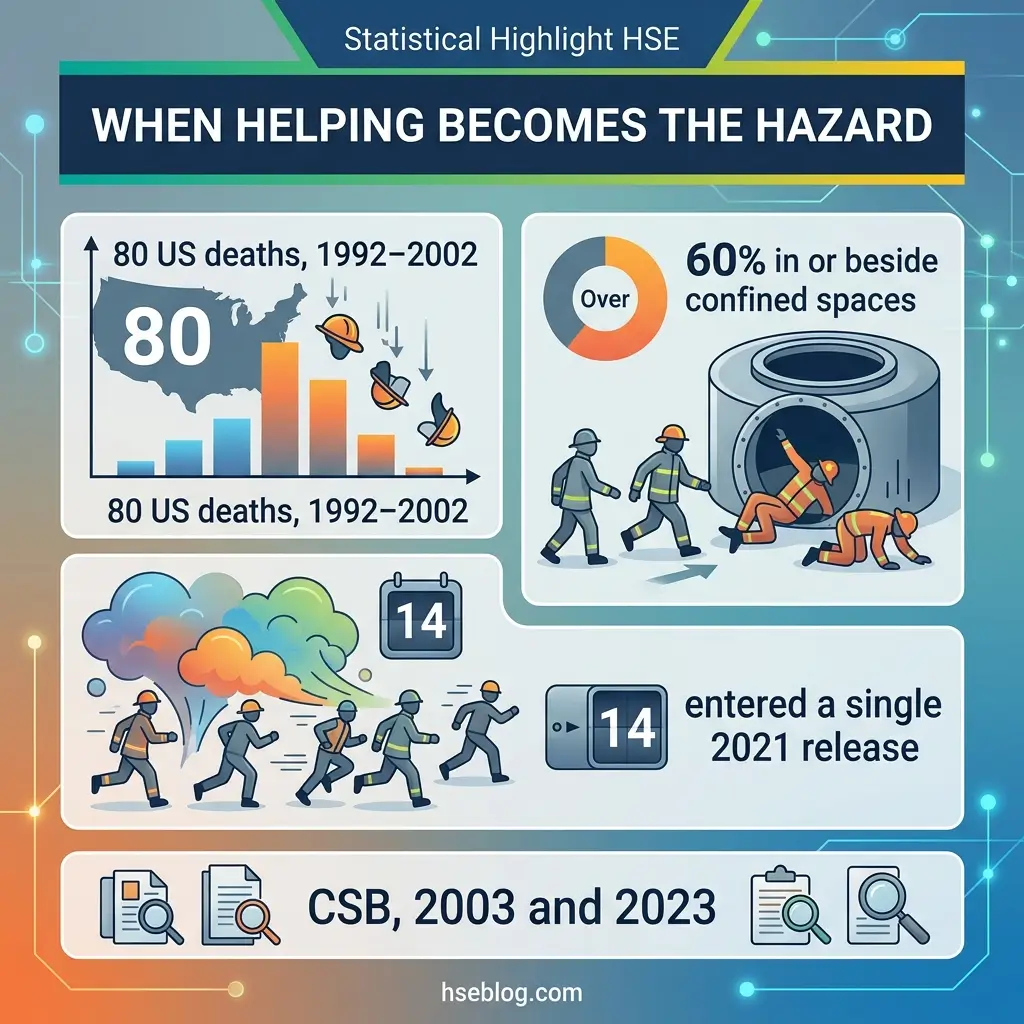
On 28 January 2021, a bent measuring tube let liquid nitrogen overflow inside a freezer room at a Georgia poultry plant, boiling into a vapour cloud four to five feet high; six workers died and several others were injured (CSB, 2023). The detail that should unsettle every safety professional: at least 14 people walked into that room to investigate or rescue colleagues, with no oxygen monitor, no alarm, and no breathing apparatus (CSB, 2023).
Oxygen depletion risks from cryogenic liquids kill quietly because the hazard is invisible, odourless, and offers no feeling of suffocation until self-rescue is already impossible. What follows is how these liquids strip oxygen from a room, why the body fails to warn you, where the danger concentrates, what the regulations demand, and the controls that actually prevent another Gainesville.
Competent-person caveat. This article provides general HSE knowledge. Life-critical work such as entry into spaces where cryogenic liquids are stored, vaporised, or have displaced air must be planned and supervised by a competent person with relevant training, jurisdiction-specific authorisation, and a site-specific risk assessment. The information here does not replace that.
How Cryogenic Liquids Cause Oxygen Depletion
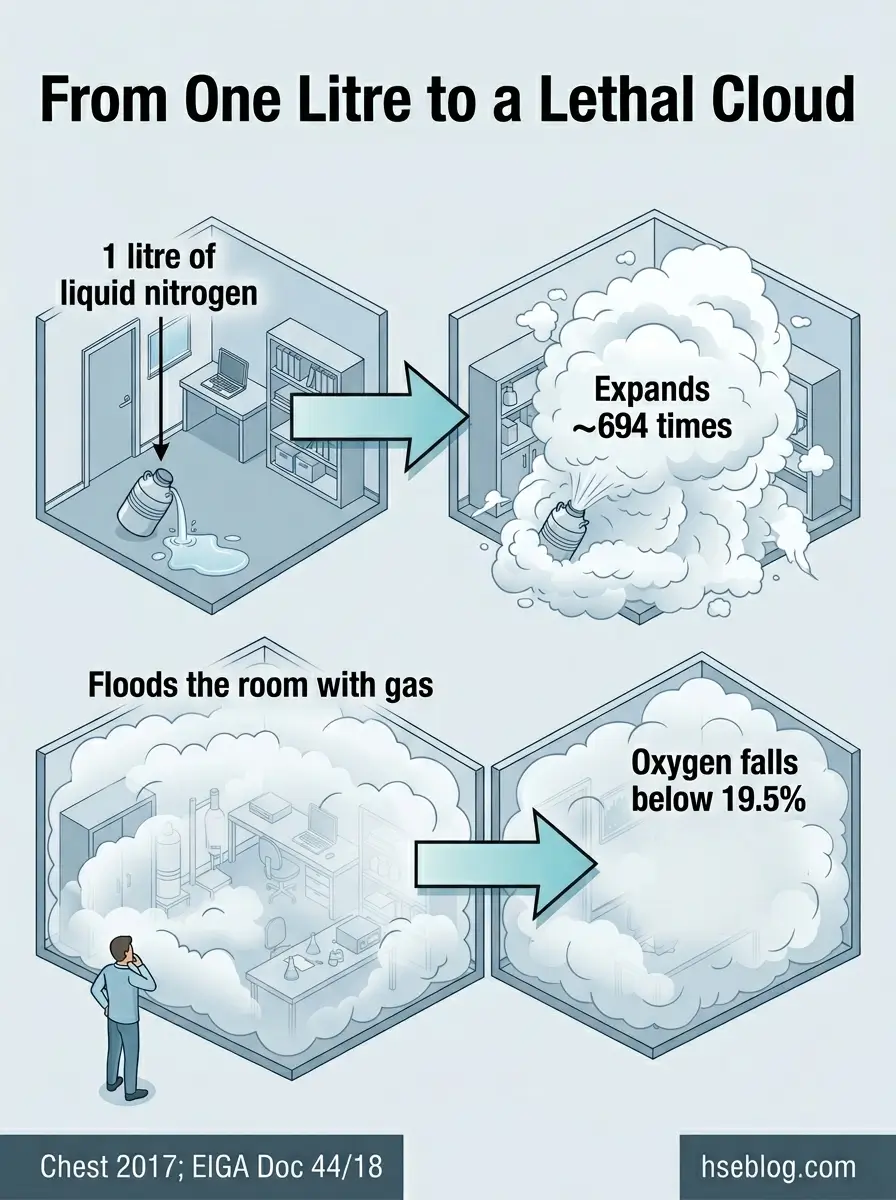
The mechanism is pure physics, not toxicity. A cryogenic liquid sits at a punishingly low temperature, and the moment heat reaches it, it boils into a gas that occupies hundreds of times the volume of the liquid it came from.
That expansion is the whole danger. One litre of spilled liquid nitrogen expands to roughly 694 litres of gas at 20 °C — enough to push breathable air out of a meaningful volume of a room (Chest, 2017).
EIGA's guidance puts the range across the common cryogens at about 0.65 to 0.78 cubic metres of gas for every litre of liquid (EIGA Doc 44/18). The colder the gas, the denser it is, so it does not rise and disperse the way intuition expects — it spreads and lingers.
| Cryogenic liquid | Boiling point | Gas from 1 litre of liquid |
|---|---|---|
| Liquid nitrogen | −196 °C | ~0.65 m³ (≈694× at 20 °C) |
| Liquid argon | −186 °C | ~0.78 m³ (most gas per litre) |
| Liquid helium | −269 °C | ~0.75 m³ |
Figures from EIGA Doc 44/18; the ~694:1 nitrogen ratio at 20 °C is from a peer-reviewed clinical report (Chest, 2017). Ratios rise further as the cold gas warms toward room temperature.
Here is the part competitors skip. Nitrogen is usually present because someone wanted to remove oxygen — inerting a vessel or line to stop fire, corrosion, or a runaway reaction.
OSHA's own confined-space rule states the trade-off plainly: inerting "produces an IDLH oxygen-deficient atmosphere" (29 CFR 1910.146). The same gas that makes a process safer makes the surrounding air lethal, and that contradiction is exactly where people are caught off guard.
Why Oxygen Depletion Gives No Warning
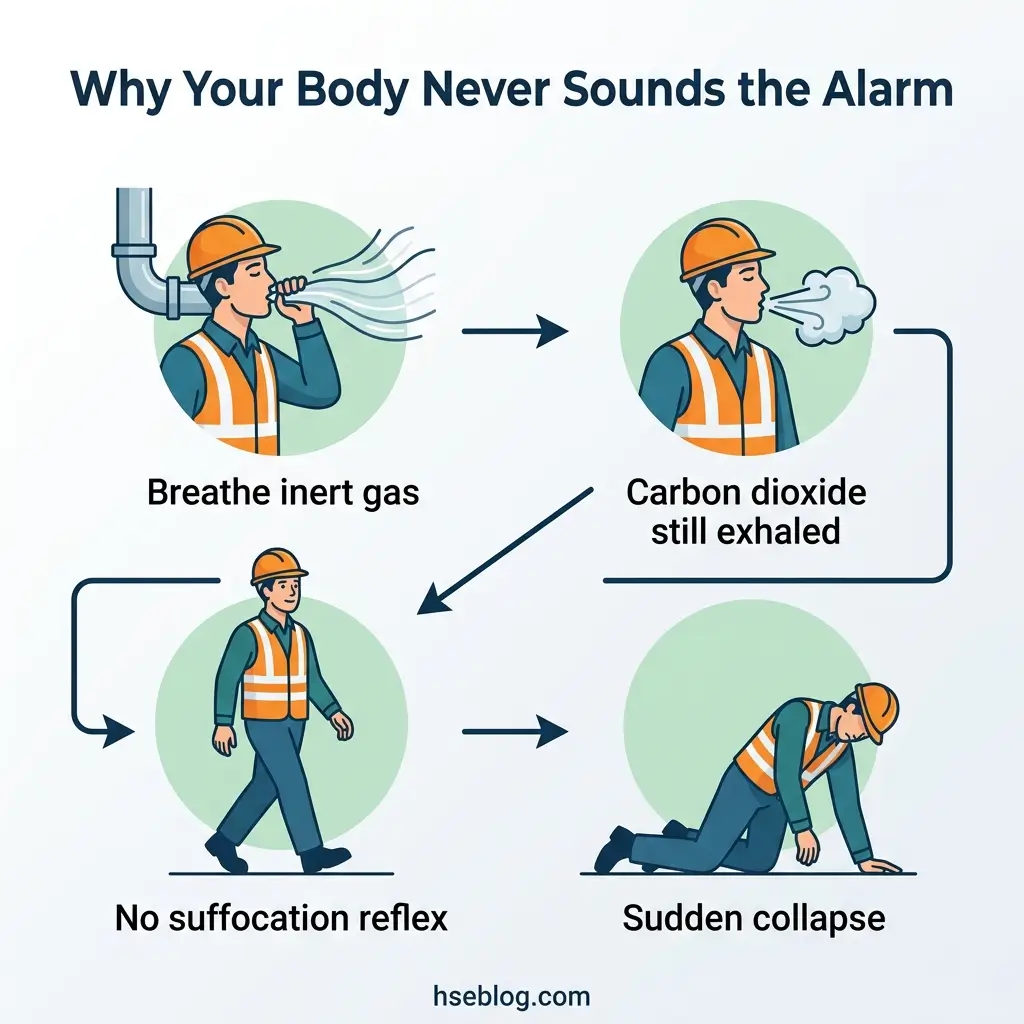
You will not feel yourself suffocating. That single fact is responsible for more cryogenic fatalities than any equipment failure, and it is the most dangerous misconception in this entire subject.
The body monitors the wrong gas
The urge to breathe is driven almost entirely by rising carbon dioxide, not by falling oxygen. In an oxygen-deficient, nitrogen-rich atmosphere, you keep exhaling CO₂ normally, so the brain never triggers the panic of air hunger (Chest, 2017).
Oxygen sensors in the body respond weakly until blood oxygen has already crashed. The result, documented in peer-reviewed clinical literature, is loss of consciousness "with few to no warning symptoms" (Chest, 2017).
The CSB states it even more bluntly: breathing an oxygen-deficient atmosphere can cause unconsciousness "after only one or two breaths," and the person cannot sense that the oxygen level is too low (CSB).
What happens as oxygen falls
The symptoms below are descriptive, not a clinical decision tool. They show how little margin exists between "normal" and "collapse."
- 20.9% — normal. Baseline breathable air.
- 16–19.5% — early impairment. Workers exerting themselves can become symptomatic quickly: faster breathing, raised heart rate, dulled thinking and coordination (OSHA interpretation, citing occupational-medicine literature).
- 12–16% — serious. Rapid breathing and heartbeat with clearly impaired attention and judgment (OSHA interpretation).
- ~6% — collapse without warning. Fainting occurs with no preliminary sign (EIGA Doc 44/18).
- Below 6% — minutes from death. A very high risk of fatal asphyxiation within a few minutes unless resuscitation is immediate (EIGA Doc 44/18).
Medical disclaimer. This description of oxygen-deficiency effects is for HSE practitioner reference. It is not medical advice. Workers with symptoms or specific exposure concerns should consult an occupational physician or a qualified medical professional.
The Deadliest Pattern: Would-Be Rescuers
A consistent pattern runs through the published fatality record: the first victim is a tragedy, and the people who rush in afterward turn it into a multiple fatality. This is the single most repeated failure mode in cryogenic and inert-gas incidents.
The CSB's 2003 nitrogen-asphyxiation study found 85 incidents over 1992–2002, killing 80 people, with more than 60% of victims in or next to a confined space (CSB, 2003). A further 14 nitrogen-asphyxiation deaths were recorded between 2012 and 2020 (CSB data).
Reviewing how these events unfold, the sequence is almost always the same:
- A worker enters or approaches a space where a cryogenic liquid has vaporised, unaware that oxygen is gone.
- They collapse silently — no shout, no struggle, often within a couple of breaths.
- A colleague sees a body on the floor and reads it as a slip, a fall, or a heart attack — never as an invisible gas.
- The colleague enters to help and collapses in the same spot.
- The toll multiplies as each responder repeats the mistake, which is exactly what happened at Foundation Food Group, where roughly 14 people entered the affected area (CSB, 2023).
The lesson the CSB drew from Gainesville is uncomfortable but precise: the workers were never told that a liquid-nitrogen release could kill, so trying to save each other cost them their own lives (CSB, 2023). You can read the full investigation in the CSB's final report on the Foundation Food Group release.
The practical takeaway for any site using cryogens: a collapsed worker near stored or vaporising cryogenic liquid is an oxygen-deficiency emergency until proven otherwise, and untrained entry is how the body count grows.
Where Does Oxygen Depletion Hide Around Cryogenic Liquids?
The instinctive answer — "inside tanks and vessels" — is incomplete and dangerously so. Oxygen depletion concentrates wherever cold, dense gas can pool or where ventilation is too weak to keep pace with boil-off.
The high-risk locations cluster into a few recognisable types:
- Confined and permit-required spaces. Tanks, vessels, pits, and pipework that have been inerted are the classic killers, and inerting itself guarantees an oxygen-deficient atmosphere (29 CFR 1910.146).
- Cold rooms and walk-in freezers. Liquid-nitrogen freezing lines vent gas continuously; a control failure can fill the room, as the Foundation Food Group cloud demonstrated at four to five feet high (CSB, 2023).
- Lifts, stairwells, and small storerooms. A dewar carried in a lift can flood a tiny, unventilated volume faster than the doors reopen.
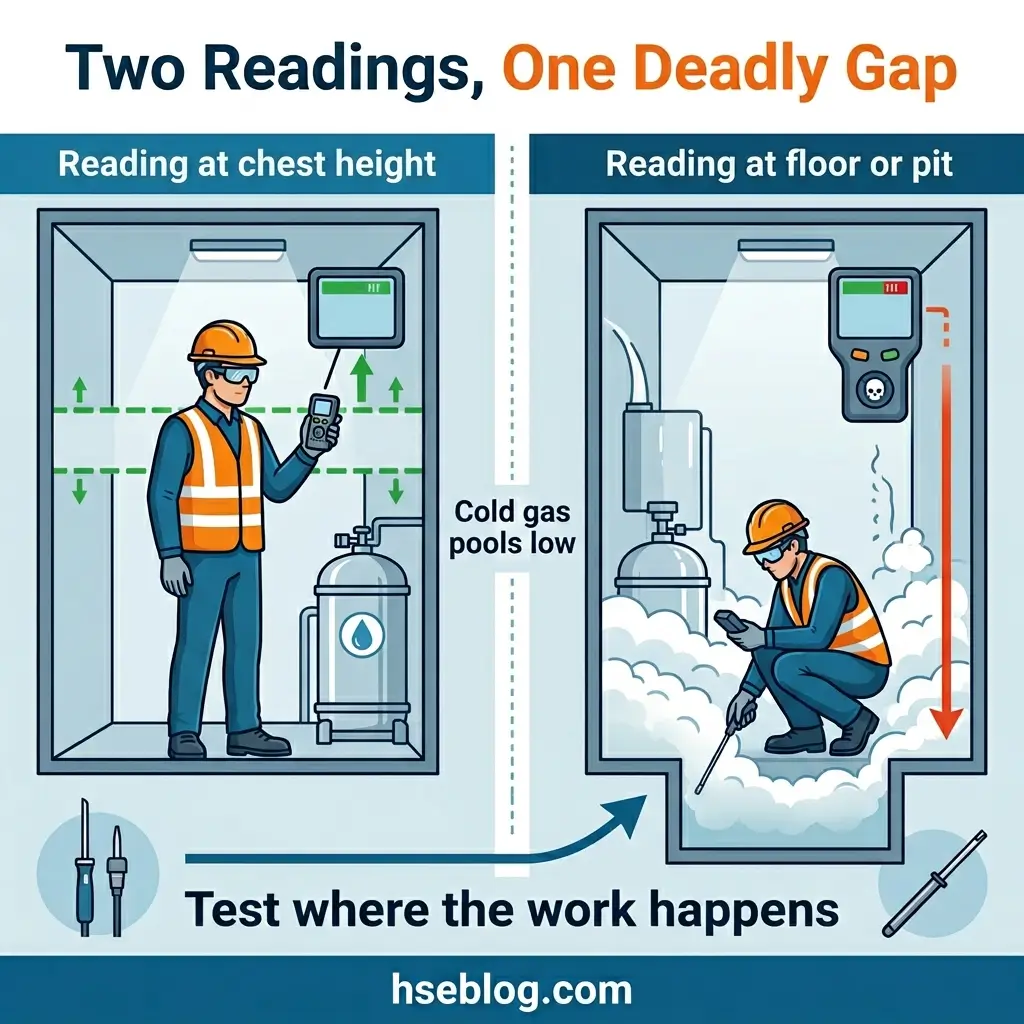
- Pits, basements, and floor-level cavities. Cold nitrogen and argon vapour are denser than air, so they sink and collect low — exactly where a fallen worker's breathing zone sits.
The reading that lies to you
Here is an applied detail that separates a thorough gas test from a fatal one. Oxygen is rarely depleted evenly across a space.
Because the cold gas pools low, a meter held at chest height in a doorway can show a comfortable 20% while the air at floor or pit level is well below the danger line. Argon, the densest of the common cryogens, makes this stratification worse.
The discipline is simple: test at the level where the work, the spill, or the body actually is — not where it is convenient to stand.
The "it's outdoors, so it's fine" trap
Open air is safer, but it is not a guarantee. A large release in a sheltered yard, a tanker bay, or against a building wall can still build a low-lying oxygen-deficient pocket before it disperses.
The CSB's own framing of "in or next to a confined space" exists precisely because people standing outside a space have been killed by the atmosphere flowing out of it (CSB, 2003).
Oxygen Limits and the Cryogenic Standards Gap
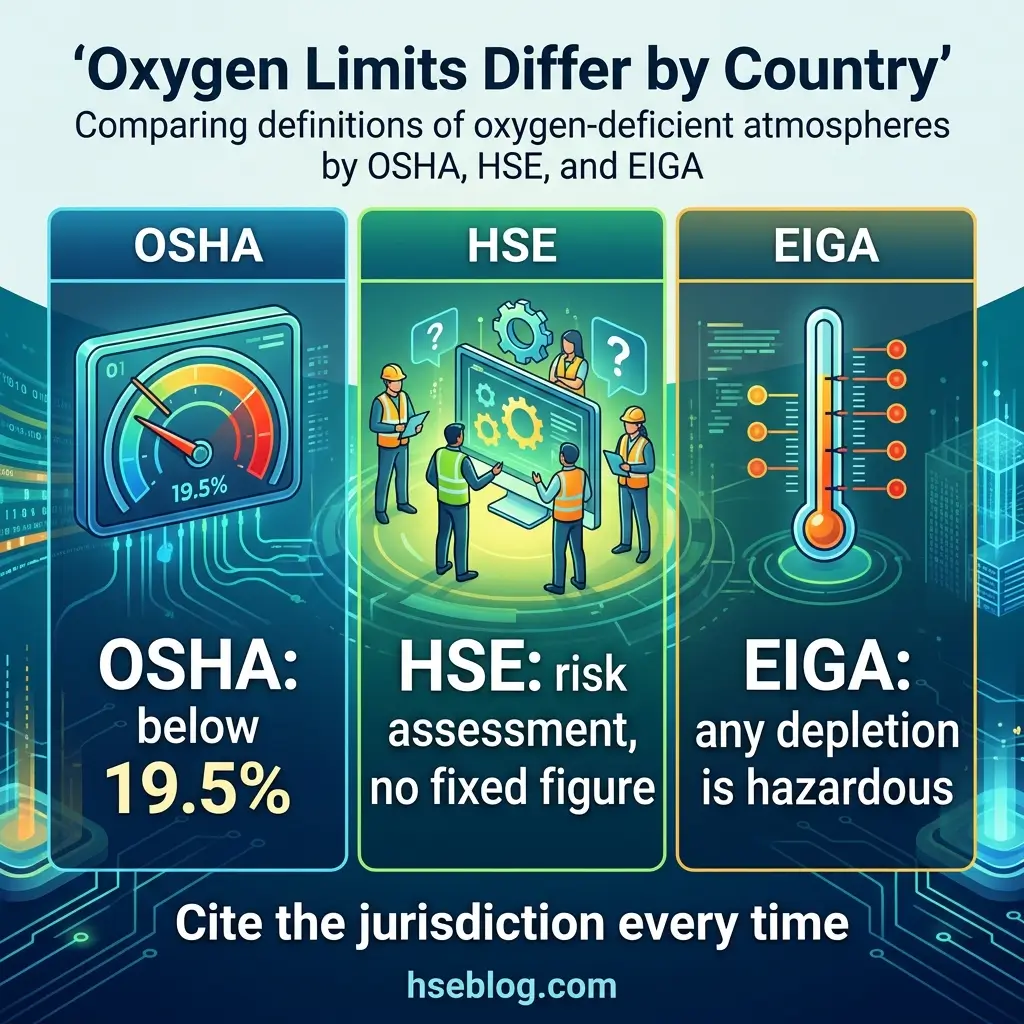
Under 29 CFR 1910.146, an atmosphere below 19.5% oxygen by volume is "oxygen-deficient," and above 23.5% is "oxygen-enriched" — the same limits OSHA sets in its respiratory protection standard, 29 CFR 1910.134 (United States). That 19.5% line is the legal trigger for treating air as hazardous, and you can read the definitions in OSHA's permit-required confined spaces standard.
OSHA also fixes the testing sequence for a reason worth understanding: test oxygen first, then combustible gases, then toxics, because a combustible-gas sensor cannot read correctly in air that is already oxygen-starved (29 CFR 1910.146).
Other jurisdictions reach the same goal differently:
| Jurisdiction | Oxygen-deficient trigger | Governing approach |
|---|---|---|
| United States (OSHA) | Below 19.5% by volume | Fixed numeric limit; 29 CFR 1910.146 / 1910.134 |
| United Kingdom (HSE) | No single numeric figure | Risk-assessment duty; Confined Spaces Regulations 1997 |
| EU / industry (EIGA) | Treats any meaningful depletion as hazardous | Guidance and monitoring; EIGA Doc 44/18 |
A point of professional honesty about where the standards sit. The UK does not publish one statutory oxygen percentage; it places a duty on employers to assess and control the risk and to maintain breathable air, which in practice means treating any depletion below the normal 20.9% as something to engineer out (HSE, Confined Spaces Regulations 1997).
There is also a genuine gap, and it is current. In its December 2023 Foundation Food Group report, the CSB concluded the incident was preventable and recommended that OSHA create a national standard specifically addressing the storage, use, and handling of cryogenic asphyxiants such as liquid nitrogen — alongside recommendations to update industry guidance and the International Fire Code to require atmospheric monitoring (CSB, 2023).
As of that report, no dedicated US standard for cryogenic asphyxiants existed; the protection comes from confined-space, respiratory, hazard-communication, and industry rules applied together. EIGA reinforced the same message with its 2024 "Dangers of Asphyxiation" safety leaflet (EIGA, 2024).
Legal disclaimer. This regulatory content reflects a general HSE professional's understanding of US and UK requirements as of 2025. It is not legal advice. Specific compliance, enforcement, or prosecution questions should go to qualified legal counsel in the applicable jurisdiction. Regulatory currency last reviewed: 2025.
Controls That Prevent Cryogenic Asphyxiation
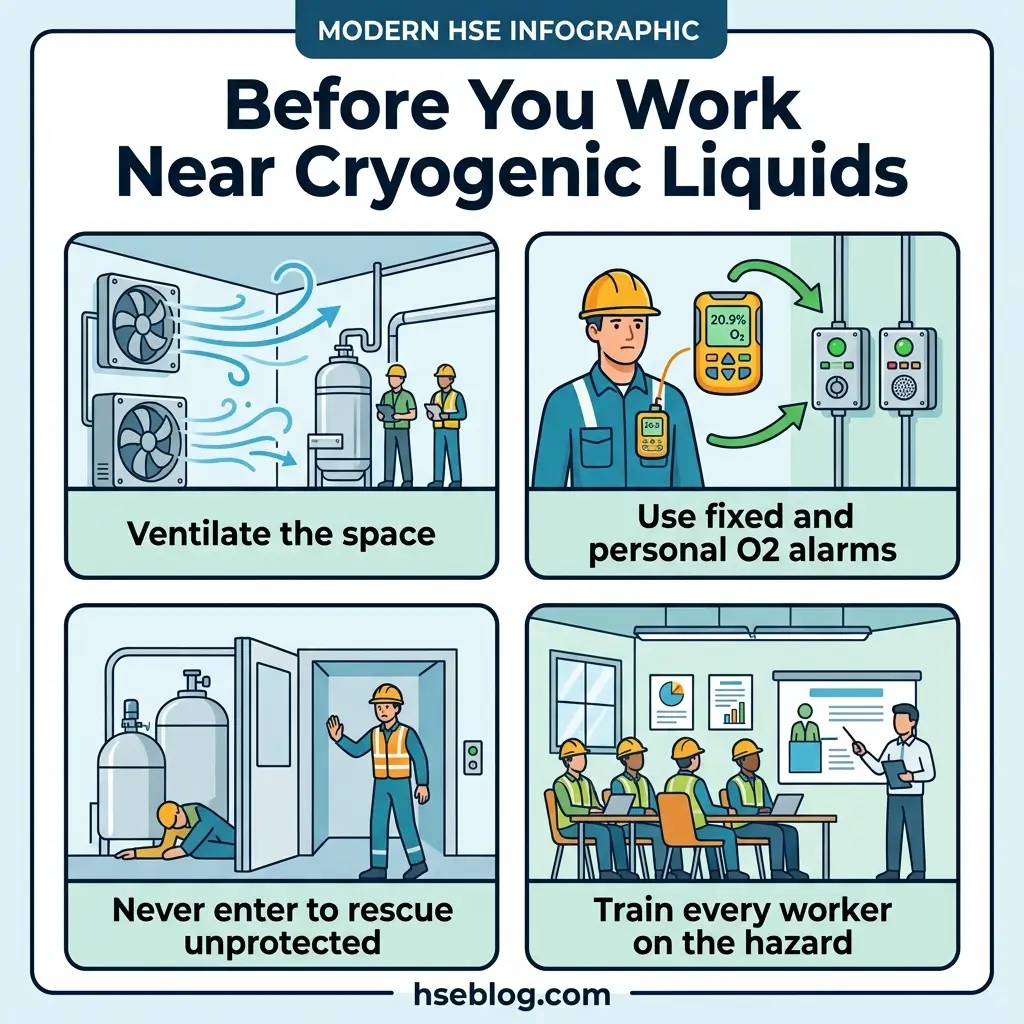
Preventing oxygen depletion from cryogenic liquids comes down to four things working together: keep the air breathable, prove it continuously, never enter blind, and make sure every worker understands the hazard. No single control is enough on its own, which is the lesson Gainesville paid for in full.
A workable control set, in priority order:
- Ventilate first. Use and store cryogens in well-ventilated areas; design vaporisers and freezing lines so boil-off is carried away, not trapped. Small rooms, cold rooms, lifts, and pits are the spaces to avoid or engineer carefully.
- Monitor continuously, in the right place. Install fixed oxygen sensors at the heights and zones where gas actually collects, with audible and visible alarms. Atmospheric monitoring was absent at Foundation Food Group, and its absence is named as a key failure (CSB, 2023).
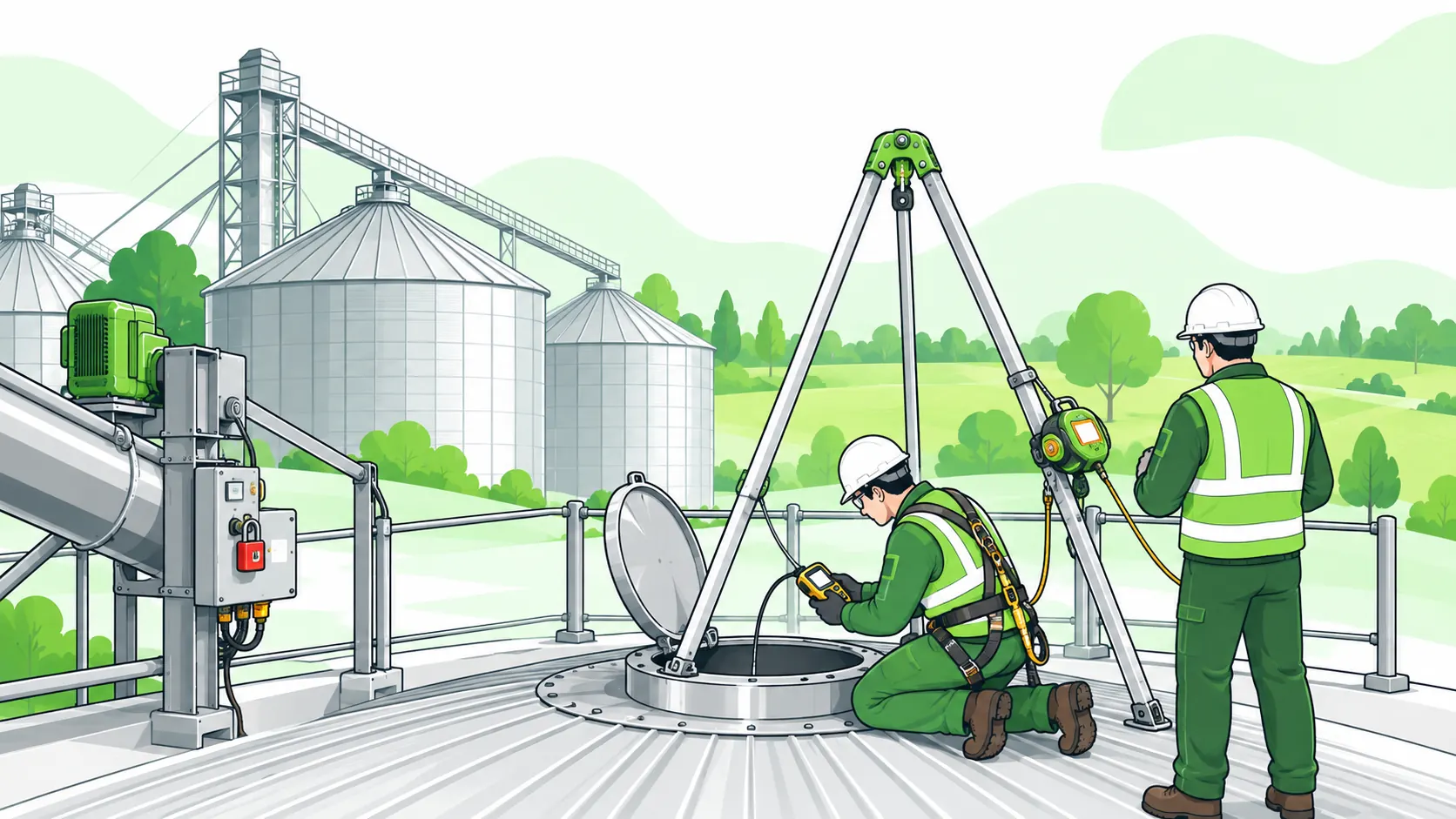
- Add personal protection for entry. For anyone working in or entering a potentially depleted space, that means personal O₂ monitors and, where the atmosphere cannot be guaranteed, supplied-air or self-contained breathing apparatus — never a filtering respirator, which cannot add oxygen.
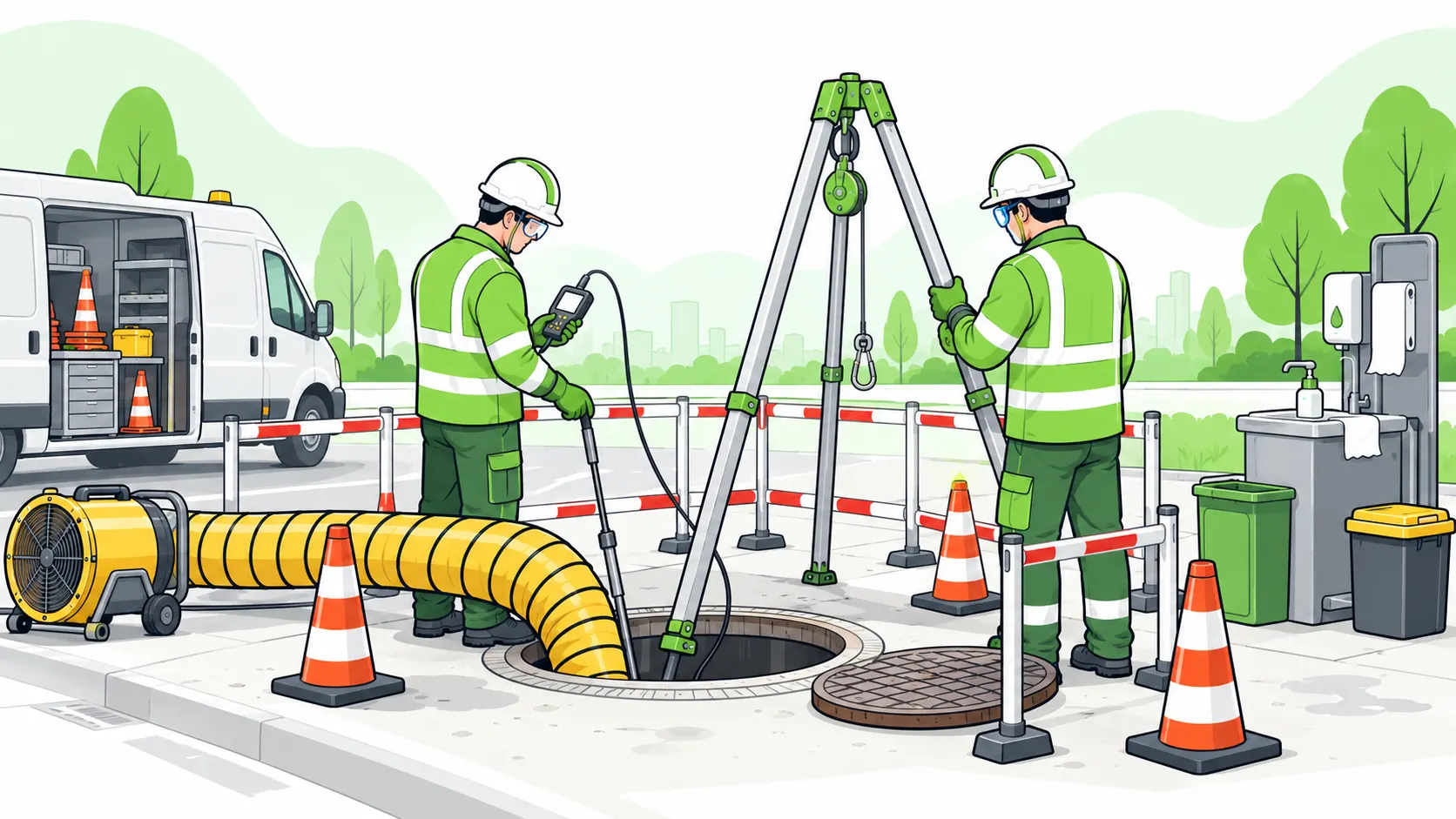
- Run a permit system for at-risk entry. Treat inerted or cryogen-affected spaces as permit-required: pre-entry testing, an attendant outside, and a rescue plan that does not rely on improvised entry (29 CFR 1910.146).
- Train for the invisible hazard. Every worker near cryogens should know that the gas gives no warning and that a collapsed colleague may signal lethal air, not a medical event.
The judgment call: personal monitor, fixed monitor, or both?
The honest answer is rarely "one or the other." A fixed alarm protects the room and warns people before they enter; a personal monitor follows the worker into the breathing zone and into the low pockets a wall sensor may miss.
For routine occupancy of a space with cryogenic risk, the defensible position is both — area detection to govern the room and personal detection to govern the person. Choosing one to save cost is exactly the kind of decision that looks reasonable on paper and indefensible after an incident.
If someone collapses: the no-entry rule
This is the hardest discipline to hold and the one that saves the most lives. If a worker drops near cryogenic liquid, the default is do not enter to retrieve them unprotected.
Raise the alarm, get trained responders with breathing apparatus, and ventilate. Enforcement makes the stakes concrete: across the companies involved at Foundation Food Group, OSHA proposed penalties approaching one million dollars, including willful violations for suffocation hazards (OSHA, 2021), detailed in the OSHA citation news release.
Recognised training pathways — NEBOSH, IOSH, OSHA outreach courses, or the regional equivalent — are where confined-space and cryogenic-hazard competence is built properly.
Frequently Asked Questions
What oxygen level is dangerous when working with cryogenic liquids?
OSHA classes any atmosphere below 19.5% oxygen by volume as oxygen-deficient and hazardous (29 CFR 1910.146). Effects begin in the 16–19.5% band during exertion, and at around 6% a person can faint with no warning at all (EIGA Doc 44/18). Treat anything below the normal 20.9% as a signal to ventilate and investigate.
Can you suffocate from liquid nitrogen in an open room?
Yes. A "large" or open room is not automatically safe, because even small volumes of cryogenic liquid expand several hundred times into gas (Chest, 2017). A control failure on a freezing line filled a room with a vapour cloud and killed six workers in 2021 (CSB, 2023). Room size buys time, not immunity.
Why don't you feel like you're suffocating in an oxygen-deficient atmosphere?
Because your breathing reflex tracks carbon dioxide build-up, not oxygen loss. In a nitrogen-rich atmosphere you keep exhaling CO₂ normally, so the brain never triggers air hunger, and unconsciousness can follow within one or two breaths (Chest, 2017; CSB). That missing warning is what makes inert gases so lethal.
Do you need a confined space permit to handle cryogenic liquids?
Not for all handling, but yes for entry into spaces where cryogens are stored, vaporised, or used to inert equipment. Inerting deliberately creates an oxygen-deficient, IDLH atmosphere (29 CFR 1910.146). Those spaces should be managed as permit-required, with pre-entry testing, an attendant, and a rescue plan in the United States.
Should I use a personal or a fixed oxygen monitor for liquid nitrogen?
Use both where the risk justifies it. A fixed area sensor protects the room and warns people before they enter; a personal monitor follows the worker into low pockets a wall unit can miss. The Foundation Food Group room had no atmospheric monitoring, which the CSB identified as a critical failure (CSB, 2023).
Is liquid oxygen an asphyxiation hazard like liquid nitrogen?
No — it is the opposite problem. Liquid oxygen does not deplete oxygen; vaporising it enriches the atmosphere, which sharply increases fire and explosion risk, the hazard OSHA limits above 23.5% (29 CFR 1910.146). Nitrogen, argon, and helium displace oxygen; oxygen enriches it. Both are dangerous, for different reasons.
The Real Cost of Underestimating This Hazard
Six families learned in 2021 that "non-toxic" and "harmless" are not the same word, and that a gas making up most of the air we breathe can empty a room of everything that keeps us alive (CSB, 2023). The cruelty of oxygen depletion from cryogenic liquids is that it punishes decency — the people who run toward a fallen colleague are often the next to fall.
That is why competence here is not paperwork; it is the difference between one casualty and several. The worker who knows the gas gives no warning, who tests at floor level, who wears a monitor, and who refuses to enter blind is the one who walks home and brings others with them.
Treat every space where a cryogenic liquid is stored or vaporises as capable of killing without a sound, and build the ventilation, monitoring, and training to match — because with oxygen depletion from cryogenic liquids, the atmosphere never gives a second warning.