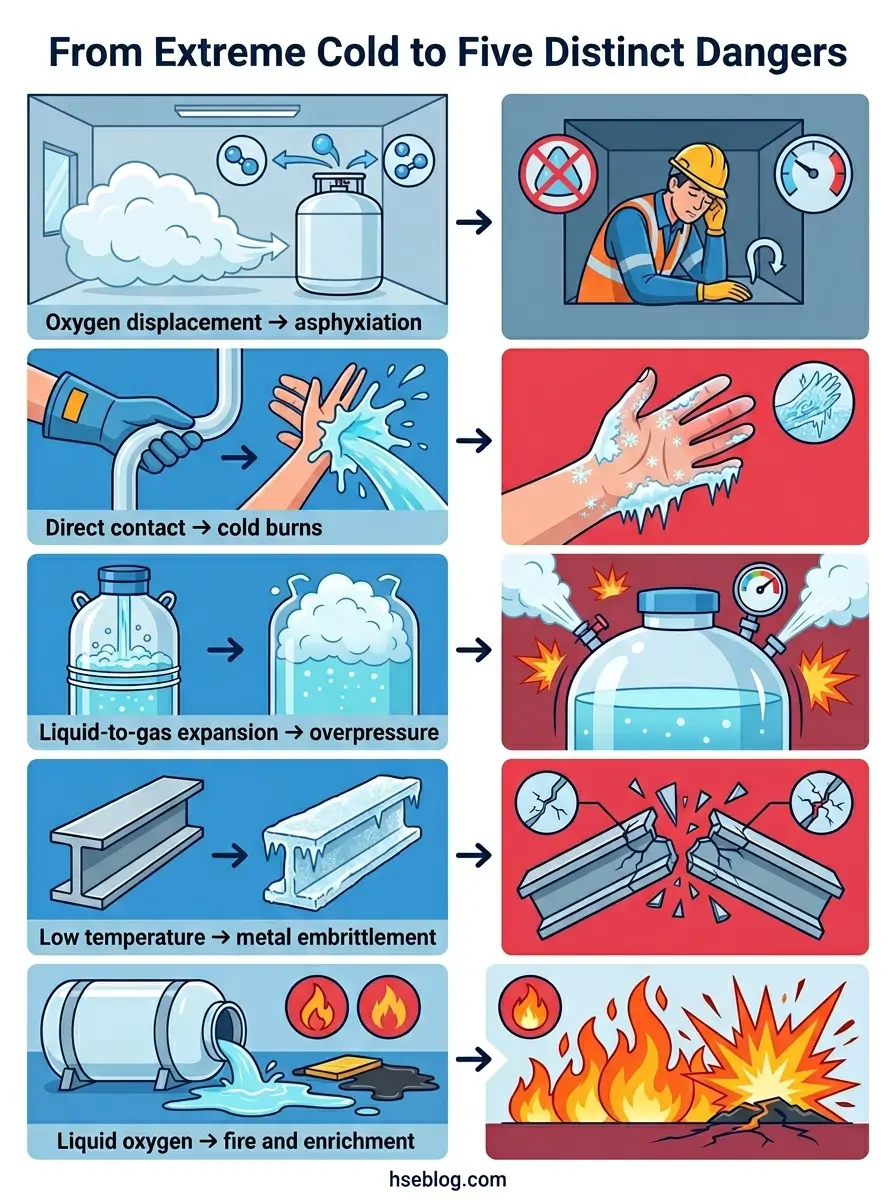
Cryogenic hazards are the cluster of dangers created when liquids stored below roughly –180 °C are used or released: rapid asphyxiation from oxygen displacement, severe cold burns and frostbite, violent overpressure as liquid flashes to gas, embrittlement of metals, and fire risk from oxygen enrichment. The cold is rarely what kills — the gas is.
A bent tube, an invisible cloud, six lives
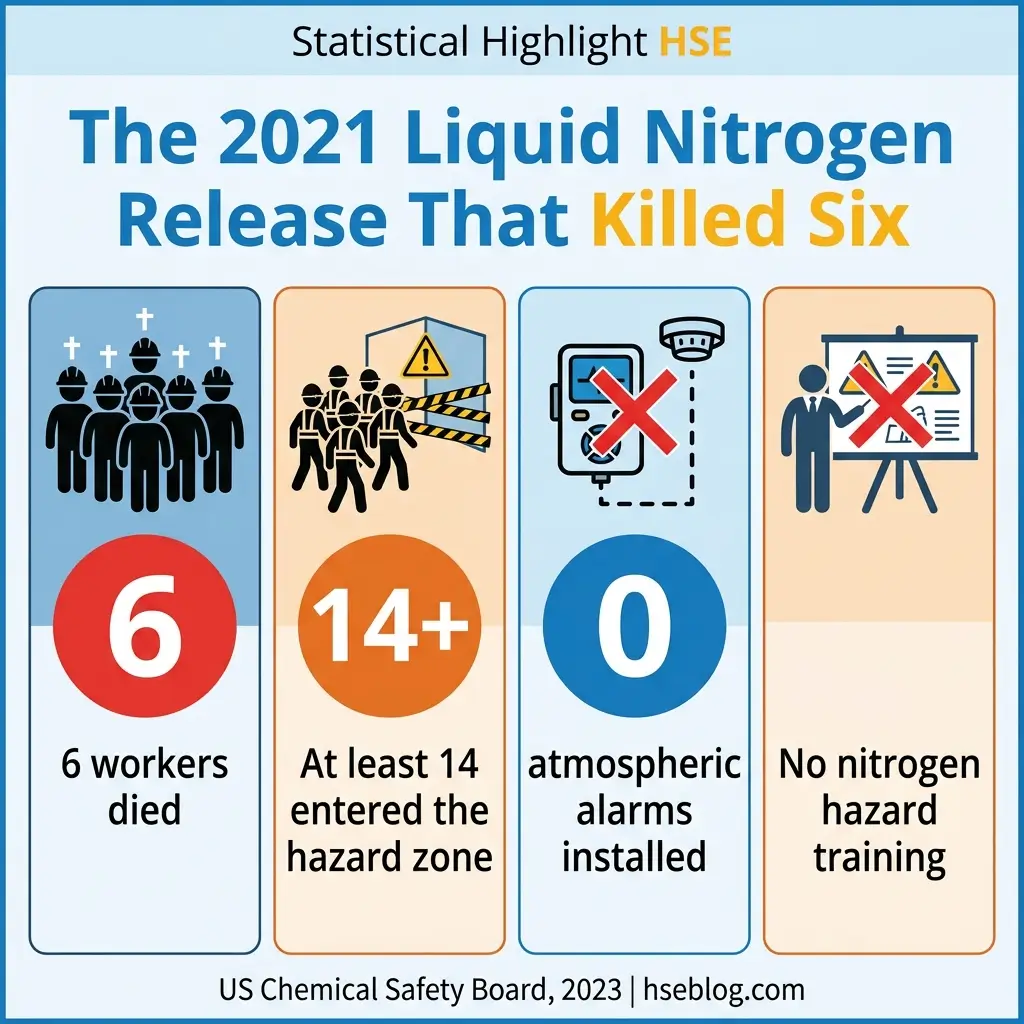
On 28 January 2021, six workers died at the Foundation Food Group poultry plant in Gainesville, Georgia, after a freezer released liquid nitrogen into an enclosed room. A "bubbler tube" used to gauge liquid level had been bent during maintenance, defeating the level control, and liquid nitrogen overflowed and vaporised into a four-to-five-foot-high cloud (US Chemical Safety Board, 2023).
The CSB found the workforce had never been trained on the asphyxiation hazard of nitrogen, and the room had no atmospheric monitoring or alarms. At least 14 people entered the area to investigate or rescue colleagues; three employees and a responding firefighter were seriously injured alongside the six who died.
That case is the clearest modern lesson in why cryogenic hazards demand their own discipline. This article breaks down each hazard mechanism, the standards that apply across US and UK jurisdictions, and the control system that separates a managed cryogenic operation from a fatality waiting for a trigger.
Competent-person caveat. This article provides general HSE knowledge. Life-critical work — entering a possible oxygen-deficient atmosphere, attempting rescue, or commissioning cryogenic equipment — must be planned and supervised by a competent person with relevant training, jurisdiction-specific authorization, and a site-specific risk assessment. The information here does not replace that.
What actually makes a liquid "cryogenic"
A cryogen is any liquid with a boiling point below 93 K (–180 °C or –240 °F) at one atmosphere — the definition used by NIST and adopted across laboratory and industrial guidance. Below that line, the liquids behave in ways ordinary chemicals do not: they boil constantly at room temperature, and a small spill produces a large, invisible volume of gas.
The hazard profile shifts with the fluid. The cold is common to all of them; the secondary danger is what changes.
| Cryogen | Boiling point (1 atm) | Dominant secondary hazard |
|---|---|---|
| Liquid helium | –269 °C | Simple asphyxiant; extreme cold; rapid boil-off |
| Liquid hydrogen | –253 °C | Asphyxiant and flammable/explosive |
| Liquid nitrogen | –196 °C | Simple asphyxiant; most widely used |
| Liquid argon | –186 °C | Asphyxiant; denser than air, pools low |
| Liquid oxygen | –183 °C | Oxidizer — fire and oxygen-enrichment risk |
The practical reading for a safety officer is that "cryogenic" is never a single hazard. A liquid nitrogen dewar in a lab and a liquid oxygen line on a gas pad need different controls, even though both will give you the same cold burn on contact.
How an odorless gas kills in seconds
The deadliest cryogenic hazard is asphyxiation, and it comes from oxygen displacement, not from the cold. When a litre of liquid nitrogen warms, it expands to roughly 700 litres of nitrogen gas — and because nitrogen is already 78% of normal air, that gas is invisible, odorless, and gives no physiological warning before it pushes breathable oxygen out of the space.
Normal air holds about 20.9% oxygen. Under OSHA's respiratory protection standard (29 CFR 1910.134), an atmosphere below 19.5% oxygen is oxygen-deficient. The UK position is the same: HSE and the British Compressed Gases Association recommend keeping workplace oxygen above 19.5% (BCGA, 2019).
The physiological slope is steep and dishonest:
- At 19.5–16%: Breathing and pulse quicken. Judgment and coordination begin to fail — but the person usually does not notice the decline.
- At 12–10%: Severe impairment, confusion, loss of the ability to self-rescue.
- Below 10%: Rapid loss of consciousness, then death, often within minutes and without a struggle.
Two patterns recur across the published incident record, and both showed up in the Foundation Food Group case. The first is the rescue cascade: a worker drops, colleagues rush in unaware the air itself is lethal, and the casualty count multiplies. The second is geometry — cold nitrogen and argon gas are denser than warm air, so they pool in pits, trenches, and floor-level spaces, which means a sensor mounted at head height can read "normal" while the working level is already fatal.
There is also a visual trap worth naming for any team. The visible fog that rolls off a spill is condensed water vapour from the air — it marks where the gas is still cold enough to condense moisture, not the actual boundary of the oxygen-deficient zone. The dangerous atmosphere extends well beyond the fog you can see.
Cold-contact injuries and the cryogenic glove myth
Direct contact with a cryogenic liquid — or with metal that has been cooled by one — causes cold burns that damage tissue as severely as a flame burn. At –196 °C, skin and underlying tissue freeze on contact, and bare flesh will stick fast to uninsulated cold metal and tear on withdrawal.
The injuries fall into a few recognisable types:
- Cold burns and frostbite. Brief splash exposure can blister; prolonged contact destroys tissue. The eyes are especially vulnerable to splashes and cold vapour.
- Stick-and-tear injuries. Touching an uninsulated cold-soaked pipe or vessel without gloves can fuse skin to metal.
- Cold-induced loss of function. Working in a cold-saturated environment reduces dexterity and concentration before any visible injury appears — a setup for secondary accidents.
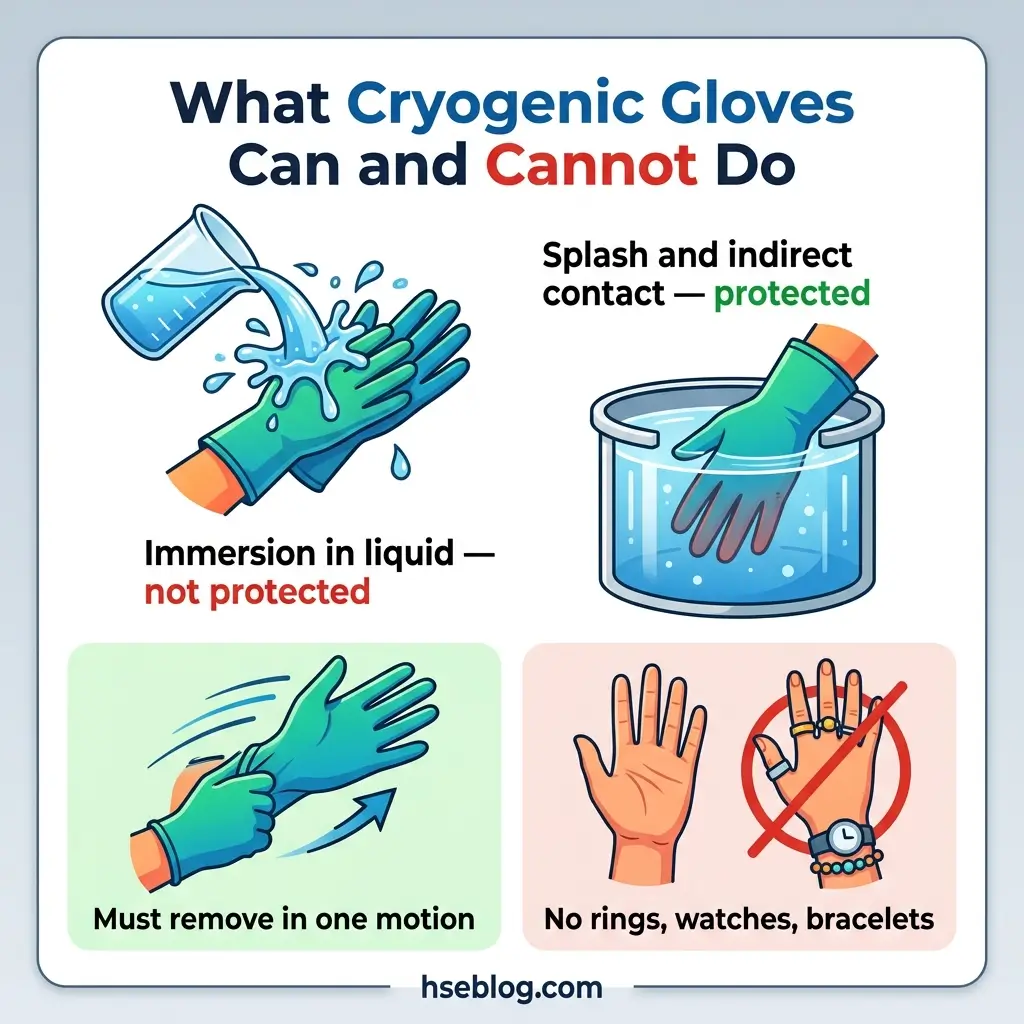
Here is the misconception that puts people in hospital. Cryogenic gloves are designed for indirect and splash protection only — they are not immersion gear. Plunge a gloved hand into liquid nitrogen, or let liquid pour into a loose glove, and the cryogen reaches skin while trapped inside, producing a worse injury than no glove at all. Glove fit matters for exactly this reason: loose-fitting gloves must be removable in a single motion so a splash can be thrown clear, and watches, rings, and bracelets come off because they trap cold liquid against skin.
The applied lesson on most sites is to keep hands out of the liquid entirely. Use tongs or designed retrieval tools for items in a cryogenic bath, and treat the gloves as backup for the spill you didn't plan for — never as permission to reach in.
Pressure, embrittlement, and oxygen enrichment
The hazards people overlook are the ones built into the equipment rather than the spill. Because cryogenic liquids expand so violently when they warm, a sealed or blocked system becomes a pressure bomb — and the same low temperatures quietly weaken the metals meant to contain them.
Overpressure from phase change
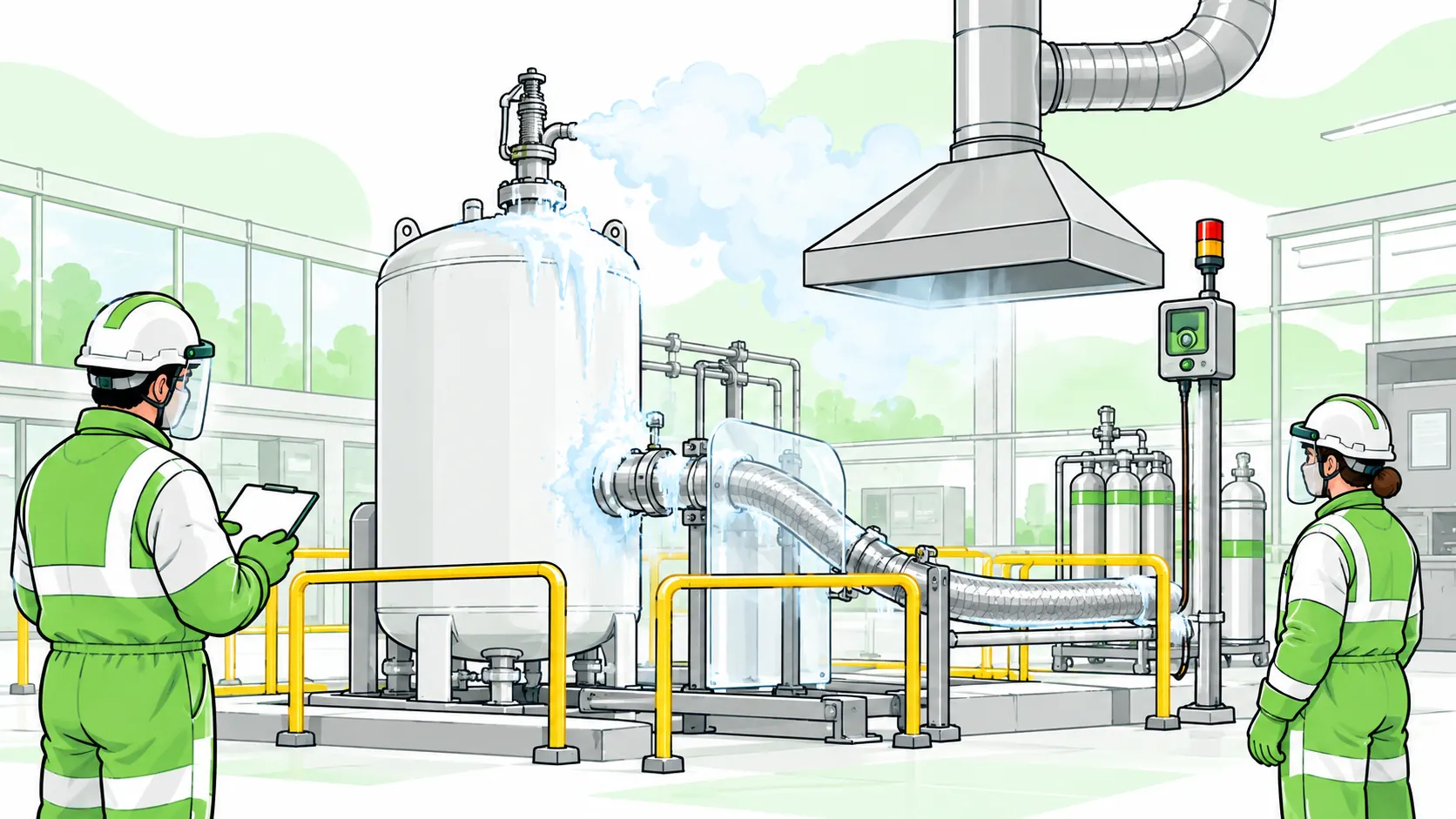
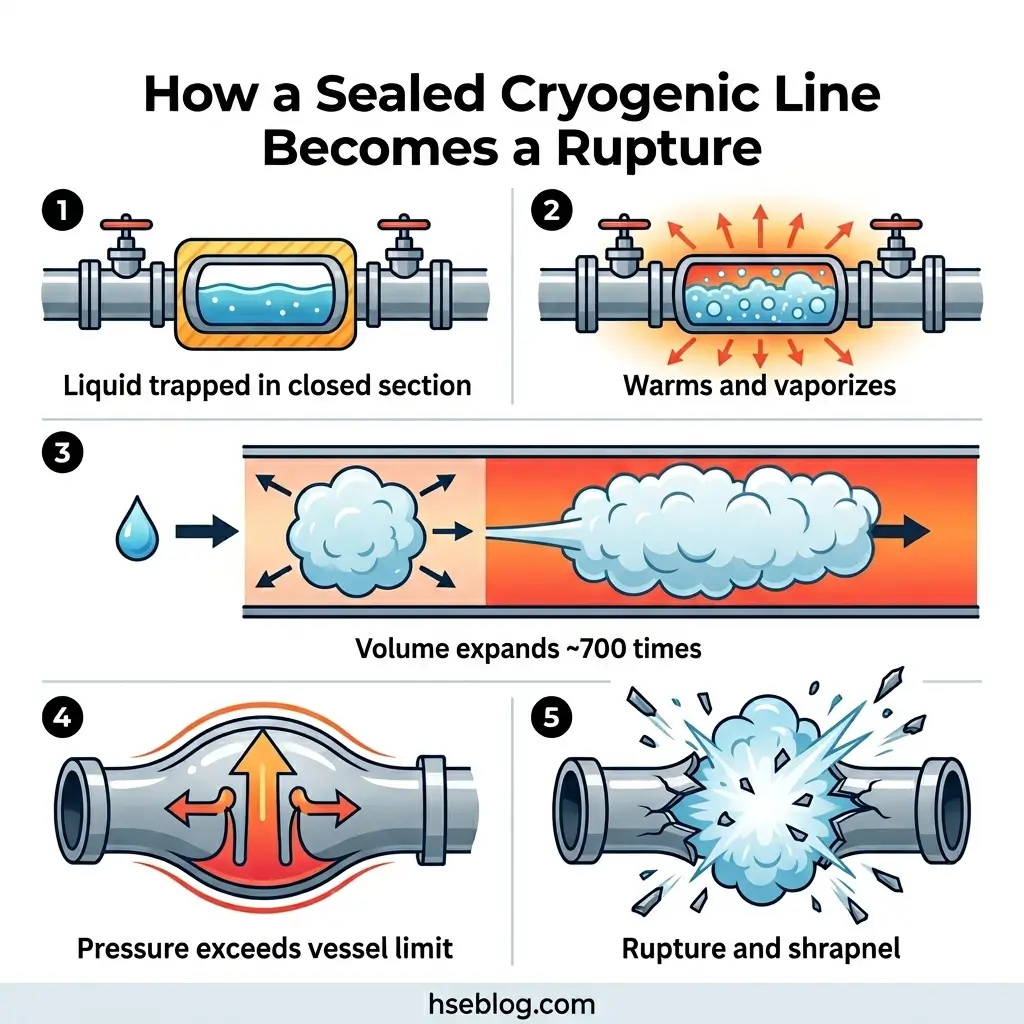
A cryogenic liquid cannot be held as a liquid at room temperature in any ordinary vessel. Trap liquid nitrogen in a closed line or a vessel with a failed relief path, and as it warms and expands by hundreds of times its volume, pressure climbs until something ruptures — typically with shrapnel.
The controls are unglamorous and non-negotiable:
- Functioning pressure-relief devices on every section where liquid could be isolated, with relief ports aimed at a safe location.
- No improvised containers. Vacuum flasks and unrated vessels fail under the thermal shock and pressure of cryogenic service.
- Watch for ice plugs. Frozen moisture can block a vent and turn a venting vessel into a sealed one.
Embrittlement and thermal stress
Metals and plastics that are tough at ambient temperature can turn brittle when cold-soaked. Carbon steel, in particular, can lose ductility and fracture almost instantaneously under load at cryogenic temperatures, and differential contraction between materials sets up thermal stresses that crack joints and seals. Cryogenic equipment is specified in compatible materials — austenitic stainless steel, copper, specific alloys — for exactly this reason, which is why substituting an "equivalent" part is a decision for an engineer, not a maintenance shortcut.
Oxygen enrichment and liquid oxygen
Liquid oxygen flips the usual asphyxiation logic. It is not an asphyxiant — it is a powerful oxidizer that makes ordinary materials burn fiercely and lowers ignition energy to the point where a normally harmless spark starts a fire. Cold surfaces chilled by other cryogens can even condense oxygen out of the air, and clothing saturated with oxygen-enriched vapour stays a fire risk for a sustained period after exposure. Any liquid oxygen system needs ignition sources, hydrocarbons, and incompatible materials kept rigorously clear.
How OSHA, HSE, and consensus standards govern cryogenic safety
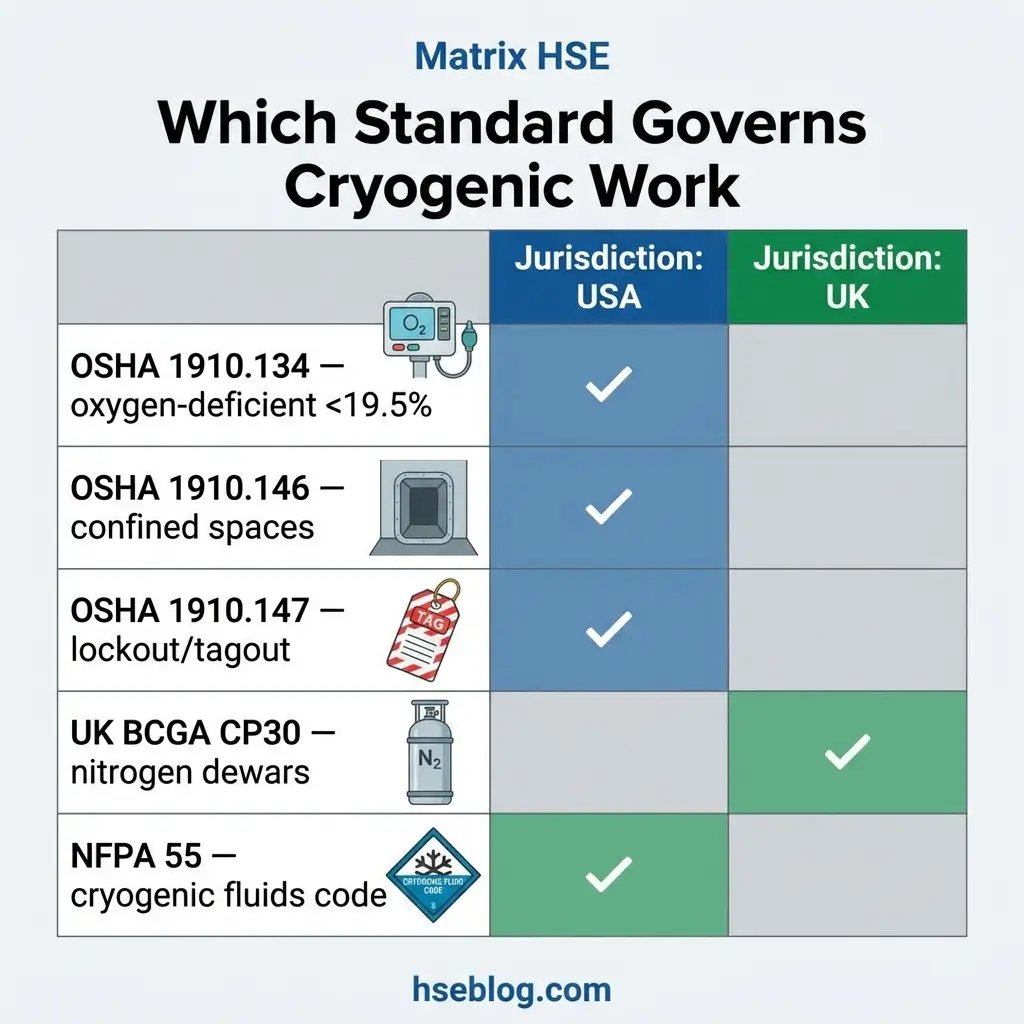
No single regulation covers cryogenic hazards end to end — and that gap is itself a safety finding. In its December 2023 report, the CSB concluded that because there is no US standard specific to cryogenic asphyxiants, Foundation Food Group was not legally required to run the process safety management that might have prevented the deaths, and it recommended OSHA promulgate one (CSB, 2023). As of this review, OSHA regulates cryogenic work through a patchwork of general standards rather than a dedicated rule.
In practice, compliance is assembled from several instruments, and the requirement that bites depends on the scenario:
| Jurisdiction | Standard | What it governs in cryogenic work |
|---|---|---|
| US (OSHA) | 29 CFR 1910.134 | Defines oxygen-deficient atmosphere (<19.5%); respiratory protection |
| US (OSHA) | 29 CFR 1910.146 | Permit-required confined spaces, including freezer rooms and pits |
| US (OSHA) | 29 CFR 1910.101 / 1910.1200 | Compressed gas handling; hazard communication and labelling |
| US (OSHA) | 29 CFR 1910.147 | Lockout/tagout during maintenance on energized cryogenic systems |
| UK (HSE/BCGA) | BCGA CP30 / CP36 | Safe use of nitrogen dewars and bulk storage; keep O₂ above 19.5% |
| International | NFPA 55; CGA P-12 | Compressed gases and cryogenic fluids code; safe handling guidance |
The citation that gets missed most often is lockout/tagout. The Foundation Food Group freezer was being worked on when the bubbler tube was bent, and OSHA's willful violations there included a failure to develop and use lockout procedures — a reminder that cryogenic releases frequently originate in maintenance, not normal running.
There is a recent signal worth weaving into any current risk assessment. In 2024, following the CSB's recommendations, OSHA issued a hazard alert flagging the asphyxiation and cryogenic dangers of flash-freezing operations and the engineering and PPE controls employers should use (OSHA, 2024). It is guidance, not a new standard — but it tells you where enforcement attention is heading.
Legal note. This regulatory summary reflects general HSE professional understanding of US and UK requirements as of June 2026. It is not legal advice. Specific compliance or enforcement questions should go to qualified counsel in the applicable jurisdiction.
Building a cryogenic safety system that holds
The controls that work follow the hierarchy of controls applied to this specific hazard — eliminate or substitute where possible, then engineer, then administrate, then equip the person. Bolting PPE onto an unmonitored room, as the Foundation Food Group case showed, protects no one.
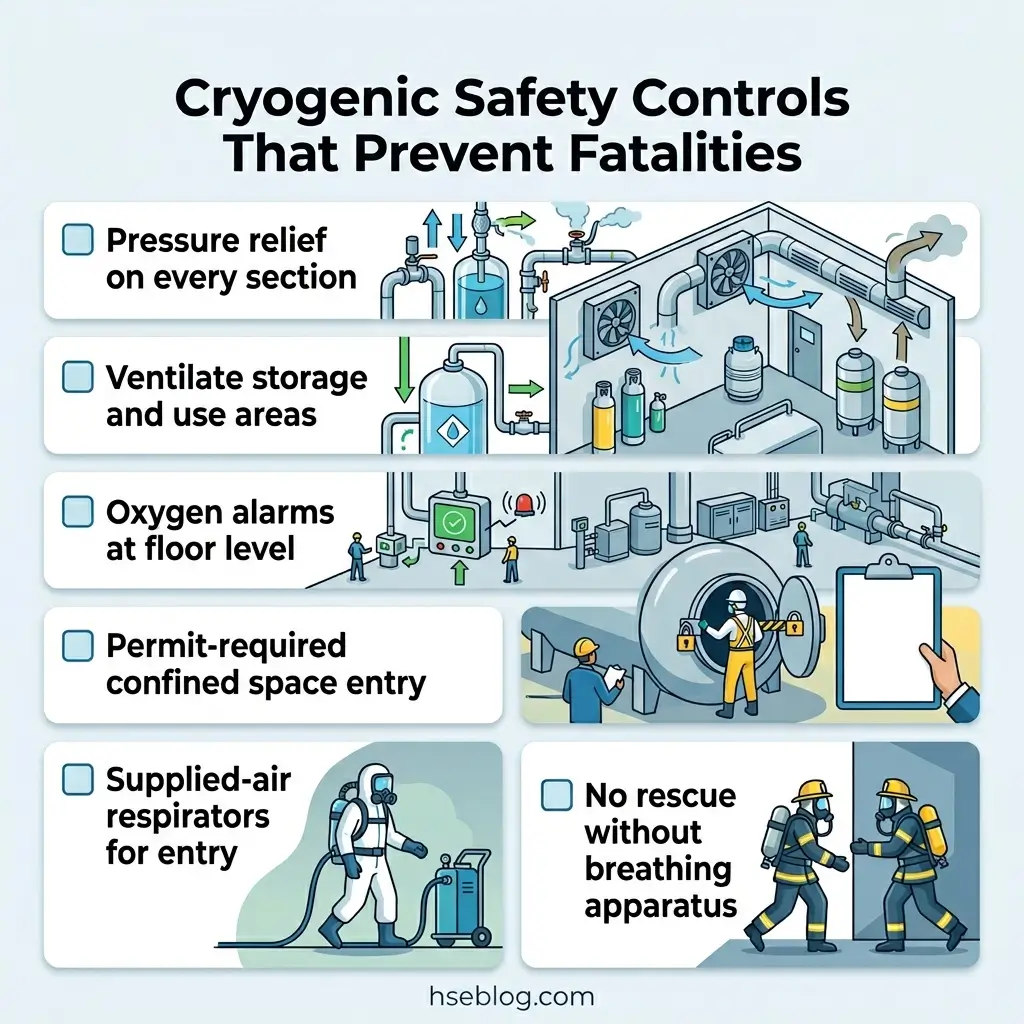
A defensible cryogenic control system runs in this order:
- Design out the single point of failure. Pressure relief on every isolatable section, redundant level control, and emergency isolation that lets a release be shut off without anyone entering the hazard zone.
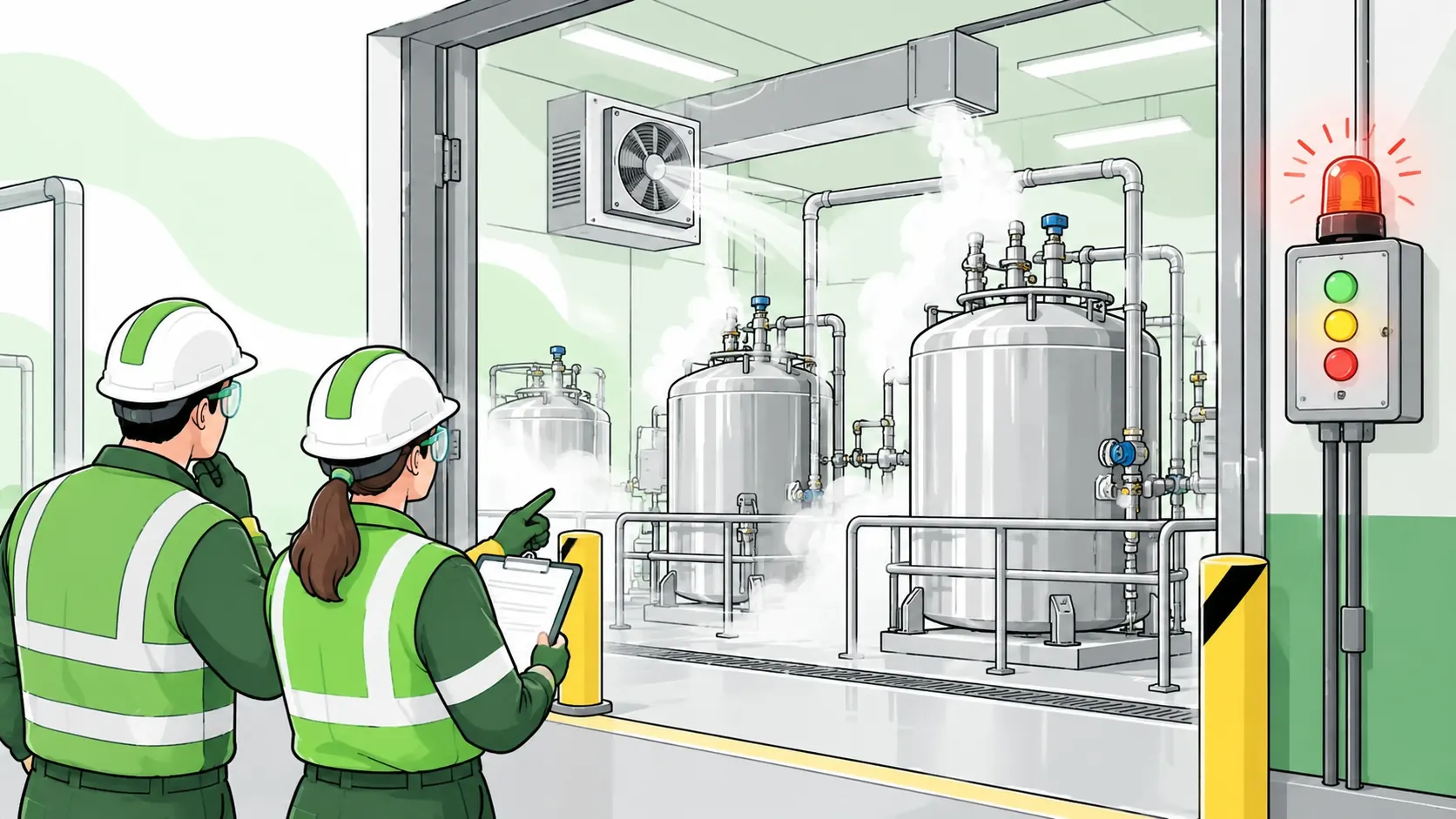
- Ventilate the space. Adequate fresh-air ventilation in storage and use areas is the primary engineering control against oxygen displacement; small, poorly ventilated rooms carry the highest asphyxiation risk.
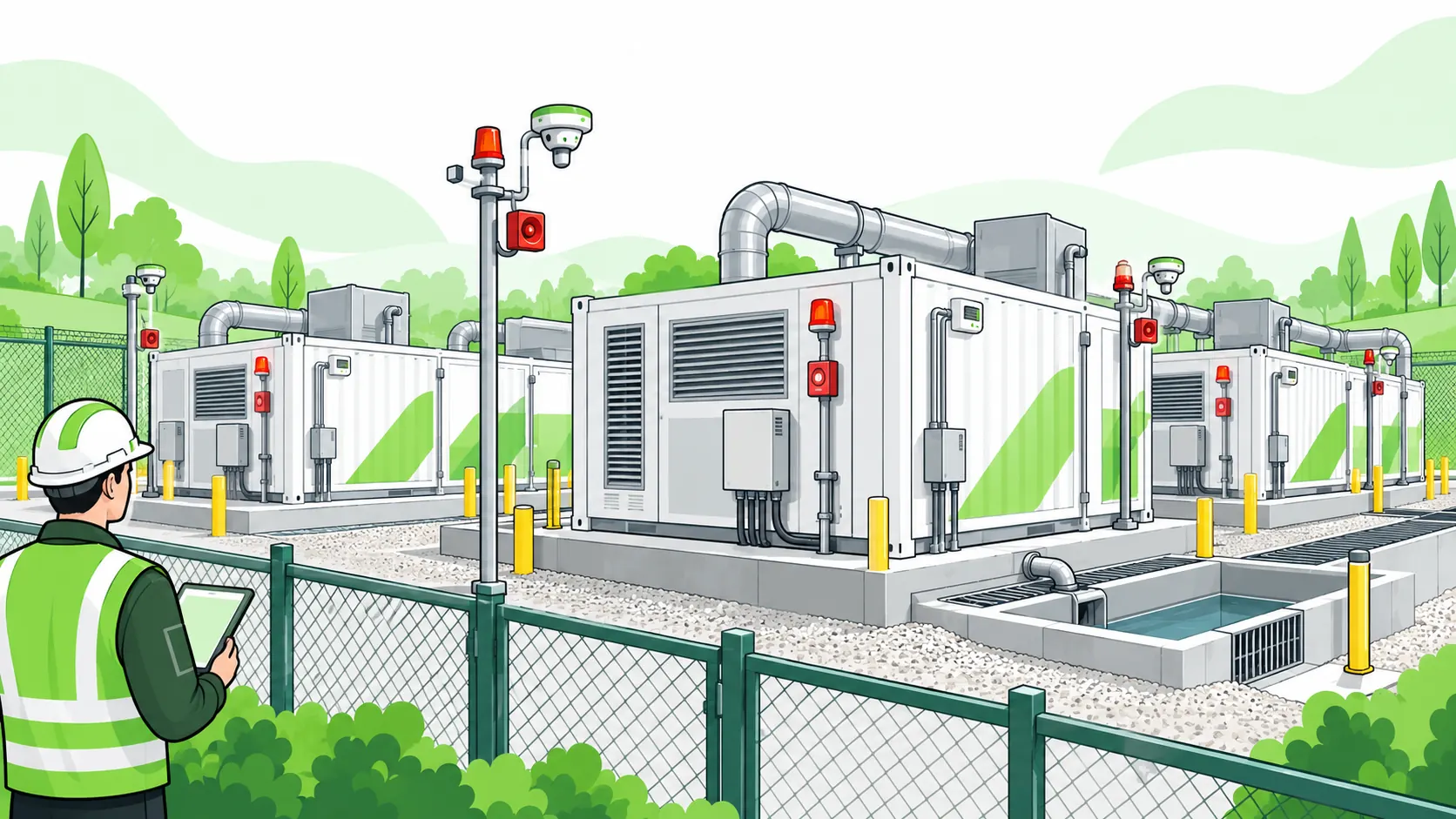
- Fix oxygen monitoring with alarms — at the right height. Continuous oxygen-deficiency alarms set to warn before 19.5% are the control that the deadliest incidents lacked. Place sensors at the working and low levels where cold gas actually pools, not only at the ceiling.
- Treat the area as a confined space when it qualifies. Freezer rooms, pits, and tanks need a permit system, atmospheric testing before entry, and the assumption that "looks fine" means nothing for an odorless gas.
- Equip for the spill and the rescue. Cryogenic gloves, face shield, apron, and closed footwear for handling; supplied-air respiratory protection (SCBA or airline) for entry into a known or suspected oxygen-deficient atmosphere — never a filtering respirator, which cannot add oxygen.
- Train for the rescue instinct. The single most repeated fatal decision is entering to help. Workers must be drilled that rescue from an oxygen-deficient atmosphere is only for people trained and equipped with breathing apparatus — and that the right first move is to raise the alarm and stay out.
The judgment call that recurs is between ventilation and monitoring, and the honest answer is that neither substitutes for the other. Ventilation reduces the probability of a deficient atmosphere; monitoring tells you when ventilation has failed. A serious operation runs both, plus the emergency isolation that lets a release be stopped from outside the room.
Recognised training pathways anchor this competence — NEBOSH and IOSH certifications for the safety function, OSHA outreach training in the US, and gas-supplier and BCGA guidance for handling specifics. Cryogenic work sits firmly in the territory where untrained improvisation kills.
Frequently Asked Questions
Is liquid nitrogen toxic?
No — liquid nitrogen and its gas are non-toxic and chemically inert. The danger is asphyxiation: as the liquid vaporises it displaces oxygen, and an atmosphere below 19.5% oxygen (OSHA 29 CFR 1910.134) impairs and then kills with no warning smell or taste. "Inert" means it won't poison you chemically, not that it's harmless.
Why is liquid nitrogen so dangerous in confined spaces?
A small volume of liquid expands to roughly 700 times its volume as gas, and in an enclosed or poorly ventilated space that gas rapidly drives oxygen below survivable levels. Because cold nitrogen is denser than warm air, it pools in pits and low areas, so floor-level oxygen can be fatal while head-height readings look normal.
Can cryogenic gloves protect against immersion in liquid nitrogen?
No. Cryogenic gloves are rated for splash and indirect contact only, not immersion. If liquid enters or saturates the glove it holds the cryogen against the skin, causing a worse cold burn. Keep hands out of the liquid, use tongs for retrieval, and choose gloves that come off in a single motion.
What is an oxygen-deficient atmosphere?
It is any atmosphere with oxygen below 19.5% by volume, the threshold defined in OSHA's respiratory protection standard and matched by HSE guidance in the UK. Normal air is about 20.9% oxygen. Below 19.5% requires controls; below roughly 10%, loss of consciousness and death can follow within minutes.
Does OSHA have a specific standard for cryogenic liquids?
Not a dedicated one. OSHA regulates cryogenic work through general standards — compressed gases (1910.101), respiratory protection (1910.134), confined spaces (1910.146), and hazard communication (1910.1200). The CSB's 2023 report recommended OSHA create a standard specific to cryogenic asphyxiants, and OSHA issued a hazard alert on the topic in 2024.
Why do cryogenic releases so often kill more than one person?
Because of the rescue cascade. The gas is invisible and odorless, so when one worker collapses, others enter believing they can help — and the air itself overcomes them. In the 2021 Georgia release, at least 14 people entered the hazard zone (CSB, 2023). Untrained rescue is the most predictable way a single casualty becomes several.
What the record keeps teaching us
The persistent error in cryogenic safety is treating "non-toxic" and "inert" as synonyms for "safe." Every serious cryogenic hazard in this article traces back to a property of physics — a 700-fold expansion, a –196 °C surface, a phase change under pressure — that does not care how routine the operation feels or how long the gas has been used without incident.
If there is one change that moves the fatality numbers, it is atmospheric monitoring tied to alarms, mounted where cold gas actually collects, combined with a workforce drilled to never enter a release to rescue without breathing apparatus. The Foundation Food Group deaths were not caused by exotic failure; they were caused by an absent alarm, an untrained crew, and the human instinct to run toward a fallen colleague. Cryogenic hazards reward the operation that engineers out the single point of failure and respects that an odorless gas gives no second chance — and they are unforgiving to the one that assumes the cold is the worst it can do.