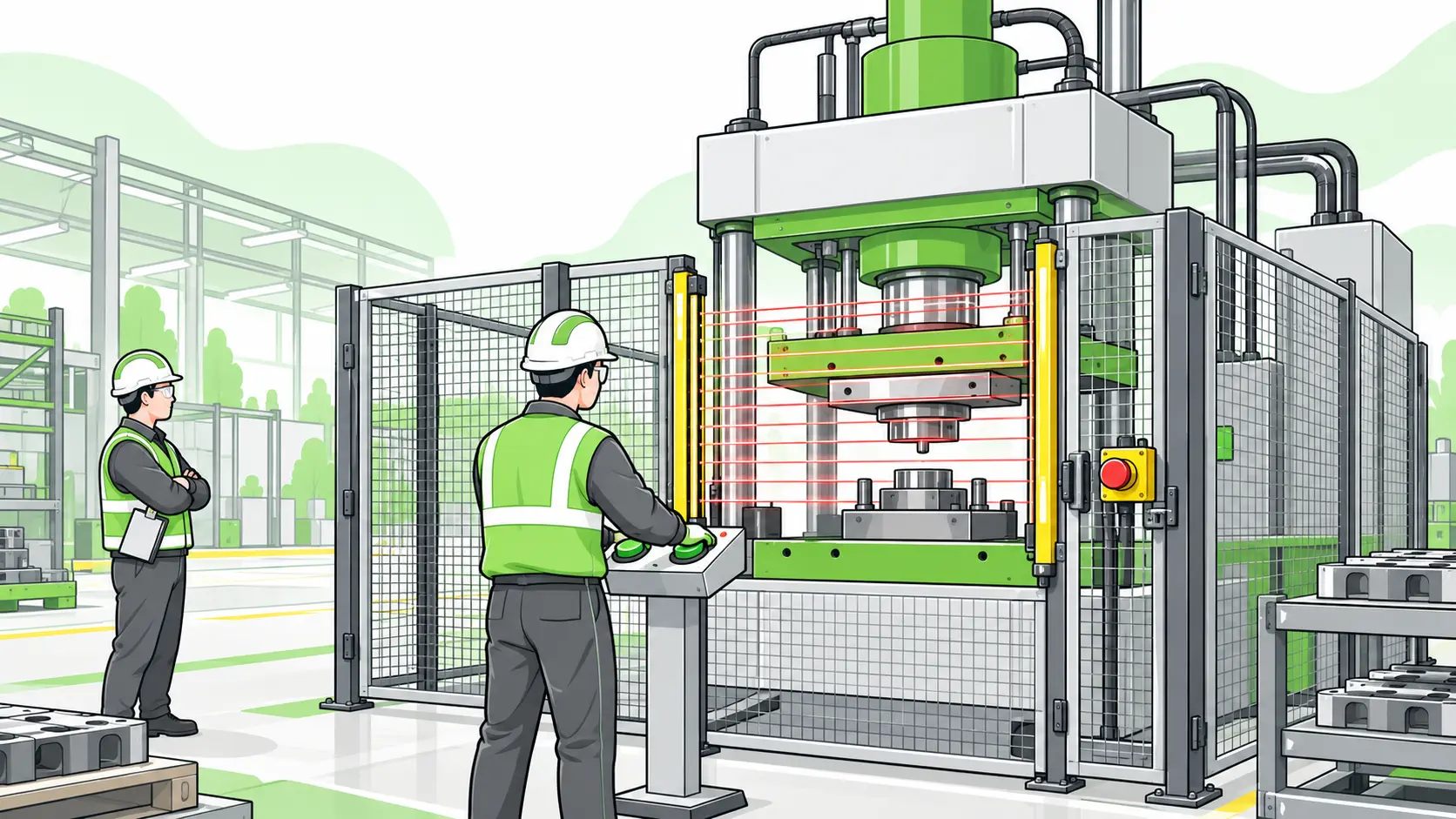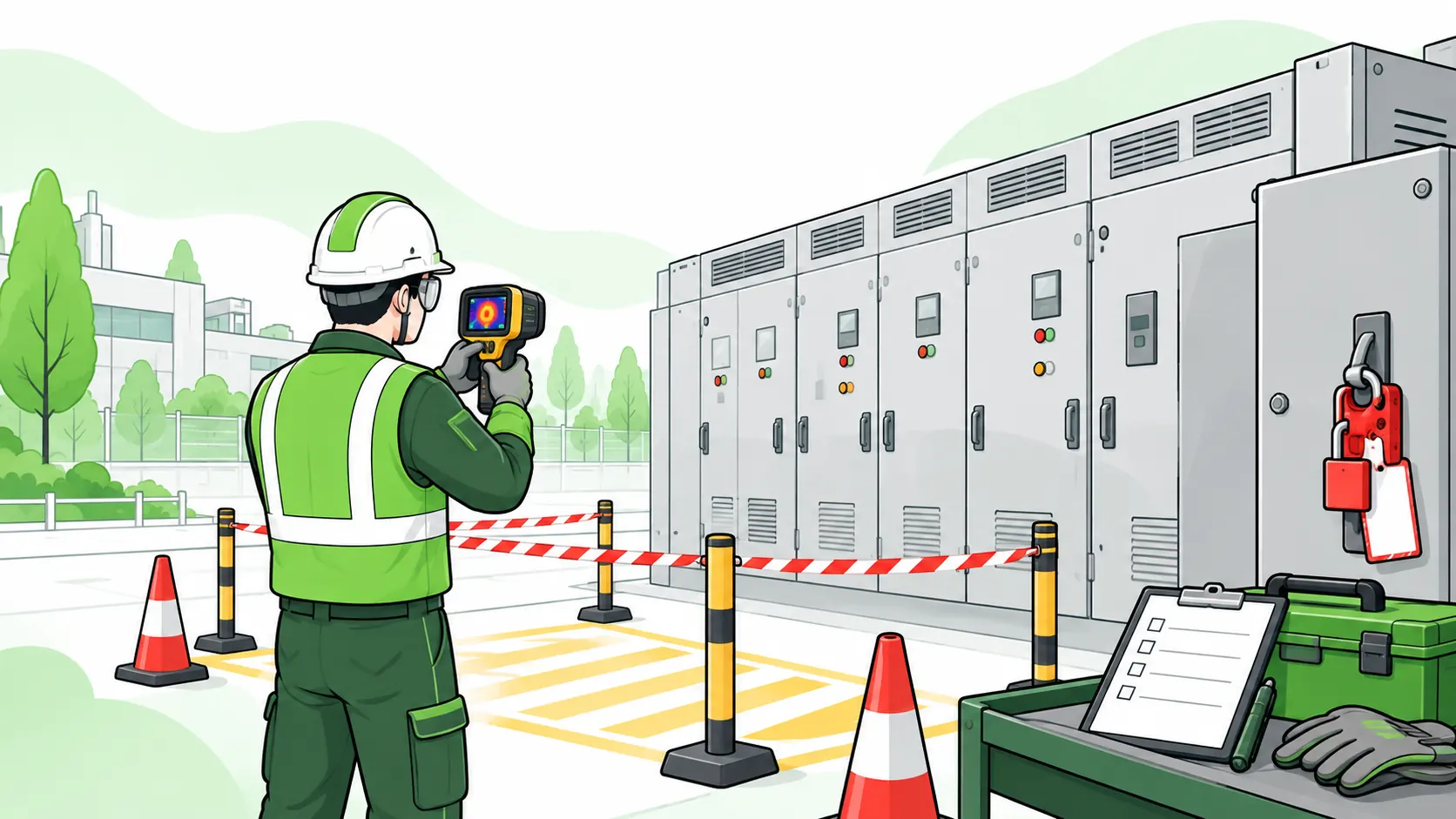
Switchgear safety is the discipline of operating, isolating, and inspecting high-energy electrical assemblies without exposing people to electrocution, arc flash, or catastrophic equipment failure. It splits into two distinct jobs — switching an in-service asset and maintaining a de-energized one — each governed by separate procedures, authorizations, and legal duties under OSHA in the US and the Electricity at Work Regulations 1989 in the UK.
Why Switchgear Safety Is a Life-Critical Discipline, Not a Routine Task
Switchgear concentrates more stored and through-fault energy in one cabinet than almost any other piece of plant a facilities team touches. Over a recent thirteen-year span, 1,940 workplace fatalities in the US involved electricity (ESFI, 2025), and the people dying are not who most managers assume.
A striking 74% of those electrical fatalities struck workers in non-electrical occupations (ESFI, 2025). Operators, facilities staff, and supervisors stand in front of energized gear without an electrician's training — which is exactly the population this guidance is written for.
Competent/qualified-person caveat: This article provides general HSE knowledge. Life-critical work such as live switching, breaker racking, and switchgear isolation must be planned and supervised by a competent person (UK) or qualified person (US) with relevant training, jurisdiction-specific authorization, and a site-specific risk assessment. The information here does not replace that, and it is not a substitute for a site-specific arc flash study.
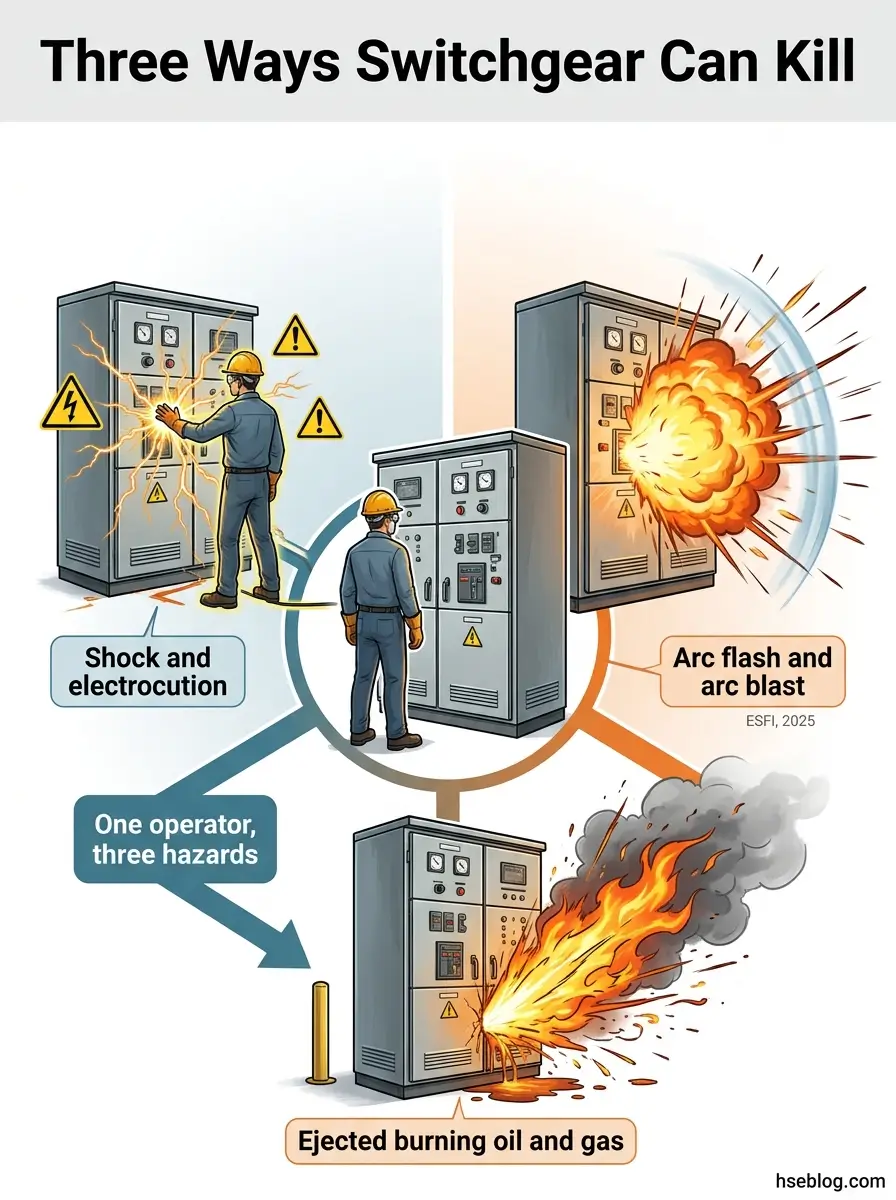
The hazard isn't one thing. Switchgear can hurt you two ways at once, and the second way is what sets it apart from general electrical work.
- Shock and electrocution — direct contact with energized conductors during access, testing, or a failed isolation.
- Arc flash and arc blast — a fault ionizes the air into a plasma fireball, releasing radiant heat, a pressure wave, and shrapnel. Arc-flash-attributed deaths make up roughly 2% of electrical fatalities in OSHA reports (ESFI, 2026) — a figure that almost certainly undercounts, since many arc events are coded as general electrical contact.
- Medium-specific failure — burning oil and gas ejected from oil-filled units, toxic decomposition by-products from arced SF6, or X-ray emission and interrupter failure in vacuum gear.
The utility sector carries the highest electrical fatality rate of any industry at 0.75 per 100,000 workers (ESFI, 2026) — and substations are where switchgear lives. For readers tracking the wider trend, ESFI's reporting also recorded 5,180 non-fatal electrical injuries with days away from work for 2023–2024, a 59% jump over the prior two-year period (ESFI, 2026).
A pattern shows up repeatedly in the published record and in how organizations actually behave: switchgear gets treated as fit-and-forget infrastructure. A unit sits energized for a decade with no operation and no condition baseline, then gets switched for the first time under a fault — which is precisely the moment latent defects surface. You can review ESFI's workplace electrical injury and fatality statistics for the underlying data behind these patterns.
Switchgear Safety: The Regulatory Framework (US vs. UK)
No single standard governs switchgear safety worldwide — the duty depends entirely on where you operate. The US runs a prescriptive system of OSHA clauses backed by referenced consensus standards, while the UK uses goal-setting law plus HSE guidance. Multinational duty-holders who apply one corporate framework to both regions routinely miss obligations the other regime imposes.
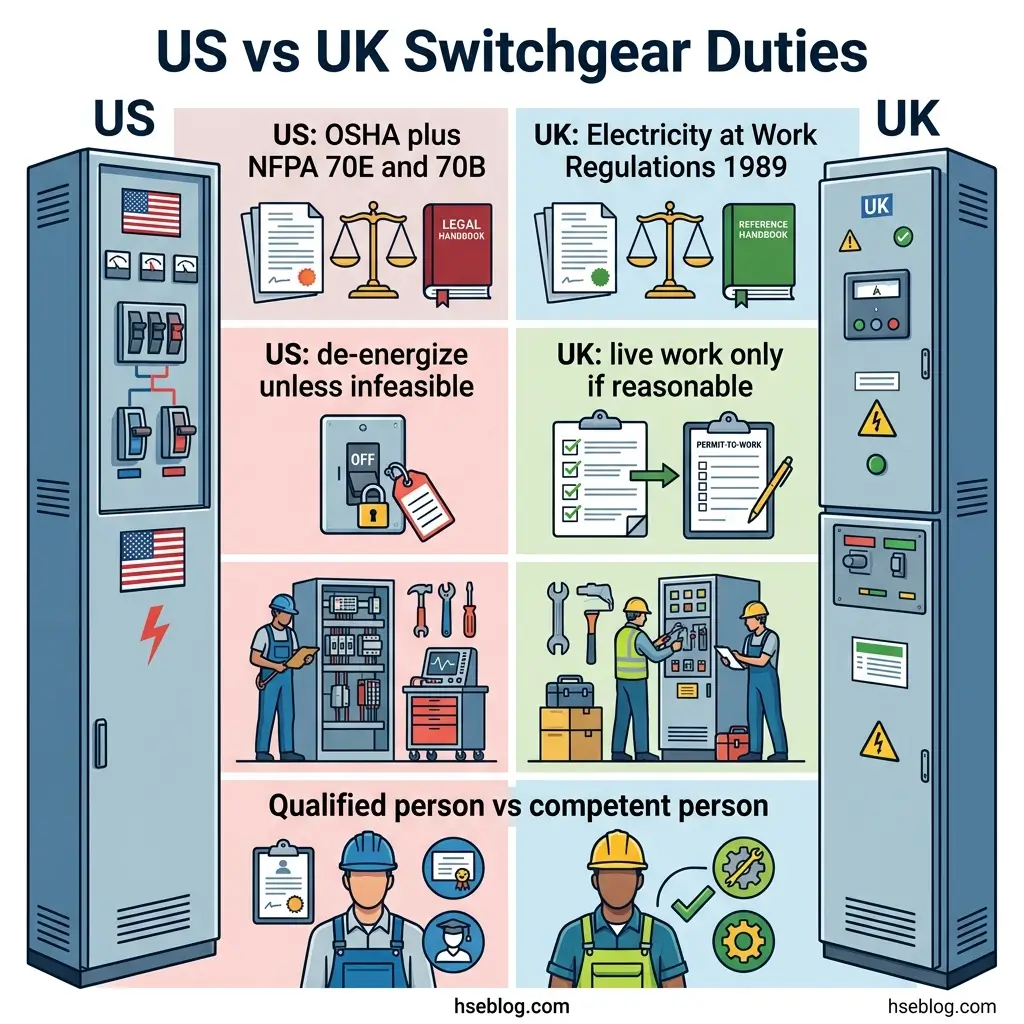
In the US, the binding text is OSHA. The field procedure most aligned with 29 CFR 1910.333 (US) is to de-energize live parts before work unless the employer can demonstrate that de-energizing is infeasible or introduces a greater hazard — and any de-energized part not locked or tagged is treated as still live. Lockout/tagout sits under 29 CFR 1910.147 (US), and qualified work on substation-class installations falls under 29 CFR 1910.269 (US).
The consensus standards OSHA references carry the technical detail. NFPA 70E (2024, US) sets arc-flash boundaries, incident-energy and PPE determination, energized-work permits, and labeling. NFPA 70B (2023, US) governs the maintenance program — and its biggest recent change matters: in the 2023 edition the language moved from "should" to "shall," making a structured Electrical Maintenance Program mandatory rather than recommended.
In the UK, the legal foundation is the Electricity at Work Regulations 1989, sitting under the Health and Safety at Work etc. Act 1974 and the Management Regulations 1999. The duty-holder must keep systems safe "so far as is reasonably practicable," and HSE's HSG230 (UK, 2015) translates that into practical guidance for switchgear selection, use, and care.
| Question | United States | United Kingdom |
|---|---|---|
| Governing instrument | OSHA 1910.331–.335, .147, .269; NFPA 70E & 70B referenced | Electricity at Work Regulations 1989; HSG230 guidance |
| De-energization rule | De-energize unless infeasible or greater hazard is demonstrated (1910.333) | Live work prohibited unless unreasonable to de-energize and reasonable to work live |
| Maintenance requirement | Mandatory program, condition-based intervals (NFPA 70B "shall," 2023) | Maintain to prevent danger, so far as reasonably practicable (EAWR reg. 4) |
| Person definition | "Qualified person" (NFPA 70E / OSHA) | "Competent person" (EAWR) |
International design rules round this out. IEC 62271-200 (International) classifies metal-enclosed MV switchgear assemblies up to 52 kV, including internal-arc classification, and IEEE C37.20.7 (US/International) defines the arc-resistant test method. HSE's HSG230 guidance remains the authoritative UK reference for the operating and maintenance duties above.
Legal disclaimer: Regulatory content here reflects general HSE professional understanding of US and UK requirements as of 2026. It is not legal advice. Specific compliance questions, enforcement situations, or prosecution risk should be directed to qualified legal counsel in the applicable jurisdiction. Regulatory content was last reviewed at the date shown in the byline block.
Who Is Allowed to Operate and Inspect Switchgear?
Authorization, not training alone, decides who may switch switchgear. A person can be trained and still not be authorized for a specific operation on a specific asset.
- Qualified person (US, NFPA 70E / OSHA 1910.269): demonstrably trained to recognize and avoid the electrical hazards of the specific equipment and task, including approach distances and arc-flash exposure.
- Competent person (UK, EAWR 1989): has the technical knowledge and experience to prevent danger for the work in question — the test is capability matched to the task, not a certificate.
- Authorization layer (both): the person must additionally be appointed or permitted to operate that asset under the site's switching scheme or permit-to-work system. Training qualifies you; authorization licenses you for the job in front of you.
Pre-Operation Safety Checks Before Switching Switchgear
Before you touch a handle or racking tool, the question to answer is simple: do I have authorization, the correct PPE for this specific gear, and confirmation that the equipment is behaving normally? Skipping this checklist is the under-served half of "operating procedures" — it is operator discipline, not maintenance.
Work through these in order before any switching action:
- Confirm authorization and the switching plan. Verify you are permitted to operate this asset, that a switching schedule or permit-to-work exists, and that it matches the live single-line diagram.
- Verify PPE against the equipment's arc flash label. Match arc-rated PPE to the labeled incident energy for that gear before you stand in front of it — never to a generic rule of thumb.
- Read the indicators, then distrust them. Check position indicators, control-power and voltage-presence indicators, interlock status, and warning signs. A mechanical position flag shows mechanism state, not proven circuit state.
- Scan for abnormal condition. Look and listen for overheating, tracking marks, corona, moisture, corrosion, abnormal noise, or burning smell. Any of these stops the operation and triggers a report.
- Confirm the arc-flash boundary is clear. Ensure no unprotected person is inside the boundary when the operation occurs.
A documented contributor to incidents is operators trusting a breaker position indicator as proof of circuit state. The flag tells you the mechanism moved — it does not confirm isolation, which only the established switching and grounding procedure can prove.
Safe Switchgear Operating Procedures
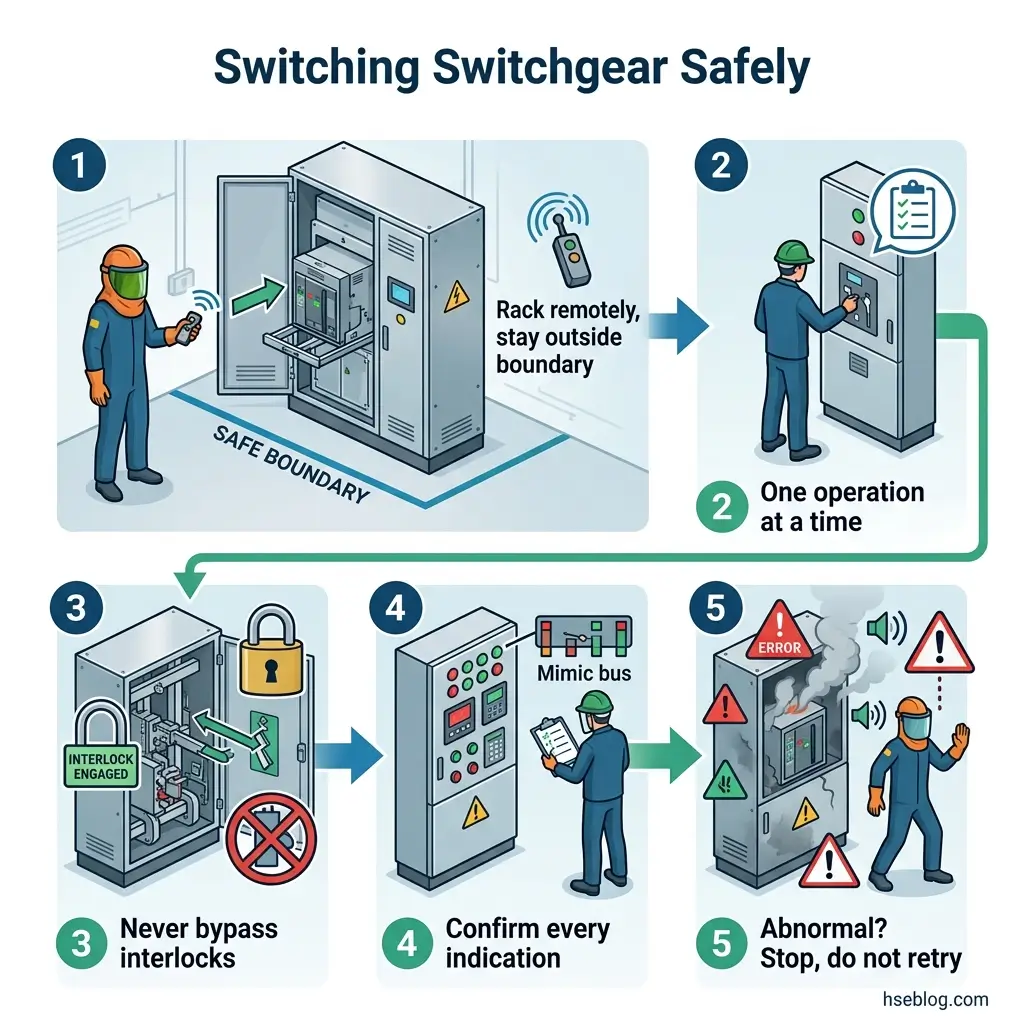
The single most effective control during switching is distance — put a wall and a remote control between the operator and the gear wherever the equipment allows it. Operating switchgear means switching, racking, and isolating an in-service asset, and HSG230 (UK, 2015) flags this as the highest-failure-likelihood moment in the equipment's life. Everything below is operation, not maintenance.
Start from the engineering controls that reduce exposure:
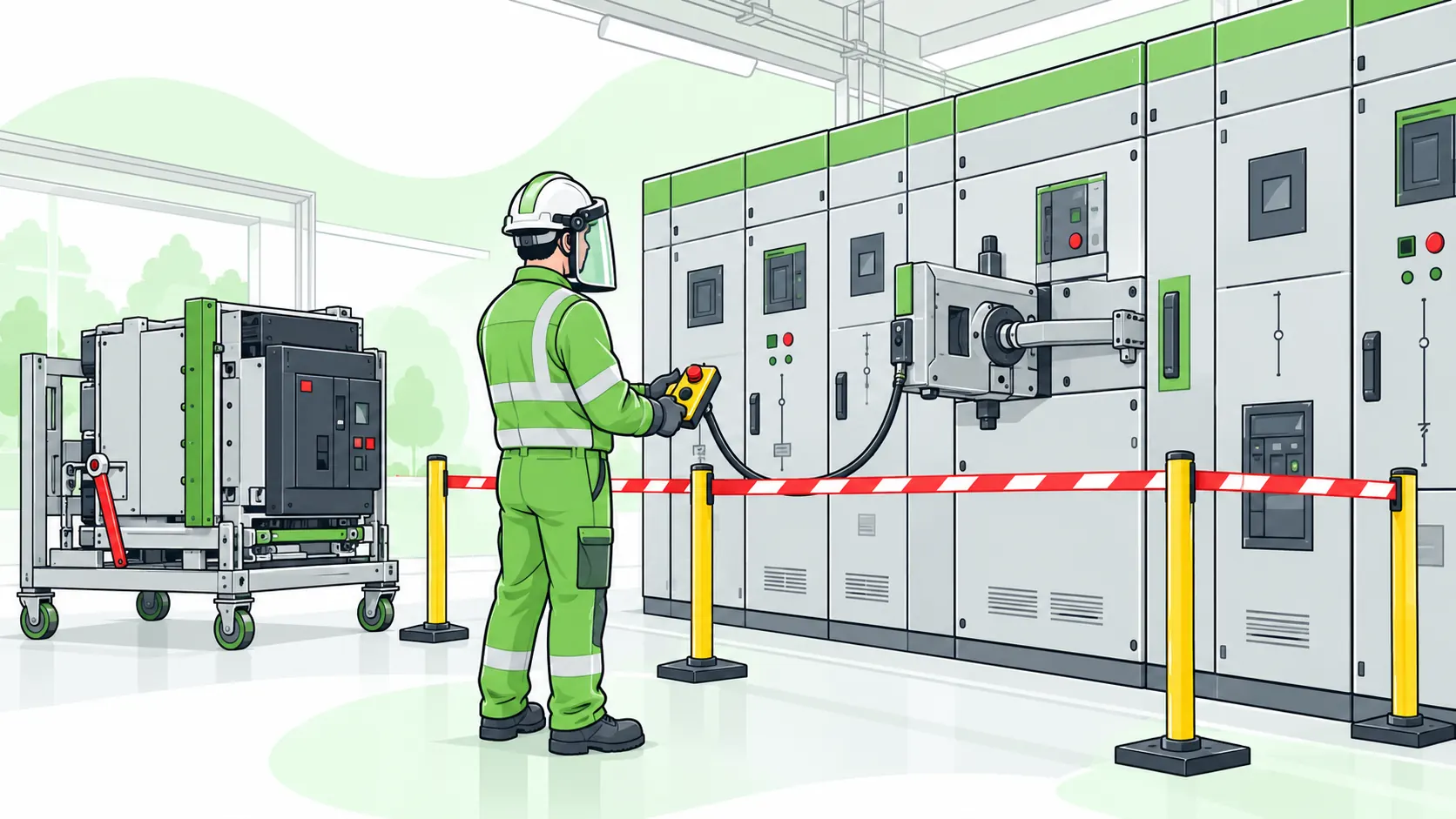
- Remote racking first. Where the equipment supports it, rack circuit breakers in and out remotely so the operator stands outside the arc-flash boundary. Manual racking demands full arc-rated PPE and a cleared boundary.
- Respect the limits of arc-resistant gear. IEEE C37.20.7 (US/International) ratings only hold with doors and covers secured in the tested configuration. Open a door, remove a cover, or rack with the unit exposed, and you may fall outside the rating entirely.
With those in place, the switching itself follows a disciplined sequence:
- One operation at a time. Complete and confirm each step against the schedule before starting the next.
- Keep the interlock sequence intact. Interlocks enforce correct order — never defeat or bypass them to ease an awkward switching sequence.
- Confirm each result. Verify the indication after every operation rather than assuming success.
- On abnormal operation, stop. If a breaker fails to close or open, or you hear or smell something wrong, do not retry. Clear the boundary, report it, and escalate to qualified maintenance.
A recurring failure pattern in the published record is teams defeating interlocks "to save time." The interlock is the engineered barrier preventing out-of-sequence energization — treating it as an obstacle removes the one control standing between a clumsy sequence and a fault.
De-Energization, Isolation, and Grounding (LOTO for Switchgear)
Switchgear lockout is harder than general LOTO because a single cabinet hides several energy sources. Isolating the obvious feeder is not isolation.
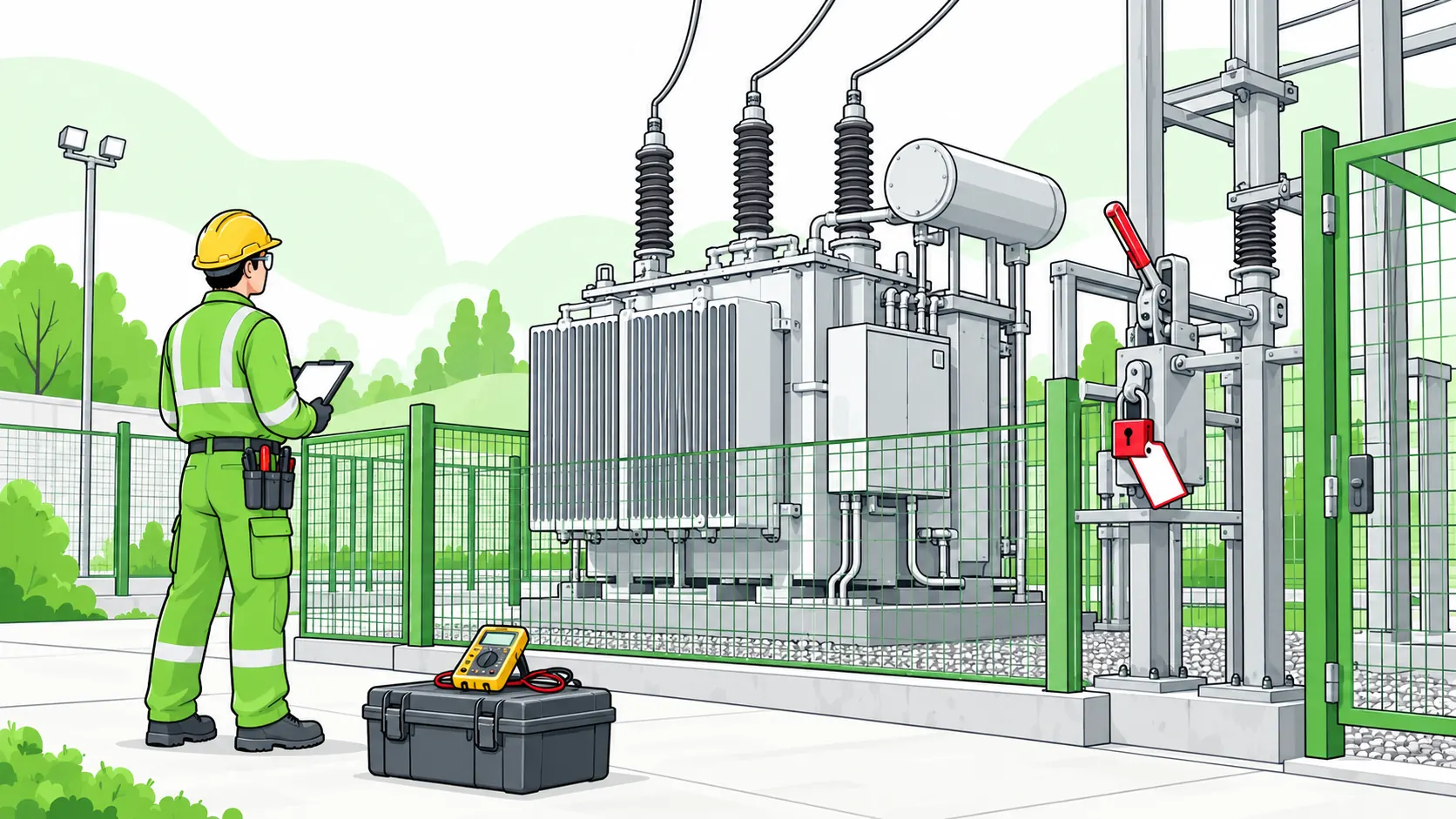
- Account for every source. Control power, spring-charging motors, upstream and downstream feeds, and capacitive stored energy all need to be addressed under 29 CFR 1910.147 (US) or the equivalent UK isolation arrangements.
- Prove the tester, then prove it again. Test-before-touch means checking your voltage tester on a known live source before and after the absence-of-voltage test, so a dead reading from a dead tester never gets mistaken for a safe circuit.
- Apply grounds rated for the fault. Fit safety grounds to all phases, rated for the available fault current at that location.
- Stay in PPE until proven dead. NFPA 70E (2024, US) requires arc-rated PPE through the lockout and verification steps, because the gear is potentially energized until voltage absence is confirmed. OSHA's safe work-practice requirements in 1910.333 reinforce that any unlocked, untagged part is treated as live.
Switchgear Inspection Procedures and Frequency
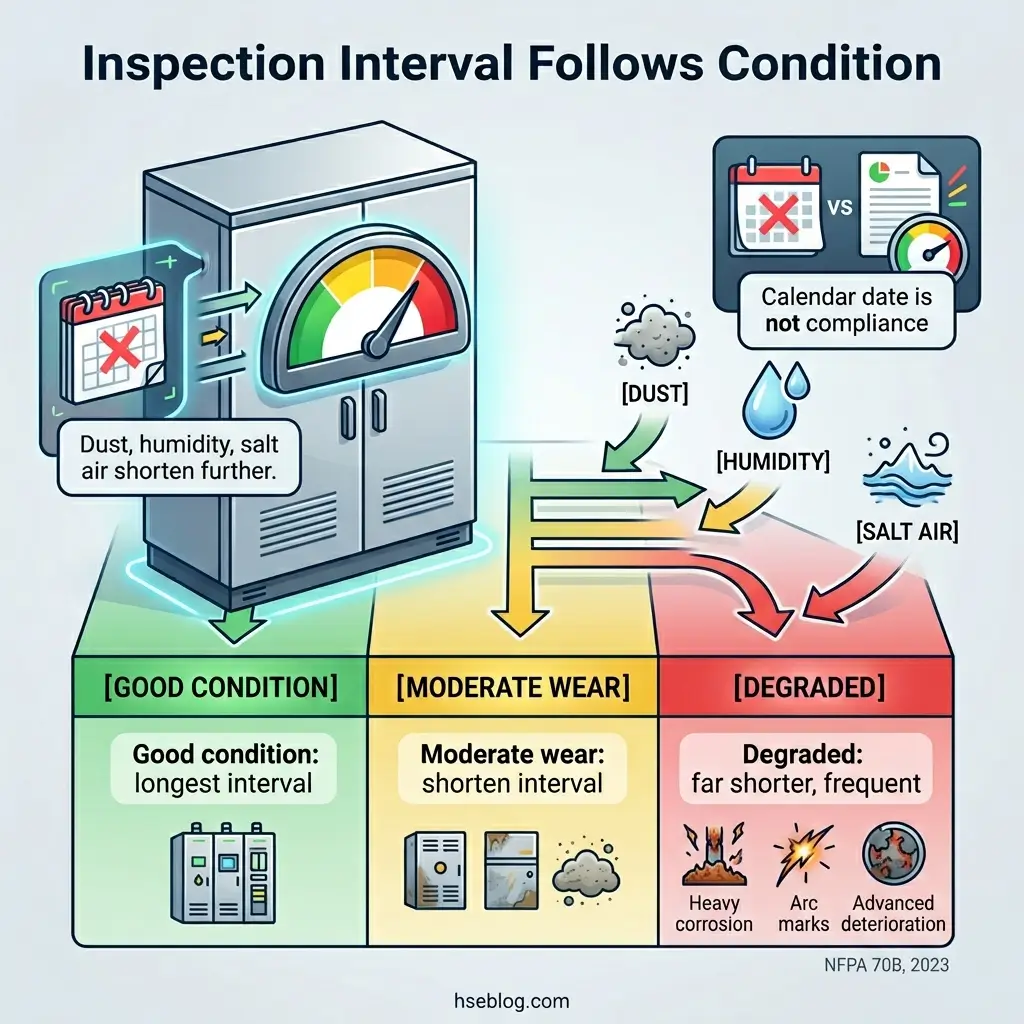
A fixed calendar interval is not compliance — and assuming it is can leave you both compliant on paper and unsafe in fact. Inspection splits into routine energized checks an operator can perform and detailed de-energized inspection that requires lockout. The frequency of the detailed work is condition-based under NFPA 70B (2023, US), not a single generic number.
What can be done while energized, under arc-flash PPE and boundary control:
- Visual checks — indicator status, signs of overheating, tracking, corrosion, moisture ingress, and physical damage.
- Thermographic/infrared scanning — finding hot joints and loose connections without opening the enclosure.
- Indicator verification — confirming position, control-power, and voltage-presence indications read sensibly.
What requires de-energization and lockout:
- Bus connections and contacts — torque checks, contact-surface condition, signs of arcing.
- Insulators and racking mechanism — tracking, cracking, contamination, and smooth mechanical operation.
- Interlocks — function-testing the engineered sequence that energized work must never defeat.
Frequency is where most programs go wrong. NFPA 70B Chapter 9 (US) ties the interval to the equipment's assessed condition, so degrading gear earns far shorter intervals than well-maintained units. In the UK, BS 6626 covers maintenance of equipment rated 1–36 kV, and environmental accelerators justify shortening any interval.
| Equipment condition | Typical interval direction | Environmental accelerators |
|---|---|---|
| Well-maintained, monitored, clean environment | Longest permissible interval | Minimal — baseline applies |
| Moderate wear or partial monitoring | Shortened from baseline | Dust, humidity, vibration |
| Degraded, faulted history, or harsh service | Far shorter, frequent re-check | Salt air, heavy dust, high humidity |
The misconception to retire is that an unmonitored "annual inspection" satisfies the standard. NFPA 70B explicitly makes the interval a function of condition — so a fixed annual check on degrading gear can be technically logged and still unsafe.
Testing That Supports Inspection (and When It Requires De-Energization)
Which test you run dictates whether the gear must be dead first. Thermography is the main energized-friendly diagnostic; most electrical tests are not.
- Energized under controls: infrared thermography reads thermal anomalies through inspection ports without breaking the enclosure.
- Requires LOTO and absence-of-voltage proof: insulation resistance testing, contact resistance testing, and partial discharge testing under applied voltage all demand a de-energized, isolated, grounded asset.
Match the diagnostic to the failure mode you suspect, and never let a test that requires isolation be attempted on live gear to save a shutdown.
Medium-Specific Hazards: Oil, SF6, Vacuum, and Air
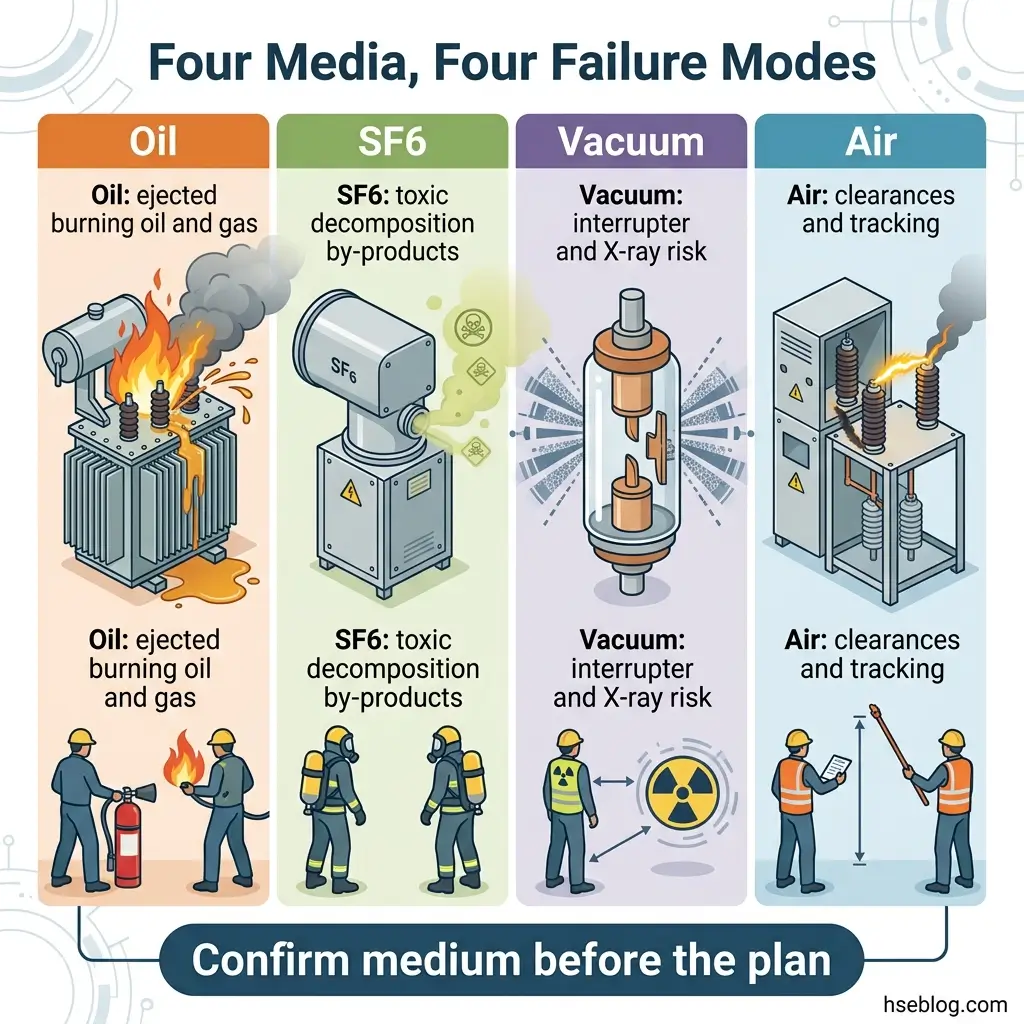
Knowing your insulating and interrupting medium changes both the inspection and the emergency response — they do not fail the same way. Operating legacy oil-filled gear on a procedure written for modern vacuum units ignores that the failure consequence is categorically more violent. HSE's HSG230 (UK, 2015) documents these medium-specific risks directly.
| Medium | Primary hazard | Key precaution |
|---|---|---|
| Oil-filled | Fire and explosion; ejection of burning oil and gas under fault | Wider exclusion zone; treat catastrophic ejection as credible; check oil condition |
| SF6 | Toxic decomposition by-products after arcing; environmental impact of release | Trained gas handling; ventilation and monitoring after arc events; leak control |
| Vacuum | Interrupter integrity loss; X-ray emission at high test voltages | Verify interrupter vacuum; limit test voltage; respect manufacturer limits |
| Air-insulated | Larger clearances; exposed live parts; airborne contamination tracking | Maintain clearances; control dust/moisture; rigorous visual inspection |
The practical takeaway: confirm the medium before you write the switching plan or the emergency response for that gear. An oil-filled unit needs a larger standoff and a fire response that a vacuum unit does not.
Documentation, Records, and the Switchgear Safety Program
Records are both a safety tool and legal evidence — under both regimes, what you cannot show, you cannot prove you did. NFPA 70B (2023, US) now requires a documented Electrical Maintenance Program, and the UK duty-holder's arrangements under the Electricity at Work Regulations 1989 must demonstrate the same intent: systems maintained to prevent danger.
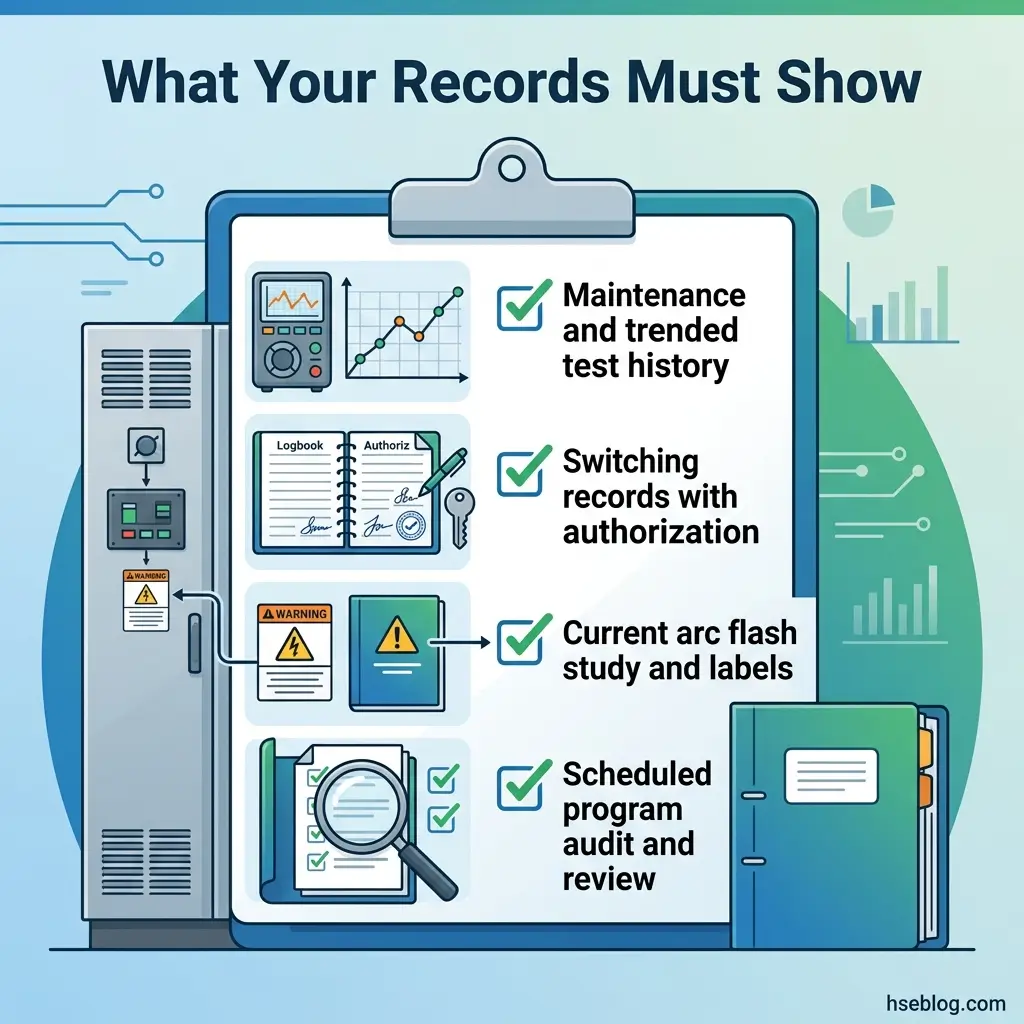
Your records should make four things visible to an auditor or investigator:
- Maintenance and test history — logs and trended test results that show condition over time, not just a date stamp.
- Switching records — what was operated, by whom, under what authorization, in what sequence.
- Arc flash study currency — the study must be re-run after equipment changes, protective-device setting changes, or reconfiguration, so PPE labels stay valid.
- Audit and review cadence — evidence the program itself is reviewed at the interval the standard requires.
Labeling closes the loop. NFPA 70E (2024, US) places the duty to apply and maintain accurate field arc-flash labels on the equipment owner — an outdated label after a system change is a documentation failure with direct operator-safety consequences.
Training reference: Building competence for this work runs through recognized pathways — NEBOSH and IOSH for HSE management duties, OSHA outreach and NFPA 70E training in the US, and equivalent regional electrical-safety authorization schemes. Authorization to switch a specific asset always sits on top of that general training.
Frequently Asked Questions
How often should medium voltage switchgear be inspected?
There is no single correct interval. Under NFPA 70B (2023, US), frequency is condition-based — well-maintained gear in a clean environment earns longer intervals, while degraded or harshly serviced units need far shorter ones. UK duty-holders follow HSG230 and BS 6626 for 1–36 kV equipment. Environment shortens intervals, and manufacturer guidance and a site risk assessment always take precedence.
Can switchgear be inspected while it is still energized?
Some of it can. Visual checks, indicator verification, and infrared thermography are performed energized, under arc-rated PPE and arc-flash boundary control. Most electrical tests — insulation resistance, contact resistance, partial discharge — require lockout and a verified absence of voltage first. The dividing line is whether the task brings you into contact with, or applies voltage to, conductors that must be dead.
What PPE do operators need when switching switchgear?
The equipment's site-specific arc flash study and incident-energy label set the PPE — not a generic list. You match arc-rated clothing and protection to the labeled incident energy for that specific gear before standing in front of it. Critically, NFPA 70E (2024, US) requires that PPE during lockout and absence-of-voltage verification too, because the gear stays potentially live until proven dead.
Is NFPA 70B mandatory now?
Since the 2023 edition, NFPA 70B is a Standard written in "shall" language rather than a recommended practice. It is not itself federal law, but authorities having jurisdiction can enforce it, and OSHA can cite it as a recognized industry practice. In effect, a documented, condition-based electrical maintenance program is now the expected baseline rather than an optional extra.
What is the difference between operating switchgear and maintaining it?
Operation means switching, racking, or isolating an in-service asset — and HSG230 (UK, 2015) identifies that as the moment switchgear is most likely to fail. Maintenance means scheduled, de-energized inspection, testing, and repair. They carry different procedures, different authorizations, and different risk profiles, which is why collapsing them into one "checklist" is a common and dangerous shortcut.
Who is legally responsible for switchgear safety in the UK?
The duty-holder, under the Electricity at Work Regulations 1989. They must ensure systems are maintained and worked on to prevent danger "so far as is reasonably practicable," and that the work is done by a competent person — with HSG230 setting out the owner-and-operator focus. This is general HSE understanding, not legal advice; specific liability questions belong with qualified counsel in your jurisdiction.
Conclusion
The industry's most expensive habit with switchgear is treating operation and maintenance as the same job. They are not — and the data points the wrong way for the assumption that standing service is the dangerous part. HSG230 (UK, 2015) places the highest failure likelihood at the moment of switching, yet most guidance still buries operating procedures inside a maintenance checklist. Separating the operator's discipline from the maintainer's is the single highest-impact change available to most sites.
Two corrections carry the rest. First, retire the calendar interval as proof of compliance: NFPA 70B (2023, US) made maintenance frequency a function of condition, and a logged annual inspection on degrading gear is paperwork, not safety. Second, if you operate across borders, stop assuming one corporate standard covers you — an OSHA-shaped arc-flash program does not discharge a UK duty-holder's obligations under the Electricity at Work Regulations 1989, and the reverse is equally true.
Strong switchgear safety, in the end, is unglamorous: confirmed authorization, PPE set by the real arc flash label, interlocks left intact, the correct medium-specific response on hand, and records that would survive an investigation. Get those right and the highest-energy cabinet on your site becomes the routine task people wrongly assumed it already was.