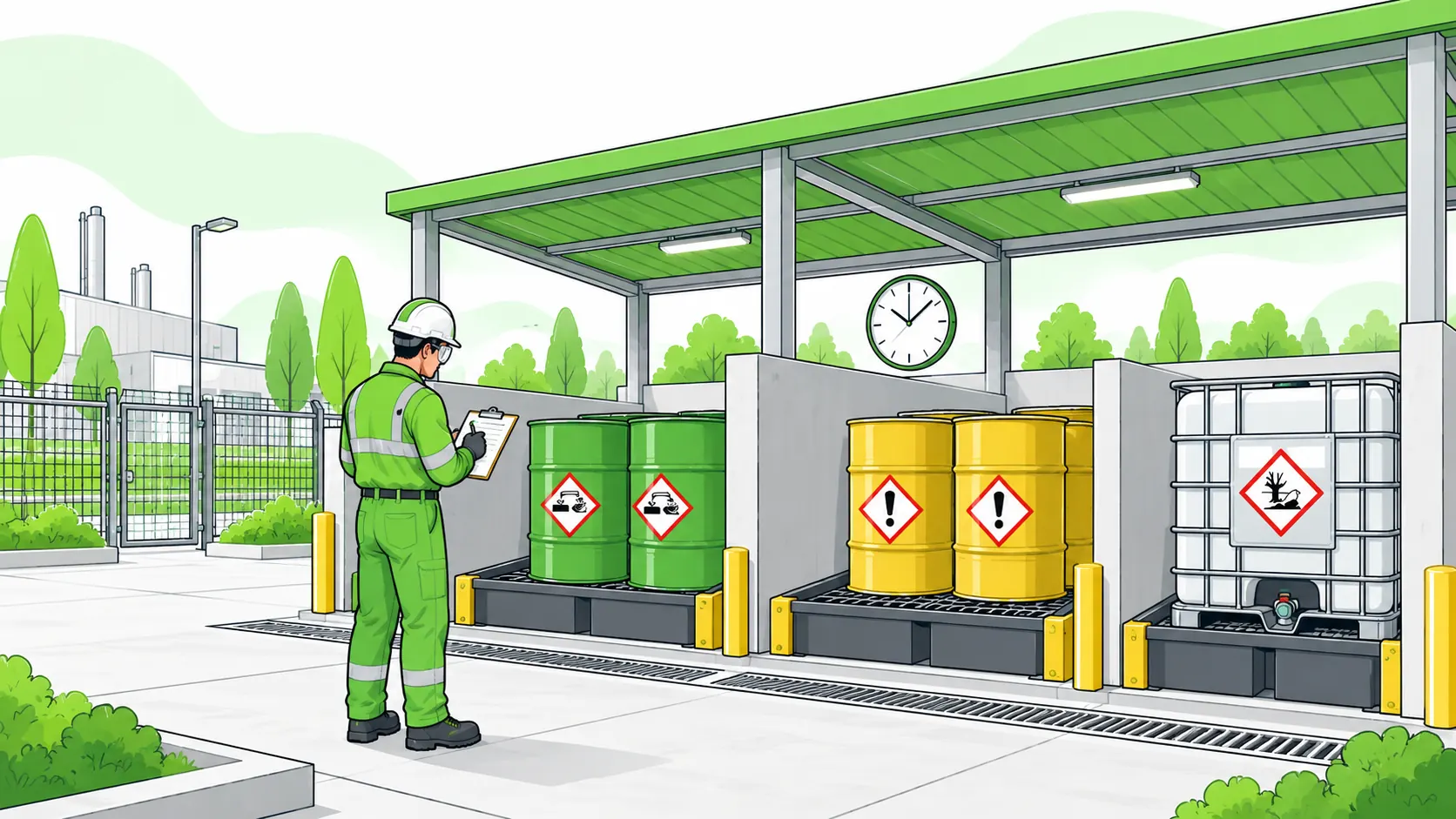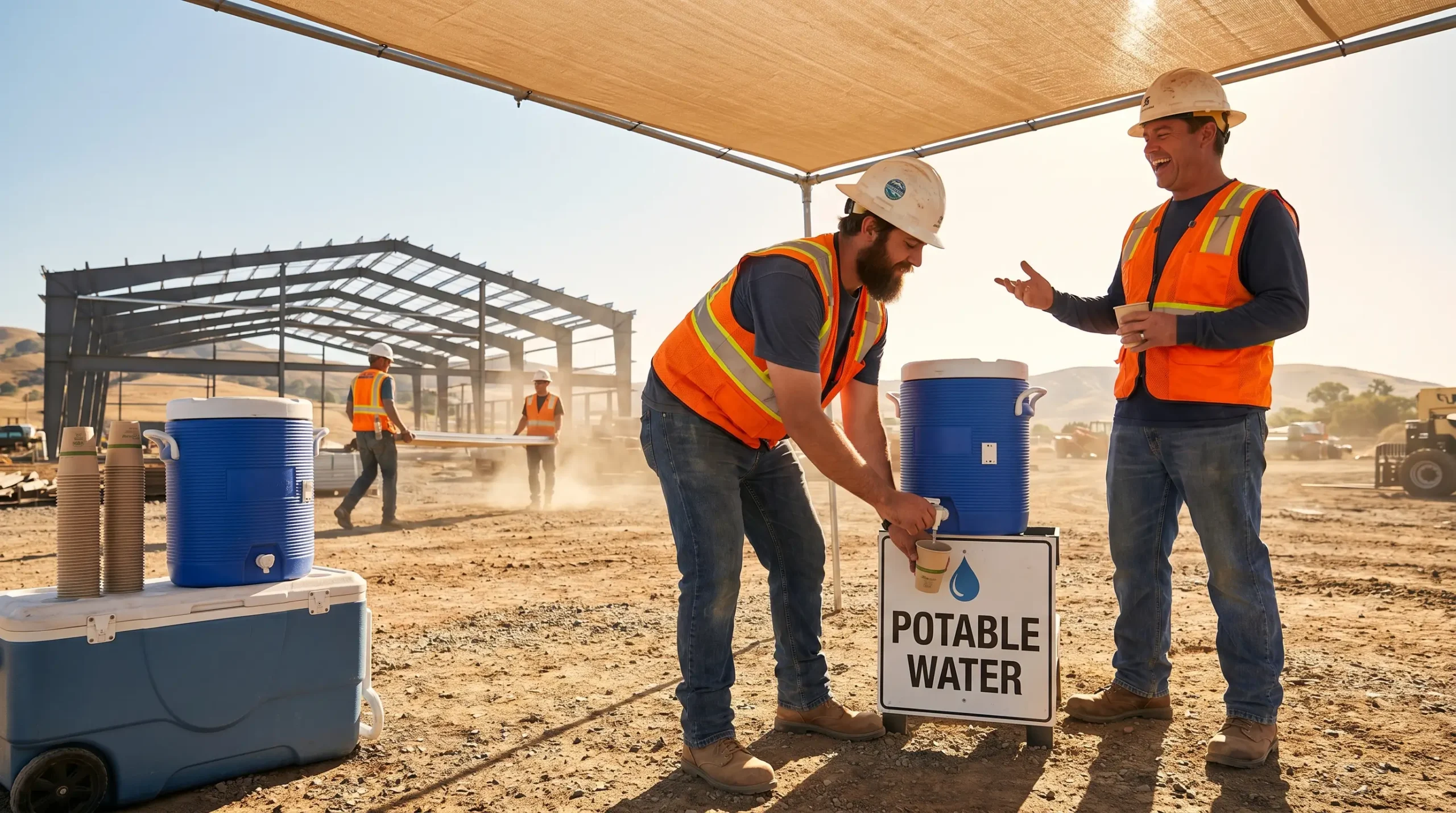
Drinking water standards are regulatory thresholds defining water safe for human consumption — setting maximum contaminant levels for microbiological, chemical, and physical parameters. Workplace regulations under OSHA (US) and HSE (UK) require employers to provide potable water meeting these standards at no cost, dispensed through approved methods, with clear separation from non-potable sources. Failure carries penalties up to $165,514 per willful violation under OSHA.
OSHA's sanitation standard — 29 CFR 1910.141 — has required potable water in every place of employment since 1975. Fifty-one years later, drinking water violations still appear on inspection reports, and the regulatory landscape around workplace hydration is shifting faster than most compliance officers realize. In April 2026, OSHA issued an updated National Emphasis Program (CPL 03-00-024) covering outdoor and indoor heat-related hazards across 55 high-risk industries — and water provision sits at the center of every heat inspection (OSHA, 2026). What was once a quiet sanitation checkbox is becoming a dynamic, auditable, enforcement-priority control.
The consequences of getting this wrong are measurable. Between 1992 and 2021, 999 US workers died from environmental heat exposure — an average of 33 fatalities per year (OSHA/BLS, 2023). In 2024 alone, 48 workers died from environmental heat (National Safety Council, 2024). Behind those numbers is a consistent failure pattern: water existed somewhere on-site, but it was not accessible, not maintained, not sufficient, or not consumed. This article breaks down what drinking water standards actually require across US, UK, EU, and international jurisdictions — where employers routinely fall short — and how the convergence of heat illness prevention rulemaking is redefining what "providing water" means in operational practice.
What Are Drinking Water Standards and Why Do They Apply to Workplaces?
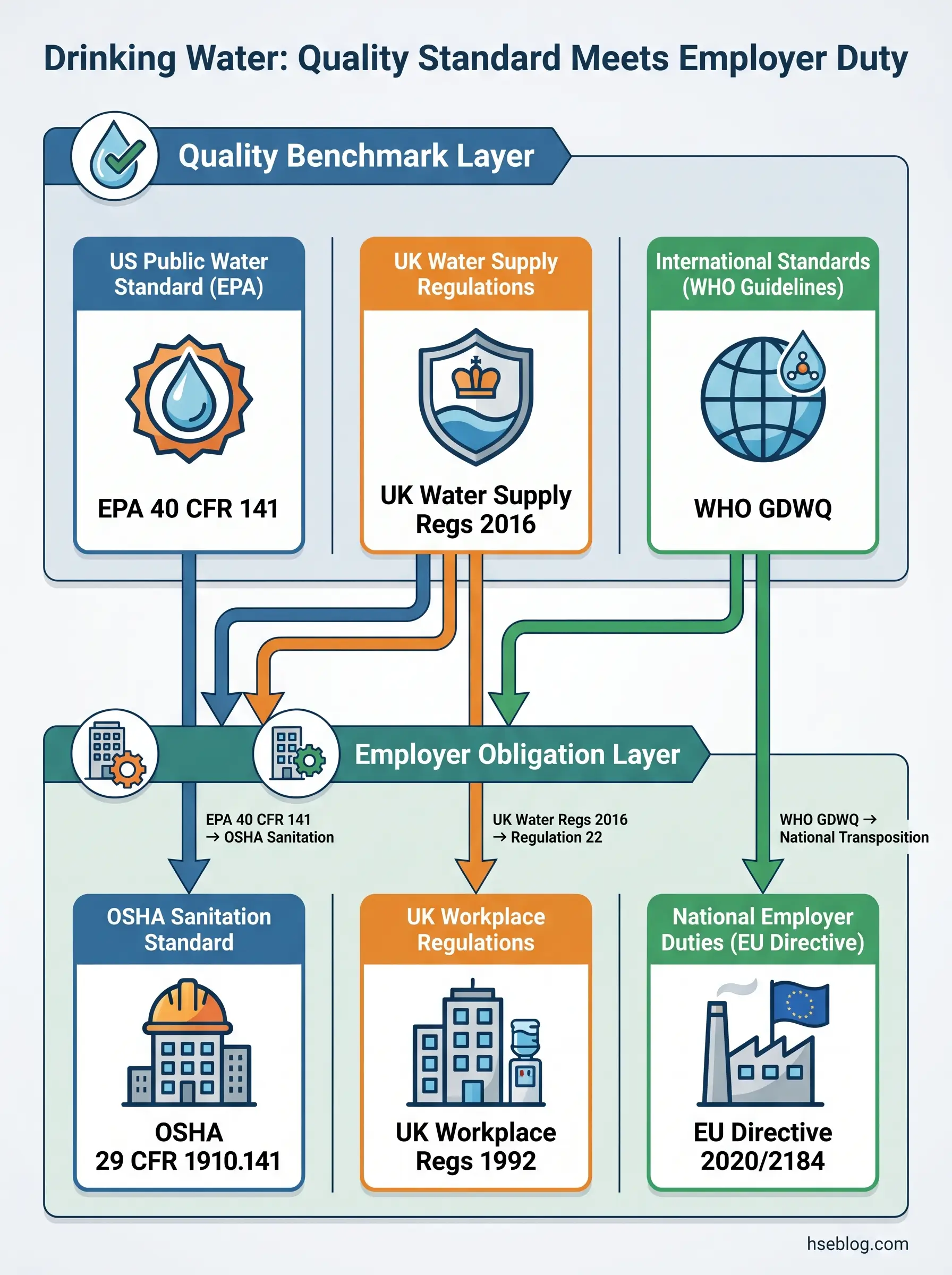
Drinking water standards are the regulatory thresholds — maximum contaminant levels for microbiological, chemical, physical, and radiological parameters — that define whether water is safe for human consumption. They exist as public health instruments. What makes them relevant to HSE professionals is a structural feature of workplace law: occupational safety regulations do not create their own water quality definitions. They cross-reference national drinking water quality standards and impose a duty on employers to provide water meeting those benchmarks.
In the US, OSHA's sanitation standards reference the EPA National Primary Drinking Water Regulations (40 CFR 141) as the quality baseline. In the UK, "wholesome" drinking water under Regulation 22 of the Workplace (Health, Safety and Welfare) Regulations 1992 is defined by the Water Supply (Water Quality) Regulations 2016. Internationally, the WHO Guidelines for Drinking-Water Quality (4th edition, 2022) provide guideline values that individual nations transpose into enforceable standards.
The employer obligation splits into two distinct compliance requirements that are frequently conflated: the duty to provide water and the duty to ensure its quality. A common practitioner confusion runs through both: many employers assume that because their building is connected to a municipal supply, the water automatically satisfies the standard. That assumption ignores the condition of internal plumbing, building age, storage tank hygiene, and temporary supply chains on project sites — any of which can degrade compliant water between the main and the tap.
How Public Drinking Water Quality Standards Set the Baseline
The EPA's National Primary Drinking Water Regulations (40 CFR 141) set enforceable maximum contaminant levels for over 90 substances across six categories: microorganisms, disinfectants, disinfection byproducts, inorganic chemicals, organic chemicals, and radionuclides. These are not guidelines — they carry monitoring, reporting, and treatment obligations for every public water system in the US. When OSHA requires "potable" water, this is the quality floor.
The UK's Water Supply (Water Quality) Regulations 2016 serve the same function, establishing standards for microbiological parameters, chemicals, and indicator parameters. The WHO Guidelines for Drinking-Water Quality (4th edition, with 2022 addenda) provide guideline values rather than enforceable limits — nations develop their own legally binding standards from WHO guidance. The practical reading for multinational employers is straightforward: the quality benchmark is always set by the jurisdiction where the workplace operates, not by the employer's home country.
OSHA Drinking Water Requirements for US Workplaces
Four OSHA sanitation standards address potable water, each governing a different industry sector. The core obligation is consistent — potable water at no cost, dispensed through approved methods, with non-potable sources clearly separated — but the specifics vary in ways that matter for multi-sector employers.
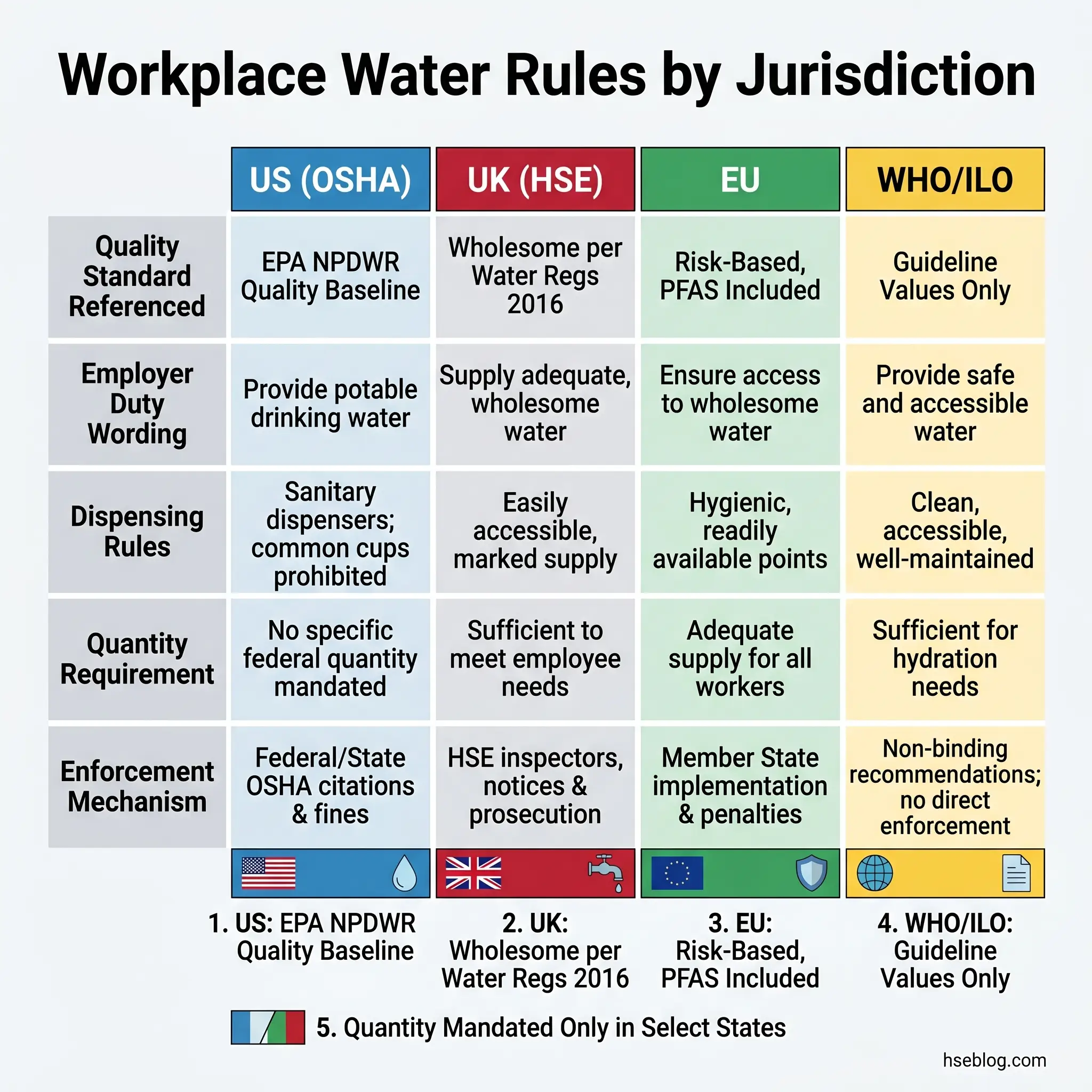
Under 29 CFR 1910.141 (General Industry), employers must provide potable water for drinking, washing, and food preparation. Approved dispensing methods include drinking fountains, covered containers with single-use cups, and single-use bottles. The standard explicitly prohibits open containers, shared cups, and common drinking vessels. Non-potable water outlets must be conspicuously posted to prevent inadvertent use, and cross-connection between potable and non-potable systems must be prevented through backflow and backsiphonage protection.
29 CFR 1926.51 (Construction) imposes parallel requirements but adds the practical challenge of temporary and remote worksites where mains supply is unavailable. Construction operations must ensure no cross-connection with non-potable systems, and non-potable outlets must be signed per Subpart G. The maritime standard (29 CFR 1915.88) goes further than general industry, specifying that water must be provided "in amounts that are adequate to meet the health and personal needs" of each employee — a quantity framing absent from the general industry regulation. The agriculture standard (29 CFR 1928.110) carries a parallel adequacy requirement.
| Sector | Standard | Key Provision | Unique Requirement |
|---|---|---|---|
| General Industry | 29 CFR 1910.141 | Potable water in all places of employment | Non-potable outlets conspicuously posted |
| Construction | 29 CFR 1926.51 | Potable water at construction sites | No cross-connection; non-potable signs per Subpart G |
| Maritime | 29 CFR 1915.88 | Amounts adequate for health and personal needs | Quantity framing; single-use dispensing explicitly specified |
| Agriculture | 29 CFR 1928.110 | Adequate potable water for health and personal needs | Quantity adequacy requirement |
A critical compliance gap runs across all four standards: no federal OSHA sanitation regulation currently specifies a minimum quantity of water per employee. The word "adequate" in maritime and agriculture provides some enforceable dimension, but for general industry and construction, the employer's obligation is to provide potable water — full stop, without a volume floor.
Audit Point: The test for "readily accessible" is not whether water exists on-site. It is whether a worker can reach it without significant disruption to their work activity. On a sprawling construction site or multi-floor facility, a single water station at the entrance fails this test for crews working 300 meters away.
State-Level Standards That Exceed Federal OSHA
State-plan states have moved ahead of federal OSHA on quantity, and this is where the compliance landscape fractures. California's Cal/OSHA Section 3395 requires employers to provide fresh, pure, suitably cool water at outdoor worksites regardless of temperature, with a minimum of one quart per employee per hour readily available. Enhanced provisions activate at 80°F. Washington's WISHA outdoor heat rule imposes a parallel one-quart-per-hour mandate during outdoor work.
Oregon, Colorado, and Nevada have adopted or are developing heat-specific hydration requirements with temperature-triggered activation. The practical consequence for multi-state employers is significant: a compliance program built to federal OSHA's quantity-silent sanitation standard will violate state law the moment a crew crosses into California or Washington.
The judgment call for compliance officers managing multi-state operations is whether to build a single, national program to the strictest state standard or maintain jurisdiction-specific programs. In most operational contexts, the former is simpler to administer, easier to train, and eliminates the risk of a crew applying the wrong standard at the wrong site.
UK Workplace Drinking Water Requirements
Regulation 22 of the Workplace (Health, Safety and Welfare) Regulations 1992 imposes a duty on employers to provide "an adequate supply of wholesome drinking water" for all persons at work in the premises. "Wholesome" is defined by reference to the Water Supply (Water Quality) Regulations 2016 — the UK equivalent of EPA's NPDWR.
The HSE Approved Code of Practice L24 recommends mains supply as the preferred source and sets practical expectations: cisterns, tanks, or vessels storing drinking water must be covered, clean, and tested or disinfected as necessary. Refillable containers must be refilled at least daily. Bottled water and dispensers are acceptable as supplementary or alternative supply where mains connection is impractical. Where both drinking water and non-drinking water are present, drinking water sources must be conspicuously marked, and sufficient cups or drinking vessels must be provided unless the supply is via a jet fountain.
The Construction (Design and Management) Regulations impose a parallel duty on contractors for construction sites, where temporary supply arrangements are the norm rather than the exception.
Watch For: A recurring UK compliance issue on construction sites: potable water stored in temporary tanks that are not cleaned or inspected between refills. The provision duty is technically met — water is available — but the quality duty is compromised. Tank hygiene is where the standard's intent separates from operational reality.
A notable distinction from the US framework: the UK approach does not specify dispensing method prohibitions with the same granularity as OSHA. There is no explicit prohibition of shared cups in the Regulations themselves, though ACOP L24 strongly recommends individual vessels or jet fountains. The UK enforcement model relies more heavily on the employer's risk assessment and the ACOP as interpretive guidance, whereas OSHA's prescriptive prohibitions (no open barrels, no shared cups) are directly enforceable as regulatory text.
International and Multi-Jurisdictional Drinking Water Frameworks
For multinational employers, the assumption that OSHA or HSE UK standards travel with the organization is a compliance error. The applicable framework is always determined by the jurisdiction where the work takes place.
The WHO Guidelines for Drinking-Water Quality (4th edition, 2022 with addenda) provide guideline values — not enforceable standards. Nations develop legally binding limits from WHO guidance, and those limits can diverge significantly. The ILO WASH@Work handbook (2016) establishes the principle that safe drinking water in the workplace is a fundamental requirement, framing it as both a health measure and a dignity issue, but it too is a guidance framework rather than an enforcement instrument.
EU Directive 2020/2184 — the recast Drinking Water Directive — is more consequential for employers operating within EU member states. It introduced risk-based approaches to water safety, updated quality parameters, and notably added requirements for monitoring PFAS and endocrine disruptors. Member states transpose the Directive into national law, so the specific compliance mechanism varies by country, but the quality benchmarks are harmonized across the bloc.
Jurisdiction Note: An employer headquartered in the US operating a facility in Germany must comply with the German transposition of EU Directive 2020/2184 — not OSHA sanitation standards — for that facility's drinking water provision. The compliance structure, testing requirements, and enforcement mechanisms differ substantially.
What Counts as Potable Water in the Workplace?
The regulatory definition of potable water is water that meets the applicable national drinking water quality standard. In practice, the question employers face is not definitional — it is evidentiary. Can you demonstrate that the water reaching your employees' lips actually meets that standard?
The EPA National Primary Drinking Water Regulations set maximum contaminant levels across six categories: microorganisms (including total coliforms and E. coli), disinfectants, disinfection byproducts, inorganic chemicals (arsenic, lead, copper, nitrate), organic chemicals (benzene, vinyl chloride, PCBs), and radionuclides. Water supplied by a regulated public water system is presumed to meet these MCLs at the point of delivery to the building.
That presumption weakens once water enters the employer's plumbing. Aging pipes can introduce lead. Stagnant water in infrequently used lines can allow bacterial growth. Temporary site supply chains — common in construction and remote operations — introduce storage, transport, and dispensing variables that the public water system never anticipated.
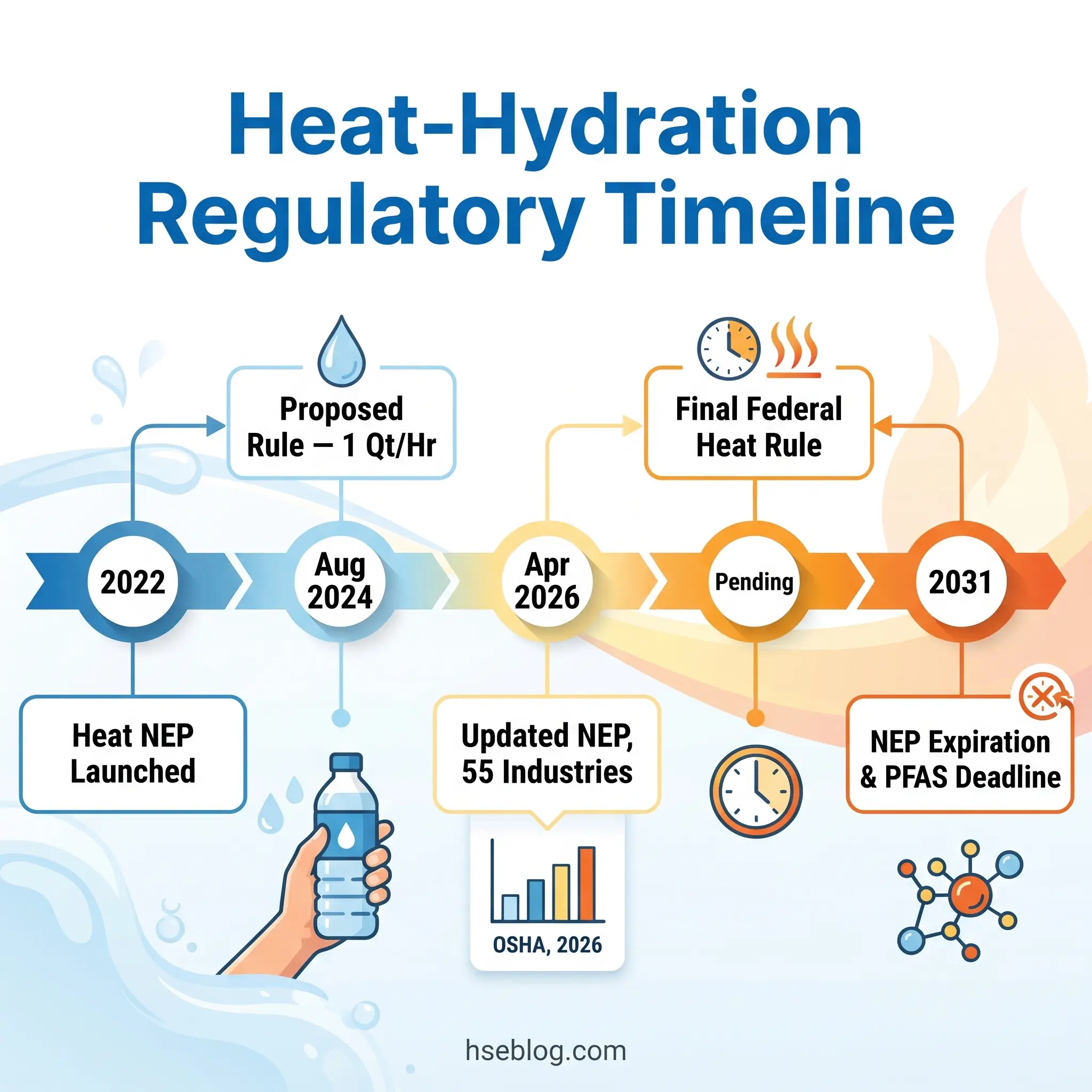
A developing area is PFAS contamination. EPA finalized maximum contaminant levels for PFOA and PFOS at 4 parts per trillion in April 2024. In May 2025, EPA announced it would retain those MCLs but plans to extend the compliance deadline from 2029 to 2031 and rescind regulations for four additional PFAS compounds (EPA, 2025). Employers relying on public water systems will benefit from system-level treatment, but those using private wells or independent supplies need to verify PFAS levels independently — and may not have considered this obligation.
Field Test: There is a practical distinction between water that is technically potable and water that employees will actually drink. Water that tastes metallic, appears cloudy, or carries an odor — even if it passes every MCL — discourages consumption. In heat-exposed work, that discouragement becomes a safety issue. Palatability matters because hydration is the control objective, and a control that workers avoid is a failed control.
A frequently overlooked trigger: employers using private wells that serve 25 or more people for 60 or more days per year may be classified as a Public Water System under the Safe Drinking Water Act. That classification activates monitoring, testing, and reporting obligations that most employers with private wells have never budgeted for.
Drinking Water and Heat Illness Prevention: The Regulatory Convergence
This is where the compliance landscape is moving fastest. Drinking water provision is shifting from a static sanitation requirement — provide a cooler, check the box — to a dynamic, temperature-responsive, quantity-specific heat illness control. The regulatory trajectory is clear, and employers who wait for a final federal rule before adjusting their programs are already behind enforcement practice.
OSHA's proposed Heat Injury and Illness Prevention rule (NPRM, 89 FR 32532, published August 2024) would require employers to provide one quart of suitably cool drinking water per employee per hour when heat triggers are reached — 80°F as the initial trigger and 90°F as the high-heat trigger. The proposed rule treats water not as a welfare facility but as a primary engineering control for heat illness. That reframing carries operational implications: engineering controls have monitoring, maintenance, and verification requirements that welfare provisions traditionally have not.
The updated National Emphasis Program (CPL 03-00-024, April 2026) expands enforcement to 55 high-risk industries and will remain in effect through 2031 (OSHA, 2026). Between April 2022 and December 2024, OSHA conducted approximately 7,000 heat-related inspections under the NEP, resulting in 60 citations and nearly 1,400 hazard alert letters (OSHA, 2026). Water provision is a focal point in every heat inspection.
California's Cal/OSHA Section 3395 already mandates fresh, pure, suitably cool water at outdoor worksites regardless of ambient temperature, with enhanced provisions triggering at 80°F. Washington's outdoor heat rule mirrors the one-quart-per-hour standard. These are not aspirational — they are actively enforced with citations.
The practitioner pattern that consistently appears in heat-related incident investigations is the gap between "water is available" and "workers are actually hydrating adequately." Water placed at a central location at 6:00 AM does not serve a crew working 200 meters away at 2:00 PM when the cooler is empty, the ice has melted, and the water temperature matches the ambient air. Treating water as a static provision rather than a dynamic control — one that must respond to temperature, workload, acclimatization status, and shift duration — is where heat illness fatalities occur.
Dispensing, Storage, and Sanitation Requirements
How water is stored and dispensed is where regulatory text meets daily operational reality — and where maintenance failures quietly erode compliance between inspections.
OSHA's approved dispensing methods across its sanitation standards are consistent: drinking fountains, covered containers with single-use cups, and single-use bottles. The prohibitions are equally clear — open barrels, pails, tanks requiring dipping, and shared cups are not permitted. These are not recommendations. They are prescriptive regulatory requirements, and violations are citable.
Non-potable water outlets must be clearly labeled to prevent inadvertent consumption, and backflow prevention devices must isolate non-potable systems from potable supply. The cross-connection concern is not theoretical: on construction sites and industrial facilities where both potable and non-potable water systems run in proximity, a single valve failure or hose connection can introduce untreated process water into the drinking supply.
| Permitted | Prohibited |
|---|---|
| Drinking fountains | Open barrels or pails |
| Covered containers with single-use cups | Shared cups or common dippers |
| Single-use sealed bottles | Tanks requiring dipping to retrieve water |
| Dispensers with sanitary spigots | Uncovered containers |
The UK framework under ACOP L24 requires containers to be refilled at least daily and cleaned or disinfected as necessary. Where both drinking and non-drinking water are available, drinking water sources must be conspicuously marked.
Water temperature is an area where regulation is deliberately vague — and where operational judgment fills the gap. Federal OSHA's proposed heat rule uses the phrase "suitably cool." Cal/OSHA requires "fresh, pure, suitably cool." No jurisdiction specifies an exact temperature in degrees. The practical interpretation across most compliance programs is water cool enough that workers will voluntarily drink it in sufficient volume — typically below 60°F (15°C) in heat conditions. Water at ambient temperature in a sun-exposed cooler on a 95°F day is technically available but functionally useless as a hydration control.
The Fix That Works: Water coolers provided on Day 1 of a project and then ignored represent one of the most predictable operational failure modes. Filters unchanged, containers not cleaned, ice not replenished, cups depleted. Compliance is a continuing obligation with a maintenance tail — not a one-time procurement event. Build dispenser maintenance into the same inspection cycle as fire extinguishers and first aid kits.
Employer Penalties and Enforcement for Non-Compliance
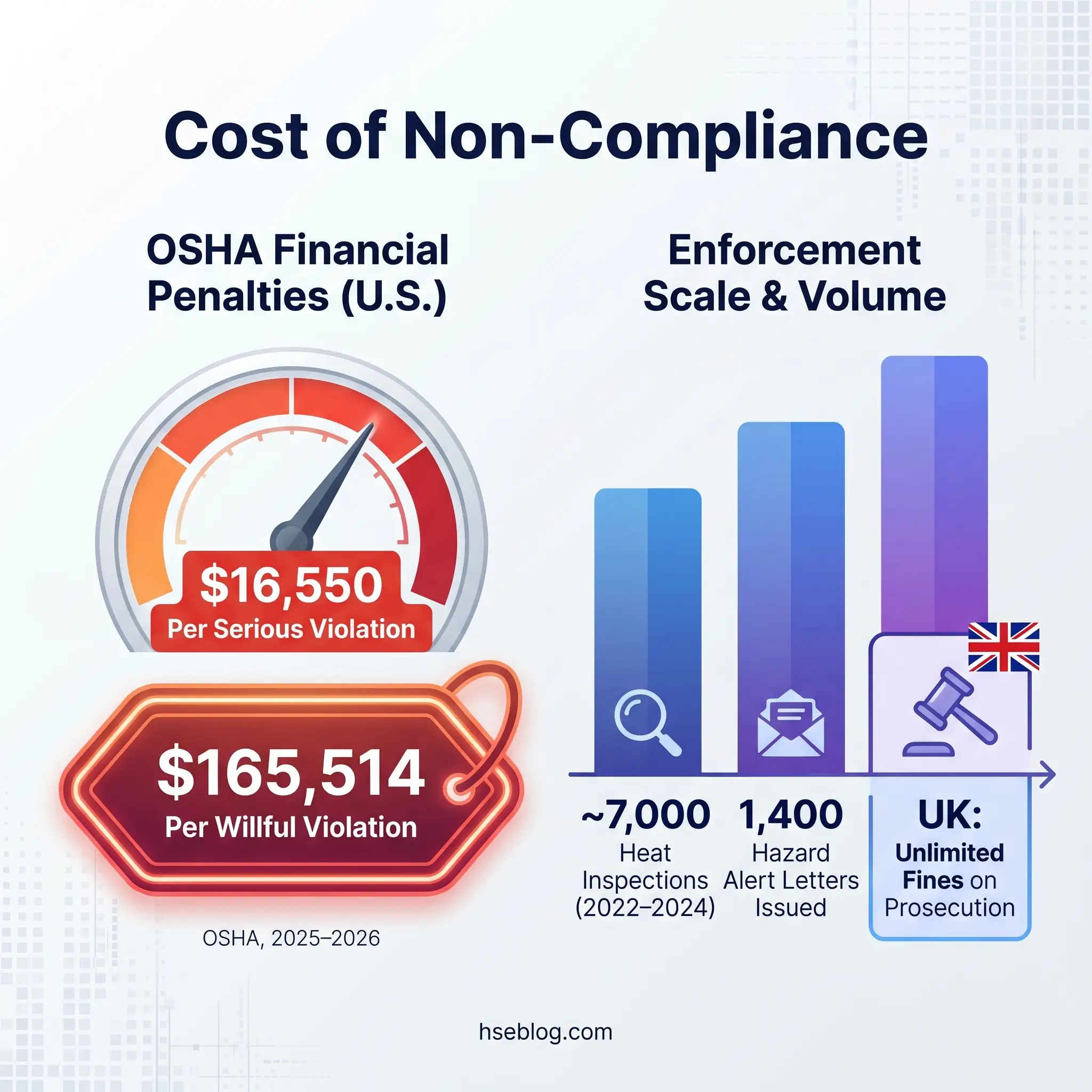
OSHA's penalty structure puts a dollar figure on non-compliance. As of January 2025, the maximum penalty for a serious violation is $16,550. Willful or repeated violations carry a maximum of $165,514 per instance (OSHA, 2025). Drinking water violations can be cited under the applicable sanitation standard or — for heat-related failures — under the General Duty Clause, Section 5(a)(1) of the OSH Act.
The General Duty Clause is the enforcement mechanism that gives drinking water violations their teeth in heat cases. When no specific standard mandates a water quantity, OSHA can still cite an employer for failing to provide adequate hydration as part of a heat illness prevention program if the hazard was recognized, the employer failed to address it, and workers were exposed to serious harm.
UK HSE enforcement operates differently but arrives at similar pressure. Inspectors can issue improvement notices (requiring corrective action within a specified period) or prohibition notices (halting work immediately). Prosecution for serious welfare breaches carries unlimited fines, and courts have demonstrated willingness to impose substantial penalties where basic welfare provisions like drinking water were neglected.
| Jurisdiction | Serious Violation | Willful/Repeated | Enforcement Tool |
|---|---|---|---|
| US Federal OSHA | Up to $16,550 | Up to $165,514 | Sanitation standard or General Duty Clause |
| UK HSE | Improvement/Prohibition notice | Unlimited fine on prosecution | Welfare Regulations + CDM |
| California Cal/OSHA | State penalty schedule (often higher than federal) | Per-violation basis | Section 3395 + General Industry |
A pattern worth noting from the published enforcement record: sanitation citations for drinking water rarely appear in isolation. When an inspector identifies water provision deficiencies, they typically find other welfare failures — inadequate toilet facilities, missing handwashing stations, absent shade structures. The water violation is a signal of systemic neglect, and inspectors treat it as one.
Between April 2022 and December 2024, OSHA conducted approximately 7,000 heat-related inspections under the NEP, issuing 60 citations and nearly 1,400 hazard alert letters (OSHA, 2026). The hazard alert letter volume is significant — it indicates that OSHA is using inspections as education-and-warning events at scale, building the enforcement record that supports future citations and rulemaking.
Building a Compliant Workplace Drinking Water Program
The most common audit finding in workplace drinking water compliance is not the absence of water. It is the absence of documentation proving the water is potable and the system is maintained. Many employers provide compliant water but cannot demonstrate compliance to an inspector — and from an enforcement perspective, undocumented compliance is indistinguishable from non-compliance.
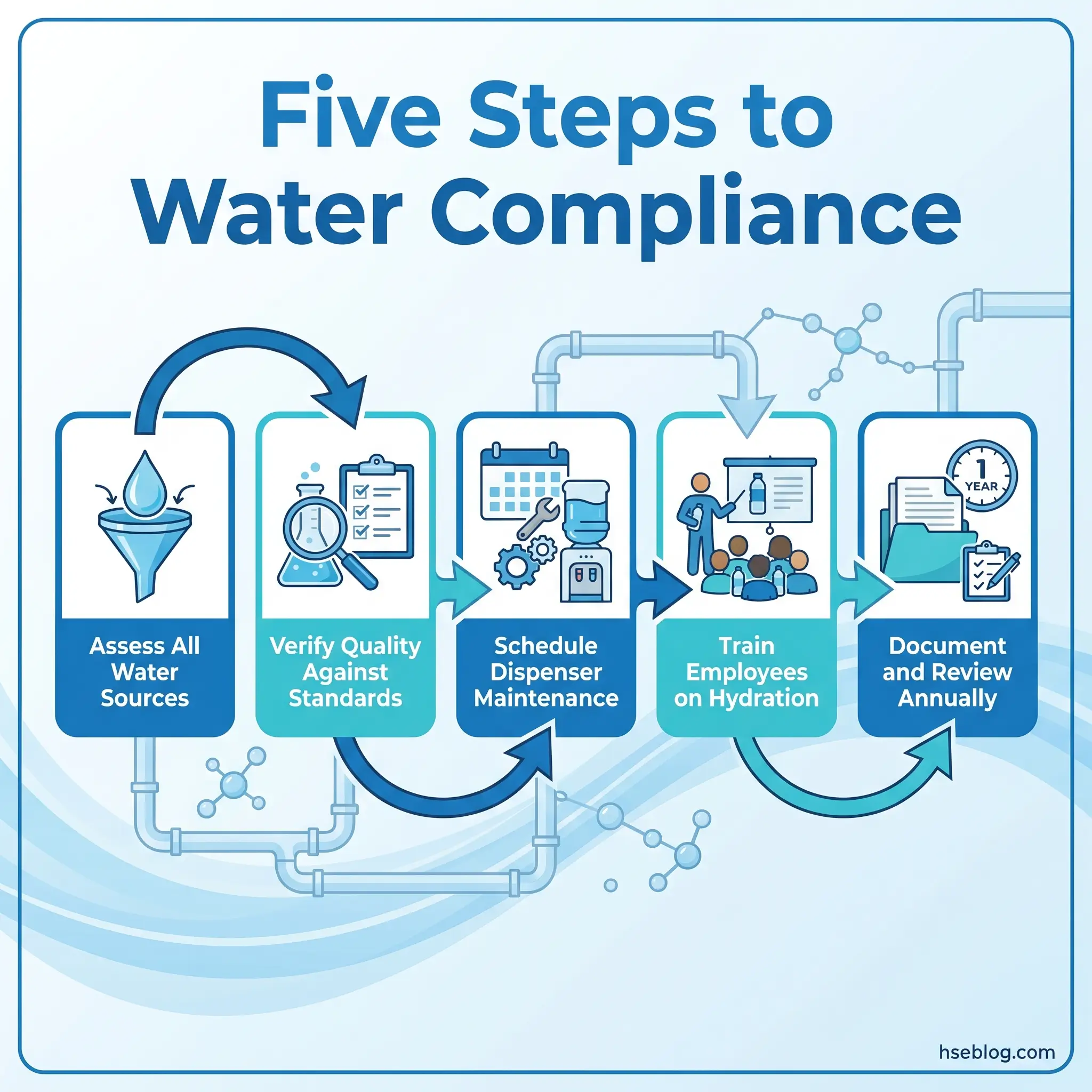
A defensible program starts with a baseline assessment. Identify every water source on-site — mains connections, private wells, temporary tanks, bottled water supply. Map every dispensing point and every non-potable outlet. For each source, verify whether it meets the applicable quality standard. Mains-connected facilities served by a regulated public water system can rely on the system's compliance — but verify building plumbing age, check for lead service lines, and confirm that internal storage tanks (if any) are maintained and inspected.
For private wells, the analysis changes substantially. If the well serves 25 or more people for 60 or more days per year, it may meet the Safe Drinking Water Act definition of a Public Water System, triggering testing, monitoring, and reporting obligations under EPA jurisdiction. Even below that threshold, well water should be tested against applicable state drinking water standards at a frequency appropriate to the risk — annually at minimum, more frequently if the well is in an area with known contaminant concerns.
Establish a maintenance and inspection schedule for all dispensing equipment. Coolers, fountains, and containers require regular cleaning, filter replacement (where applicable), and temperature monitoring in heat conditions. Document every maintenance action. Build this into the existing inspection cycle rather than creating a parallel system — if fire extinguishers and first aid kits are inspected monthly, add water dispensers to the same checklist.
Train employees on three things: where potable water is located, what non-potable labels mean, and why hydration matters in heat conditions. Training is especially critical during onboarding and at the start of heat-exposure seasons. Document attendance and content.
Review the entire program annually, or sooner if conditions change — a new site, a regulatory update, a water quality incident, or a shift in operational temperature exposure. The April 2026 NEP update and the pending federal heat rule are both triggers for review now, not when the final rule publishes.
Pro Tip: Photograph your dispensing stations, labels, and maintenance logs during each inspection cycle. Time-stamped photographic evidence is the single most convincing compliance artifact in a contested citation — it demonstrates conditions at a specific point in time in a way that a checked box on a form cannot.
Frequently Asked Questions
Can an employer charge employees for drinking water?
No. Under OSHA's sanitation standards (29 CFR 1910.141, 1926.51, 1915.88), potable drinking water must be provided at no cost to employees. The UK's Workplace Regulations 1992, Regulation 22, impose a parallel free-provision duty. Bottled water is not required if compliant tap water is available, but whatever form the water takes, the employer bears the cost. Charging employees for drinking water — directly or through vending — violates the employer's statutory obligation in both jurisdictions.
Does OSHA require a specific amount of water per employee?
Federal OSHA's existing sanitation standards do not specify a minimum volume. The maritime and agriculture standards require amounts "adequate to meet health and personal needs," but general industry and construction are quantity-silent. However, OSHA's proposed Heat Injury and Illness Prevention rule would establish one quart per employee per hour when heat triggers are met. California and Washington already enforce this quantity mandate for outdoor work. Treating one quart per hour as operational best practice is prudent even where not yet legally required.
Is an employer required to provide bottled water at work?
Not if potable tap water from a regulated public water system is available and meets EPA or applicable state/local drinking water standards. Bottled water or dispensers become necessary when mains supply is unavailable, when the building plumbing compromises water quality (lead pipes, aging infrastructure), when the site is temporary or remote, or when the public water system issues a boil-water notice or advisory. The obligation is potable water — the format is the employer's operational choice.
What temperature should workplace drinking water be?
No US federal standard specifies an exact temperature. OSHA's proposed heat rule uses "suitably cool," and Cal/OSHA requires "fresh, pure, suitably cool." The practical standard across most compliance programs is water cool enough to encourage voluntary consumption — generally below 60°F (15°C) in heat-exposed conditions. Water at ambient temperature on a hot day may technically satisfy the provision requirement but fails as a hydration control if workers will not drink it.
Can bathroom tap water count as the workplace drinking water supply?
OSHA does not explicitly prohibit bathroom taps as a potable water source, and if the tap delivers potable water from a regulated supply, it technically meets the quality requirement. However, industry guidance and multiple compliance interpretations consistently hold that bathroom sinks do not satisfy the intent of workplace drinking water provision. Dedicated fountains, coolers, or covered containers in accessible, hygienic locations are the recognized standard. Relying on bathroom taps invites both inspector scrutiny and worker reluctance to hydrate.
How do PFAS regulations affect workplace drinking water?
EPA finalized maximum contaminant levels for PFOA and PFOS at 4 parts per trillion in April 2024. In May 2025, EPA announced it would retain those MCLs but extend the compliance deadline to 2031 and rescind regulations for four additional PFAS compounds (EPA, 2025). Employers served by public water systems will benefit from system-level treatment as those systems achieve compliance. Employers using private wells or independent supplies should test for PFAS independently, particularly in areas with known PFAS contamination from industrial or military sources.
Conclusion
Workplace drinking water compliance is no longer the static welfare provision it was for decades. The regulatory direction — visible in OSHA's proposed heat rule, the April 2026 NEP expansion to 55 industries, state-level quantity mandates in California and Washington, and the EPA's PFAS MCL framework — points toward a future where water provision is managed as a dynamic, documented, auditable control with specific quantity, temperature, and accessibility standards. Employers still treating it as a set-and-forget cooler placement are building compliance debt that will come due either at inspection or at an incident.
The operational shift this requires is not dramatic, but it is deliberate. Assess your water sources. Verify quality. Maintain dispensing equipment on a schedule. Document what you provide and how you maintain it. Train your workforce. Review annually and whenever regulatory triggers fire — and two of those triggers have already fired in 2025 and 2026.
What separates a compliant drinking water program from a citation is rarely the presence or absence of water. It is whether the employer can prove — with dated records, maintenance logs, test results, and training documentation — that the water reaching employees meets the applicable drinking water standard and that the system delivering it is actively managed. The standard is not perfection. It is demonstrable diligence.