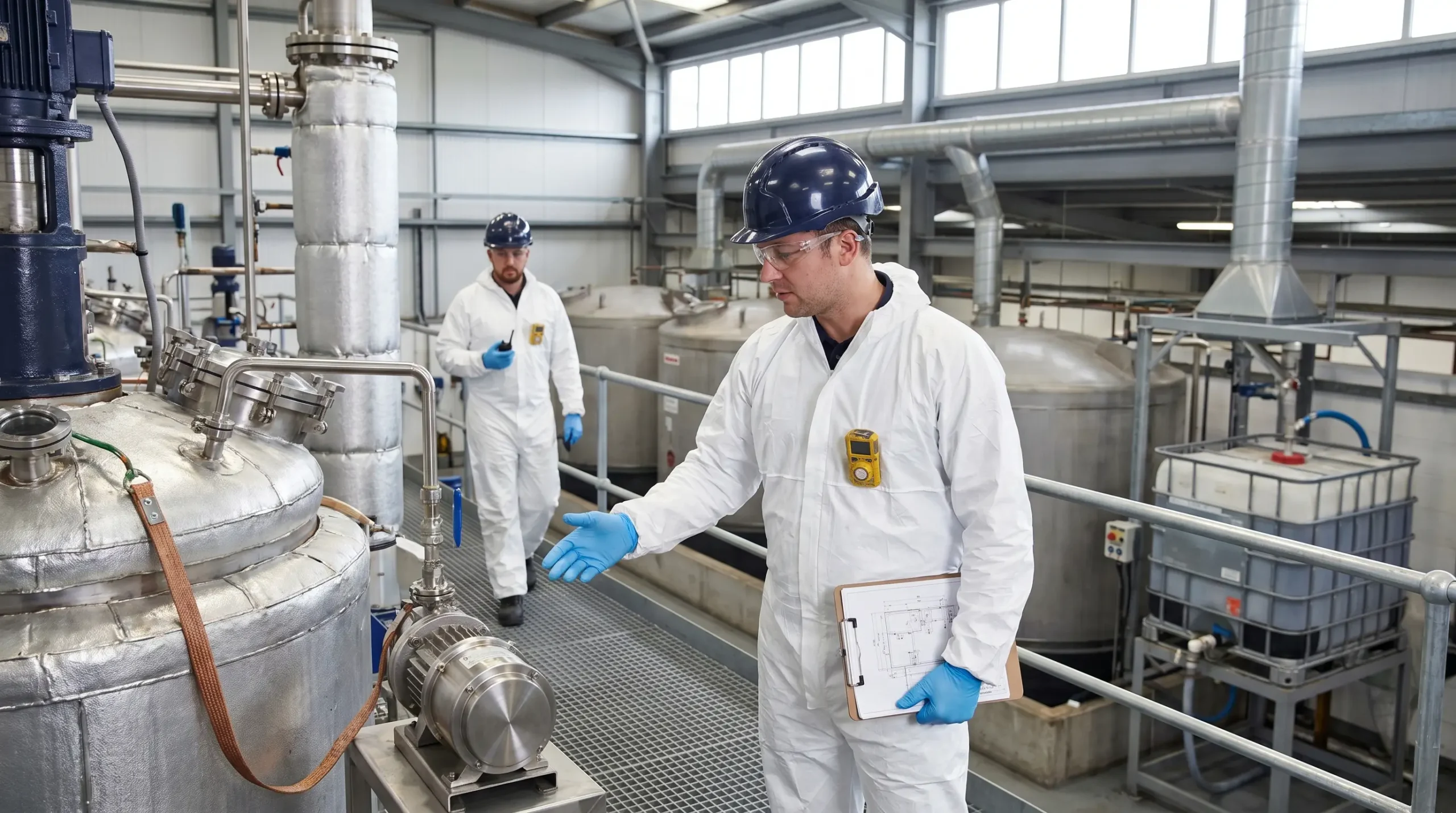
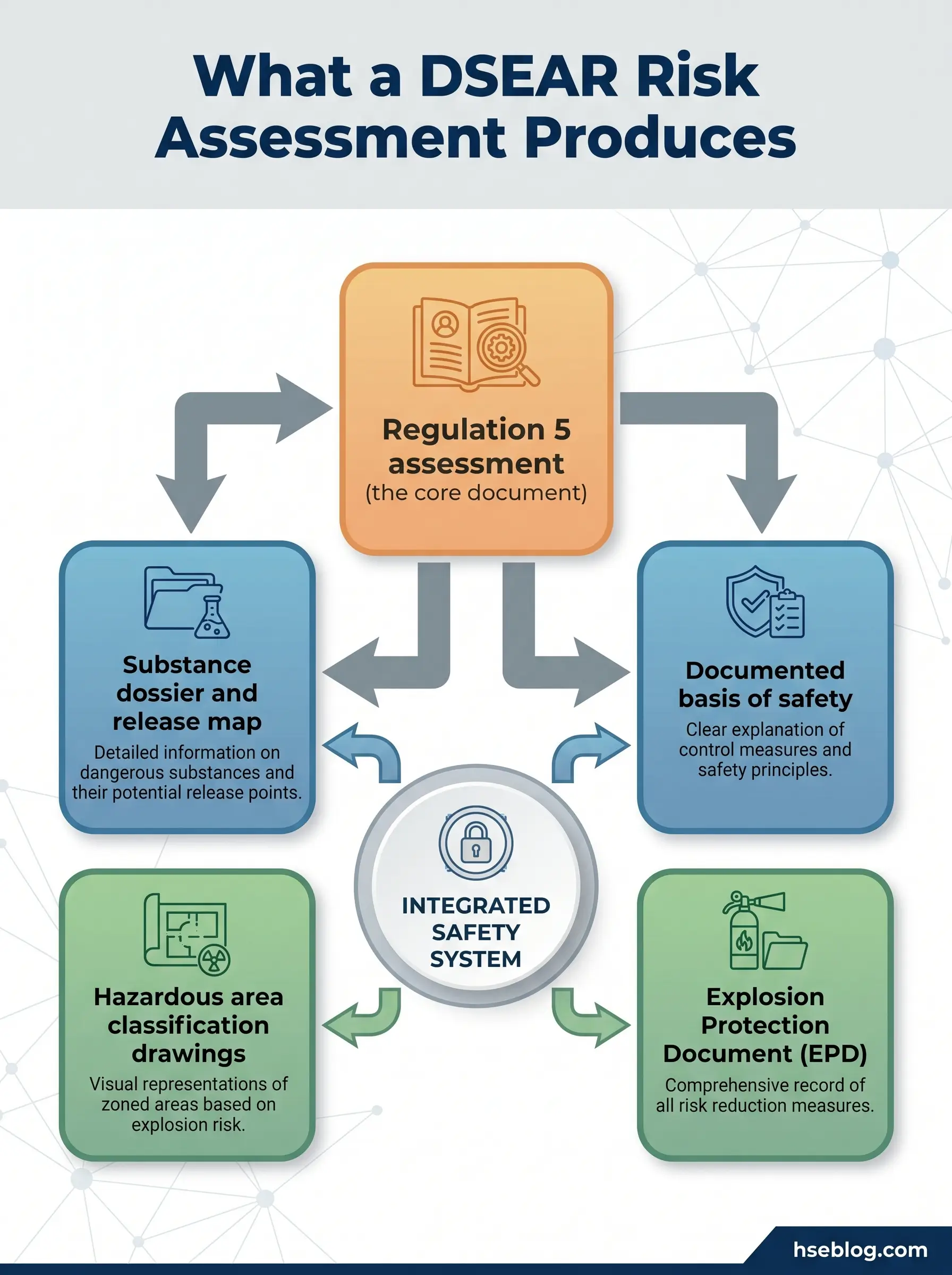
Regulation 5(1) of DSEAR 2002 reads that the employer "shall make a suitable and sufficient assessment of the risks… which arise from" a dangerous substance. Three phrases in that clause — suitable and sufficient, before work is carried out, and arise from that substance — have carried more weight in HSE enforcement than most duty holders expect. On a batch reactor line I looked after at a specialty chemicals plant in a temperate manufacturing corridor, the visiting inspector did not ask for zone drawings first. She asked for the scope statement, the substance dossier, and the documented basis of safety. The drawings came afterwards. The reason is straightforward: zones are an output, not the assessment itself.
This guide walks through a full DSEAR risk assessment as eight sequenced steps, anchored to Regulations 5 through 9 of DSEAR 2002 and to the supporting technical standards. Get the sequence wrong and the document can be technically rich but legally deficient — a position HSE has cited in rejection letters and improvement notices. What follows is the method I use on active sites, not a desk-study approximation, covering scope, data gathering, hazardous area classification, ignition-source evaluation, the basis of safety decision, controls, and the Explosion Protection Document.
What Is a DSEAR Risk Assessment and Why It Matters
A DSEAR risk assessment is the Regulation 5 duty to identify and evaluate fire, explosion, and corrosion-to-metal risks arising from dangerous substances, before any relevant work is carried out. It sits inside a narrower legal frame than most people assume. The Dangerous Substances and Explosive Atmospheres Regulations 2002 (SI 2002/2776) implement the ATEX 153 Workplace Directive in Great Britain and replaced or amended around twenty earlier pieces of flammable-substances legislation when they came into force on 9 December 2002.
The assessment is the pivot point of DSEAR compliance. Everything in Regulations 6 through 9 — elimination and control, area classification, emergency arrangements, information and training — flows from the conclusions reached in the Regulation 5 document. No valid assessment, no lawful work.
It is also distinct from COSHH. COSHH deals with health effects — toxicity, sensitisation, long-term exposure. DSEAR deals with safety effects — ignition, deflagration, pressure release, metal attack. The same substance, toluene for example, can be in scope of both. I have watched site teams assume their COSHH file covered flammability and move on. It does not.
When a DSEAR Risk Assessment Is Required
The decision is simpler than most duty holders treat it. If a work activity involves a dangerous substance that is present — or liable to be present — and a fire, explosion, or metal-corrosion safety risk can arise from it, DSEAR applies. Full stop. The employer cannot opt out on the grounds that quantities are small or work is occasional.
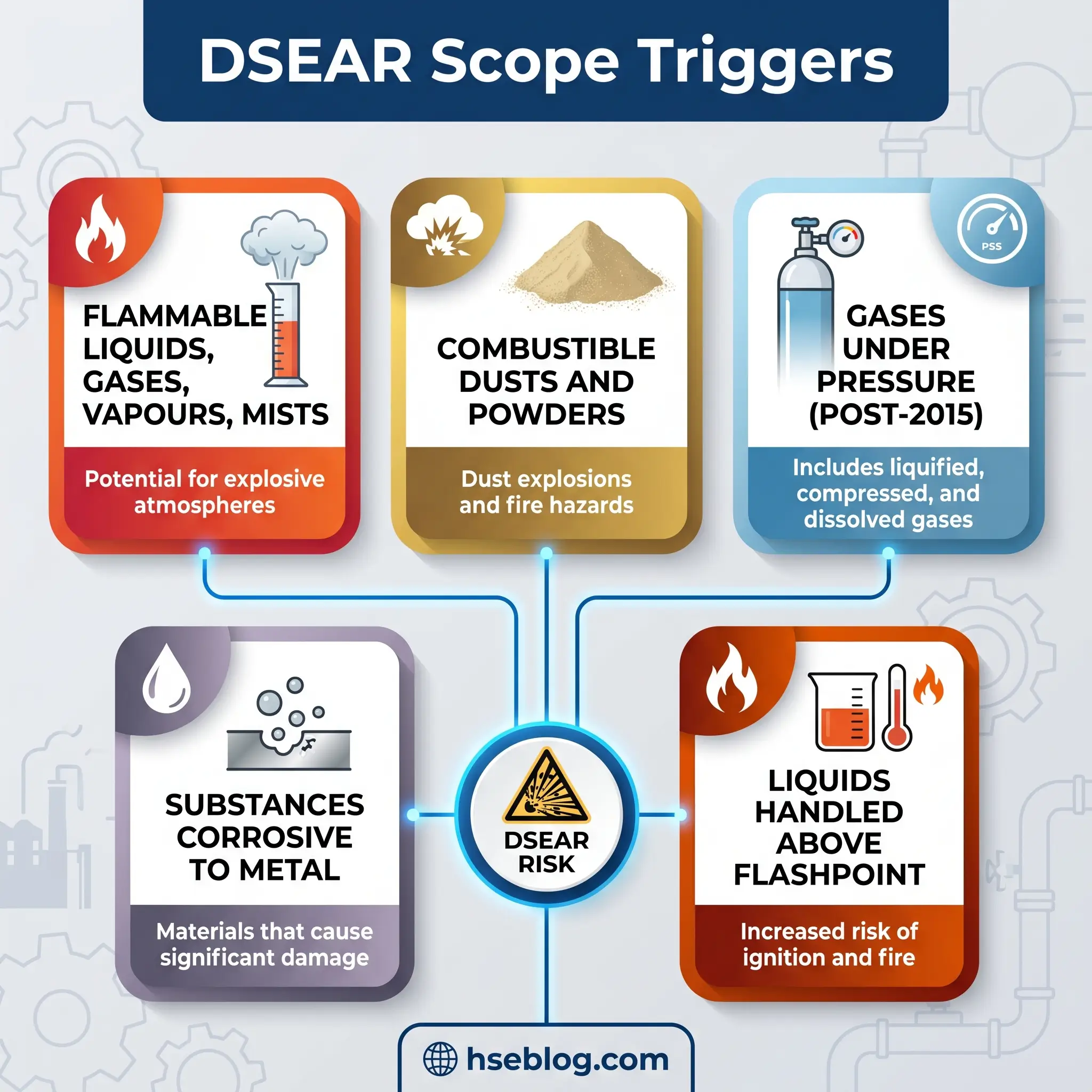
The triggers that bring a site into scope are concrete:
- Flammable liquids such as solvents, fuels, thinners, inks — including diesel and gas oil, which came into scope when CLP raised the flashpoint ceiling to 60 °C.
- Flammable gases including LPG, acetylene, hydrogen (often generated by battery charging bays), methane, and ammonia.
- Combustible dusts such as flour, sugar, wood, metal fines, plastic powders, and many pharmaceutical intermediates.
- Pressurised gases, brought into DSEAR scope by the 2015 amendment.
- Substances corrosive to metal, also added in 2015 via the Chemical Agents Directive revisions.
- High-flashpoint liquids handled above their flashpoint — a detail that frequently catches out process lines running heated oils or hot-fill operations.
The industries where DSEAR is a permanent fixture are obvious: chemicals, pharmaceuticals, paints and coatings, food and drink manufacture, distilleries, woodworking, waste processing, and oil and gas. The ones where it is overlooked are less obvious — warehouses with LPG forklift charging, hospitals with medical gas manifolds, data centres with bulk UPS rooms, and any workshop that runs solvent degreasing.
Who Should Conduct the Assessment
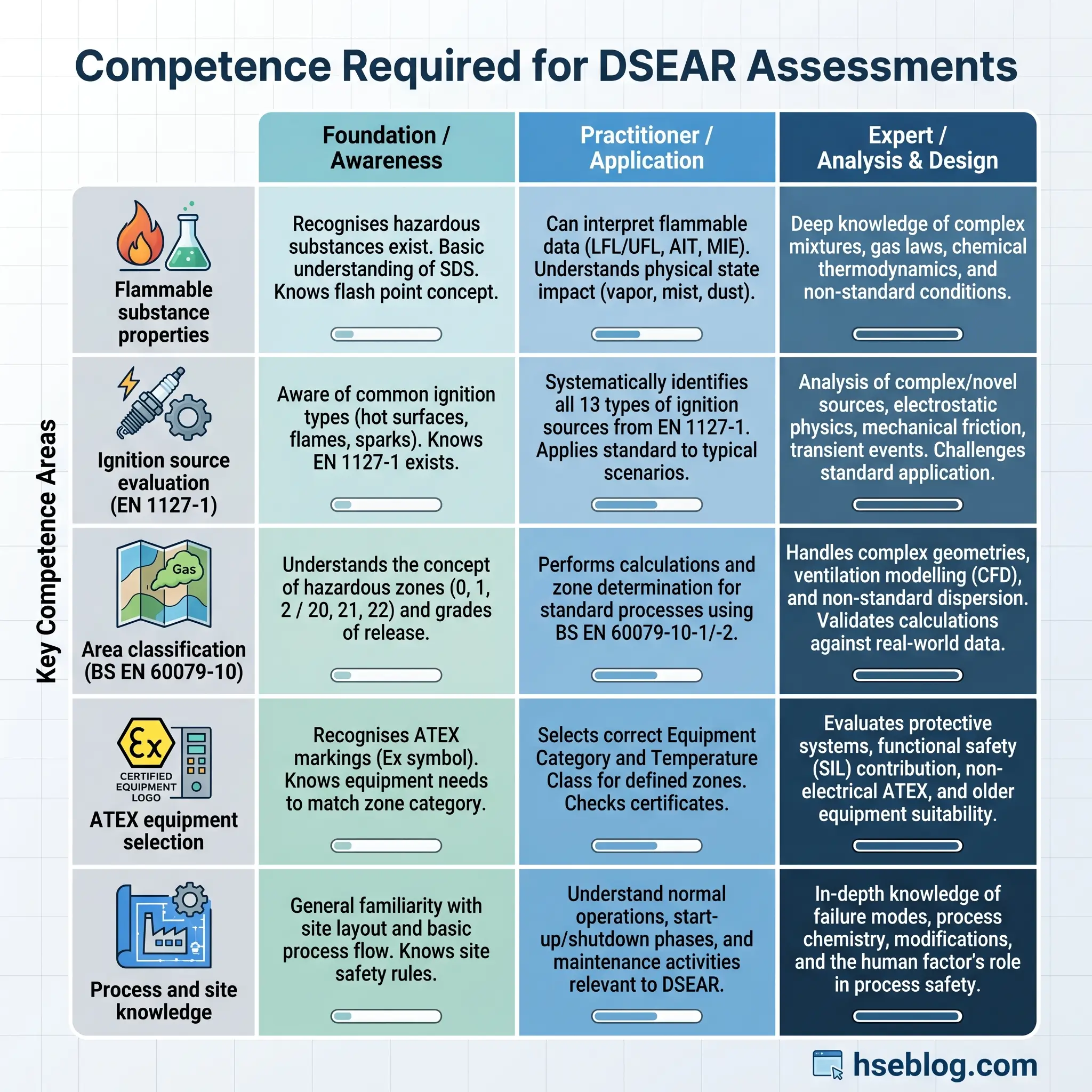
DSEAR requires a "competent person" and deliberately does not prescribe qualifications. That ambiguity trips sites up. Competence has to be proportionate to the risk and complexity of the operation — a small paint store with two drums of white spirit does not need the same assessor as a solvent-recovery plant with a distillation column and a reactor hall.
For anything beyond the simplest scenarios, the assessor needs working knowledge of flammable substance behaviour, the thirteen categories of ignition source in BS EN 1127-1, hazardous area classification methodology in BS EN 60079-10-1 and -10-2, ATEX equipment categories under the Equipment and Protective Systems Regulations 2016, and — crucially — the site's own processes. An external consultant who has never watched a drum filler operate at 2 a.m. will miss things an experienced operator would flag in minutes.
On larger or higher-hazard sites, a single assessor is rarely enough. The usual team at the chemicals plant I referenced earlier was a process safety engineer, the site HSE lead, an electrical engineer familiar with ATEX equipment selection, an operations representative from the affected area, and — for any reactor work — the principal chemist. One person does not hold all the relevant knowledge, and HSE has rejected assessments where the named competent person could not demonstrate sufficient depth across the required areas.
The 8-Step DSEAR Risk Assessment Process
In practice, a defensible DSEAR risk assessment follows eight steps in order. Each step produces a specific output that the next step consumes. Most of the "five-step" and "seven-step" versions circulating online collapse steps together or skip the link between release sources, ignition sources, and the basis of safety — which is the exact gap HSE inspectors probe first.
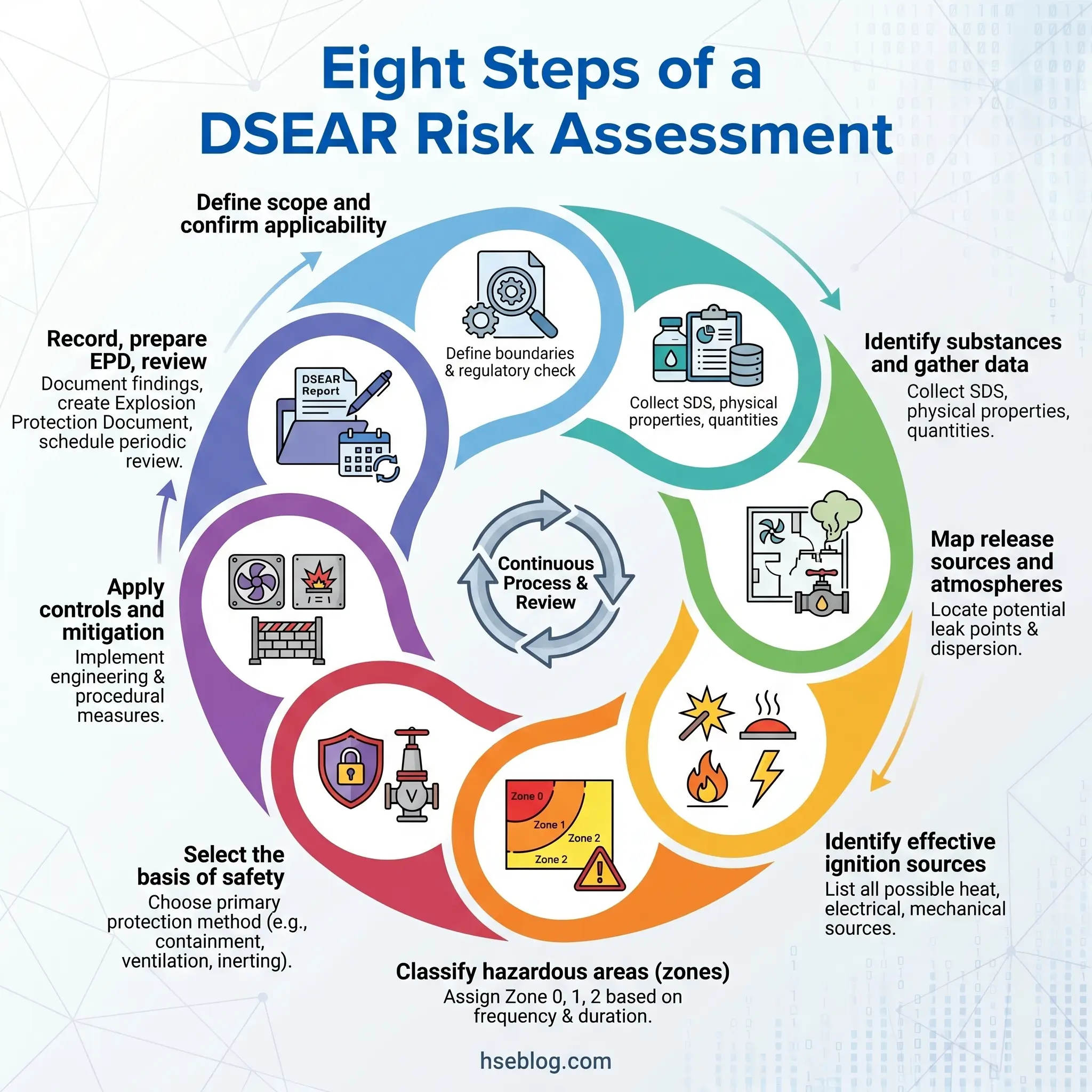
Step 1: Define the Scope and Confirm DSEAR Applies
The assessment starts with a written scope. Decide whether you are assessing a whole site, a single process line, a storage area, or one activity — and list the work activities covered, including normal operation, start-up and shutdown, cleaning, maintenance, and foreseeable abnormal conditions. Leave cleaning and maintenance out and the assessment is almost certainly not "suitable and sufficient."
Confirm DSEAR applicability against the triggers above and, where appropriate, cross-reference the Management of Health and Safety at Work Regulations 1999 general risk assessment, the COSHH assessment, and the Regulatory Reform (Fire Safety) Order 2005 fire risk assessment to avoid duplicating work. A well-scoped DSEAR document pulls in those references without repeating them. The output of this step is a one- or two-page scope statement that a third party could read and know exactly what the assessment covers and, importantly, what it does not.
Step 2: Identify Dangerous Substances and Gather Data
Every substance present, generated, or produced within the scope has to be inventoried — including by-products. Sanding dust in a polymer hall, hydrogen off-gas from lead-acid battery charging, welding fume during maintenance, and volatile intermediates formed during a reaction all count. Relying on the incoming raw materials list alone is a common shortcut that has burned a lot of sites.
For each substance, compile the relevant physical and chemical data from Section 9 of the Safety Data Sheet and the CLP hazard class from Section 2. The data you need for the later steps includes:
- Flashpoint, boiling point, vapour pressure, and vapour density.
- Lower and upper explosive limits (LEL, UEL) for gases and vapours.
- Minimum ignition energy (MIE) and minimum ignition temperature for dusts.
- Auto-ignition temperature and temperature class.
- Quantity, form, process temperature, and process pressure at each location.
The output of this step is a substance dossier keyed to the sites and processes where each material appears.
Step 3: Identify Release Sources and Potential Explosive Atmospheres
This is where substance data meets physical geography. Map every point on the plant where a flammable atmosphere could form and classify each release by grade: continuous (present continuously or for long periods), primary (likely during normal operation), or secondary (not expected in normal operation, short duration if it occurs). The distinction comes from BS EN 60079-10-1 and feeds directly into zone allocation in Step 5.
Ventilation has to be characterised at the same time — type (natural or artificial), degree (high, medium, low), and availability (good, fair, poor) — because ventilation changes both the extent and the persistence of any atmosphere formed. A primary-grade release in a poorly ventilated pit is a very different risk from the same release under a high-degree LEV canopy. Consider normal operation, maintenance, cleaning, and foreseeable fault conditions such as seal failures, overfills, and loss of inerting. Look at connected spaces too — drains, ducting, pits, and adjacent rooms that can transport vapour or dust.
Step 4: Identify Ignition Sources
BS EN 1127-1 lists thirteen categories of effective ignition source. The assessment must work through each of them against the release sources identified in Step 3:
- Hot surfaces, including heated process equipment, steam tracing, and light fittings.
- Flames and hot gases, including exhaust from internal combustion engines.
- Mechanically generated sparks from grinding, impact, or friction.
- Electrical apparatus not rated for the zone it sits in.
- Stray electric currents and cathodic protection systems.
- Static electricity from pouring, filling, powder transfer, or synthetic clothing.
- Lightning, usually managed through the structural LPS.
- Radio-frequency electromagnetic waves (10 kHz to 300 GHz).
- Electromagnetic waves from 300 GHz to 3×10⁶ GHz (optical spectrum) — lasers and intense light sources.
- Ionising radiation.
- Ultrasound.
- Adiabatic compression and shock waves.
- Exothermic reactions, including self-heating and runaway decompositions.
Electrostatic discharge deserves particular attention — I have seen bonding straps on IBCs omitted during filler changeover and dust-handling hoses installed without conductive linings. The output of this step is a site-specific ignition-source register, not a generic checklist copied from the standard.
Step 5: Carry Out Hazardous Area Classification (Regulation 7)
Regulation 7 and Schedule 2 of DSEAR require hazardous places to be classified into zones. For gases, vapours, and mists these are Zone 0 (explosive atmosphere continuously or for long periods), Zone 1 (likely in normal operation), and Zone 2 (unlikely and short-duration if it does occur). For dusts, the equivalent bands are Zone 20, Zone 21, and Zone 22. The methodology for assigning zones comes from BS EN 60079-10-1:2021 for gases and vapours and BS EN 60079-10-2 for dusts, with the Energy Institute Model Code of Practice Part 15 used in petroleum-type operations.
Zone assignment is not a free choice — it is dictated by the grade of release from Step 3 and the ventilation characterisation. The output should include zone data sheets for each release source and marked-up general arrangement drawings showing zone extent in plan and elevation. Every HAC must be verified by a competent person before the area is put into use, and revisited whenever the release basis changes. A colleague running HAC at a small distillery found that a modest increase in batch size had pushed the Zone 2 boundary through an adjacent motor control centre — a fact nobody had noticed because the HAC was treated as a one-time deliverable rather than part of the living assessment.
Step 6: Evaluate Risk and Select the Basis of Safety
Up to this point the assessment has been largely descriptive. Step 6 is where the decisions happen. For each scenario — release source plus potentially effective ignition source — the assessor evaluates the likelihood of ignition and the severity of consequences, then selects the philosophy by which the site will actually be kept safe. BS EN 1127-1 recognises three bases of safety:
- Avoidance of flammable atmosphere — for example, inerting a reactor headspace with nitrogen, controlling humidity to suppress dust clouds, or keeping a process below the flashpoint of its contents.
- Avoidance of effective ignition sources — through zone-appropriate ATEX equipment, bonding and earthing, hot-work permits, and static dissipation.
- Explosion protection — containment, venting, suppression, and isolation to limit consequences when prevention cannot be relied on.
Most real sites run a combination: a primary basis of safety backed by a secondary one. A solvent-recovery column typically uses inerting as primary and zoned electrical equipment as secondary. A flour silo often runs explosion venting as primary and ignition-source control as secondary. The basis of safety for each scenario has to be stated and justified in the assessment. I have read hundreds of DSEAR documents that describe controls without ever naming the basis of safety. That gap is the single most common reason an assessment falls short of "suitable and sufficient."
Step 7: Apply Control and Mitigation Measures (Regulation 6)
Regulation 6 sets a statutory priority order. Elimination comes first — can the dangerous substance be removed or replaced? A move from a flammable solvent to an aqueous process, or from MEK to a higher-flashpoint alternative, eliminates the hazard at source. Where elimination is not reasonably practicable, the regulation requires, in order:
- Reduce the quantity of dangerous substance to the minimum consistent with the work.
- Avoid or minimise releases.
- Control releases at source.
- Prevent the formation of an explosive atmosphere.
- Ensure any release is safely vented or extracted.
- Avoid ignition sources and adverse conditions.
- Segregate incompatible substances.
Mitigation measures — the things that limit harm when prevention has failed — sit alongside controls, not instead of them. Reducing the number of people exposed, specifying explosion-resistant plant, fitting explosion relief panels or chemical suppression, and providing flame-retardant and anti-static PPE all fall here.
Equipment selected for use in zoned areas must meet the Equipment and Protective Systems Intended for Use in Potentially Explosive Atmospheres Regulations 2016, with Category 1 equipment in Zone 0/20, Category 2 in Zone 1/21, and Category 3 in Zone 2/22. UK duties under these regulations have been retained post-Brexit and remain aligned with the ATEX 114 framework.
Step 8: Record Findings, Plan for Emergencies, and Review
Regulation 5(4) requires employers with five or more employees to record the significant findings. Below that threshold recording is still best practice — and effectively required by any reasonable reading of "suitable and sufficient." The accepted format is an Explosion Protection Document (EPD) pulling together the substance inventory, release sources, zone classification, basis of safety, control and mitigation measures, equipment selection, emergency arrangements, training records, and management of change.
Regulation 8 requires emergency procedures proportionate to the risk: warning and communication systems, first-aid provision, drills, and repair-work procedures. Regulation 9 requires relevant information, instruction, and training for employees and for contractors carrying out work in hazardous areas. One lesson I pass on to new site HSE leads: the first question after any incident is almost always whether the people on shift had been told what the assessment concluded. If the training records do not line up with the assessment's findings, the employer is exposed on Regulation 9 regardless of how good the technical content is.
Review is not a three-year calendar event. The trigger-based reviews matter more: any change of substance or quantity, any change to process conditions, any new plant, any incident or near-miss, any relevant change in the standards — including the 2021 revision of BS EN 60079-10-1 that many older assessments still have not caught up with. Low-risk stable sites often settle on a three- to five-year full review cycle. High-hazard sites work on one- to two-year cycles, with change-triggered partial reviews in between.
Common Pitfalls That Cause DSEAR Assessments to Fail HSE Scrutiny
HSE inspectors and competent-person verifiers see the same failure patterns repeat across sectors. Recognising them early saves enforcement trouble later.
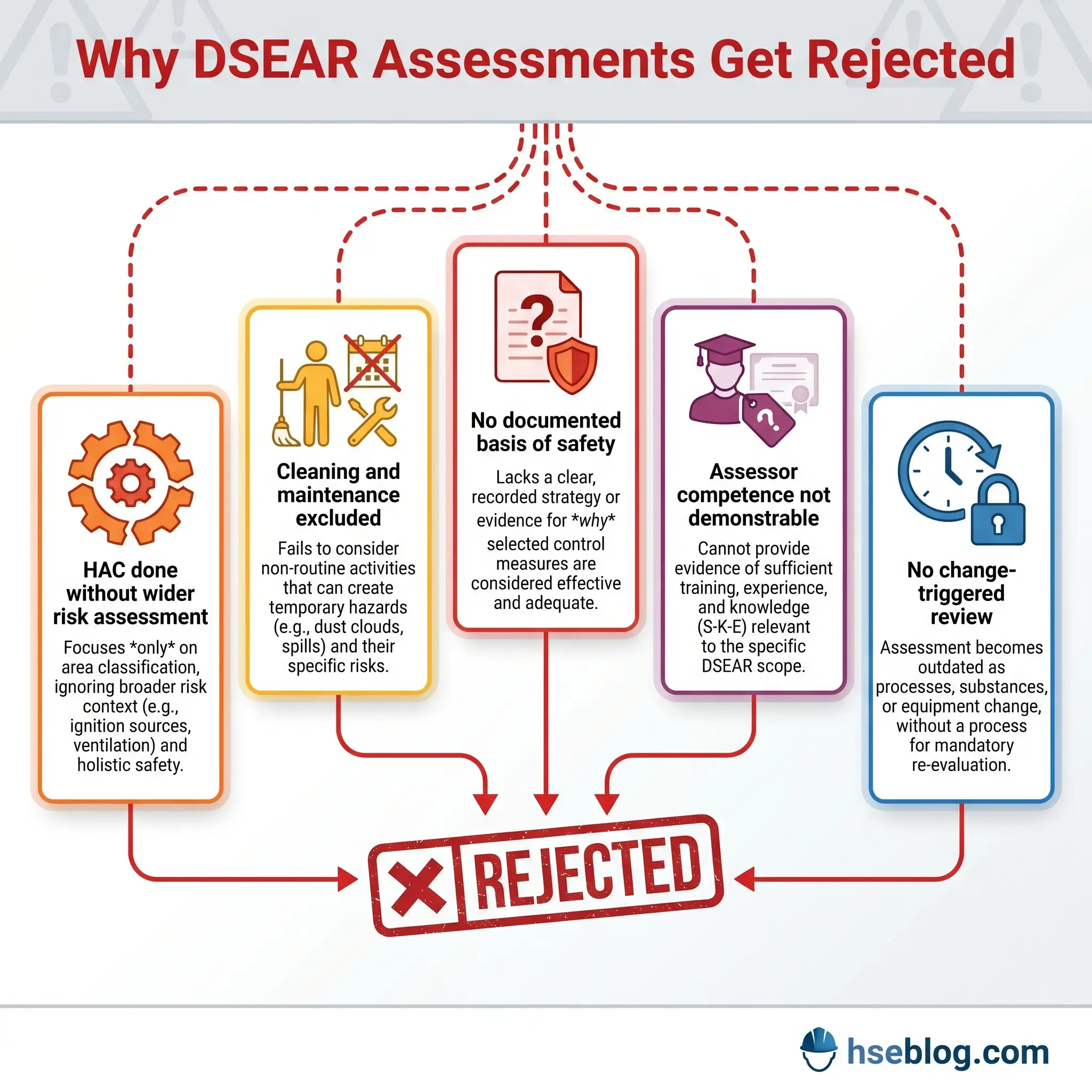
- Treating HAC as the whole assessment. Zone drawings without release analysis, ignition-source evaluation, or a basis of safety are not a Regulation 5 document. They are one of its outputs.
- Ignoring maintenance, cleaning, and abnormal operations. The inspector's first question is often what happens when the plant is opened, not when it is running.
- Copying a template without site-specific data. Generic tables of substances and zones from a consultancy template betray themselves inside the first few pages.
- An assessor who cannot demonstrate competence. HSE has rejected assessments on this point alone, regardless of the document's technical quality.
- No documented basis of safety. The assessment lists controls but never explains the philosophy tying them together.
- No reassessment after change. A new solvent, a bigger batch, a repositioned fan — any of these can invalidate the existing document.
- Combustible dust written off as "not really flammable." Flour, sugar, and many pharmaceutical intermediates have lower MIE values than most solvents and have killed more people in the last two decades than bulk flammable liquids.
- Missing the 2015 amendment. Sites with pressurised gases or substances corrosive to metal sometimes still treat DSEAR as a "flammables only" regulation.
How DSEAR Links to COSHH, Fire Risk Assessment, and ATEX
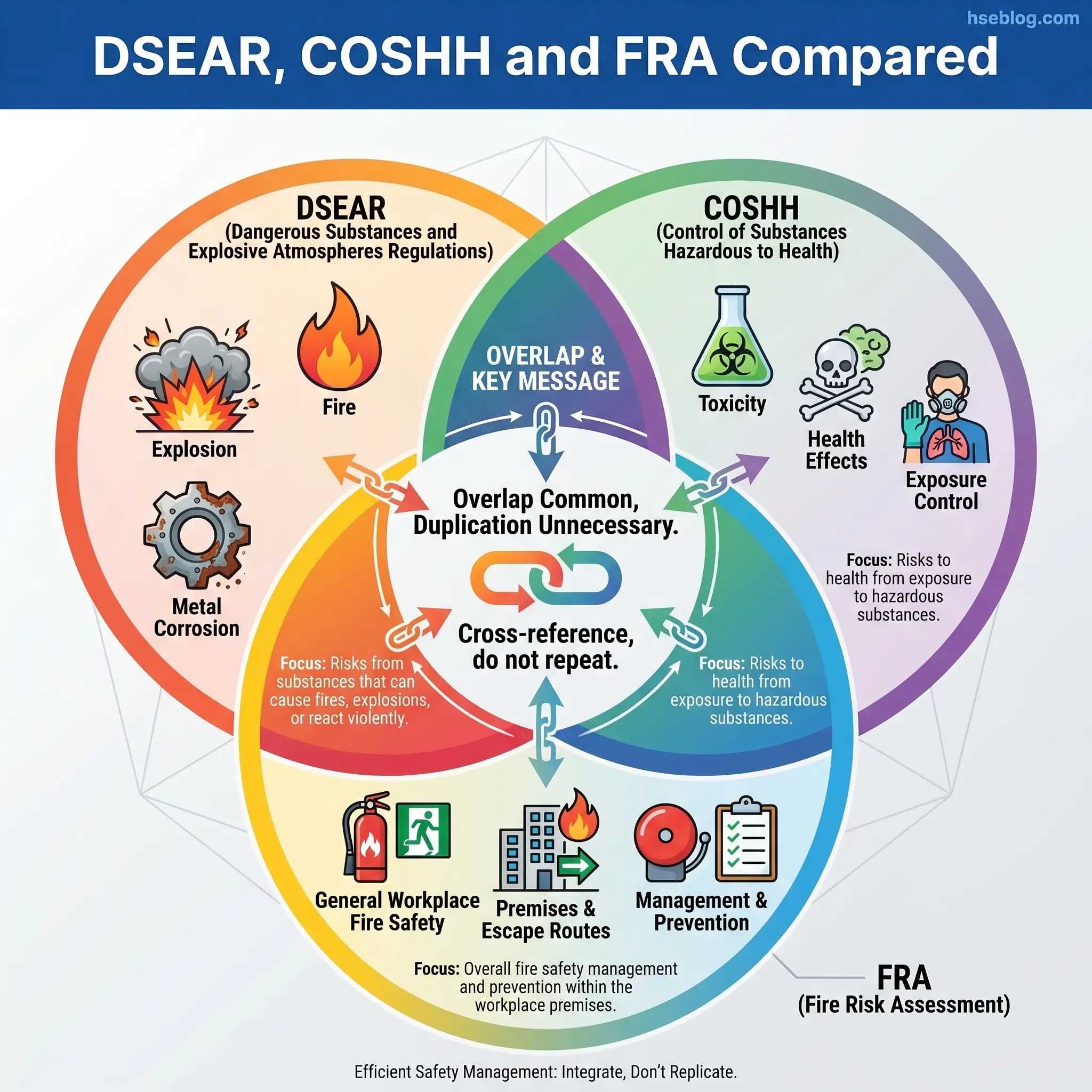
DSEAR sits in a cluster of overlapping regimes. Confusing the boundaries leads to duplicated work, contradictory conclusions, and — not infrequently — gaps that none of the assessments end up covering.
| Regime | Focus | Legal instrument | Typical output |
|---|---|---|---|
| DSEAR | Fire, explosion, metal corrosion from dangerous substances | DSEAR 2002 | Explosion Protection Document, zone drawings |
| COSHH | Health effects of hazardous substances (toxicity, sensitisation) | COSHH 2002 | Exposure assessment, control strategy |
| Fire Risk Assessment | General workplace fire safety (means of escape, warning, evacuation) | Regulatory Reform (Fire Safety) Order 2005 | FRA document, fire strategy |
The same substance — acetone, for example — will appear in a COSHH assessment for its inhalation and defatting effects, in a DSEAR assessment for its low flashpoint and Zone 1 potential, and in a Fire Risk Assessment as part of the general fire load. The three documents should cross-reference each other, not repeat each other.
ATEX sits alongside DSEAR rather than under it. ATEX 114 — implemented in Great Britain by the Equipment and Protective Systems Intended for Use in Potentially Explosive Atmospheres Regulations 2016 — places duties on manufacturers to certify equipment for use in zoned areas. ATEX 153, implemented by DSEAR, places duties on employers to classify those areas and select the right equipment for them. UK duties under both frameworks were retained after EU exit, and the post-2015 scope extensions to gases under pressure and corrosive-to-metal substances remain in force.
Frequently Asked Questions
How often should a DSEAR risk assessment be reviewed?
DSEAR itself sets no fixed frequency. The duty is to keep the assessment current, which in practice means reviewing whenever a substance, quantity, process, plant item, standard, or organisational arrangement changes — and whenever an incident or near-miss reveals a gap. Most stable low-risk sites settle on a three- to five-year full review, with high-hazard sites on one- to two-year cycles. A calendar review alone is not compliant; change-triggered review is what the regulation actually expects.
Who is legally required to carry out a DSEAR risk assessment?
The employer, or self-employed person, is the duty holder under Regulation 5. That duty cannot be delegated away, even when a consultant does the technical work. The assessment itself must be carried out by a competent person — meaning someone with the knowledge, skills, and experience proportionate to the hazards. For small sites that can be an internal HSE manager with flammable substances training. For a reactor hall or a dust-handling plant, it is usually a multidisciplinary team.
What is the difference between DSEAR and COSHH?
DSEAR addresses safety risks — fire, explosion, and metal corrosion — from dangerous substances. COSHH addresses health risks — toxicity, sensitisation, irritancy, and long-term exposure effects. A single substance often triggers both regimes simultaneously. The two assessments should cross-reference each other rather than duplicate content, but neither one substitutes for the other.
Is a DSEAR risk assessment the same as Hazardous Area Classification?
No. Hazardous Area Classification is one output of a DSEAR risk assessment, required by Regulation 7 and guided by BS EN 60079-10-1 and -10-2. A DSEAR assessment without HAC is incomplete. HAC carried out in isolation, without the broader Regulation 5 analysis of releases, ignition sources, and basis of safety, does not meet the "suitable and sufficient" test and has been cited in HSE rejection letters.
Do I need to record my DSEAR risk assessment?
Regulation 5(4) makes recording mandatory for employers with five or more employees. For smaller organisations it remains strongly recommended — an undocumented assessment is effectively unverifiable and fails the evidence test at enforcement. The accepted format is an Explosion Protection Document (EPD) that consolidates the substance inventory, release and ignition analysis, zone classification, basis of safety, controls, emergency arrangements, and training records.
Can I carry out a DSEAR risk assessment in-house or do I need a consultant?
It depends on site complexity and available internal competence. A small workshop with a single flammables store can often be assessed competently in-house using HSE INDG370 as the framework. A batch chemicals plant, a solvent-recovery operation, a pharmaceutical dust-handling line, or any site with Zone 0 or Zone 20 areas almost always needs external specialist input — typically alongside internal process and operations knowledge. Consultancy support does not transfer the legal duty, which remains with the employer.
Conclusion
A compliant DSEAR risk assessment is a sequence of decisions, not a fill-in template. Scope the work first. Build a defensible substance and release dataset before drawing zones. Treat ignition sources with the same rigour as atmospheres. Name the basis of safety for every scenario and prove the controls deliver it. Record the whole thing in an Explosion Protection Document and revisit it when anything material changes — not just when the calendar says so.
The sites that handle DSEAR well share one habit: they treat the assessment as a live document the operations team actually uses. The sites that struggle treat it as a compliance artefact filed in a shared drive. Regulation 5's "suitable and sufficient" test, the statutory priority order in Regulation 6, the zone classification duty in Regulation 7, the emergency arrangements in Regulation 8, and the training duty in Regulation 9 only interlock correctly when the assessment is kept current. Anything less and the legal, operational, and human exposure grows quietly in the background until something — an inspector, a leak, or an ignition — makes it visible.