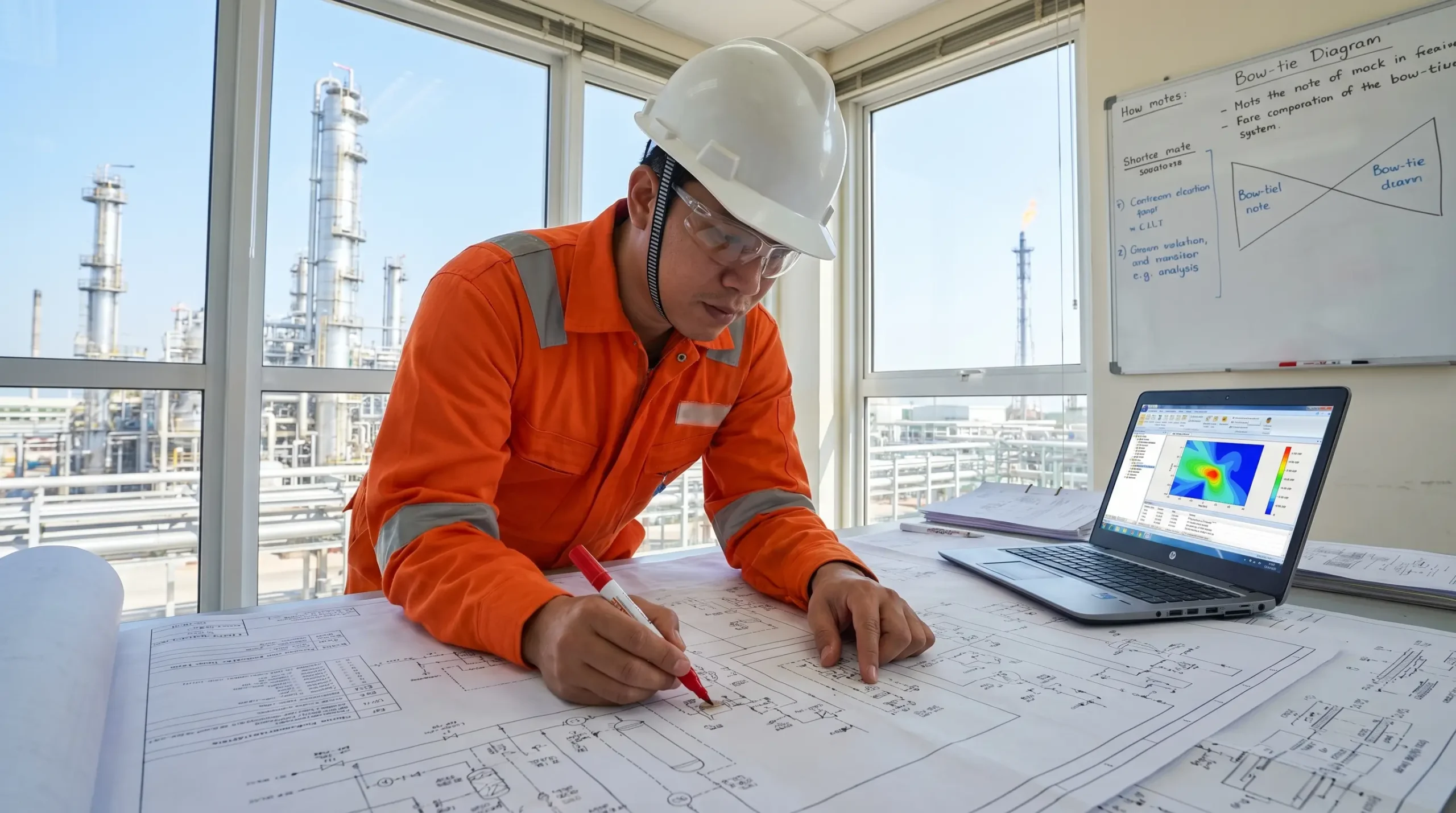
The fire suppression system in a new LNG processing module had passed every paper review. Piping and instrumentation diagrams looked clean. The design contractor had signed off. But during a pre-commissioning walkthrough at a gas facility in the Gulf, I noticed the deluge valve orientation would trap condensate in a dead leg — creating a potential blockage that could delay activation by critical seconds during a real emergency. That finding didn't come from a safety checklist. It came from an engineer who understood both fluid dynamics and fire protection standards. That's what a safety engineer does — they see the hazard buried inside the design.
A safety engineer is not the person who hands out hard hats or prints toolbox talk cards. They are technical professionals who apply engineering principles to identify, evaluate, and control hazards before those hazards produce injuries, fatalities, or catastrophic losses. This article breaks down who safety engineers really are, what they do on site and in design offices, how their role differs from other safety professionals, what qualifications they need, and why industries from petrochemical to aerospace cannot operate without them.
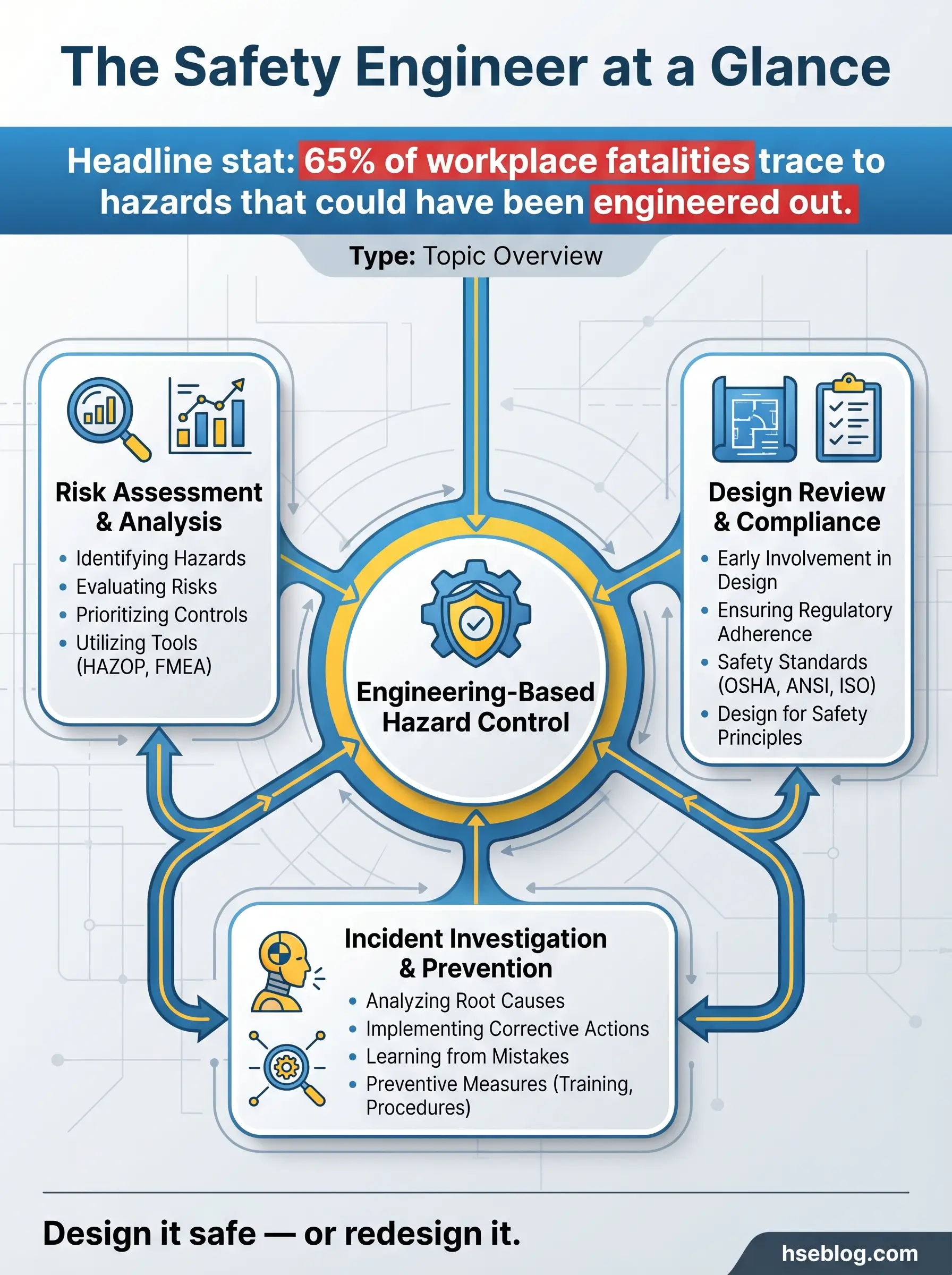
What Is a Safety Engineer? A Field-Level Definition
A safety engineer is a technical professional who applies engineering methods, scientific analysis, and systems thinking to eliminate or control workplace hazards at their source. Unlike safety officers who primarily enforce rules and monitor compliance, safety engineers work upstream — in the design phase, during process modifications, and at the interface between operations and engineering disciplines.
The scope of their work covers several critical domains that separate them from generalist safety roles:
- Hazard identification through engineering analysis: Using techniques like Hazard and Operability Studies (HAZOP), Failure Mode and Effects Analysis (FMEA), and fault tree analysis to systematically identify what can go wrong before it does
- Design review and inherent safety: Evaluating engineering drawings, specifications, and process designs to eliminate hazards through substitution, simplification, or modification — not just by adding protective barriers
- Risk quantification: Assigning numerical probability and consequence values to hazards using quantitative risk assessment (QRA), moving beyond subjective judgment to data-driven decision-making
- Systems safety integration: Ensuring that safety requirements are built into project lifecycles from concept through decommissioning — not bolted on as an afterthought
- Loss prevention engineering: Analyzing process conditions, material properties, and equipment integrity to prevent catastrophic events like fires, explosions, and toxic releases
A safety engineer doesn't just ask "Is this safe?" — they ask "What failure modes exist, what is the probability of each, and what engineering controls reduce that probability to an acceptable level?
Pro Tip: If your organization has safety professionals who only conduct inspections and write reports but never review engineering drawings or participate in design meetings, you have safety officers — not safety engineers. The distinction matters because it determines whether hazards are caught before construction or after someone gets hurt.
How a Safety Engineer Differs From Other Safety Professionals
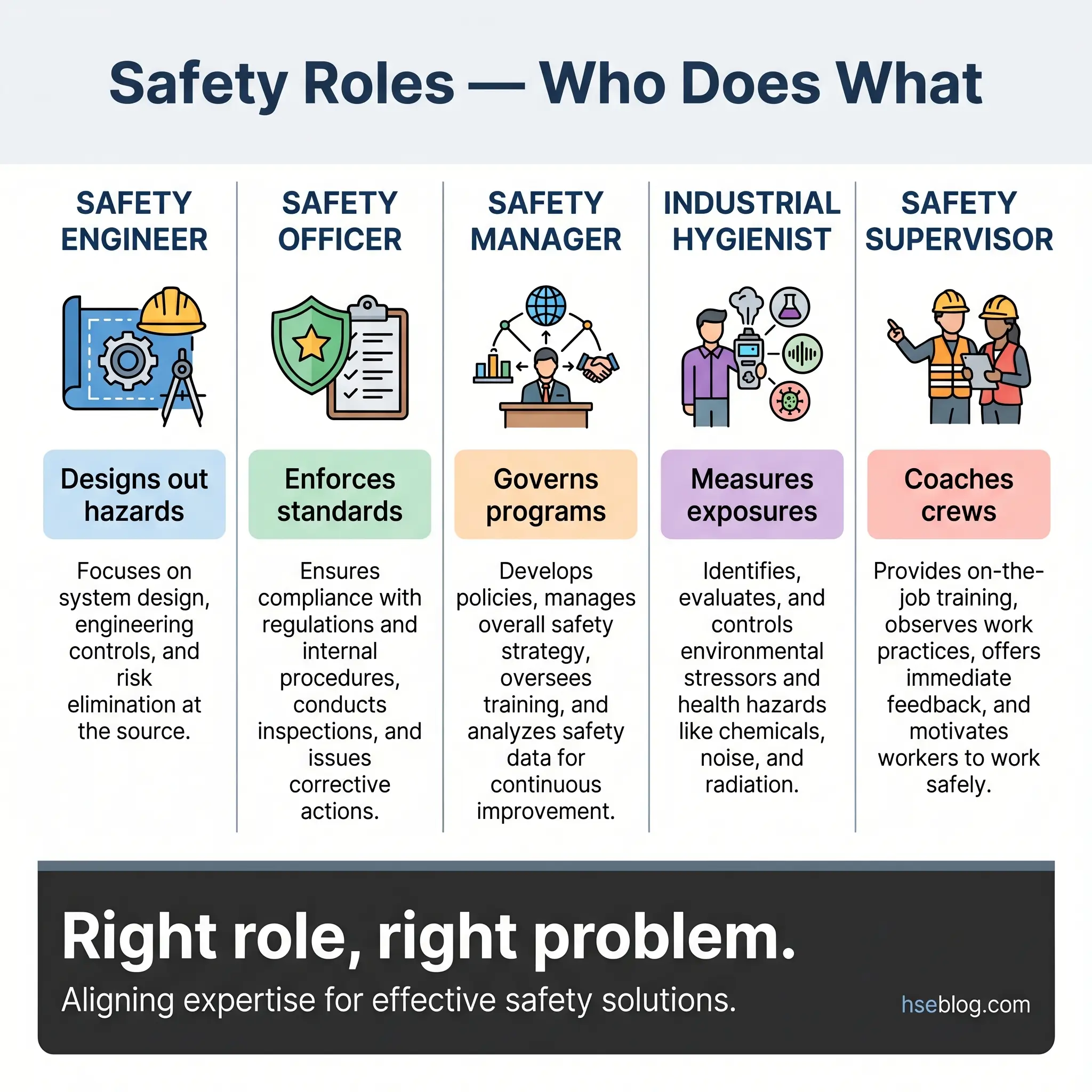
One of the most common points of confusion in the HSE field — and I've seen it cause real organizational dysfunction — is treating safety engineers, safety officers, safety managers, and industrial hygienists as interchangeable roles. They are not. Each has a distinct function, and misaligning them creates blind spots.
The following comparison clarifies where each role sits in the safety ecosystem:
| Role | Primary Focus | Core Method | Typical Work Setting |
|---|---|---|---|
| Safety Engineer | Hazard elimination through design and engineering controls | HAZOP, FMEA, QRA, fault tree analysis | Design offices, project engineering, process facilities |
| Safety Officer | Compliance monitoring and hazard enforcement | Inspections, audits, permit verification | Active construction sites, operational facilities |
| Safety Manager | Safety program governance and strategic oversight | Policy development, KPI tracking, management review | Corporate offices, site management teams |
| Industrial Hygienist | Occupational health exposure assessment | Air sampling, noise monitoring, biological monitoring | Laboratories, process plants, manufacturing |
| Safety Supervisor | Frontline worker behavior and task-level safety | Toolbox talks, task observations, crew briefings | Work fronts, production floors, field operations |
During a refinery turnaround in Southeast Asia, I watched this distinction play out in real time. The safety officers were inspecting scaffolding and checking harness lanyards. The safety manager was tracking daily incident statistics. But when the process engineering team proposed a hot tap on a live hydrocarbon line, it was the safety engineer who ran the risk assessment, reviewed the procedure against API 2201, evaluated the wall thickness data, and determined whether the operation could proceed safely. No other role on that site had the technical depth to make that call.
Core Responsibilities of a Safety Engineer
The day-to-day work of a safety engineer varies by industry, but certain responsibilities remain constant regardless of whether they're working on an offshore platform, a pharmaceutical plant, or an aerospace assembly line. I've held this role across multiple sectors, and the technical backbone doesn't change — only the regulatory wrapper and hazard profile shift.
These are the responsibilities that define the role in practice:
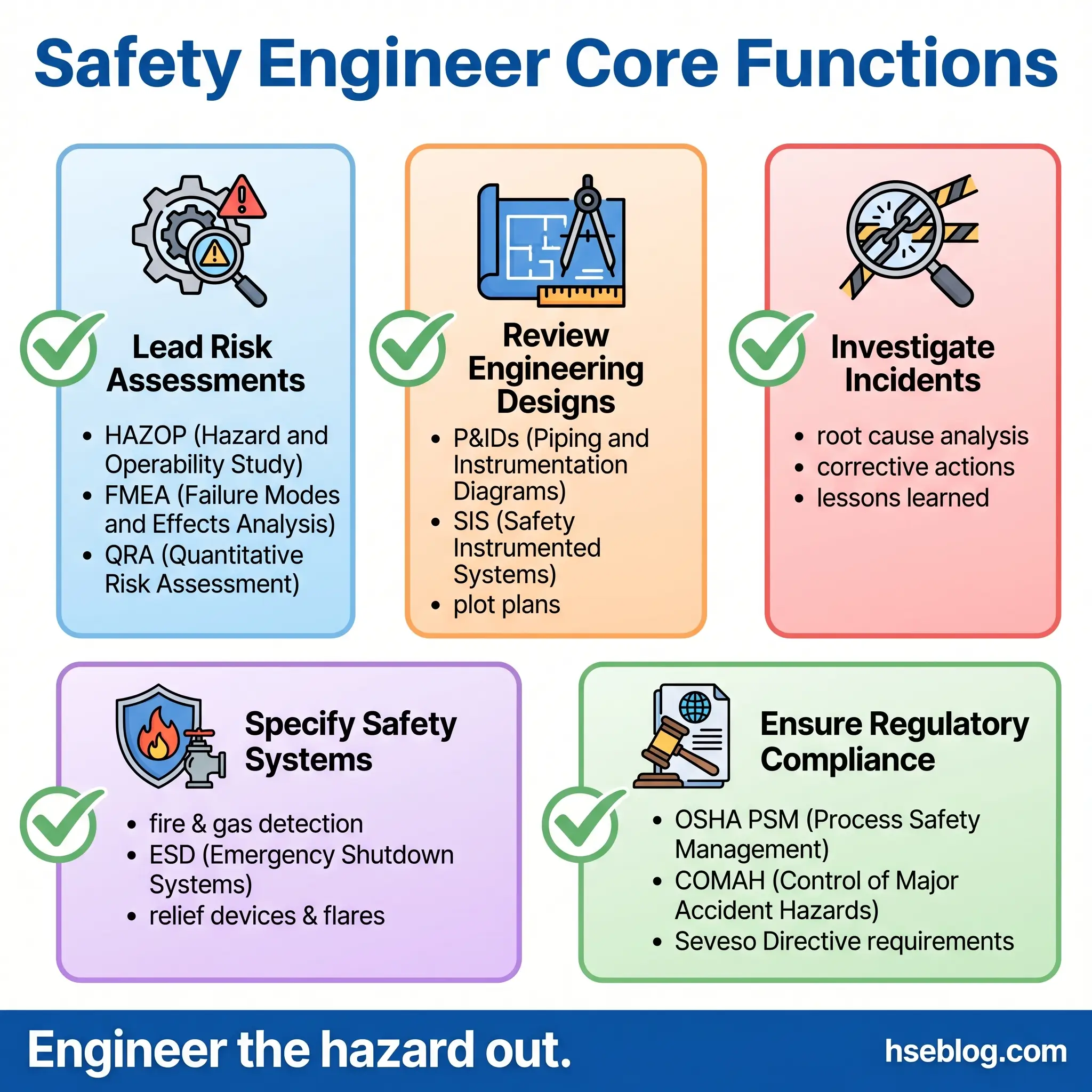
- Conducting formal risk assessments: Leading structured assessments using methodologies like HAZOP, bow-tie analysis, and LOPA (Layer of Protection Analysis) to evaluate process and design risks
- Reviewing engineering deliverables: Scrutinizing P&IDs, equipment datasheets, plot plans, cause-and-effect matrices, and safety instrumented system (SIS) designs for compliance with safety standards
- Developing safety cases and reports: Preparing formal safety documentation required by regulators — safety cases for major hazard facilities, Quantitative Risk Assessments for land-use planning, and ALARP demonstrations
- Investigating incidents and near-misses: Applying root cause analysis techniques to determine systemic failures, not just immediate causes, and translating findings into engineering corrective actions
- Specifying safety-critical equipment: Defining requirements for fire and gas detection systems, emergency shutdown systems, pressure relief devices, and passive fire protection
- Interfacing with engineering disciplines: Working alongside process, mechanical, electrical, instrumentation, and civil engineers to ensure safety is integrated, not siloed
- Regulatory compliance management: Interpreting and applying OSHA process safety management (PSM) requirements, the Seveso III Directive in Europe, COMAH regulations in the UK, and equivalent frameworks globally
Pro Tip: The mark of an effective safety engineer isn't how many reports they produce — it's how many hazards never materialize because they were eliminated during design. Track your "hazards closed at design stage" metric. It's the truest measure of your value.
Proactive vs. Reactive Safety Engineering
A pattern I've observed across dozens of projects is that organizations misuse safety engineers by assigning them primarily to incident investigation — a reactive function. While investigation is part of the role, the real return on investment comes from proactive engineering activities.
The split should look like this for a mature safety engineering function:
- 70–80% proactive work: Design reviews, HAZOP facilitation, risk assessments, management of change (MOC) reviews, pre-startup safety reviews (PSSR)
- 20–30% reactive work: Incident investigations, corrective action tracking, regulatory response, audit follow-ups
When that ratio inverts — when a safety engineer spends most of their time investigating incidents instead of preventing them — it signals a systemic failure in how the organization manages risk.
Essential Qualifications and Certifications for Safety Engineers
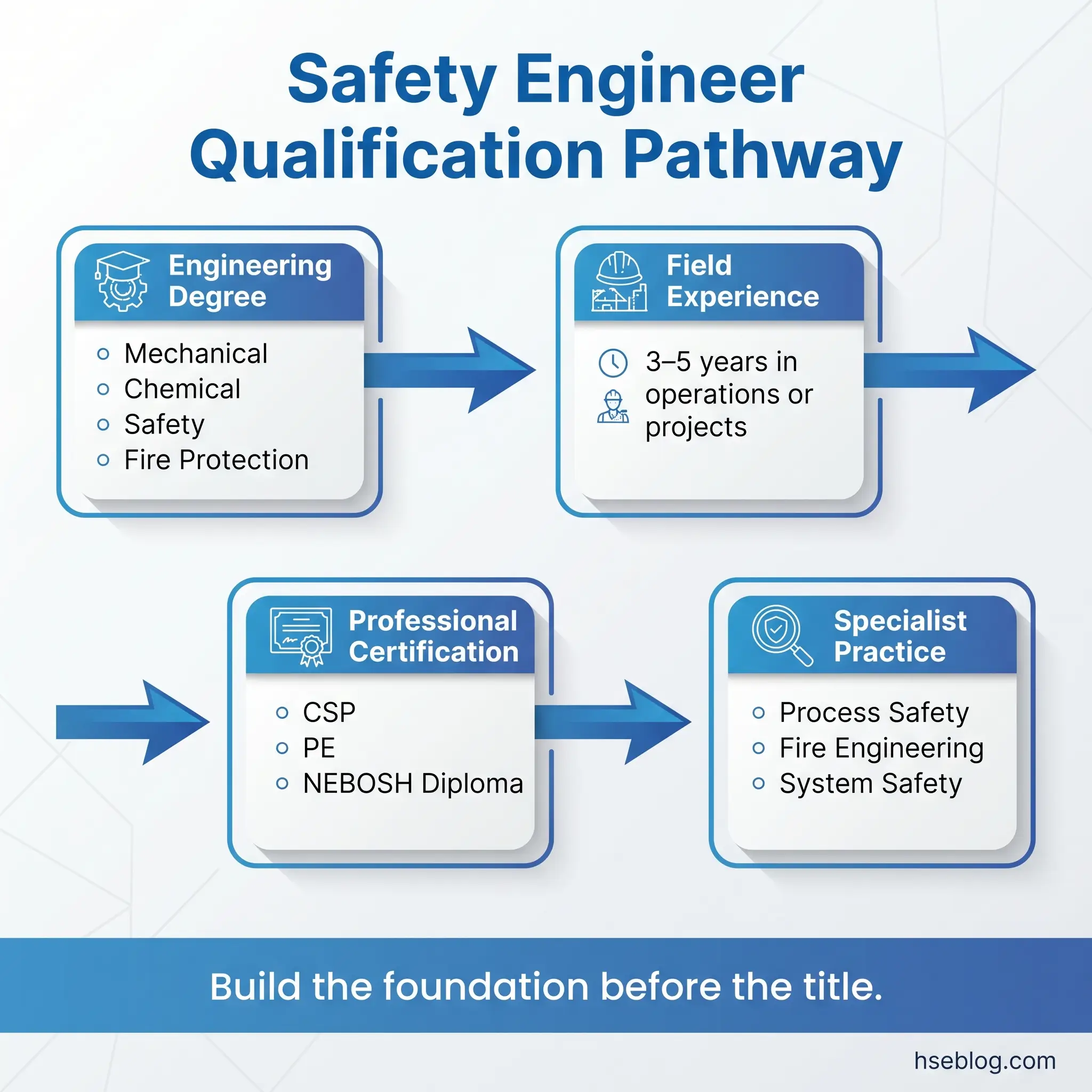
The qualification pathway for a safety engineer is distinctly more technical than for most HSE roles. This is not a career path where a two-week diploma substitutes for a degree. The engineering component is non-negotiable — and I've seen hiring panels reject candidates with decades of safety experience because they lacked the engineering foundation to perform technical analysis.
Educational Foundation
The baseline education for a safety engineer typically follows one of two tracks:
- Direct route: A bachelor's degree in safety engineering, fire protection engineering, or occupational safety and health engineering from an ABET-accredited program (in the US) or equivalent
- Crossover route: A bachelor's degree in mechanical, chemical, electrical, civil, or industrial engineering, supplemented by graduate-level study or professional development in safety engineering principles
Both routes work, but the crossover route is actually more common in practice. Many of the strongest safety engineers I've worked with started as process engineers or mechanical engineers and migrated into safety after gaining operational experience. That blend of core engineering discipline and field-level hazard understanding is extremely difficult to replicate through classroom study alone.
Professional Certifications
Certifications validate competency and are increasingly required by major operators and EPC contractors. The most recognized certifications for safety engineers include:
- Certified Safety Professional (CSP): Administered by the Board of Certified Safety Professionals (BCSP), this is the gold standard in the US and widely recognized internationally. Requires a degree, qualifying experience, and passing the CSP examination
- Professional Engineer (PE) in Fire Protection or Safety: A state-issued engineering license that authorizes the engineer to stamp and seal safety engineering deliverables — critical for design-build projects
- NEBOSH International Diploma: The benchmark HSE qualification outside North America, covering management systems, risk assessment, and occupational health at an advanced level
- Certified Fire Protection Specialist (CFPS): Issued by NFPA, focused on fire risk assessment, fire protection systems, and code compliance
- Associate Safety Professional (ASP): The stepping-stone to CSP, often pursued by early-career safety engineers building toward full certification
Pro Tip: If you're choosing between certifications, prioritize the one recognized by the industry and geography where you intend to work. A CSP carries weight in the Americas and Middle East. A NEBOSH Diploma opens doors in Europe, Africa, and Asia-Pacific. Both are respected globally, but regional preference matters when clients shortlist candidates.
Industries That Employ Safety Engineers
Safety engineers are not confined to a single sector. Any industry where process complexity, energy density, or failure consequences are high requires engineering-level safety expertise. I've moved between several of these sectors over my career, and while the hazard profiles change, the analytical approach remains the same.
The following industries represent the highest demand for qualified safety engineers:
- Oil, gas, and petrochemical: Process safety management, HAZOP studies, SIL assessments, fire and explosion risk analysis, and major accident prevention. This sector employs more safety engineers per capita than any other
- Aerospace and defense: System safety engineering, fault tolerance design, software safety assurance, and compliance with MIL-STD-882 and SAE ARP4761
- Nuclear energy: Probabilistic safety assessment, defense-in-depth design, criticality safety, and regulatory compliance under frameworks like NRC 10 CFR Part 50
- Chemical manufacturing: Inherent safety design, reactive chemical hazard assessment, LOPA, and compliance with OSHA 29 CFR 1910.119
- Construction and infrastructure: Temporary works design safety, demolition engineering, crane lift planning, and design risk management under CDM 2015
- Mining and minerals processing: Ground control engineering, ventilation design, dust explosion prevention, and tailings dam safety
- Pharmaceutical and biotech: Containment system design, solvent handling safety, cleanroom safety integration, and process hazard analysis
- Renewable energy: Wind turbine safety engineering, battery energy storage system (BESS) fire risk, and high-voltage electrical safety design
The common thread across all these industries is consequence severity. Where a single failure can kill multiple people, destroy assets, or cause environmental catastrophe — that's where safety engineers earn their position.
Key Skills That Separate Effective Safety Engineers
Technical qualifications get you through the door. Skills determine whether you make a difference. Over years of mentoring junior safety engineers and evaluating candidates for project roles, I've identified the capabilities that consistently separate those who add real value from those who merely occupy the title.
The skill set breaks into two categories — technical and interpersonal — and both are equally essential:
Technical Skills
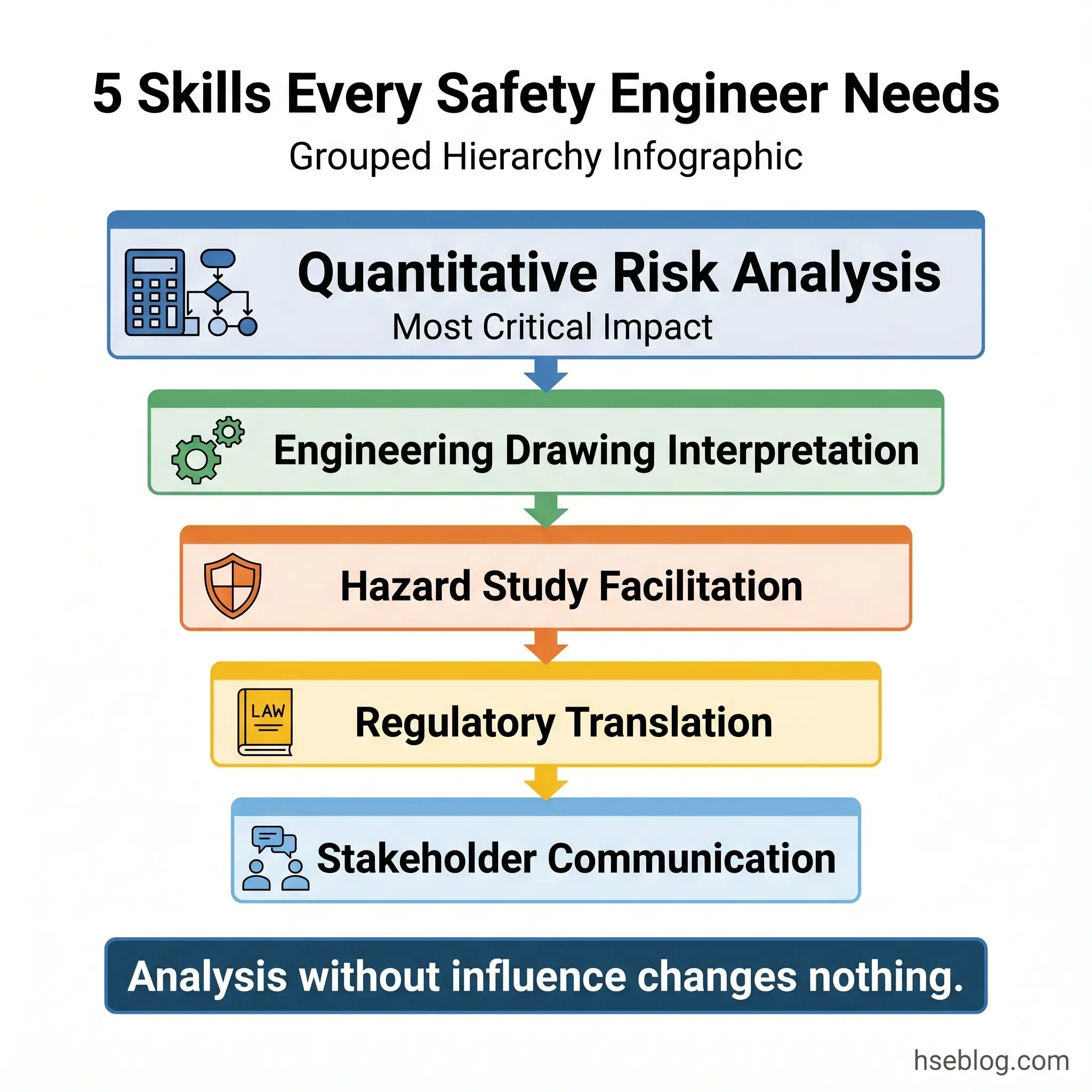
- Quantitative risk analysis: The ability to calculate individual and societal risk levels, develop F-N curves, and apply risk acceptance criteria. This is mathematics, not opinion
- Process hazard analysis facilitation: Leading HAZOP, What-If, and FMEA workshops with multidisciplinary teams — managing both the technical content and the group dynamics
- Engineering drawing interpretation: Reading and critically reviewing P&IDs, electrical schematics, structural drawings, and fire protection layouts. You cannot assess what you cannot read
- Safety instrumented systems: Understanding SIL determination, SIF design, and functional safety lifecycle per IEC 61508/61511
- Fire and explosion modeling: Using consequence modeling tools to predict thermal radiation zones, blast overpressure contours, and toxic dispersion envelopes
- Regulatory interpretation: Translating dense regulatory text into specific engineering requirements — knowing what a standard actually demands in design terms
Interpersonal and Strategic Skills
Equally critical but often undervalued, these competencies determine whether a safety engineer's technical recommendations actually get implemented:
- Influencing without authority: Safety engineers rarely have direct authority over design decisions. They must persuade project managers, lead engineers, and commercial directors through evidence and clear communication
- Challenging constructively: The ability to say "this design is not safe" to a senior engineer or project director — with technical backing — without destroying the working relationship
- Communicating risk to non-engineers: Translating probability calculations and consequence models into language that operations managers, financial controllers, and executive leadership can act on
- Prioritizing under resource constraints: Every project has budget and schedule pressure. Effective safety engineers know which risks are tolerable and which demand immediate engineering intervention
Pro Tip: If you can run a HAZOP but can't explain to a project director why the resulting recommendations justify a $2 million scope change, your technical analysis dies in a filing cabinet. Communication is not a soft skill for safety engineers — it's a survival skill.
Career Path and Progression for Safety Engineers
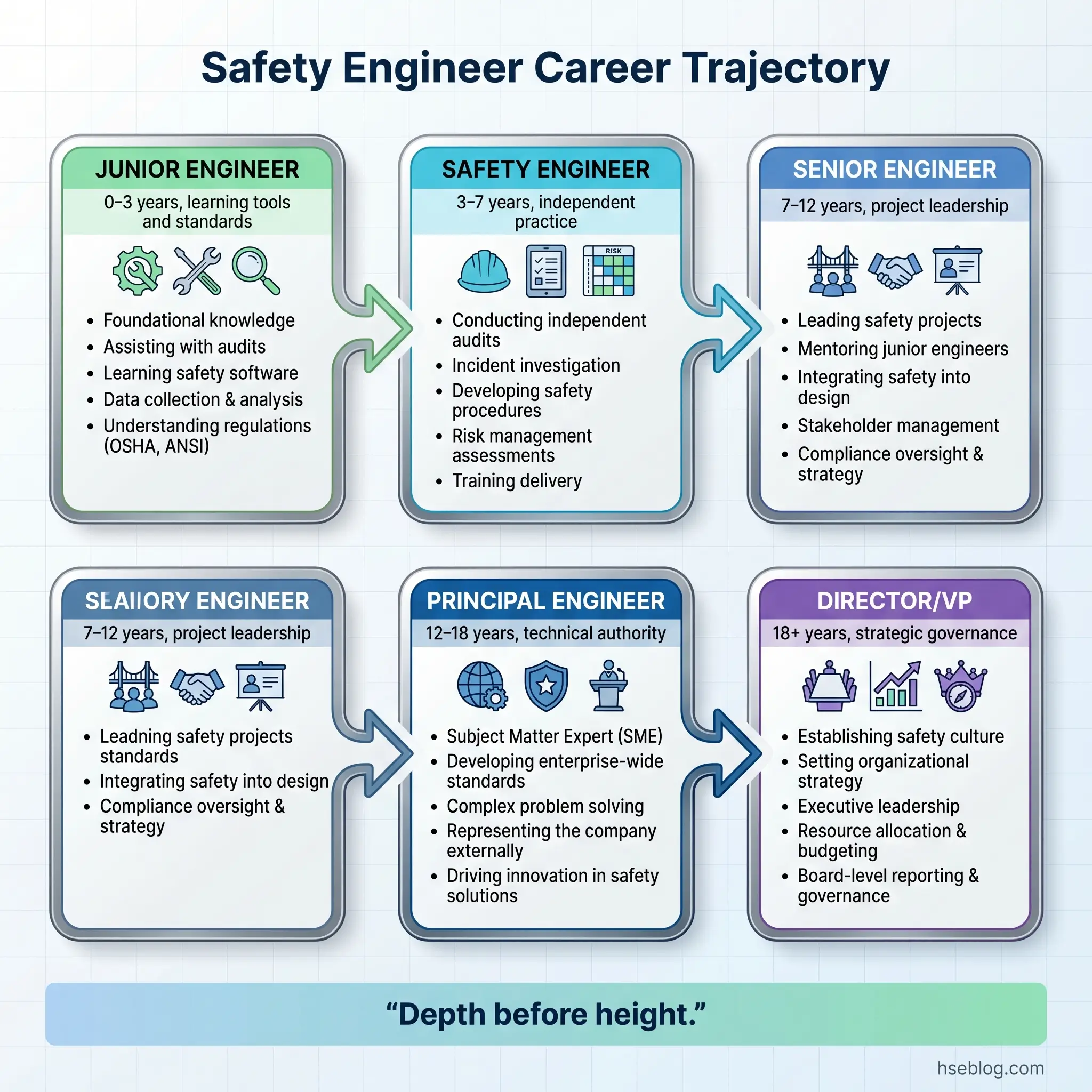
The safety engineering career path is not always linear. Some professionals enter through graduate programs, others transition from operations or core engineering disciplines mid-career. Both routes can lead to senior technical or leadership positions, but the trajectory depends on the type of experience accumulated, not just years served.
A typical progression through safety engineering follows this pattern:
- Graduate/Junior Safety Engineer (0–3 years): Supporting senior engineers on HAZOP studies, compiling safety deliverables, conducting basic risk assessments, learning industry-specific standards and tools
- Safety Engineer (3–7 years): Independently leading risk assessments, facilitating hazard studies, reviewing engineering designs, managing safety deliverables for small-to-medium projects
- Senior Safety Engineer (7–12 years): Leading safety engineering for major projects or facilities, mentoring junior staff, interfacing with regulators, developing safety cases, and making ALARP judgments
- Principal/Lead Safety Engineer (12–18 years): Setting technical direction for safety engineering teams, establishing company standards and methodologies, providing expert witness testimony, leading accident investigations of national significance
- Safety Engineering Director / VP of Safety (18+ years): Strategic safety leadership, board-level risk governance, regulatory liaison at industry level, shaping organizational safety culture through systems and investment
Alternative Career Branches
Not every safety engineer follows the vertical leadership track. Several lateral moves offer equally fulfilling and impactful careers:
- Specialist consultant: Providing expert services in niche areas like fire engineering, explosion protection, or functional safety across multiple clients and industries
- Regulatory authority inspector: Joining bodies like OSHA, HSE UK, or national nuclear regulators as a technical inspector with enforcement powers
- Insurance and risk surveying: Working with major insurers to assess facility risks, set premiums, and recommend loss prevention measures
- Academic and research: Contributing to safety science through university research, standard development committees, and incident investigation methodology advancement
Safety Engineer Salary and Market Demand
Compensation for safety engineers reflects the technical nature and consequence-severity of the role. I've been involved in salary benchmarking exercises for EPC contractors and owner-operators, and the data consistently shows safety engineers commanding higher compensation than generalist HSE roles.
Market factors driving demand and compensation include:
- Process safety regulation expansion: Post-Deepwater Horizon and post-Bhopal regulatory environments have permanently increased demand for qualified safety engineers in major hazard industries
- Aging workforce: A significant portion of experienced safety engineers are approaching retirement, creating a talent gap that organizations are struggling to fill
- Energy transition projects: New hydrogen, carbon capture, ammonia, and battery storage facilities require safety engineering input on novel hazards where historical data is limited
- Insurance requirements: Major industrial insurers increasingly require evidence of qualified safety engineering involvement as a condition of coverage
The Bureau of Labor Statistics projects occupational health and safety engineering roles to grow steadily, but the real driver is quality, not quantity — organizations need safety engineers who can handle quantitative analysis and complex process safety, not just write inspection reports.
Common Misconceptions About Safety Engineers
Misunderstandings about the safety engineer role persist across industries, and they create real problems — from misallocation of responsibilities to underinvestment in engineering-level safety resources. I've had to correct these misconceptions in boardrooms, project kick-off meetings, and even within HSE departments.
The most damaging myths — and the reality behind each — need to be addressed directly:
- "Safety engineers are just senior safety officers." They are fundamentally different roles. Safety officers enforce existing rules. Safety engineers create the technical basis for those rules by analyzing hazards, quantifying risks, and designing controls. Conflating them means your engineering designs are reviewed by someone without the technical capability to identify design-level flaws
- "Any engineer can do safety engineering." A mechanical engineer who has never studied system safety, risk assessment methodology, or regulatory frameworks cannot perform a HAZOP, write a safety case, or determine an appropriate Safety Integrity Level. Domain-specific training is essential
- "Safety engineers slow projects down." This perception usually comes from projects where safety engineering involvement starts too late. When embedded from the concept phase, safety engineers prevent costly rework, regulatory delays, and catastrophic redesigns. A $50,000 design modification during detailed engineering saves $5 million in construction rework
- "Safety engineering is only for major hazard industries." Manufacturing, logistics, healthcare, and food processing all benefit from engineering-level hazard analysis. Any operation with energy sources, moving parts, or chemical exposures has hazards that respond better to engineering controls than to administrative rules
- "Certifications matter more than experience." Certifications validate knowledge, but competence comes from applying that knowledge under real operational conditions. I've met CSP holders who couldn't lead a HAZOP and uncertified engineers who could dismantle a flawed safety case in minutes. Both credentials and field experience are necessary — neither alone is sufficient
Pro Tip: When interviewing safety engineer candidates, ask them to walk you through the last HAZOP they facilitated or the last safety case they authored. Technical credentials on a resume don't reveal whether someone can actually perform the work under project pressure.
Conclusion
A safety engineer is the technical conscience of any operation where failure carries serious consequences. They don't just identify hazards — they engineer those hazards out of existence through design analysis, risk quantification, and systematic controls that operate upstream of every inspection checklist and toolbox talk. The role demands an uncommon blend of engineering depth, regulatory knowledge, and the interpersonal skill to drive safety recommendations through organizational resistance.
The profession is evolving rapidly. Energy transition, novel process technologies, and increasingly complex regulatory landscapes are expanding both the scope and the value of safety engineering. Organizations that invest in qualified safety engineers — embedding them early in project lifecycles, funding their professional development, and giving them genuine authority over design decisions — consistently outperform those that treat safety as an administrative function layered on top of engineering.
If you work alongside a safety engineer, understand that their questions about your design aren't obstructions — they're the last line of defense between a successful operation and a catastrophic failure. And if you are considering this career path, know that few roles in the HSE profession offer a clearer line between your daily work and the people who go home safe because of it.