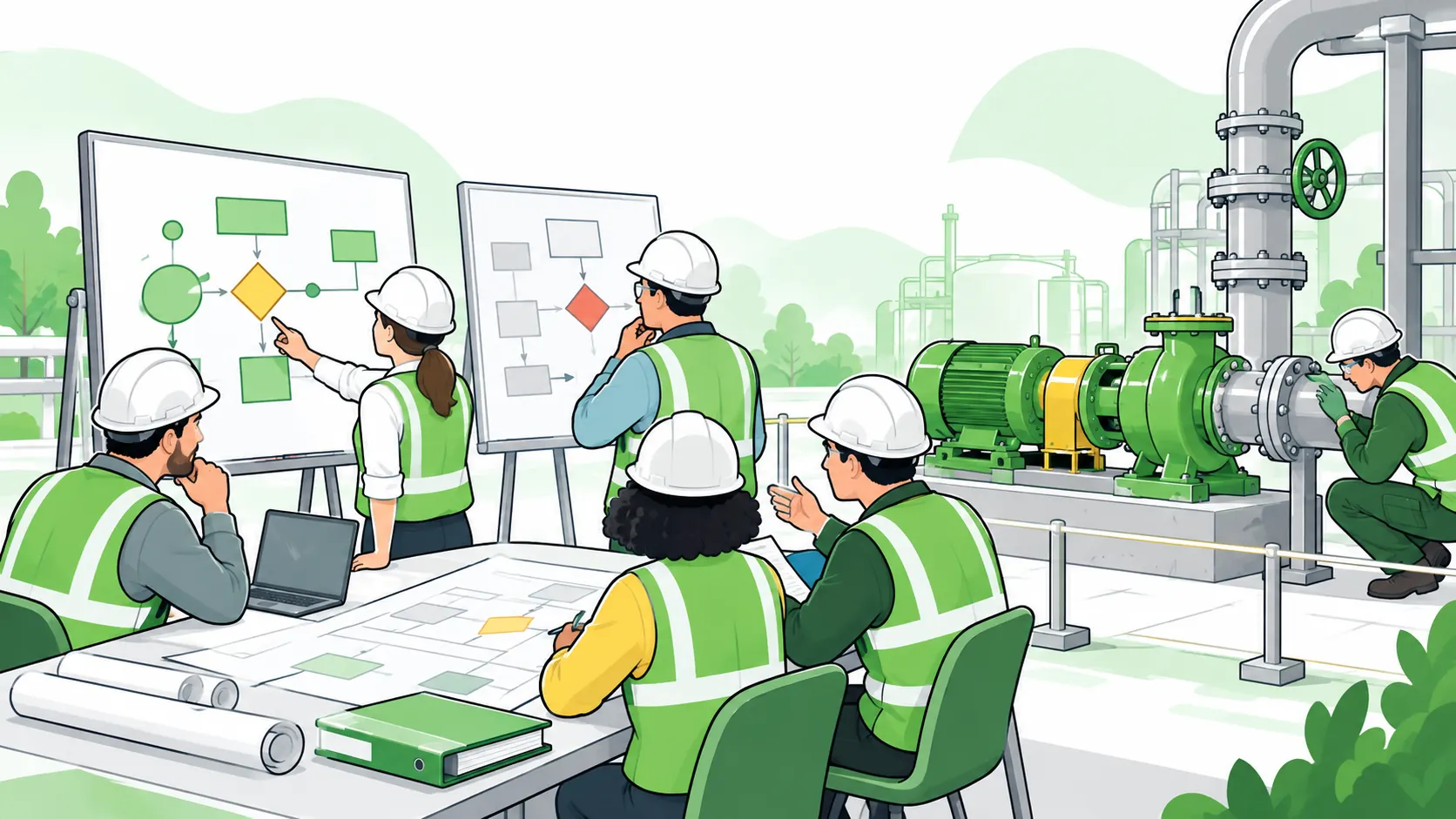
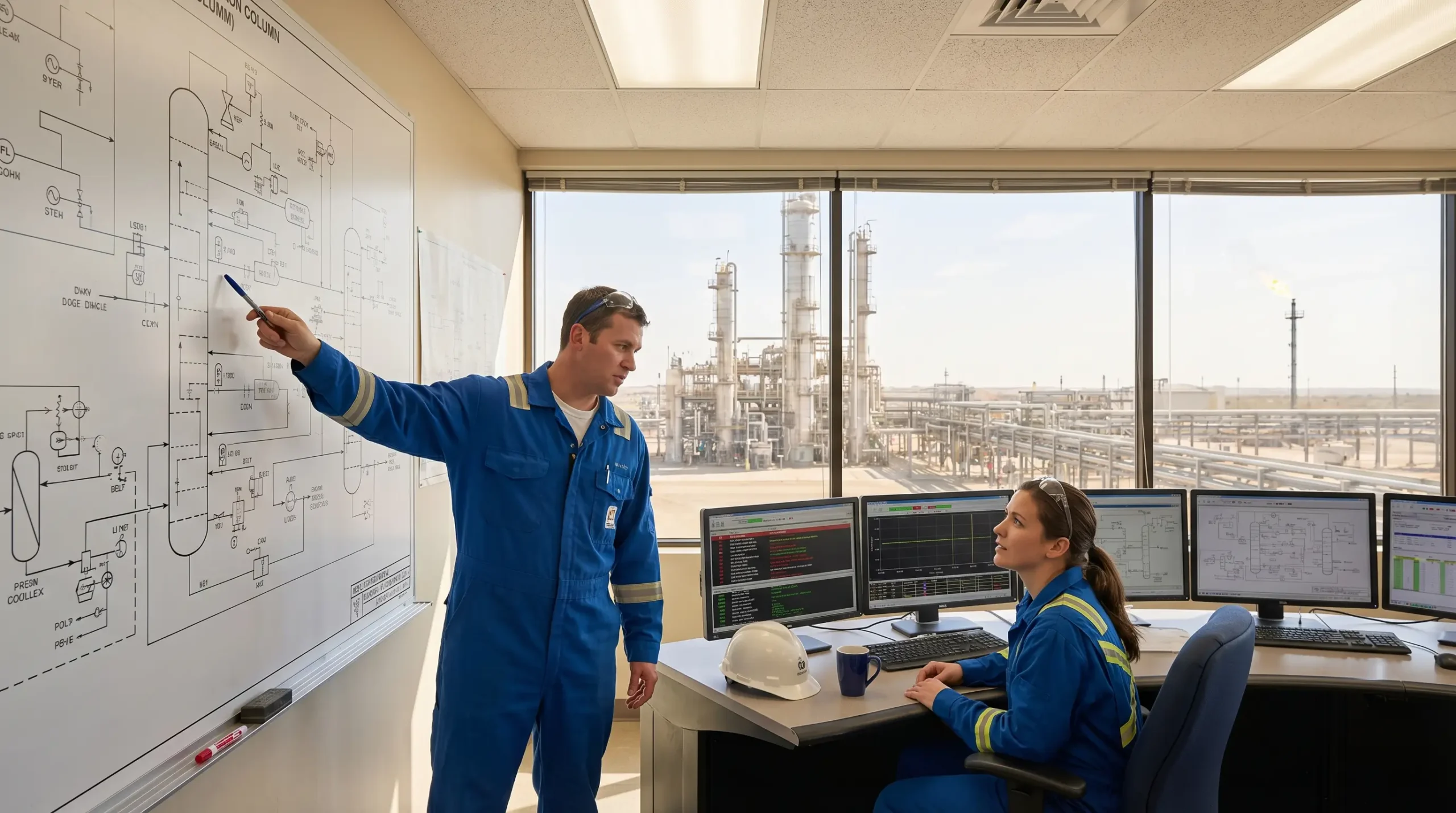
Three years into a role managing process safety at a gas fractionation complex, I sat through a corporate leadership review where an executive pointed at the facility's Total Recordable Injury Rate — it had dropped to 0.24 — and declared the site "the safest in the portfolio." The operations manager beside me shifted in his seat. He knew that two critical pressure safety valves on our depropanizer column had failed their proof tests that quarter, that a management of change backlog was growing unchecked, and that a near-miss involving a flange gasket blowout on the C3 splitter had been closed out without a thorough investigation. The injury rate was real. The sense of safety it created was not.
That gap — between personal safety performance and process safety performance — is one of the most dangerous blind spots in high-hazard operations. Personal safety protects individual workers from common injuries: slips, falls, hand lacerations, noise-induced hearing loss. Process safety prevents the kind of event that kills fifteen people at once, flattens a unit, forces community evacuation, and ends careers in a courtroom. This article breaks down the difference between process safety and personal safety across seven critical dimensions, explains why the metrics are not interchangeable, and maps the management systems, indicators, and leadership accountabilities that separate the two disciplines. If you work in oil and gas, chemicals, pharmaceuticals, or any operation handling hazardous materials under pressure, this distinction is not academic — it is operational survival.
What Is the Difference Between Process Safety and Personal Safety?
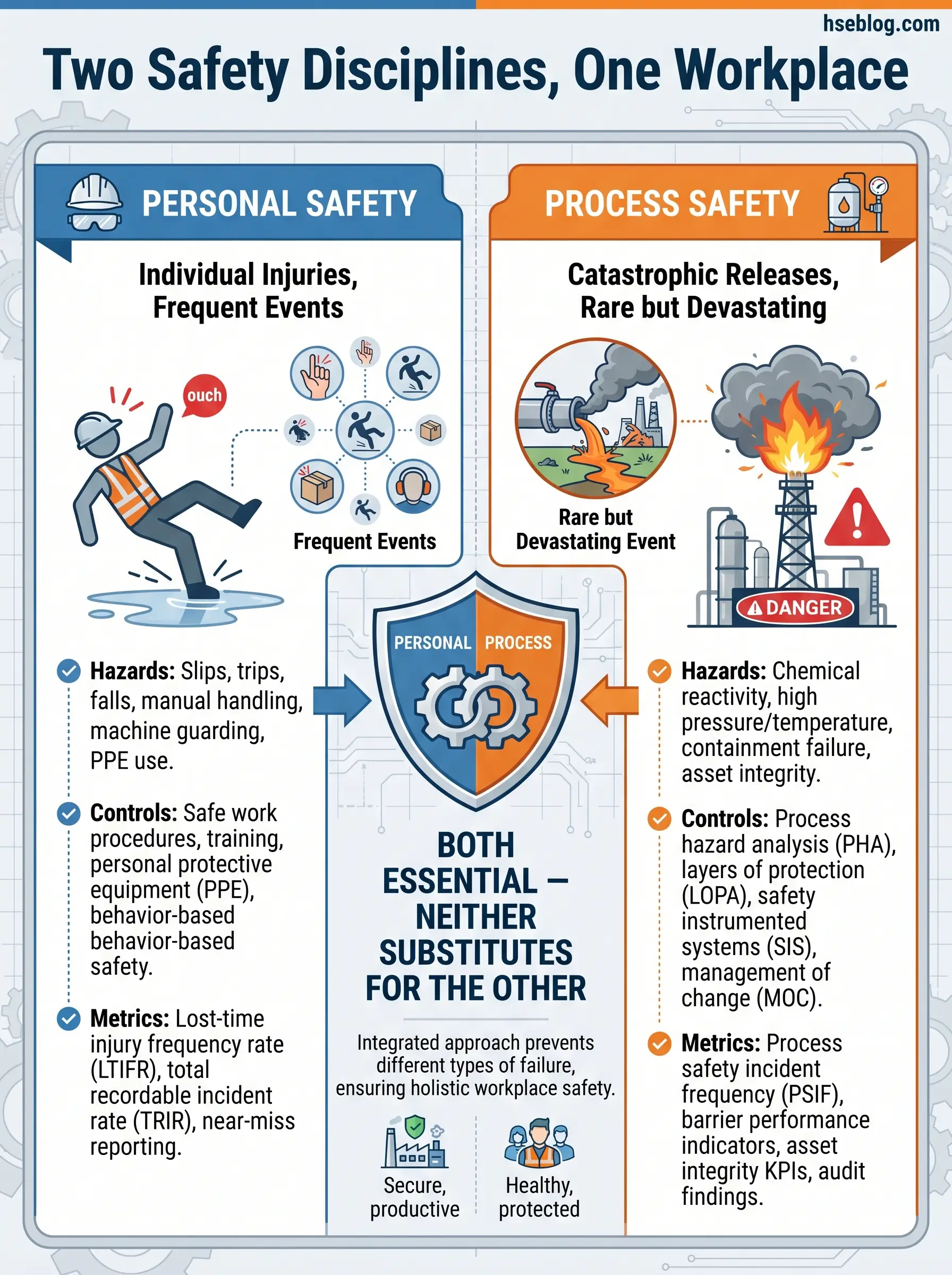
The shortest answer: personal safety keeps individual workers from getting hurt on the job. Process safety keeps hazardous processes from failing catastrophically.
Personal safety addresses the injuries and illnesses that affect workers directly — a strained back from manual handling, a laceration from an unguarded machine, a chemical splash to the eye during a sample draw. These events happen with relative frequency, they harm one or a small number of people, and the controls are largely behavioral, procedural, and PPE-based.
Process safety addresses a fundamentally different category of risk. It focuses on preventing major accident hazards — uncontrolled releases of flammable, toxic, or reactive substances, overpressure events, explosions, fires, and structural failures of containment systems. These events are rare by comparison, but their consequences are orders of magnitude more severe. A single loss-of-containment event on a high-pressure hydrocarbon line can produce a vapor cloud ignition that kills dozens, destroys capital assets worth hundreds of millions, and triggers regulatory shutdowns lasting months.
Both disciplines matter. Neither replaces the other. A colleague who spent twenty years in refinery operations once put it this way: "Personal safety is about sending everyone home tonight. Process safety is about making sure the plant is still standing tomorrow."
Process Safety vs Personal Safety: Side-by-Side Comparison
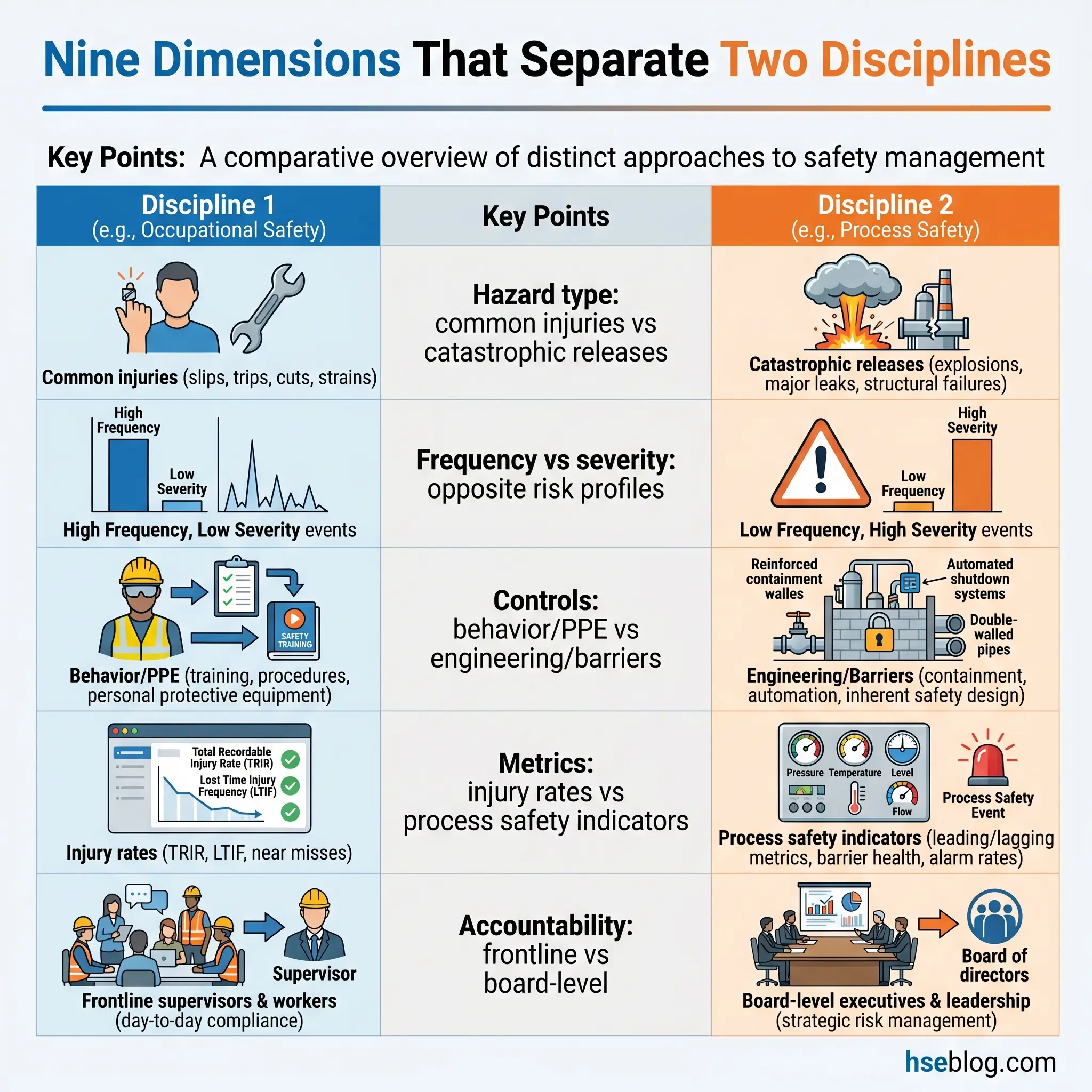
Before diving into the detailed differences, this comparison snapshot captures the core contrasts across nine dimensions. Use it as a quick reference when explaining the distinction to operations teams or leadership.
| Dimension | Personal Safety | Process Safety |
|---|---|---|
| Objective | Prevent worker injuries and occupational illness | Prevent catastrophic releases, fires, explosions, and toxic events |
| Typical hazards | Slips, trips, falls, struck-by, caught-between, manual handling, noise, chemical splash | Loss of containment, overpressure, runaway reaction, vapor cloud ignition, tank overfill, structural failure |
| Consequence profile | High frequency, low severity — one or few people affected | Low frequency, high severity — multiple fatalities, community impact, environmental damage, asset destruction |
| Who is affected | Individual worker or small group | Workers, contractors, nearby communities, environment, business continuity |
| Examples | Ladder fall, hand laceration, forklift strike, hearing loss, ergonomic strain | Flange blowout, relief valve failure, hydrogen sulfide release, boiling liquid expanding vapor explosion (BLEVE) |
| Common tools | JSAs, behavioral observations, PPE programs, housekeeping audits | HAZOP, PHA, LOPA, bow-tie analysis, alarm management, barrier verification |
| Leading indicators | Safety observations, near-miss reports, training completion, inspection rates | Overdue safety-critical maintenance, unresolved MOC items, barrier impairments, alarm flood frequency, temporary defeat logs |
| Lagging indicators | TRIR, LTIR, first-aid cases, restricted work cases | Tier 1 and Tier 2 process safety events (per API RP 754), severity of release events |
| Ownership / accountability | Frontline supervision, individual workers, HSE department | Senior leadership, engineering authority, operations management, process safety team, and the board |
Comparison Dimensions Worth Noting
The table above highlights a critical pattern: personal safety relies heavily on individual behavior and supervision, while process safety depends on engineering design, integrity management, and organizational decision-making. A supervisor can hand a worker the right gloves. That same supervisor cannot single-handedly ensure the mechanical integrity of a pressure vessel operating at 45 bar.
Why Process Safety Is Not the Same as Occupational Safety
Many searchers use "personal safety," "occupational safety," and "workplace safety" interchangeably — and in everyday conversation, that is understandable. Occupational safety applies broadly across almost every workplace. It covers the general duty to protect employees from recognized hazards: guarding machines, controlling noise, managing chemicals through safety data sheets, ensuring ergonomic workstations. Every warehouse, office, factory, and construction site needs it.
Process safety, by contrast, is a specialist discipline that becomes critical where hazardous materials, significant stored energy, high pressures, extreme temperatures, or complex chemical reactions are present. It is most relevant in chemical manufacturing, oil and gas processing, refining, pharmaceutical batch operations, power generation, and any facility where a single equipment failure or procedural deviation could trigger a major accident.
The distinction matters because process safety failures do not stay inside the fence line. A toxic hydrogen fluoride release from an alkylation unit does not just injure the operator — it can force evacuation of surrounding communities. A vapor cloud explosion does not just damage the unit involved — it can destroy adjacent process areas, kill workers hundreds of meters away, and generate shockwaves that shatter windows in residential neighborhoods. Personal safety incidents are tragedies for individuals and families. Process safety incidents can become national news, criminal prosecutions, and industry-reshaping regulatory responses.
I have seen facilities that scored exceptionally well on occupational safety audits — clean walkways, 100% PPE compliance, strong near-miss reporting culture — while their process safety management systems were threadbare. Relief valve testing was overdue. Process safety information packages had not been updated since the last major turnaround. Operating procedures referenced equipment that had been modified three times without a formal management of change review. The occupational safety program was visible and active. The process safety program was buried in an engineering filing cabinet.
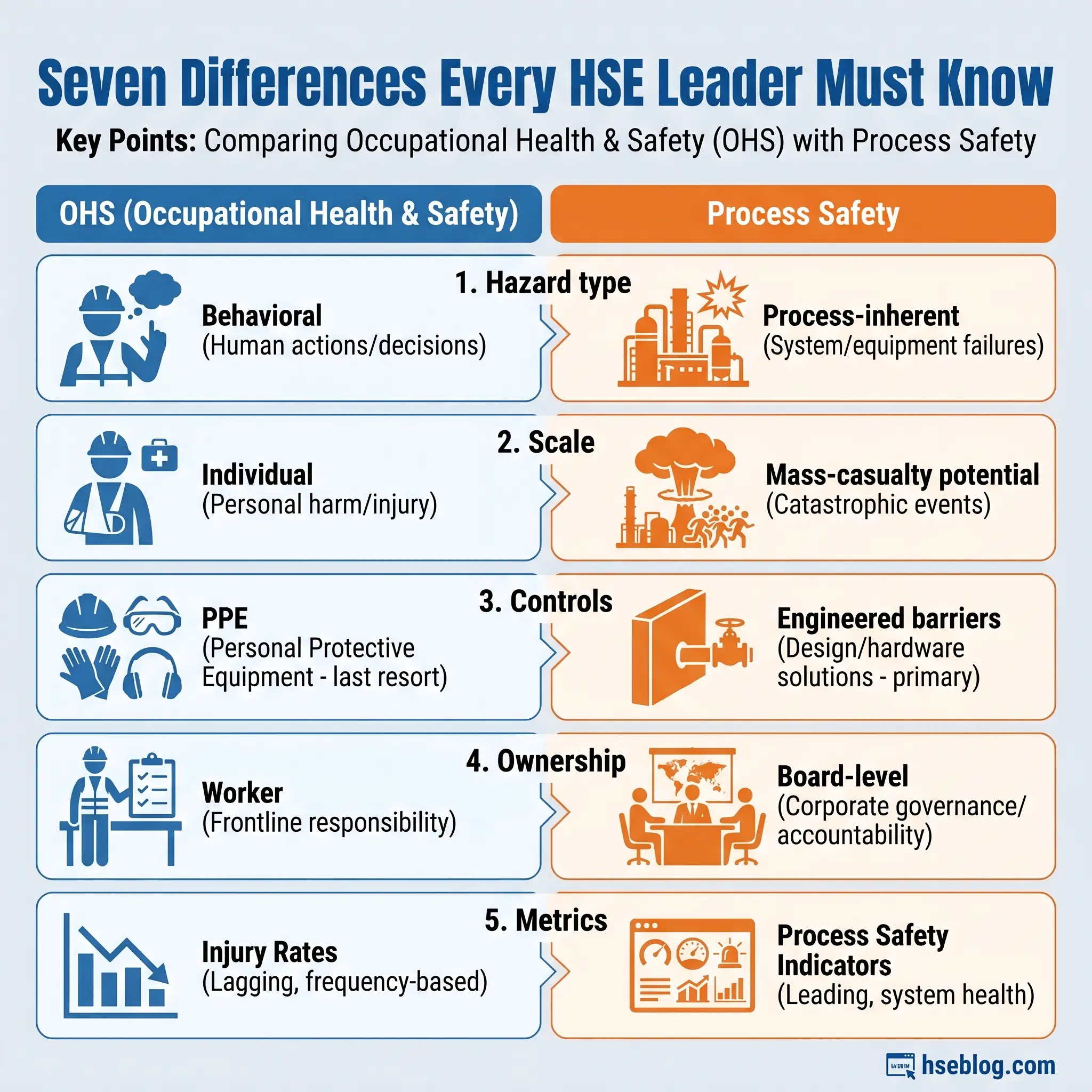
The 7 Key Differences Between Process Safety and Personal Safety
Understanding these seven distinctions is essential for anyone managing safety in a high-hazard operation. Each difference has direct implications for how you allocate resources, design management systems, and report to leadership.
- Type of hazard. Personal safety hazards are the familiar ones: working at height, moving machinery, manual handling, slip and trip exposures, contact with hot surfaces, noise. Process safety hazards involve loss of containment, overpressure, runaway exothermic reactions, ignition of flammable vapor clouds, catastrophic structural failure of vessels or pipework, and uncontrolled release of toxic substances. These are hazards inherent in the process itself — not in the worker's behavior around it.
- Consequence scale. A personal safety incident typically affects one worker or a small group. A process safety event can kill dozens simultaneously, injure hundreds, cause environmental contamination across kilometers, destroy capital assets, and shut down operations for months or permanently. The BP Texas City refinery explosion in 2005 killed 15 workers and injured more than 170 — a single event, a single moment.
- Likelihood profile. Personal safety incidents are statistically frequent but individually less severe. Process safety events are rare — a facility may operate for decades without one — but when they occur, the severity is catastrophic. This rarity makes them psychologically easy to dismiss, which is exactly why they demand systematic management.
- Control strategy. PPE and safe work behaviors are meaningful controls for personal safety. They are almost irrelevant to process safety. You cannot prevent a runaway reaction by wearing safety glasses. Process safety must be controlled through inherently safer design, engineered barriers, protective instrumentation, mechanical integrity programs, operating envelope management, and rigorous management of change. The OSHA Process Safety Management standard (29 CFR 1910.119) exists precisely because behavioral controls alone are insufficient for highly hazardous processes.
- Ownership and accountability. Every worker shares responsibility for personal safety — wearing PPE, following procedures, reporting hazards. Process safety demands something additional: senior leadership commitment to fund integrity programs, engineering authority to set and enforce design standards, and management willingness to shut down production when safety-critical barriers are impaired. During a turnaround at our gas plant, I watched a unit manager authorize a 72-hour production delay to replace a corroded pipe section that had not yet leaked but showed wall-thickness readings below the minimum calculated threshold. That decision cost the company revenue. It also prevented a potential loss-of-containment event on a line carrying liquid propane at 18 bar. No frontline worker could have made that call.
- Competence requirements. Personal safety participation requires general safety awareness — hazard recognition, proper lifting technique, correct PPE selection. Process safety requires structured hazard analysis skills, understanding of process chemistry and thermodynamics, knowledge of relief system design, proficiency in techniques like HAZOP, PHA, and LOPA, and the ability to interpret pressure-temperature phase diagrams, corrosion data, and alarm rationalization studies.
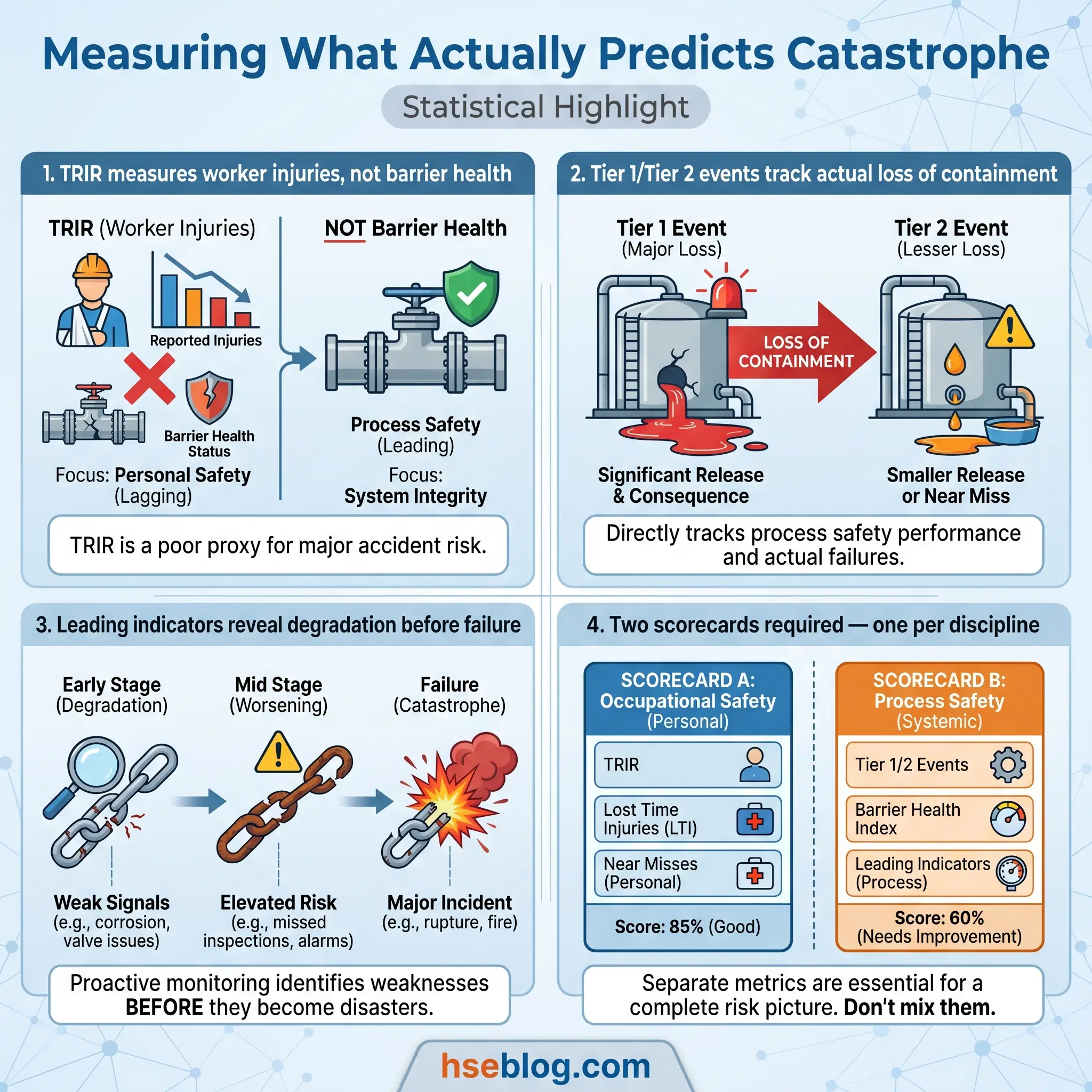
- Metrics and measurement. This is where the most dangerous confusion occurs. Injury frequency rates — TRIR, LTIR, DART — measure personal safety performance. They do not measure process safety performance. Dedicated process safety indicators, structured around frameworks like API RP 754 and HSE's HSG254 guidance, are required to track the health of barriers, the frequency of loss-of-containment events, and the status of safety-critical maintenance.
Why Low Injury Rates Can Hide Serious Process Safety Weaknesses
This might be the single most important concept in this entire article: a facility can have an outstanding personal safety record while its process safety is quietly deteriorating.
Injury metrics are lagging indicators for worker-level harm. They count events that have already happened — recordable injuries, lost-time cases, first-aid treatments. They are useful for what they measure. The problem is what they do not measure. A corroded pressure vessel that has not yet ruptured does not appear in the TRIR. An overdue proof test on a high-integrity pressure protection system generates no recordable incident. A management of change request that was approved without adequate technical review creates no lost-time injury — until the day the modified process exceeds its design envelope and a catastrophic release occurs.
Watch For: The organization that celebrates declining injury rates while simultaneously deferring safety-critical maintenance, extending inspection intervals, or reducing process safety staffing. That combination is not safe performance — it is risk accumulation.
The Texas City Lesson
The connection between low injury rates and false confidence was laid bare by the Baker Panel investigation following the 2005 BP Texas City refinery explosion. The panel found that BP had placed significant emphasis on personal safety metrics and had achieved notable improvements in injury rates across its U.S. refining operations. However, those same metrics provided no warning of the degraded process safety conditions — deferred maintenance, inadequate operating procedures, repeated warning signs from previous incidents — that culminated in the isomerization unit explosion. The CSB's 20th-anniversary lessons-learned analysis in 2025 reinforced this finding, emphasizing that the distinction between process safety and personal safety remains as operationally critical today as it was two decades ago.
The lesson is plain: injury statistics and process safety health are measured on different instruments. Treating one as a proxy for the other is not a simplification — it is a systemic failure of risk intelligence.
Examples of Personal Safety Hazards vs Process Safety Hazards
Definitions clarify the concept. Examples make it usable. The following illustrates both categories across several industry settings, because process safety is not confined to refineries alone.
Personal safety hazard examples:
- Ladder fall during routine inspection — a maintenance technician descends a fixed ladder with three points of contact compromised by a carried tool. Single person affected, injury severity ranges from bruising to fracture.
- Hand laceration during gasket cutting — a pipefitter uses a utility knife without cut-resistant gloves. Immediate first-aid or recordable injury.
- Forklift pedestrian strike in warehouse — inadequate segregation between pedestrian and vehicle routes. Single-person impact.
- Noise-induced hearing loss — prolonged exposure to compressor noise above 85 dB(A) without adequate hearing protection.
- Manual handling strain — a field operator lifts a 25 kg valve actuator without mechanical assistance.
Process safety hazard examples:
- Overpressure event on a fractionation column — a blocked outlet combined with continued heat input exceeds the vessel's maximum allowable working pressure. The relief valve lifts, but if it fails to reseat or the blockage is downstream of the relief path, catastrophic rupture is possible.
- Flammable vapor cloud ignition — a flange leak on a propane line releases a heavier-than-air vapor cloud that migrates to an ignition source 40 meters away. Flash fire or explosion potential.
- Runaway exothermic reaction in a batch reactor — cooling system failure during an addition step causes temperature excursion beyond the reaction's thermal stability limit. Potential for vessel rupture and toxic release.
- Tank overfill and containment failure — an atmospheric storage tank receiving product with a failed high-level alarm and no independent overfill protection overflows, breaching secondary containment.
- Corrosion-driven loss of containment — internal corrosion under insulation thins a carbon steel pipe section below minimum wall thickness. The pipe eventually fails under normal operating pressure, releasing hot hydrocarbon fluid.
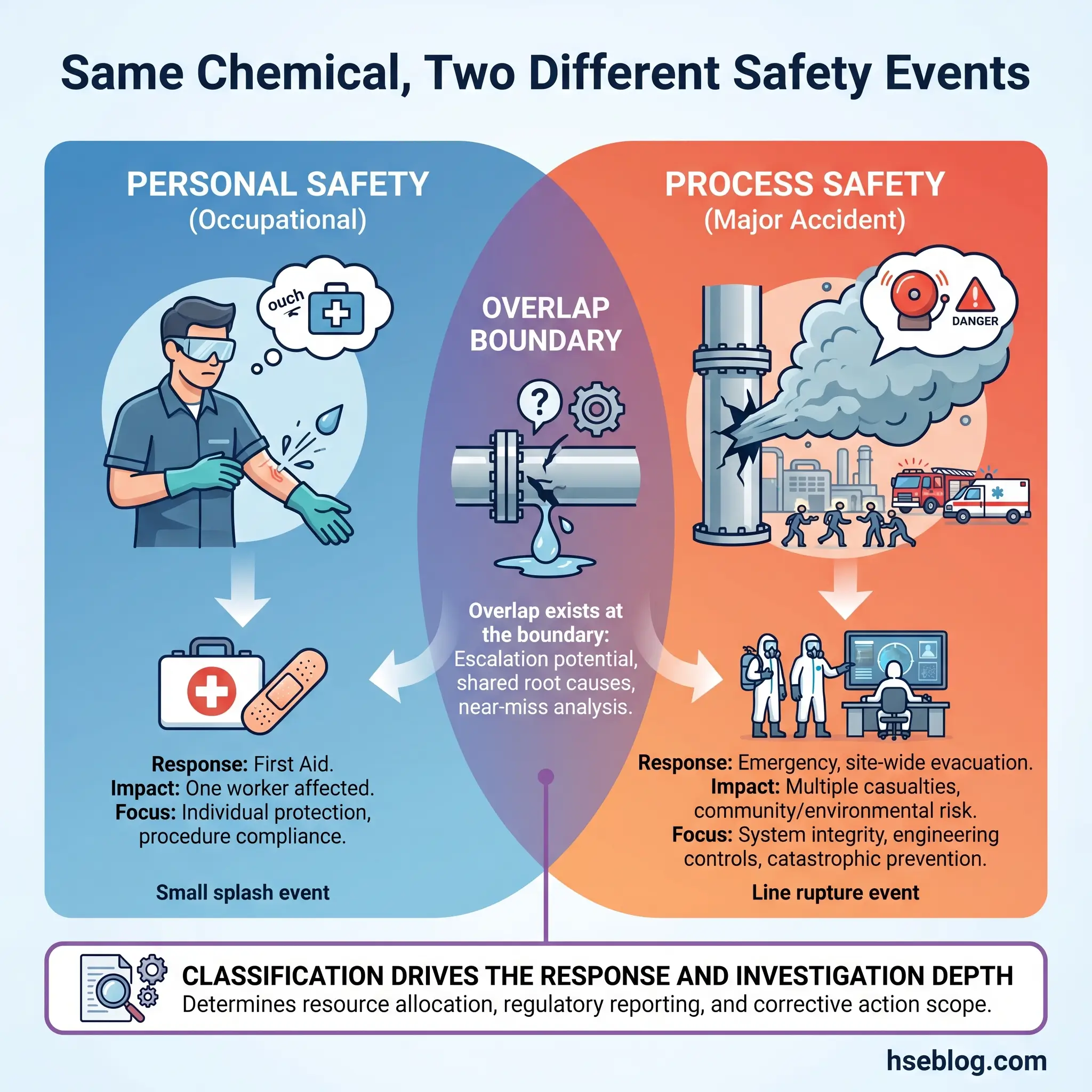
Field Test: Pick any hazard on your site register. Ask: "If this hazard materializes, does it injure one person — or could it escalate to a multi-casualty event involving fire, explosion, or toxic release?" That question separates personal safety from process safety more clearly than any definition.
Where they overlap: A small chemical splash during a sample draw is a personal safety incident — one worker, one injury, resolved with first aid and a procedure review. But if that same chemical line develops a full-bore rupture during maintenance because the energy isolation was inadequate and the line contained residual hydrogen sulfide, the event crosses into process safety territory: multiple potential fatalities, emergency response activation, regulatory notification.
How Process Safety Is Managed Differently
Process safety cannot be managed through toolbox talks, safety observations, and incident pyramids. It requires a structured management system built on hazard understanding, engineering rigor, and organizational discipline.
OSHA's Process Safety Management standard — 29 CFR 1910.119 — establishes the regulatory baseline in the United States. It applies to facilities handling highly hazardous chemicals above specified threshold quantities and mandates a formal system to prevent or minimize the consequences of catastrophic releases. The standard's fourteen elements — from process safety information and process hazard analysis through mechanical integrity, management of change, and incident investigation — form an integrated framework, not a checklist of independent tasks.
Internationally, frameworks like the Energy Institute's High Level Framework for Process Safety Management (2nd edition, 2022) and the CCPS Process Safety Metrics Guide (Version 4.1, 2022) provide complementary structures that emphasize leadership, risk understanding, barrier management, and continuous learning. HSE UK's approach through HSG254, updated as recently as August 2025, focuses specifically on developing process safety indicators that monitor the effectiveness of major hazard controls — a fundamentally different measurement philosophy from counting injuries.
What makes process safety management distinct in practice is the depth of technical rigor required at every stage. During a HAZOP study on a new gas dehydration unit at our facility, the team spent four hours on a single node — the glycol regeneration reboiler — examining seventeen deviation scenarios. One deviation, involving a blocked drain combined with loss of temperature indication, would have been invisible in a standard JSA. It required process engineering knowledge, understanding of glycol decomposition chemistry at elevated temperatures, and familiarity with the specific metallurgy of the reboiler tubes. That depth of analysis is routine in process safety. It does not exist in personal safety management — nor does it need to.
Process Safety Tools Worth Naming
The specialist toolkit for process safety includes HAZOP (Hazard and Operability Study) for systematic deviation analysis, PHA (Process Hazard Analysis) as the broader category of structured studies, LOPA (Layer of Protection Analysis) for quantifying independent protection layer adequacy, bow-tie analysis for visualizing threat-barrier-consequence relationships, asset integrity management programs for maintaining the physical condition of safety-critical equipment, alarm rationalization to ensure safety alarms function as genuine protective barriers rather than nuisance signals, and management of change procedures to prevent unreviewed modifications from introducing new hazard scenarios.
What Metrics Matter for Personal Safety vs Process Safety?
During a quarterly review, I asked each department head to name their top three safety metrics. Every one of them cited TRIR, LTIR, and near-miss reporting rates. Not one mentioned a process safety indicator. That gap in metric literacy is common — and it is dangerous.
The following table distinguishes the two measurement systems and explains what each metric actually reveals about risk.
| Metric Category | Specific Metric | What It Tells You |
|---|---|---|
| Personal safety — lagging | Total Recordable Injury Rate (TRIR) | Frequency of injuries requiring medical treatment beyond first aid |
| Personal safety — lagging | Lost-Time Injury Rate (LTIR) | Frequency of injuries causing absence from work |
| Personal safety — leading | Safety observation rate | Volume of proactive hazard identification by workforce |
| Personal safety — leading | Training completion rate | Coverage of safety competence development |
| Process safety — lagging | Tier 1 process safety events (API RP 754) | Major loss-of-containment events exceeding defined thresholds for quantity, injury, cost, or community impact |
| Process safety — lagging | Tier 2 process safety events (API RP 754) | Loss-of-containment events below Tier 1 thresholds but above normal operational expectations |
| Process safety — leading | Overdue safety-critical maintenance | Integrity status of barriers that prevent major accidents |
| Process safety — leading | Management of change backlog | Unreviewed modifications that may introduce uncontrolled hazard scenarios |
| Process safety — leading | Safety-critical device proof test completion | Functional verification of emergency shutdown systems, relief valves, gas detectors |
| Process safety — leading | Temporary barrier defeat log | Duration and number of safety-critical barriers removed from service |
OSHA's guidance on leading indicators provides a useful starting framework, though it primarily addresses occupational safety. For process safety specifically, API RP 754 (now in its 3rd edition) and the CCPS Process Safety Metrics Guide Version 4.1 offer the most structured and widely adopted indicator frameworks for refining, petrochemical, and chemical operations.
Audit Point: Ask your process safety team how many Tier 1 and Tier 2 events the facility recorded in the past three years. If they cannot answer within sixty seconds — or if no one has classified events against API RP 754 criteria — the facility does not have a functioning process safety metrics program, regardless of what the injury rate says.
Which Industries Need to Distinguish Process Safety from Personal Safety Most Clearly?
Every workplace needs personal safety. Process safety becomes critical wherever the consequences of equipment failure, containment loss, or procedural deviation can escalate beyond individual harm into catastrophic territory. The following industries carry the highest obligation to maintain both disciplines as distinct, properly resourced programs.
- Oil and gas (upstream, midstream, downstream) — high-pressure hydrocarbons, hydrogen sulfide exposure, flammable atmospheres, complex processing sequences from wellhead to export terminal.
- Chemical manufacturing and petrochemicals — reactive chemistry, toxic intermediates, exothermic processes, large inventories of hazardous substances.
- Pharmaceutical and batch processing — solvent handling, reactive synthesis steps, dust explosion potential in powder handling areas.
- Power generation and utilities — steam systems at extreme temperatures and pressures, ammonia-based cooling, hydrogen for generator cooling, coal dust or biomass dust hazards.
- Food and beverage processing — ammonia refrigeration systems, combustible dust from grain and powder handling, pressure vessels in pasteurization and sterilization.
- Mining and minerals processing — cyanide leach circuits, sulfuric acid handling, tailings dam integrity, dust explosion hazards in conveyor systems.
The common thread is not the industry label — it is the presence of hazardous materials, stored energy, or process conditions that can produce consequences extending beyond the immediate work area.
Can Process Safety and Personal Safety Be Managed Together?
They must be managed within one integrated HSE system — but they must never be collapsed into a single scoreboard.
The shared enablers are real: safety culture, reporting culture, competence management, leadership visibility, learning from incidents, and workforce engagement underpin both disciplines. A site with poor personal safety culture — where workers hide injuries, supervisors ignore near-misses, and management treats safety as a cost center — is unlikely to sustain strong process safety either. The cultural foundations are the same.
Where integration fails is at the measurement and control level. I have explained this to operations managers by drawing two separate columns on a whiteboard. The left column lists the controls that prevent a worker from falling off a scaffold: guardrails, harness, competent person inspection, work-at-height permit. The right column lists the controls that prevent a propane storage sphere from overpressurizing: relief valve sizing, high-pressure trip, process design review, mechanical integrity inspection, management of change review for any modification to the pressure protection system. The two columns share zero items. Managing them as if they are the same thing guarantees that one — usually process safety — receives inadequate attention.
The operating principle should be straightforward: one safety management system, two distinct sets of controls, two distinct sets of indicators, and dual reporting lines to leadership that ensure neither discipline is diluted by the other.
Frequently Asked Questions
What is the main difference between process safety and personal safety?
Personal safety prevents injuries to individual workers — cuts, falls, strains, and exposures that happen with relative frequency. Process safety prevents catastrophic events — explosions, toxic releases, fires, and structural failures — that are rare but capable of killing multiple people, devastating communities, and destroying entire facilities. The hazards are different, the controls are different, and the metrics must be different.
Why don't low injury rates prove strong process safety performance?
Injury rates measure the frequency of worker-level harm events. They do not measure the condition of engineered barriers — pressure relief systems, interlocks, containment integrity, alarm functionality — that prevent major accidents. A facility can achieve a TRIR of zero while its safety-critical maintenance is overdue, its management of change process is backlogged, and its corrosion monitoring program is underfunded. The Baker Panel investigation after the 2005 Texas City explosion documented exactly this disconnect at BP's U.S. refining operations.
What are examples of process safety incidents?
Process safety incidents include loss-of-containment events such as flange or pipe failures releasing flammable or toxic materials, overpressure events causing vessel rupture, vapor cloud explosions following ignition of released hydrocarbons, runaway reactions in batch or continuous reactors exceeding thermal design limits, boiling liquid expanding vapor explosions (BLEVEs) from fire-impinged pressure vessels, and tank overfills breaching secondary containment. Each involves failure of engineered barriers or management systems, not simply individual worker error.
Who is responsible for process safety in an organization?
Responsibility is shared but weighted toward leadership. Frontline operators must follow procedures and report anomalies. Supervisors must enforce operating discipline. Engineering must maintain design integrity and conduct hazard analysis. Operations management must ensure mechanical integrity programs are funded and executed. Senior leadership and the board must treat process safety as a governance issue, allocate capital for barrier maintenance, and review process safety indicators with the same rigor they apply to financial performance. OSHA 29 CFR 1910.119 places specific obligations on the employer to establish and maintain a comprehensive process safety management program.
Can one incident involve both personal safety and process safety?
Yes. A chemical release that injures a single operator through skin contact is a personal safety incident. If that same release escalates — because the substance is flammable and finds an ignition source, or because it is toxic and the wind carries it toward occupied areas — it becomes a process safety event. The initial harm may be personal, but the potential for escalation to a multi-casualty, community-impact event is what defines the process safety dimension. Incident investigations must assess both dimensions to ensure the correct controls are strengthened.
What metrics are used for process safety?
Process safety uses a separate indicator framework from injury statistics. Lagging indicators include Tier 1 and Tier 2 process safety events as defined by API RP 754, which classify loss-of-containment events by severity thresholds for quantity released, injuries, cost, and community impact. Leading indicators track the health of preventive barriers: overdue safety-critical maintenance tasks, proof test completion rates for emergency shutdown systems, management of change closure timelines, temporary barrier defeat durations, and alarm system health metrics. HSE UK's HSG254 provides guidance for developing site-specific process safety indicators tailored to the facility's major hazard profile.
The industry's most persistent and dangerous confusion is not about which safety discipline matters more — both are essential. The dangerous confusion is treating them as one discipline with one set of metrics and one management approach. Every major accident investigation in the past two decades has reinforced the same finding: organizations that rely on personal injury statistics to gauge their process safety health are measuring the wrong signal. They are watching the speedometer while the engine temperature gauge climbs unnoticed.
The highest-impact change an organization in a high-hazard industry can make is structural: establish process safety indicators alongside personal safety indicators, report both to leadership independently, and never allow one to overshadow or substitute for the other. That separation does not divide the safety function — it completes it. A facility that tracks both disciplines with equal rigor, resources both with equal commitment, and holds leadership accountable for both with equal consequence is a facility that understands what safety actually requires.
The question worth asking in your next management review is uncomfortable but necessary: "If our injury rate dropped to zero tomorrow, would we know whether our major hazard controls are getting stronger or weaker?" If the answer is silence, the work starts now.