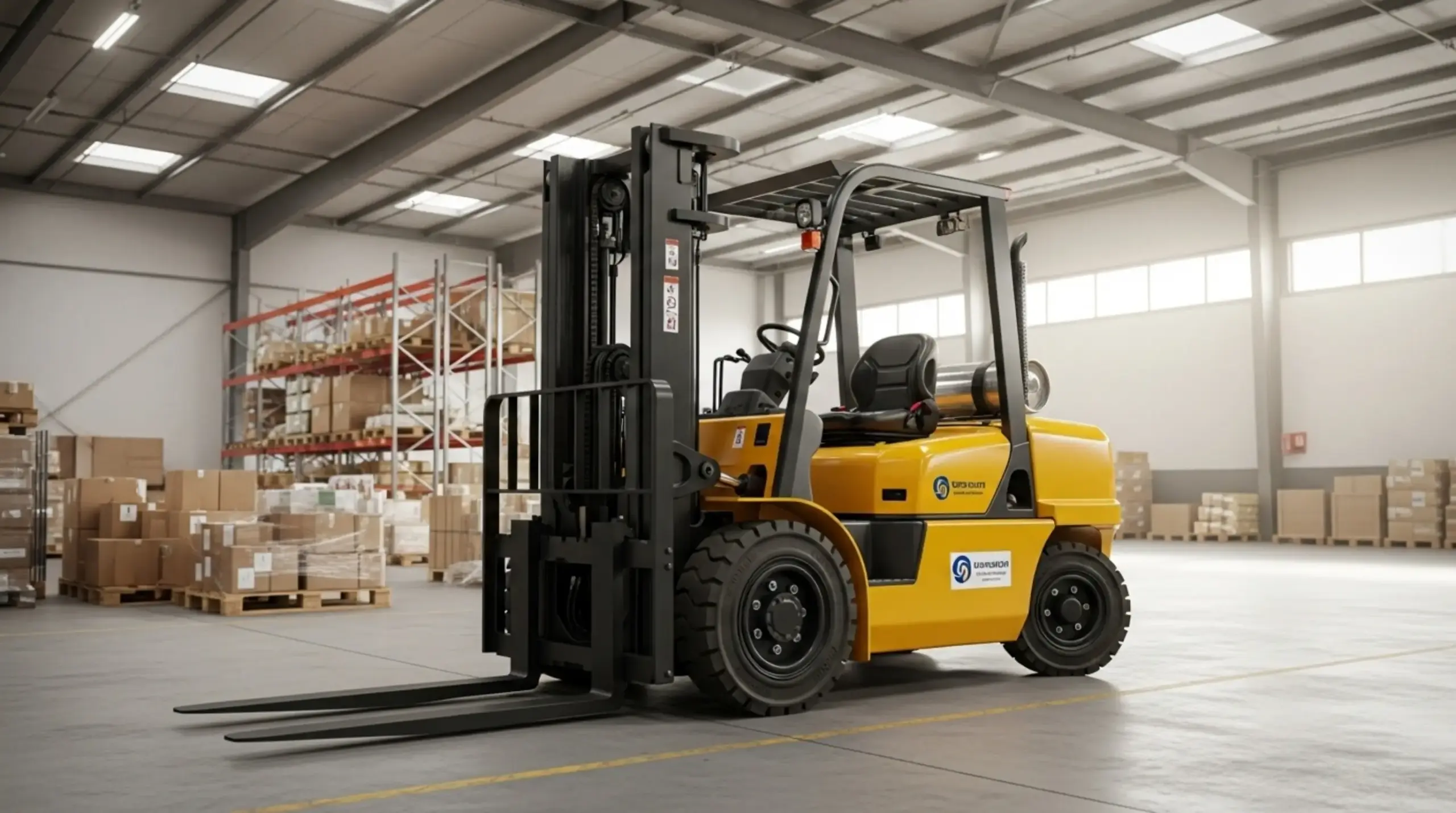
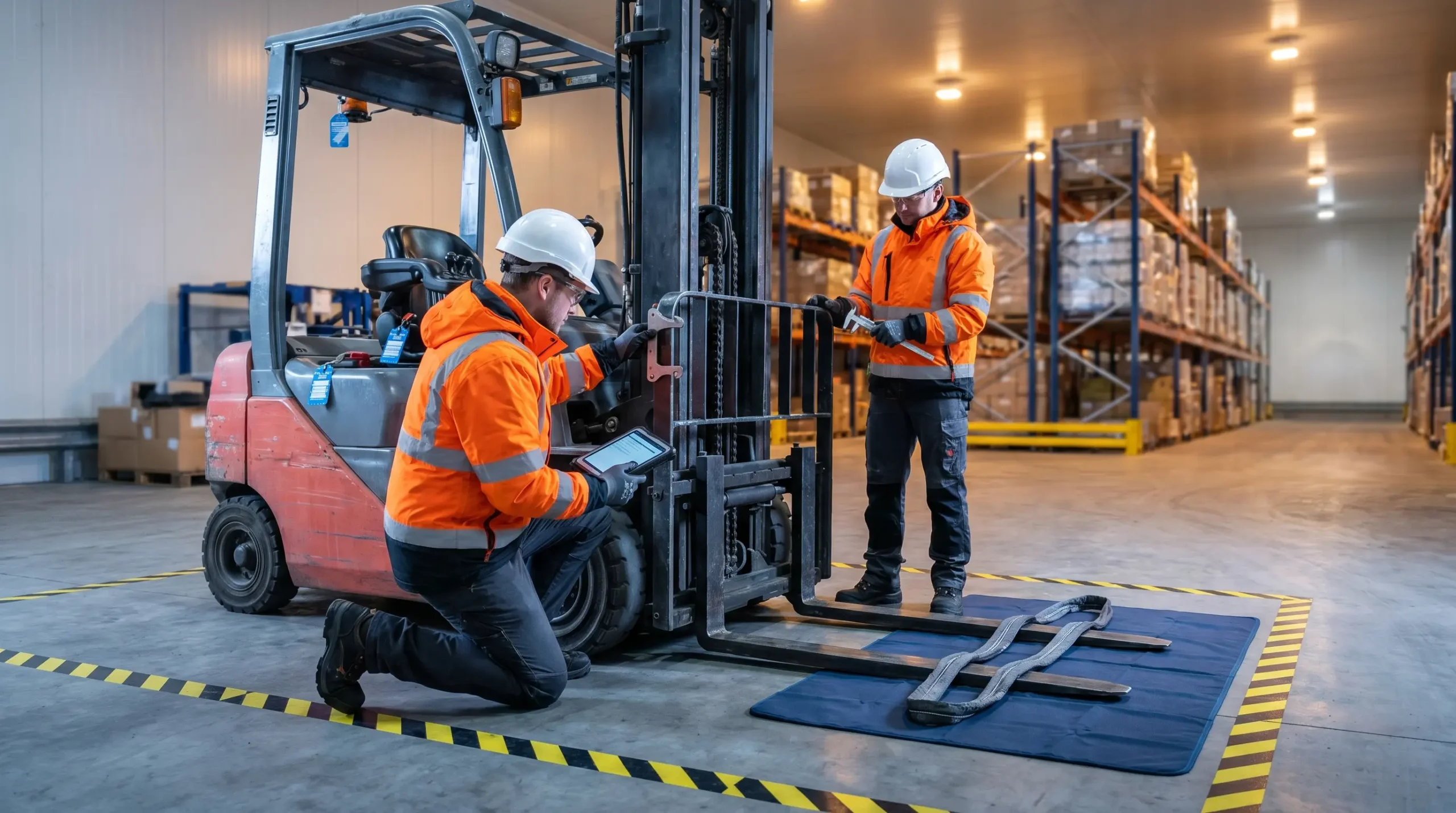
I inherited a mixed lifting fleet when I moved to the distribution and cold-storage campus I now cover — sixteen counterbalance forklifts, four reach trucks, two goods-only platform lifts between the mezzanine and the chilled dispatch floor, and around 140 accessories ranging from polyester round slings to grade 80 chain sets on the yard-side loading frames. During my second week, the site manager handed me a folder labelled "LOLER" that contained, among other things, a 14-month-old forklift certificate, a Declaration of Conformity for a reach truck that had been assembled on site, and a stack of sling reports with no unique IDs tying them to anything in the racking. That folder is the reason I am unusually strict about thorough examinations. Every one of those documents had a story that mattered, and most of them were telling the wrong one.
Thorough examination of lifting equipment is the single clearest compliance obligation most duty holders still get wrong. It is not servicing. It is not a walk-around. It is a statutory assessment under the Lifting Operations and Lifting Equipment Regulations 1998 — and when it fails, equipment gets taken out of service on the spot, the enforcing authority hears about it within the working week, and the duty holder (not the examiner, not the hire company) carries the legal consequence. This guide walks through what a thorough examination actually is, which equipment it covers, how often it applies, who can carry it out, what must appear in the report, how defects are categorised, and how to prepare your site so the competent person's time is spent examining rather than hunting for paperwork.
What Is a Thorough Examination of Lifting Equipment?
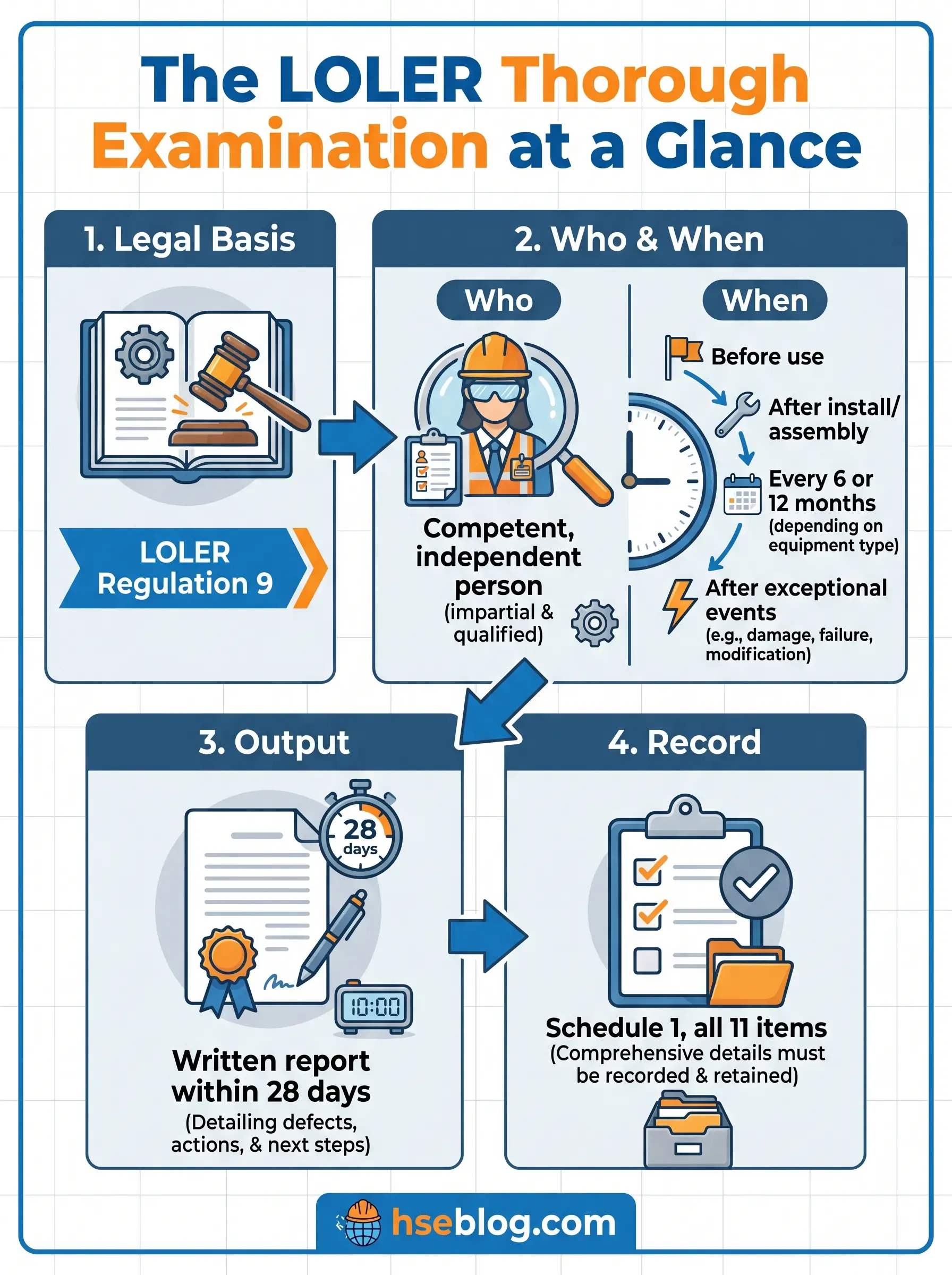
The HSE's definition is deliberately precise: a thorough examination is a systematic and detailed examination of the equipment and safety-critical parts, carried out at specified intervals by a competent person, and resulting in a written report. Three things have to happen together — the examination itself, the written report, and the notification of any defect that is (or could become) a danger. Remove any one of those and you do not have a thorough examination in the legal sense. You have a service visit with good intentions.
It helps to compare it against the other things that happen to lifting equipment in a normal operating month, because the terms get used interchangeably on most sites and almost always incorrectly.
- Thorough examination: Statutory, scheduled, conducted by a competent and independent person, results in a Report of Thorough Examination under LOLER Regulation 10 and Schedule 1.
- Inspection: A lighter-touch interim check — required by LOLER where conditions warrant it between thorough examinations — recorded but not to Schedule 1 depth.
- Routine maintenance: Manufacturer-driven servicing (lubrication, hydraulic checks, component replacement). Keeps the equipment running; does not satisfy LOLER.
- Pre-use operator check: The daily walk-around the operator does before starting work. Captures tyre damage, fluid leaks, obvious defects. Essential, but at the bottom of the hierarchy.
A useful mental model I repeat in toolbox talks is that thorough examination is the MOT — periodic, independent, legally mandated, and centred on the equipment's ability to remain safe in service. Maintenance is the service. The operator check is the driver looking over the car before the school run. All three are necessary. Only one of them satisfies Regulation 9.
Which Equipment Needs a LOLER Thorough Examination?
LOLER defines lifting equipment as "work equipment for lifting or lowering loads" and explicitly includes its attachments used for anchoring, fixing or supporting it. Lifting accessories — the kit that connects a load to the equipment — are covered in their own right. The scope is wider than most duty holders assume, and the grey areas are where I see the most audit findings.
| Covered by LOLER | Not covered by LOLER (PUWER applies) |
|---|---|
| Tower, mobile, and overhead cranes | Escalators and moving walkways |
| Forklift and reach trucks (lifting mechanism) | Simple pallet trucks lifting only clear of the ground |
| Passenger and goods lifts | Stair lifts in private dwellings |
| Patient and personnel hoists (hospitals, care homes) | Conveyors for horizontal transport |
| MEWPs — scissor lifts, cherry pickers, boom lifts | Equipment used solely by members of the public (HSW Act) |
| Vehicle inspection pit hoists and platform hoists | Lifts in domestic premises |
| Winches, jacks, gin wheels | |
| Slings (wire, chain, textile), shackles, eyebolts, spreader beams, hooks, chains |
The grey zones deserve specific attention. Excavators fitted with lifting eyes and used in lifting mode sit under LOLER with additional requirements around safe working loads and overload protection — something I verify every time a civils contractor arrives on the yard wanting to drop a concrete ring. A telehandler hoisting a load on forks behaves as lifting equipment; the same telehandler shifting a pallet along the ground, arguably does not. And equipment that lifts people — without exception — drops into the stricter 6-monthly interval the moment personnel can ride it.
LOLER vs PUWER: Why Both Matter
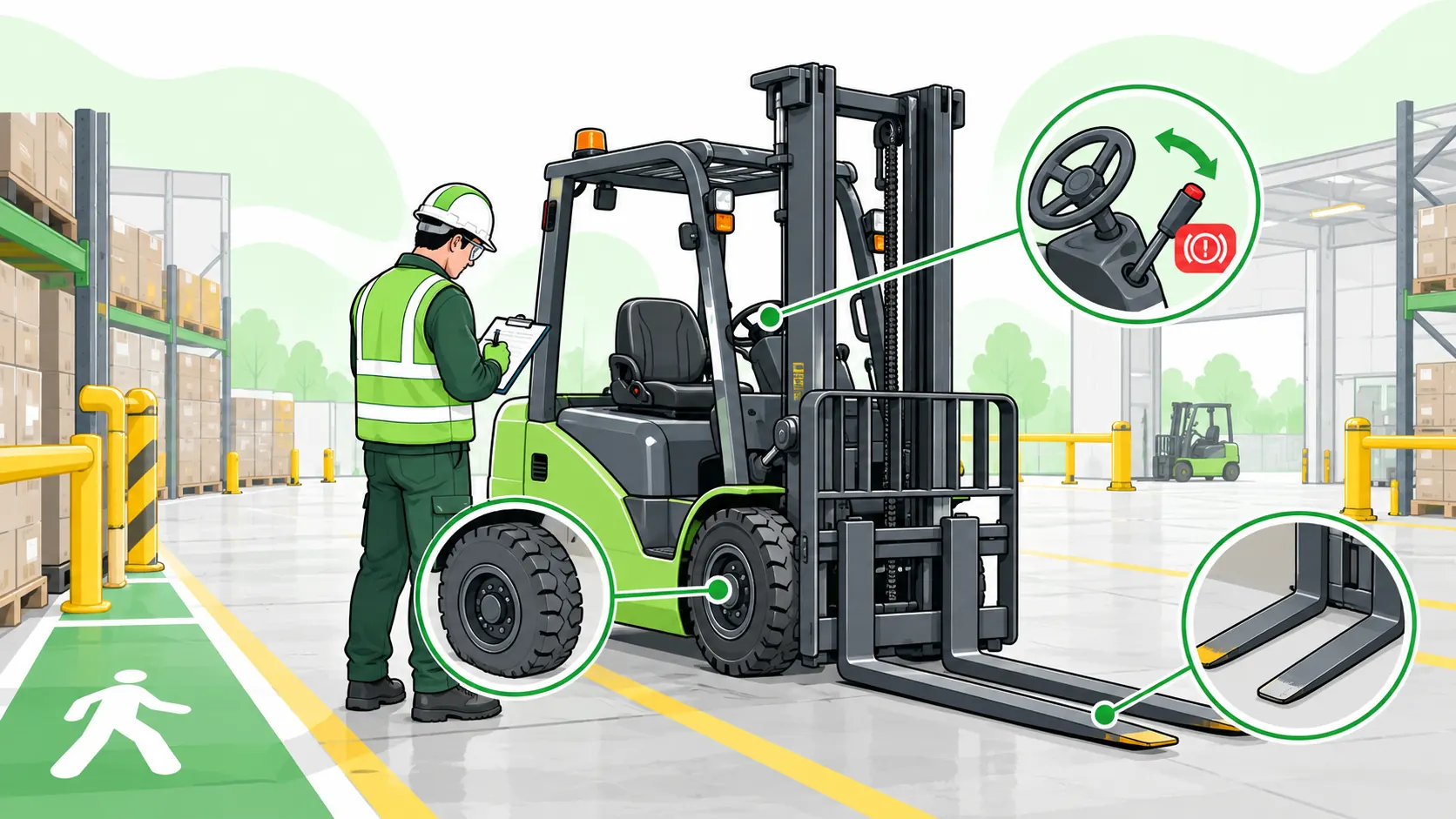
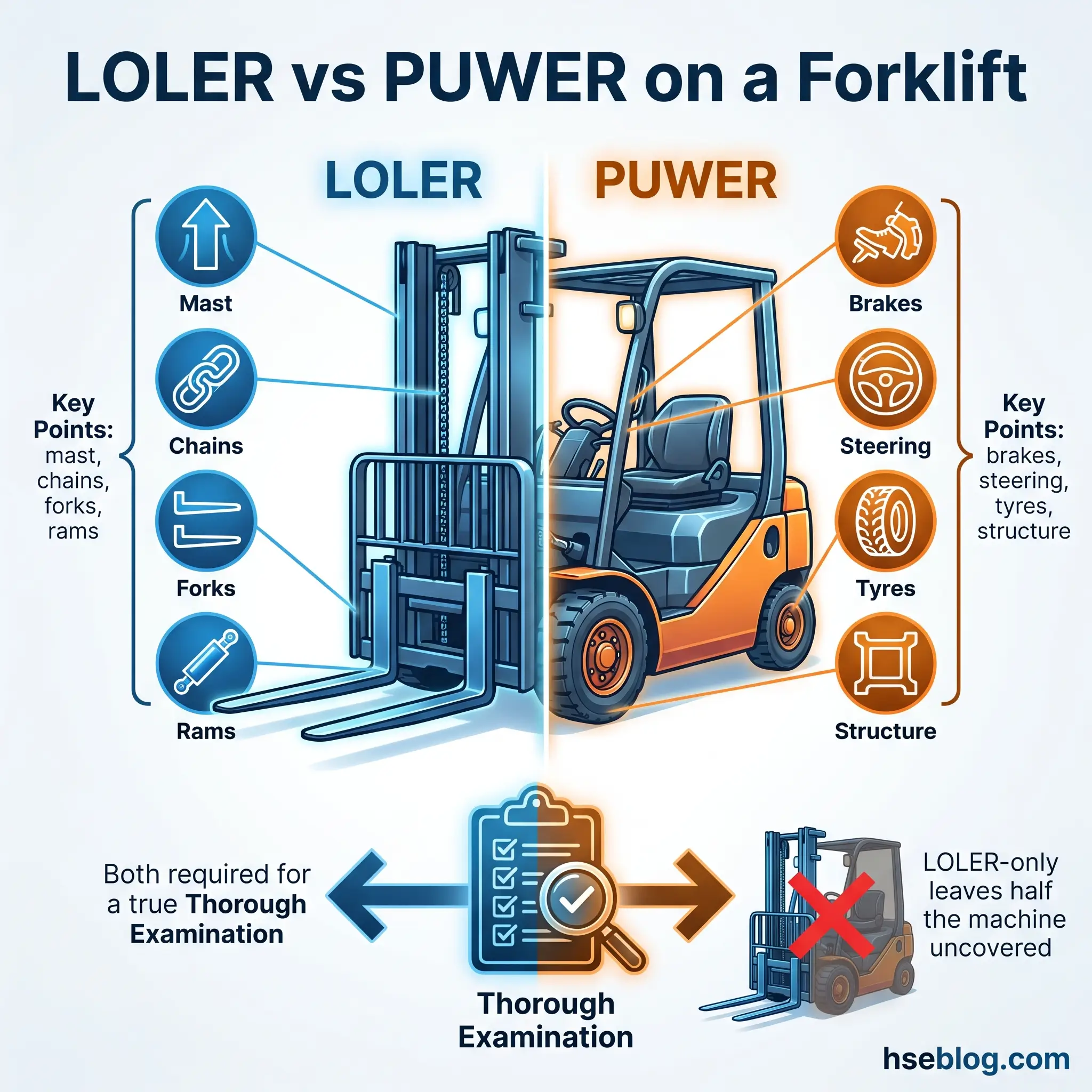
On a forklift, the lifting mast, chains, hydraulic rams, carriage, forks, and attachments fall under LOLER. The brakes, steering, tyres, horn, lights, seatbelt, and structural integrity fall under PUWER 1998 — specifically Regulation 6, which requires inspection of work equipment exposed to conditions causing deterioration. Industry commentary from bodies like CFTS and the British Safety Council has flagged for years that the great majority of materials handling inspections still address only the LOLER elements. That is how a forklift with a perfectly valid LOLER certificate ends up involved in an incident because its service brake had been degrading for six months.
A true "Thorough Examination" under the CFTS scheme covers both duties — 33 LOLER-specified parts plus 34 PUWER-relevant items on a standard counterbalance truck. If your forklift examiner is handing you a certificate that mentions only LOLER, you have the lifting mechanism covered and half the machine uncovered. Ask for the PUWER scope in writing.
When a Thorough Examination Must Be Carried Out
LOLER Regulation 9 sets four distinct trigger points across the equipment lifecycle. A duty holder needs to know all four, because confusion here is the single most common reason I see equipment in service without valid examination.
- Before first use. New equipment requires a thorough examination unless the supplier has provided a UKCA (or EC) Declaration of Conformity less than 12 months old AND the equipment does not depend on conditions of installation. A factory-built accessory with current conformity documentation is generally exempt. A platform lift, a tower crane, or a mezzanine goods lift — anything assembled on site — is not. Those always need first-use examination because their safety depends on how they were put together in your building.
- After installation or assembly at a new location. Relocating a tower crane, repositioning a goods lift to serve a new floor, re-installing a vehicle inspection hoist after a facility refit — any of these trigger examination before the equipment goes back into service. The documentation from the original location does not travel with it.
- Periodically while in service. The 6-month and 12-month intervals (covered in detail below) apply throughout the equipment's working life, or the intervals set by a written examination scheme if one is in place.
- Following exceptional circumstances. This is the catch-all trigger duty holders most often miss. Exceptional circumstances include damage from a collision, overload events, modifications or major repairs, long-term storage followed by a return to service, exposure to harsh or corrosive conditions, a period of heavy or unusual use, and any incident that raises a reasonable question about the equipment's continued integrity. When a reach truck on my site glanced a steel post last winter, it came out of service the same shift — thorough examination before the next route, regardless of what the in-service interval said.
A note on paperwork: the UKCA Declaration of Conformity replaced the EC Declaration for equipment placed on the GB market from 1 January 2022. Plenty of older equipment still carries valid EC documentation, and that remains acceptable for items already on the market before the transition. New procurement from 2022 onwards should arrive with UKCA documentation — and if it does not, question it before the equipment is accepted into service.
LOLER Inspection Frequency: Is It 6 Months or 12 Months?
The answer is: both, depending on what you lift. The rule set by Regulation 9 is unambiguous once you split the equipment into two groups.
| Equipment type | Maximum interval | Examples |
|---|---|---|
| Equipment used to lift people | 6 months | Passenger lifts, MEWPs, patient hoists, construction hoists, platform lifts |
| All lifting accessories | 6 months | Slings, shackles, chains, eyebolts, spreader beams, hooks |
| All other lifting equipment | 12 months | Forklifts, cranes, overhead gantries, winches, goods lifts, jacks |
The industry mnemonic — "above the hook, 12 months; below the hook, 6 months" — captures the accessory rule neatly. The hoist, the crane, the fork carriage above the hook runs on the 12-month interval. Everything hanging below it, plus anything carrying people, sits on the 6-month interval. The logic is straightforward once you see it: accessories take direct load, wear unpredictably, and are the component most likely to fail catastrophically between examinations. People-lifting equipment is subject to the same tighter interval because the consequence of failure is a fall from height.
These are maximum intervals, not recommendations. A competent person can draw up a written examination scheme that specifies shorter intervals — for example, slings in contact with acidic wash-down chemicals, or MEWPs operating in an offshore environment. The scheme can also, for specific components, justify slightly longer intervals where risk is demonstrably low. What a scheme cannot do is extend intervals for personnel-lifting equipment or accessories beyond what risk actually allows. Examination schemes are an engineering decision, not a cost-saving one.
Watch For: A certificate date that is within the 6 or 12 months but an examination date that is several weeks earlier than the report issue date. The legal interval runs from the date of examination, not the date the report arrives. Schedule the next examination from the day the engineer was on site.
Who Can Carry Out a LOLER Thorough Examination? The Competent Person
"Competent person" is the single most misunderstood term in the regulation. LOLER itself does not define it in the main text — the definition lives in the HSE Approved Code of Practice L113, which sets out what competence actually means for this work. Because L113 has special legal status under section 16 of the Health and Safety at Work etc. Act 1974, courts will treat a failure to meet it as evidence of non-compliance unless the duty holder can show they met the law by another route.
The ACOP criteria boil down to four things the competent person must demonstrate:
- Appropriate practical and theoretical knowledge and experience of the lifting equipment being examined. Not lifting equipment in general — the specific class.
- The ability to detect defects or weaknesses through examination AND to assess their importance for the equipment's continued safe use.
- Sufficient independence and impartiality to allow objective decisions.
- Genuine separation from routine maintenance on that equipment. The person who performs the servicing cannot sign off the thorough examination on the same item. This is non-negotiable and auditors look for it directly.
Competence is equipment-specific. A LEEA-qualified sling examiner is not automatically competent on a tower crane. A CFTS-accredited forklift examiner is not automatically competent on a patient hoist. Ask three questions of any proposed competent person: which classes of equipment does their certification cover, how many years of examination experience do they hold on that class, and who is their scheme provider (LEEA, CFTS, or a recognised engineering institution). If the answer to any of those is vague, find someone else.
In-house examination is legally possible — some larger operators have their own qualified engineers — but the independence test is where most in-house arrangements fall down. A maintenance engineer who services the forklifts cannot examine them. A senior engineer in a different department, working to a documented examination scheme with traceable training, reasonably can. The duty holder owns the question of whether that separation is genuine.
Audit Point: When a regulator asks to see evidence of competence, they do not want a certificate on a wall. They want the examiner's training records, their class-specific qualifications, and a written statement confirming they do not perform maintenance on the equipment they examine. Keep that package together.
What Does a Thorough Examination Actually Involve?
Most duty holders have never watched a thorough examination from start to finish. That unfamiliarity is why poor examinations slip through — if you do not know what a good one looks like, you cannot recognise when you have been given a bad one. The following is the sequence I expect to see, and what I quietly check for when an examiner is on site.
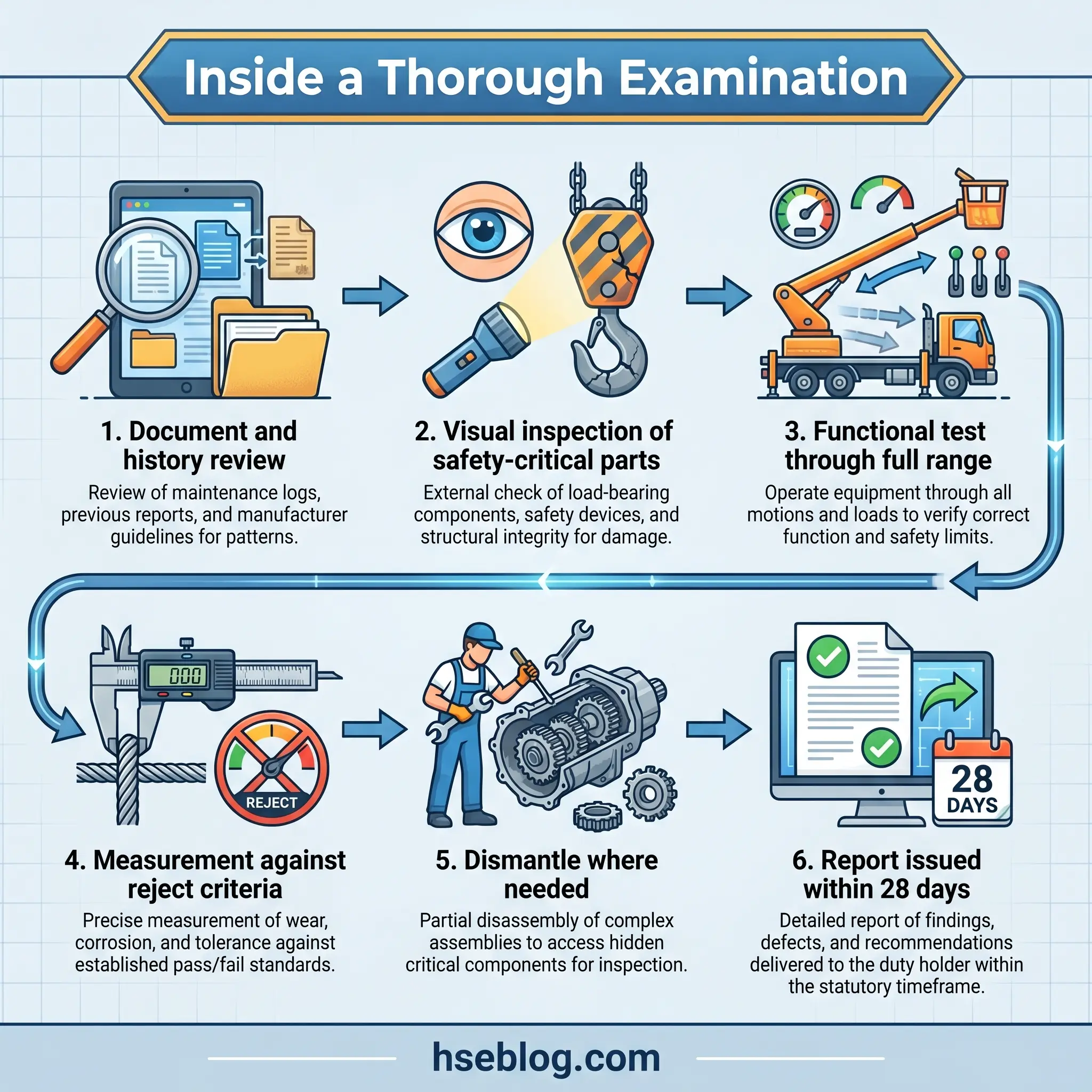
- Pre-examination document review. The competent person asks for previous reports, maintenance records, the incident log, and the Declaration of Conformity before putting hands on the equipment. If they skip this step, they are examining without context — they do not know what was flagged last time, whether the equipment was overloaded last month, or whether a repair was logged that would require re-examination.
- Visual examination of safety-critical components. Structure, welds, mechanisms, wiring, controls, SWL markings, safety devices, guards, end-of-travel limits. The examiner is looking for corrosion, deformation, crack indicators, illegible markings, worn or missing guards. This is slower than it looks — a properly conducted visual on a counterbalance forklift mast takes the better part of an hour.
- Functional testing through the full range of movement. Under a representative load (not necessarily SWL — modern practice has moved away from overload tests that stress equipment unnecessarily). The examiner watches for unusual sounds, hesitation, hydraulic creep, brake behaviour, and the function of safety devices at travel limits.
- Measurement-based assessment. Chain elongation measured with a chain gauge, not a tape. Hook throat opening measured with a vernier against the manufacturer's reject limit. Sling damage assessed against published wear and cut-depth criteria. Slew-ring bearing play checked to the original equipment tolerance. This is the part that separates a genuine thorough examination from a walk-around — it requires tools, reference data, and published reject criteria.
- Dismantling where necessary. Some components (internal brake assemblies, gearbox inspection covers, slewing ring bolts) can only be assessed by opening the equipment. A good examiner will flag this in advance so maintenance time is scheduled.
- Installation integrity checks on fixed equipment. Platform lifts, tower cranes, mezzanine goods lifts — the examination includes the anchoring and supporting structure, not just the mechanism. Baseplate bolt torque, guide rail alignment, pit and shaft condition.
The end of the physical examination is not the end of the job. The examiner leaves the site with enough information to issue a Report of Thorough Examination — which is where the next section becomes critical.
The Report of Thorough Examination: What LOLER Schedule 1 Requires
LOLER Regulation 10 requires the competent person to make a written report to the duty holder, and Schedule 1 specifies its content. No fixed layout is mandated — the report can be paper or electronic, on any template — but all 11 required items must appear, and missing any of them makes the document non-compliant. When I audit incoming reports from hire companies, I check against this list item by item.
- Name and address of the employer for whom the examination was made — that is, the duty holder.
- Address of the premises at which the examination was made.
- Identification of the equipment, including the date of manufacture where known — typically the serial number, unique asset ID, and make/model.
- Date of the last thorough examination, to establish continuity.
- Safe Working Load (SWL) of the equipment — confirmed, or any change required if the examiner is reducing it.
- Identification of the purpose for which the examination was made — before first use, after installation at a new location, within an examination scheme, following exceptional circumstances, or at the 6 or 12-month interval.
- Identification of any defects found that are or could become a danger to persons, and whether they are of immediate or imminent concern.
- Repairs, renewals, or alterations required to remedy the defects, with the timescale within which each must be completed.
- Particulars of any test carried out during the examination.
- The latest date by which the next thorough examination must be carried out.
- Name, address, and qualifications of the competent person making the report, and for whom they were acting.
Two timing rules sit around this list. The report must be provided to the duty holder as soon as is practicable, and in writing within 28 days of the examination. A verbal notification of a Category A defect goes at once — the written report follows, but it does not wait for the 28-day window. In practice, any competent examiner sends a preliminary finding within 24–48 hours so the duty holder can act, with the formal document issued shortly after.
The Fix That Works: Build an internal acceptance check that every incoming Report of Thorough Examination is mapped against the 11 Schedule 1 items before it is filed. A report missing the examiner's qualifications, or the date of next examination, is not a legally valid document — and the duty holder, not the examiner, is the one who will answer for it.
Handling Defects: Category A, B, and C — and the Enforcing Authority
Defect categorisation is where thorough examination turns from paperwork into operational decision-making. The categories are not defined within LOLER itself — they come from industry practice codified by LEEA and used across competent person schemes — but the legal notification chain behind Category A defects is set out in Regulation 10 and has real teeth.
| Category | What it means | Action required | Who is notified |
|---|---|---|---|
| A | Existing or imminent risk of serious personal injury | Equipment out of service immediately | Duty holder verbally at once; enforcing authority (HSE or local authority) by the competent person in writing |
| B | Defects requiring remedy within a specified timescale | Equipment may continue in use with controls in place until remedied by deadline | Duty holder in the report |
| C | Defects not posing immediate risk — monitor or correct at next service | Equipment continues in normal use | Duty holder in the report |
The Category A mechanism is the one duty holders most often misunderstand. When the competent person identifies a Category A defect, two things happen in parallel. First, the duty holder is told verbally that the equipment must not be used — this conversation happens on site, before the examiner leaves. Second, the competent person has an independent legal duty to send a copy of the report to the relevant enforcing authority (the HSE for industrial premises, or the local authority for most warehouses, offices, care homes, and retail). That notification is not a favour, and it is not something the duty holder can talk the examiner out of.
I had this conversation during a scheduled examination of a 2-tonne electric chain hoist a client had installed above a packaging line. The examiner found a worn load brake with evidence of slippage under test — unmistakable Category A. The hoist was isolated and tagged before he left. The conversation with the operations manager was short: the line stopped that shift until a replacement hoist was installed and re-examined, and the HSE received the report. Non-negotiable.
Enforcement patterns around LOLER tend to cluster around the same failures: equipment used past its examination date, Category A defects ignored or "monitored" while the equipment continued in service, reports produced without site attendance (so-called "desk examinations"), and duty holders over-relying on manufacturer Declarations of Conformity beyond the 12-month window. If any of those describe how your site is currently operating, the thorough examination is not the real problem — the management system around it is.
Examination Scheme vs Default Intervals: Which Should You Choose?
Regulation 9 gives duty holders two routes: examine at the default 6 or 12-month intervals, or follow a written examination scheme drawn up by a competent person. The default intervals are legal maximums. A competent person can shorten them based on risk, and — for specific components only, with documented justification — can sometimes stretch them slightly where evidence supports it. The scheme is a formal engineering document; it is not a negotiation tool to reduce examination costs.
Writing an examination scheme starts to make sense in a few specific situations:
- Fleets of similar equipment where aligning intervals and scheduling examinations by batch reduces operational disruption.
- Equipment in harsh operating conditions — corrosive atmospheres, extreme temperatures, continuous heavy duty — where the default interval may be insufficient.
- Specialised or bespoke lifting systems whose safety-critical components do not map cleanly onto off-the-shelf examination intervals.
- Equipment with components of different criticality where different parts of the same machine benefit from different examination frequencies.
The scheme itself is written by the competent person in consultation with the duty holder, documented, retained on site, and reviewed at sensible intervals (typically annually or after any significant change in operating conditions). Without the written scheme, the default intervals apply. With it, the scheme intervals become legally binding — so once you have one, you are committed to following it.
Record Keeping Requirements Under LOLER Regulation 11
Record keeping is where most LOLER audit findings land, because the retention rules are not uniform — different document types have different retention periods, and duty holders who apply a single blanket rule usually end up either discarding documents they needed or keeping documents they did not.
| Document type | Retention period | Form |
|---|---|---|
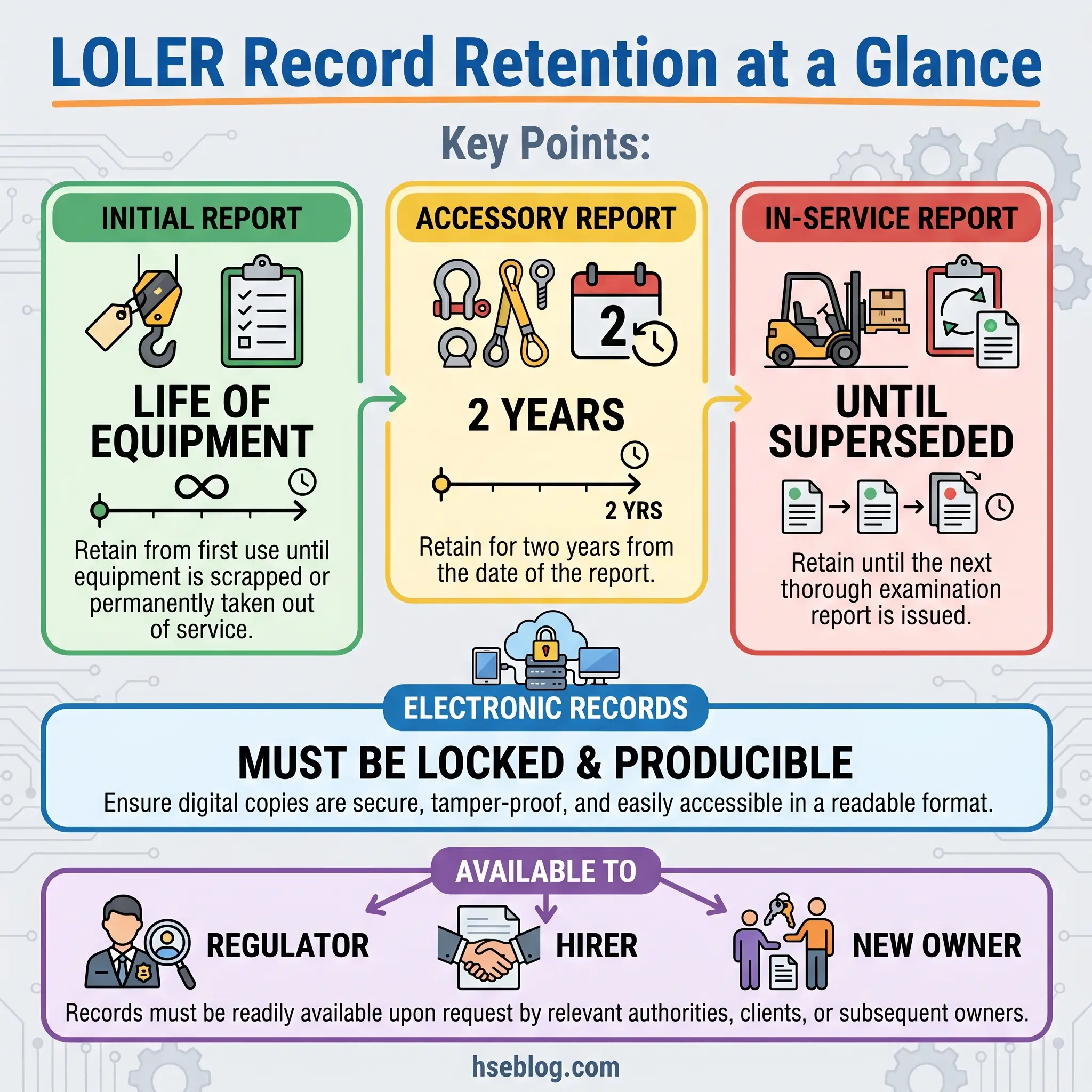
| Initial examination report (before first use) | Life of the equipment | Paper or electronic |
| Lifting accessory examination reports | 2 years from date of report | Paper or electronic |
| In-service examination report (other equipment) | Until next report supersedes it | Paper or electronic |
| Inspection records (interim inspections) | Until next inspection report supersedes them | Paper or electronic |
| Declaration of Conformity (UKCA or EC) | Life of the equipment (recommended) | As supplied |
Records may be held electronically — Regulation 11 does not require paper — but electronic records must be protected from unauthorised alteration and producible in written form on request. That matters. A PDF library with no version control, no access restrictions, and no audit trail on edits is not a compliant electronic record system. Most of the LEEA-accredited digital reporting platforms now in use on UK sites meet the standard because they timestamp, lock edits, and retain original versions. Home-made spreadsheets very rarely do.
Records must also be available to the enforcing authority on request, to anyone hiring or using the equipment at a different location, and to a second-hand buyer if the equipment is sold. This is why traceable unique identifiers on accessories matter — a sling with no ID cannot be matched to its report, and a report with no matching sling is worth nothing to an inspector.
The industry shift toward QR-code asset tagging, LEEA-accredited electronic reporting, and CFTS digital certificates has made all of this significantly easier than it was a decade ago. If your site is still running on a paper file and a spreadsheet, the trigger to migrate is usually the first real audit.
Penalties for LOLER Non-Compliance
The HSE and local authority enforcement powers around LOLER are the same powers that apply across the Health and Safety at Work framework: improvement notices, prohibition notices (which stop the use of equipment immediately), unlimited fines in the Crown Court, and prosecution of individuals — directors, managers, or competent persons — where culpability is high. Since the Sentencing Council's 2015 Health and Safety Offences Definitive Guideline came into force, penalties have been calibrated against risk of harm, culpability, and the turnover of the organisation — with custodial sentences available for individuals in the most serious cases.
Typical fine bands for LOLER-related breaches have ranged from around £10,000 at the lower end to several hundred thousand pounds for serious cases involving large organisations, with higher penalties where fatalities or multiple injuries resulted. The figure matters less than the pattern, which I keep repeating to operations teams who think compliance is expensive: HSE estimates work-related injury and ill health costs the British economy over £20 billion annually, and a single LOLER prosecution following an incident will generally cost a business more than a decade of compliant examination programmes.
The prosecution patterns themselves are consistent across published enforcement notices:
- Equipment operated beyond the date of the last valid examination.
- Category A defects identified but not acted on, with equipment returned to service.
- Reports produced without the examiner attending site, or against a desk-based review of photos.
- Duty holders relying on a Declaration of Conformity that is older than 12 months as justification for skipping first-use examination.
- Hire arrangements where the site operator assumed the hire company carried the duty — they do not.
The last point deserves emphasis because it comes up in enforcement commentary repeatedly. Liability under LOLER cannot be transferred to the examiner, the hire company, or a third-party manager. The duty holder — the employer or person with control of the equipment at the workplace — is the legally responsible party. Contractually, you can require your hire company to provide a current report. Legally, the obligation to ensure it exists and is valid sits with you.
Alongside the 2024/25 provisional HSE figures — 124 worker deaths in Great Britain, with handling, lifting or carrying accounting for around 17% of non-fatal workplace injuries — the case for treating thorough examination as a front-of-mind operational discipline rather than a calendar event gets stronger every year.
Pre-Examination Checklist: How to Prepare Your Site
The single cheapest way to improve the quality of a thorough examination is to prepare for it. A competent person who spends the first two hours of a scheduled visit looking for serial numbers, chasing down Declarations of Conformity, and trying to find the key for the battery room, is a competent person not examining your equipment. The following is the checklist I run 48 hours before any scheduled examination on my site.
- Current equipment register with unique identifiers for every item in scope — make, model, serial number, location, and asset ID. Accessories too, with their own IDs. If an item is not on the register, the examiner cannot certify it.
- Previous Report of Thorough Examination for each item, so the examiner can see what was flagged last time and whether it was remedied.
- Declaration of Conformity (UKCA or EC) where available — essential for first-use examinations, useful for reference on older equipment.
- Manufacturer's manual and records of manufacturer-specified maintenance. The examiner needs the reject criteria and tolerances.
- Incident, overload, or collision history for the past 12 months. Anything that might qualify as exceptional circumstances gets flagged here.
- Lifting plans and risk assessments for current operations — supports the PUWER side of any combined examination.
- Operator training records for any equipment requiring trained operators (forklifts, MEWPs, cranes). PUWER Regulation 9 requires adequate training; the examiner may verify.
- SWL markings legible and visible on every item. If a marking is worn or painted over, fix it before the examination — the examiner cannot sign off SWL confirmation on equipment where the marking is unreadable.
- Physical access to each item. Equipment should be available and not in active use during its examination slot. Forklifts off the floor, MEWPs with access to their maintenance positions, accessories laid out rather than in use.
- Nominated site contact who knows where every item is, has the keys, and can answer questions on operational history. One person, not five.
Print that list, give it to whoever manages the asset register, and work through it the week before each scheduled examination. You will notice the difference in the quality of the report you receive — and so will your auditor.
The HSE's free INDG422 leaflet is worth downloading and circulating to anyone on site who needs a quick reference on what a thorough examination is and what it involves.
Frequently Asked Questions
Is a LOLER thorough examination the same as an inspection?
No — they are distinct under the regulations. A thorough examination is the systematic, detailed assessment by a competent person that produces a written Schedule 1 report under Regulation 9. An inspection is a lighter-touch check required by Regulation 9 between thorough examinations where the risk of deterioration warrants it, recorded but without the Schedule 1 depth. Equipment can require both. They are not interchangeable.
Do I need a thorough examination if the equipment is brand new?
New equipment with a UKCA or EC Declaration of Conformity less than 12 months old generally does not require a separate first-use examination, provided the equipment does not depend on conditions of installation. If it was assembled on site — a platform lift, a tower crane, a mezzanine goods lift — first-use examination is mandatory regardless of how recent the Declaration is. The conformity document covers the factory build. It cannot certify how the item was installed in your building.
Who is the "duty holder" under LOLER?
The duty holder is the employer or self-employed person providing lifting equipment for use at work, together with anyone who owns, operates, or has control over the equipment. On a hired forklift used by your staff on your premises, you are the duty holder. On a contractor's crane operating within your site boundary, the picture is more layered — but your duty as the occupier does not disappear because a contractor brought the machine. Responsibility cannot be contracted away.
Can I do LOLER thorough examinations in-house?
Yes, provided the person carrying them out is genuinely competent, independent, and impartial for the equipment class. The non-negotiable rule is that the examiner cannot be the same individual who performs routine maintenance on the equipment — ACOP L113 is explicit on this. Some large operators maintain their own qualified examination engineers successfully; smaller sites usually find it more practical to use an external competent person accredited through LEEA or CFTS.
What happens if lifting equipment fails its thorough examination?
It depends on the defect category. A Category A defect removes the equipment from service immediately, the competent person notifies the enforcing authority, and the equipment cannot return to service until the defect is remedied and re-examined. Category B defects carry a specified repair timescale and equipment may continue in use only if the examiner's controls allow it. Category C defects are monitored and corrected at the next service. Ignoring any of them is a direct route to enforcement.
Does LOLER apply to hired or leased lifting equipment?
Yes. The site operator using the equipment is the duty holder and is legally responsible for ensuring a valid Report of Thorough Examination is in place — even when the hire company arranged the examination. In practice, the hire contract will usually confirm who arranged the current certificate, but the legal duty to confirm its validity before use sits with the hirer. Accept no item on site without a current, legible report in hand.
How long should a Report of Thorough Examination be kept?v
Initial examination reports are retained for the life of the equipment. Reports on lifting accessories are retained for two years from the date of the report. In-service examination reports on other equipment are retained until the next report supersedes them. Inspection records are kept until the next inspection is recorded. Declarations of Conformity should be retained for the life of the equipment even though LOLER does not specify this directly.
Conclusion
The habits that separate a compliant site from a non-compliant one, under LOLER, are almost entirely administrative — not technical. Schedule the examinations against a traceable register. Accept reports only after checking them against the 11 Schedule 1 items. Treat Category A defects as immediate operational stops, not negotiation points. Keep electronic records that meet the Regulation 11 standard for lock-down and retrievability. Verify every hired item has a current report before it operates, and document that verification. None of that requires engineering judgement — it requires a management system that a regulator can inspect and a duty holder can defend.
The engineering judgement sits with the competent person, and that is exactly where the regulation wants it. Your job as duty holder is to put that person in front of the right equipment, at the right interval, with the right information, and then to act without delay on what they tell you. The thorough examination of lifting equipment is the mechanism through which a lifting operation remains safe between the day it was commissioned and the day it leaves your site — and for most duty holders, the gap between doing it well and doing it badly is not the skill of the examiner, but the preparation and response of the organisation around them.