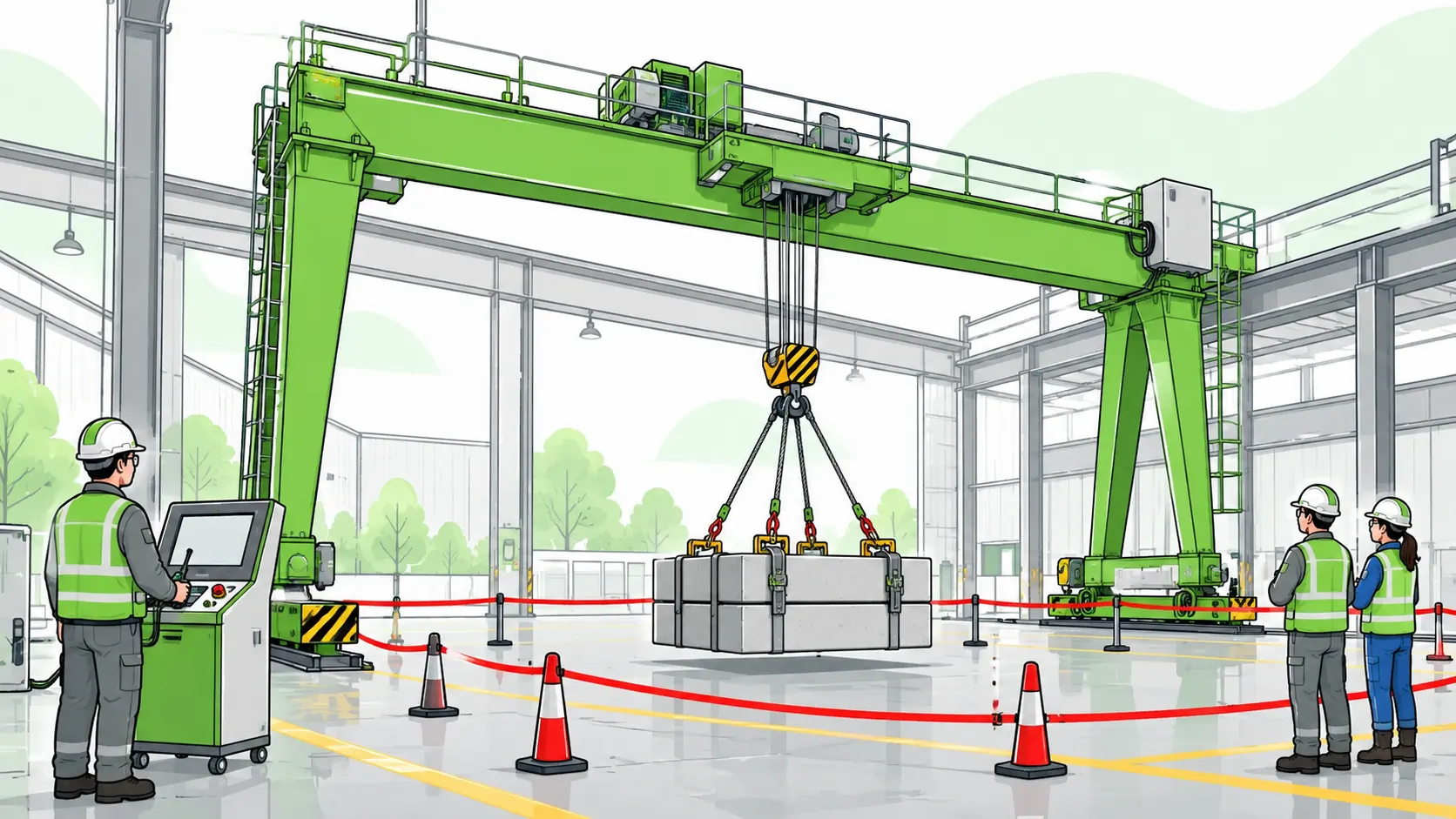
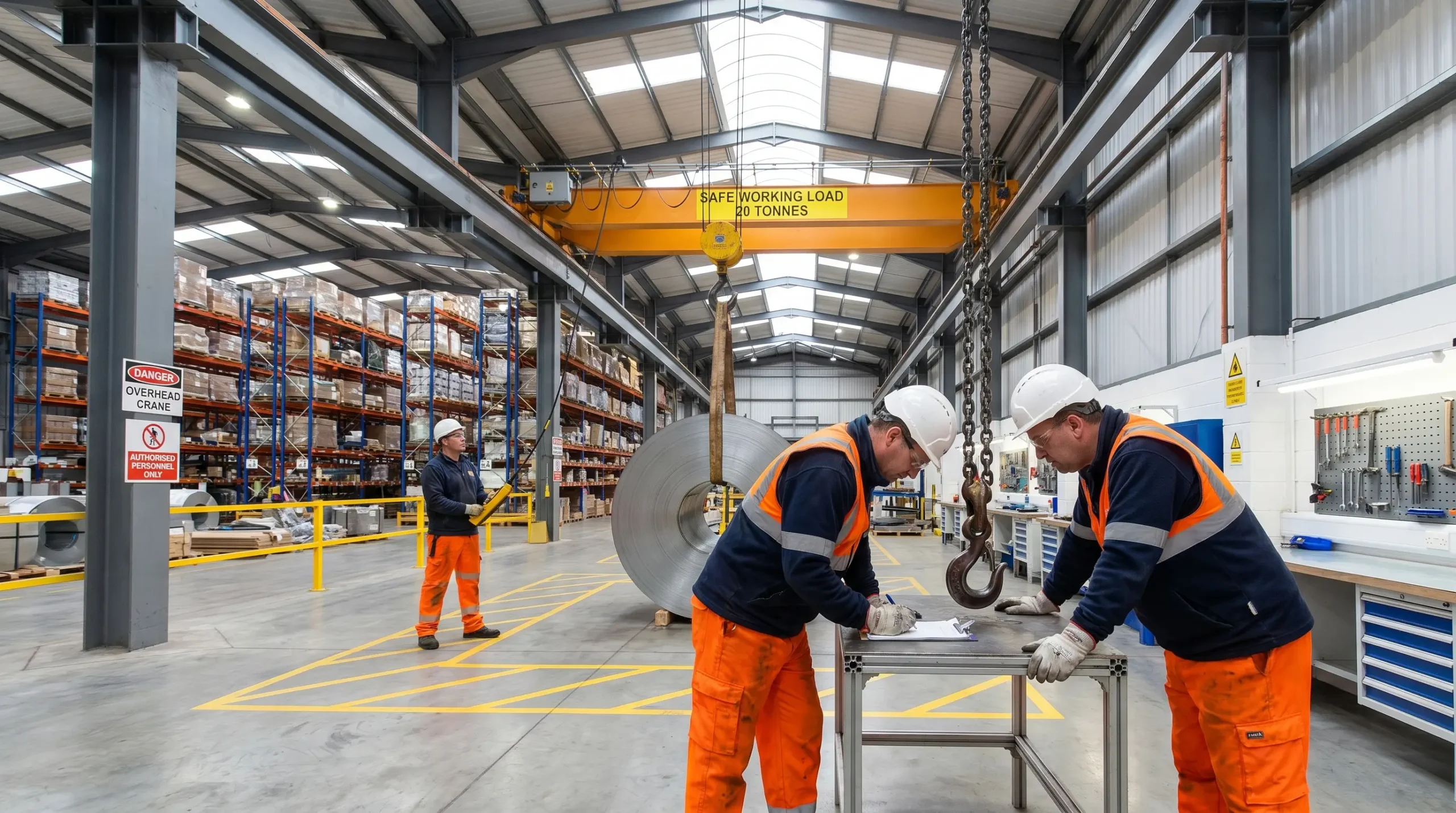
Pre-shift handover at our Midlands distribution hub, six-fifteen on a Monday. The overhead gantry crane above Bay 4 was due back into service after weekend repair work, and the thorough examination certificate our LEEA-accredited surveyor had signed off on the Friday was sitting on the supervisor's clipboard. The operator wouldn't touch the pendant until that document was physically in his hand and the Safe Working Load plate on the crab was verified clean and legible. Forty seconds of paperwork confirmation before a five-tonne coil ever left the floor — that small friction is the heartbeat of LOLER.
That friction exists because the alternative is measured in bodies. Between April 2024 and March 2025, 124 workers died in work-related incidents across Great Britain, and handling, lifting or carrying accounted for 17% of all non-fatal workplace injuries that year — the second-largest single category. This guide walks through LOLER (Lifting Operations and Lifting Equipment Regulations 1998) the way duty holders actually need to understand it: what it covers, how it differs from PUWER, who counts as a competent person, what a thorough examination involves, and how to comply without drowning in paperwork. We will work through all 17 regulations, the three tiers of inspection, the planning duty under Regulation 8, and the enforcement reality that has produced six-figure fines and custodial sentences since the sentencing guidelines changed in 2015.
What is LOLER? A Plain-English Definition
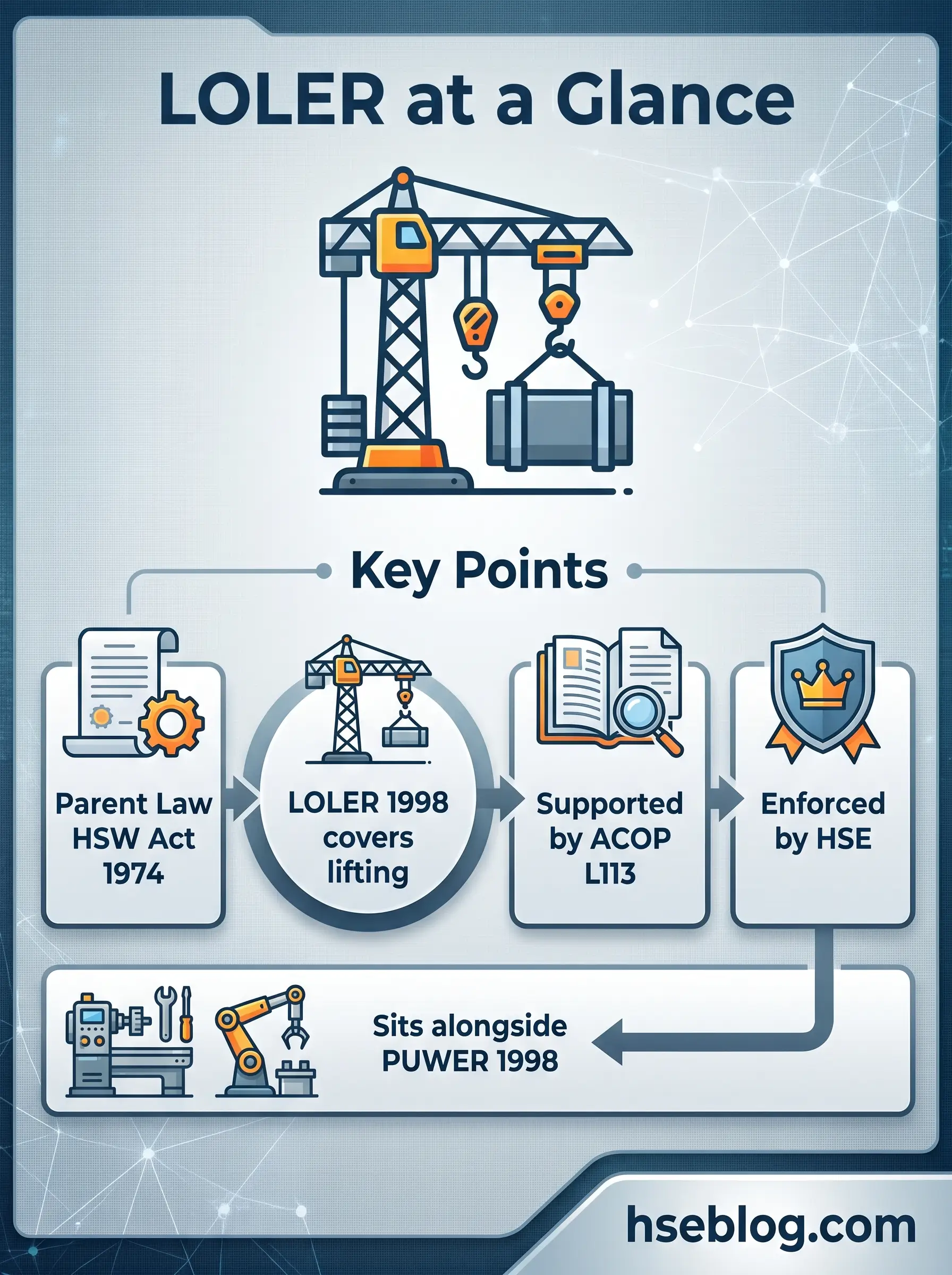
LOLER is the common name for the Lifting Operations and Lifting Equipment Regulations 1998, made under the Health and Safety at Work etc. Act 1974 and brought into force on 5 December 1998 as Statutory Instrument 1998 No. 2307. It sets specific, enforceable duties on anyone whose work involves lifting equipment or lifting operations, and it is enforced by the Health and Safety Executive across Great Britain. The HSE's own landing page at hse.gov.uk/work-equipment-machinery/loler.htm is the authoritative starting point for any duty holder.
The regulations are supported by the Approved Code of Practice L113, "Safe use of lifting equipment," which carries special legal status under Section 16 of the HSW Act — a court will treat a failure to follow the ACOP as evidence of breach unless the duty holder can show they met the underlying duty by some other equivalent means. ACOP guidance is not optional wallpaper. When you combine the regulations themselves with L113, you have the operating manual for every lift in the country, from a care home's patient hoist to a tower crane on a high-rise contract.
The core purpose is narrower than people assume. LOLER exists to reduce one specific class of risk — the risk that arises from lifting operations and the lifting equipment used to carry them out. Everything else about work equipment sits under PUWER 1998, which we will come back to later.
Why LOLER Exists: The Problem It Solves
124 worker fatalities across Great Britain in 2024/25 is the grim backdrop for every conversation about lifting. Construction alone accounted for 35 of those deaths, and while falls from height remained the single largest cause, struck-by-load and equipment-collapse incidents continue to feature in HSE's annual statistics with depressing regularity. Lifting equipment, when it fails, tends to fail catastrophically. A sling parts, a jib collapses, a patient hoist gives way — and the person underneath has no reaction time.
Before LOLER, Great Britain's lifting rules were scattered across a patchwork of older statutes — the Factories Act 1961, the Construction (Lifting Operations) Regulations 1961, the Docks Regulations 1988, and several others — each covering a narrow slice of workplaces and leaving awkward gaps between them. The 1998 regulations consolidated those duties, extended them to every workplace, and implemented the European Amending Directive to the Use of Work Equipment Directive. A single, coherent regime replaced a dozen fragmented ones.
PUWER 1998 covers all work equipment — drills, conveyors, presses, the lot — but its general provisions cannot carry the specific weight that lifting demands. Load calculation, stability under load, periodic statutory examination, formal lift planning, Safe Working Load marking — these are lifting-specific duties that general work equipment law was never designed to address. LOLER fills that gap.
Who Does LOLER Apply To?
Confusion about who actually holds LOLER duties is the single most common reason compliance failures turn up in audits. A site manager will tell you the hire company is responsible because the equipment is theirs; the hire company will tell you the user is responsible because they have control on site. The regulations resolve that argument unambiguously.
LOLER applies to:
- Employers whose employees use lifting equipment at work, in any sector.
- Self-employed persons who use lifting equipment for their own work.
- Anyone with control over lifting equipment — whether it is owned, hired, leased, loaned, or second-hand.
- Contractors operating on another party's site, including sub-contractors carrying out discrete lifting tasks.
- Duty holders on offshore installations and activities on the GB continental shelf, by virtue of the Health and Safety at Work etc. Act (Application Outside Great Britain) Order 2013.
The regulations do not apply to private domestic use — a homeowner jacking up a car on their driveway is not a LOLER duty holder. They do apply the moment that same jack is used by a self-employed mechanic working under their business name. "At work" is the trigger, and control is the test.
Where a hire arrangement is in place, both the hirer and the user usually share duties. The hire company is responsible for placing compliant equipment into service with a valid thorough examination; the user is responsible for the lift planning, the operator's competence, pre-use checks, and keeping the equipment within its intended use during the hire period. Neither party can shift its duties onto the other by contract — that is a point the HSE has made repeatedly in enforcement cases.
What Equipment Does LOLER Cover?
The definition is deliberately broad. Lifting equipment means any work equipment used for lifting or lowering loads, and a load includes a person. That sweep captures far more than most duty holders initially expect, which is why a first-pass equipment audit at a new site almost always adds items to the LOLER register.
| Equipment Type | Typical Setting | Default Examination Frequency |
|---|---|---|
| Mobile, tower, overhead and vehicle-mounted cranes | Construction, ports, manufacturing | 12 months (6 if lifting persons) |
| Forklifts, telehandlers, reach stackers | Warehousing, construction, logistics | 12 months |
| Passenger and goods lifts, platform lifts, stairlifts | Commercial buildings, healthcare | 6 months (lifting persons) |
| Vehicle tail lifts and inspection pit lifts | Transport, vehicle workshops | 6 months |
| Scissor lifts and MEWPs | Facilities maintenance, construction | 6 months |
| Patient hoists and slings | Hospitals, care homes | 6 months |
| Lifting accessories — chains, slings, shackles, eyebolts, spreader beams | All sectors | 6 months |
| Rope access and cradle equipment | Facade cleaning, inspection | 6 months |
Lifting accessories are the line item that catches most organisations out. A warehouse may have its forklifts on a disciplined 12-month cycle but keep three or four spare lifting slings in a tool cupboard that nobody has ever entered onto the register. Those accessories are equipment in their own right under LOLER, they require their own Safe Working Load marking, and they need thorough examination every six months.
What Equipment is NOT Covered by LOLER?
LOLER's scope is broad, but it is not infinite. Some equipment that involves vertical movement is expressly outside the regulations — either because it is governed by different law or because the risk profile is handled elsewhere.
- Escalators and moving walkways — covered by Regulation 19 of the Workplace (Health, Safety and Welfare) Regulations 1992.
- Simple pallet trucks that raise a load only clear of the ground to allow movement, with no stacking or reaching function.
- Ships' lifting equipment — covered by merchant shipping legislation under the HSE/MCA/MAIB Memorandum of Understanding.
- Stairlifts and platform lifts in private dwellings or for non-workers such as customers using a shopping centre passenger lift.
- Conveyor systems designed for continuous material transport rather than lifting discrete loads.
A lift that falls outside LOLER is not a regulatory-free zone. PUWER almost always picks it up, the HSW Act always applies, and product safety legislation governs placing it on the market. LOLER simply does not add its own specific layer on top.
The 17 Regulations of LOLER: Structured Breakdown
Most summaries of LOLER pick three or four regulations and leave the rest unsaid. That approach produces managers who can cite Regulation 9 by heart but have no idea what Regulation 6 requires. The full statutory text sits at legislation.gov.uk/uksi/1998/2307/contents for anyone who wants it cold. The table below walks through all 17 — group by group — with the practical action each one demands.
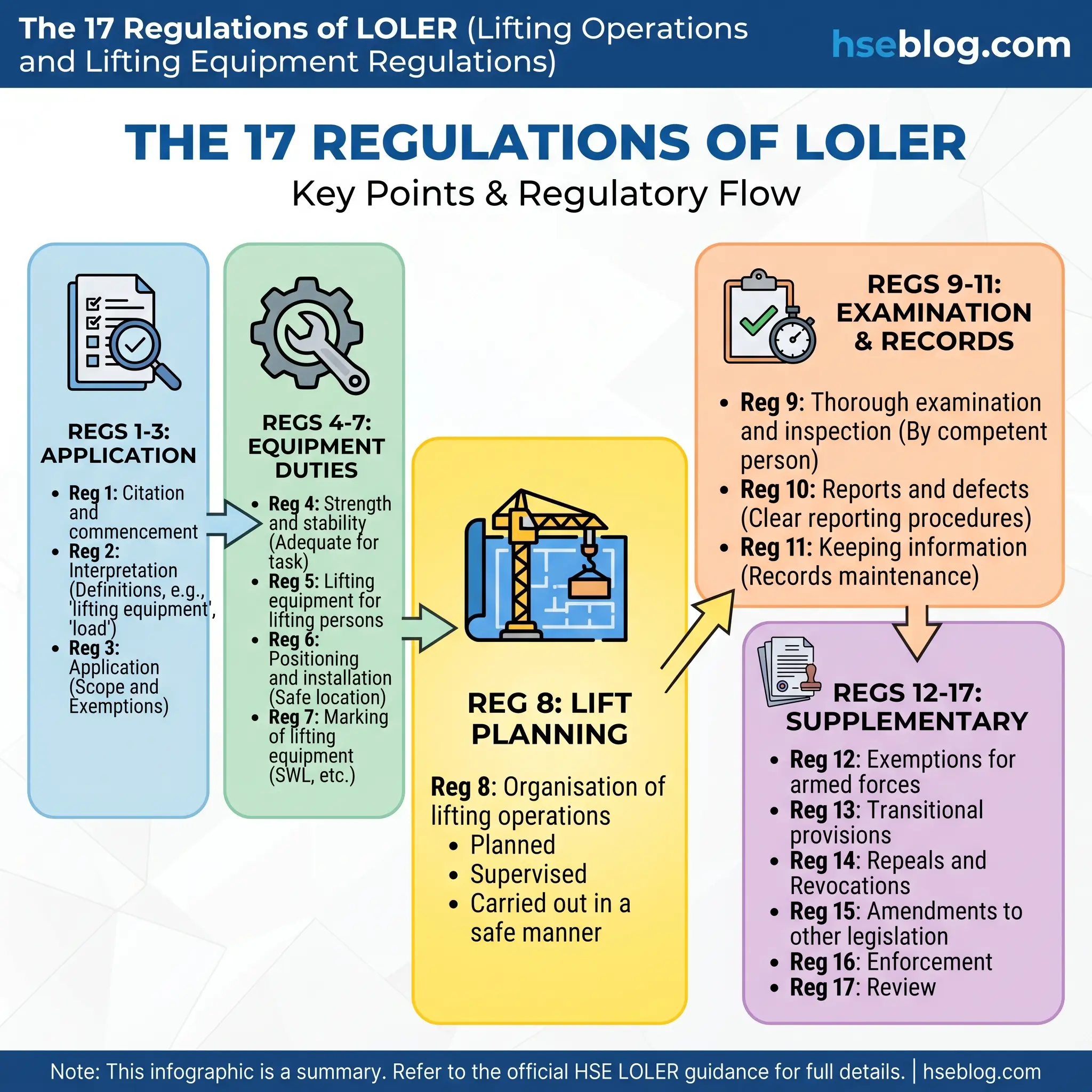
| Reg | Title | Plain-English Meaning | Practical Action |
|---|---|---|---|
| 1 | Citation and commencement | Names the regulations and sets the start date | Reference SI 1998/2307 in policies |
| 2 | Interpretation | Defines "lifting equipment," "lifting operation," "accessory for lifting" | Use statutory definitions in your LOLER register |
| 3 | Application | Sets scope — work activities, employers, self-employed, offshore | Confirm your activities are in scope |
| 4 | Strength and stability | Equipment and accessories must be adequate for the load and stable | Calculate loads, assess ground bearing, verify SWL margin |
| 5 | Lifting equipment for lifting persons | Extra safeguards where people are lifted — no free-fall, anti-crushing, emergency features | Use person-rated equipment only; check emergency descent |
| 6 | Positioning and installation | Minimise risk of striking people, drifting, falling, or unintended release | Establish exclusion zones, verify anchor points |
| 7 | Marking | SWL clearly shown; accessories individually identified and marked | Audit every item for legible marking |
| 8 | Organisation of lifting operations | Every lifting operation must be planned, supervised, and carried out safely | Appoint competent planner; document lift plan |
| 9 | Thorough examination and inspection | Statutory examination intervals and triggers | Schedule 6/12-month examinations; examine on first use |
| 10 | Reports and defects | Written reports; serious defects reported to duty holder and authority | Retain reports; immediate quarantine of defective kit |
| 11 | Keeping of information | Record retention rules | Retain reports until superseded or for two years |
| 12 | Exemption certificates | HSE may exempt for national security | Rarely applicable |
| 13 | Application to Crown | Binds the Crown where lifting activities occur | Relevant to government estate |
| 14 | Repeals and revocations | Removes the older pre-1998 lifting regulations | Context only |
| 15-17 | Northern Ireland, offshore, general | Extend or limit jurisdictional reach | Check if you operate offshore or in NI |
The regulations you will touch every week are 4, 7, 8, 9, and 10. The others set the frame.
Planning a Lifting Operation: Regulation 8 in Practice
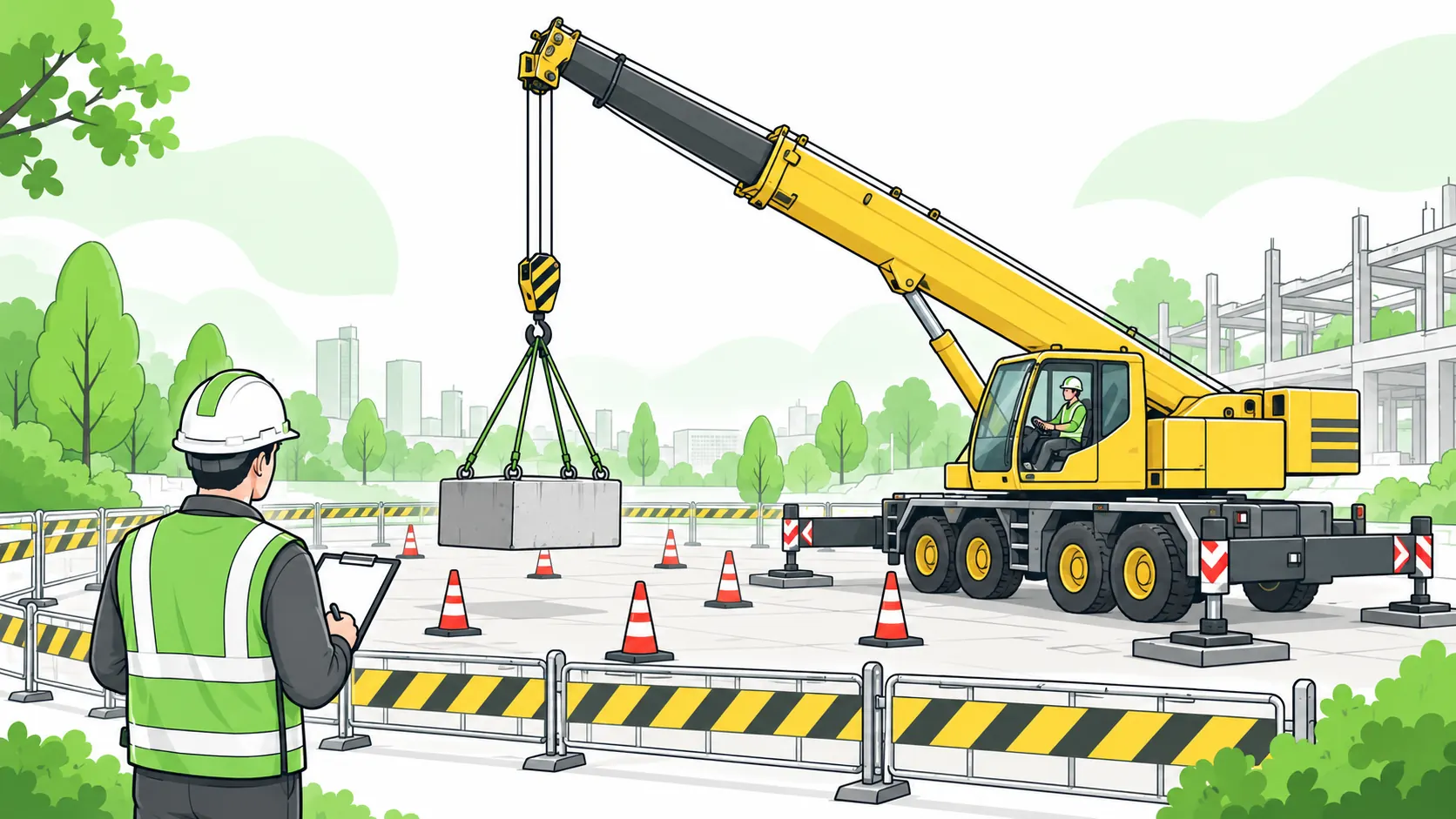
Regulation 8 is the one that separates organisations that understand lifting from those that just own equipment. It requires every lifting operation to be properly planned by a competent person, appropriately supervised, and carried out in a safe manner. The duty scales with risk — a routine forklift pallet transfer in a warehouse does not require the same planning treatment as a tandem lift positioning a rooftop chiller with two mobile cranes.
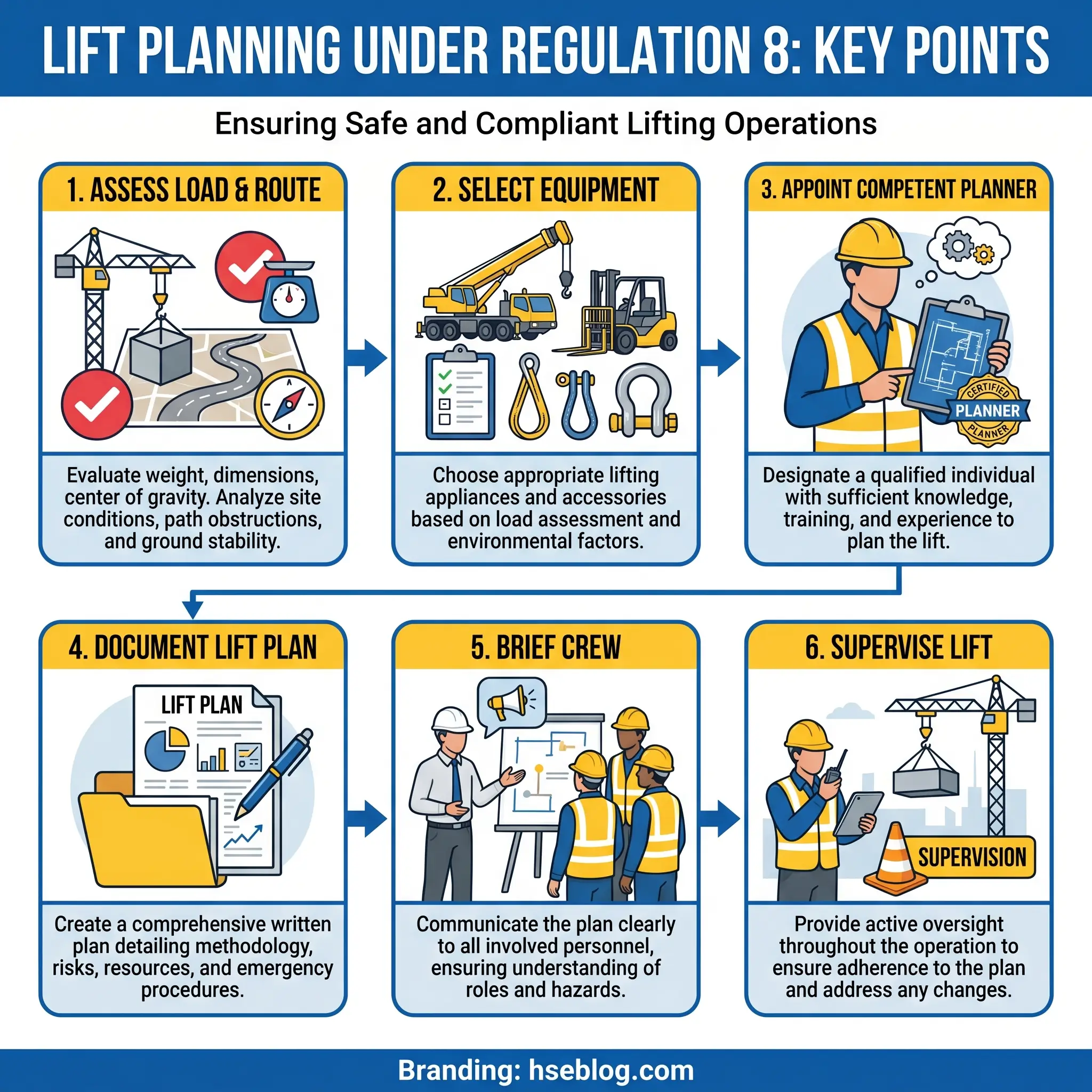
For simple, repetitive lifts — stock rotation in a distribution centre, for example — a generic risk assessment combined with a documented safe system of work will usually satisfy Regulation 8. The trained operator, the inspected truck, the marked racking, and the pre-use check log carry the weight.
Complex lifts demand a written lift plan. The triggers are well-established across industry:
- Tandem lifts using two or more cranes.
- Lifts close to overhead power lines or other live services.
- Lifts over occupied buildings, public spaces, or working crews.
- Tower crane erection, climbing, and dismantle.
- Lifts where the load exceeds 75% of the crane's rated capacity at radius.
- Lifts involving irregular loads where the centre of gravity is uncertain.
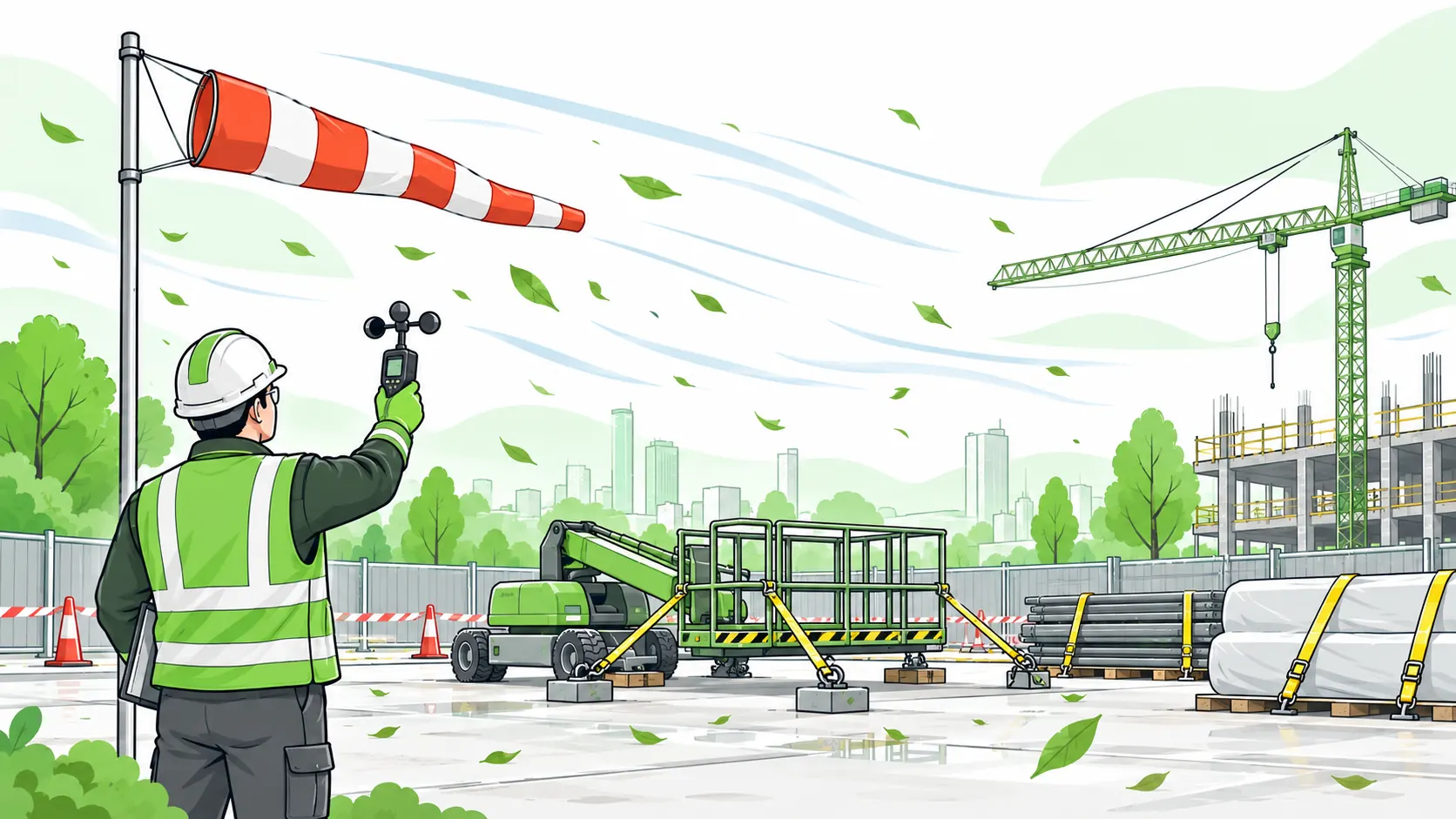
A competent lift plan covers the load — weight, dimensions, centre of gravity, attachment points — the equipment selection with duty chart verification, the ground and site conditions including any outrigger mat calculations, the exclusion zone, the communication method, the weather cut-offs, and the emergency response including rescue arrangements if people are being lifted. BS 7121, the industry Code of Practice for Safe Use of Cranes, is the reference standard for crane operations and formally defines the Appointed Person role — typically a holder of the CPCS A61 qualification or equivalent demonstrated competence.
I learned the value of a written lift plan the hard way watching a site team try to reverse-engineer one during an HSE inspection visit. The Appointed Person had done the arithmetic in his head and briefed the crew verbally. The visit didn't end with a prohibition notice — the lift was technically sound — but the improvement notice that followed cost the contractor three days of reprogramming and a board-level conversation they didn't enjoy.
Thorough Examinations: Frequency, Scope and Records
The statutory thorough examination under Regulation 9 is the heart of LOLER compliance. It is not the same thing as a pre-use check or a routine maintenance inspection, and conflating the three is the fastest route to non-compliance. HSE's own guidance at hse.gov.uk/work-equipment-machinery/thorough-examinations-lifting-equipment.htm sets out the distinctions in detail.
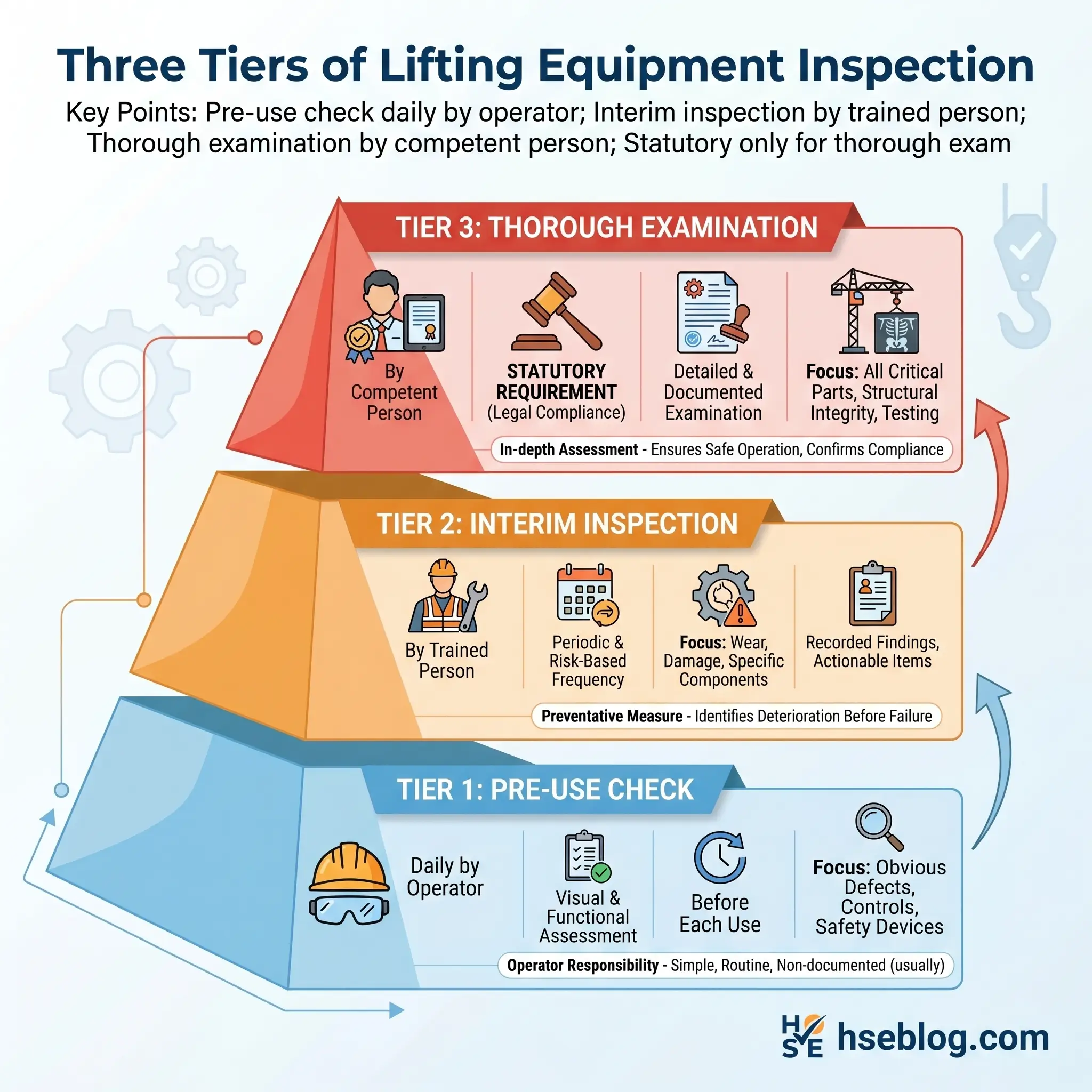
The three tiers work as follows:
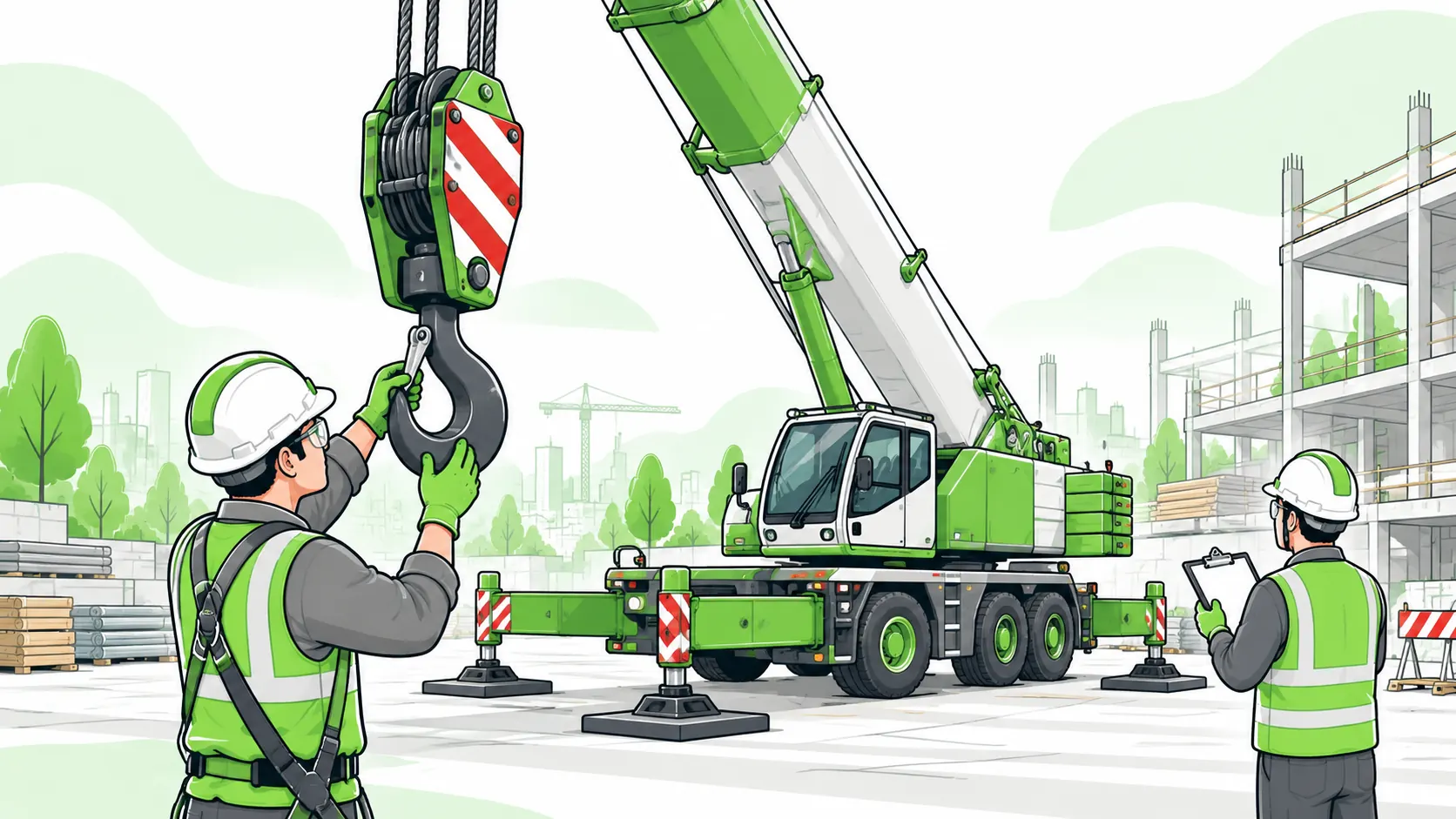
- Pre-use checks happen every shift, carried out by the operator. They are visual and functional — brake test, hook latch, sling condition, warning devices, tyre pressures where relevant. They are not statutory under LOLER, but PUWER Regulation 6 and any competent safe system of work make them functionally compulsory.
- Interim inspections sit between the operator's pre-use check and the statutory thorough examination. They are carried out by a trained person — often a supervisor or a maintenance technician — on a weekly, monthly, or quarterly cycle set by the duty holder's risk assessment. They catch deterioration before it becomes a failure.
- Thorough examinations are statutory. They are conducted by a competent person independent of the maintenance of that equipment, they follow a documented methodology, and they produce a written report under Schedule 1.
The default intervals are fixed in Regulation 9:
- Every 6 months for lifting equipment used to lift persons.
- Every 6 months for all lifting accessories.
- Every 12 months for all other lifting equipment.
- At any interval set by a written examination scheme drawn up by a competent person, where that scheme is based on engineering assessment of the specific equipment and duty cycle.
Additional thorough examinations are required on first use of new equipment (unless covered by a valid Declaration of Conformity less than 12 months old and not assembled on site), after installation at a new location if safety depends on the installation conditions, and following exceptional circumstances such as overload, a collision, prolonged disuse, or modifications affecting safety.
What is a Thorough Examination?
A thorough examination is a systematic and detailed assessment of lifting equipment and accessories by a competent person, carried out to identify defects or weaknesses that may affect safe use. It goes beyond a visual walk-around. It typically includes visual inspection of safety-critical components including load-bearing parts and attachment points, functional testing of limits, brakes, interlocks and emergency stops, dimensional checks on hooks, chains, and wear-rated components, and — where engineering judgement requires it — non-destructive testing or proof load testing. The examiner signs a report under Schedule 1 confirming the equipment is safe to continue in service, or flagging defects that require action.
Who is a Competent Person Under LOLER?
The regulations use the term "competent person" but deliberately do not define it in specifics — a drafting choice that has caused more grief than any other in LOLER. ACOP L113, available at hse.gov.uk/pubns/books/l113.htm, fills the gap at paragraph 296, setting the standard as someone with "such appropriate practical and theoretical knowledge and experience of the lifting equipment to be examined as will enable them to detect defects or weaknesses and to assess their importance in relation to the safety and continued use of the equipment."
"Practical and theoretical" is the operative phrase. A time-served engineer with no formal qualification can be competent; a freshly certified graduate with no field exposure usually cannot. The common qualification routes are LEEA Diploma certification, engineer surveyor accreditation through an insurance company's inspection arm, and manufacturer-specific training for complex proprietary equipment.
The other requirement is independence. The competent person cannot be the individual responsible for maintaining the equipment on a day-to-day basis — the conflict of interest is fatal to the examination's value. This does not rule out in-house examiners. A large manufacturer or rail operator may legitimately employ its own competent persons, provided they sit organisationally separate from the maintenance function and follow a documented impartiality protocol. Most organisations find it cleaner and cheaper to contract with a LEEA-accredited inspection body or with their equipment insurer's engineering team.
When a newly appointed site supervisor asked me last autumn whether the fitter who greased our overhead gantry could also sign off its thorough examination, the answer was the same three-word sentence LEEA have been repeating for decades: "No — different people." Once he understood why, he never asked again.
Do not confuse the competent person for thorough examination with the Appointed Person for lifting operations planning. They are distinct roles, they usually require different qualifications, and the same individual rarely holds both for the same lift.
Marking Lifting Equipment: Safe Working Load Requirements
Regulation 7 sets the marking rules. Every piece of lifting equipment must display its Safe Working Load clearly and durably. Accessories must each be individually identified and marked — a yard full of unmarked slings is a yard full of non-compliant accessories, regardless of how well their manufacturer's paperwork has been filed.
Where equipment has a variable SWL — a mobile crane with a boom that can configure to different radii, an engine hoist with multiple hook positions, a spreader beam with adjustable attachment points — the full range must be available to the operator, either on a durable plate, a load chart in the cab, or an integrated display.
Equipment used for lifting persons must be marked as such, visibly and unambiguously, so that it cannot be confused with similar materials-only equipment on the same site. The marking should survive the working life of the equipment; paint that fades under a year of outdoor exposure will not.
Since 1 January 2021 the UKCA mark has replaced the CE mark for lifting equipment placed on the Great Britain market, although successive Government extensions have kept CE marking acceptable for placement into GB service into 2026 and beyond for most product categories. Northern Ireland continues to operate under the Windsor Framework, meaning CE or UKNI marking applies there. Duty holders procuring new equipment in 2026 should verify the applicable regime for the market of placement rather than assuming the pre-Brexit position.
Record-Keeping and Reporting Obligations
Regulations 10 and 11 handle reports and retention. Every thorough examination produces a written report signed by the competent person and delivered to the duty holder as soon as practicable. The report must contain the items set out in Schedule 1:
- Identification of the duty holder and the equipment, including serial number or unique identifier.
- Date of the examination and date by which the next is due.
- Particulars of any defect found, whether it is an existing or potential danger.
- Particulars of any repair, alteration, or replacement required.
- Identification and signature of the competent person.
Where a defect is found that presents a risk of serious personal injury, the competent person has two further duties. They must notify the duty holder immediately — verbally as well as in writing — and they must send a copy of the report to the relevant enforcing authority (HSE, or the local authority where LA enforcement applies). That dual reporting is not a courtesy; it is a legal obligation under Regulation 10, and a competent person who fails to send the report commits a breach in their own right.
Retention periods are straightforward. Reports for lifting equipment must be kept until the next thorough examination report is received, or for two years, whichever is longer. Reports for lifting accessories must be kept until the accessory is disposed of. Digital records are acceptable provided they are tamper-evident — a PDF in a controlled document system is fine; an editable spreadsheet where anyone can alter inspection dates is not.
LOLER vs PUWER: How the Two Regulations Interact
The single most common misconception in lifting compliance is that LOLER and PUWER are alternatives. They are not. For lifting equipment, the two regulations apply in parallel and compliance with both is required.
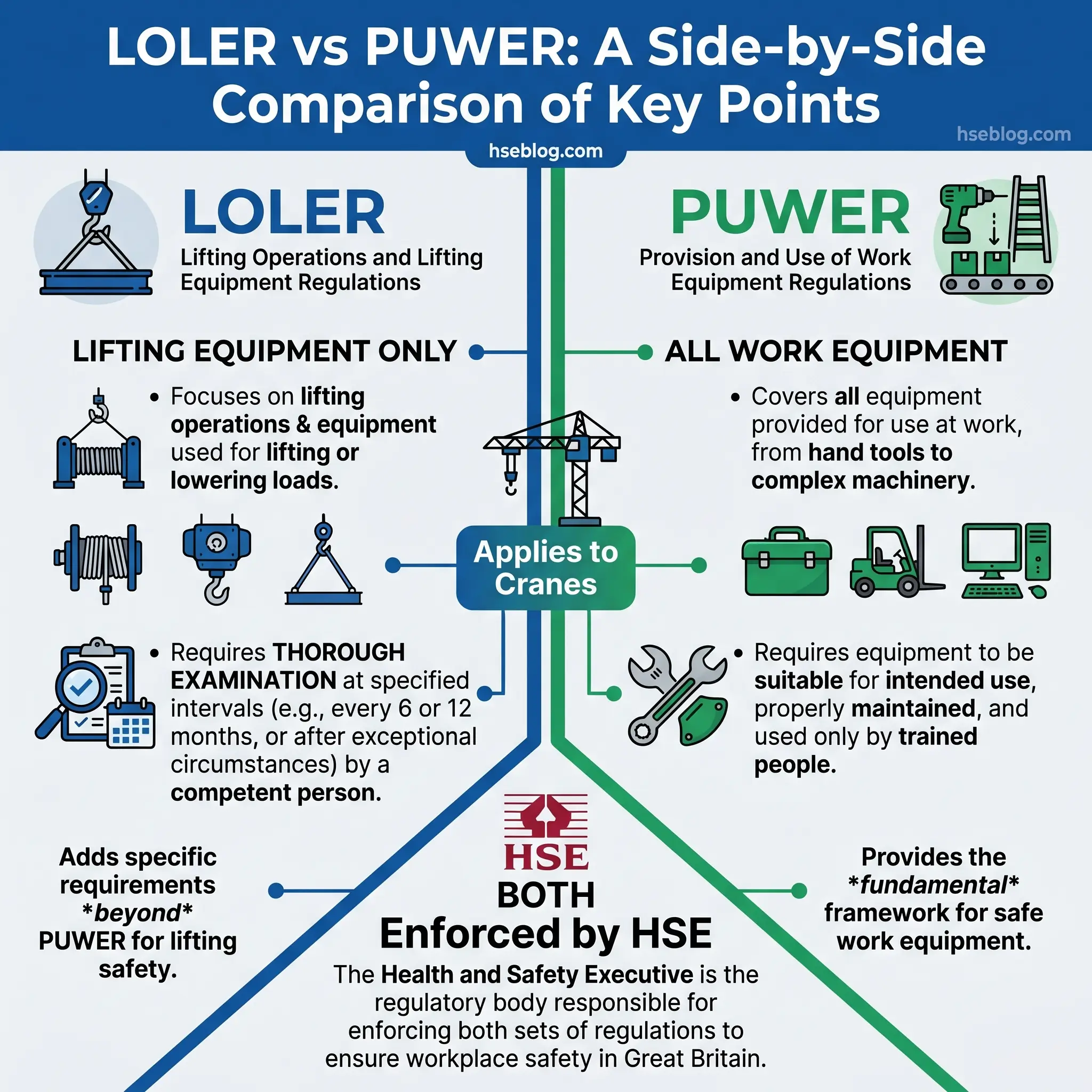
| Feature | PUWER 1998 | LOLER 1998 |
|---|---|---|
| Scope | All work equipment | Lifting equipment only |
| Primary concerns | Selection, suitability, maintenance, training, controls, guarding | Strength, stability, SWL marking, lift planning, statutory examination |
| Inspection requirement | Risk-based inspection under Reg 6 | Statutory thorough examination under Reg 9 |
| Marking requirement | General safety markings | Safe Working Load specifically |
| Applies to a forklift? | Yes | Yes |
| Applies to a drill press? | Yes | No |
| Applies to an escalator? | Yes | No |
Compliance with LOLER does not discharge PUWER duties. A forklift that has a current thorough examination certificate but is missing its PUWER-required operator training, maintenance log, or guarding is still a non-compliant machine. The two regulations overlap deliberately — PUWER sets the baseline for every work equipment item and LOLER adds the lifting-specific layer on top.
Penalties for Non-Compliance: Real Consequences
The Sentencing Council's Definitive Guideline for Health and Safety Offences came into force on 1 February 2016 and changed the penalty landscape for LOLER breaches. Fines are now unlimited in the Crown Court — the previous £20,000 magistrates cap no longer applies once a case moves up — and custodial sentences of up to two years are available for individual duty holders in serious cases.
Recent and representative prosecutions show the enforcement appetite:
- A rail construction contractor was fined £600,000 after exceeding the safe lifting capacity of a crane, following a guilty plea to breaches of LOLER and PUWER.
- A coach company in Wrexham was fined £250,000 after HSE inspectors found 11 pieces of lifting equipment had gone without thorough examination.
- A car manufacturer was fined £200,000 after technicians were found to be using vehicle lifts with unreported defects.
- The Catholic Blind Institute at Christopher Grange nursing home in Liverpool was fined £18,000 with £13,876 in costs after an 81-year-old resident died in 2011 when a patient sling failed during a hoist transfer. The sling had not been subject to a thorough examination.
- A site manager received a two-year custodial sentence after a cradle collapse on a facade project killed a worker, with the investigation identifying failures to examine and inspect the equipment.
Beyond the criminal penalty, conviction carries consequences that often dwarf the fine itself: public listing on HSE's prosecution register, voidance of liability insurance for the underlying incident, loss of PQQ-qualified status on major frameworks, and in serious cases personal disqualification of directors under the Company Directors Disqualification Act 1986.
How to Comply with LOLER: A Practical Checklist
Every site I audit that holds its LOLER regime cleanly does the same twelve things. Every site that stumbles is usually missing three or four of them.
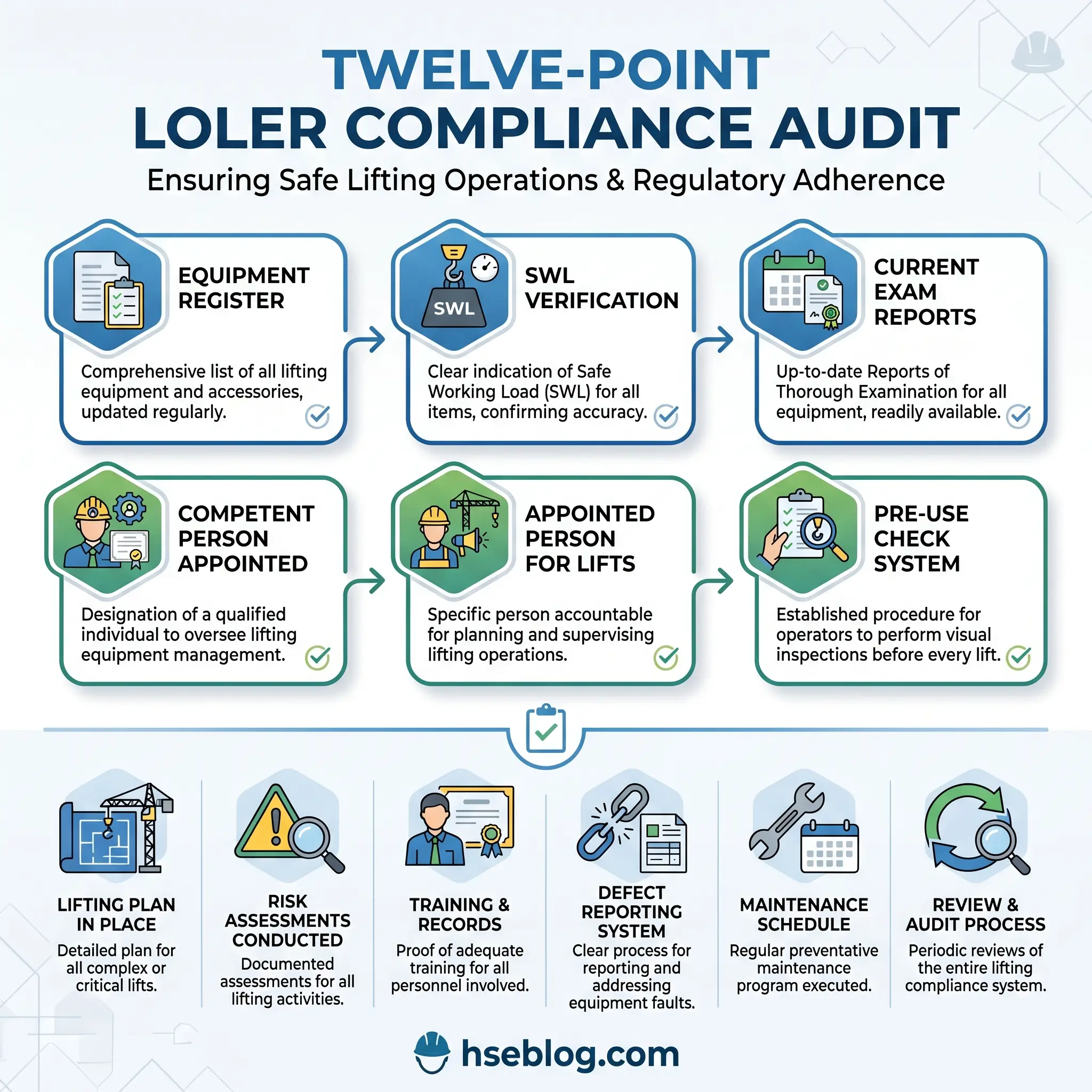
- Maintain a live register of every lifting equipment item and accessory in scope, updated whenever something is hired in, purchased, or disposed of.
- Verify Safe Working Load markings are present, legible, and correct on every item during routine site walks.
- Hold a current, in-date thorough examination report on file for every entry in the register, with the next-due date flagged 60 days ahead.
- Appoint a competent person — in-house or contracted — for thorough examinations, with their qualifications and independence documented.
- Appoint an Appointed Person for lifting operations planning, with CPCS A61 or equivalent competence evidenced.
- Produce written lift plans for every complex lift and generic safe systems of work for routine repetitive lifts.
- Train operators to the equipment they use and keep competence records with refresher dates.
- Operate a documented pre-use check procedure with sign-off by the operator before first use each shift.
- Run a set reminder system for upcoming thorough examination due dates — spreadsheet, CMMS module, or calendar alerts.
- Have a written process for immediate quarantine of defective equipment, including physical lock-out and a red-tag register.
- Retain all thorough examination reports for the statutory minimum and longer where contractual requirements demand it.
- Audit the whole system annually against LOLER, PUWER, and ACOP L113 — and act on what the audit finds.
Frequently Asked Questions
How much does a LOLER thorough examination cost?
There is no single figure, because cost scales with equipment complexity, accessibility, and the number of items examined in one visit. A productive competent person can typically examine between 25 and 150 items in an eight-hour day depending on type — simple lifting accessories at the top of that range, complex tower cranes at the bottom. Most duty holders find that bundling items into a single visit reduces the per-item cost significantly compared with piecemeal call-outs.
What is the difference between a LOLER inspection and a thorough examination?
"LOLER inspection" is colloquial shorthand; "thorough examination" is the statutory term from Regulation 9. If someone quotes you for a "LOLER inspection," clarify whether they mean the full statutory thorough examination by a competent person, a routine operator inspection, or an interim maintenance check. The three are not interchangeable, and only the thorough examination discharges the Regulation 9 duty.
Does LOLER apply to pallet trucks?
A simple hand pallet truck that raises a load only high enough to clear the ground for transport is outside LOLER. The moment a pallet truck is used to lift loads to a stacking height, reach into racking, or operate as a powered lifter, it falls within scope and requires thorough examination. The test is the function, not the nameplate.
Can an employee carry out a LOLER thorough examination in-house?
Yes — nothing in the regulations requires an external examiner. The employee must meet the competent person standard in ACOP L113 paragraph 296, must be independent of the maintenance of the equipment they examine, and must have documented authority to report defects including to the enforcing authority. In practice, most organisations contract examinations to a LEEA-accredited body or an insurance engineering service because the impartiality is easier to evidence.
What happens if a thorough examination finds a defect?
Defective equipment must be taken out of service immediately. If the defect poses a risk of serious personal injury, the competent person notifies the duty holder verbally at once, follows up in writing, and sends a copy of the report to the relevant enforcing authority under Regulation 10. The duty holder then decides whether the defect can be repaired to bring the equipment back into compliant service, or whether it must be disposed of.
Does LOLER apply outside the United Kingdom?
Formally, no. LOLER is Great Britain legislation enforced by the HSE, with parallel application to Northern Ireland under the corresponding NI statutory instrument. In practice, LOLER is widely referenced internationally as a benchmark regime, and many multinational operators apply LOLER-equivalent standards at overseas sites where local lifting regulation is weaker or absent.
Conclusion
If you are reading this as the person ultimately accountable for lifting equipment in your organisation, here is the question worth sitting with: could you, right now, produce a complete register of every lifting item and accessory in your operation, with a current thorough examination report attached to each one, the competent person named, the Appointed Person for planning identified, and evidence that every complex lift in the past quarter had a written lift plan? If the answer involves phrases like "mostly," "I think so," or "let me ask," that gap is your exposure.
LOLER is unusual among health and safety regulations in that it hands duty holders a very clear performance standard. The 17 regulations, the ACOP, the statutory examination cycle, the planning duty, and the reporting rules together set out exactly what compliance looks like. There is no ambiguity about whether you need a thorough examination or whether a defective crane can stay in service. The ambiguity lives only in how well the duty holder has built the systems that make compliance routine rather than reactive.
The next lift your organisation carries out — the forklift move tomorrow morning, the overhead crane pick next week, the cherry-picker hire for the facade works in three weeks' time — is either going to run inside a system that has anticipated it, or it is going to depend on the competence and attention of whoever happens to be on shift. LOLER, properly implemented, means it never has to depend on the latter.