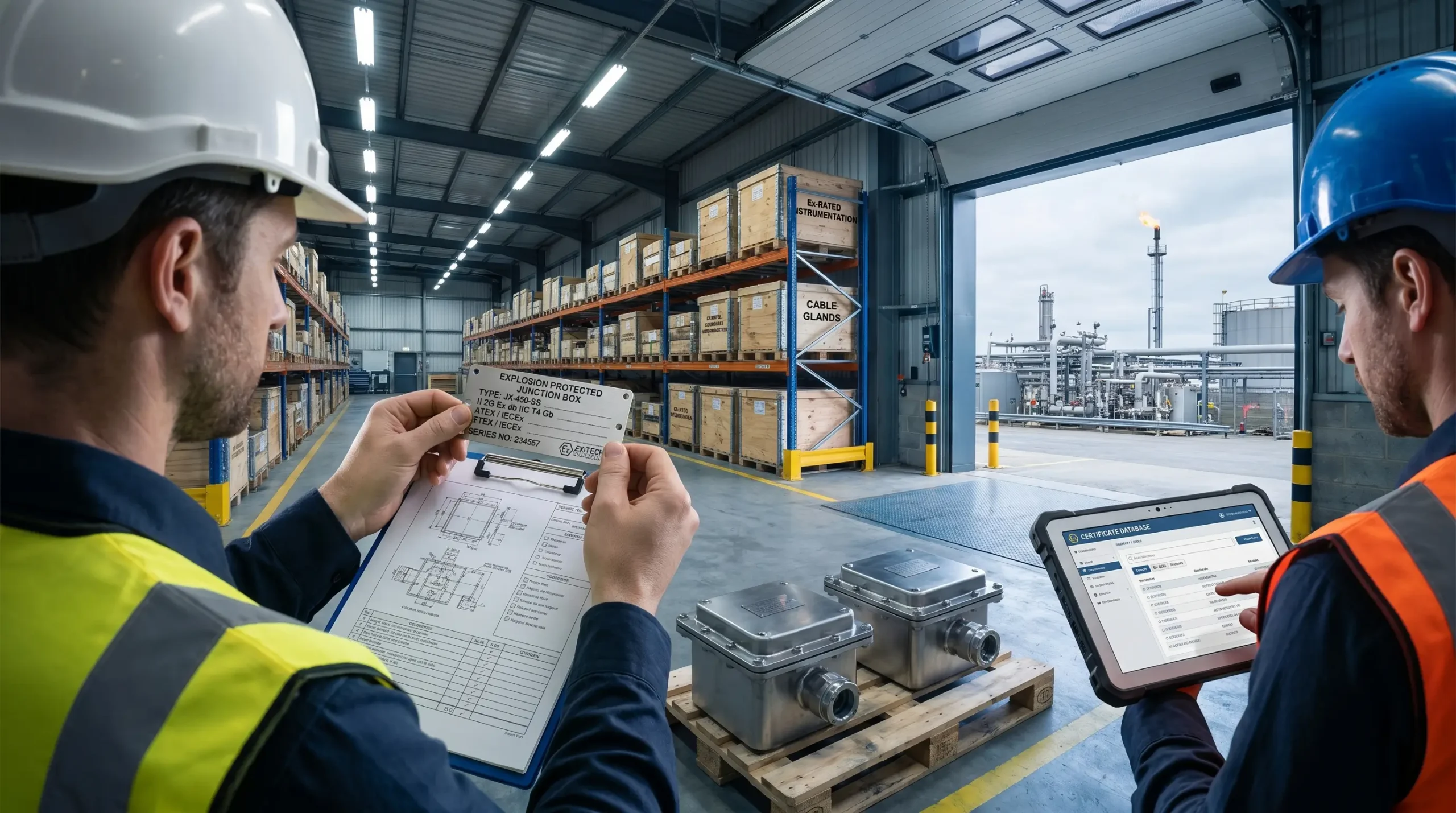
Two junction boxes sat on the receiving dock last Thursday morning. Both rated for Zone 1 gas environments, both from the same manufacturer, both containing identical internal components. One carried a CE mark with ATEX Category 2G designation. The other displayed an IECEx Certificate of Conformity number with EPL Gb. A procurement engineer on a new LNG terminal project picked up both labels, held them side by side, and asked the question I hear at least twice a month: "Are these the same thing?"
They are not. And confusing them — or assuming one substitutes for the other — can stall a project, trigger regulatory non-compliance, or put equipment into service without lawful certification for the jurisdiction where it operates. The ATEX directives and the IECEx scheme both exist to prevent ignition of explosive atmospheres by ensuring equipment meets rigorous safety standards. But they originate from fundamentally different legal and organizational frameworks, follow different certification workflows, and carry different weight depending on where in the world your equipment will be installed. This article breaks down every dimension of the ATEX vs IECEx comparison — from legal standing and certification processes to marking systems, geographic acceptance, cost considerations, and the practical decision framework you need to choose correctly.
What Are ATEX and IECEx? Understanding the Two Certification Systems
Using uncertified equipment in an explosive atmosphere is not a procedural shortcut — it is a potential ignition source with legal consequences attached. Both ATEX and IECEx exist because explosion-protected equipment must be designed, tested, and verified before it enters any environment where flammable gases, vapors, mists, or combustible dusts could reach ignitable concentrations. Between January 2023 and January 2024, Dust Safety Science recorded 263 fires, 53 explosions, 94 injuries, and 62 fatalities related to combustible dust globally. Electrical faults account for roughly 22% of industrial fires. These numbers underscore why certification is not administrative overhead — it is the engineered barrier between normal operations and catastrophic failure.
Where the two systems diverge is in their origin, legal authority, and operational scope. Understanding each one individually is the prerequisite for understanding how they compare.
ATEX: The European Regulatory Framework
ATEX is not a voluntary standard or a certification preference. It is European Union law. The name derives from "ATmosphères EXplosibles," and it encompasses two directives that work in tandem. Directive 2014/34/EU — the ATEX Equipment Directive — defines essential health and safety requirements (EHSRs) and conformity assessment procedures for equipment and protective systems intended for use in explosive atmospheres. It replaced the earlier Directive 94/9/EC in April 2016 and applies to manufacturers and importers placing products on the EU market. The sixth edition of its guidelines was issued in January 2026, confirming that this regulatory framework continues to evolve actively.
The companion directive, 1999/92/EC — the ATEX Workplace Directive — addresses the employer's obligations. It requires employers to classify hazardous areas into zones, assess explosion risks, and implement protective measures for workers potentially at risk from explosive atmospheres. Together, these two directives cover the entire lifecycle: how equipment is built and how it is used.
A point that frequently gets overlooked in comparison articles: ATEX covers both electrical and non-electrical equipment. Mechanical assemblies, protective systems, and components all fall within its scope. This breadth is important for procurement teams sourcing complete packages for hazardous installations.
IECEx: The International Certification Scheme
The IECEx system operates on a different foundation entirely. Managed by the International Electrotechnical Commission, IECEx is a voluntary, standards-based certification scheme — not a law or regulation. Its full name — the IEC System for Certification to Standards Relating to Equipment for Use in Explosive Atmospheres — signals its scope clearly.
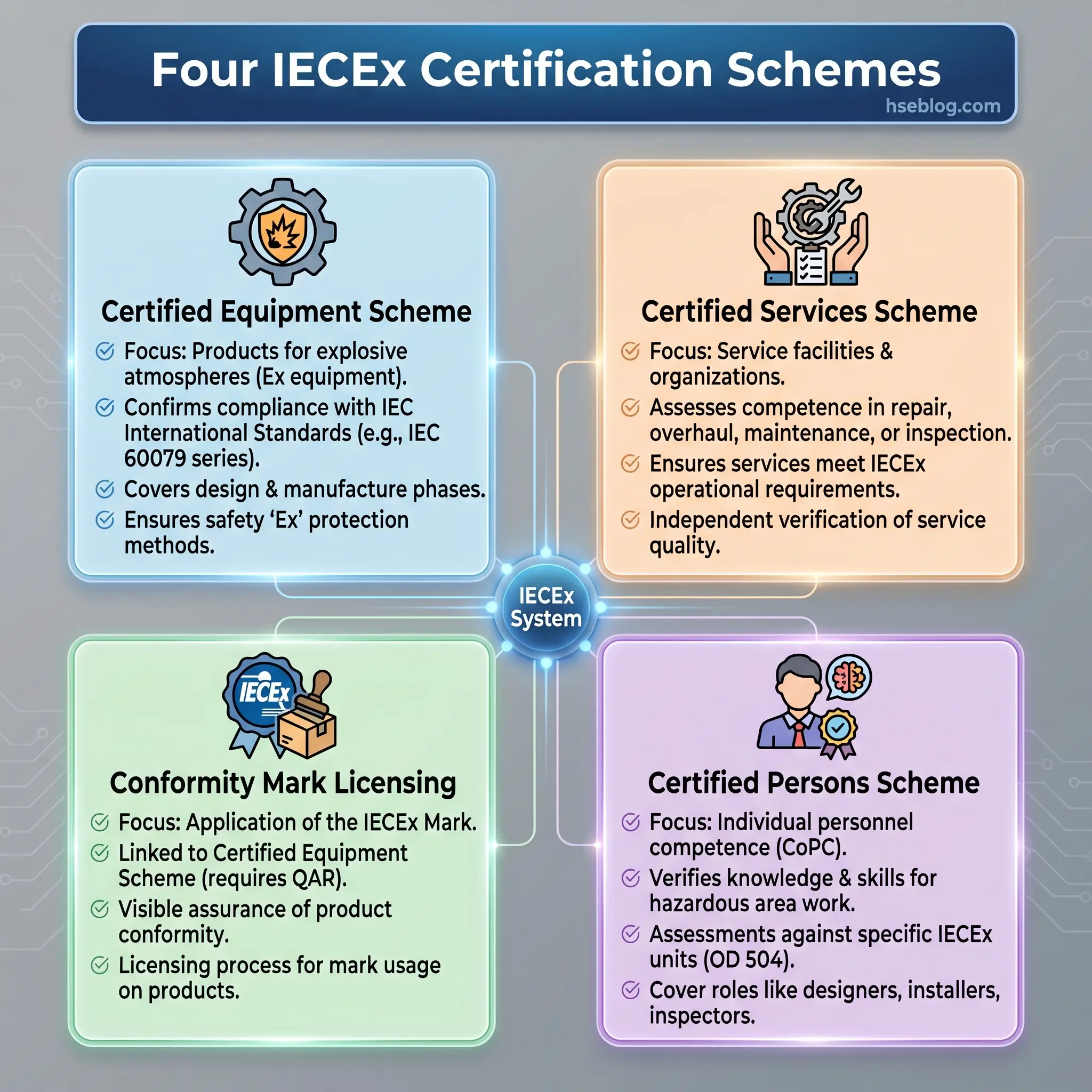
What distinguishes IECEx from most certification frameworks is its breadth across four distinct schemes. The Certified Equipment Scheme handles product conformity. The Certified Services Scheme covers repair, overhaul, and installation work on Ex equipment. The Conformity Mark Licensing System provides a unified product mark. And the Certified Persons Scheme verifies competence of individuals working on Ex equipment. No competitor consistently highlights this fourfold structure, but it matters: IECEx is not just about equipment — it is about the entire competency chain surrounding explosive atmosphere safety.
IECEx certification is recognized across more than 40 countries spanning six continents, with over 30 countries actively participating in the scheme, including the United States, China, Japan, South Korea, Australia, and Brazil. Over 3 million workers worldwide face hazardous environments where explosion-protected equipment is required — a workforce whose safety depends on whichever certification system their jurisdiction recognizes.
How Do ATEX and IECEx Differ? A Side-by-Side Comparison
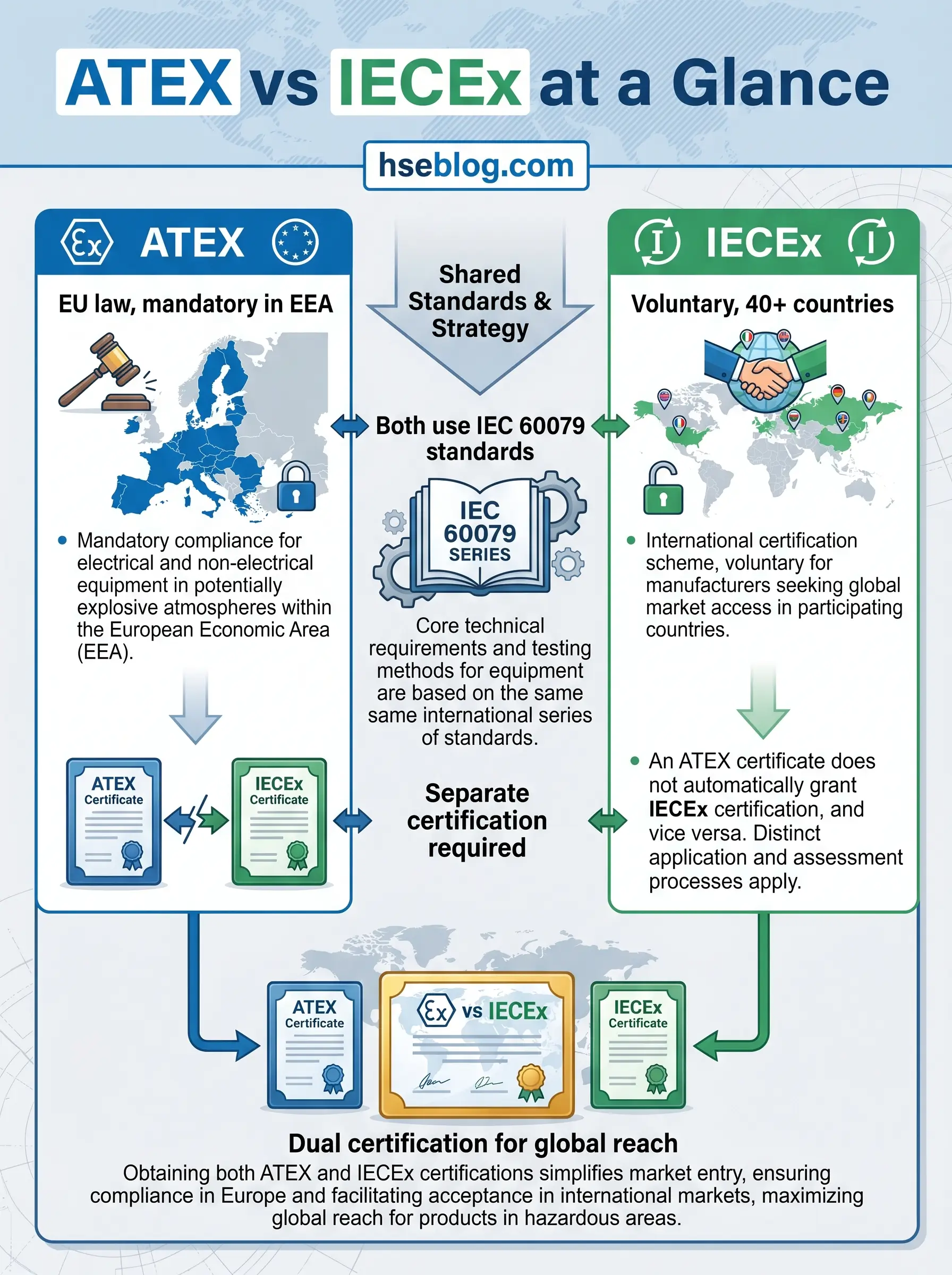
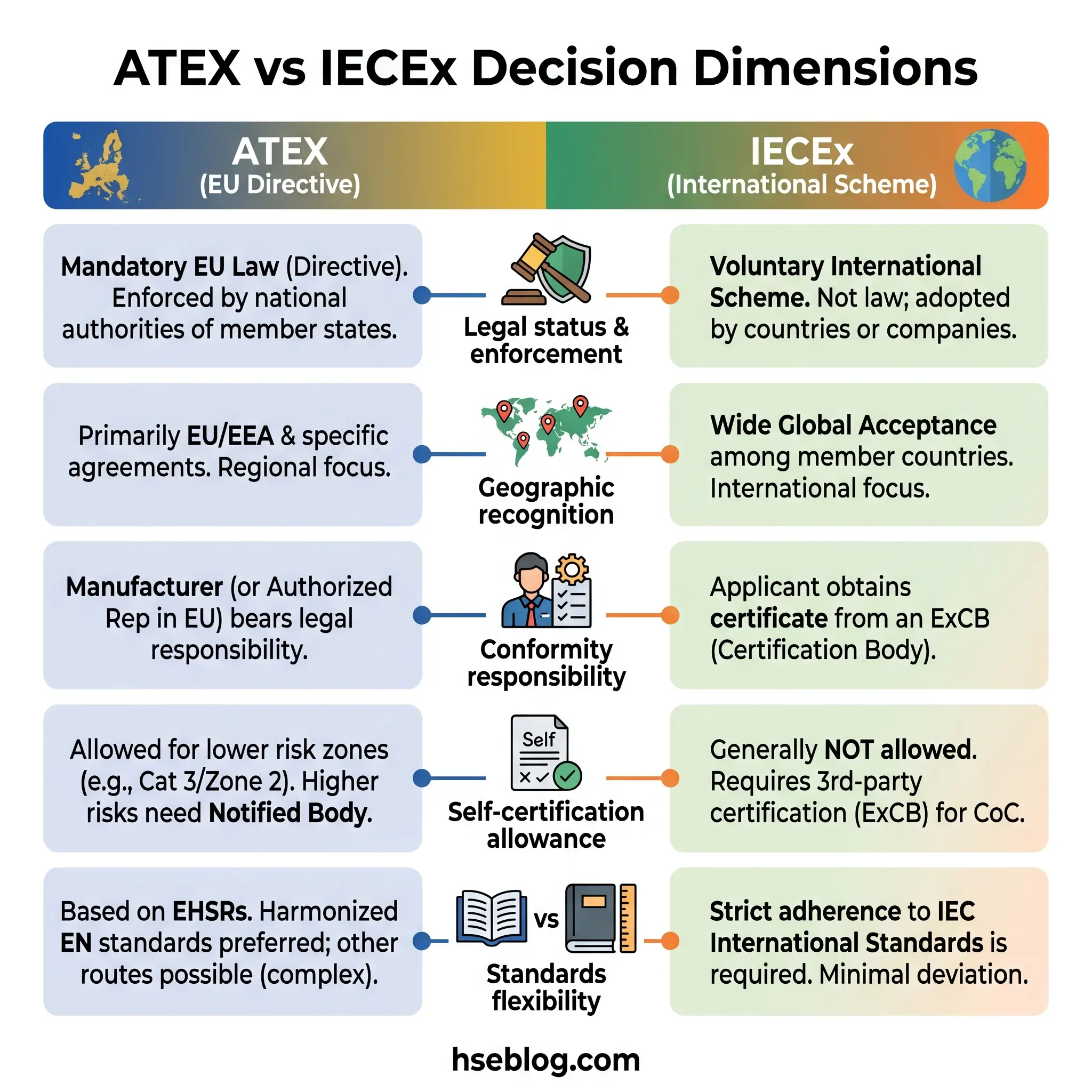
The single most important distinction to internalize is this: ATEX is a legal requirement enforced by EU member states; IECEx is a voluntary certification accepted by participating countries. Everything else — from how certificates are issued to who bears conformity responsibility — flows from that fundamental difference.
The following table maps the core comparison dimensions. The narrative sections below expand on each row with practical implications.
| Dimension | ATEX | IECEx |
|---|---|---|
| Legal status | Mandatory EU law | Voluntary international scheme |
| Geographic scope | EU/EEA member states | 40+ countries across six continents |
| Governing documents | Directives 2014/34/EU & 1999/92/EC | IECEx Operational Documents (OD 005) |
| Standards basis | EN 60079 (harmonized IEC standards) | IEC 60079 series directly |
| Conformity document | EU Declaration of Conformity (DoC) — issued by manufacturer | Certificate of Conformity (CoC) — issued by ExCB |
| Self-certification | Allowed for Category 3 (Zone 2/22) equipment | Not permitted — third-party assessment for all equipment |
| Equipment scope | Electrical and non-electrical | Historically electrical; now includes non-electrical |
| Compliance flexibility | EHSRs are the legal benchmark; standards are "deemed to comply" | Full compliance with IEC standards required — no deviation |
One row in that table deserves particular attention. Under ATEX, the manufacturer issues the EU Declaration of Conformity and affixes the CE mark. The manufacturer assumes legal responsibility for the product's compliance. Under IECEx, the ExCB — an independent Ex Certification Body — issues the Certificate of Conformity after reviewing test reports and audit results. The formal responsibility shifts to a third party. I have watched procurement engineers misread this distinction for years, assuming that a manufacturer's word carries equivalent weight in both systems. It does not.
The flexibility dimension also creates real-world friction. ATEX operates on a principle that harmonized EN standards provide a "presumption of conformity" with the Essential Health and Safety Requirements. A manufacturer can technically demonstrate compliance through alternative means — the EHSRs are the legal benchmark, and the standards are one route to meet them. IECEx offers no such flexibility. Compliance with the IEC 60079 series is the requirement, full stop. When a colleague at a testing laboratory described the difference, he put it simply: "ATEX gives you a door and a window. IECEx gives you a door."
Certification Process: How Equipment Gets Approved Under Each System
Most comparison articles state that certification processes differ — then stop there. Manufacturers navigating these pathways for the first time need to understand what each step demands.
ATEX Certification Workflow
The ATEX route follows this sequence for Category 1 and Category 2 equipment (Zone 0/1 and Zone 20/21):
- Risk assessment and product design — The manufacturer designs the product to meet the Essential Health and Safety Requirements specified in Directive 2014/34/EU.
- Type examination by a Notified Body — A designated Notified Body examines the product design and tests representative samples against the applicable harmonized EN 60079 standards.
- Quality Assurance Notification (QAN) — The manufacturer's quality management system undergoes assessment, with periodic manufacturing audits to ensure ongoing production conformity.
- EU Declaration of Conformity (DoC) — The manufacturer issues this document, taking legal responsibility for the product's compliance with the directive.
- CE marking applied — The CE mark, accompanied by the Notified Body's identification number, is affixed to the product.
For Category 3 equipment destined for Zone 2 or Zone 22 — where explosive atmospheres are unlikely during normal operations — the manufacturer can self-declare conformity through internal production control without involving a Notified Body.
IECEx Certification Workflow
The IECEx process follows a different chain of custody:
- Product design to IEC standards — The manufacturer designs the product for full compliance with the applicable IEC 60079 standards.
- Testing at an accredited ExTL — An Ex Testing Laboratory accredited within the IECEx system conducts all required testing and issues an Ex Test Report (ExTR).
- Quality Assessment Report (QAR) — A factory audit produces the QAR, verifying manufacturing consistency and quality management under the requirements of IECEx Operational Document OD 005.
- Certificate of Conformity (CoC) — The ExCB reviews the ExTR and QAR, then issues the Certificate of Conformity. This certificate is published in the publicly accessible IECEx online certificate database.
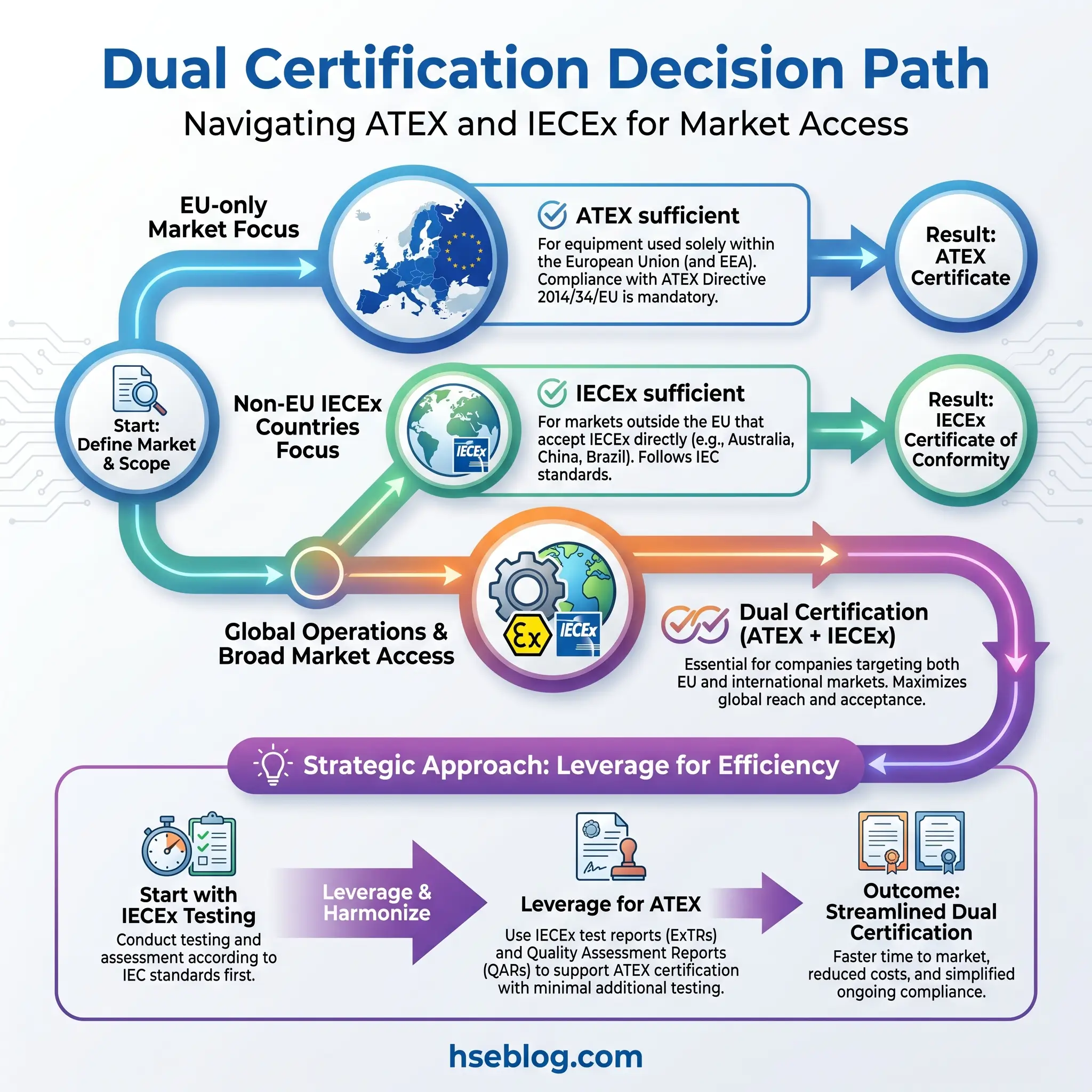
A critical workflow asymmetry exists between the two systems. ATEX certification can be based on an IECEx test report — an ExTR produced at an accredited IECEx laboratory can support an ATEX application to a Notified Body. However, IECEx certification cannot be based solely on ATEX documentation. The IECEx system requires its own test reports from accredited ExTLs. For manufacturers pursuing dual certification, the strategic approach is to begin with IECEx testing, then leverage those reports for the ATEX pathway.
Field Test: Before accepting any Ex equipment on site, pull the certificate number from the nameplate and verify it against the IECEx online database or request the ATEX DoC directly from the manufacturer. If either takes more than a few minutes to produce, that is your first red flag.
Equipment Marking and Labeling: How to Read ATEX and IECEx Tags
Reading an equipment label in a hazardous area warehouse is a skill that separates experienced procurement engineers from everyone else. Both systems encode critical information into their markings, but they encode it differently.
An ATEX marking string typically reads something like:
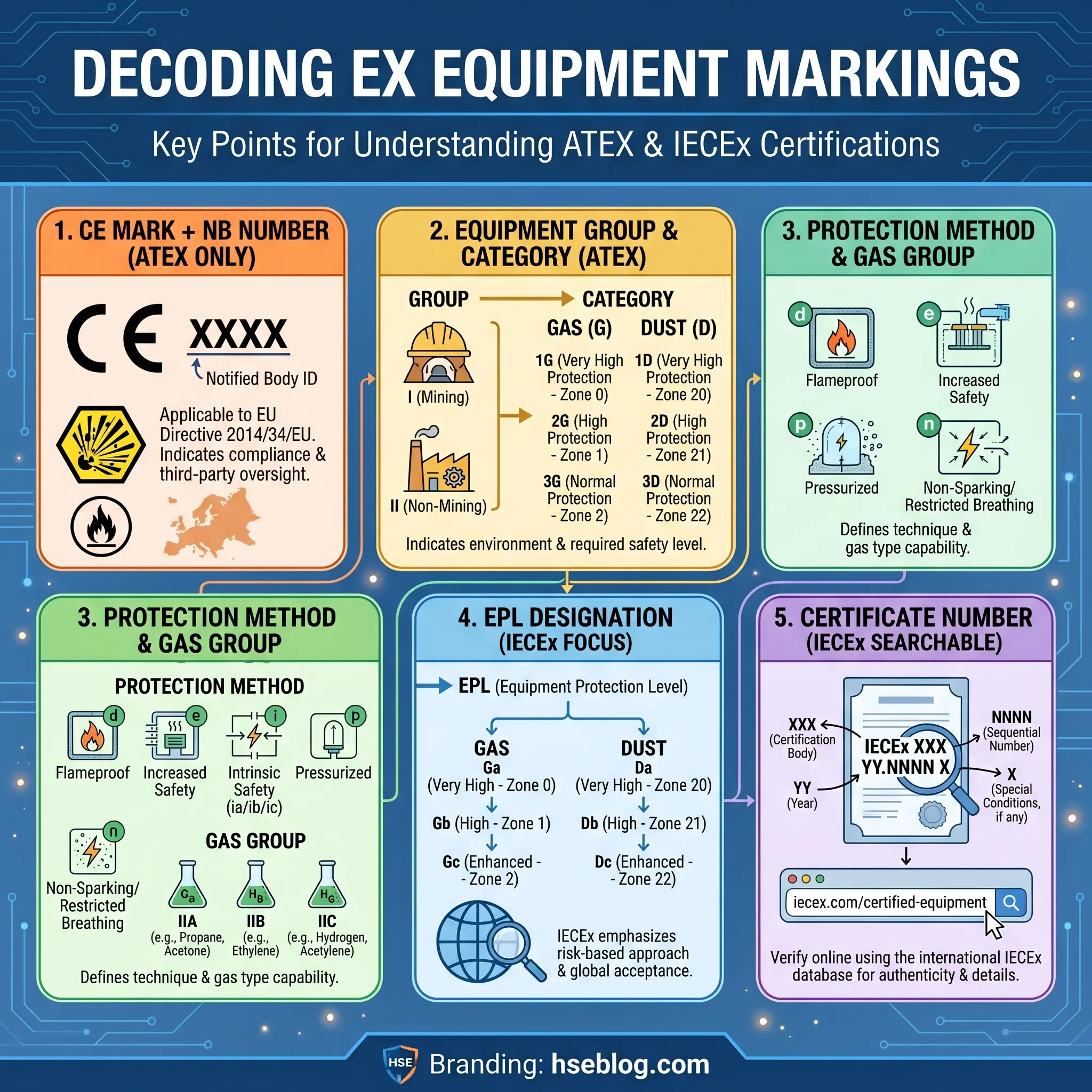
CE 0080 ⟨Ex⟩ II 2G Ex db IIC T4 Gb
Each element tells you something specific. The CE mark and four-digit number identify the Notified Body. The hexagonal ATEX explosion protection symbol confirms the directive applies. "II" designates Equipment Group II (surface industries — as opposed to Group I for mining). "2G" indicates Category 2, Gas atmosphere. The protection method codes (db), gas group (IIC), and temperature class (T4) follow. The trailing "Gb" is the Equipment Protection Level, increasingly included on ATEX markings for alignment with IEC standards.
An IECEx marking for equivalent equipment looks different:
Ex db IIC T4 Gb — IECEx [ExCB Code] 24.0001X
The CE mark, equipment group, and equipment category are absent. Instead, you get the ExCB certificate number — a traceable, searchable reference that links directly to the IECEx online database. The Equipment Protection Level (Gb) serves the role that ATEX categories serve, but using a different classification system.
The equivalence between ATEX categories and IECEx Equipment Protection Levels is consistent but uses different terminology:
| Zone | ATEX Category | IECEx EPL | Protection Level |
|---|---|---|---|
| Zone 0 / Zone 20 | Category 1 | EPL Ga / Da | Very high — continuous explosive atmosphere |
| Zone 1 / Zone 21 | Category 2 | EPL Gb / Db | High — likely during normal operations |
| Zone 2 / Zone 22 | Category 3 | EPL Gc / Dc | Enhanced — unlikely but possible |
During a recent equipment verification exercise for an offshore gas processing module, I walked a junior engineer through decoding seventeen different nameplates. The marking that confused him most was a dual-certified product carrying both ATEX and IECEx information on the same label. Once he understood that the ATEX portion communicates with EU regulators and the IECEx portion communicates with the global certification database, the logic clicked.
Zone Classification: Do ATEX and IECEx Use the Same Hazardous Area Zones?
This question generates more unnecessary confusion than almost any other in the ATEX vs IECEx comparison. The answer is straightforward: both systems use identical zone classifications for hazardous areas. The difference lies not in how areas are classified, but in how equipment suitability for each zone is expressed.
The zone designations are shared across both systems:
| Zone | Atmosphere | Frequency of Occurrence |
|---|---|---|
| Zone 0 / Zone 20 | Gas/vapor or dust | Continuously or for long periods |
| Zone 1 / Zone 21 | Gas/vapor or dust | Likely during normal operations |
| Zone 2 / Zone 22 | Gas/vapor or dust | Unlikely, short periods only |
Zone 0 and Zone 20 demand the highest level of equipment protection — ATEX Category 1 or IECEx EPL "a." Zone 1 and Zone 21 require Category 2 or EPL "b." Zone 2 and Zone 22 need Category 3 or EPL "c."
This alignment is not accidental. Both systems draw their zone classification from IEC 60079-10-1 (gases) and IEC 60079-10-2 (dusts). The practical benefit for multinational projects is significant: a single hazardous area classification study serves both ATEX and IECEx compliance requirements. The work diverges only at equipment selection, where the different labeling systems require attention to the correct designation format.
Geographic Acceptance: Where Is Each Certification Recognized?
The geographic question is usually the first one that triggers the ATEX vs IECEx comparison in the first place. A manufacturer designing a pressure transmitter for a refinery in Rotterdam faces a different certification requirement than one supplying the same transmitter to a gas plant in Perth.
ATEX is mandatory across all EU and EEA member states — 30 countries where placing non-ATEX-certified equipment on the market for hazardous area use is a legal violation. Beyond the EU core, Turkey and Switzerland apply ATEX requirements through bilateral agreements. The United Kingdom, post-Brexit, continues to uphold ATEX-equivalent requirements under the Dangerous Substances and Explosive Atmospheres Regulations 2002 (DSEAR), now alongside the UKCA marking scheme for the domestic market.
IECEx operates across a broader but less uniform landscape. Over 40 countries participate in the scheme, but "participation" means different things in different jurisdictions. Australia and New Zealand accept IECEx certification directly as their national standard for hazardous area electrical equipment — no additional national certification required. GCC countries in the Middle East increasingly mandate or prefer IECEx certification in oil and gas procurement specifications, particularly in Saudi Arabia and the UAE. Singapore, South Africa, India, Brazil, Canada, China, Japan, and South Korea all participate, though some layer additional national requirements on top.
The critical point for equipment manufacturers: IECEx is not a legal substitute for ATEX within the EU. A product carrying only an IECEx Certificate of Conformity cannot legally be installed in a Zone 1 location in Germany or France. The certifications must be obtained independently. The hazardous-area equipment market is projected to reach $17.35 billion by 2030 — and manufacturers who limit themselves to a single certification system are limiting their addressable share of that market.
Audit Point: When reviewing equipment procurement packages for international projects, verify that the certification type matches the destination country's requirements — not the country of manufacture. Equipment built in the EU with ATEX certification alone will not satisfy regulatory requirements in an Australian facility.
When Do You Need Dual Certification?
Dual ATEX and IECEx certification has become standard practice — not a premium option — in industries with multinational footprints. Oil and gas, petrochemicals, LNG, maritime, and mining operations routinely specify dual certification in their procurement requirements because project equipment may be manufactured in one jurisdiction, warehoused in another, and installed in a third.
The economics make sense because both systems share the same technical backbone: the IEC 60079 series. A single product design can satisfy both sets of requirements. The certification workflows run separately, but the underlying testing can overlap significantly. An ExTR produced at an IECEx-accredited testing laboratory supports the ATEX application to a Notified Body, which reduces duplication and compresses timelines.
Cost and timeline vary with product complexity. ATEX certification alone typically takes three to six months. IECEx certification runs four to nine months. Pursuing both concurrently — starting with IECEx testing and leveraging reports for ATEX — compresses the combined timeline considerably compared to sequential approaches. On cost, IECEx certification generally runs higher due to the global scope and mandatory third-party assessment at every level. Total costs for a product family can range from $15,000 to over $100,000 depending on the number of protection concepts, gas groups, and enclosure variants involved.
The decision framework reduces to three scenarios. Products sold exclusively within Europe need only ATEX. Products destined solely for IECEx-accepting countries outside Europe need only IECEx. Products serving global markets — or products whose end-market is uncertain at the design stage — benefit most from dual certification pursued from the outset.
Watch For: Equipment originally certified for a single market that gets redeployed internationally during asset transfers or decommissioning. I have seen Zone 1 instruments shipped from a European refinery to a Middle Eastern expansion project with only ATEX certification — technically non-compliant from the moment they crossed the border.
Certification Bodies: Notified Bodies vs. ExCBs and ExTLs
The institutional architecture behind each system determines who tests your equipment, who issues the certificate, and what mutual recognition applies across borders.
ATEX Notified Bodies are designated by EU member state governments. Each member state authorizes specific organizations to assess conformity with the ATEX directive, and these bodies report to national authorities. The designation is jurisdiction-specific — a Notified Body authorized in Germany operates under German government oversight.
IECEx uses a two-tier structure. ExTLs — Ex Testing Laboratories — conduct the physical testing and produce Ex Test Reports. ExCBs — Ex Certification Bodies — review those reports alongside Quality Assessment Reports and issue the Certificate of Conformity. Both ExTLs and ExCBs must be accredited against ISO/IEC 17065, the international standard for conformity assessment bodies, ensuring independence and technical competence.
Several major organizations — TÜV SÜD, SGS, Intertek, UL, Nemko, Eurofins — hold dual designation as both ATEX Notified Bodies and IECEx ExCBs. Working with a single organization that holds both designations simplifies dual certification considerably, providing a unified project manager, shared test samples, and coordinated audit schedules.
One structural difference carries real procurement implications. IECEx mandates mutual acceptance of ExTRs between all accredited bodies. A test report produced at an ExTL in Australia must be accepted by an ExCB in Norway. ATEX has no equivalent formal mutual recognition requirement between Notified Bodies. In practice, this means IECEx test data flows across borders more predictably — a meaningful advantage for manufacturers working with multiple certification partners across different regions.
Common Myths About ATEX and IECEx
Misconceptions about these two systems circulate freely in procurement specifications, project documents, and even HSE training materials. Four myths appear with particular frequency.
Myth: "ATEX certification makes equipment IECEx compliant." This is false. Despite using technically aligned standards, the certification processes are entirely separate. An ATEX Declaration of Conformity does not produce, imply, or substitute for an IECEx Certificate of Conformity. The testing may overlap; the certification does not.
Myth: "IECEx certification satisfies ATEX requirements in Europe." Also false. IECEx holds no legal standing within the EU. Equipment installed in a European hazardous area without valid ATEX certification and CE marking fails to comply with Directive 2014/34/EU — regardless of how many IECEx certificates accompany it.
Myth: "ATEX only applies to electrical equipment." Incorrect. Unlike IECEx, which historically focused on electrical apparatus, ATEX covers electrical equipment, non-electrical equipment, mechanical assemblies, protective systems, and components. The directive's scope is deliberately broad to address all potential ignition sources in explosive atmospheres.
Myth: "IECEx is only useful outside Europe." This is an oversimplification. European multinationals use IECEx certification extensively for non-EU sites. More significantly, IECEx test reports accelerate ATEX certification by providing accepted test data. And as the IECEx and ATEX technical relationship demonstrates, the two systems are complementary tools in a global compliance strategy, not competing alternatives.
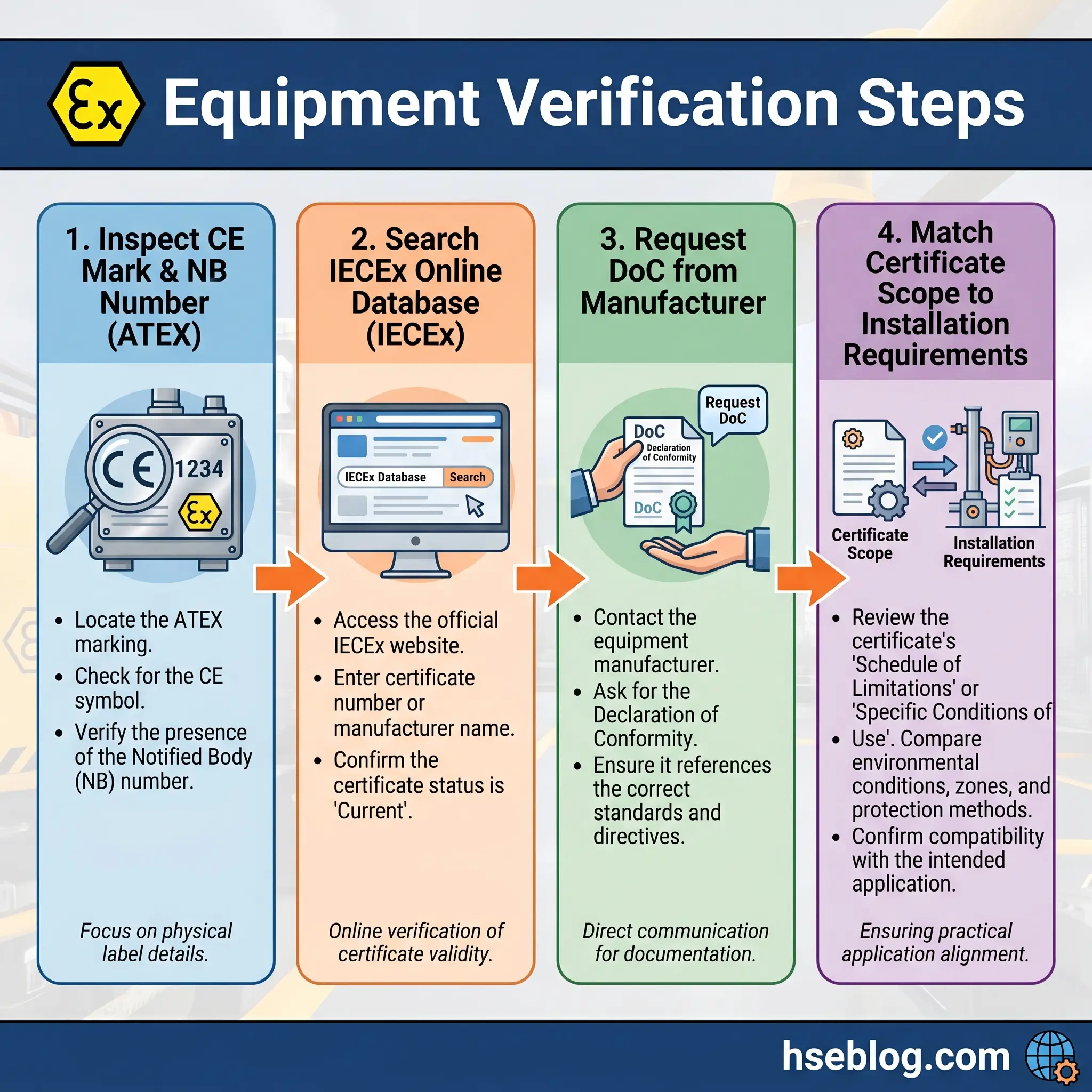
How to Verify ATEX and IECEx Certification
Verification is a procurement discipline, not an afterthought. Counterfeit or misrepresented Ex certification has created genuine safety risks on projects where equipment was sourced through extended supply chains or unfamiliar vendors.
For ATEX-certified equipment, the verification steps are manufacturer-facing. Check the CE mark on the product and confirm the four-digit Notified Body number is legible. Request the EU Declaration of Conformity from the manufacturer — this document is their legal attestation of compliance, and they are required to provide it. Cross-reference the Notified Body number against the EU's NANDO database to confirm the body is currently designated for the ATEX directive.
For IECEx-certified equipment, verification is more transparent. The IECEx online certificate database at iecex.com is publicly accessible. Search by manufacturer name, product description, or certificate number. The database displays the full certificate scope, including protection concepts, gas groups, temperature classes, and the issuing ExCB. If the certificate number on the equipment does not return a valid result, that equipment's certification status is unconfirmed.
Warning signs that should trigger deeper investigation: markings that are poorly printed or inconsistent with standard formatting, certificate numbers that do not match any database record, missing or incomplete temperature class designations, and equipment sourced from resellers who cannot produce original conformity documentation on request.
Always verify that the certificate's scope covers the specific zone, gas group, and temperature class required by the installation. A valid certificate for T3 equipment does not authorize its use in a T6 environment.
How to Choose Between ATEX and IECEx for Your Operation
The decision framework ties every preceding section into a practical outcome. Three scenarios cover the majority of real-world situations.
Scenario 1: EU/EEA-only operations. If your equipment will be manufactured, sold, and installed exclusively within EU or EEA member states, ATEX compliance under Directive 2014/34/EU is your mandatory and sufficient requirement. IECEx adds no legal value in this context, though it may add commercial value if you anticipate future market expansion.
Scenario 2: Non-EU international operations. If your equipment operates exclusively in countries that recognize IECEx — Australia, New Zealand, Singapore, GCC states, South Africa, or other participating nations — IECEx is the most efficient certification route. Verify the specific country's acceptance criteria, as some jurisdictions layer additional national requirements on top of IECEx.
Scenario 3: Global or multi-market operations. If your equipment serves both European and international markets — or if the final destination is unknown at the design stage — dual ATEX and IECEx certification is the strategic choice. Design to IEC 60079 standards from the outset, pursue IECEx testing first, then leverage ExTRs for the ATEX application.
Regardless of scenario, one step remains non-negotiable: verify local regulatory requirements before assuming either certification is accepted in a specific country. National deviations, additional testing requirements, and evolving adoption timelines mean that "IECEx-accepted" does not always mean "IECEx-only." The IEC 60079-0 Edition 8 update — expected to become the baseline for future conformity assessments under both systems — will introduce changes to intrinsic safety requirements, encapsulation standards, and assembly documentation that manufacturers must prepare for now.
Frequently Asked Questions
Can IECEx certification replace ATEX in the European Union?
No. IECEx holds no legal standing within the EU or EEA. Directive 2014/34/EU requires ATEX-certified equipment with CE marking for hazardous area installations. IECEx test reports can support an ATEX application — reducing testing duplication — but the IECEx Certificate of Conformity itself does not satisfy European regulatory requirements.
Can equipment hold both ATEX and IECEx certification simultaneously?
Yes, and this is common practice for equipment manufacturers serving global markets. The shared IEC 60079 technical basis means a single product design can meet both sets of requirements. Dual-certified equipment carries both ATEX markings (CE, category, group) and IECEx markings (ExCB certificate number, EPL) on the same nameplate.
Does ATEX apply only to electrical equipment?
No. ATEX Directive 2014/34/EU explicitly covers electrical and non-electrical equipment, protective systems, components, and assemblies intended for use in explosive atmospheres. This scope is broader than the IECEx system, which historically focused on electrical apparatus — though IECEx has expanded to include non-electrical equipment as well.
How long does ATEX or IECEx certification take?
ATEX certification typically takes three to six months for Category 1 and 2 equipment, depending on product complexity and documentation readiness. IECEx certification generally takes four to nine months due to the mandatory third-party assessment structure. Pursuing both concurrently — with IECEx testing first — compresses the total timeline compared to sequential applications.
What happens if I install IECEx-only certified equipment in an EU country?
This constitutes non-compliance with Directive 2014/34/EU. Consequences can include regulatory penalties, equipment seizure, mandatory work stoppages, and potential criminal liability if an incident occurs. Market surveillance authorities in EU member states actively monitor compliance, and non-conforming equipment discovered during inspections or incident investigations carries serious enforcement risk.
Do ATEX and IECEx use the same hazardous area zone classification?
Yes. Both systems use identical zone designations — Zone 0, 1, 2 for gases and Zone 20, 21, 22 for dusts — derived from IEC 60079-10. The difference is in how equipment suitability for each zone is expressed: ATEX uses equipment categories (1, 2, 3) while IECEx uses Equipment Protection Levels (a, b, c). Category 1 corresponds to EPL "a," Category 2 to EPL "b," and Category 3 to EPL "c."
The ATEX vs IECEx question ultimately comes down to jurisdiction, market strategy, and operational scope. These are not competing systems — they are parallel frameworks addressing the same fundamental safety objective through different institutional mechanisms. The manufacturer who designs to IEC 60079 standards from day one, pursues IECEx testing at an accredited ExTL, and uses those test reports to support both an ExCB Certificate of Conformity and an ATEX Declaration of Conformity through a Notified Body has built the most efficient compliance pathway available.
What matters on the receiving dock — where those two junction boxes sat last Thursday morning — is that every piece of equipment entering a hazardous area carries certification that is valid, verifiable, and matched to the regulatory requirements of the country where it will operate. Not the country where it was manufactured. Not the country where it was warehoused. The country where a worker will rely on it to not become an ignition source.
The certification label is the last line of engineered defense before equipment meets an explosive atmosphere. Make sure you can read it, verify it, and trust it.