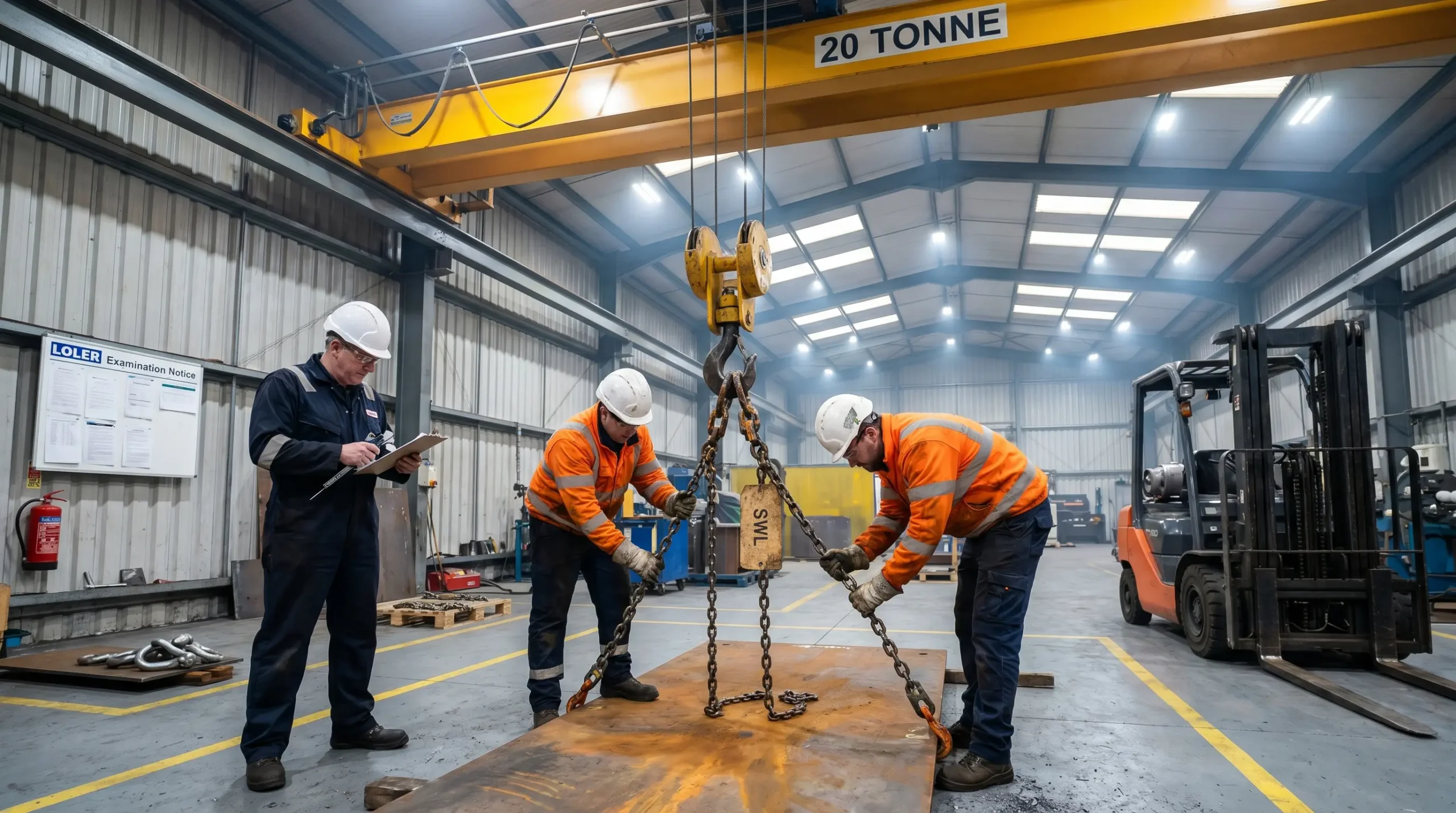
The first LOLER thorough examination report I ever signed off was on a 20-tonne overhead gantry crane in a steel fabrication shop — running two shifts, six welders below it at any moment, a magnet attachment swinging coil after coil onto cutting beds. The maintenance manager handed me a PUWER inspection certificate from three months earlier and asked, in complete sincerity, whether we could skip the thorough examination because "the crane's already been signed off." That single question explains why this article exists. Two regulations, overlapping and complementary, are routinely treated as interchangeable by duty holders — and the enforcement record shows how expensive that misreading becomes.
This guide sets out the difference between LOLER and PUWER in the detail a compliance decision actually requires. It covers what each regulation is, where they overlap, which one applies to your equipment, how inspection duties differ, and what the HSE does when duty holders get it wrong. By the end you will be able to categorise any piece of equipment on your site and know exactly which statutory duties attach to it.
Quick Answer: The Difference Between LOLER and PUWER in One Minute
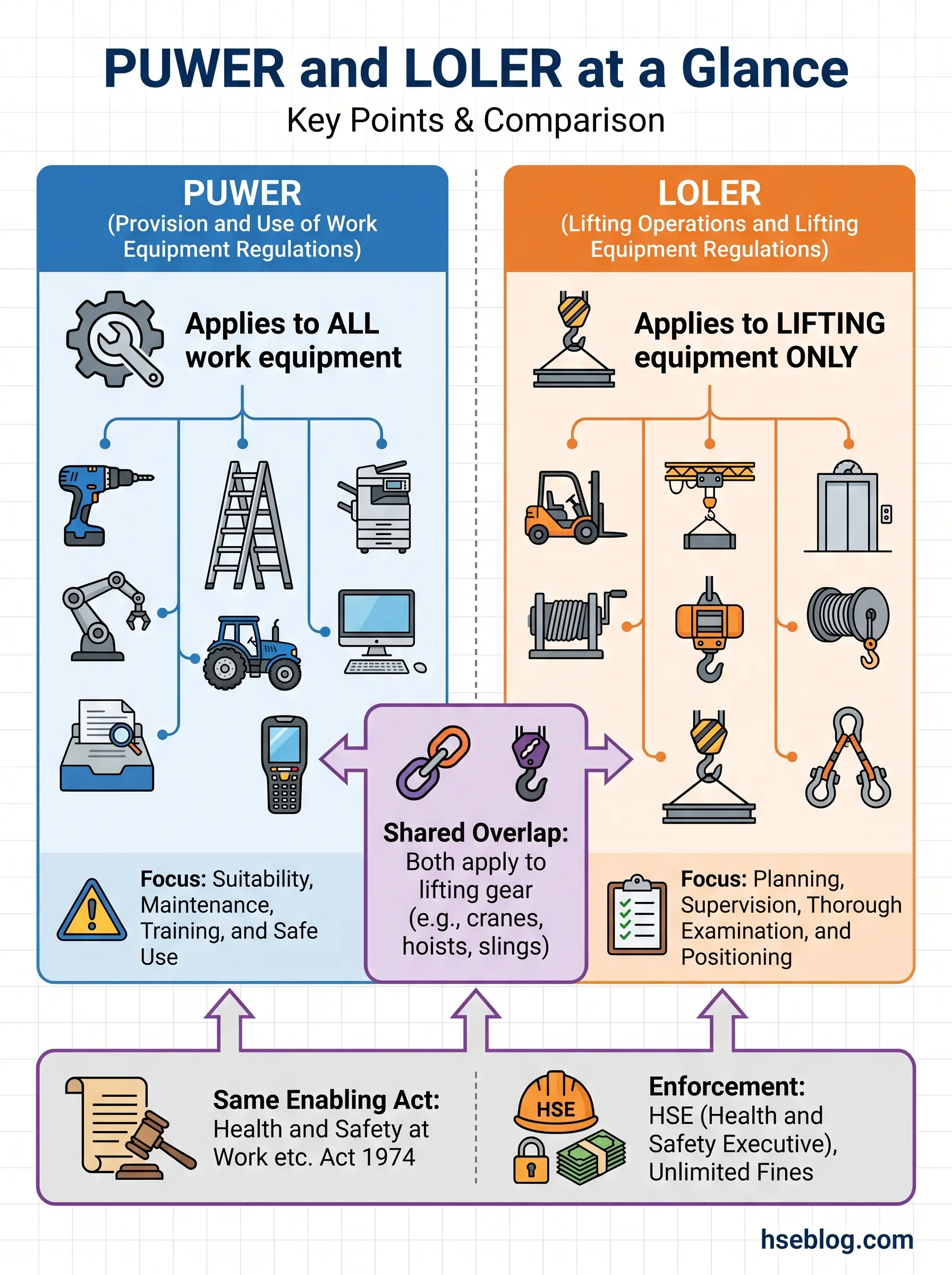
PUWER governs every piece of equipment used at work. LOLER governs only the equipment that lifts — and the lifting operations themselves. Both came into force on 5 December 1998, both are made under the Health and Safety at Work etc. Act 1974, and both are enforced by the Health and Safety Executive. The critical point most duty holders miss: lifting equipment is still work equipment, so LOLER duties sit on top of PUWER duties rather than replacing them.
| Regulation | Scope | Who It Affects |
|---|---|---|
| PUWER 1998 | All work equipment — tools, machinery, vehicles, installations | Every employer, self-employed person, or controller of work equipment |
| LOLER 1998 | Lifting equipment and lifting accessories only | Anyone who owns, operates, or has control of lifting equipment at work |
| Overlap | Lifting equipment must satisfy both | Cranes, forklifts, hoists, MEWPs, tail-lifts, passenger lifts |
What Is PUWER? (Provision and Use of Work Equipment Regulations 1998)
PUWER is the statutory instrument SI 1998/2306, made under sections 15 and 49 of the Health and Safety at Work etc. Act 1974. Its reach is deliberately broad: the regulation applies to any machinery, appliance, apparatus, tool, or installation used by a worker at work. "Use" is interpreted widely too — it covers starting, stopping, programming, setting, transporting, repairing, modifying, maintaining, servicing, and cleaning. If a worker touches it during the working day, PUWER has something to say about it.
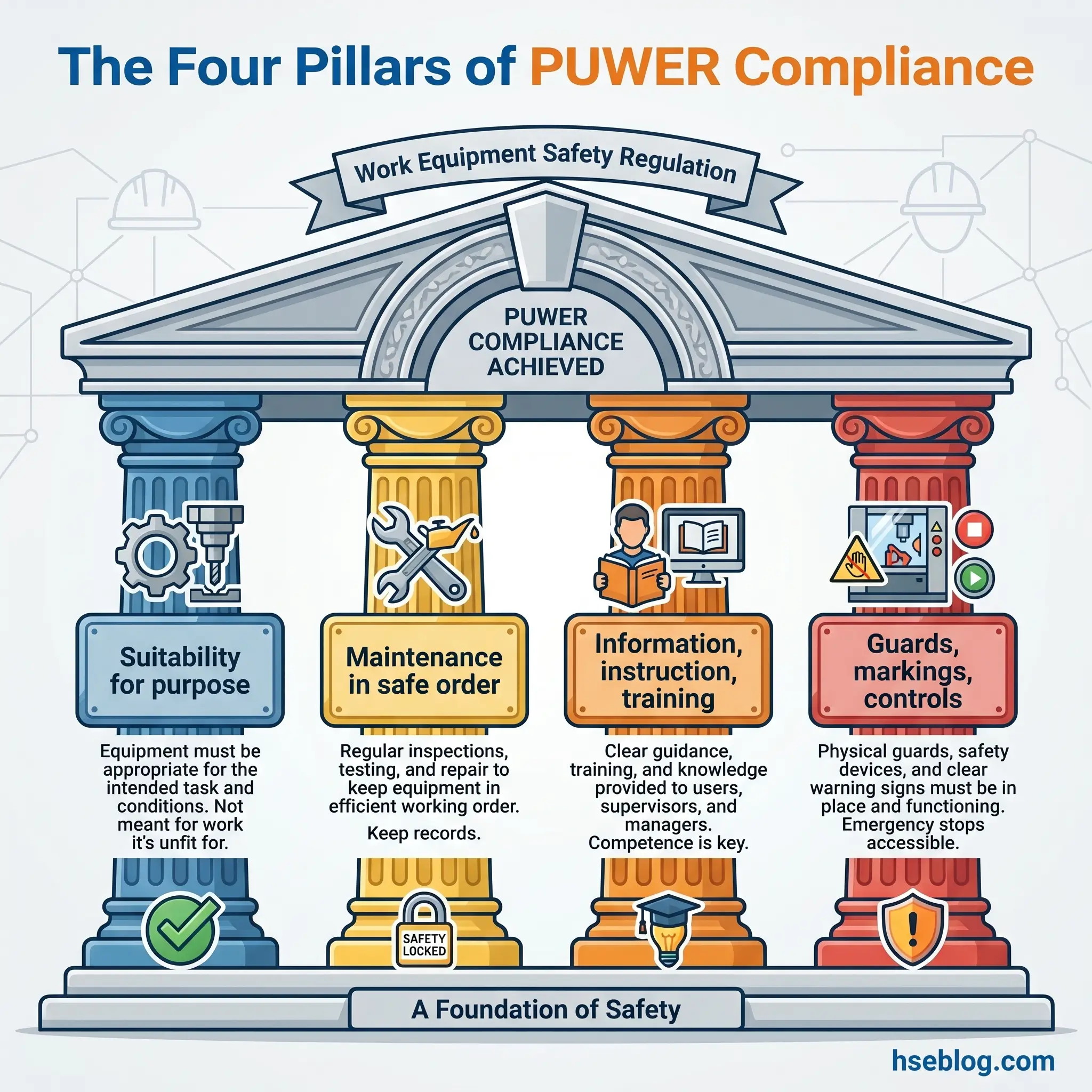
The regulation rests on four operational principles that duty holders need to build their equipment management systems around. Equipment must be suitable for its intended use and the environment it runs in. It must be maintained in an efficient state, in efficient working order, and in good repair. Users must be given adequate information, instruction, and training. And the equipment itself must carry appropriate protection — guards, emergency stops, isolation, stability, lighting, markings.
The duty holders under PUWER include every employer, every self-employed person, and anyone who has control of work equipment, including a person whose trade or business consists of supplying such equipment. The scope of equipment covered is enormous:
- Hand tools — hammers, screwdrivers, knives, manual cutters
- Power tools — drills, grinders, impact wrenches, nail guns
- Machinery — CNC mills, lathes, presses, conveyors, mixers
- Vehicles used at work — vans, HGVs, telehandlers, on-site dumpers
- Installations — compressors, pressure systems, fixed extraction plant
- Office equipment — guillotines, shredders, laminators
If you want the official position, the HSE's PUWER overview page sets it out in the regulator's own words, and the Approved Code of Practice L22 (third edition) is the working guidance practitioners rely on day to day.
What Is LOLER? (Lifting Operations and Lifting Equipment Regulations 1998)
LOLER is the statutory instrument SI 1998/2307 — same enabling Act, same commencement date as PUWER, narrower scope. It exists to reduce injury and death arising from two specific things: the lifting equipment itself, and the lifting operation that uses it. Regulation 8(2) defines a lifting operation as "an operation concerned with the lifting or lowering of a load," and makes clear that a load can include a person. That matters because it pulls patient hoists, passenger lifts, and mobile elevating work platforms firmly into scope.
LOLER captures two categories of equipment that PUWER does not separately identify. First, lifting equipment — the machine that does the lifting. Second, lifting accessories — the gear that attaches the load to the lifting equipment. Both have to meet LOLER's strength, stability, marking, and examination requirements.
- Lifting equipment: overhead cranes, tower cranes, mobile cranes, forklifts, telehandlers, vehicle tail-lifts, passenger lifts, goods lifts, patient hoists, MEWPs, car ramps, engine hoists, building maintenance cradles, winches used to lift loads
- Lifting accessories: chains, slings, shackles, webbing slings, eyebolts, lifting beams, spreader bars, lifting magnets, vacuum lifters, clamps, hooks
Watch For: A rigger strapping a load with a sling that has no visible SWL tag. Under LOLER Regulation 7, every lifting accessory must be marked with its safe working load. A missing or illegible tag is not a paperwork failure — it is a sign the accessory has dropped out of the examination regime entirely.
The HSE's LOLER overview page explains the regulation's structure in plain language, and the Approved Code of Practice L113 — updated in 2018 — provides the practical compliance guidance.
LOLER vs PUWER: Side-by-Side Comparison
The two regulations share an architecture but diverge sharply in the specifics. The table below captures what actually differs once you move past scope into day-to-day compliance.
| Feature | PUWER 1998 | LOLER 1998 |
|---|---|---|
| Statutory instrument | SI 1998/2306 | SI 1998/2307 |
| Scope | All work equipment | Lifting equipment and accessories only |
| Supporting ACOP | L22 (third edition) | L113 (updated 2018) |
| Inspection interval | Risk-based, suitable intervals (Reg 6) | Statutory: 6 months (people/accessories), 12 months (other) — Reg 9 |
| Type of inspection | Inspection — risk-based functional check | Thorough examination — systematic statutory examination |
| Competent person standard | Adequate knowledge and experience for the equipment | Appropriate practical and theoretical knowledge, with sufficient independence |
| Required markings | General health and safety markings | Safe working load (SWL/WLL) clearly marked on every item |
| Risk assessment focus | Suitability and safe use of the equipment | Planning the lifting operation itself |
| Record-keeping | General inspection records | Formal Schedule 1 thorough examination report; retention durations specified |
| Reporting defects | Record and act on defects internally | Serious defects must be reported to the enforcing authority (Reg 10) |
Three material differences stand out once the table is read through the eyes of a duty holder. First, LOLER's 6/12-month examination cycle is fixed by statute — it is not negotiable on the basis of risk appetite. Second, the LOLER competent person must be sufficiently independent from the day-to-day maintenance of the equipment; PUWER has no equivalent independence requirement. Third, LOLER creates an external reporting duty for serious defects under Regulation 10 — PUWER keeps defect management internal to the duty holder.
The Overlap: When Both LOLER and PUWER Apply
Here is the misreading I started this article with, written out plainly: lifting equipment does not stop being work equipment just because LOLER also applies to it. Both regulations attach to the same machine simultaneously. Every lifting component is covered by LOLER. Every non-lifting component on the same machine is covered by PUWER. A thorough examination that ignores either half fails both regulations.
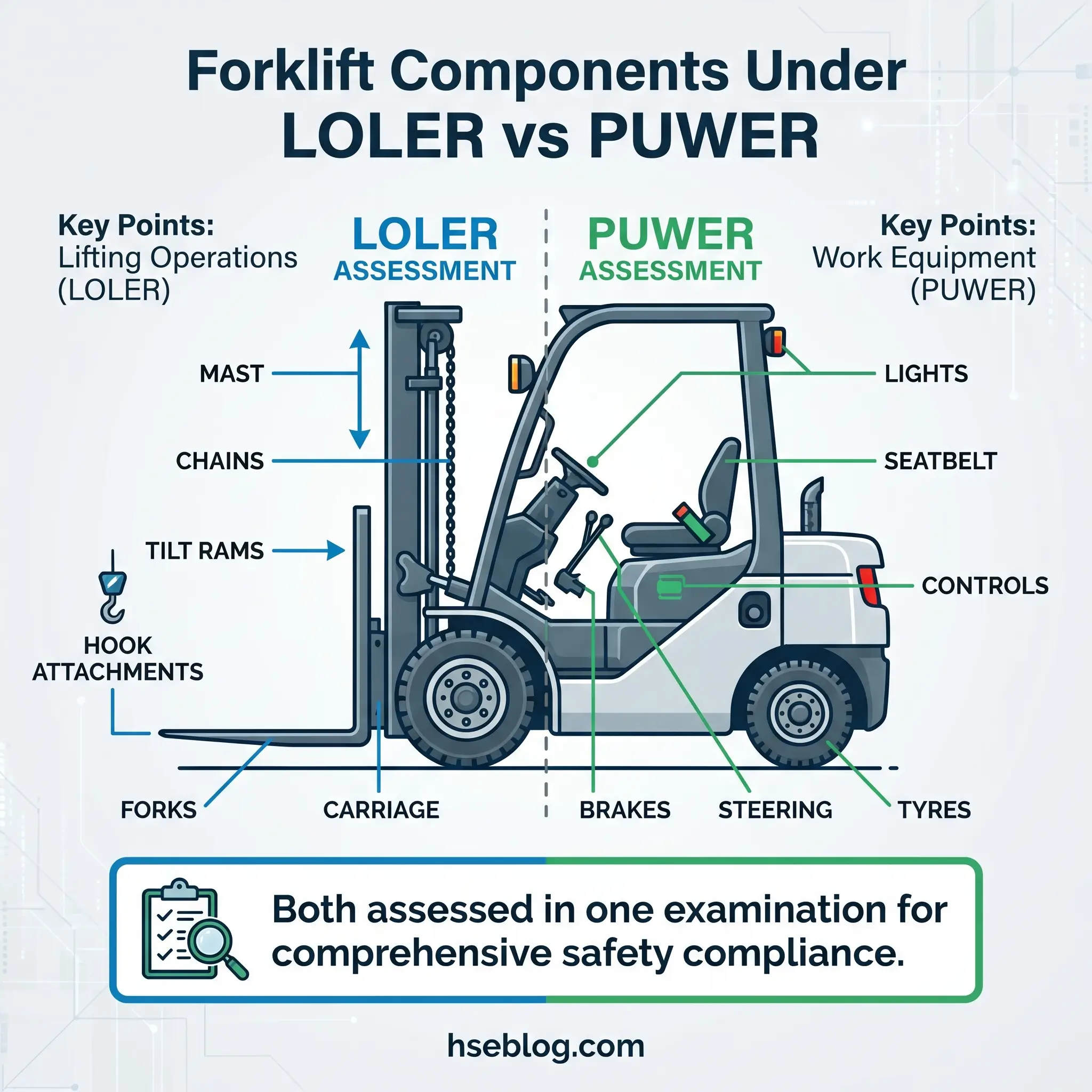
Take a standard counterbalance forklift. The mast, chains, forks, carriage, and tilt rams are lifting components — LOLER territory, examined every 12 months. The brakes, steering, hydraulics (non-lifting), tyres, seatbelt, lights, and horn are work equipment — PUWER territory, inspected at risk-based intervals. A genuine thorough examination covers both sides of the machine. The Consolidated Fork Truck Services (CFTS) framework, including its Guidance Note GN28, has become the de facto industry benchmark precisely because it unifies LOLER and PUWER examination into a single visit — and because HSE inspectors increasingly expect to see both elements documented.
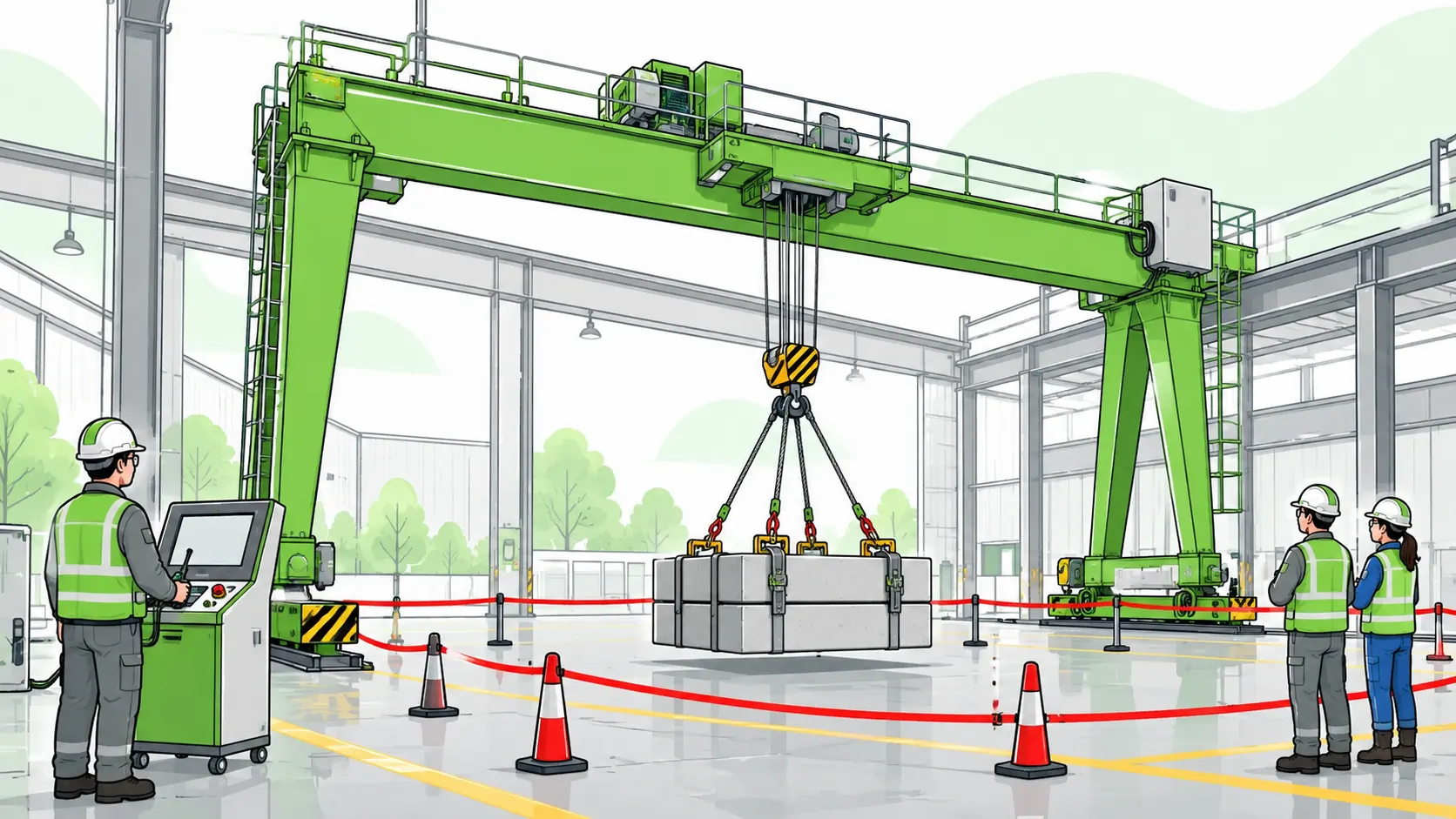
Now take an overhead gantry crane running 24 hours a day in a fabrication shop. LOLER governs the hoist, drum, wire rope, hook, and structural crane components — thoroughly examined every 12 months, or every six if it is lifting people. PUWER governs the pendant controls, the anti-collision system, the isolator, the access ladder, and the routine maintenance regime. If the PUWER maintenance fails, the crane is not safe. If the LOLER examination is missed, the crane is not legal. Both have to hold up.
What this means in practice: maintain two parallel registers on every lifting machine — a LOLER thorough examination schedule with statutory dates, and a PUWER maintenance and inspection schedule driven by manufacturer intervals and risk. Never let one stand in for the other.
Which Regulation Applies to My Equipment? A Decision Guide
Most duty holders ask the wrong question. They ask "is this LOLER or PUWER?" when the real question is "does LOLER apply on top of PUWER for this piece of equipment, or only PUWER?" Work through these four steps for any machine, tool, or accessory on your register.
- Is it used at work? If nobody at work uses it for work purposes, neither regulation applies. A private stairlift in a domestic home falls outside both. The moment an employee uses it — even a cleaner on a commercial contract — the picture changes.
- Does it lift or lower a load? If no, stop here. PUWER applies, LOLER does not. If yes, move to step 3.
- Is the lifting incidental or functional? A pallet truck that raises the load only enough to clear the floor is generally treated as moving equipment, not lifting equipment — PUWER only. The HSE's view is that the lifting must be a primary function, not just a means of translating the load.
- Is the load a person or lifted over people? If yes, LOLER examination intervals tighten from 12 months to 6, and lifting operation planning under Regulation 8 becomes non-negotiable.
Edge cases cause more confusion than mainstream equipment. The table below settles the most common ones.
| Equipment | Applicable Regulation(s) | Notes |
|---|---|---|
| Counterbalance forklift | LOLER + PUWER | Classic dual-coverage example |
| Manual pallet truck (low-lift, under ~300mm) | PUWER only | Lifting is incidental to moving |
| High-lift or powered stacker | LOLER + PUWER | Lift height beyond floor clearance |
| Patient hoist (hospital, care home) | LOLER + PUWER | 6-month examination — lifts people |
| Passenger lift in commercial building | LOLER + PUWER | 6-month examination |
| Escalator, moving walkway | PUWER only | Not classed as lifting under LOLER |
| Stairlift in private dwelling | Neither | No work activity involved |
| Vehicle tail-lift | LOLER + PUWER | 6 or 12 months depending on use |
| Scaffold hoist | LOLER + PUWER | Lifting equipment by definition |
| MEWP (scissor lift, boom) | LOLER + PUWER | 6-month — lifts people |
| Lifting accessory (sling, shackle) | LOLER | 6-month thorough examination |
| Hand tools, power tools | PUWER only | No lifting function |
| Office shredder, guillotine | PUWER only | Work equipment |
Inspection and Thorough Examination Requirements Compared
The inspection regime is where the two regulations diverge most sharply in practice. PUWER Regulation 6 requires inspection at suitable intervals determined by risk. LOLER Regulation 9 specifies the intervals by statute and Schedule 1 specifies exactly what the written report must contain. They sound similar. They are operationally very different.
LOLER Thorough Examination Intervals
Regulation 9 fixes the cadence. The duty holder has no discretion to lengthen it, though a written examination scheme drawn up by a competent person can substitute a bespoke interval — usually to shorten it for high-risk or high-cycle equipment.
| Equipment Category | Minimum Thorough Examination Interval |
|---|---|
| Lifting equipment used to lift people | Every 6 months |
| Lifting accessories (slings, shackles, chains, webbing) | Every 6 months |
| All other lifting equipment | Every 12 months |
| Equipment under a written examination scheme | As specified in the scheme |
| Exceptional circumstances | Immediate re-examination (e.g., after damage, modification, long storage) |
Schedule 1 of LOLER lists the 11 items that must appear on a thorough examination report — the name and address of the examiner, the identification of the equipment, the date of the last examination, any defects posing existing or imminent risk, and the latest date the next examination must be completed. A report missing any Schedule 1 item is not a LOLER-compliant report. The HSE leaflet INDG422 sets out the practical process and the competent person criteria in plain language.
PUWER Inspection Approach
PUWER treats inspection as the output of a risk assessment, not a calendar exercise. Regulation 6 requires inspection where the equipment's safety depends on installation conditions, where it is exposed to deteriorating conditions, or where it could create a significant risk as a result of use. The duty holder sets the interval — but sets it defensibly. A defensible PUWER interval reflects manufacturer guidance, in-service conditions, utilisation rates, and prior defect history. "We've always done it quarterly" is not a defensible interval.
The competent person standard differs too. Under PUWER, competence means adequate knowledge, training, and experience of the specific equipment. Under LOLER, the competent person must have appropriate practical and theoretical knowledge of the lifting equipment and must be sufficiently independent of the daily maintenance to provide an objective assessment. A maintenance technician can run a PUWER inspection on the plant they service. They should not be signing the LOLER thorough examination on the same equipment.
Audit Point: One of the quickest ways an HSE inspector tests a site's LOLER regime is to ask who carried out the last thorough examination and what their relationship is to the maintenance contract. If the same person services and examines the equipment, the independence test fails.
Compliance Obligations for Employers and Duty Holders
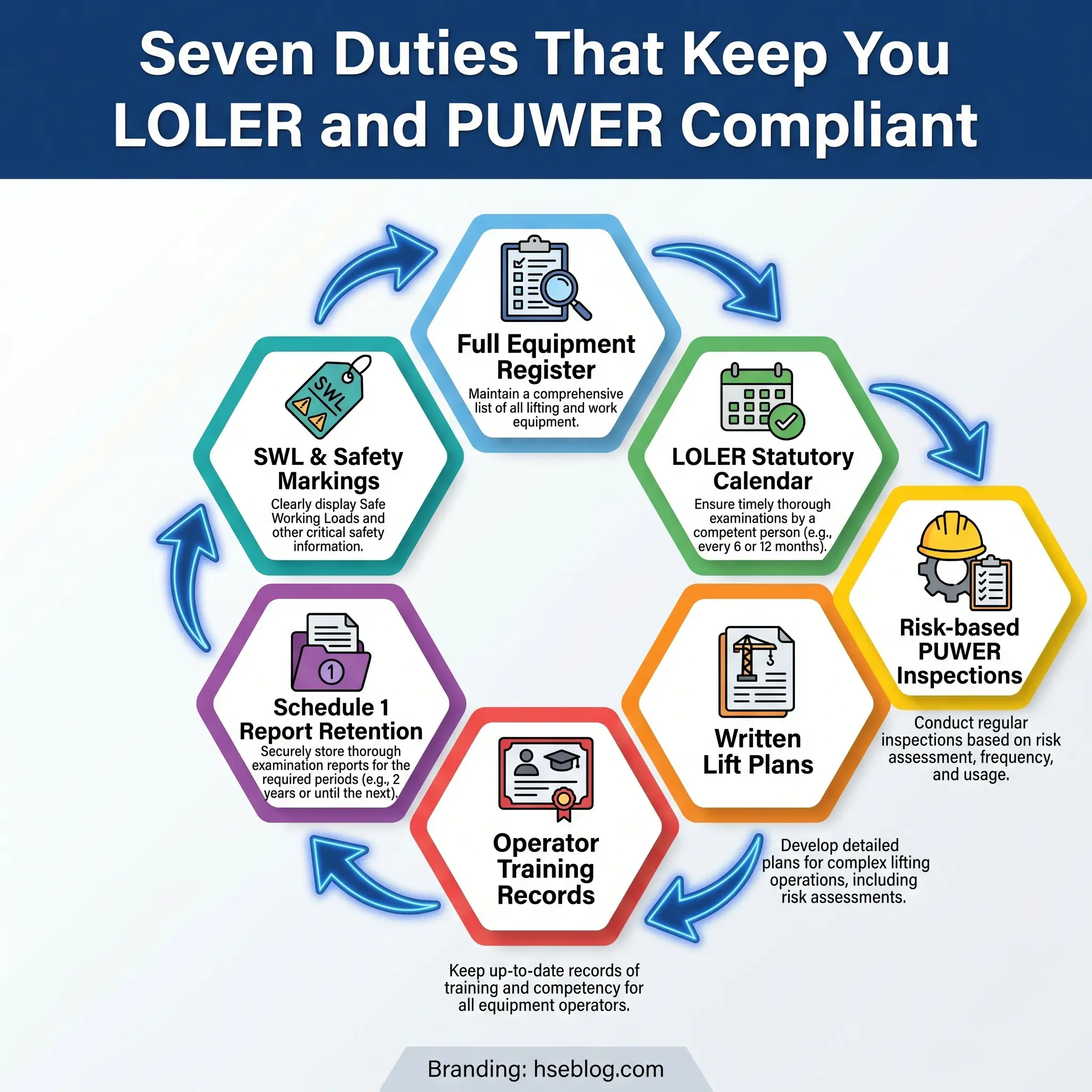
Translating the two regulations into operational action comes down to seven duties. Miss any of them and the audit trail shows it.
- Build a complete equipment register. Every piece of work equipment listed, with lifting equipment flagged separately. Include serial numbers, location, date of commissioning, and most recent examination date.
- Maintain a LOLER compliance calendar. Statutory 6/12-month dates with a lead-time buffer. Thorough examinations that run late are a regulatory breach, not an administrative slip.
- Run risk-based PUWER inspections and maintenance. Manufacturer intervals as the baseline, tightened for demanding service. Record every inspection — a paper trail is the only way to prove Regulation 6 compliance after an incident.
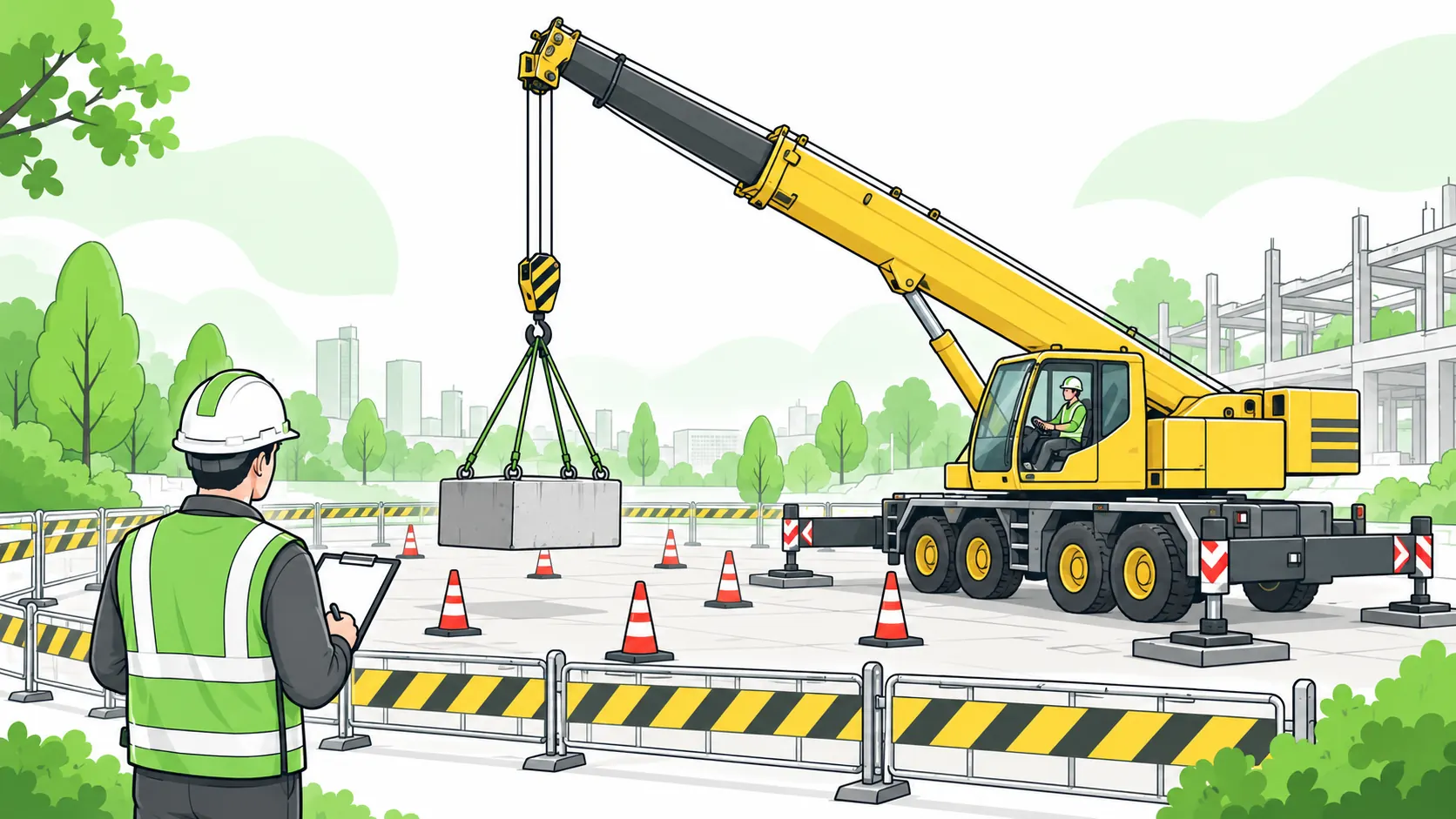
- Plan every lifting operation. LOLER Regulation 8 requires lifts to be properly planned, appropriately supervised, and safely carried out. Routine lifts need a generic plan; complex lifts need a written method statement and a lift supervisor.
- Deliver information, instruction, training, and supervision. PUWER Regulations 8 and 9 make this explicit — no operator on equipment they have not been trained on.
- Keep Schedule 1 thorough examination reports. Retained for the life of the equipment, or until the next thorough examination, depending on the report category.
- Mark everything. PUWER health and safety markings where needed; LOLER SWL/WLL visibly on every lifting accessory and lifting machine.
Consequences of Non-Compliance
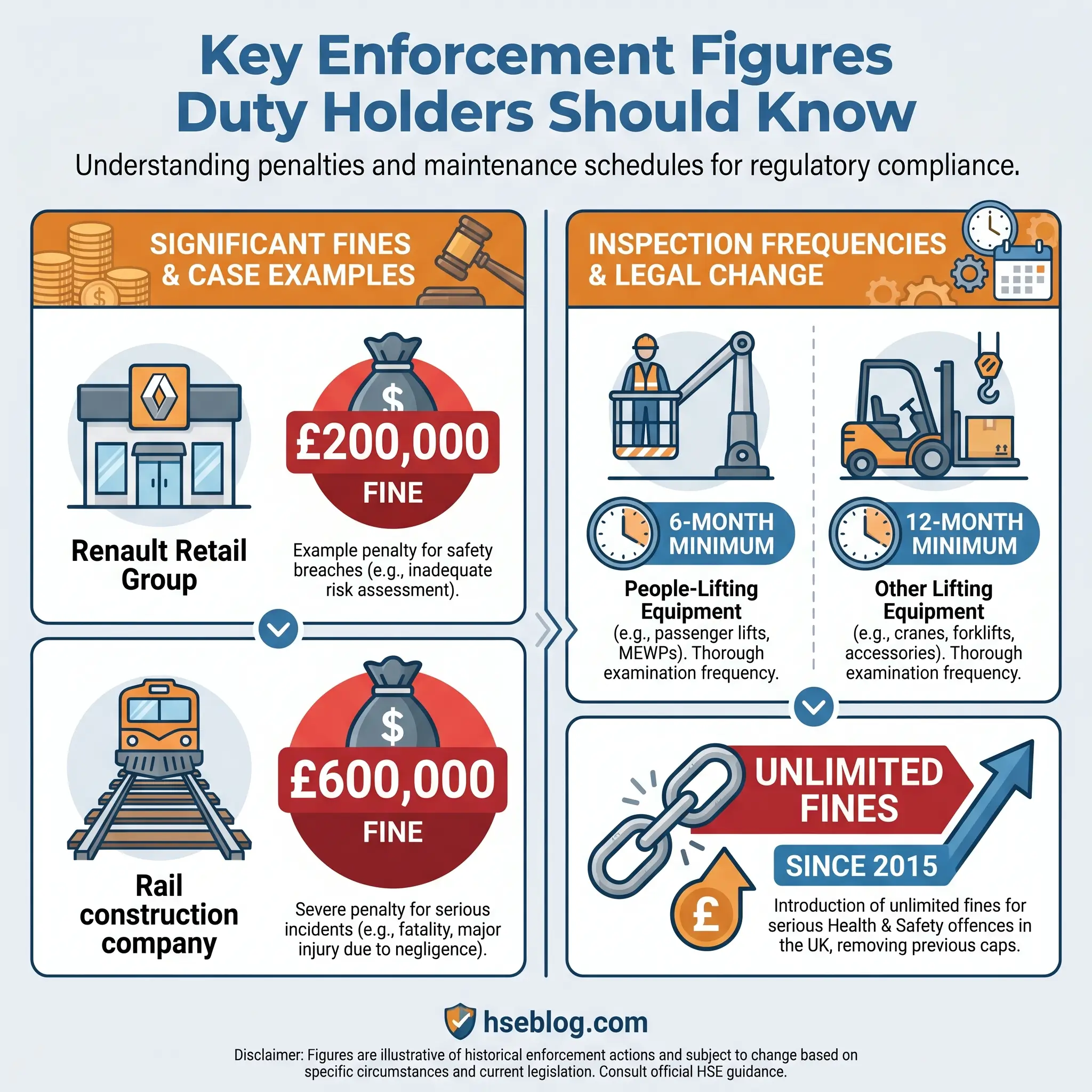
The enforcement picture has sharpened considerably since the 2015 Sentencing Council guidelines came into effect. Fines are now unlimited, tied to organisational turnover, and scaled to culpability and harm. The days of a tariff-style penalty for a LOLER breach are gone.
The HSE's enforcement toolkit runs through three escalating steps. An improvement notice requires remedial action within a specified period. A prohibition notice stops the activity immediately until the breach is resolved — a single prohibition notice on a production-critical crane can shut a shift. Prosecution in the Magistrates' or Crown Court brings unlimited fines and, where the breach is serious, personal prosecution of directors, managers, and other officers under Section 37 of the Health and Safety at Work Act. Custodial sentences for individual duty holders are now a routine feature of HSE sentencing outcomes.
The Fix That Works: Renault Retail Group was fined £200,000 with £17,218 in costs after pleading guilty to breaches of PUWER Regulation 5(1) and LOLER Regulation 10(3)(a). The case is a textbook illustration of how the two regulations are prosecuted together when a duty holder fails both maintenance and reporting duties on lifting equipment.
The human cost is starker still. In the Catholic Blind Institute case, a patient hoist sling failed and a resident died. The HSE inspector's finding was unambiguous: the sling should have been thoroughly examined at least once every six months under LOLER. A £200,000 fine is a painful line on a company's P&L. A fatality from a sling that should have been examined is not something any duty holder recovers from. A rail construction company was fined £600,000 after failing to ensure lifting operations were carried out safely under LOLER — and HSE data suggests that roughly half of farm deaths involving moving vehicles on British farms could have been prevented if PUWER-covered elements such as brakes and steering had been properly inspected. The regulations are not administrative overhead. They are the engineering controls the legislature has written down.
Similarities: What LOLER and PUWER Have in Common
Before closing out the comparison, it is worth naming the common ground. The two regulations are complementary by design.
- Both are made under the enabling powers of the Health and Safety at Work etc. Act 1974.
- Both came into force on the same day — 5 December 1998.
- Both place duties on employers, the self-employed, and anyone with control over work equipment.
- Both require a competent person standard, inspection regime, and maintenance discipline.
- Both require clear, durable markings on equipment.
- Both are enforced by the HSE, or by the local authority in certain lower-risk premises.
Frequently Asked Questions
Do I need LOLER if I already comply with PUWER?
Yes. LOLER imposes specific duties that PUWER does not cover — statutory 6/12-month thorough examinations under Regulation 9, SWL marking on every accessory, lifting operation planning under Regulation 8, and defect reporting to the enforcing authority under Regulation 10. PUWER compliance does not discharge those duties. For any equipment that lifts, treat LOLER and PUWER as parallel tracks that both have to stay green.
Is a forklift covered by LOLER or PUWER?
Both. The lifting components — mast, chains, forks, carriage, tilt rams, attachments — sit under LOLER. The non-lifting components — brakes, steering, tyres, seatbelt, lights, controls — sit under PUWER. A credible thorough examination covers both halves, which is why the CFTS framework has become the industry benchmark: it rolls the LOLER and PUWER elements into one unified examination.
How often are LOLER inspections required?
LOLER Regulation 9 fixes the minimum intervals at 6 months for lifting accessories and for equipment that lifts people, and 12 months for all other lifting equipment. A competent person can draw up a written examination scheme specifying different intervals — usually shorter for high-risk or high-cycle plant. Thorough examinations are also required after exceptional circumstances such as damage, major modification, or prolonged out-of-service storage.
Who counts as a competent person under LOLER?
Someone with appropriate practical and theoretical knowledge of the specific lifting equipment, sufficient to identify defects and assess their significance. Independence is the test that often fails on site — ACOP L113 makes clear the examiner should be sufficiently independent, which in practice means not the person or organisation that carries out routine maintenance on the same equipment.
Are pallet trucks covered by LOLER or PUWER?
Simple manual pallet trucks that raise the load only enough to clear the floor while moving it generally fall under PUWER alone — the lift is incidental to the move. Powered stackers, high-lift pallet trucks, and any pallet equipment raising the load more than a few hundred millimetres are treated as lifting equipment and fall under both LOLER and PUWER.
What is the difference between a PUWER inspection and a LOLER thorough examination?
A PUWER inspection is a risk-based check that verifies the equipment is still safe to use — interval set by the duty holder based on risk. A LOLER thorough examination is a systematic, statutory examination on fixed 6- or 12-month intervals, carried out by an independent competent person, producing a formal report that meets all 11 content requirements in Schedule 1 of LOLER. One is an operational health check; the other is a statutory audit.
The Decisions That Separate Compliant Sites from Prosecuted Ones
The distinction between LOLER and PUWER is not a philosophical one — it is the difference between a complete equipment safety regime and one with a large, expensive gap in the middle. Every duty holder reading this needs to make four decisions. Does your equipment register flag lifting equipment separately from general work equipment? Does your LOLER examination schedule run on statutory dates, not convenient ones? Is your competent person genuinely independent of the maintenance contract? And for every lifting operation on your site, is there a plan that Regulation 8 would recognise?
Look at how you manage your lifting equipment the next time you walk the site. Pick the nearest forklift, MEWP, or patient hoist and ask yourself whether you could produce, within five minutes, the current Schedule 1 thorough examination report, the PUWER inspection record, the operator's training certificate, and the written lift plan for the work happening around it. If any of those four documents is missing, the difference between LOLER and PUWER has stopped being an academic question and started being a prosecution waiting to happen.