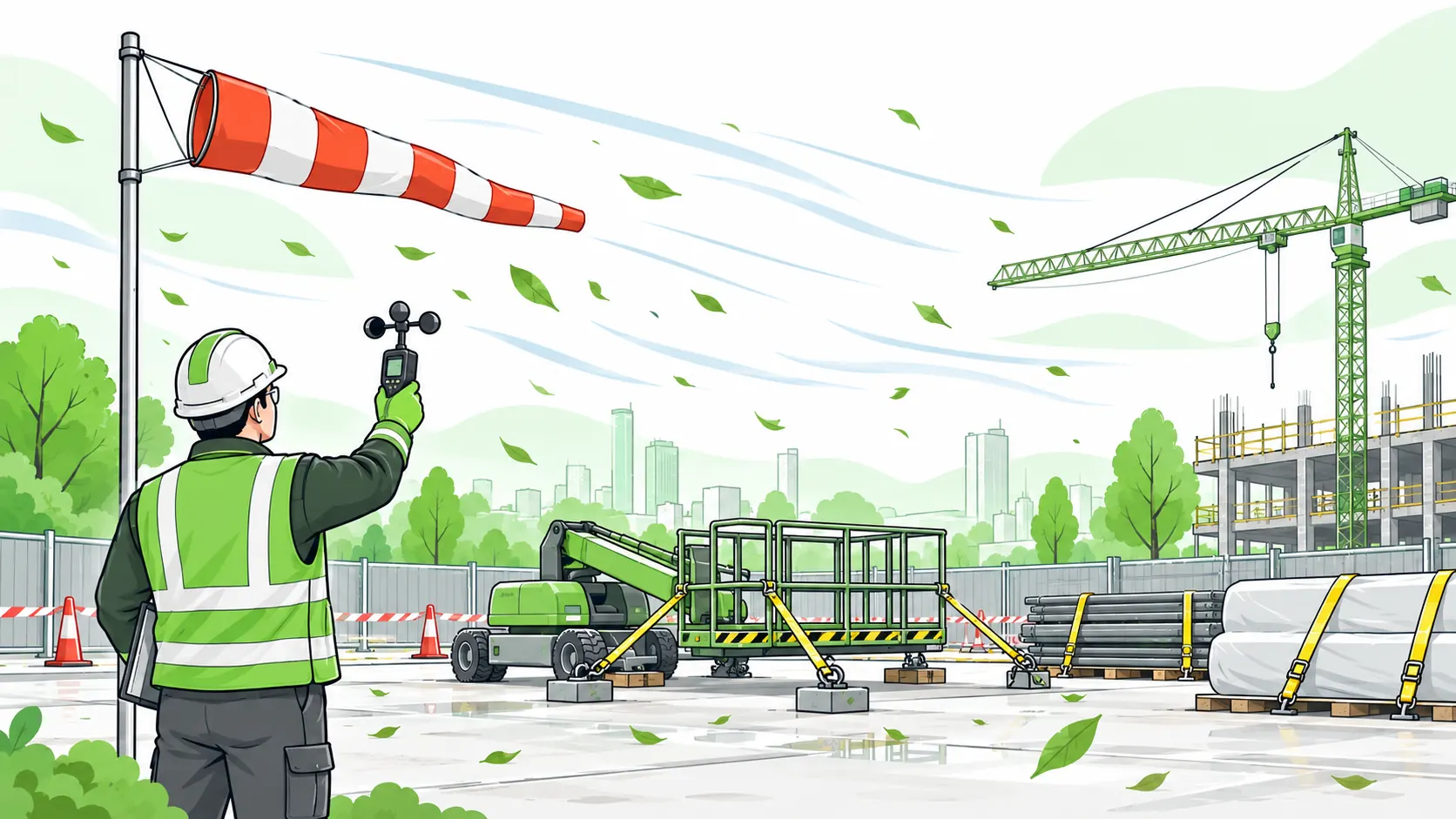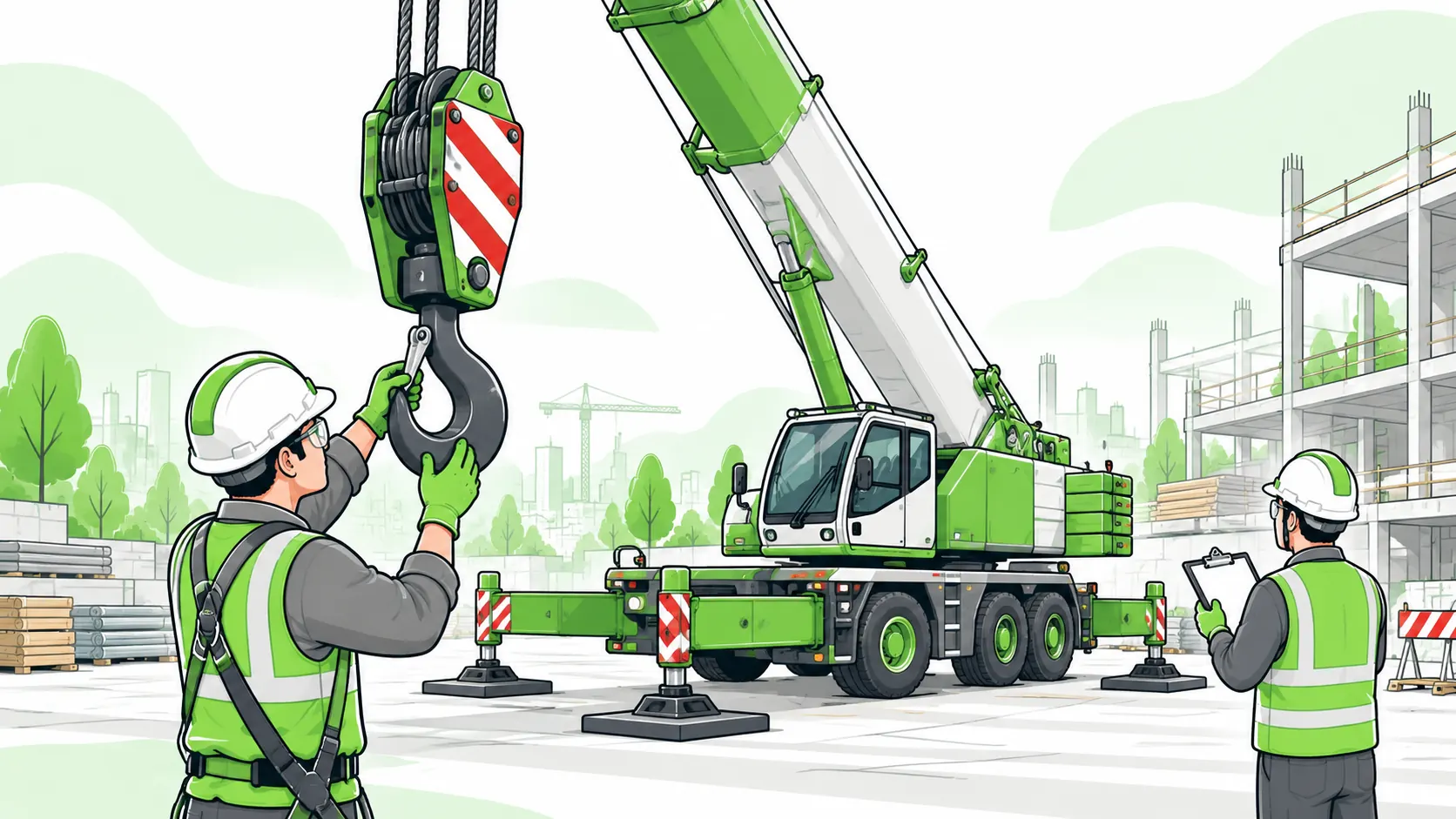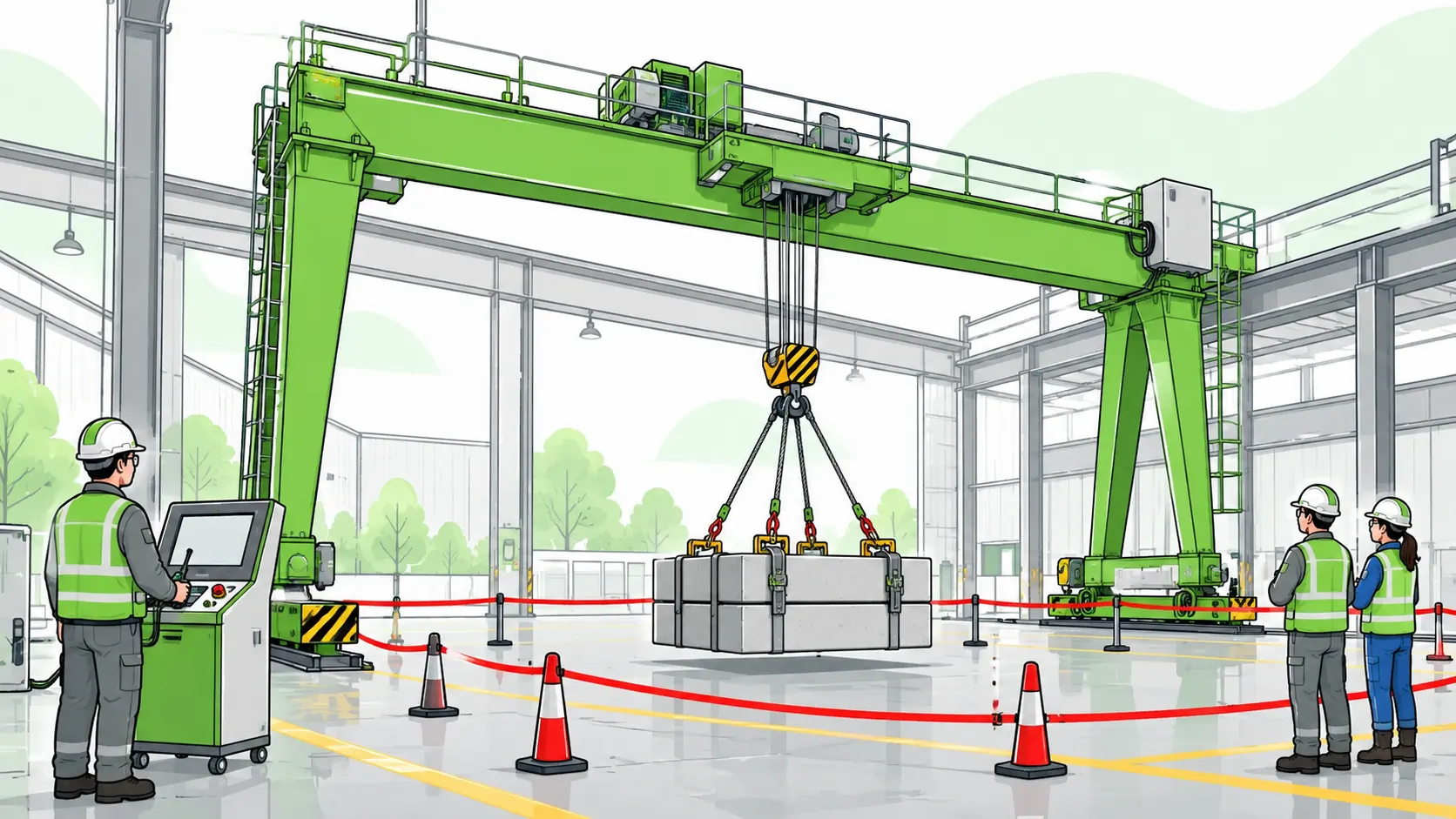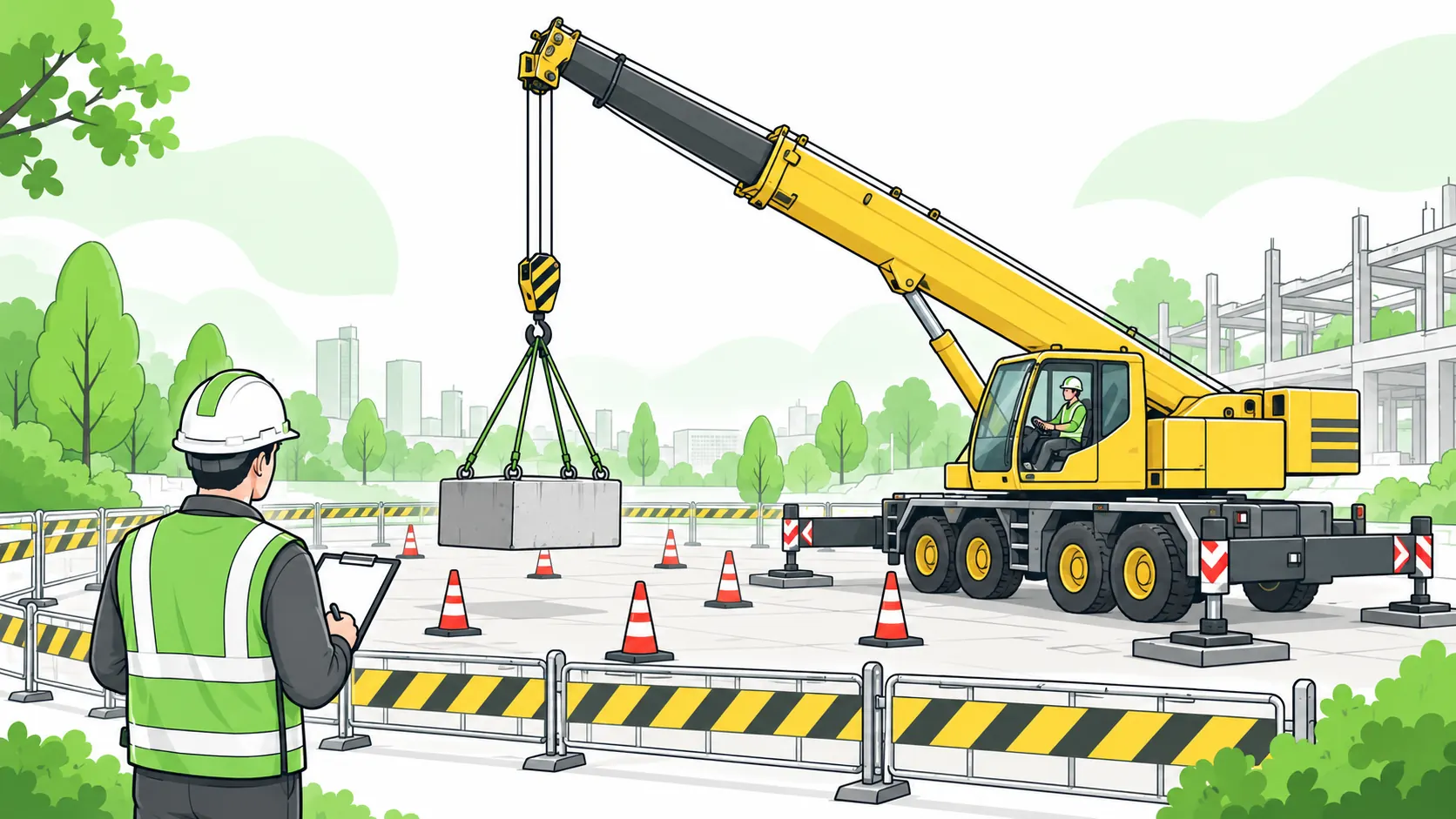
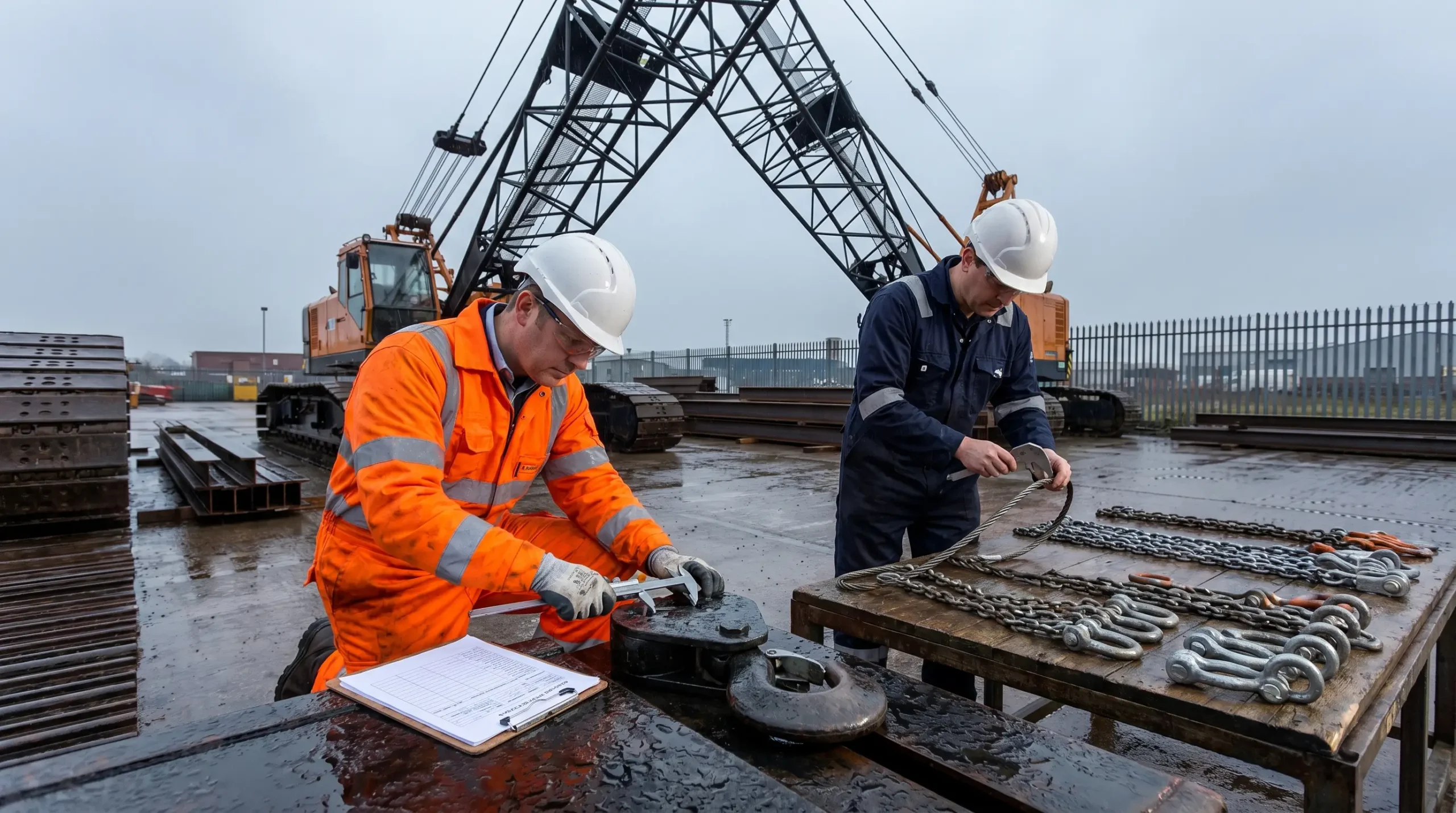
The contract lifting engineer handed me the slip at 06:40 — cracked link plate on the main block of the 40-tonne crawler. We had a steel girder booked to go up at 08:00, with the haul road already closed and three subcontract crews stood down waiting. That slip, written by a competent person, was the moment the next six hours of the project belonged to the Lifting Operations and Lifting Equipment Regulations 1998 — not to the programme, not to the client, not to the commercial pressure sitting in my inbox. This is what LOLER does on a working site: it takes decisions out of the hands of people with schedules and puts them into the hands of people with examination reports.
LOLER (Statutory Instrument 1998/2307) is made under the Health and Safety at Work etc. Act 1974 and sits alongside the Provision and Use of Work Equipment Regulations 1998 (PUWER) as one of the two pillars governing work equipment in Great Britain. It applies to any employer, self-employed person, or duty holder with control over lifting equipment used at work — which is a much wider population than most employers assume. If your business operates a patient hoist in a care home, a tail lift on a delivery van, a passenger lift in a hotel, or a forklift in a warehouse, you are a LOLER duty holder.
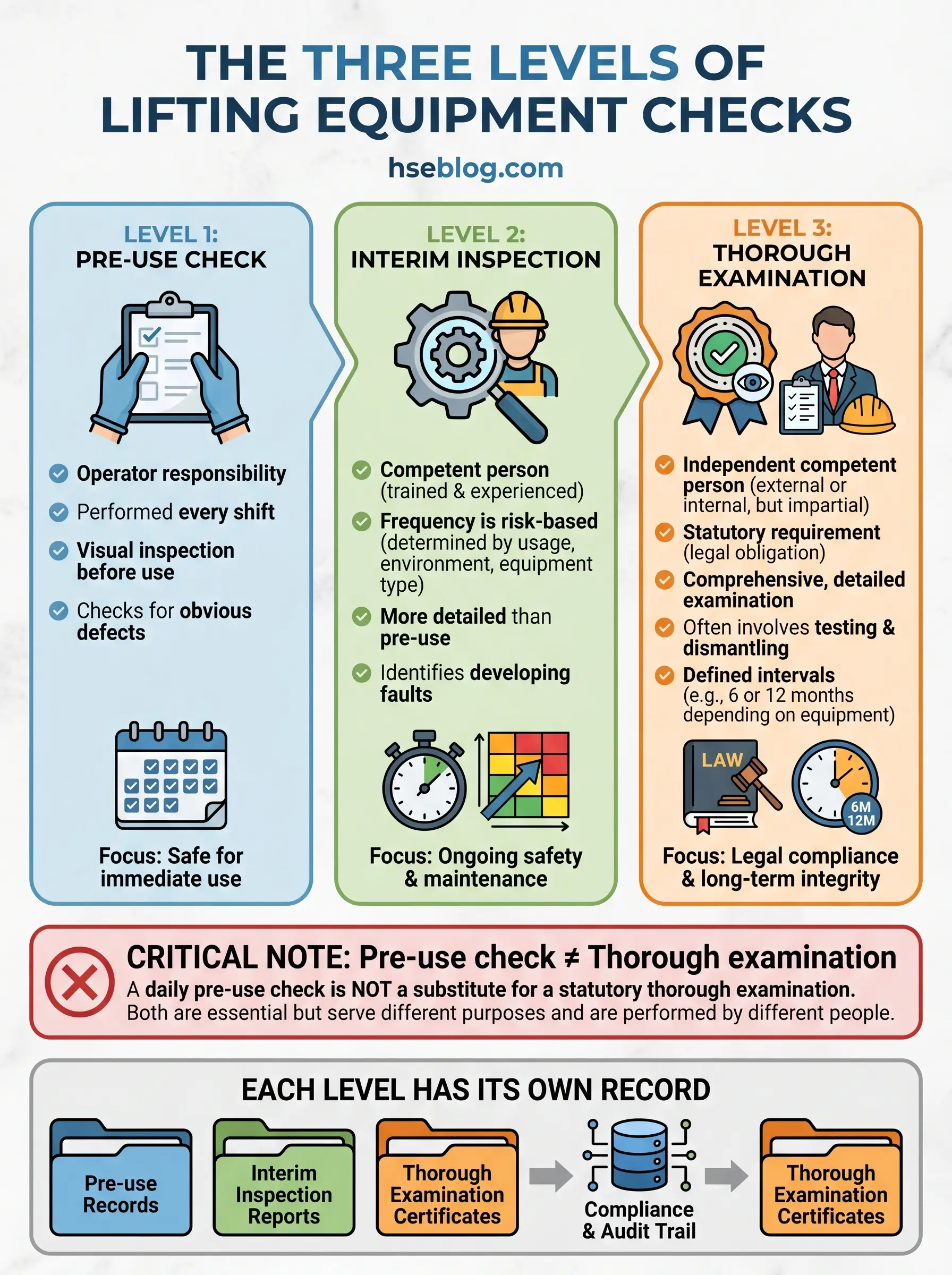
One thing competitor content routinely blurs is the difference between three levels of check, and employers get penalised for that confusion. The distinctions matter because they trigger different obligations, different competence requirements, and different records.
| Check Type | Who Performs It | Frequency | Legal Basis |
|---|---|---|---|
| Pre-use check | Trained operator | Every use / start of shift | PUWER Regulation 6, supporting LOLER |
| Interim inspection | Competent person (usually in-house) | Risk-based, between thorough examinations | PUWER Regulation 6 |
| Thorough examination | Independent competent person | 6 or 12 months, per scheme, or after exceptional circumstances | LOLER Regulation 9 |
Lifting failures are rarely forgiving. A dropped load crushes, a chain failure under tension can amputate, and a passenger lift overrun can kill. The HSE's 2024/25 statistics record 124 worker fatalities across Great Britain and 59,219 RIDDOR-reportable injuries to employees, with work-related injury and ill health costing the economy an estimated £22.9 billion in the most recent reference year. LOLER compliance is a material share of how serious employers keep those numbers from growing on their watch.
Which Equipment Is Covered by LOLER Inspection Requirements?
The boundary question trips up more duty holders than any other part of LOLER. The test is functional, not categorical: if a piece of equipment is used at work to lift or lower a load — including a person — it is captured by LOLER. That makes the scope wider than "cranes and forklifts" by a considerable margin.
The obvious population is cranes (tower, mobile, overhead gantry), forklift trucks, mobile elevating work platforms (MEWPs), passenger and goods lifts, vehicle tail lifts, vehicle-mounted cranes (HIABs), patient hoists, and construction hoists. The less obvious population is where enforcement action tends to originate — pallet trucks that lift above 300mm, rope access anchor points where the anchor itself forms part of the lifting system, and bath hoists in care homes that too many duty holders still class as "assistive equipment."
| Covered by LOLER | Outside LOLER (PUWER only) |
|---|---|
| Tower, mobile, overhead cranes | Conveyor belts (horizontal transfer) |
| Forklifts, reach trucks | Low-lift pallet trucks (below 300mm) |
| MEWPs and cherry pickers | Escalators and moving walkways |
| Passenger and goods lifts | Fixed industrial robots |
| Tail lifts on vehicles | Vehicle jacks used only for maintenance |
| Patient and bath hoists | Fixed platforms accessed by stairs |
| Vehicle-mounted cranes (HIABs) | — |
| Chains, slings, shackles, eyebolts | — |
Lifting Accessories — A Category Often Overlooked
Accessories are where compliance systems quietly rot. A sling is not "part of" the crane it hangs from under LOLER — it is lifting equipment in its own right, with its own 6-month thorough examination interval, its own identification marking, and its own Schedule 1 report. I've walked into lift plan reviews where the crane had a pristine examination history and the shackles in the rigging loft had no markings I could trace to any report. That asymmetry is the single most common finding in HSE lifting-related improvement notices, and it lives entirely in the accessories cupboard.
Employer Duties Under LOLER: The Core Legal Obligations
Most LOLER pages online describe what inspection companies do. Very few describe what the regulations actually require the employer to do. The list below is worth pinning to the wall of anyone who holds that duty — each item is a specific obligation mapped to a specific regulation, and each one has been the basis of HSE enforcement action somewhere in the country.
- Regulation 4 — Strength and stability. Ensure equipment has adequate strength and stability for each load, including composite loads and loads applied to components (eyebolts, anchors, mounting brackets). This is not satisfied by the manufacturer's Declaration of Conformity alone where equipment is assembled, modified, or used outside its original design envelope.
- Regulation 6 — Positioning and installation. Ensure equipment is positioned or installed to minimise the risk of striking a person, the load, or equipment drifting, falling, or freely releasing. On fixed installations like passenger lifts, this includes guarding, shaft integrity, and interlocks.
- Regulation 7 — Marking. Ensure machinery and accessories are clearly marked with the Safe Working Load (SWL), or where the SWL depends on configuration, ensure information is available to the operator. Lifting equipment for people must be marked accordingly. A shackle without a legible SWL stamp fails this regulation the moment it enters service.
- Regulation 8 — Organisation of lifting operations. Every lifting operation must be properly planned by a competent person, appropriately supervised, and carried out safely. Lift plans are not bureaucracy — they are the Regulation 8 evidence.
- Regulation 9 — Thorough examination and inspection. Ensure thorough examinations are carried out at the statutory intervals, according to a written examination scheme, or after exceptional circumstances. This is the core operational requirement.
- Regulation 10 — Reports and defects. Ensure the competent person provides a written Schedule 1 report, notifies the duty holder of any serious defect, and sends a copy to the enforcing authority where the examination identifies a defect that could cause existing or imminent risk of serious personal injury.
- Regulation 11 — Records. Keep reports of thorough examination, the Declaration of Conformity for each piece of equipment, and examination scheme documentation — for the periods specified in the regulation.
LOLER Inspection Frequency: How Often Must Equipment Be Examined?
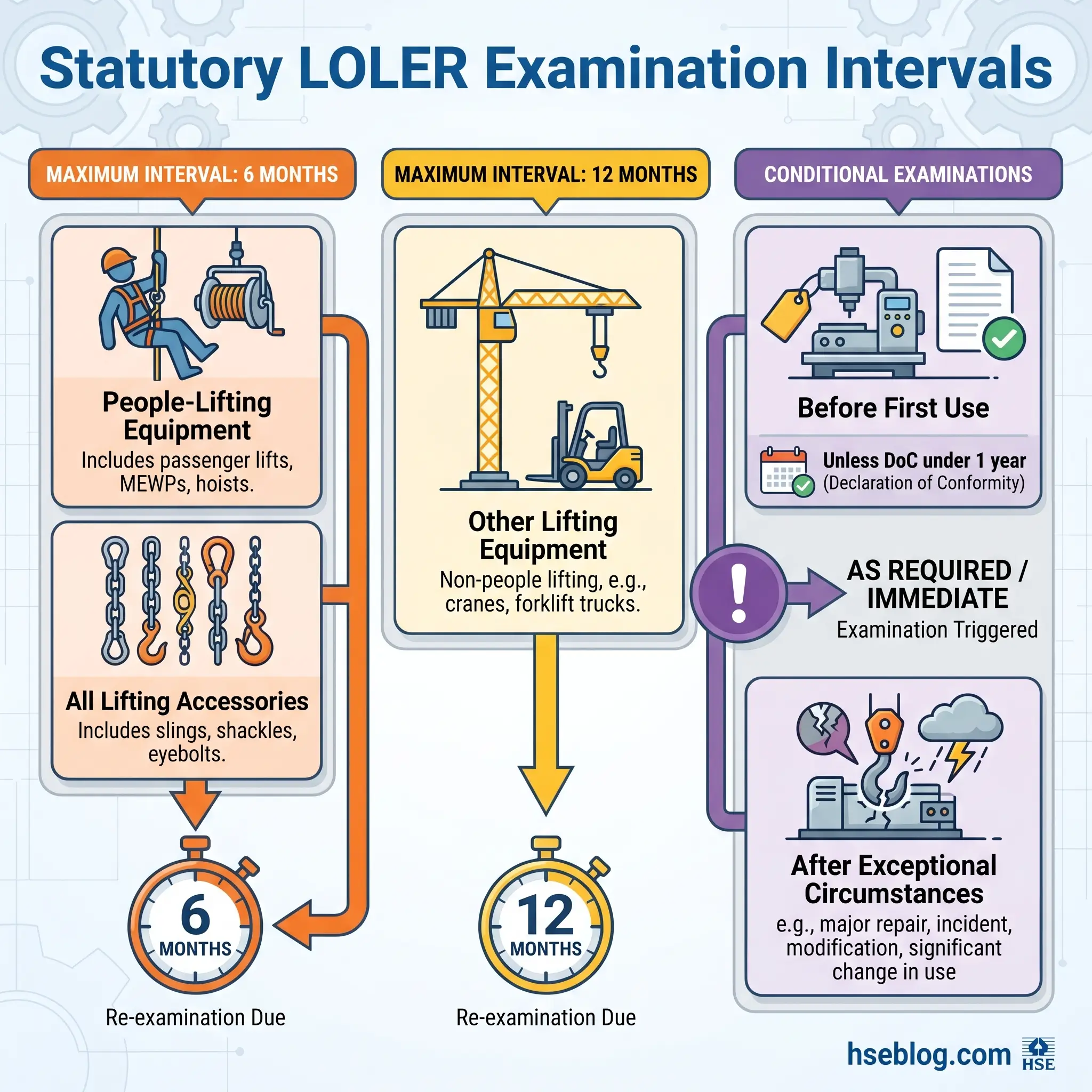
The frequency rules are shorter than they look, but the four trigger events around them are where duty holders slip up. Standard intervals from Regulation 9 are summarised below.
| Equipment Category | Thorough Examination Interval |
|---|---|
| Equipment used to lift persons (passenger lifts, MEWPs, patient hoists) | Every 6 months |
| All lifting accessories (chains, slings, shackles, eyebolts, hooks) | Every 6 months |
| All other lifting equipment (most cranes, forklifts, goods lifts) | Every 12 months |
| Any equipment, per an examination scheme drawn up by a competent person | As specified in the scheme |
The four trigger events that override these defaults are where I see most employers caught short:
- Before first use. Unless the equipment has a Declaration of Conformity less than one year old AND has not been assembled on site. Most site-assembled equipment (tower cranes, goods hoists, installed passenger lifts) needs a pre-use thorough examination regardless of how new the paperwork is.
- After installation or assembly at a new location. A tower crane climbed on Monday is a different piece of equipment from a safety-case perspective than the same crane on the ground on Friday. A post-erection thorough examination is mandatory.
- After exceptional circumstances. Damage, a period out of use long enough to raise corrosion or component concerns, a major modification, unusual weather events (floods, structural impact), or a near-miss that may have loaded components beyond expected parameters.
- As required by a written examination scheme. More on this in the next section — it is both an obligation and a flexibility.
The HSE's detailed guidance on thorough examinations expands on the "exceptional circumstances" trigger and is the reference I point duty holders to whenever there's an argument on site about whether an event justifies an unscheduled examination. The answer on the day is almost always yes.
When Standard Intervals Are Not Enough: Examination Schemes Explained
The examination scheme is the most under-used provision in LOLER, and the one that saves employers the most money when used properly. Regulation 9 allows a written scheme — drawn up by a competent person — to set examination intervals different from the default 6 or 12 months, provided the scheme is justified by risk.
A scheme goes in both directions. For a passenger lift in a low-traffic office block used only by delivery staff, a competent person may justify extending certain checks beyond the statutory interval. For a forklift running round-the-clock in a frozen-goods warehouse where thermal cycling and condensation are degrading the mast rollers, a scheme may pull the interval down to 4 months. Either direction requires the scheme to be documented, signed by the competent person, and retained with the examination records.
Field Test: If you operate more than ten pieces of lifting equipment across variable duty cycles, ask your competent person to produce a written examination scheme. The default intervals are a regulatory floor, not an engineering answer. A scheme forces the risk conversation that the default dates hide.
Who Is a "Competent Person" Under LOLER?
The competent person is the single most misunderstood concept in LOLER. There is no government licence, no certificate that confers the status, and no single qualification that guarantees it. The ACOP L113 paragraph 296 standard is the reference definition: a person with such appropriate practical and theoretical knowledge and experience of the lifting equipment to be thoroughly examined that they can detect defects or weaknesses and assess their importance in relation to the safety and continued use of the lifting equipment.
That definition has two halves. Practical and theoretical knowledge means qualifications, training, and time on tools — typically evidenced by engineer surveyor qualifications, LEEA (Lifting Equipment Engineers Association) membership, or equivalent professional standing. The second half — the assessment of importance — is where judgement lives. A worn pin is a finding; whether that worn pin is in-service-acceptable, needs monitoring, or requires immediate withdrawal is the competence question.
Independence is the separate, equally important requirement. The competent person must be sufficiently independent and impartial that their opinion is not compromised by the production pressures or maintenance history of the equipment. An employer can use in-house competent persons — this is permitted — but not the same person who performs the routine maintenance. The logic is straightforward: the same engineer who torqued the bolts last week cannot credibly certify the bolts this week.
The Competent Person Test
Before appointing any inspector, in-house or external, an employer should be able to answer five questions. What relevant professional qualifications does this person hold? How many years have they worked with this specific equipment type? Are they independent of the routine maintenance of the equipment they will examine? What professional indemnity cover sits behind their opinion? Can they produce Schedule 1 reports they have authored for equipment similar to yours?
Most duty holders outside very large corporate estates will conclude that external competent persons are the safer path. The liability exposure of getting in-house competence wrong — particularly after an incident — is rarely worth the savings.
What Does a LOLER Thorough Examination Involve?
A thorough examination is not a checklist inspection and not a maintenance service. It is a structured engineering assessment of whether the equipment is safe to continue in service until the next examination. Knowing what actually happens during one helps employers plan downtime, prepare equipment access, and understand why certain items take the time they do.
- Pre-examination documentation review. The competent person reviews previous reports, the Declaration of Conformity, maintenance records, and any interim inspection findings. Defects from prior reports are carried forward to confirm remedial action.
- Visual examination. A structured visual of safety-critical components — structural members, welds, pins, wire ropes, chains, hooks, brake assemblies, control interlocks, anti-two-block devices, load-limit systems. Corrosion, deformation, wear patterns, and missing markings are recorded.
- Functional checks. Operation of the equipment across its working envelope — control responsiveness, brake holding, limit switch activation, emergency stop function, descent rates on lifts and hoists.
- Dimensional and wear measurements. Calliper and gauge measurements on items with defined wear limits — hook throat openings, chain link elongation, wire rope diameter, sheave groove wear.
- Non-destructive testing, where required by risk assessment. Magnetic particle inspection, dye penetrant, ultrasonic testing — typically on high-stress components with fatigue history. Not every examination requires NDT; it is deployed where the competent person judges it necessary.
- Disassembly, where justified. Internal examination of gearboxes, brake assemblies, or enclosed structural components where external examination cannot give a reliable opinion.
- Report preparation. The Schedule 1 report is written immediately after the examination and delivered to the duty holder.
One item that confuses duty holders: overload testing is not routine. Loading equipment to 125% of SWL for periodic confirmation is old-generation practice that can actually damage equipment and shorten service life. Modern thorough examinations rely on structural assessment, component measurement, and condition monitoring — overload testing is reserved for first-use proof testing, post-major-repair verification, or where specifically required by a standard for that equipment type.
The Schedule 1 Report: What Must Be Recorded
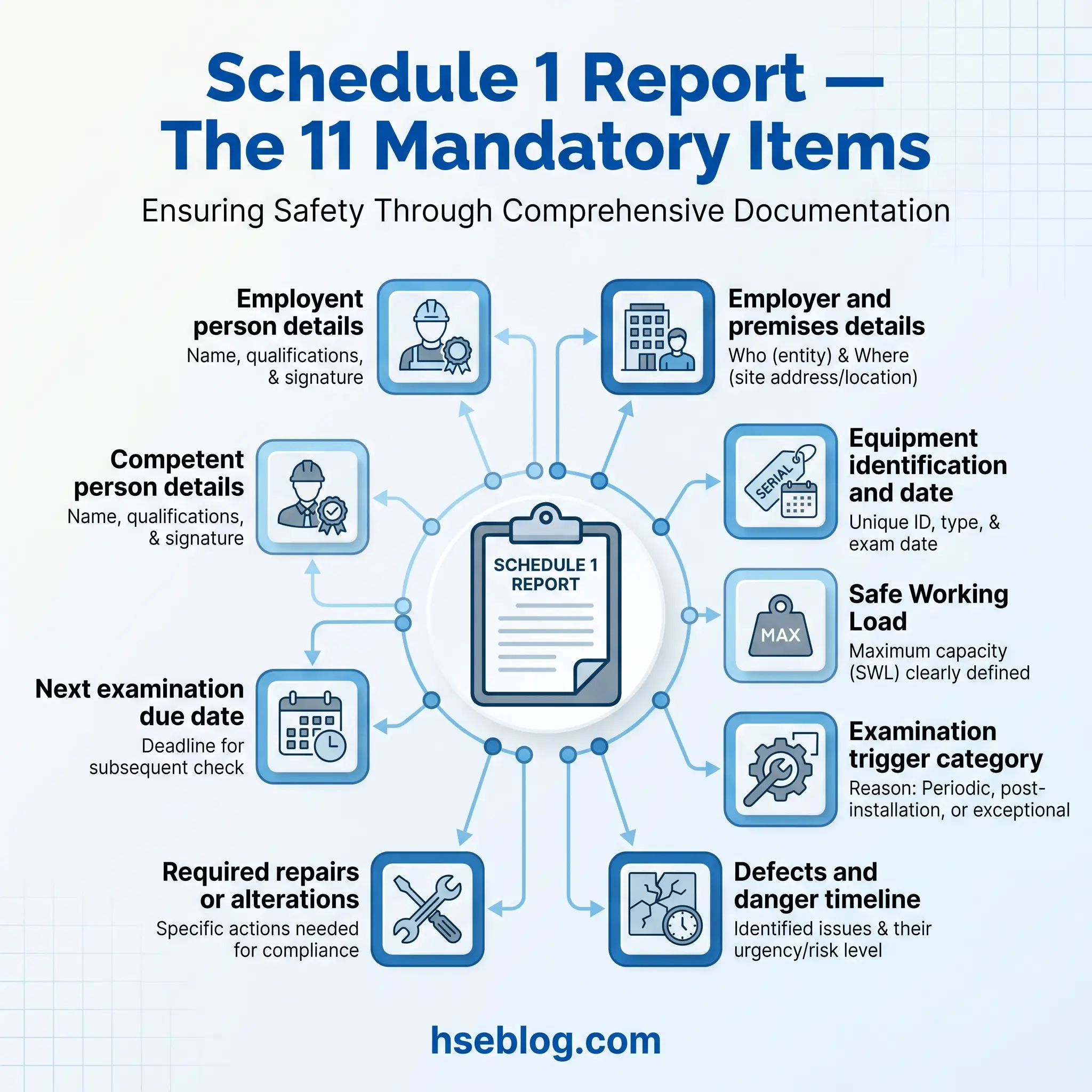
LOLER Schedule 1 specifies eleven items that every thorough examination report must contain. Competitor guidance routinely skips this list, but it is the employer's single best tool for checking whether the report you're paying for is legally compliant — before the HSE checks for you.
- Name and address of the employer for whom the examination was made
- Address of the premises at which the examination was made
- Particulars sufficient to identify the lifting equipment, including where known its date of manufacture
- Date of the last thorough examination
- The Safe Working Load of the equipment (or, where the SWL depends on configuration, each SWL or information sufficient to determine it)
- Confirmation of whether the examination was before first use, after installation/assembly at a new location, within an interval under Regulation 9(3), or in accordance with an examination scheme, or after exceptional circumstances
- Confirmation of whether the examination identified any defect that is or could become a danger, a description of that defect, and a statement of when it could become dangerous
- Particulars of any repair, renewal, or alteration required to remedy a defect that could become dangerous
- The latest date by which the next thorough examination must be carried out
- Where the examination included inspection/testing of parts by a person other than the competent person, the name of that person
- Name, address, and qualifications of the competent person; name and address of the person signing on their behalf; and date of the report
There is no mandatory report format — content is what matters. Reports can be paper or electronic, but must be producible in writing if requested and protected from unauthorised alteration.
What Happens When Defects Are Found?
When a competent person finds a defect involving existing or imminent risk of serious personal injury, a cascade of legal obligations starts — and it moves faster than most employers expect. On the crawler crane morning I described at the start, the paperwork for the enforcing authority notification was drafted before the replacement block arrived on site.
- Immediate verbal notification. The competent person tells the duty holder straight away. This is not an email the next morning — it is a conversation on the day, recorded in the examination day's notes.
- Written report confirming the defect. Even if the defect is remedied on the spot (a sling destroyed, a shackle withdrawn), the written report must still identify it. "Fixed verbally" has no legal standing.
- Equipment withdrawn from service. The employer must take the equipment out of use until the defect is remedied. This is a Regulation 9(3)(b) consequence — continuing to use equipment after a notified defect is an enforcement-grade breach.
- Copy to the enforcing authority. The competent person sends a copy of the report to HSE (for most industrial premises) or the local authority (for most commercial, retail, hospitality, and office premises). The employer does not need to do this themselves, but must not obstruct it.
- RIDDOR assessment. If the defect caused — or could have caused — a reportable dangerous occurrence, the employer has a separate RIDDOR 2013 obligation to report. Collapse of lifting equipment, overturn of a crane, and failure of any load-bearing part are specifically reportable dangerous occurrences.
- Remedial action and re-examination. Equipment is repaired, re-inspected, and the re-examination report is added to the records before the equipment returns to service.
Record-Keeping Requirements Every Employer Must Meet
LOLER enforcement action is often won or lost in record-keeping, not in the equipment condition itself. When the HSE arrives after an incident, the conversation starts with "show me your records" — not "show me your crane."
| Record Type | Minimum Retention | Legal Basis |
|---|---|---|
| Thorough examination report (lifting accessories) | 2 years | LOLER Reg 11(1)(a) |
| Thorough examination report (other lifting equipment) | Until next examination is made | LOLER Reg 11(1)(b) |
| Declaration of Conformity (new equipment) | Life of the equipment | LOLER Reg 9(1) reliance |
| Examination scheme | While in use, plus superseded versions for audit | LOLER Reg 11(1)(c) |
| Defect reports and remedial action records | Life of equipment (practical standard) | LOLER Reg 10 + HSAW Act |
| Asset register of all lifting equipment | While equipment is in service | Practical compliance |
Electronic records are acceptable under current HSE guidance, provided they are producible in writing on request and protected from unauthorised alteration. This is the provision under which modern digital LOLER compliance platforms — inspection management software with audit trails, automated reminder systems, and IoT-based condition monitoring on cranes and MEWPs — have become widespread through 2025 and into 2026. The underlying LOLER regulations have not changed; the tooling around them has.
LOLER vs PUWER: What Employers Need to Understand
Nearly every piece of lifting equipment is also work equipment, which means both LOLER and PUWER apply at the same time. I've seen employers treat a clean LOLER report as a PUWER pass, and it is not. The two regulations cover different aspects of the same equipment and both carry enforcement consequences.
| Aspect | LOLER 1998 | PUWER 1998 |
|---|---|---|
| Scope | Lifting equipment only | All work equipment |
| Core focus | Strength, stability, thorough examination, lifting planning | Suitability, maintenance, inspection, training |
| Frequency driver | Statutory (6 or 12 months) or examination scheme | Risk-assessed inspection regime |
| Competent person required | Yes, for thorough examination | Yes, for inspection where appropriate |
| Typical failure mode | Component failure under load | Operator injury, inadequate training, poor maintenance |
| Overlap example | Forklift — LOLER for lift, PUWER for drive/brakes/training |
A Consolidated Fork Truck Services (CFTS) "Thorough Examination" standard for lift trucks combines LOLER and PUWER elements into a single examination because the equipment needs both. That combined approach is the benchmark employers should look for on dual-regulated equipment — a LOLER-only examination on a forklift leaves the PUWER duties untested.
Consequences of Non-Compliance: HSE Enforcement in Practice
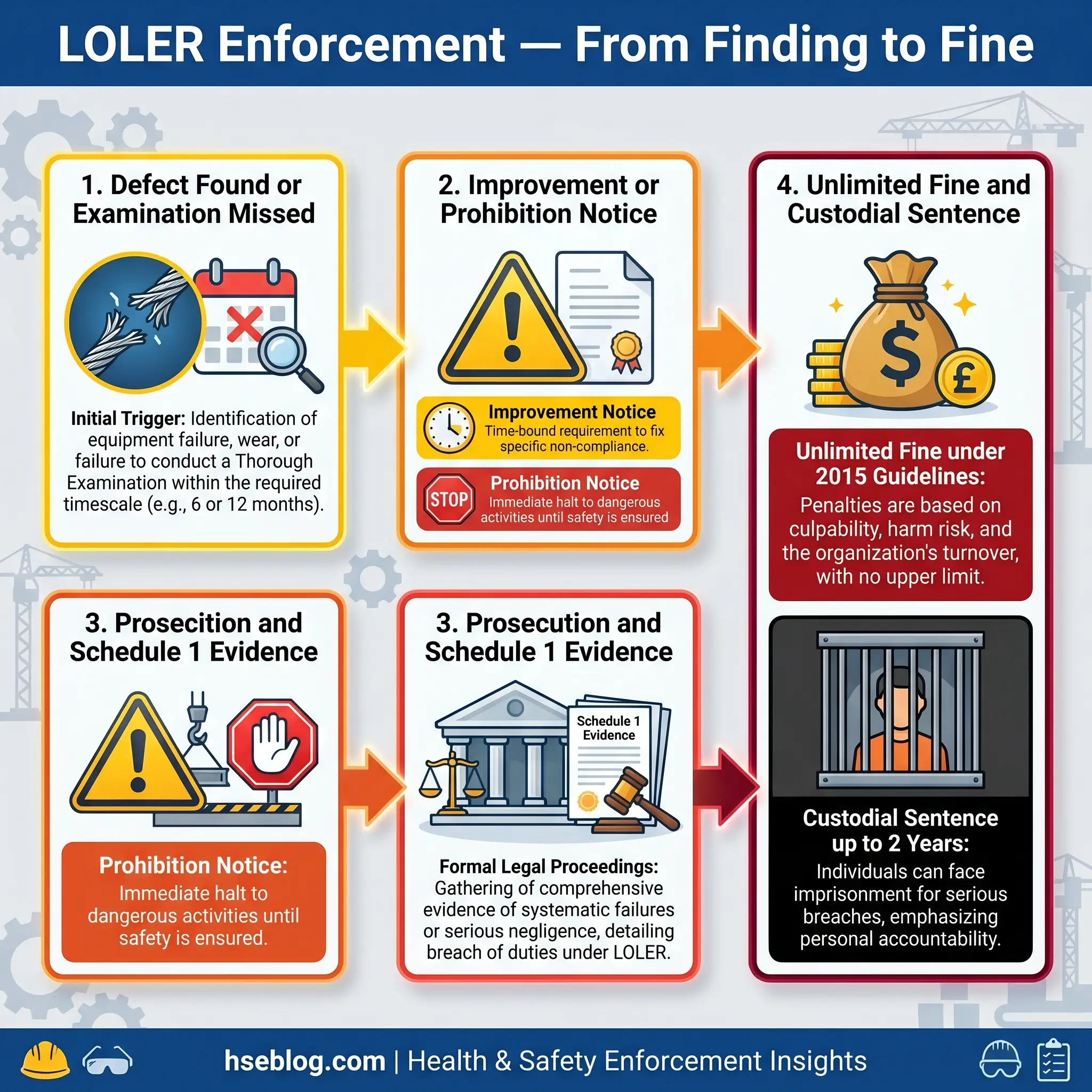
The enforcement picture changed materially in 2016 when the Sentencing Council's definitive guideline on health and safety offences removed the £20,000 cap on magistrates' court fines. Fines are now unlimited and calculated against a matrix of turnover, culpability, and harm.
HSE has four principal enforcement mechanisms for LOLER breaches:
- Improvement notice. Typically 21 days to comply. A non-appealed, un-complied notice becomes a criminal matter.
- Prohibition notice. Immediate cessation of the identified unsafe work activity. The equipment or operation cannot resume until the hazard is controlled.
- Prosecution. Criminal prosecution of the corporate duty holder, individual directors, or both. Convictions go on the HSE public register — a reputational exposure that often outlasts the financial penalty.
- Corporate manslaughter referral. Where a LOLER failure contributes to a fatality and the failure reflects how the organisation's activities were managed or organised.
The published enforcement record makes the theory concrete. A steel fabricator was prosecuted and fined £13,333 plus £2,527 costs after failing to carry out thorough examinations on two cranes within an extended deadline — a case that turned not on an incident, but on documentary non-compliance with Regulation 9. At the other end, a rail construction company was fined £600,000 following a guilty plea after a lifting operation was carried out exceeding safe lifting capacity — the SWL breach crossing straight through Regulation 7 and Regulation 8 obligations.
The case that changes the room: £600,000 is not the outlier figure anymore. For organisations with serious turnover, fines in the £500,000–£2 million range for significant LOLER breaches are within the Sentencing Guideline matrix. Duty holders can also face custodial sentences of up to two years for serious breaches. Anyone falsely pretending to be a competent inspector faces up to six months. The penalty ceiling is measured in careers, not just cash.
Against the wider backdrop — 124 workers killed at work in Great Britain in 2024/25, construction alone recording 35 fatalities, and the economic cost of workplace injury and ill health sitting at £22.9 billion — the case for robust LOLER compliance is not a paperwork argument. It is a business continuity argument.
Building a LOLER Compliance System: Practical Steps for Employers
Compliance is a system, not a purchase. The employers I've seen navigate HSE inspections cleanly are not the ones who spent the most on inspection contracts — they are the ones who ran LOLER as a managed process with clear ownership. The implementation sequence below is the one I recommend to any duty holder building this from scratch or rebuilding after an audit finding.
- Build an asset register of every piece of lifting equipment and every accessory. Unique ID, description, location, SWL, Declaration of Conformity date, date acquired. Accessories count individually — a rigging loft of fifty slings is fifty register entries.
- Map each asset to an examination interval. 6 months, 12 months, or per written examination scheme. Flag the next due date and the trigger conditions (fixed interval, exceptional circumstances sensitivity, first-use status).
- Appoint your competent person, in writing. External contract or internal appointment — the appointment document names the individual, their qualifications, the scope of equipment, and the independence arrangements.
- Document the pre-use check procedure for each equipment category. Operator's daily or per-shift checks, with a recording method. This is the PUWER layer under LOLER and is routinely checked during HSE visits.
- Operate a defect reporting and quarantine procedure. Clear route from operator to supervisor to competent person. Physical lock-out and tagging for equipment withdrawn from service. Written remedial action before return to service.
- Implement digital compliance tooling where scale justifies it. An inspection management platform with automated reminders and audit-trail retention is not a regulatory requirement, but it is increasingly the practical answer for estates of more than 20–30 assets and the direction the industry has moved in through 2025–2026.
- Conduct an annual management review of LOLER status. Examination due dates met, defect trends, examination scheme adequacy, competent person performance, training coverage. Document the review — it is the evidence that LOLER is being actively managed, not just serviced.
Frequently Asked Questions
How often does lifting equipment need to be inspected under LOLER?
Lifting equipment used to lift people and all lifting accessories require a thorough examination every 6 months. All other lifting equipment requires a thorough examination every 12 months. Four events override these intervals: before first use (unless a Declaration of Conformity less than one year old is available and the equipment is not assembled on site), after installation or assembly at a new location, after exceptional circumstances such as damage or major modification, and whenever a written examination scheme prepared by a competent person specifies a different interval.
Can an employee carry out a LOLER inspection in-house?
Yes, where the employee meets the competent person standard set out in ACOP L113 paragraph 296 — sufficient practical and theoretical knowledge and experience to identify defects and judge their significance — and is independent from routine maintenance of the equipment they examine. In practice, most employers appoint an external competent person because independence is easier to evidence and the liability exposure sits with an insured third party. Employers with large internal engineering functions can and do run the in-house model successfully.
What is the difference between a LOLER inspection and a thorough examination?
"Thorough examination" is the statutory term used in LOLER Regulation 9 and carries specific legal requirements — a competent person, a Schedule 1 report, and a fixed interval or examination scheme. "Inspection" in common use often refers to interim checks that sit between thorough examinations, carried out under PUWER to spot developing deterioration. Pre-use checks by operators are a third, separate activity. Only the thorough examination satisfies Regulation 9.
Is a LOLER certificate legally required?
No — there is no legal document called a "LOLER certificate." The legal document is the Report of Thorough Examination, containing the eleven items specified in Schedule 1 of LOLER 1998. Many inspection companies produce documents titled "LOLER certificate" as a commercial format, which is not a problem provided the document contains the Schedule 1 content. Employers should check the content against Schedule 1, not accept the title at face value.
What happens if you fail a LOLER inspection?
The equipment must be taken out of service immediately until the defect is remedied. The competent person notifies the duty holder verbally and in writing, and sends a copy of the report to the enforcing authority — HSE for most industrial workplaces, the local authority for most retail, hospitality, and office environments. Repeated or systemic failures can trigger improvement notices, prohibition notices, or prosecution under Regulation 9.
How much can a company be fined for breaching LOLER?
Fines for LOLER breaches are unlimited since the 2015 Sentencing Council Definitive Guideline removed the previous £20,000 magistrates' cap. Penalties scale with turnover, culpability, and harm — published enforcement cases range from around £13,000 for documentary non-compliance with Regulation 9, to £600,000 for a lifting operation exceeding the safe working capacity, with higher figures recorded for organisations with large turnover. Duty holders can also face custodial sentences of up to two years for serious breaches.
Conclusion
LOLER compliance is something most organisations get wrong in the same way: they outsource the inspections and assume the duty has moved with the invoice. It has not. The legal duty under the Lifting Operations and Lifting Equipment Regulations 1998 sits with the employer throughout the life of every piece of lifting equipment and every accessory on the register — before first use, between examinations, after exceptional circumstances, and on the day an HSE inspector arrives.
Of everything covered above, the single highest-impact change I'd push any duty holder towards is the one competitors barely mention: commission a written examination scheme from your competent person for your critical equipment. The default 6 and 12-month intervals are a regulatory floor that treats a thrice-weekly care-home patient hoist the same as a warehouse crane lifting twice a month. A scheme forces the risk conversation that the default dates hide, and the resulting documented reasoning is exactly what a well-prepared defence looks like if an incident ever reaches court.
Through 2025 and 2026, digital LOLER compliance platforms and IoT-based condition monitoring on cranes and MEWPs have moved from early-adopter to mainstream — HSE already permits electronic records provided they are producible on request and protected from alteration. What has not changed is the framework itself: the employer duties under Regulations 4 through 11 are exactly as they were when LOLER came into force. The tooling is modernising. The obligation on the duty holder is not.