

TL;DR
- If an inspector visits and finds no material breach → expect informal verbal advice or a written advisory letter with recommendations for improvement — no legal enforcement, no financial penalty.
- If an inspector identifies a regulatory contravention → expect an improvement notice requiring you to fix the breach within a set deadline (minimum 21 days under UK law), or face criminal charges for non-compliance.
- If an inspector identifies a risk of serious personal injury → expect a prohibition notice halting the dangerous activity immediately — and unlike an improvement notice, appealing it does not automatically suspend the prohibition.
- If breaches are serious, repeated, or involve a fatality → expect prosecution, with penalties reaching unlimited fines and imprisonment in the UK, or up to $165,514 per willful violation in the US (OSHA, 2025).
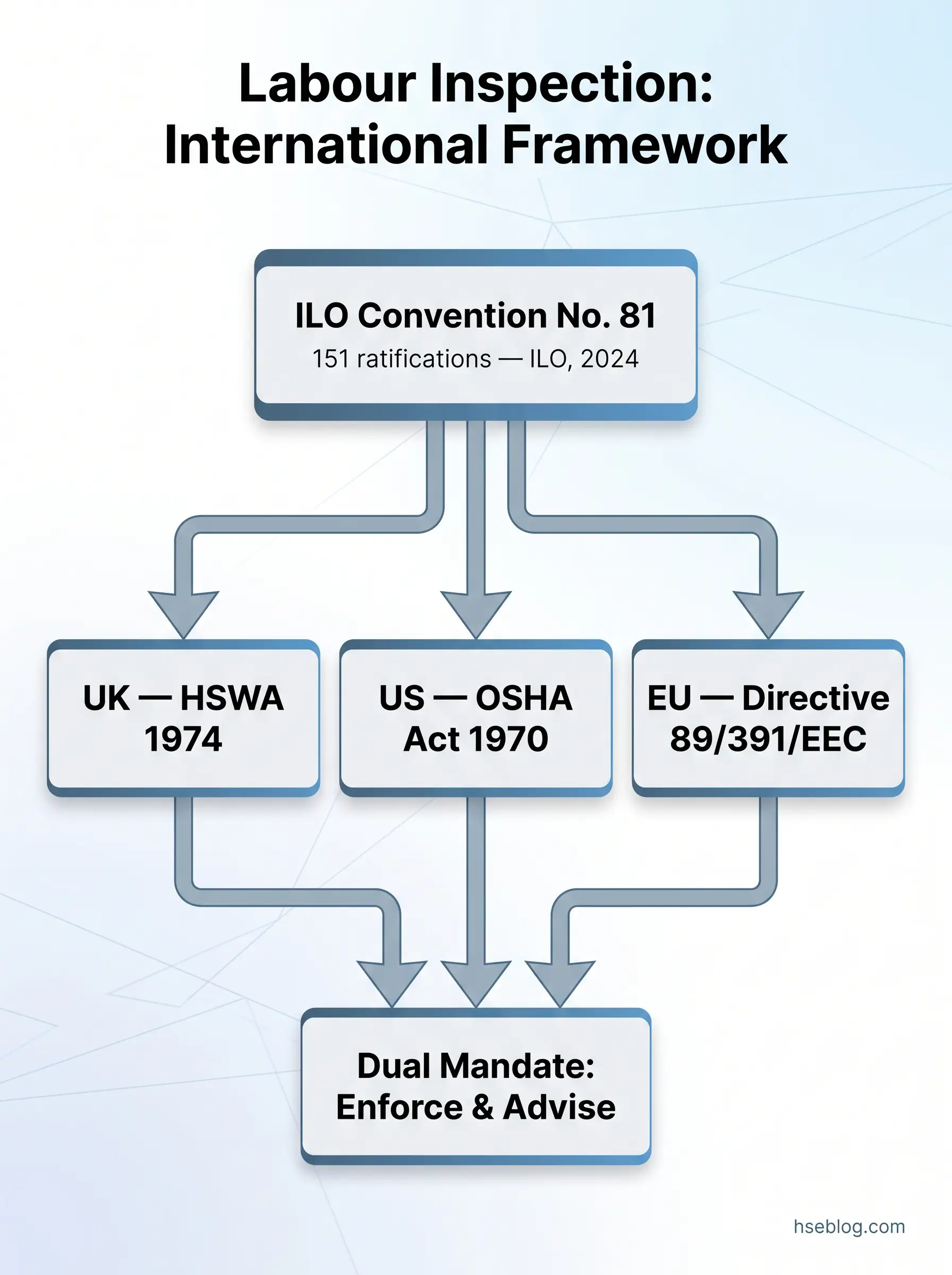
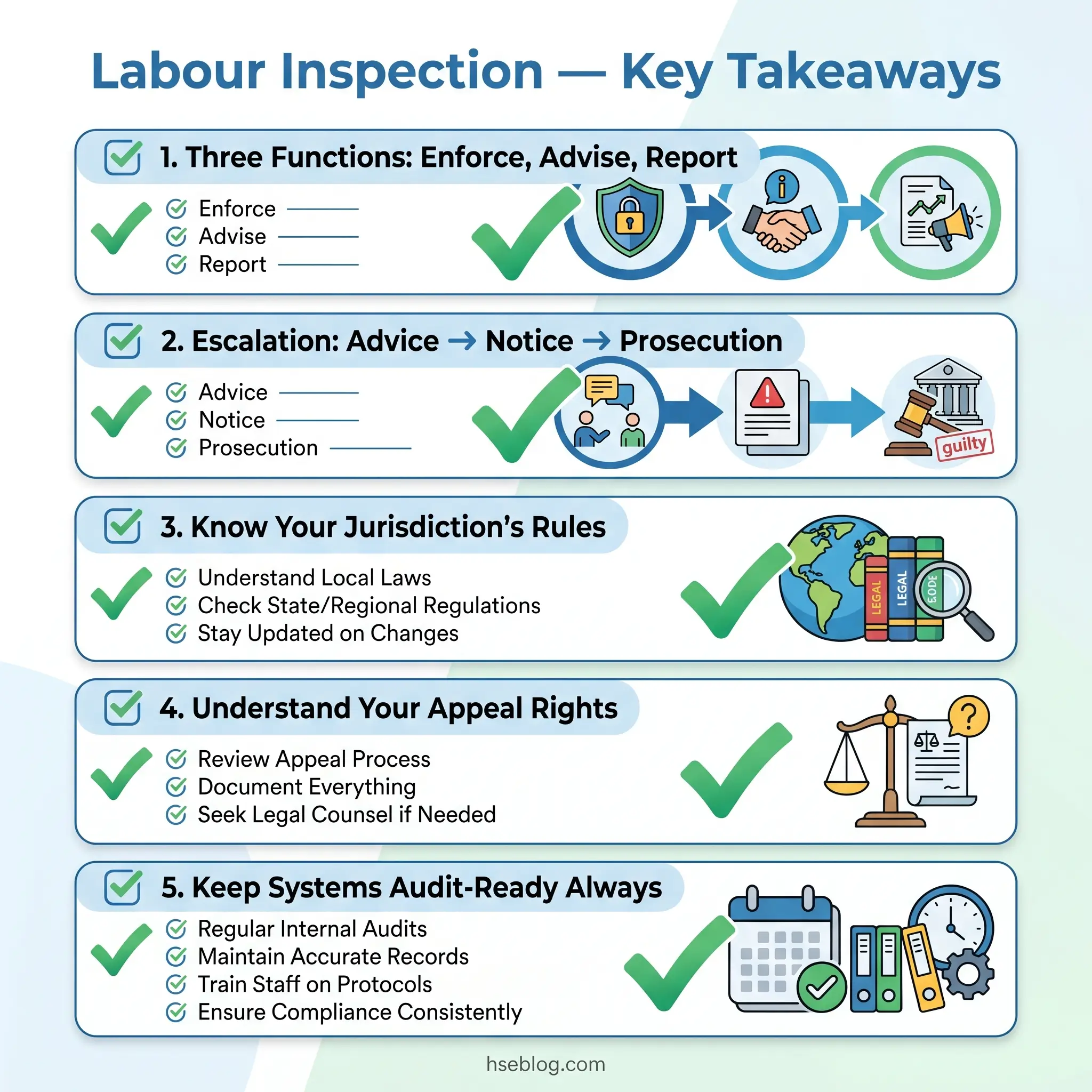
Labour inspectors exist to enforce workplace safety and health legislation, advise employers and workers on compliance, and report systemic defects to regulatory authorities. Their powers derive from international standards — principally ILO Convention No. 81, ratified by 151 member states (ILO, 2024) — and are implemented through national legislation such as the UK Health and Safety at Work Act 1974 and the US OSHA Act 1970. Following a workplace visit, an inspector’s response escalates from informal advice through formal enforcement notices to criminal prosecution, depending on the severity, immediacy, and persistence of the hazard identified.
What Is Labour Inspection and Why Does It Matter?
ILO Convention No. 81 defines labour inspection as a public function with a dual mandate: enforcing legislation that governs working conditions, and advising employers and workers on how to comply. That dual character matters. Convention No. 81 is not an obscure treaty — it is one of only four ILO instruments classified as a “governance convention,” foundational to the entire international labour standards system. As of November 2024, 151 member states have ratified it (ILO, 2024), making it one of the most widely adopted instruments in international labour law. The reason professional qualifications like the NEBOSH International General Certificate test this topic specifically is that labour inspection sits at the intersection of legal obligation, worker protection, and management system effectiveness.
A persistent misconception among employers frames inspection as purely punitive — an adversarial encounter designed to catch failures and impose penalties. In practice, the advisory function often consumes more of an inspector’s time than enforcement. The most effective inspectorates worldwide balance deterrence with education, and their enforcement statistics reflect this. Nearly 3 million people die annually from work-related accidents and diseases globally, with approximately 395 million workers sustaining non-fatal injuries (ILO/WHO joint estimates, 2024). The scale of that burden is exactly why inspection systems exist — and why understanding their functions and enforcement powers is not optional knowledge for any HSE professional.
Core Functions of Labour Inspection
Article 3(1) of ILO Convention No. 81 assigns three distinct functions to national labour inspection systems. These are not vague aspirations — they are treaty obligations that ratifying states must implement through their domestic legal frameworks. Each function serves a different purpose in the regulatory ecosystem, and understanding how they interconnect explains why modern inspection systems operate the way they do.
Enforcement of Legal Provisions
The primary function is securing compliance with legal provisions relating to conditions of work and worker protection. The scope extends far beyond physical safety hazards. Convention No. 81 explicitly covers hours of work, wages, welfare provisions, employment of children and young persons, and related matters — wherever national legislation gives inspectors jurisdiction. Different countries scope this differently. In the UK, HSE inspectors focus on health and safety obligations under the Health and Safety at Work Act 1974, while employment rights enforcement (wages, hours, discrimination) is handled by separate agencies. In some EU member states and many developing countries, a single inspectorate covers the full spectrum — from machine guarding to unpaid wages.
The enforcement function is what gives inspectors their legal teeth: the power to enter workplaces, examine conditions, and compel corrective action through formal notices or prosecution when they find breaches.
Advisory and Educational Role
The second function — supplying technical information and advice to employers and workers — is the one that shapes most inspection interactions. ILO guidance emphasizes that inspectors should spend the majority of their working time on actual workplace visits, not desk administration. In practice, this advisory role takes several forms. In the UK, HSE’s approach under its Enforcement Policy Statement prioritizes verbal and written advice as the first response to minor non-compliance, escalating to formal enforcement only when risk or culpability justifies it. In the US, OSHA maintains a separate On-Site Consultation Program — distinct from enforcement inspections — that provides free advisory visits to small and medium employers, explicitly shielded from enforcement consequences.
The practical difference between an advisory visit and an enforcement visit matters enormously for employers. Advisory outcomes improve compliance without triggering legal consequences; enforcement outcomes create legal obligations with penalties for failure.
Reporting Systemic Defects to Authorities
The third function is the one most often missed in exam answers and employer mental models. Convention No. 81 requires inspectors to bring to the attention of competent authorities any defects or abuses not adequately covered by existing legislation. This intelligence loop is what drives regulatory evolution. Inspector field observations feed into the annual reports required under Articles 19–21 of Convention 81, and those reports shape future legislative priorities.
A concrete example: the UK HSE’s Working Minds campaign on work-related stress and psychosocial risk emerged partly from accumulated inspector field observations that existing guidance was not reaching employers effectively. Inspectors saw patterns across hundreds of workplaces that no single employer could see — and fed that systemic intelligence upward.
How Does a Labour Inspection Visit Work?
The inspection lifecycle follows a broadly consistent pattern across jurisdictions, though specific procedures vary by country and inspectorate. Understanding this lifecycle demystifies the process for employers facing their first visit — and helps experienced safety managers manage the interaction effectively.
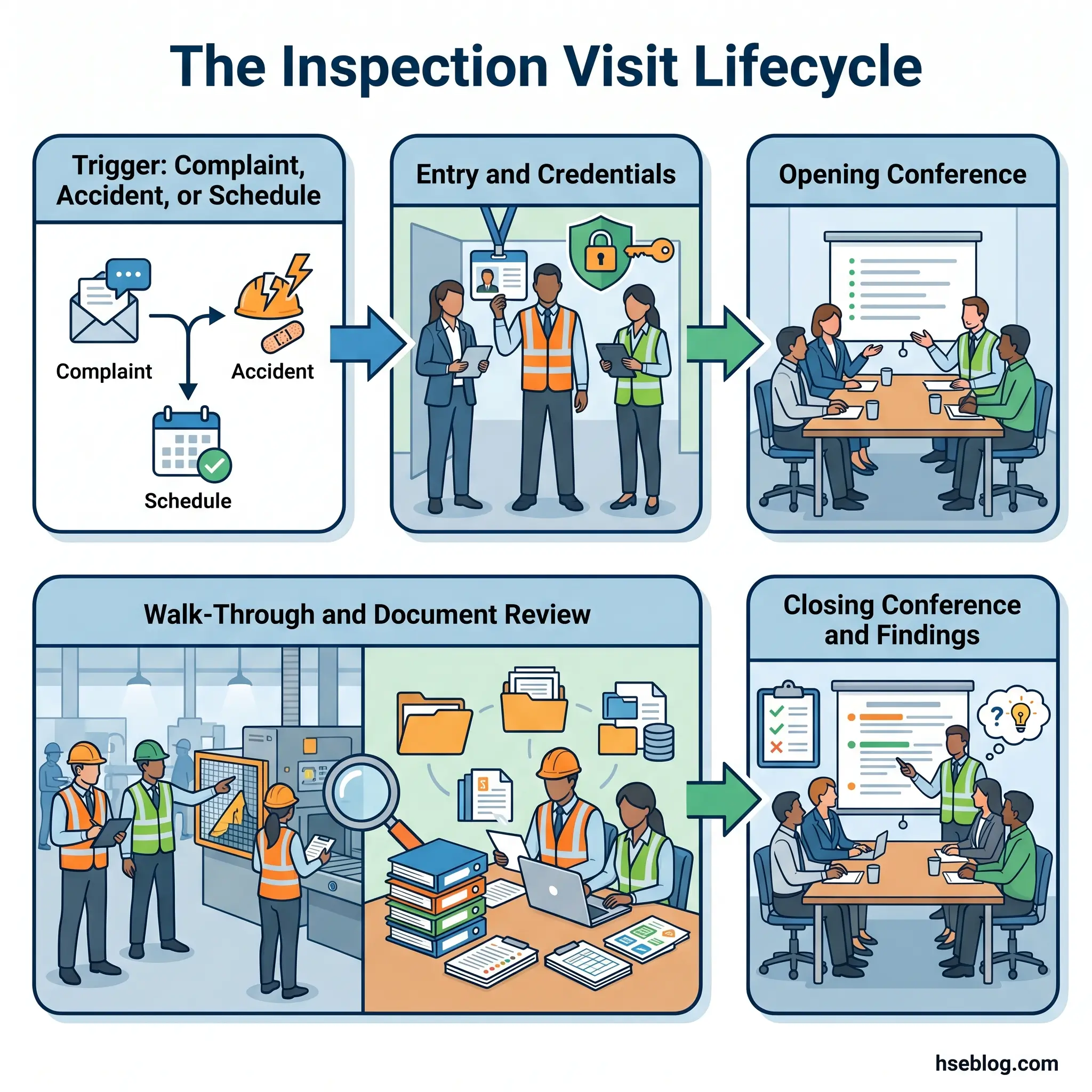
Visits are triggered through several pathways: programmed or routine inspections based on sector risk profiles and inspection schedules; reactive inspections following worker complaints, accident notifications, or referrals from other agencies; and follow-up inspections verifying that previously identified deficiencies have been corrected. In the US, OSHA operates an explicit priority hierarchy — imminent danger situations first, then fatality and catastrophe investigations, then complaints and referrals, and finally programmed inspections.
Convention No. 81, Article 12 grants inspectors the right to enter workplaces freely, at any hour of the day or night, without prior notice. Most national legislation mirrors this. Under Section 20(2)(a) of the Health and Safety at Work Act 1974 (UK), an inspector may enter premises at any reasonable time. Under Section 8(a) of the OSHA Act (US), compliance officers may inspect workplaces without advance notice — although employers retain the right to require a warrant under the Fourth Amendment.
Once on site, the visit typically proceeds through an opening conference (introductions, scope, credentials), a walk-through inspection (observation, questioning, document examination, sampling, photography), and a closing conference where findings are communicated and next steps outlined. The opening conference often sets the entire tone. Employers who demonstrate active safety management systems, accessible documentation, and a cooperative approach tend to receive advisory outcomes — not because inspectors go easy, but because systematic control reduces the objective risk profile that drives enforcement decisions.
What Are the Powers of a Labour Inspector?
Inspector powers divide into two categories that serve different functions: investigative powers used to gather information, and enforcement powers used to compel action. Conflating the two is a common error in exam answers and employer responses alike.
Investigative powers are exercised during the visit itself. Under ILO Convention No. 81, Article 12, and under corresponding national legislation, these include the right to enter workplaces without prior notice, to examine and test any article, substance, plant, or equipment, to take samples for analysis, to require the production of documents and records for inspection and copying, to take photographs and measurements, and to question any person present. Under Section 20(2)(j) of the Health and Safety at Work Act 1974 (UK), an inspector can require any person to answer questions and to sign a declaration of the truth of their answers. A critical practical detail here: answers given under compulsion of Section 20 cannot be used in evidence against the person who gave them in subsequent proceedings. This distinction between a voluntary statement and a compelled statement is something practitioners need to understand, and it is a detail no competitor article addresses.
Under Section 8(a) of the OSHA Act (US), compliance officers hold parallel powers — though the employer’s right to require an inspection warrant (under the Fourth Amendment, affirmed in Marshall v. Barlow’s Inc., 1978) introduces a procedural step that has no direct UK equivalent.
Enforcement powers are what the inspector deploys after findings indicate a breach. These range from informal actions to criminal prosecution and form the escalation pathway covered in the next section. The important distinction is this: investigative powers are about gathering evidence; enforcement powers are about compelling change. An inspector exercises investigative powers on every visit. Enforcement powers activate only when the evidence justifies intervention.
What Actions Can a Labour Inspector Take Following a Visit?
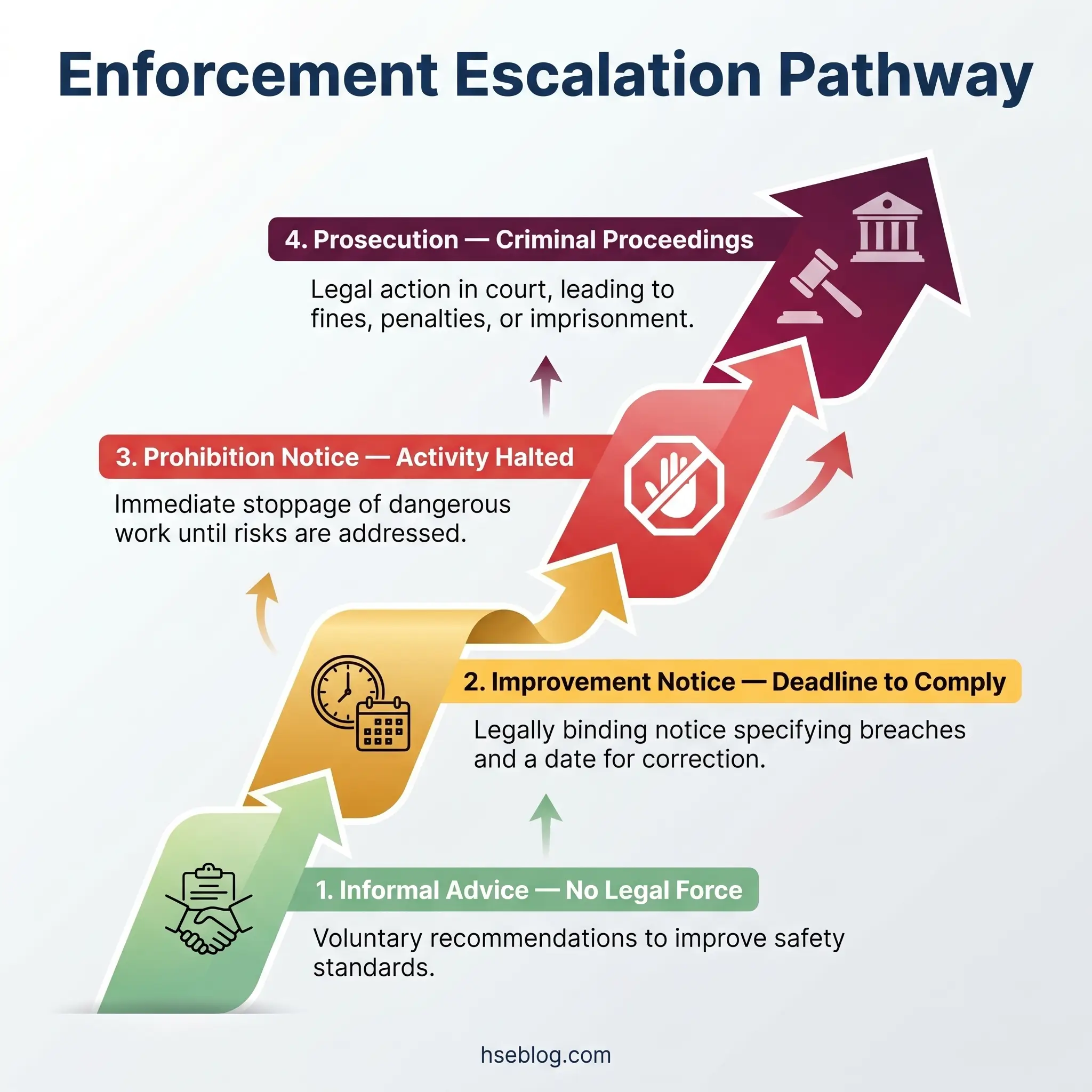
This is the enforcement escalation pathway — the decision logic that determines whether an employer receives informal guidance, a formal notice, or a criminal prosecution. The actions are not a flat menu; they represent increasing levels of severity, each triggered by specific conditions relating to the nature of the breach, the level of risk, and the employer’s response history.
Informal Advisory Actions
The most common inspection outcome is informal action — verbal advice given during the closing conference, or a written advisory letter issued afterward. These carry no legal force. They signal that the inspector has identified areas where practice falls short of good standards, but the risk level and culpability do not justify formal enforcement. In the UK, this outcome aligns with HSE’s Enforcement Policy Statement and the Enforcement Management Model (EMM), which requires inspectors to consider proportionality before escalating.
Written advisory letters typically specify the issue identified, reference the relevant legal provision, and recommend corrective action within a reasonable timeframe. They are not legally binding — but ignoring them is rarely wise. A pattern of ignored advisory letters signals poor safety culture and may influence the inspector’s enforcement response on a subsequent visit.
Improvement Notices
When an inspector is of the opinion that a person is contravening a relevant statutory provision, or has contravened it in circumstances that make it likely the contravention will continue or be repeated, the inspector may issue an improvement notice under Section 21 of the Health and Safety at Work Act 1974 (UK). The notice must state which provision is being contravened, specify the inspector’s reasons, and require the person to remedy the contravention within a stated period — which must not be less than 21 days.
The 21-day minimum exists because that is also the appeal window. An employer receiving an improvement notice has 21 days to appeal to an Employment Tribunal. A critical detail: appealing an improvement notice suspends it until the appeal is determined. This suspension rule has practical consequences — it means an employer can legally delay compliance by lodging an appeal, which experienced safety professionals should factor into their risk management approach.
Non-compliance with an improvement notice is a criminal offence. In the UK, penalties on summary conviction (Magistrates’ Court) can reach an unlimited fine and/or up to 6 months imprisonment. On conviction on indictment (Crown Court), penalties can reach an unlimited fine and/or up to 2 years imprisonment.
Prohibition Notices
A prohibition notice under Section 22 of the HSWA 1974 (UK) addresses a fundamentally different threshold. Where an improvement notice addresses a regulatory breach, a prohibition notice addresses a risk of serious personal injury. The inspector need not identify a specific contravention — only that the activities being carried out involve, or will involve, a risk of serious personal injury.
Prohibition notices come in two forms. An immediate prohibition notice takes effect the moment it is served — the activity must stop. A deferred prohibition notice specifies a future date or event after which the activity must cease unless the risk is remedied. Once an immediate prohibition notice is issued, the inspector cannot informally withdraw it. The only route to resume operations is either to satisfy the inspector that the risk has been eliminated, or to succeed on a formal appeal.
Here is the distinction that catches employers by surprise: unlike an improvement notice, appealing a prohibition notice does not automatically suspend it. The activity remains halted while the appeal proceeds — unless the Employment Tribunal specifically orders otherwise. This asymmetry reflects the severity of risk that prohibition notices address.
Prosecution and Criminal Proceedings
Prosecution represents the highest enforcement escalation. In the UK, HSE refers cases for prosecution when breaches involve death, serious injury, persistent non-compliance, or failure to comply with enforcement notices. In 2024/25, HSE completed 246 criminal prosecutions with a 96% conviction rate, resulting in fines exceeding £33 million (HSE Annual Report, 2025). The public register of enforcement notices and convictions creates a reputational deterrent that, for many organizations, outweighs the direct financial penalty.
In the US, the enforcement model operates differently. OSHA issues citations directly — classified as serious, willful, other-than-serious, repeat, or failure to abate — each carrying defined maximum penalties. The maximum penalty for a willful or repeated violation is $165,514 as of January 2025 (OSHA, 2025). Failure to abate carries daily penalties of up to $16,550 per day. Criminal prosecution under the OSHA Act requires referral to the Department of Justice and is generally reserved for willful violations that cause a worker’s death.
The UK also operates a cost recovery mechanism unique among major jurisdictions: the Fee for Intervention (FFI). When an inspector identifies a material breach of health and safety law, HSE charges the duty holder for the time spent on the related enforcement activity. FFI is not a fine — it is a regulatory cost recovery fee. Employers can challenge FFI charges through a separate process from challenging the enforcement notice itself.
Audit Point: A single improvement notice rarely indicates an isolated problem. Experienced practitioners recognize it as a signal to review the entire management system. The specific deficiency cited is usually a symptom of broader weaknesses in risk assessment, supervision, or competence management that extend well beyond one finding.
How Do Enforcement Approaches Differ Across Jurisdictions?
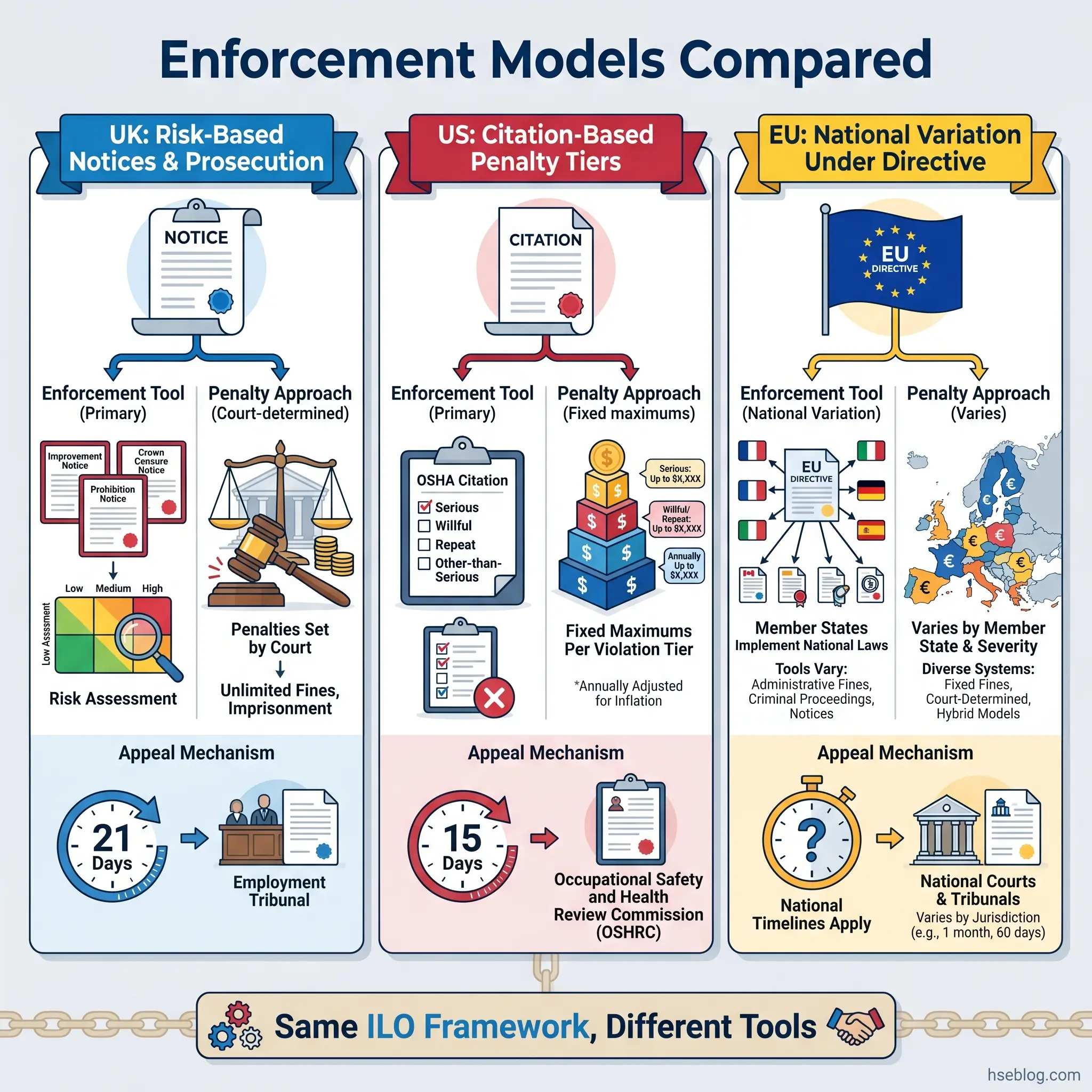
Despite sharing a common foundation in ILO Convention No. 81, the UK, US, and EU have developed distinctly different enforcement architectures. For employers operating across borders — and for HSE professionals advising multinational operations — understanding these differences is not academic. The same workplace deficiency can trigger fundamentally different regulatory responses depending on jurisdiction.
| Dimension | UK (HSWA 1974 / HSE) | US (OSHA Act / 29 CFR 1903) | EU (Directive 89/391/EEC) |
|---|---|---|---|
| Enforcement model | Risk-based via Enforcement Management Model | Citation-based with defined penalty tiers | National variation; directive requires adequate enforcement |
| Primary tools | Improvement notice, prohibition notice, prosecution | Citation types: serious, willful, repeat, other-than-serious, failure to abate | Varies — most member states use improvement/prohibition-type notices |
| Penalty setting | Courts determine fines upon prosecution (unlimited on indictment) | Fixed maximum per violation type ($165,514 willful/repeat, 2025) | Set by national law; varies widely across member states |
| Appeal route | Employment Tribunal within 21 days | OSHRC within 15 working days | National labour courts or administrative tribunals |
| Appeal suspends notice? | Improvement notice: yes. Prohibition notice: no | Contested citation: penalties stayed pending hearing | Varies by member state |
| Cost recovery | Fee for Intervention (FFI) for material breaches | No equivalent cost recovery mechanism | No standardized mechanism |
| Public register | Published register of enforcement notices and convictions | Published OSHA inspection database | Varies by member state |
The UK system’s public register creates a transparency mechanism that often carries greater practical deterrent effect than the direct financial penalty. For publicly listed companies, supply chain partners, and organizations bidding for government contracts, a published enforcement notice signals regulatory risk that procurement and investment decisions factor in.
In the US, the informal conference mechanism available after a citation is heavily underutilized. Employers who receive an OSHA citation can request an informal conference with the Area Director to discuss the findings, negotiate abatement timelines, and potentially reduce penalties. Many employers — particularly those without dedicated safety counsel — do not realize this option exists.
The ILO recommends a benchmark ratio of 1 labour inspector per 10,000 workers in industrial market economies (ILO, 2006). Many countries miss this benchmark. The global trend of declining inspector-to-worker ratios, alongside growing workforce complexity and supply chain fragmentation, raises questions about enforcement capacity. In the UK, HSE enforcement notices dropped from approximately 7,000 in 2023/24 to over 4,400 in 2024/25 (HSE Annual Report, 2025) — amid ongoing debate about whether resource constraints are weakening regulatory enforcement capacity.
On the technology front, the ILO launched its LIFT (Labour Inspectorates and the Future of Technology) digital case management tool in 2024–2025, piloting it across five countries and creating centralized digital repositories of inspection data spanning more than 3,900 economic units (ILO, 2025). Expansion into the Caribbean, Asia-Pacific, and Africa is planned for 2026–27. This shift toward digital inspection infrastructure may begin to address capacity gaps — but it will not replace the need for adequately staffed inspectorates.
What Are an Employer’s Rights During and After an Inspection?
Enforcement powers are not unlimited. Employers retain specific rights before, during, and after an inspection — and understanding these rights is part of effective safety management, not an adversarial posture.
At the point of entry, employers have the right to verify the inspector’s credentials. In the UK, inspectors carry warranted identification under HSWA 1974. In the US, OSHA compliance officers present their credentials and a copy of the complaint (if complaint-triggered, with identifying information removed). US employers retain the right under the Fourth Amendment to require an inspection warrant before allowing entry — a right affirmed by the Supreme Court in Marshall v. Barlow’s Inc. (1978). Exercising this right is legal, though in practice it delays rather than prevents the inspection, as OSHA will typically obtain a warrant from a federal magistrate.
During the inspection, employers have the right to have a representative present during walk-throughs and interviews. Under Section 20 of the HSWA 1974 (UK), any person questioned by an inspector can nominate a person to be present during the interview — unless the inspector reasonably considers that nominated person’s presence would prejudice the investigation.
After the inspection, appeal rights are defined by statute. In the UK, improvement and prohibition notices may be appealed to an Employment Tribunal within 21 days of service. In the US, employers have 15 working days from citation receipt to file a notice of contest with the Occupational Safety and Health Review Commission (OSHRC). Missing these deadlines generally forfeits the right of appeal — a procedural trap that catches employers who assume they have more time than they do.
Watch For: Reflexively refusing entry or appealing every enforcement action may feel protective, but it typically damages the employer-regulator relationship. Inspectors note non-cooperation, and subsequent interactions tend to start at a higher enforcement threshold. Experienced safety managers work cooperatively first and reserve formal appeals for notices that are genuinely unjustified or disproportionate.
How Can Employers Prepare for a Labour Inspection Visit?
Preparation for an inspection is not about staging a performance — it is about maintaining the systems, documentation, and competence that a well-run operation should have in place continuously.
The most common preparation failure is documentation that exists but cannot be demonstrated. Risk assessments filed in a cabinet, training records logged in a spreadsheet no one references, maintenance schedules that do not reflect actual practice. Inspectors distinguish rapidly between a documented system and a functioning one. The walk-through, the questions to frontline workers, and the cross-referencing of records against observable conditions will expose the gap within minutes.
Practical preparation covers several areas that experienced safety professionals keep audit-ready at all times:
- Accessible documentation — Risk assessments, method statements, COSHH assessments, training records, competence evidence, incident logs, and maintenance records should be retrievable within minutes, not hours. Electronic systems with search capability have a practical advantage over paper filing.
- Designated liaison — Identify a competent person to receive the inspector, manage the opening conference, accompany the walk-through, and coordinate access to documentation and personnel. This person should understand the organization’s safety management system and be authorized to make commitments on behalf of the employer.
- Self-audit alignment — Conduct periodic internal inspections using the same focus areas common to regulatory inspections: risk assessment currency, control implementation, training adequacy, incident investigation quality, and welfare provisions. Treat internal findings with the same seriousness as external enforcement.
- Post-visit response protocol — Before any inspection occurs, establish how the organization will respond to informal advice, improvement notices, and prohibition notices. Define who reviews the notice, who authorizes corrective action, who manages the appeal-window decision, and how lessons are fed back into the management system.
The Fix That Works: Treat every internal audit finding as if an inspector wrote it. Organizations that close internal non-conformances with the same rigour they would apply to an enforcement notice rarely face enforcement escalation during actual regulatory visits.
Frequently Asked Questions
Conclusion
The pattern that runs through every published enforcement report, every prosecution outcome, and every post-inspection debrief is consistent: employers who treat labour inspection as an adversarial event to survive tend to accumulate enforcement actions, while those who maintain functioning safety management systems as an operational baseline tend to receive advisory outcomes. The difference is not luck or leniency — it is the objective evidence an inspector finds when they walk through the door, question workers, and cross-reference documentation against observable conditions.
What the industry consistently underestimates is the intelligence function. Inspectors are not just checking your site — they are building a picture of systemic patterns across an entire sector. The defects they report upward shape the regulations you will face next year. Understanding the functions of labour inspection means understanding that every visit has consequences beyond the individual employer: it feeds the regulatory cycle that governs how the entire industry operates.
The highest-impact change any organization can make is closing the gap between documented systems and demonstrated practice. An improvement notice, a prohibition notice, a prosecution — these are outcomes of that gap. Eliminate it, and the enforcement pathway rarely escalates beyond advice.