

TL;DR — What Your Fire Prevention SOP Must Deliver
- Ground every procedure in your fire risk assessment — the SOP codifies risk assessment findings into daily actions, not the other way around
- Control ignition sources with specific, enforceable procedures — hot work permits, electrical maintenance schedules, designated smoking areas, and static discharge protocols each need their own documented controls
- Assign accountability by name or job title — OSHA 29 CFR 1910.39 (US) requires this; generic “all employees” language fails audits and fails people
- Build in mandatory review triggers — annual cycle at minimum, plus event-driven updates after any fire incident, near-miss, process change, or regulatory revision
- Test the SOP through drills before you need it in an emergency — a procedure that hasn’t been walked through on-site is a liability, not a plan
A fire prevention SOP is a documented set of procedures that outlines how an organization identifies fire hazards, controls ignition sources, maintains fire protection systems, manages combustible materials, and trains employees to prevent workplace fires. Required under OSHA 29 CFR 1910.39 in the US and under the Regulatory Reform (Fire Safety) Order 2005 in England and Wales, it converts fire risk assessment findings into daily operational practices.
Workplace fires and explosions cause more than 5,000 injuries and 200 deaths annually in the United States (US Bureau of Labor Statistics, ongoing reporting cited by OSHA, 2026). Behind each of those numbers is a failure that a well-built fire prevention SOP exists to prevent — an uncontrolled ignition source, improperly stored flammable materials, a detection system left uninspected, or a workforce that was never trained on the hazards specific to their facility. The financial cost is severe. The human cost is irreversible.
That gap between knowing fire prevention matters and actually embedding it into daily operations is precisely what a fire prevention standard operating procedure fills. This article breaks down the key components of a fire prevention SOP, walks through how to develop and implement one, identifies the regulatory standards that govern the requirement across jurisdictions, and — critically — addresses the common mistakes that cause fire prevention SOPs to fail in practice. Whether you manage a single facility or operate across multiple jurisdictions, the goal is the same: a document your people can actually follow, not one that satisfies an auditor and collects dust.
This article provides general HSE knowledge. Life-critical work such as fire prevention planning, fire protection system design, and emergency preparedness must be planned and supervised by a competent person with relevant training, jurisdiction-specific authorization, and site-specific risk assessment. The information here does not replace that.
What Is a Fire Prevention SOP and Why Does It Matter?
A fire prevention SOP is not the same document as an emergency action plan, and confusing the two is one of the most common documentation errors in workplace fire safety. Under US regulation, OSHA draws a clear line: 29 CFR 1910.39 addresses fire prevention — the systematic elimination and control of fire hazards before ignition occurs. Its companion standard, 29 CFR 1910.38, covers the emergency action plan — what happens after a fire starts. Many organizations need both. Few clearly separate them.
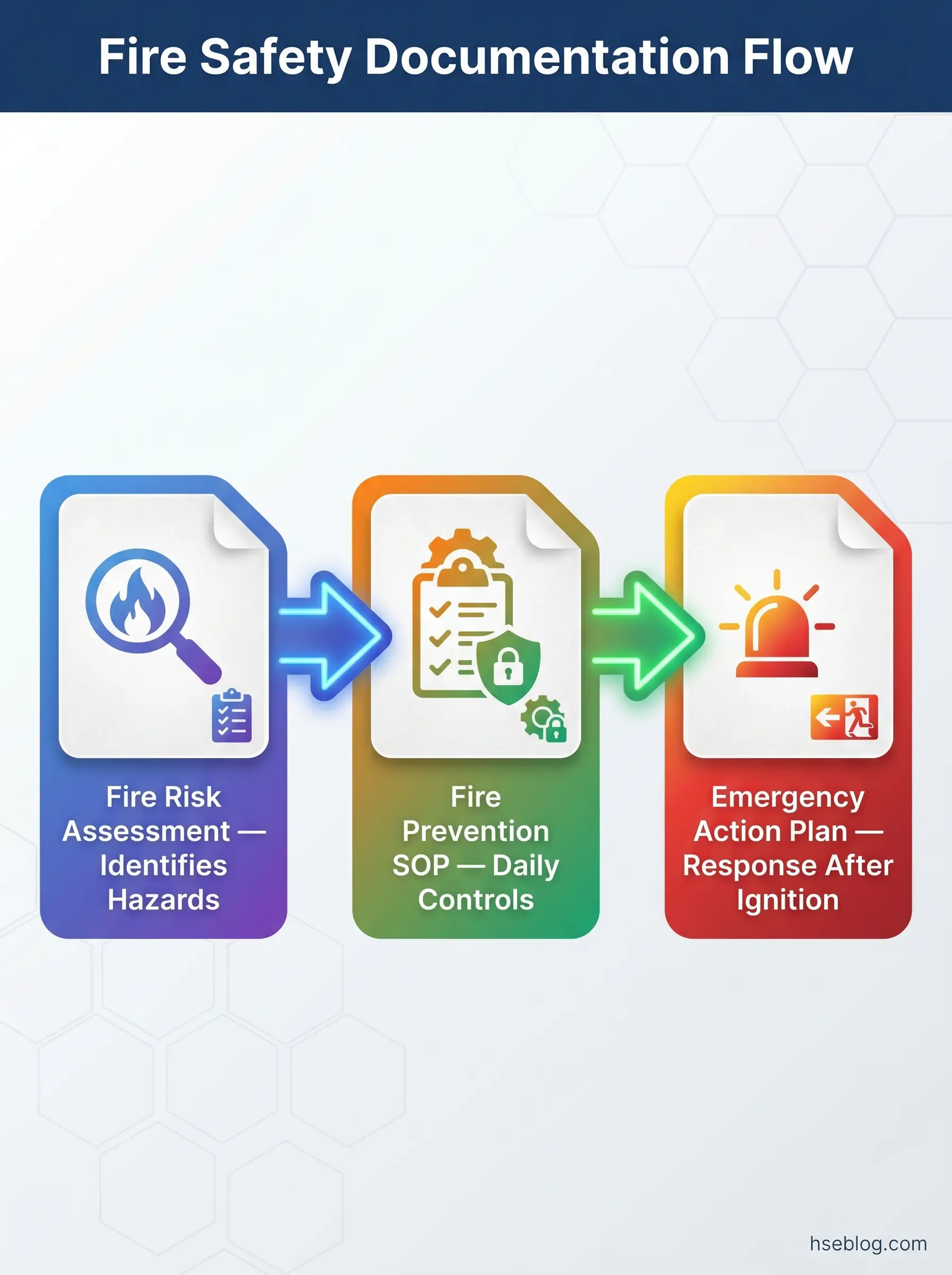
The fire prevention SOP sits between two other critical documents. Upstream, the fire risk assessment identifies hazards and evaluates risk. Downstream, the emergency action plan governs response. The SOP is the operational bridge: it takes the risk assessment’s findings and converts them into specific, repeatable procedures that workers follow every day. Store flammable liquids this way. Inspect electrical panels on this schedule. Clear combustible waste at this frequency. Report ignition hazards through this channel.
A consistent pattern across published incident investigations and enforcement actions: the organizations that experience preventable workplace fires almost always had a fire prevention plan on paper. What they lacked was a document specific enough to drive behavior and current enough to reflect actual site conditions. The SOP’s value is not in its existence — it is in its specificity, its accessibility, and its currency.
Key Components of a Fire Prevention SOP
The strength of a fire prevention SOP depends entirely on how specifically it addresses the hazards present in the facility it governs. A generic template that lists “control ignition sources” and “store flammable materials safely” without defining quantities, distances, frequencies, and responsible persons is not operationally useful — and it will not survive a competent audit. The components below represent the minimum functional structure, but every element must be adapted to site-specific conditions.
Identification and Classification of Fire Hazards
Every fire requires three elements — fuel, oxygen, and an ignition source. The fire prevention SOP must systematically identify where each element exists in the workplace and where they can converge. This begins with an inventory of flammable and combustible materials, classified by flash point: flammable liquids (flash point below 37.8°C / 100°F), combustible liquids (flash point at or above 37.8°C), flammable gases, combustible dusts, and ordinary combustibles such as paper, wood, and textiles.
Ignition source mapping is equally critical. The most common ignition sources vary by workplace type, but across industrial and commercial settings, the published data consistently points to the same categories:
- Electrical faults — damaged wiring, overloaded circuits, improperly maintained panels. Electrical fires account for approximately 22% of workplace fires (Industrial Fire TX, citing NFPA/MCR Safety, 2024)
- Hot work — welding, cutting, grinding, brazing. Each operation produces sparks and heat capable of igniting materials several meters away
- Cooking equipment — the leading cause of fires in non-residential spaces, responsible for 30.3% of fires in nonresidential buildings in the US (US Fire Administration, 2023)
- Friction and mechanical heat — bearings, conveyors, rotating equipment operating without adequate lubrication or maintenance
- Static discharge — particularly dangerous during transfer operations involving flammable liquids or in environments with combustible dusts
The SOP must document where these hazards exist on a facility map — not in a footnote, but as a referenced visual that employees can consult. Hazard identification is not a one-time exercise. Any process change, new material introduction, or facility modification triggers a reassessment.
Ignition Source Control Procedures
Identifying ignition sources without specifying their controls is the equivalent of diagnosing a disease without prescribing treatment. Each ignition category demands its own documented control procedure.
Electrical safety controls require scheduled inspection and maintenance of wiring, panels, and equipment — with defective items taken out of service immediately, not tagged for future repair. Hot work demands a formal permit system: pre-work area inspection, combustible material clearance (OSHA guidance references a minimum 35-foot radius for sparks), continuous fire watch during and for at least 30 minutes after work completion, and written authorization from a designated supervisor. Smoking policies must designate specific areas at least 20 feet from flammable material storage and prohibit open flames in all other zones.
Static electricity control — grounding and bonding procedures — is frequently overlooked outside chemical processing environments, yet static discharge during liquid transfer or in dust-laden atmospheres has initiated some of the most catastrophic industrial fires on record. The SOP must specify bonding procedures for container-to-container transfers and grounding for all conductive equipment in flammable atmospheres.
Watch For: Hot work permits that become rubber stamps. When every permit is approved without documented pre-work inspection, the system is not functioning as a control — it is functioning as paperwork. The permit system only prevents fires when the person signing it has physically inspected the area.
Flammable Materials Storage and Handling
Storage and handling procedures are where a fire prevention SOP becomes most facility-specific and where regulatory variation across jurisdictions is sharpest. NFPA 1: Fire Code 2024 (US/adopted internationally) establishes maximum allowable quantities (MAQ) for flammable and combustible liquids by occupancy type and control area. These thresholds determine whether a storage configuration is compliant or whether additional fire protection — sprinklers, dedicated storage rooms, or detached storage buildings — is required.
Containers must meet approved standards (UL-listed or FM-approved). Flammable storage cabinets are required to be self-closing and labeled. Incompatible materials — oxidizers stored near flammables, for example — must be physically segregated, not merely placed on different shelves within the same cabinet. Safety Data Sheets must be accessible for every stored chemical, and the SOP should reference them as the primary source for material-specific fire risk information.
The judgment call most organizations struggle with is cumulative quantity. A facility may comply at each individual storage point — a few liters here, a cabinet there — but exceed MAQ thresholds when all storage locations are aggregated across the building. The SOP must address total facility inventory, not just individual cabinet contents. This requires a centralized inventory system and clear responsibility for maintaining it.
Spill response procedures also belong in this section. A flammable liquid spill in an area with uncontrolled ignition sources creates an immediate fire risk, and the SOP should specify containment measures, cleanup procedures, and when to escalate to emergency response.
Fire Detection, Alarm, and Suppression Systems
The fire prevention SOP must address not just the existence of fire protection systems but their ongoing inspection, testing, and maintenance — because a system that is present but non-functional is worse than no system at all; it creates a false sense of security.
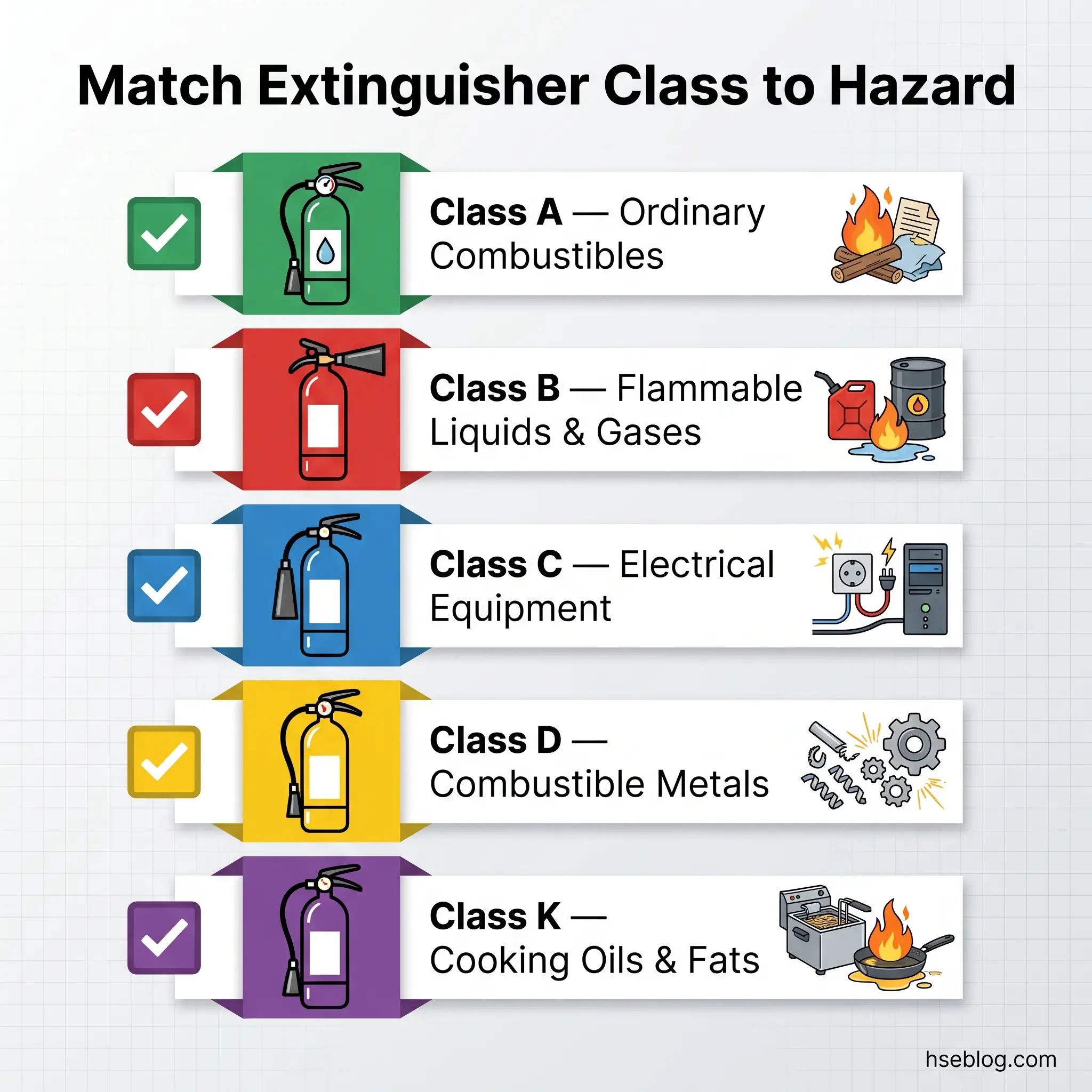
Fire extinguishers require classification matching to facility hazards. The SOP should specify which classes are deployed where:
- Class A — ordinary combustibles (wood, paper, cloth)
- Class B — flammable liquids and gases
- Class C — energized electrical equipment
- Class D — combustible metals
- Class K — cooking oils and fats
Placement criteria, travel distances, monthly visual inspections, annual maintenance inspections, and hydrostatic testing schedules (every 5 or 12 years depending on extinguisher type, per OSHA 29 CFR 1910.157, US) must all be documented in the SOP with assigned responsibility.
Sprinkler systems and water-based suppression systems fall under NFPA 25 (US/widely adopted), which sets detailed inspection, testing, and maintenance frequencies. The 2025 edition of NFPA 25 introduced updated testing protocols for water-based fire protection systems — organizations maintaining SOPs written against earlier editions should verify alignment with current requirements.
Smoke detectors, heat detectors, and fire alarm systems require documented testing frequencies and battery replacement schedules. Where detection systems integrate with building management systems or automatic suppression, the SOP must define the response sequence and identify who receives alarm notifications.
Housekeeping and Combustible Waste Control
Housekeeping is the fire prevention component most likely to degrade over time — and the least likely to receive dedicated SOP attention. Approximately 118,000 nonresidential building fires occurred in the United States in 2023 (NFPA, 2024). A significant proportion of these are attributable to conditions that routine housekeeping directly controls: accumulated combustible waste, obstructed egress paths, dust buildup on surfaces and in ventilation systems, and improperly stored materials.
The SOP should specify:
- Daily combustible waste disposal — oily rags, paper waste, packing materials, and wood shavings must be removed from work areas at the end of each shift
- Self-closing metal containers — required for all combustible waste, particularly oily or solvent-contaminated rags that can spontaneously combust
- Egress path clearance — no storage in stairwells, corridors, or within marked evacuation routes; fire doors must never be propped open
- Dust accumulation management — critical in manufacturing, woodworking, and food processing environments where combustible dust explosions are a recognized hazard
SOPs that specify frequency, assign accountability by name or role, and include photographic standards for acceptable versus unacceptable conditions consistently outperform text-only instructions. A line reading “maintain good housekeeping” means nothing. A line reading “Shift supervisor clears combustible waste from production floor and signs off before end of each shift” means everything.
The Fix That Works: Attach photos to the SOP showing what “clean” looks like for each area. Workers cannot meet a standard they cannot visualize. This approach is especially effective in multilingual workforces.
Employee Training and Fire Drill Requirements
A fire prevention SOP is only as effective as the training that supports it. Under OSHA 29 CFR 1910.39 (US), employers must inform employees of the fire hazards they are exposed to upon initial job assignment. Where fire extinguishers are provided, OSHA 29 CFR 1910.157 (US) requires annual training on general principles and hazards of incipient-stage firefighting — including the PASS technique (Pull the pin, Aim at the base of the fire, Squeeze the handle, Sweep side to side).
Training must distinguish between two tiers. All employees require general fire prevention awareness: hazard identification, reporting procedures, evacuation routes, and assembly point locations. Designated fire response personnel — fire wardens, fire watch operators, hot work permit holders — need specialized training on their specific responsibilities, equipment operation, and decision-making authority.
Fire drill frequency is not universally prescribed. Best practice recommends semi-annual drills at minimum, with quarterly drills for high-risk facilities (warehouses storing flammable materials, manufacturing with hot work operations, healthcare facilities). Under the UK Regulatory Reform (Fire Safety) Order 2005, the responsible person must ensure drills are conducted at sufficient frequency to ensure all occupants are familiar with evacuation procedures — the frequency is risk assessment-driven rather than numerically prescribed.
Training records — names, dates, content covered, competency verification — must be maintained. The SOP should specify the record retention period and storage location.
Roles, Responsibilities, and Accountability
OSHA 29 CFR 1910.39(c) (US) requires that the fire prevention plan include the names or job titles of personnel responsible for maintenance of equipment and systems installed to prevent or control ignition of fires. This is not optional language. The standard demands specificity.
The SOP should define responsibilities at three levels. The fire safety officer or plan administrator owns the document, coordinates reviews, manages training records, and serves as the primary point of contact for fire prevention matters. Supervisors are responsible for ensuring their teams comply with SOP procedures daily — clearing combustible waste, following hot work permit requirements, reporting hazards, and maintaining housekeeping standards. Individual employees are responsible for adhering to procedures, reporting fire hazards immediately, and participating in training and drills.
Under the UK Fire Safety Order 2005 (England and Wales), the “responsible person” — typically the employer, building owner, or person with control of the premises — carries legal accountability for fire safety. This concept places clear personal liability on a named individual, in contrast to OSHA’s approach of requiring named job titles within the plan. Multinational organizations should ensure their SOP addresses both models where applicable.
How to Develop and Implement a Fire Prevention SOP
The development process begins with the fire risk assessment — not with a blank template. The SOP codifies the controls that the risk assessment identifies as necessary. Starting from a generic template and hoping to adapt it to site conditions reverses this relationship and almost always produces a document that is technically correct on paper but operationally useless.
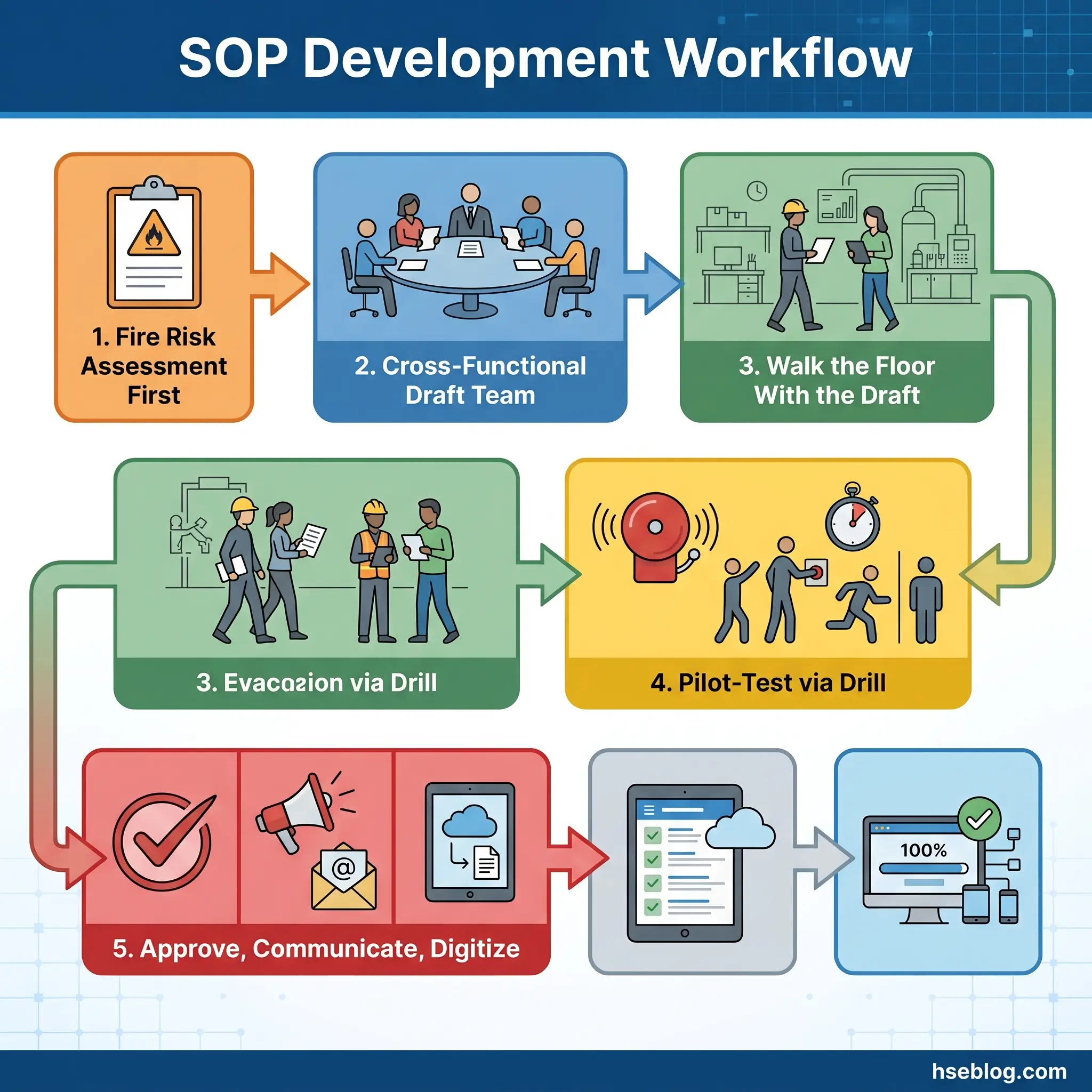
The practical steps for development follow a logical sequence:
- Conduct or review the fire risk assessment. Identify all fire hazards, evaluate risk levels, and determine required controls. This is the foundation document. Under the UK Building Safety Act 2022, Section 156, effective 1 October 2023, fire risk assessment findings for all non-domestic premises under the Fire Safety Order must now be fully recorded in writing — eliminating the previous option for mental-only assessments in simpler premises
- Assemble a cross-functional drafting team. Include representatives from operations, maintenance, HR, procurement (for chemical inventory), and frontline workers who understand how tasks are actually performed. An SOP written entirely by the safety department, without operational input, frequently includes steps that are physically impractical
- Draft in plain language. The reading level must be accessible to all employees. Technical terms should be defined on first use. Procedures should be written as clear, direct instructions — not as regulatory paraphrases
- Walk the facility floor with the draft. This is the step that separates effective SOPs from paper exercises. Every procedure should be tested against real conditions. Does the specified fire extinguisher actually exist where the SOP says it should? Is the designated smoking area actually 20 feet from flammable storage? Can workers actually follow the hot work clearance distances given the physical layout?
- Pilot-test through a tabletop exercise or drill. Before full rollout, conduct a tabletop exercise where the team walks through fire scenarios using the draft SOP as the response guide. Gaps and ambiguities become visible immediately
- Obtain management sign-off and communicate formally. The SOP is a management-approved document. Its authority must be visible. Distribute to all affected employees, post in accessible locations, and integrate into onboarding procedures
- Digitize for accessibility and version control. Where practical, maintain the SOP in a digital document management system with version control, access logging, and automated review reminders. Paper copies at workstations remain important for operational access, but the master must be controlled
OSHA’s fire prevention plan eTool provides practical guidance on meeting 1910.39 requirements and is a useful cross-reference during the drafting process.
What Regulatory Standards Govern Fire Prevention SOPs?
Regulatory requirements for fire prevention planning vary significantly by jurisdiction, and HSE professionals working across borders need to understand where obligations diverge. The table below compares the primary frameworks.
| Requirement | OSHA 29 CFR 1910.39 (US) | UK Fire Safety Order 2005 (England & Wales) | ISO 45001:2018 (Global) |
|---|---|---|---|
| Written plan mandatory? | Yes, when triggered by another standard (e.g., 1910.157). Oral communication allowed for ≤10 employees | Yes — fire risk assessment must be recorded in writing since Oct 2023 (Building Safety Act s.156) | Yes — Clause 8.2 requires documented emergency preparedness and response |
| Hazard identification | Must list major workplace fire hazards and their handling/storage procedures | Risk assessment must identify fire hazards, persons at risk, and existing/required precautions | Clause 6.1.2 requires systematic hazard identification including fire |
| Named responsible persons | Must include names or job titles of responsible personnel | “Responsible person” carries personal legal liability | Management must assign roles, responsibilities, and authorities (Clause 5.3) |
| Training requirements | Inform employees of fire hazards upon initial assignment; annual extinguisher training under 1910.157 | Must provide adequate fire safety training to employees; frequency is risk-based | Clause 7.2 requires competence through training; Clause 7.3 requires awareness |
| Review/update trigger | No explicit frequency; must reflect current conditions | Must review upon material changes, or if no longer valid | Clause 10.2 requires continual improvement; review after incidents and changes |
| Enforcement approach | Prescriptive minimum elements | Goal-based (risk assessment-driven) | Management system framework; certifiable |
Practitioners operating across multiple jurisdictions face a practical choice. Maintaining separate SOPs per jurisdiction creates version-control complexity and consistency risk. The operationally stronger approach is building the SOP to the strictest applicable standard — typically a combination of NFPA’s detailed inspection frequencies and the UK Fire Safety Order’s risk-assessment rigor — and noting where local requirements permit less stringent alternatives.
NFPA 1: Fire Code, 2024 edition (US/adopted internationally) provides the most comprehensive fire safety code currently available, covering fire prevention, fire protection systems, means of egress, hazardous materials, and emergency planning. NFPA 72 governs fire alarm systems, and NFPA 25 (2025 edition) sets detailed inspection and maintenance standards for water-based suppression systems. These codes are not standalone legal requirements in most jurisdictions but are widely adopted by reference into local building and fire codes.
Jurisdiction Note: OSHA 1910.39 specifies minimum plan elements but does not prescribe specific inspection frequencies for fire protection equipment. NFPA 25 and NFPA 72 set far more detailed schedules. Organizations using OSHA compliance as their ceiling — rather than their floor — will likely fall short of the operational standard needed to prevent fires effectively.
Common Mistakes When Developing Fire Prevention SOPs
This is where the gap between documentation and prevention either closes or widens. Reviewing fire prevention SOPs across different facility types reveals consistent failure patterns — not failures of intent, but failures of execution that the document structure itself enables.
Writing for the auditor, not the worker. The most prevalent failure. The SOP reads like a regulatory paraphrase — technically accurate, comprehensively structured, and entirely unread by the people who need it. If the document exceeds 15–20 pages without a clear summary section, frontline workers will not engage with it. The misconception that a longer SOP is a better SOP is both widespread and dangerous. An effective fire prevention SOP is as short as it can be while remaining specific enough to drive action.
Failing to update after facility changes. A fire prevention SOP written during facility commissioning or initial certification that has never been revised to reflect layout changes, new equipment, additional chemical storage, or modified processes is worse than outdated — it is actively misleading. Workers following an obsolete SOP may be walking past uncontrolled hazards the document doesn’t acknowledge.
Listing controls without accountability or frequency. “Inspect fire extinguishers regularly” is not a procedure. “Maintenance technician inspects all fire extinguishers monthly per checklist FP-04; findings logged in maintenance management system; deficiencies corrected within 48 hours” is a procedure. The difference between these two statements is the difference between a document that prevents fires and one that prevents audit findings.
Copying another organization’s SOP. Template-based SOPs fail because they reflect someone else’s facility, someone else’s hazards, and someone else’s regulatory environment. An SOP borrowed from a warehouse and applied to a manufacturing floor will miss process-specific ignition sources entirely. Customization to site-specific conditions is not optional — it is the entire point.
Omitting contractors and visitors. Contractors performing hot work, electrical work, or equipment installation introduce ignition risks that the regular workforce does not. Visitors unfamiliar with evacuation routes and assembly points are at heightened risk during an emergency. The SOP must address how fire prevention procedures apply to non-employees present on site, including permit requirements and orientation procedures.
Never testing the SOP through drills. A fire prevention SOP that has never been exercised through a drill or tabletop exercise is an untested hypothesis. Drills reveal whether procedures are physically executable, whether responsibilities are clearly understood, and whether the SOP’s assumptions about equipment locations, egress routes, and communication channels match reality.
Audit Point: When reviewing a fire prevention SOP, check the revision history first. If the document has not been updated since its initial issue date — or if revisions show only formatting changes — the SOP is almost certainly not reflecting current site conditions.
How to Maintain and Review a Fire Prevention SOP
The highest-risk failure in fire prevention documentation is the “set-and-forget” SOP — produced to meet a compliance requirement, then left untouched until the next audit cycle or, worse, until after an incident. A fire prevention SOP is a living document, and its maintenance schedule must be as defined and enforced as the maintenance schedule for fire protection equipment.
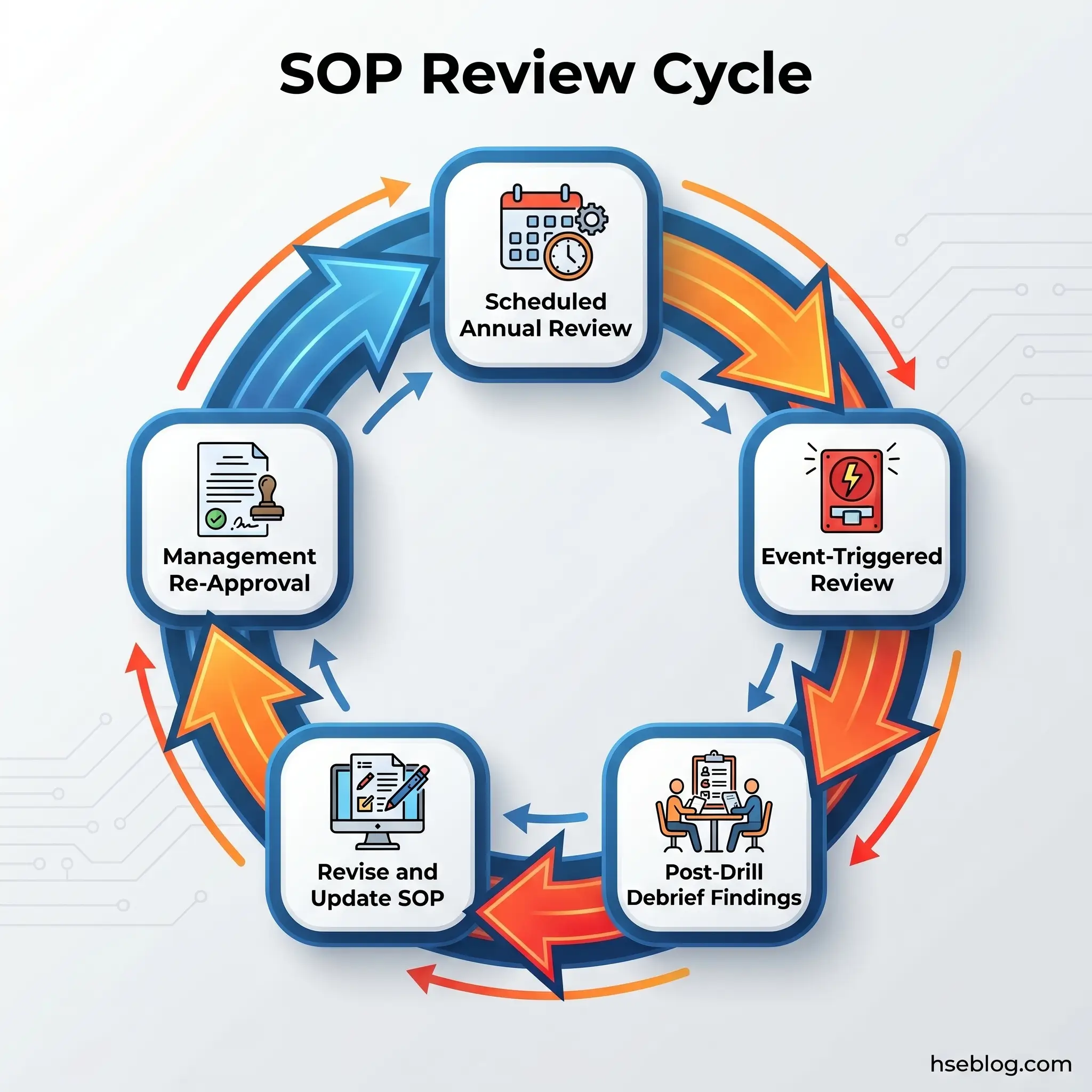
Scheduled reviews should occur annually at minimum. High-risk operations — facilities with significant flammable material storage, active hot work programs, or multiple ignition source categories — warrant semi-annual reviews. These reviews are not checkbox exercises; they require the reviewer to walk the facility and compare documented procedures against current conditions.
Event-triggered reviews are equally important. Any fire incident, fire-related near-miss, process change, facility modification, new chemical introduction, or regulatory update should trigger an immediate SOP review and, where necessary, revision. The UK Fire Safety Order (England and Wales) explicitly requires the responsible person to review the fire risk assessment — and by extension, the controls it drives — when there is reason to believe it is no longer valid or when a significant change occurs.
Version control discipline separates functional documents from documentation chaos. Every revision should carry a version number, revision date, summary of changes, and approval signature. Digital document management systems with automated review reminders are strongly preferable to paper-based systems, though physical copies at workstations remain necessary for operational access.
Post-drill debriefs are an underused review mechanism. When a fire drill reveals that an evacuation route is obstructed, that employees do not know their assembly point, or that the fire alarm is inaudible in certain areas, those findings must feed directly back into the SOP as revisions — not remain as bullet points in a debrief report that no one revisits.
For organizations operating under ISO 45001:2018 (Global), fire prevention SOPs integrate into the Plan-Do-Check-Act (PDCA) cycle. The SOP is planned and implemented (Clauses 6.1.2, 8.2), its effectiveness is evaluated through audits, drills, and incident review (Clause 9), and findings drive continual improvement (Clause 10.2). This framework provides a systematic structure for SOP maintenance that many organizations already have in place but fail to apply specifically to fire prevention documentation.
Frequently Asked Questions
Conclusion
The persistent weakness in fire prevention SOPs across industries is not a lack of content — it is a lack of specificity. Organizations produce documents that name the right categories (hazard identification, ignition control, fire protection maintenance, housekeeping, training) but fill them with instructions too vague to enforce and too generic to act on. The single highest-impact change an organization can make is converting every line of its fire prevention SOP from a general principle into a site-specific, accountable, time-bound instruction.
A fire prevention standard operating procedure earns its value when three conditions are met simultaneously: it reflects current facility conditions and hazards, it assigns clear responsibility and frequency to every control measure, and it is regularly tested through drills and revised based on findings. Any SOP that fails one of these conditions is a compliance artifact, not a fire prevention tool.
For practitioners managing fire prevention SOPs across jurisdictions, the operational path forward is building to the strictest applicable standard — combining NFPA’s detailed inspection requirements, the UK Fire Safety Order’s risk-assessment rigor, and OSHA’s named-accountability mandate — and documenting where local requirements diverge. The goal is never the document itself. The goal is a workplace where the conditions for uncontrolled fire cannot quietly assemble while everyone assumes someone else is watching.