Twenty years ago a coatings plant could keep drums of toluene and xylene stacked against a warehouse wall and call it storage. Since 9 December 2002 that arrangement has been a criminal offence under the Dangerous Substances and Explosive Atmospheres Regulations 2002 — DSEAR — which implements the workplace provisions of ATEX 153 across Great Britain. The regulations cover every flammable liquid on every kind of site, from the single aerosol in a maintenance cupboard to a 50,000-litre bulk tank farm. The Buncefield fire of December 2005 — five days of flame, a reshaping of how HSE and the Environment Agency view bulk flammable storage — is the backdrop every inspector still carries into a compliance visit.
DSEAR duties fall on employers and the self-employed, and on duty holders who control the workplace. Enforcement sits primarily with HSE, with petroleum enforcement authorities covering forecourts and local authorities handling lower-risk workplaces. A breach can bring unlimited fines in the Crown Court, personal prosecution of directors and managers under Section 37 of the Health and Safety at Work etc. Act 1974, and prohibition notices that stop production until remedial work is complete. The duty-holder net is wide:
- The employer who owns or operates the site and its processes
- The self-employed person who brings flammable liquids onto a site to work with them
- The person in control of the workplace — which may differ from the employer under lease or shared-occupancy arrangements
- Directors, managers and secretaries whose consent, connivance or neglect contributed to a breach
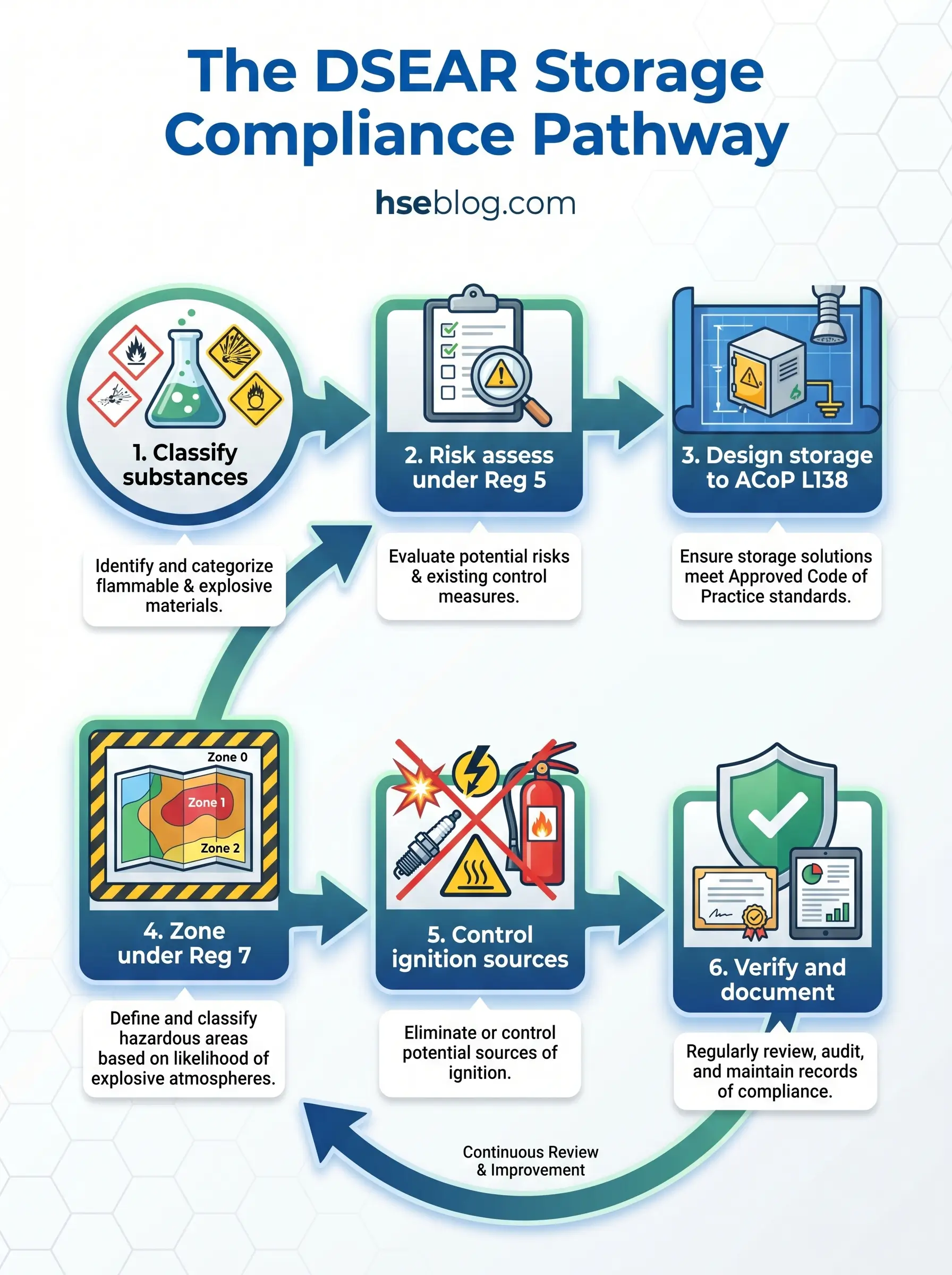
This guide walks through what DSEAR legally requires for flammable liquid storage and — section by section — how to actually do it. It aligns to UK law, references ATEX 153 for readers working to EU-equivalent standards, and consolidates DSEAR, ACoP L138, HSG51 and BS EN 14470-1 into a single compliance pathway.
What Counts as a Flammable Liquid Under DSEAR?
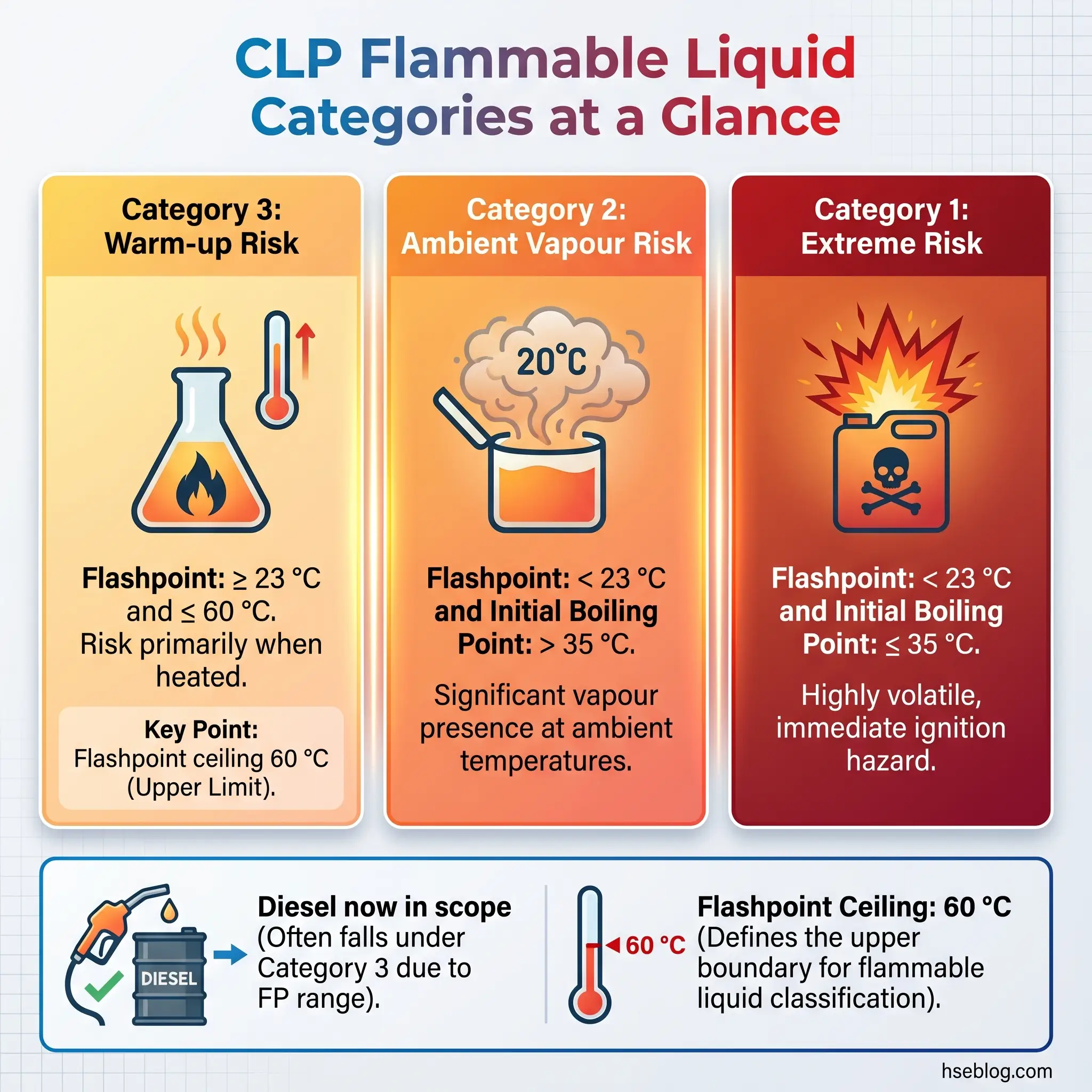
The most persistent misconception I meet on compliance audits is that DSEAR only applies to "the obvious stuff" — petrol, acetone, ethanol. DSEAR defines a dangerous substance by reference to the CLP Regulation, and since 2015 the flashpoint ceiling for flammable liquids sits at 60 °C. That single change swept diesel, gas oil and most kerosenes into DSEAR scope. A lot of sites are still operating off pre-2015 assumptions and are quietly non-compliant.
The CLP classification itself is straightforward once you have three thresholds in your head.
| CLP Category | Flashpoint | Initial Boiling Point | Typical Substances | Risk Indicator |
|---|---|---|---|---|
| Category 1 | < 23 °C | ≤ 35 °C | Diethyl ether, petroleum ether, pentane | Extremely flammable vapour at ambient |
| Category 2 | < 23 °C | > 35 °C | Petrol, acetone, toluene, MEK, IPA | Flammable vapour at ambient |
| Category 3 | ≥ 23 °C and ≤ 60 °C | — | White spirit, kerosene, diesel, gas oil | Flammable when warmed or atomised |
On a coatings site you will typically find Category 2 solvents as the headline risk — acetone, toluene, xylene, methyl ethyl ketone — with Category 3 carriers in the finished paints and white spirit in the cleaning station. A pharmaceutical lab will lean more Category 1 and 2. An engineering workshop may be dominated by diesel and kerosene in Category 3, and a decade ago would have argued they sat outside DSEAR. They don't.
DSEAR also reaches beyond CLP. A substance that has not been formally CLP-classified still falls within scope if it meets any physical hazard class under CLP — and dusts, flammable gases, and unstable substances are all captured under their own provisions of the same regulations. HSE's DSEAR in detail page sets out the full scope for reference.
The Six DSEAR Duties That Apply to Storage
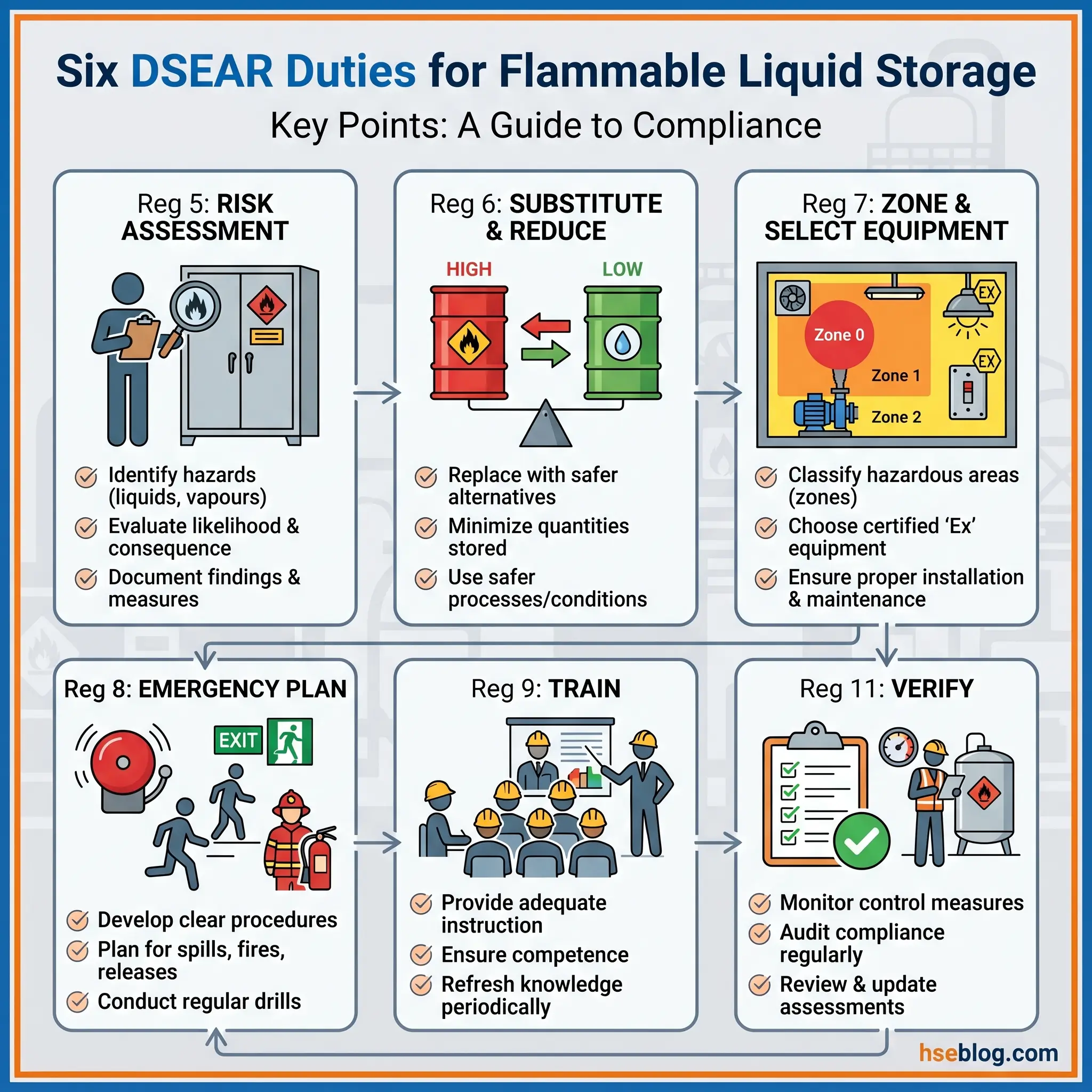
Six regulations carry the storage-related weight. Walking a site with an inspector, these are the hooks each question will hang from.
Regulation 5: Risk Assessment
Regulation 5 requires a suitable and sufficient assessment of every fire, explosion and thermal-runaway risk arising from a dangerous substance on site. For flammable liquids in storage this means identifying the quantity held, the flashpoint of each substance, the realistic release scenarios, the ignition sources in and around the store, and the adequacy of escape routes and ventilation. Where you employ five or more people the significant findings must be recorded. Review is not optional — every change of substance, quantity, process or incident triggers a re-look.
Regulation 6: Elimination or Reduction of Risk
Reg 6 and Schedule 1 spell out the hierarchy: eliminate the substance, substitute with something less hazardous, change the process, then apply engineering controls, and only then rely on procedural and PPE measures. On a coatings site the live substitution question is usually whether a Category 2 solvent can be replaced by a Category 3 alternative — for example moving from a low-flashpoint MEK-based cleaner to a white-spirit equivalent where performance permits. The reduction step matters as much as elimination; cutting stock held from a pallet of drums to a single day's requirement is itself a Reg 6 control.
Regulation 7: Places Where Explosive Atmospheres May Occur
Reg 7 and Schedule 2 require hazardous area classification, Ex-rated equipment selection and EX warning signs at zone boundaries. A flammable liquid does not automatically create a zone — but any workplace where vapour can realistically reach its lower explosive limit under foreseeable conditions does. This is the regulation that drives your Explosion Protection Document.
Regulation 8: Arrangements for Incidents, Accidents and Emergencies
Emergency procedures proportionate to the risk: warning systems, escape routes, first-aid fire-fighting, drills, information to emergency services. The phrase "proportionate to the risk" is important — a 50-litre cabinet in a small workshop does not need the same emergency architecture as a 20-tonne IBC compound, but both need something written, known and practised.
Regulation 9: Information, Instruction and Training
Anyone who handles, stores, decants, transports or works near flammable liquids must be trained on the substance properties, the safety data sheet content, the storage rules, ignition-source control, spill response and emergency actions. Competence — not attendance — is the test.
Regulation 11: Verification of Overall Explosion Safety
Before a workplace containing a hazardous zone is used for the first time, overall explosion safety must be verified by a person competent in the field of explosion protection. That competence is typically demonstrated through recognised professional routes — IECEx Ex002, CompEx, or chartered engineer status with relevant specialism. The verification certificate lives inside the Explosion Protection Document.
Building a DSEAR-Compliant Risk Assessment for Flammable Liquid Storage
ACoP L138 — the Approved Code of Practice that sits alongside DSEAR — is the document HSE inspectors benchmark your risk assessment against. Failure to follow it without equivalent measures creates a presumption of breach. The methodology it implies is a seven-step walk that works for a single cabinet or a full tank farm.
- Inventory everything. Every flammable liquid on site with quantity, flashpoint, CLP category, SDS reference, storage location and peak demand. If it is not on the list it will not be assessed.
- Map the release scenarios. Spills during decanting from drum to container, container failure on a racked IBC, vapour migration from an opened drum, pump-seal leaks, hose disconnection. Realistic scenarios, not worst-case fantasy.
- Identify every ignition source in the area. Electrical equipment, hot surfaces, welding and hot-work activity, static discharge, lift-truck ignition systems, smoking points, mobile phones, lighting fixtures. Ignition sources are what turn a leak into an incident.
- Assess exposure. Who is normally in the area, for how long, what ventilation provision exists, how close the store sits to escape routes and populated areas, what the prevailing wind direction does to outdoor vapour drift.
- Apply the hierarchy of control from Reg 6. Every unacceptable risk must be traced to a control sitting as high up the hierarchy as is reasonably practicable.
- Record the significant findings. Where you employ five or more, this is a legal recording duty, not a recommendation.
- Set review triggers. Change of substance or quantity. Change of process. Change of location. Incident or near-miss. New equipment. Organisational change. Minimum periodic review — typically annual.
On a coatings site where I once worked, the commonest assessment failures an HSE inspector flagged in a pre-start visit were the same four items every time:
- Inventory limited to "the flammables store" — missing the drums sitting beside mixing vessels and the half-litre containers in the QC lab
- Release scenarios written generically — "spillage" — with no link to the actual transfer activity
- Ignition-source list missing mobile phones and lift trucks
- No stated review interval, so the assessment slowly aged out of reality
Field Test: Walk your flammables store with the risk assessment in hand. If you cannot point to every container listed in the assessment, and every container you can see is not in the assessment, the document has already failed its first test.
Indoor Storage: Quantity Limits, Cabinets and Fire-Resisting Construction
This is the most searched practical question under DSEAR and the area where ACoP L138 is most prescriptive. The guiding principle is not a number — it is that only the minimum quantity needed for a half-day or single shift should be in a workroom. Everything else belongs in a dedicated external store or a properly constructed storage room.
Within that principle, HSE's guidance on flammable liquid storage in workrooms sets out recommended maxima that inspectors use as a reference point:
| Liquid Type | Recommended Maximum in Workroom Cabinet/Bin |
|---|---|
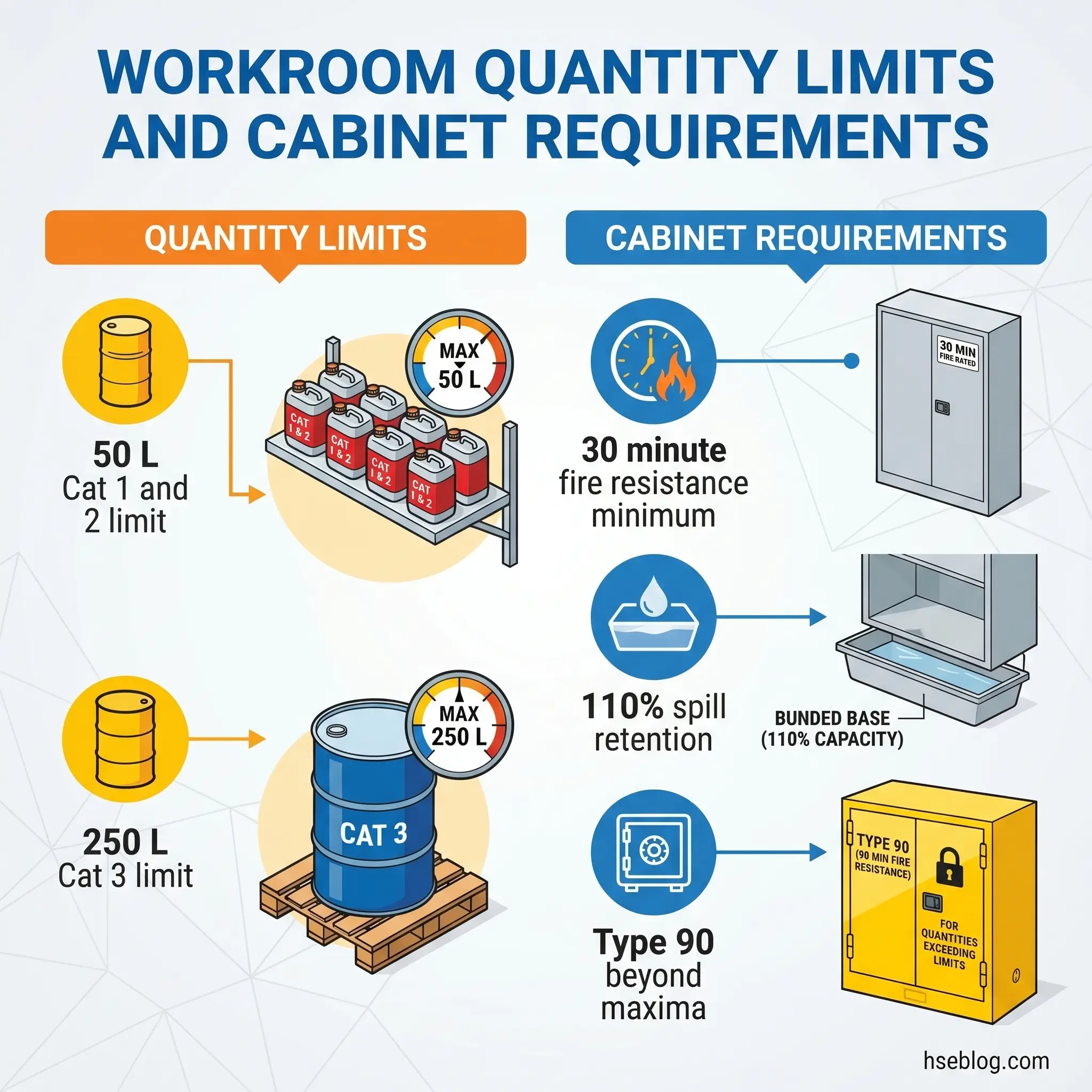
| Extremely/highly flammable liquids and flammable liquids with flashpoint below ambient (CLP Cat 1 and 2) | 50 litres |
| Flammable liquids with flashpoint up to 60 °C (CLP Cat 3) | 250 litres |
These are recommended, not absolute. Exceed them and the burden shifts to you to demonstrate — through risk assessment and additional controls — that the arrangement remains safe.
The cabinet or bin itself has to perform. ACoP L138 calls for minimum 30 minutes fire resistance covering integrity, insulation and load-bearing capacity where applicable, sealed joints, close-fitting doors or lids, construction material with a melting point above 750 °C, and spill retention equal to 110% of the largest container inside or 25% of total contents — whichever is greater. A cabinet that cannot contain its own spill is not a cabinet. It is a fire-feed.
BS EN 14470-1:2023 — the current version, replacing the 2004 standard still quoted on far too many vendor websites — classifies safety storage cabinets by minutes of fire resistance:
| BS EN 14470-1 Type | Fire Resistance | Typical Use Case |
|---|---|---|
| Type 15 | 15 minutes | Small-quantity dispensing cabinets in low-occupancy areas |
| Type 30 | 30 minutes | Minimum that satisfies ACoP L138 in most workroom settings |
| Type 60 | 60 minutes | Higher-quantity cabinets, multi-occupancy workrooms |
| Type 90 | 90 minutes | Recommended where quantities approach or exceed ACoP maxima, or where evacuation times justify it |
The 2023 revision expanded coverage to cabinets up to 2 m³ and retained the functional requirements: doors must close fully within 20 seconds from any position, door retainers must release at 50 °C (−10 °C tolerance), and ventilation openings must close automatically at 70 °C. A cabinet failing any of those functions on inspection is not compliant regardless of what the certificate says.
Location matters as much as construction. The cabinet must sit away from immediate processing areas, never obstruct an escape route, and be kept away from radiators, process heat sources and direct sunlight. Segregation inside is non-negotiable: flammable liquids never share a cabinet with oxidisers, energetic substances, corrosives or water-reactive materials, even where space is tight. The chemistry does not care about your footprint.
"Empty" Containers Are Not Empty
Watch For: A 200-litre drum that has held toluene and been emptied by pumping is not empty. It contains residual vapour at or above the lower explosive limit, and a single static discharge or spark will ignite it. Under DSEAR every nominally empty container must be treated as a full one until it has been formally decontaminated, purged or reconditioned — and that sits on the same cabinet, same separation and same zoning rules as a full drum.
Outdoor Bulk Storage: Separation Distances and Fire-Rated Enclosures
Once flammable liquid quantities exceed what indoor cabinets can reasonably hold, outdoor storage becomes the default — a drum compound, a walk-in fire-rated container, an IBC store on a bunded slab. HSG51 (3rd edition, 2015) sets the separation distance framework and it is the one document inspectors cite most often on outdoor visits.
For storage of between 1,000 and 100,000 litres the default minimum separation is four metres from occupied buildings, site boundaries, ignition sources and other flammable-liquid stores. Below 1,000 litres the distances reduce; above 100,000 litres they grow rapidly and the assessment becomes site-specific. Where separation distances cannot be achieved — which is the usual reality on built-up industrial estates — a fire-rated enclosure to REI 60, 90, 120 or 240 can substitute. The enclosure rating must reflect the fire load and the exposure risk, and the calculation is a competent-person task.
The other controls stack on top of separation:
- Bunding and secondary containment capable of holding 110% of the largest single container, with provision to contain fire-water run-off and prevent environmental release to drains or watercourses
- Stacking limits — 200-litre nominal metal drums no more than three high vertically or four high horizontally on the roll; IBCs limited to supplier guidance, typically no more than two high and only where the base unit is rated for the static load
- Security against trespass, unauthorised decanting and arson — a flammable-liquid compound is a prime target in industrial insurance claims
- Signage under the Health and Safety (Safety Signs and Signals) Regulations 1996 — the triangular warning for flammable materials, EX signage at zone boundaries, and clear no-smoking and no-mobile-phone prohibition signs
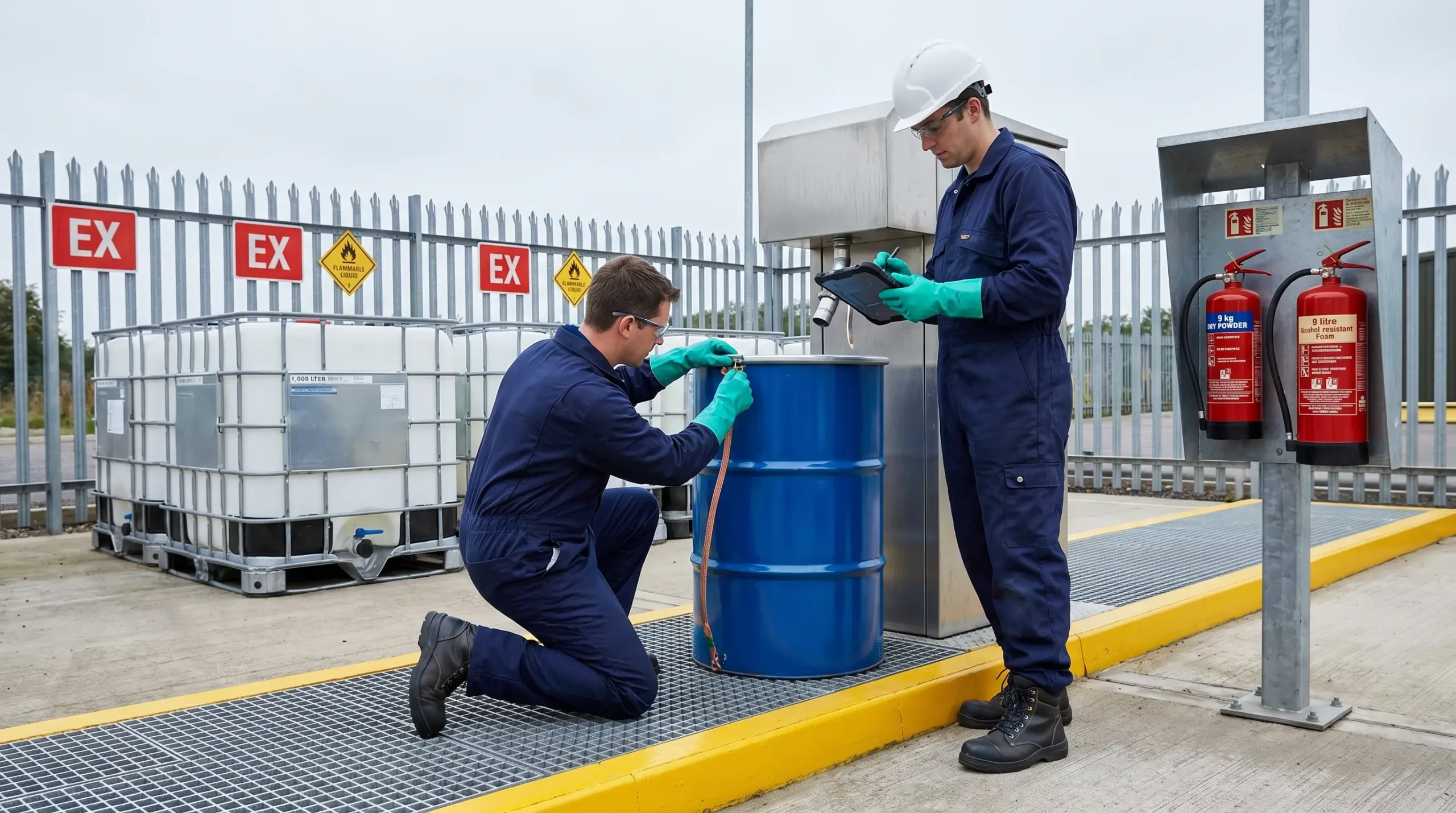
- Ground conductivity and earthing — a concrete slab with earthing points for drum dispensing, because transferring 60 litres of acetone into a stainless-steel container on an insulated plastic pallet is how static-ignition incidents begin
On one site audit I ran, the compound passed every document check and failed on a single detail: the earthing cable had been disconnected from the dispensing point because the spring clip kept snagging on a passing pump trolley. A competent storeman had "fixed" the nuisance by removing the cable. The risk assessment had not captured the foreseeability of that modification. That is the level of detail Reg 5 is asking for.
Hazardous Area Classification and ATEX Equipment Selection
Regulation 7 is where DSEAR meets ATEX and where competent-person input becomes unavoidable. Hazardous area classification does not apply to every flammable liquid store — sealed containers at ambient temperature below their flashpoint, in a well-ventilated area, often produce what BS EN 60079-10-1 calls a zone of negligible extent. But wherever vapour can realistically form an explosive atmosphere, the area has to be classified, the equipment has to match, and the boundaries have to be signed.
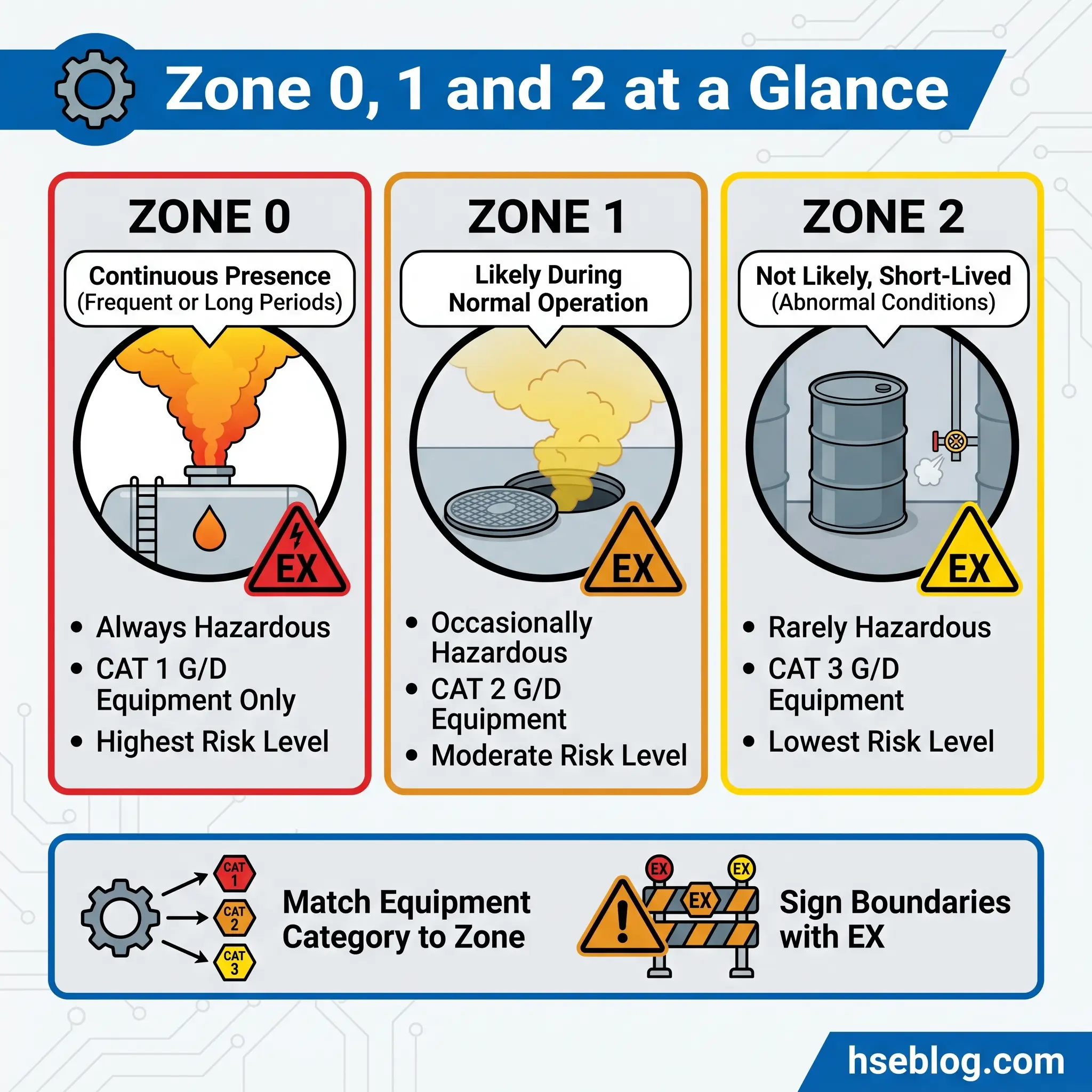
| Zone | Definition | Equipment Category |
|---|---|---|
| Zone 0 | Explosive atmosphere present continuously or for long periods | Category 1G |
| Zone 1 | Explosive atmosphere likely in normal operation | Category 2G |
| Zone 2 | Explosive atmosphere unlikely, and short-lived if it occurs | Category 3G |
The interior of a tank holding a Category 2 solvent above its flashpoint is Zone 0. The space immediately around a drum vent during decanting, or around a pump seal that periodically leaks, is Zone 1. A well-ventilated pump room or the area immediately outside a Zone 1 envelope typically sits in Zone 2. Getting these boundaries right is a standards-led exercise under BS EN 60079-10-1 and the Energy Institute Model Code IP15, and the resulting drawings are signed off by a competent person.
Equipment selection follows. BS EN 60079-14 governs the design, selection and erection of electrical installations in explosive atmospheres, and BS EN 60079-17 covers the lifecycle inspection and maintenance regime. The broad rule — Zone 0 needs Category 1G, Zone 1 accepts Category 1 or 2G, Zone 2 accepts Category 1, 2 or 3G — is a starting point, not a substitute for the standards. Pre-2003 equipment already in service at the time DSEAR came into force can remain if the risk assessment confirms it is still safe. New equipment must be compliant with the Equipment and Protective Systems Intended for Use in Potentially Explosive Atmospheres Regulations 2016 (EPS 2016), which implement the ATEX Equipment Directive in the UK post-Brexit.
HSE's ATEX and explosive atmospheres page is the starting reference for readers building their first classification. The resulting drawings and rationale sit inside the Explosion Protection Document — of which more shortly.
Controlling Ignition Sources in and Around Storage
"Remove the ignition sources" is the generic advice across safety websites. On a flammable liquid store it has to be specific, because the sources inspectors cite in enforcement notices are rarely the obvious ones.
Electrical. No standard 13-amp sockets inside any zoned area. Intrinsically safe switchgear where electrical isolation is needed near the store. ATEX-certified lighting rated for the zone it sits in. Supply cables glanded to the enclosure standard specified in BS EN 60079-14. An extension lead trailing into a Zone 2 pump room — which I have seen on more than one site — is an automatic improvement notice.
Mechanical. Non-sparking hand tools for any maintenance work inside a zone, which in practice means beryllium-copper or bronze where steel would spark. Lift trucks rated to at least EX/PX classification for Zone 1, or diesel trucks with flame traps for Zone 2 where risk assessment supports it. Pump and valve selection with attention to friction heating on running seals.
Static electricity. Bonding and earthing during every decanting operation. Earthed drum stands that are tested at defined intervals. Clothing policy — synthetic overalls accumulate static, cotton or anti-static work wear releases it. The IBC compound mentioned earlier failed on exactly this.
Thermal. Hot surfaces kept out of zones where possible. Heating pipes lagged and routed clear. Radiant heaters banned inside storage enclosures. Direct sunlight on dark-painted drums in summer can push internal temperature above the flashpoint of a Category 3 liquid — an issue that rarely makes the risk assessment.
Human. A written smoking policy with enforced boundaries, visible signage and consequences. Mobile phones banned in zoned areas unless they are intrinsically safe certified — an ATEX-rated mobile phone is an accepted engineering control, a standard phone is not. Hot-work permits for every cutting, welding, grinding or burning task within defined distances of the store.
Lightning. Outdoor bulk stores over a threshold volume need lightning protection designed to BS EN 62305, tied into the site earthing grid and inspected on the same cycle as the rest of the electrical installation.
The Fix That Works: A laminated ignition-source register kept at the flammable store entrance — updated when a new piece of equipment enters the zone, audited quarterly against what is actually present. It is a 30-minute control that closes the single most common DSEAR enforcement gap.
Emergency Planning, Spill Response and Fire-Fighting
Regulation 8 makes emergency arrangements a specific storage duty rather than a general site responsibility. The minimum arrangements that survive an HSE scrutiny visit are tight and specific.
- Written emergency procedures dealing with flammable-liquid release, fire and explosion — referenced to the specific substances on site, not a generic template
- Alarm and warning systems audible in every part of the store, with a defined evacuation signal and a defined all-clear signal, tested on a scheduled cycle
- Escape routes kept permanently clear of stored containers, obstructing pallets and trip hazards, with photoluminescent or powered signage compliant with the Safety Signs Regulations
- Spill response materials matched to the substance held — hydrocarbon absorbents for mineral oils, universal absorbents for mixed solvents, alcohol-resistant foam for polar solvents — stored in a cabinet at the store entrance, not locked away in a central stores
- Fire extinguishers sited 3 to 8 metres from the store, typically 9 kg dry powder or 9 litre foam, with alcohol-resistant foam where acetone, ethanol, IPA or other polar solvents are held — close enough to reach, far enough to survive the fire that starts inside the store
- Bund and drainage design capable of retaining fire-water run-off, with interceptors or shut-off valves preventing release to watercourses; this is where DSEAR and environmental permitting meet
- Fire and Rescue Service liaison where inventory exceeds local thresholds, with pre-incident plans shared and site familiarisation visits arranged
The Regulatory Reform (Fire Safety) Order 2005 sits alongside DSEAR for sites in England and Wales; the equivalent Scottish Regulations apply north of the border. The two regimes overlap significantly, and a properly built emergency plan satisfies both.
Training, Information and the Explosion Protection Document
Regulation 9 is where duty holders underperform most consistently in audits. Training content, not training attendance, is the benchmark.
Training
Training for anyone who handles, stores or works near flammable liquids must cover substance hazards, SDS interpretation and the specific fields that matter (flashpoint, vapour density, evaporation rate), permitted quantities and locations on site, correct container use and labelling, decanting and transfer procedures, spill response, emergency actions, and the meaning of EX signage and other safety signs. Refresher intervals are set by risk assessment — typically annual for high-risk roles, biennial for lower-risk roles, with retraining triggered by any process or substance change.
I once watched a new storeman open a drum of solvent with a claw hammer because nobody had told him the plant kept cap-opening spanners for exactly that task. His induction had covered fire extinguishers and escape routes. It had not covered the physical act of opening a drum of flammable solvent without generating a spark. That gap — between awareness training and competence training — is the Reg 9 gap.
The Explosion Protection Document
Where Reg 7 zoning applies, an Explosion Protection Document is mandatory. It is the single auditable record that ties every other element together and the first file an HSE inspector asks to see. At a minimum it pulls together:
- Substances held on site, with CLP classification and quantities
- HAC drawings with signed competent-person verification
- The risk assessment conclusions and control-measure summary
- The Reg 11 verification certificate for new installations
- Maintenance and inspection schedules under BS EN 60079-17
- Emergency arrangements, training records and the review cycle
ACoP L138 — available on the HSE publication page — sets out the EPD expectations in practical terms. A site that cannot produce its EPD inside 15 minutes of an inspector asking for it has already failed one of the easier DSEAR tests.
Inspection, Maintenance and Verification
DSEAR compliance is a lifecycle duty, not a certification event. The cabinet that passed its install inspection last year may have a damaged door seal and a plugged vent today. The zone drawing that was accurate two years ago may not reflect the new pump installed last month.
The lifecycle regime runs across three layers.
Initial verification under Reg 11 — competent-person sign-off of overall explosion safety before the hazardous area is first used.
Periodic inspection of electrical equipment in hazardous areas under BS EN 60079-17, working through visual, close and detailed inspection levels on defined intervals. Visual inspections catch the obvious — corrosion, missing bolts, damaged cables — and the interval is typically 12 months for Zone 1 and 24 months for Zone 2. Close and detailed inspections go deeper and run on a longer cycle, but the site record must show both types happening.
Cabinet and containment integrity checks — door seals, self-closing mechanism function, ventilation opening condition, bund integrity. A monthly walk-the-store inspection captures most issues before they become breaches.
The reassessment triggers under Reg 5 sit across the top of the whole lifecycle:
- New substance introduced to the inventory — even in small quantities
- Changed quantity of an existing substance pushing close to or beyond recommended maxima
- Modified process changing release scenarios or ignition-source profile
- Incident or near-miss involving the substance, the container or the storage arrangement
Inspection and maintenance records should be retained for a minimum of five years. In practice, retaining them across the lifetime of the installation is easier administratively and supports a due diligence defence if one is ever needed.
What Enforcement Looks Like and How to Stay Ahead of It
HSE's enforcement tools on DSEAR breaches run from verbal advice through to prosecution, and the pattern is well documented.
- Verbal advice during a routine visit — common on first-time findings where the breach is minor and being actively remedied
- Improvement notices — a written requirement to put specific matters right by a deadline, typically 21 days minimum
- Prohibition notices — immediate stop on an activity until remediated, with no right to continue operating the affected process
- Prosecution — Crown Court for indictable offences, with unlimited fines and individual director or manager prosecution under Section 37 HSWA
The findings that drive enforcement recur across sectors: no hazardous area classification where one is evidently needed, no Explosion Protection Document where zoning exists, excess workroom quantities that breach the ACoP maxima without documented justification, ignition-source control gaps, and untrained or inadequately trained personnel decanting flammable liquids without the basic competencies.
The insurance angle rarely appears in HSE guidance but matters enormously. Most property and business-interruption policies carry a DSEAR-linked warranty. A site operating without a current risk assessment, or without an EPD where one is required, may find its cover voided on claim — turning a recoverable incident into a business-ending one. The due diligence defence under HSWA rests on being able to demonstrate that the duty holder took all reasonable steps to prevent the breach. That defence is only as strong as the documentation behind it: the current, dated, competent-person-reviewed risk assessment; the signed EPD; the training records; the inspection records; the maintenance records. Prevention is not cheaper than remediation — it is the only credible defence when something goes wrong.
Two adjacent pressures are reshaping how duty holders approach flammable liquid storage. The first is lithium-ion battery storage: BS EN 14470-1-tested cabinets offering 90-minute inside-out protection are now standard for battery storage in the same compounds that hold solvents, and the read-across from flammable-liquid cabinet design to battery cabinet design is pushing both standards forward. The second is green hydrogen handling on sites that have traditionally stored hydrocarbon fuels; hydrogen does not behave like a liquid but its classification under DSEAR and ATEX sits inside the same regulatory fabric, and the competent persons signing off solvent stores today will be signing off hydrogen cabinets tomorrow.
Frequently Asked Questions
What is the maximum quantity of flammable liquid allowed in a workroom under DSEAR?
ACoP L138 recommends 50 litres for Category 1 and 2 flammable liquids — those with a flashpoint below ambient — and 250 litres for Category 3 liquids with a flashpoint up to 60 °C. These are recommended maxima, not absolute limits. The overriding principle is that only the minimum quantity needed for a half-day or single shift should be in the workroom. Exceeding the recommended figure is possible where the risk assessment justifies it and additional controls are in place, but the burden of proof sits with the duty holder.
Does DSEAR apply to diesel storage?
Yes. The 2015 change to the CLP flashpoint ceiling — raising it to 60 °C — brought diesel, gas oil and most kerosenes into scope. HSE expects a proportionate response: the fire risk of diesel in sealed drums at ambient temperature is materially lower than that of petrol, and the risk assessment should reflect that. But the regulatory duty to assess, record and control is the same.
What fire rating does a flammable storage cabinet need under DSEAR?
The minimum under ACoP L138 is 30 minutes — covering integrity, insulation and load-bearing capacity. BS EN 14470-1:2023 classifies cabinets as Type 15, 30, 60 or 90 depending on minutes of fire resistance, with Type 90 recommended where quantities approach or exceed the ACoP maxima, or where evacuation times justify the extended protection. A cabinet with a certificate but a damaged door seal or a disabled self-closing mechanism is not compliant regardless of the paperwork.
Is a DSEAR risk assessment legally required?
Yes, under Regulation 5. The assessment must be suitable and sufficient, cover every dangerous substance on site, and be kept current. Where five or more people are employed the significant findings must be recorded. The assessment has to be reviewed whenever there is a substance change, quantity change, process change, incident, or at a minimum periodic interval — typically annually.
What is the difference between DSEAR and COSHH for flammable liquids?
DSEAR covers the safety risks arising from a substance's physical properties — fire, explosion, thermal runaway, metal corrosion. COSHH covers the health risks from the same substance — toxicity, irritation, sensitisation, carcinogenicity. Most laboratory and workshop solvents carry both types of hazard, which means they require both assessments. A solvent that is flammable and irritant needs a DSEAR assessment for the fire risk and a COSHH assessment for the inhalation risk. Neither assessment replaces the other.
Do I need hazardous area classification for a small flammable liquid store?
It depends on whether an explosive atmosphere can realistically form. Sealed containers at ambient temperature, held below their flashpoint in a well-ventilated area, often produce what BS EN 60079-10-1 terms a zone of negligible extent — in which case formal classification may not be required beyond the documented rationale. Any activity that breaks the seal — decanting, sampling, mixing, venting — changes that picture immediately. The decision is a competent-person call, not a duty-holder assumption.
What is an Explosion Protection Document and do I need one?
An EPD is mandatory wherever Regulation 7 applies — that is, wherever the site has a classified hazardous zone. It brings together the substances held, the HAC drawings, the risk assessment conclusions, the control measures, the Reg 11 verification certificate, the inspection and maintenance schedule, and the emergency arrangements into a single auditable file. It is the first document HSE inspectors ask for on a DSEAR visit, and a site that cannot produce it promptly has already signalled a compliance gap.
Conclusion: The Compliance Checklist
Flammable liquids storage under DSEAR sits on a narrow path between what the regulations require and what the day-to-day operation can sustain. The common failures are procedural, not technical — missing inventories, aged risk assessments, over-stocked workrooms, unclassified zones, cabinets that have degraded since install. The route out of those failures is a recurring self-audit against a clear list of legal and practical duties.
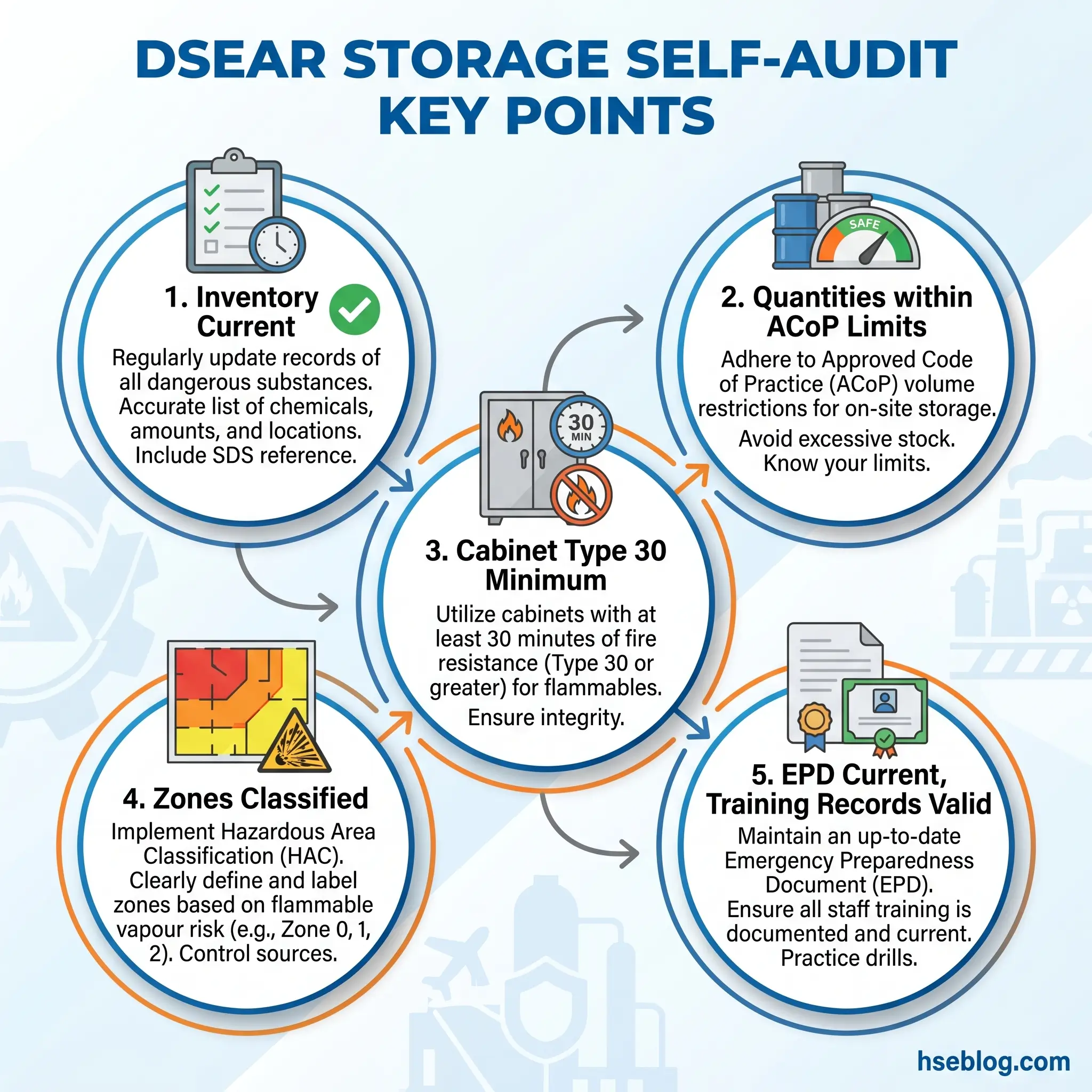
Use this as the screenshot-and-walk checklist for flammable liquids storage DSEAR compliance:
- Complete substance inventory with CLP category, flashpoint, quantity, SDS reference and storage location for every flammable liquid on site
- Current Regulation 5 risk assessment with recorded significant findings, reviewed within the last 12 months or since the last material change
- Workroom quantities within the ACoP L138 recommended maxima of 50 litres (Category 1 and 2) and 250 litres (Category 3), or documented justification for any exceedance
- Cabinets and bins meeting minimum 30-minute fire resistance with 110% spill retention, sealed joints, close-fitting doors and compatible-only contents — BS EN 14470-1:2023 Type 30 minimum, Type 90 where quantities approach the maxima
- Outdoor storage satisfying HSG51 separation distances, or fire-rated enclosure where distances cannot be achieved, with bunding, stacking limits and earthing in place
- Hazardous area classification drawings signed by a competent person, with EX signage at every zone boundary and equipment category matched to the zone
- Ignition-source control documented and audited — electrical, mechanical, static, thermal, human, lightning
- Emergency arrangements proportionate to the risk: written procedures, alarms, escape routes, spill response materials, correct extinguisher types, fire-water containment
- Training and competence records current for every person handling, storing or working near flammable liquids, with refresher intervals set by risk
- Explosion Protection Document in place and accessible where Regulation 7 zoning applies, containing all the components set out in ACoP L138
- Regulation 11 verification certificate for every hazardous installation placed in service since the regulations came into force
- Inspection and maintenance regime running under BS EN 60079-17, with records retained for a minimum of five years
Work each item, date each outcome, and close the gaps. That is what DSEAR compliance looks like when it survives an inspector's visit — and, more importantly, when it survives the Friday-afternoon spill that would otherwise become Monday morning's incident report.