
TL;DR
- Elimination removes the contaminant entirely — the only control with zero residual exposure risk, most feasible during the design phase before a process is built
- Engineering controls are the operational workhorse — local exhaust ventilation, enclosure, and wet methods physically reduce airborne concentrations at the source
- Occupational exposure limits vary by jurisdiction — OSHA PELs, NIOSH RELs, ACGIH TLVs, and UK WELs often set different thresholds for the same substance; practitioners should reference the most protective limit
- PPE is the last resort, not the first response — it protects only the wearer, depends entirely on correct fit and consistent use, and does nothing to reduce contamination at the source
- Verification is where most programmes fail — controls degrade without maintenance; exposure monitoring and periodic testing are not optional extras but ongoing obligations
The hierarchy of controls for workplace contaminants is a five-level framework that prioritises control measures from most to least effective: elimination, substitution, engineering controls, administrative controls, and personal protective equipment. Controls at the top of the hierarchy are preferred because they reduce exposure at the source and do not depend on worker behaviour to remain effective.
An estimated 13,000 workers die each year in the United Kingdom alone from diseases caused by exposure to hazardous substances at work — cancers, chronic respiratory conditions, and organ damage that often take decades to manifest (Health and Safety Executive, cited 2025). These are not sudden-impact fatalities. They are the slow consequences of inadequate contaminant control, accumulated shift by shift, in workplaces where the exposure was technically manageable.
That number represents a single jurisdiction. Across the United States, workplace injuries and illnesses cost between $174 billion and $348 billion annually (AFL-CIO, 2025) — a figure the AFL-CIO describes as an undercount. The hierarchy of controls for workplace contaminants exists precisely to prevent this kind of accumulating harm. This article applies that framework not as a textbook exercise but as a practical decision-making structure for controlling dusts, vapours, chemical agents, biological hazards, and physical agents in operational environments. Every level of the hierarchy carries specific technical demands, common failure modes, and jurisdictional requirements that determine whether a control programme actually protects workers — or merely exists on paper.
What Is the Hierarchy of Controls for Workplace Contaminants?
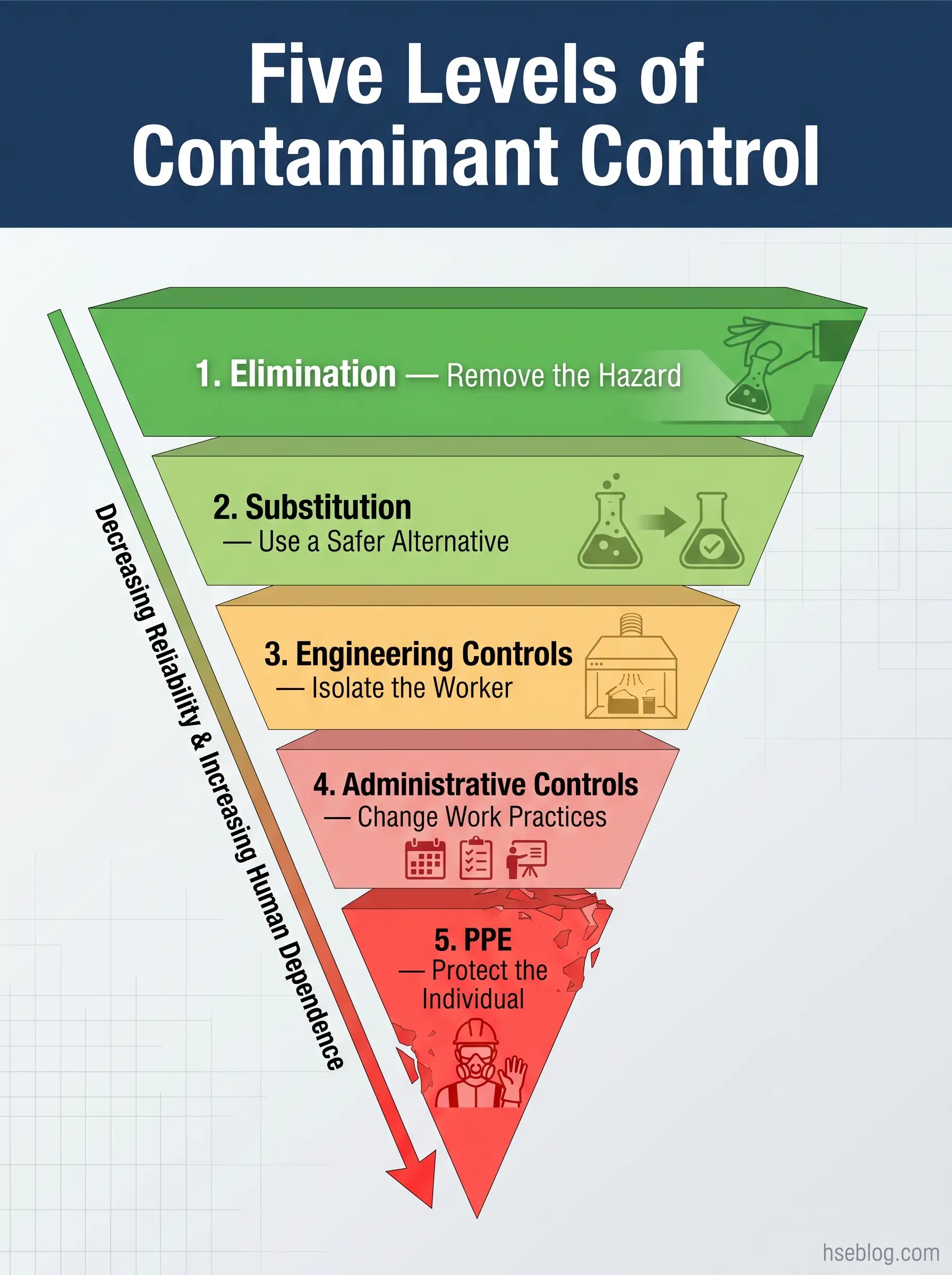
The hierarchy of controls is a prioritised framework for reducing worker exposure to harmful substances and agents in the workplace. Unlike a menu of options, where the user selects based on preference or convenience, the hierarchy is ordered by reliability. Controls at the top — elimination and substitution — operate independently of human behaviour. They do not require a worker to remember a procedure, wear equipment correctly, or comply with a schedule. Controls at the bottom — administrative measures and PPE — depend entirely on sustained human action, making them inherently less dependable over time.
The five levels, in descending order of effectiveness, are:
- Elimination — physically removing the hazardous substance or contaminant-generating process from the workplace
- Substitution — replacing a hazardous substance or process with a less hazardous alternative
- Engineering controls — isolating workers from the contaminant through physical barriers, ventilation, or process modification
- Administrative controls — changing how, when, and for how long workers are exposed through procedures, scheduling, and training
- Personal protective equipment (PPE) — equipping individual workers with respiratory protection, gloves, or protective clothing as a final barrier
This hierarchy is codified across major regulatory and management system frameworks globally. ISO 45001:2018 Clause 8.1.2 requires organisations to eliminate hazards and reduce risks using this sequence. OSHA embeds the hierarchy into its enforcement of 29 CFR 1910.1000, requiring engineering and administrative controls before PPE. The UK’s COSHH Regulations 2002 (Regulation 7) prescribe a similar prioritised approach under the duty to prevent or adequately control exposure. NIOSH’s hierarchy of controls framework provides the foundational five-level model used as an advisory reference across US industries.
A common practitioner observation across industries: many organisations mentally treat the hierarchy as a flat list. They select whichever control is most convenient — often PPE — rather than working systematically from the top down. This inverted application is not merely a procedural error. It places the most unreliable controls where the most reliable ones should be.
Elimination: Removing the Contaminant at Source
Elimination is the most effective control because it removes the exposure entirely. If a hazardous substance is not present in the workplace, no worker can be exposed to it. The practical difficulty is that elimination is far easier to achieve during the design and procurement phase than in an established operation — which is precisely why Prevention through Design matters.
Prevention through Design, a NIOSH-championed initiative, operationalises elimination at the earliest project stage. When a new facility is being designed or a process is being commissioned, engineers can evaluate whether a contaminant-generating step is necessary at all. Removing a solvent-based degreasing stage and replacing it with mechanical cleaning during process design costs a fraction of retrofitting the same change into an operational facility. Automating a task that generates airborne dust — so that no worker is present in the exposure zone — is another elimination strategy that becomes exponentially more expensive after construction.
The judgment call practitioners face repeatedly is whether elimination has been genuinely investigated or simply dismissed. A pattern across risk assessment documentation: the elimination row is checked “not reasonably practicable” with minimal or no supporting analysis. Teams rarely spend adequate time exploring whether the contaminant-generating step is truly essential or is simply inherited from an older process design that was never questioned. The burden under COSHH and under ISO 45001 Clause 8.1.2 is on the employer to demonstrate that elimination was considered and to document why it was not feasible — not to skip it as a theoretical ideal.
Substitution: Replacing Hazardous Substances with Safer Alternatives
Where elimination is not feasible, the next question is whether the hazardous substance or process can be replaced with something less harmful. Substitution requires a genuine comparative hazard assessment — not a simple swap. A substitute may carry different hazard classifications, interact with other workplace agents, or create new exposure pathways that the original substance did not.
Replacing high-volatility organic solvents with low-volatility or water-based alternatives is one of the most widely applied substitution strategies in manufacturing. Switching from a carcinogenic substance to one with fewer hazard classifications reduces the severity of any residual exposure. But the common failure mode is substitution creating a false sense of security. A less toxic chemical may still require engineering controls — yet teams sometimes abandon those controls after substituting, operating under the assumption that the problem has been solved. A substance with a lower toxicity rating but a higher vapour pressure at working temperature can produce greater airborne concentrations than the “more toxic” original, resulting in higher actual exposure.
Regulatory frameworks require documentation. Under COSHH, substitution decisions must be recorded as part of the assessment, including the rationale for selecting the substitute and the assessment of any new risks introduced. This is not administrative paperwork for its own sake — it forces a structured evaluation that prevents reactive, poorly considered swaps.
| Scenario | Hazardous Substance | Substitute | Key Trade-Off |
|---|---|---|---|
| Surface degreasing | Trichloroethylene (carcinogen) | Aqueous cleaning agent | May require process redesign; longer cleaning cycle |
| Adhesive bonding | Solvent-based adhesive (high VOCs) | Water-based adhesive | Different curing properties; may need ventilation review |
| Abrasive blasting | Silica sand (respirable crystalline silica) | Garnet or steel grit | Different surface finish; cost difference |
Engineering Controls: Isolating Workers from Contaminant Exposure
Engineering controls form the operational backbone of most workplace contaminant control programmes. Where the substance cannot be eliminated or substituted, engineering measures physically reduce worker exposure by capturing, containing, or diluting the contaminant before it reaches the breathing zone.
Local Exhaust Ventilation (LEV)
LEV captures contaminants at or near the point of generation — before they disperse into the wider workplace atmosphere. The effectiveness of an LEV system depends on the match between hood design, capture velocity, and contaminant behaviour. A heavy dust generated at low velocity requires different hood geometry and airflow than a light vapour released at high temperature. Getting this match wrong is the most frequent design-stage failure in LEV installations.
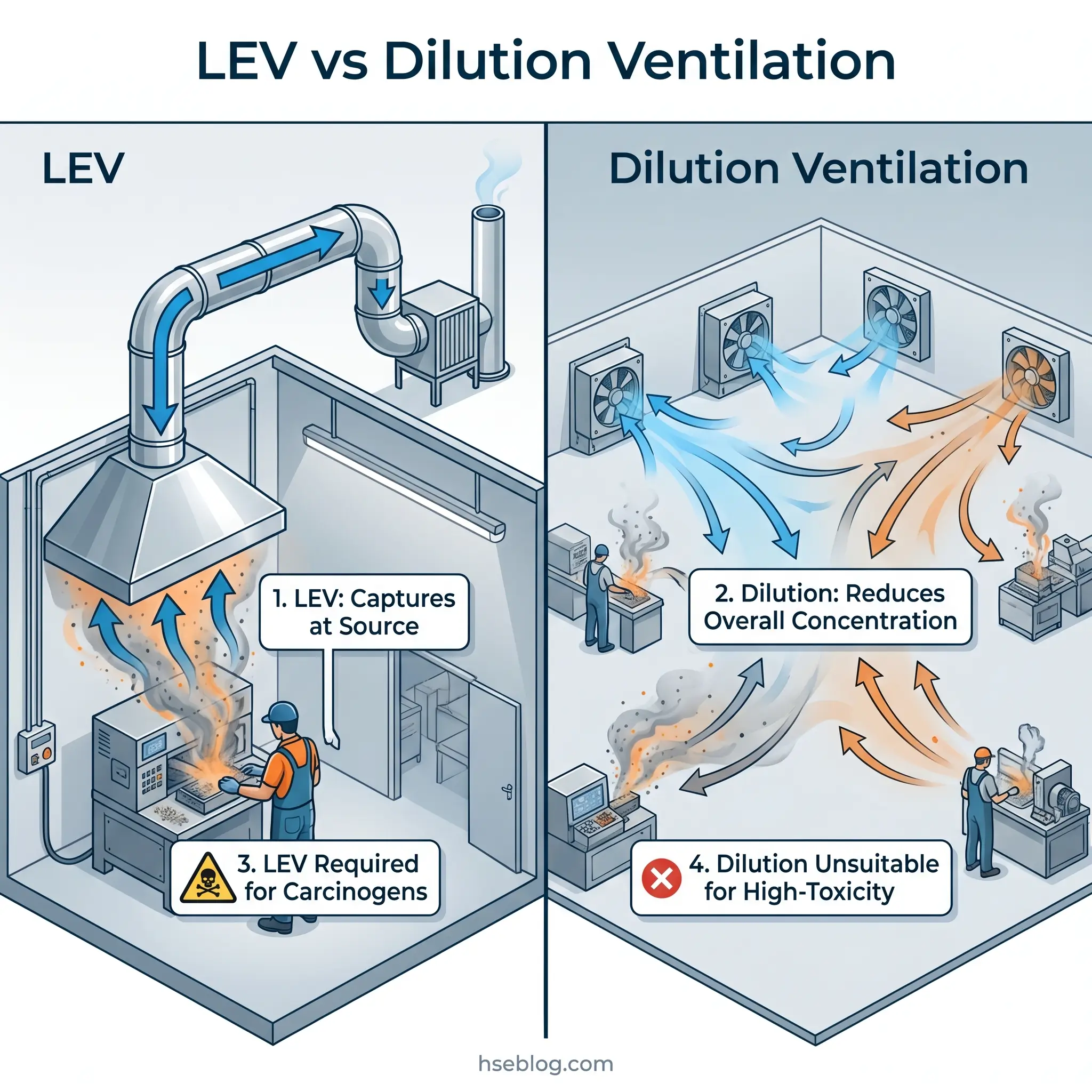
The critical distinction between LEV and dilution (general) ventilation determines which situations each can address. LEV is the preferred control for localised, high-concentration sources and is essential for highly toxic or carcinogenic substances where even brief peak exposures are dangerous. Dilution ventilation introduces fresh air to lower overall airborne concentration across a space, but it does not protect the worker positioned nearest to the source and is inappropriate for carcinogens or substances with very low occupational exposure limits.
| Factor | Local Exhaust Ventilation (LEV) | Dilution (General) Ventilation |
|---|---|---|
| Best application | Localised, high-concentration sources; highly toxic substances | Widely dispersed, low-toxicity contaminants in large spaces |
| Worker protection near source | High — captures at point of generation | Low — does not protect worker closest to source |
| Suitability for carcinogens | Required | Unsuitable as sole control |
| Maintenance demand | High — filters, fans, ductwork need periodic inspection | Moderate — HVAC maintenance |
| Capital cost | Higher | Lower |
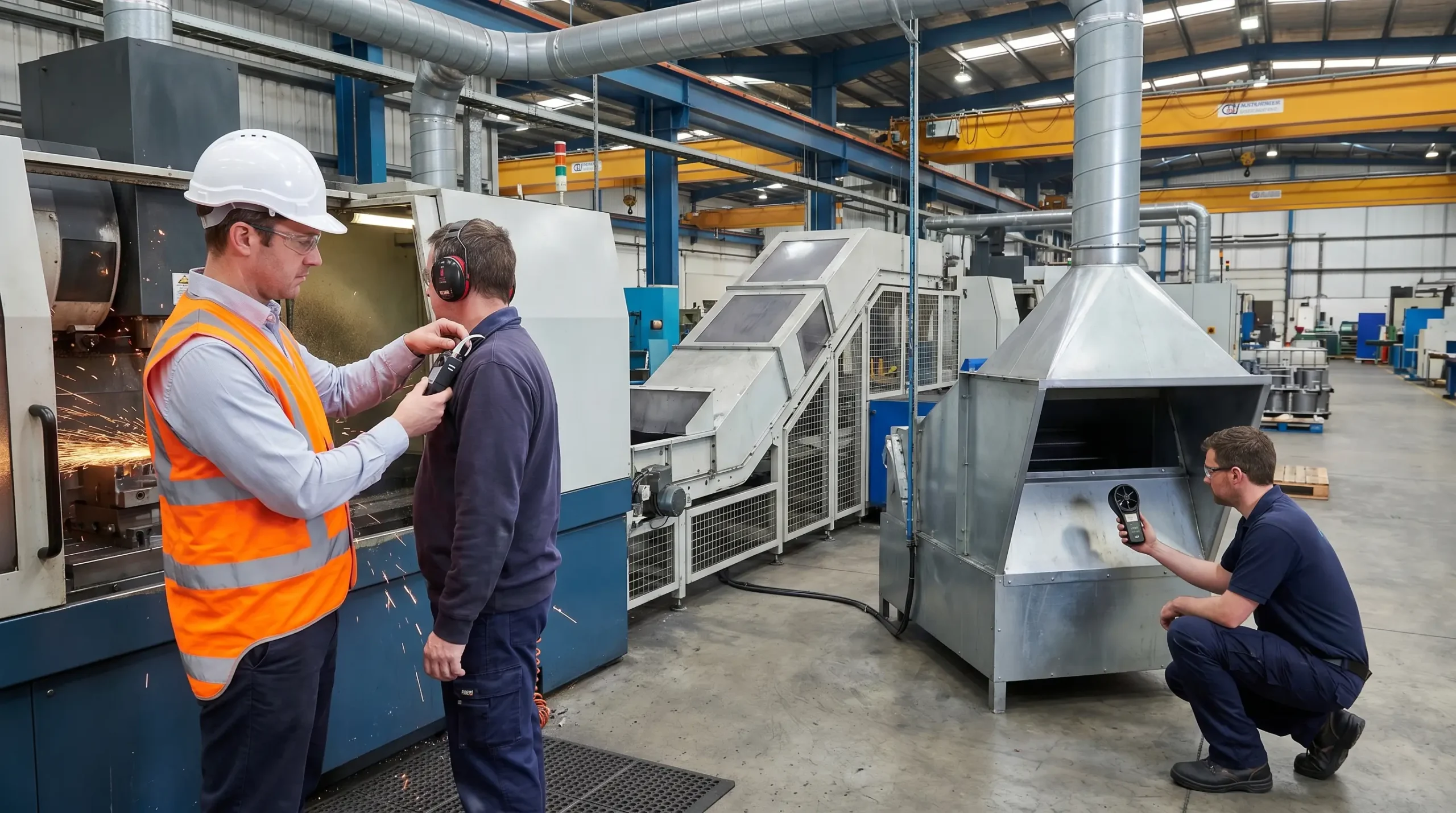
Process enclosure and containment — gloveboxes, sealed reactors, enclosed conveyor systems — physically isolate the worker from the contaminant entirely. Wet suppression methods, such as water spray applied during cutting or grinding operations, reduce airborne dust at the point of generation. Each of these engineering approaches operates without relying on the worker to take any action, which is why they sit above administrative controls and PPE in the hierarchy.
LEV Examination and Testing Requirements
An LEV system that was effective at installation will not remain effective indefinitely. Filters block, fan performance degrades, ductwork develops leaks, and capture hoods get repositioned or obstructed. Under COSHH Regulation 9 (UK jurisdiction), LEV systems must receive thorough examination and testing at least every 14 months — a legally binding requirement, not guidance. OSHA’s 29 CFR 1910.1000(e) (US jurisdiction) requires that engineering controls be maintained, though it does not prescribe a universal testing frequency.
A consistent pattern in enforcement actions and investigation reports: LEV systems that were well-designed at commissioning gradually lose performance over 12–18 months when maintenance schedules are not enforced. The initial installation gives operational teams confidence, but the slow decline in capture velocity often goes undetected until exposure monitoring reveals rising airborne concentrations — or, worse, until health surveillance picks up early signs of occupational disease.
Audit Point: Request LEV examination records and compare tested capture velocities against the original design specification. A gap between the two is the earliest indicator that a control programme is losing effectiveness.
Administrative Controls: Managing Exposure Through Work Practices
Administrative controls do not reduce the contaminant itself. They reduce exposure by changing how, when, and for how long workers interact with contaminated environments. This fundamental distinction explains their lower ranking: they depend entirely on human compliance and sustained management attention to remain effective.
Job rotation limits individual exposure duration by distributing time in high-exposure zones across a larger workforce. Standard operating procedures specify how high-exposure tasks are to be performed — sequence, duration, and required precautions. Permit-to-work systems gate access to tasks generating elevated contaminant exposure, ensuring that controls are verified before work begins and that only trained personnel perform the work.
Training requirements go beyond procedure compliance. Workers must understand what substances they are exposed to, how those substances cause harm, and why specific controls exist — not just which steps to follow. A worker who understands that respirable crystalline silica causes irreversible lung fibrosis approaches dust control differently than one who has merely been told to “follow the SOP.”
Housekeeping practices prevent settled dust and residues from becoming secondary sources of airborne contamination. Dry sweeping of settled silica dust, for example, re-suspends the very particles the engineering controls were designed to capture — converting a controlled surface into an uncontrolled airborne hazard.
Administrative controls are the tier most susceptible to erosion over time. Procedures written during initial commissioning gradually relax in practice, particularly during production pressure or staff turnover. The written system may appear robust in an audit, while the operational reality diverges significantly. This gap between documented procedure and actual practice is a recurring finding in HSE enforcement investigations.
Occupational Exposure Limits: Setting the Benchmark for Adequate Control
Occupational exposure limits define the benchmark for determining whether controls are achieving adequate protection. They are not safe/unsafe thresholds — they represent concentrations below which the majority of workers are not expected to suffer adverse health effects over a working lifetime. That distinction matters: individual susceptibility varies, and some substances have no truly safe exposure level.
Three OEL frameworks dominate the US landscape: OSHA Permissible Exposure Limits (PELs), NIOSH Recommended Exposure Limits (RELs), and ACGIH Threshold Limit Values (TLVs). In the UK, Workplace Exposure Limits (WELs) are published in EH40/2005, now in its fourth edition (January 2020), which introduced 13 new or revised WELs for carcinogens and mutagens — including reduced limits for hardwood dust and chromium (VI) compounds (HSE, 2020).
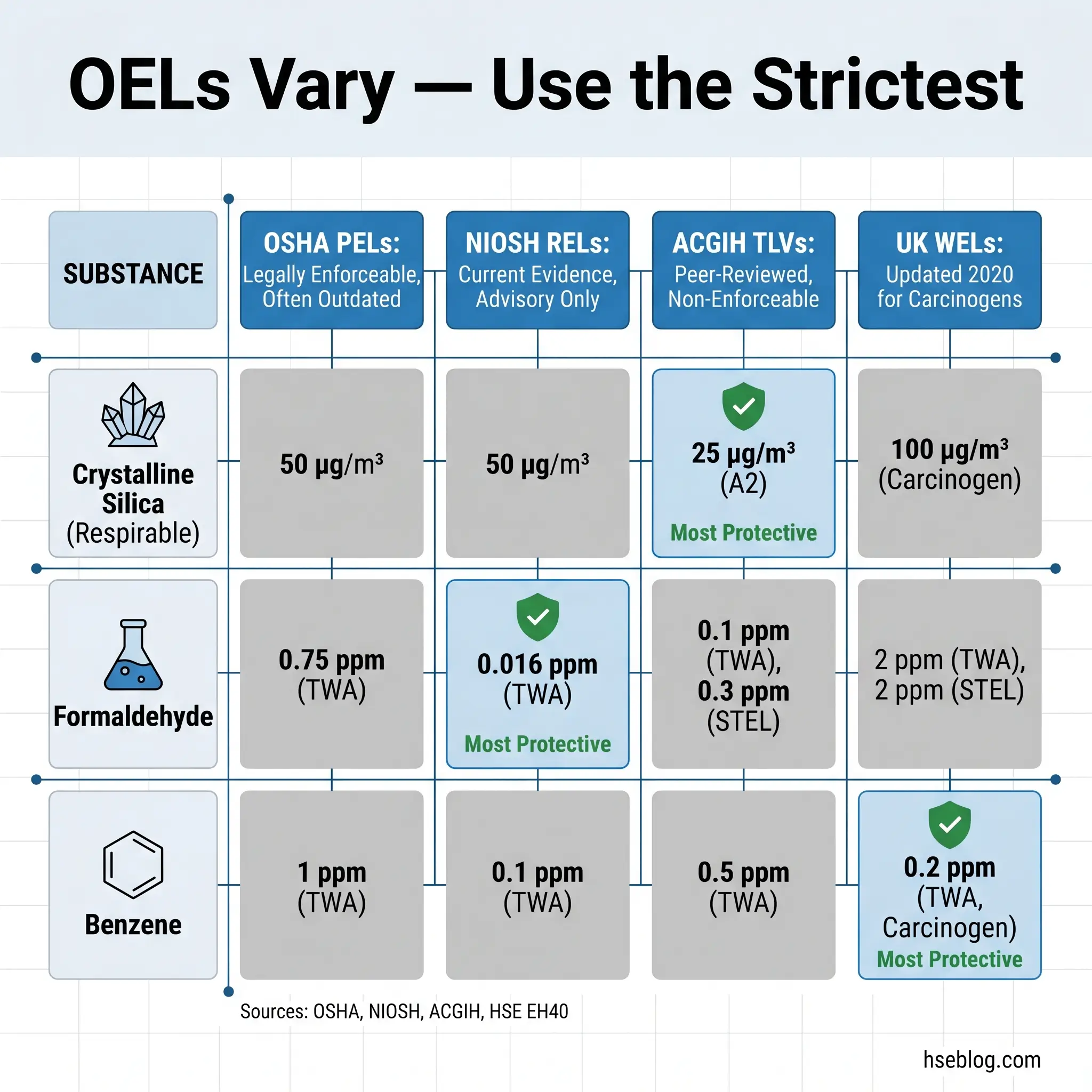
The critical practitioner issue: these frameworks frequently set different limits for the same substance. Most OSHA PELs were adopted shortly after the Occupational Safety and Health Act of 1970 and have not been comprehensively updated. NIOSH RELs reflect more current toxicological evidence but carry no legal force — they are recommendations. ACGIH TLVs are peer-reviewed consensus values updated annually but are also non-enforceable. Competent practitioners reference the most protective available limit and document which limit is governing their exposure assessment.
| Substance | OSHA PEL (US) | NIOSH REL (US) | ACGIH TLV | UK WEL |
|---|---|---|---|---|
| Respirable crystalline silica | 50 µg/m³ TWA | 50 µg/m³ TWA | 25 µg/m³ TWA | 100 µg/m³ TWA |
| Formaldehyde | 0.75 ppm TWA; 2 ppm STEL | 0.016 ppm TWA; 0.1 ppm ceiling | 0.1 ppm ceiling | 2 ppm TWA; 2 ppm STEL |
| Benzene | 1 ppm TWA; 5 ppm STEL | 0.1 ppm TWA; 1 ppm STEL | 0.5 ppm TWA; 2.5 ppm STEL | 1 ppm TWA |
| Inhalable wood dust | None specific (PNOR 15 mg/m³) | 1 mg/m³ TWA | 1 mg/m³ TWA (inhalable) | 5 mg/m³ TWA (inhalable); 3 mg/m³ TWA (hardwood) |
Content covering occupational exposure limits and health surveillance is for HSE practitioner reference. It is not medical advice. Workers with specific symptoms or exposure concerns should consult an occupational physician or qualified medical professional.
For chemicals lacking established OELs — and there are thousands — control banding offers a structured alternative. The NIOSH Occupational Exposure Banding e-Tool assigns hazard bands based on toxicological potency and pairs them with recommended control approaches, providing a pathway for managing substances that the OEL system has not yet addressed. However, the 2025 restructuring of NIOSH — in which most staff were released and multiple departments closed following HHS reorganisation orders — has raised significant questions about the future development and maintenance of tools like the Exposure Banding e-Tool, as well as the agency’s capacity to develop and update RELs going forward.
Personal Protective Equipment: The Last Line of Defence
PPE occupies the bottom of the hierarchy for a reason: it does nothing to reduce the contaminant at its source. It protects only the individual wearer, and only for as long as it is worn, correctly fitted, and properly maintained. If a respirator is removed for five minutes in a contaminated atmosphere, exposure occurs for those five minutes without mitigation. No other control tier has this vulnerability.
Respiratory protective equipment (RPE) selection must match the contaminant type, concentration, and oxygen environment. Air-purifying respirators — half-face, full-face, and powered units — filter contaminants from ambient air but are only suitable when oxygen levels are adequate and the contaminant is within the filter’s rated capacity. Supplied-air respirators deliver breathing air from an independent source and are required when oxygen deficiency or very high contaminant concentrations make air-purifying devices insufficient.
Fit testing is not optional. A respirator that does not seal to the wearer’s face does not provide its rated protection factor — and visual inspection alone cannot verify seal integrity. Chemical-resistant gloves, protective clothing, and eye or face protection must be matched to the specific contaminant’s chemical properties, not selected generically.
PPE programmes require formal structure: selection based on hazard assessment, training in correct use and limitations, fit testing for tight-fitting RPE, maintenance and replacement schedules, and supervision to verify compliance. OSHA’s proposed deregulatory rulemakings published on July 1, 2025, include proposals to amend respirator medical evaluation requirements and revise substance-specific respirator standards for multiple chemicals — changes that, if finalized, will affect how RPE programmes are structured across US-regulated workplaces.
The most consequential pattern in contaminant control failures: PPE is often the first control implemented rather than the last, because it requires no process change, no capital expenditure, and no engineering design time. This inverted application of the hierarchy places the least reliable control where the most reliable one should be. Reviewing published enforcement actions, this inversion is among the most frequently cited deficiencies in workplaces where occupational disease is later identified.
How to Select and Combine Controls for Different Contaminant Types
The hierarchy is not about selecting a single tier. Effective contaminant control almost always involves multiple levels working together, with the strategy anchored as high on the hierarchy as possible and supplemented by lower tiers to address residual risk.
Where competitors and training materials typically stop at explaining each level in isolation, the operational question practitioners actually face is: given this specific contaminant, what combination of controls produces adequate protection?
The answer varies by contaminant type because the physical behaviour, toxicity profile, and regulatory requirements differ fundamentally between a respirable dust, a volatile organic compound, and a biological agent.
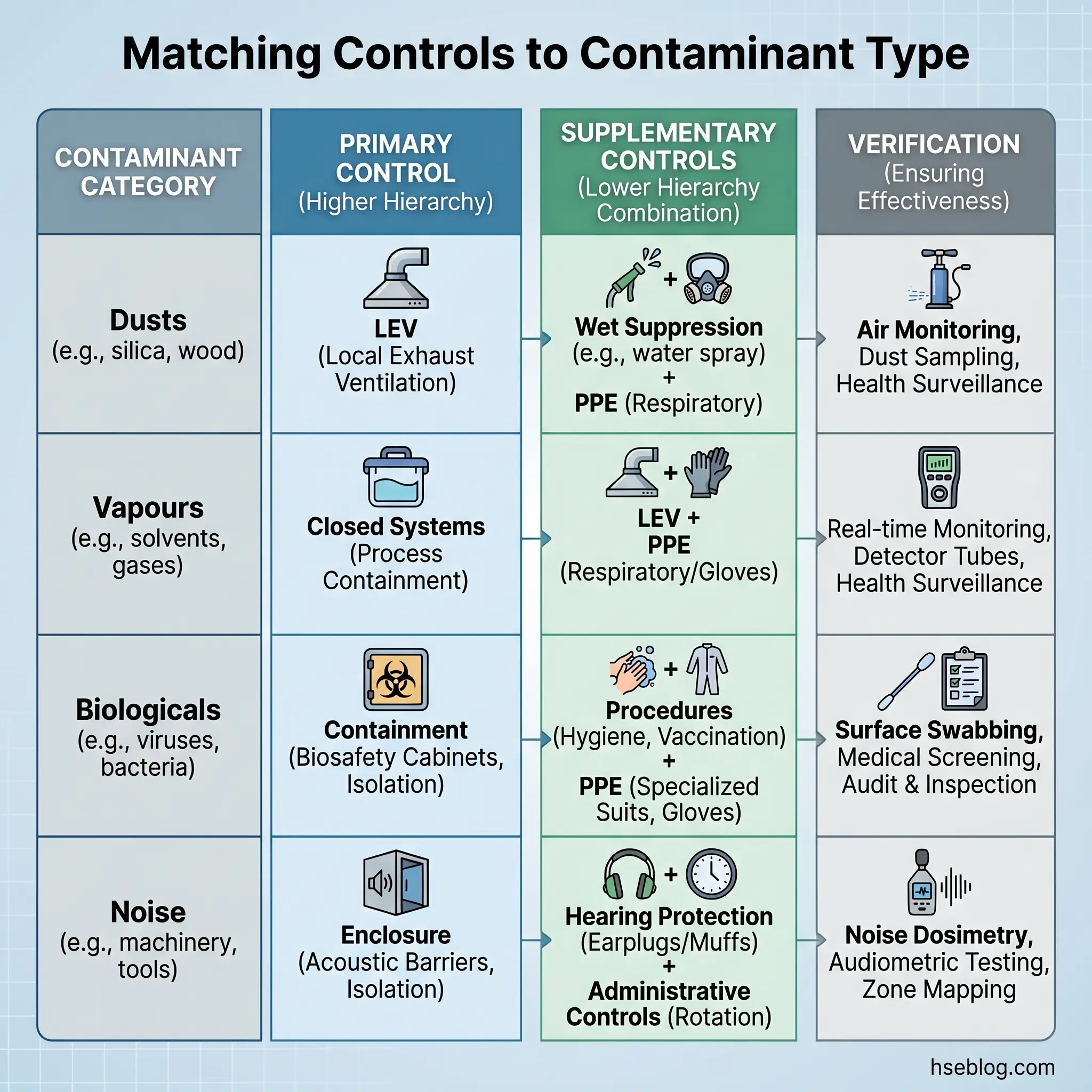
| Contaminant Type | Primary Control Tier | Supplementary Controls | Verification Method |
|---|---|---|---|
| Airborne dusts (e.g., silica, wood dust) | Engineering: LEV + wet suppression | Administrative: SOPs, housekeeping; PPE: RPE during transitional periods | Personal exposure monitoring; LEV testing |
| Chemical vapours and gases | Engineering: closed-system processes + LEV | Administrative: exposure monitoring, permits; PPE: RPE backup | Area and personal sampling; LEV testing |
| Biological agents (risk group dependent) | Engineering: containment (biosafety cabinets, sealed systems) | Administrative: procedural controls, decontamination protocols; PPE: gloves, RPE, protective clothing | Environmental monitoring; health surveillance |
| Noise | Engineering: enclosure, vibration isolation, damping | Administrative: exposure scheduling; PPE: hearing protection programme | Noise dosimetry; audiometric testing |
The documentation requirement is consistent across frameworks. Risk assessments under COSHH, OSHA hazard assessments, and ISO 45001 operational planning all require that the selected combination of controls be recorded, justified, and reviewed. When a CCOHS hierarchy of controls overview describes the framework, it emphasises this layered application — no single control is expected to do all the work for most real-world contaminant scenarios.
Watch For: Biological agents classified in higher risk groups (e.g., ACDP Advisory Committee Risk Group 3 in the UK, or CDC/NIH Biosafety Level 3 in the US) carry prescriptive minimum containment requirements that override the normal flexibility of the hierarchy. The containment level is not negotiable based on practicability arguments that might apply to chemical or dust controls.
Verifying and Maintaining Control Effectiveness
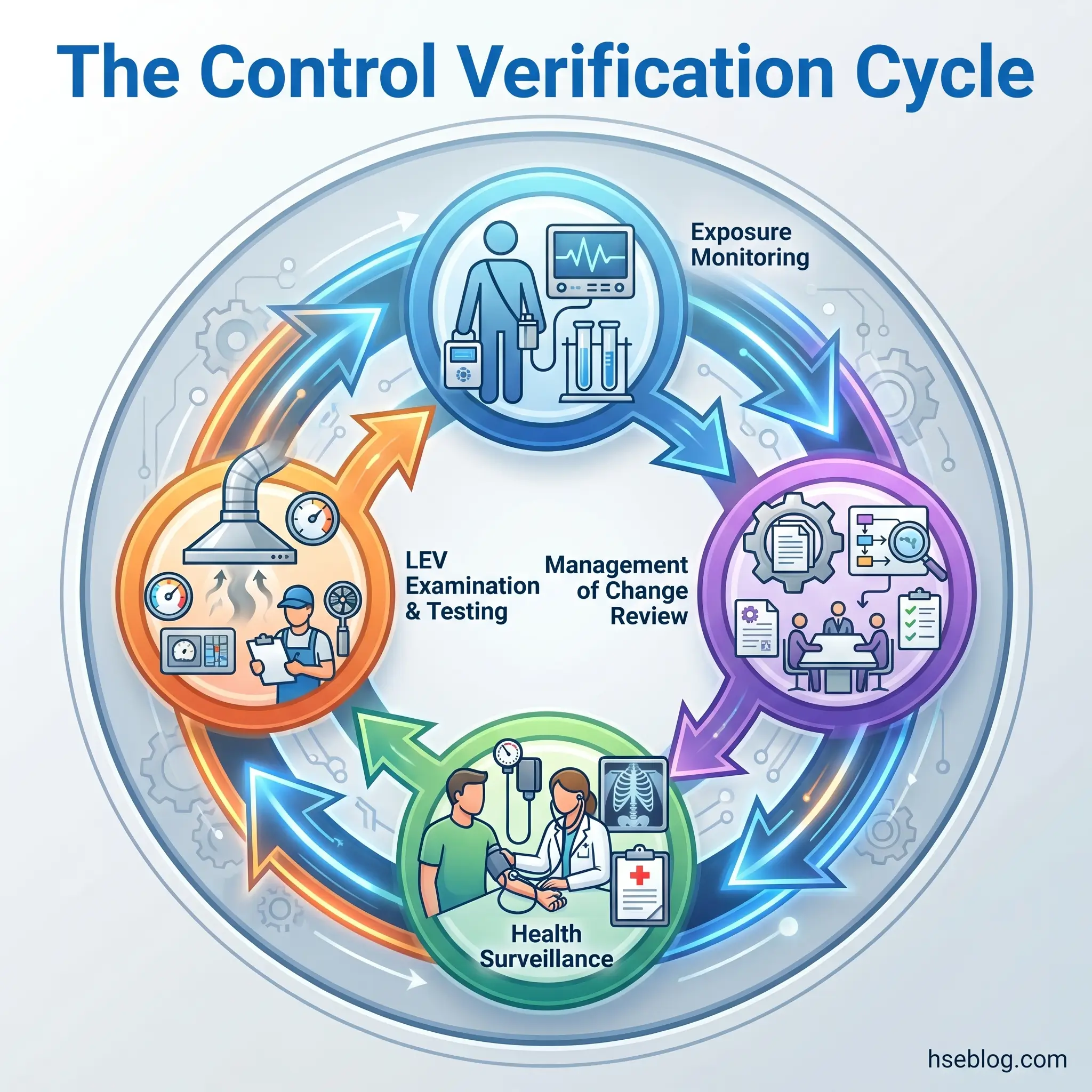
A well-designed control that is never re-tested or maintained will eventually fail to protect workers. This is not a hypothetical concern — it is the single most common mode of control failure. The “set and forget” approach to engineering controls produces a familiar pattern: exposure monitoring conducted shortly after installation shows airborne concentrations well below limits, confidence builds, and testing intervals stretch or disappear. Months or years later, health surveillance or a routine exposure survey reveals concentrations that have crept back toward — or past — the applicable OEL.
Verification requires multiple concurrent activities, each serving a different function in the control assurance chain.
Exposure monitoring through personal and area air sampling provides direct evidence of whether airborne concentrations remain below occupational exposure limits at the worker’s breathing zone. The results must be compared against the most protective applicable OEL, not merely the legally enforceable minimum. Under COSHH Regulation 10, employers must monitor workplace exposure where the assessment identifies a risk from a hazardous substance — and must keep records for at least 40 years where they relate to identified individuals.
LEV examination and testing, as discussed in the engineering controls section, follows a legally mandated schedule in the UK (at least every 14 months under COSHH Regulation 9). Where no prescriptive frequency applies, the practical standard is to test at intervals that reflect the system’s degradation rate — which depends on operating hours, contaminant type, and environmental conditions.
Health surveillance applies when exposure to certain substances mandates biological monitoring, lung function testing, skin assessments, or medical screening. Health surveillance does not replace exposure monitoring — it provides a separate, complementary line of evidence that controls are adequate by checking for early signs of health effects in exposed workers.
Management of change is the process that triggers reassessment when anything affecting the exposure profile shifts: new substances introduced, process volumes increased, equipment relocated, ventilation modified, or workforce patterns changed. Without a formal management-of-change process, control programmes become silently misaligned with actual workplace conditions.
Record-keeping under COSHH, OSHA, and ISO 45001 is not bureaucratic overhead — it creates the audit trail that demonstrates due diligence and enables trend analysis across monitoring cycles.
The US total recordable case rate for private industry fell to 2.3 per 100 full-time equivalent workers in 2024 — the lowest since 2003 (Bureau of Labor Statistics, 2026). Respiratory illness incidence dropped to 5.1 cases per 10,000 FTE workers, down from 9.5 in 2023, representing the lowest rate since 2019 (Bureau of Labor Statistics, 2026). These improvements correlate with sustained investment in engineering controls and exposure management programmes — and they reverse when that investment erodes.
Field Test: Compare current exposure monitoring data against the readings taken within three months of the control’s installation. If concentrations have risen by more than 20% without a documented change in process conditions, the control system has degraded and requires investigation.
Frequently Asked Questions
Conclusion
The hierarchy of controls for workplace contaminants fails most often not because practitioners misunderstand the framework, but because operational pressures invert its application. PPE gets deployed first because it requires no process change. Engineering controls get installed but never re-tested. Administrative procedures exist in documentation but erode in practice. The framework itself is sound — the gap lives in execution and sustained commitment to verification.
Three decisions shape whether a contaminant control programme actually protects workers. First, whether elimination and substitution receive genuine investigation during design and procurement rather than being reflexively dismissed as impractical. Second, whether engineering controls — particularly LEV systems — are tested and maintained on a schedule that reflects actual degradation rates, not just regulatory minimums. Third, whether exposure monitoring data is acted upon when concentrations trend upward, rather than filed and forgotten.
The 5,070 fatal work injuries recorded in the United States in 2024 (Bureau of Labor Statistics, 2026) — and the thousands of latent occupational disease deaths accumulating beneath that number — are not evidence that the hierarchy fails. They are evidence of what happens when the hierarchy is acknowledged in writing and bypassed in practice. The distinction between a workplace that controls contaminant exposure and one that merely documents the intention to do so comes down to one discipline: treating verification not as a periodic audit exercise but as an operational function with the same priority as production itself.