
TL;DR
- International Workers’ Day on May 1 honors the labor movements that gave workers the right to safe, fair workplaces.
- Worker rights and safety are inseparable — every hard-won protection traces back to someone who was injured, exploited, or killed.
- Modern HSE frameworks exist because workers demanded them — OSHA, the Health and Safety at Work Act, and ILO conventions are products of labor struggle.
- Celebrating means acting, not just remembering — use this day to audit gaps, reinforce stop-work authority, and recommit to worker participation.
- Every right ignored on site dishonors the movement — enforcement, not ceremony, is the real tribute.
I was standing on a refinery platform in the Gulf during a turnaround shutdown — 3,000 contractor workers spread across the complex, twelve-hour shifts, compressed timelines. A young scaffolder flagged me down. He had been working fourteen consecutive days without a rest day because his supervisor told him the contract didn’t allow refusal. He didn’t know he had the right to report unsafe scheduling. He didn’t know the company’s own fatigue management policy existed. He was twenty-three years old, visibly exhausted, and one bad step from a fall that could have ended his life.
That moment captures exactly why International Workers’ Day still matters to every HSE professional. May 1 is not a holiday about parades or political speeches. It is about the fundamental principle that every worker — regardless of contract type, nationality, or trade — has the right to go home alive and unharmed. The protections we enforce daily on site, from permit-to-work systems to occupational exposure limits, exist because generations of workers organized, protested, bled, and died to demand them. This article examines the history, the rights, the ongoing gaps, and what HSE professionals should do — not just on May 1, but every day — to honor the labor movement that made our profession possible.
The History of International Workers’ Day and Its Link to Workplace Safety
International Workers’ Day — also called May Day — is a global observance rooted in one of the most consequential labor struggles in modern history. Understanding where it started reveals why workplace safety and labor rights have never been separate issues.
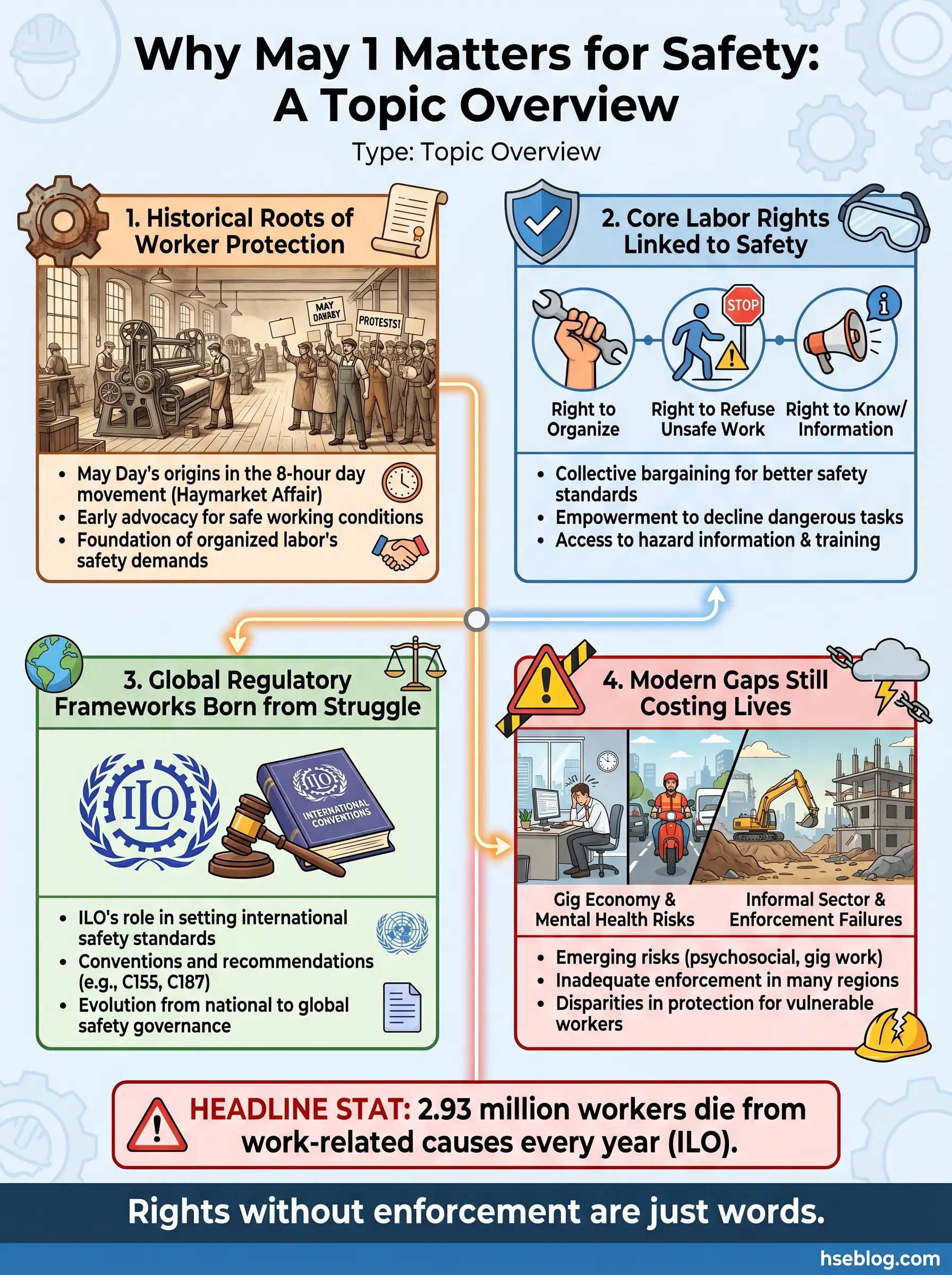
On May 1, 1886, over 300,000 workers across the United States walked off their jobs demanding an eight-hour workday. The standard at the time was ten to sixteen hours of grueling labor, often in conditions that would horrify any modern safety professional — unguarded machinery, toxic dust with no ventilation, child laborers operating presses alongside adults. The strikes reached a violent flashpoint at Haymarket Square in Chicago on May 4, where a bomb explosion and police gunfire killed both officers and workers. The Haymarket affair became a catalyst for labor movements worldwide.
The connection to occupational safety runs deep. Those early workers were not just demanding shorter hours — they were demanding survival. Fatigue from sixteen-hour shifts caused amputations in textile mills. Lack of rest periods led to fatal errors in steel foundries. The eight-hour day was, at its core, a safety intervention before the term even existed.
By 1889, the Second International declared May 1 as International Workers’ Day to commemorate the Haymarket struggle and push for labor reforms globally. Over the following century, the demands broadened to include fair wages, collective bargaining, elimination of child labor, and — critically — the right to safe and healthy working conditions. Every major occupational safety framework we use today traces its lineage to these movements.
“Workers have the right to conditions of work that respect their health and safety.” — ILO Declaration on Fundamental Principles and Rights at Work
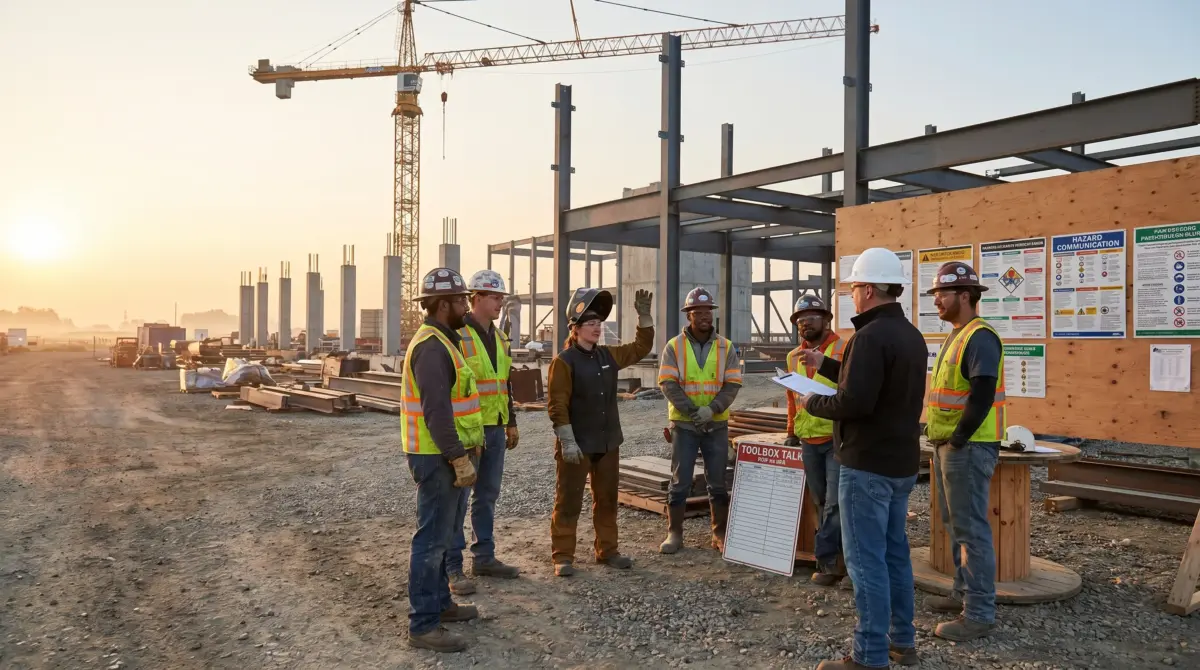
Pro Tip: Use International Workers’ Day as a calendar trigger to run a “rights awareness” toolbox talk. I have done this on multiple projects — a fifteen-minute session on May 1 where workers hear, in plain language, their right to refuse unsafe work, their right to report hazards without retaliation, and their right to access safety information. The engagement is always higher than a standard safety brief because the context gives it meaning.
Core Worker Rights That Protect Lives on Site
The rights that labor movements fought for are not abstract legal concepts. They are operational safeguards that prevent injuries and fatalities every single day. When these rights are suppressed — by intimidation, ignorance, or contractual manipulation — incident rates climb.
The following rights form the backbone of every credible HSE management system, and each one was born from worker struggle:
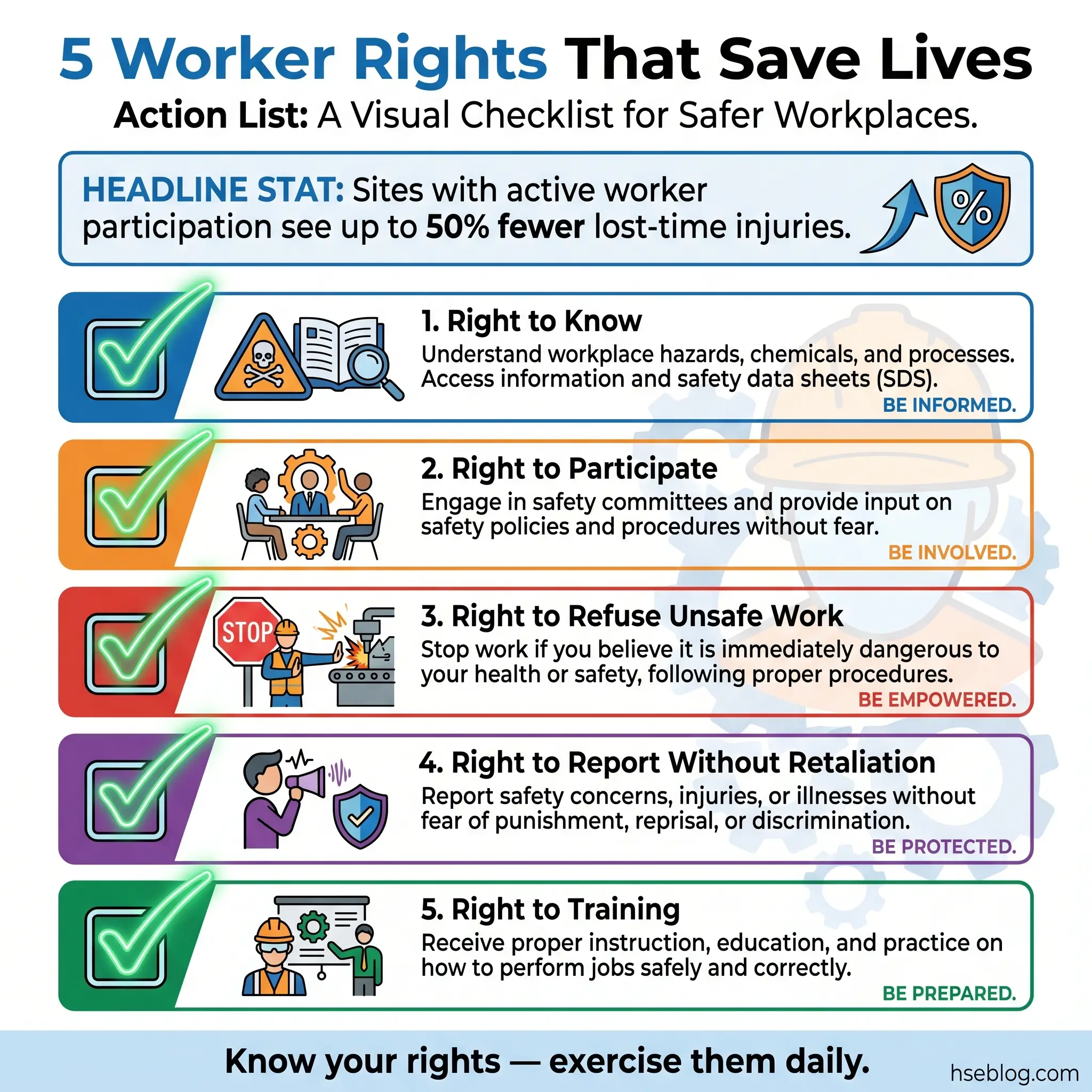
- The right to know: Workers must be informed of hazards they are exposed to. This underpins hazard communication programs, Safety Data Sheet access, and pre-task briefings. Under OSHA’s Hazard Communication Standard (29 CFR 1910.1200), employers must ensure every worker understands the chemicals and physical hazards in their work area.
- The right to participate: Workers must have a voice in safety decisions that affect them. ISO 45001:2018 Clause 5.4 mandates worker consultation and participation — not as a suggestion, but as a system requirement. Safety committees, hazard reporting channels, and joint inspections all flow from this right.
- The right to refuse unsafe work: This is the single most powerful safety tool any worker possesses. When a welder recognizes that ventilation has failed in a confined space, the right to stop work and withdraw without disciplinary action is what prevents a fatality. OSHA’s Section 11(c) protects workers from retaliation for exercising this right.
- The right to report without retaliation: Whistleblower protections ensure that workers who report unsafe conditions, near-misses, or regulatory violations are shielded from termination, demotion, or harassment. Without this, incident data dries up, leading indicators vanish, and organizations lose their early warning system.
- The right to training: Workers must receive competent, language-appropriate safety training before exposure to hazards. The EU Framework Directive 89/391/EEC explicitly requires employers to provide training adapted to the evolution of risks and the emergence of new hazards.
I have audited operations on four continents, and the pattern is remarkably consistent: sites where workers actively exercise these rights have lower TRIR, higher near-miss reporting rates, and stronger safety cultures. Sites where these rights exist only on paper — posted on a notice board that nobody reads — are the ones generating serious incidents.
Global Regulatory Frameworks Born from Labor Movements
No safety regulation appeared in a vacuum. Every standard, act, and convention that HSE professionals enforce today was written because workers demanded protection — often after catastrophic failures proved voluntary compliance was a myth.
The following table maps key regulatory frameworks to the labor struggles that produced them:
| Regulatory Framework | Year | Origin in Labor Struggle |
|---|---|---|
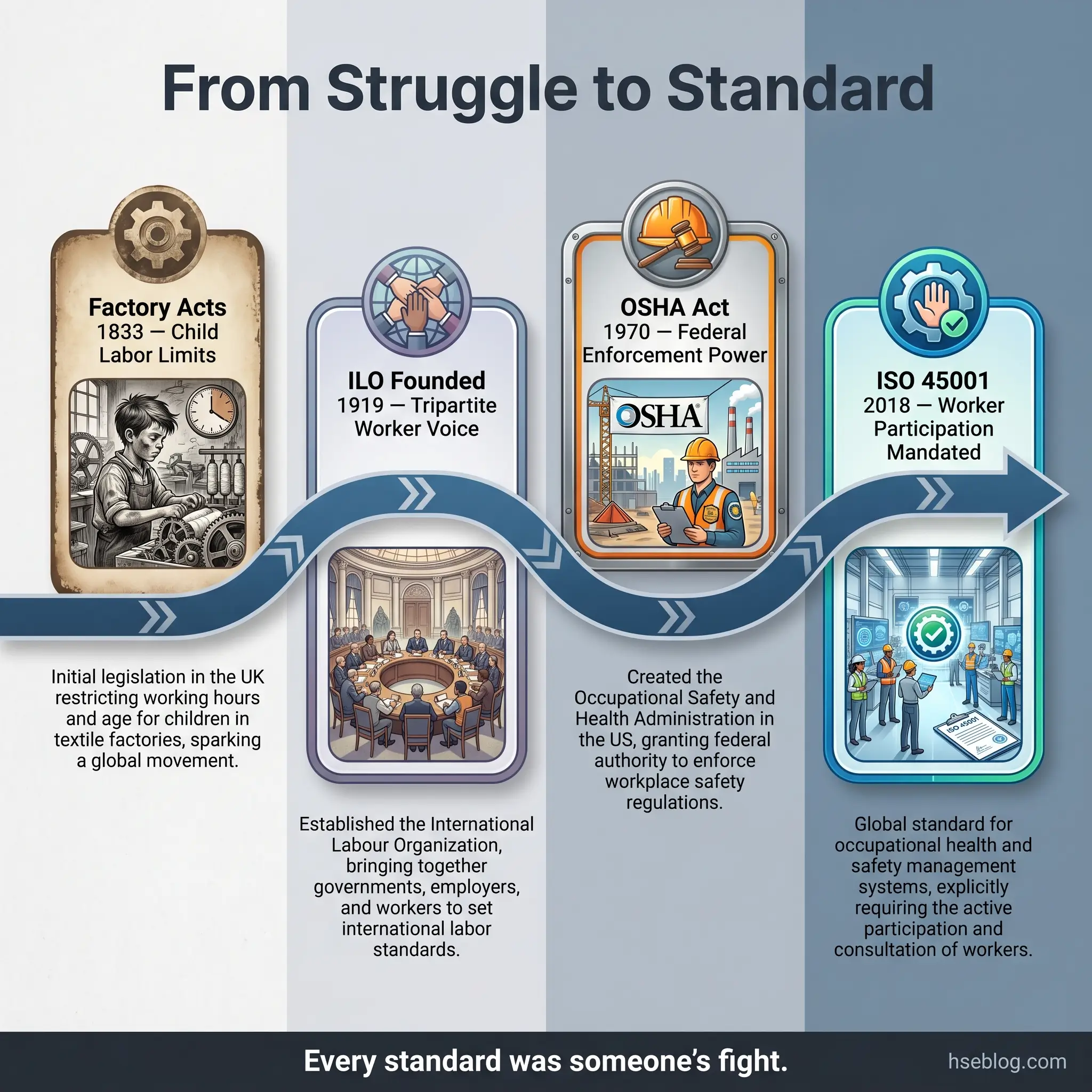
| Factory Acts (UK) | 1833–1901 | Child labor deaths and mass injuries in textile mills drove parliamentary reform |
| ILO Convention C155 (OSH Convention) | 1981 | Decades of global labor advocacy for a universal right to safe work |
| OSHA Act (USA) | 1970 | 14,000 worker deaths annually in the 1960s forced legislative action |
| Health and Safety at Work Act (UK) | 1974 | Lord Robens’ report responded to organized labor’s demand for comprehensive reform |
| EU Framework Directive 89/391/EEC | 1989 | European labor unions pushed for harmonized minimum safety standards |
| ISO 45001 | 2018 | International consensus replacing OHSAS 18001, incorporating worker participation as a core principle |
The ILO’s Foundational Role
The International Labour Organization, established in 1919, remains the only tripartite UN agency — meaning workers, employers, and governments all have an equal voice. ILO Convention C155 and its accompanying Recommendation R164 established the global baseline that every worker has the right to a safe and healthy working environment. Article 19 of C155 specifically requires arrangements at the enterprise level that give workers and their representatives the ability to inquire, be consulted, and participate in safety decisions.
OSHA and the American Labor Movement
Before OSHA existed, American workers had almost no federal recourse when employers exposed them to lethal hazards. Asbestos manufacturers knew their product was killing workers decades before regulations appeared. Coal miners died from black lung disease while companies denied any link. The Occupational Safety and Health Act of 1970 was not a gift from Congress — it was extracted through sustained union pressure, public outrage over preventable deaths, and a political climate where ignoring worker casualties became untenable.
Pro Tip: When onboarding new HSE staff, assign them a case study of a pre-regulation industrial disaster — the Triangle Shirtwaist Factory fire of 1911 is a powerful one. It killed 146 garment workers, mostly young immigrant women, because exit doors were locked to prevent unauthorized breaks. That single event accelerated fire safety codes, building evacuation requirements, and labor organizing rights across the United States. Understanding this history changes how a safety professional views their own role.
Why International Workers’ Day Still Matters for HSE Professionals
Some argue that modern safety regulations have made labor rights advocacy unnecessary — that the battles have been won. The data tells a different story, and field experience confirms it.
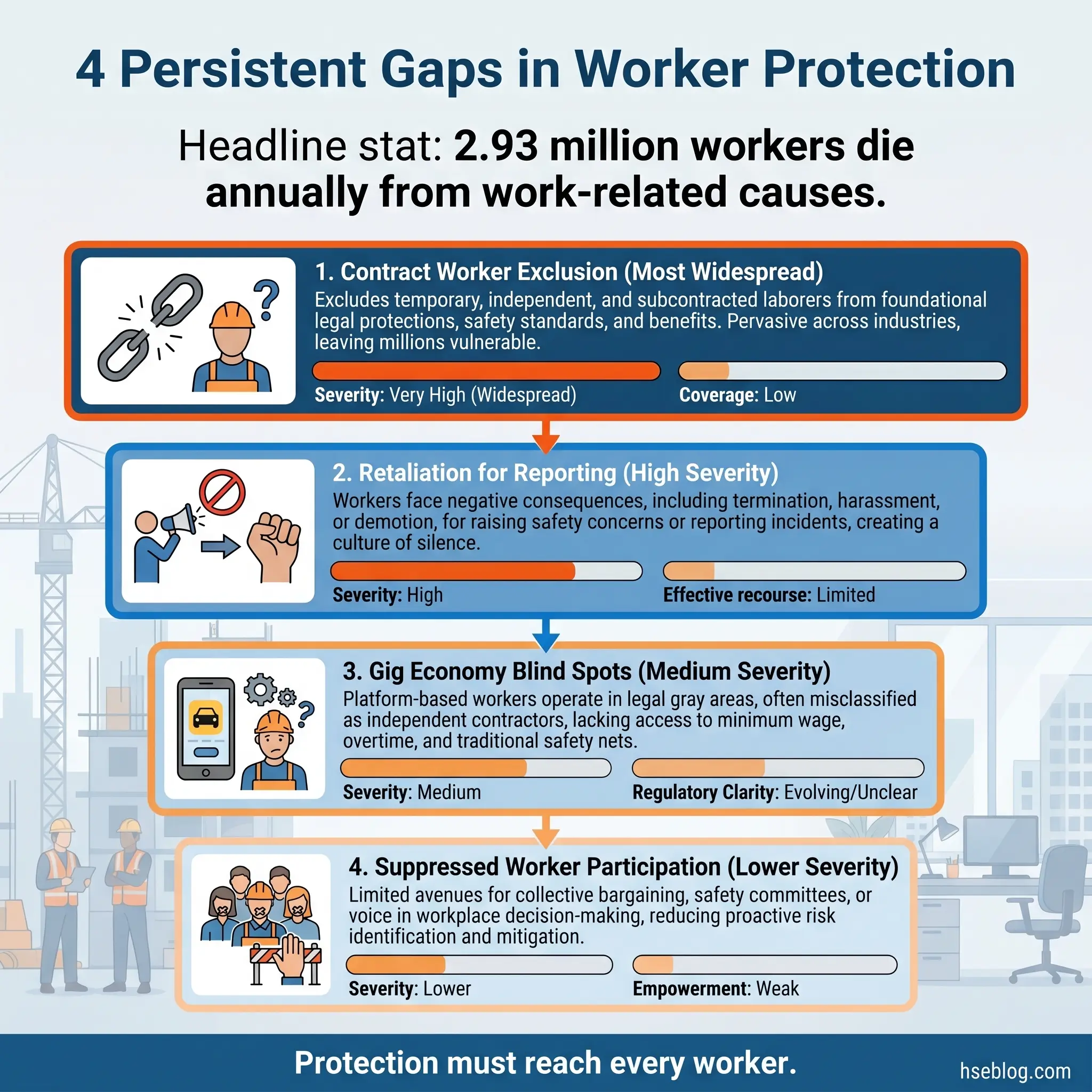
The ILO estimates that approximately 2.93 million workers die each year from occupational accidents and work-related diseases. That number has increased, not decreased, in recent global assessments. Behind the statistic are real gaps that HSE professionals encounter regularly:
- Contract worker exclusion: On large construction and industrial projects, contract workers often receive weaker safety protections than direct employees. I have seen contractors in the Gulf working without heat stress management plans that permanent staff received — same hazard, same site, different treatment based on employment status.
- Retaliation for reporting: Despite legal protections, many workers still fear consequences for raising safety concerns. A 2023 safety culture survey across the European construction sector found that nearly 30% of frontline workers had witnessed or experienced informal retaliation — shift reassignment, reduced hours, social exclusion — after reporting a hazard.
- Informal and gig economy gaps: Workers in the gig economy, informal sectors, and domestic work often fall completely outside the scope of occupational health and safety regulations. No risk assessment. No PPE. No incident reporting mechanism. These workers are invisible to the regulatory frameworks that May Day helped build.
- Suppressed worker voice: In operations where safety committees exist only on paper and management reviews are rubber-stamped, the right to participate becomes meaningless. ISO 45001 auditors frequently cite non-conformities related to Clause 5.4 — but the deeper problem is cultural, not procedural.
- Migrant worker vulnerability: Large infrastructure projects often rely on migrant labor forces who face language barriers, unfamiliar regulatory environments, and contractual dependencies that make it dangerous to refuse unsafe assignments. I managed HSE on a major EPC project where over fifteen nationalities worked together — delivering toolbox talks in three languages simultaneously was a daily challenge, but it was non-negotiable because comprehension is a right, not a courtesy.
“Freedom of association and the effective recognition of the right to collective bargaining are enabling rights — they make possible the realization of other rights, including to safe and healthy working conditions.” — ILO
Pro Tip: Run an anonymous “rights awareness pulse check” on your site every May. Three questions are enough: (1) Do you know how to refuse unsafe work without consequences? (2) Have you ever hesitated to report a hazard? (3) Do you feel your voice is heard in safety meetings? The answers will tell you more about your safety culture than your TRIR ever will.
How to Honor International Workers’ Day as an HSE Professional
The worst way to observe May 1 is to post a safety slogan on a notice board and move on. The best way is to take concrete action that reinforces the rights this day represents. Every action below has been tested on real projects — these are not theoretical recommendations.
The following actions translate the spirit of International Workers’ Day into measurable safety improvements:
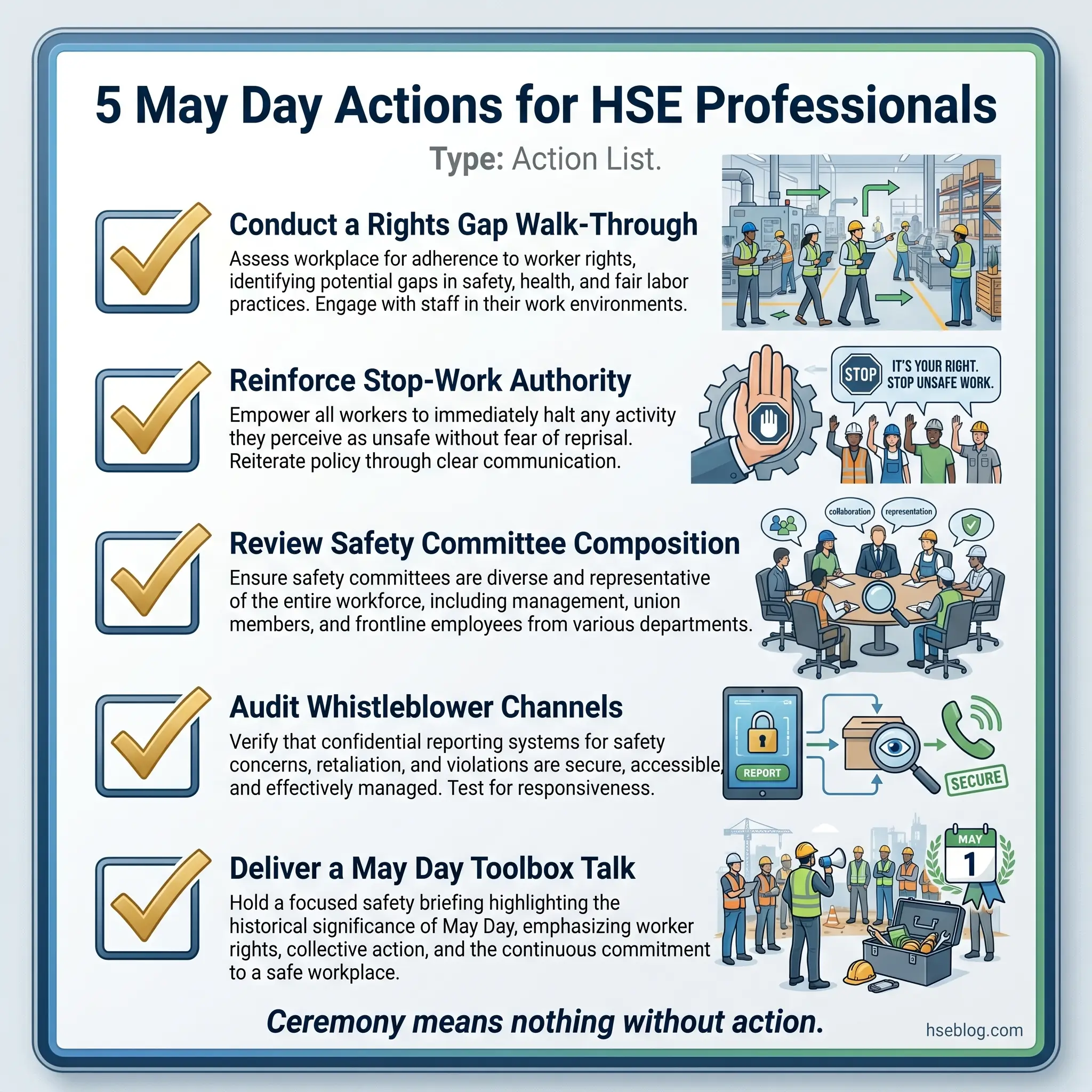
- Conduct a “rights gap” walk-through: Walk your site on May 1 — not as a compliance inspection, but specifically looking for gaps in worker rights. Are hazard communication materials available in every language spoken on site? Can every worker identify the nearest emergency muster point? Do contract workers have the same access to incident reporting channels as direct employees?
- Reinforce stop-work authority publicly: Use a site-wide PA announcement, toolbox talk, or crew briefing to remind every worker — including supervisors and managers — that stop-work authority applies to everyone, carries no penalty, and is expected whenever conditions are unsafe.
- Review your safety committee composition: Check whether the workers on your safety committee actually represent the workforce. If every member is a supervisor or foreman, worker voice is not being heard. ILO R164 Recommendation 12 calls for worker representatives to be elected by workers, not appointed by management.
- Audit your whistleblower channels: Test whether your hazard reporting system is actually accessible and anonymous. I once discovered that a site’s “anonymous” reporting hotline required callers to enter their employee ID before leaving a message. That single design flaw silenced the entire reporting mechanism.
- Deliver a May Day toolbox talk: Prepare a brief that covers the history of May 1, the five core worker rights, and a site-specific example of how exercising those rights prevented an incident. Connect the abstract concept to the workers’ daily reality.
Embedding Worker Rights into Your Safety Management System
Beyond May 1 actions, worker rights should be structurally embedded in your health and safety management system. Treating them as a one-day event undermines their purpose.
The following elements ensure worker rights are systemic, not symbolic:
- Policy integration: Your health and safety policy should explicitly reference worker rights — including the right to refuse unsafe work, the right to consultation, and protection from retaliation. If your policy only covers hazards and objectives without mentioning rights, it is incomplete.
- Leading indicator tracking: Measure worker participation as a leading indicator. Track safety committee attendance rates, hazard report submission counts by worker category (not just totals), and the percentage of toolbox talks delivered with interpreter support where needed.
- Management review agenda: Include a standing agenda item in management reviews that evaluates whether workers are exercising their rights. Low near-miss reporting is not necessarily good news — it may signal suppression.
- Contractor pre-qualification: Add worker rights verification to your contractor assessment process. Ask how contractors communicate employee rights, whether they permit union membership, and how they handle safety refusals. A contractor who penalizes stop-work authority has no place on a responsible project.
Lessons from the Field: When Worker Rights Were Denied
Real incidents anchor the importance of worker rights in human consequence, not legal theory. The following cases come from direct professional experience — names and identifying details are omitted, but the lessons are precise.
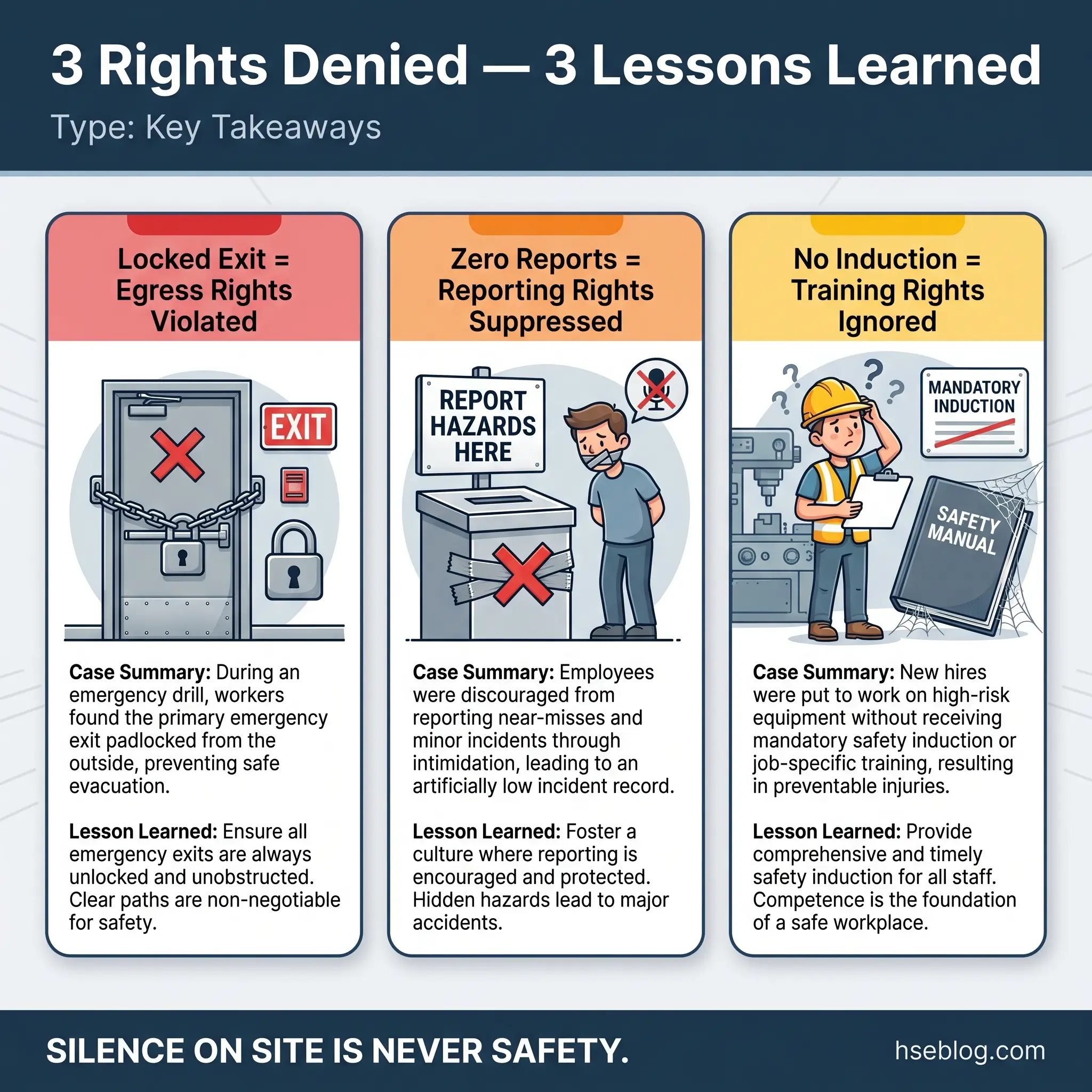
The Locked Emergency Exit
During a fire safety audit of a garment manufacturing facility in Southeast Asia, I found the rear emergency exit padlocked during production hours. The facility manager explained that workers had been using the exit for unauthorized smoke breaks, and locking it solved the “discipline problem.” I stopped production immediately. The parallel to the Triangle Shirtwaist fire — over a century earlier, same root cause — was not lost on anyone in the management meeting that followed. The right to a safe means of egress is non-negotiable, regardless of operational convenience.
The Silent Workforce
On a pipeline construction project in West Africa, I noticed that near-miss reports dropped to zero over a three-month period. Zero reports from 1,200 workers is not a safety achievement — it is a red flag. Investigation revealed that a field supervisor had been tearing up hazard report cards before they reached the site HSE office, telling workers that “too many reports make the project look bad.” That supervisor was removed. But the deeper failure was systemic: no one in management questioned three months of silence. The workers’ right to report had been stolen, and the system designed to protect that right had no verification loop.
The Untrained Crew
On a petrochemical brownfield expansion, I encountered a crew of twelve electrical workers who had been mobilized and put to work within hours of arriving on site — no safety induction, no site-specific risk briefing, no verification of competence. Their foreman said the project timeline didn’t allow for “administrative delays.” Three of those twelve workers could not read the language on the isolation tags they were expected to verify. The right to training before hazard exposure is not an administrative delay. It is the minimum threshold of duty of care.
Pro Tip: Document these kinds of rights-denial incidents in your lessons-learned database with the same rigor you apply to LTIs and environmental spills. They are precursors to serious harm, and they reveal cultural failures that lagging indicators will never capture.
Conclusion
International Workers’ Day is not a historical footnote. It is a live accountability check for every HSE professional, every site supervisor, and every executive who signs a health and safety policy. The rights that workers fought for — to know their hazards, to participate in safety decisions, to refuse dangerous work without retaliation, to be trained before exposure — are the same rights that prevent fatalities on our sites today. When those rights are exercised freely, safety systems function. When they are suppressed, people get hurt.
The ILO’s estimate of 2.93 million work-related deaths per year is not just a statistic. It represents a global failure to fully deliver on what the labor movement demanded over a century ago. As HSE professionals, we carry a specific responsibility: to ensure that every worker under our watch — regardless of contract type, nationality, or trade — has access to the protections that generations bled to establish. That means enforcing rights in practice, not just displaying them on a poster.
Every permit you review, every toolbox talk you deliver, every stop-work event you support traces back to a worker who once stood up and refused to accept death as a condition of employment. May 1 is a reminder that our profession exists because workers demanded it. The most meaningful thing we can do on International Workers’ Day is make sure their fight was not wasted.