
TL;DR
- LEL is the minimum gas concentration needed in air for ignition to occur — below it, the mixture is too lean to burn.
- 10% LEL is the standard action threshold — evacuate, ventilate, or stop work before conditions escalate.
- Continuous atmospheric monitoring with calibrated gas detectors is the only reliable way to track LEL in real time.
- Hot work and confined space entry demand pre-entry LEL readings below 1% before any permit is issued.
- A single missed LEL reading has caused fatal explosions on sites that appeared safe minutes earlier.
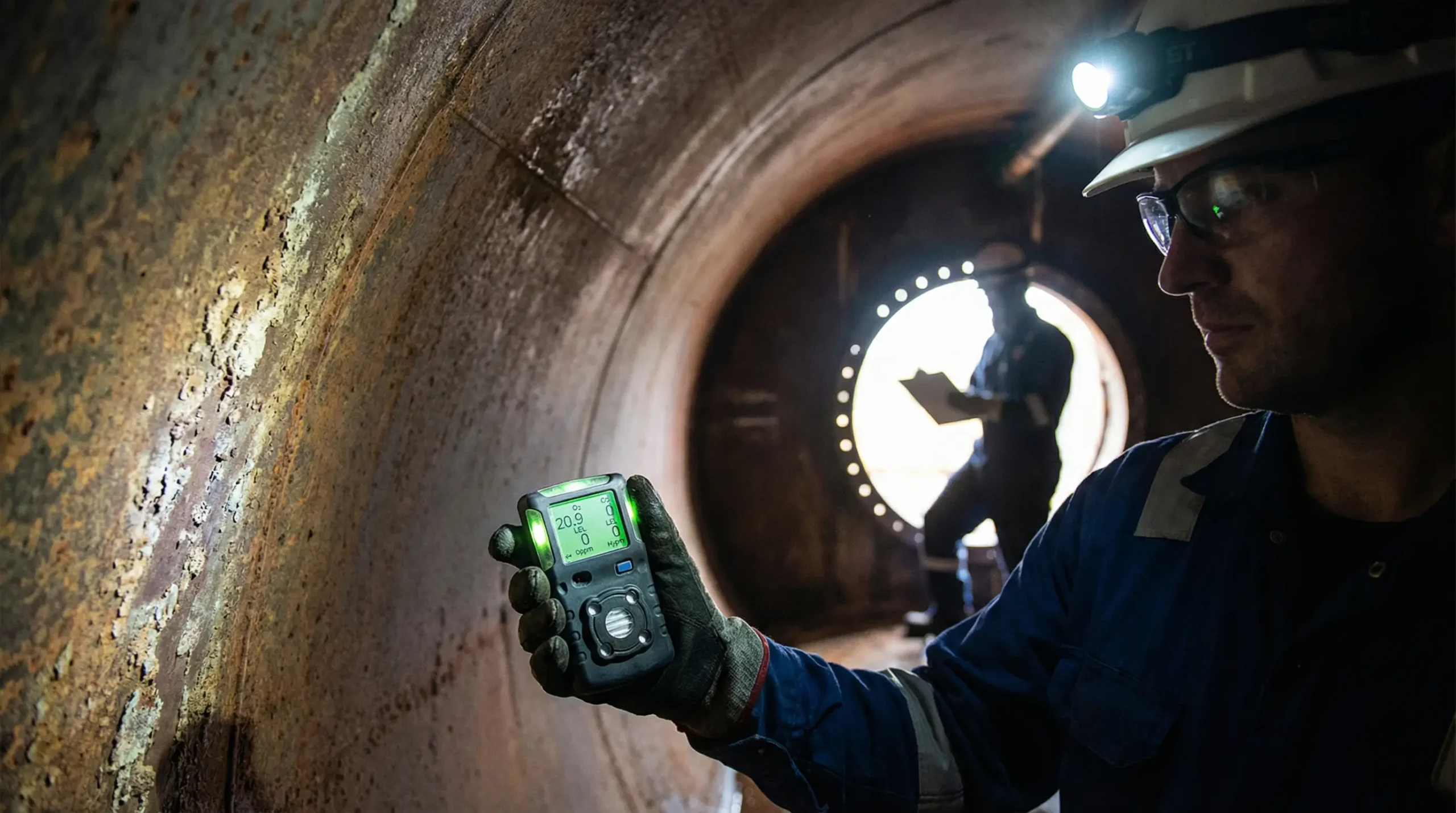
I was reviewing gas test records on a petrochemical turnaround in the Gulf when the attendant’s four-gas monitor started alarming at 14% LEL inside a vessel that had been steamed, purged, and signed off as gas-free just forty minutes earlier. The vessel had residual hydrocarbons trapped behind scale buildup on the internal baffles — invisible to the naked eye and missed during the initial purge verification. Two workers were already rigging inside. We pulled them out within ninety seconds. That vessel, at 14% LEL with methane as the primary constituent, was roughly halfway to a concentration that could have detonated with a single spark from a pneumatic wrench.
The lower explosive limit is one of the most critical numbers in occupational safety, yet it remains one of the most misunderstood. Workers hear “LEL” in toolbox talks and confined space briefings, but many cannot explain what the number on their detector actually represents — or at what reading they should stop breathing and start moving. This article breaks down what LEL means, how it governs safe atmospheric conditions, where it applies across industries, common monitoring mistakes that lead to fatalities, and the practical controls every site team must enforce.
What Is the Lower Explosive Limit (LEL)?
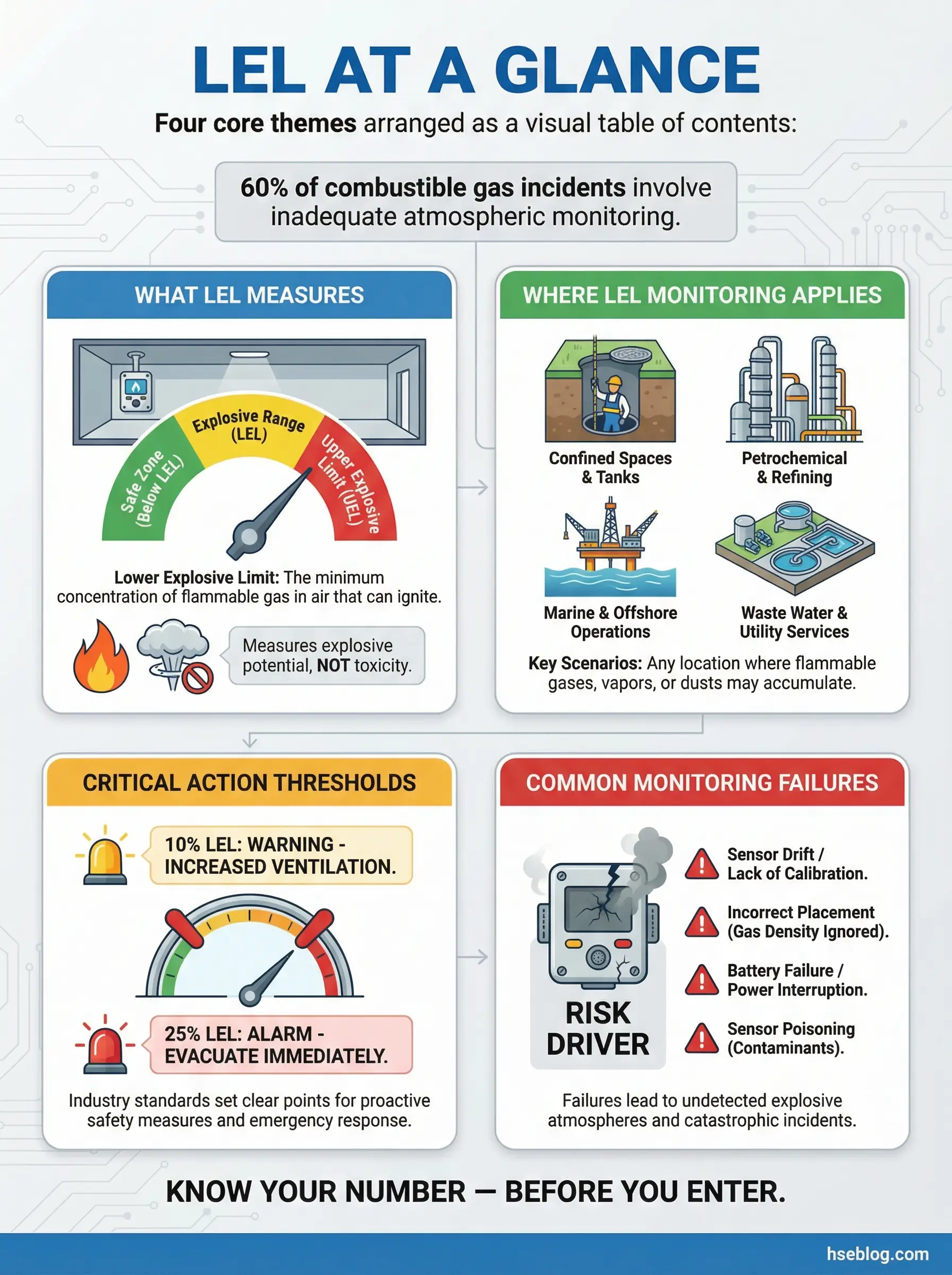
The lower explosive limit is the minimum concentration of a flammable gas or vapor in air, expressed as a percentage by volume, at which the mixture can ignite in the presence of an ignition source. Below the LEL, the fuel-to-air ratio is too lean — there simply is not enough combustible material suspended in the atmosphere to sustain a flame front.
Every flammable substance has its own specific LEL value. Methane ignites at 5% concentration by volume. Hydrogen sits much lower at 4%. Gasoline vapor becomes dangerous at just 1.4%. These numbers are not arbitrary — they are determined through laboratory testing under controlled conditions and published in safety data sheets, NFPA 325, and OSHA reference materials.
The LEL works in tandem with the upper explosive limit (UEL). Together, these two values define the explosive range — the concentration window within which ignition is possible. Here is how common gases compare:
| Gas / Vapor | LEL (% vol.) | UEL (% vol.) | Explosive Range Width |
|---|---|---|---|
| Methane | 5.0 | 15.0 | 10.0% |
| Propane | 2.1 | 9.5 | 7.4% |
| Hydrogen | 4.0 | 75.0 | 71.0% |
| Acetylene | 2.5 | 100.0 | 97.5% |
| Gasoline vapor | 1.4 | 7.6 | 6.2% |
| Ammonia | 15.0 | 28.0 | 13.0% |
A gas with a wide explosive range — like hydrogen or acetylene — is inherently more dangerous because it can ignite across a much broader set of concentrations. A narrow range does not make a gas safe; it means the window for ignition is smaller, but reaching LEL is often easier.
Pro Tip: When you see “% LEL” on a gas detector display, the instrument is not showing the raw gas concentration. It is showing what percentage of the way to the LEL the current atmosphere has reached. A reading of 10% LEL for methane means the atmosphere contains 0.5% methane by volume — which is 10% of the 5.0% needed to reach the ignition threshold.
Why LEL Matters on Every Work Site
Understanding flammable atmosphere thresholds is not an academic exercise. It is the difference between a controlled work environment and a catastrophic explosion. I have investigated three separate incidents across different industries where the root cause traced directly back to crews misunderstanding or ignoring LEL readings.
The reasons LEL monitoring is non-negotiable fall into several interconnected categories:
- Explosion prevention is binary. A flammable atmosphere either exists or it does not. There is no partial explosion. Once the concentration crosses LEL in the presence of an ignition source and sufficient oxygen, detonation occurs — often in milliseconds.
- Gas concentrations shift without warning. Temperature changes, agitation of sludge, breaking through scale, opening valves, or even changes in wind direction can push a gas-free environment past LEL within seconds.
- Human senses cannot detect LEL. Methane is odorless. Many hydrocarbon vapors are only detectable by smell at concentrations far above their LEL. By the time you smell gasoline vapor indoors, you may already be inside the explosive range.
- Regulatory frameworks treat LEL exceedance as a critical failure. OSHA 29 CFR 1910.146 requires atmospheric testing before confined space entry, with combustible gas as one of the three mandatory parameters. HSE UK’s Dangerous Substances and Explosive Atmospheres Regulations (DSEAR) classify any area where explosive atmospheres may occur as requiring formal hazardous zone classification.
LEL vs. UEL: Understanding the Explosive Range
Many safety professionals reference the LEL in isolation without fully explaining its relationship with the upper explosive limit. That gap causes confusion — especially among workers who assume that going above the UEL means the atmosphere is somehow safe again.
The explosive range is the concentration band between LEL and UEL where ignition is possible. Below LEL, the mixture is too lean. Above UEL, the mixture is too rich — there is not enough oxygen relative to fuel for combustion. But “too rich to burn” is not a safe condition in any operational context, for several critical reasons:
- Rich atmospheres are oxygen-deficient. A concentration above the UEL means the gas has displaced enough air to make the atmosphere immediately dangerous to life and health (IDLH) from an asphyxiation standpoint alone.
- Dilution passes through the explosive range. If a vessel contains a gas concentration above the UEL and you begin ventilating, the concentration drops — and it passes directly through the explosive range on its way down. This is the exact scenario that has caused explosion-during-purging fatalities.
- Stratification creates mixed zones. Heavier-than-air vapors settle in low spots. The top of a tank may read above UEL while the middle sits squarely in the explosive range. A single gas reading at one elevation tells you nothing about the full picture.
Never treat a UEL exceedance as a non-hazardous condition. The atmosphere is both explosive (during any dilution) and immediately toxic from oxygen displacement.
Pro Tip: During vessel purging operations, always monitor LEL continuously at multiple elevations — top, middle, and bottom. I have seen purge operations where the top of a tank read 0% LEL while the bottom still held 40% LEL from settled propane vapor. The crew working at the bottom manway had no idea they were inside the explosive range.
How LEL Is Measured: Gas Detection in Practice
Knowing the LEL value for a substance means nothing if you cannot measure the actual atmospheric concentration accurately. Gas detectors are the frontline tool, and getting them right is a matter of life and death.
Combustible gas sensors in portable and fixed gas detectors typically use one of two sensing technologies, each with distinct field implications:
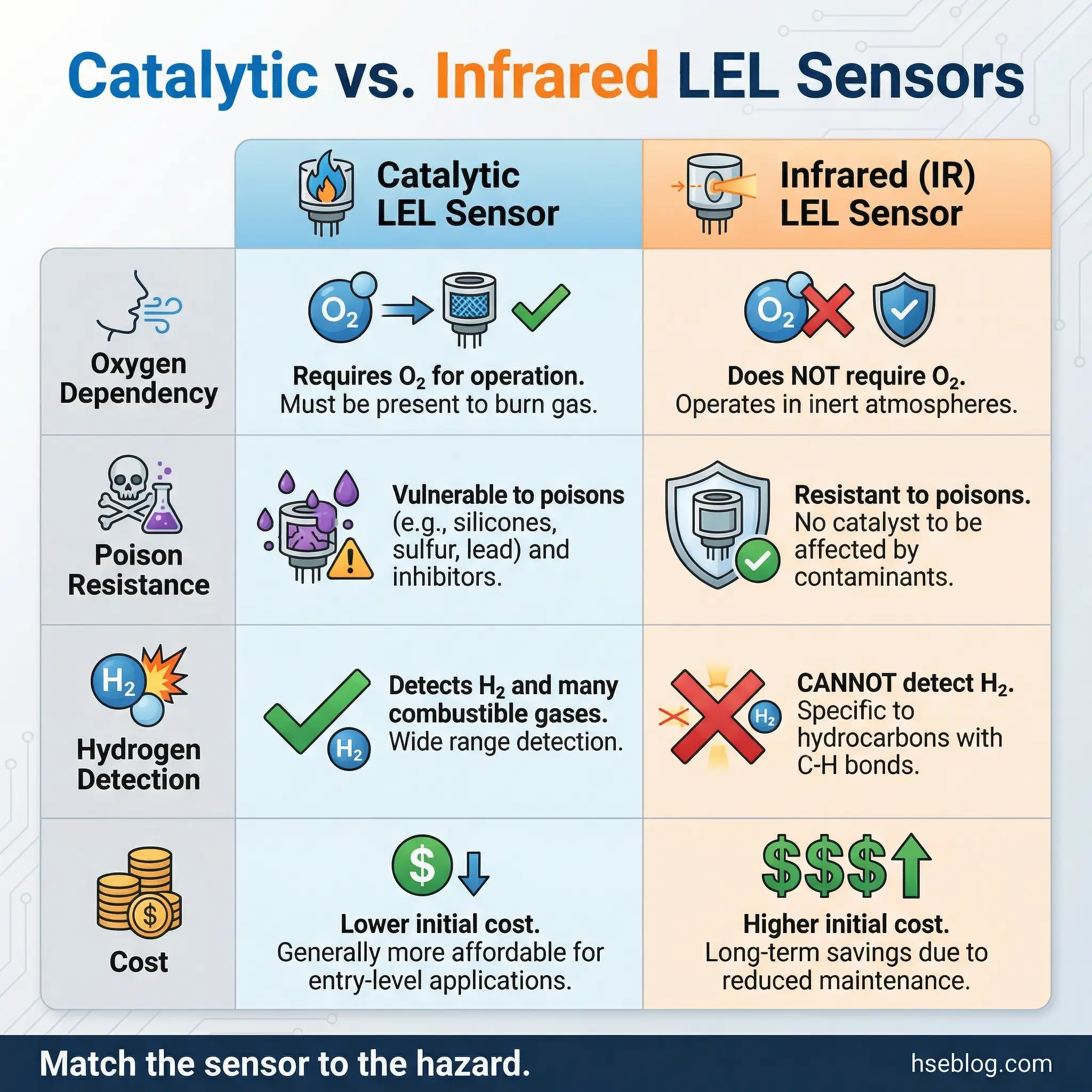
- Catalytic bead (pellistor) sensors work by oxidizing combustible gas on a heated catalytic element and measuring the resulting temperature change. They are reliable, well-understood, and the standard for most industrial LEL monitoring. However, they require oxygen to function — in oxygen-deficient atmospheres below approximately 10% O₂, they give false-low readings. They can also be poisoned by silicone compounds, lead, and hydrogen sulfide, which permanently degrade sensitivity.
- Infrared (IR/NDIR) sensors measure gas concentration by detecting absorption of infrared light at specific wavelengths. They do not require oxygen, are not susceptible to catalyst poisoning, and work in inert or oxygen-enriched atmospheres. They cannot detect hydrogen (which does not absorb IR). They cost more and are typically found in fixed installations or higher-end portable units.
Proper gas detection on site demands more than just carrying a monitor. The following practices separate competent atmospheric monitoring from checkbox compliance:
- Bump test before every shift. Expose the sensor to known calibration gas and confirm it alarms. A bump test takes thirty seconds and confirms the sensor is responsive. OSHA, the International Society of Automation (ISA), and most detector manufacturers recommend daily bump testing.
- Full calibration on schedule. Follow the manufacturer’s recommended calibration interval — typically monthly or quarterly. Use certified calibration gas traceable to national standards.
- Test at the correct height. Gas behavior depends on vapor density. Methane (lighter than air) rises. Propane and gasoline vapor (heavier than air) sink. Test at the elevation where gas is most likely to accumulate — not just at breathing zone height.
- Allow for sensor response time. Catalytic bead sensors typically need 15–30 seconds to reach a stable reading in a new atmosphere. Sweeping the detector quickly through an area gives unreliable readings.
- Monitor continuously, not just at entry. A single pre-entry reading is a snapshot. Atmospheric conditions change as work progresses — especially during hot work, grinding, coating removal, or any activity that generates heat or sparks near residual hydrocarbons.
Critical LEL Action Thresholds and Alarm Set Points
Gas detectors do not simply display a number — they are programmed with alarm thresholds that trigger specific responses. Understanding what these thresholds mean and how to act on them is where many site teams fall short.
Industry-standard alarm set points for combustible gas detection follow a two-tier structure that aligns with OSHA expectations and international best practice:
- Low alarm at 10% LEL. This is the investigation and enhanced ventilation threshold. At 10% LEL, the atmosphere contains one-tenth of the fuel concentration needed for ignition. Work should pause, the source should be identified, and ventilation should be increased or confirmed adequate. No hot work is permissible.
- High alarm at 25% LEL. This is the evacuation threshold. At 25% LEL, the atmosphere is one-quarter of the way to an explosive concentration. All personnel must withdraw immediately, ignition sources must be eliminated, and re-entry is prohibited until the atmosphere is confirmed below 10% LEL by a competent person.
For confined space entry and hot work permits, regulatory and industry standards set much tighter requirements:
- OSHA 29 CFR 1910.146 requires the atmosphere to be tested and confirmed safe before entry. Industry practice — and most company standards I have audited — sets the entry threshold at less than 1% LEL for permit-required confined spaces.
- Hot work permits (NFPA 51B, API 2009) require the atmosphere to test at 0% LEL or as close to zero as measurable before any flame, arc, or spark-producing work begins. On turnarounds in the Gulf, I have refused to sign hot work permits where the reading was 0.5% LEL — because residual hydrocarbons trapped behind insulation or under scale could release during the cutting or welding and push past the action threshold instantly.
Pro Tip: Alarm set points are not suggestions — they are triggers for immediate, rehearsed responses. I have seen sites where the 10% LEL alarm sounded and the crew silenced it because “it always does that near the pump room.” Three weeks later, that same pump room leaked enough vapor to reach 30% LEL during a compressor changeover. Alarm fatigue kills.
Where LEL Monitoring Is Required: Key Work Scenarios
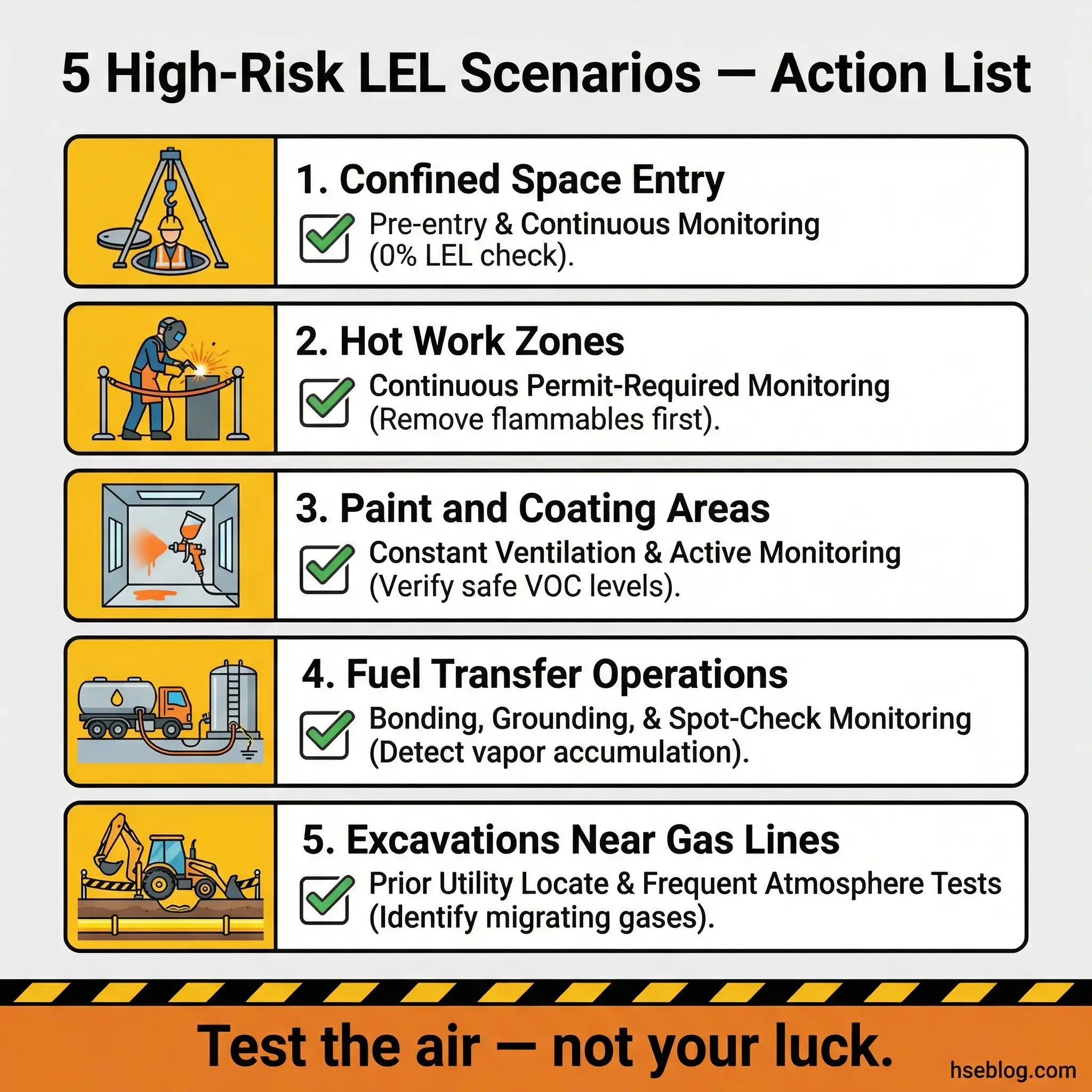
LEL monitoring applies far beyond confined spaces. Any environment where flammable gases or vapors can accumulate demands continuous or pre-task atmospheric testing. The following scenarios represent the highest-risk applications based on incident frequency and regulatory mandate:
- Confined space entry. Tanks, vessels, pits, trenches, silos, and any enclosed or semi-enclosed space where flammable gas can accumulate. LEL testing is one of three mandatory atmospheric parameters alongside oxygen and toxic gas (typically H₂S or CO).
- Hot work operations. Welding, cutting, grinding, and any spark-producing activity near flammable materials, piping, or storage. NFPA 51B requires atmospheric testing within the hot work zone and adjacent areas before and during the work.
- Painting and coating operations. Solvent-based paints release volatile organic compounds (VOCs) with low flash points and correspondingly low LEL values. Spray painting in enclosed areas routinely generates atmospheres above 10% LEL without forced ventilation.
- Fuel transfer and tank cleaning. Gasoline, diesel, and crude oil vapors accumulate rapidly during tank gauging, sampling, loading, and cleaning operations. LEL monitoring at tank openings and in surrounding drainage areas is standard practice.
- Excavation near buried utilities. Natural gas leaks from damaged pipelines accumulate in trench bottoms. OSHA 29 CFR 1926.651 requires atmospheric testing in excavations deeper than four feet where hazardous atmospheres could exist.
- Waste treatment and sewerage. Methane generation from organic decomposition in wastewater systems creates persistent LEL exposure. Fixed gas detection systems in pump stations and enclosed treatment areas are an engineering control, not optional equipment.
- Laboratory and chemical storage areas. Spills, leaking cylinder valves, and volatilization from open containers generate localized flammable atmospheres that may not trigger building-wide detection systems.
OSHA’s Hazard Communication Standard (29 CFR 1910.1200) requires that Safety Data Sheets list the LEL and UEL for every flammable substance. If you cannot find the LEL on the SDS, the SDS is non-compliant — and you do not have the information you need to set your detector alarm points correctly.
Common LEL Monitoring Mistakes That Lead to Incidents
Over the course of dozens of incident investigations and hundreds of audits, the same monitoring failures appear with disturbing regularity. These are not theoretical risks — they are documented root causes from real explosion and fatality reports.
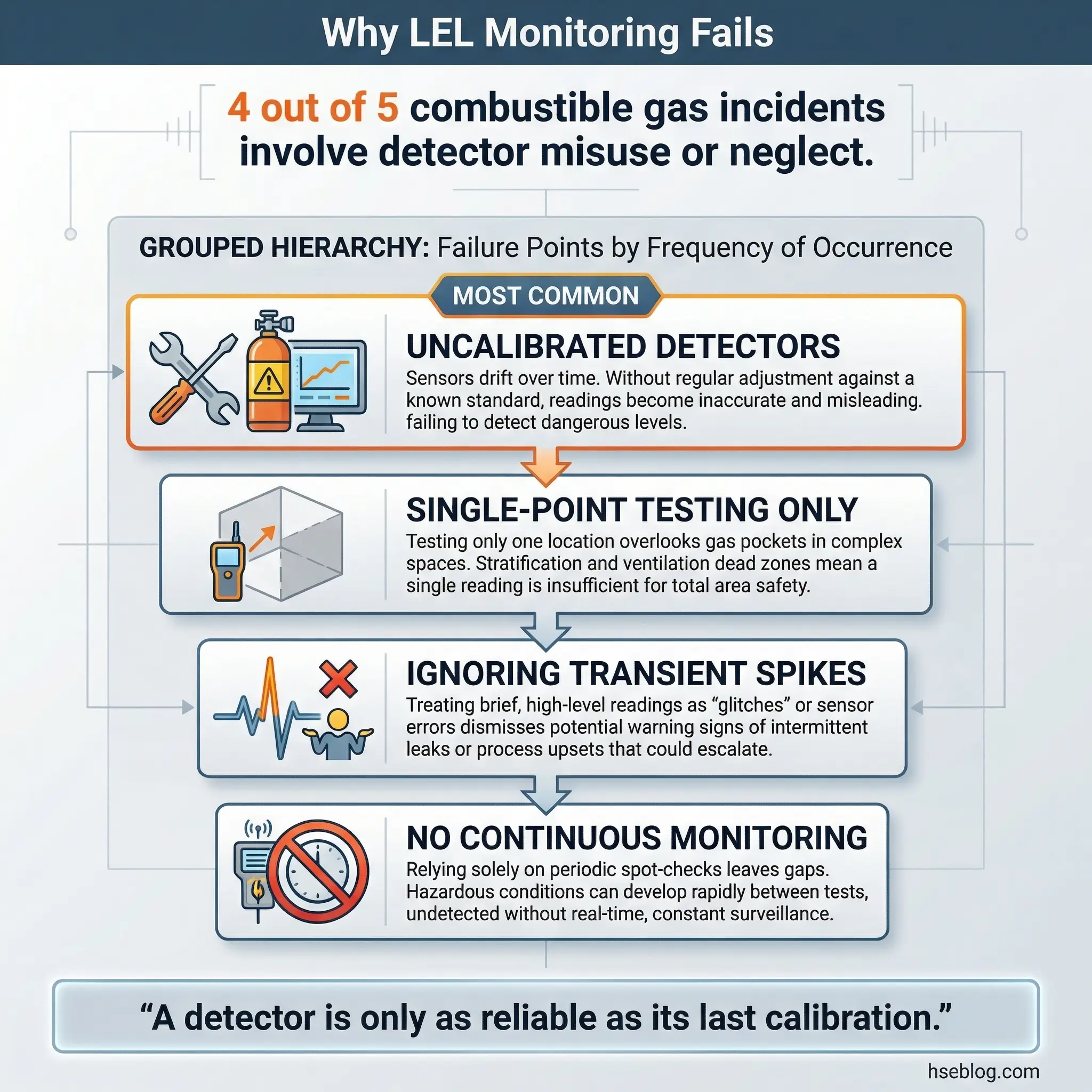
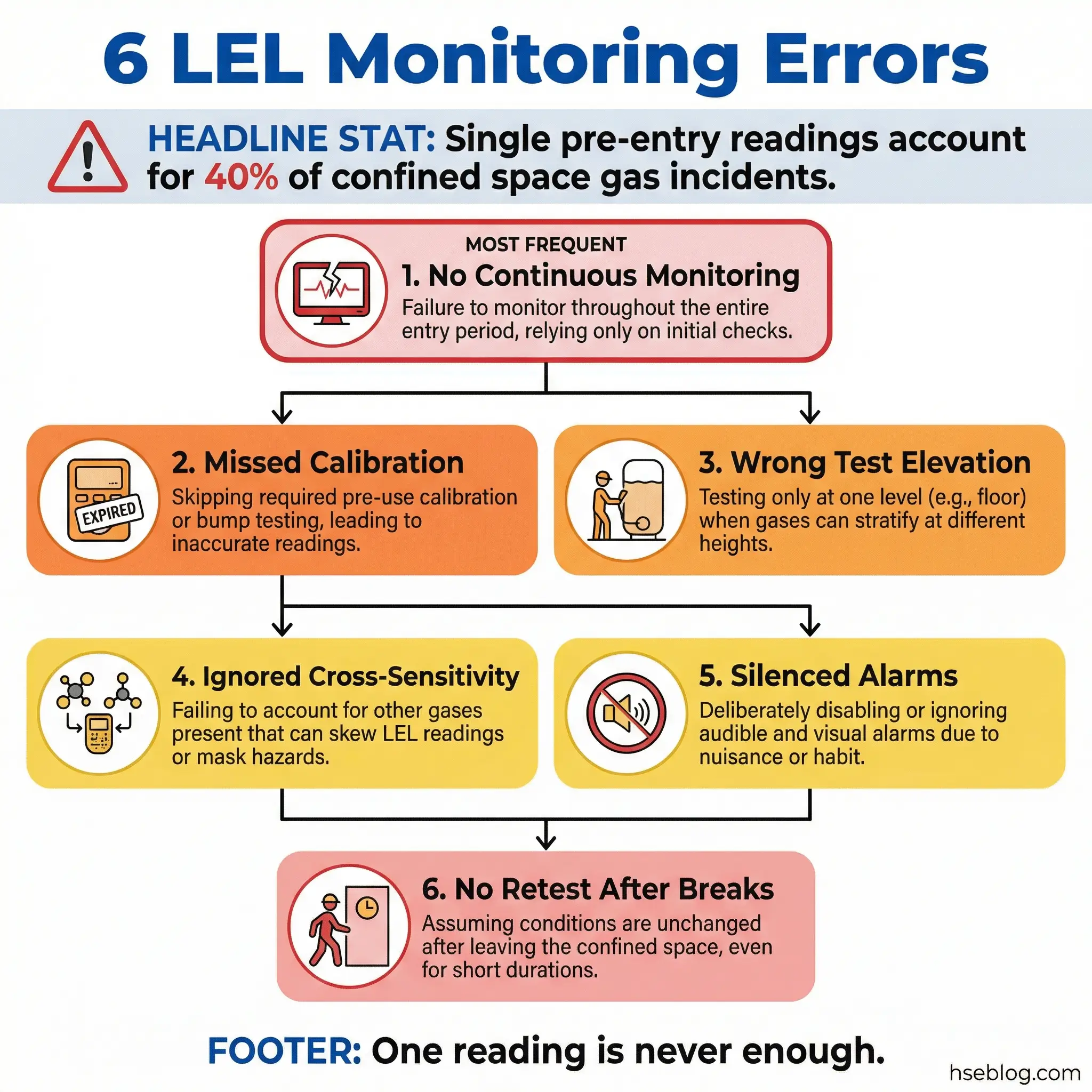
The following mistakes account for the majority of combustible gas monitoring failures across industries:
- Relying on a single pre-entry reading. A snapshot reading before entry tells you what the atmosphere was at that moment — not what it will be in twenty minutes when grinding begins or temperatures rise. Continuous monitoring is the only reliable approach.
- Failure to bump test or calibrate. A catalytic bead sensor degraded by silicone exposure reads 0% LEL in a 20% LEL atmosphere. The crew enters believing the space is gas-free. This exact scenario appeared in a CSB investigation of a refinery explosion.
- Testing at the wrong elevation. Methane rises, propane sinks, and gasoline vapor pools at ground level. Testing only at breathing zone height misses the accumulation zone entirely.
- Ignoring cross-sensitivity limitations. A detector calibrated for methane does not respond identically to pentane, hexane, or acetone vapor. Correction factors must be applied, or the detector must be calibrated with the specific target gas. Using a methane-calibrated detector in a gasoline vapor environment without applying the correction factor can understate the actual concentration by 40–50%.
- Silencing alarms without investigating. Alarm fatigue is a system-level failure, not a human error. If detectors alarm frequently in a specific area, the correct response is to investigate and control the source — not to raise the alarm threshold or disable the audible alarm.
- No atmospheric monitoring during breaks. Crews leave a confined space for lunch, return thirty minutes later, and re-enter without retesting. Conditions inside the space may have changed completely — especially if ventilation was shut down during the break.
Pro Tip: I carry a calibration log sticker on every gas detector I issue for confined space work. Before handing the instrument to an entrant, I check the sticker. If calibration is overdue — even by one day — the detector does not go into service. No exceptions. A detector you cannot trust is worse than no detector at all, because it gives false confidence.
Practical Control Measures for LEL Hazards
Controlling flammable atmospheres requires a layered approach. No single measure eliminates the risk. The hierarchy of controls applies directly — with engineering controls doing the heavy lifting and administrative controls filling the gaps.
The following measures represent proven, field-validated controls that I have implemented or audited across refinery turnarounds, confined space programs, and chemical plant operations:
Engineering Controls
Engineering solutions are the most effective layer because they reduce the hazard at its source, independent of human behavior:
- Forced mechanical ventilation. Continuous airflow through confined spaces, work areas, or enclosed rooms dilutes combustible gas below LEL and prevents accumulation. Ventilation rate must be calculated based on the space volume, gas generation rate, and target concentration — not estimated.
- Fixed gas detection systems with automatic shutdowns. In process plants, fixed catalytic or IR detectors tied to the safety instrumented system (SIS) can trigger equipment shutdown, valve closure, or deluge activation when LEL thresholds are exceeded.
- Inerting and purging. Displacing the atmosphere with nitrogen or CO₂ before maintenance eliminates the oxygen leg of the fire triangle, preventing ignition regardless of fuel concentration. Inerting creates an IDLH atmosphere from an oxygen standpoint, so entry requires supplied-air respiratory protection.
- Vapor containment and extraction. Local exhaust ventilation (LEV) at the source — such as extraction hoods over solvent baths or capture systems at tank vents — prevents vapor from dispersing into the work area.
Administrative Controls
Administrative controls supplement engineering measures and address human factors:
- Permit-to-work systems. Every confined space entry and hot work activity must be governed by a formal permit that documents atmospheric test results, ventilation status, and emergency procedures. The permit is the control document — not just paperwork.
- Competent person designation. Only trained, qualified individuals should take atmospheric readings, interpret results, and authorize entry. OSHA defines a competent person as one who can identify hazards and has the authority to take corrective action.
- Gas test communication protocols. Readings must be communicated clearly to every person entering the work zone — not just logged on a clipboard. On one turnaround I managed, we required the attendant to verbally announce the LEL reading every fifteen minutes over the radio. It felt excessive until it prevented a crew from entering a vessel where LEL had climbed to 12% during a piping isolation failure.
- Emergency response planning. Rescue procedures, evacuation routes, and alarm response actions must be documented, communicated, and rehearsed before work begins — not after an alarm sounds.
LEL in Confined Space Operations: A Closer Look
Confined spaces deserve special attention because they concentrate every LEL-related risk into a small, enclosed, difficult-to-escape environment. Atmospheric hazards are the leading cause of confined space fatalities, and combustible gas is one of the three primary threats alongside oxygen deficiency and toxic exposure.
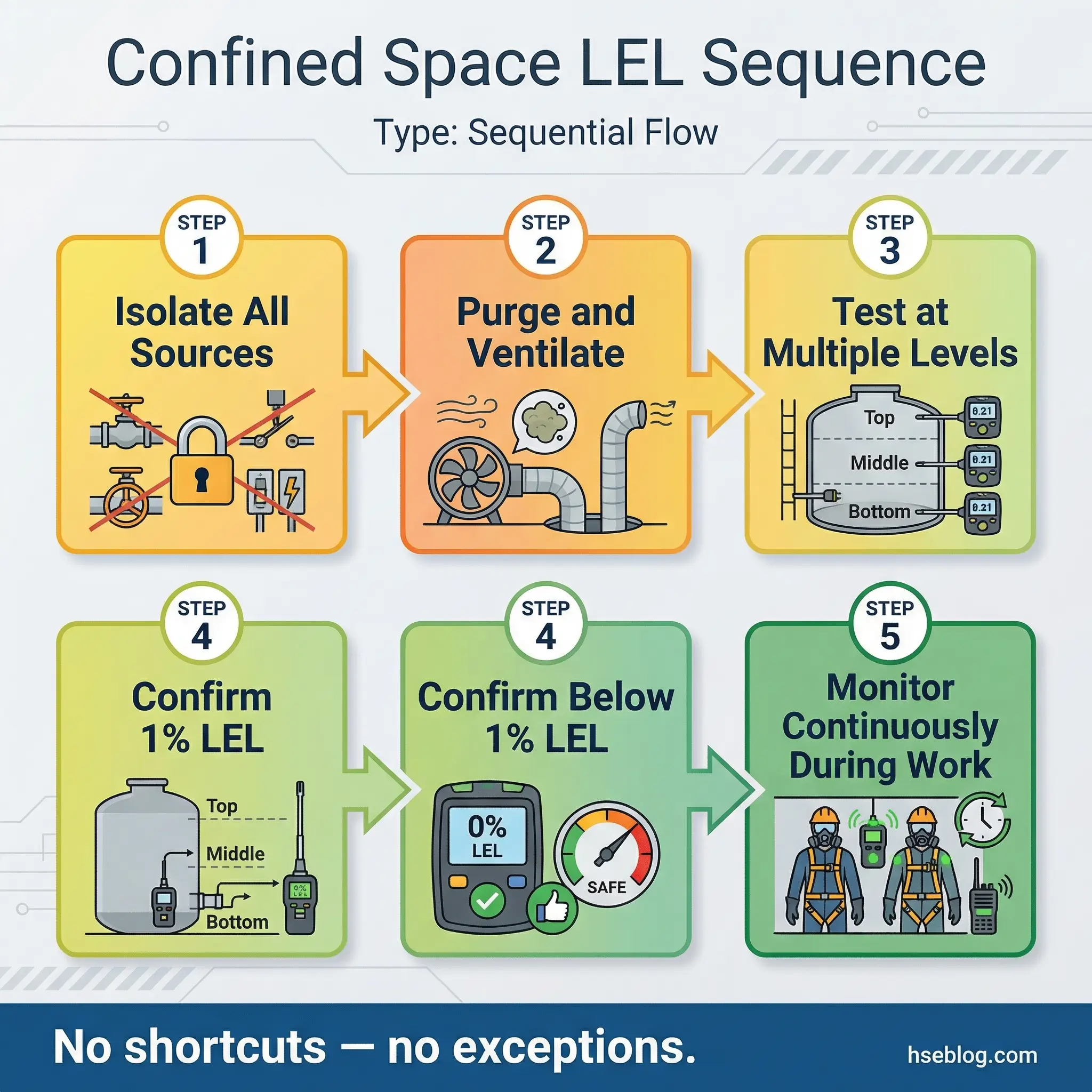
The confined space entry procedure for LEL management follows a strict sequence that no competent safety professional should deviate from:
- Isolate the space. Lock out, tag out, blank, or blind all energy sources, product lines, and drainage connections that could introduce flammable material into the space.
- Purge and ventilate. Displace the existing atmosphere with fresh air using mechanical ventilation. Allow sufficient air changes to reduce residual gas concentration.
- Test the atmosphere. Using a calibrated four-gas detector, test for oxygen first (must be 20.9% ± 0.5%), then combustible gas (must be less than 1% LEL for entry), then toxic gases (H₂S, CO within permissible limits).
- Test at multiple elevations. Take readings at the top, middle, and bottom of the space. Record each reading on the entry permit.
- Establish continuous monitoring. The entrant carries a personal monitor, and the attendant monitors from the entry point. Any reading reaching 10% LEL triggers immediate withdrawal.
- Maintain ventilation throughout the work. Never shut down ventilation while personnel are inside the space. If ventilation fails, evacuate immediately and do not re-enter until the atmosphere is retested and confirmed safe.
OSHA 29 CFR 1910.146(d)(5)(ii) requires that conditions in the permit space are tested before entry, and the testing must be done by a qualified person using calibrated, direct-reading instruments.
Pro Tip: I always carry a length of sampling tubing with the gas detector when testing deep vessels or horizontal confined spaces. Dropping the detector on a lanyard only tells you the reading at one point. Running the sample draw through six feet of tubing lets you test the far corners, low points, and areas behind baffles without entering the space. The extra thirty seconds of remote sampling has saved lives.
Conclusion
The lower explosive limit is not a number on a data sheet. It is the boundary between a controlled work environment and an uncontrolled detonation. Every gas detector reading, every permit signature, every decision to enter or withdraw from a space comes down to whether the atmosphere is below that threshold — and whether your monitoring equipment, calibration records, and competent persons can be trusted to tell you the truth.
The pattern behind combustible gas incidents is maddeningly consistent: a skipped bump test, a single reading mistaken for continuous monitoring, a crew that silenced an alarm because it triggered too often, a detector calibrated for the wrong gas. None of these failures are sophisticated. None require advanced technology to prevent. They require discipline, competence, and an organizational culture that treats atmospheric monitoring as a life-critical activity — because that is exactly what it is.
If there is one lesson I would distill from every LEL-related incident I have investigated or reviewed, it is this: the atmosphere does not negotiate. It does not give warnings beyond the ones your instruments provide. Respect the number on your detector, act on every alarm, and never enter a space you have not tested — completely, correctly, and continuously.