
TL;DR
- If your LEV serves a non-Schedule-4 process, then the statutory maximum between thorough examinations is 14 months under COSHH Regulation 9 — not 12.
- If your process falls within COSHH Schedule 4, then the minimum interval compresses to one or six months, regardless of how recently the system was tested.
- If you outsource the TExT to a P601-certified engineer, then you have outsourced the test method — not the Regulation 9 duty, which stays with the employer.
- If an HSE inspector visits tomorrow, then they will ask for the LEV logbook before they look at the system itself — the documentation trail is the substance of compliance.
Under Regulation 9 of the Control of Substances Hazardous to Health Regulations 2002, local exhaust ventilation in Great Britain must be thoroughly examined and tested by a competent person at least once every 14 months. Schedule 4 of COSHH sets shorter statutory minimums — typically six or one month — for specified high-risk processes. Records must be kept for at least five years.
HSE’s Occupational Lung Disease Statistics, published November 2025, estimate around 11,000 lung disease deaths each year in Great Britain linked to past workplace exposures (HSE, 2025). That figure dwarfs the 124 acute work-related fatalities recorded over the same reporting period (HSE, 2025). It is also the strongest argument for taking LEV seriously as a statutory duty rather than a maintenance line item — because almost every case of long-latency occupational lung disease began with an engineering control that was either never adequate or allowed to drift out of performance without anyone noticing.
This article sets out what COSHH actually requires for LEV testing and maintenance, how the Regulation 9 duty operates alongside Regulations 7 and 8, and how to evidence compliance if HSE turns up on site. The scope is UK — Great Britain under COSHH 2002, Northern Ireland under the parallel COSHH (NI) 2003. Readers in the US, EU and other jurisdictions should treat the intervals and thresholds below as UK-specific; OSHA, NIOSH, ACGIH and EU frameworks operate under different duty holders, different limits, and in many cases different test philosophies.
Legal disclaimer: Regulatory content here reflects general HSE professional understanding of UK requirements as of 2026. It is not legal advice. Specific compliance questions, enforcement situations, or prosecution risk should be directed to qualified legal counsel in the applicable jurisdiction.
What COSHH Requires for LEV: The Regulation 7–8–9 Duty Chain
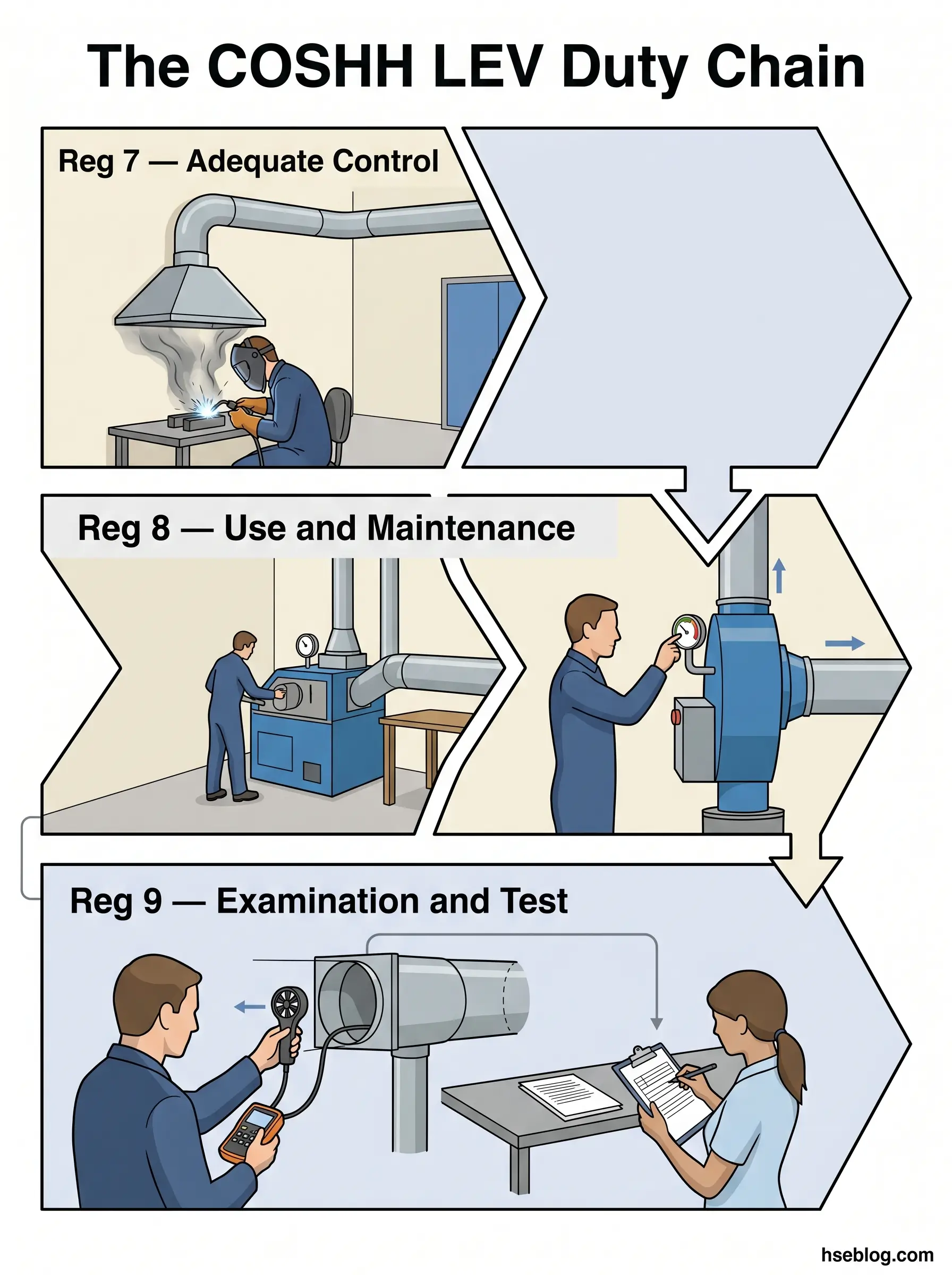
LEV does not sit in a regulation of its own. It sits inside the broader COSHH control architecture, and the reason most compliance failures are really management failures is that duty holders treat the 14-month test as the whole duty. It is not. The test is the closing step of a three-regulation chain.
Regulation 7 of COSHH 2002 obliges employers to ensure that exposure to substances hazardous to health is either prevented or — where that is not reasonably practicable — adequately controlled. LEV is one of the engineering control options, sitting below elimination and substitution in the hierarchy. Regulation 8 then requires employers to ensure that controls are properly used, and that employees cooperate. Regulation 9 is the specific testing and maintenance duty: the system must be “maintained in an efficient state, in efficient working order, in good repair and in a clean condition,” with thorough examination and testing at defined intervals.
The sixth edition of the L5 Approved Code of Practice (HSE, 2013) is explicit that the record-keeping duty sits with the employer, not with the examiner or service provider. That detail matters because of a recurring misconception: outsourcing the TExT to a P601 engineer is read as outsourcing the Regulation 9 duty. It is not. The employer remains the duty holder for acting on recommendations, closing out defects, retaining records, and answering to an inspector.
Audit Point: L5 carries special legal status. Where a duty holder does not follow the ACoP, the burden shifts to them to prove they met the law by an equivalent alternative — a markedly harder position in prosecution than simply showing conformance.
How Often Must LEV Be Tested Under COSHH?
The headline number is 14 months — but that number is the maximum permitted interval, not a default or a target. Under COSHH Regulation 9, a thorough examination and test must occur at least once every 14 months for most LEV systems. The two-month buffer beyond 12 exists in law to accommodate scheduling flexibility without breaching the maximum. It is not an invitation to extend the effective interval.
Two further layers compress the interval for specific situations. First, Schedule 4 of COSHH sets shorter statutory minimums for named high-risk processes. Second, HSG258 (HSE, 2017) is clear that testing must occur more frequently where wear and tear would degrade performance between scheduled tests, or where risk assessment identifies higher exposure potential. A recurring pattern across audits is duty holders defaulting every LEV system on a site to 14 months regardless of the process it serves — a stance that creates instant compliance exposure the moment a Schedule 4 process is introduced into the workshop.
Schedule 4 Processes: Monthly and Six-Monthly Intervals
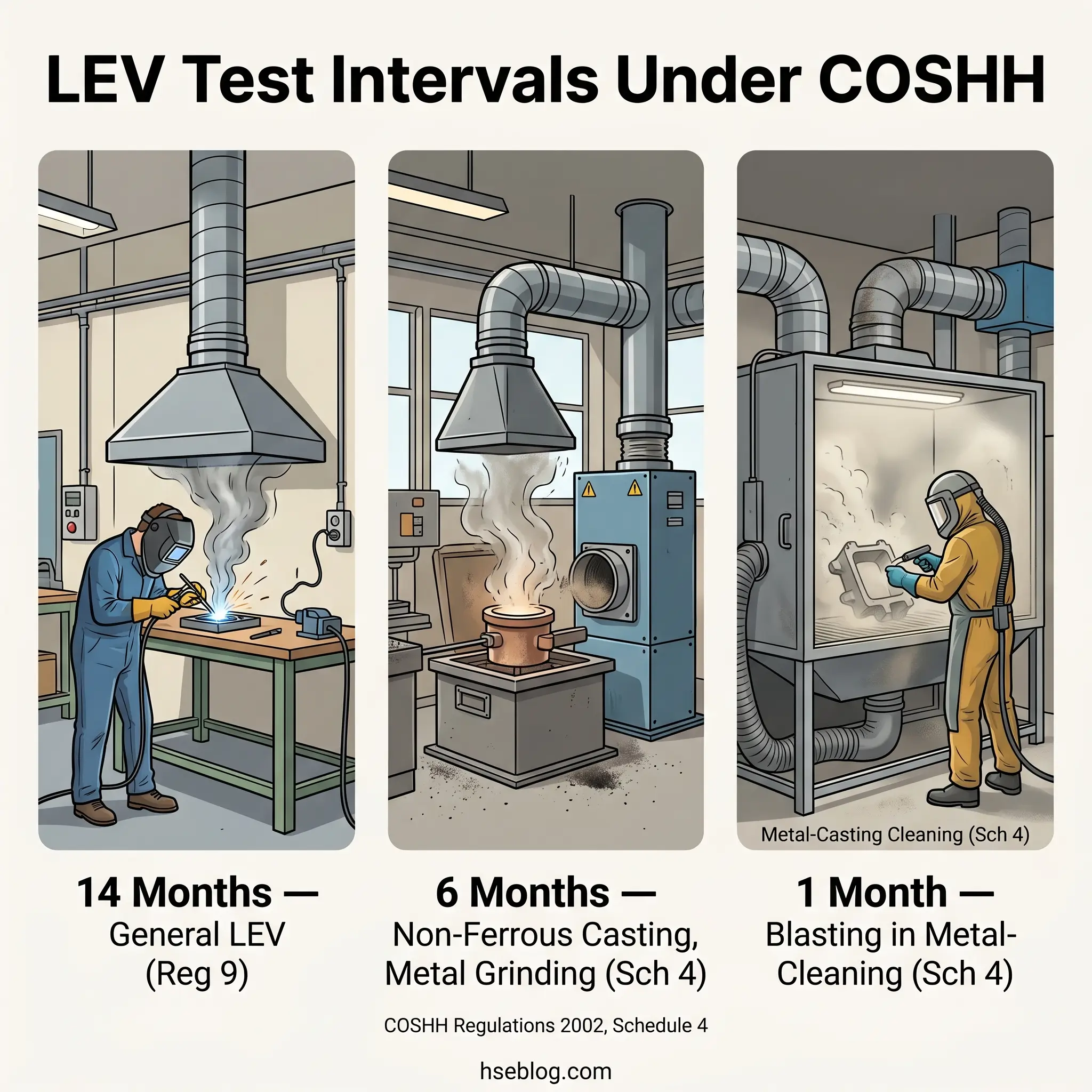
Schedule 4 of COSHH 2002 lists specific processes whose LEV systems must be tested more often than the general 14-month maximum. The intervals below are the statutory floor, not best practice:
| Process | Minimum interval | Source |
|---|---|---|
| Blasting in the cleaning of metal castings | 1 month | Schedule 4, COSHH 2002 |
| Jute cloth manufacture | 1 month | Schedule 4, COSHH 2002 |
| Processes giving off dust or fume in non-ferrous metal casting | 6 months | Schedule 4, COSHH 2002 |
| Grinding, abrading or polishing of metal articles (other than gold, platinum, iridium) by mechanical power, for more than 12 hours a week | 6 months | Schedule 4, COSHH 2002 |
| All other LEV not listed above | 14 months | Regulation 9, COSHH 2002 |
The practical reading is that any workshop that takes on stone fabrication, metal grinding, or blasting work must review its LEV test schedule before the first job, not after the next renewal.
When HSG258 Says Test More Often Than Every 14 Months
For systems outside Schedule 4, the 14-month interval is not automatic. HSG258 expects the duty holder to review risk-based factors that might shorten it: high-toxicity substances where even modest control drift creates disproportionate exposure; rapid filter loading where static-pressure drop rises measurably between tests; high-duty-cycle equipment running multi-shift; and systems whose historical TExT records show a declining performance trend across successive tests. Where any of these is present, the defensible interval is the shorter one the risk assessment supports — and the commissioning baseline is the reference point for judging drift.
What a Thorough Examination and Test (TExT) Actually Involves
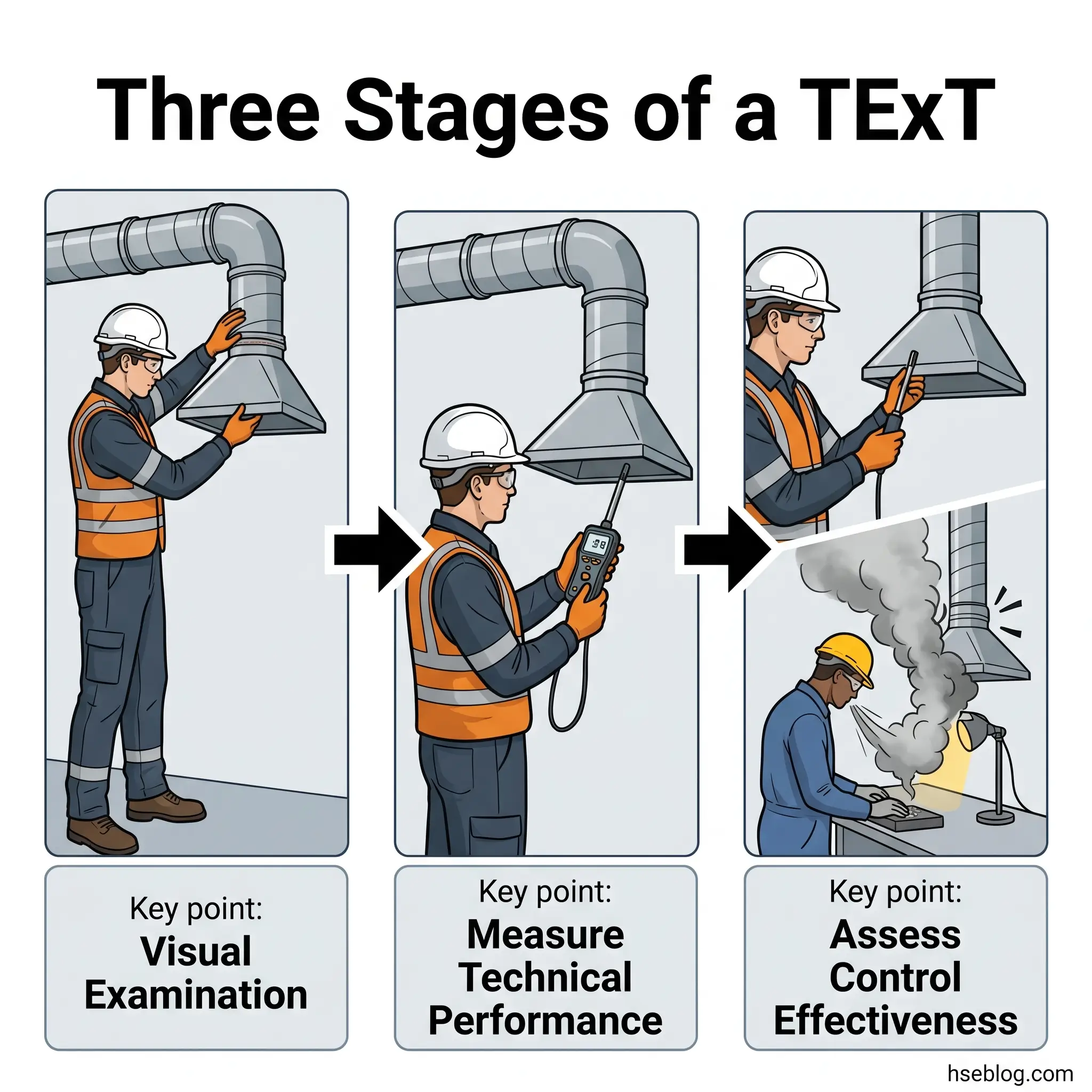
A TExT is not a single measurement exercise. HSG258 (HSE, 2017) structures the test in three sequential stages, and reading a TExT report without understanding those stages is where most duty holders lose ground in inspection conversations.
Stage 1 — Thorough visual examination. The examiner inspects the physical condition and integrity of hoods, ducting, filter housings, fans, discharge points, airflow indicators, signage and labelling. Any damage, corrosion, blockage, or unauthorised modification since commissioning is a finding in itself — the system’s current geometry needs to match the system that was designed.
Stage 2 — Measuring technical performance. Quantitative measurements are taken: face and capture velocity at hoods, transport velocity in ducting, static pressures across hoods and filters, volume flow, and confirmation of fan rotation direction. Each reading is compared against the commissioning or designed performance data. Absence of that benchmark data is itself a reportable finding — the examiner cannot judge drift against a blank.
Stage 3 — Assessment of control effectiveness. This is the stage most commonly underweighted. Stage 3 is qualitative confirmation that the system is actually controlling exposure at the worker’s breathing zone — dust-lamp observation, smoke testing, and, where appropriate, comparison of workplace air monitoring against the relevant Workplace Exposure Limit in EH40/2005 (HSE). A system can pass every Stage 2 airflow number and still fail Stage 3 if the hood is mispositioned or the operator routinely works outside the capture envelope.
One further point on scope. On-tool extraction units — the captured-at-source systems used with power tools — are LEV for TExT purposes, but only the extraction unit itself is subject to the TExT. The hoses and hoods attached to it fall under Regulation 8 maintenance checks rather than the statutory examination, as HSE’s LEV frequently asked questions confirm.
Who Is Competent to Test LEV — and How to Verify It
The law does not name a qualification for an LEV examiner. HSE defines competence as the right combination of knowledge, skills and experience for the specific LEV system and the specific process it serves. That wording matters because it does two things at once: it removes any single-certificate shortcut, and it puts the verification burden on the duty holder.
In practice, the BOHS P-series qualifications have become the industry benchmark. P601 (Thorough Examination and Testing of LEV Systems, Level 4) is the standard qualification for TExT examiners; P602 covers basic design principles; P604 (Performance Evaluation, Commissioning and Management, Level 5) is the higher-tier qualification carried by examiners who do commissioning or complex diagnostic work; and P600 covers the methods for testing performance. These are recognised by HSE, UKAS and IOHA — but they are benchmarks, not statutory requirements.
The judgment call for a duty holder selecting an examiner is whether certification matches the system in front of them. P601 certifies test method competence, not domain experience. An examiner whose hands-on record sits entirely in woodworking extraction may miss important failure modes on an isocyanate spray booth or a pharmaceutical fume cupboard. Useful verification checks before procurement include: qualification currency, prior experience with the specific LEV type, anonymised sample reports on similar systems, references from comparable duty holders, and — as a stronger procurement signal than any individual certificate — UKAS accreditation of the testing organisation itself. The BOHS P601 qualification specification is the starting point for understanding what the certificate does and does not cover.
Maintenance Between Tests: The Regulation 8 Counterpart
Treating the 14-month TExT as “the maintenance plan” is one of the most common framing errors in LEV compliance. The TExT is the statutory check, not the maintenance regime. Regulation 8 of COSHH 2002 requires that controls are used and kept in working order between tests — a duty discharged through routine operator checks, planned maintenance, and a populated logbook.
A functional LEV logbook contains: the commissioning report with baseline performance data; operator pre-use check records (airflow indicator reading, visible hood and duct damage, unusual noise or vibration); weekly or monthly planned maintenance records (filter condition, static pressure readings, damper settings, alarm function tests); defect and repair records with closure evidence; and the most recent TExT report. Under Regulation 9 the logbook is a legal record; HSE inspectors will ask to see it before they inspect the system itself.
Watch For: Filter saturation is the single most common cause of TExT failure across the published pattern, and it is preventable. The threshold for replacement is either the manufacturer-specified loading limit or a measured static-pressure drop crossing the design threshold — whichever comes first. Scheduling filter checks only at the 14-month TExT is insufficient for any continuously-used system.
A broader pattern worth flagging: inadequate logbooks are among the most frequently cited findings in HSE inspections of LEV-reliant workplaces — not because the system is unsafe, but because the duty holder cannot evidence that it is safe. Compliance and evidence of compliance are treated as equivalent in practice; a gap in either is a finding.
When LEV Fails the Test: Prioritising Remedial Action
An LEV system that fails its TExT does not quietly slip into a repair queue. HSE guidance in HSG258 recommends visible pass/fail labelling on hoods and systems — red “Failed” labels plus an emergency written report where the defect prevents effective control. This is recommended practice rather than strict legal requirement, but it is the practice the ACoP aligns with.
The triage principle is straightforward: any defect that prevents effective control of exposure means the affected process must stop until the system is made safe. Lower-severity defects — those that degrade performance without defeating control — are listed as required remedial actions in the examiner’s report, with the duty holder responsible for action, retest and record closure.
Across the published pattern, common TExT failure modes and their typical root causes are:
- Saturated or non-compliant filters, including M-class / H-class filter mismatches for hazardous dusts — root cause is usually a missing or under-specified filter-change schedule.
- Uneven or reduced airflow at hoods on a shared manifold — when multiple hoods fail simultaneously on low airflow, the fault almost always lies at the fan, filter bank, or main duct, not the hoods.
- Duct blockage or internal deposition — typical where transport velocity has been specified too low for the contaminant load, or where cleaning frequency is not matched to deposition rate.
- Damaged or modified hood geometry — often the result of undocumented operator alterations over time, rather than mechanical damage.
- Failed airflow indicators or alarms — a particular concern because the control has been running blind between the last indication and the failed test.
- Incorrect fan rotation direction — usually introduced after a motor replacement or electrical works, and not always caught without Stage 2 measurement.
- Leakage at duct joints — degrades system static pressure and capture velocity across all connected hoods.
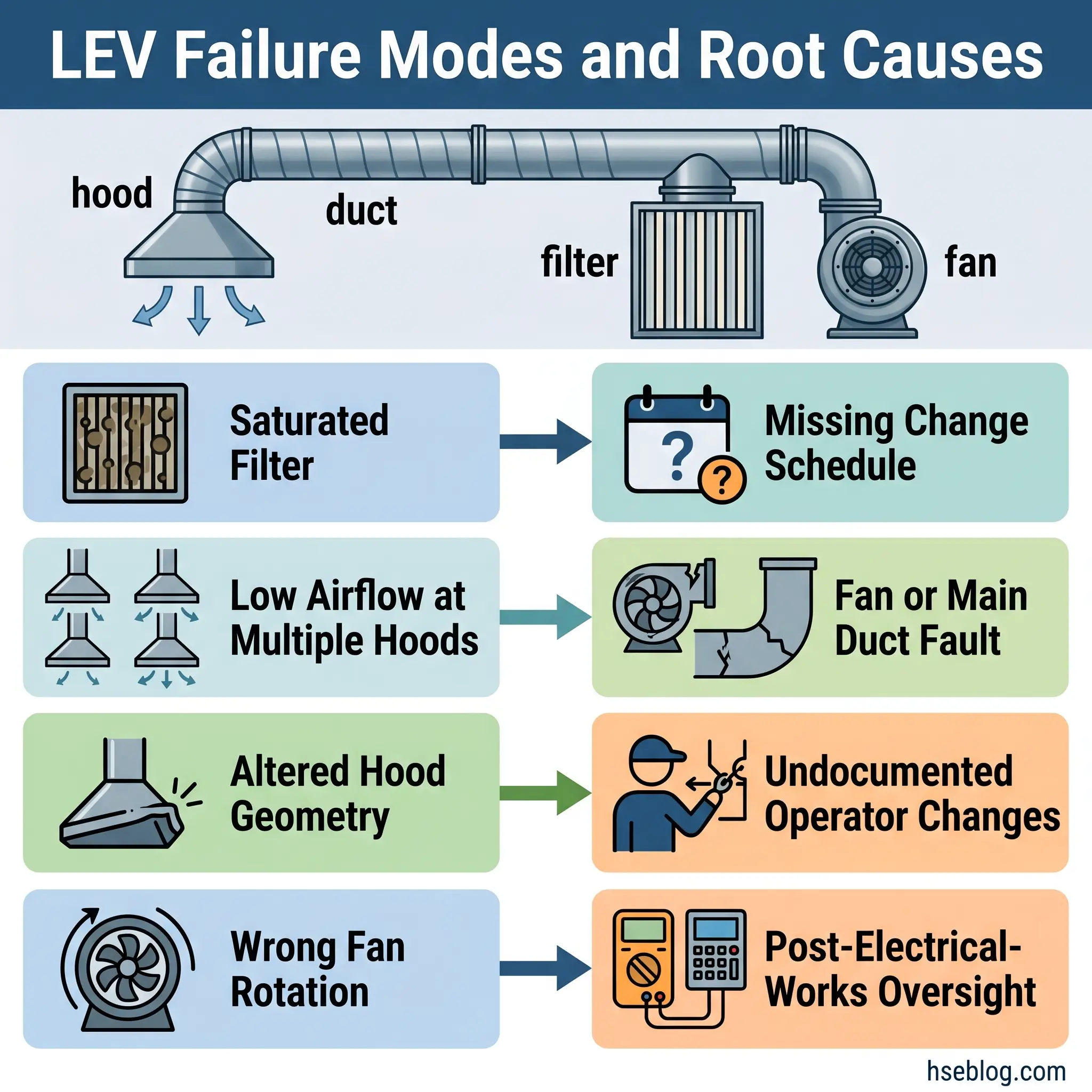
The diagnostic discipline is to read failures as a system, not a list. Treating symptom-by-symptom leads to repeat failures at the next test; identifying the common cause across multiple defects is where a P604-qualified engineer typically earns the fee.
LEV Record-Keeping: What to Keep, for How Long, and Why
The five-year retention rule under Regulation 9 is widely cited and inconsistently operationalised. The minimum is clear — TExT reports and related repair records must be kept for at least five years — but retention alone does not build a defensible position. Three record classes matter in an inspection:
| Record type | Minimum retention | Who holds the duty | Where to store |
|---|---|---|---|
| TExT reports and repair records | 5 years (Reg 9, COSHH 2002) | Employer | LEV logbook / accessible file |
| Commissioning reports, user manuals, design documentation | Life of equipment (best practice) | Employer | Equipment file; never discarded |
| Routine Reg 8 check records (logbook entries) | No prescribed period; 5 years typical | Employer | LEV logbook |
The sixth edition of L5 (HSE, 2013) is explicit that the employer, not the examiner or service provider, holds the record-keeping duty. A recurring issue flagged during inspections is records scattered across emails, filing cabinets and third-party contractor portals — a situation that can be benign operationally and still create an evidentially weak position. The defensible standard is retrievability in minutes, not days. A duty holder who can produce baseline, routine, TExT and remediation records inside a single meeting is in a materially different legal position from one who cannot.
COSHH LEV Duties in Enforcement and Occupational Lung Disease Context
The enforcement context is not theoretical. HSE’s Dust Kills campaign and the ongoing stone-worktop silica inspection initiative, active through 2024 and 2025, have put LEV, water suppression and RPE at the centre of site inspections in construction, stone fabrication and monumental masonry (HSE, 2025). In 2022/23, HSE carried out more than 1,000 woodworking inspections and reported a high proportion of inspected businesses failing to adequately control exposure to respiratory sensitisers (HSE, 2023). HSE further estimates that over 500 construction workers die each year in Great Britain from past exposure to silica dust (HSE, Dust Kills campaign materials, 2023–2024).
The wider public-health frame is the Occupational Lung Disease Statistics bulletin (HSE, 2025), which estimates approximately 11,000 lung disease deaths per year in Great Britain linked to past occupational exposure — dominated by COPD (around 35%), non-asbestos lung cancer, asbestos-related lung cancer and mesothelioma. These are long-latency diseases; the engineering controls that would have prevented them sat in workplaces twenty or thirty years ago. LEV running today is, in the same way, the preventive frontline for disease that will or will not manifest in the 2040s and 2050s.
Enforcement consequences run the full HSE range: improvement notices, prohibition notices, unlimited fines on conviction, and director-level liability under sections 2, 3 and 6 of the Health and Safety at Work etc. Act 1974. The pattern worth understanding is that the gap between “we test every 14 months” and “we can defend our control regime in an enforcement context” is wider than most duty holders assume. The documentation trail is what HSE actually inspects; the physical system is a secondary question once the records are weak.

Frequently Asked Questions
The Compliance Decisions That Matter
A defensible LEV compliance regime reduces to four decisions the duty holder makes and evidences. First, set the test interval correctly — 14 months only for systems outside Schedule 4, compressed intervals for Schedule 4 processes, and shorter still where risk assessment or HSG258 factors demand it. Second, select a competent examiner with direct experience on the specific system type, not on LEV in general. Third, maintain the Regulation 8 logbook as a continuously populated record, not a pre-inspection exercise.
Fourth, and most often the weak point, treat the TExT report as the opening of the remediation cycle rather than the closing of the test. Defects named in the report are actioned, retested and closed out in writing, with dated evidence in the same logbook. Closing that loop is the substantive difference between the duty holder who can produce a complete evidence pack inside a meeting and the one who cannot.
The common thread across each of these decisions is that LEV testing COSHH requirements are not a single event on a calendar. They are a continuous evidence cycle — Regulation 7 deciding the control, Regulation 8 running it, Regulation 9 validating it — and the cycle is what keeps the engineering controls preventing the lung disease that the 2025 HSE statistics are still counting thirty years later.