
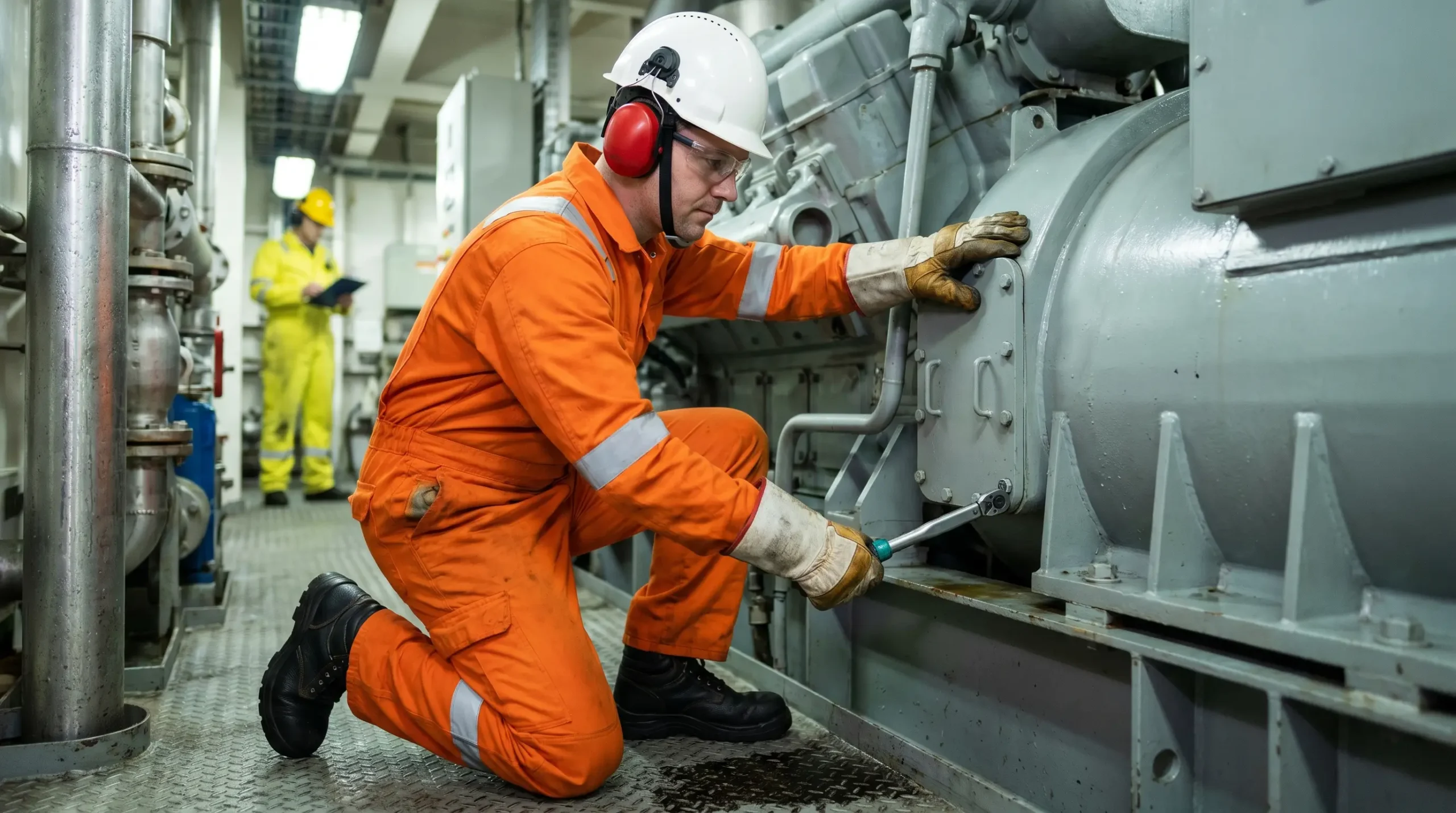
TL;DR
- 2,659 marine casualties and incidents were reported across EU member states in 2024 (EMSA, 2025) — near the 10-year average, with crew absorbing most of the injury load.
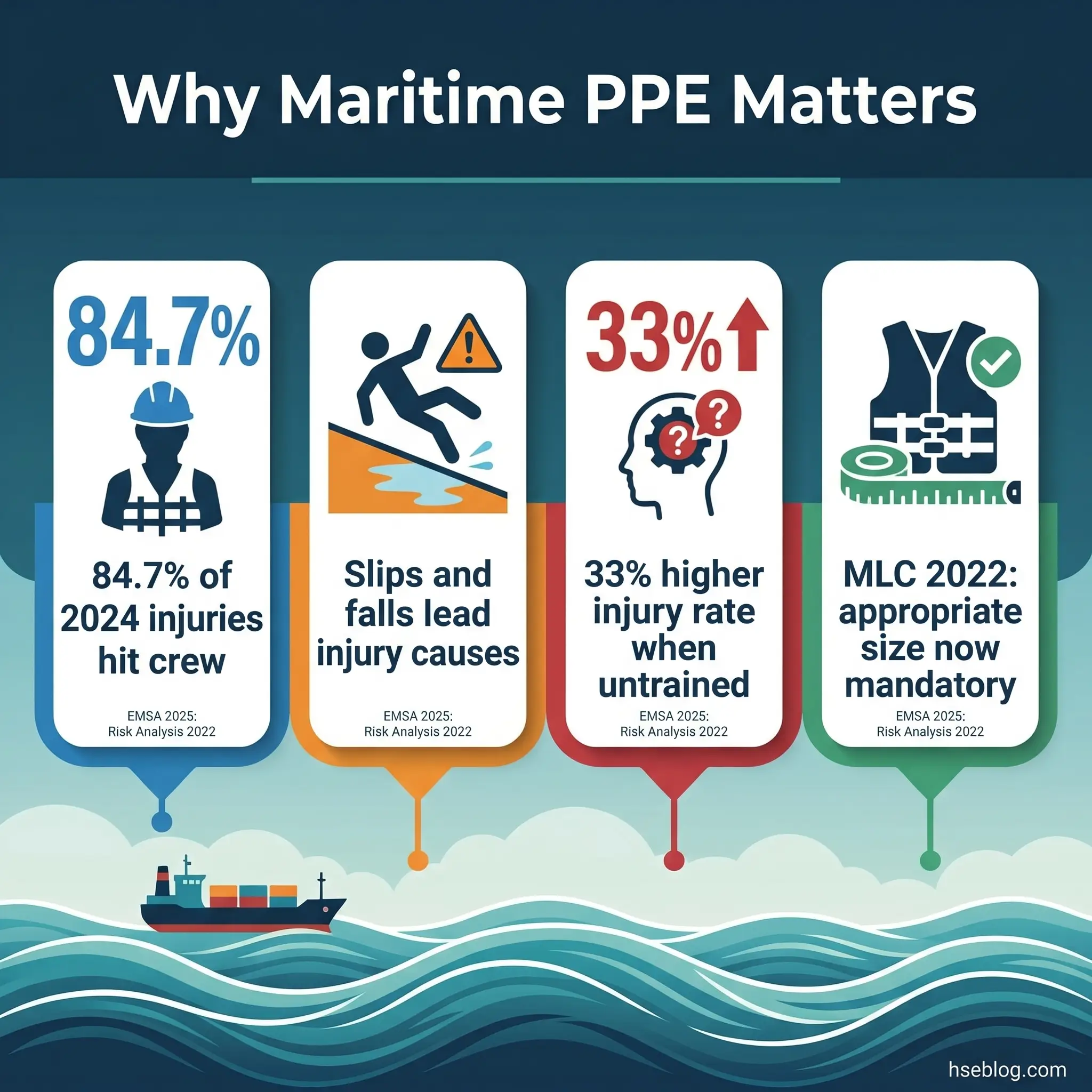
- 84.7% of maritime injuries in 2024 involved crew members (EMSA, 2025), making onboard PPE a frontline defense rather than a paperwork exercise.
- Falls from stumbling and slipping were the leading cause of both injuries and fatalities in person-related occurrences across 2015–2024 (EMSA, 2025), placing anti-slip footwear and fall protection above most other PPE categories in priority.
- MLC 2006 Standard A4.3 now mandates appropriately-sized PPE for every seafarer, following the 2022 amendments that entered force on 23 December 2024 (ILO).
Maritime PPE is the personal protective equipment shipowners are legally required to provide to seafarers under SOLAS, the MLC 2006, and the ISM Code. It covers head, eye, hearing, respiratory, hand, foot, body, and fall protection, plus lifesaving items such as SOLAS lifejackets and immersion suits — selected through documented hazard assessment for the specific task and environment.
Since 23 December 2024, one line of the Maritime Labour Convention has quietly reshaped how shipowners procure protective equipment: Standard A4.3, as amended in 2022, now requires personal protective equipment of “appropriate size” for every seafarer on board. For decades, the practical assumption on merchant vessels was that one set of sizing — predominantly designed for adult male frames — would serve any crew. That assumption is no longer defensible under the Convention, and flag states from the United Kingdom to Singapore are already building the requirement into their inspection protocols.
The shift matters because maritime PPE does not function like PPE on a factory floor. A seafarer who discovers, two days into a trans-Pacific voyage, that a harness will not tighten enough to secure them, or that safety boots slide off a wet ladder, has no supply store within reach. This article covers maritime PPE in depth: what the international and national regulations actually require, how PPE categories map onto shipboard hazards, how competent persons select equipment through hazard assessment, what maintenance and inspection look like at sea, and where port state control inspectors now focus their scrutiny.
What Is Maritime PPE and Why Does It Matter at Sea?
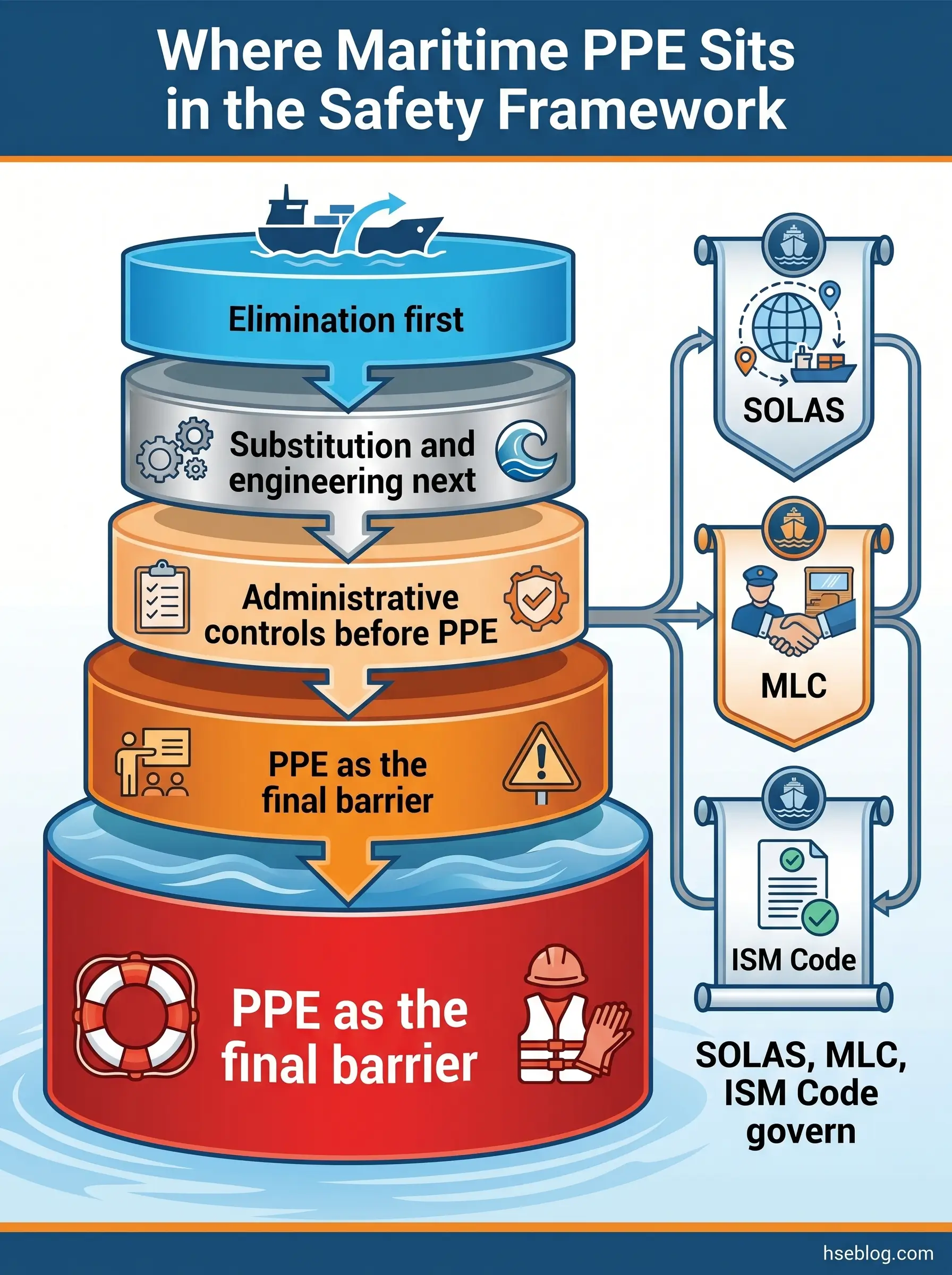
Maritime PPE is the final barrier in the hierarchy of controls — worn by seafarers to reduce exposure to hazards that cannot be eliminated through vessel design, engineering controls, or safe systems of work. Every PPE item is, by definition, a sign that an earlier control has reached its limit. That framing is important because it prevents a common misreading: that issuing PPE discharges the shipowner’s safety duty.
The maritime environment sharpens the demand on protective equipment in ways land-based HSE practitioners often underestimate. Salt spray, sustained humidity, and ultraviolet exposure accelerate the degradation of polymers, adhesives, and metal fasteners. Vessel motion affects how equipment fits and how reliably it stays in place during an emergency. And when equipment fails at sea, the gap to medical care is measured in hours or days, not minutes.
The regulatory architecture reflects this reality. SOLAS governs life-saving appliances under Chapter III; the MLC 2006 places the duty to provide occupational PPE on the shipowner under Regulation 4.3; the ISM Code requires the company safety management system to document how PPE is selected, inspected, and maintained. Three instruments, three purposes, one combined obligation — no seafarer should be sent into a foreseeable hazard without equipment fit for it.
A pattern worth naming: in practice, many vessels treat the PPE inventory as a fixed stores list rather than an output of ongoing hazard assessment. The same gloves issued for mooring end up being used for chemical cargo handling, because “those are the gloves we carry.” That is the exact failure mode the ISM Code’s safety management framework is designed to prevent.
Regulatory Framework: Who Requires What and Where
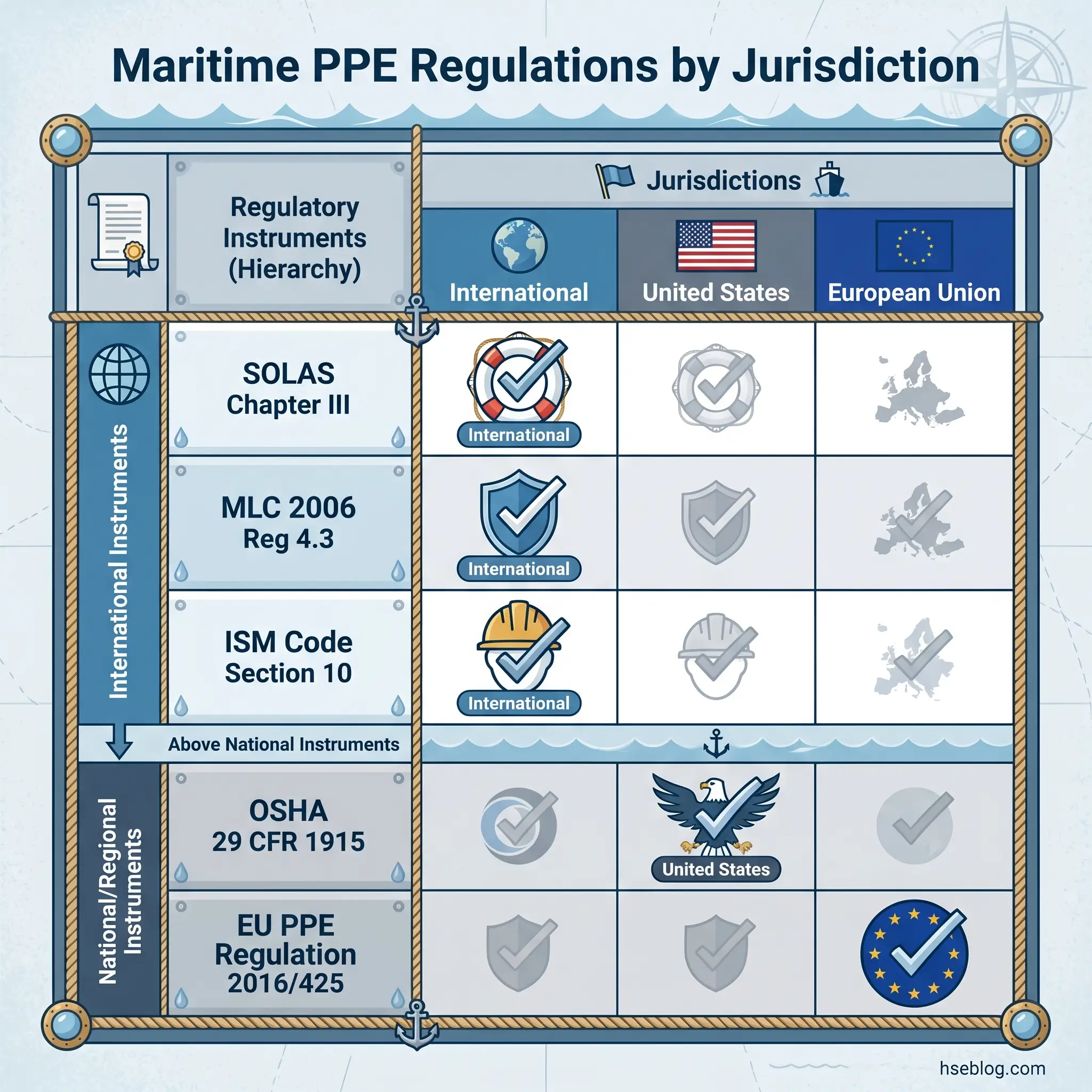
No single regulator governs PPE at sea. The framework is layered: international conventions set the baseline, flag state law implements them, and regional or national product standards (CE marking, ANSI, EN ISO) govern how specific equipment must perform.
At the international level, three instruments do most of the work. SOLAS 1974 Chapter III, with the LSA Code, mandates lifejackets, immersion suits, and thermal protective aids for emergency abandonment. The MLC 2006, under Regulation 4.3 and Standard A4.3, requires shipowners to provide PPE, conduct risk evaluations, and train seafarers in its use — a duty that now explicitly extends to appropriate sizing for the crew actually on board. The ISM Code, mandatory under SOLAS Chapter IX, requires the company safety management system to include procedures for PPE identification, maintenance, and training.
National layers add specificity. In the United States, the OSHA shipyard employment standards at 29 CFR 1915 Subpart I (§§1915.152–1915.160) govern PPE for shipyard employment, requiring a written workplace hazard assessment, employer-funded provision, and documented training. In the United Kingdom, the MCA implements PPE obligations through MSN 1870 (M+F) and related merchant shipping notices, with MGN 706 (M) setting out the UK approach to the MLC 2022 amendments. Across the European Union, Regulation 2016/425 requires that any PPE placed on the EU market — including equipment purchased for EU-flagged vessels — carry CE marking, be classified into risk categories (I, II, or III), and come with compliant documentation.
The practical reading of this stack matters. CE-marked PPE on the ship’s shelf does not, on its own, demonstrate compliance. Port state control officers increasingly look for the link between the documented hazard assessment, the PPE register, and the equipment physically available and correctly sized for the crew. Missing that chain of evidence is how well-stocked vessels still pick up PPE deficiencies.
| Instrument | Jurisdiction | Core PPE Obligation |
|---|---|---|
| SOLAS Ch III / LSA Code | International | Lifejackets, immersion suits, thermal protective aids |
| MLC 2006, Reg 4.3 / Std A4.3 | International | Appropriate, appropriately-sized PPE; risk evaluation; training |
| ISM Code, Section 10 | International | SMS procedures for PPE selection, inspection, maintenance |
| OSHA 29 CFR 1915 Subpart I | United States | Written hazard assessment; employer-funded PPE; training |
| MCA MSN 1870 (M+F) | United Kingdom | Implementation of PPE Regulations 1999 for seafarers |
| EU PPE Regulation 2016/425 | European Union | CE marking and risk classification for PPE on EU market |
Jurisdiction Note: Where international and national thresholds conflict — for example, hearing protection triggers at 85 dB(A) under the IMO Code on Noise Levels (Resolution MSC.337(91)) versus OSHA’s 90 dB(A) PEL — the stricter reference should govern PPE selection. OSHA’s own 85 dB(A) action level aligns with the IMO threshold.
How the MLC 2022 Amendments Changed PPE Requirements
The 2022 amendments to the MLC 2006, adopted by the International Labour Conference and entered into force on 23 December 2024, made two substantive changes to the PPE regime under Standard A4.3.
First, and most discussed: the standard now explicitly requires PPE of “appropriate size” for seafarers, recognising that the growing proportion of women in the maritime workforce — together with the reality that male crew also vary in build — had made one-size-fits-most provisioning unsafe. The ILO’s guidance on the amendment is clear that “appropriately-sized” is not aspirational language; shipowners are expected to stock a range of sizes for gloves, coveralls, harnesses, footwear, and respiratory protection.
Second, the amendments expanded mandatory reporting of seafarer fatalities to the ILO, creating a stronger evidence base for future safety standards.
The UK has operationalised the amendments through MGN 706 (M), which sets out how flag state surveyors and port state control officers should treat PPE-sizing deficiencies. A glove that is too large, a harness that cannot be tightened enough for a smaller crew member, or a pair of boots available only in one size are now directly auditable against the Convention — not as comfort complaints but as unsafe-condition findings. The further MLC amendments adopted at the ILO in 2025, expected to enter force in late 2027, are anticipated to reinforce the inclusive-PPE direction.
Types of Maritime PPE by Body Region
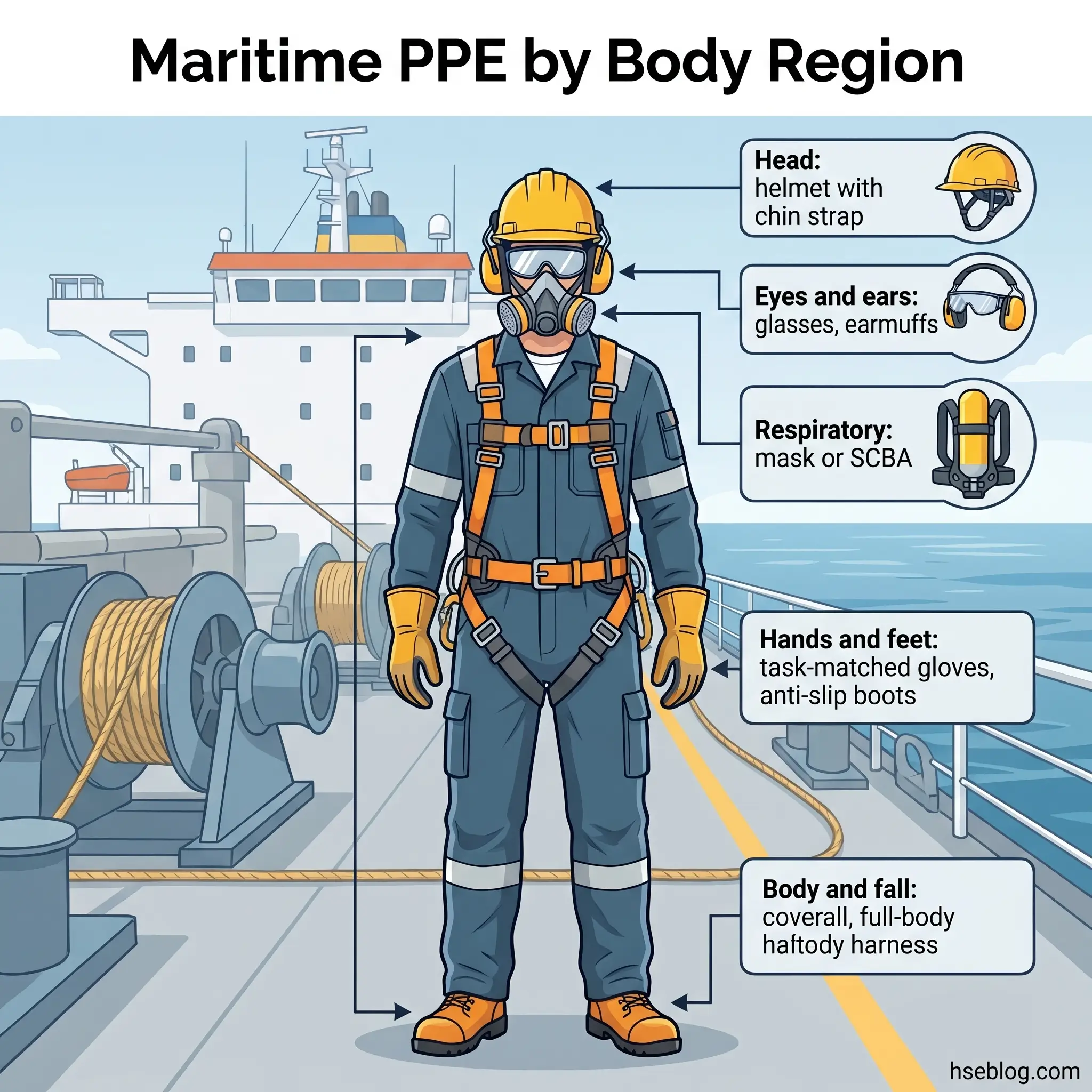
Organising PPE by the body region it protects — rather than by a flat numbered list — reflects how a hazard assessment actually proceeds. The competent person identifies hazards likely to affect a given body part, then selects equipment matched to those hazards and compliant with the applicable product standard.
Head Protection
Industrial safety helmets conforming to EN 397 (Europe) or ANSI/ISEA Z89.1 (US) are the baseline for deck, engine room, and cargo work. The maritime-specific consideration is the chin strap: vessels move, overhead hazards fall, and a helmet that cannot be retained during a sudden roll or impact offers limited value. Helmets exposed to constant UV and salt should be inspected for brittleness at least monthly and replaced in line with manufacturer shelf-life markings.
Eye and Face Protection
Safety glasses, goggles, and face shields cover impact, chemical splash, UV, and welding arc hazards. On deck, UV-filtering eyewear matters more than most crews recognise — reflected glare off the sea accelerates corneal damage. In the engine room, anti-fog coatings are operationally essential; fogged lenses get removed, and removed PPE protects nothing. Welding goggles and face shields are task-specific and should never be substituted by general-purpose safety glasses during hot work.
Hearing Protection
Engine rooms regularly produce sustained noise of 110 to 120 dB(A). The IMO Code on Noise Levels on Board Ships sets 85 dB(A) as the threshold requiring hearing protection — stricter than OSHA’s 90 dB(A) PEL and aligned with its 85 dB(A) action level. Earmuffs are typically preferable in engine spaces because they are easier to inspect visually and less prone to cross-contamination; earplugs work well for intermittent exposure when hygienically stored.
Respiratory Protection
The respiratory category spans disposable dust masks, half- and full-face air-purifying respirators, and self-contained breathing apparatus (SCBA) or airline systems for enclosed space entry and firefighting. Fit testing is the component most often skipped on ships — a respirator that seals poorly offers the user a false sense of protection. SCBA requires trained competence and is governed under SOLAS Chapter II-2 for firefighting and under IMO Resolution A.1050(27) and the 2022 enclosed space amendments for entry operations.
Hand Protection
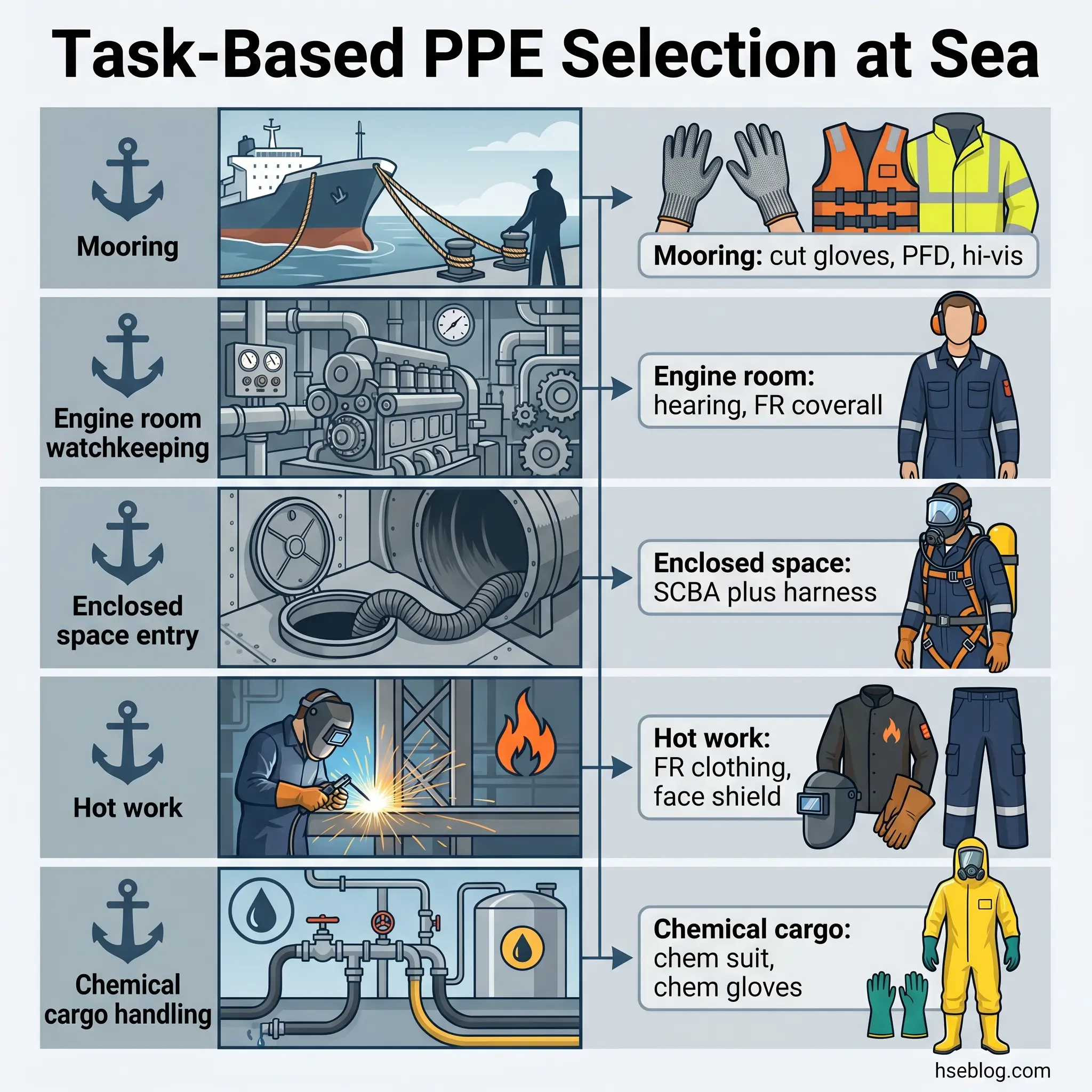
Hand protection is the category most abused by inventory simplification. A single glove type cannot cover mooring (cut and abrasion), chemical cargo handling (permeation and degradation), hot work (heat and spark), and electrical work (dielectric). Glove selection should be driven by task-specific risk assessment and matched to the applicable standard — EN 388 for mechanical risk, EN 374 for chemical risk, EN 407 for heat, EN 60903 for electrical work. Defaulting to one glove for all tasks is a documentable failure of the PPE hazard assessment.
Foot Protection
Safety boots for shipboard use should meet EN ISO 20345 (S3 or higher for deck work) or ASTM F2413, with anti-slip outsoles appropriate for wet, oily, and inclined surfaces. Ankle coverage matters because ladder and gangway use is constant; oil resistance matters because engine rooms demand it; penetration resistance matters because deck debris is unavoidable. Given that slips and stumbles remain the leading injury-causing event type across the 2015–2024 dataset (EMSA, 2025), the case for robust, well-maintained anti-slip footwear is empirical, not ornamental.
Body Protection
Coveralls and boiler suits provide the general-purpose base layer. Flame-retardant clothing to ISO 11612 is required for hot work and recommended for engine room watchkeeping. Chemical protective suits (EN 14605, EN 943) are task-specific and must be matched by permeation data to the cargo being handled. High-visibility garments to EN ISO 20471 improve visibility during night operations and pilot transfers.
Fall Protection
Full-body harnesses (EN 361 / ANSI Z359.11) with shock-absorbing lanyards (EN 355) are the standard for work at height, overside work, and certain enclosed space operations. A common and dangerous confusion is treating a personal flotation device as a substitute for fall protection when working overside; they serve different functions, and a PFD will not stop a fall onto a lower deck or into machinery. Harness webbing degrades faster on vessels in tropical routes where UV and salt spray combine, and replacement cycles calibrated for temperate operations are not always conservative enough for equatorial service.
Lifesaving PPE: Lifejackets, Immersion Suits, and PFDs
Lifesaving appliances are governed separately from occupational PPE because their purpose is survival after vessel abandonment, not injury prevention during routine work. SOLAS Chapter III and the LSA Code set the requirements: one SOLAS-approved lifejacket per person, with additional jackets at watchkeeping stations; immersion suits for each person on vessels operating in cold waters; and thermal protective aids on survival craft.
A SOLAS-approved lifejacket is not interchangeable with a work vest or personal flotation device. SOLAS lifejackets are designed to self-right an unconscious wearer, incorporate a light, a whistle, and retroreflective tape, and are certified against rigorous buoyancy and stability tests. PFDs — lighter and less restrictive — are appropriate for routine work near water during mooring, gangway watch, pilot transfer, or over-the-side operations in calm conditions. Wearing the wrong one in the wrong context is a documented deficiency; both should be available on board, with clear procedures governing which is used when.
Inspection schedules for lifesaving PPE are SOLAS-driven: annual servicing of inflatable lifejackets, routine deck inspection of immersion suits for seam integrity, and replacement triggered by any failed functional test or expired manufacturer date. Inflatable lifejackets with gas cylinders require particular attention; a cylinder that has been fired or partially discharged offers no protection.
How to Select the Right PPE: The Maritime Hazard Assessment Process
This article provides general HSE knowledge. Life-critical work such as enclosed space entry, work at height overside, and hot work aboard vessels must be planned and supervised by a competent person with relevant training, flag-state authorisation, and site-specific risk assessment. The information here does not replace that. Recognised training pathways include NEBOSH International Certificate, IOSH Managing Safely, OSHA maritime outreach programmes, and STCW-approved shipboard safety courses.
PPE selection that is not driven by hazard assessment is guesswork dressed as procedure. The ISM Code’s safety management system framework, read together with MLC Standard A4.3, requires shipowners to identify hazards, evaluate their likelihood and consequence, apply the hierarchy of controls, and — where residual risk remains — select PPE matched to the specific hazard.
The hierarchy matters because PPE is the last resort. Before issuing equipment, the competent person should ask whether the hazard can be eliminated (remove the task), substituted (replace a toxic cargo with a safer alternative), engineered out (local exhaust ventilation, machine guarding), or administratively controlled (procedures, permits, rotation). Only when these earlier controls are exhausted does PPE become the primary barrier, and the weaknesses of PPE as a control — dependent on human behaviour, fit, condition, and training — become the shipowner’s acceptable residual risk.
Shipboard PPE assessments differ by operational context. Deck operations during mooring demand cut-resistant gloves, anti-slip boots, hard hats with chin straps, high-visibility clothing, and PFDs when working near the rail. Engine room watchkeeping demands flame-retardant coveralls, hearing protection, safety glasses with anti-fog, steel-toe oil-resistant boots, and task-specific gloves. Enclosed space entry — governed by SOLAS Regulation XI-1/7 and its supporting resolutions — requires SCBA or airline breathing apparatus, a full-body harness with rescue line, a calibrated gas detector, and coordinated rescue arrangements before entry.
The output of the assessment is not just a list of PPE; it is a documented rationale linking each identified hazard to selected equipment, the applicable product standard, and the associated training requirement. That documentation is what separates a compliant SMS from one that will fail PSC scrutiny.
Audit Point: PSC officers frequently test the link between the hazard assessment and the PPE register by asking a seafarer which glove is correct for a named cargo or task. A correct product answer with no matching entry in the assessment — or an assessment with no matching item in stock — counts as a deficiency.
A pattern worth flagging: PPE hazard assessments are often completed once during initial SMS setup and then never revisited. New cargo types, new crew demographics, new equipment onboard, and new regulatory requirements (such as the 2022 MLC amendments on sizing) should all trigger reassessment. A static assessment in a changing operational environment is not an assessment; it is an artefact.
PPE Maintenance, Inspection, and Replacement at Sea
The shipboard environment is harder on PPE than most industrial settings. Salt accelerates corrosion of metal buckles and D-rings. Humidity degrades natural rubber and certain elastomers. Ultraviolet exposure embrittles polymer components, particularly webbing. Storage space is constrained, meaning equipment often shares lockers with cleaning chemicals or hot work fuel — both of which cause further damage.
Effective maintenance rests on two inspection regimes working together: formal monthly inspection by the Safety Officer or a designated competent person, and pre-use checks by the individual seafarer. The formal inspection documents condition against a checklist; the pre-use check catches damage that occurred since the last formal inspection. Neither replaces the other.
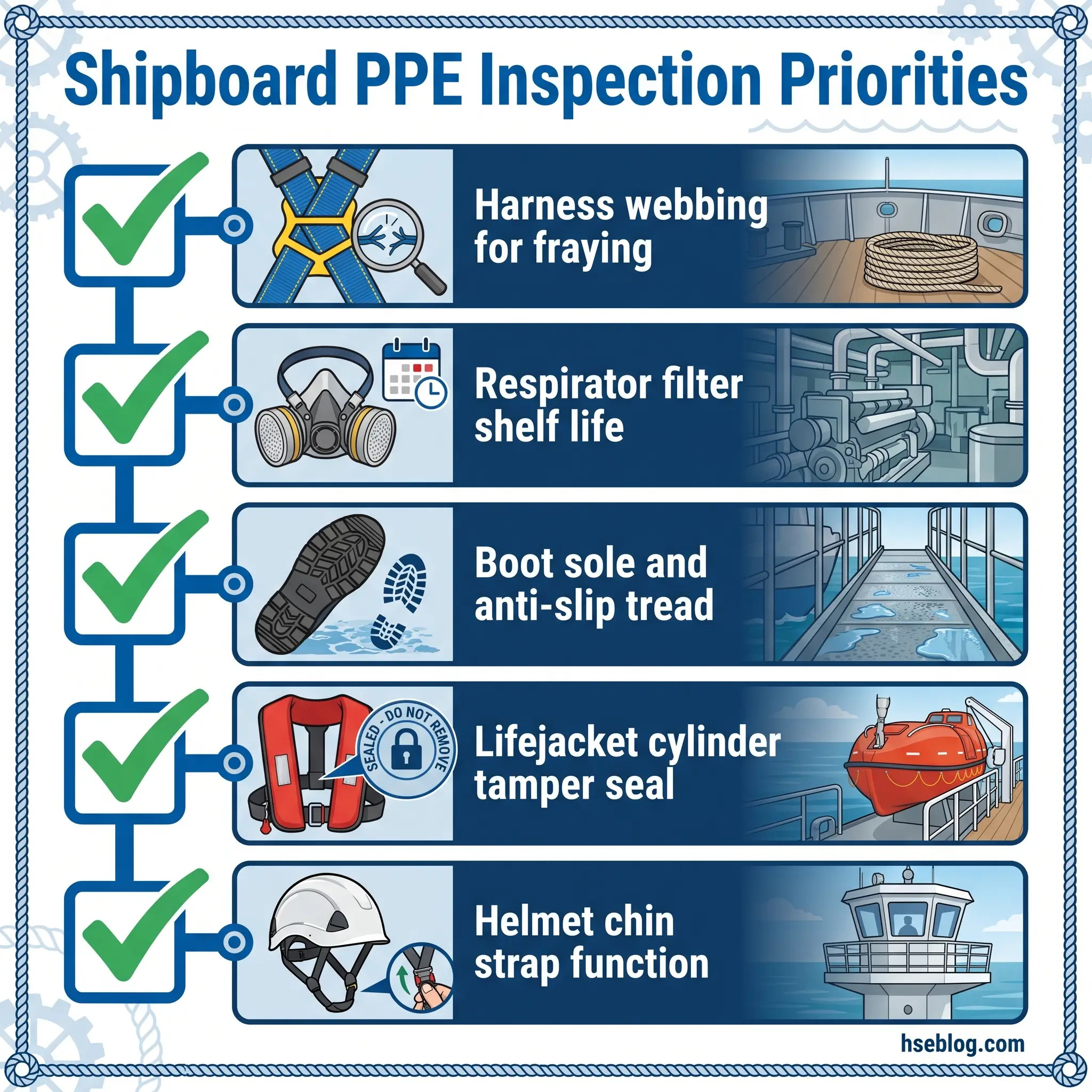
Replacement triggers include visible damage (cuts, abrasion, discoloration), expired shelf life (particularly respiratory filters, harness webbing, and SOLAS-approved items), contamination (chemical saturation, biological exposure), and failed functional test (buckles that will not engage, harness legs that will not adjust, respirators that fail a seal check). Record-keeping under both the ISM Code and MLC requires inspection results and replacement actions to be logged and retained.
The tropical-route pattern is worth naming explicitly: a harness webbing replacement cycle calibrated for vessels operating in the North Atlantic may be dangerously inadequate for a vessel spending its operational life in equatorial waters, where UV and salt combine to degrade webbing far faster. Manufacturer guidance should be treated as a ceiling, not a floor, in high-exposure routes.
Watch For: Expired respirator filters still fitted to the regulator, harness webbing with visible fraying but still in service, inflatable lifejacket cylinders missing their tamper seals, and safety boots with worn-through anti-slip tread. Each of these is both an equipment failure and a failure of the inspection regime.
PPE Training and Compliance Culture Onboard
PPE that is available but not used protects no one. The human element is central to PPE effectiveness, and the published record makes it quantifiable: research referenced in Sea Technology Magazine (2022–2023), drawing on a study in Risk Analysis, found that roughly 4% of maritime workers reported never receiving proper PPE training, and untrained workers showed a 33% higher injury rate than trained peers. Training is not a formality; it is a measurable determinant of injury outcome.
Training obligations under the MLC (Standard A4.3) and STCW extend beyond handing a worker a manual. Effective PPE training covers: why the equipment is required for a specific task (hazard mechanism), how to don and adjust it correctly (including fit checks for respirators and harnesses), how to inspect it before use, how to store it, and when to report or reject damaged equipment. Toolbox talks, safety drills, and competency assessments reinforce the training and should be documented as part of the SMS. Recognised formal training pathways — NEBOSH, IOSH, OSHA maritime outreach, and STCW-approved shipboard safety courses — provide a structured foundation that individual vessel inductions can build on.
Compliance culture is shaped from the top. When masters and senior officers enforce PPE rules for ratings during cargo operations but relax their own compliance during routine deck walks, the inconsistency is visible to every crew member and corrosive to the safety culture. The same principle applies to shore-based managers who tour a vessel without the PPE they require of the crew. Safety cultures that survive PSC scrutiny and casualty investigation are built on consistent, visible compliance at every rank.
Resistance to PPE use follows predictable patterns: discomfort (heat, restriction of movement), perception that the hazard is not serious enough, peer culture that treats PPE as a sign of inexperience, and — in some cases — PPE that genuinely does not fit. The 2022 MLC amendments on appropriate sizing address the last of these; the others require ongoing attention from the Safety Officer and senior leadership.
Common PPE Deficiencies Found During Port State Control Inspections
Port state control inspectors across the Tokyo and Paris MOU regions, the US Coast Guard, and other regimes follow broadly similar lines of enquiry when assessing PPE compliance. Understanding what they look for helps vessels prepare — and more importantly, helps crews identify gaps before an inspection rather than during one.
Common deficiency patterns include:
- Missing or incomplete PPE register — no documented list of PPE onboard, or a register that does not match physical stock. The register should link to the hazard assessment and the SMS.
- Damaged, expired, or incorrectly sized equipment — harness webbing with fraying, respirator filters beyond shelf life, gloves with chemical contamination, boots with failed soles. Post-MLC 2022, lack of a size range to accommodate the actual crew is now explicitly auditable.
- Absence of documented hazard assessment linked to PPE selection — CE-marked or standard-compliant equipment on board but no record showing how it was selected for the operational hazards. Product certification alone does not close this gap.
- Crew unable to demonstrate knowledge of PPE use during drills — a seafarer who cannot perform a harness donning check or a respirator fit check, or who cannot explain when a SOLAS lifejacket is worn versus a PFD, indicates a training deficiency regardless of paper records.
- Inconsistent maintenance and inspection records — logs with gaps, inspections signed by persons not designated as competent, or replacement dates that do not match manufacturer shelf life.
The underlying pattern across these findings is the same: PPE treated as an inventory item rather than an active element of the safety management system. Closing the gap requires the documented chain — hazard assessment → PPE selection → provision in appropriate sizes → training → inspection and maintenance → replacement — to be visible, current, and consistent with the operational reality of the vessel. EMSA’s published casualty overviews, available through the agency’s annual casualty publications portal, are a useful reference for understanding which injury patterns current PPE regimes are failing to prevent.
Frequently Asked Questions
Why Maritime PPE Decisions Carry More Weight Than Most Know
The case for maritime PPE is written in casualty data, not slogans. Between 2015 and 2024, 609 lives were lost across 416 marine casualties in EU member state waters alone (EMSA, 2025); 84.7% of injuries in 2024 fell on crew members (EMSA, 2025); and slips and stumbles remained the leading cause of both injury and fatality in person-related occurrences across the same decade. These are the outcomes PPE is designed to intervene in — not abstractly, but at the specific point where a boot loses grip on a wet ladder, a harness arrests a fall over the rail, or a respirator keeps cargo vapour out of a lung.
The seafarer’s position is unlike that of a land-based worker. When equipment fails at sea, the fallback is not a nearby hospital or a replacement from a regional stockroom; the fallback is whatever else is on the vessel and whatever competence the crew has to use it. That reality places an unusual weight on the decisions shipowners, masters, and Safety Officers make about maritime PPE — which equipment to stock, in what sizes, how often to inspect and replace it, and how to train the people who will depend on it.
The gap between compliant vessels and exposed ones is rarely a gap in budget or in product catalogue. It is a gap in the documented chain — hazard assessment, selection, provision in appropriate sizes, training, inspection, replacement — that the MLC, SOLAS, and the ISM Code together require. Closing that gap is not a paperwork project; it is how the people on board go home.