

TL;DR
- If you employ anyone under 18 — or under 25 in some Canadian provinces — specific legal duties activate that don’t apply to your general workforce: pre-start risk assessment, prohibited-work compliance, and hours and night-work limits.
- If your existing risk assessment doesn’t already account for inexperience and immaturity, a young person’s risk assessment must be completed before the worker starts, under MHSWR 1999 Reg 19 (UK) and Directive 94/33/EC (EU).
- If a 16–17 year-old will operate a meat slicer, paper baler, forklift, or work on a roof, the work is prohibited under 29 CFR Part 570 Subpart E (US) and the equivalent UK and EU restrictions — regardless of parental consent.
- If you employ minors in the US, recent DOL Wage and Hour enforcement assesses civil money penalties per violation rather than per child. FY 2024 totals reached $15.1 million — an 89% year-over-year increase (US Department of Labor, 2025).
Employers of workers under 18 — and under 25 in some jurisdictions — owe specific legal duties beyond general worker safety. These include a pre-start young person’s risk assessment, prohibited-work compliance, and proportionate-to-inexperience supervision under MHSWR 1999 Reg 19 (UK), Directive 94/33/EC (EU), the FLSA Hazardous Occupations Orders at 29 CFR Part 570 Subpart E (US), and provincial OHS regulation in Canada.
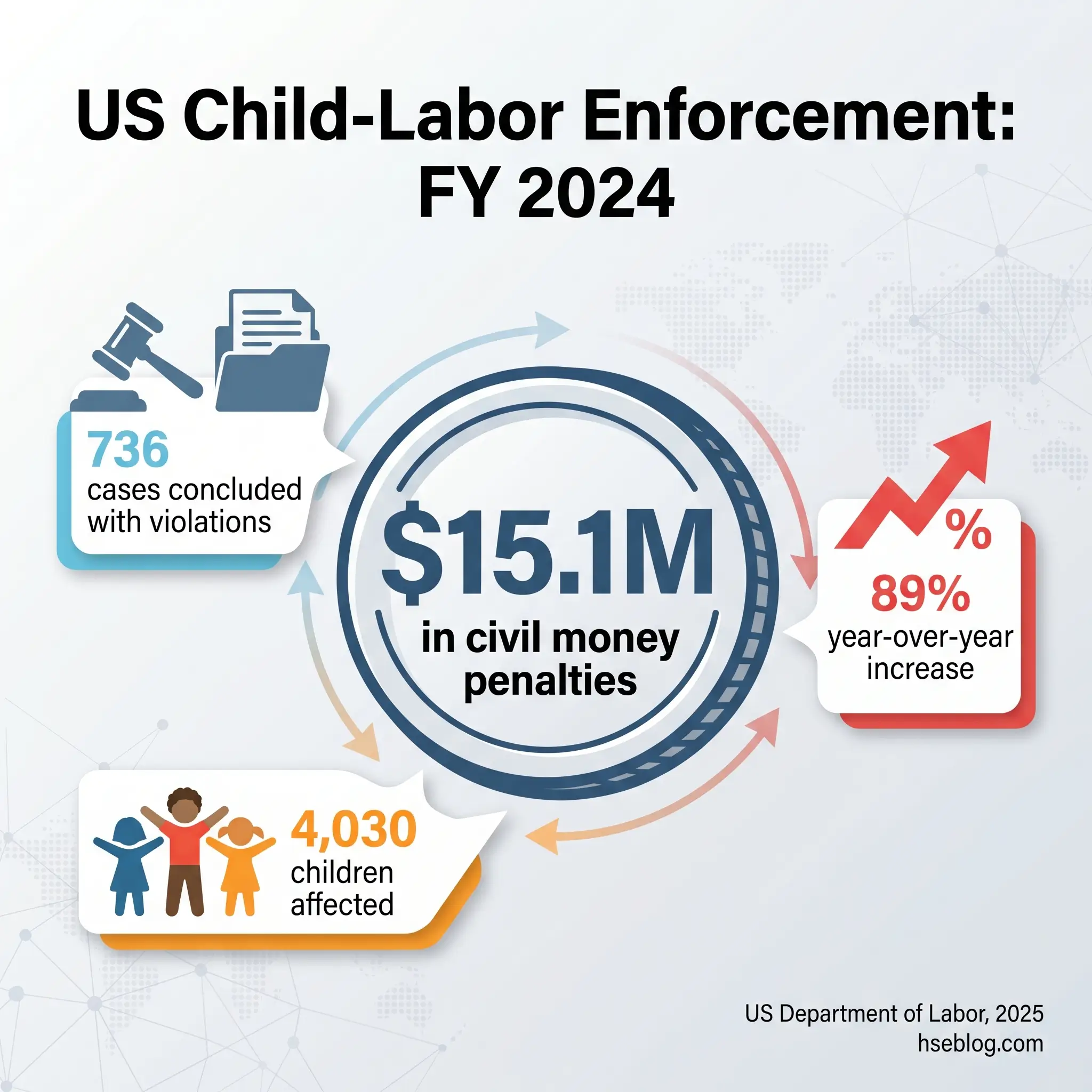
In FY 2024, the US Department of Labor’s Wage and Hour Division concluded 736 child-labor cases involving violations affecting 4,030 children and assessed $15.1 million in civil money penalties — an 89% year-over-year increase, with more than 1,000 open investigations as of January 2025 (US Department of Labor, 2025). The shift behind those numbers is structural rather than cyclical. A November 2023 Field Assistance Bulletin moved CMP assessment from per-child to per-violation, and the “hot goods” injunction has returned as an active enforcement tool. For employers, this re-prices an old compliance question.
Young workers safety is no longer a footnote in the staff handbook. It is a distinct duty stream with its own pre-start procedure, prohibited-work list, and enforcement profile across the UK, EU, US, and Canada. Misclassifying it as ordinary new-starter onboarding has become one of the more expensive errors an employer can make. This article maps the legal duties that apply when you employ anyone under 18 — or under 25 in parts of Canada — walks through the young person’s risk assessment in operational terms, and shows where the recent enforcement shift has changed the compliance arithmetic.
Why Young Workers Are a Distinct Safety Population — Not Just “New Starters”
The four major regulatory regimes — UK, EU, US, and Canadian provincial — converge on the same underlying rationale. Young workers face elevated risk from a combination of factors that don’t apply to experienced adults: inexperience, lack of hazard awareness, incomplete physical and psychological maturity, and a disproportionate eagerness to please that suppresses willingness to raise safety concerns. The legislative response across all four jurisdictions is therefore protective, not just preventive.
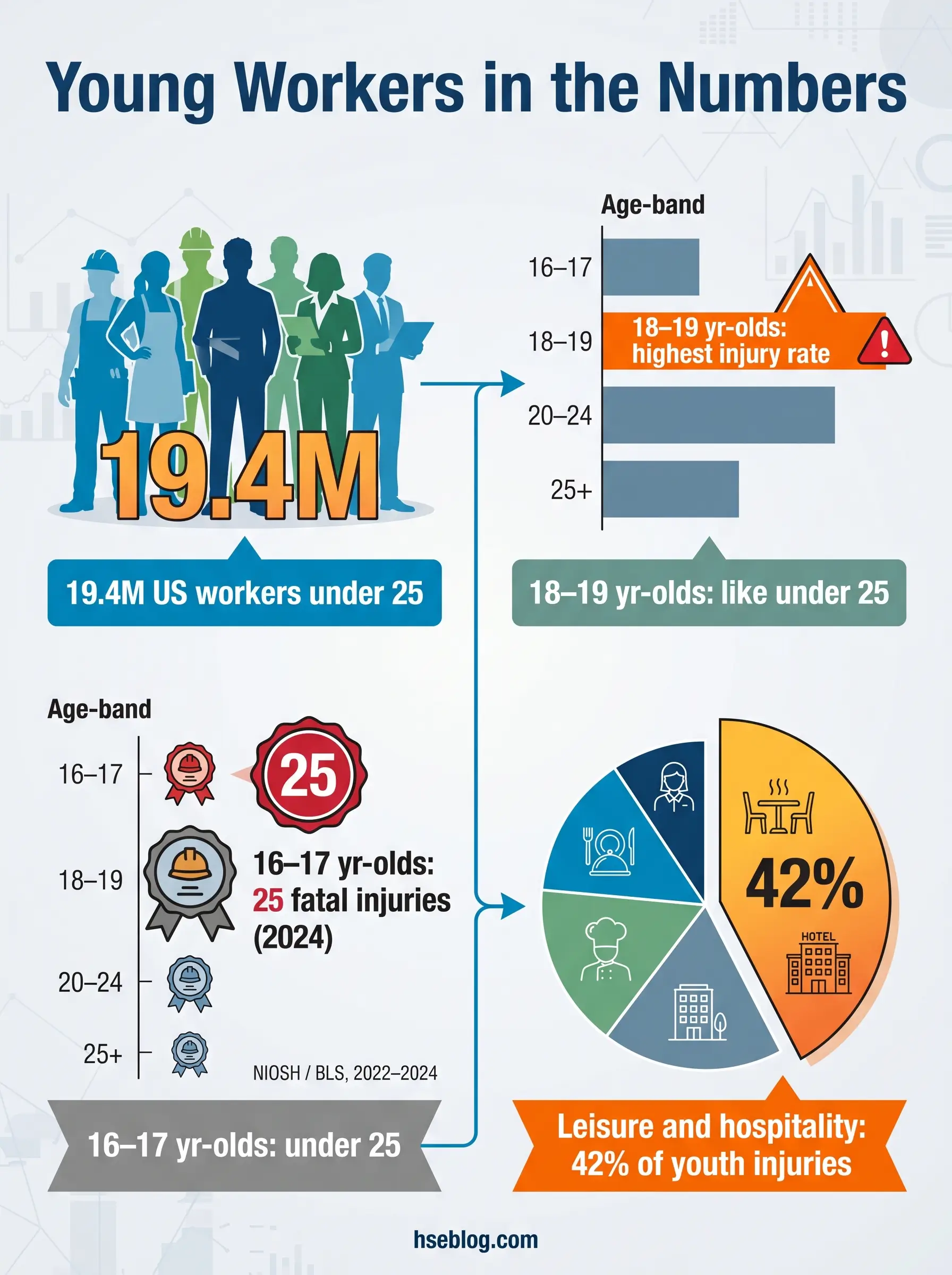
The data supports the regulatory position. In the US, BLS recorded 25 fatal occupational injuries among 16–17 year-olds, 66 among 18–19 year-olds, and 314 among 20–24 year-olds in 2024 (US Bureau of Labor Statistics, 2026). NIOSH analysis of NEISS-Work data indicates approximately 26,900 emergency-department-treated work injuries among 15–17 year-olds in 2022 alone (CDC NIOSH, 2024). The rate picture sharpens further: 18–19 year-olds carried 404 ED-treated injuries per 10,000 full-time-equivalent workers in the 2012–2018 dataset — the highest rate of any working-age band examined (CDC, MMWR 2020). The European pattern is consistent. EU-OSHA estimates 18–24 year-olds experience a work-injury rate roughly 50% higher than older age groups (European Agency for Safety and Health at Work).
The “first six months on the job” pattern applies to any new starter, but it sharpens for young workers because the inexperience is compound — new to the job, new to the workplace, and often new to working life entirely. Reviewing the published patterns, organisations frequently treat the young-worker risk profile as a training problem when it is, structurally, a supervision-density problem. The same training delivered to two workers will land differently depending on whether someone is checking comprehension on the floor or only on the LMS dashboard.
Sectoral concentration matters too. In 2020, leisure and hospitality alone accounted for 42% of reported youth injuries and illnesses requiring at least a day away from work in the US (CDC NIOSH, 2024). That single statistic shapes which industries should expect the highest scrutiny — and where the duty-of-care failures cluster.
Who Counts as a “Young Worker”? Definitions Across Jurisdictions
Resolving the definitional question first matters because the answer changes which duties apply.
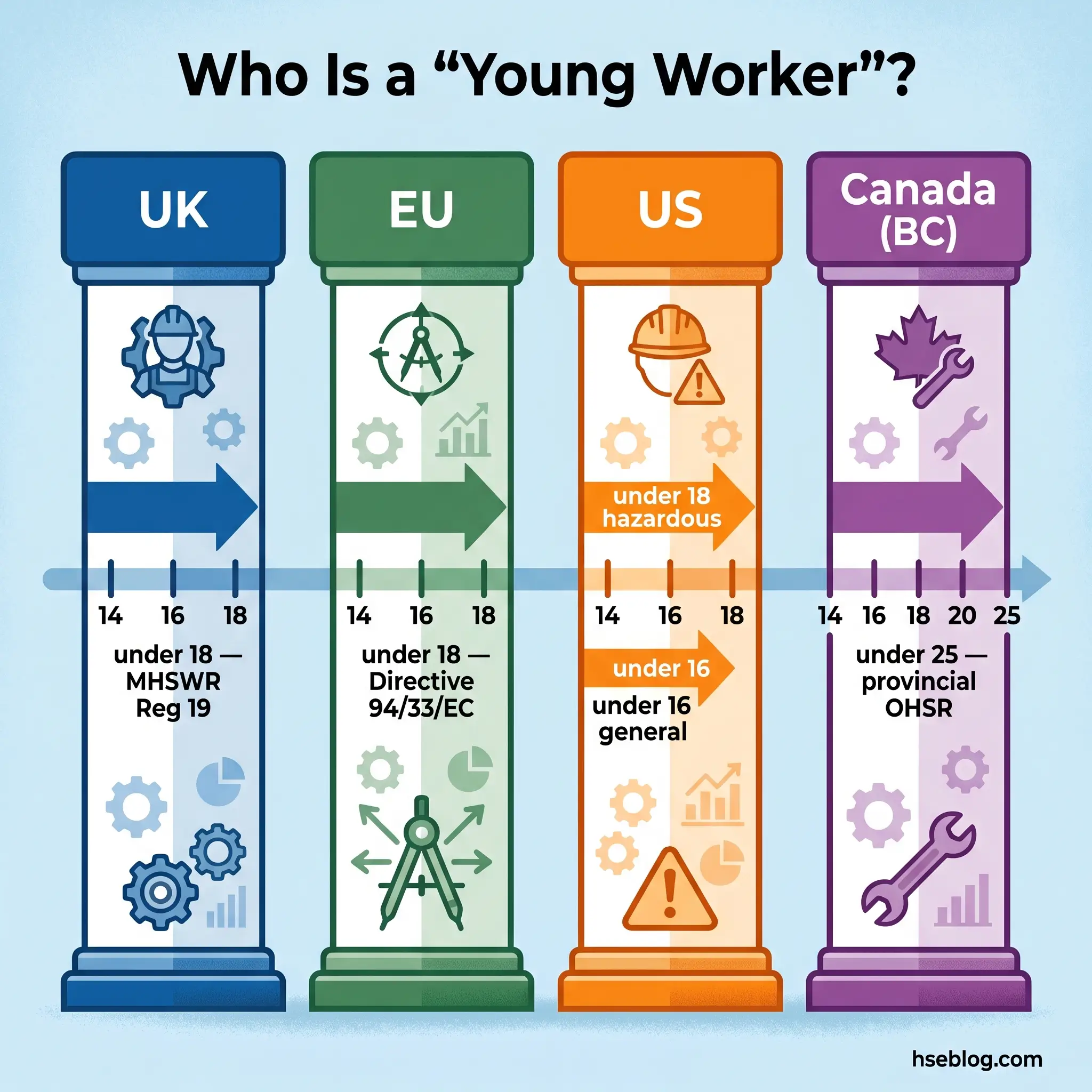
In the UK, MHSWR 1999 defines a “young person” as anyone under 18, with a separate “child” category for those below the minimum school leaving age — the school year in which they turn 16. The EU framework under Council Directive 94/33/EC mirrors that structure: “young person” under 18, with distinct child and adolescent categories.
The US has no single statutory “young worker” term. Federal child labor provisions under the FLSA and 29 CFR Part 570 cover under-18s in declared hazardous occupations, with broader restrictions for under-16s and separate agricultural rules. OSHA and NIOSH use “young workers” administratively to mean under-25 or under-24 for statistical purposes. Canada is provincial: WorkSafeBC’s Occupational Health and Safety Regulation defines “young worker” as anyone under 25, alongside a separate “new worker” category that applies regardless of age. The ILO uses 15–24 as its international framing.
A recurring misclassification appears in multinational organisations: a UK-trained safety lead applies the under-18 lens to a US site and misses the under-25 protective programming OSHA and NIOSH frame their guidance around. Or the inverse — a US-led group treats UK 17-year-olds as adults because federal FLSA permits hours that the Working Time Regulations 1998 prohibit. The article you’re reading uses “young worker” in the broadest sense, but each duty cited names its own age trigger.
| Jurisdiction | Term | Age band | Source instrument |
|---|---|---|---|
| UK | Young person / child | Under 18 / below MSLA | MHSWR 1999 Reg 19 |
| EU | Young person / child / adolescent | Under 18 | Directive 94/33/EC |
| US (federal) | Minor / oppressive child labor | Under 18 (HOs); under 16 (general) | FLSA, 29 CFR Part 570 |
| US (administrative) | Young workers | Under 25 / under 24 | OSHA / NIOSH framing |
| Canada (BC) | Young worker / new worker | Under 25 / any age | OHSR (provincial) |
| ILO | Young workers | 15–24 | International framing |
Legal Duties of Employers: A Jurisdiction-by-Jurisdiction Map
Each duty stream operates separately, even when they overlap on the same site. Treating them as a single unified regime is one of the cleaner ways to fail an inspection.
United Kingdom: MHSWR 1999 Regulation 19 and the Working Time Regulations 1998
When employing a young person, MHSWR 1999 Reg 19 requires the employer to ensure protection from risks consequent on inexperience, lack of risk awareness, or immaturity. The Regulation goes further, prohibiting employment of young persons for work beyond their physical or psychological capacity, work involving harmful exposure to specified agents (toxic, carcinogenic, mutagenic, ionising radiation), or work carrying accident risks they cannot reasonably recognise because of insufficient attention to safety or limited experience. Reg 19 transposes Directive 94/33/EC into UK law and requires the employer to take account of risk-assessment factors before the young person starts.
The Working Time Regulations 1998 add a separate hours-of-work duty: a maximum of 8 hours per day and 40 hours per week for workers above MSLA but under 18, a 30-minute rest break if work exceeds 4.5 hours, two days off per week, and night-work restrictions normally between 10pm and 6am.
European Union: Council Directive 94/33/EC
The Directive is binding on Member States and sets the protective floor — domestic law cannot fall below it. Article 6 mandates a pre-employment risk assessment that specifically considers young persons’ inexperience, the fitting-out of the workstation, the nature and duration of exposures, work equipment, organisation of work, and training content. The Annex prohibits exposure to specific physical, biological, and chemical agents — including biological agents in risk groups 3 and 4, ionising radiation above limits, and high-pressure atmosphere work. Directive 2014/27/EU updated the Annex to align with the CLP Regulation classifications.
United States: FLSA Child Labor Provisions, 29 CFR Part 570, and the OSH Act
Two duty streams apply simultaneously and competitor content routinely conflates them. The first is the FLSA child-labor regime — hours, age limits, and the 17 Hazardous Occupations Orders at 29 CFR Part 570 Subpart E — enforced by the DOL Wage and Hour Division. The second is the OSH Act §5 General Duty Clause obligation to provide a workplace free from recognised hazards likely to cause death or serious physical harm, enforced by OSHA. Both apply to every minor on every covered worksite. Where a state OSHA plan or state child-labor law is more protective than the federal floor, the more protective standard governs (29 CFR 570.50). The whistleblower provision at OSH Act §11(c) protects young workers who exercise their rights under the Act, which matters because young workers consistently underuse the right to refuse unsafe work.
Canada (Illustrative): Provincial OHS Regulations
Canadian duties are provincial. WorkSafeBC’s Occupational Health and Safety Regulation requires an orientation and training programme for both young workers (under 25) and new workers, with prescribed content covering hazards, controls, emergency procedures, the right to refuse unsafe work, and supervisor identification. Alberta and Ontario operate equivalent young-worker frameworks under their respective OHS legislation. The article cannot make a national Canadian statement; the duties must be read province by province.
The recurring failure across all four regimes: employers treat the pre-start risk assessment as a paper exercise filed once and never revisited. Both MHSWR Reg 19 and Directive 94/33/EC anticipate review when conditions change — new equipment, new role, change in the young person’s capability — and the FLSA framework operates the same way in practice when DOL investigators review whether a Hazardous Occupations Order applies to current duties.
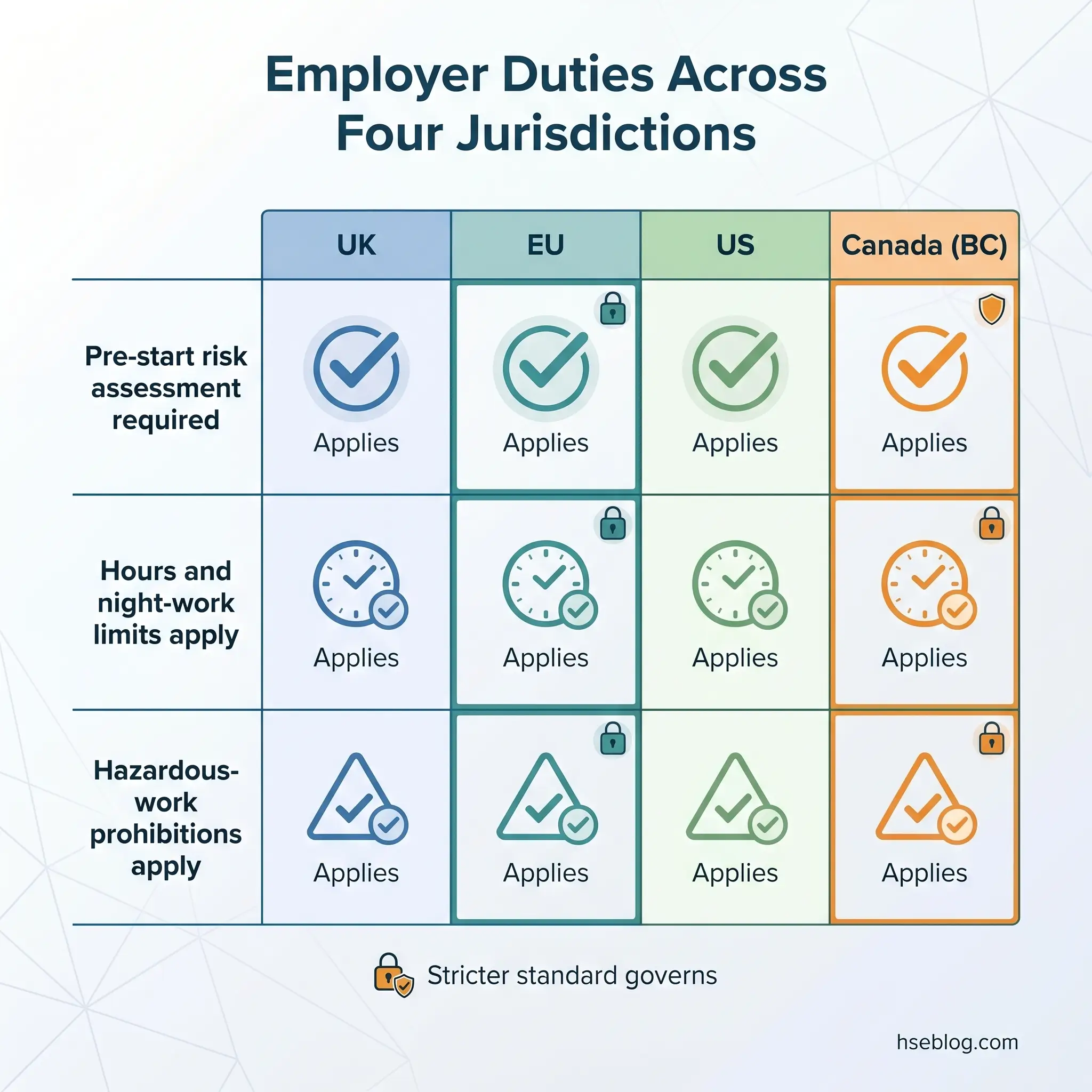
| Jurisdiction | Source instrument | Age trigger | Pre-start RA required? | Hours / night-work limits? | Hazardous-work prohibitions? |
|---|---|---|---|---|---|
| UK | MHSWR 1999 Reg 19 + WTR 1998 | Under 18 | Yes | Yes (8/day, 40/week, night) | Yes |
| EU | Directive 94/33/EC | Under 18 | Yes | Yes (Member State) | Yes (Annex) |
| US | FLSA + 29 CFR 570 + OSH Act §5 | Under 18 (HOs); 16 (general) | Functionally required to verify HO compliance | Yes (under 16); state-specific (16–17) | Yes (17 HOs) |
| Canada (BC) | OHSR Part 3 | Under 25 (orientation) | Yes (orientation/training) | Provincial | Provincial |
Conducting a Young Person’s Risk Assessment: The Procedure
Moving from law to operations: when you sit down to perform or review the assessment, what does the procedure actually look like?
The trigger is the first question. A fresh assessment is required when you’re employing a young person for the first time, when the young person has particular needs — a disability, a known health condition, a capability limitation — or when conditions change significantly. Where your existing workplace risk assessment already accounts for young-person factors and the new starter’s maturity profile is similar, HSE’s position is that no separate assessment is required. But the existing assessment must genuinely consider those factors, not merely employ them as a tickbox heading.
The mandated factors to consider — under Directive 94/33/EC Article 6 and MHSWR Reg 19:
Watch For Inexperience and lack of risk awareness; fitting-out and layout of the workplace and workstation; nature, degree, and duration of exposure to physical, biological, and chemical agents; work equipment and how it is used; organisation of work; level and content of training and instruction.
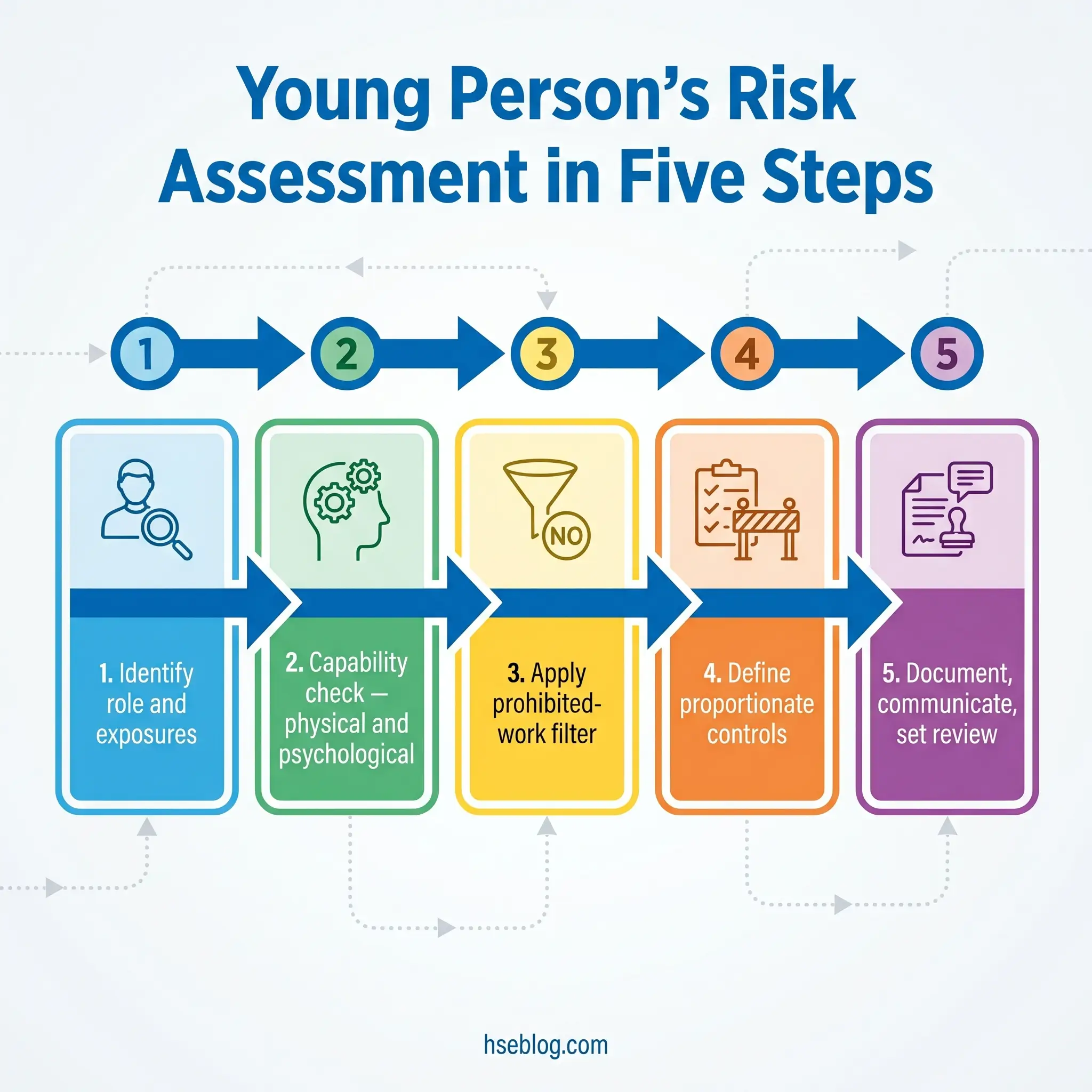
In practice the assessment runs through five operational steps:
- Identify the young person’s role and exposures. Map actual tasks, not job titles — a kitchen porter on paper may be cleaning a meat slicer in fact, which engages HO 10 in the US framework and the Annex chemical-agent restrictions in the UK and EU.
- Run the capability check. Physical maturity (manual handling weights, posture, reach) and psychological maturity (decision-making under pressure, ability to refuse unsafe work, comfort raising concerns).
- Apply the prohibited-work filter. Cross-check the task list against the 17 HOs (US), Annex prohibitions (EU/UK), and any provincial restrictions (Canada). If a task fails the filter, it is removed from the role — not “controlled.”
- Define proportionate-to-inexperience controls. Supervision density, mentor assignment, restricted access to higher-risk tasks until competence is verified, comprehension-checked induction.
- Document, communicate, and set the review trigger. Document the assessment (UK micro-employers under five employees are exempt from written RAs but should still keep a record); communicate findings to the young person and, for under-MSLA work-experience students, to parents or guardians.
The most common defect in young-person assessments: the “young person factors” appear in the assessment narrative but never alter the control measures. The document notes immaturity and inexperience, then lists controls identical to those for a 40-year-old. A young-person RA that produces no incremental controls is usually evidence the assessment didn’t actually happen — only its paperwork did.
Prohibited and Restricted Work: What Young Workers Cannot Do
Employers reaching this article from a search result are usually here for one question: can my under-18 do this specific task?
The US framework is the 17 Hazardous Occupations Orders at 29 CFR Part 570 Subpart E. Read in plain terms, the prohibited occupations for 16–17 year-olds include:
- HO 1 — manufacturing and storing explosives
- HO 2 — motor-vehicle driving and outside helper
- HO 3 — coal and other mining
- HO 4 — logging and sawmilling
- HO 5 — power-driven woodworking machines
- HO 6 — exposure to radioactive substances
- HO 7 — power-driven hoisting apparatus including forklifts
- HO 8 — power-driven metal forming, punching, and shearing machines
- HO 10 — slaughtering, meat-packing, and meat-processing operations (including the meat-slicer prohibition)
- HO 12 — power-driven balers, compactors, and paper-products machines
- HO 14 — power-driven circular saws, band saws, chain saws, guillotine shears, wood chippers, and abrasive cutting discs
- HO 16 — roofing operations and work on or about a roof
- HO 17 — excavation operations
The list also covers brick and tile manufacturing and wrecking and demolition. Some HOs admit narrow apprentice and student-learner exemptions tied to formal written training agreements, intermittent and short-period work, direct supervision by a qualified person, and school coordination — but the exemptions are tightly drawn and do not cover most of the HOs. For 14- and 15-year-olds, US restrictions go further: no manufacturing employment, no operation of most power-driven equipment, hours-of-day caps, and weekly hour limits during school terms.
The EU and UK framework operates through the Annex to Directive 94/33/EC: prohibited exposure to toxic, carcinogenic, and mutagenic agents; lead; biological agents in risk groups 3 and 4; ionising radiation above defined limits; high-pressure atmosphere work; certain animals; and explosives. UK domestic law adds age-restricted equipment beyond the Annex — forklift trucks and certain woodworking machinery sit on this list.
Audit Point A pattern observable in DOL Wage and Hour enforcement: the most common HO violations in food service are HO 10 (the meat-slicer cleaning prohibition) and HO 12 (paper-product compactor and baler operation). Both look innocuous to a manager who sees a willing teenager and a familiar machine, and both routinely surface in recent CMP cases. The legal-ignorance defence does not exist.
Parental consent does not override any of these prohibitions. The narrow FLSA family-business exemption applies only to non-hazardous, non-mining, non-manufacturing work and does not reach declared hazardous occupations.
Training, Supervision, and the Information Duty
All four regimes mandate information, instruction, training, and supervision proportionate to the young person’s inexperience. The duty is universal; calibration is the harder problem.
Pre-start induction must cover the hazards present, the controls in place, emergency procedures, and the route to raise safety concerns. OSHA explicitly requires training in a language and vocabulary the worker understands. HSE puts it as: check they understand and are able to remember and follow instructions. Read in operational terms, this is a behavioural verification — observation, structured questioning, watching the task performed — not an LMS click-through.
Supervision density is the duty most often miscalibrated. “More than adults” is the regulatory standard; in practice it means a named buddy or mentor for the first weeks, defined check-in intervals, and a clear rule against lone work in higher-risk tasks until competence is independently verified. Documenting the supervision arrangement — who, how often, what triggers escalation — is what turns the duty from a slogan into a defensible record.
The right to refuse unsafe work is protected under OSH Act §11(c) in the US and Employment Rights Act 1996 s.44 in the UK. Young workers consistently underuse this right because of the eagerness-to-please dynamic the regulators flag. The induction must teach that the right exists and the route for exercising it without retaliation — and supervisors must be trained not to punish its use.
The “completed training” trap is the failure mode worth naming directly. A green tick on the LMS is not the comprehension check the regulator expects. Treat completion records as evidence of attendance, not competence.
Work Experience, Placements, and Apprentices: The Special Cases
These are the configurations employers most often misclassify.
Work-experience students under MSLA. Under UK law, work-experience students are treated as employees for HSE purposes. Standard employers’ liability insurance through ABI/Lloyd’s member insurers covers the placement. HSE permits no separate risk assessment if the existing assessment already accounts for young-person factors and the student’s maturity profile is similar to those already covered.
Apprentices. Apprentices are workers in full employment terms — every employer duty applies, plus the under-18 prohibitions if relevant.
Student-learner exemptions to specific US HOs. Narrow and conditional. The exemption requires a formal written agreement, intermittent and short-period work, direct supervision by a qualified person, and school coordination. Not every HO permits the exemption — most do not.
Temporary and agency placements. Both employer and host carry duties. US OSHA frames this as joint responsibility; UK HSWA produces a shared-duty outcome via the obligations on both parties. The practical risk is the host assumes the agency briefed the worker, the agency assumes the host did, and the young worker is fully briefed by neither.
The same gap shows up in school-coordinated work experience: the host employer assumes the school has done the safety briefing, while the school assumes the host has done the on-site induction. Closing the gap is a paperwork question — a written confirmation from each party of what they covered.
What Recent Enforcement Looks Like — and Why It Matters for Your RA
Current enforcement reality is what separates this article from generic competitor content written before the FY 2023–2024 surge.
In FY 2024, the US DOL Wage and Hour Division concluded 736 child-labor cases involving violations affecting 4,030 children, with $15.1 million in civil money penalties — an 89% year-over-year increase, and more than 1,000 open investigations as of January 2025 (US Department of Labor, 2025). The shift behind the numbers is the November 2023 Field Assistance Bulletin moving CMP assessment from per-child to per-violation. The same set of facts now generates substantially higher aggregate penalties.
The “hot goods” provision is back in active use. It allows the Department to obtain injunctive relief preventing the shipment of goods produced at an establishment where child-labor violations occurred in the prior 30 days. Disgorgement orders against shippers add a downstream supply-chain dimension that did not feature meaningfully in pre-2023 enforcement.
State-level divergence has accelerated, complicating the picture for multi-state employers:
- California’s AB 3234 (effective January 1, 2025) requires employers to publish voluntary-audit child-labor findings.
- Iowa, Arkansas, and Florida have enacted rollbacks weakening minor-work-hour and hazardous-occupation protections. The federal floor remains binding regardless, so the practical effect on multi-state employers is more compliance complexity, not less.
The pattern in the recent settlement record is consistent: the violation was a Hazardous Occupations breach — meat-slicer cleaning, baler operation, forklift use — that the manager genuinely did not know was prohibited. The risk assessment is the mechanism that surfaces the prohibition before the work starts. A defensible young-person RA is a documented one, dated and signed, with the prohibited-work filter visibly applied.
Regulatory content here reflects general HSE professional understanding of UK, EU, US, and Canadian (provincial example) requirements as of the article’s last-reviewed date. It is not legal advice. Specific compliance questions, enforcement situations, or prosecution risk should be directed to qualified employment-law counsel in the applicable jurisdiction.
Frequently Asked Questions
Conclusion
Three operational decisions follow from everything above. First, before any worker under 18 starts — and in jurisdictions like British Columbia, anyone under 25 — confirm whether the existing risk assessment genuinely accounts for inexperience and immaturity, or whether a fresh assessment is owed. The test is whether the controls produced for a young person differ from those produced for an experienced adult. If they don’t, the assessment hasn’t been done; only its paperwork has.
Second, run the prohibited-work filter as a hard cross-check against the 17 Hazardous Occupations Orders (US), the Annex to Directive 94/33/EC (EU/UK), and any applicable provincial list (Canada). Remove failing tasks from the role rather than attempting to control them. Parental consent does not unlock these prohibitions, and the legal-ignorance defence does not exist when DOL or HSE arrives.
Third, treat training as comprehension-verified, not LMS-completed, and document the supervision density. Recent DOL enforcement has re-priced young workers safety: per-violation CMP assessment, the active “hot goods” provision, and $15.1 million in FY 2024 penalties (US Department of Labor, 2025) mean a defensible young-person risk assessment is no longer a paperwork preference. It is the mechanism that turns a manager’s good intentions into a record that holds up under inspection — and the document that, on the day a 16-year-old is asked to clean the slicer, makes the right answer the obvious one.