
The study wasn't about drunk drivers. It was about night-shift workers heading home after a normal shift — no alcohol, no drugs, no medications. After a night of sleep, the near-crash rate across their test drives was zero. After a night shift, 37.5% of those drives produced a near-crash event, and every single one of them happened past the 45-minute mark. The drivers weren't reckless. Their bodies just weren't awake enough to react. That finding is the reason night shift safety tips have to be built on evidence, not comfort.
Night work is measurably, statistically more dangerous than day work, and the danger follows the worker out of the gate and into the car park. The rest of this guide is a set of worker-first controls pulled from what actually holds up on a 24/7 operation: concrete sleep targets, caffeine timing, nap windows, PPE specifics, commute planning, and the long-term health checks most workers never think to ask for. Every tip here is anchored to a standard, a statistic, or a rule — because "get enough rest" is not a control measure.
Why Night Shift Work Is Riskier Than Day Work
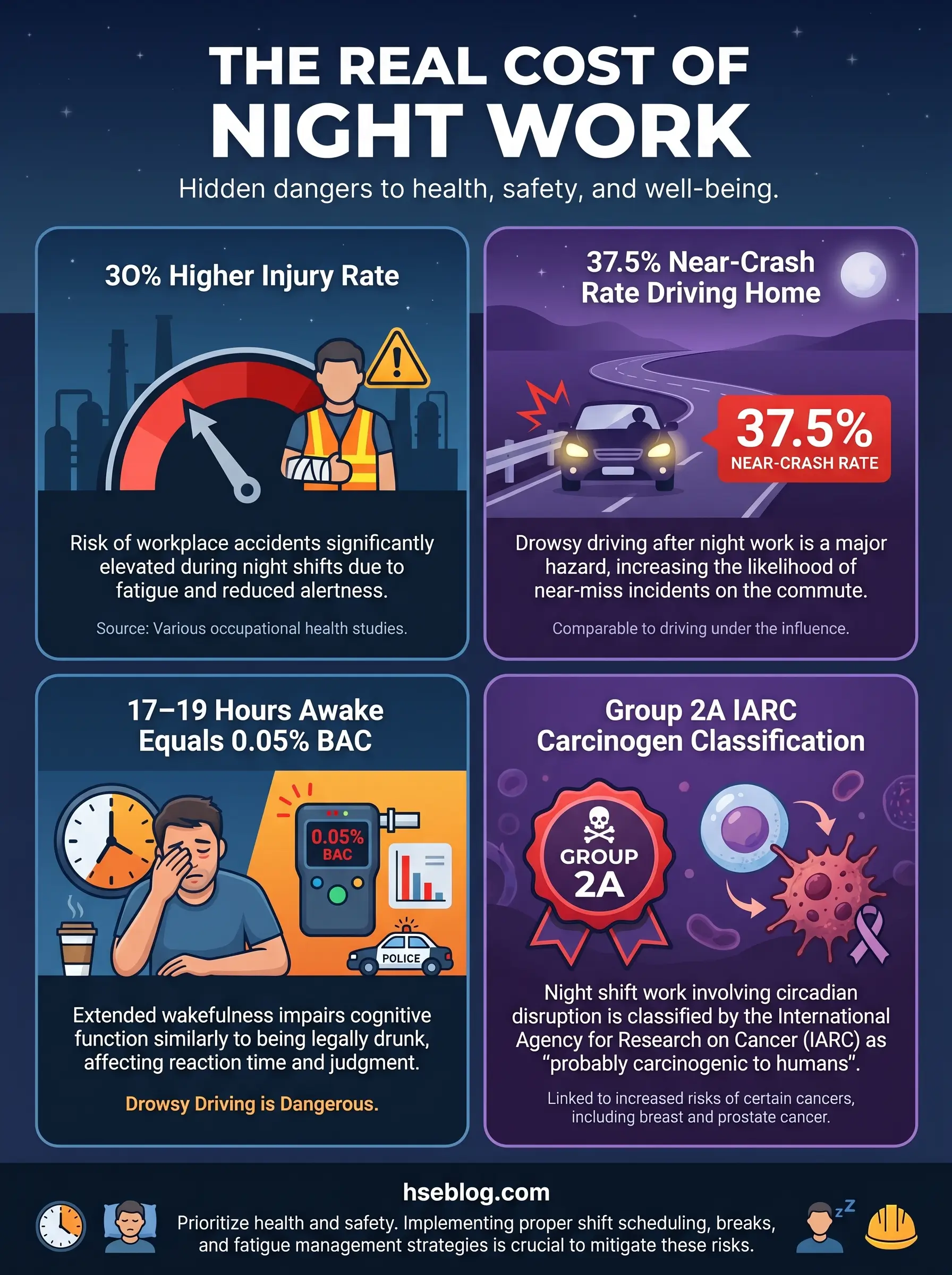
The numbers aren't close. OSHA and NIOSH data put injury and accident rates 18% higher on evening shifts and 30% higher on night shifts compared with day work, and the reason isn't mystery — it's biology. Between roughly 02:00 and 06:00 the human body hits its circadian low, where core temperature, alertness, and reaction time all bottom out. Microsleeps — short lapses of consciousness lasting two to thirty seconds — cluster in that window. An operator can lose three seconds without knowing it, and a busy yard doesn't forgive three seconds.
Sleep debt makes it worse. Research in Occupational and Environmental Medicine (Williamson and Feyer, 2000) found that being awake for 17 to 19 hours produces cognitive impairment comparable to a blood alcohol concentration of about 0.05% — the legal driving limit in many countries. A 2005 study by Dembe and colleagues, widely cited by OSHA, linked 12-hour shifts to a 37% increase in injury risk.
The long-horizon picture matches the short one. In 2007 the International Agency for Research on Cancer classified shift work involving circadian disruption as probably carcinogenic to humans — Group 2A, the same category as DDT. The industrial disaster reel tells the same story from a different angle: Chernobyl, Three Mile Island, Exxon Valdez, and the 2005 Texas City BP refinery explosion all involved night-shift fatigue as a contributing factor. Night shift hazards aren't theoretical.
Tip 1: Protect Your Sleep Like It's Part of the Job
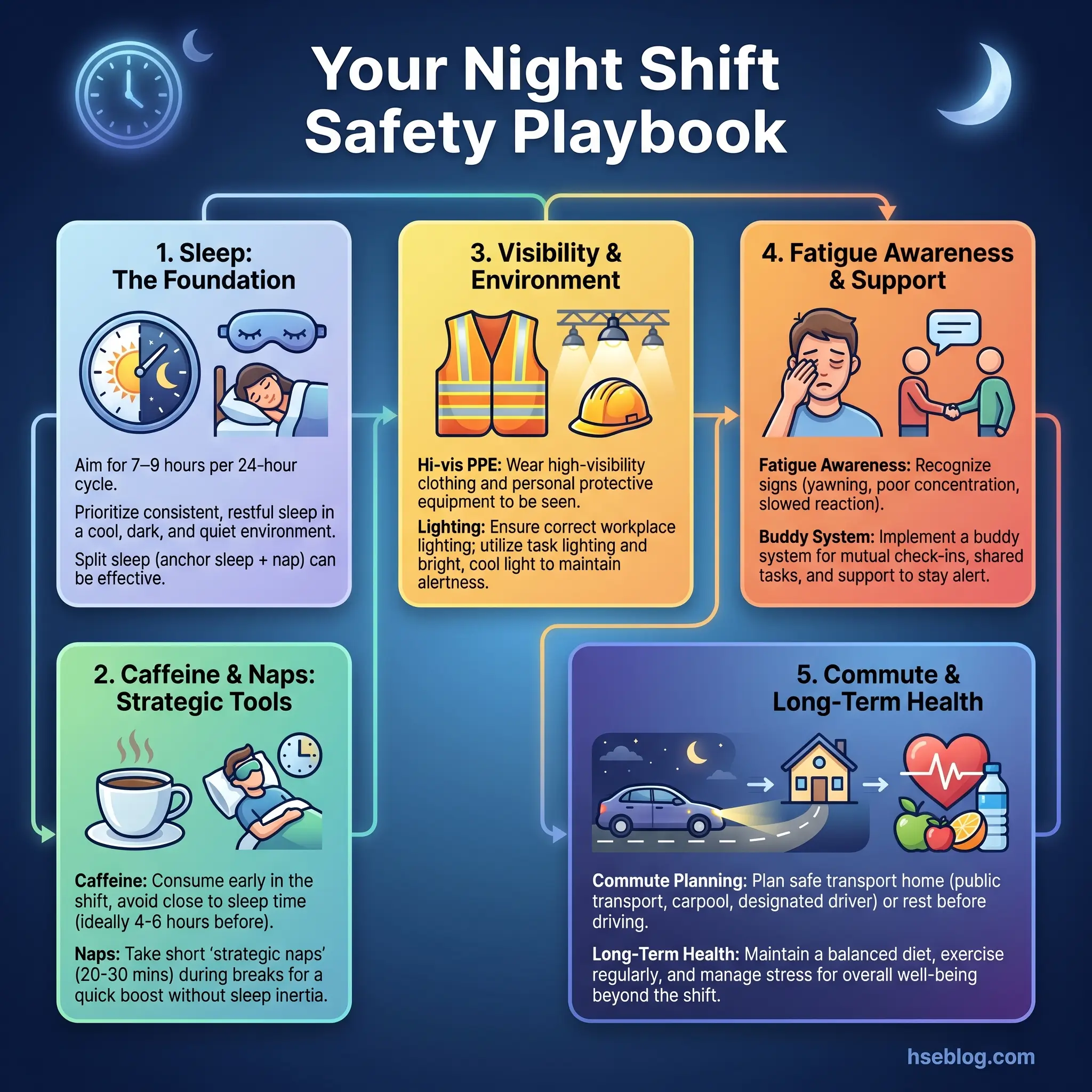
A well-slept crew moves differently on the yard — steadier on the walk, quicker on the radio, more patient with the machinery. The difference is obvious if you know what to look for, and it starts with 7 to 9 hours of sleep per 24-hour cycle. Even workers who've done nights for a decade rarely fully adapt below that — the circadian clock is stubborn, and it wants daylight.
What makes night shift sleep tips for workers different from ordinary sleep advice is the environment. Your bedroom is working against you: the sun is up, neighbours are awake, and your phone is handing you emergencies every eleven minutes. The job is to build a dark, quiet, cool cave and defend it like it's plant-critical equipment.
- Blackout curtains or a proper eye mask: daylight suppresses melatonin even through closed eyelids.
- Earplugs or white noise: neighbourhood noise is the single biggest sleep disruptor for day-sleepers.
- Bedroom temperature 16–19°C (60–67°F): the body needs a small core-temperature drop to initiate sleep.
- Consistent bed and wake times, including days off: rotating back to a daytime schedule on weekends rebuilds the debt you just paid off.
- Household boundaries: a sign on the door, a silenced phone, a conversation with family. People who don't work nights don't instinctively grasp that 13:00 is your 03:00.
If you can't get one long block, split it. An anchor sleep of 4–5 hours after the shift plus a 90-minute pre-shift nap is documented sleep hygiene guidance from NIOSH and HSE UK's shift-worker resources and will keep you functional through a rough week.
Tip 2: Use Caffeine Strategically, Not Constantly
Caffeine has a half-life of 5 to 6 hours. The large coffee at 04:00 meant to push you through the circadian trough is still half-active at 10:00, when you're trying to sleep. This is why people who hammer coffee all shift feel wrecked by Wednesday — they've been slowly poisoning their own rest.
Front-load caffeine in the first half of the shift, then cut it off at least six hours before intended sleep. If your shift ends at 06:00 and you plan to sleep at 08:00, your last coffee needed to be at 02:00. Work backwards from your sleep, not forwards from your fatigue.
One technique that actually works on the yard is the coffee nap. Drink a coffee, then lie down immediately. Caffeine takes 20–30 minutes to hit peak effect, which is roughly when a 20-minute power nap ends. You wake up with the rest and the stimulant landing together. It sounds like a gimmick until you try it on a Thursday.
A note on energy drinks: the crash from stacked stimulants is usually worse than the boost. I've watched operators go from wired to barely upright in forty minutes after a large can. If you need that much chemistry to stay alert, the problem is sleep debt, not caffeine supply.
Tip 3: Take a Strategic Nap When Policy Allows
NIOSH is explicit on this — a planned nap during a night shift is a safety control, not a concession to weakness. The evidence is strong enough that aviation, rail, and long-haul trucking have built nap protocols into their fatigue risk management standards. If your employer doesn't have a policy, NIOSH Publication No. 2004-143 gives you a credible document to put on the table.
Duration matters more than most people realise:
- Target 20–30 minutes. Long enough to restore alertness, short enough to avoid slow-wave sleep and the grogginess that comes with it.
- Avoid the 45–90 minute window. Waking mid-slow-wave produces sleep inertia that can last up to an hour and leave you worse than before.
- If you have 90+ minutes and real quiet, take a full cycle. You'll wake at the end of a stage, not the middle.
- Schedule the nap before the 02:00–06:00 circadian trough, not after. A proactive nap keeps you out of the hole; a reactive one only shortens how long you spend in it.
The environment matters almost as much as the duration — dark, quiet, cool, and somewhere you'll actually lie down. A plastic chair under a break-room fluorescent isn't a nap space. When I brief supervisors on this, I close with the same point: a twenty-minute nap is cheaper than an incident investigation.
Tip 4: Fuel Your Body for a Night Shift, Not a Day Shift
Your digestive system runs on the same circadian clock as the rest of you, and between 01:00 and 04:00 it's in low gear. That's why heavy, fatty, or spicy meals at 02:00 sit like bricks and wake you up with reflux five hours later.
| Window | What works | What doesn't |
|---|---|---|
| Pre-shift (2–3 hours before) | Balanced main meal: protein, complex carbs, vegetables | Skipping to "save" for later |
| Mid-shift (01:00–04:00) | Light protein-forward snacks, nuts, yoghurt, fruit | Heavy, fried, spicy, or sugar-loaded food |
| Pre-sleep | Small snack if hungry — plain carb plus protein | Large meals, alcohol, stimulants |
Hydration is the other half. Dehydration mimics fatigue almost perfectly — the headache, the foggy head, the heavy limbs — and workers routinely underestimate how much the climate inside a warehouse or cab dries them out. Keep water in reach and aim for clear-to-pale urine across the shift. Skip sugary drinks: the glucose spike gives you ninety good minutes and then a hard cliff.
One chronic issue for night workers is vitamin D. You're sleeping when the sun is up, which means you rarely see it. Routine bloodwork and a supplement if needed is the cheapest long-term fix in this whole guide.
Tip 5: Recognise the Warning Signs of Fatigue — In Yourself and Co-Workers
This is the tip that actually saves lives. Fatigued workers consistently over-rate their own alertness, which is why self-assessment alone is unreliable. Peer check-ins are more dependable, and supervisors trained to spot the signs are more dependable still.
The warning signs split into two groups:
| Early signs | Late signs |
|---|---|
| Yawning, heavy eyelids | Microsleeps of 2–30 seconds |
| Slowed reaction time | Irritability, short temper |
| Re-reading the same instruction | Tunnel vision, narrowed focus |
| Lane drift when driving | Forgetting the last few minutes |
| Difficulty concentrating | Making calls you'd normally question |
A 2023 construction-industry study found that fatigue caused a 12% reduction in hazard recognition and a 28% drop in safety-risk judgment. Those are the exact tasks — seeing a hazard, deciding what to do about it — that keep you alive on a dynamic site. Losing a quarter of your risk-assessment capacity is the difference between "I should stop this job" and "it'll be fine, one more lift."
A number of operators I work with are now rolling out biomathematical fatigue prediction tools — platforms like Readi and AlertMeter that score fitness-for-duty at shift start based on sleep, prior hours worked, and circadian position. They don't replace peer awareness, but they give supervisors a defensible data point when they pull someone off a high-risk task. Under most HSE frameworks, reporting unfitness for duty is a worker's legal duty, not a courtesy. If you're unsafe, you say so.
Tip 6: Wear the Right PPE — High-Visibility Gear Is Not Optional
Visibility is the single biggest physical-environment difference between day and night work. A forklift driver can see a vest at fifty metres on a sunny afternoon and miss the same vest at ten metres in a yard lit by four sodium lights.
Match high-visibility PPE to the environment using ANSI/ISEA 107-2020:
- Class 2 garments: suitable for workers exposed to traffic under 40 km/h or working near moving plant where sightlines are reasonable.
- Class 3 garments: required above 40 km/h or in complex, low-sightline environments — reach stacker operations, rail yards, open highway work.
- Headlamps or helmet-mounted lights: for detailed tasks where overhead lighting creates shadows — hands stay free for the actual work.
- Retroreflective striping on trousers, not just vests: vehicle headlights hit at leg level first, and a worker bent over a task is effectively invisible from the waist up.
- Slip-resistant footwear: in poor lighting, your feet can't verify surfaces the way they do in daylight.
One detail most workers miss: a dirty or faded hi-vis vest can lose up to 40% of its retroreflectivity. Check yours at the start of every shift. If the fluorescent colour looks muddy or the stripes look grey rather than silver, replace it. Hi-vis PPE that doesn't reflect is just a uniform.
Tip 7: Keep Your Work Area Brightly and Correctly Lit
Bright, blue-enriched light during the first half of your shift increases alertness — this is well-established in the NIOSH shift-worker training module on light and in ISO 8995 lighting guidance. Typical minimum illumination is 200 lux for general work areas, rising to 500 lux or more for precision tasks. Local codes may require higher.
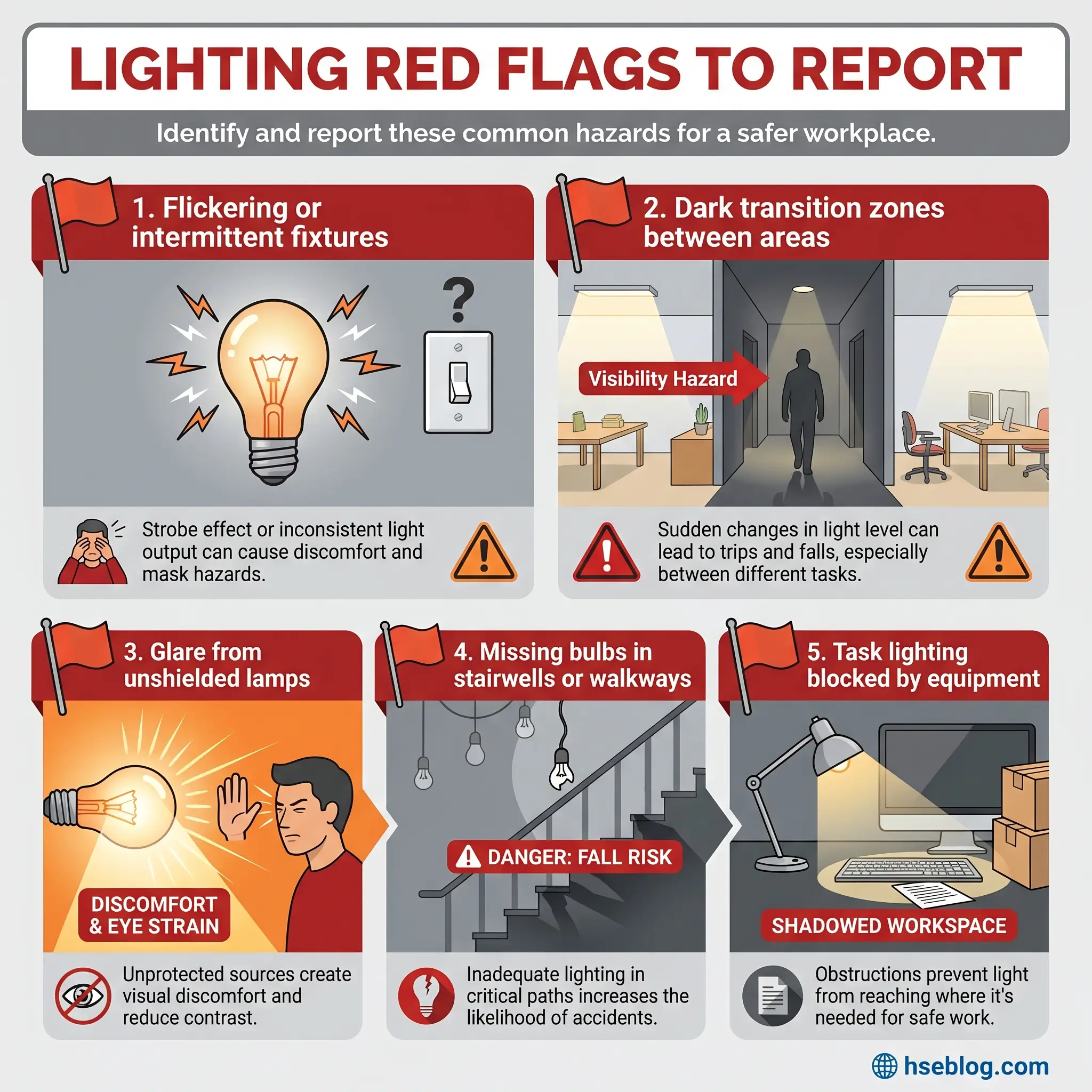
Glare is the invisible half of the problem. A worksite can be technically well-lit but visually punishing — direct light into the eyes narrows pupil response, which makes the shadows darker and hazards harder to see. Diffused fixtures, correctly positioned task lights, and shielded outdoor light towers all reduce glare without reducing illumination. On mobile tasks, vehicle-mounted lighting extends your usable cone.
Lighting outages are a reportable issue, not a tolerable one. A missing bulb in a stairwell turns a routine descent into a trip-and-fall risk. Raise it with your supervisor the same shift you notice it, and write it up if it's still out by the next.
Tip 8: Plan Your Commute Home — It's the Most Dangerous Part of the Shift
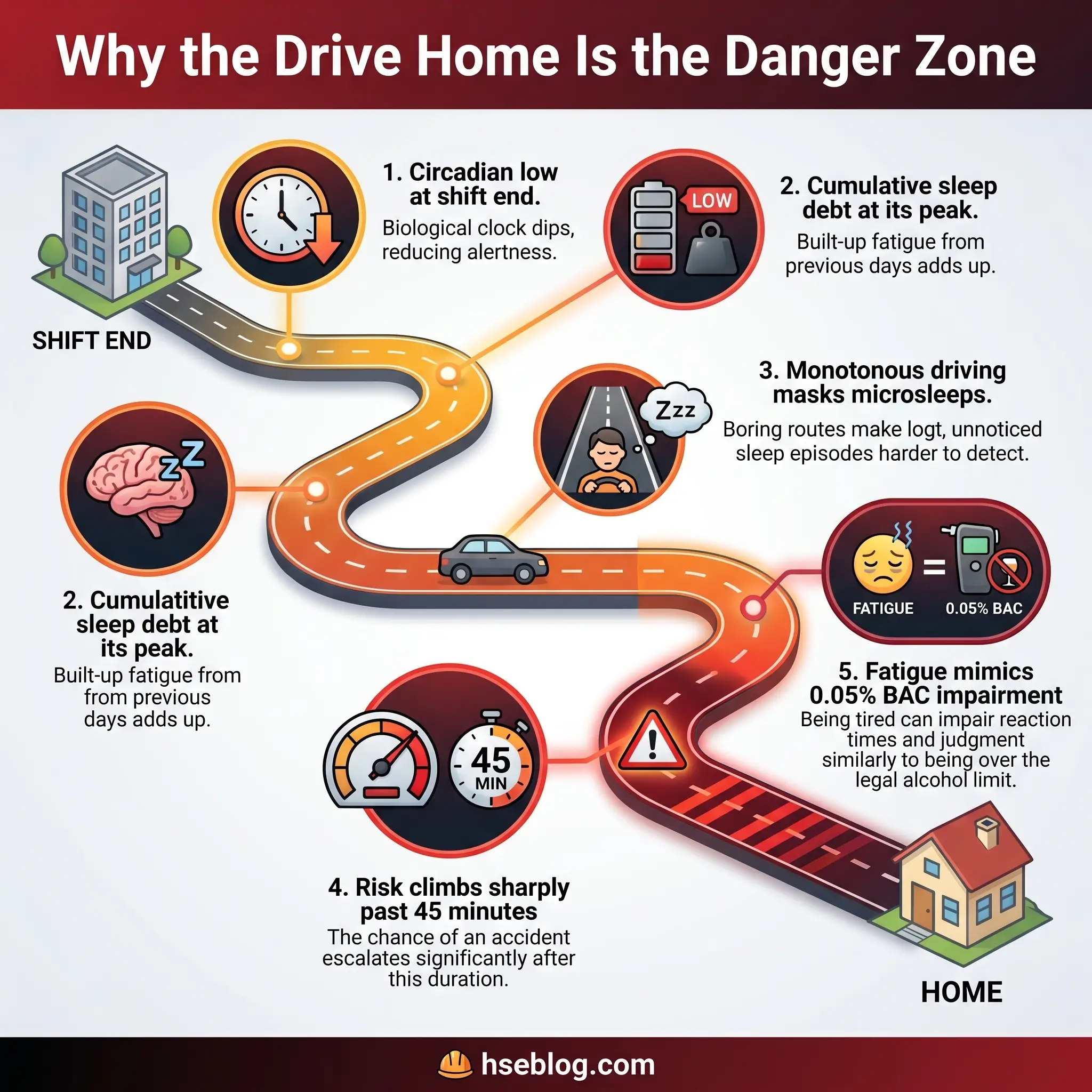
The most important sentence in this guide: for many night-shift workers, the drive home is statistically more dangerous than the shift itself.
A 2016 study by Lee and colleagues in the Proceedings of the National Academy of Sciences put experienced night-shift workers through post-shift test drives. After a normal night of sleep, the near-crash rate was zero. After a night shift, 37.5% of the drives produced a near-crash event — and every single near-crash occurred after 45 minutes of driving. NHTSA data tells a similar story: drowsy driving was involved in an estimated 21% of fatal crashes and 13% of serious-injury crashes between 2009 and 2013. Drowsy driving doesn't feel like drunk driving, which is part of why it kills more people.
If your commute home is longer than 45 minutes after a night shift, you are in the highest-risk population on the road. Plan accordingly — not occasionally, every time.
Build alternatives before you need them:
- Rideshare, public transit, or carpool with a worker on a different schedule
- Shuttle or employer-provided transport where available
- A short nap in the car park before starting the drive — 20–30 minutes, then go
- A rest space on site for workers finishing a rough shift
If you must drive, understand that cool air, loud music, and open windows buy minutes, not hours. Caffeine buys a similar window. None of them buy a safe drive home when you're genuinely fatigued. If drowsiness hits mid-drive, pull over and stop. A gas-station nap is cheaper than a guardrail.
Tip 9: Lean on the Buddy System and Stay Connected
Night shifts usually run with thinner supervision, fewer co-workers, and long stretches of lone work. That combination creates two separate risks — a physical one (no one sees you go down) and a mental one (isolation over months feeds measurably higher rates of depression and anxiety in night-shift populations).
Staying safe on night shift means, at a minimum:
- Documented lone-worker procedures — most jurisdictions now require them for solo high-risk tasks, and the HSE UK framework is explicit on this point.
- Radio, phone, or lone-worker device with mandown alarm for confined spaces, elevated work, or isolated yards.
- Fixed check-in intervals — typically every 30–60 minutes depending on task risk, with an escalation plan if a check-in is missed.
- Clear line of sight to your supervisor — you should know their name, their location, and at least two ways to reach them.
- Social connection during breaks — take them together when possible. Talking to another human at 03:00 is a direct counter to the cognitive drift of the small hours.
I've watched two terminals run the same task — one with a buddy protocol, one without. The difference wasn't in whether incidents happened. It was in whether they were caught at near-miss stage or after a casualty.
Tip 10: Protect Your Long-Term Health with Regular Screening
Night shift fatigue management is a short-horizon goal. The longer horizon is the career. Working nights for twenty years has documented links to cardiovascular disease, type 2 diabetes, digestive disorders, certain cancers, and Shift Work Sleep Disorder — a diagnosable condition affecting roughly 10% of night and rotating-shift workers (Costa, 2010). It's treatable once someone looks for it. Most employers won't offer unless you ask.
Night work is a defined trigger for occupational health surveillance under the UK Working Time Regulations 1998 and EU Working Time Directive 2003/88/EC — workers are entitled to free health assessments before assignment and at regular intervals. Request yours in writing if it hasn't been offered. A baseline matters, and so does a re-check every 12 to 24 months.
What to screen for:
- Cardiovascular health — blood pressure, lipid panel, resting heart rate
- Metabolic health — fasting glucose, HbA1c, waist circumference
- Digestive symptoms — reflux, IBS-pattern complaints
- Sleep disorders — SWSD and sleep apnoea, which worsens fast on shift work
- Mental health — standardised depression and anxiety screens
Maintain cardiovascular fitness at around 150 minutes of moderate activity weekly, but not within two hours of intended sleep — exercise raises core temperature and blocks sleep onset. And watch for mood changes. The solitude of the small hours amplifies both depression and anxiety, and waiting for a crisis before asking for help is the worst strategy available. If something has felt off for more than a few weeks, talk to someone qualified.
What Employers Must Do to Support Night Shift Safety
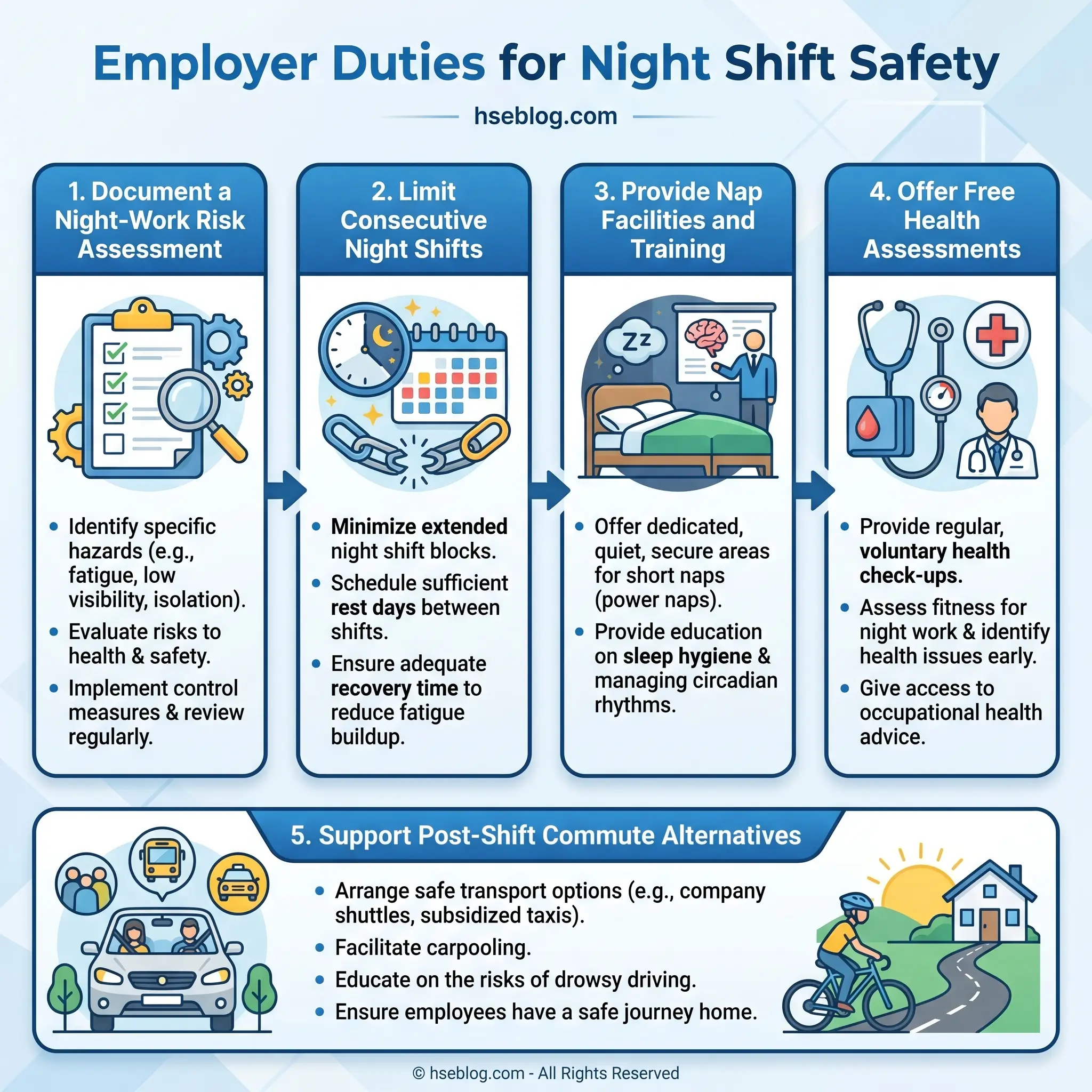
Every control in this guide depends on an organisational condition — a nap room to nap in, a risk assessment to rely on, lighting that works, a supervisor who's reachable. That's the employer's side of the contract, and the regulatory framework treats it as non-negotiable.
At minimum, a responsible employer will:
- Conduct a documented night-work risk assessment — required under HSE UK Management of Health and Safety at Work Regulations 1999, Regulation 3, and paralleled by ISO 45001:2018 Clauses 6.1.2 and 8.1.2.
- Limit consecutive night shifts and prefer forward-rotating patterns (morning → afternoon → night), which are easier on the circadian system than backward rotation.
- Provide fatigue-management training, nap facilities, adequate lighting, and emergency coverage — not as perks, as controls.
- Offer free health assessments under Regulation 7 of the UK Working Time Regulations 1998 and Articles 8–12 of the EU Working Time Directive.
- Make post-shift commute alternatives available where feasible — shuttles, on-site rest rooms, or shift-end schedules that don't dump workers onto the road at 06:00.
The enforcement hook in the United States sits inside the OSHA General Duty Clause, OSH Act Section 5(a)(1), which obliges employers to provide a workplace free from recognised hazards. OSHA's 2016 letter of interpretation confirmed that unmanaged fatigue hazards fall within scope. In the petrochemical sector, API Recommended Practice 755 — issued after the 2005 Texas City BP explosion — sets the baseline for fatigue risk management programmes. The 2023–2024 wave of state-level legislation on healthcare worker rest breaks in California, New York, and Oregon is a clear signal that the regulatory direction of travel is tightening, not loosening.
Frequently Asked Questions
What is the best nap length during a night shift?
Twenty to thirty minutes is the sweet spot. It restores alertness without letting you drop into slow-wave sleep, which is where sleep inertia comes from. The worst window is 45 to 90 minutes — you wake mid-cycle and feel worse than before you lay down. If you genuinely have 90+ minutes and a dark, quiet space, take a full cycle. NIOSH Publication No. 2004-143 backs the power nap as an evidence-based fatigue control.
Why is driving home after a night shift so dangerous?
Three forces hit you at the same time: you're at the tail end of your circadian trough, you've accumulated the shift's worth of sleep debt, and the drive itself is monotonous enough to mask microsleeps. The 2016 PNAS study by Lee and colleagues found 37.5% of test drives after a night shift produced a near-crash event, against 0% after a night of sleep. Every near-crash happened past the 45-minute mark. Treat commutes longer than that as a high-risk activity and plan alternatives in advance.
When is the most dangerous time during a night shift?
The hours between 02:00 and 06:00. That's the circadian low point — core body temperature, alertness, and reaction time all bottom out together, and microsleep events cluster in that window. High-consequence tasks should be scheduled before or after it whenever the job allows, and risk controls should be tightest when they can't be.
Can my employer be held liable if fatigue causes an accident?
In most jurisdictions, yes. Under the OSHA General Duty Clause, Section 5(a)(1), an employer can be cited when a recognised hazard — including fatigue — was not controlled. The HSE UK framework gets there through MHSWR Regulation 3 risk assessment duties and the Working Time Regulations 1998. The EU Working Time Directive 2003/88/EC imposes parallel obligations. If fatigue was foreseeable and uncontrolled, the legal exposure sits with the employer.
Is working night shift work dangerous over the long term?
The evidence says yes, which is why night work is a recognised trigger for occupational health surveillance. The IARC classified shift work involving circadian disruption as probably carcinogenic to humans (Group 2A) in 2007. Add higher rates of cardiovascular disease, type 2 diabetes, digestive disorders, and a 10% prevalence of Shift Work Sleep Disorder, and night work becomes a chronic exposure to be managed — not a schedule quirk. Regular screening catches most of these early enough to treat.
Conclusion
Night work isn't going away. Goods have to move, patients have to be cared for, power grids have to stay up, and whole industries — intermodal freight, utilities, emergency services, process plants, healthcare — will run through the small hours for as long as the economy demands it. What can change is how many workers pay for those shifts with their health or their lives.
The ten night shift safety tips in this guide are controls, not suggestions. Each one has a reason, a number, and a standard behind it. A worker who sleeps badly, mismanages caffeine, skips naps, eats wrong, hides fatigue from the crew, wears faded hi-vis, works in poor light, drives home exhausted, stays isolated, and never asks for a health check isn't unlucky when something goes wrong. They're running a predictable set of failures in a predictable order. A worker who reverses those ten patterns is doing the actual job of staying safe on night shift — not hoping, not toughing it out, working it.
The people who lose most to night work aren't the ones who are obviously careless. They're the ones who were never told what "good" looks like, and who assumed that feeling wrecked was just what this work costs. It doesn't have to be. Know the numbers, build the habits, push back on employers who skip their side of the contract, and treat your own body as the most important piece of equipment you will ever operate.