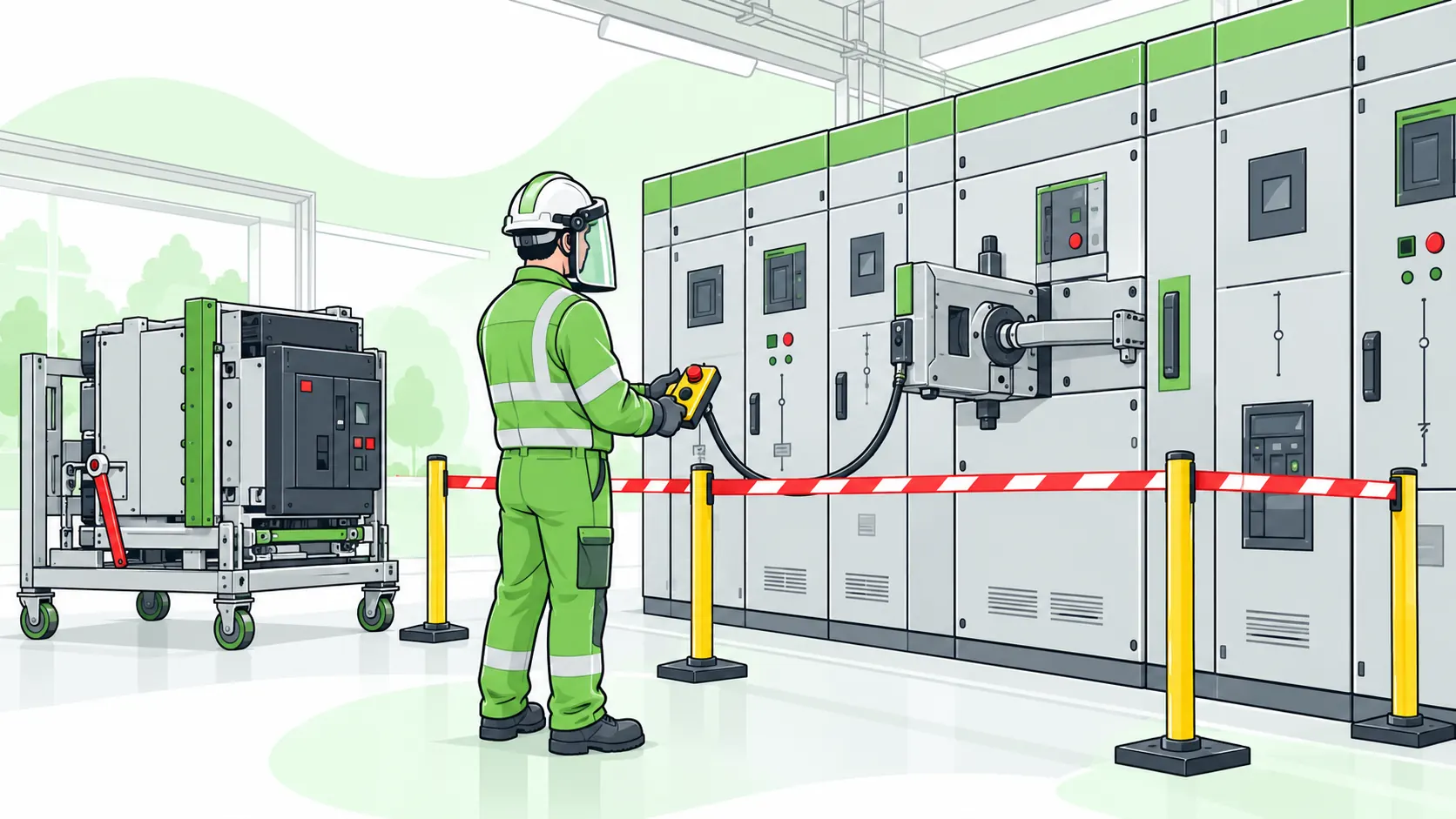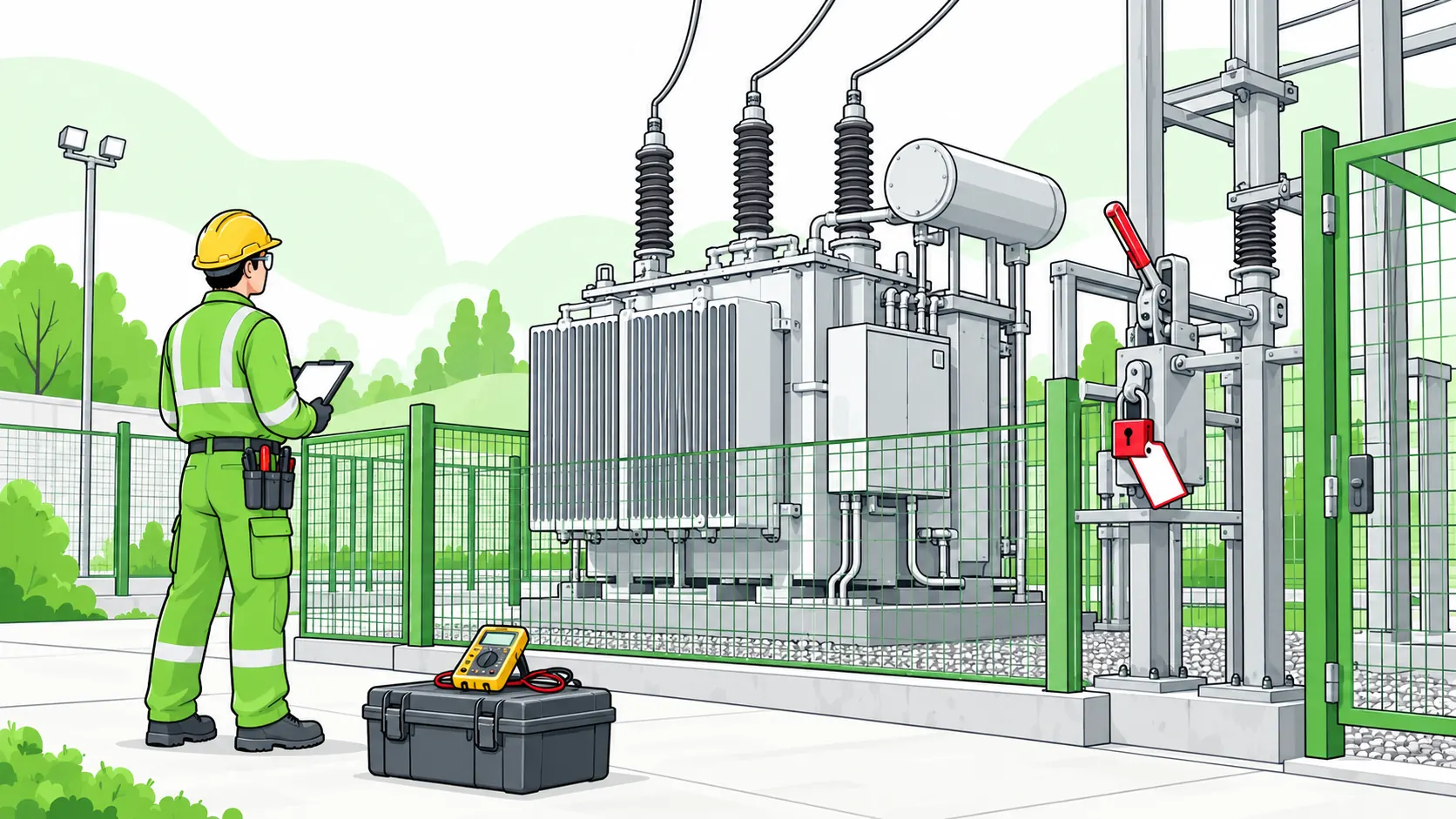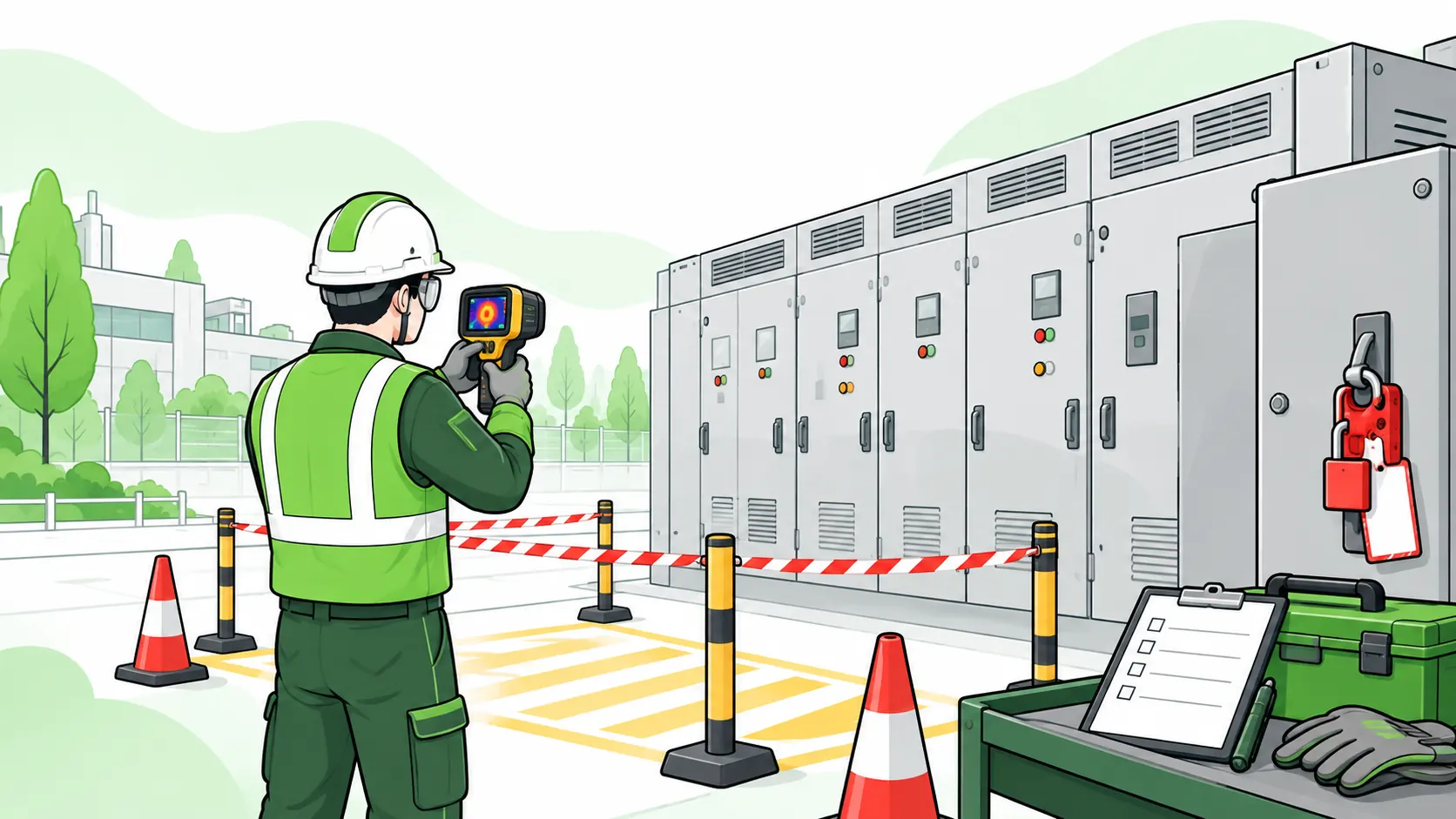
A maintenance electrician at a beverage processing line had done what he called "LOTO" on a filler drive motor — padlock on the disconnect, tag hung, key in his pocket. A visiting contractor trained under UK regs asked one question: "Have you proved it dead?" The electrician had not. He had never used a two-pole voltage indicator, let alone a proving unit. That single gap — a padlock with no voltage verification at the point of work — is how someone ends up touching a circuit that a second supply still feeds.
Safe isolation and lockout/tagout are often used as though they mean the same thing. They don't. They overlap heavily, they share the same goal, and in the right combination they make electrical and mechanical work survivable. But they come from different regulatory families, they define "verification" differently, and they apply to different scopes of energy. Getting the terminology wrong is usually harmless. Getting the procedure wrong is how people die during maintenance. This article pulls apart safe isolation vs lockout tagout, shows where they converge and where they diverge, and gives you a decision model for which framework to apply on your site.
Safe Isolation vs Lockout Tagout: What's Actually Being Compared?
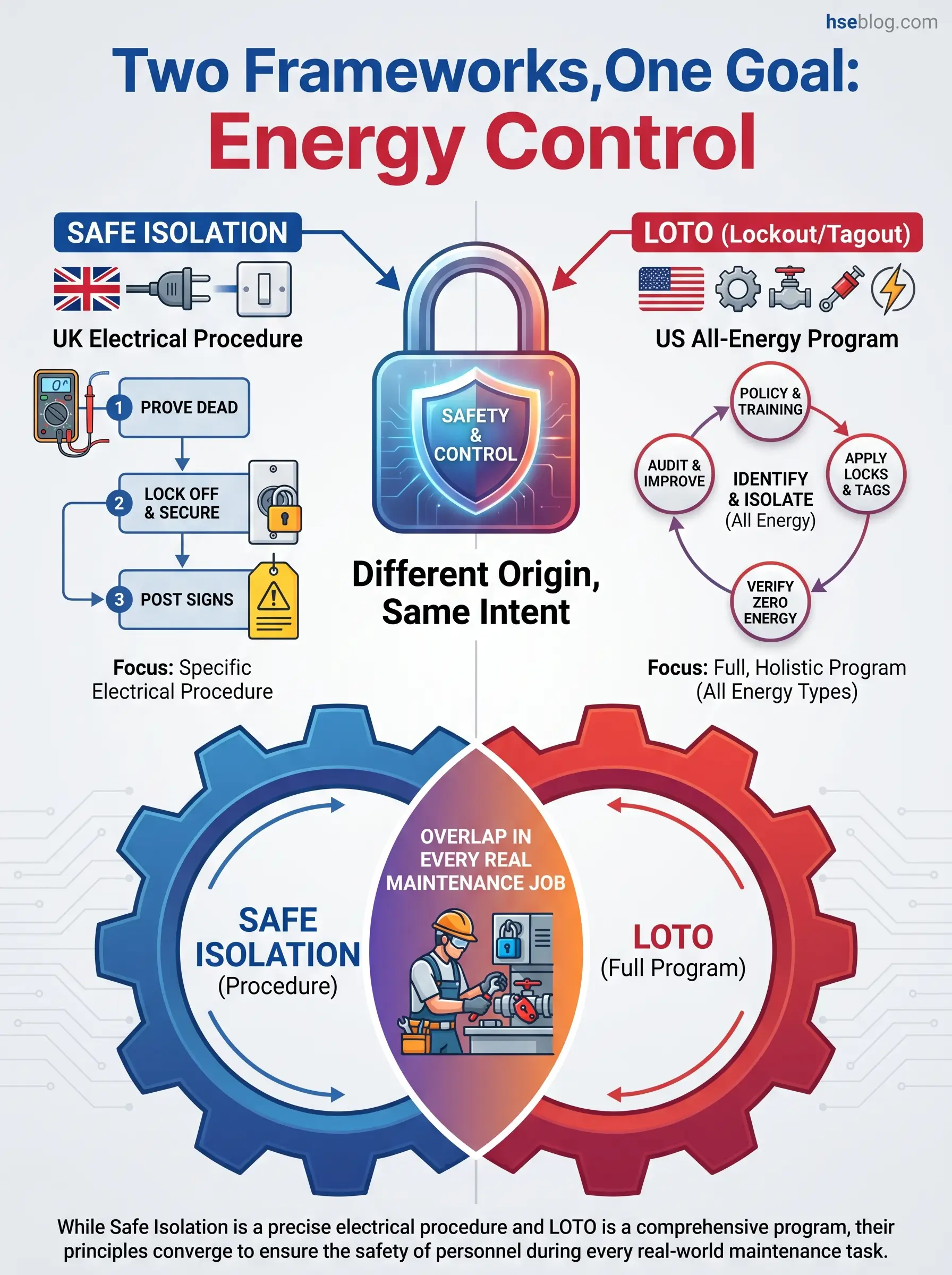
The confusion is legitimate. Walk through any multinational manufacturing facility today and you will hear electricians, engineers, and supervisors use "LOTO," "lockout," "safe isolation," and "isolation" as though they were interchangeable. They are not, but they are not wholly separate either. One term describes a procedure — a defined sequence for electrical work. The other describes a program — a full management system for controlling any form of hazardous energy. Both arose to solve the same problem: workers being killed by equipment they had good reason to believe was dead.
| Term | One-Line Definition |
|---|---|
| Safe isolation | A UK/European electrical procedure to disconnect, secure, and verify a circuit dead before work. |
| Lockout/tagout (LOTO) | A US-rooted program for controlling all hazardous energy during servicing, built on written procedures, locks, tags, and verification. |
The core claim of this article: one is a procedure, the other is a program, and in modern practice they are stitched together.
What Is Safe Isolation? (UK/European Definition)
In the UK framework, safe isolation is the electrical procedure you carry out to make a circuit dead and keep it dead for the duration of the work. Its legal foundation is the Electricity at Work Regulations 1989 — specifically Regulation 12 (means for cutting off supply and for isolation), Regulation 13 (precautions for work on equipment made dead), and Regulation 14 (the narrow conditions under which live working is permitted). The practical guidance sits in HSE HSG85 and Guidance Note GS38.
The standard safe isolation sequence runs:
- Identify the correct circuit using drawings, labelling, and tracing.
- Seek permission to isolate from whoever controls the installation.
- Switch off at the appropriate isolating device.
- Secure the isolation with a lock and a unique key.
- Post a caution notice so no one restores supply by accident.
- Prove the voltage indicator on a known live source before use.
- Test the circuit dead at the point of work — phase-to-phase, phase-to-neutral, phase-to-earth.
- Re-prove the voltage indicator against the known live source immediately after.
Three details deserve emphasis. Safe isolation in its traditional framing addresses electrical energy almost exclusively — stored mechanical, hydraulic, and pneumatic energy sit outside its original scope. The equipment is prescriptive: a GS38-compliant two-pole voltage indicator with fused leads and shrouded probe tips, plus a proving unit meeting BS EN 61243 — not a multimeter, not a non-contact voltage tester. And the work can only be carried out by a competent person as defined under EAWR.
What Is Lockout Tagout (LOTO)? (US/OSHA Definition)
LOTO is the US framework under OSHA 29 CFR 1910.147 — formally the Control of Hazardous Energy standard — backed by 29 CFR 1910.333 for electrical work and 29 CFR 1926 Subpart K for construction. Its scope is wider than safe isolation in two important directions: it covers all seven hazardous energy types, and it is a complete program rather than a standalone procedure. OSHA estimates that proper LOTO compliance prevents roughly 120 fatalities and 50,000 injuries annually in the United States, and the agency calculates around three million US workers are exposed to hazardous energy during routine servicing.
The six accepted steps:
- Prepare for shutdown — identify all energy sources, their magnitudes, and isolation methods.
- Shut down the equipment through its normal operating controls.
- Isolate the equipment at each energy-isolating device.
- Apply lockout or tagout devices to each isolation point.
- Control stored or residual energy — bleed accumulators, block suspended loads, discharge capacitors.
- Verify isolation before starting work, typically by attempting to start the equipment.
The seven energy types run across electrical, mechanical, hydraulic, pneumatic, chemical, thermal, and gravitational. A hydraulic capping station on a bottling line carries three simultaneous threats during servicing — electrical supply, stored pressure in the ram circuit, and the physical weight of the head itself — and LOTO requires each one controlled independently.
The program scaffolding is what sets 1910.147 apart from a simple procedure. It demands written machine-specific procedures, training for "authorized" and "affected" employees, annual periodic inspection of the procedure in use under 1910.147(c)(6), rules for group lockout and shift changes, and documented exceptions where tagout replaces lockout. Lockout is the preferred method; tagout is acceptable only where a device cannot be locked out and equivalent protection is demonstrated.
The Core Difference: Procedure vs Program vs Physical Control
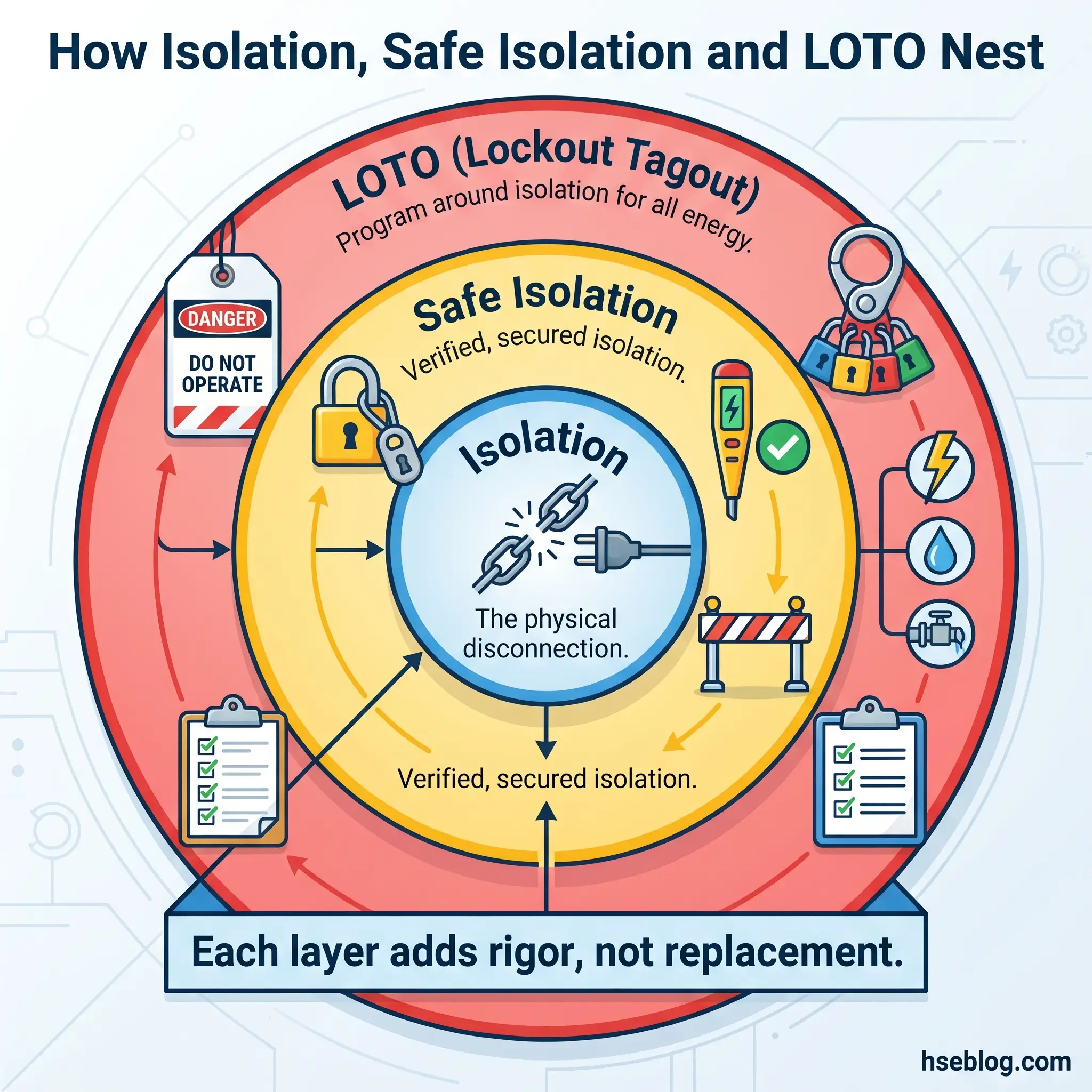
This is where most explanations fall apart. Isolation, safe isolation, and LOTO are three nested concepts, not three synonyms.
Isolation is the physical act — opening a switch, closing a valve, breaking a connection — that severs the path between the energy source and the equipment.
Safe isolation is the UK electrical procedure built around that physical act. It adds verification (prove dead), securing (lock off), and communication (caution notice) so that the isolation is reliable and cannot be reversed accidentally.
LOTO is the all-energy program built around isolation across any energy type. It adds written procedures per machine, training programs, stored-energy control, group rules, and annual inspections so that isolation is reliable at scale across a workforce.
A competent isolation can exist without safe isolation or LOTO, but it is inferior practice. A compliant LOTO always contains isolation. A safe isolation does not strictly require LOTO hardware to be legal in the UK, but modern HSE-aligned guidance has absorbed lockout hardware into the procedure anyway. For auditors and cross-border contractors this distinction matters. A US auditor reviewing a UK electrical isolation will ask for the written procedure, the training records, and the annual inspection — LOTO expectations. A UK HSE inspector visiting a US-owned plant will ask whether the voltage indicator was proved before and after the test — safe isolation expectations. When these frameworks meet on the same asset, the gaps become visible fast.
Side-by-Side Comparison: Safe Isolation vs Lockout Tagout
The table below compares the two frameworks across nine dimensions that actually shape site practice.
| Dimension | Safe Isolation (UK/EU) | Lockout/Tagout (US/OSHA) |
|---|---|---|
| Regulatory origin | EAWR 1989 Regs 12–14; HSE GS38; HSG85 | 29 CFR 1910.147; 1910.333; 1926 Subpart K |
| Primary jurisdiction | UK, Ireland, EU tradition | US, Canada (via CSA Z460) |
| Energy scope | Primarily electrical | All seven hazardous energy types |
| Nature | Defined procedure | Full energy-control program |
| Verification method | Prove dead with two-pole voltage indicator against known live source | Try-out by attempting to start equipment |
| Key hardware | Voltage indicator, proving unit, lock-off, caution notice | Padlocks, hasps, tags, lockout devices, stored-energy blocks |
| Who performs | Competent person (EAWR definition) | Authorized employee |
| Mandatory documentation | Risk assessment, method statement | Written machine-specific energy-control procedure |
| Periodic inspection | Implied via EAWR duty-holder obligations | Explicit annual inspection under 1910.147(c)(6) |
Read the table this way. Rows 1–3 show the two frameworks emerging from different legal traditions with different scope. Rows 4–6 show how those traditions produce different operational artefacts — a procedure versus a program, a voltage test versus a start-test. Rows 7–9 show the administrative consequences — who does the work, what paperwork supports it, how often it is audited.
How the Steps Actually Differ in Practice
Placed side by side, the sequences rhyme more than they diverge. Both start with identification, move through shut-down and isolation, and end with verification. Where they split matters.
| Stage | UK Safe Isolation | OSHA LOTO |
|---|---|---|
| 1 | Identify circuit and energy sources | Prepare — identify all energy sources |
| 2 | Seek permission | Shut down via normal controls |
| 3 | Switch off at isolating device | Isolate at every energy-isolating device |
| 4 | Secure with lock and caution notice | Apply lockout/tagout devices |
| 5 | (Usually absent as an explicit step) | Control stored and residual energy |
| 6 | Prove indicator, test dead, re-prove | Verify by attempting to start |
The step-5 gap is the most consequential divergence in scope. Traditional UK safe isolation does not explicitly require stored-energy dissipation, because its starting assumption is purely electrical. LOTO demands it because a hydraulic accumulator or a suspended gravitational load can kill a worker who has already locked off the electrical supply. On modern UK sites, I routinely see LOTO hardware — coloured padlocks, multi-lock hasps, lock-out stations — pulled directly into the safe isolation workflow, with stored energy handled as a separate risk-assessment item rather than a procedural step. It works. The documentation trail is messier than a single integrated procedure.
The Verification Difference: Prove Dead vs Try-Out
This is the single most important practical difference between the two frameworks, and the one most competitors gloss over.
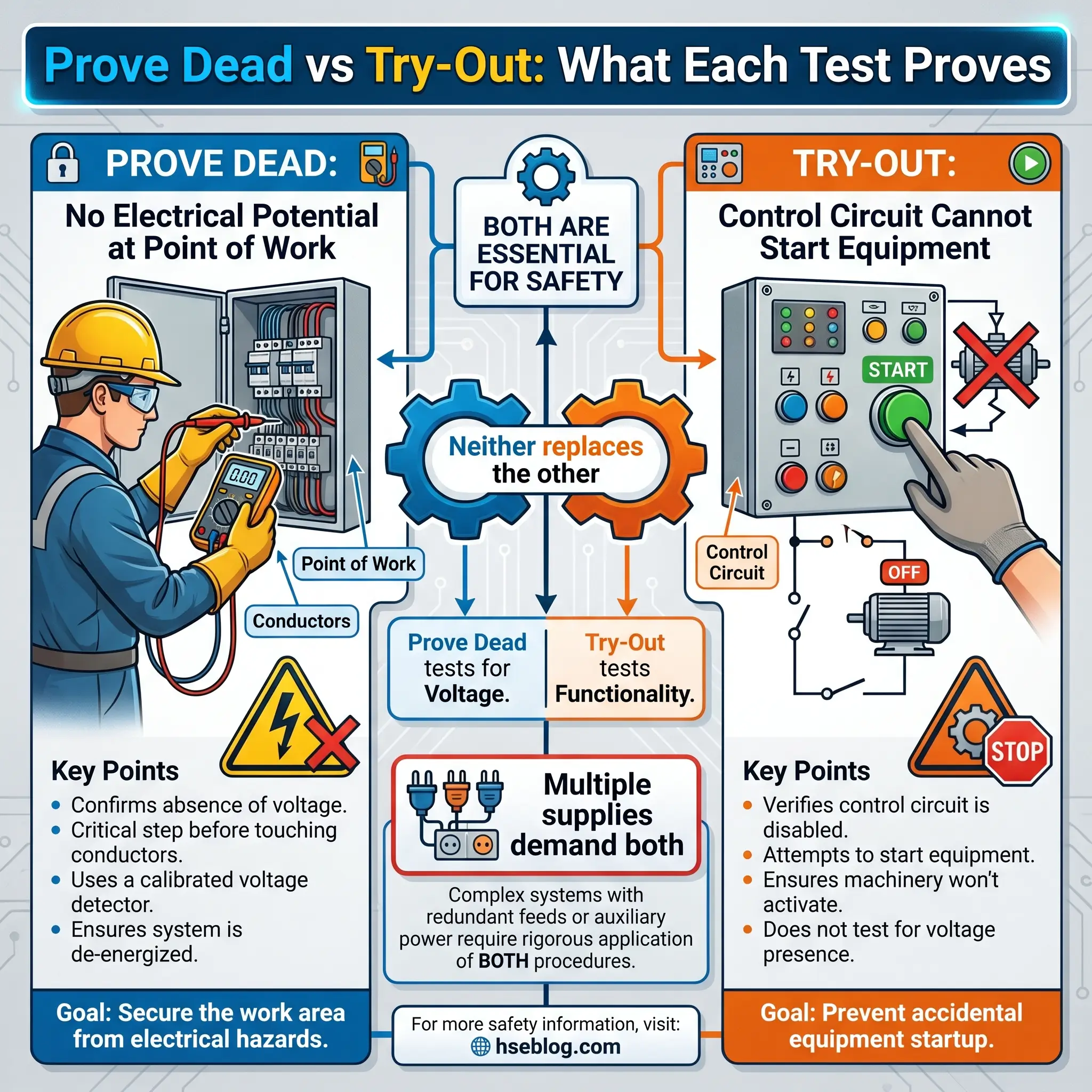
"Prove dead" means using a GS38-compliant two-pole voltage indicator, first tested against a known live source (a proving unit or confirmed live supply), then used at the point of work across every possible combination — phase-to-phase, phase-to-neutral, phase-to-earth — and then tested again against the known live source. The final re-prove confirms the indicator did not silently fail between the first test and the last.
"Try-out" means attempting to start the equipment through its normal operating controls — pushing start, turning the selector switch, activating the panel — to confirm nothing happens.
These two verifications answer different questions. Prove dead confirms the absence of electrical potential at a specific point. Try-out confirms the control circuit cannot energize the power circuit through its normal path. Neither is a complete substitute for the other.
Watch For: A try-out alone cannot detect a back-feed from a second supply, an embedded UPS, a parallel generator, or a charged capacitor bank. A prove-dead at one point cannot detect a re-energization risk from an unlocked upstream breaker. On systems with multiple supplies or stored energy, you need both tests — not one or the other.
When Does Safe Isolation Apply vs When Does Lockout Tagout Apply?
The honest answer is a mix of jurisdiction and task profile. A decision model that holds up on multi-standard sites:
- Use safe isolation terminology and procedure when working under UK or EU electrical regulations, the task involves electrical energy only, and the primary risk is electric shock or arc flash.
- Use LOTO framework when multiple energy types are present (hydraulic, pneumatic, thermal, gravitational), the site falls under OSHA jurisdiction, or the work involves fixed machinery with stored energy.
- Use both together when the task is electrical but forms part of a broader maintenance program, when the site operates under multiple standards, or when contractors from different regulatory backgrounds work the same asset.
Global organizations increasingly harmonize through ISO 14118:2017 (Prevention of unexpected start-up) and CSA Z460-20, which treat the two frameworks as compatible rather than competing. A unified procedure meeting the stricter of the two standards per element — GS38 verification plus 1910.147 program structure — is now the default at most multinational manufacturing and pharmaceutical sites.
Regulatory Overlap: EAWR, OSHA 1910.147, ISO 14118, and AS/NZS 4836
Competitors stop at one jurisdiction. The reality is that the major standards converge on the same performance outcomes even when their language differs. The table below maps the landscape.
| Jurisdiction | Primary Standard | Terminology Used |
|---|---|---|
| UK | EAWR 1989; HSG85; GS38 | Safe isolation |
| US | 29 CFR 1910.147; 1910.333; 1926 Subpart K | Lockout/tagout; control of hazardous energy |
| EU / International | ISO 14118:2017; ISO 14119:2024; Machinery Directive 2006/42/EC | Prevention of unexpected start-up; energy isolation |
| Canada | CSA Z460-20 | Control of hazardous energy; lockout |
| Australia / New Zealand | WHS Regulations Part 4.7; AS/NZS 4836:2023 | Safe working; de-energization; isolation |
Every one of these standards demands the same five outcomes: identify all energy sources, disconnect them, secure against re-energization, verify the disconnection, and restore energy only under controlled conditions. The differences sit in hardware preferences, verification method, documentation, and which energy types are named explicitly. CCOHS offers a neutral third-party synthesis that treats both frameworks under a single "hazardous energy control" umbrella. The ISO 14119:2024 update to the interlocking-devices standard is pulling the international community closer on hardware expectations, and it pairs with the January 2025 OSHA civil-penalty adjustment — $16,550 per serious violation, $165,514 per willful or repeat — to signal that this is a live, moving regulatory field, not a settled one.
Common Misconceptions and Where Sites Go Wrong
Enforcement data makes the failure patterns clear. OSHA's FY 2024 top-cited standards list placed 29 CFR 1910.147 among the most frequently cited, with citations in the mid-2,500s — a standard under active enforcement, not a dormant one. The US Bureau of Labor Statistics recorded 226 deaths in the "struck, caught, or compressed by running powered equipment" category in 2023, with 48 occurring during maintenance, cleaning, or testing — the windows when LOTO should be in force. The recurring field misconceptions:
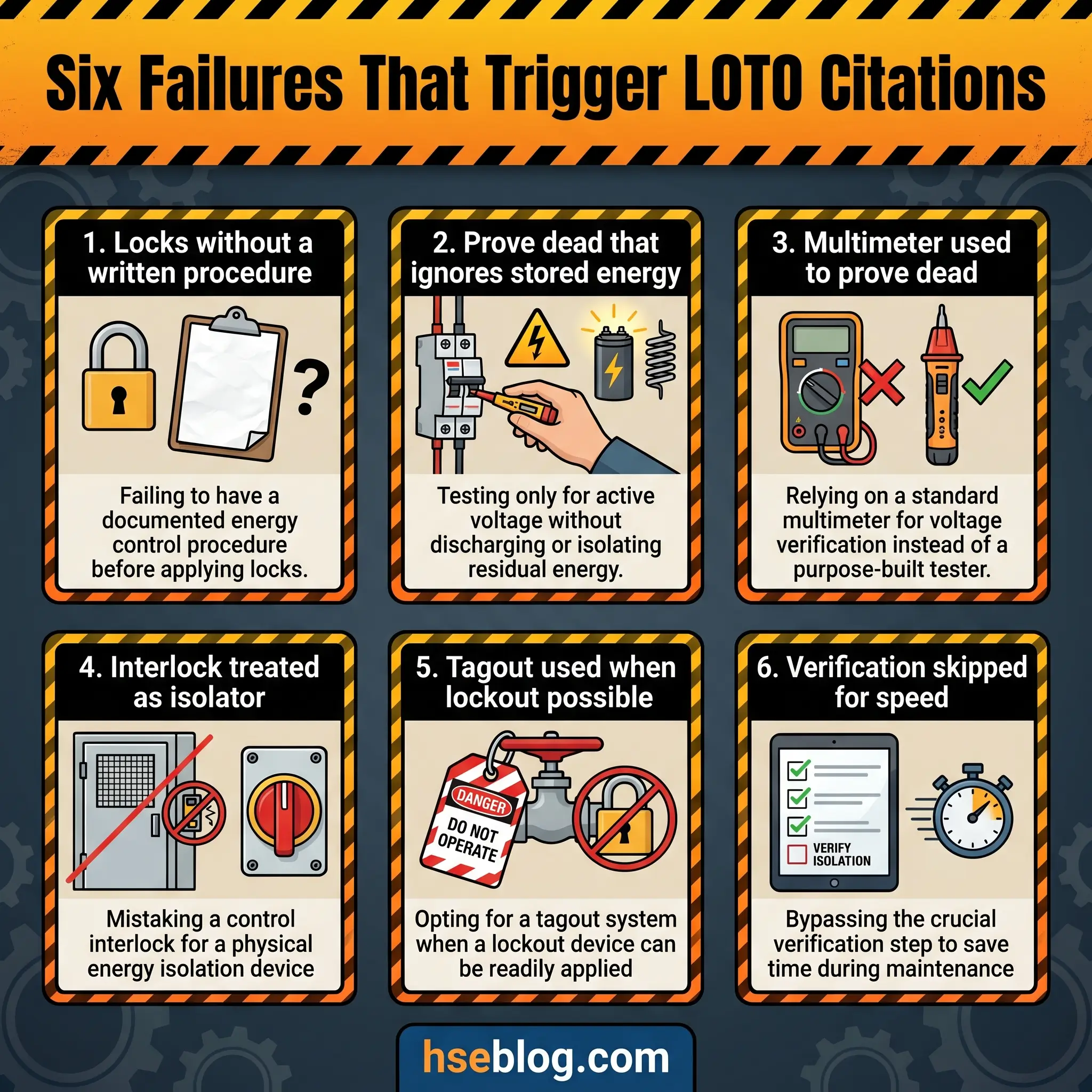
- "We have locks, so we have LOTO." Locks are necessary but not sufficient. A compliant program requires written machine-specific procedures, authorized-employee training, and annual periodic inspection. A wall of padlocks with no procedure is a citation waiting to happen.
- "We proved dead, so we're safe." Proving dead at one point does not protect against stored energy, a second supply, embedded generation, a UPS, or charged capacitors.
- "Our multimeter is fine for testing." GS38 requires a dedicated two-pole voltage indicator with fused leads, finger guards, and probe tips exposed no more than 4 mm (2 mm with shroud). Multimeters can mislead silently; non-contact testers can fail on shielded or insulated conductors.
- "The interlock is as good as an isolator." Push buttons, selector switches, and interlocked guards are not energy-isolating devices under 1910.147. An energy-isolating device must physically break the energy path.
- "Tagout is the same as lockout." Tagout is acceptable under OSHA only when a device cannot be locked out, and only when equivalent protection is demonstrated under 1910.147(c)(3).
- "Prove dead / try-out takes too long on this job." Skipping verification is the single most common contributor to fatal energy-control incidents in maintenance work.
The Fix That Works: Treat verification as non-negotiable and time-protected. Build it into the permit-to-work, not into the goodwill of the electrician working under time pressure.
Can You Do One Without the Other?
Safe isolation without lockout hardware is legal in some UK contexts — EAWR 1989 does not mandate a padlock in every case. But it is inferior practice, and both HSE HSG85 and Electrical Safety First Best Practice Guide 2 now treat locking off as essential rather than optional. If the isolator can accept a lock and you have one, use it.
LOTO without proper isolation is a contradiction. Isolation is step 3 of the six-step LOTO sequence — skip or under-specify it and you do not have LOTO, you have decoration. Tagout-only programs, where a tag is hung but no lock applied, are permitted under 29 CFR 1910.147 only where the energy-isolating device is not capable of being locked out, and only where equivalent protection is demonstrated through measures like removing an isolating element, blocking a control switch, or opening an extra disconnecting device. Most isolators built in the last twenty years accept a lock by design — the "not capable" exemption is narrower than many sites assume.
Frequently Asked Questions
Do UK electricians use lockout tagout?
Not under that legal name. LOTO is not written into UK law. But EAWR 1989 Regulation 14 and HSG85 require outcomes equivalent to LOTO — prevention of unexpected re-energization, demonstrable verification, and secure isolation. Electrical Safety First Best Practice Guide 2, produced with HSE input, has absorbed lockout hardware and philosophy into modern UK safe isolation practice, so in practical terms most UK sites run LOTO without calling it that.
When is tagout used instead of lockout?
Only when an energy-isolating device is not capable of being locked out. 29 CFR 1910.147(c)(3) requires the employer to demonstrate equivalent protection when tagout replaces lockout — typically by removing an isolating element, blocking a control switch, or opening an additional disconnecting device. For any device installed in the last two decades, the "not capable" exemption rarely applies; most modern isolators are built to accept a lock.
Does lockout tagout apply to electrical work only?
No. OSHA 1910.147 covers seven hazardous energy types: electrical, mechanical, hydraulic, pneumatic, chemical, thermal, and gravitational. A hydraulic press, a pressurized steam line, or a suspended load all fall under LOTO even if no electrical isolation is involved. This is one of the most important differences between LOTO and UK safe isolation, which was framed around electrical hazards in its original guidance.
Why isn't a multimeter acceptable for proving dead?
GS38 sets strict requirements for electrical test equipment used to prove dead: a dedicated two-pole voltage indicator with fused test leads, finger guards, and probe tips exposed no more than 4 mm (2 mm where shrouded). A multimeter has none of those features by default and can silently fail — a blown internal fuse can leave it reading zero on any live circuit. Non-contact testers can also fail on screened or insulated conductors. Only the two-pole voltage indicator, used with a proving unit, gives the required confidence.
Can a single procedure satisfy both safe isolation and LOTO requirements?
Yes. Most multinational manufacturing and pharma sites now write unified energy-control procedures that meet the stricter of the two standards for each element — GS38-compliant verification for electrical work, 1910.147-style written procedures and annual inspection for program structure, and ISO 14118 principles as the stored-energy baseline. One document, one training program, auditable under either framework.
Is safe isolation the same as lockout tagout?
No — they overlap but they are not identical. Safe isolation is a UK electrical procedure defined primarily for electrical work under EAWR 1989. Lockout/tagout is a US program under OSHA 1910.147 covering all seven hazardous energy types with documentation, training, and inspection requirements built in. The procedures share DNA, but they diverge on scope, hardware expectations, and verification method.
Key Takeaways
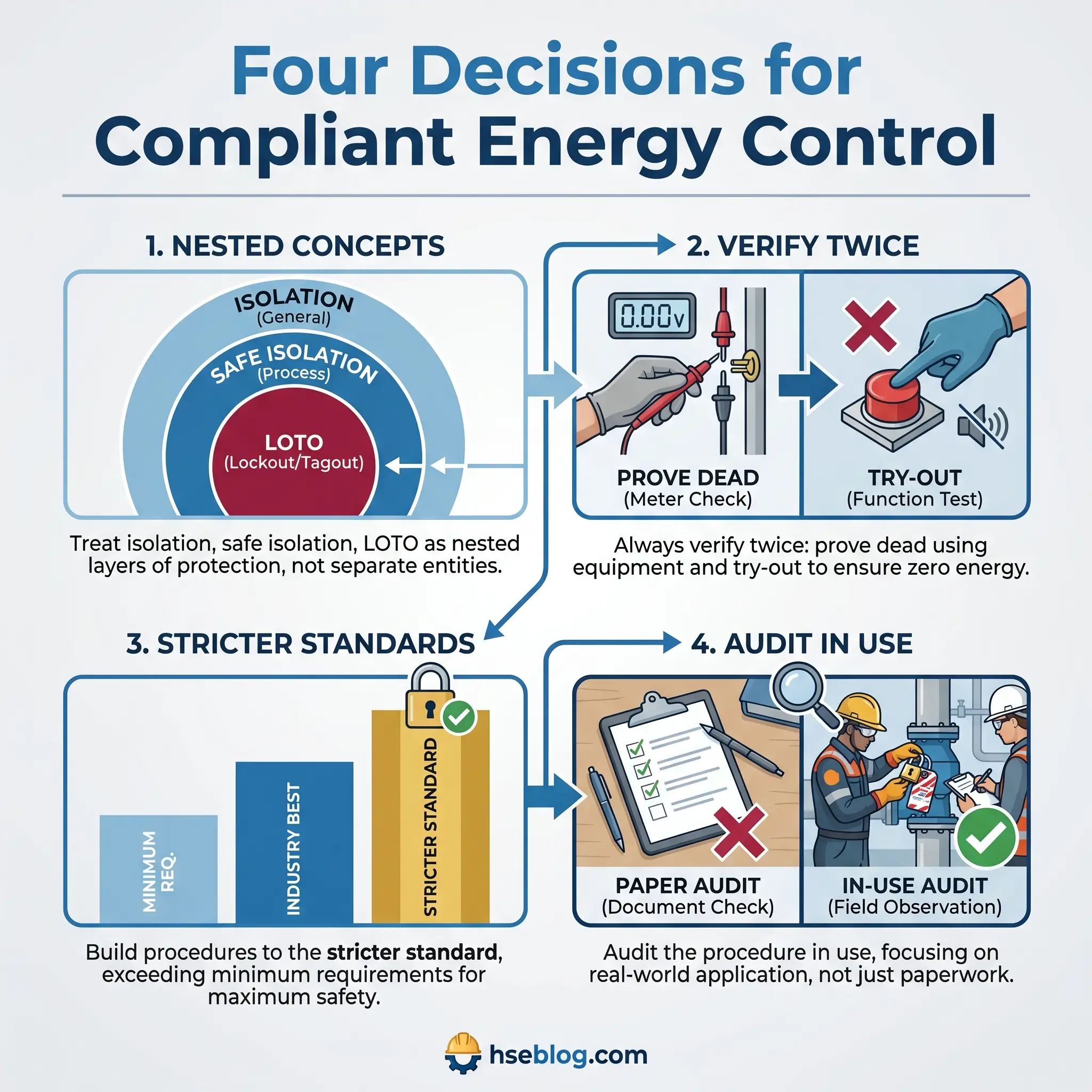
Four decisions drive safe energy control regardless of which flag flies over the site. Treat isolation as the physical act, safe isolation as the UK electrical procedure wrapped around that act, and LOTO as the full program that makes isolation reliable at scale across all energy types. Verify twice — prove dead for electrical work, try-out for control circuits — because each test answers a different question and neither is a full substitute. Build your procedure to the stricter of the two standards on every element: GS38 hardware for verification, 1910.147 program structure for documentation and training, ISO 14118 principles for stored energy. Audit against the procedure in use, not the procedure on paper — the annual inspection requirement in 1910.147(c)(6) exists precisely because drift is inevitable.
The safe isolation vs lockout tagout debate is resolved not by picking one framework over the other but by treating them as complementary. The cost of getting this wrong is not academic. OSHA penalties now reach $16,550 per serious violation and $165,514 per willful one, and enforcement activity on 1910.147 is rising, not falling. The human cost — the electrician standing at an opened panel assuming the equipment is dead when it is not — is the reason either framework exists at all.