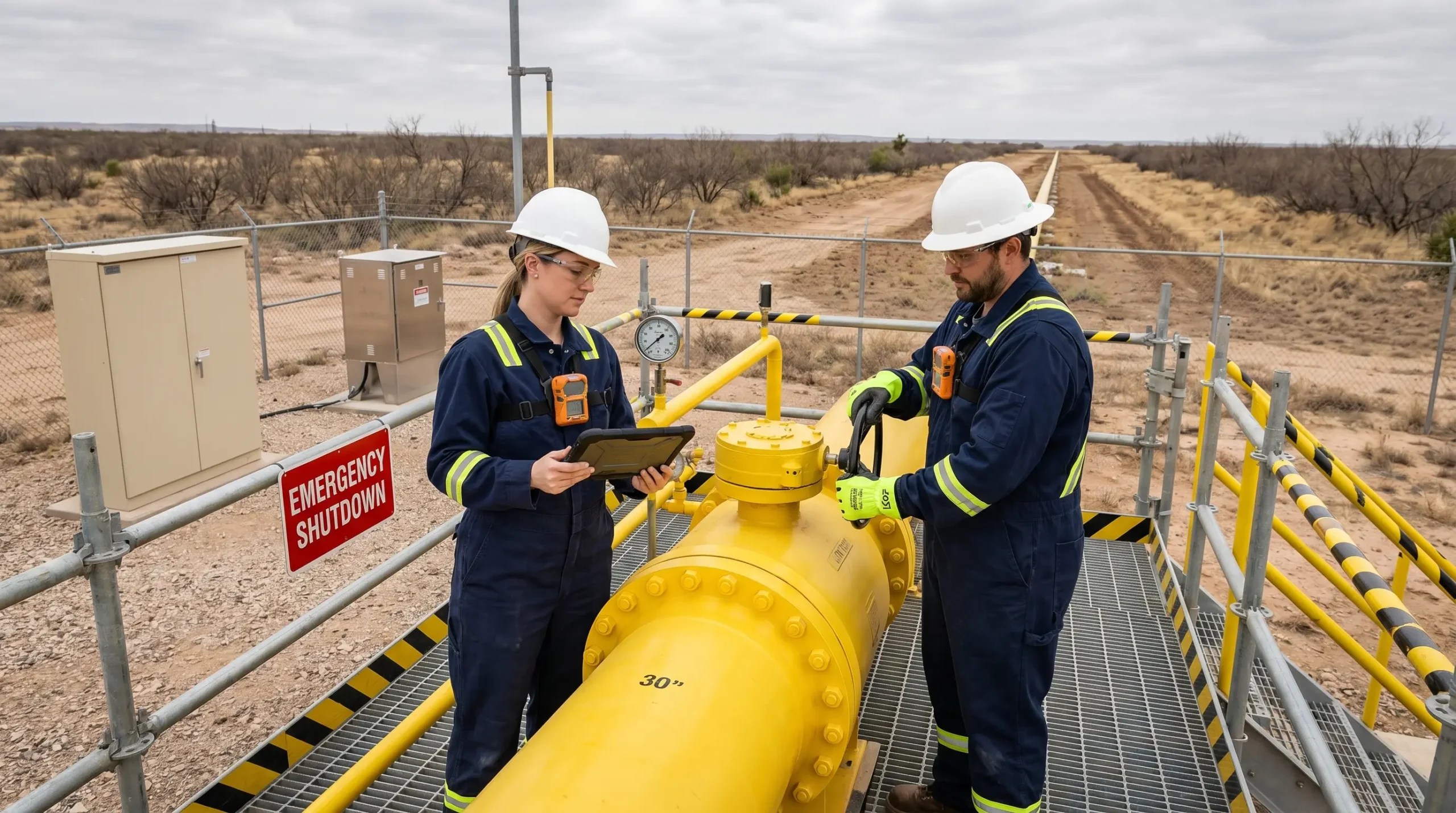
On the evening of September 9, 2010, a 30-inch natural gas transmission line running beneath a residential street in San Bruno, California ruptured during a pressure-control operation. Eight people were killed, more than sixty injured, thirty-eight homes destroyed, and roughly seventy others damaged. Eleven months earlier, a six-foot seam failure on a 30-inch crude line near Marshall, Michigan released about 843,000 gallons of heavy oil into Talmadge Creek, which fed directly into the Kalamazoo River. The two failures had almost nothing technical in common — different products, different regions, different operators. They shared a single root: an integrity management program that missed exactly what it was built to find.
Those two incidents rewrote the rulebook for pipeline safety integrity management. Regulators tightened the code, operators rebuilt their programs, and a generation of integrity engineers now works inside a discipline that treats every mile of pipe as a system to be assessed, monitored, and continually re-evaluated. This guide walks through both sides of that discipline — the hazards pipelines carry and the management framework that keeps those hazards from becoming headlines. You will see how threats are classified, how consequence areas are prioritized, how assessment methods are chosen, and where the field is heading next.
What Is Pipeline Integrity Management?
API RP 1160 and ASME B31.8S both define Pipeline Integrity Management (PIM) as a performance-based, leadership-driven process for continuously verifying that a pipeline remains fit for its intended service. The working definition I use with newer engineers on our transmission system is simpler: integrity management is what you do so that the pipe's condition never surprises you.
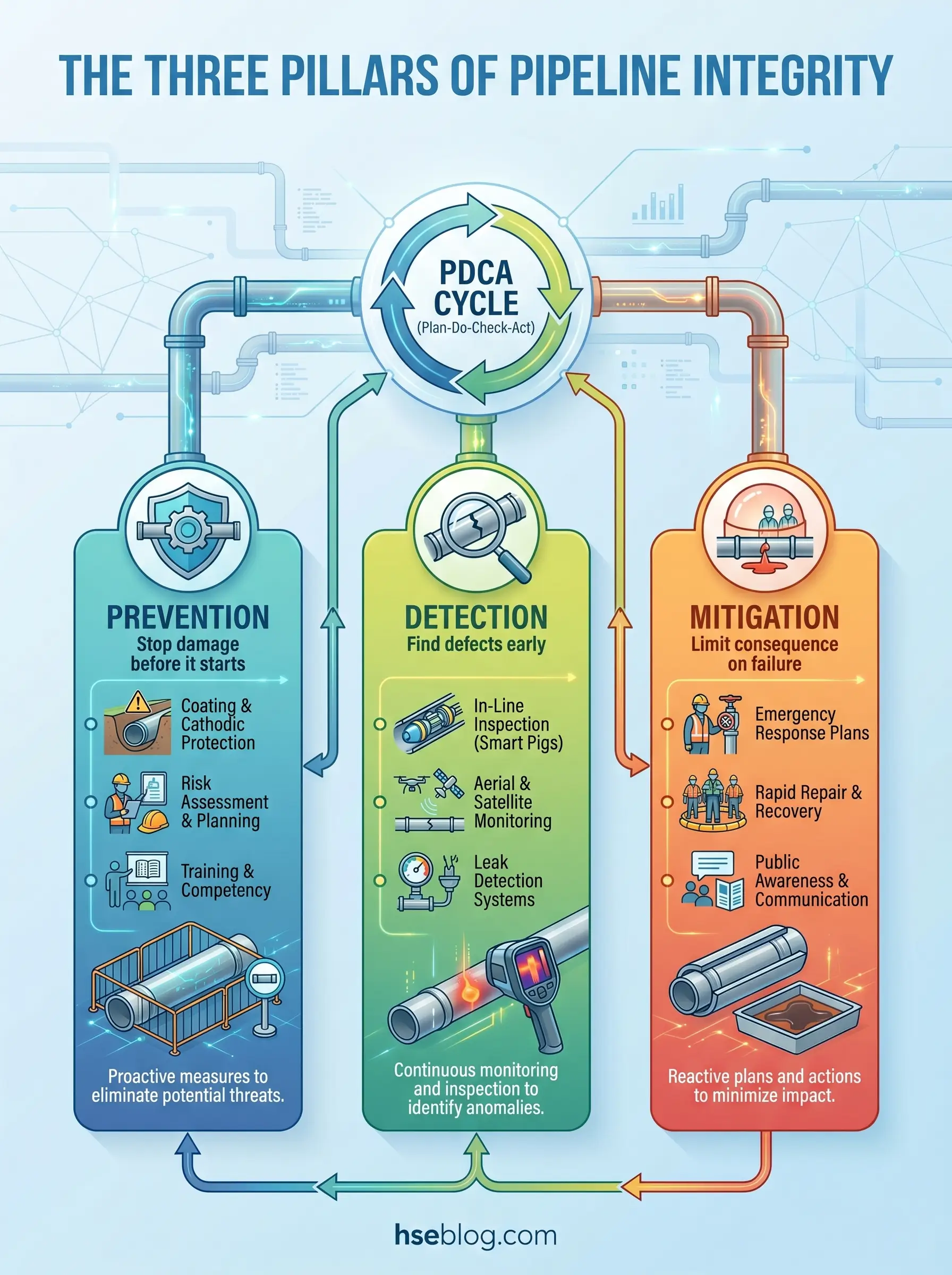
A mature Pipeline Integrity Management Program (IMP or PIMS) rests on three pillars — prevention, detection, and mitigation. Prevention keeps damage from occurring. Detection finds it early, while safety margins still exist. Mitigation limits consequence when prevention or detection falls short. Strip any one pillar and the other two collapse.
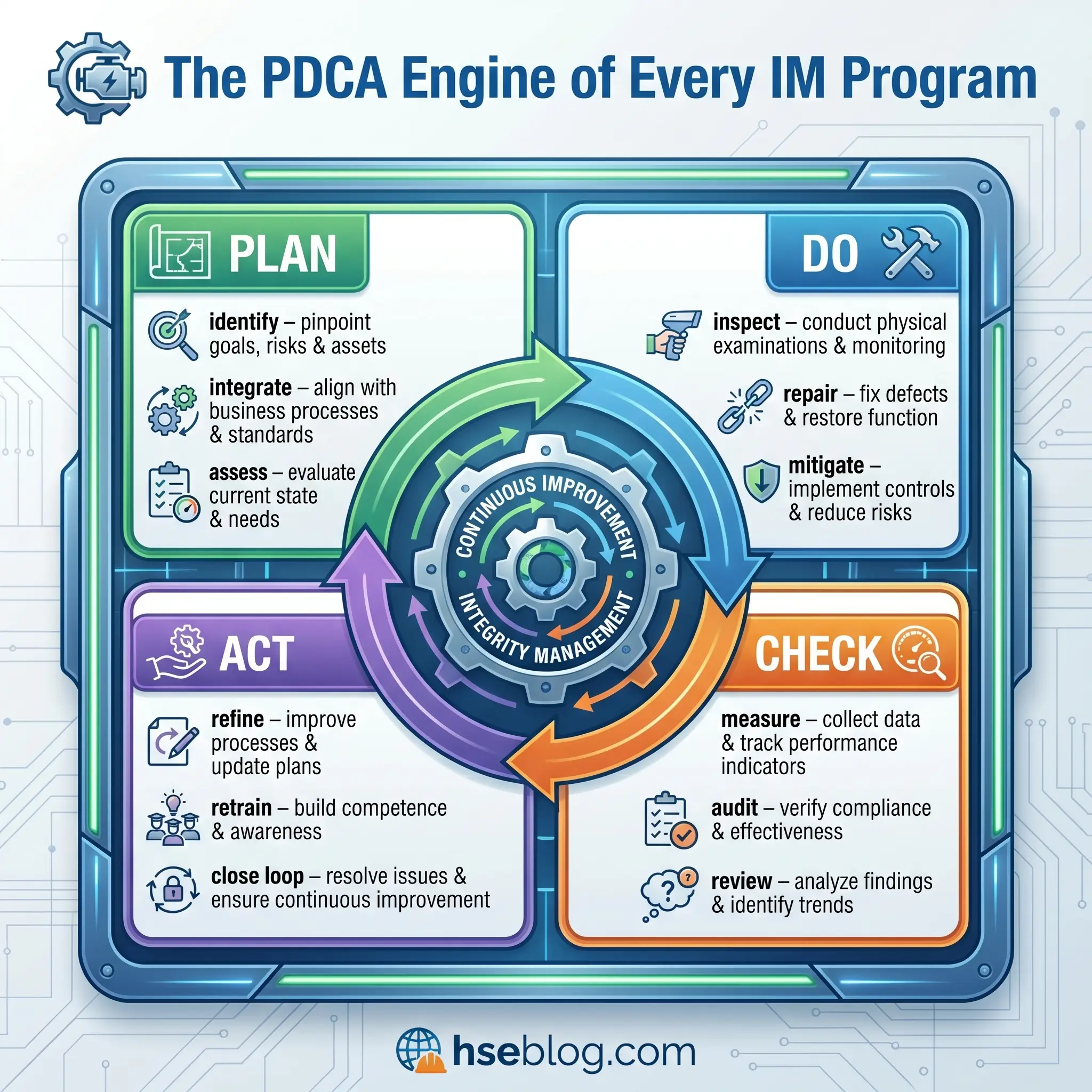
The engine that drives a program is the Plan-Do-Check-Act (PDCA) cycle. Plan identifies threats, assesses risk, and sets priorities. Do executes inspections, repairs, and preventive work. Check measures performance against defined metrics. Act closes the loop by refining thresholds and re-allocating resources based on what the program learned.
Ownership is where most programs quietly fail. Integrity engineers hold the technical pen, but the program only works when operations, maintenance, and executive leadership treat integrity as a line-of-business responsibility rather than a compliance file. PHMSA's stakeholder communications portal explains the discipline in plain operator language for anyone building a working understanding from the ground up.
Types of Pipelines and Their Associated Hazards
A gas gathering line at 600 psi in a dry plateau field and a cross-country crude trunk line moving sour product at 1,200 psi share almost nothing operationally. Segment the asset by what it carries and what it does before any serious hazard discussion — the hazard profile follows the product, not the pipe.
| Pipeline Type | Typical Product | Primary Hazard Signature |
|---|---|---|
| Gas transmission | High-pressure methane, NGLs | Large-diameter rupture, jet fire, blast overpressure |
| Gas distribution | Medium / low-pressure methane | Urban ignition, leak migration into structures |
| Gas gathering | Wet sour gas, produced fluids | Internal corrosion, H₂S exposure |
| Hazardous liquid | Crude, refined products, NGLs | Spill, watershed contamination, vapor ignition |
| CO₂ | Supercritical CO₂ | Asphyxiation plume, running ductile fracture |
| Water / slurry | Potable water, mine tailings | Service disruption, erosion-driven rupture |
Product properties drive severity. Flammability determines ignition consequence. Toxicity determines the exposure radius. Volatility determines whether a liquid release stays a pool or becomes a vapor cloud. Pressure determines how far the energy travels when containment fails.
The Major Hazards Associated with Pipelines
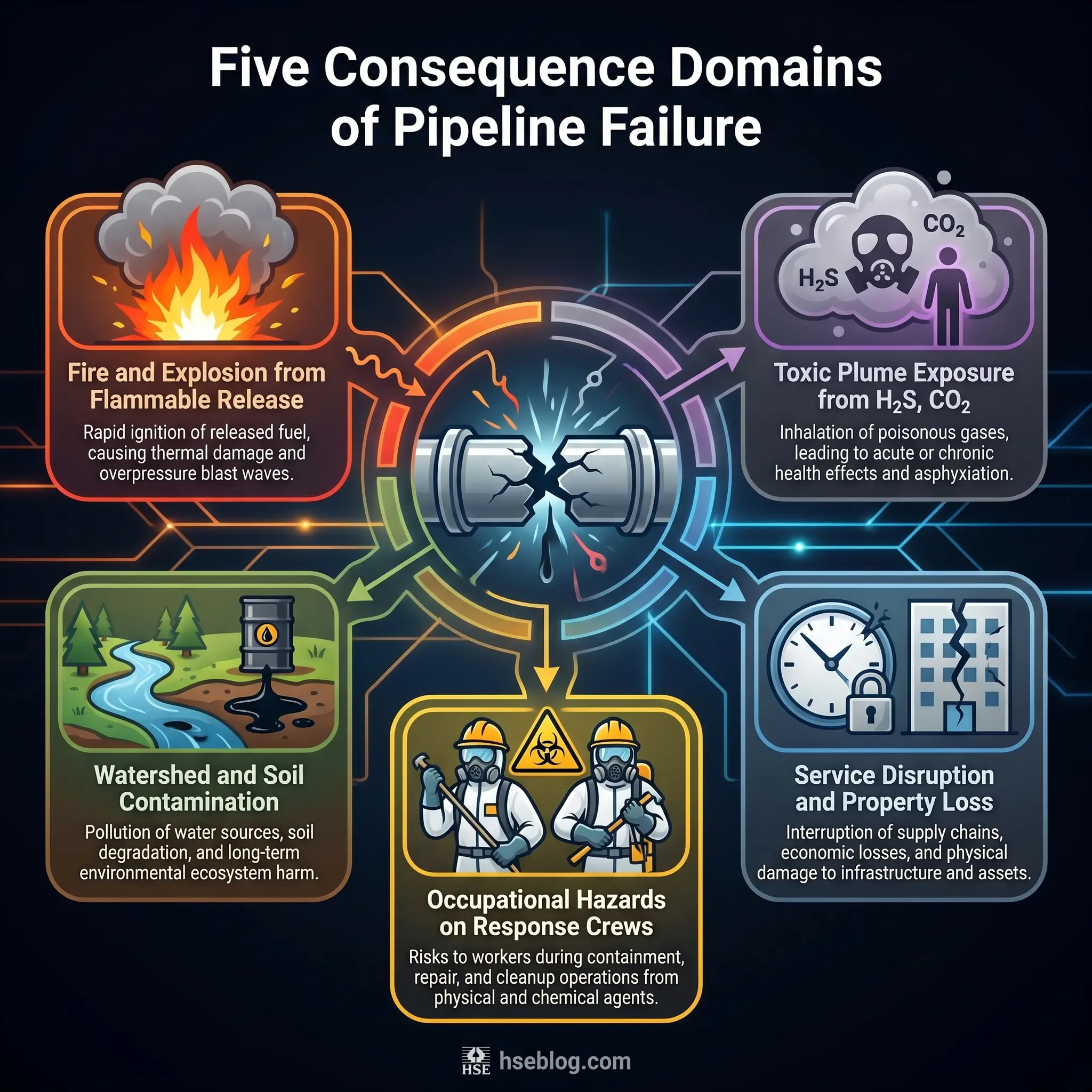
From the community's perspective, a pipeline is a hazard only at the moment it fails. That frame — consequence before cause — shapes how regulators and responders think about the system. Five consequence domains cover almost every incident worth studying.
- Fire and explosion. Methane and highly volatile liquids release, find an ignition source, and convert stored pressure into overpressure. Jet fires from transmission ruptures have thrown flames over 300 feet and radiated heat strong enough to ignite structures hundreds of feet back.
- Toxic exposure. Sour gas lines carrying hydrogen sulfide, ammonia pipelines, and CO₂ trunk lines each generate plumes that harm at distances far larger than the rupture crater suggests. H₂S at 700 ppm collapses a person inside a breath or two.
- Environmental contamination. Hydrocarbon spills reach watersheds faster than response crews reach access points. Once crude enters a river system, as it did at Marshall, the cleanup runs for years and the liability runs longer.
- Cryogenic and asphyxiation hazards. LNG and cold-temperature releases cause cold burns, displace oxygen, and create slow-moving vapor clouds that can re-ignite far from the source.
- Property, service, and occupational consequences. Loss of supply shuts hospitals, airports, and power generation. Construction and maintenance activity around live pipe layers trenching, confined-space, and hot-work hazards on top of the product risk itself.
Pipeline Threat Categories: The ASME B31.8S Framework
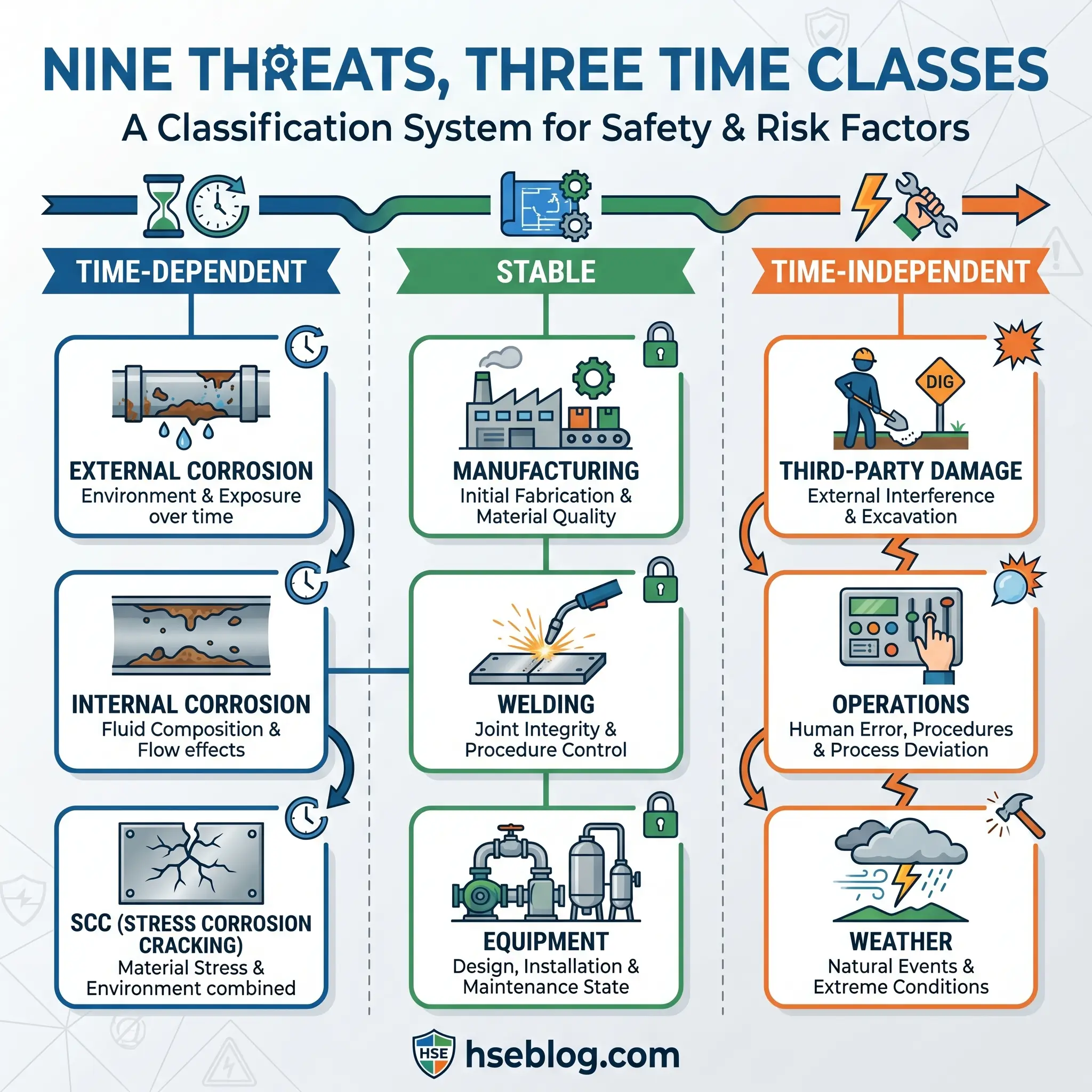
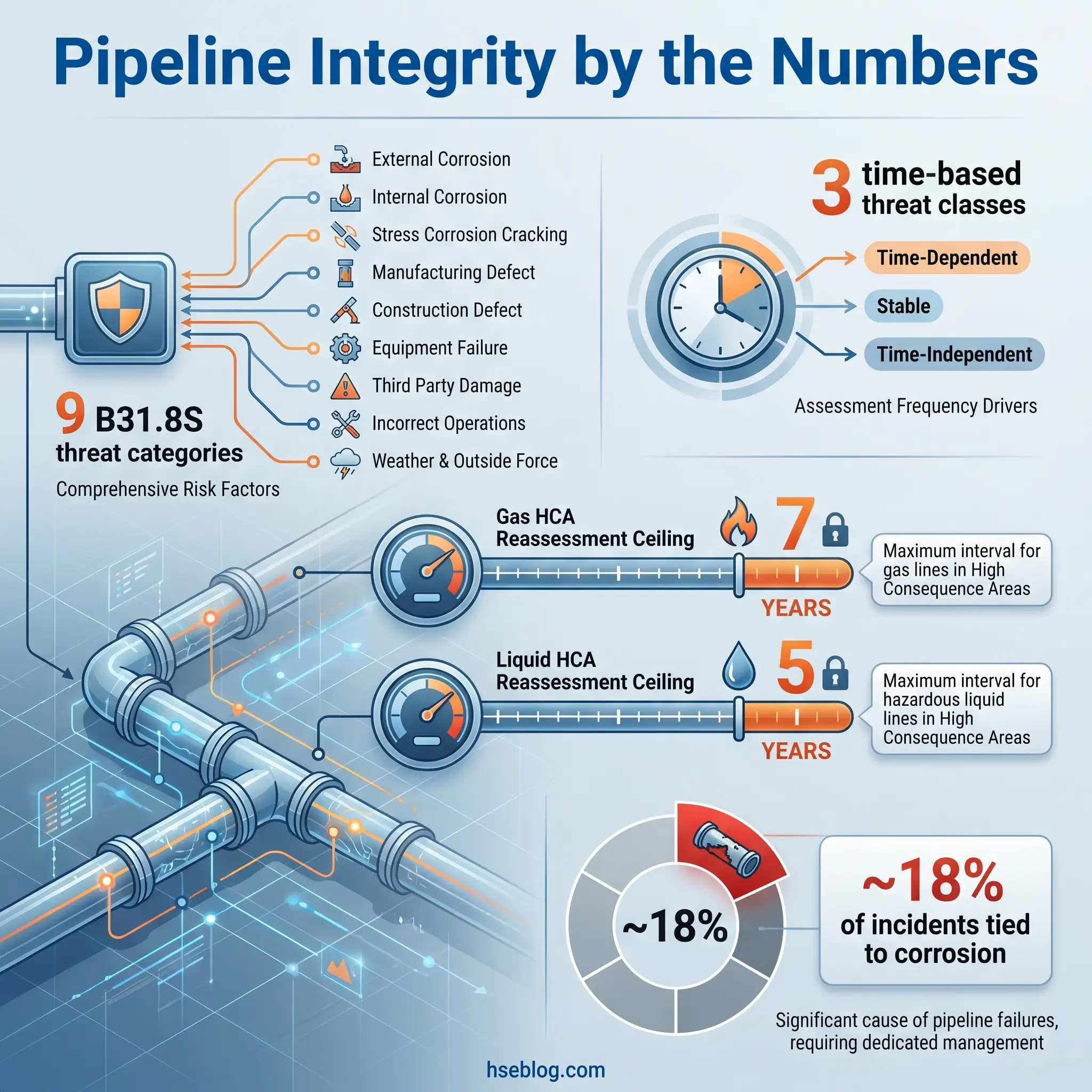
The backbone of modern pipeline integrity management is not a regulation — it is a standard. ASME B31.8S groups twenty-two identified failure causes into nine threat categories and sorts those nine into three time-based classes. PHMSA, API RP 1160, CSA Z662, and most international operators use this same taxonomy, which is why every serious IM data-integration exercise maps back to it. The ASME B31.8S document itself remains the canonical reference for operators designing or benchmarking a program.
The time-based grouping matters because the way a threat evolves determines how often you assess for it, which tool detects it, and what "still fit for service" means for any feature found.
Time-Dependent Threats
These threats grow in magnitude over time and drive reassessment intervals.
External corrosion remains the most common degradation mechanism on buried pipe. Coating breakdown allows soil moisture and oxygen to attack steel, while cathodic protection holds the reaction in check until it does not. Internal corrosion attacks from the product side when water, CO₂, H₂S, or microbial activity collects in low points — a colleague's ICDA dig on a gathering line last year opened pipe with 40 percent wall loss concentrated at the exact low point his flow model had flagged. Stress corrosion cracking (SCC) couples tensile stress with a corrosive environment, producing colonies of tight axial cracks that standard MFL tools routinely miss.
Over the past two decades, corrosion has accounted for approximately 18 percent of significant pipeline incidents and roughly 23 percent of significant failures across hazardous liquid and gas transmission systems combined.
Stable (Resident) Threats
These defects are born with the pipe and carried through its service life.
Manufacturing defects — seam-weld imperfections, laminations, hook cracks — sit dormant until an operating pressure or hydrotest challenges them. Welding and fabrication defects appear in girth welds, wrinkle bends, and field-fabricated fittings. Equipment threats cover gaskets, O-rings, control valves, and pressure-limiting components whose failure mode is sudden rather than progressive. Stable threats respond to fitness-for-service assessment, not corrosion-growth modeling. If the feature was stable at hydrotest and operating conditions have not changed, it generally stays stable.
Time-Independent Threats
These strike without warning and do not follow a growth curve.
Third-party damage and excavation contact sits at the top of PHMSA's incident ledger for a reason — a single backhoe tooth can erase a century of corrosion control in thirty seconds. Over a twenty-year study window, excavation damage alone caused roughly 147 fatalities and 619 injuries, a higher human toll than corrosion despite corrosion's larger share of total incidents. Incorrect operations captures human error: bypasses left in place, valve-alignment mistakes, over-pressure events. Weather and outside force includes earth movement, flooding, lightning strikes on cathodic-protection systems, and seismic displacement.
High Consequence Areas (HCAs) and Moderate Consequence Areas (MCAs)
Not every mile of pipe receives the same integrity attention, and for a reason any operator with a finite inspection budget understands — resources follow consequence. HCAs are segments where a failure would do the most harm to people, drinking water, or ecologically sensitive areas, and they carry the strictest requirements.
For gas transmission, 49 CFR §192.903 defines HCAs using the potential impact radius (PIR) — the distance a thermal event could travel from a full-bore rupture. A 30-inch line at 1,000 psi has a PIR measured in hundreds of feet; a 4-inch distribution line has one in the low single digits of meters. For hazardous liquids, 49 CFR §195.450 defines HCAs around high-population areas, navigable waters, and unusually sensitive environmental zones.
HCAs move. A segment that sat in open grazing land when it was commissioned can run under a new subdivision twenty years later. Operators reassess population density and environmental sensitivity on a defined cycle, and the PHMSA Gas Mega Rule extended many HCA-level protections to a broader zone called the Moderate Consequence Area (MCA). That extension brought tens of thousands of additional miles of gas transmission pipe under the expanded integrity umbrella — a shift that quietly redefined what "covered" means for most operators still working through the 2020–2024 rollout.
Watch For: HCA segment boundaries quietly outdated by new residential development near the right-of-way. A PIR that overlaps a school zone that was farmland five years ago is the kind of change auditors now look for.
The Core Elements of a Pipeline Integrity Management Program
49 CFR 192 Subpart O lists sixteen mandatory elements for a gas transmission integrity program, and 49 CFR 195.452 sets the hazardous liquid counterpart. Laid against the PDCA cycle, those elements stop looking like a compliance checklist and start looking like a coherent management system. PHMSA's gas transmission integrity management fact sheet breaks all sixteen down in plain operator language.
Plan. Identify covered segments — HCAs, MCAs, PIR calculations. Integrate data across every record source: ILI runs, cathodic protection surveys, leak history, construction records, SCADA trends. Assign applicable threats to each segment using the nine B31.8S categories. Assess risk qualitatively, semi-quantitatively, or through full quantitative risk analysis depending on segment complexity and consequence.
Do. Execute the baseline assessment and the periodic reassessment schedule through ILI, pressure testing, or direct assessment. Apply the immediate / one-year / scheduled repair criteria. Implement preventive and mitigative measures — valve automation, damage-prevention programs, right-of-way patrols, public awareness campaigns.
Check. Measure program performance against defined metrics: leak and rupture rates per mile, repair turnaround times, inspection coverage, near-miss reporting rate. Audit internally and through third parties. Review management-of-change entries against field reality rather than against the paperwork trail alone.
Act. Update risk models, adjust reassessment intervals, retrain personnel under Operator Qualification requirements, revise procedures. Records management is not an afterthought — traceable, verifiable, and complete documentation (TVC) is now an enforcement focus under the Mega Rule, with attribute-integration milestones that reached a key deadline in February 2024.
Integrity Assessment Methods
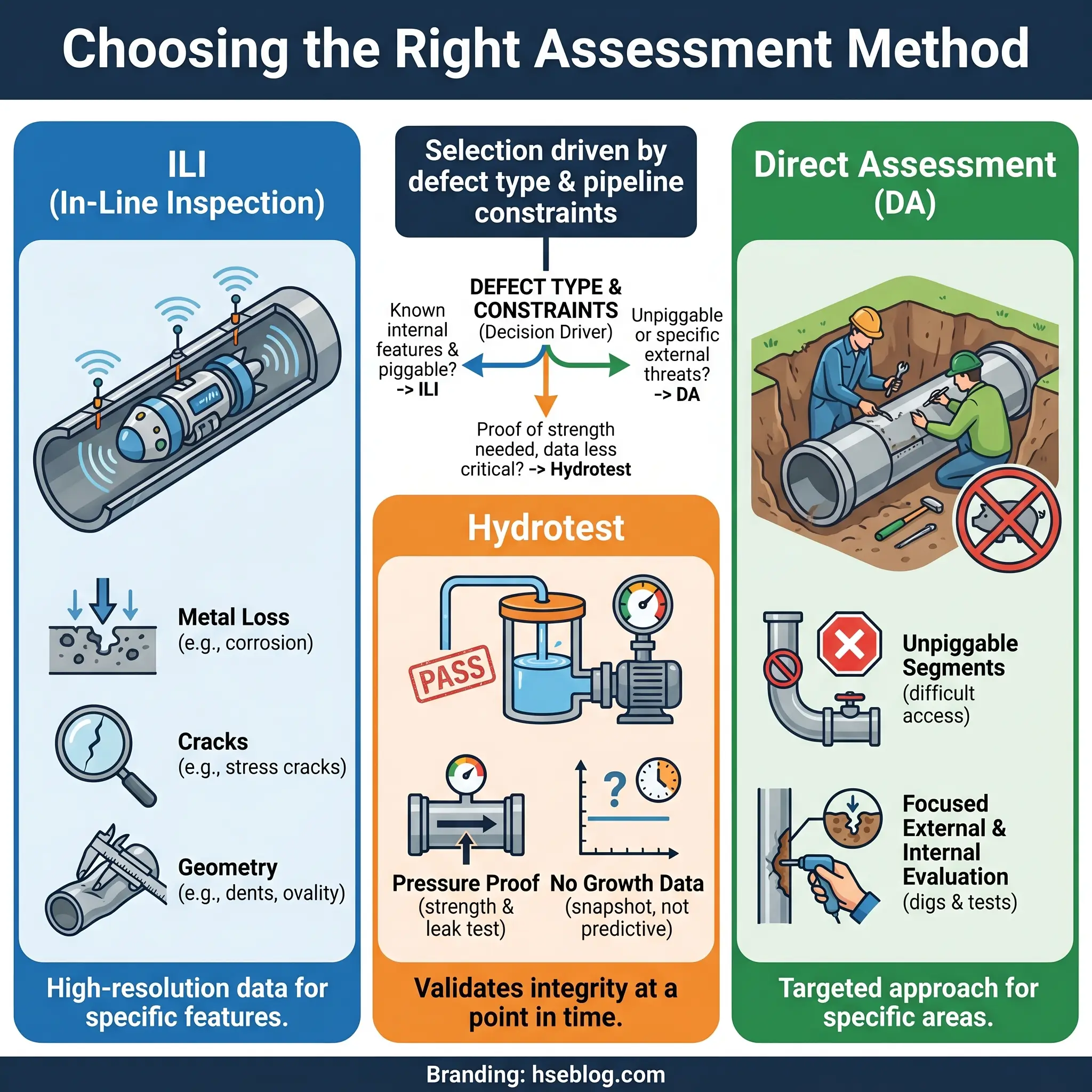
The three assessment options any operator weighs are in-line inspection, hydrostatic pressure testing, and direct assessment. Each finds a different class of defect, and each leaves blind spots.
In-line inspection (ILI) runs a smart pig through the pipe under product flow. Magnetic flux leakage (MFL) tools find metal loss — external and internal corrosion, gouges. Ultrasonic (UT) tools measure wall thickness directly but require a liquid couplant, which limits their use in gas lines unless a liquid slug is staged. EMAT tools generate shear waves in the pipe wall itself and are the primary technology for crack detection, including SCC colonies that MFL routinely underestimates. Caliper and geometry tools find dents and ovalities. Hybrid MFL-UT tools have demonstrated metal-loss depth sizing of roughly ±0.4 mm, and probability of detection on modern tools reaches 90 percent or higher depending on defect type.
Hydrostatic pressure testing pressurizes the line to a defined multiple of MAOP — typically 1.25 to 1.5 times — and holds it. The test proves the line can carry pressure on the day of the test. What it does not do is characterize defects or predict growth, which is why pressure testing has largely been displaced by ILI on piggable lines except as a commissioning test or post-repair verification.
Direct assessment is the third leg. External Corrosion Direct Assessment (ECDA) combines above-grade CP and coating surveys with targeted excavations. Internal Corrosion Direct Assessment (ICDA) uses flow modeling to identify low points where water and corrosive species collect, then excavates those points. SCCDA targets stress corrosion cracking through terrain, coating, and operational screens. Direct assessment is the method of choice for unpiggable segments — short risers, tight bends, mixed diameters — where ILI cannot reach.
Selection is not a preference question. Piggability, product, defect type, and regulatory category drive it. A liquid line with a known crack history and EMAT piggability goes to ILI. A gas gathering line with a history of internal corrosion in low points goes to ICDA. A short, unpiggable transition spool gets pressure tested. Operators who pick by habit rather than by defect-method fit are the operators who miss things.
Prevention and Mitigation Controls
Finding a defect is only half of integrity management. Preventing the next one — and limiting consequence when prevention fails — is where the program earns its keep.
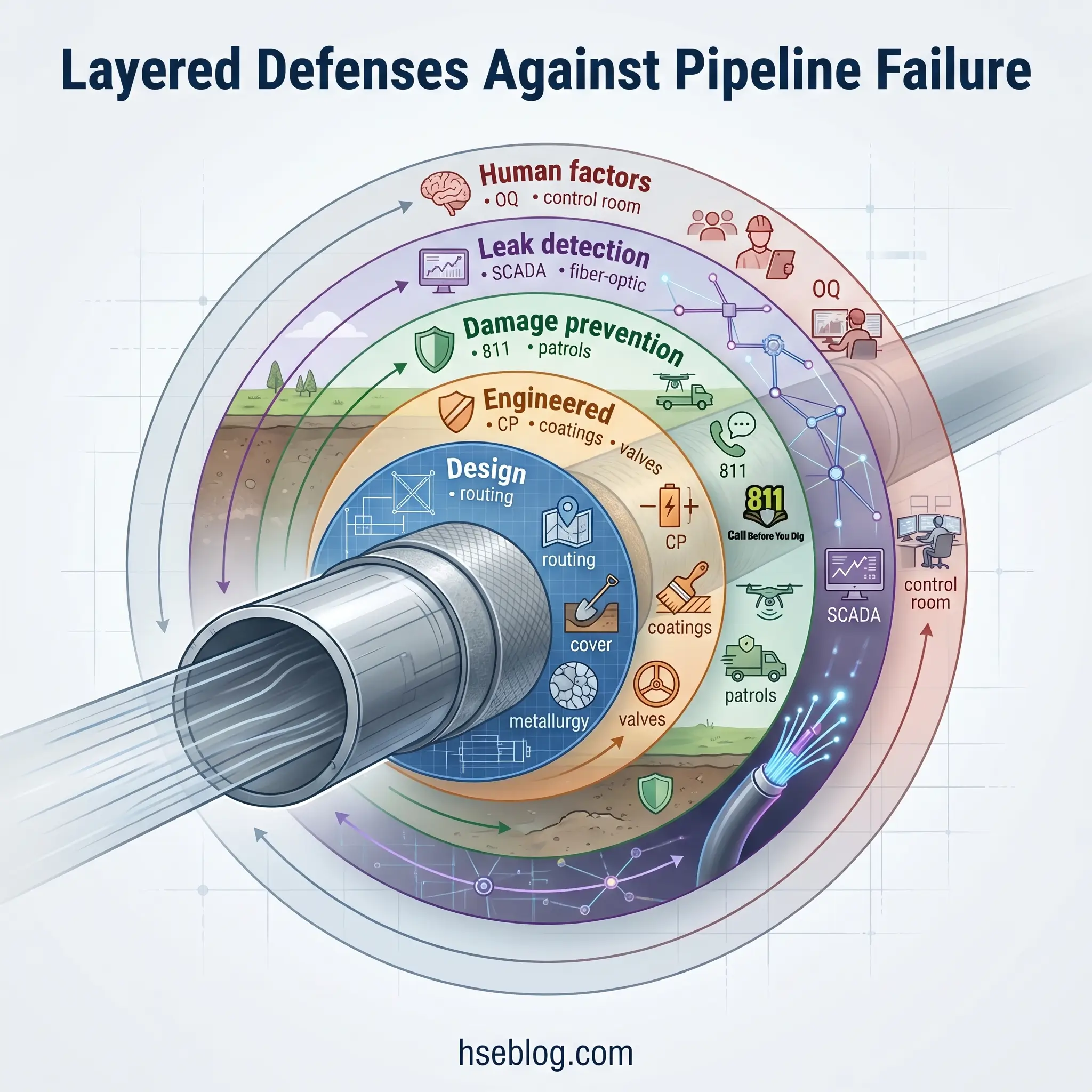
Design comes first. Route selection away from population centers, adequate depth of cover, wall-thickness margin above MAOP requirements, and corrosion-appropriate metallurgy eliminate threats that cannot be fully managed later. A line routed through a drainage swale will flood; a line with insufficient cover will be struck.
Engineered barriers do the ongoing work. Cathodic protection holds external corrosion in check when coatings fail — and coatings always fail somewhere. On a recent ECDA excavation in our corridor, the team uncovered a two-inch coating holiday with no measurable wall loss because the CP current density at that elevation had held the reaction flat for fifteen years. Inhibitor injection suppresses internal corrosion on wet-product lines. Remote and automatic shutoff valves (RSVs/ASVs) limit release volume after a rupture. Following San Bruno, the push for shorter valve spacing on HCA segments became one of the defining post-incident control changes.
Damage prevention is a separate discipline with its own culture. One-call / 811 compliance, right-of-way patrols, aerial surveillance, pipe locator verification, and structured public awareness programs exist because third-party contact is the top time-independent threat. The common failure mode is not technical — it is a contractor who does not wait for locate marks, or a landowner who does not know a transmission line crosses the property.
Leak detection rides on top of everything else. SCADA-based computational pipeline monitoring (CPM) catches rate and pressure anomalies. Acoustic and fiber-optic distributed sensing catches smaller releases that do not show up on mass balance. Drone and aerial patrols close gaps between inline detection events. None of these alone is sufficient, which is why modern programs layer two or three together.
Human factors finish the picture. Operator Qualification requirements under 49 CFR Part 192 Subpart N and Part 195 Subpart G tie documented competency to every covered task. Control-room management rules under §192.631 and §195.446 govern shift handovers, fatigue management, and alarm response. The weakest link in most modern failures is not a tool or a specification — it is a human decision made under pressure.
Key Regulations and Standards Governing Pipeline Integrity
A practical authority map helps integrity engineers separate what applies, what is advisory, and what is best practice.
| Standard | Scope | Key Requirement |
|---|---|---|
| 49 CFR Part 192 | US gas pipelines | Subpart O integrity management; Mega Rule extensions to MCAs |
| 49 CFR Part 195 | US hazardous liquid pipelines | §195.452 baseline and five-year reassessment in HCAs |
| ASME B31.4 / B31.8 | Design, construction, operation | Material, wall thickness, MAOP, operational limits |
| ASME B31.8S | Gas pipeline integrity | Nine threat categories, data integration, risk assessment |
| ASME B31G | Corroded pipe evaluation | Remaining strength calculation for metal-loss features |
| API RP 1160 | Hazardous liquid IM | Prevention, detection, and mitigation framework |
| API RP 1173 | Pipeline Safety Management | Leadership, risk, operational controls, assurance |
| API RP 1176 | Cracking in pipelines | SCC, fatigue, and seam-weld crack management |
| API Std 1163 | ILI qualification | Tool validation and performance specification |
| ISO 15589 (Parts 1, 2) | Cathodic protection | International CP design and operating criteria |
| CSA Z662 / PD 8010 | Canada / UK national codes | Aligned with risk-based IM principles |
| NACE / AMPP standards | Corrosion control | Coating, inhibitor, monitoring specifications |
How Often Should Pipelines Be Inspected and Reassessed?
There is no single answer, because the regulatory maximum is not always the correct interval. Under 49 CFR §192.939, gas transmission segments in HCAs carry a seven-year maximum reassessment interval. Under 49 CFR §195.452, hazardous liquid segments in HCAs carry a five-year maximum. Those are ceilings, not targets.
Operators routinely reassess sooner when the numbers demand it. Corrosion growth rates derived from two consecutive ILI runs can justify a three- or four-year interval on a segment running aggressive product. A new threat introduced by a third-party land-use change can trigger an immediate reassessment regardless of when the last one ran. The Mega Rule tightened several of these interval-reduction triggers and required operators to document the basis for any interval set below the regulatory ceiling.
The rule I give integrity planners under my direction: set the interval on the segment's worst-growing feature, not the average. An average interval is what missed the critical feature on the failed Marshall segment — the growing crack-like indication sat inside a population of metal-loss features that a group-average growth rate did not capture.
Emerging Challenges and the Future of Pipeline Integrity
The discipline is shifting faster than it has in a generation.
Hydrogen and hydrogen-blended pipelines. Hydrogen's small molecule escapes through seals and fittings that hold methane fine, and its interaction with steel — hydrogen embrittlement and hydrogen-assisted cracking — changes the fitness-for-service rules on legacy pipe. Ongoing PHMSA and DOE research programs are working to establish material compatibility limits, blend thresholds, and ILI tool performance for hydrogen service. Operators converting or blending existing natural gas systems are, for now, making conservative engineering choices rather than following a settled code.
CO₂ pipelines for carbon capture. Supercritical CO₂ behaves unlike any product most operators have moved before. Phase shifts at pressure drops can drive long running ductile fractures, and a release creates a dense, cold asphyxiation plume that hugs terrain. The Satartia, Mississippi incident reframed CO₂ pipeline consequence modeling for the industry almost overnight.
AI and predictive integrity. Hybrid mechanistic-machine-learning models are moving corrosion-growth prediction from reactive to proactive. Recent operator case studies have reported meaningful reductions in integrity operating cost alongside accuracy gains in corrosion growth prediction when validated AI models are paired with physics-based degradation mechanisms. The caution is real — ML models trained on limited data sets fail silently on segments outside their training range.
Digital twins and unified-data platforms. Integrity teams that historically lived in spreadsheets are migrating to platforms that pull ILI, CP, SCADA, GIS, and operational data into a single queryable model. The value is not automation but the ability to ask cross-domain questions — do CP underprotection events correlate with corrosion features on this segment? — without a month of data stitching.
Cybersecurity and SCADA resilience. The 2021 Colonial Pipeline shutdown turned cybersecurity from an IT concern into a pipeline-integrity concern. Ransomware on IT systems forced a precautionary shutdown of OT operations, and the TSA security directives that followed are still reshaping how operators segment networks, control privileged access, and exercise incident response.
Aging infrastructure. A significant share of the US pipeline network predates the modern welding, material, and integrity standards that govern new construction. Replacement programs are expensive and slow. The short-term discipline is running those assets responsibly under an integrity program that accounts honestly for their vintage.
Building a Culture of Pipeline Safety
Technical controls fail without the behaviors that sustain them. After San Bruno, PHMSA's focus shifted toward safety culture as a leading indicator — on the recognition that the failed segment's records and the engineering behavior around those records had warning signs years in advance that the culture had not elevated to decision-makers.
API RP 1173 codified the Pipeline Safety Management System (SMS) framework around seven pillars: leadership commitment, stakeholder engagement, risk management, operational controls, incident investigation, competence and training, and assurance. The industry's Pipeline SMS portal at pipelinesms.org gives operators reference materials, maturity models, and assessment tools to benchmark where their program actually sits versus where the paperwork claims it is.
The measure of a mature culture is simple. What happens when someone on the crew raises a concern about a permit, an ILI dig call, or a pressure test? In a program with real culture, the work stops and the concern gets evaluated on its technical merits. In a program without it, the concern gets absorbed into paperwork and the work continues. Both programs pass the same regulatory audit. Only one prevents the next incident.
Frequently Asked Questions
What is the difference between pipeline safety and pipeline integrity management?
Pipeline safety is the outcome — no harm to people, property, or the environment. Pipeline integrity management is the engineering and management process that delivers that outcome. Safety is what the public sees. Integrity is what the operator must build, evidence, and continually prove.
What are the most common causes of pipeline failures?
PHMSA data across the last two decades points to four persistent leaders — external and internal corrosion, excavation and third-party damage, equipment failure, and incorrect operations. Corrosion drives the largest share of significant incidents overall, but excavation damage carries the highest human toll relative to its incident count. No single control addresses all four, which is why layered prevention and detection is the industry standard.
What is a smart pig and how does it work?
A smart pig is an in-line inspection tool propelled through a pipeline by the product itself. Different sensor platforms find different defects: MFL (magnetic flux leakage) detects metal loss, UT detects wall thickness with acoustic precision, EMAT detects cracks and SCC, and caliper tools detect dents and geometry changes. A typical run collects gigabytes of data along every foot of pipe, which analysts then correlate against prior runs to estimate growth rates.
What is a High Consequence Area (HCA)?
An HCA is a pipeline segment where a failure would cause the greatest harm. For gas transmission, the definition in 49 CFR §192.903 uses the potential impact radius around population and structures. For hazardous liquids, 49 CFR §195.450 uses proximity to populated zones, drinking-water sources, and ecologically unusually sensitive areas. HCAs are dynamic — a segment can become an HCA years after commissioning as development grows around the right-of-way.
How often are pipelines inspected and reassessed?
The regulatory maximum is seven years for gas transmission HCA segments and five years for hazardous liquid HCA segments. Most operators reassess sooner when corrosion growth rates, new threats, or changes in segment consequence justify a shorter interval. The Mega Rule requires operators to document the technical basis for whatever interval they choose below the ceiling.
Are hydrogen pipelines more dangerous than natural gas pipelines?
The honest answer is: they are differently dangerous, and the codes are still catching up. Hydrogen's small molecule leaks through fittings that hold methane, its ignition energy is lower, and it interacts with carbon steel in ways — embrittlement, assisted cracking — that natural gas does not. None of that makes hydrogen unmanageable, but it means legacy gas pipe cannot simply be converted without material compatibility assessment, and ILI tools for hydrogen service are still maturing under active PHMSA and DOE research.
Conclusion
Pipeline safety integrity management is moving from a discipline built around periodic inspections and paper records toward one built around continuous, data-driven condition awareness. The shift is already visible. Mega Rule implementation has extended integrity oversight beyond traditional HCAs into MCAs. AI and digital-twin platforms are reshaping how corrosion growth is predicted. Hydrogen and CO₂ services are forcing a rethink of fitness-for-service on material combinations the existing codes were not written for. None of that displaces the fundamentals.
Threats still come from the nine ASME B31.8S categories. Consequence still concentrates in HCAs and MCAs. The PDCA cycle still drives every mature program. What changes over the next decade is the resolution at which operators can see the pipe — and the speed at which they can act when the data says something has shifted.
The operators who lead that decade will be the ones who treat pipeline safety integrity management as an evolving discipline rather than a fixed compliance package, adopting new tools where they strengthen the fundamentals and staying skeptical where they do not. The pipe outlasts the people who commission it. The program has to as well.