
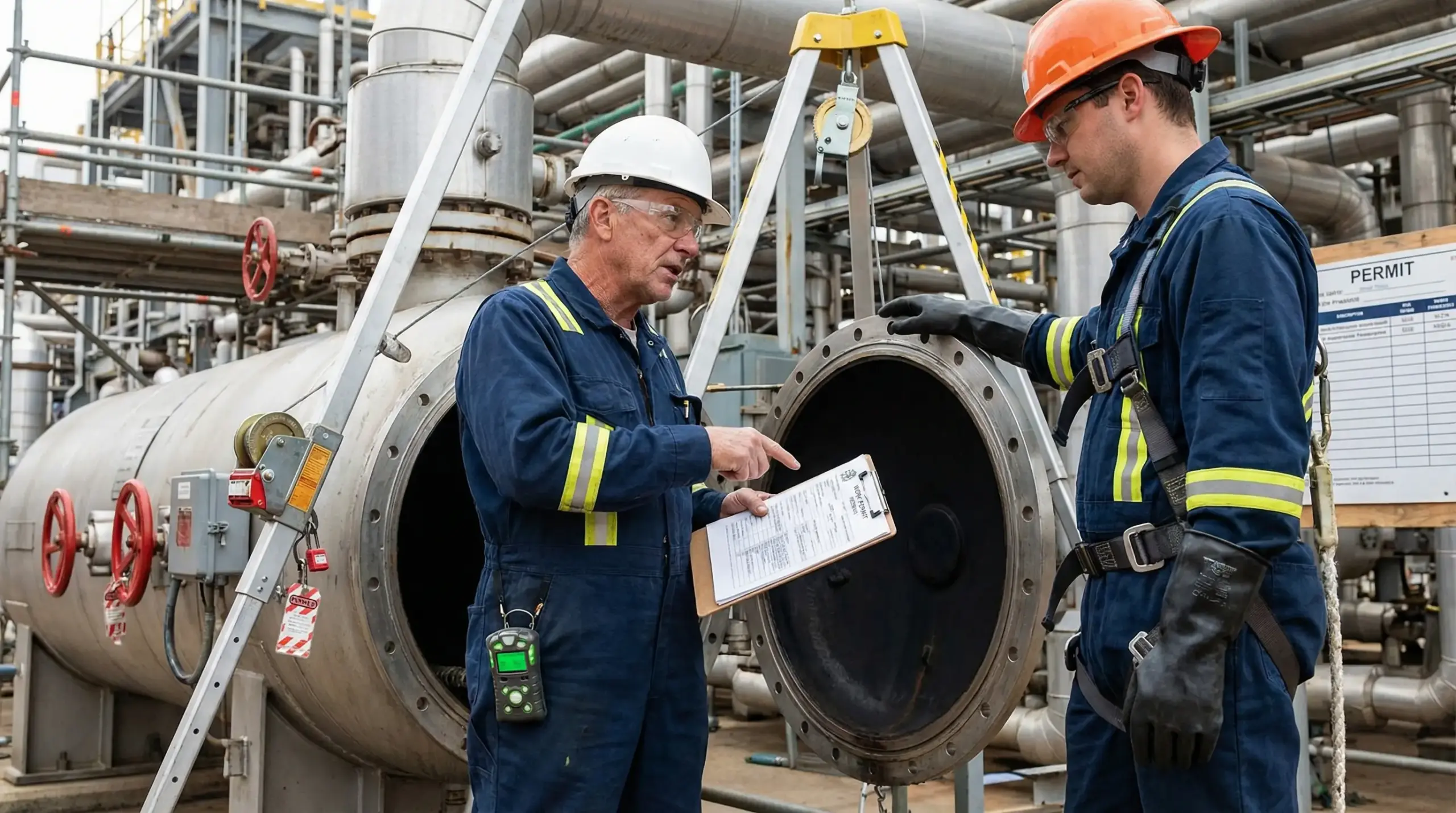
TL;DR
- A Permit to Work (PTW) system is a formal, documented process that authorizes high-risk work only after all hazards have been identified, controls verified, and responsibilities assigned — it is the last gate between planning and execution on any high-hazard site.
- PTW is not paperwork — it is a live risk control tool. The permit itself is worthless if the conversations, isolations, atmospheric tests, and physical verifications behind it never happened.
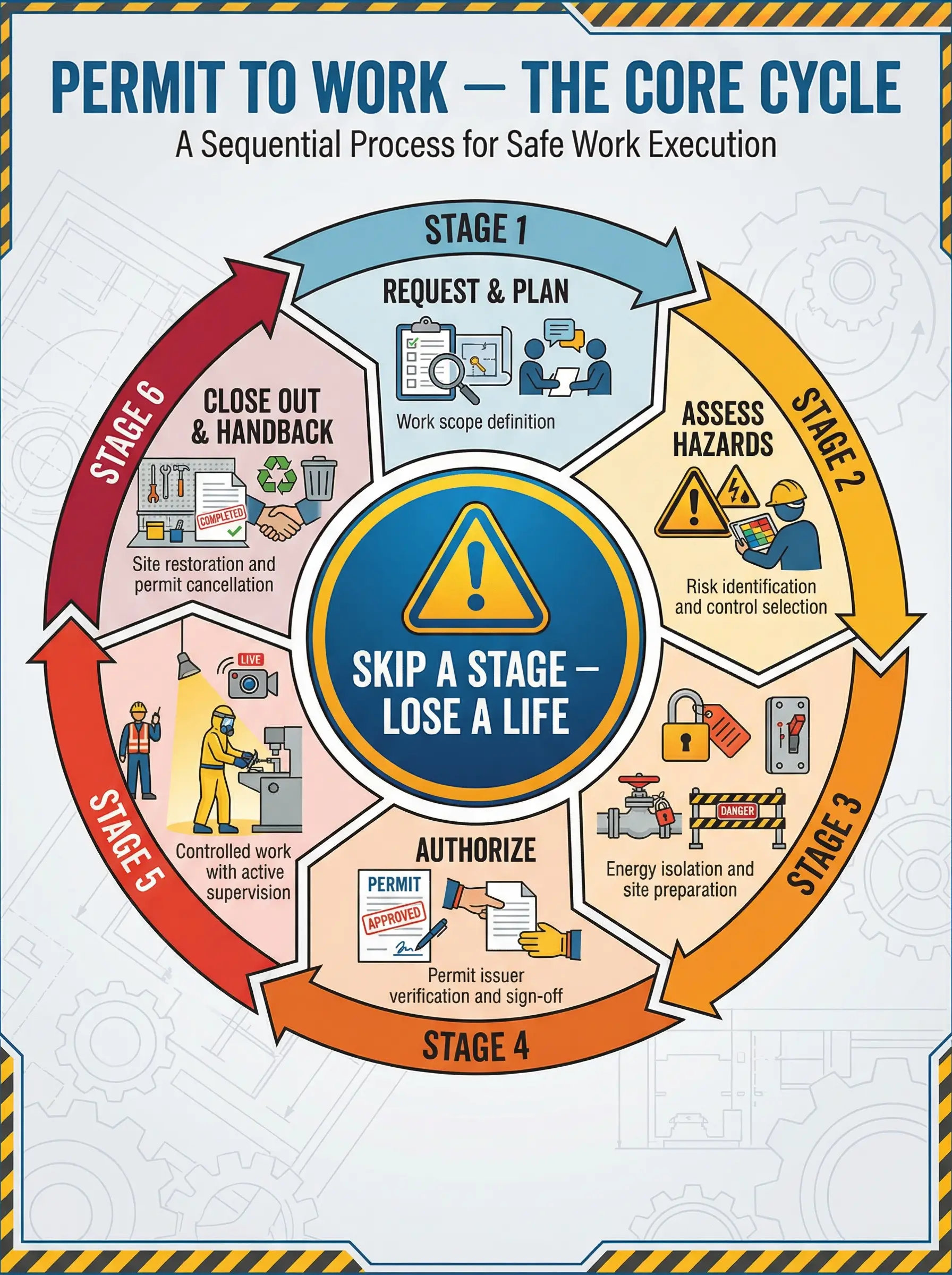
- Every PTW procedure follows a core cycle: request → risk assessment → isolation and preparation → authorization → execution with monitoring → handback and close-out. Skipping any stage has killed workers.
- Common site failures include permit shopping, copy-paste hazard assessments, and working beyond permit validity. These are not administrative errors — they are systemic breakdowns that investigators find in almost every PTW-related fatality.
- A well-run PTW system protects workers, clarifies accountability, and creates a real-time map of every high-risk activity happening on your site at any given moment.
The crane was already rigged, and the crew was ready to lift when I arrived for a routine site walk on a refinery turnaround in the Gulf. I asked to see the lifting permit. The supervisor pulled out a crumpled form — dated three days earlier, issued for a completely different lift, in a different area of the plant. The crew had been working off a dead permit all morning. No updated risk assessment, no re-verification of exclusion zones, no communication with the simultaneous operations team running hot work two levels above. I stopped the job. The conversation that followed was uncomfortable, but the alternative — a major lift proceeding under uncontrolled conditions within meters of live hot work — was unthinkable.
That incident captures everything wrong with how permit-to-work systems fail in practice. The paperwork existed. The signatures were there. But the system behind the paper — the hazard identification, the live verification, the real-time coordination — had collapsed entirely. Permit-to-work systems are one of the most critical risk controls in any high-hazard operation, and they are also one of the most commonly degraded. This article breaks down what a PTW system actually is, how the procedure works from request to close-out, where it fails on real sites, and what it takes to run one that genuinely protects people.
What Is a Permit to Work System?
A permit-to-work system is a formal, documented management system that controls the authorization, execution, and completion of work activities identified as high-risk. It ensures that before any hazardous task begins, all foreseeable risks have been assessed, appropriate controls have been implemented and physically verified, and every person involved understands their role, the hazards, and the emergency response plan. The permit itself — the physical or digital document — is simply the visible output of that entire process. It is not the system. It is the record that the system functioned.
The distinction matters because the most dangerous PTW failures I have investigated were never paperwork failures. They were failures of process — situations where the form was completed but the underlying safety actions were skipped, assumed, or delegated to someone who never carried them out.
A functioning PTW system delivers several critical outcomes that no other single control can replicate on a complex site:
- Formal hazard identification before work starts. Every permit requires a task-specific risk assessment that forces the permit holder and issuer to think through what could go wrong — before tools leave the container.
- Verified control implementation. Controls are not just listed on a form. They are physically checked — isolations confirmed, atmospheres tested, barriers erected, PPE verified — before authorization is granted.
- Clear accountability chain. The permit defines who requested the work, who assessed the risk, who authorized it, who is responsible during execution, and who signs off on completion. When something goes wrong, there is no ambiguity.
- Real-time visibility of simultaneous operations. On any complex site — a refinery turnaround, a construction mega-project, an offshore platform — dozens of high-risk activities may be running concurrently. The PTW system is the only mechanism that gives the site authority a live picture of what is happening, where, and what conflicts might exist.
- A legal and regulatory compliance record. Regulators expect documented evidence that high-risk work was formally controlled. A well-maintained PTW log is one of the first things an inspector or investigator will request after an incident.
OSHA 29 CFR 1910.146 requires a written permit system for confined space entry, specifying that entry permits must document the space, hazards, controls, authorized entrants, attendants, and entry supervisors — and that no entry is permitted until conditions are verified.
Pro Tip: If your PTW system is only discussed when someone needs a signature and forgotten the moment work begins, you do not have a system. You have a filing exercise. The real test of a PTW system is what happens between authorization and close-out — not what is written on the form.
When Is a Permit to Work Required?
Not every task on a worksite needs a permit. PTW systems are designed specifically for activities where the risk level exceeds what routine precautions and standard operating procedures can control. Issuing permits for low-risk, everyday tasks dilutes the system, creates permit fatigue, and teaches workers that the permit is just another piece of paper to sign before doing what they were going to do anyway.
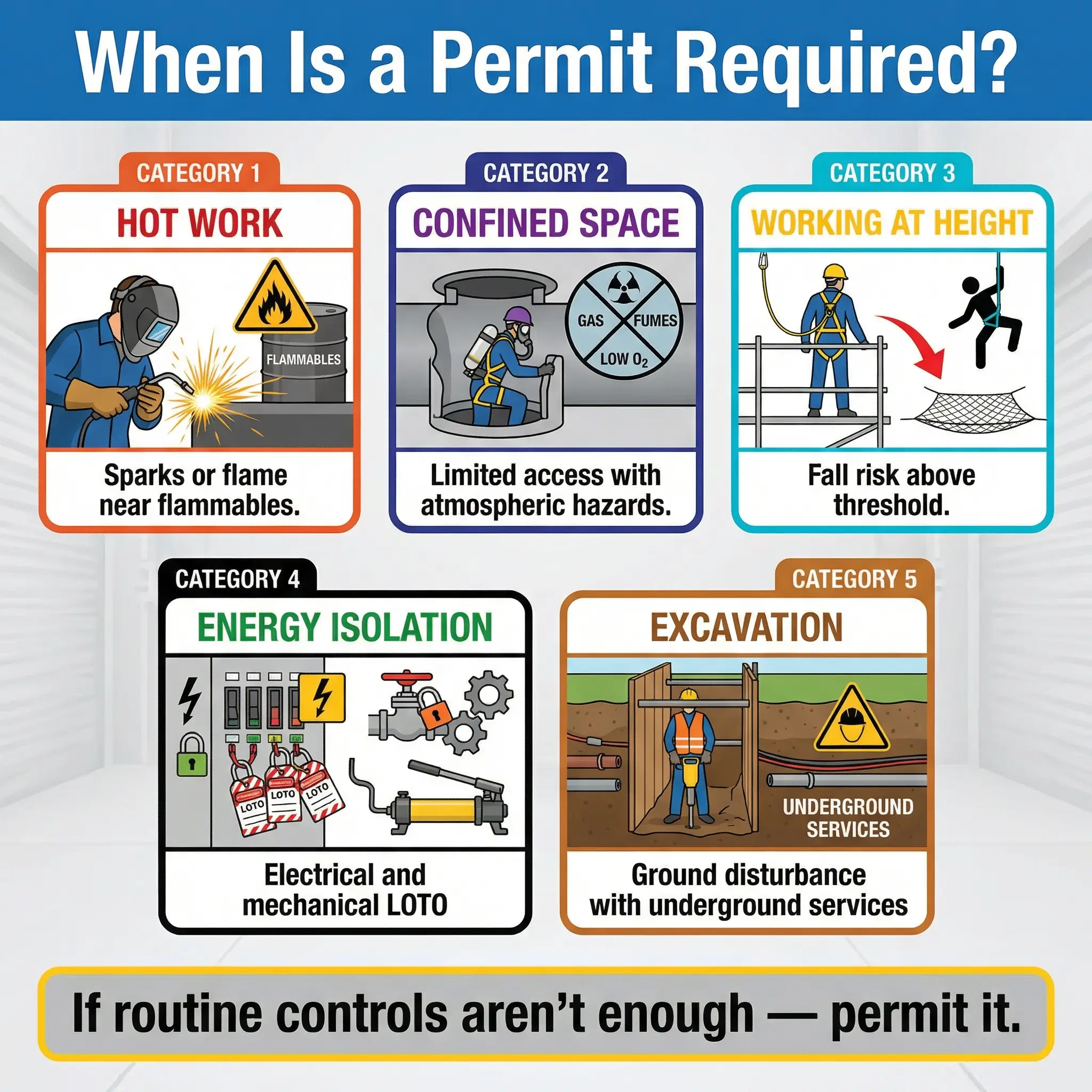
The following categories of work almost universally require a permit to work across high-hazard industries. The specific permit types may vary by company and jurisdiction, but the underlying principle is consistent — these activities carry risks that demand formal, documented pre-work verification:
- Hot work — welding, cutting, grinding, brazing, or any activity that produces sparks, open flame, or elevated temperatures in areas where flammable materials, vapors, or dust may be present.
- Confined space entry — entry into any space with limited access or egress that is not designed for continuous occupancy and where atmospheric hazards, engulfment, or entrapment risks exist.
- Working at height — any task where a person could fall a distance likely to cause injury, including work on scaffolding, rooftops, ladders above designated thresholds, and open edges.
- Electrical isolation and live working — de-energization, lockout-tagout, or any work on or near energized electrical systems.
- Excavation and ground disturbance — trenching, piling, drilling, or any activity that breaks ground where underground services, unstable soil, or adjacent structure risks exist.
- Lifting operations — crane lifts, heavy rigging, tandem lifts, or lifts over live plant, occupied areas, or critical equipment.
- Radiographic work — use of ionizing radiation sources for non-destructive testing (NDT) requiring exclusion zones and radiation safety controls.
- Work on pressurized systems — breaking containment on piping, vessels, or equipment that operates under pressure or contains hazardous fluids.
- Simultaneous operations (SIMOPS) — any combination of the above activities occurring in overlapping areas or timeframes where one activity’s hazards could affect another’s workers.
I once audited a manufacturing plant that had eliminated permit requirements for working at height below three meters “to reduce paperwork.” Within six months, they had two fall injuries — both from heights under three meters, both in situations where a permit process would have forced someone to assess the edge protection, verify the ladder condition, and think about what was below the worker. The paperwork reduction saved time. It cost two people their health.
Pro Tip: The question is never “does this task legally require a permit?” The question is “does this task carry risks that our routine controls cannot adequately manage without formal, pre-work verification?” If the answer is yes, permit it — regardless of what the minimum regulatory threshold says.
Key Roles and Responsibilities in a PTW System
A permit to work system only functions when every person in the chain understands exactly what they are responsible for — and what they are not. Role confusion is a root cause in a staggering number of PTW-related incidents. I have read investigation reports where the permit issuer assumed the performing authority had verified isolations, the performing authority assumed the issuer had done it, and neither had. The worker entered the space. The isolation was incomplete. The outcome was fatal.
The following roles form the accountability structure of any credible PTW system. Titles may vary between organizations, but the functions are universal:
- Site Authority (or Area Authority): The person with overall responsibility for all activities within a defined area of the site. They approve or reject permit requests based on potential conflicts with other ongoing work, plant status, and simultaneous operations. On a refinery turnaround, this is typically the turnaround manager or operations shift supervisor. They own the “big picture” — nobody starts high-risk work in their area without their knowledge and consent.
- Permit Issuer (or Issuing Authority): The person who physically issues the permit after verifying that all preconditions are met. This is not a desk job. The permit issuer must visit the worksite, confirm that isolations are in place, barriers are erected, atmospheric testing is done (where applicable), and the work area matches what the permit describes. They sign the permit only when they are personally satisfied that it is safe to proceed.
- Permit Holder (or Performing Authority): The person who receives the permit, accepts responsibility for carrying out the work within the permit conditions, and ensures that their crew understands the hazards, controls, and emergency procedures. The permit holder must be competent in the specific work activity and present at the worksite for the duration of the permitted work. They cannot delegate this role to an unqualified substitute.
- Permit Receiver (where applicable): In some systems, particularly contractor-managed work, a separate permit receiver accepts the permit on behalf of the performing crew. This adds a layer of contractor accountability but must never create confusion about who holds ultimate responsibility at the workface.
- Attendant / Standby Person: Required for specific permit types such as confined space entry. The attendant maintains continuous communication with the entrant, monitors conditions, and initiates emergency response if required. They must never leave their post or take on any other task during the permitted activity.
| Role | Primary Responsibility | Must Be Present at Worksite? | Can They Delegate? |
|---|---|---|---|
| Site Authority | Approve work within their area; manage SIMOPS conflicts | No — but must be reachable | Can delegate approval within defined limits |
| Permit Issuer | Verify all controls are in place before issuing | Yes — during verification and issue | No — must personally verify |
| Permit Holder | Execute work within permit conditions; brief crew | Yes — throughout permitted work | No — must remain on site |
| Attendant | Monitor entrant/worker; maintain communication | Yes — continuously | No — must not leave post |
HSE UK guidance (L101 — Safe Work in Confined Spaces) specifies that the person issuing a confined space entry permit must be competent to assess the risks, verify the precautions, and confirm that emergency arrangements are in place before any entry is authorized.
Pro Tip: During a turnaround audit in Southeast Asia, I found permits being issued from a site office 400 meters from the work area. The issuer had not visited the workface once — he was signing permits based on radio confirmation from the permit holder. That is not a PTW system. That is a remote-signing service. If the issuer has not physically stood at the work location and verified conditions with their own eyes, the permit is worthless.
The Permit to Work Procedure — Step by Step
Understanding the PTW procedure means understanding that it is not a linear checklist someone ticks off and files. It is a living cycle where every stage builds on the previous one, and failure at any single stage can cascade into a fatal outcome. The procedure described below represents the standard PTW cycle used across major oil and gas operators, EPC contractors, and heavy industry — adapted from frameworks aligned with ISO 45001 and the Energy Institute’s guidance on PTW systems.
Stage 1 — Work Request and Planning
Every permit begins before the permit form is ever touched. The performing team identifies the task, defines the scope, and submits a work request to the site authority or planning coordinator. This is where the first critical safety decisions are made — often by people who do not realize it.
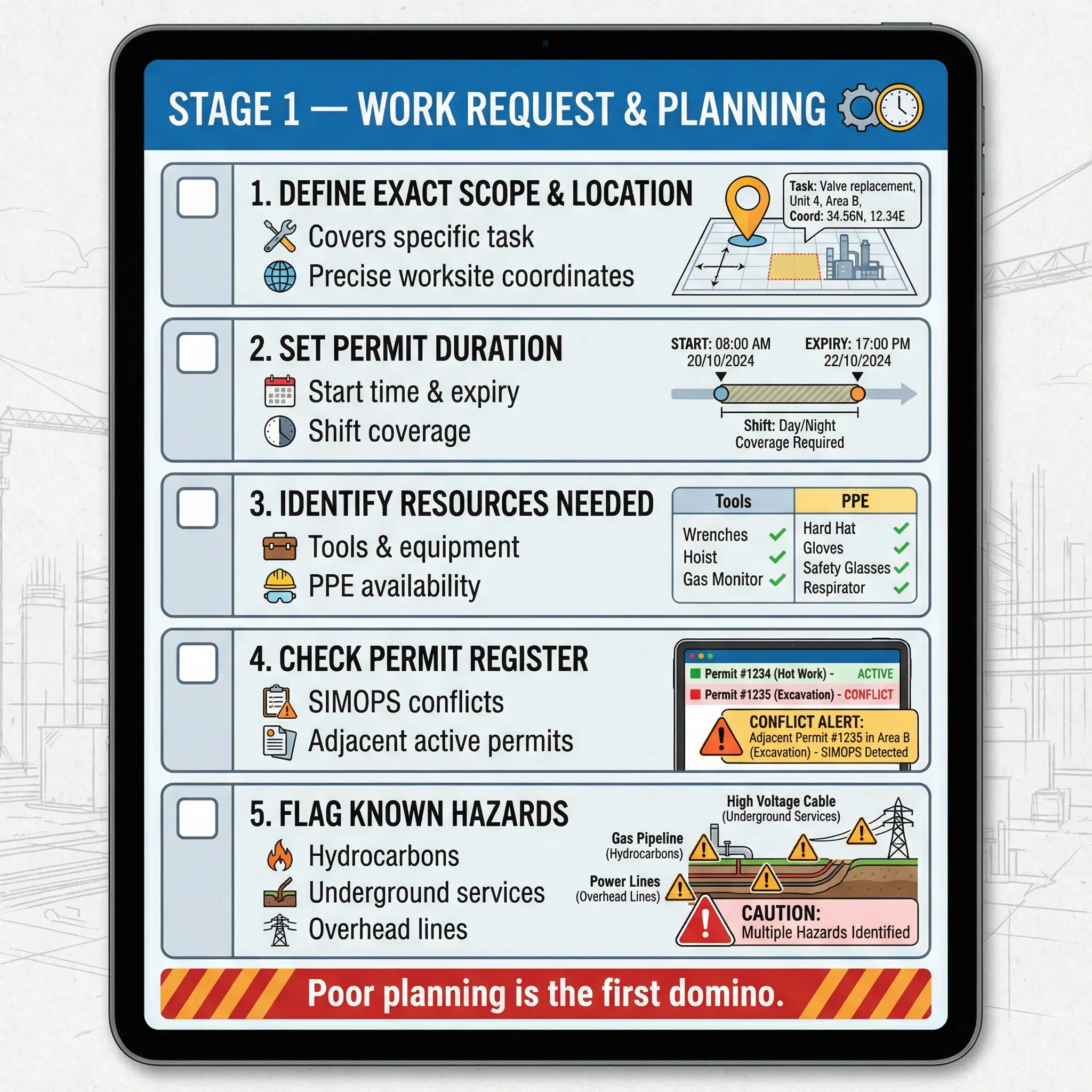
The work request stage must capture and verify the following before any permit is drafted:
- Exact work scope and location. Not “maintenance on Pump P-101” but “replacement of mechanical seal on Pump P-101A, located at ground level on Unit 3, east side, adjacent to the flare header.”
- Planned duration and shift coverage. The permit must define when work starts, when it must stop, and what happens if the task spans a shift change.
- Required resources and equipment. What tools, lifting equipment, scaffolding, ventilation, or specialized PPE will be needed — and are they available and inspected?
- Identification of adjacent and simultaneous activities. The planning team must check the permit register for any other live permits in the same area or adjacent areas that could create conflicting hazards.
- Preliminary hazard identification. Before the formal risk assessment, the requesting team should flag known hazards — presence of hydrocarbons, overhead power lines, underground services, asbestos-containing materials, or live process streams nearby.
I worked on a gas plant expansion where the planning team caught a conflict during Stage 1 that would have been invisible once work started. A hot work permit request for pipe welding on a mezzanine was submitted for the same morning that a confined space entry was planned for a vessel directly below. The hot work sparks would have fallen into the vessel opening. The planning register caught it. No one got hurt. If the system had not forced both teams to register their work in advance, that conflict would have been discovered by a spark landing on an entrant’s back.
Stage 2 — Risk Assessment
Once the work request is approved in principle, the next stage is a task-specific risk assessment conducted jointly by the permit issuer, the permit holder, and — critically — the workers who will actually perform the task. This is not a copy-paste exercise from a generic risk assessment library.
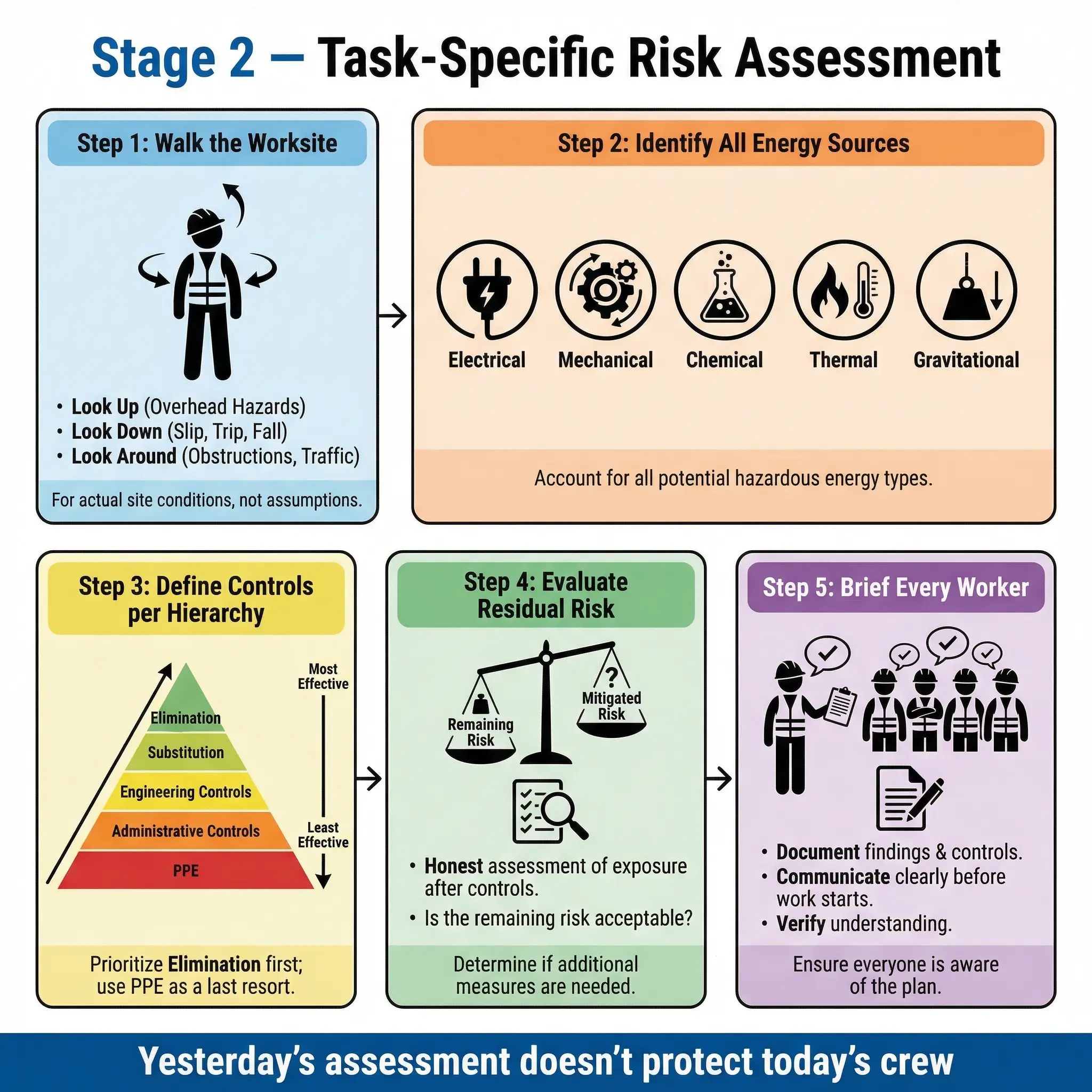
The risk assessment must address the specific conditions at the specific location on the specific day the work is planned. A rigorous task-specific risk assessment covers:
- Hazard identification for the actual work environment. Walk the worksite. Look up, look down, look around. What is above the work area? What is below? What is on either side? What process is running in adjacent equipment?
- Energy source identification. Electrical, mechanical, hydraulic, pneumatic, thermal, chemical, gravitational, stored pressure — every energy source that could harm the worker must be identified and a specific isolation plan defined.
- Atmospheric hazards (where applicable). If the work involves or is adjacent to confined spaces, chemical storage, or process equipment, atmospheric testing requirements must be defined — what gases, what instruments, what frequency.
- Environmental factors. Weather, temperature extremes, lighting levels, noise, access and egress routes, and emergency evacuation paths.
- Residual risk after controls. After all planned controls are applied, what residual risks remain — and are they acceptable? This honest evaluation is where many risk assessments fail. Teams list controls and assume the risk drops to zero. It never does.
- Identify all hazards specific to the task, location, and conditions.
- Evaluate severity and likelihood for each hazard — use the organization’s risk matrix consistently.
- Define control measures for each hazard using the hierarchy of controls — elimination first, PPE last.
- Determine residual risk after controls and confirm it is within acceptable limits.
- Document the assessment, attach it to the permit, and brief every worker on the findings before work begins.
Pro Tip: The single most reliable indicator of a poor PTW system is a risk assessment that looks identical to the one done for the same task six months ago. Conditions change. Weather changes. Adjacent activities change. Personnel change. If your risk assessment does not reflect what is actually happening on site today, it is fiction — and fiction does not protect anyone.
Stage 3 — Isolation, Preparation, and Preconditions
This is the stage where the physical work happens before the work happens. Every control measure identified in the risk assessment must be physically implemented and verified before the permit can be authorized. This is the most labor-intensive stage — and the one most frequently shortcut under schedule pressure.
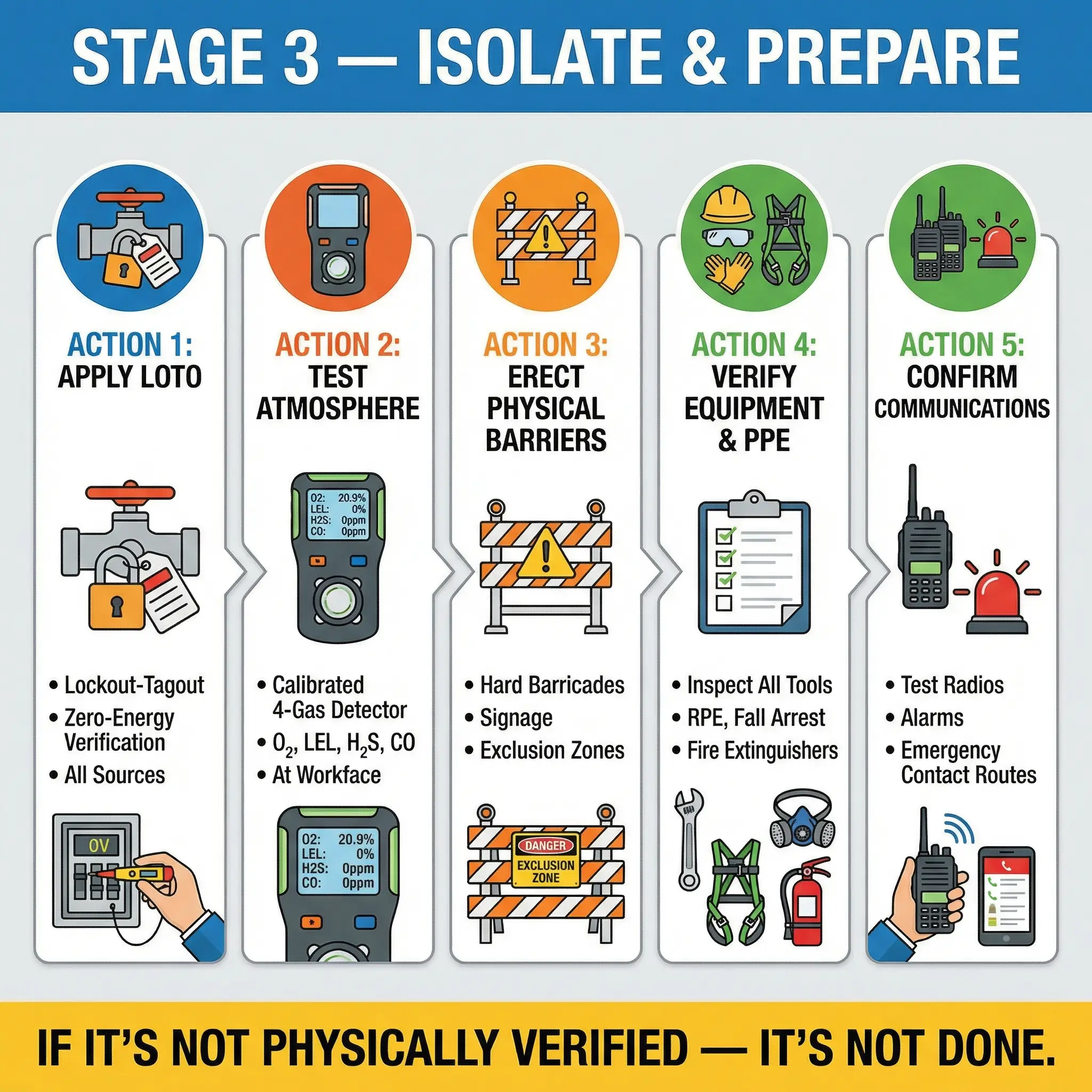
Isolation and preparation tasks typically include the following, depending on the permit type and hazard profile:
- Energy isolation (LOTO). Every energy source identified must be isolated using lockout-tagout procedures. Locks and tags must be applied by authorized personnel. Try-start or zero-energy verification must be performed to confirm the isolation is effective — never assume a valve is closed or a breaker is off without physical verification.
- Atmospheric testing. For confined space and hot work permits, atmospheric testing must be conducted with a calibrated instrument immediately before permit issue — not the night before, not during the morning toolbox talk, but at the workface within the timeframe specified by the permit procedure. Readings for oxygen, flammable gases (LEL), and toxic gases (H₂S, CO, or others based on the process) must fall within safe limits.
- Physical barriers and exclusion zones. Hard barriers, barricades, signage, and where necessary, dedicated hole watchers or banksmen must be in place before work begins.
- Equipment and PPE verification. All tools, lifting gear, respiratory protection, fall arrest systems, fire extinguishers, and emergency equipment specified on the permit must be present, inspected, and in serviceable condition at the worksite.
- Communication systems confirmed. Two-way radios, emergency alarms, and the ability to contact the control room, emergency response team, and medical services must be tested and confirmed functional.
On an offshore platform in the North Sea, I witnessed a permit issuer walk to the worksite, physically pull the valve handle to confirm it was locked shut, check the lock and tag, visually verify the electrical breaker position, read the atmospheric monitor display, and only then sign the permit — a process that took eight minutes. The contractor supervisor watching said, “That’s the most thorough issuer I’ve ever seen.” It should not be exceptional. It should be the minimum standard.
Stage 4 — Permit Authorization and Issue
Only after all preconditions in Stage 3 are physically verified does the permit issuer authorize the permit. Authorization is not a signature on a form. It is a professional declaration that the issuer has personally confirmed conditions are safe for the specified work to proceed.
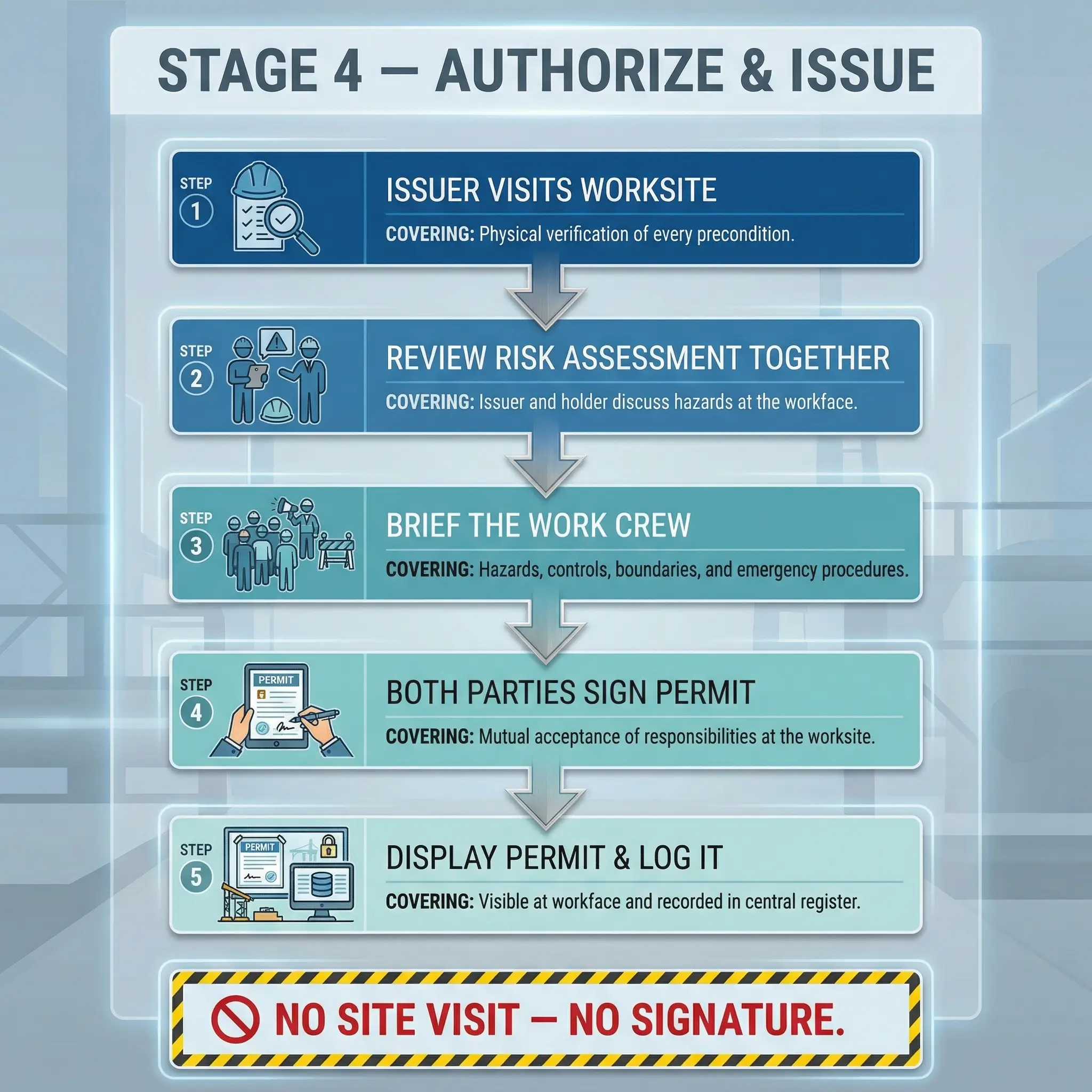
The permit authorization process follows a precise sequence that ensures nothing is assumed or delegated:
- Permit issuer visits the worksite and physically verifies every precondition — isolations, atmospheric readings, barriers, PPE, emergency equipment.
- Permit issuer reviews the risk assessment with the permit holder at the worksite — not in the office.
- Permit holder briefs the work crew on the permit conditions, hazards, controls, emergency procedures, and the boundaries of the permitted work (what they can do — and what they must not do).
- Both the issuer and holder sign the permit at the worksite, confirming mutual understanding and acceptance of responsibilities.
- The permit is displayed at the worksite — visibly, legibly, and protected from weather damage. Workers must be able to read the permit conditions at any time during the task.
- A copy of the permit is logged at the central permit office or control room so the site authority has a live record of all active permits.
The Energy Institute (EI) — Guidance on Permit-to-Work Systems recommends that the permit should be a “dynamic document that facilitates communication between all parties” and that the issuing process must include a face-to-face discussion at the worksite between the issuer and the performing authority.
Stage 5 — Work Execution and Monitoring
Once the permit is live, the work begins — but the PTW system does not pause. Stage 5 is where the system either functions as a live safety tool or degrades into an ignored piece of paper pinned to a scaffold tube.
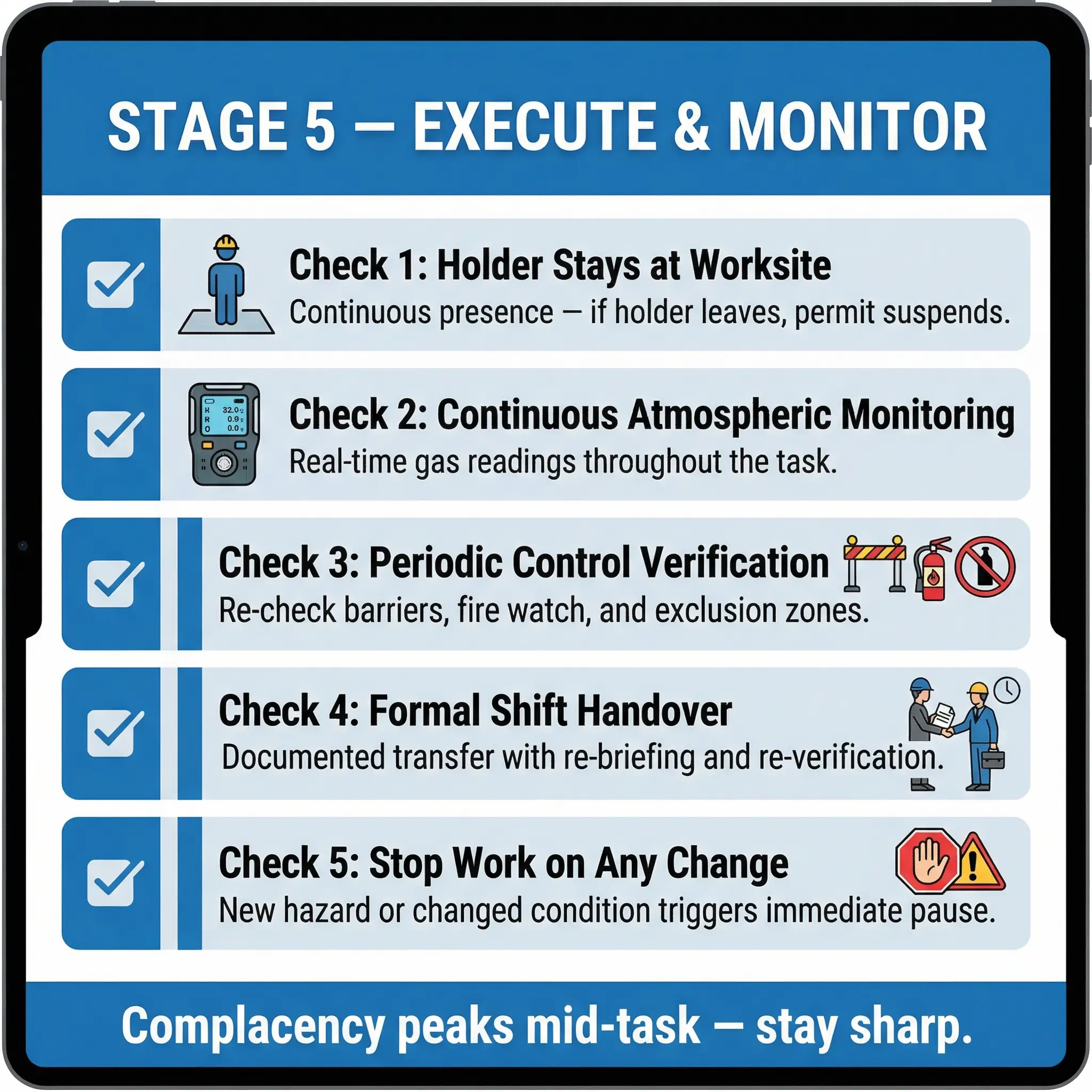
Active monitoring during permitted work is the responsibility of both the permit holder and the site authority. The following monitoring requirements must be maintained throughout the work duration:
- Permit holder remains at the worksite. The holder cannot leave the work area to attend meetings, collect materials, or supervise another task. If the holder must leave, the permit must be suspended.
- Continuous atmospheric monitoring for confined space and hot work permits. Pre-entry testing alone is insufficient — atmospheric conditions can change within minutes due to process leaks, weather shifts, or disturbance of residual materials.
- Periodic verification of controls. Barriers, exclusion zones, fire watch positions, and equipment conditions must be checked at regular intervals — not just at the start of work.
- Shift handover protocol. If the permitted work spans a shift change, the outgoing permit holder must formally hand over the permit to the incoming holder, re-brief the crew, and re-verify conditions. Many fatal incidents have occurred in the gap between shifts when permit conditions were not re-confirmed.
- Change management during live work. If conditions change — unexpected gas reading, weather deterioration, adjacent activity starting, equipment malfunction — the work must stop immediately and the permit issuer must be notified. The permit may need to be suspended, revised, or cancelled.
I investigated a hot work incident at a tank farm where the fire watch was pulled off the fire watch to help carry materials. The welder continued cutting. A spark ignited residual vapors in a drain channel that had not been identified in the risk assessment. The fire spread to two adjacent tanks before emergency response contained it. The fire watch had been gone for eleven minutes. The entire sequence — from removing the fire watch to ignition to tank involvement — happened in less than eight minutes.
Pro Tip: The most dangerous moment in any permitted work is not the start. It is the midpoint — when the crew has settled into a rhythm, complacency creeps in, and the initial heightened awareness from the permit briefing has faded. Schedule your verification visits for the middle of the task, not the beginning.
Stage 6 — Suspension, Handback, and Close-Out
The permit does not end when the task is finished. It ends when the worksite is formally returned to a safe, verified condition and the permit is officially cancelled. This stage is routinely neglected — and the incidents that result from incomplete close-out are entirely preventable.
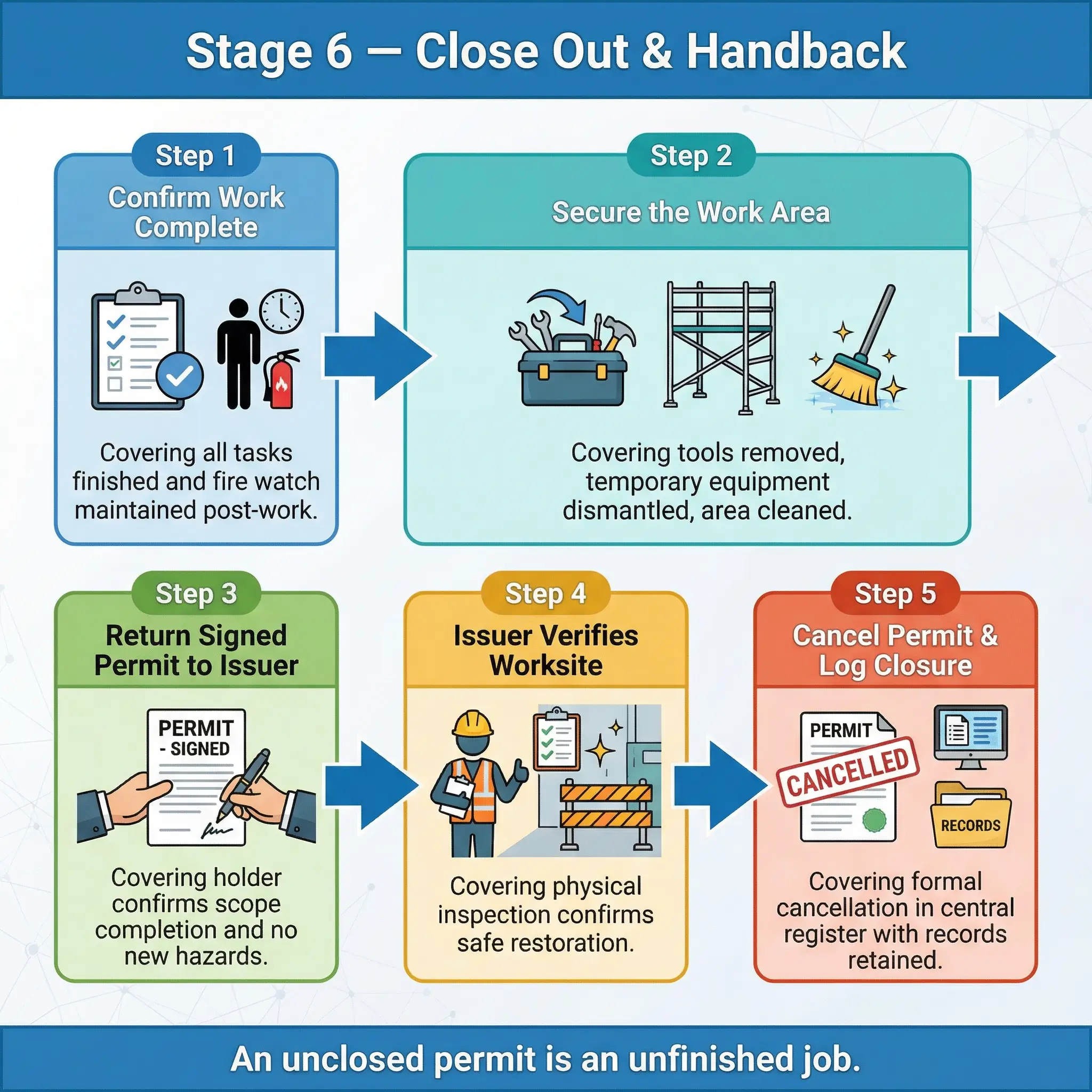
The close-out process follows a strict sequence to ensure no residual hazards are left behind:
- Permit holder confirms all work is complete and the work area is safe — tools removed, temporary equipment dismantled, fire watch maintained for the required post-work period (typically 30–60 minutes for hot work).
- Permit holder returns the signed permit to the permit issuer, confirming that the work scope described on the permit has been completed and no additional hazards have been introduced.
- Permit issuer visits the worksite to verify that the area is restored to a safe condition — isolations can be removed, barriers dismantled, and the area returned to normal operations.
- Permit is formally cancelled by the issuer and logged as closed in the central permit register. The original permit must be retained for the organization’s defined record-keeping period.
- De-isolation and reinstatement of systems or equipment is carried out only after the permit is cancelled and the site authority has confirmed it is safe to restore normal operations.
A permit that is completed but never formally closed out creates a dangerous phantom — the permit register shows active work in an area where work has actually stopped, confusing SIMOPS coordination and potentially preventing other necessary permits from being issued for the same location.
Common Permit to Work Failures on Real Sites
Every PTW-related fatality investigation I have been involved in — or reviewed — traces back to the same set of recurring failures. These are not obscure edge cases. They are systemic weaknesses that persist across industries, geographies, and organizational sizes because they are rooted in human behavior, schedule pressure, and cultural tolerance of shortcuts.
The following failures appear with depressing regularity in incident investigations and audit findings worldwide:
- Permit shopping. The permit holder is refused a permit by one issuer (because conditions are not met), so they approach a different issuer who is less rigorous or less familiar with the work area. This is a system failure — not an individual one. It means the organization has no mechanism to prevent duplicate or conflicting permit requests.
- Copy-paste risk assessments. The risk assessment attached to the permit is identical to the one used last week, last month, or last year for a “similar” task. No site-specific conditions were assessed. No adjacent activities were checked. The document exists but the thinking does not.
- Working beyond permit validity. The permit was issued for a specific time window — say 06:00 to 14:00. The task runs long. Instead of suspending and re-issuing, the crew continues working on an expired permit. After the original validity period, conditions may have changed, adjacent work may have started, and the controls verified that morning may no longer be adequate.
- Permit issued but controls not verified. The permit form has all the right boxes ticked, but the issuer signed it in the site office without visiting the worksite. Isolations are listed as “confirmed” but were never physically checked. Atmospheric readings are recorded but the instrument was not calibrated — or the test was done hours before entry.
- Failure to manage shift handover. The day-shift permit holder goes home. The night-shift crew arrives and continues the work based on a verbal handover — no re-briefing, no re-verification of conditions, no formal transfer of the permit. The night-shift crew may not even know what hazards were identified that morning.
- Scope creep without permit revision. The permitted work was to replace a valve on a specific line. During the task, the crew discovers a second valve that also needs replacement — on a different line, with different isolation requirements. Instead of stopping and requesting a new permit, they “just do it” under the existing one.
- Attendant abandonment. The confined space attendant — the one person whose sole job is to monitor the entrant and initiate rescue if needed — is pulled away to help with another task, fetch equipment, or take a break without a qualified replacement.
| Failure Type | Root Cause | Typical Consequence |
|---|---|---|
| Permit shopping | No centralized permit register; multiple issuers without coordination | Conflicting permits issued; hazard controls bypassed |
| Copy-paste risk assessment | Schedule pressure; no quality check on assessments | Hazards specific to actual conditions missed entirely |
| Working beyond validity | Production pressure; “almost done” mentality | Work continues under unverified, potentially changed conditions |
| Controls not verified | Issuer signs remotely; normalization of deviance | Workers enter hazardous environments believing controls are in place when they are not |
| Shift handover failure | No formal handover protocol; verbal-only transfer | Incoming crew unaware of hazards, controls, or permit conditions |
| Scope creep | “While we’re here” culture; no change management discipline | Work performed without risk assessment or appropriate isolations |
| Attendant abandonment | Understaffing; multi-tasking culture; poor supervision | No one monitoring entrant; delayed or absent emergency response |
How to Build and Sustain an Effective PTW System
Running a permit-to-work system that actually protects people — rather than one that simply generates paperwork — requires deliberate design, constant reinforcement, and honest self-assessment. I have helped implement PTW systems on greenfield construction projects and overhauled broken ones on mature operating plants, and the challenges are different but the principles are the same.
The following elements distinguish a PTW system that works from one that exists only on paper:
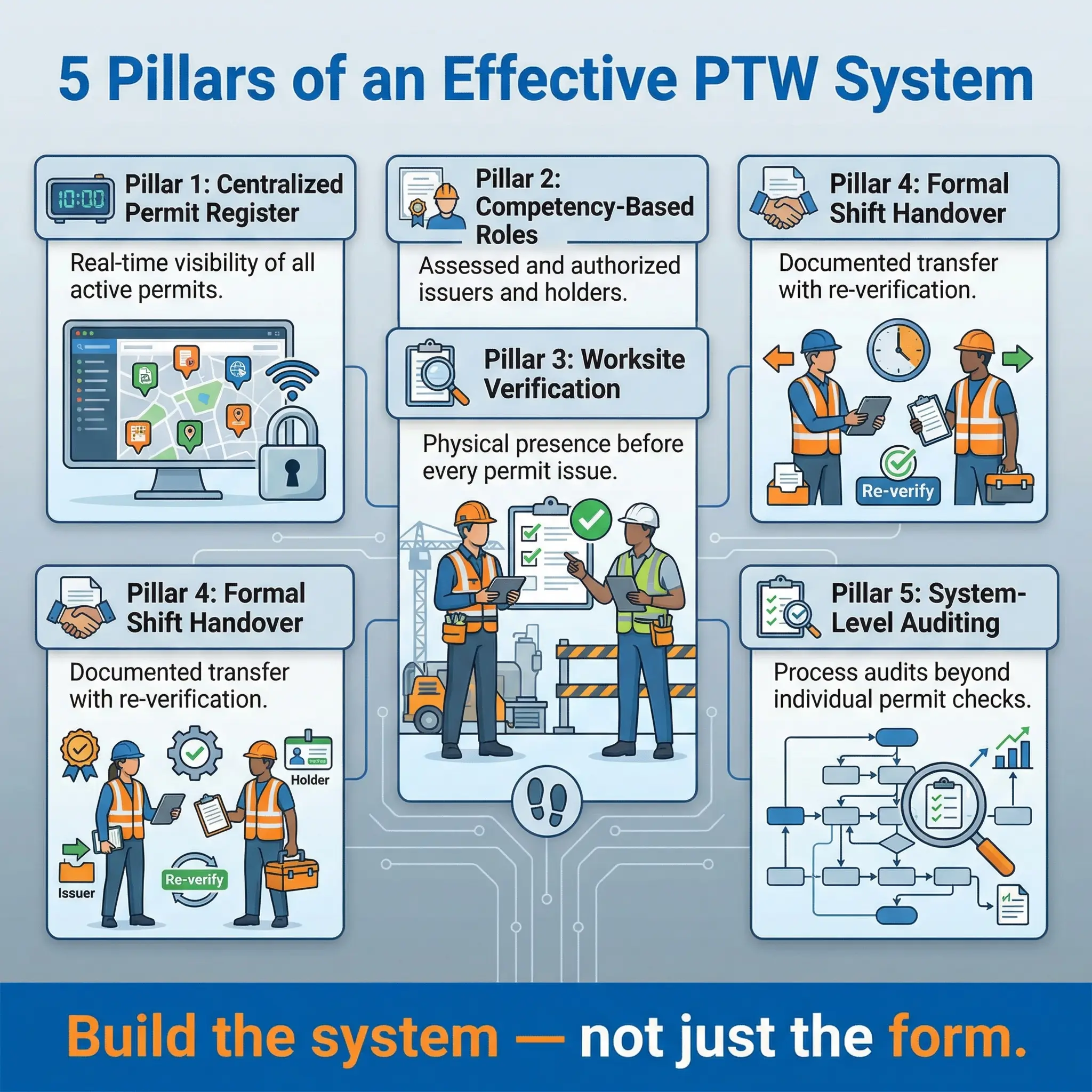
- Centralized permit register with conflict checking. Every active permit must be logged in a single register — physical board or digital system — that the site authority and all permit issuers can see in real time. The register must flag potential conflicts between simultaneous permits in overlapping areas. Without this, SIMOPS coordination is guesswork.
- Competency-based role assignment. Permit issuers, holders, and attendants must be formally assessed and authorized — not just “experienced” or “senior.” Competency should cover hazard recognition, isolation verification, atmospheric testing interpretation, and emergency response for the specific permit types they will work with.
- Mandatory worksite verification before issue. Organizational policy must explicitly state — and audits must verify — that no permit is issued without the issuer physically visiting the worksite and personally verifying preconditions. Remote or phone-based authorization should be prohibited.
- Formal shift handover procedure for live permits. A documented handover process that requires the incoming permit holder to re-verify conditions, re-brief the crew, and countersign the permit. Verbal-only handovers should be a disciplinary matter, not a convenience.
- Regular PTW system audits — not just permit checks. Auditing individual permits tells you whether one form was filled in correctly. Auditing the system tells you whether the process is functioning — are issuers visiting worksites? Are risk assessments task-specific? Are conflicts being caught? Are close-outs being completed? System-level audits reveal patterns that individual permit checks miss.
- Visible leadership engagement. When site managers and project directors participate in permit reviews, walk worksites during permitted activities, and ask questions about the PTW process, they send a signal that the system matters. When they never interact with it, they send the opposite signal — and the workforce notices.
- Learning from near-misses and permit deviations. Every permit deviation — working beyond validity, scope creep, missed atmospheric test, absent attendant — must be reported, investigated, and fed back into the system as a learning event. Waiting for a fatality to trigger improvement is not risk management. It is negligence.
ISO 45001:2018, Clause 8.1 requires organizations to establish, implement, and maintain processes for the elimination of hazards and reduction of OH&S risks using the hierarchy of controls — and specifically requires processes that manage “change” and “temporary situations,” both of which are core to PTW operations.
Digital Permit to Work Systems — Practical Realities
The shift from paper-based to digital PTW systems has accelerated across major operators and EPC contractors over the past decade. Digital systems offer genuine advantages — but they also introduce new failure modes that organizations often do not anticipate until an incident reveals them.
The benefits of digital PTW systems are real when implemented well:
- Automated conflict detection. Digital systems can cross-reference active permits by location, time, and hazard type — flagging SIMOPS conflicts that a human scanning a whiteboard might miss.
- Real-time permit status visibility. Site authorities, HSE managers, and control room operators can see which permits are active, which are approaching expiry, and which areas of the site have concurrent high-risk activities — from any screen, anywhere.
- Audit trail integrity. Every action — request, approval, issue, suspension, cancellation — is time-stamped and attributed to a specific user. This creates an investigation-quality record that paper systems cannot match.
- Trend analysis and performance monitoring. Digital systems can generate data on permit volumes, rejection rates, most common hazard types, overdue close-outs, and near-miss patterns — enabling proactive system improvement rather than reactive correction.
However, I have also seen digital PTW implementations create dangerous false confidence. On a major construction project in the Middle East, the organization invested heavily in a tablet-based PTW application. Within six months, permit issuers were completing the digital checklist from the site office — tapping “verified” on each item without leaving their desk. The digital system made it easier to complete the form but did nothing to ensure the physical verification behind each checkbox actually happened. The technology had improved the paperwork and degraded the safety.
The technology is only as good as the culture operating it. A digital PTW system with poor field verification discipline is just a faster way to generate non-compliant permits.
Regulatory and Standards Framework for PTW Systems
Permit-to-work systems are not optional extras for high-hazard operations. They are either explicitly required by regulation or implicitly expected as a fundamental element of occupational safety management. Understanding where the legal obligation sits helps organizations design systems that meet — and exceed — minimum compliance.
The major regulatory and standards frameworks addressing PTW systems include:
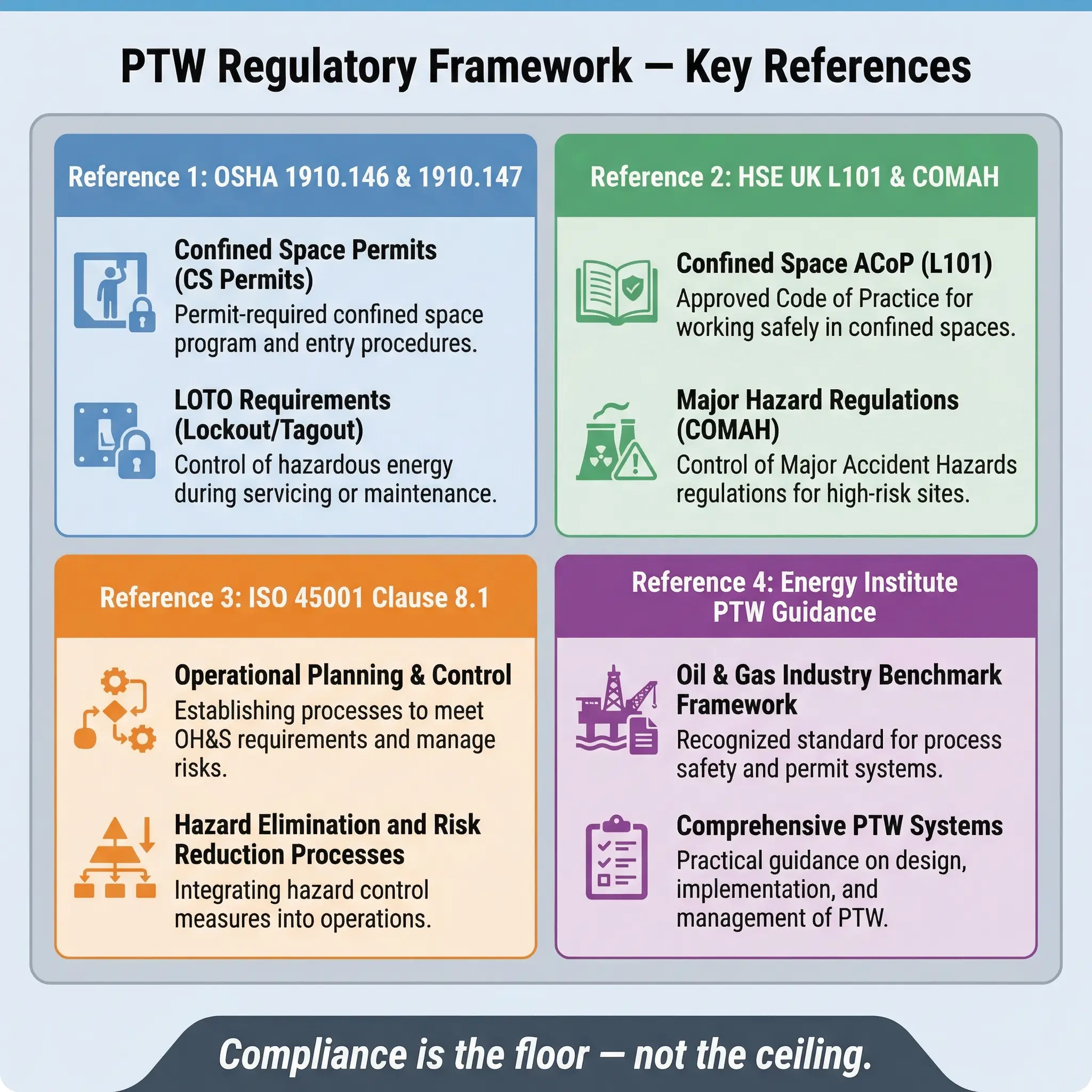
- OSHA (US) — 29 CFR 1910.146 (Confined Space) and 29 CFR 1910.147 (LOTO): OSHA mandates written permit systems for permit-required confined space entry and requires lockout-tagout procedures for the control of hazardous energy. While OSHA does not prescribe a universal PTW system, its standards for specific high-risk activities constitute de facto permit requirements.
- HSE UK — Various ACoPs and Guidance: The UK Health and Safety Executive requires or strongly recommends permit to work systems through Approved Codes of Practice for confined spaces (L101), work at height, and the management of hazardous installations under the COMAH Regulations. HSE UK enforcement has repeatedly cited inadequate PTW as a causal factor in major incident investigations.
- ISO 45001:2018: The international standard for occupational health and safety management systems requires organizations to establish processes for managing change, controlling high-risk activities, and ensuring worker competency — all of which are operationalized through PTW systems in practice.
- Energy Institute (EI) — Guidance on Permit-to-Work Systems in the Petroleum Industry: Widely adopted across the oil and gas sector globally, this guidance provides the most detailed framework for PTW system design, implementation, and audit — and is frequently referenced as the benchmark by major operators.
- IFC/World Bank EHS Guidelines: For international projects, the International Finance Corporation’s Environmental, Health, and Safety Guidelines reference PTW systems as an expected control for construction, demolition, and maintenance activities in high-hazard environments.
Conclusion
A permit-to-work system is not a bureaucratic layer added on top of operations to satisfy auditors. It is the single most critical administrative control available for managing high-risk work on any complex site. When it functions as designed — with genuine hazard identification, physical verification of controls, clear accountability, and active monitoring throughout the work — it prevents the kind of catastrophic incidents that no amount of PPE or training can stop after the fact. When it is reduced to a signature exercise, a filing routine, or a box-ticking formality, it creates something worse than no system at all: a false sense of security that everyone is protected when in reality nobody is.
Every PTW failure I have investigated shares the same DNA — someone, somewhere in the chain, decided that the process was less important than the schedule. The issuer who signed without visiting the worksite. The supervisor who let the crew continue on an expired permit. The planner who did not check the register for conflicts. The manager who accepted a copy-paste risk assessment because “we’ve done this job a hundred times.” Each of those decisions was small, rational in isolation, and entirely predictable in its outcome. The permit to work system exists precisely to interrupt that chain — to force a pause, a conversation, a physical check that stands between a shortcut and a catastrophe.
If you run a site, audit a system, or hold a permit in your hands, remember this: the permit is not the safety. The permit is evidence that safety happened. If the actions behind the permit — the walk to the worksite, the check on the isolation, the honest risk assessment, the face-to-face briefing — did not happen, then the permit is just paper. And paper has never stopped a fatality.