
Section 37 of the Health and Safety at Work etc. Act 1974 is the clause that keeps directors awake the night after a serious incident. It says that where a RIDDOR-reportable event is caused by the consent, connivance, or neglect of a director, manager, secretary, or similar officer, that individual can be prosecuted personally alongside the company. I have sat across the table from a finance director who had never opened our site safety file, then had to explain — under caution — why an over-seven-day injury had been recorded in the accident book but never submitted on F2508. That conversation is what RIDDOR enforcement looks like when it reaches a boardroom.
The Reporting of Injuries, Diseases and Dangerous Occurrences Regulations 2013 feed the intelligence the Health and Safety Executive uses to decide where to inspect, which sectors to target with campaigns, and which prosecutions to pursue. Getting RIDDOR right is not administration — it is the difference between an investigation that stays on your desk and one that lands in a magistrates' court. This guide covers what RIDDOR is, who must report, the seven categories of reportable incidents, the timeframes that trip people up, how to actually submit a report, and the record-keeping duties that sit alongside it.
What is RIDDOR?
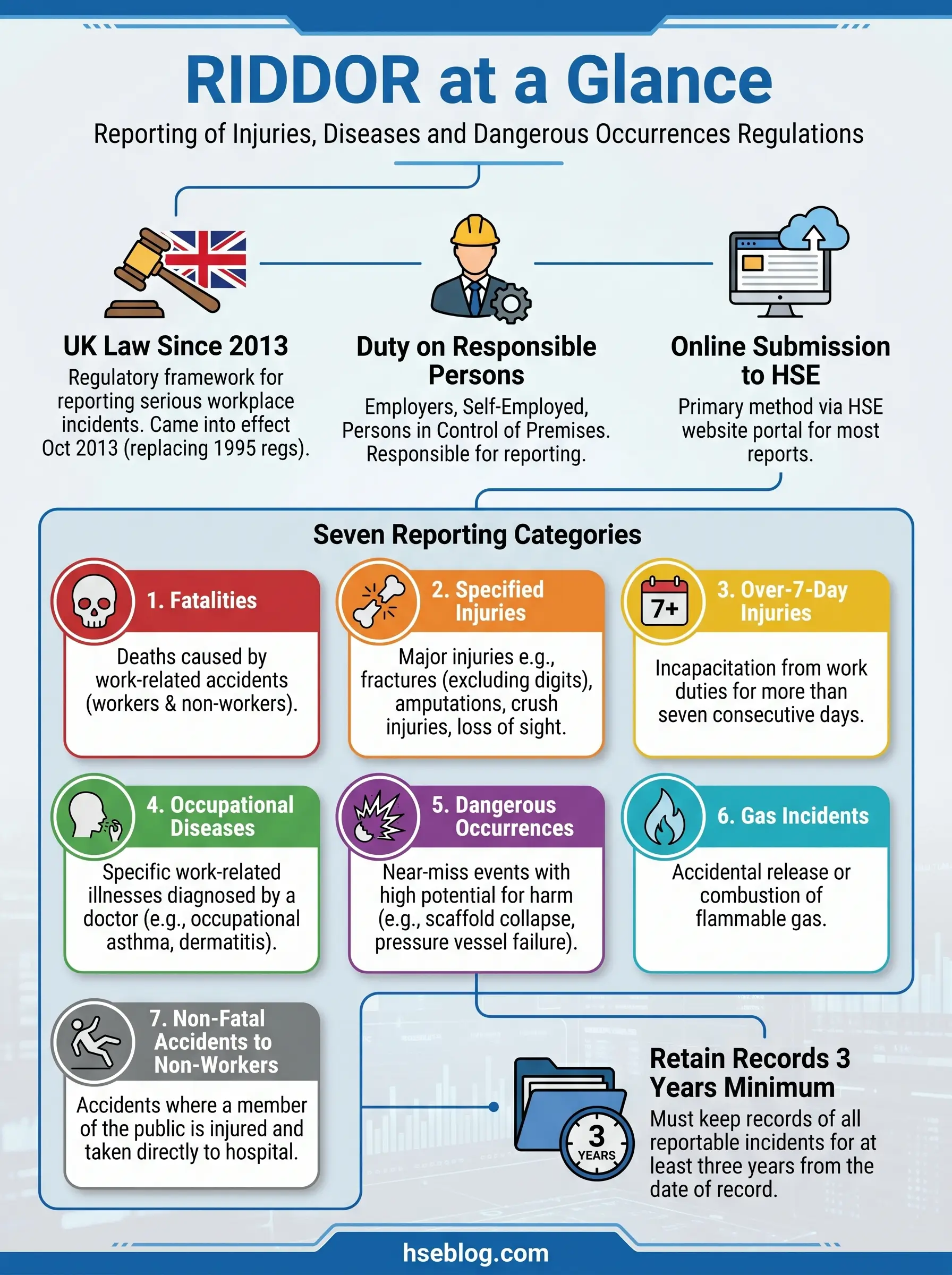
RIDDOR is UK law that places a duty on employers, self-employed people, and those in control of work premises to report certain workplace deaths, injuries, diseases, and near-misses to the Health and Safety Executive or the relevant local authority. The acronym stands for the Reporting of Injuries, Diseases and Dangerous Occurrences Regulations. The version in force today is RIDDOR 2013 (Statutory Instrument 2013/1471), which came into effect on 1 October 2013 and replaced the longer, more cumbersome RIDDOR 1995.
At a glance, here's what every duty holder needs to know:
- Parent legislation: Made under the Health and Safety at Work etc. Act 1974
- Jurisdiction: Applies across Great Britain; Northern Ireland operates under RIDDOR (NI) 1997
- Duty holders: "Responsible persons" — employers, the self-employed, and those in control of premises
- Regulator: The HSE, or local authorities for sectors like retail, warehousing, and hospitality
- Enforcement: Failure to report is a criminal offence, carrying unlimited fines and potential custodial sentences
The full text of the regulations is available on legislation.gov.uk, and the HSE's landing page at hse.gov.uk/riddor is the authoritative reference point for duty holders.
Why RIDDOR Exists: The Purpose of Reporting
Strip the regulation back and its purpose is simple: reports feed intelligence. When a dangerous occurrence is submitted — a scaffolding collapse, a pressure system failure, an uncontrolled release of a biological agent — that data lands in the HSE's central system and contributes to a national picture of where workers are getting hurt and why. Without RIDDOR, the regulator would be operating on anecdote.
Across our distribution centre, a single over-seven-day injury from a chilled-bay fall might feel like an isolated event. But when the HSE sees ten similar reports across the cold chain sector in a quarter, that triggers targeted campaigns, inspection programmes, and sometimes amendments to approved codes of practice. This is why RIDDOR is written to capture the full spread — from fatalities at one end to specified near-misses at the other. It is also why submitting a report that does not meet the threshold wastes investigative capacity that should be pointed elsewhere.
Who Must Report Under RIDDOR? The "Responsible Person"
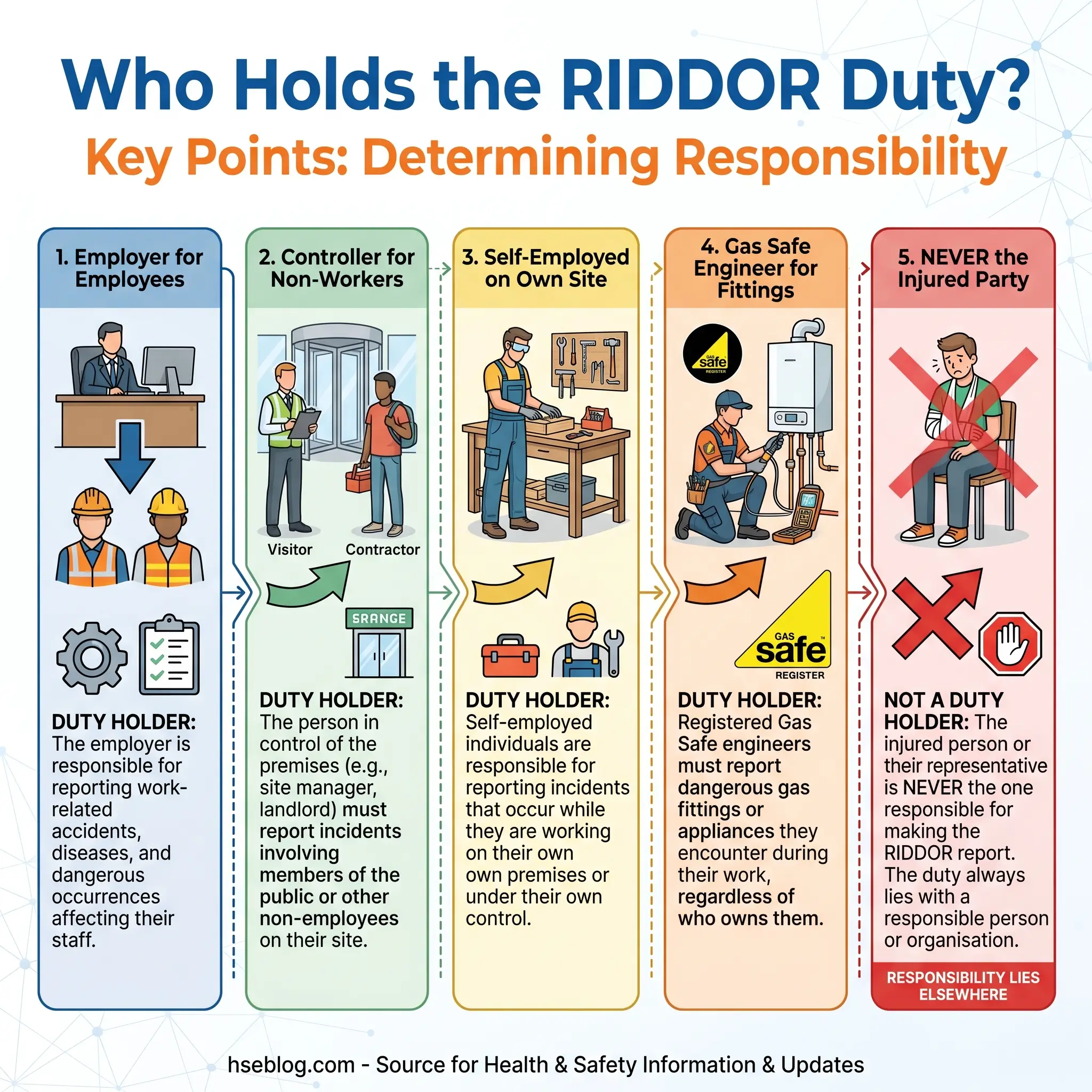
Regulation 2 of RIDDOR 2013 defines the "responsible person" — and this is the element that causes the most confusion on mixed sites. The injured party does not report. The witness does not report. Only the responsible person has the legal duty, and identifying them depends on the scenario.
I spent an afternoon last year explaining this to a logistics team leader who assumed a visiting maintenance contractor would "sort the paperwork" after an incident involving one of his own electricians. He would not have — the duty sat with us as the employer. The table below covers the scenarios that come up most often in practice.
| Scenario | Who reports |
|---|---|
| Employee injured at own employer's site | The employer |
| Self-employed worker injured on someone else's premises | The person in control of those premises |
| Self-employed worker injured on their own premises | The self-employed person themselves |
| Agency worker injured at the hirer's site | The party in control of the worksite (usually the hirer) |
| Member of the public injured by a work activity | The person in control of the premises where the activity took place |
| Dangerous gas fitting discovered by an engineer | The Gas Safe registered engineer (Regulation 7) |
Employees have no direct RIDDOR duty. They should flag incidents internally — and most contracts of employment require it — but the legal report to the HSE is always the responsible person's obligation.
What Must Be Reported? The Seven Categories
RIDDOR does not ask you to report every workplace accident. A paper cut, a bruised knee, or a stumble on a kerb will never meet the threshold — though they may still belong in your accident book. What RIDDOR captures is narrower and more specific: seven categories set out across Regulations 4 to 9 and their supporting schedules.
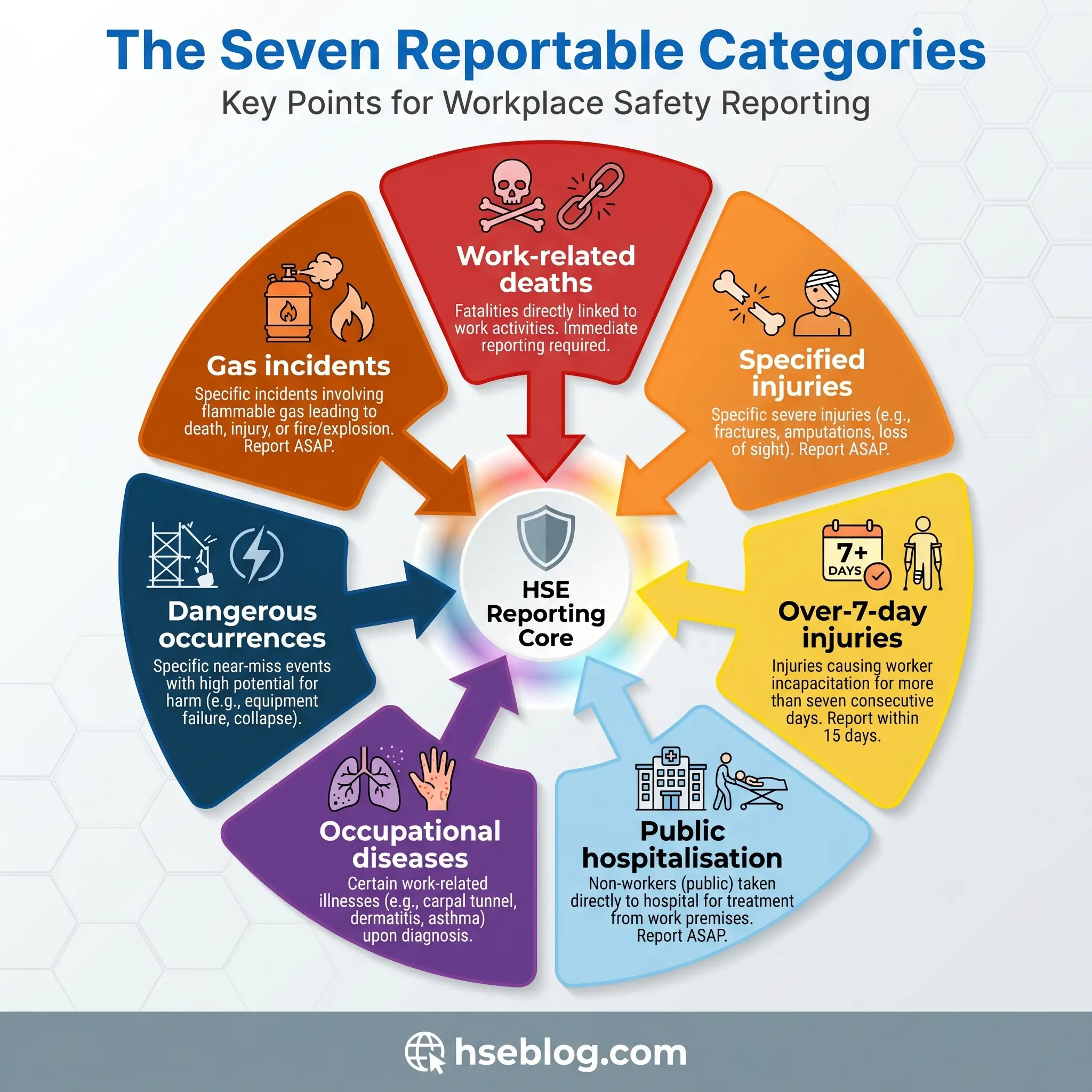
The seven categories are:
- Work-related deaths
- Specified injuries to workers (Regulation 4)
- Over-seven-day injuries to workers
- Injuries to non-workers (members of the public)
- Occupational diseases (Regulation 8)
- Dangerous occurrences (Schedule 2)
- Gas incidents
Each category has its own triggers, thresholds, and exclusions. The HSE's definitive list of reportable incidents should sit in every safety team's reference folder, but here is how each category breaks down in practice.
1. Work-Related Deaths
Regulation 6 covers the death of any person — worker or non-worker — arising from a work-related accident. The trigger is the accident itself being work-related; the death does not have to occur at the scene. A "365-day rule" applies: if a person dies within one year of a reportable injury from that same accident, the death itself must then be reported. Deaths from natural causes on site (a heart attack during a normal shift, for example), suicides, and work-related road traffic accidents on public roads fall outside the scope.
2. Specified Injuries to Workers (Regulation 4)
Regulation 4 and Schedule 1 list the specified injuries — the category that replaced the older "major injury" terminology when RIDDOR 2013 came in. These are serious, immediately reportable injuries to workers:
- Fractures — excluding fingers, thumbs, and toes
- Amputations — any part of the body
- Permanent loss of, or reduction in, sight
- Crush injuries to the head or torso causing damage to the brain or internal organs
- Serious burns covering more than 10% of the body, or damaging the eyes, respiratory system, or other vital organs
- Scalpings (separation of skin from the head) requiring hospital treatment
- Loss of consciousness caused by head injury or asphyxia
- Enclosed-space injuries leading to hypothermia, heat-induced illness, resuscitation, or more than 24 hours of hospital admission
Watch For: A closed fracture of the arm discovered on an X-ray two days after the incident is still a specified injury. The reporting duty begins when the diagnosis arrives, not when the accident happened.
3. Over-Seven-Day Injuries to Workers
This is the category most frequently mishandled. If a worker is incapacitated for more than seven consecutive days — unable to perform their normal duties — as a result of a workplace accident, the incident must be reported. Three rules catch people out:
- The day of the accident itself is not counted
- Weekends, rest days, and bank holidays are counted
- The report must be submitted within 15 days of the accident, not the date incapacity began
There is a separate duty to record over-three-day injuries in the accident book under Regulation 12, but those do not need to be reported to the HSE unless they cross the seven-day threshold.
4. Injuries to Non-Workers (Members of the Public)
Regulation 5 deals with injuries to people not at work — visitors, customers, members of the public passing a construction hoarding. Any injury from a work-related accident is reportable if the person is taken directly from the scene of the accident to hospital for treatment. This is a lower threshold than for workers, because the regulation recognises the public has not consented to workplace risk.
One exception: for incidents occurring on hospital premises, only specified injuries are reportable, because hospitals are already geared to treat injuries on site.
5. Occupational Diseases (Regulation 8)
Regulation 8 and Schedule 3 list the reportable occupational diseases. A worker must have received a formal written diagnosis from a registered medical practitioner, and the disease must be linked to one of the specified work activities. The eight primary categories are:
- Carpal tunnel syndrome — where work involves regular use of percussive or vibrating tools
- Cramp of the hand or forearm — from repetitive movements
- Occupational dermatitis — caused by chemical or biological agents
- Hand-arm vibration syndrome (HAVS)
- Occupational asthma — from exposure to known respiratory sensitisers
- Tendonitis or tenosynovitis of the hand or forearm — from repetitive work
- Any occupational cancer
- Any disease attributable to an occupational exposure to a biological agent
Unlike injuries, diseases have no "accident" moment. The reporting clock starts the day you receive the written diagnosis.
6. Dangerous Occurrences (Schedule 2)
Dangerous occurrences are specified near-misses — events that had the potential to cause serious harm, regardless of whether anyone was injured. Schedule 2 sets out 27 categories for general workplaces, with additional schedules for mines, quarries, offshore installations, and rail transport systems. The general list includes:
- Collapse, overturning, or failure of lifting equipment
- Pressure system failures
- Contact with overhead power lines
- Uncontrolled release of biological agents likely to cause severe human illness
- Radiation incidents
- Collapse of scaffolding over five metres high
- Unintended explosions or fires causing work stoppage of more than 24 hours
Audit Point: Dangerous occurrences are the category auditors scrutinise hardest because they reveal what the site chose not to report. A racking collapse in a warehouse — even with no one near it — is reportable under Schedule 2. Sites routinely miss this.
7. Gas Incidents
Two duties sit under this heading. First, distributors, fillers, importers, and suppliers of flammable gas must report incidents where someone has died, lost consciousness, or been taken to hospital because of the gas. Second, Gas Safe registered engineers must report dangerous gas fittings they discover during their work — fittings so flawed that they could cause death, loss of consciousness, or hospitalisation if left in service. This second route is sometimes called the RIDDOR Regulation 7 "dangerous gas fittings" report.
What Is NOT Reportable Under RIDDOR
Over-reporting creates noise that blunts the regulator's intelligence and wastes the duty holder's time. Regulation 14 and the schedules set out explicit exemptions. The following are not RIDDOR-reportable:
- Deaths or injuries caused by medical or dental treatment delivered by a registered practitioner — even where the treatment is a consequence of a workplace exposure
- Road traffic accidents on public highways — these are police matters, except where the accident involved exposure to a substance being carried, loading or unloading activities, construction work on the road, or escape of a substance from the vehicle
- Armed forces personnel on duty — reported through separate military channels
- Precautionary hospital attendance where no injury has been diagnosed — sitting in A&E for four hours and being sent home is not reportable
- Injuries with no identifiable external event — a worker feeling a "sharp twinge" while lifting, with no trip or obstruction, is not reportable; the accident itself must be identifiable
- Suicides — currently outside the regulation's scope, though this is under active debate
- Self-employed deaths on their own sole-occupied premises — because there is no separate duty holder to report
The "identifiable external event" test catches a lot of genuine injuries. Gradual-onset musculoskeletal pain that develops over weeks without a specific triggering incident fails the test and is not reportable — though it may well be recordable, and may be notifiable under the occupational disease route if it meets Schedule 3.
RIDDOR Reporting Timeframes: How Long Do You Have?
Timeframes are where prosecutions tend to begin. A late report is a breach even if every other element is correct. RIDDOR splits its deadlines into two parts: the "without delay" notification that something has happened, and the formal written submission.
| Incident type | Initial notification | Formal report deadline |
|---|---|---|
| Death (worker or non-worker) | Without delay, by quickest means (phone) | Within 10 days |
| Specified injury | Without delay | Within 10 days |
| Over-seven-day injury to a worker | — | Within 15 days of the accident |
| Injury to non-worker taken to hospital | Without delay | Within 10 days |
| Occupational disease | Without delay on receipt of written diagnosis | Within 10 days |
| Dangerous occurrence | Without delay | Within 10 days |
| Gas incident / dangerous gas fitting | Without delay | Within 14 days (gas fittings) |
The 15-day deadline for over-seven-day injuries is misread more often than any other number in the regulation. It runs from the date of the accident, not from the date the seven-day threshold is crossed. If an employee is injured on the 1st of the month and is still off work on the 9th (the eighth day, triggering the duty), the report must be filed by the 16th — fifteen days from the accident, not fifteen days from the 9th.
How to Submit a RIDDOR Report: Step-by-Step
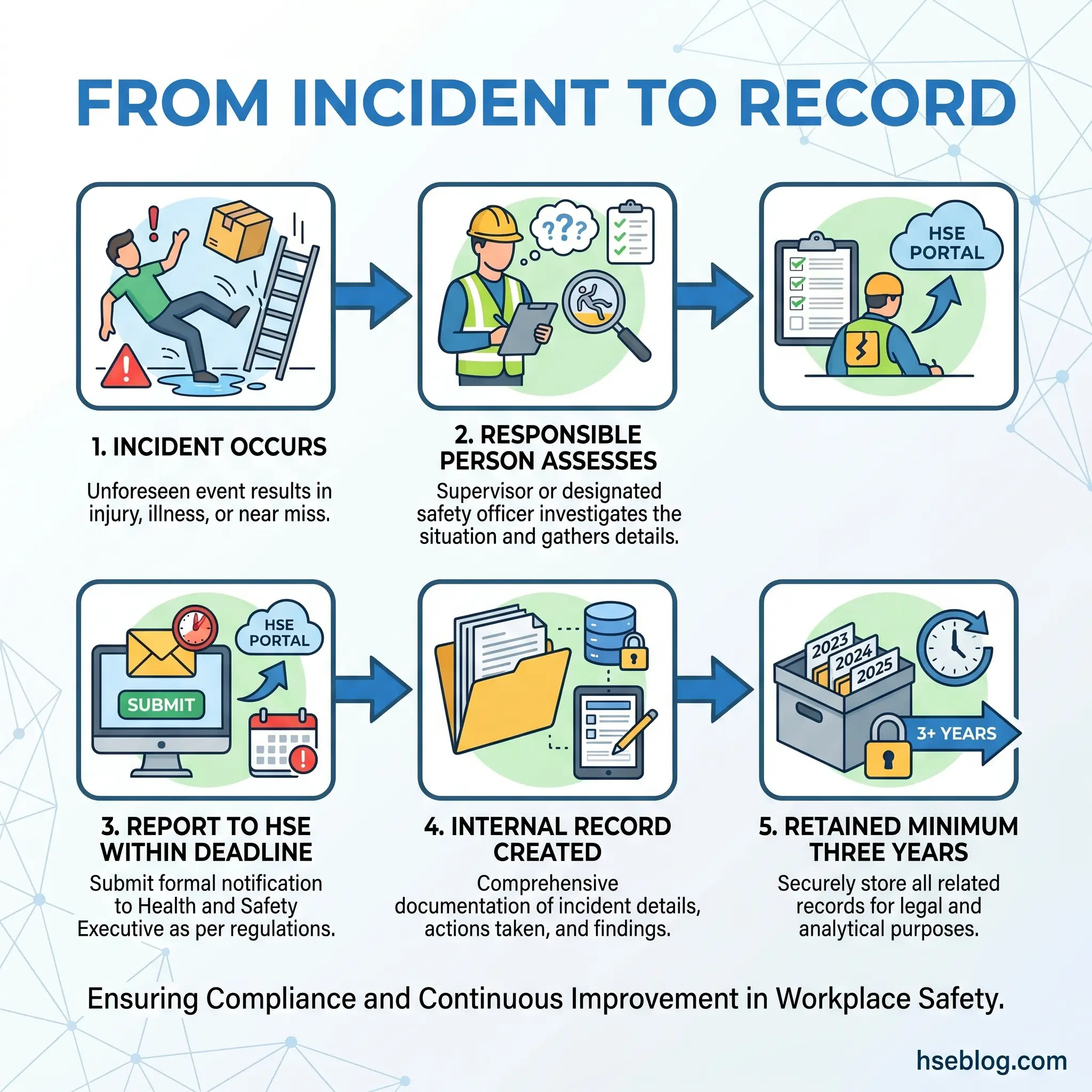
The HSE phased out paper F2508 forms for most categories years ago. Routine reporting is now done through the HSE online reporting portal. Telephone reporting remains available for the most serious categories only.
The process runs as follows:
- Gather the facts before you open the form. Date, time, and precise location of the incident. Personal details of the injured person including age, occupation, and employment status. SIC code for your business. A clear description of what happened — not a judgement of cause, but a factual sequence. Details of any equipment, substances, or materials involved. Immediate actions taken.
- Choose the correct form. The portal splits submissions by type: Report of an Injury (including fatal), Report of a Dangerous Occurrence, Report of a Case of Disease, Report of a Flammable Gas Incident, Report of a Dangerous Gas Fitting, and the ROGI form for offshore incidents. Picking the wrong form causes rejections and missed deadlines.
- Complete the form online. The interface autosaves progress. Pay particular attention to the "kind of accident" and "agent or factor" fields — these feed the HSE's statistical categorisation.
- Submit and download the PDF confirmation. The portal issues a reference number and a PDF copy. Save both. This PDF is your evidence of compliance if the report is later queried.
- Use the phone route only for fatal or specified-injury cases. The HSE Incident Contact Centre on 0345 300 9923 operates during office hours (Monday to Friday, 8:30am to 5:00pm). A phone notification still requires a formal online submission within 10 days.
- Update records internally. Cross-reference the RIDDOR reference number into your accident book entry and your incident investigation file. Auditors will look for this link.
The Fix That Works: Build a pre-populated internal RIDDOR worksheet that matches the online form's fields. When an incident happens, the nominated reporter fills the worksheet first and uses it to complete the HSE form. This eliminates the errors that come from trying to compose a report under pressure, especially out of hours.
Record-Keeping Requirements Under RIDDOR
Reporting and record-keeping are two separate duties. A report goes to the HSE. A record stays with you. Regulation 12 requires the responsible person to keep a record of every reportable injury, disease, and dangerous occurrence.
The minimum retention is three years from the date the record was made, though most legal advisors recommend five or six years to align with the civil litigation limitation period under the Limitation Act 1980. A claim for personal injury can be brought up to three years from the date of knowledge of the injury — and that date can fall well after the incident.
Each record must contain:
- Date and method of reporting
- Date, time, and place of the event
- Personal details of those involved
- A brief description of the event or disease
The Social Security (Claims and Payments) Regulations 1979 require any employer of ten or more people to maintain an accident book. The standard is Form BI 510 (or an electronic equivalent). It can serve as the RIDDOR record for injuries, but not for diseases or dangerous occurrences, which need their own records. And because the accident book captures personal data, you have to handle it under the Data Protection Act 2018 — which in practice means the pages need to be tear-out, each filed separately, so one worker's entry is not visible to others.
Penalties for Failing to Report Under RIDDOR
Failure to comply with RIDDOR is a criminal offence under the Health and Safety at Work etc. Act 1974. The practical consequences are:
- Summary conviction in a magistrates' court carries a fine; fines for health and safety offences are unlimited in the Crown Court following the Legal Aid, Sentencing and Punishment of Offenders Act 2012
- Custodial sentences of up to two years on indictment are available for the most serious breaches
- Personal prosecution of directors, managers, secretaries, or similar officers is available under Section 37 of the 1974 Act where the offence was committed with their consent, connivance, or neglect
- Director disqualification of up to 15 years under the Company Directors Disqualification Act 1986
- Reputational and commercial consequences — insurers treat late or missed RIDDOR reports as a red flag, and public tender processes often require disclosure of safety breaches
RIDDOR data is not automatically forwarded to your insurer. You will need to notify them separately under your policy's incident reporting clause — usually within 24 to 48 hours of the event.
RIDDOR Reporting in Context: The 2024/25 Picture
The HSE's annual statistics for 2024/25, published in the summer of 2025, give the clearest current picture of what RIDDOR is capturing — and what it may be missing.
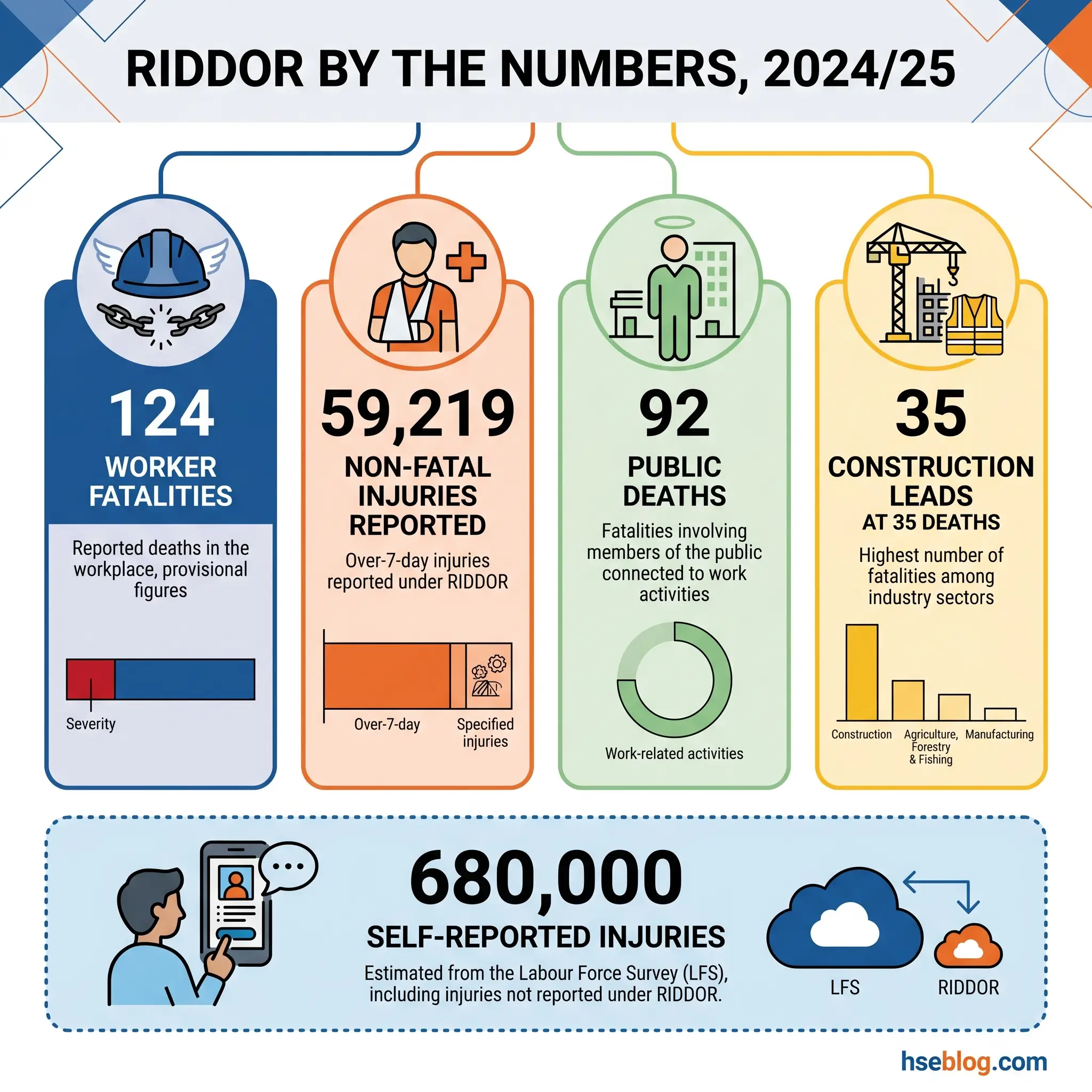
The Health and Safety Executive's latest data shows that 124 workers were killed in work-related accidents in Great Britain in the year 2024/25, a reduction of 14 fatalities from 2023/24 DWF. Construction accounted for 35 deaths — 28% of all worker fatalities — followed by agriculture, forestry and fishing with 23, and 35 workers were killed after falling from a height, the main cause of work-related fatal injury in almost every year since at least 2001/02 IOSH magazine. A total of 92 members of the public were also killed in work-related accidents in 2024/25, an increase of six fatalities from the previous year IOSH magazine.
The non-fatal figures tell a different story. 59,219 employee injuries were reported by employers under RIDDOR, which is both the second-lowest number on record and the second-lowest rate of injury ever reported Safesmart. That sounds like progress until you compare it with the Labour Force Survey's self-reported figure of roughly 680,000 non-fatal injuries — more than eleven times higher. Under-reporting is the elephant in the RIDDOR room, and the gap is what the HSE's enforcement strategy is increasingly built to close.
Field Test: Over a rolling 12 months, compare your site's RIDDOR submissions against your accident book entries. If the ratio is markedly lower than your industry peers', your reporting thresholds are probably being misapplied somewhere in the chain.
There is also an active policy debate about extending RIDDOR to cover work-related suicides, driven by the record 964,000 workers reporting work-related stress, depression or anxiety in 2024/25 — an increase of 180,000 cases from last year Safesmart. The regulation has not been amended, but watch this space — the HSE's focus on psychological harm is sharpening.
Common RIDDOR Reporting Mistakes to Avoid
Eight years of submitting and auditing RIDDOR reports across the logistics and manufacturing sector have turned up the same errors repeatedly:
- Confusing the over-3-day recording duty with the over-7-day reporting duty. Both exist. Only the second goes to the HSE.
- Failing the "work-related" test. An employee twisting an ankle in your car park at lunchtime on their way to buy a sandwich is not, in most cases, a work-related accident. The question is whether the accident arose from the work activity, the condition of the premises used for work, or the equipment involved.
- Missing dangerous occurrences. The racking collapse with no one underneath. The pallet truck that lost its load in an empty aisle. These are Schedule 2 events and are reportable.
- Assuming minor public injuries are not reportable. If a visitor is taken directly to hospital for treatment, the report is required — even if the diagnosis turns out to be minor.
- Miscounting the seven days. The day of the accident is excluded, weekends are included, and the 15-day clock runs from the accident date.
- Overlooking occupational diseases. Because there is no incident to investigate, the duty is easy to forget. The written diagnosis is your trigger.
- Treating the accident book as sufficient. It is a record, not a report. The two duties are separate.
- Delegating reporting without training. A site manager who has never completed an F2508 online will panic when they have to. Train the nominated reporter before you need them.
Frequently Asked Questions
What does RIDDOR stand for?
RIDDOR stands for the Reporting of Injuries, Diseases and Dangerous Occurrences Regulations. The current version, RIDDOR 2013, was made under the Health and Safety at Work etc. Act 1974 and came into force on 1 October 2013, replacing the 1995 regulations.
Is a minor injury RIDDOR reportable?
Usually not — but the answer depends on who was hurt. A minor injury to a worker does not trigger RIDDOR unless it becomes an over-seven-day incapacity, in which case the 15-day reporting deadline applies. A minor-looking injury to a member of the public is different: if that person is taken directly from the scene to hospital for treatment, Regulation 5 requires a report regardless of how trivial the injury ultimately proves. All workplace injuries, however minor, should still be entered in the accident book.
How long do I have to report a RIDDOR incident?
Deaths, specified injuries, dangerous occurrences, occupational diseases, and non-worker hospitalisations must be notified to the HSE without delay, with the formal online submission completed within 10 days. Over-seven-day injuries to workers have a 15-day deadline, running from the date of the accident — not the date the seven-day threshold is crossed.
What's the difference between RIDDOR and the accident book?
RIDDOR is a duty to report specified incidents to the HSE. The accident book (typically Form BI 510) is a separate record-keeping duty under the Social Security (Claims and Payments) Regulations 1979, which applies to any employer with ten or more employees. The accident book can serve as your RIDDOR record for injuries, but not for diseases or dangerous occurrences — and logging an incident in the book does not satisfy the duty to report it to the HSE.
Is a near miss RIDDOR reportable?
Only specific near-misses are reportable. Regulation 7 and Schedule 2 list 27 "dangerous occurrences" — events with the potential for serious harm — that must be reported whether or not anyone was injured. Examples include lifting equipment collapse, pressure system failures, overhead power line contact, and scaffolding collapses above five metres. General near-misses outside this list are not RIDDOR-reportable, though they should be investigated and recorded internally.
Can you go to prison for not reporting a RIDDOR incident?
Yes. Breach of RIDDOR is a criminal offence under the Health and Safety at Work etc. Act 1974, and the most serious breaches carry custodial sentences of up to two years on indictment alongside unlimited fines. Section 37 of the 1974 Act allows directors, managers, and similar officers to be prosecuted personally where an offence was committed with their consent, connivance, or neglect. Enforcement typically targets a pattern of non-compliance rather than a single missed report, but a missed fatality report has a high chance of becoming a prosecution.
Conclusion
RIDDOR compliance reduces to four practical decisions, repeated every time an incident reaches the safety desk. First, identify the responsible person — and make sure they know it is them, not the injured party, not the witness, not the subcontractor. Second, test the event against the seven reporting categories and the explicit exemptions; if it fails both, record it in the accident book and move on. Third, diary the correct deadline — 10 days for most categories, 15 days for over-seven-day injuries, "without delay" by phone for fatalities — and file the submission through the HSE's online portal or Incident Contact Centre. Fourth, close the loop with an internal record that meets the Regulation 12 content requirements and survives at least three years.
Two habits separate sites that handle RIDDOR well from those that handle it badly. The well-run ones rehearse their reporting workflow before they need it, usually as part of an annual emergency drill, so the nominated reporter has opened the F2508 interface at least once outside an incident. They also audit their accident book against their RIDDOR submissions every quarter, looking for the gap that reveals a misapplied threshold. Get those two habits embedded, and RIDDOR stops being a compliance scramble and becomes what it was designed to be — intelligence that helps the HSE prevent the next fatality, and evidence that your site was doing its job when the one that couldn't be prevented arrived.