
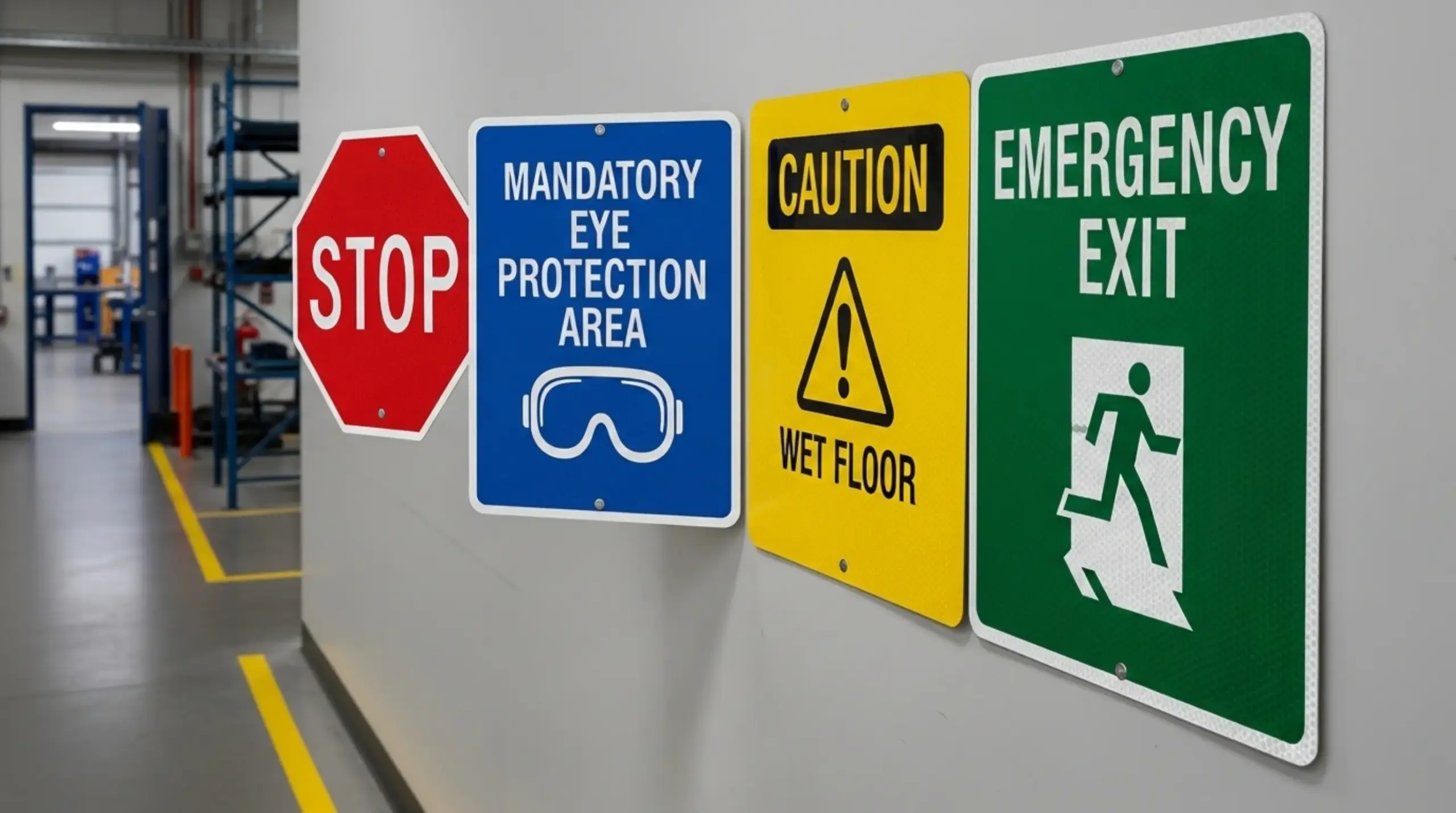
During a high-pressure audit on a multinational petrochemical project, I once found a critical isolation valve marked with a faded, handwritten tag instead of a standardized “No Entry” sign. That single oversight could have resulted in a catastrophic release of pressurized steam. Signs are not “wall decor”; they are the silent supervisors of a high-risk site, providing instant instruction when a human supervisor isn’t present.
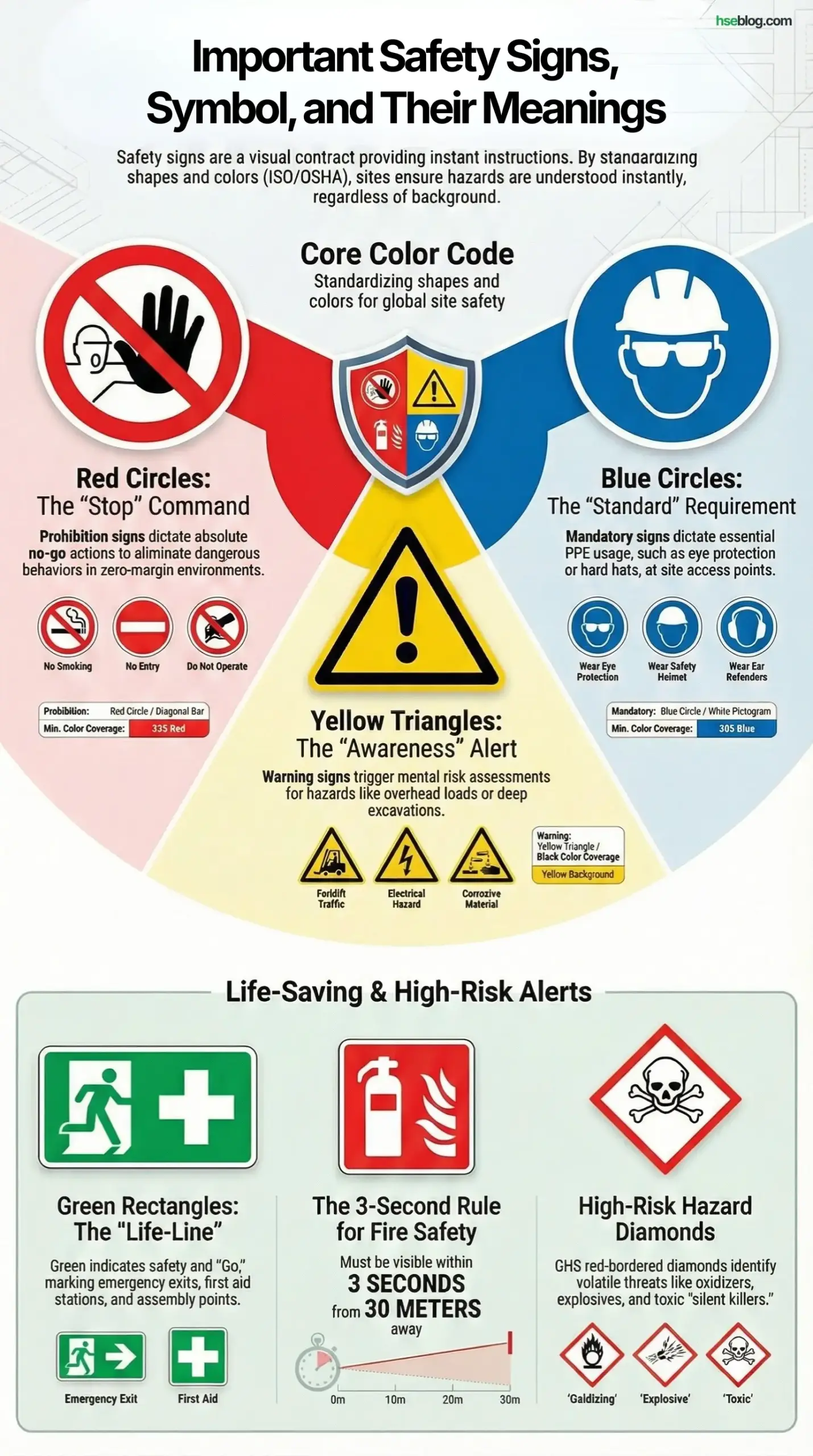
Understanding these 25 signs is fundamental for every person on-site. This guide breaks down the visual language of safety based on international standards (ISO/OSHA), ensuring that whether you are in a refinery or a warehouse, the message remains the same: stay informed, stay protected, and stay alive.
TL;DR
- Identify by Shape and Color: Colors (Red, Yellow, Blue, Green) dictate the message type before you even read the text.
- Placement is Key: Signs must be visible, unobstructed, and located at the point of hazard or entry.
- Standardization Saves Lives: Consistent use of ISO 7010 or OSHA/ANSI standards ensures workers from all backgrounds understand the risk.
- Compliance is Not Optional: Missing or faded signage is a primary citation in safety audits and a leading indicator of poor site culture.
25 Essential Safety Signs and Meanings | HSE Field Guide
Safety signage is the primary method of communicating hazards in real-time across high-risk operational environments. These 25 signs represent a universal language designed to bridge the gap between complex safety regulations and the immediate physical reality of the job site. Each category serves a distinct functional purpose in risk mitigation, from dictating the use of Personal Protective Equipment (PPE) to marking the location of life-saving emergency apparatus.
1. Prohibition Signs: The “Stop” Command
In the hierarchy of site discipline, Prohibition Signs are absolute. If I see a worker smoking under a “No Smoking” sign in a battery storage facility, that is an immediate “Stop Work Authority” (SWA) event and likely a permanent removal from the project. These signs are designed to eliminate dangerous behaviors in environments where the margin for error is zero.
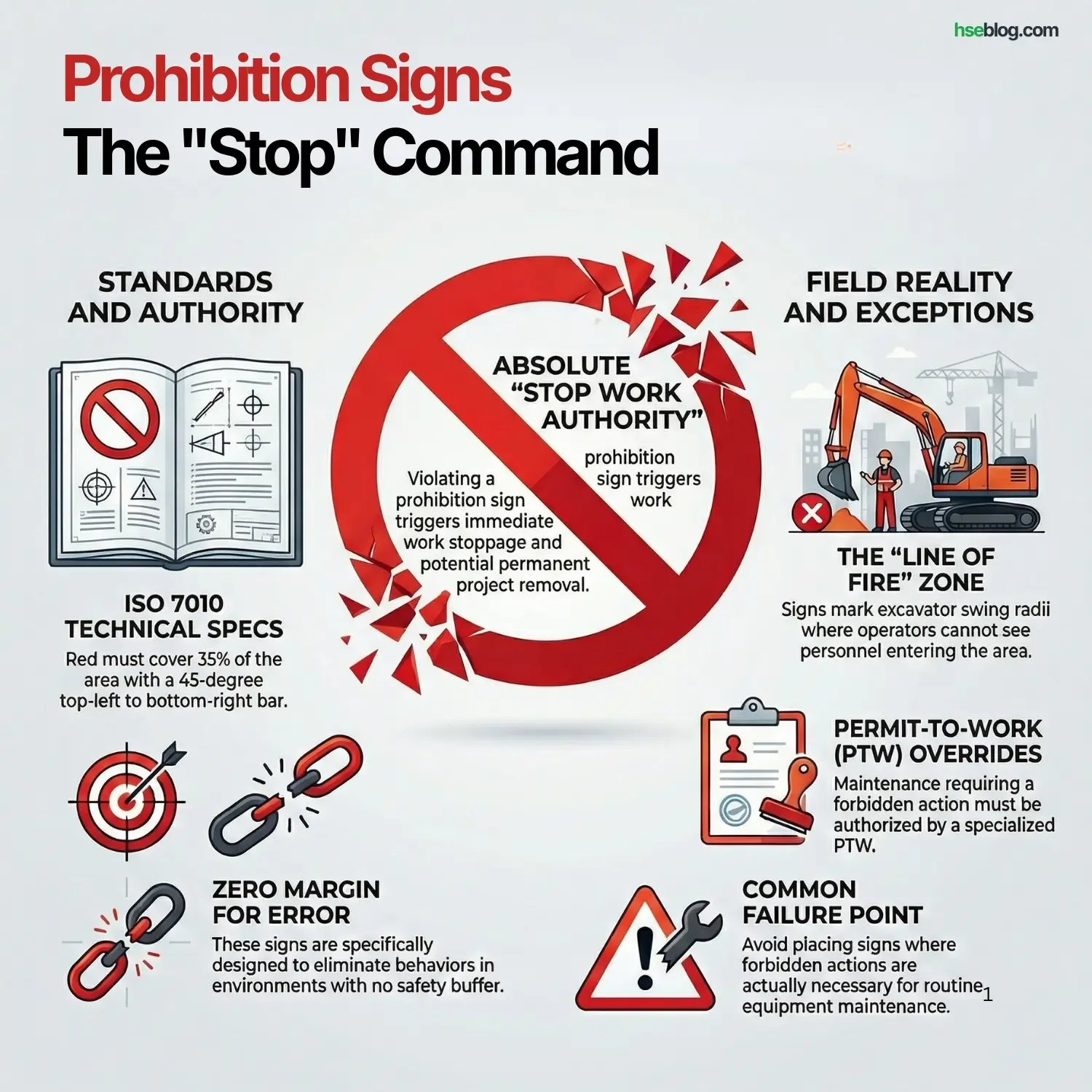
- The Technical Specs: According to ISO 7010, the red must cover at least 35% of the sign area. The diagonal bar always runs from the top left to the bottom right at a 45-degree angle.
- Field Reality: These are often used to prevent “Unauthorized Entry.” In heavy civil engineering, we use them on the swing radius of excavators. If you cross that red circle, you are entering a “Line of Fire” zone where the operator cannot see you.
- Common Failure: Placing these signs where the “forbidden action” is actually necessary for maintenance. In those cases, a specialized Permit-to-Work (PTW) must override the sign.
2. Warning Signs: The “Awareness” Alert
Warning signs are different from Prohibition signs; they don’t say “don’t do it,” they say “do it with extreme caution.” On a wind farm project, I’ve seen these used for “Overhead Hazards.” They are meant to trigger a mental risk assessment in the worker’s mind before they proceed.
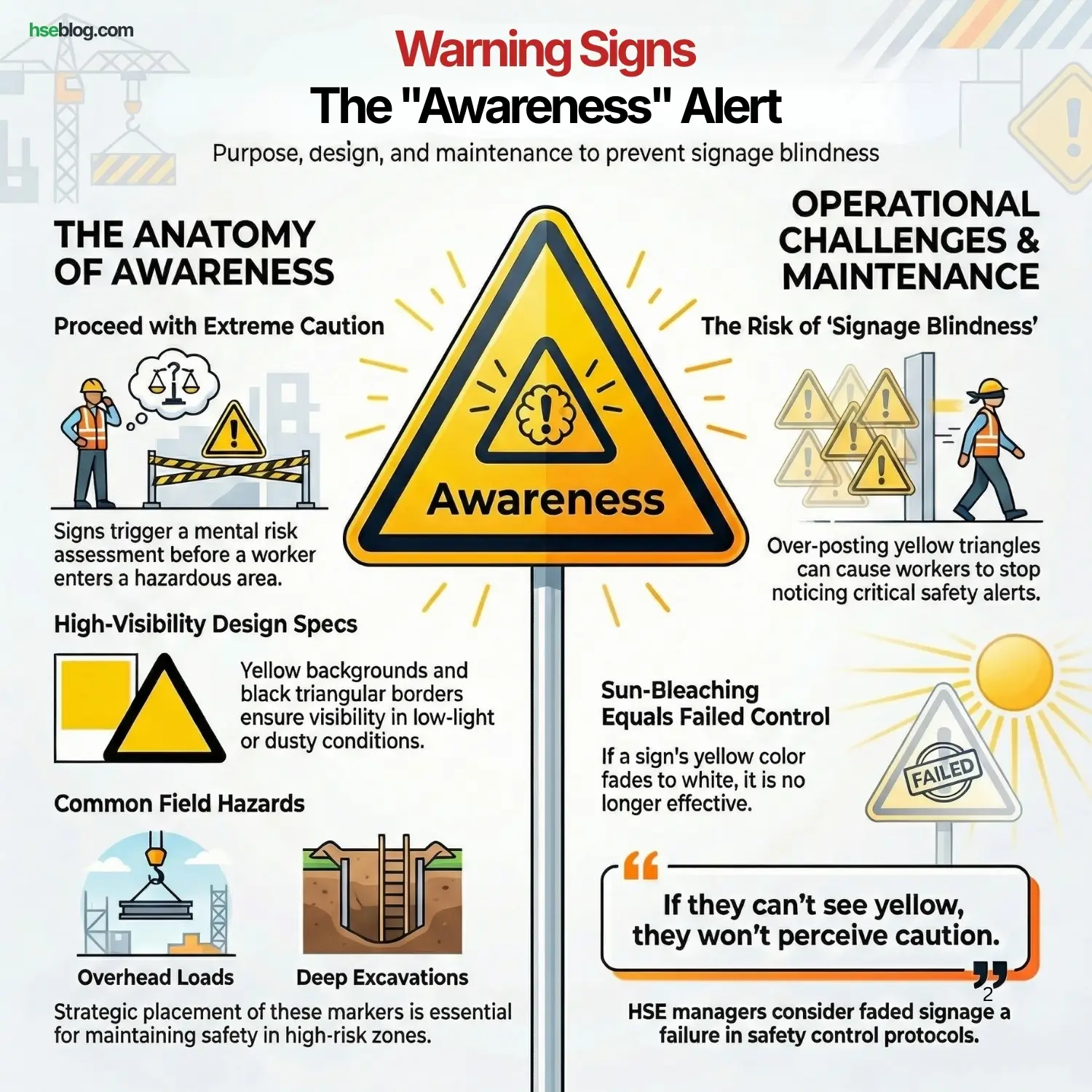
- The Technical Specs: The yellow (amber) background is intended to be visible even in low-light or dusty conditions. The black border ensures the triangle shape is recognizable from a distance, even if the central symbol is obscured.
- Field Reality: “Warning: Deep Excavation” or “Warning: Overhead Load.” The biggest issue I see in the field is “Signage Blindness”—where so many yellow triangles are posted that workers stop seeing them.
- HSE Insight: As a manager, if I see a warning sign that has been sun-bleached to white, I consider it a failed control. If the worker can’t see the yellow, they won’t perceive the caution.
3. Mandatory Signs: The “Standard” Requirement
These are my primary audit tools. If I walk into a “Blue Zone” (an area dominated by Blue Mandatory circles), and the workers aren’t following the instructions, it’s a sign of a breakdown in supervision. These signs are almost always tied to Personal Protective Equipment (PPE).
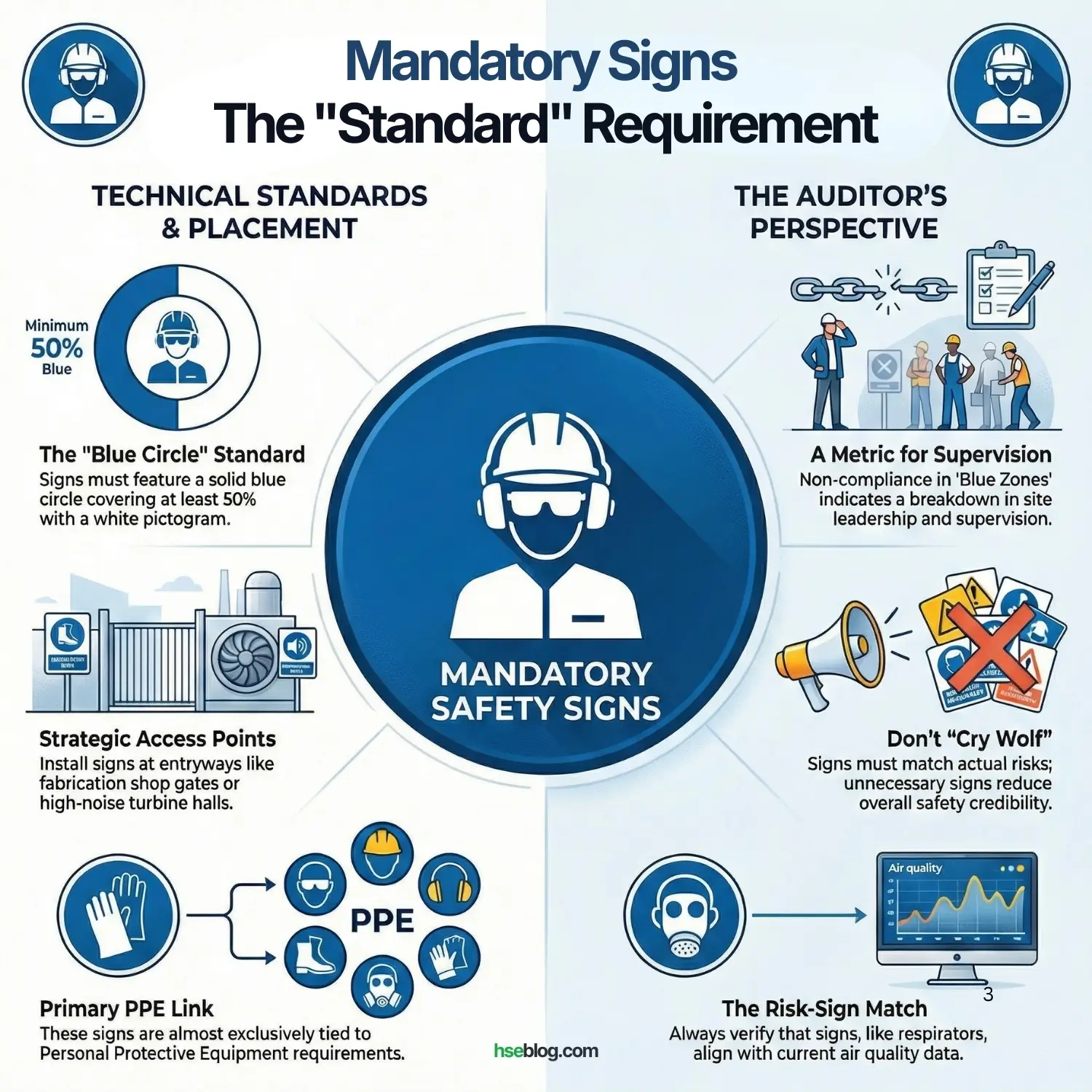
- The Technical Specs: A solid blue circle with a white pictogram. The blue must cover at least 50% of the sign.
- Field Reality: We place these at “Access Points.” You’ll see them at the gate of a fabrication shop (Wear Eye Protection) or a high-noise turbine hall (Wear Ear Protection).
- Pro Tip: I always check if the mandatory sign matches the actual risk. If a sign says “Wear Respirator” but the air quality test shows no contaminants, the sign is “crying wolf” and reduces the credibility of other signs on-site.
4. Emergency Signs: The “Life-Line”
When the alarms go off and the smoke starts to fill a corridor, the human brain reverts to basic pattern recognition. You stop reading words and start looking for colors. Green is the universal color for “Go” and “Safety.”
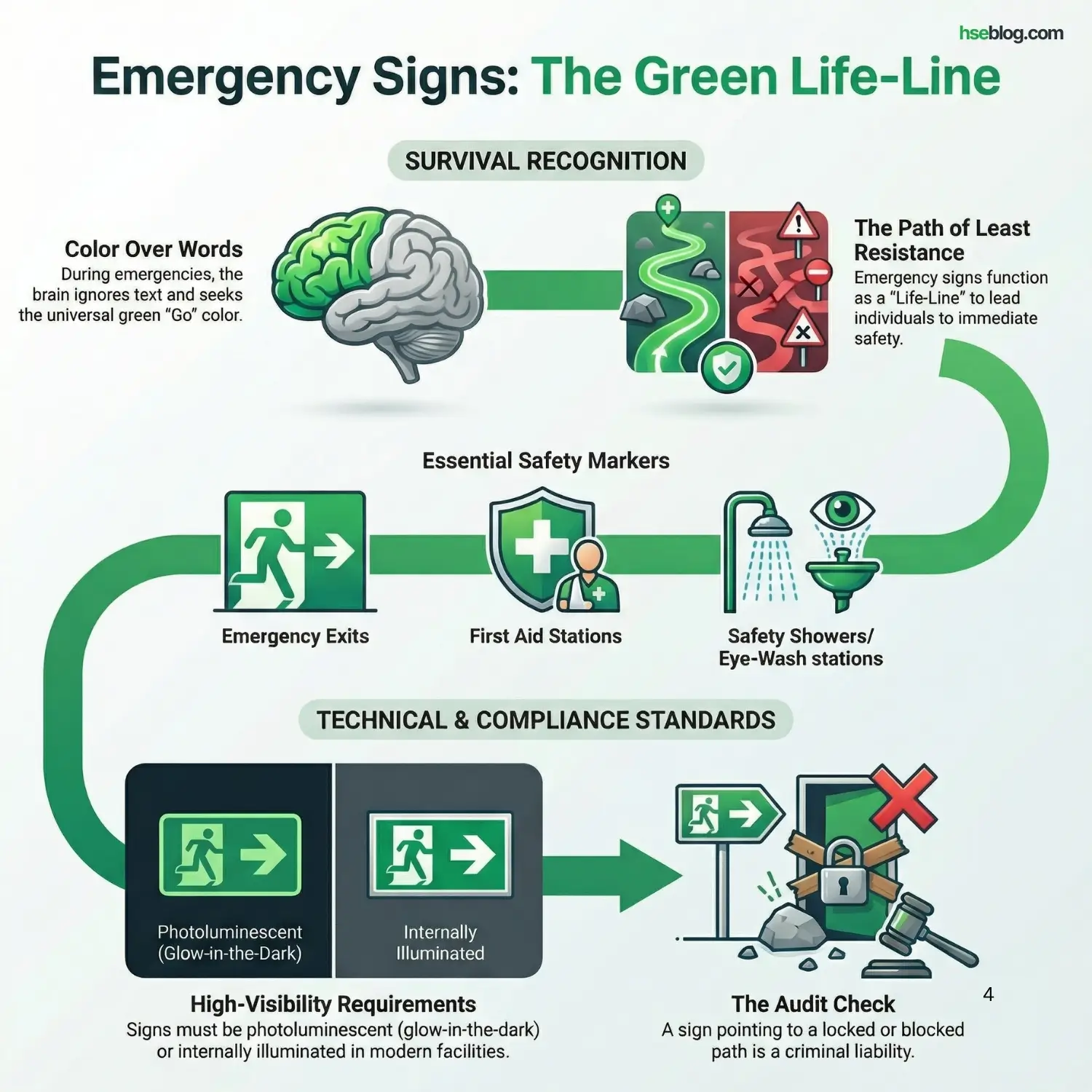
- The Technical Specs: These must be photoluminescent (glow-in-the-dark) or internally illuminated in modern facilities. They indicate the “Path of Least Resistance” to a place of safety.
- Field Reality: These include “Emergency Exit,” “First Aid Station,” and “Safety Shower.” During a spill of sulfuric acid at a chemical plant, I watched a worker find the eye-wash station solely because of the green sign visible through the mist.
- Audit Check: I always check if an emergency exit sign actually leads to a clear path. A green sign pointing to a locked door or a blocked hallway is a criminal liability for the HSE Manager.
5. Flammable Signs: The “Volatility” Warning
In Oil & Gas or chemical processing, this sign—often a diamond-shaped GHS (Globally Harmonized System) label or a yellow warning triangle—is the most respected symbol on the rig. It identifies substances with a low flashpoint.
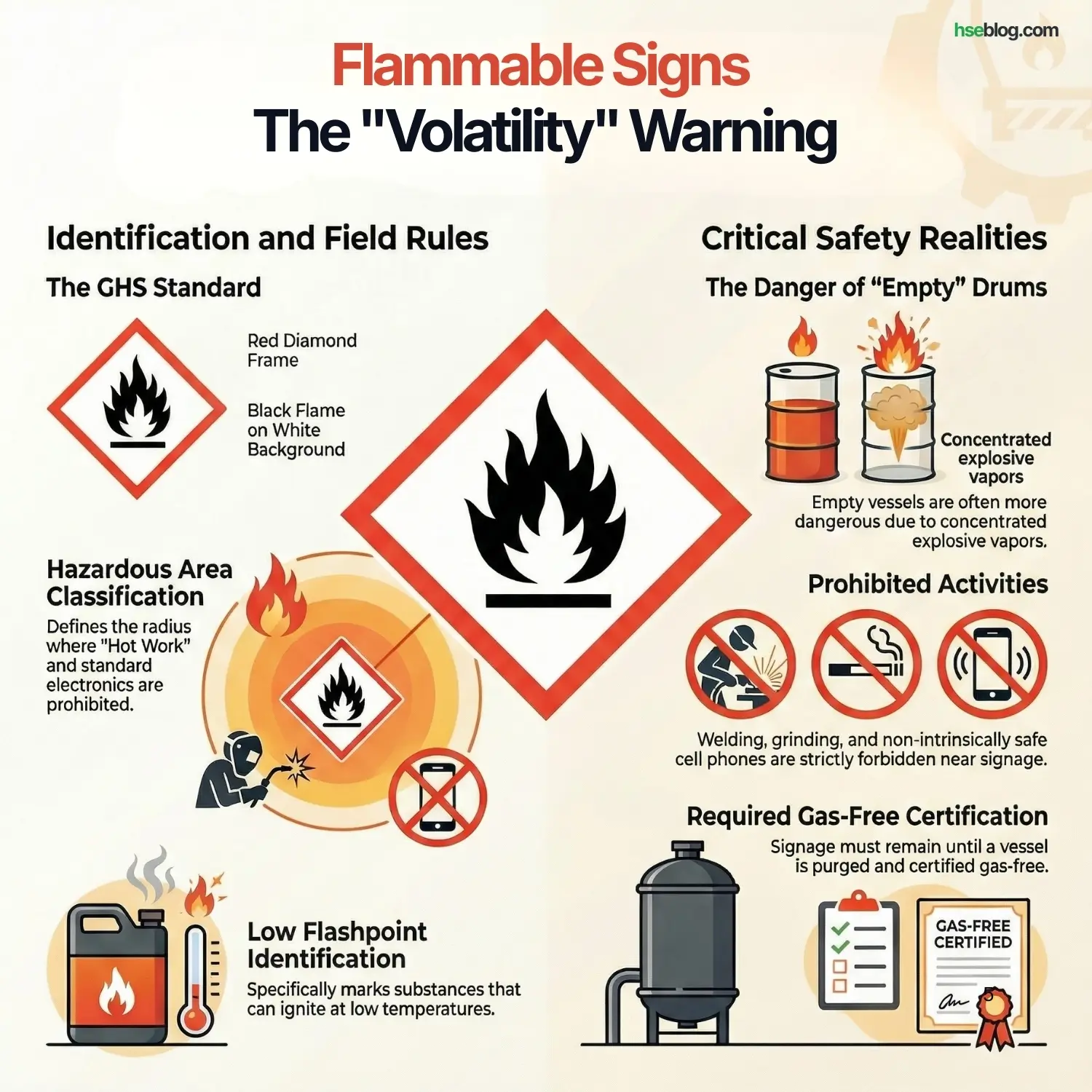
- The Technical Specs: Usually features a flame symbol. If it’s a GHS pictogram, it’s a black flame on a white background with a red diamond frame.
- Field Reality: This sign dictates the “Hazardous Area Classification.” If this sign is posted, you cannot have “Hot Work” (welding, grinding) or non-intrinsically safe electronics (like standard cell phones) within a specific radius.
- Common Mistake: Storing “empty” fuel drums without this signage. An empty drum is often more dangerous than a full one because it is filled with explosive vapors. If it’s a flammable hazard, the sign stays until the vessel is purged and certified gas-free.
6. Explosive Signs: The “Zero-Tolerance” Zone
When I’m on a mining site or a demolition project, this sign isn’t just a warning; it defines a “Blast Radius.” It marks materials that don’t just burn—they detonate. A detonation is a supersonic shockwave that destroys everything in its path.
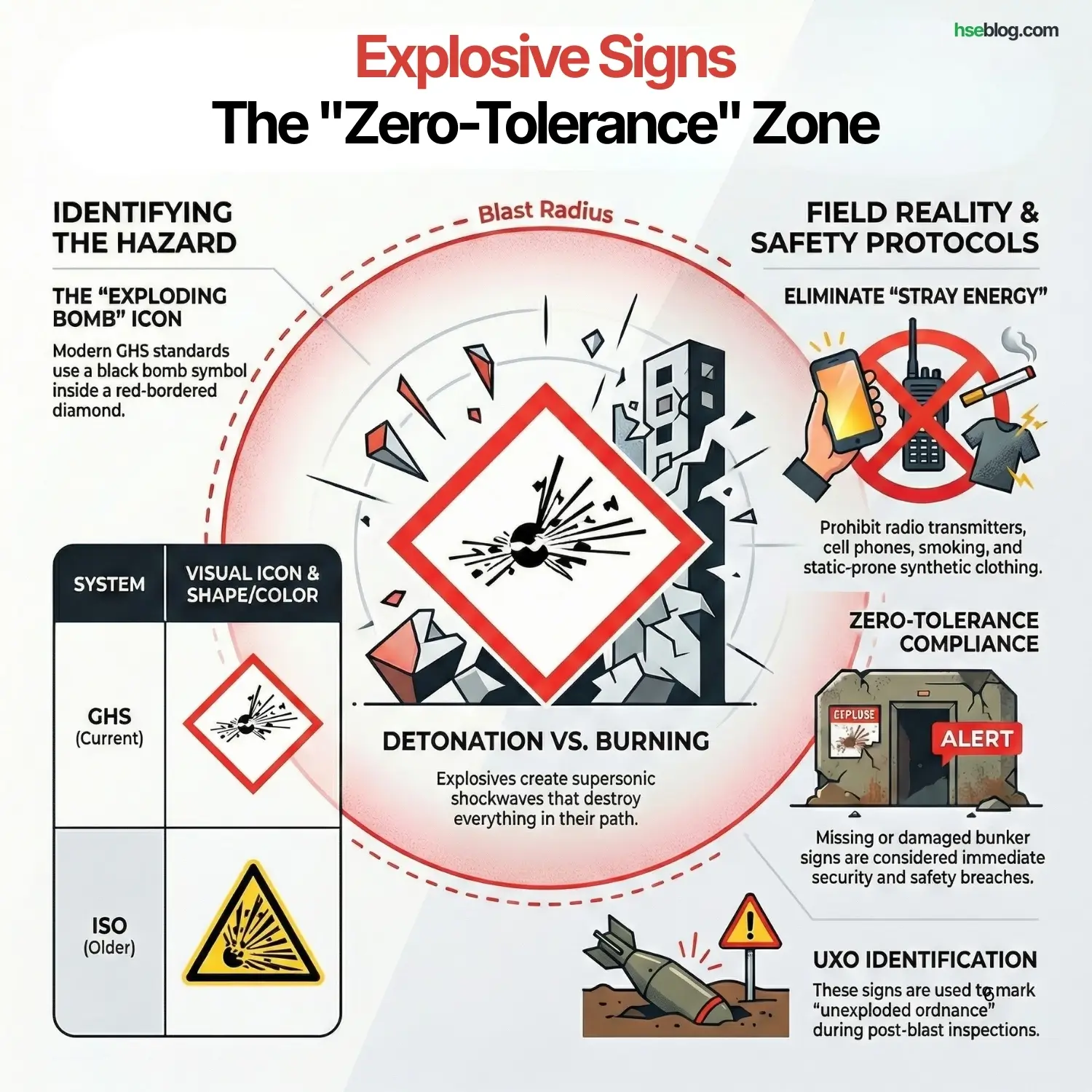
- The Technical Specs: Under the GHS (Globally Harmonized System), this is a black “exploding bomb” icon inside a red-bordered diamond. In older ISO formats, it’s a black symbol in a yellow triangle.
- Field Reality: This sign demands total control over “stray energy.” This means no radio transmitters, no cell phones, and no smoking. Even static electricity from a synthetic jacket can be enough to trigger some sensitive primary explosives.
- HSE Insight: I check the storage magazines (bunkers) for these signs daily. If the sign is missing or damaged, it’s an immediate security and safety breach. We also use these to mark “unexploded ordnance” (UXO) in post-blast inspections.
7. Fire Extinguisher Signs: The “Immediate Response” Marker
During a fire, “tunnel vision” kicks in. A worker’s heart rate spikes to 150+ BPM, and they physically cannot process complex information. They need a high-visibility marker that stands out against the smoke.
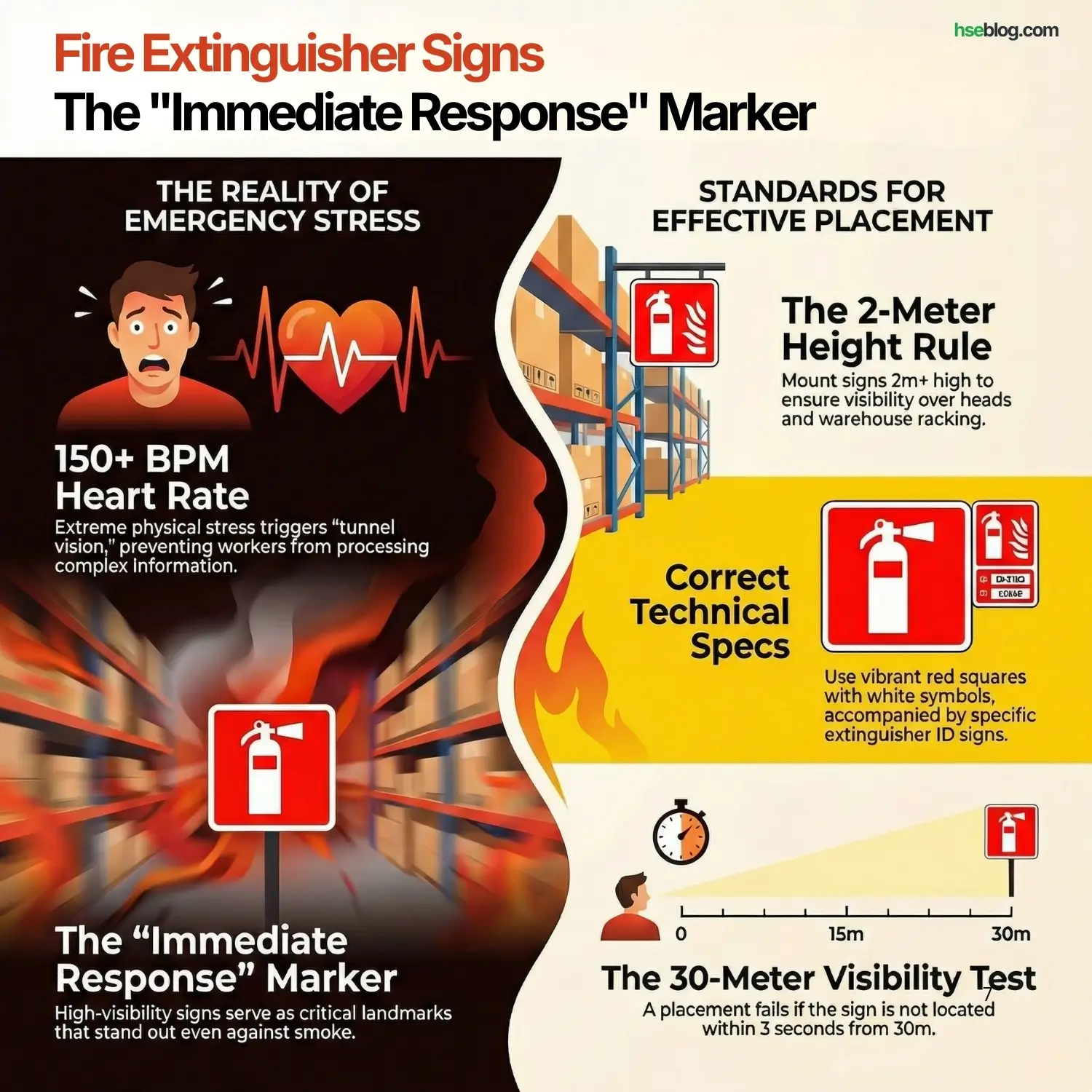
- The Technical Specs: A vibrant red square with a white symbol of a fire extinguisher. These are often accompanied by a “ID sign” that tells you what type of fire the extinguisher is for (e.g., CO2 for electrical, Powder for general).
- Field Reality: The biggest mistake I see? Mounting the extinguisher but not the sign, or mounting the sign behind an open door. These signs should be mounted at a height of 2 meters or higher so they are visible over the heads of people and across warehouse racking.
- Pro Tip: If I’m auditing a site, I stand 30 meters away and try to locate the red sign. If I can’t see it within 3 seconds, the placement is a failure.
8. Biohazard Signs: The “Invisible Pathogen” Warning
I’ve seen these used extensively in wastewater treatment plants and during the remediation of medical waste. Unlike a physical hazards, a biohazard is a slow killer—bacteria, viruses, or toxins that you might carry home to your family on your skin or clothes.
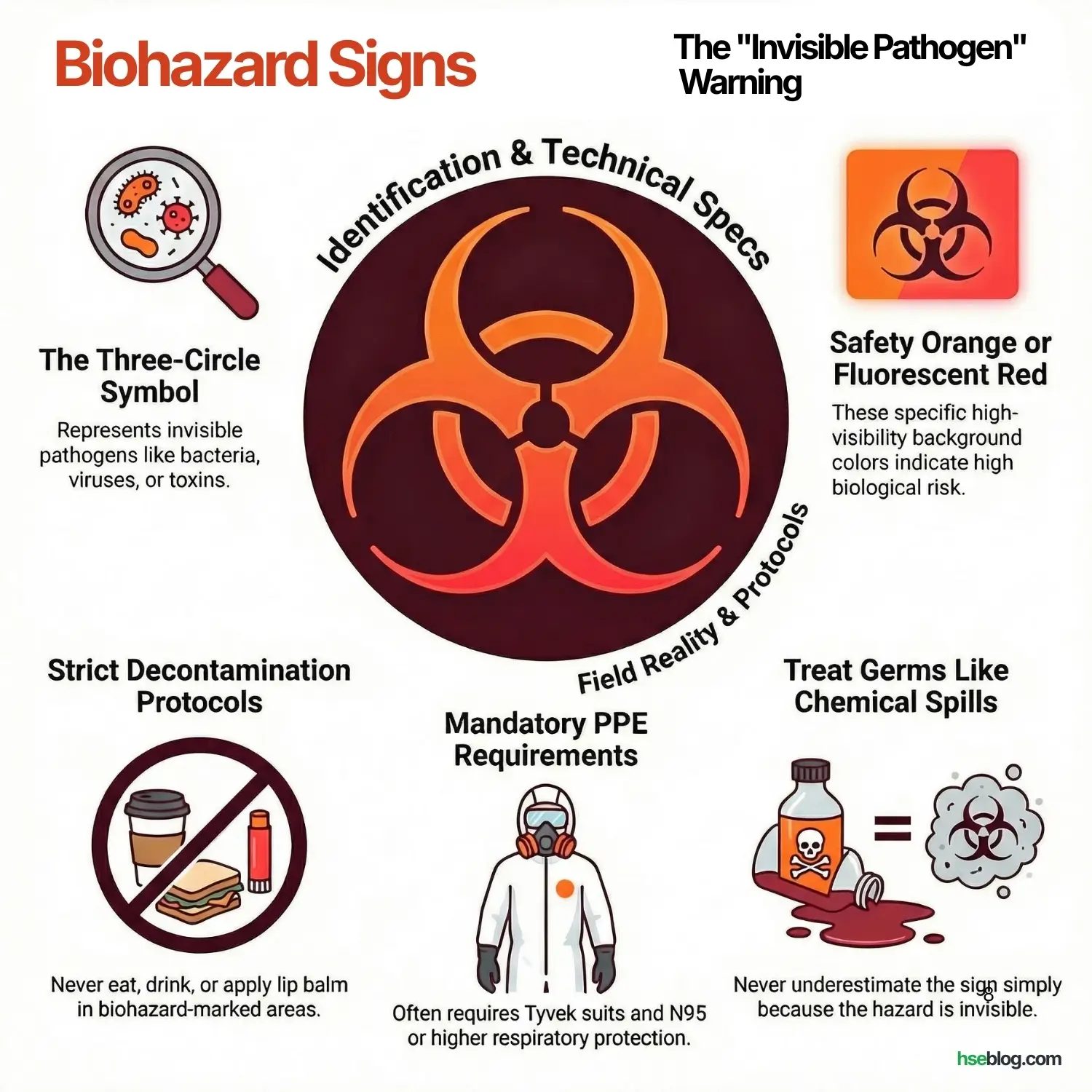
- The Technical Specs: A unique, three-circle symbol. It is almost always printed on a “Safety Orange” or “Fluorescent Red” background to indicate high biological risk.
- Field Reality: This sign triggers “Decontamination Protocols.” If you see this sign, you do not eat, drink, or apply lip balm in that area. It often mandates “Tyvek” suits and specific respiratory protection (like an N95 or higher).
- Critical Note: In my experience, workers often underestimate this sign because they can’t “see” the germs. I treat a biohazard sign with the same respect as a chemical spill.
9. High Voltage Signs: The “No-Touch” Indicator
I’ve stood over a “flashover” site where an uncertified worker touched a busbar. Electricity doesn’t need physical contact to kill you; it can “arc” through the air if the voltage is high enough. This sign is the barrier between life and certain death.
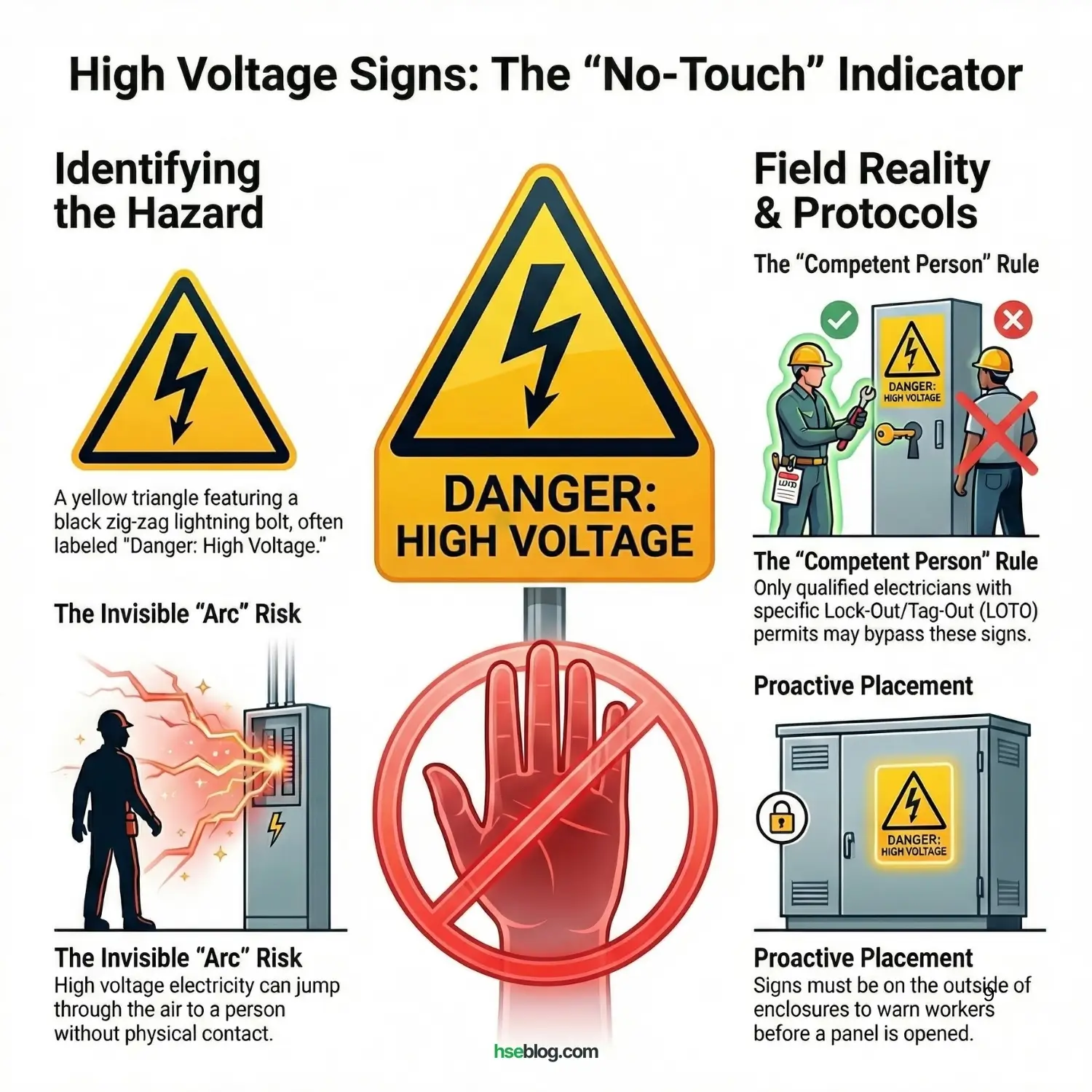
- The Technical Specs: A yellow triangle with a black “zig-zag” lightning bolt. In many regions, the words “Danger: High Voltage” or “Danger of Death” are added for emphasis.
- Field Reality: This sign is used on substation fences, transformer doors, and cable trays. My rule is simple: if you aren’t a “Competent Person” (a qualified electrician) with a specific Lock-Out/Tag-Out (LOTO) permit, you don’t even touch the handle of a door with this sign on it.
- HSE Insight: I always ensure these are placed on the outside of enclosures. Warning a worker after they’ve already opened the panel is too late.
10. Radioactive Signs: The “Time, Distance, Shielding” Rule
In the oil and gas industry, we use radioactive isotopes to check the integrity of welds (Industrial Radiography). You can’t see, smell, or feel radiation, but it can alter your DNA or cause acute radiation syndrome within hours.
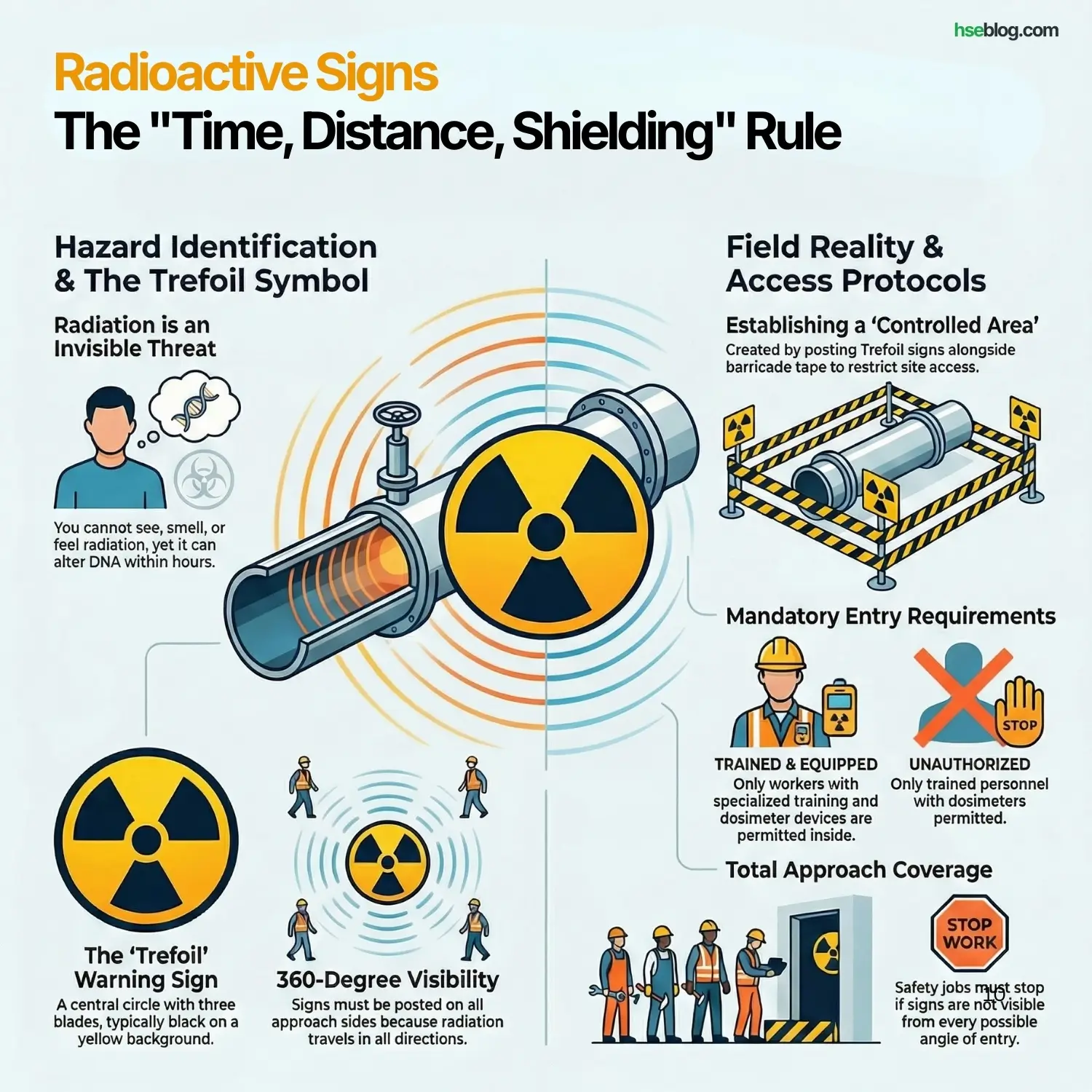
- The Technical Specs: The “Trefoil” symbol—a central circle with three blades. Usually black on a yellow background.
- Field Reality: When this sign is posted alongside “barricade tape,” it creates a “Controlled Area.” Only workers with dosimeters (devices that measure radiation exposure) and specialized training are allowed inside.
- Field Lesson: I’ve had to stop jobs because a crew set up a radiography zone but didn’t post these signs on all approach sides. Radiation travels in all directions; the sign must be visible from every possible angle of entry.
11. Toxic/Poison Signs: The “Fatal Exposure” Warning
In the oilfields, we see this most often with Hydrogen Sulfide (H2S). It is a “silent killer” because it can deaden your sense of smell before it knocks you unconscious. When you see the skull and crossbones, you are in an environment where a single breath or skin contact could be your last.
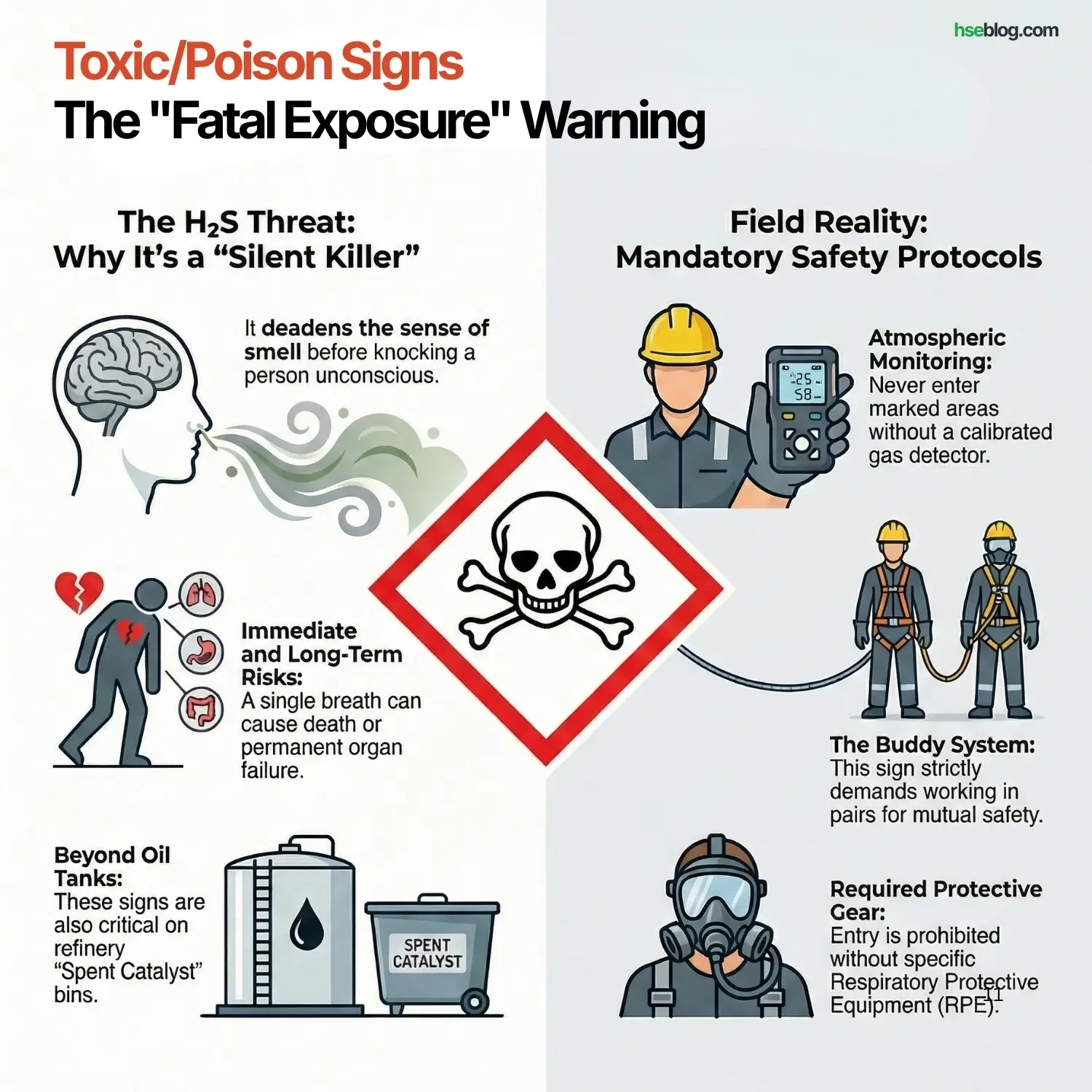
- The Technical Specs: Part of the GHS (Globally Harmonized System), featuring a black skull and crossbones on a white background with a red diamond frame.
- Field Reality: This sign demands a “buddy system” and atmospheric monitoring. If this sign is on a tank or a room, you do not enter without a calibrated gas detector.
- HSE Insight: I’ve seen these on “Spent Catalyst” bins in refineries. The danger isn’t just immediate death; it’s long-term organ failure. Treat this sign as a “Keep Out” unless you have the specific Respiratory Protective Equipment (RPE) required.
12. Wear Eye Protection Signs: The “Blink-of-an-Eye” Defense
I’ve investigated eye injuries where a worker thought, “I’m just doing one quick cut.” A metal shard traveling at high velocity doesn’t care about your schedule. This mandatory sign is posted wherever there is a risk of flying debris, chemical splashes, or intense light (UV).
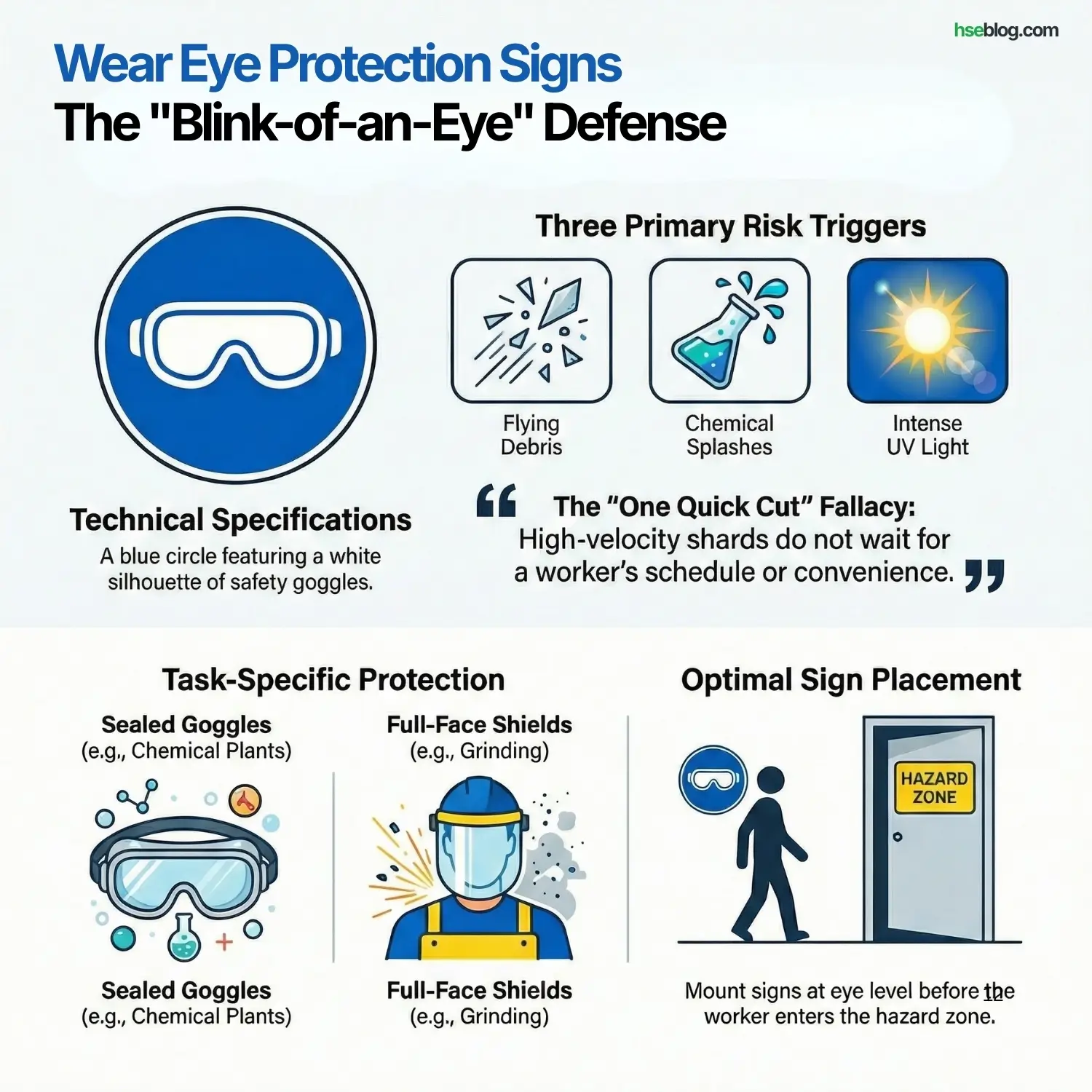
- The Technical Specs: A blue circle with a white silhouette of safety goggles.
- Field Reality: This doesn’t just mean “glasses.” In a chemical plant, it might mean “sealed goggles,” and in a grinding bay, it might mean a “full-face shield.”
- Pro Tip: I check if the sign is posted at eye level. If a worker has to look up or down to find the requirement, they’ve already walked into the hazard zone unprotected.
13. Wear a Hard Hat Signs: The “Red Zone” Boundary
On a high-rise construction site, the area below any active work is a “Drop Zone.” A 500g bolt dropped from 30 meters hits with the force of a small sledgehammer. This sign defines where your skull needs a reinforced shell.
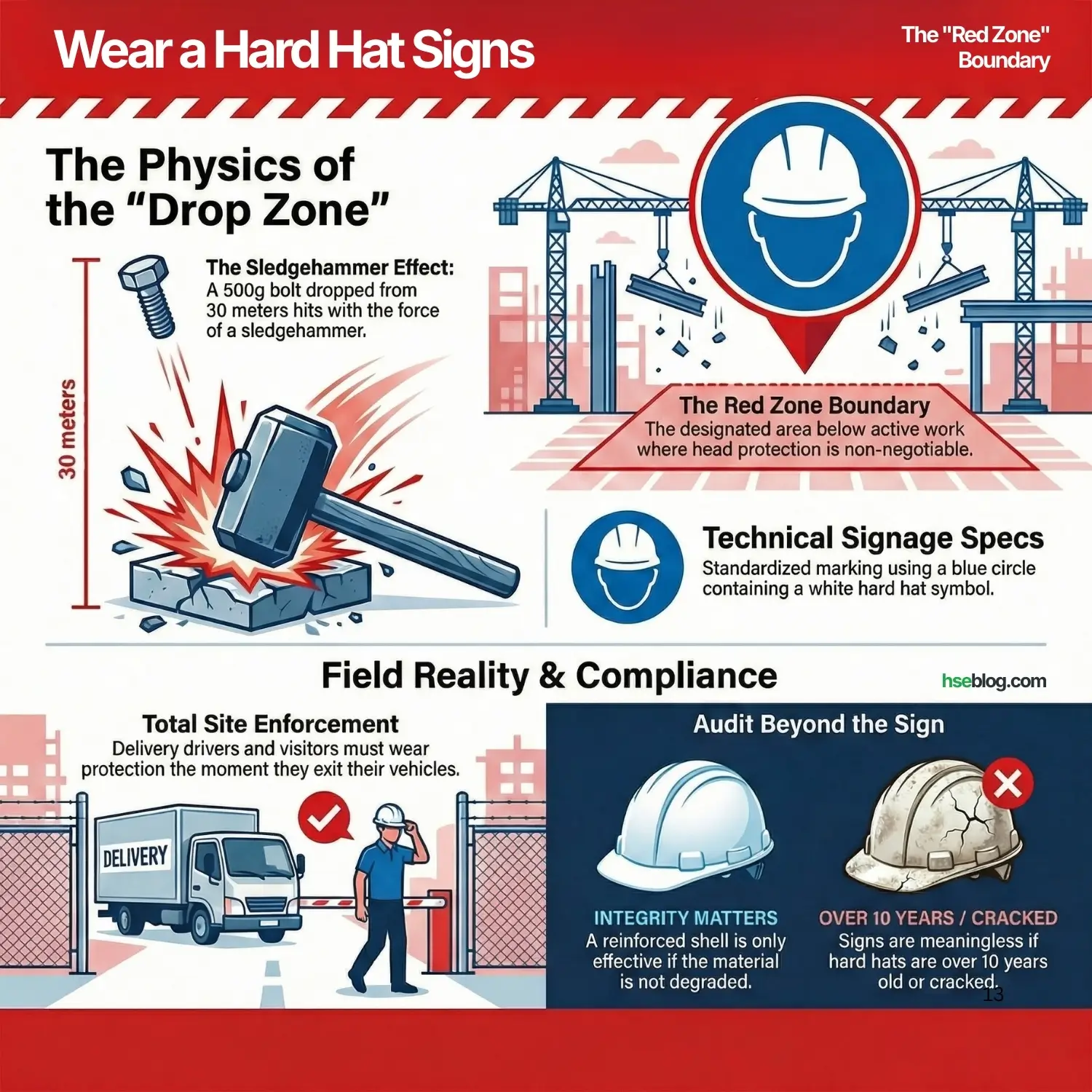
- The Technical Specs: A blue circle with a white hard hat symbol.
- Field Reality: The “Hard Hat Area” must be clearly demarcated. I’ve often stopped delivery drivers from stepping out of their cabs because they ignored this sign.
- Audit Note: I look for the condition of the hard hats, not just the presence of the sign. If the sign is there but the hats are 10 years old and cracked, the sign is a hollow gesture.
14. Wear Ear Protection Signs: The “Silent Disability” Warning
Noise-induced hearing loss (NIHL) is unique because it doesn’t bleed and it doesn’t hurt—until it’s too late. If you are standing a meter away from someone and have to shout to be heard, you are in an area that requires this sign.
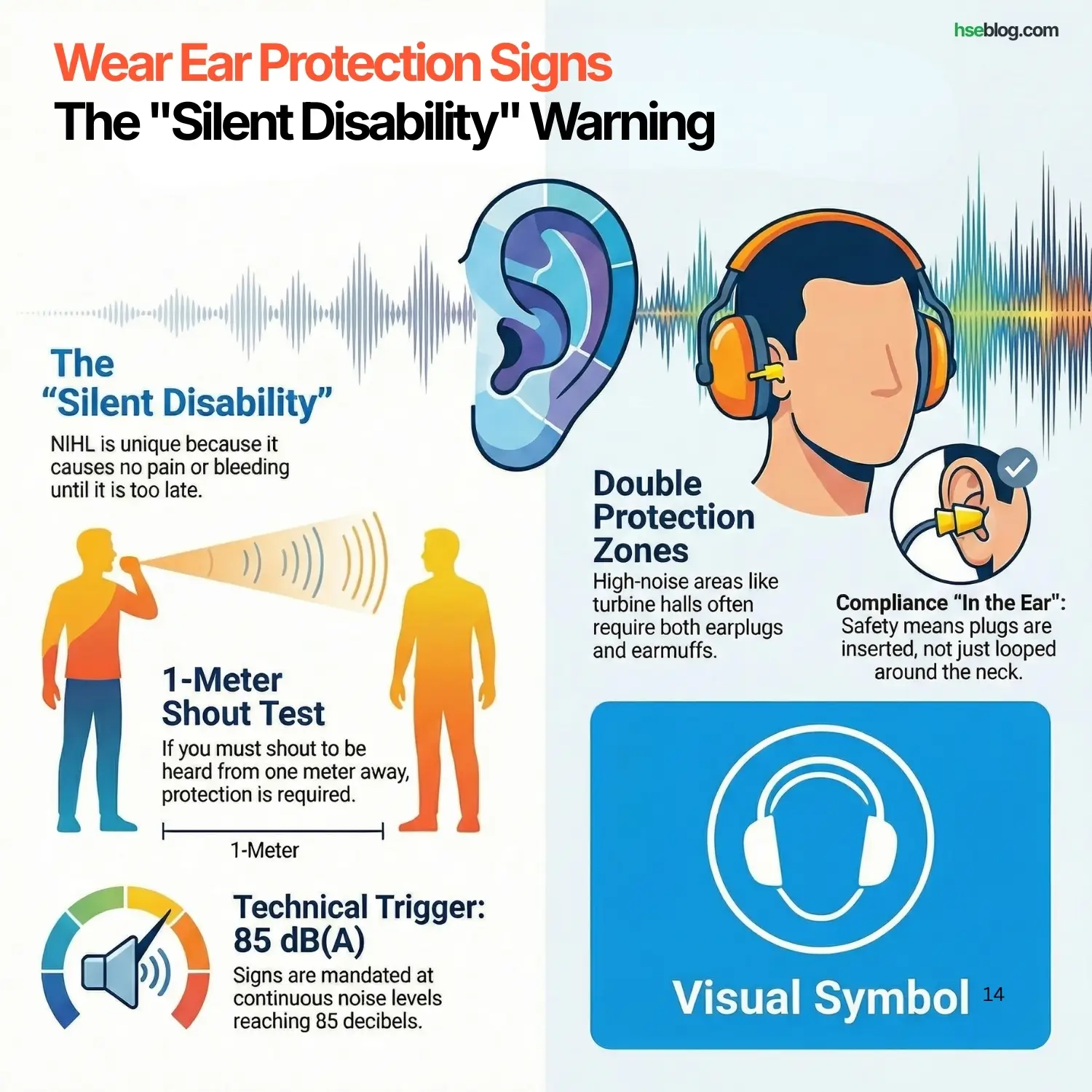
- The Technical Specs: A blue circle with a white symbol of ear muffs. Usually triggered at a continuous noise level of 85 dB(A).
- Field Reality: In turbine halls or compressor stations, “double protection” (plugs + muffs) might be required.
- Field Lesson: Workers often “loop” their earplugs around their necks but don’t put them in. When I see this sign, I check for “compliance in the ear,” not just “compliance on the person.”
15. Emergency Exit Signs: The “Only Way Out”
In a fire or a toxic gas release, “General Directional Awareness” disappears. People tend to exit the way they entered, even if that path is blocked by fire. These signs provide a standardized, illuminated escape route that must be visible through smoke.
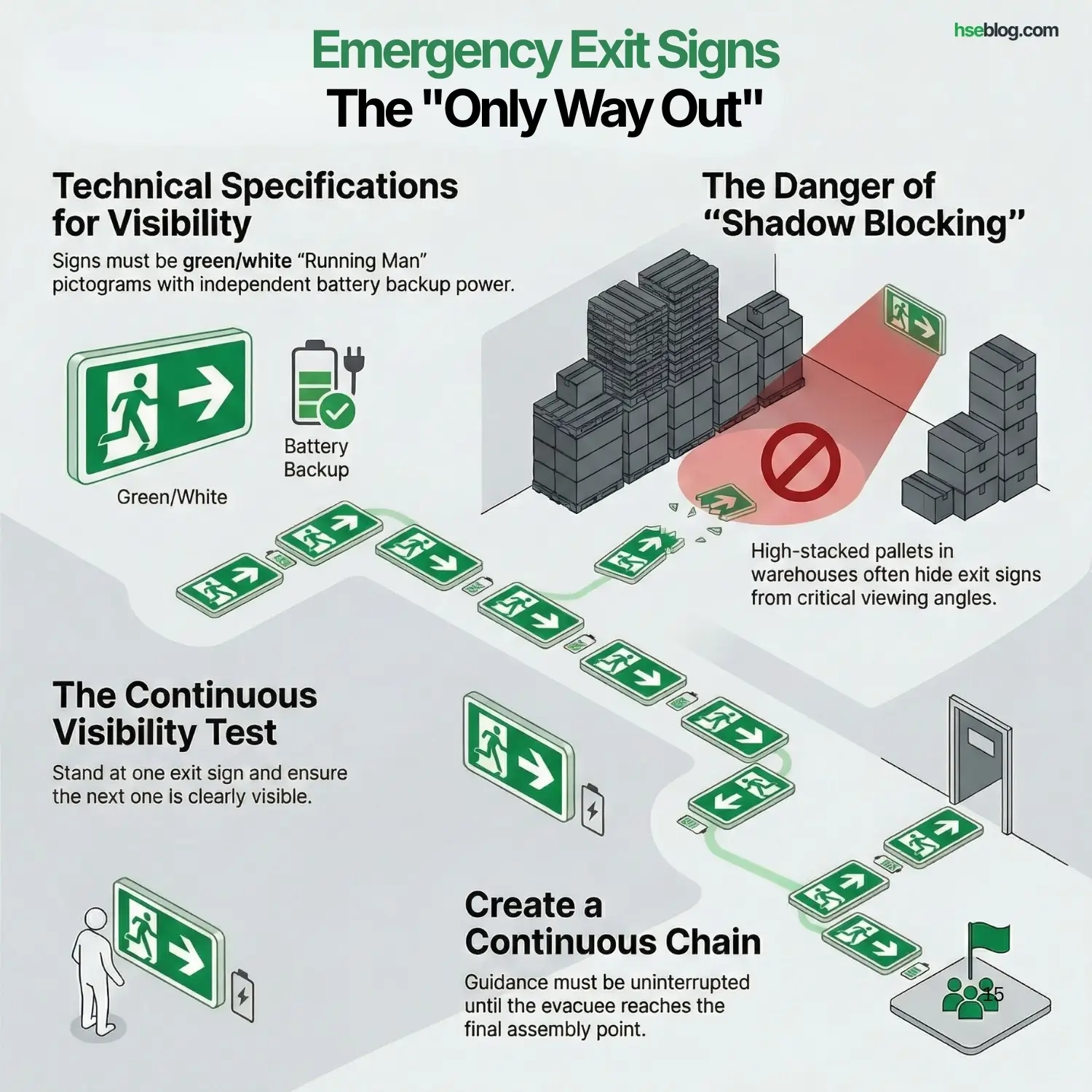
- The Technical Specs: A green rectangle with white text (EXIT) or a “Running Man” pictogram. They must have an independent battery backup (Emergency Power).
- Field Reality: The biggest failure I find in warehouses is “shadow blocking”—where high-stacked pallets hide the exit sign from certain angles.
- HSE Insight: During my “Walk-the-Path” audits, I ensure that if you stand at one exit sign, you can see the next one. It should be a continuous “chain” of guidance until you reach the final assembly point.
16. First Aid Signs: The “Golden Hour” Marker
In trauma management, the “Golden Hour” is the window where medical intervention is most successful. On a sprawling construction site or a remote oil rig, workers need to know exactly where the trauma kit, AED (Defibrillator), or stretcher is located without having to ask.
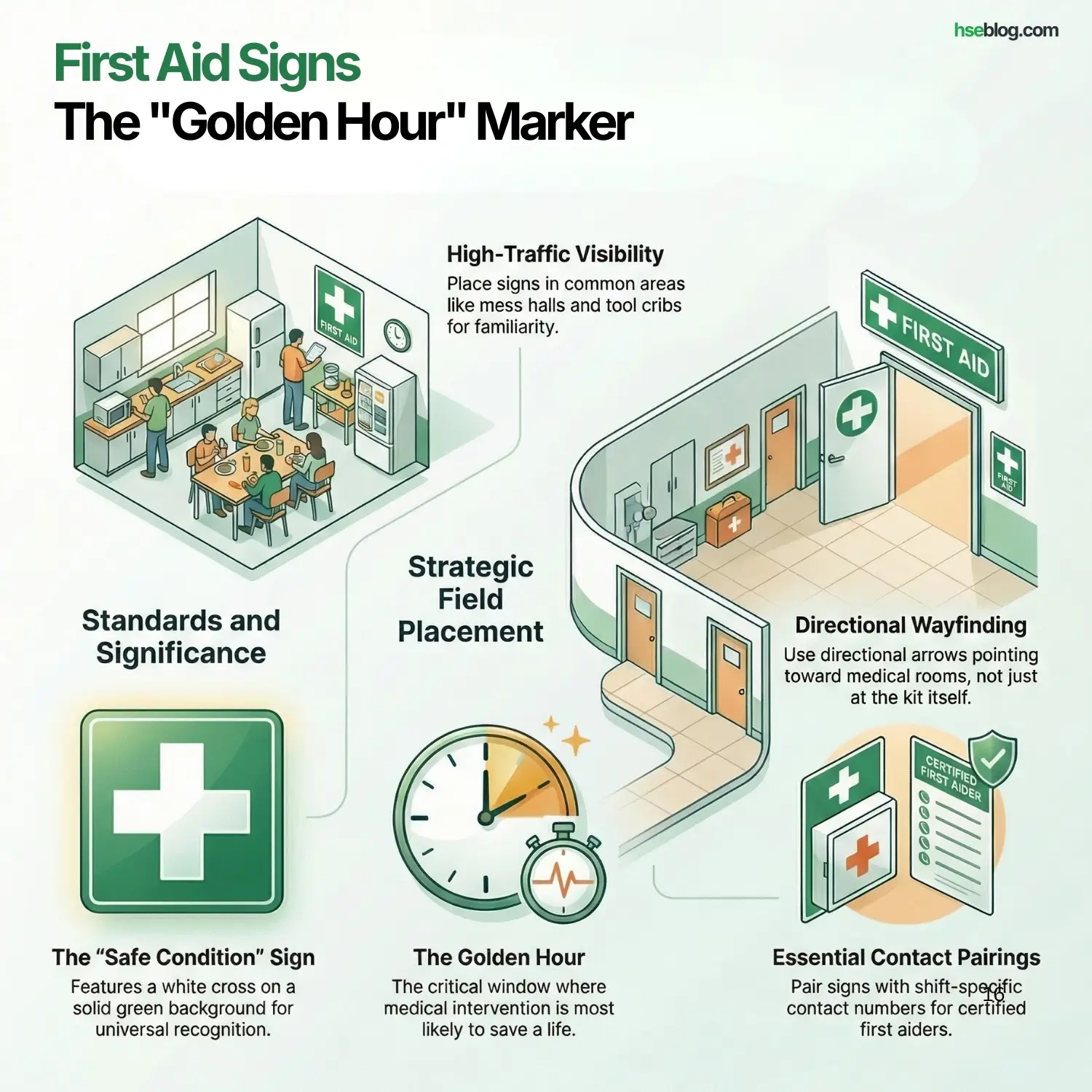
- The Technical Specs: A white cross (often the “Swiss Cross”) on a solid green background. This is a Safe Condition sign.
- Field Reality: I ensure these are placed in high-traffic areas like mess halls and tool cribs. More importantly, I pair them with a list of the names and contact numbers of the Certified First Aiders on that shift.
- Pro Tip: If you have a large site, these signs should have directional arrows pointing toward the medical room. A sign that is only at the kit is useless if you’re 50 meters away and bleeding out.
17. No Smoking Signs: The “Ignition Control” Rule
I don’t look at “No Smoking” as a health policy—I look at it as a fire prevention measure. In a hazardous waste facility or near a hydrogen storage tank, a single ember is an ignition source. In 2026, this also strictly includes E-cigarettes and Vaping, which can produce sparks or heat.
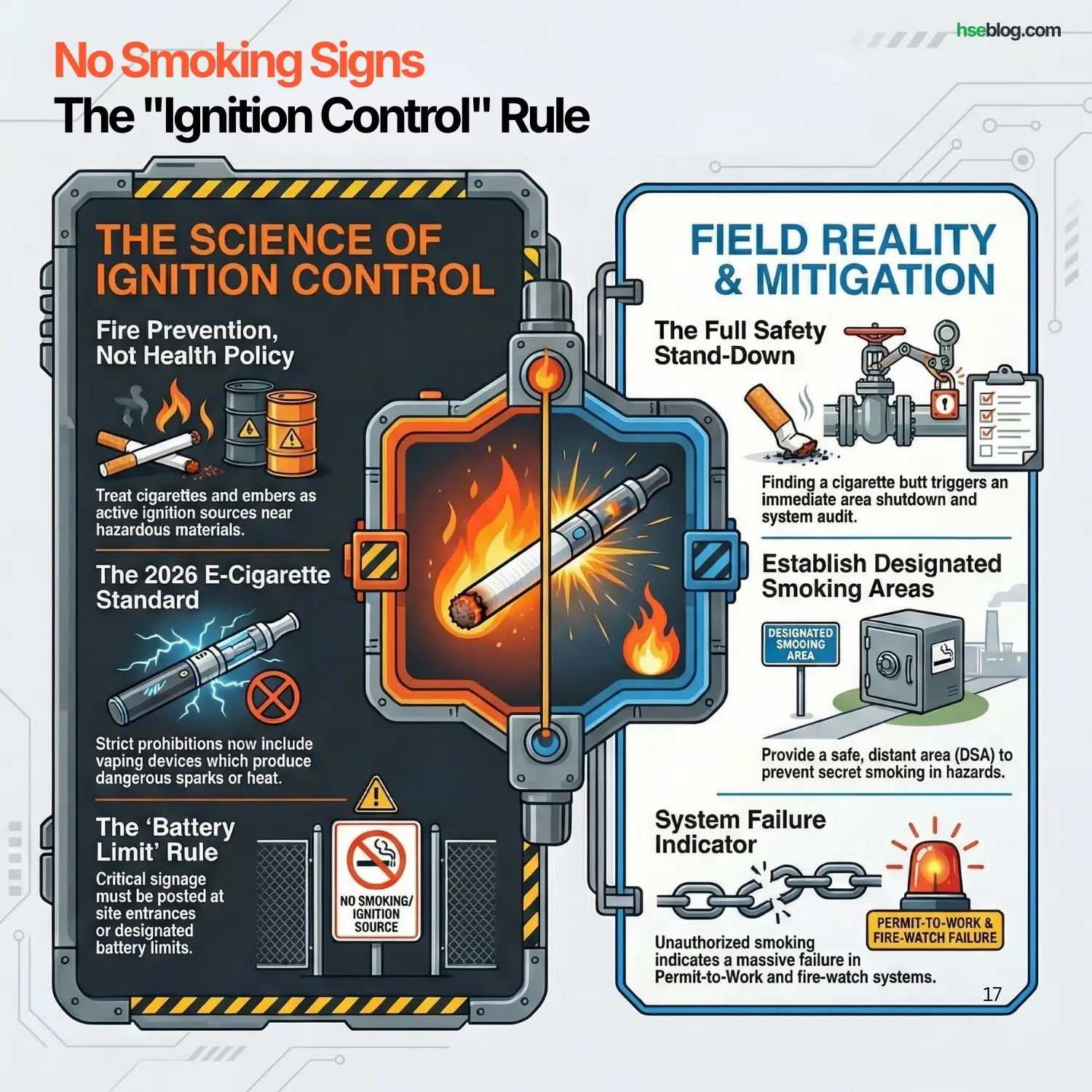
- The Technical Specs: A red circle with a diagonal bar over a burning cigarette.
- Field Reality: These must be posted at the “Battery Limit” or site entrance. If I find a cigarette butt in a “No Smoking” zone, I shut down the area and perform a full safety stand-down. It indicates a massive failure in the site’s “Permit-to-Work” and fire-watch system.
- HSE Insight: Always provide a “Designated Smoking Area” (DSA) far from the hazard. If you don’t give people a safe place to smoke, they will do it secretly in dangerous places.
18. Forklift Operating Area Signs: The “Line of Sight” Warning
In warehousing and logistics, forklifts are the #1 killer. They are heavy, they have blind spots, and they can’t stop on a dime. This sign is a reminder to pedestrians that they are entering a “shared-use” zone where the machine always wins in a collision.
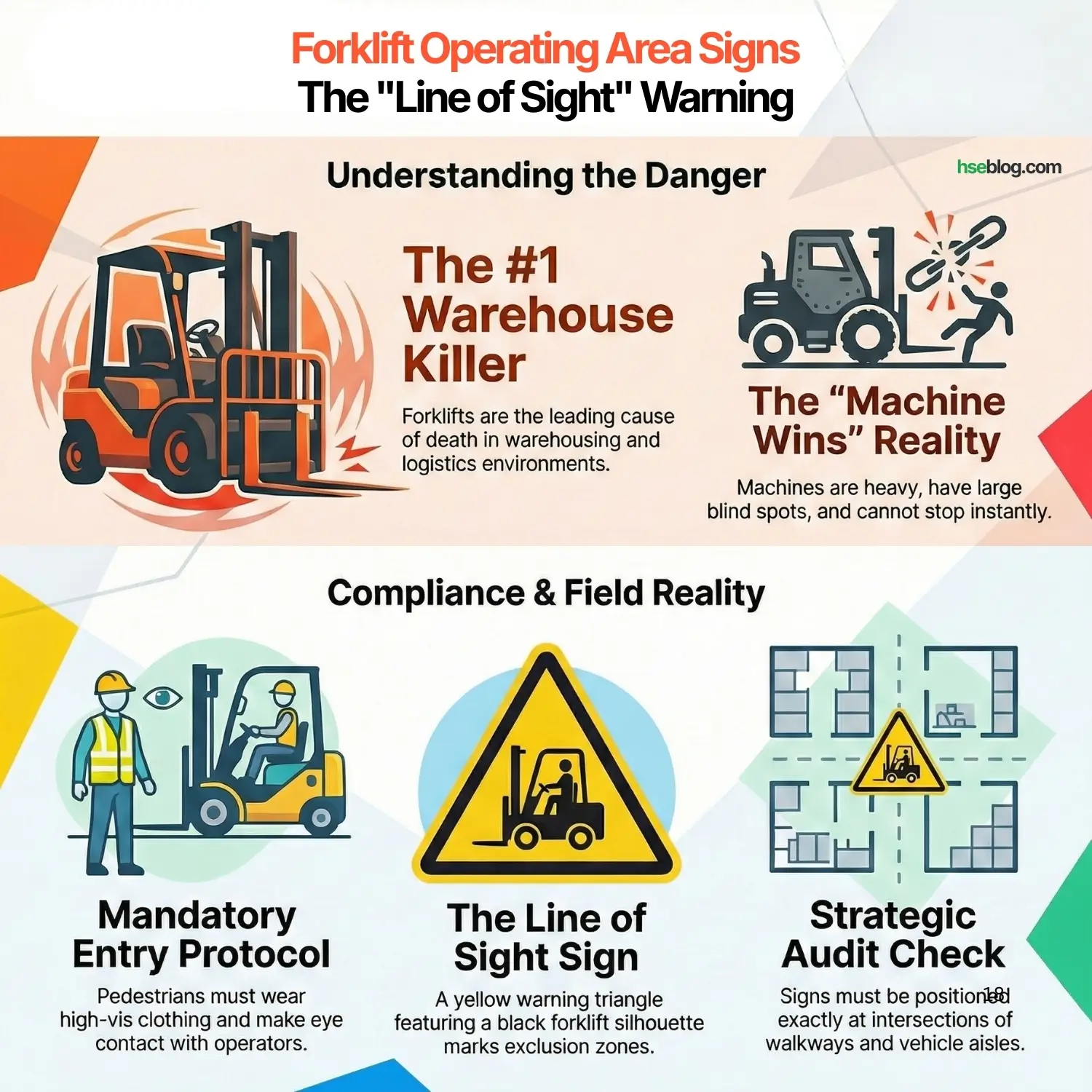
- The Technical Specs: A yellow warning triangle with a black forklift silhouette.
- Field Reality: I use these to mark “Pedestrian Exclusion Zones.” If a worker crosses this sign without making eye contact with the operator or wearing high-vis clothing, it’s a near-miss event that must be logged.
- Audit Check: Are these signs placed at the intersection of pedestrian walkways and vehicle aisles? If not, the warning is poorly timed.
19. Under Construction Signs: The “Evolving Hazard” Alert
This sign is unique because it marks an area where the hazards change every hour. One day it’s a trip hazard; the next day, it’s an open leading edge or a live electrical wire. It effectively tells the worker: “The standard site safety rules are active here, but the environment is unstable.”
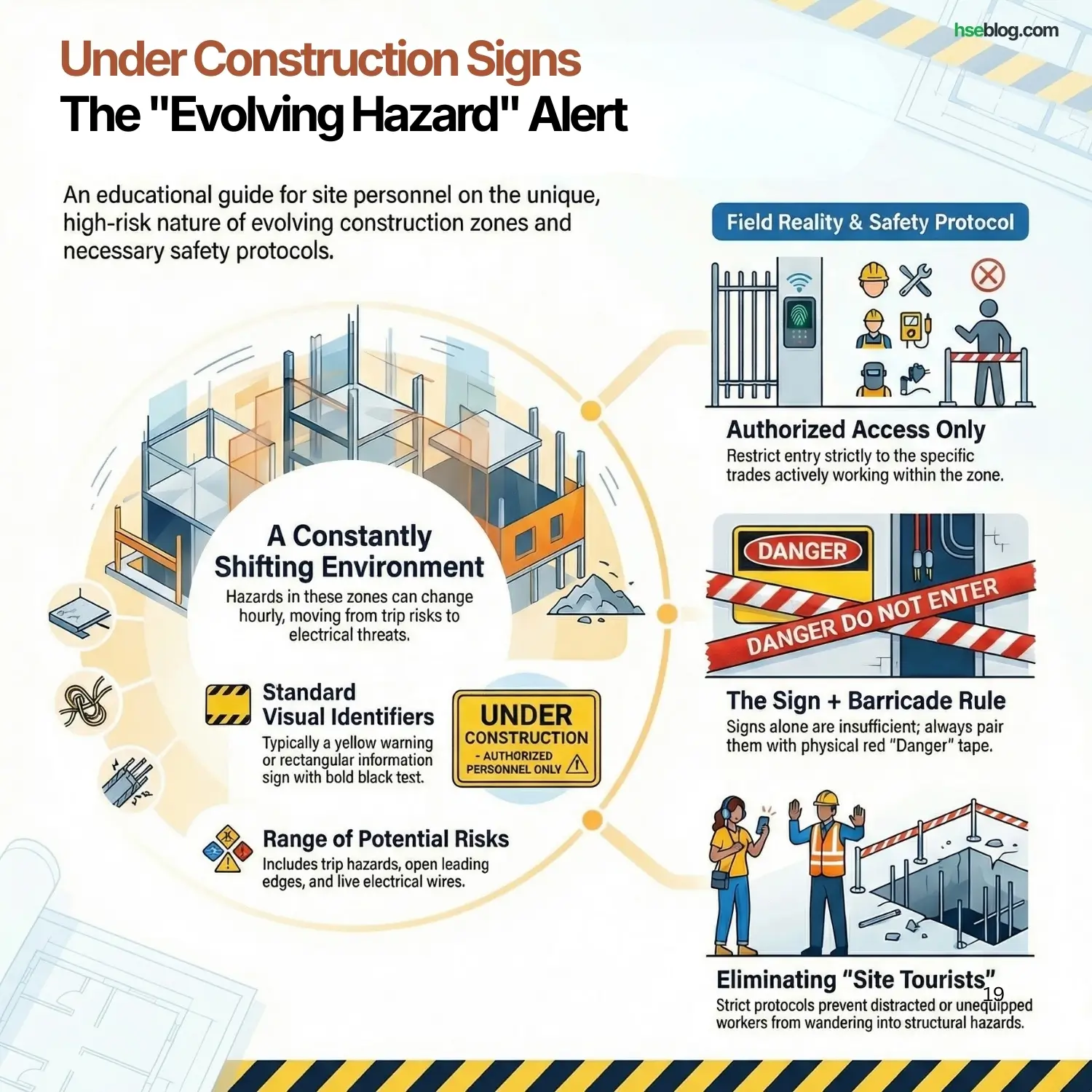
- The Technical Specs: Usually a yellow warning sign or a rectangular “Information” sign with bold black text.
- Field Reality: I use these to denote “Authorized Access Only.” If you aren’t part of the specific trade working in that zone, you stay out. It prevents “tourists” or unequipped workers from wandering into a structural hazard.
- HSE Insight: These should be paired with physical barriers (like red “Danger” tape). A sign alone won’t stop a distracted worker, but a sign plus a barricade will.
20. Emergency Assembly Point Signs: The “Accountability” Hub
An Emergency Assembly Point (EAP) sign marks the designated safe location where all personnel must gather after an evacuation due to fire, explosion, chemical release, or any major emergency. This is not just a meeting spot—it’s where headcount, accountability, and incident command begin.
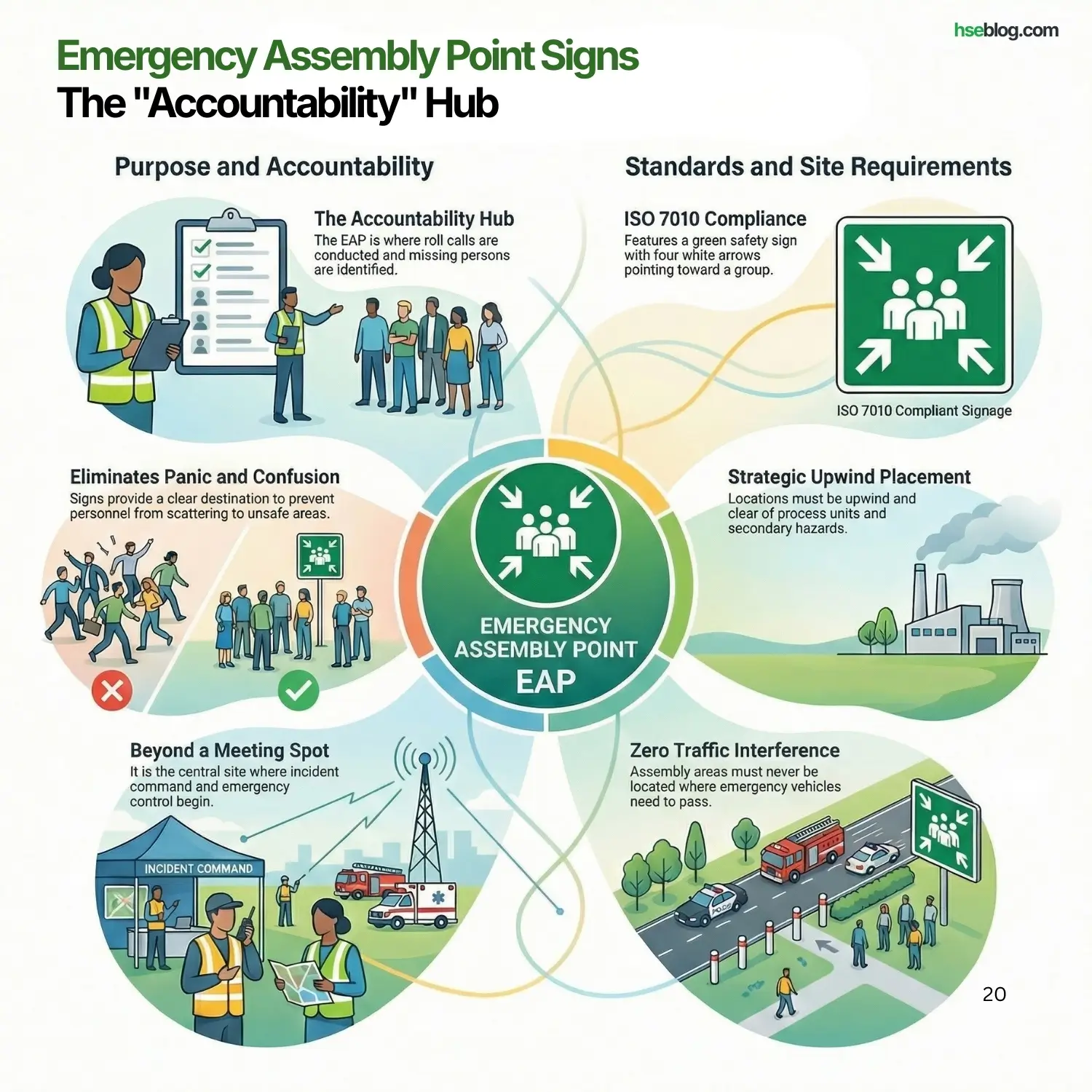
During a fire, explosion, or chemical release, people panic and scatter. The Emergency Assembly Point sign removes confusion by telling everyone exactly where to go once they evacuate. This is where accountability begins—if you can’t confirm who is safe, you don’t have control of the emergency.
- The Technical Specs: A green safety sign with four white arrows pointing inward toward a group of people, compliant with ISO 7010 (E007) or equivalent standards.
- Field Reality: This is where roll calls are conducted and missing persons are identified. If workers gather at gates, vehicles, or site offices instead of the marked assembly point, the emergency response is already failing.
- Audit Check: Are these signs visible along evacuation routes and at final exits? Is the assembly point located upwind, away from process units, traffic routes, and secondary hazards? If emergency vehicles pass through the assembly area, the location is wrong.
21. Oxidizer Signs: The “Fire Intensifier”
I’ve seen experienced workers mistake these for standard “Flammable” signs. That is a dangerous error. Flammables are the fuel; Oxidizers are the chemical oxygen source. If a fire starts near an oxidizer (like Hydrogen Peroxide or Nitric Acid), it will burn white-hot and cannot be smothered.
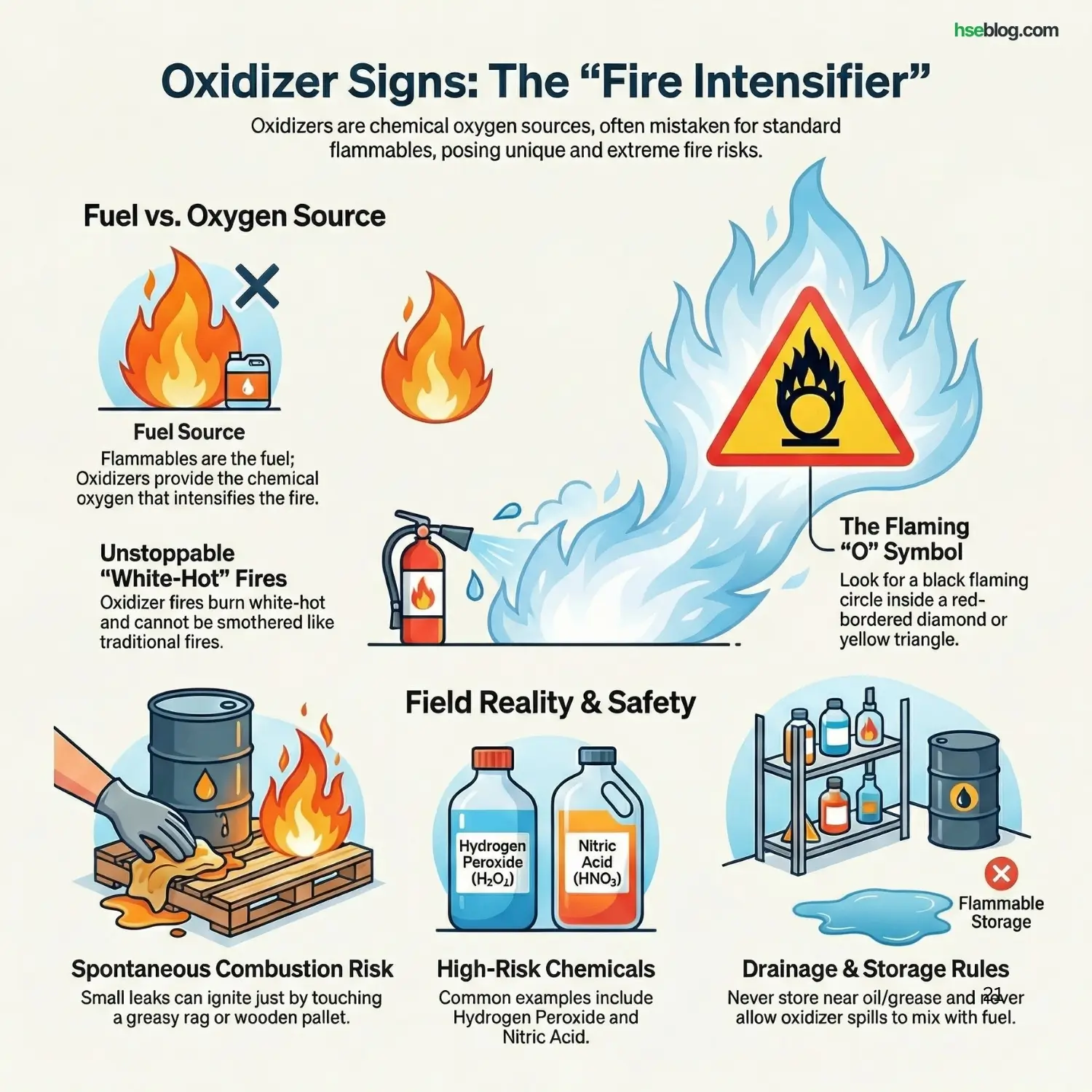
- The Technical Specs: A black flaming circle (the letter “O”) inside a red-bordered diamond (GHS) or a yellow triangle.
- Field Reality: You never store these near oil, grease, or wooden pallets. I’ve seen small leaks of an oxidizer cause “spontaneous combustion” just by touching a greasy rag.
- HSE Insight: When I see this sign, I check the drainage. You cannot allow oxidizer spills to mix with fuels in the same trench.
22. Restricted Area Signs: The “Gatekeeper”
These aren’t just about “privacy.” In the field, a Restricted Area sign usually means there is a hazard inside that requires specific life-saving training to survive—such as Confined Space Entry or H2S awareness.
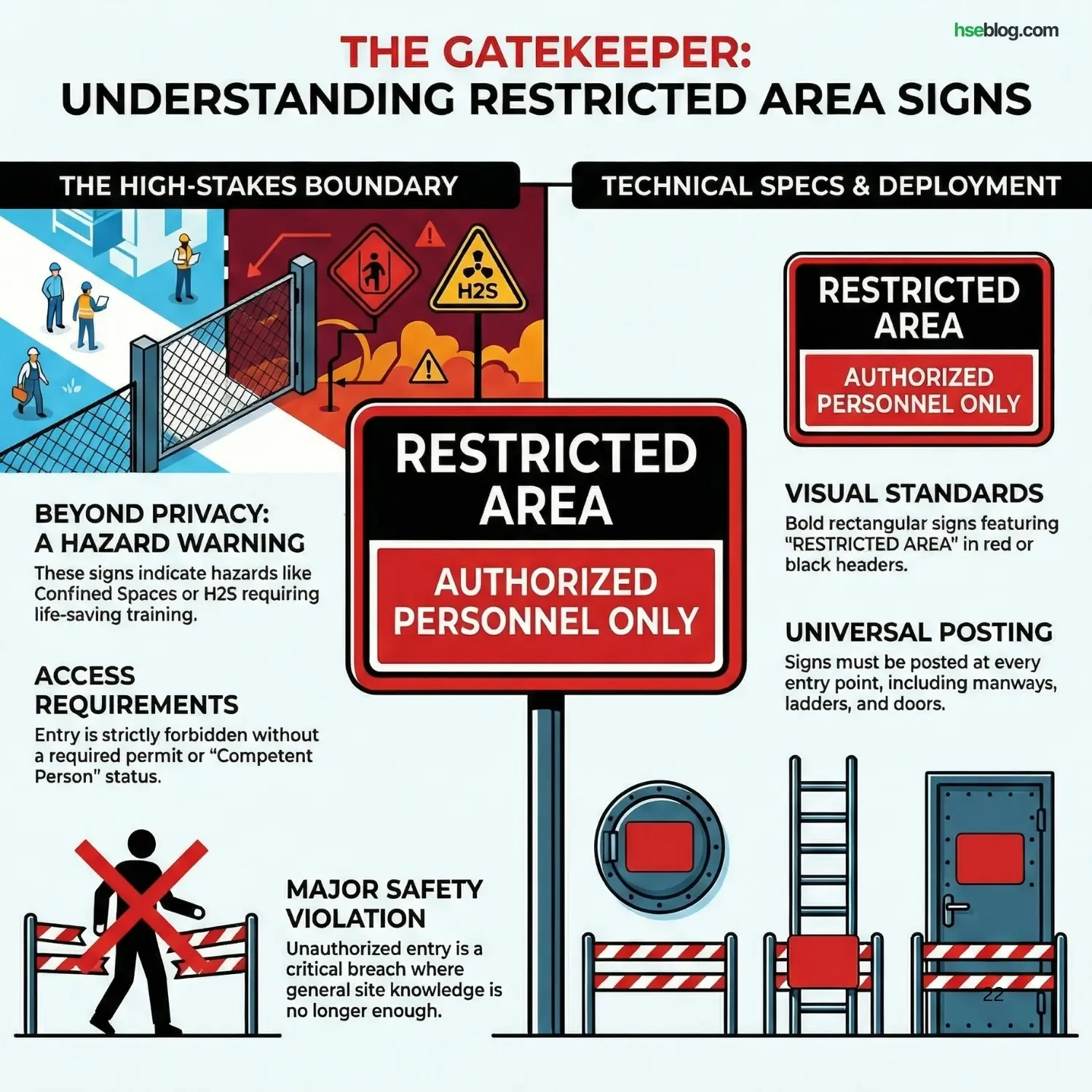
- The Technical Specs: Usually a bold rectangular sign with “RESTRICTED AREA” in a red or black header.
- Field Reality: If a worker enters this zone without the required permit or “Competent Person” status, I consider it a major safety violation. This is the boundary where “general site knowledge” is no longer enough to keep you safe.
- HSE Insight: These signs must be posted at every possible entry point (manways, ladders, doors), not just the main one.
23. Eye Wash Station Signs: The “Anti-Blindness” Guide
In a chemical splash event, the victim is often temporarily blinded and in extreme pain. They won’t be looking for a small label; they need a high-visibility green marker that points them to the water.
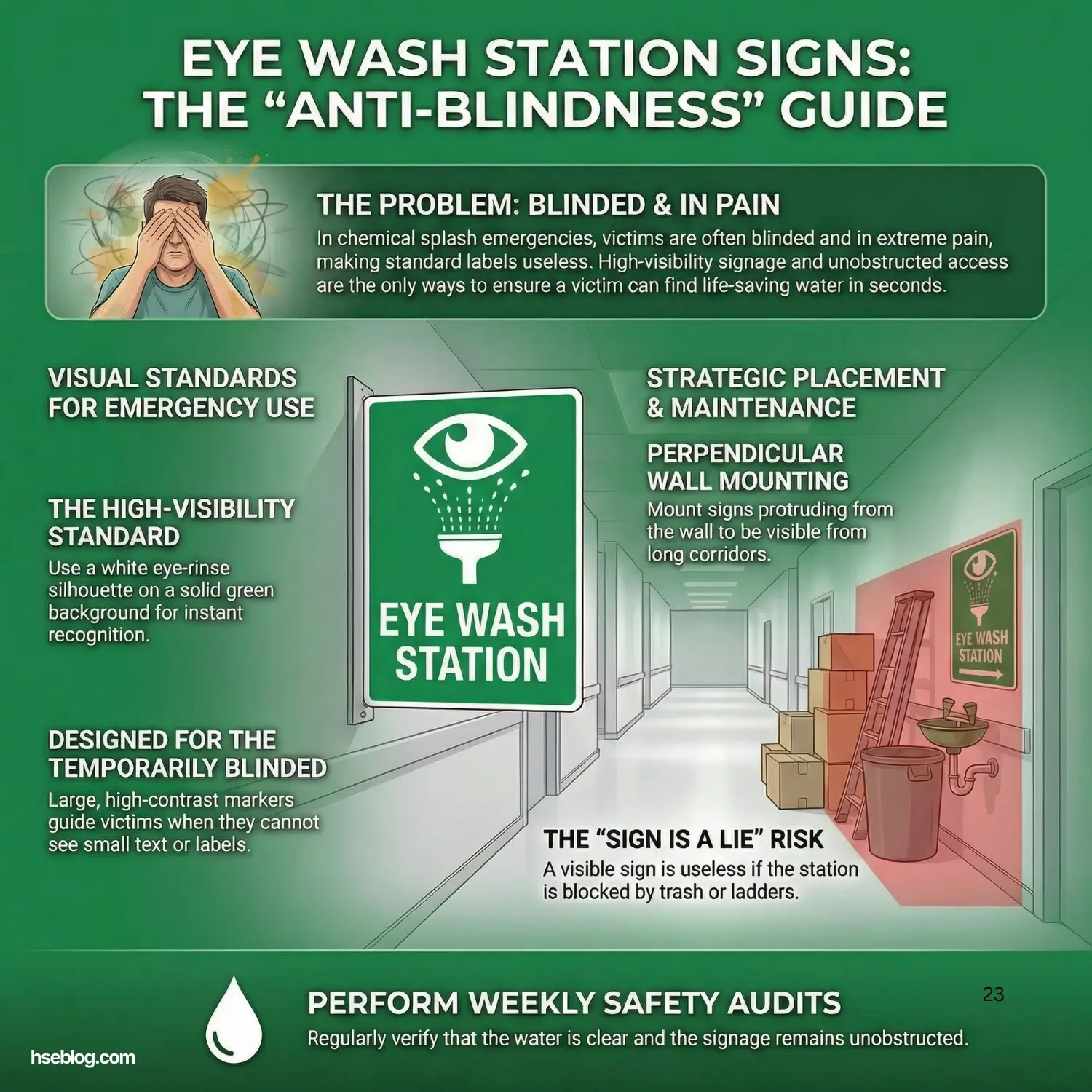
- The Technical Specs: A white silhouette of an eye being rinsed with water on a solid green background.
- Field Reality: I ensure these signs are mounted perpendicular to the wall so they can be seen from down a long corridor, not just when standing directly in front of the station.
- Pro Tip: If the sign is there, but the station is blocked by a trash can or a ladder, the sign is a lie. I test these stations weekly during my audits to ensure the water is clear and the sign is visible.
24. Wet Floor Signs: The “High-Frequency” Risk
Don’t let the “yellow plastic cone” fool you. Slips, trips, and falls (STFs) are the most frequent cause of lost-time injuries (LTIs) in almost every industry. A wet floor in a workshop is a massive hazard when workers are carrying heavy tools or chemicals.
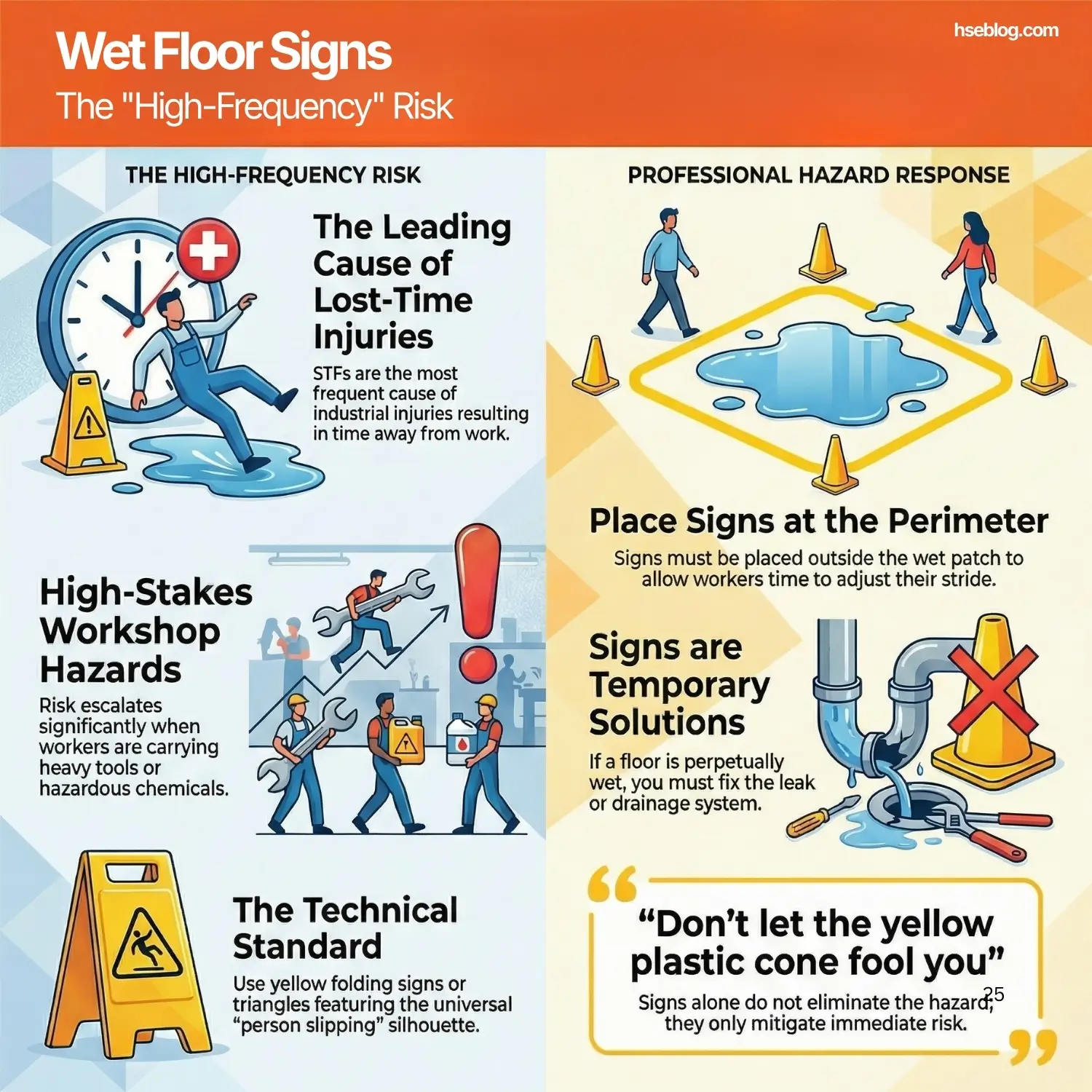
- The Technical Specs: A yellow folding floor sign or triangle with a silhouette of a person slipping.
- Field Reality: These are temporary signs. If a floor stays wet forever, the sign isn’t the solution—fixing the leak or the drainage is.
- HSE Insight: I’ve investigated broken hips from slips where the sign was placed after the wet patch. The sign must be placed at the perimeter of the hazard to give the worker time to change their stride.
25. Personal Protective Equipment (PPE) Signs: The “Site Law”
This is typically a “Composite Sign” found at the main entrance. It summarizes the minimum requirements for the entire site. It is the first thing I check when I arrive at a new project.
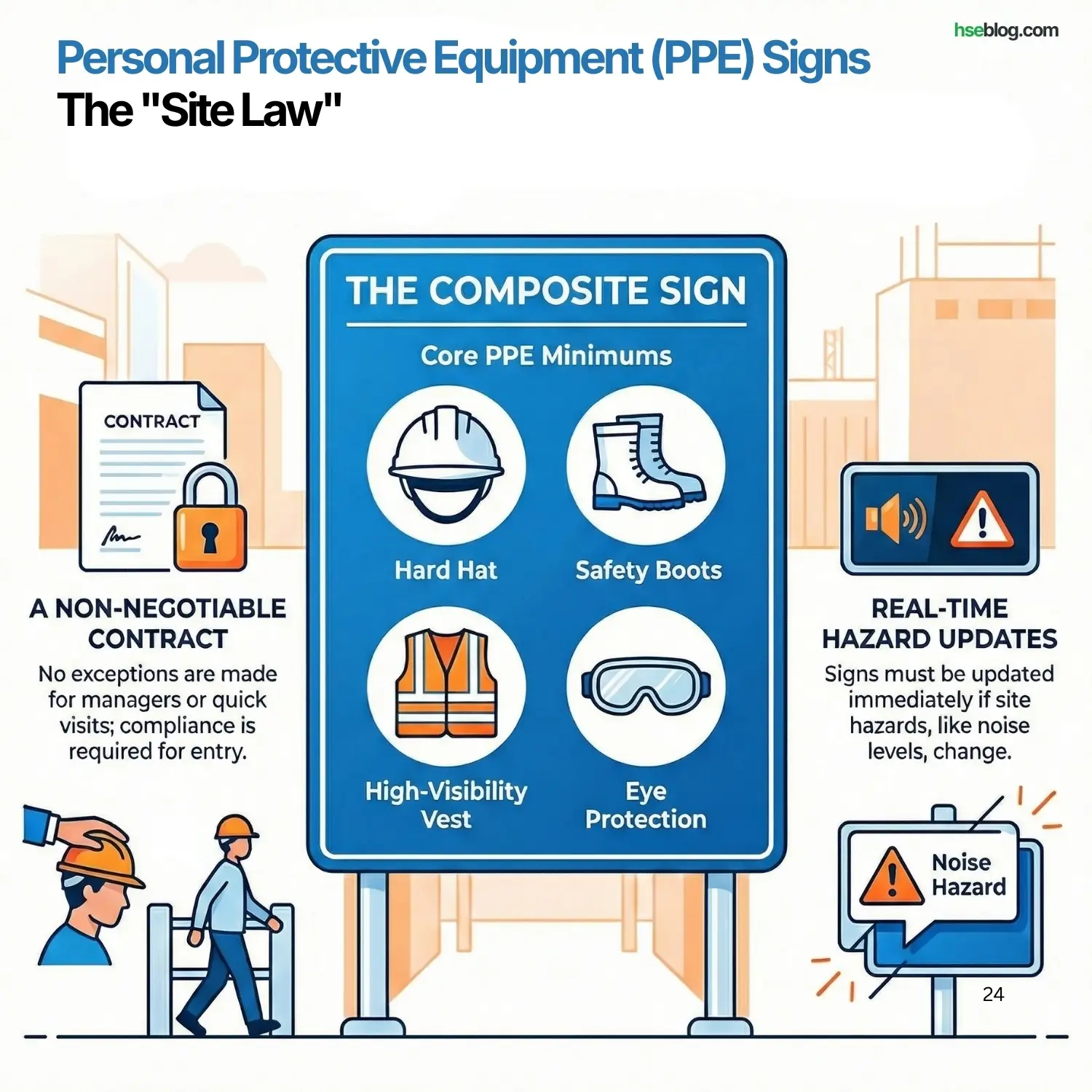
- The Technical Specs: A large blue rectangle containing multiple white circles (Hard hat, Safety boots, High-vis, Glasses).
- Field Reality: This sign is my “contract” with the workforce. If you aren’t wearing what the sign says, you don’t pass the gate. No exceptions for “quick visits” or “I’m just the manager.”
- Audit Note: If the site hazards have changed—for example, if ear protection is now required—this main gate sign must be updated immediately to reflect the current reality.
Conclusion
As an HSE professional, I look at signs as a contract between the employer and the worker. The employer provides the warning, and the worker provides the compliance. If either side breaks that contract, someone eventually gets hurt. Never walk past a sign and treat it as background noise. Those symbols were developed through decades of hard-learned lessons—many of them paid for in blood. Respect the sign, respect the hazard, and ensure you go home the same way you arrived.