
TL;DR
- Fall protection triggers at 15 feet under OSHA Subpart R (29 CFR 1926.760) — not the 6-foot threshold from Subpart M that governs general construction.
- Connectors and CDZ deckers operate under modified rules — protected at two stories or 30 feet, whichever is less, with specific equipment mandated between 15–30 feet.
- Decking kills more ironworkers than connecting — SENRAC data overturns the common assumption that connectors face the greatest fatality risk.
- Site-specific erection plans are mandatory when alternate means and methods are used, but pre-erection coordination between controlling contractor and steel erector is required on every project.
- Untrained workers assigned to steel erection remain a leading cause of serious incidents — OSHA’s eTool documents cases where carpenters and labourers attempted erection tasks without Subpart R training.
Under OSHA’s steel erection standard (29 CFR 1926.760), all employees engaged in steel erection must be protected from fall hazards when working more than 15 feet above a lower level. Connectors and controlled decking zone workers have modified thresholds — protection required above two stories or 30 feet, whichever is less. Acceptable methods include guardrail systems, safety net systems, personal fall arrest systems, positioning device systems, and fall restraint systems.
In 2024, 1,032 construction and extraction workers died on the job in the United States (US Bureau of Labor Statistics, 2026). Of those, 389 deaths — roughly 38% — resulted from falls, slips, and trips (US Bureau of Labor Statistics, 2026), making falls the single deadliest hazard category in the industry for yet another year.
Steel erection concentrates that risk into an unforgiving combination: narrow walking surfaces, heavy suspended loads, dynamic structural instability during assembly sequences, and workers moving between connection points dozens of feet above grade. When OSHA finalized the current Subpart R standard in 2001, the agency estimated that full compliance would prevent 30 fatalities and 1,142 injuries annually among approximately 56,840 exposed workers (OSHA, 2001). This article breaks down the specific hazards steel erectors face, the regulatory framework that governs their protection, and the best practices that separate competent operations from the ones that generate fatality reports.
What Is Steel Erection and Why Is It One of Construction’s Most Dangerous Activities?
Steel erection, as defined under OSHA’s scope at 29 CFR 1926.750, covers the construction, alteration, or repair of steel structures — including the assembly of beams, columns, metal decking, open web steel joists, and all associated rigging, hoisting, connecting, welding, bolting, and point-to-point movement during those activities.
The scope is broader than most site teams realize. Subpart R applies to ornamental iron, curtain walls, window walls, and siding systems — not just skeletal structural frames on high-rise projects.
A common compliance gap starts right here: assuming these standards only govern ironworkers assembling multi-story frames. Any worker performing activities within Subpart R’s scope is covered, regardless of their trade classification.
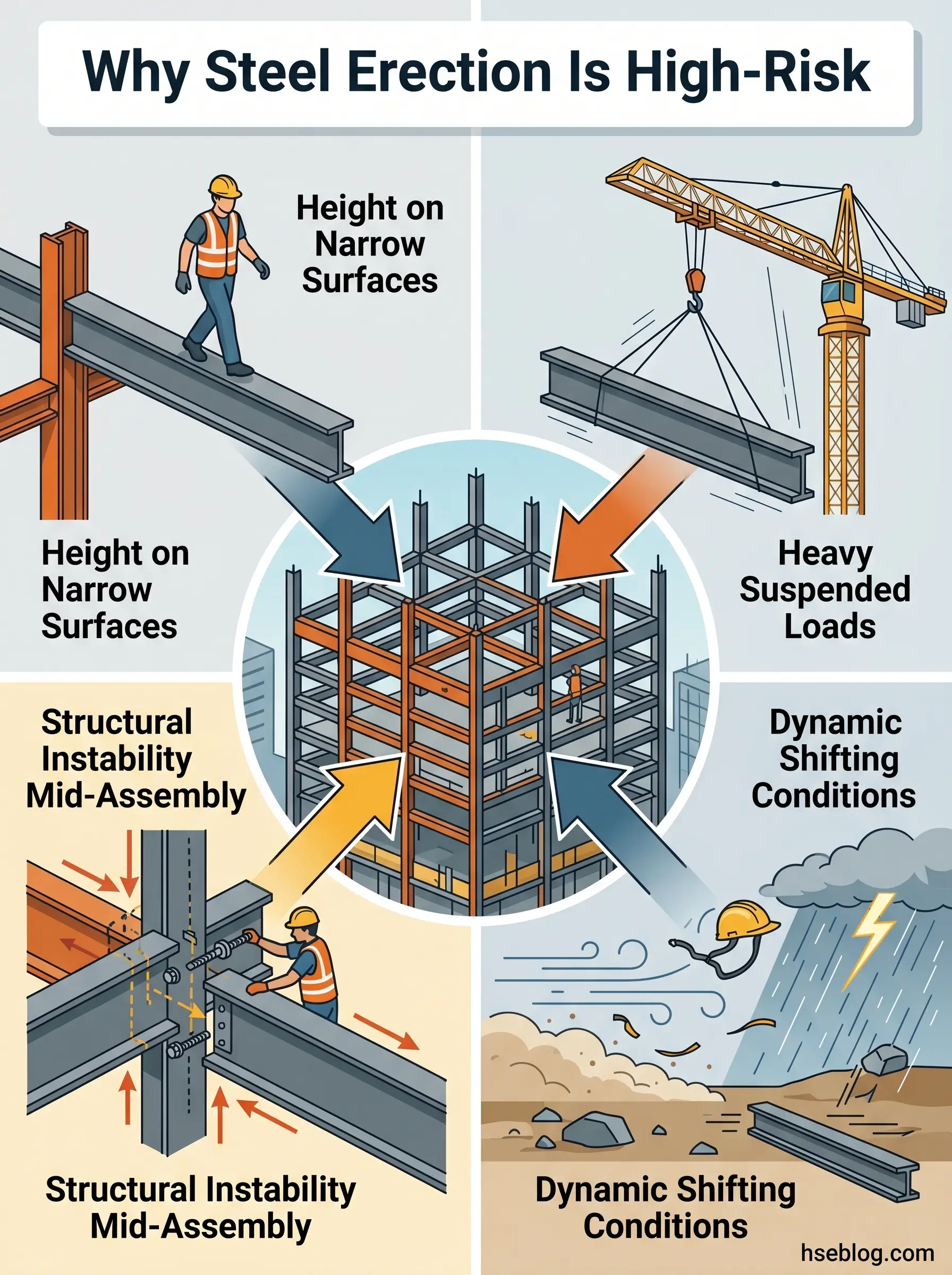
What makes steel erection distinct from general construction hazards is the convergence of multiple high-energy risk factors simultaneously:
- Height exposure on minimal surfaces — connectors and deckers work on beams as narrow as 4–6 inches, with no permanent flooring beneath them.
- Heavy suspended loads in motion — structural members weighing thousands of pounds swing through the work zone during every lift cycle.
- Structural instability during assembly — the steel frame is at its weakest during the intermediate erection stages, before bracing and permanent connections are completed.
- Dynamic conditions — wind, shifting loads, and the erection sequence itself change the hazard profile continuously throughout each shift.
The historical baseline reflects this severity: before the current standard, an average of 35 ironworkers died annually during steel erection activities, with approximately 2,300 lost-work-day injuries per year (OSHA/SENRAC, 2001–2002).
Key Hazards in Steel Erection
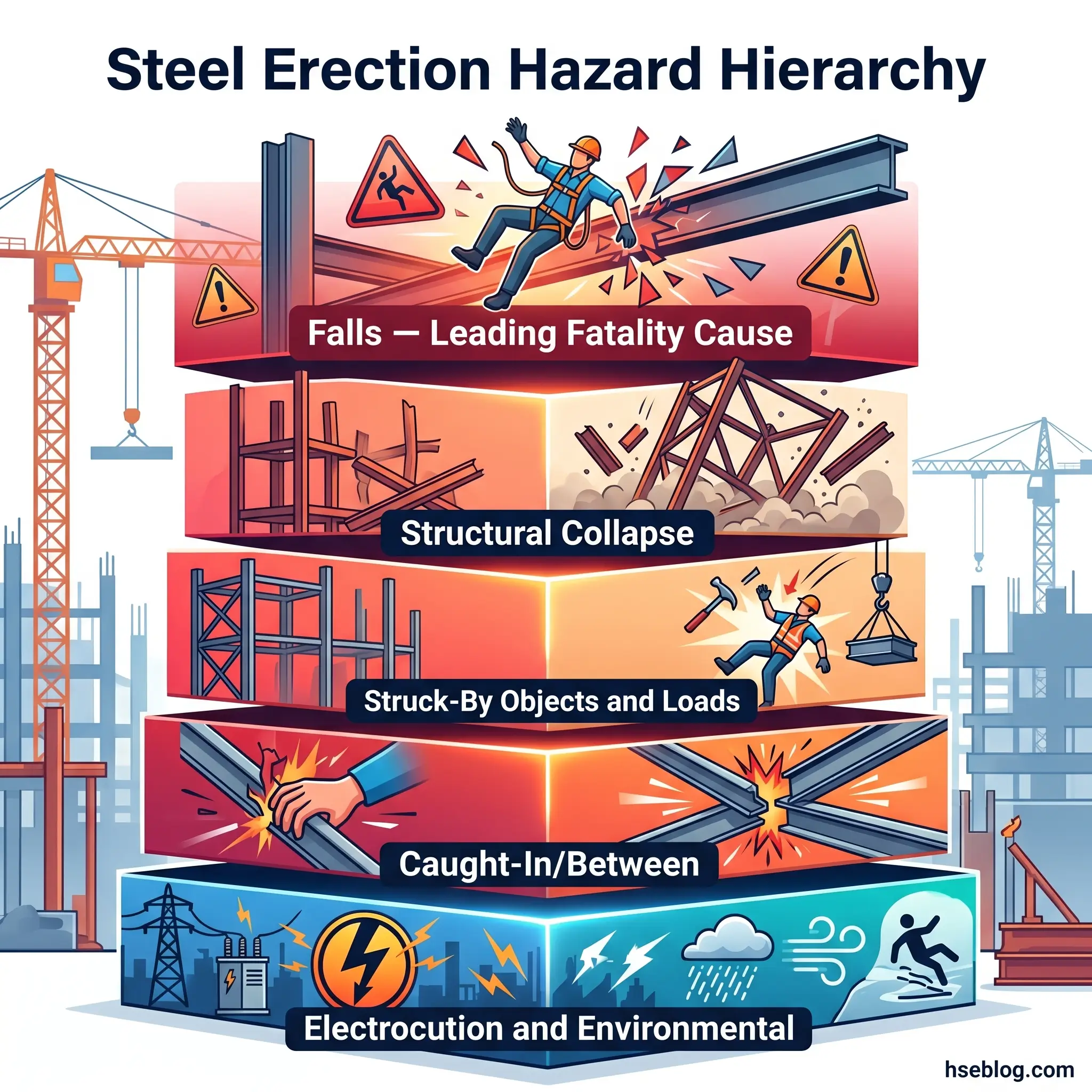
Every steel erection fatality traces back to a finite set of hazard mechanisms — and the published incident record shows that risk is not distributed the way most people assume. SENRAC’s analysis of ironworker fatalities over an eleven-year period revealed that decking activities caused more deaths than connecting — a counter-intuitive finding, since most observers assume connectors face the greatest exposure.
Understanding where the risk actually concentrates changes how competent teams prioritize their controls.
Falls: The Leading Cause of Steel Erection Fatalities
Falls dominate the steel erection fatality record across every reporting period. The mechanisms break down into distinct exposure types:
- Leading-edge falls during decking — workers placing initial metal decking sheets advance toward an unprotected edge with each sheet laid, often without guardrails or personal fall arrest systems.
- Falls during connecting — connectors working at column-beam intersections reach, lean, and reposition on narrow surfaces while guiding structural members into place.
- Falls from open web steel joists — joists are inherently unstable until bridging is installed; workers traversing unbridged joists face both fall and collapse risk simultaneously.
- Falls through openings — gaps in partially completed decking or around stairwell and elevator shaft openings.
A recurring pattern in OSHA fatality investigations: the worker was wearing a harness but was not tied off. The equipment was present; the connection to an anchorage point was not. This distinction — between having fall protection and using fall protection — appears in case after case.
Fall protection remained the most-cited OSHA violation for the 15th consecutive year in FY 2025, with 5,914 violations under 1926.501 (OSHA, 2025). That citation volume reflects the gap between what the standard requires and what actually happens at the working level.
Structural Collapse and Load Instability
Steel structures are often at their most vulnerable during the intermediate stages of erection — after initial members are placed but before bracing, bolting, and permanent connections stabilize the frame. Three failure modes dominate the published record:
- Premature crane release — disconnecting the crane from a structural member before it is adequately secured with the minimum required bolts. The member becomes a free-standing element vulnerable to wind, vibration, or the impact of the next lift.
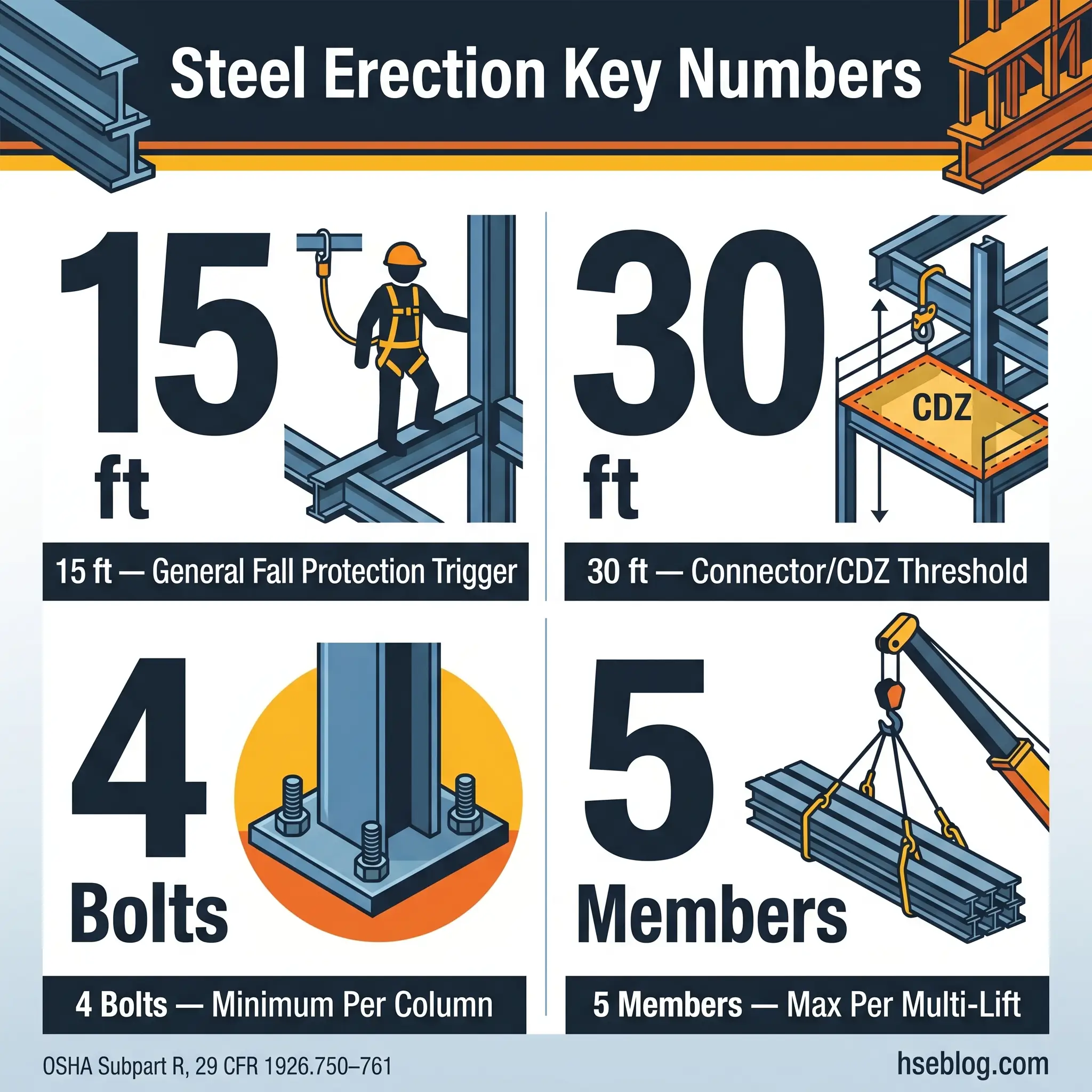
- Inadequate column anchorage — the 2001 Subpart R revision increased the minimum from two to four anchor bolts per column (29 CFR 1926.755(a)(1), US) precisely because two-bolt configurations had contributed to column failures during erection.
- Open web steel joist instability — joists are laterally unstable until bridging is installed. Workers who walk joists before bridging completion face both a fall hazard and a collapse hazard — the joist can roll under their weight.
The judgment call for site supervisors is knowing when a member is “adequately secured” before releasing the crane. The regulatory minimum — typically two bolts drawn up wrench-tight at each connection — is a floor, not a guarantee of stability. Wind loading, member weight, and the erection sequence all factor into whether that minimum is sufficient for the actual conditions.
Struck-By, Caught-In/Between, and Environmental Hazards
The remaining hazard categories complete the risk profile:
- Struck-by — falling tools, detached loads, crane-swing impacts, and decking sheets blown from unsecured bundles by wind. Tool lanyards and secured bundling are simple controls that prevent a disproportionate share of struck-by incidents.
- Caught-in/between — swinging loads during hoisting and placement create pinch points, particularly during connecting operations where the worker guides the member into position.
- Electrocution — crane booms and aerial lifts contacting overhead power lines. Minimum approach distances are well-established, but the hazard persists because boom operators lose spatial awareness of power line proximity during complex lifts.
- Environmental exposure — wind affects load stability and worker balance simultaneously; cold reduces grip strength and dexterity; heat stress compounds cognitive load at height. OSHA’s 2025 PPE standard revision (29 CFR 1926.95(c), effective January 13, 2025) now explicitly mandates that PPE must properly fit each worker — the construction industry was the last major sector without this requirement (OSHA, 2025).
OSHA Subpart R: Regulatory Requirements for Steel Erection Safety
The governing standard for steel erection safety in the United States is 29 CFR 1926 Subpart R (sections 1926.750–761), which replaced the outdated original standard in 2001 after a decade-long rulemaking process involving SENRAC — the Steel Erection Negotiated Rulemaking Advisory Committee.
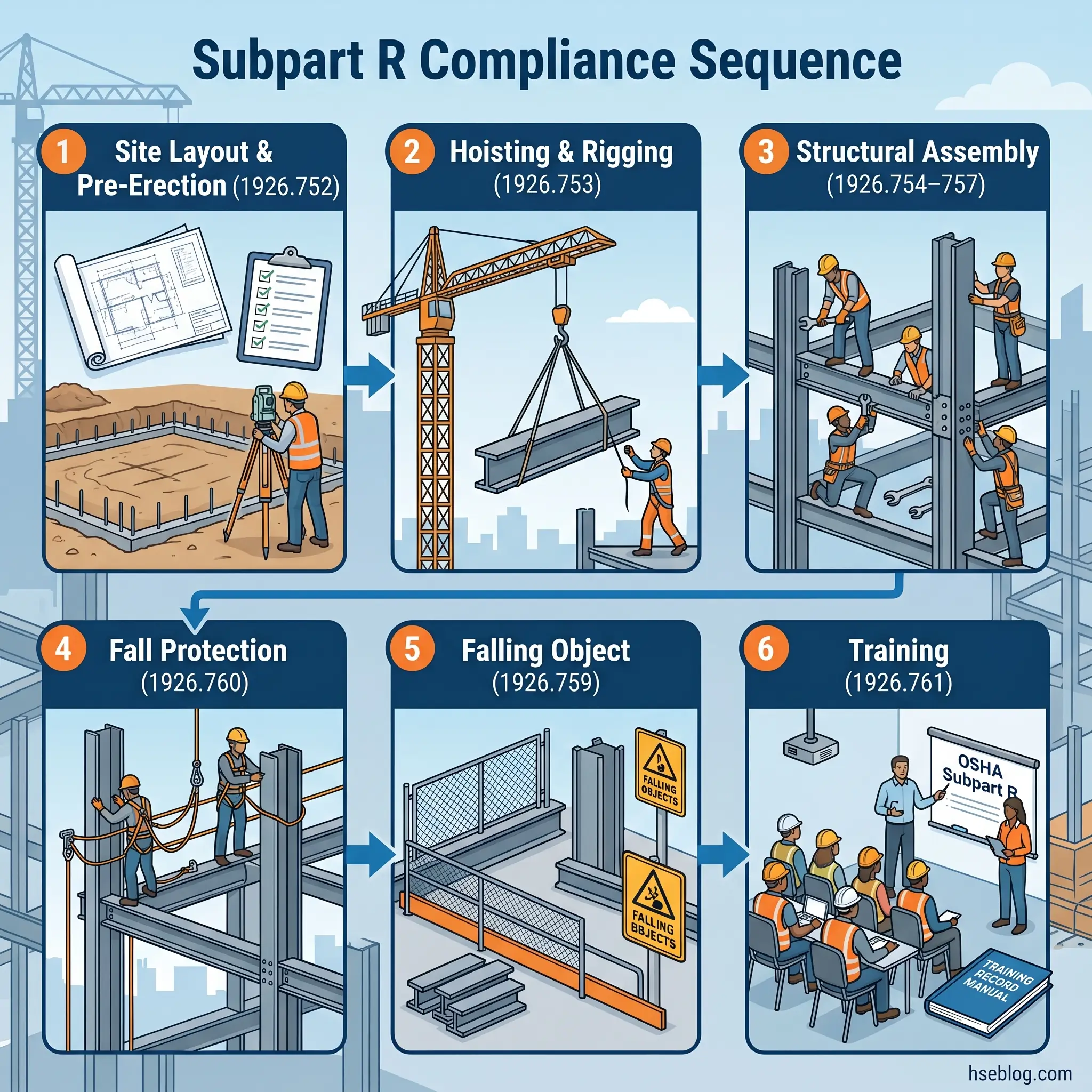
Rather than walking through each section sequentially, the practical requirements group into six functional areas that mirror how erection projects actually operate.
Site Layout and Pre-Erection Requirements (1926.752)
Before any steel goes up, the controlling contractor carries specific obligations under Subpart R:
- Written notification that concrete in footings, piers, and walls has reached 75% of its intended compressive strength — steel erection cannot begin without this documentation.
- Safe site conditions — adequate access roads, firm and graded ground for crane operations, and drainage that prevents undermining of crane support.
- Pre-planning of overhead hoisting operations — the controlling contractor and steel erector must coordinate routes, timing, and exclusion zones.
The most consequential planning failure is not the erection plan document itself. It is the absence of genuine coordination between the controlling contractor and the steel erector. Subpart R places upstream obligations on the controlling contractor that often get overlooked when focus falls entirely on the erector’s scope.
Hoisting, Rigging, and Structural Assembly (1926.753–757)
These provisions govern the physical act of getting steel from the ground to its final position:
- Daily crane inspections before each shift, conducted by a competent person.
- Qualified rigger requirement — rigging must be performed or supervised by a qualified rigger, not delegated to general labourers.
- Multiple-lift rigging — limited to a maximum of five members per lift, performed only by trained employees, with crane manufacturer approval of the rigging procedure.
- Column anchorage — minimum four anchor bolts per column (1926.755(a)(1)), with field modifications to anchor bolts following specific documented procedures.
- Open web steel joist erection — bolted diagonal erection bridging required for spans of 40 feet or more; joists must not be released from the crane until the required bridging is installed (1926.757).
Falling Object Protection and Training (1926.759, 1926.761)
Falling object protection under Subpart R is performance-based — the standard requires protection but does not prescribe a single method. Securing tools with lanyards, toe boards on working platforms, and controlled access zones below active erection areas all satisfy the requirement depending on site conditions.
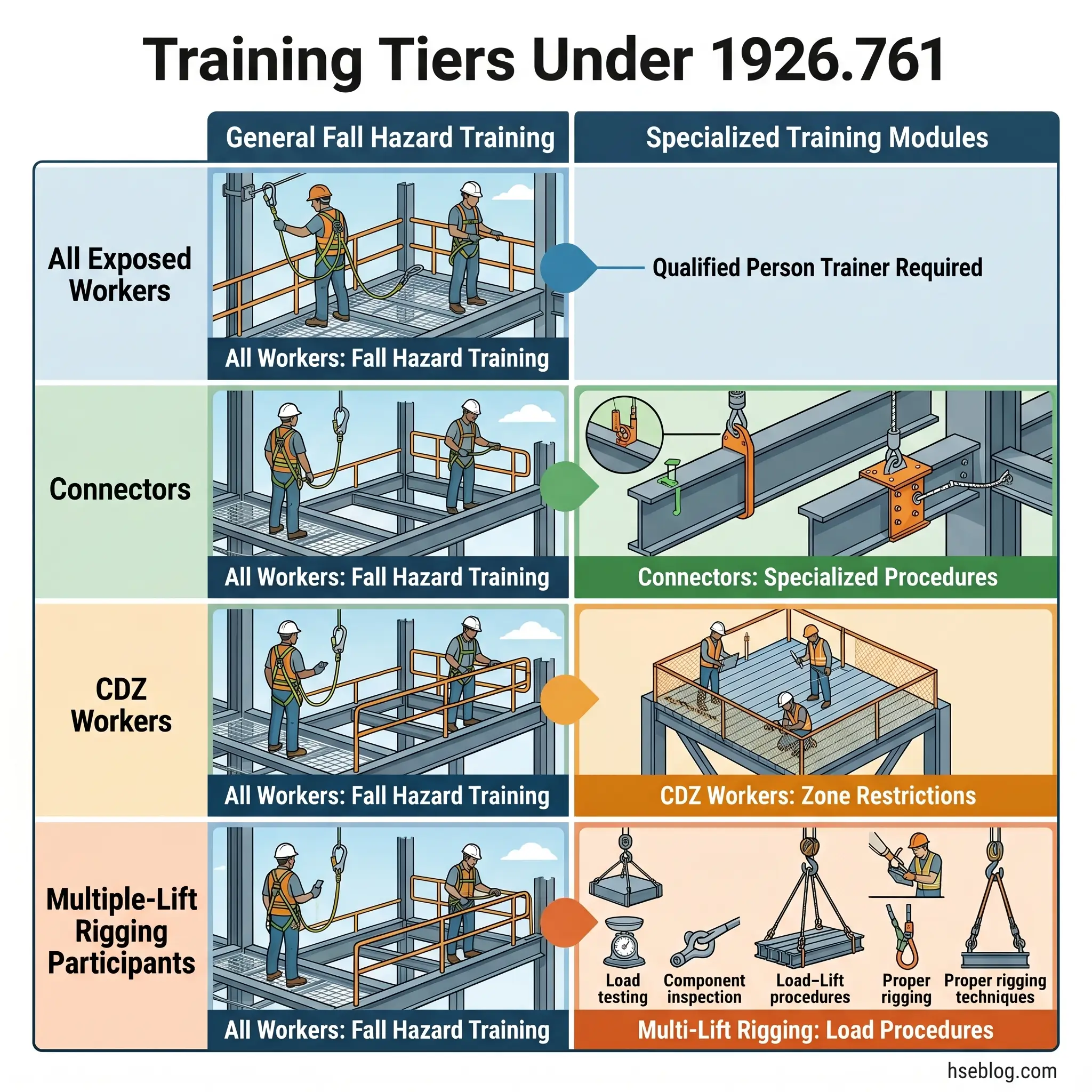
Training requirements under 1926.761 demand that all exposed workers receive fall hazard training from a qualified person — not simply any supervisor. The training must cover five areas: hazard recognition, hazard-related procedures, equipment use and handling, equipment inspection, and fall prevention/protection procedures.
Special training is separately required for three worker categories: connectors, CDZ workers, and multiple-lift rigging participants. The OSHA steel erection training eTool documents cases where untrained carpenters attempted to set a 30-foot I-beam and released the crane connection before securing the member, resulting in the beam falling and injuring both workers. The critical scenario is not an experienced ironworker making a mistake — it is an untrained worker from another trade being assigned to steel erection without the specialized training Subpart R requires.
What Is the Fall Protection Action Level for Steel Erection?
The general fall protection action level under Subpart R is 15 feet — not the 6-foot trigger from Subpart M (29 CFR 1926.502) that governs general construction. This distinction is the single most misapplied provision on multi-trade construction sites.
At 15 feet above a lower level, all steel erection workers must be protected by one of five acceptable systems: guardrail systems, safety net systems, personal fall arrest systems (PFAS), positioning device systems, or fall restraint systems. But two worker categories operate under modified thresholds.
The following table clarifies which rules apply to which workers:
| Worker Category | Action Level | Equipment Required (15–30 ft) | Governing Clause |
|---|---|---|---|
| General steel erection worker | 15 feet | PFAS, guardrails, nets, positioning, or restraint | 1926.760(a)(1) |
| Connector | 2 stories or 30 ft (whichever is less) | Must complete connector training; must wear PFAS with adequate anchorage or be able to be tied off; one-on-one restraint not required between 15–30 ft | 1926.760(b) |
| CDZ decker (leading edge) | 2 stories or 30 ft (whichever is less) | CDZ must meet all conditions of 1926.760(c); max 90 ft width/length; controlled access; worker training | 1926.760(c) |
A persistent misconception: site supervisors expand the “connector” classification to workers who are not actually performing connecting activities. Under Subpart R, a connector is narrowly defined as an employee who, working with hoisting equipment, places and connects structural members. Workers using come-alongs or chain-falls to move steel into position are not connectors. The distinction matters because it determines whether the relaxed 30-foot threshold applies.
Per OSHA’s 2011 interpretation, there is no “safe distance” from an unprotected edge that eliminates the fall protection requirement. If a worker is on a surface with an unprotected side or edge above the action level, protection is required — regardless of how far from the edge the worker believes they are.
When Subpart R Ends and Subpart M Begins
The jurisdiction shift between Subpart R (15-foot trigger) and Subpart M (6-foot trigger) creates confusion on active construction sites. The practical rule: Subpart R governs while steel erection activities are underway. Once the steel erector completes their scope and other trades begin work on the same structure — installing MEP systems, cladding, or interior framing — Subpart M’s 6-foot action level governs those workers.
Perimeter safety cables must be installed around the structure’s perimeter as soon as metal decking is complete, at the top of the final column splice, on multi-story structures (1926.760(a)(2)). The custody-of-fall-protection provisions address what happens when the steel erector leaves fall protection in place for subsequent trades — a practical coordination issue that requires pre-planning between the controlling contractor and the erector.
Site-Specific Erection Plans: Planning for Safety Before Steel Goes Up
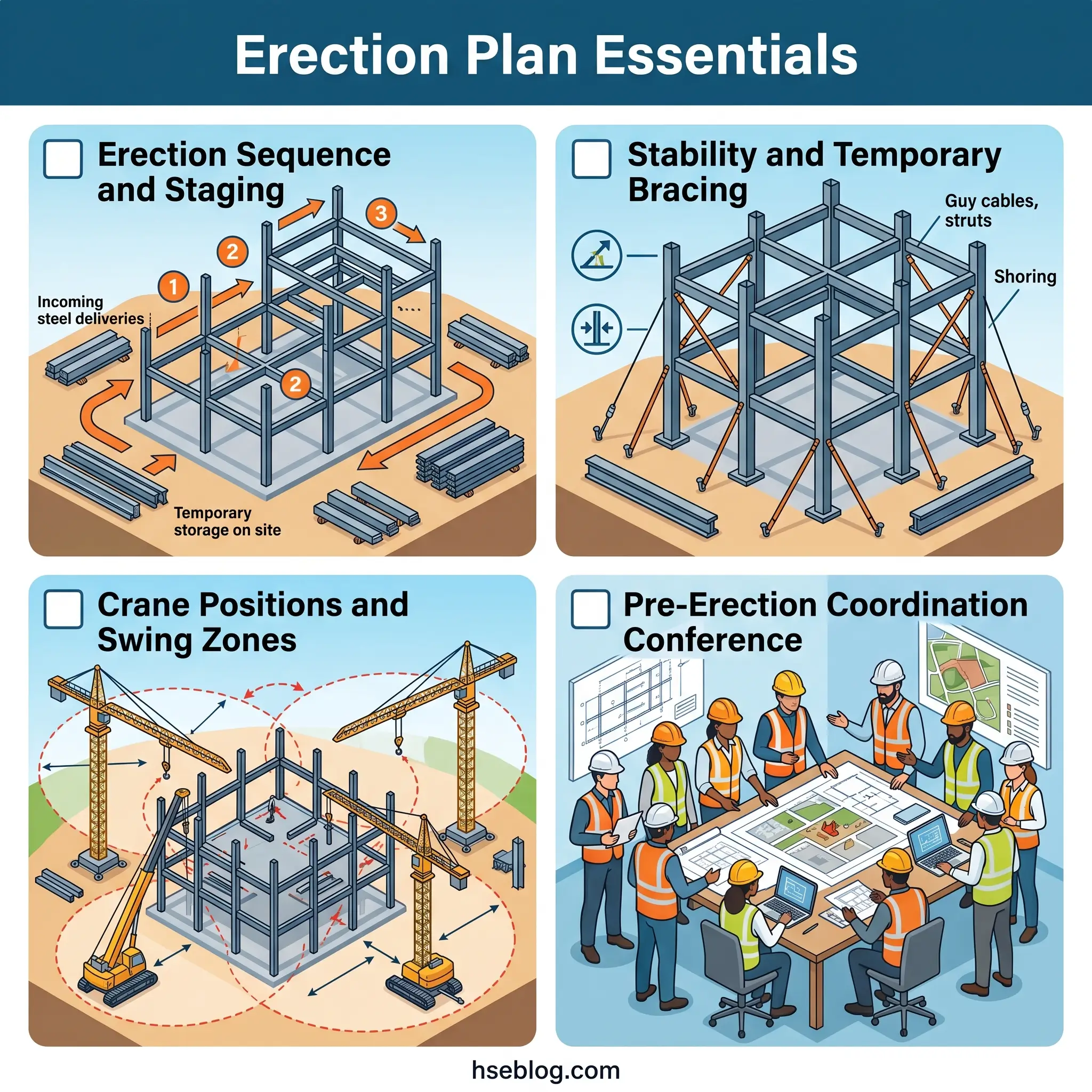
A site-specific erection plan is required under 1926.752(e) when employers elect to use alternate means and methods for certain Subpart R provisions — specifically those referenced in 1926.753(c)(5), 1926.757(a)(4), and 1926.757(e)(4). Outside those specific triggers, the plan is not mandated, but every competent steel erection operation develops one regardless.
OSHA’s non-mandatory Appendix A provides a practical framework for the plan’s content:
- Erection sequence — the order in which members will be erected, designed to maintain structural stability at every intermediate stage.
- Stability requirements — temporary bracing, guy wires, or shoring needed at each stage of the sequence.
- Crane and derrick locations — planned positions, swing radii, and exclusion zones.
- Pre-erection conference checklist — documented coordination between the controlling contractor and steel erector covering site conditions, access, concrete curing status, and overhead hazard zones.
The written notification requirement before erection can commence is not optional. The controlling contractor must provide documentation that concrete has reached adequate strength, that the site is graded and drained, and that access is safe for erection equipment.
For teams seeking detailed enforcement guidance on erection plan requirements, OSHA’s CPL 02-01-034 contains the Q&A clarifications compliance officers use during inspections — the same document is available to contractors for proactive compliance.
Best Practices for Steel Erection Safety
Regulatory compliance is the baseline — not the ceiling. The operations that sustain zero-serious-injury performance over multi-year periods build layers of control beyond what Subpart R mandates.
Engineering Controls
The evolution of fall protection hardware tells a story about what happens when safety engineering meets cultural resistance. When the 2001 standard introduced 100% tie-off requirements, experienced ironworkers pushed back hard — they viewed constant attachment as incompatible with the agility connecting demands.
That tension drove innovation in three areas:
- Retractable self-retracting lifelines (SRLs) — allow free movement within a radius while arresting falls within inches, resolving the mobility-versus-protection conflict.
- Horizontal lifeline systems — pre-rigged cable systems that let connectors move along beams while remaining continuously attached to a rated anchorage.
- Adjustable beam clamps (“beamers”) — portable anchorage devices that a connector installs ahead of their path, creating rated tie-off points where permanent anchorages don’t yet exist.
These weren’t adopted because the standard required them specifically. They were adopted because they made compliance physically possible for workers whose jobs demand constant repositioning.
Administrative Controls
Engineering controls fail if the daily operational discipline doesn’t support them:
- Pre-shift briefings that address changed conditions — not a recycled generic talk, but a walk-through of what is different today: new lifts planned, members erected since yesterday, wind forecast, crane configuration changes.
- Crane signal standardisation — hand signals between connectors and crane operators must follow OSHA/ASME conventions. Radio communication supplements but does not replace visual signals.
- Weather monitoring — Subpart R does not specify a wind speed threshold for stopping steel erection, but crane manufacturers set operational limits. The competent person must assess conditions continuously and halt operations when wind compromises load stability or worker balance.
- Housekeeping as a struck-by control — securing decking bundles against wind displacement, maintaining clear walking paths on beams, and tethering every tool used at height.
PPE Selection and Inspection
PPE for steel erection is not generic “fall protection equipment.” The harness, lanyard, and anchorage must be matched to the worker’s task:
- Full-body harness — inspected before every shift for frayed webbing, deformed hardware, and stitching integrity. A harness that has arrested a fall must be removed from service immediately.
- Energy-absorbing lanyards or SRLs — selected based on fall clearance distance. An energy-absorbing lanyard requires more clearance than an SRL — a miscalculation here turns a fall arrest system into a ground-impact event.
- Hard hats with chin straps — standard in steel erection because the work angles and wind conditions that ironworkers face will remove an unsecured hard hat.
OSHA’s 2025 PPE revision (29 CFR 1926.95(c)) now requires that PPE properly fit each worker — an overdue mandate for an industry where ill-fitting harnesses routinely reduce both comfort and arrest performance.
Steel Erection Training Requirements Under OSHA
The training provisions under 1926.761 are where the standard’s intent meets its most common failure mode: workers from other trades assigned to steel erection tasks without the specialized training Subpart R requires.
All exposed workers must receive fall hazard training from a qualified person. The standard specifies a qualified person — defined as someone with a recognized degree, certificate, or professional standing, or extensive knowledge and experience — not merely a foreman or lead hand.
Training must address five content areas under 1926.761(b):
- Recognition of applicable fall hazards specific to the steel erection work being performed
- Procedures for erecting, maintaining, and disassembling fall protection systems applicable to the site
- Use and operation of controlled decking zones, guardrails, PFAS, safety nets, and other protection systems
- Proper use and inspection of equipment used for fall protection
- Procedures for fall prevention and protection methods relevant to the site conditions
Beyond the general requirement, three worker categories require additional specialized training: connectors (who must understand the equipment and procedures specific to connecting operations), CDZ workers (who must understand CDZ boundaries and restrictions), and multiple-lift rigging participants (who must understand the rigging procedures and load limitations).
The non-mandatory training guidelines in Appendix E provide a curriculum framework. Using them is not required, but they represent OSHA’s view of what adequate training content looks like — and they become a reference point in enforcement proceedings when an employer’s training program is challenged as insufficient.
International Standards for Steel Erection Safety
Teams working outside the United States — or on multinational projects — operate under different regulatory architectures that shift safety obligations earlier in the project lifecycle.
UK: CDM 2015 and Work at Height Regulations 2005
The Construction (Design and Management) Regulations 2015 place a designer duty on considering safe erection at the design stage — a structural configuration that is difficult to erect safely should be challenged before it reaches the fabrication shop. This upstream obligation has no direct equivalent in OSHA’s Subpart R, which focuses primarily on the erection phase itself.
The Work at Height Regulations 2005 (UK) impose a formal hierarchy that is more prescriptive than OSHA’s approach:
- Avoid work at height entirely where reasonably practicable.
- Collective protection (guardrails, safety nets) takes precedence where work at height cannot be avoided.
- Personal protection (harnesses, PFAS) is permitted only when collective protection is not reasonably practicable.
This hierarchy means that a UK-based steel erection operation must demonstrate why guardrails or nets are not feasible before relying on personal fall arrest — the reverse of the US approach, where all five protection methods are presented as equally acceptable options.
BCSA Guidance and ILO Standards
The British Constructional Steelwork Association (BCSA) publishes supplementary guidance that addresses practical gaps in the regulations — including the Safe Site Handover Certificate and the Guide to Steel Erection in Windy Conditions, which provides wind assessment criteria that neither OSHA Subpart R nor CDM 2015 specify numerically.
The ILO’s guidance on structural steel erection covers PPE suitability, ladder condition, scaffolding component inspection, and safe raising/lowering techniques — serving as a baseline reference for jurisdictions that lack their own detailed steel erection standards.
For teams working across jurisdictions, the critical difference is this: the UK framework embeds safety obligations across the supply chain from design through construction, while the US framework concentrates obligations on the erection contractor and controlling contractor during the construction phase. Neither approach is inherently superior — but failing to understand which framework governs creates compliance gaps on every multinational project.
Frequently Asked Questions
Conclusion
The steel erection fatality record keeps teaching the same lesson: the most dangerous conditions on a steel erection site are not the ones that look dramatic. They are the ones that are misclassified, misunderstood, or delegated to workers who lack the training to recognise them.
Decking kills more ironworkers than connecting. The connector exception gets applied to workers who are not connectors. Subpart R’s 15-foot trigger gets confused with Subpart M’s 6-foot trigger the moment another trade steps onto the same structure. And the most catastrophic incidents — beams released before bolting, joists walked before bridging — stem from sequence decisions made by people who do not understand that a steel frame is at its most unstable in the middle of being built.
Competent steel erection safety demands three things simultaneously: regulatory precision in applying the correct standard to the correct worker at the correct phase, engineering solutions that make protection compatible with the physical demands of ironwork, and a training investment that ensures no one touches structural steel without understanding how Subpart R governs their specific activity. The 2026 BLS data showing construction fall fatalities at their lowest since 2011 (US Bureau of Labor Statistics, 2026) suggests progress — but every number in that dataset represents a gap between what the standard requires and what someone actually did at height.