
TL;DR
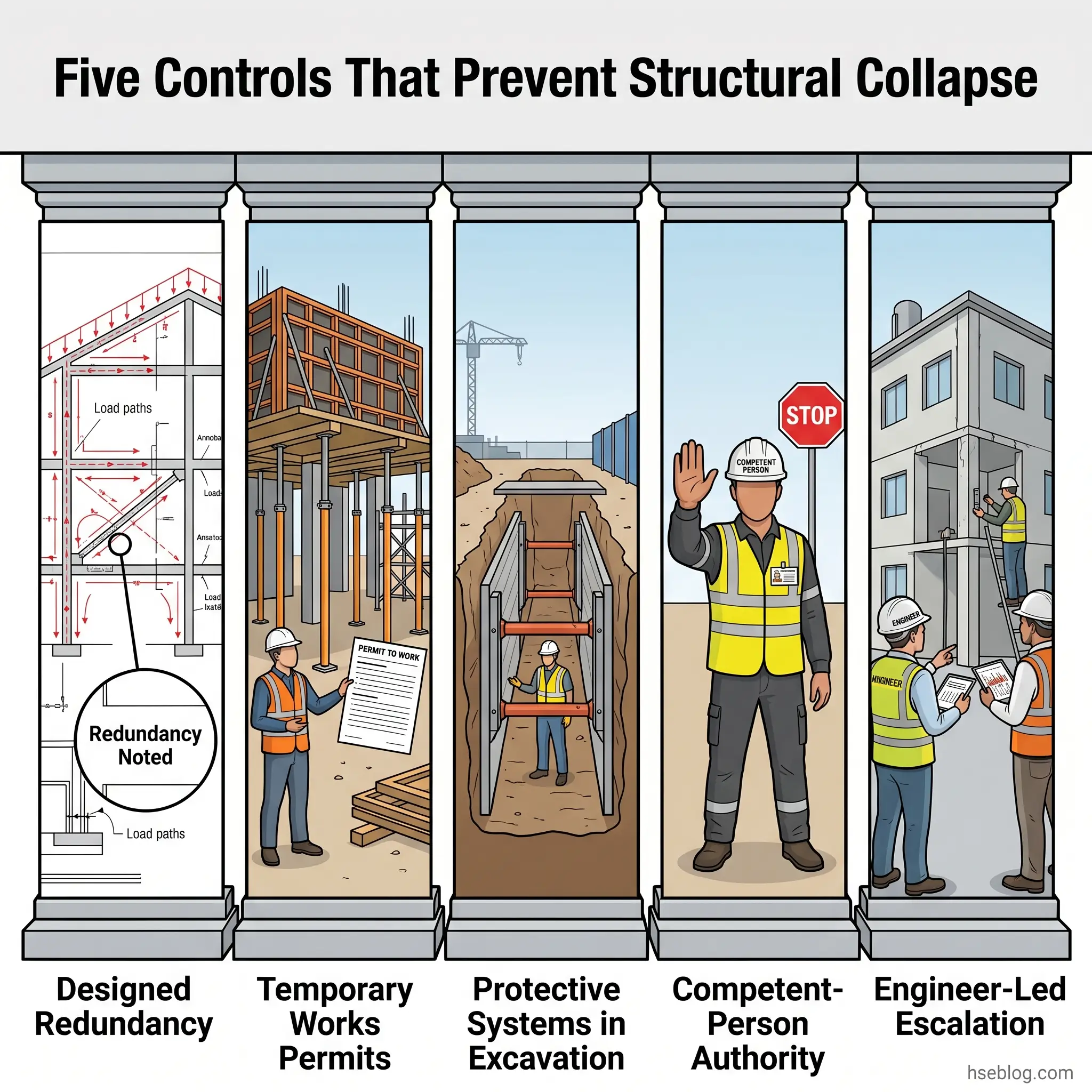
- Engineer redundancy into the structure. Buildings without alternate load paths fail disproportionately when one column or connection is lost — the progressive collapse mechanism the regulations target.
- Treat temporary works as load-bearing. Scaffolds, props, formwork, and shoring carry real load; informal alteration without engineer approval is the recurring construction-phase trigger.
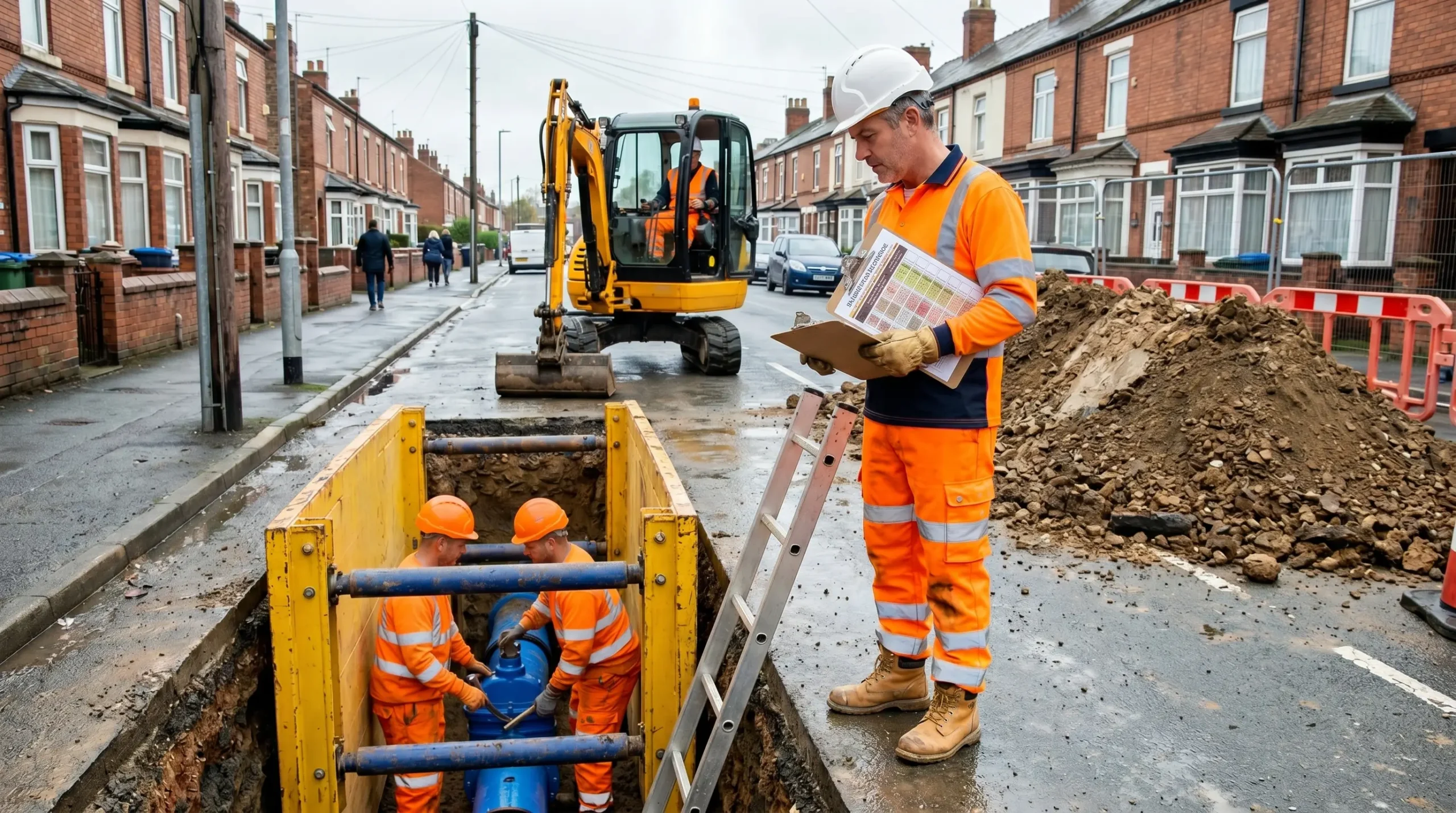
- Slope, shore, or shield every excavation that can collapse. OSHA mandates protective systems at 5 ft; HSE applies the same logic from 1.2 m. A trench box protects occupants — it does not prevent cave-in.
- Give the competent person genuine stop-work authority. Where competent-person systems fail in prosecution, the role exists on paper but lacks schedule-overriding power.
- Escalate distress signs as safety directives, not budget items. Bowed walls, progressive crack widening, and binding doors require a structural engineer’s response — not a price negotiation.
Structural collapse prevention depends on five linked controls applied across build, demolition, excavation, and operational phases: a verified design with structural redundancy, properly engineered temporary works that are never altered without written approval, soil-appropriate excavation protective systems, a competent person with documented stop-work authority, and an inspection regime that escalates visible distress to a structural engineer rather than absorbing it as deferred maintenance.
On 24 June 2021, the 12-story Champlain Towers South condominium in Surfside, Florida partially collapsed in the early hours of the morning, killing 98 people (NIST, 2025). The National Institute of Standards and Technology, operating under the National Construction Safety Team Act, has spent four years reconstructing the failure sequence.
Its September 2025 update confirmed that collapse most likely initiated in a pool-deck slab-column connection, with the full technical report and six supporting volumes scheduled into 2026 (NIST, 2025). The investigation is the most significant US building-failure inquiry since the World Trade Center towers, and it has already changed how regulators in multiple jurisdictions think about existing-structure inspection regimes.
Structural collapse occupies an unusual position in occupational risk. It is uncommon, catastrophic when it happens, and almost always preceded by indicators that someone saw and either misread or did not have the authority to act on.
Effective structural collapse prevention is not a single control but a discipline that runs through design, construction, demolition, excavation, and the operational life of a building. This article covers each of those contexts, anchored to OSHA, CDM 2015, and the controls that actually break the documented failure patterns.
Why Structural Collapse Demands a Distinct Safety Discipline
Collapse is categorically different from most workplace hazards because PPE has near-zero protective value once it begins. A hard hat will not save a worker from a falling wall section, and a hi-vis vest is not a control when three cubic yards of saturated soil — roughly 6,000 to 9,000 pounds — moves into a trench.
Building collapse safety measures therefore sit upstream of the hazard itself. They are decided in design offices, in temporary-works calculations, in pre-demolition surveys, and in the inspection records of buildings already in service.
Four distinct contexts dominate the field, and they cannot be managed with shared controls.
| Context | Primary Hazard | Lead Standard | Key Decision Holder |
|---|---|---|---|
| New-build construction | Incomplete or unverified temporary works | CDM 2015; BS 5975:2019 (UK) | Temporary Works Coordinator |
| Demolition / alteration | Sequence error; misjudged load paths | CDM 2015 (UK); 29 CFR 1926 Subpart T (US) | Competent demolition engineer |
| Excavation / trenching | Cave-in from soil failure | 29 CFR 1926 Subpart P (US); HSE guidance (UK) | Competent person |
| Existing buildings | Material degradation; deferred maintenance | Jurisdictional facade/condition rules | Owner + structural engineer |
Competent-person notice. This article provides general HSE knowledge on structural collapse prevention. Life-critical work such as temporary-works design, demolition sequencing, excavation protective-system selection, and existing-structure intervention must be planned and supervised by a competent person with relevant training, jurisdiction-specific authorization, and site-specific assessment. The information here does not replace that role.
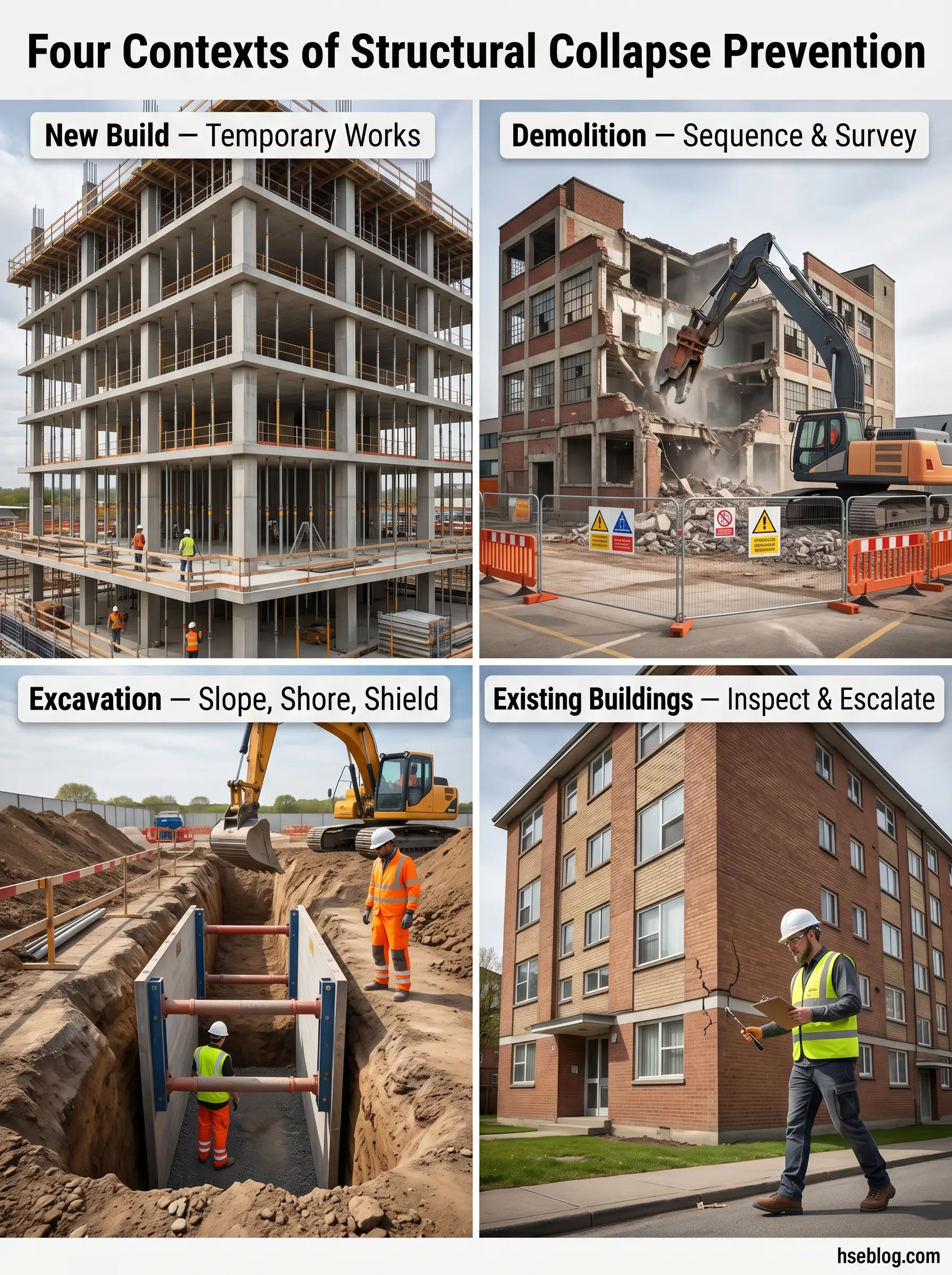
A recurring failure mode in HSE practice is treating any one of these contexts as a generic “construction site” problem. The controls do not transfer between them.
A trench-collapse prevention plan offers nothing useful to a demolition crew, and a pre-demolition structural survey will not catch corroded reinforcement in an operating parking garage.
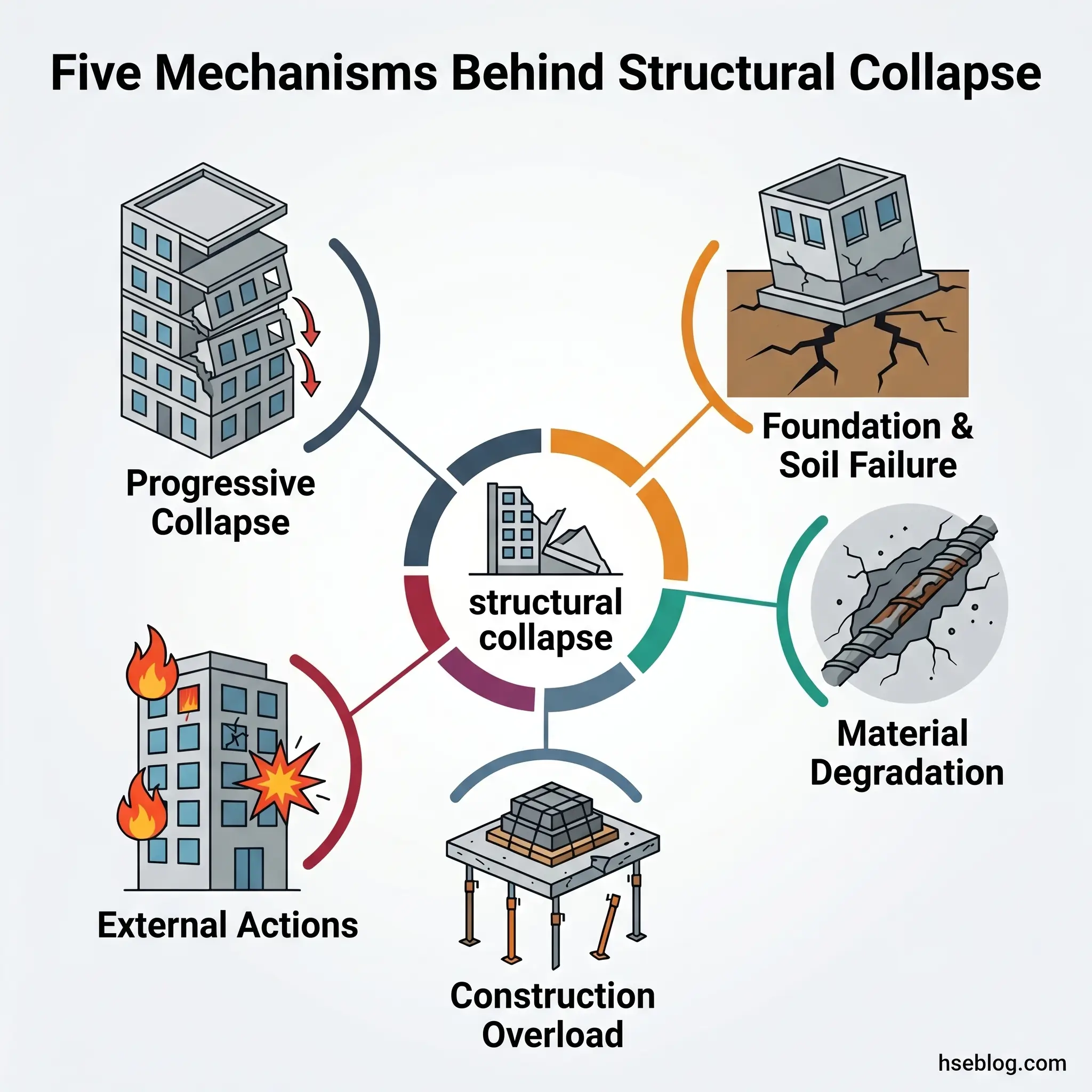
How Structures Actually Fail: The Mechanisms Behind Collapse
A consistent pattern across major investigations — Champlain Towers South, the 2023 Davenport, Iowa apartment partial collapse, and the 2023 New York City parking garage failure on Ann Street — is that distress signs were visible and often documented for months or years before the structure failed. The gap was not detection. It was the escalation pathway from observation to binding action.
Understanding the mechanisms behind these failures is what allows a competent person to read warning signs accurately.
Progressive (Disproportionate) Collapse
Progressive collapse occurs when local damage cascades through a structure that lacks alternate load paths. The 1968 Ronan Point partial collapse in London — a gas explosion in a single corner kitchen that cascaded into the collapse of a 22-story tower’s entire corner — is the regulatory origin point for UK structural-stability requirements.
In the US, the General Services Administration and Department of Defense progressive collapse prevention guidance govern federal building design. The buildings most exposed are those with limited redundancy: older flat-plate concrete structures, limited-redundancy precast assemblies, and lift-slab construction. This is what causes progressive collapse in buildings — the absence of an alternate load path when one element is compromised.
Foundation and Soil Failure
Foundations fail through differential settlement, expansive or collapsible soils, undermining from adjacent excavation, and — though ruled out at Surfside — karst conditions. Adjacent-excavation undermining is the most preventable category in this group.
A trench dug too close to an existing footing without engineered shoring can transfer enough load to the soil mass for the foundation to migrate or rotate.
Material Degradation
Reinforced concrete fails slowly. Reinforcement corrosion expands the steel to roughly six to seven times its original volume; that expansion cracks and spalls the surrounding concrete and accelerates further corrosion.
In coastal and de-icing-salt environments, chloride ingress drives the process. The visible signs — rust staining, spalling concrete with exposed reinforcement, sagging slabs — are late-stage symptoms, not early warnings.
Construction Overload and Sequencing Error
Premature load application is one of the highest-leverage construction-phase failures. Stripping formwork before concrete has reached design strength, stacking material on an unfinished slab, or sequencing such that load paths are incomplete are the recurring patterns.
Every floor of a multi-storey concrete frame depends on the integrity of the level below. An interrupted load path is a collapse condition, not merely a quality issue.
External Actions
Fire, blast, vehicle impact, seismic loading, wind, and hydraulic loads each carry their own structural physics. Steel loses approximately half its strength at temperatures between 1,100 and 1,500°F, which is why unprotected steel framing fails in sustained fire conditions.
Each external action interacts with the as-built redundancy and material condition of the structure.
Leading Indicators That Precede Collapse
Where pre-collapse warning signs exist, they cluster in recognisable patterns. The warning signs of imminent building collapse are not subtle once a competent observer knows what to look for.
- Progressive crack-width changes. A static crack is a record; a widening crack is a process.
- Audible structural sounds. Cracking, popping, or grinding from concrete or masonry under load.
- Visible deflection changes. A slab or beam that did not sag last month and does now.
- Doors and windows binding suddenly. Frame distortion with no seasonal humidity explanation.
- Spalling concrete with exposed reinforcement. Particularly at slab-column connections.
- Water ingress changes. New leaks, or shifted leak locations, often indicate movement above.
Preventing Collapse During Construction and Temporary Works
CDM 2015 distributes structural-stability duties across the client, principal designer, principal contractor, and competent engineers — but operational collapse risk concentrates in temporary works. During construction, the structure does not yet have the redundancy its design specifies.
Scaffolds, formwork, falsework, shoring, propping, and bracing are doing real load-bearing work. They will continue doing it until the permanent structure can take over.
The recurring violation pattern in the published record is informal alteration. A worker, foreman, or trade contractor removes or repositions a brace, prop, or tie because it is in the way of the next task — and the element being moved is not recognised as structural.
The control that breaks this pattern is a written permit-to-alter regime tied to the temporary-works drawings, signed off by a Temporary Works Coordinator appointed under BS 5975:2019. The standard is UK national but has no operational equivalent in US regulation, which makes it the reference framework even on US projects above modest complexity.
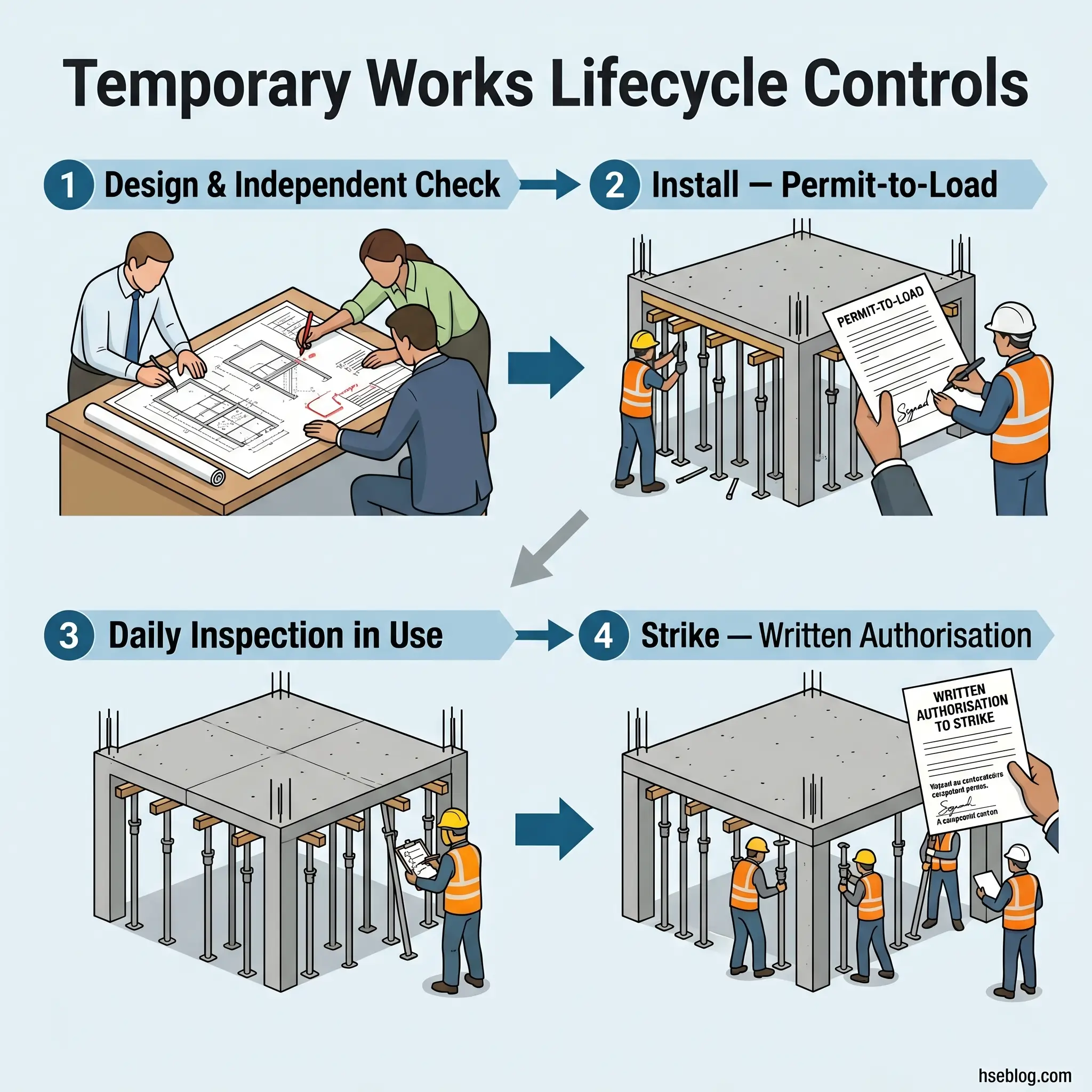
Three lifecycle controls keep temporary works safety inside safe operating limits:
- Design and check. Temporary-works design follows the same engineering rigour as permanent works, with an independent check proportionate to the consequence of failure.
- Permit-to-load and permit-to-strike. Loads are not applied to formwork or shoring until concrete strength is verified by test; supports are not removed until written authorisation is given.
- Inspection during use. Daily visual inspection by a competent person, with structured re-inspection after weather events, vibration sources, or load changes.
HSE has been explicit on one specific misconception: a standard tied scaffold provides vertical support only and will not restrain a building during alteration or demolition. Scaffold counted as façade retention is a recurring finding in UK demolition prosecutions.
Temporary Works Coordinator and Competent Engineer Sign-Off
BS 5975 requires the appointment of a Temporary Works Coordinator on projects where temporary works carry meaningful collapse consequence. In the US, 29 CFR 1926.652(b)(4) requires that protective systems for excavations deeper than 20 feet be designed by a registered professional engineer.
The role exists for a reason that becomes obvious in investigation reports. Where structural decisions are made by site managers without formal engineering review, the failure rate rises measurably.
Preventing Collapse During Demolition and Alteration
Under CDM 2015 in the UK and 29 CFR 1926 Subpart T in the US, demolition is treated as construction work — but it inverts the logic. Structural integrity is being deliberately removed, and sequence errors are immediately fatal because there is no temporary-works backstop catching the mistake.
How to prevent structural collapse during demolition starts with treating the planning phase as the primary control opportunity. Once work is in progress, correction is rarely possible.
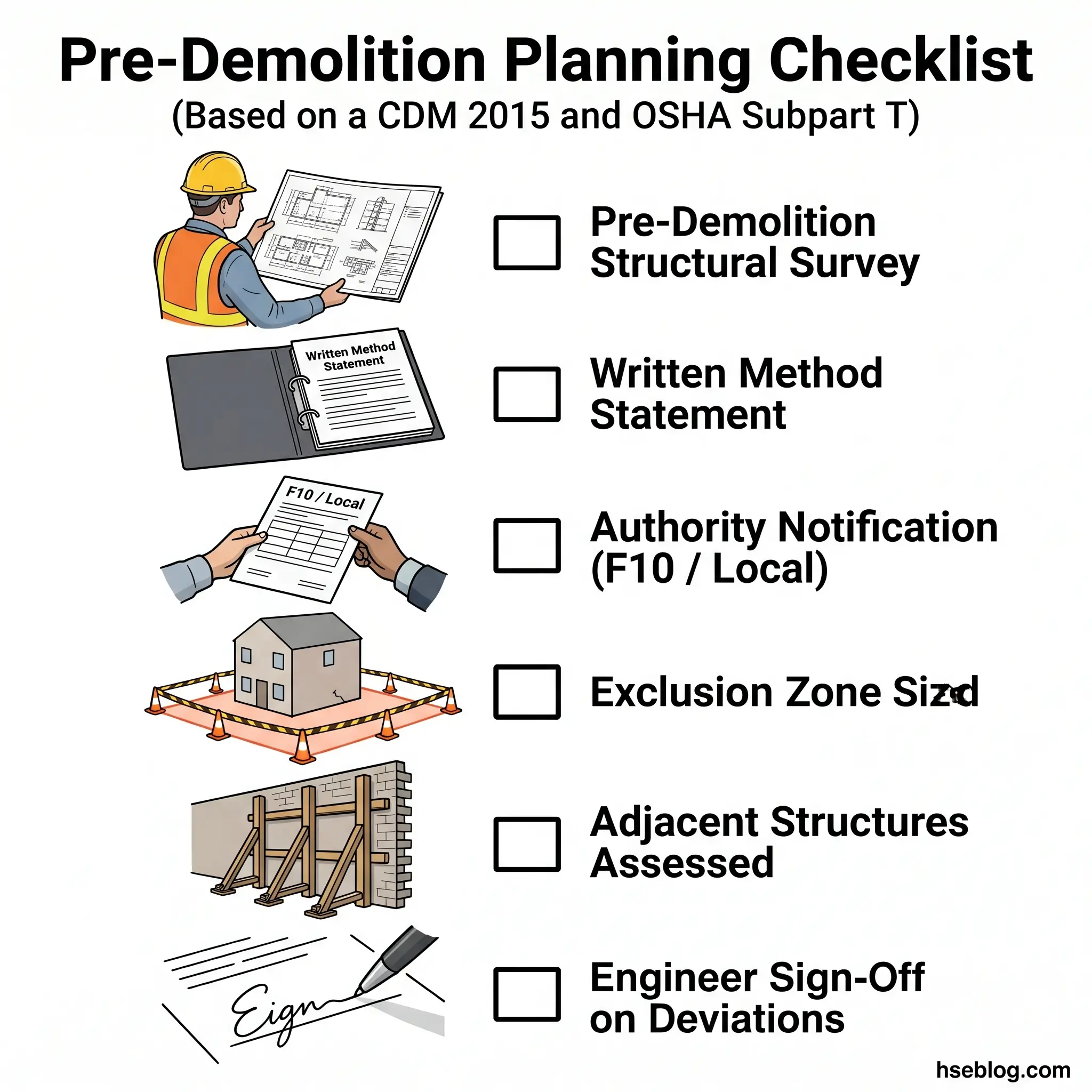
The preventive controls for structural stability during demolition cluster into a defined sequence:
- Commission a pre-demolition structural survey. A competent engineer maps load paths, identifies hidden modifications from previous alterations, and flags deleterious materials including asbestos and lead.
- Produce a written demolition method statement. The document specifies the sequence of removal, the temporary works supporting any partially-demolished structure, plant positions, and exclusion zones. CDM 2015 makes this a documented requirement.
- Notify the relevant authorities. In the UK, an F10 notification to HSE is required for projects over 30 working days or 500 person-days, with six weeks’ notice to local authority building control before demolition begins.
- Establish an exclusion zone proportionate to the structure’s height plus a debris-flight margin. This is the same collapse zone management principle NIOSH applies to fire-ground operations — wall height plus margin.
- Manage adjacent-structure risk. Party walls, neighbouring foundations, and any adjacent slopes are part of the demolition risk envelope, not background context.
- Require engineer approval for any deviation from the method statement. Pre-weakening cuts and modified sequences are not site-supervisor decisions.
Demolition incidents seldom involve the structure being demolished. The casualties are usually on the adjacent structure, on a temporary access platform, or on a misjudged load-bearing element after pre-weakening — most often a wall the operator assumed was a partition.
The control point is the sequence drawing reviewed pre-shift, not the toolbox briefing at gate-in.
Preventing Excavation and Trench Collapse
US Department of Labor data reported a decline from 39 trench-collapse worker deaths in 2022 to 15 in 2023, with 12 reported by date of release in 2024 (OSHA, 2024). The roughly 70 percent reduction is attributed to the National Emphasis Program on Trenching and Excavation and stepped-up criminal-referral activity by federal prosecutors.
The same dataset shows more than 250 trench cave-in fatalities in the US between 2013 and 2023, with most cases involving employers who failed to follow basic protective-system regulations (NPR investigation citing OSHA data, 2024). One cubic yard of soil weighs 2,000–3,000 pounds; most trench collapses involve three to five cubic yards (former OSHA Deputy Assistant Secretary Jordan Barab, cited in NPR, 2024).
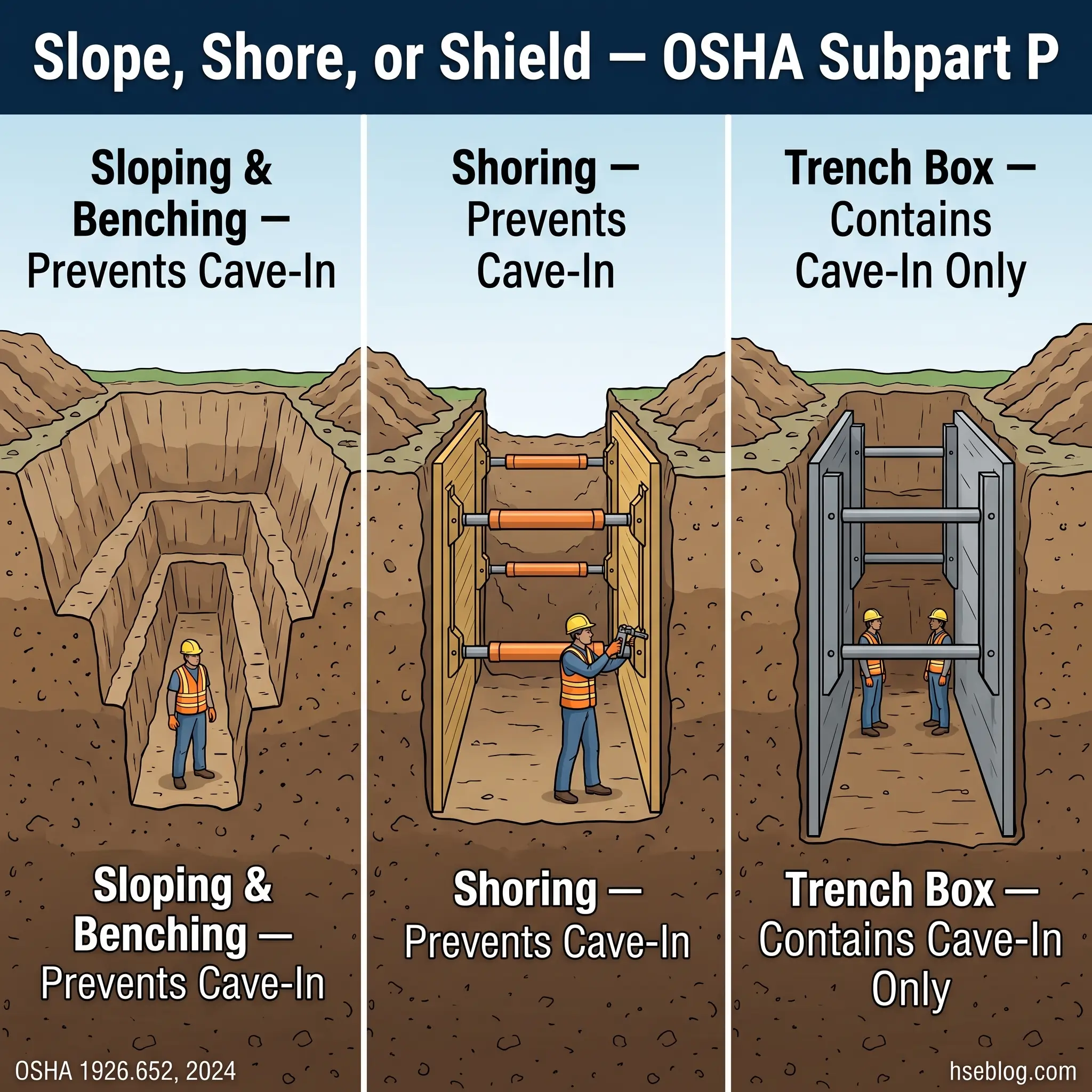
Trench collapse prevention under 29 CFR 1926 Subpart P sets a prescriptive hierarchy that maps cleanly to the field decision sequence. OSHA trenching and excavation requirements for cave-in protection are detailed in OSHA’s trenching and excavation overview and in the full text of Subpart P.
| Protective System | Mechanism | Best Suited To | Limitation |
|---|---|---|---|
| Sloping and benching | Cuts the trench wall back to a stable angle | Open ground with sufficient surface space | Requires soil classification; impractical in confined ROW |
| Shoring (hydraulic, timber, mechanical) | Active support against the trench walls | Utility work in tight footprints | Installation sequence is itself a hazard |
| Trench box / shielding | Protects occupants if a cave-in occurs | Where neither sloping nor shoring is feasible | Does not prevent cave-in — only contains its consequence |
Soil classification under OSHA Appendix A drives protective-system selection: stable rock, Type A (≥1.5 tsf unconfined compressive strength), Type B (greater than 0.5 to less than 1.5 tsf), and Type C (less than 0.5 tsf, submerged, or saturated). Type C is the most dangerous and the most common in utility trenches.
The threshold rules to operate from:
- 5 feet (US): Protective system required at 5 feet and above unless excavation is in stable rock; competent-person judgment governs below 5 feet (1926.652(a)(1)).
- 1.2 m (UK): HSE expects support, batter back, or shoring from 1.2 m where unsupported collapse risk exists.
- 20 feet (US): Protective systems above 20 feet must be designed by a registered professional engineer (1926.652(b)(2)).
- 4 feet (US): Safe egress required in trenches 4 feet deep or more; ladders, ramps, or steps within 25 feet of lateral travel.
- 2 feet (US): Spoil piles, equipment, and material must be set back at least 2 feet from the excavation edge.
For cross-jurisdiction operations, the conservative working floor is the US 5-foot rule combined with the UK 1.2 m practical depth — apply protective systems from the lower threshold.
A persistent pattern in trench-collapse investigations is that fatalities cluster in small-contractor utility work — sewer and water lines at 8 to 15 feet depth — where the protective system is not inadequate. It is absent.
The work is “just a few hours” or “we’ll only be down there once,” and the cost-benefit calculation underlying that decision has consistently been wrong by an order of magnitude.
Protecting Existing Structures: Inspection, Maintenance, and Early Intervention
The Champlain Towers South investigation has made existing-structure inspection the most regulator-active area of structural collapse work since 2021. The NIST investigation into the Champlain Towers South collapse has flagged not only the technical failure mechanism — most likely initiated at a pool-deck slab-column connection — but a recurring documentation gap.
That gap is the loss of original construction records and the absence of peer review documentation for repair recommendations (NIST, 2025). The owner-side decision pattern that recurs in post-2020 US building-collapse cases is treating a structural engineer’s repair recommendation as a price quote to be negotiated downward.
Deferred maintenance is the documented antecedent. The escalation control that breaks the pattern is making engineer recommendations a binding gate within the building’s safety system, not a budget line item.
Visible distress signs that warrant immediate engineer involvement on an existing structure:
- Bowed or leaning walls that did not previously bow.
- Cracking with progressive width changes documented over weeks or months.
- Spalling concrete with exposed reinforcement — particularly around slab-column connections, balconies, and post-tensioned anchorages.
- Sagging slabs or beams detected by visual inspection or laser straight-edge.
- Doors and windows that bind without seasonal humidity explanation.
- Rust staining on concrete surfaces indicating active reinforcement corrosion.
The intervention hierarchy escalates from observation through to evacuation:
- Observation. Visible distress signs documented with photographs, timestamps, and a competent inspection scheduled.
- Instrumentation. Crack gauges, tilt monitors, and survey targets installed where movement is active or suspected.
- Non-destructive testing. Ground-penetrating radar, half-cell potential testing, and ultrasonic methods where internal degradation is suspected.
- Restricted use. Live load reduced and affected areas closed when an engineer concludes capacity is compromised.
- Evacuation. Immediate evacuation and authority notification when failure is foreseeable.
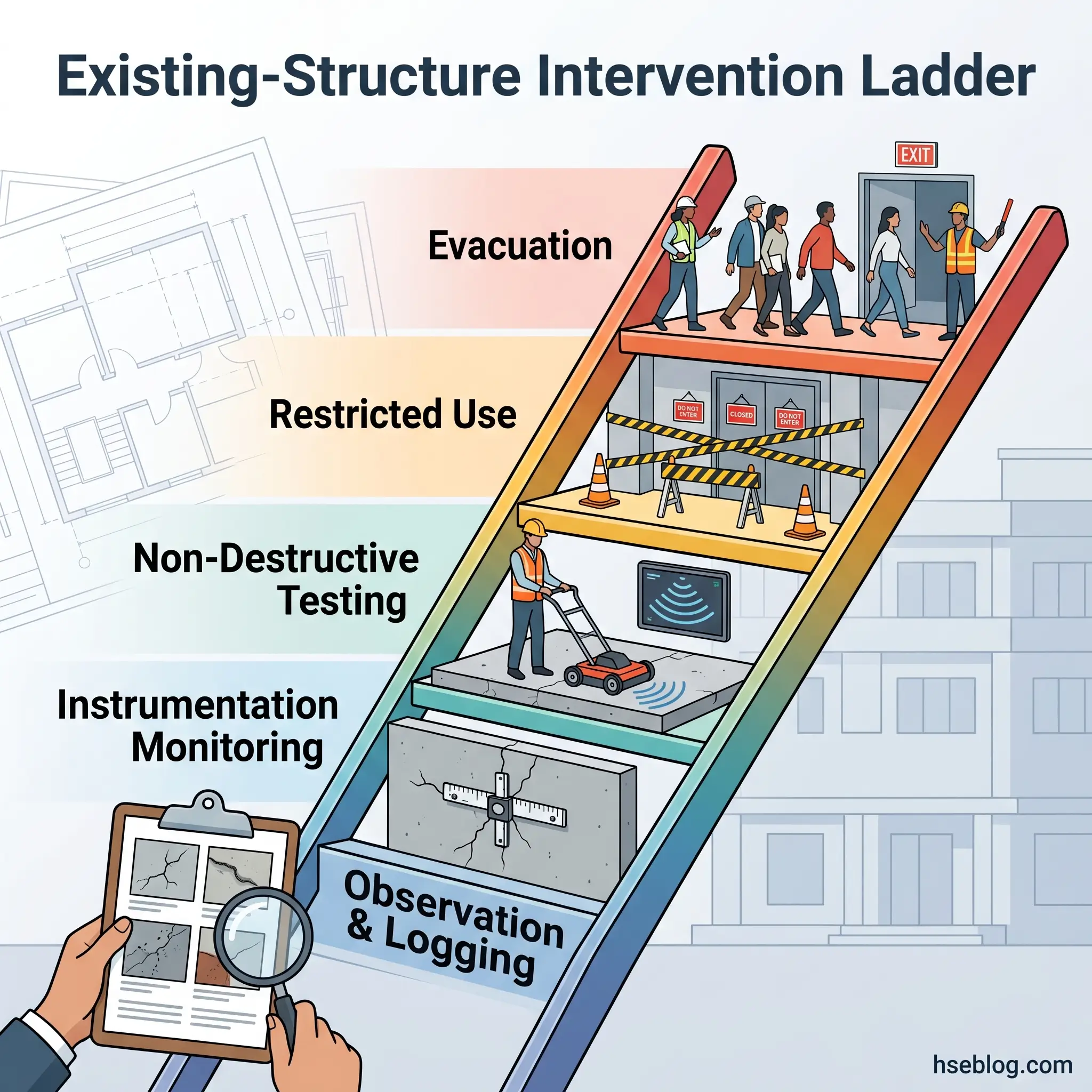
The Champlain Towers timeline — from the 2018 engineer’s report identifying major structural damage to the pool-deck waterproofing and concrete columns, through to June 2021 — is the strongest available illustration of why each rung of this ladder needs a defined trigger and a defined decision-maker.
The records-retention question is the secondary lesson. Buildings designed for 50–100 years assume periodic maintenance and an intact documentation chain, and both fail more often than the structural members themselves.
Roles, Competence, and the Decision Authority Problem
On most projects, structural-stability authority appears clearly on the organogram and remains absent in practice. Every collapse-prevention regime depends on a named competent person or engineer with the power to stop work — and this is the single most diluted role on most sites.
OSHA defines a competent person at 29 CFR 1926.650(b) as one knowledgeable, able to identify existing and predictable hazards, and authorised to take immediate corrective action. CDM 2015 distributes equivalent CDM 2015 duties for structural stability across client, principal designer, principal contractor, designer, and contractor — each carrying specific obligations.
Legal note. Regulatory content here reflects general HSE professional understanding of OSHA and CDM 2015 requirements as of the year of last review. It is not legal advice. Specific compliance questions, enforcement situations, or prosecution risk should be directed to qualified legal counsel in the applicable jurisdiction.
| Role | Jurisdiction | Core Structural Duty |
|---|---|---|
| Competent person | US (OSHA) | Identify hazards; classify soil; daily excavation inspection; halt work if conditions warrant |
| Temporary Works Coordinator | UK (BS 5975) | Coordinate design, check, install, monitor, and strike of temporary works |
| Principal designer | UK (CDM 2015) | Plan, manage, monitor pre-construction; coordinate design risk |
| Principal contractor | UK (CDM 2015) | Plan, manage, monitor construction phase; structural-stability execution |
| Registered professional engineer | US (1926.652) | Design protective systems above 20 ft; engineer of record for major demolition |
| Building owner / facility manager | All | Commission inspections; act on engineer recommendations; record retention |
The test that matters in practice is not whether the role appears on paper. It is whether the named person can stop work without escalation, and whether that authority is documented.
Where competent-person systems fail in prosecution, the failure is rarely ignorance. It is that the named competent person was on paper but absent in practice, or present but without the authority to halt schedule-driven decisions made above them.
Site tenure is not a competence credential. Twenty years of carpentry experience does not include the specific structural knowledge required to authorise pre-weakening cuts or sign off a permit-to-strike — competence is role-specific, demonstrable, and current.
What to Do When Collapse Risk Becomes Imminent
When pre-collapse indicators have escalated to an imminent threat, the immediate priority is exclusion, escalation, and protection of life. Detailed structural diagnosis comes later.
The operational pivot is brief and non-negotiable:
- Evacuate the structure and adjacent areas. Establish an exclusion zone proportionate to the structure’s height, plus a debris-flight margin.
- Notify the relevant authorities. Building control and HSE in the UK; OSHA, local building department, and emergency services in the US. Notify an independent structural engineer.
- Do not re-enter to retrieve property, tools, or documents. Re-entry to recover equipment is a recurring secondary-casualty pattern in post-collapse investigations.
- Document the trigger conditions. Photographs with timestamps, witness names, and the specific indicators that prompted evacuation — this record becomes the investigation foundation.
- Maintain the exclusion zone until the engineer authorises re-entry. Schedule pressure, weather, or contractor cost claims are not grounds for early re-entry.
The discipline that prevents secondary casualties is rehearsed in evacuation drills, not improvised at the moment. The five minutes after a collapse warning are the worst possible time to design an exclusion zone or work out who has the authority to call it.
Frequently Asked Questions
Conclusion
The construction industry tends to treat structural collapse prevention as a technical problem with engineering answers. The technical answers exist and they are clear: redundancy in design, permits for temporary-works alteration, slope-shore-shield in excavation, binding engineer authority for existing structures.
The recurring failure is not in any of those controls. It is in the gap between observation and binding action — the small-contractor decision to skip the trench box, the owner’s decision to defer a repair, the supervisor’s verbal approval to move a brace.
The highest-impact change available to most operations is making competent-person authority real. That means a written stop-work power that survives schedule pressure, an engineer recommendation that functions as a safety directive rather than a budget item, and an alteration permit signed before work begins rather than reconstructed after an incident. None of these is expensive, and all of them have been documented as absent in the prosecutions that follow collapses.
The 70 percent reduction in US trench-collapse deaths between 2022 and 2023 (OSHA, 2024) is the proof of concept. It came from enforcement posture and authority, not from a new control technology. When the power to halt the work is present and exercised, preventing structural collapse on construction sites becomes routine practice rather than aspirational principle.