
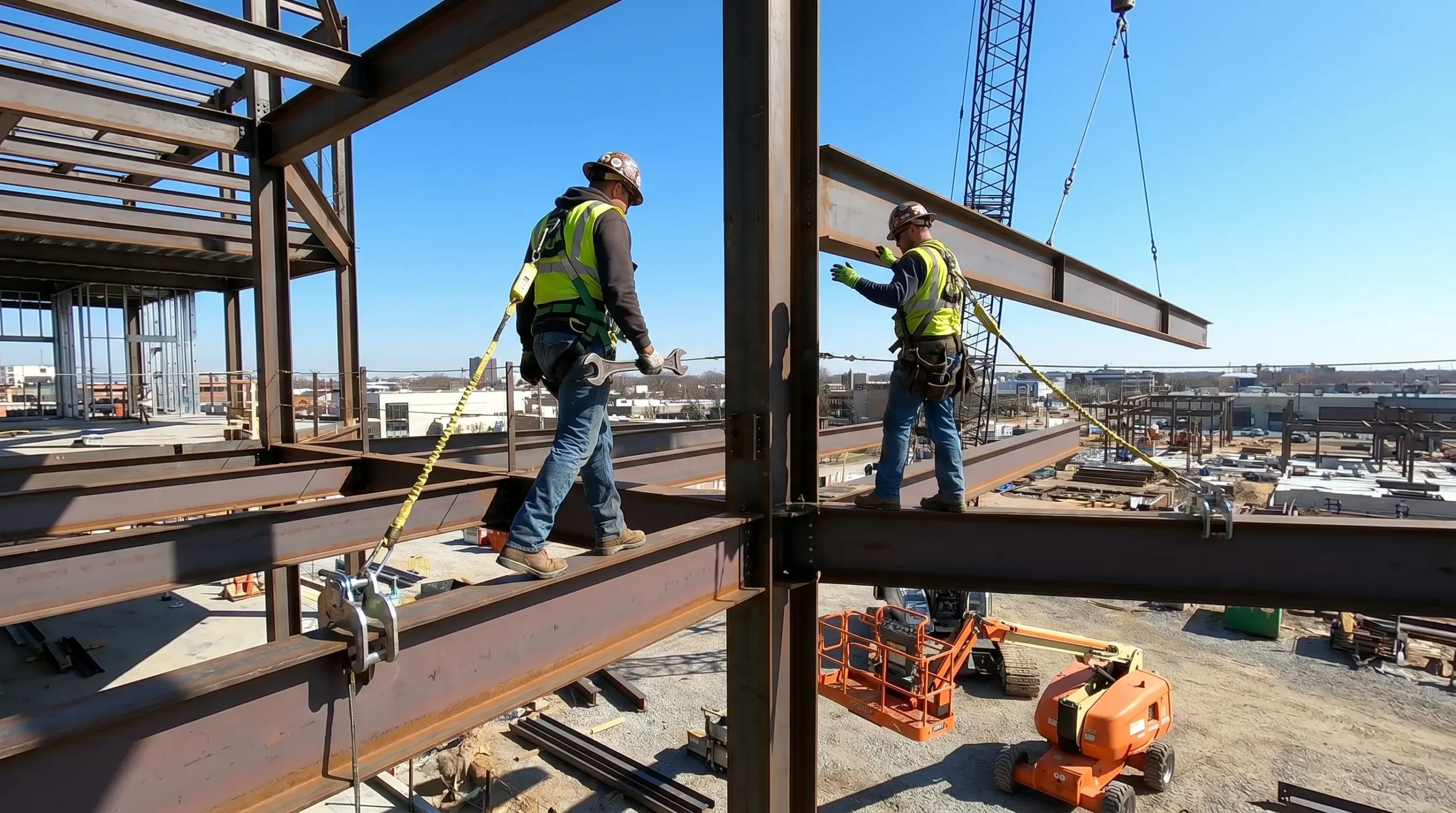
TL;DR — Structural Steelwork Fall Prevention
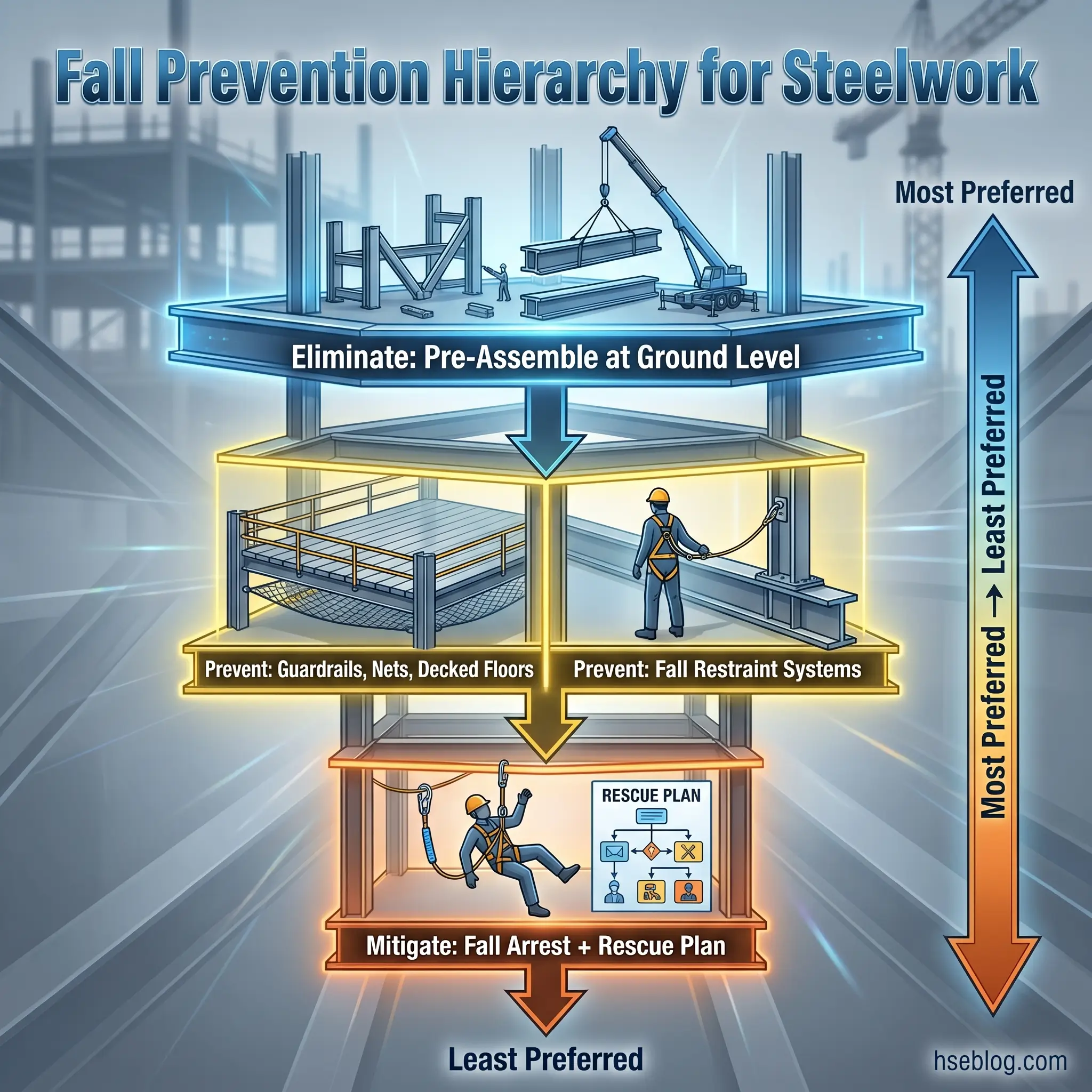
- Apply the hierarchy before selecting equipment — eliminate height work through ground-level pre-assembly, prevent falls with collective protection (guardrails, nets, decked floors), and only then move to personal fall arrest systems.
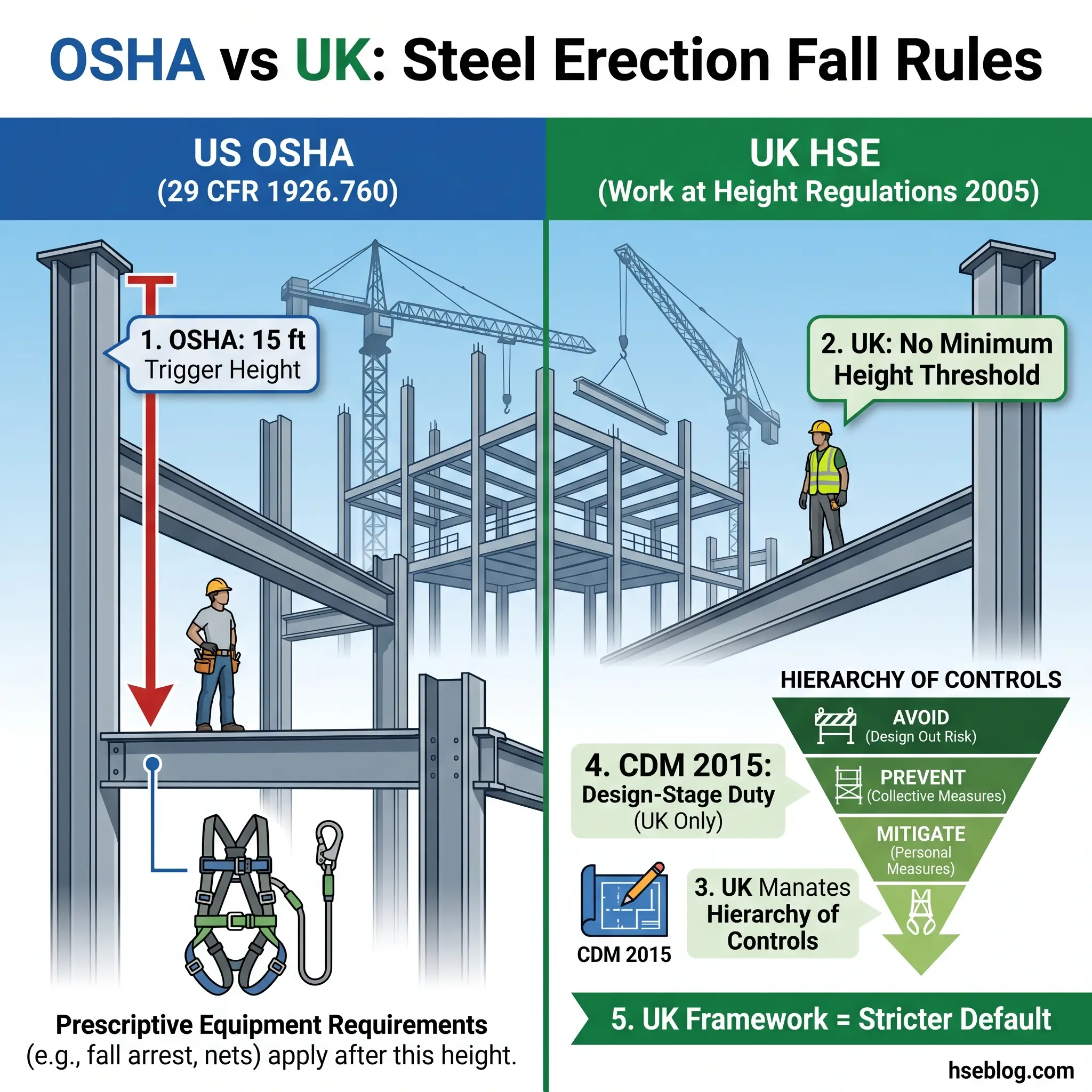
- Know your jurisdictional trigger height — OSHA requires fall protection above 15 ft for steel erection (29 CFR 1926.760); UK Work at Height Regulations 2005 impose no minimum height at all.
- Plan anchorage into the erection sequence — every connection point in the steel raising plan needs a viable tie-off point before the worker arrives there.
- Rescue planning is not optional — suspension trauma can incapacitate a fallen worker within minutes; a site-specific, practised rescue plan must accompany every fall arrest system.
- CDZs are not exemptions — Controlled Decking Zones substitute specific controls for conventional fall protection between 15 and 30 ft, but they carry strict dimensional, training, and access limitations that erode fast on active sites.
Falls from height kill more construction workers than any other hazard in both the United States and the United Kingdom. Structural steelwork fall prevention demands a hierarchy-driven approach — eliminating height work through pre-assembly where feasible, preventing falls through collective and personal protection systems, and mitigating fall consequences through arrest systems paired with prompt, site-specific rescue planning. Steel erection is uniquely dangerous because workers create the very surfaces they stand on, operate on narrow open-steel beams without guardrails, and face severely limited overhead anchorage during the early stages of erection.
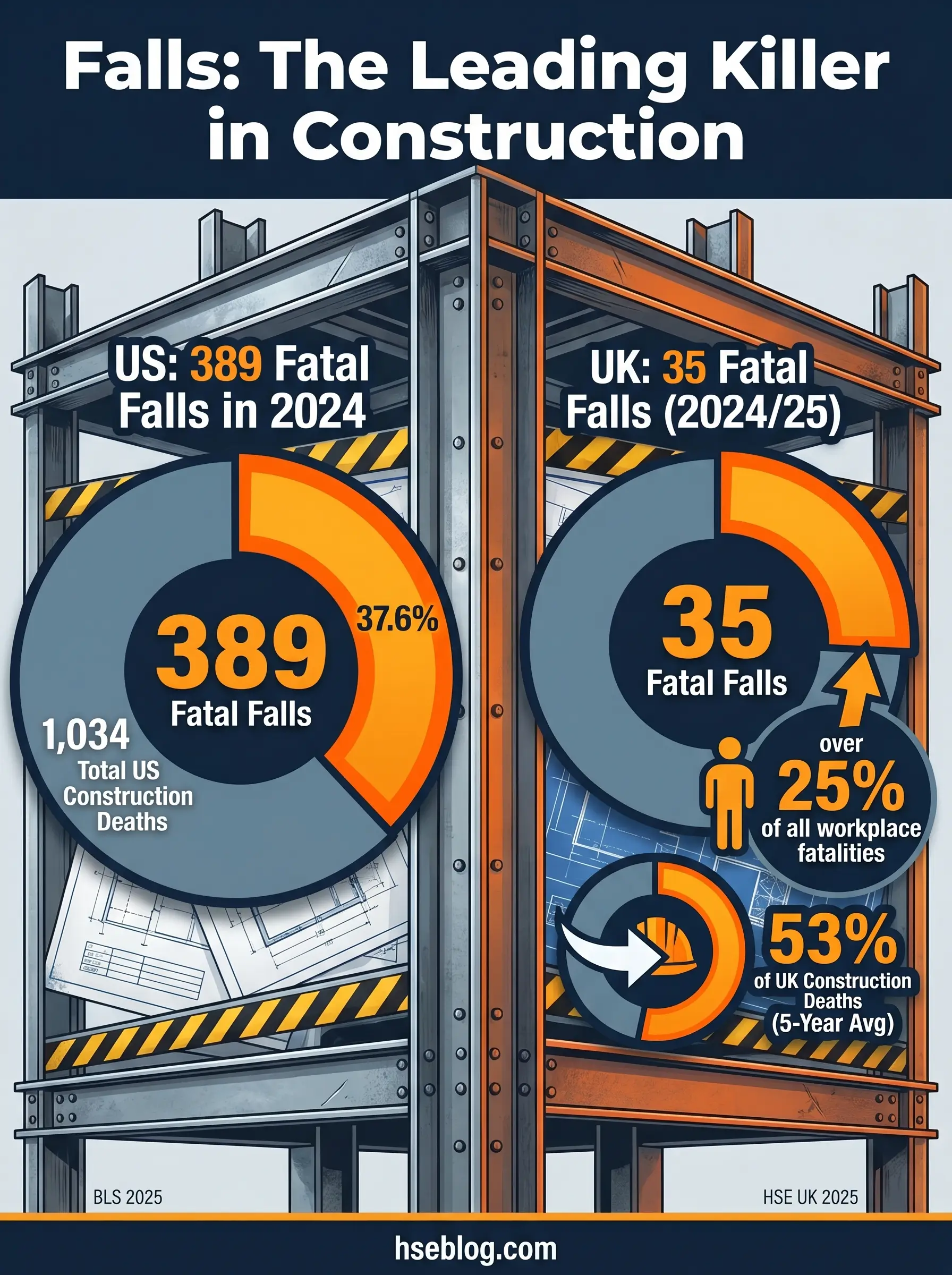
In 2024, 389 workers died from falls to a lower level out of 1,034 total US construction fatalities (US Bureau of Labor Statistics, 2025). Across the Atlantic, 35 workers were killed by falls from height in Great Britain during 2024/25, representing over 25% of all workplace fatalities (UK Health and Safety Executive, 2025). These are not abstract numbers — each one represents a failure in a system that was supposed to keep someone alive while working above the ground.
Structural steelwork erection concentrates fall risk in ways that general construction does not. The work surface is a narrow I-beam flange, often less than 12 inches wide, with open air on both sides. Guardrails do not exist until someone installs them. Anchor points above foot level are frequently unavailable until the structure grows tall enough to provide them. This article applies the fall prevention hierarchy of controls to structural steelwork, covers both US OSHA and UK HSE regulatory frameworks with explicit jurisdictional labelling, addresses equipment selection for the specific challenges steel erectors face, and — critically — treats rescue planning as the mandatory companion to fall arrest that most guidance omits entirely.
Why Falls Remain the Leading Killer in Structural Steelwork
The hazard profile of structural steelwork is fundamentally different from other construction activities, and that difference explains why fall fatalities cluster disproportionately in this trade. Steel erectors work on evolving structures where every surface they stand on was placed minutes or hours earlier, overhead anchorage is structurally unavailable until later erection stages, and the work demands constant movement between connection points.
The raw data confirms the scale. In the US, 260 fatal falls occurred from heights between 6 and 30 feet, with an additional 67 from heights exceeding 30 feet, in construction during 2023 (US Bureau of Labor Statistics, 2024). The concentration of deaths in the 6-to-30-foot band is particularly relevant to steel erection, where much of the work occurs in precisely that range.
In Great Britain, falls from height account for approximately 53% of all worker deaths in construction over a rolling five-year period from 2020/21 to 2024/25 (UK Health and Safety Executive, 2025). OSHA enforcement data reinforces the point: fall protection under 29 CFR 1926.501 was the most cited standard in FY 2024, with construction employers receiving 26,005 citations totalling $119 million in penalties (OSHA, 2024).
What Makes Steel Erection Uniquely Dangerous
Conventional fall protection — guardrails, toe boards, fully decked floors — is designed for static platforms. Steel erection presents three conditions that challenge those assumptions:
- No pre-existing work surface. The steel erector is building the surface. Guardrails cannot be installed on a beam that has not yet been placed.
- Limited overhead anchorage. During early erection stages, there is often nothing above the worker to anchor a fall arrest system to. Anchorage must be planned into the erection sequence itself.
- Constant repositioning. Connectors move from beam to column to beam, bolting connections while traversing narrow flanges. Static tie-off is impractical without systems designed for mobile work.
A pattern visible across published incident reports is that steel erection crews treat mobility as incompatible with 100% tie-off. In practice, it is the erection sequence planning — not the equipment — that creates this perceived conflict. When anchorage points are designed into the raising plan, continuous attachment becomes feasible.
The Hierarchy of Control for Fall Prevention on Steelwork
Every fall protection decision on a steelwork site should begin with the hierarchy of controls — not with equipment selection. The Work at Height Regulations 2005 (UK) explicitly codify this as avoid, prevent, mitigate. OSHA’s framework follows the same logic through the general hierarchy of hazard controls, even though 29 CFR 1926 Subpart R focuses more heavily on prescriptive equipment requirements.
The hierarchy operates in three tiers, each with distinct applications to steelwork:
| Tier | Method | Steelwork Example | Limitation |
|---|---|---|---|
| Elimination | Remove the need to work at height | Pre-assemble steelwork with guardrails at ground level before crane lift | Not feasible for all connections; crane capacity limits assembly size |
| Prevention — Collective | Collective protection preventing falls | Perimeter safety cables, safety nets, fully decked floors within two stories of erection | Requires early design-stage decisions; often omitted when not planned into erection sequence |
| Prevention — Personal | Fall restraint systems | Short lanyard or restraint line preventing worker from reaching an unprotected edge | Limits worker reach; requires anchor points positioned to maintain restraint geometry |
| Mitigation | Fall arrest and consequence reduction | Full-body harness with SRL, safety nets below work level | Does not prevent the fall — only limits its consequence; demands a rescue plan |
The common failure mode I observe in method statements and erection plans across the published record is hierarchy inversion. Crews default to harnesses because elimination and collective protection require decisions made weeks or months earlier — at the design and planning stage. By the time steel arrives on site, the opportunity for elimination has passed, and collective protection was never specified.
Designing Out Height Work: Pre-Assembly and Prefabrication
The most effective fall prevention measure is one that removes the worker from the height entirely. Ground-level pre-assembly — fabricating steelwork sections complete with guardrails, toe boards, and access platforms before craning into position — eliminates a significant proportion of at-height connection work.
BCSA guidance specifically advocates attaching guardrails to steelwork at ground level before lifting. The UK HSE adopts the same approach, recommending that contractors “erect guard rails on steelwork at ground level and then crane the steel and the guard rails into position.”
Three practical applications stand out:
- Modular steelwork assembly — bolting multi-beam sections together at ground level so that the crane lifts a partially assembled frame rather than individual members.
- Pre-attached edge protection — guardrail stanchions welded or bolted to beams during fabrication, folding into position after the lift.
- MEWP substitution — using mobile elevating work platforms for bolt-up and connection work where the structure geometry and ground conditions permit, rather than requiring workers to walk steel.
The judgment call here is between crane capacity and fall risk reduction. Larger pre-assembled sections reduce height exposure but demand heavier lifts, potentially requiring a larger crane or multiple picks. In most operational contexts, the risk reduction justifies the additional cranage cost — but that trade-off must be made explicitly during planning, not assumed.
Fall Protection Requirements for Steel Erection: OSHA vs UK Regulations
Regulatory requirements for structural steelwork fall prevention diverge significantly between the US and the UK, and multinational projects that default to one country’s thresholds without checking the other create compliance gaps. The core difference: OSHA sets a specific trigger height for steel erection; the UK imposes no minimum height at all.
| Requirement | OSHA (US) — 29 CFR 1926.760 | UK — Work at Height Regulations 2005 | Key Difference |
|---|---|---|---|
| Trigger height | 15 ft for steel erection activities | No minimum — applies wherever a fall could cause personal injury | UK is stricter; a 3 m fall can be fatal |
| Connectors (15–30 ft) | Must have completed connector training, be equipped with PFAS and able to tie off, or work in a CDZ | Must use hierarchy: avoid → prevent → mitigate, regardless of height | OSHA provides connector-specific provisions; UK applies general hierarchy |
| Above 2 stories / 30 ft | Full fall protection required, even in CDZs | Already covered — no height exemption exists | No divergence in practice at this height |
| Hierarchy requirement | Implied through general duty but not codified in 1926.760 | Explicitly codified: avoid work at height → prevent falls → mitigate consequences | UK legally mandates hierarchy consideration |
| Design-stage duty | No direct equivalent in Subpart R | CDM Regulations 2015 require designers to eliminate or reduce height risks at design stage | UK pushes fall prevention upstream to design |
| Guardrail height | 42 in (±3 in) per 1926.502 | Minimum 950 mm, with intermediate rail gap not exceeding 470 mm | Comparable, minor dimensional differences |
| Rescue obligation | Prompt rescue required — 29 CFR 1926.502(d)(20) | Implied through duty of care and planning requirements | Both require rescue capability; OSHA is more explicit |
An OSHA interpretation letter from 2011 confirms that there is no “safe distance” from an unprotected edge that waives the fall protection requirement — if a steel erector is above 15 feet, protection is required regardless of how far they are from the edge.
EU Directive 2001/45/EC establishes minimum requirements for temporary work at height equipment across EU member states, supplementing national regulations. For projects with European scope, this directive provides a baseline that national regulations must meet or exceed.
The practical reading of this regulatory landscape: the UK framework is the stricter reference. Applying it as the default standard on any project ensures compliance in both jurisdictions — the reverse is not true.
Controlled Decking Zones: Rules, Boundaries, and Common Errors
A Controlled Decking Zone is not an exemption from fall protection — it is an OSHA-specific provision (29 CFR 1926.760) that substitutes a defined set of controls for conventional fall protection during leading-edge metal decking work between 15 and 30 feet. Misunderstanding that distinction is where CDZ-related incidents begin.
The rules governing CDZs are precise:
- Dimensional limits — the CDZ must be no more than 90 feet wide and 90 feet deep from any leading edge.
- Unsecured decking — no more than 3,000 square feet of unsecured decking may exist within the CDZ at any time.
- Access restriction — only employees engaged in leading-edge work who have completed CDZ-specific training under 29 CFR 1926.761 may enter.
- Height ceiling — fall protection is required above two stories or 30 feet, whichever is less, even within a CDZ.
- Prohibited activities — final deck attachments and installation of shear connectors must not be performed within the CDZ boundary.
- Control lines — the perimeter of the CDZ must be marked by control lines or equivalent means, clearly distinguishing it from the rest of the work area.
Where CDZs Break Down on Active Sites
The published record and enforcement data reveal a consistent set of CDZ failures that repeat across projects:
- Boundary degradation — control lines get displaced by foot traffic, material movement, and crane operations. What started as a defined 90 × 90 ft zone becomes ambiguous within days.
- Access control failure — untrained workers from other trades wander into the CDZ because nobody is actively monitoring entry. The training requirement under 1926.761 is meaningless without physical access control.
- Unsecured decking overshoot — the 3,000 sq ft limit on unsecured decking is exceeded because no one is tracking it in real time. Decking crews work faster than attachment crews, and the gap widens unnoticed.
- CDZ treated as permanent — CDZs are intended for active leading-edge decking work. Once decking is complete and secured, the CDZ designation must be removed and conventional fall protection applies.
The misconception that a CDZ is a “fall protection free zone” persists despite clear regulatory language to the contrary. CDZs replace one set of controls with another — they do not eliminate the obligation.
Equipment Selection for Fall Protection on Structural Steelwork
Equipment selection for steel erection fall protection must follow — not precede — the hierarchy analysis. Once collective protection and elimination options have been evaluated and their limits identified, personal protective equipment fills the remaining gaps. The specific challenge in steelwork is matching equipment to the mobile, elevated, edge-exposed work that connectors and decking crews perform.
Personal Fall Arrest Systems (PFAS)
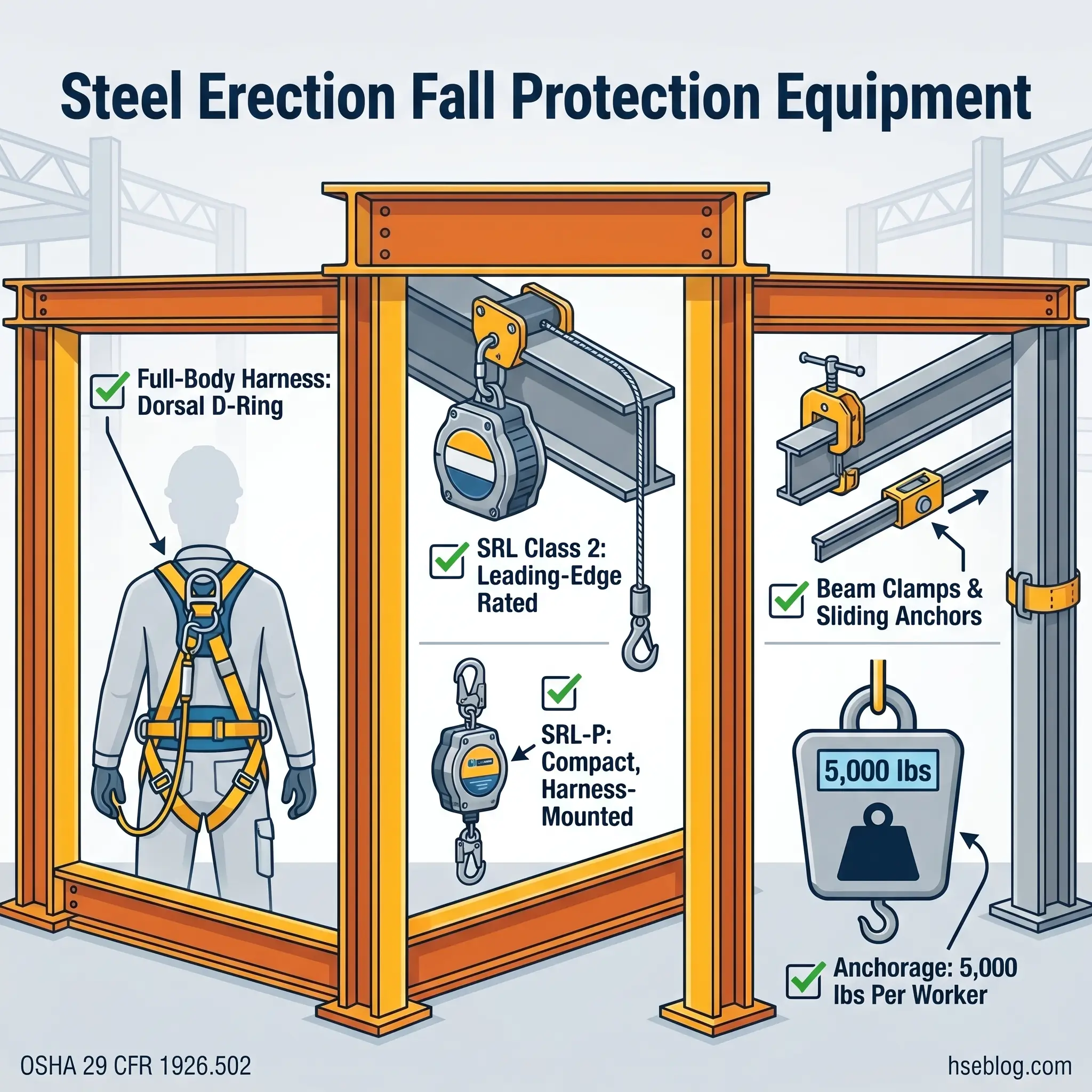
A PFAS comprises three components: a full-body harness, a connecting device (lanyard or self-retracting lifeline), and an anchorage point. Under OSHA 29 CFR 1926.502, each component must work as an integrated system — mixing incompatible components is a cited violation.
The harness must distribute arrest forces across the thighs, pelvis, chest, and shoulders. For steel erection, the dorsal D-ring is the primary arrest attachment point, while hip D-rings serve positioning purposes during column work.
Self-Retracting Lifelines (SRLs)
SRL classification changed significantly under ANSI/ASSP Z359.14-2021, which reclassifies self-retracting devices into SRL, SRL-R (rescue/retrieval), and SRL-P (personal) types, with Class 1 (overhead anchorage) and Class 2 (leading-edge rated) designations.
- Class 1 SRLs are designed for overhead anchorage only, where the anchorage point is above the worker’s head.
- Class 2 SRLs are rated for foot-level anchorage and leading-edge exposure — the condition steel erectors face routinely.
For steel erection work, Class 2 is typically the correct specification. Using a Class 1 device in a leading-edge scenario subjects the lifeline to edge contact during a fall, which it is not designed to survive.
SRL-P (personal SRLs) are compact, harness-mounted devices increasingly adopted for connector mobility. They retract automatically, eliminating trip hazards from trailing lanyards on narrow beams, and allow connectors to move between tie-off points with minimal slack in the system.
Anchorage Options for Structural Steel
Anchorage on steelwork must support 5,000 lbs per attached worker, or be designed, installed, and used under the supervision of a qualified person as part of a complete PFAS that limits arrest forces — a requirement under 29 CFR 1926.502(d)(15).
- Beam clamps — mechanical clamps that attach to steel flanges without welding or drilling; quick to install and reposition as the structure grows.
- Sliding beam anchors — allow horizontal movement along a beam while maintaining anchorage; useful for decking crews traversing long spans.
- Column straps and cross-arm straps — wrap around columns or cross-members; temporary, adjustable, and appropriate for bolt-up work at column-beam connections.
Steel joists and open-web steel joists must never be used as anchorage unless a qualified person has provided written approval — their design load paths are not intended for the eccentric forces a fall arrest generates.
Horizontal Lifelines
For decking crews working across long spans, horizontal lifelines allow multiple workers to move laterally while remaining attached. Critical factors include cable deflection under load (which increases free-fall distance), spacing of intermediate anchors, and the number of workers the system is designed to support simultaneously.
Horizontal lifeline systems on steelwork must be designed by a qualified person — field-rigged wire rope between two columns is not an engineered system and will not perform predictably under arrest loads.
Anchorage Planning Through the Erection Sequence
Anchorage cannot be treated as a site-level decision made the morning work begins — it must be integrated into the erection sequence during planning so that every worker has a viable tie-off point at every stage of the steel raising process.
The key planning principles:
- Align anchor placement with travel paths. If a connector must traverse a beam to reach a connection point, the anchor and lifeline system must cover that path — not just the final work position.
- Raise anchor location to reduce free-fall distance. Anchorage at foot level increases free-fall distance and arrest force. Where the structure permits, anchor points should be positioned at or above the worker’s dorsal D-ring height.
- Eliminate swing fall hazards. If the anchor point is not directly above or in line with the potential fall path, the worker will swing in a pendulum arc. The erection sequence plan must identify where swing falls are possible and either reposition anchors or provide physical barriers.
- Address the transition gap. The most dangerous moments in steel erection are transitions — when a worker disconnects from one anchor to connect to the next. Double-lanyard or dual-leg SRL systems maintain 100% tie-off during transitions.
Equipment Inspection in the Steel Erection Environment
A misconception that recurs across equipment management programs: inspection schedules designed for general construction are adequate for steel erection. They are not.
Welding slag, abrasive steel surfaces, sharp bolt ends, and the constant dragging of lanyards and SRLs across raw steel degrade fall protection equipment far faster than office-tower or platform work. ANSI/ASSP Z359.1-2024, which became effective July 1, 2025, updated requirements for managed fall protection programs including inspection protocols — reinforcing that inspection frequency must be tied to exposure conditions, not calendar intervals.
What Is a Fall Rescue Plan and Why Does Steel Erection Demand One?
A fall rescue plan is a documented, site-specific procedure for retrieving a worker who has been arrested by a personal fall arrest system and is now suspended in their harness. Under OSHA 29 CFR 1926.502(d)(20), employers must provide for prompt rescue of employees in the event of a fall. The rescue plan is not an optional addendum to the fall protection plan — it is the mandatory second half.
The Suspension Trauma Threat
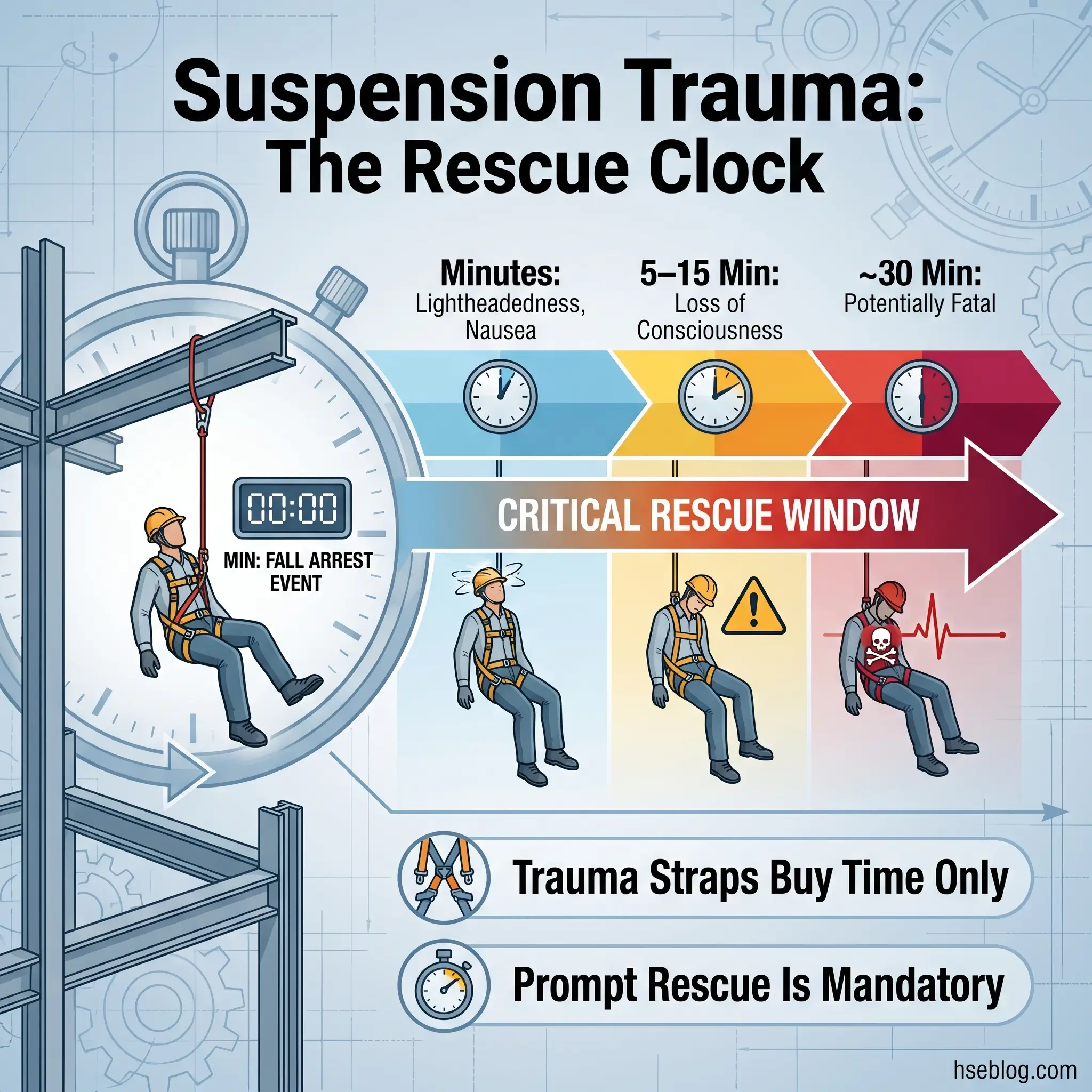
When a worker hangs motionless in a full-body harness, the leg straps compress the femoral veins. Blood pools in the legs, venous return to the heart drops, and orthostatic intolerance develops.
The clinical progression is severe:
- Within minutes — reduced blood flow causes lightheadedness, nausea, and elevated heart rate.
- Within 5–15 minutes — the worker may lose consciousness, becoming unable to self-rescue.
- Within approximately 30 minutes — suspension trauma can be fatal if the worker is not rescued and placed in a position that restores circulation.
Suspension relief straps — simple webbing loops the worker deploys to stand in and relieve leg-strap pressure — buy critical time but are not a substitute for rescue. They require the worker to be conscious and able to use them.
Why Steel Erection Makes Rescue Exceptionally Difficult
The rescue plan gap is the most common systemic failure in steel erection fall protection. Teams invest in harnesses, SRLs, and anchorage systems, then have no documented or practised plan for retrieving a suspended worker from an open structure with the following conditions:
- No floors. The steel frame may have no decked levels below the suspended worker, meaning there is no platform from which to conduct a retrieval.
- Incomplete access. Stairways and ladders may not yet be installed. Rescue personnel cannot simply walk to the worker’s location.
- Limited crane availability. The erection crane may be under load or repositioning. Relying on the erection crane as the rescue mechanism is a single-point-of-failure plan.
Rescue Plan Essentials
A site-specific rescue plan for steel erection should address:
- Primary rescue method — aerial lift (boom lift or scissor lift) staged nearby with a trained operator, or a retrieval system with mechanical advantage that can lower the worker to a safe level.
- Backup rescue method — what happens if the primary method is unavailable (crane breakdown, aerial lift cannot reach the location, wind conditions).
- Trained rescue personnel — designated, on-site, practised in the specific rescue procedure. “Call 911” is not a rescue plan — municipal emergency services are rarely trained or equipped for high-steel rescue.
- Communication protocol — how the fall is detected, who is notified, and how rescue is initiated.
- Suspension relief — all workers equipped with trauma straps and trained to deploy them.
- Practice drills — the plan must be rehearsed, not just written. A rescue plan that has never been practised is a document, not a capability.
The OSHA Fall Prevention Campaign emphasises the plan-provide-train framework, and rescue sits squarely within that structure.
Training and Competence Requirements for Steel Erection at Height
Completing a training course is not the same as being competent — and confusing the two is one of the most persistent failures in steel erection safety management. Training delivers knowledge; competence requires the supervised application of that knowledge to the specific task, structure type, and site conditions the worker will face.
OSHA and UK regulations take different but complementary approaches:
- OSHA 29 CFR 1926.761 requires fall hazard training for all employees exposed to fall hazards during steel erection, plus special training programs for connectors (who work at height between columns and beams), CDZ workers, and multiple-lift rigging crews.
- UK Work at Height Regulations 2005 require that all work at height be carried out by persons who are competent — defined as having sufficient training, knowledge, and experience for the specific task. This is a performance-based standard rather than a prescriptive training syllabus.
- BCSA guidance adds a practical layer: supervision must be provided by persons suitably trained and experienced in the type and size of structure being erected. A supervisor experienced in portal-frame erection is not automatically competent for multi-storey steel-frame work.
The Competent Person Role
The competent person designation carries specific weight in steel erection fall protection:
- Equipment inspection — the competent person verifies that harnesses, SRLs, lanyards, and anchorage devices are in serviceable condition before each shift.
- Anchor selection verification — confirming that specified anchorage points are structurally adequate for the loads they will carry during fall arrest.
- Site-specific hazard assessment — identifying conditions not anticipated in the general method statement, including weather changes, crane proximity, adjacent-trade conflicts, and altered erection sequences.
Refresher Training Triggers
Training is not a one-time event. Refresher training should be triggered by:
- Equipment changes — introduction of new SRL types, new anchorage systems, or updated harness models.
- Procedure changes — modified erection sequences, new rescue methods, or changes to the CDZ configuration.
- Observed deficiencies — a competent person or supervisor identifies workers not following established procedures.
- Incidents or near misses — any fall event, arrested or otherwise, triggers a review of whether training gaps contributed.
Pre-Erection Planning: Integrating Fall Prevention into the Method Statement
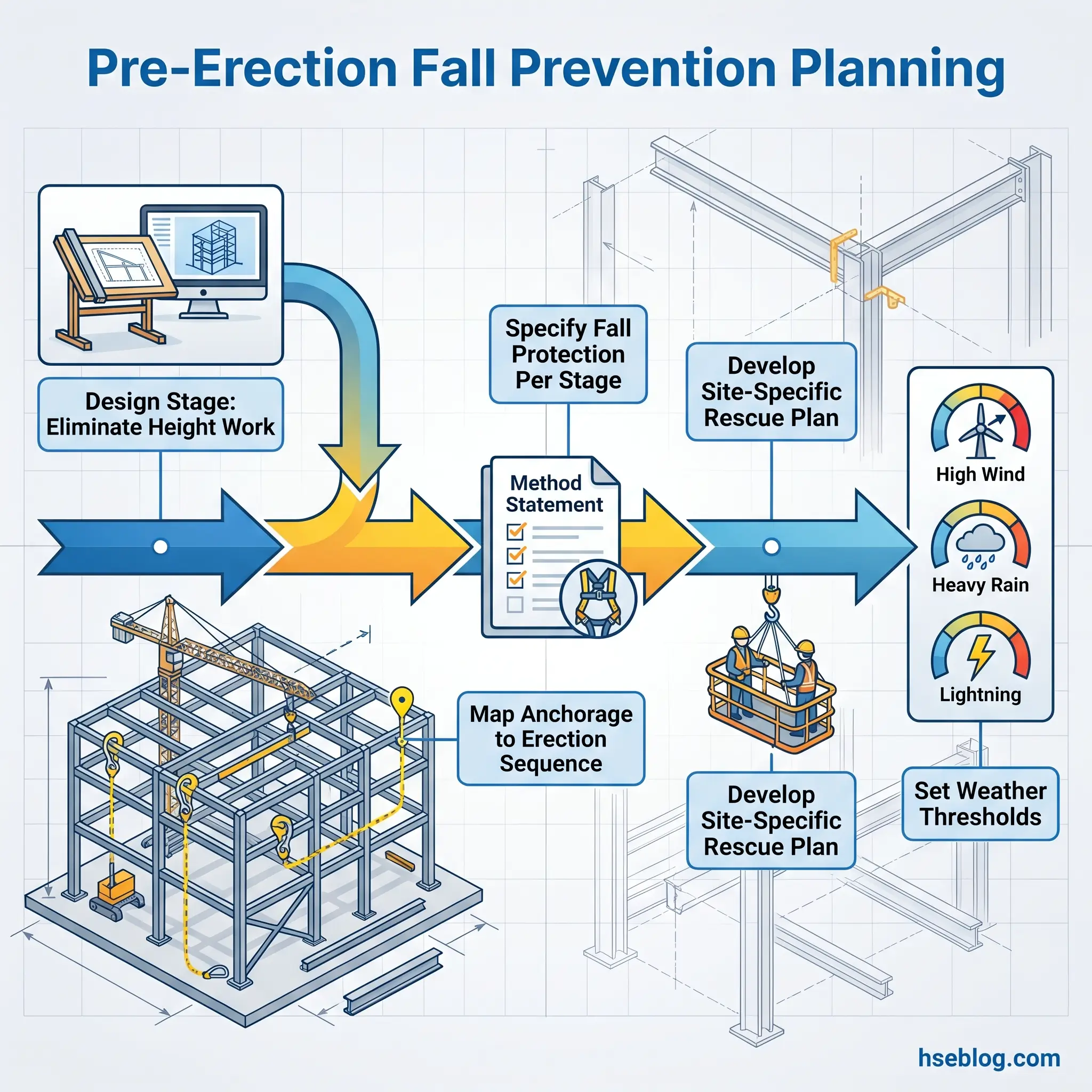
Fall prevention that begins on site is already too late. The method statement for steel erection must integrate fall protection decisions at the planning stage, accounting for the site-specific geometry, crane positions, erection sequence, and access routes that determine whether stated fall protection measures are actually feasible.
Method Statement Elements for Fall Prevention
A site-specific erection plan should address the following as minimum content:
- Erection sequence — the order in which steel members are placed, with anchorage availability mapped to each stage.
- Crane positions and reach — confirming that crane placement does not block access routes or conflict with fall protection systems.
- Temporary works — any temporary bracing, shoring, or supports needed during erection, including temporary anchorage for fall protection.
- Fall protection provisions per stage — what system (elimination, collective, personal) applies at each erection stage, and what triggers the transition to the next system.
- Access routes — how workers reach their work positions at each stage, and how fall protection is maintained during travel.
- Rescue provisions — rescue method, equipment location, personnel designation, and practice schedule.
- Weather thresholds — wind speed limits for steel erection (BCSA guidance addresses this), and protocols for ice or frost on steel surfaces, which eliminate friction and make beam-walking exponentially more dangerous.
Controlling Contractor / Principal Contractor Coordination
Under OSHA, the controlling contractor is responsible for reasonable care in ensuring that fall protection obligations are met across all subcontractors on the steel erection site. Under UK CDM Regulations 2015, the principal contractor plans, manages, and coordinates health and safety during construction — including the interface between the steelwork contractor and subsequent trades.
A critical coordination point: OSHA 29 CFR 1926.760(e) addresses the handover of fall protection responsibility from the steel erector to subsequent trades. Once the steel erector completes their scope, the controlling contractor must ensure that fall protection for the erected structure is maintained for all workers who follow — decking crews, MEP trades, cladding installers.
Method statements for steel erection frequently become generic templates carried from project to project. The critical value is in site-specific detail — column heights, bay sizes, crane reach limitations, access routes, adjacent structures — that determines whether the fall protection measures described on paper can be executed on that specific site. HSE guidance on assessing work at height provides a practical framework for this site-specific assessment.
Frequently Asked Questions
Conclusion
Structural steelwork fall prevention fails when it is treated as an equipment decision rather than a system. The hierarchy of controls — elimination through pre-assembly, prevention through collective and personal protection, mitigation through fall arrest — must be applied as a genuine decision framework during the planning stage, not as a retrospective justification for defaulting to harnesses. OSHA’s eTool for steel erection fall protection reinforces this structure, but the real test is whether it survives first contact with the erection sequence on a specific site.
The gap that costs lives is not equipment — it is rescue. OSHA’s National Emphasis Program on Falls, launched in May 2023 and continuing through 2024–2025, investigated 189 fatal falls in FY 2024, a 19% reduction from FY 2023 (OSHA, 2024). The trend is positive, but each of those 189 deaths began with a plan that either lacked rescue provisions or contained a rescue plan that had never been practised. A fall arrest system without a rescue plan is half a system — and the half that’s missing is the half that determines whether the worker comes home.
Every steel erector suspended 60 feet above grade in a full-body harness, on a structure with no floors and no stairways, is relying on someone else’s planning. That plan — the anchorage mapped to the erection sequence, the SRL rated for leading-edge exposure, the rescue lift staged and crewed, the trauma straps trained on — is the difference between a controlled event and a fatality.