
TL;DR
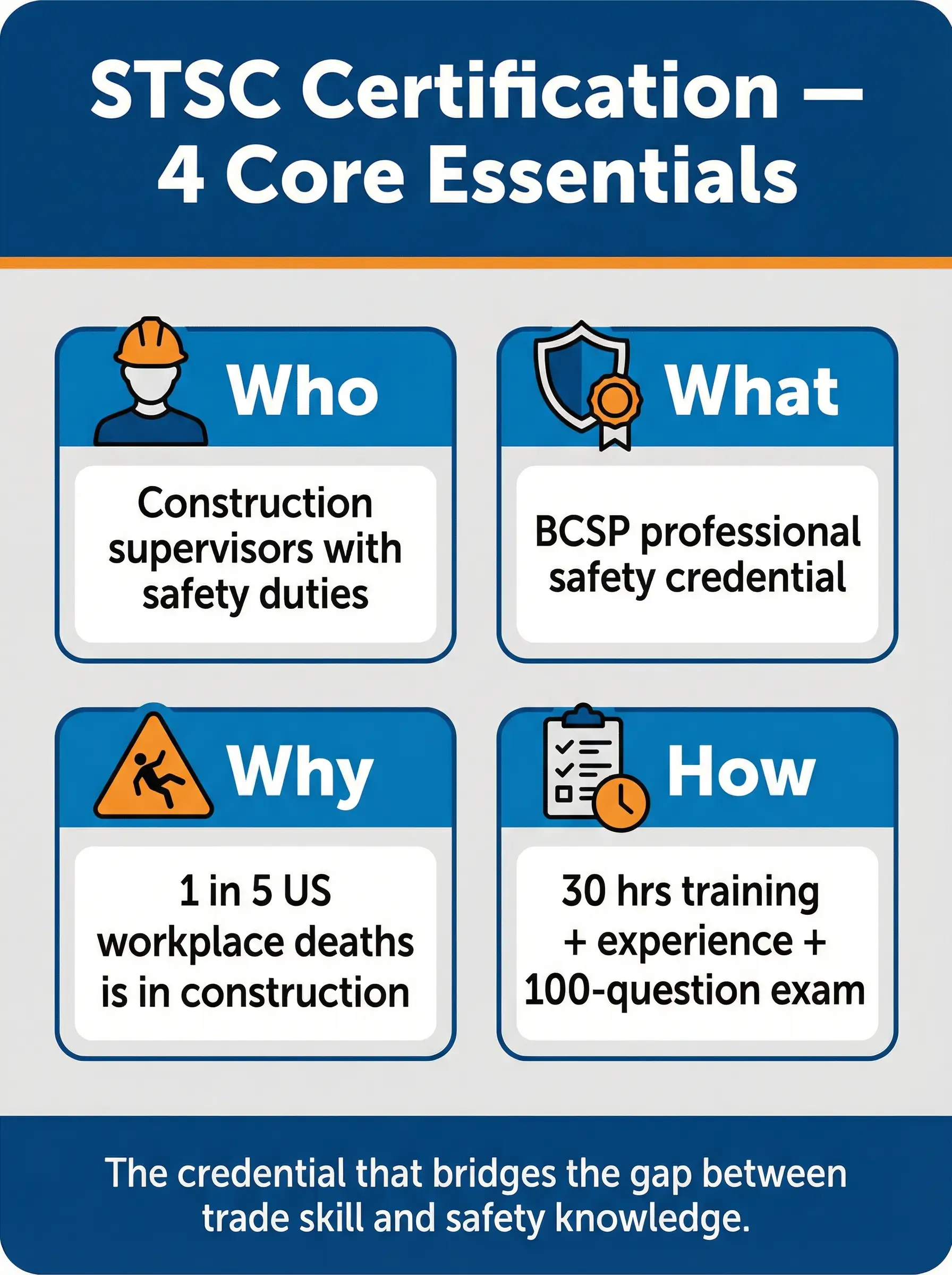
- What it is: The Safety Trained Supervisor Construction (STSC) is a professional credential issued by the Board of Certified Safety Professionals (BCSP) that validates a construction supervisor’s applied knowledge in jobsite safety, hazard identification, and safety leadership.
- Who needs it: Construction supervisors, superintendents, forepersons, crew chiefs, project managers, and craftspeople who carry safety responsibilities — even when safety is not their primary job duty.
- Key requirements: A minimum of 30 hours of formal safety training, plus either two years of supervisory experience, four years of construction work experience, a relevant associate degree or higher, or completion of a two-year trade apprenticeship.
- The exam: 100 multiple-choice questions across five domains, two hours, administered at Pearson VUE testing centers worldwide, with a $185 exam fee and a $120 application fee.
- Why it matters: Construction accounts for roughly one in five workplace fatalities in the United States — the STSC equips the people closest to the hazards with the knowledge to prevent them.
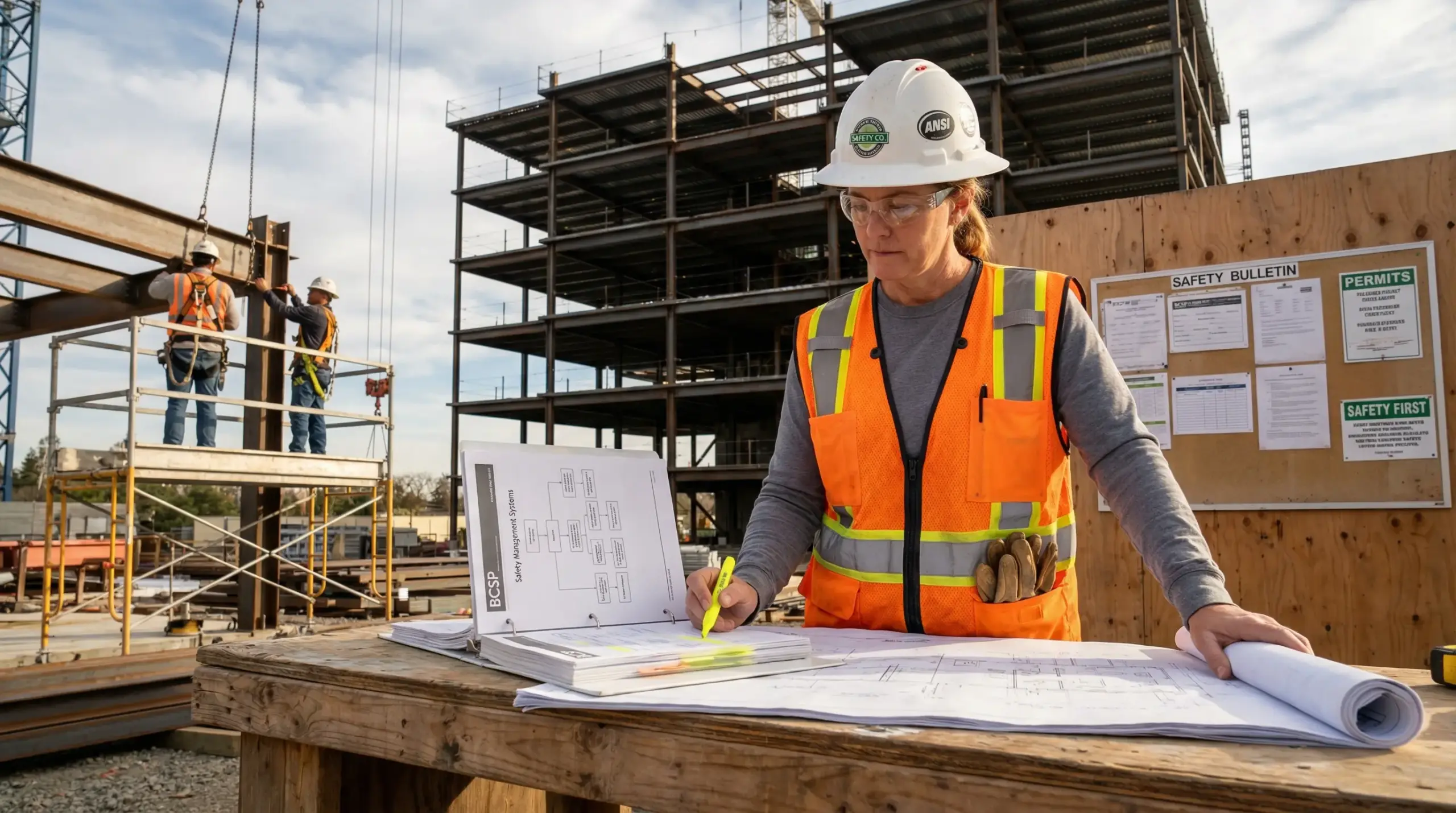
I was standing on the third floor of a commercial building project in the American Midwest, watching a crew strip formwork without a single fall protection anchor point in sight. When I stopped the work and asked the foreman why his crew was unclipped, he gave me a look I’ve seen a hundred times — not defiance, just genuine confusion. “Nobody told me they needed tie-off above two stories,” he said. He had 14 years of experience. He ran a tight crew. He simply didn’t know what he didn’t know, and that gap between trade competence and safety knowledge is exactly where people get killed.
That foreman is the reason the STSC certification exists. Falls from elevation remain the leading cause of death for construction workers, accounting for 389 of the 1,034 construction fatalities recorded in 2024 according to BLS data. The construction industry carries the grim distinction of recording roughly one in five workplace deaths in the United States. These are not abstract statistics — they represent supervisors who didn’t recognize the hazard, crews who weren’t briefed, and controls that were never implemented because the person in charge lacked the foundational safety knowledge the STSC is designed to build. This article covers everything you need to know about the STSC certification: what it is, who it’s designed for, what the exam covers, how to qualify, and why this credential is increasingly becoming a baseline expectation on construction projects worldwide.
What Is the STSC Certification?
The Safety Trained Supervisor Construction (STSC) is a professional certification issued by the Board of Certified Safety Professionals (BCSP), the most recognized credentialing body for safety, health, and environmental professionals in North America. BCSP has over 6,000 individuals who actively hold the STSC credential. It is not a training course or a certificate of attendance — it is a competency-based credential that requires candidates to demonstrate applied safety knowledge through a proctored examination.
The STSC is specifically designed for construction industry personnel whose primary role is a craft, trade, technical specialty, or supervisory function — but who also carry safety responsibilities on the jobsite. STSC candidates often have safety duties that are adjunct, collateral, or ancillary to their main job responsibilities, covering tasks such as hazard monitoring, regulatory compliance, employee training, safety documentation, and coordinating hazard corrections.
This distinction matters. The STSC does not attempt to turn a superintendent into a full-time safety professional. It aims to give that superintendent enough structured safety knowledge to recognize hazards, implement basic controls, communicate safety expectations, and know when to call in the specialists. I’ve audited projects where the site superintendent held the STSC and projects where nobody in the chain of command had any formal safety credential beyond an OSHA 30-Hour card. The difference in hazard recognition, documentation quality, and incident response was measurable.
BCSP credentials are recognized as the standard for safety credentialing. The STSC sits within a family of BCSP certifications — including the CSP, CHST, OHST, STS, and ASP — each targeting different levels of safety responsibility and industry focus. — [External Link: https://www.bcsp.org/credentials-at-a-glance]
Pro Tip: Don’t confuse the STSC with the OSHA 30-Hour Construction card. The OSHA 30-Hour is an awareness-level training course with no exam and no prerequisite experience. The STSC is a proctored, competency-based certification that requires verified work experience and ongoing recertification. They serve completely different purposes — and project owners increasingly know the difference.
Who Needs the STSC Certification?
The short answer is any construction professional who supervises people, coordinates work, or makes decisions that affect worker safety on a jobsite — even if “safety” isn’t in their job title. But the practical reality is more nuanced than that, and I’ve seen the credential benefit some roles far more than others.
The following roles gain the most from earning the STSC, based on what I’ve observed across large-scale EPC projects, commercial construction, and civil infrastructure work:
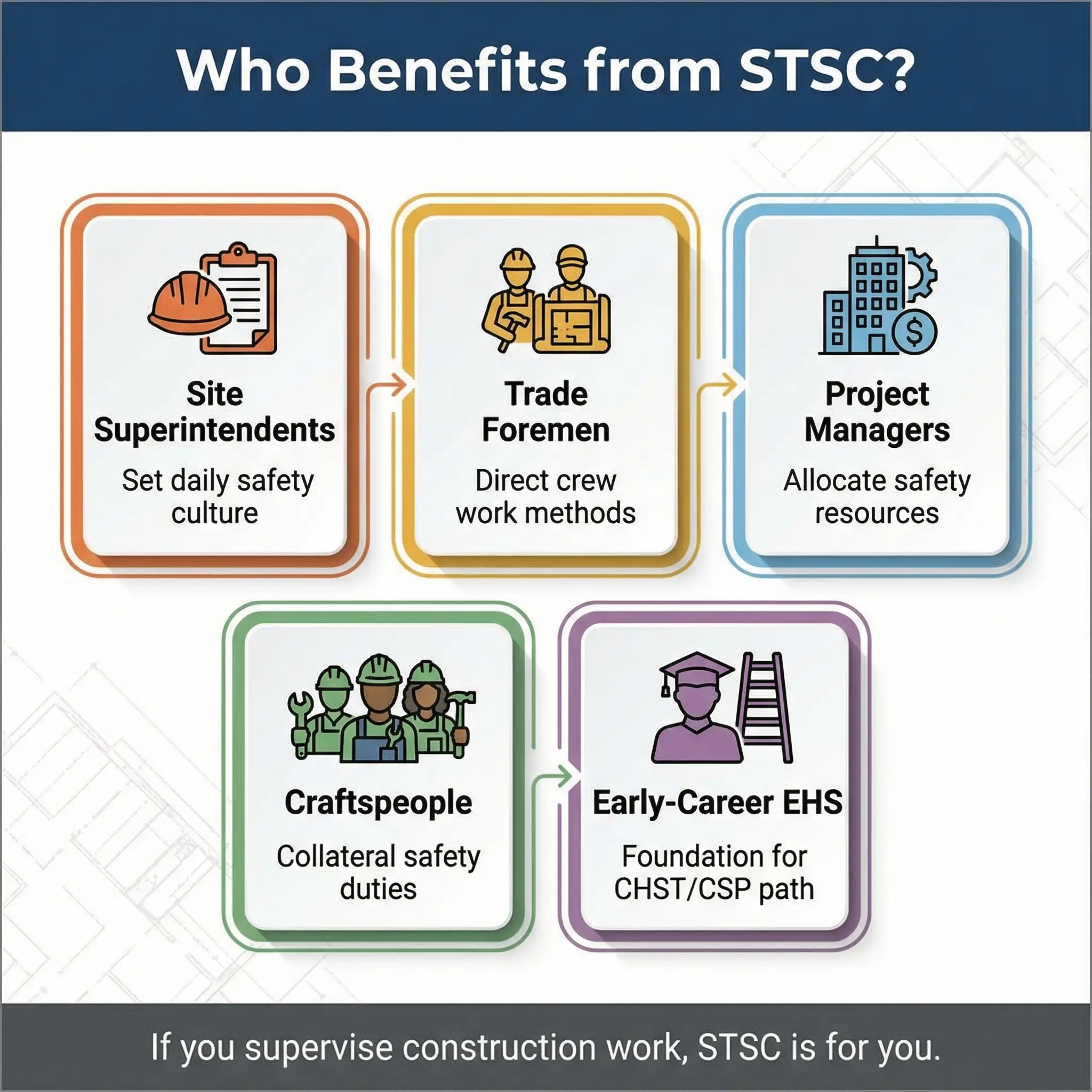
- Site superintendents and general foremen: These are the people who set the daily pace and culture. When they understand hazard controls at a technical level, crews follow. When they don’t, safety becomes someone else’s problem.
- Trade foremen and crew chiefs: Electricians, ironworkers, pipefitters, concrete crews — any trade lead who directs others and has de facto authority over how work is performed.
- Project managers and construction managers: They may not swing a hammer, but they allocate resources, approve schedules, and make trade-off decisions that directly impact safety conditions on the ground.
- Craftspeople with collateral safety duties: On many jobsites, especially smaller operations, experienced workers are assigned safety observation, toolbox talk delivery, or incident reporting responsibilities without any formal credential to back it up.
- EHS professionals early in their construction career: The STSC serves as a foundational credential before pursuing the CHST or CSP, building construction-specific knowledge that the broader certifications assume you already have.
When the STSC Becomes a Job Requirement
There’s a growing trend I’ve tracked over the past several years — general contractors, owner-operators, and procurement teams are writing STSC certification (or equivalent BCSP credentials) into bid requirements and supervisor qualification matrices. I’ve reviewed contractor prequalification packages on infrastructure projects in North America and the Gulf where the scoring rubric awarded bonus points for STSC-certified supervision.
The logic is simple. A superintendent with the STSC has demonstrated — through examination, not just attendance — that they understand fall protection requirements, excavation hazard controls, electrical safety standards, and emergency response procedures. That’s a lower-risk hire for any project owner.
STSC vs. Other BCSP Construction Certifications
One of the most common questions I get from supervisors exploring credentialing options is whether they should pursue the STSC, the CHST, or the STS. They are related but serve distinctly different audiences and career stages.
The following comparison breaks down the key differences based on target audience, experience requirements, and professional focus:
| Feature | STSC | CHST | STS |
|---|---|---|---|
| Target Audience | Construction supervisors with collateral safety duties | Full-time or part-time construction safety practitioners | Supervisors/leaders in any industry |
| Safety as Primary Duty? | No — safety is secondary to trade/supervision role | Yes — minimum 35% of duties must be safety-related | No — safety is secondary to leadership role |
| Experience Required | 2 yrs supervisory or 4 yrs construction work | 3 yrs in construction safety | 2 yrs supervisory or 4 yrs work in any industry |
| Training Prerequisite | 30 hours of formal safety training | None specified (experience-based) | 30 hours of formal safety training |
| Exam Length | 100 questions / 2 hours | 200 questions / 4 hours | 100 questions / 2 hours |
| Exam Fee | $185 | $185 | $185 |
| Industry Focus | Construction-specific | Construction-specific | General industry |
| Career Path | Foundation credential → CHST → CSP | Mid-level credential → CSP | Foundation credential (general) |
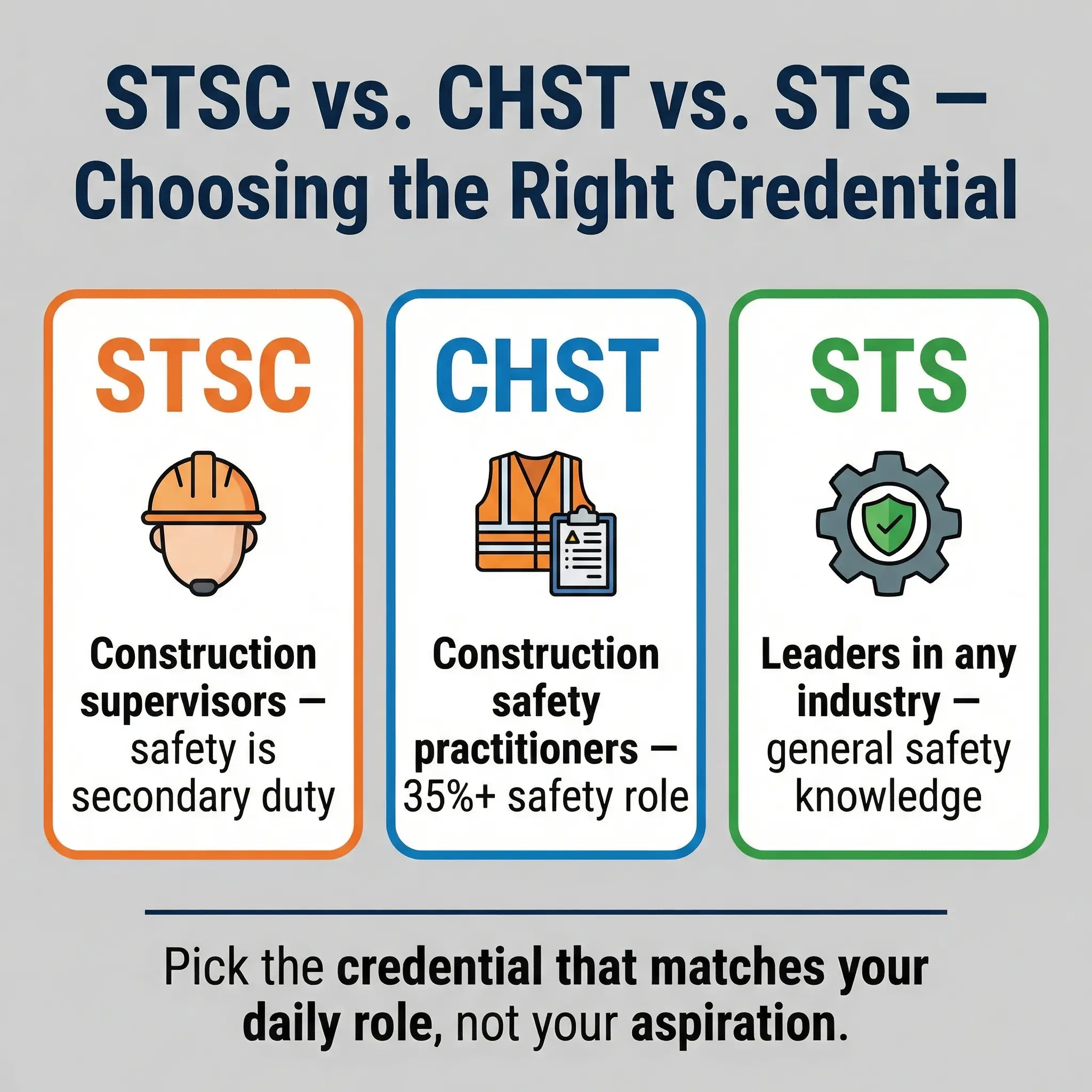
The STSC is similar to the STS but tailored specifically for construction supervisors — those who make decisions that impact employee safety on the job site. The CHST, on the other hand, is designed for individuals who work on construction sites and spend at least 35% of their time on construction safety tasks.
Here’s my practical guidance on selection. If you are a foreman, superintendent, or project manager who directs construction work and carries some safety responsibility but safety is not your primary function, the STSC is your credential. If you are a dedicated site safety officer or health and safety coordinator spending the majority of your time on safety activities, start with the CHST. The STS is appropriate if you work outside construction or hold a general management role across multiple industries.
Pro Tip: The STSC credential counts toward eligibility for higher BCSP certifications. Recertification for the STSC can be fulfilled through 30 hours of safety and health courses, or by earning the CIT, STS, CHST, OHST, ASP, SMS, or CSP credential. Think of it as the first rung on a credentialing ladder, not a dead end.
STSC Eligibility Requirements — What You Need Before You Apply
BCSP does not allow anyone to simply register and sit for the exam. There is a formal application process with verified eligibility criteria, and I’ve seen applicants rejected for incomplete documentation more often than you’d expect.
Candidates must satisfy both of the following requirements to be eligible for the STSC examination:
Requirement 1: Safety Training (Mandatory for All Applicants)
Every STSC applicant must document a minimum of 30 hours of formal safety, health, and environmental training. This is non-negotiable and must be completed before application submission.
Qualifying training includes a broad range of formats, and BCSP is reasonably flexible on what counts:
- OSHA 10-Hour and 30-Hour construction courses — the most common pathway
- Company-delivered internal safety training programs — toolbox talks alone don’t qualify, but structured programs with documented hours do
- Industry conferences and safety seminars — sessions must be safety-focused, not general project management
- University or technical college safety courses — including distance learning
- Trade union safety training programs — apprenticeship safety modules typically count
- NEBOSH, IOSH, or other internationally recognized safety courses — BCSP evaluates these on a case-by-case basis
The 30 hours can be accumulated across multiple courses and providers — it does not need to come from a single program.
Requirement 2: Experience (One of the Following)
In addition to the training requirement, applicants must meet one of these experience pathways:
- Two years of supervisory experience in any construction role — this is the most common pathway for foremen and superintendents
- Four years of construction-related work experience — must be a minimum of 18 hours per week to qualify as part-time
- An associate degree or higher in occupational safety, risk management, or construction management
- Completion of a two-year trade or union training program/apprenticeship
I want to emphasize the 18-hour minimum for part-time work experience. I’ve reviewed applications where candidates submitted seasonal or sporadic employment that didn’t meet this threshold, and BCSP will reject it.
Pro Tip: Start gathering your training certificates and employment verification letters early. BCSP may request supporting documentation during the application review, and digging through old company records under a deadline creates unnecessary stress.
What Does the STSC Exam Cover? The Five Blueprint Domains
The STSC examination is built around a formal blueprint that defines exactly what knowledge areas are tested and how heavily each domain is weighted. Understanding this blueprint is critical for effective preparation — and in my experience, candidates who study without reviewing the blueprint first tend to over-prepare in areas that carry less weight and under-prepare in areas that carry more.
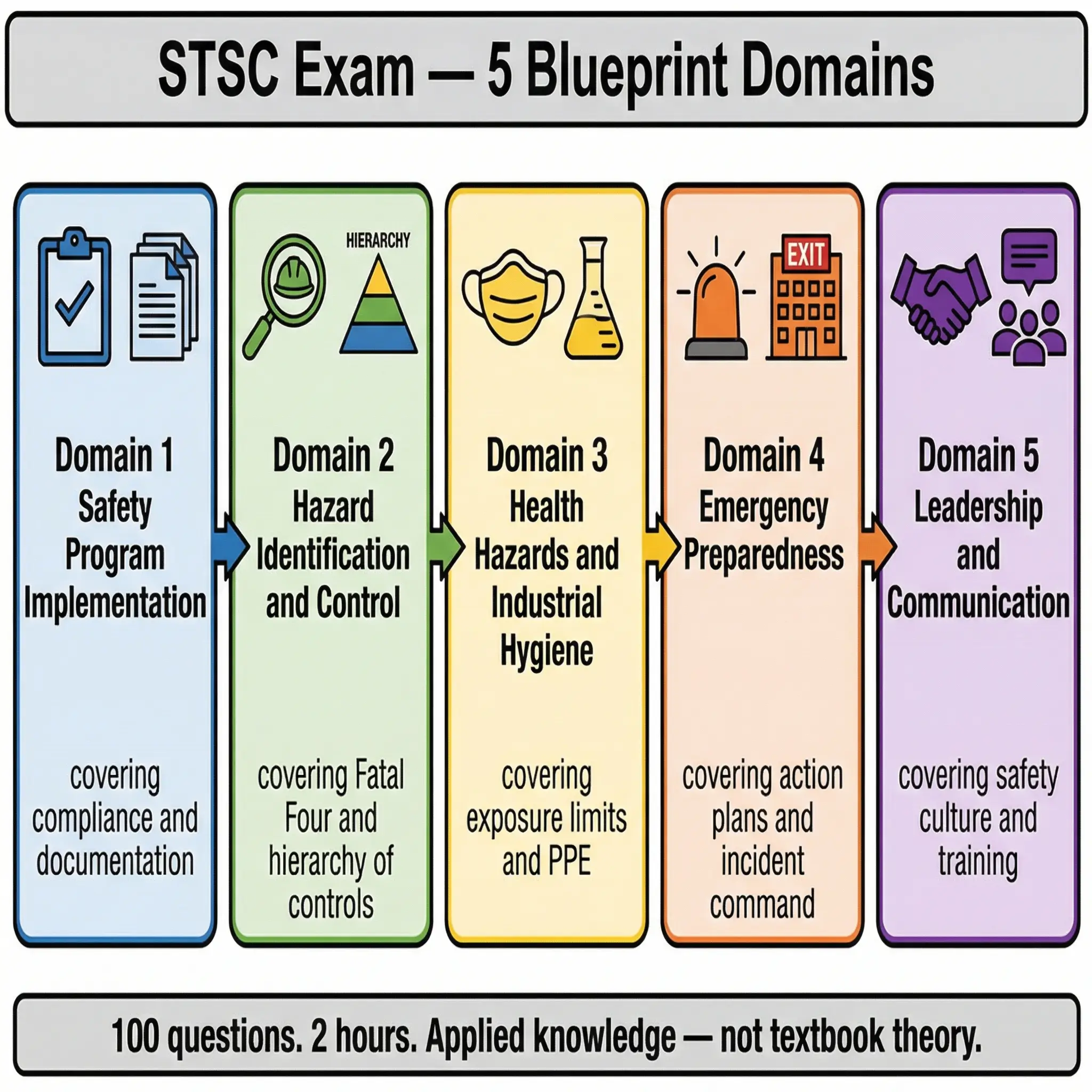
The STSC exam is a two-hour test consisting of 100 multiple-choice questions designed to examine applied knowledge and experience gained through professional practice. Questions are not purely theoretical — they test your ability to apply safety principles to realistic construction scenarios.
The five exam domains, based on the current BCSP blueprint, cover the full spectrum of what a competent construction supervisor needs to know:
Domain 1: Safety Program Implementation
This domain tests your understanding of how safety management systems function on a construction project — not as abstract theory, but as operational reality. Expect questions on safety program elements, regulatory compliance obligations, incident investigation and documentation, inspection and audit processes, and contractor safety management.
During an audit of a highway bridge project in the southeastern United States, I found that the site superintendent could recite the company’s safety policy from memory — but had no idea how the incident investigation procedure actually worked. He’d never filled out a root cause analysis form. That’s exactly the gap this domain targets.
Domain 2: Hazard Identification and Control
This is the heaviest domain on the exam and the most directly applicable to daily site operations. It covers the construction “Fatal Four” — falls, struck-by, caught-in/between, and electrocution — along with excavation hazards, scaffolding, crane and rigging operations, fire prevention, confined spaces, demolition, and the hierarchy of controls applied to construction-specific scenarios.
Key regulatory standards tested include OSHA 29 CFR 1926 Subparts C through X, covering everything from fall protection (Subpart M) to electrical safety (Subpart K) to excavations (Subpart P).
Domain 3: Health Hazards and Basic Industrial Hygiene
Construction supervisors often underestimate this domain, which covers occupational health exposures including noise, silica dust, lead, asbestos, heat stress, chemical hazards, and the fundamentals of exposure assessment. Questions test your understanding of occupational exposure limits (PELs, TLVs), biological monitoring, PPE selection for health hazards, and the basics of Safety Data Sheet (SDS) interpretation under GHS/HazCom.
Domain 4: Emergency Preparedness and Management
This domain covers emergency action planning, evacuation procedures, fire protection systems, first aid and medical program requirements, and incident command fundamentals. The exam tests whether you can develop and implement emergency response plans — not just whether you know one exists.
Domain 5: Leadership, Communication, and Training
The final domain addresses the human side of construction safety — motivating workers, delivering effective safety communication, conducting toolbox talks and safety orientations, understanding adult learning principles, managing resistance to safety practices, and exercising stop-work authority.
I consider this the most undervalued domain. Technical hazard knowledge means nothing if a supervisor can’t communicate expectations clearly, motivate crew compliance, or stand firm when production pressure overrides safety.
The STSC Application and Exam Process — Step by Step
The application-to-certification journey involves several distinct stages, and each has specific timelines and requirements that candidates must track carefully.
The following steps walk through the complete process from initial application to credential award:
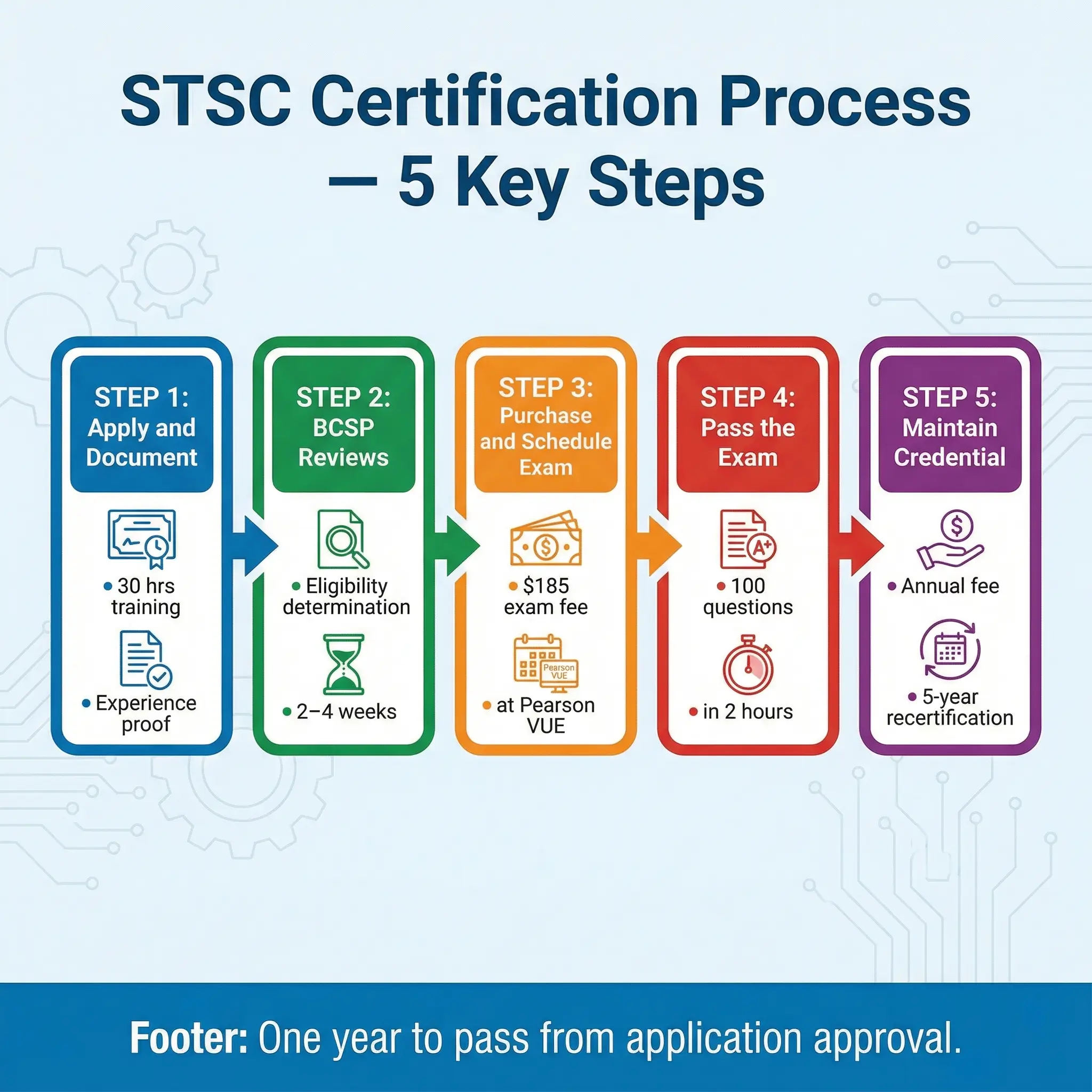
- Create a BCSP account at bcsp.org through the My Profile portal. This is your central hub for applications, exam purchases, and credential management.
- Complete and submit your application with documentation of your 30 hours of safety training and your qualifying experience pathway. Pay the $120 application fee at submission.
- Wait for BCSP review and eligibility determination. BCSP staff review submitted materials and may request additional documentation. Approval timelines vary but typically take two to four weeks.
- Purchase your exam authorization once approved. The STSC examination costs $185 for a single attempt. You have one year from application approval to schedule and pass the exam.
- Schedule your exam at a Pearson VUE testing center. Pearson has hundreds of test centers located around the world. You must allow at least six weeks between exam attempts if you need to retake.
- Sit for the exam — 100 multiple-choice questions, two hours, computer-based with immediate preliminary results.
- Receive your STSC credential upon passing. You are now a BCSP certificant and may use the STSC designation after your name.
Maintaining Your STSC — Recertification Requirements
Earning the STSC is not a one-time event. BCSP requires ongoing professional development to maintain the credential, and I’ve seen people lose their certification simply because they forgot to track their recertification points.
The maintenance requirements include the following ongoing obligations:
- Annual maintenance fee — required to retain use of the STSC credential
- Recertification every five years — all credential holders must remain current with changes in professional practice and demonstrate continuing education activities to earn the recertification points required every five years
- 30 hours of safety and health training within each five-year cycle satisfies the recertification requirement, or you can earn recertification credit through other BCSP-approved activities
Pro Tip: Track your continuing education hours from the day you earn the credential — not six months before recertification is due. I maintain a simple spreadsheet with course name, provider, date, hours, and certificate file location. It takes five minutes per entry and saves hours of panic later.
How to Prepare for the STSC Exam — Field-Tested Strategies
I’ve mentored over a dozen supervisors through the STSC exam process, and the ones who passed on the first attempt all did the same three things: they studied the blueprint before choosing study materials, they focused on applied knowledge over memorization, and they took timed practice exams under realistic conditions.
The following preparation strategies are based on what actually works — not what looks good in a study plan:
- Download and study the BCSP STSC Exam Blueprint first. This document tells you exactly what percentage of questions come from each domain. It is available free on the BCSP website. Every hour of study should be traceable back to a blueprint topic. [External Link: https://www.bcsp.org/safety-trained-supervisor-construction-stsc]
- Use the BCSP examCORE program as your primary study resource. The examCORE course provides in-depth information on each area of the STSC blueprint, featuring pre- and post-assessments along with learning modules designed to prepare candidates for the exam. It includes over 1,000 practice questions.
- Supplement with a study guide and practice exams. Third-party prep courses from providers like ClickSafety and ISSM offer structured workshops, workbooks, and timed practice exams that simulate the real exam environment.
- Focus on OSHA 29 CFR 1926 — construction standards. The exam draws heavily from these regulations. You don’t need to memorize every subpart, but you must understand the principles behind fall protection (Subpart M), scaffolding (Subpart L), excavations (Subpart P), electrical safety (Subpart K), and crane/derrick operations (Subpart CC).
- Study the hierarchy of controls as it applies to construction hazards. Every domain assumes you understand elimination, substitution, engineering controls, administrative controls, and PPE — and can apply them to real site scenarios.
- Take at least three full-length timed practice exams under conditions that mirror the real test — two hours, no interruptions, no reference materials. Your score trend across these practice exams is the most reliable predictor of your actual exam performance.
Common Mistakes That Cause STSC Exam Failure
I’ve debriefed candidates who failed the STSC, and the failure patterns are consistent. Understanding these mistakes is as valuable as any study material.
- Over-relying on field experience without studying the standards. Experienced supervisors assume their practical knowledge will carry them through. The exam tests applied knowledge of specific OSHA standards and safety management principles — not just common sense.
- Ignoring Domain 3 (Health Hazards and Industrial Hygiene). Construction supervisors tend to focus on physical hazards and neglect occupational health topics like silica exposure limits, noise dosimetry, and chemical hazard communication. This domain consistently trips up candidates who skip it.
- Poor time management during the exam. Two hours for 100 questions means 72 seconds per question. Candidates who spend too long on difficult questions early run out of time on easier questions at the end.
- Not reading questions carefully. Many STSC questions include qualifiers like “most appropriate,” “first action,” or “best practice.” Selecting a technically correct answer that doesn’t match the qualifier is a common error.
Why the STSC Matters — The Business and Safety Case
I’ve heard the pushback from contractors a thousand times: “My guys have been building for 20 years — they don’t need a piece of paper.” And then I walk the site and find unshored trenches, missing guardrails, and toolbox talk logs that haven’t been signed in three months. Experience without structured knowledge creates blind spots, and blind spots kill people.
The business case for STSC certification is built on measurable outcomes that I’ve tracked across multiple projects:
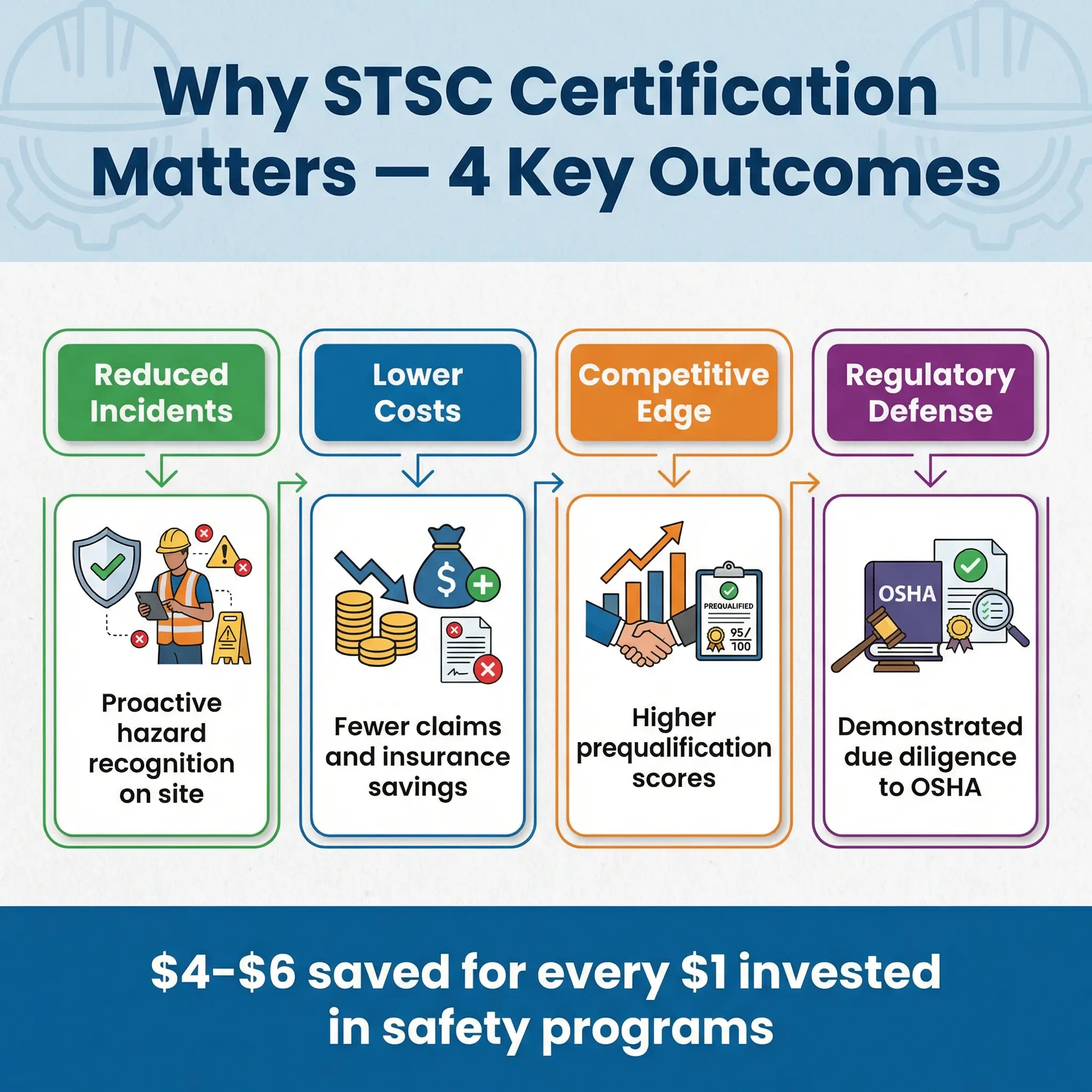
- Reduced incident rates. Projects with STSC-certified supervision consistently show lower recordable injury rates in my audit data. When supervisors understand the “why” behind controls — not just the “what” — compliance becomes proactive rather than reactive.
- Lower insurance and workers’ compensation costs. Fatal construction injuries cost the United States an estimated $5 billion annually in healthcare, lost income, and lost production. Certified supervision is a demonstrable risk mitigation measure that insurers recognize.
- Competitive advantage in prequalification. Contractor prequalification systems like ISNetworld, Avetta, and BROWZ increasingly evaluate workforce credentialing. STSC-certified supervisors score higher on these platforms.
- Regulatory defensibility. If OSHA investigates an incident on your site, having STSC-certified supervision demonstrates due diligence in training and competency assurance. It doesn’t guarantee immunity, but it demonstrates organizational commitment to worker safety.
- Reduced OSHA citation risk. Fall protection remains the most frequently cited OSHA standard year after year, followed by hazard communication, ladders, and scaffolding — all topics the STSC exam covers in depth.
The Safety Case — What Certification Actually Changes on Site
Beyond the business metrics, there is a tangible behavioral shift when a supervisor earns the STSC. I’ve watched it happen repeatedly. A foreman who previously viewed safety meetings as a time-wasting formality starts running them with purpose. A superintendent who used to wave off near-miss reports starts documenting them and tracking trends. The certification doesn’t just add knowledge — it changes the lens through which a supervisor sees the jobsite.
On a high-rise project in the Gulf, I worked alongside a structural superintendent who earned his STSC midway through the project. Before certification, his daily safety engagement was limited to reminding workers about hard hats. After certification, he started conducting informal workplace inspections every morning, identifying fall hazards before the safety team’s formal walkthrough caught them. His crew’s recordable injury rate dropped to zero for the remaining eight months of the project. That’s not a coincidence — that’s applied knowledge in action.
STSC Certification and Career Advancement in Construction Safety
The STSC is not just a credential — it’s a career accelerator for construction professionals who want to move beyond trade work into supervisory, management, or dedicated safety roles. I’ve seen the trajectory play out dozens of times: a carpenter foreman earns the STSC, gets tapped to lead the site’s safety committee, transitions into a superintendent role, and eventually pursues the CHST or CSP to move into full-time safety management.
The BCSP credentialing pathway is designed to support this progression, and the STSC is the entry point for construction professionals:
- STSC → CHST: The STSC provides the foundational construction safety knowledge that the CHST assumes you already possess. Many CHST candidates report that their STSC preparation covered 40–50% of the CHST blueprint material.
- STSC → ASP → CSP: For supervisors who want to pursue the gold standard Certified Safety Professional credential, the STSC demonstrates commitment and builds the knowledge base that the ASP and CSP examinations expand upon.
- STSC + OSHA 30-Hour: Together, these credentials create a strong baseline for any construction supervisor. The OSHA 30-Hour provides awareness-level training, while the STSC validates the ability to apply that knowledge under examination conditions.
Job vacancies for safety professionals commonly include BCSP credentials such as the STSC as a desired or required qualification, along with requisite education and experience. Human resources departments and recruiters increasingly rely on professional certifications to confirm minimum qualifications for construction safety positions.
Common Misconceptions About the STSC Certification
After years of guiding construction professionals through the credentialing process, I’ve encountered the same misconceptions repeatedly. Clearing these up saves time and prevents candidates from pursuing the wrong credential or approaching preparation with flawed assumptions.
The following misconceptions are the ones I address most frequently in pre-exam mentoring sessions:
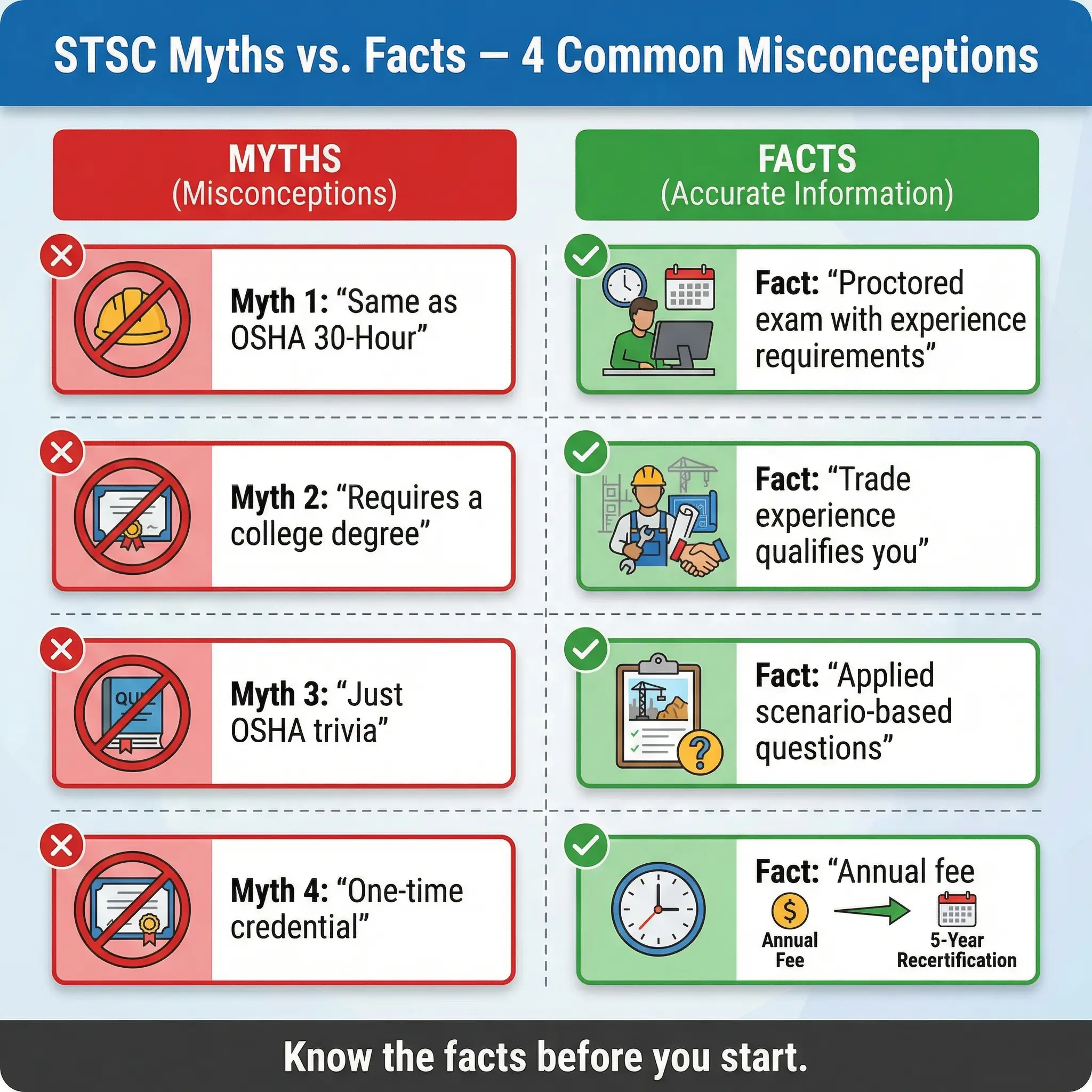
- “The OSHA 30-Hour card is the same thing.” It is not. The OSHA 30-Hour is an awareness-level training course with no exam, no experience prerequisite, and no recertification requirement. The STSC is a proctored, competency-based certification that verifies applied knowledge. They complement each other — they do not substitute for each other.
- “I need a college degree to qualify.” A degree is one of four pathways to eligibility. Two years of supervisory experience or four years of construction work experience qualifies you just as well. The credential was designed to be accessible to trade professionals.
- “The exam is just OSHA trivia.” The STSC exam tests applied knowledge — your ability to analyze a scenario and select the most appropriate safety response. Pure memorization of standard numbers won’t get you through. Understanding principles and their practical application will.
- “Once I pass, I’m done.” BCSP requires annual maintenance fees and recertification every five years through documented continuing education. Letting the credential lapse means losing the right to use the STSC designation.
- “The STSC is only recognized in the United States.” While BCSP is a U.S.-based organization, the STSC is recognized internationally. Pearson VUE testing centers are located around the world, and multinational contractors operating globally accept BCSP credentials as evidence of safety competency.
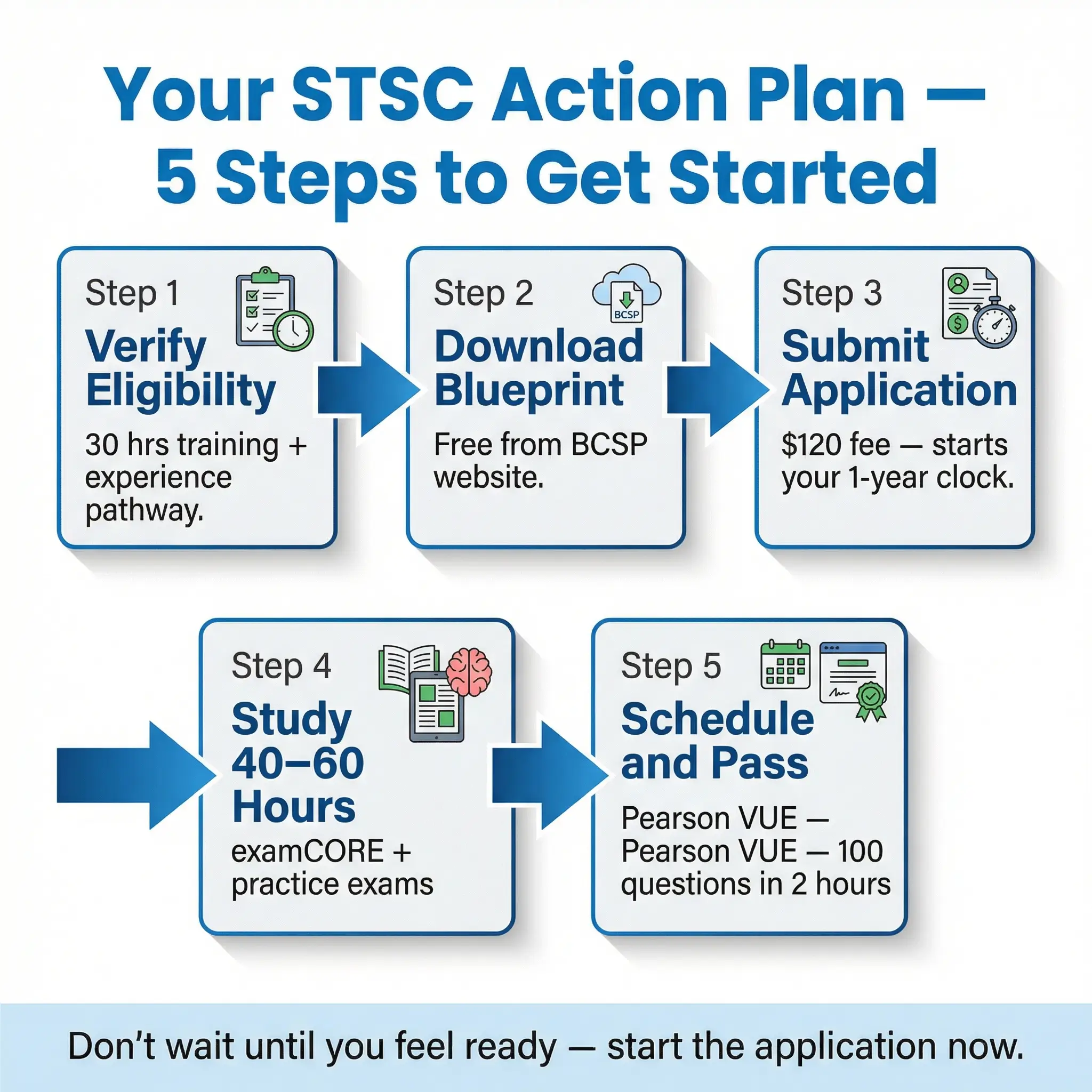
Practical Steps to Get Started With Your STSC Certification
If you’ve read this far and decided the STSC is the right credential for you, here’s the action plan I give every supervisor I mentor through the process.
The following roadmap is built on what I’ve seen work efficiently without wasted time or money:
- Verify your eligibility today. Review your training records and employment history against the two requirements: 30 hours of documented safety training and one qualifying experience pathway. If you’re short on training hours, enroll in an OSHA 30-Hour construction course — that single course covers your entire training prerequisite.
- Download the STSC Exam Blueprint and Reference List from the BCSP website. Read them before purchasing any study materials. The blueprint tells you what to study; the reference list tells you where to study it.
- Create your BCSP account and submit your application. Don’t wait until you feel “ready” to study — the application review takes time, and your one-year exam window doesn’t start until approval.
- Select your study method. Self-paced online prep, workbooks, or live workshops — choose what matches your learning style. Budget 40–60 hours of focused study time for a first-attempt pass.
- Schedule your exam at least four weeks before your target date. This creates accountability and prevents indefinite postponement — a pattern I’ve seen derail many candidates.
- Take three timed practice exams before your scheduled test date. If you’re scoring above 75% consistently, you’re ready.
- Pass the exam, earn the credential, and start tracking your continuing education immediately.
Conclusion
The STSC certification answers a problem I’ve seen on construction sites across three continents and more than a decade of practice: competent trade professionals who can build anything you ask them to build, but who lack the structured safety knowledge to keep their crews alive while doing it. That gap between craft skill and safety competency is not a character flaw — it’s a training failure, and the STSC is the most direct, credible, and internationally recognized tool to close it.
Construction will always be high-hazard work. Falls will always be possible from elevation. Trenches will always pose engulfment risk. Electrical energy will always be lethal if controls fail. The question is not whether hazards exist — it’s whether the person directing the work understands them well enough to prevent exposure. The STSC gives construction supervisors the knowledge framework to do exactly that, and the professional credential to prove it.
If you supervise construction work at any level — from a two-person crew to a 500-worker megaproject — invest in the STSC. Not because a prequalification system demands it, not because your company’s insurance broker recommended it, but because every worker who goes home safe at the end of the day is a direct reflection of the decisions you made that morning. The credential won’t make those decisions for you, but it will make damn sure you’re equipped to make them right.