

TL;DR
- What is a Temporary Works Coordinator? A competent person appointed by a contractor to coordinate the planning, design, checking and execution of temporary works on a construction site — not the designer, not the site supervisor, a distinct control role.
- Is the TWC title legally required? The title is not. The duties sit underneath CDM 2015 and the Health and Safety at Work etc. Act 1974, which are statutory. BS 5975-1:2024 is how industry discharges those duties.
- What authority does a TWC actually hold? Formal authority to stop work on unsafe or non-compliant temporary works, written into the appointment and backed by the employing organisation’s Designated Individual.
A Temporary Works Coordinator (TWC) is a competent person appointed by a contractor to coordinate the planning, design, checking, implementation, use and dismantling of temporary works on a construction project. Under BS 5975-1:2024 and CDM 2015, the TWC ensures designs are produced, independently checked, and correctly implemented — and holds explicit authority to stop unsafe work.
The most common misreading of the Temporary Works Coordinator role is also the most dangerous. Because BS 5975-1:2024 is not itself compulsory, some contractors treat the TWC appointment as a paperwork preference rather than an operational necessity. HSE’s own Construction FAQ is direct: the standard is voluntary, but the duty to plan, manage and monitor temporary works is not. Under CDM 2015 Regulation 13 and Sections 2 and 3 of the Health and Safety at Work etc. Act 1974, that duty is statutory. A prosecution does not ask whether you used BS 5975 — it asks how you controlled the temporary works, and BS 5975 is the yardstick the inspector, the insurer and the court will reach for.
Construction remained the UK sector with the highest number of worker fatalities in 2024/25 — 35 workers killed, at a rate of 1.92 per 100,000, roughly 4.8 times the all-industry rate (Health and Safety Executive, 2025). Temporary works contribute disproportionately to that figure because falsework collapses, scaffold failures and unplanned load transfers share a single weak point: coordination. This article sets out the temporary works coordinator roles and responsibilities under BS 5975-1:2024, places them inside the UK legal framework, and flags the practitioner patterns that decide whether an appointment is a genuine control function or a name on an organogram. This guidance reflects UK practice; readers working elsewhere should treat it as best-practice reference and check their national regulatory framework.
What Is a Temporary Works Coordinator?
BS 5975-1:2024 defines a Temporary Works Coordinator as a competent individual appointed to coordinate all matters relating to temporary works on a project — covering falsework, formwork, scaffolding, excavation support, propping, façade retention, crane and piling bases, hoardings and any engineered short-duration structure that enables the permanent works. HSE is explicit that the TWC is a procedural control role, not a design role; coordination is deliberately a wider responsibility than design.
That distinction is the single most confused point in the role. The Temporary Works Designer (TWD) produces the calculations and drawings. The Temporary Works Supervisor (TWS) is site-based, inspecting installation against the approved design. The TWC sits above both — ensuring the brief is right, the design is produced and independently checked, the register is maintained, permits are issued, and changes are reviewed. Treating “TWC” as a new business-card line for the existing site agent, without a distinct scope and written authority, is the moment the control function collapses into the project’s general pressure.
The role was formalised after the 1974–75 Bragg Report into falsework collapses, which found repeatedly that no single person had been tasked with coordinating temporary works across the site. The TWC exists because no one else in the duty-holder hierarchy had the remit.
Where the TWC Role Sits in UK Law and Standards
The legal position is narrower and sharper than most commentary suggests. There is no UK statute that compels a contractor to use the title “Temporary Works Coordinator” or to adopt BS 5975. HSE’s published position is clear on that point — but it is equally clear that the duty to plan, manage and monitor temporary works is absolute under CDM 2015 Regulation 13 for principal contractors, and under the Health and Safety at Work etc. Act 1974 for every employer and person in control of construction work.
Reading this as “BS 5975 is optional” misses the enforcement reality. HSE inspectors, professional indemnity insurers, major infrastructure clients and — in the event of a failure — coroners and prosecutors use BS 5975 as the benchmark of reasonable practice. SIM 02/2010/04 sets out inspector expectations that mirror the BS 5975 framework: formal TWC appointment in writing, demonstrable competence, documented authority to stop work. Departure from the standard is not automatically a breach, but you will be asked to justify it against the reference, and the absence of any equivalent system is the prosecution’s opening move, not yours.
The standards framework, as of 2025, reads as follows. BS 5975-1:2024 (management procedures) and BS 5975-2:2024 (falsework design) were published by BSI on 17 December 2024, replacing BS 5975:2019. Clause numbering has shifted because former Clauses 2 and 3 were amalgamated — a practical problem, because live contractor procedures, training slide-decks and recruitment job adverts still cite the withdrawn BS 5975:2008 Clause 7.2.5 or BS 5975:2019 Clause 11. Any document in a company management system referencing those clauses now needs re-pointing. PAS 8811:2017 supplements BS 5975 for major infrastructure clients, and sector bodies including Network Rail and National Highways maintain their own procedures layered on top.
Regulatory content here reflects general HSE professional understanding of UK requirements as of 2026. It is not legal advice. Specific compliance questions, enforcement situations, or prosecution risk should be directed to qualified legal counsel in the applicable jurisdiction.
How the TWC Fits in the Temporary Works Hierarchy
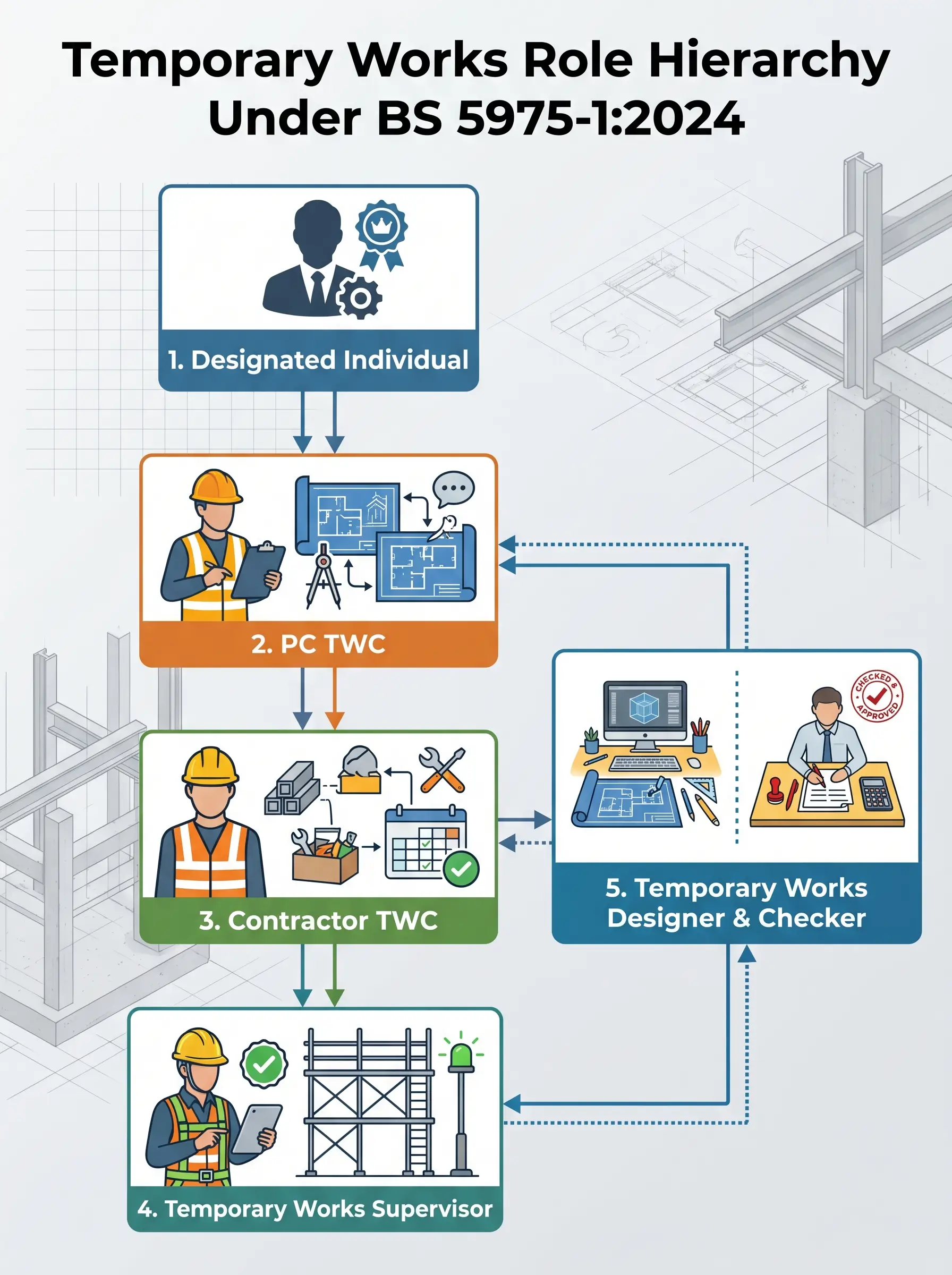
BS 5975-1:2024 establishes five temporary works roles, and confusion between them is the fastest route to an unmanaged site. The Designated Individual (DI) sits at organisation level — typically a board director or senior engineering manager — and is accountable for the company’s TW procedure and for signing off that individual TWCs are competent for the scope they are appointed to. The Principal Contractor’s TWC (PC TWC) owns site-wide coordination. A contractor’s TWC coordinates a specific package and reports up to the PC TWC. The Temporary Works Supervisor (TWS) is site-based, inspecting and assisting the TWC, and the Temporary Works Designer and independent Design Checker form a parallel technical function.
The reader-facing comparison that earns its place here is the three-role distinction between TWC, TWS and TWD:
| Feature | Temporary Works Coordinator | Temporary Works Supervisor | Temporary Works Designer |
|---|---|---|---|
| Appointed by | Contractor (PC or sub) | TWC / contractor | Contractor or external |
| Primary scope | Coordinating the TW process | Supervising TW on site | Producing TW design |
| Site-based? | Proportionate to complexity | Yes, during installation | Usually office-based |
| Authority to stop work | Yes, explicit in appointment | Yes, for imminent risk | No (advisory on design) |
| BS 5975-1:2024 reference | Clause 11 (formerly Clause 12 in the 2019 edition) | Clause 11 | Clause 7 and related |
| Typical qualification | HNC/HND minimum + CITB TWCTC | Site engineering experience + TWSTC | Chartered or incorporated engineer |
The failure pattern at this interface is predictable. Subcontractors bring their own temporary works onto a site — scaffolding, façade retention propping, trench boxes — without declaring them to the PC TWC, who then has no visibility of the design, the check certificate or the load limitations. BS 5975-1:2024 tightened that interface. The PC TWC’s register should be the single source of truth, and every temporary work item on the site should appear in it regardless of which contractor owns it.
The Core Responsibilities of the Temporary Works Coordinator
This article is a general explanation of the TWC role and does not replace formal TWC training, BS 5975-1:2024 itself, or the judgement of a competent person appointed for a specific project.
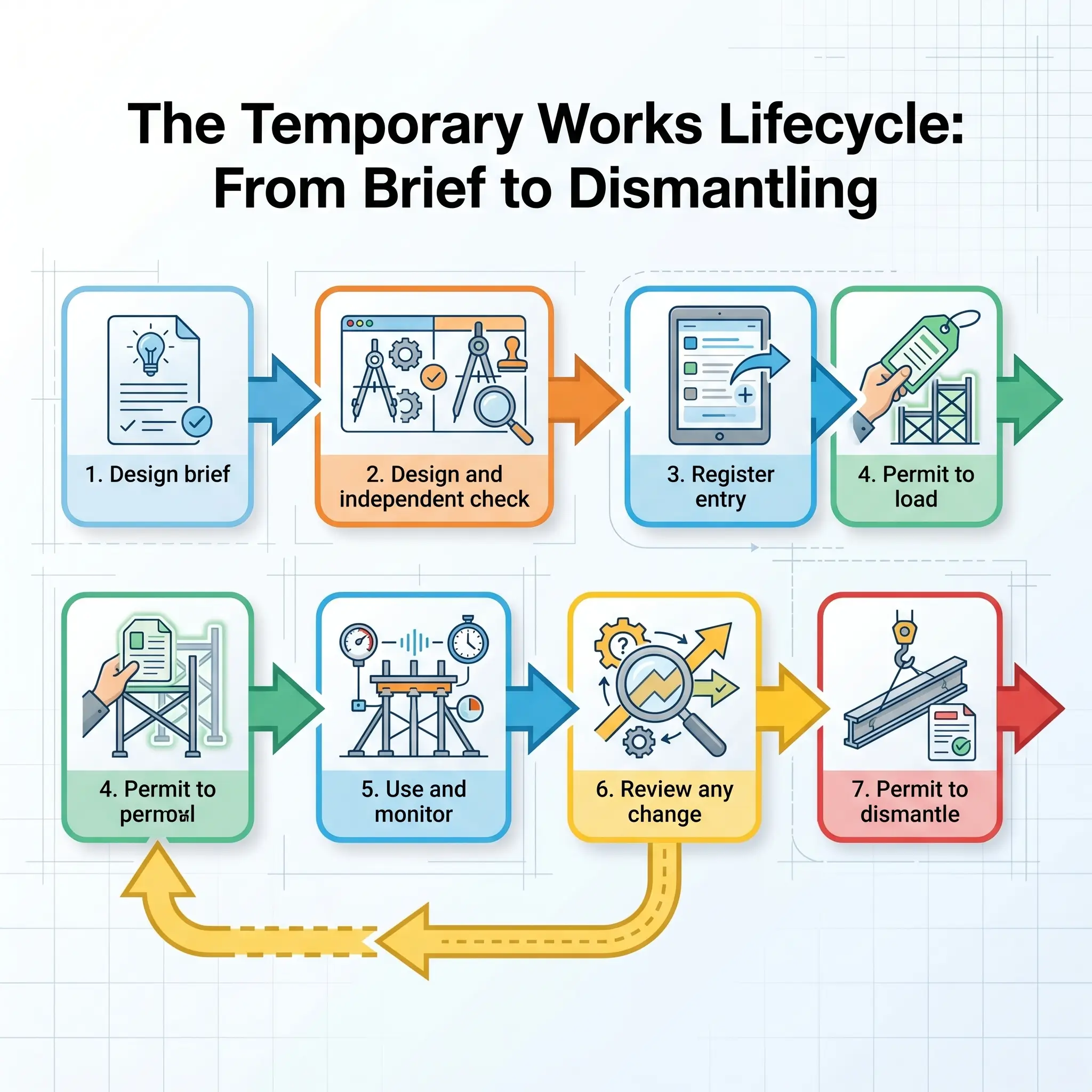
BS 5975-1:2024 lists 23 duties for the Principal Contractor’s TWC, rising to 26 when other contractors are managing their own temporary works on site, with a separate duty list for contractor TWCs (BSI / CITB Appendix L, 2024). Reading the standard’s clauses end-to-end is the right way to learn them. Grouping them by the actual temporary works lifecycle is the right way to understand them.
Planning and Coordination
The TWC coordinates all temporary works on the project or package, ensures responsibilities are allocated and accepted in writing, and maintains the working interface with the Principal Designer, Permanent Works Designer, TWD, TWS and site team. The practical reading of this clause on most sites: if the TWC cannot name every live TW item on the site and its current status, the coordination duty is not being discharged.
Design Brief and Design
The TWC ensures a design brief is prepared, is adequate, and matches actual site conditions — not the conditions assumed at tender. Residual risks flagged by the Permanent Works Designer must feed into the TW design brief. The TWC then ensures a competent TWD produces a suitable design.
Independent Design Checking
The TWC ensures the design is checked by someone not involved in the original design, that the check category (0, 1, 2 or 3) is appropriate to complexity and risk under BS 5975-1:2024, and that a design check certificate is obtained where the category requires one. Category selection is a judgement call — a Cat 1 check on work that warranted Cat 2 is a common root cause finding in TW incident reports.
Register and Documentation
A temporary works register covering every TW item on the site is established and maintained by the TWC, with drawings, calculations and supporting documents attached and indexed. Relevant information must be transmitted to the health and safety file at project close-out.
Site Implementation
Before installation, the TWC ensures the TWS and installation team have the full design, limitations and residual risks, an inspection and test plan, and a specific method statement. Pre-erection checks of materials, components and ground conditions are completed. A permit to load is issued only after a satisfactory final check — and never by anyone other than the TWC or a formally delegated alternate.
Use, Monitoring and Changes
Inspection, monitoring and maintenance during use are ongoing duties. The single most missed duty in practice is the review of proposed changes — adding a propping level, re-sequencing a strike, loading a structure earlier than planned. A functioning TWC operates a standing “no change without sign-off” rule. A nominal TWC finds out about the change in the incident investigation.
Dismantling and Handover
The TWC confirms the permanent works have attained adequate strength before issuing a permit to dismantle, ensures a documented safe system of work governs the dismantling sequence, and closes out the register, passing information to the principal contractor.
PC TWC vs Contractor TWC: What’s Different
BS 5975-1:2024 sharpens a distinction that the 2008 and 2019 editions blurred. On a single-contractor site the TWC’s duties are as above. On a multi-contractor site the Principal Contractor’s TWC carries additional responsibilities: deciding whether each contractor’s TW procedure is acceptable or whether the contractor must work to the PC’s procedure, ensuring every contractor TWC feeds their package information into the PC’s register, and chairing the interface between packages where one contractor’s temporary works affect another trade’s access or loading.
Where the PC approves a contractor to operate under their own procedure, the PC TWC still requires visibility of appointments, design checks and permits. Where the PC requires the contractor to work to the PC’s procedure, the contractor’s TWC is effectively operating inside the PC’s management system. Most real disputes on congested multi-package sites happen here — particularly around who owns the risk when a subcontractor’s scaffold or propping constrains another trade’s work. The PC TWC resolves those by recording them formally, not by tolerating the ambiguity until something moves.
Competence, Training and Appointment
BS 5975-1:2024 defines competence through four components: knowledge, training, experience and qualifications proportionate to the complexity of the temporary works being coordinated. HSE expects formal written appointment — an email naming someone as “TWC for the site” is not sufficient — and expects authority to stop work to be explicit in that appointment.
The CITB Temporary Works Coordinator Training Course (TWCTC) is the industry-standard two-day course, developed with HSE, the Temporary Works Forum, CECA, UKCG and FMB, with a one-day refresher (TWCTC-R) required before the five-year certificate expires. Typical professional profile: HNC or HND (minimum) in civil or structural engineering, a CSCS card, relevant TW experience, and the TWCTC certificate.
The judgement call that gets made badly is treating the certificate as competence. It is not. Competence under BS 5975-1:2024 is scope-specific. A TWC competent for trench support on a utilities contract is not automatically competent for top-down basement construction or a multi-lift façade retention. The Designated Individual’s sign-off should name the scope the TWC is being appointed for, and a TWC whose scope has shifted mid-project should be re-signed off or re-appointed. The Temporary Works Forum’s free guidance notes on TWC competence are a useful external reference for DIs making these judgements.
Authority, Limits and What the TWC Does NOT Do
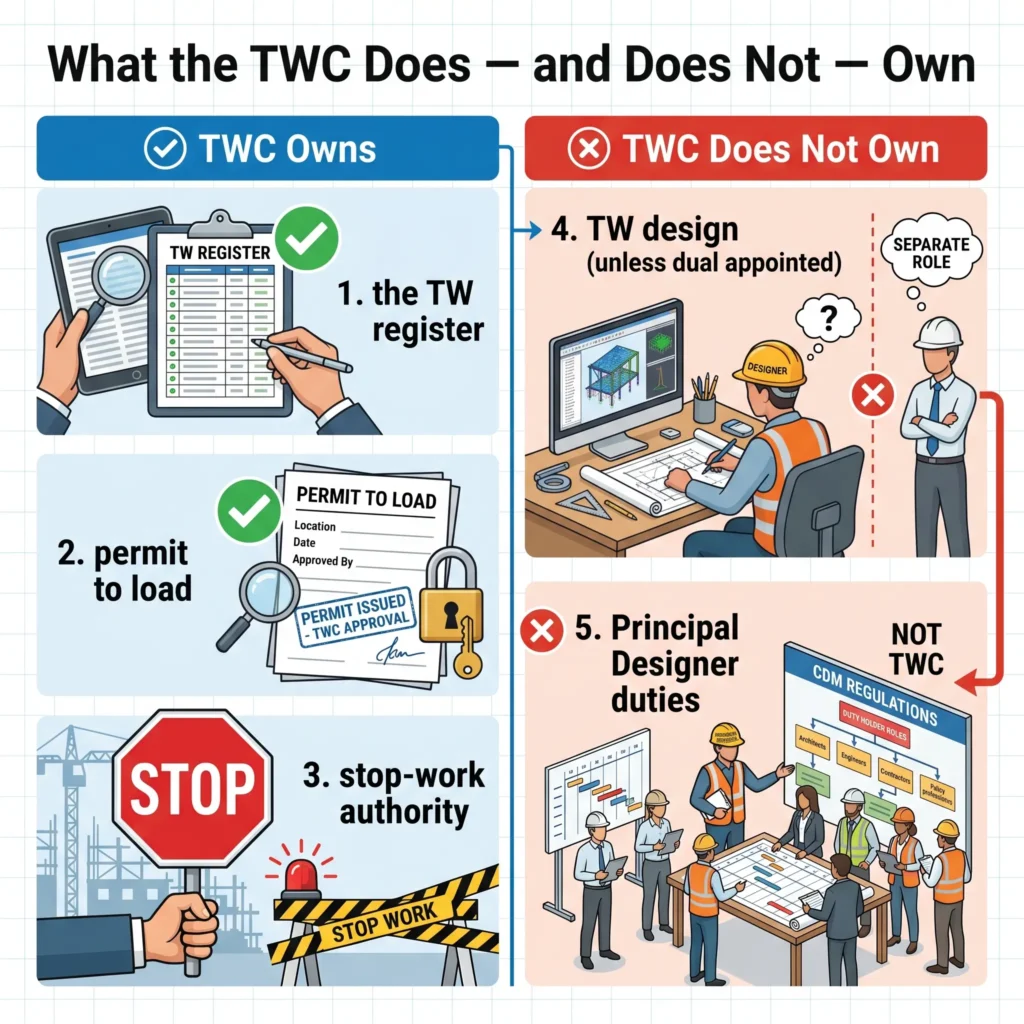
The role’s authority is meaningful because its limits are defined. The TWC is not the designer of the temporary works unless formally appointed in both roles on a simple, low-risk scheme — and even then the independent check must be performed by someone else. The TWC is not the CDM Principal Designer. The TWC does not sign off on the permanent works. The TWC does not replace the TWS on site. These exclusions matter because overreach is its own failure mode: a TWC acting as ad-hoc designer absorbs calculation liability they were not appointed to carry.
What the TWC does carry, non-delegably, is authority to stop work on any temporary works that are unsafe or non-compliant. That authority is worth nothing unless written into the appointment letter, visible in the site induction, and backed when exercised. The pattern that corrodes the role most reliably is the TWC who escalates a concern, is overruled by programme pressure, and then fails to record the escalation in writing. The integrity of the role depends on the TWC being willing to use stop-work authority — and on the organisation backing them when they do. A TWC whose stop-work authority is theoretical has not been appointed in any meaningful sense.
Common Failure Patterns in TWC Implementation
HSE enforcement records, SCOSS reports and the Bragg Report legacy all converge on a consistent finding: coordination and communication, not calculation, cause most temporary works failures. That is the single most important pattern for a TWC or a DI to internalise, because it reframes where to spend attention.
Recurring patterns visible across the published record include:
- The desk-based TWC. A head-office engineer coordinating three or four sites by email and register update, with no regular site walk. BS 5975-1:2024 does not require the TWC to be resident full-time, but on complex sites effective coordination usually requires someone walking the works.
- The late appointment. A TWC appointed after tender, after subcontractor packages are let, after the design brief has already been written. The role is meant to influence those decisions, not ratify them.
- The unreviewed change. Site teams modify temporary works in response to programme or weather pressure without looping back through the TWC. By the time the TWC sees the change, it is already loaded.
- The orphaned subcontractor package. A subcontractor brings TW on site that never reaches the PC’s register. The PC TWC cannot coordinate what they do not know exists.
- The certificate-scope mismatch. A TWC with a valid TWCTC certificate but no experience of the specific TW type — propping, façade retention, heavy falsework, top-down construction. The paperwork covers the role; the competence does not cover the project.
- Paper compliance. Registers updated retrospectively, design checks initialled without substantive review, permits signed at the desk after work has already started.
Each of these is preventable at the appointment stage. The DI’s job is to appoint the right person for the scope; the TWC’s job is to refuse appointments they are not competent to hold.
How the TWC Role Connects to CDM 2015 and the Building Safety Act 2022
The TWC role does not sit inside CDM 2015 by name, but it is the mechanism by which the Principal Contractor’s Regulation 13 duty to plan, manage and monitor the construction phase is operationally discharged for temporary works. Historically, the CDM Principal Designer’s involvement with temporary works has been limited — temporary works typically develop after the principal design stage. The TWC bridges that gap.
The practical landscape shift since 2023–2024 is coming from a different direction. The Building Safety Act 2022 and the Building Safety Regulator, operating on higher-risk buildings, are driving traceability and competence expectations under the “Golden Thread” principle. The temporary works register and design-check documentation that a TWC maintains are now auditable artefacts inside that thread. Weak register practice that was commercially tolerated on general construction sites no longer passes muster on HRB work — auditors and the BSR expect TW documentation to trace back to designer appointments, check certificates and dated approvals. A TWC on HRB work is, in effect, also a record-keeper for the building’s construction-phase Golden Thread, and should be appointed in that awareness.
Frequently Asked Questions
Conclusion
The regulatory ground beneath this role is shifting. BS 5975-1:2024 and BS 5975-2:2024 have replaced the 2019 edition and reshuffled clause numbering; live contractor management systems still citing withdrawn clauses need updating before the next audit cycle, not after it. The Building Safety Regulator is raising the evidential bar for temporary works records on higher-risk buildings, and the Golden Thread principle is pulling TWC-maintained documentation into a far more auditable frame than the general construction sector has historically tolerated.
Against that direction of travel, the temporary works coordinator roles and responsibilities matter more, not less. The trajectory for the rest of this decade is toward named, competent, formally appointed TWCs with scope-specific sign-off, demonstrable site presence on complex work, and documentation that traces back cleanly to designer appointments and check certificates. The dysfunctions the sector has carried for years — the desk-based TWC, the late appointment, the unreviewed change, the certificate that covers the role but not the scope — are precisely the patterns the new evidential expectations will surface.
For contractors and Designated Individuals the practical takeaway is narrow. Appoint the right person for the scope. Write the authority into the appointment. Back the TWC when they use it. Readers working outside the United Kingdom should treat this as best-practice reference and check their national framework; this article is not legal advice, and project-specific decisions should go to a qualified construction lawyer or a chartered engineer competent in temporary works.