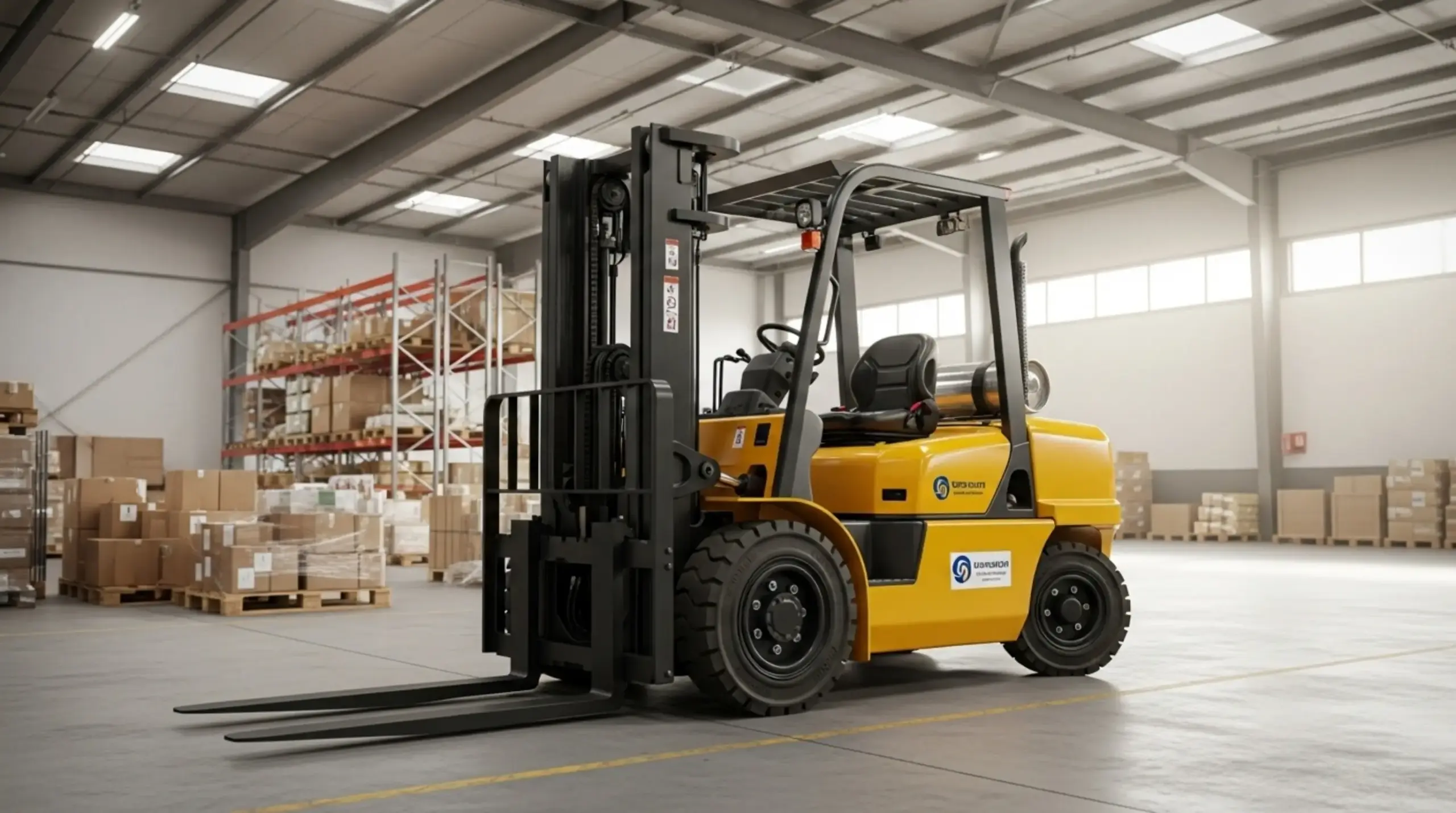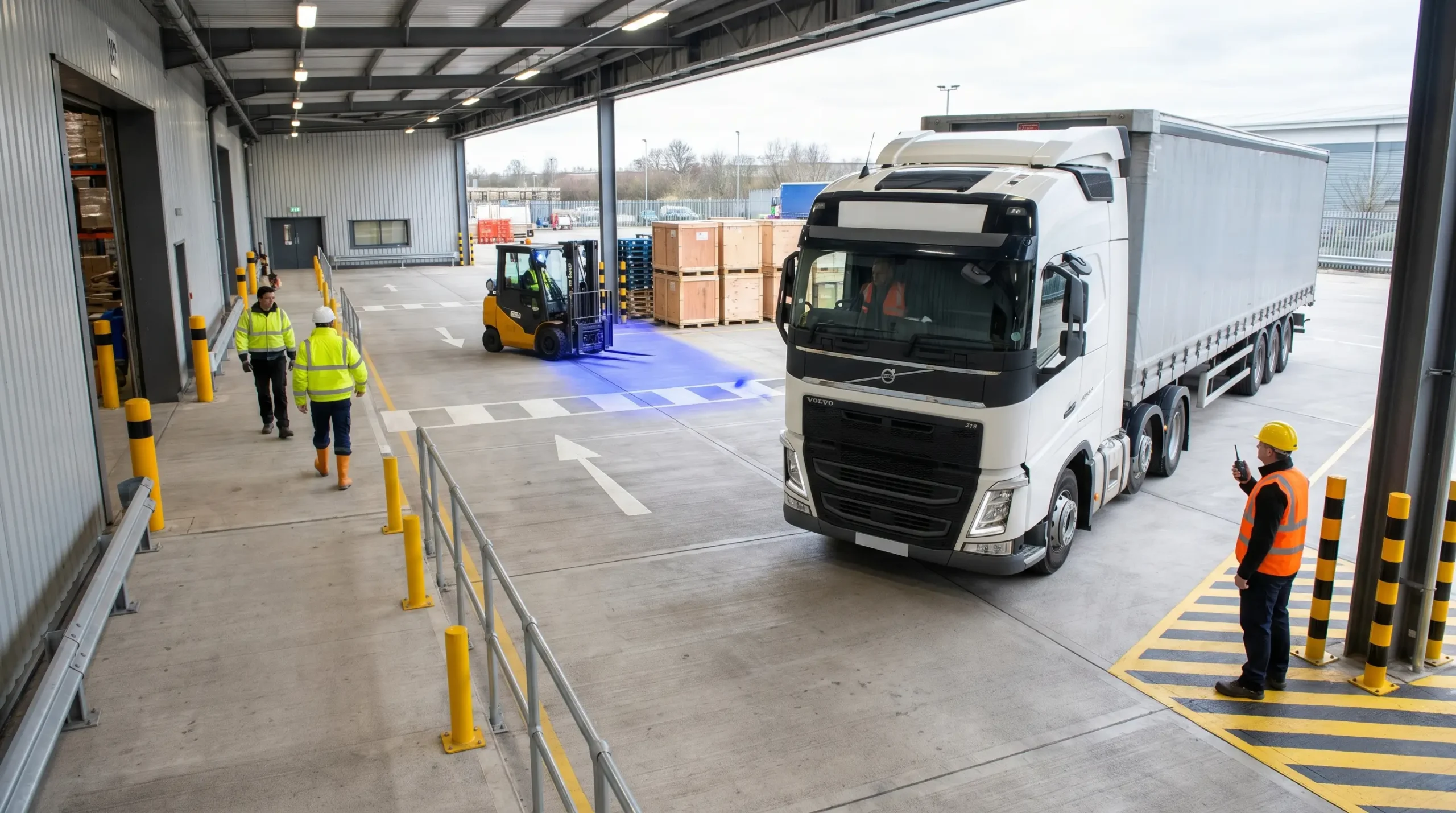
Workplace transport safety is the systematic management of risks created by any vehicle or mobile equipment operating within a work setting — forklifts, HGVs, vans, earth-moving plant, and automated guided vehicles. It rests on three pillars: designing a safe site with segregated pedestrian and vehicle routes, maintaining vehicles that are suitable and properly equipped, and ensuring every driver is trained, assessed, and supervised. Employers hold legal obligations to assess transport risks, implement proportionate controls, and provide adequate training under the UK Workplace (Health, Safety and Welfare) Regulations 1992 (Regulation 17), OSHA standards in the US, and EU Framework Directives — with penalties for failure reaching six-figure fines and criminal prosecution.
What Is Workplace Transport Safety and Why Does It Matter?
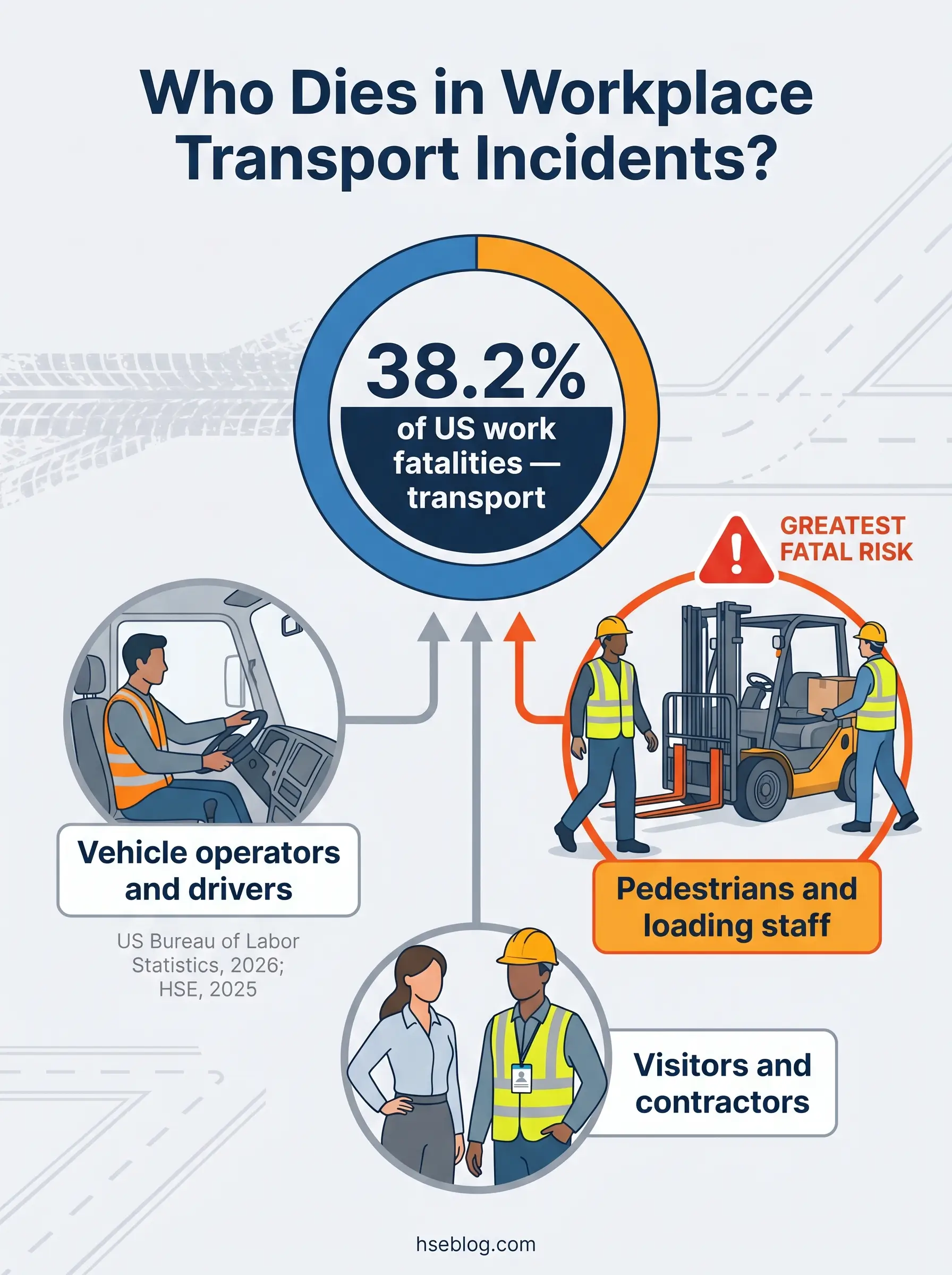
Transportation incidents accounted for 38.2% of all occupational fatalities in the United States in 2024 (US Bureau of Labor Statistics, 2026). That single figure represents the leading event category for worker deaths — ahead of falls, struck-by-object, and electrocution. Across the Atlantic, 14 workers were struck and killed by moving vehicles in Great Britain during 2024/25, contributing to a total of 124 worker fatalities that year (HSE, 2025). These are not fringe risks. They are the most persistent lethal hazards in modern workplaces.
Workplace transport covers any vehicle movement within a work setting: forklifts operating in warehouses, HGVs manoeuvring in distribution yards, dump trucks on construction sites, tractors on agricultural land, vans reversing at loading bays. It does not cover work-related road risk — driving on public highways for work purposes — which falls under separate regulatory frameworks and different reporting obligations. HSE's RIDDOR statistics, for instance, exclude public road traffic incidents entirely. The distinction matters because the controls, the legal duties, and the data sit in different systems.
Three categories of people face workplace transport risk: vehicle operators and drivers; non-drivers who work near vehicles — pedestrians, loading staff, maintenance crews; and visitors, contractors, and members of the public present on site. A pattern that consistently emerges from fatal incident data deserves emphasis here: the majority of workplace transport fatalities happen to non-drivers. People who had no control over the vehicle that killed them. Organisations that focus vehicle safety exclusively on driver behaviour and training miss the population most at risk.
Common Workplace Transport Hazards and How Incidents Happen
Workplace transport hazards follow recognisable patterns regardless of whether the setting is a warehouse, a construction site, or a farm. The incident types recur because the underlying physics — heavy vehicles, limited visibility, shared spaces — remain constant. Understanding the hazard mechanism for each type is essential for designing controls that address root causes rather than symptoms.
Struck by a moving vehicle remains the dominant fatal scenario. The vehicle is frequently reversing. The pedestrian is frequently in an area they believe is safe — behind a vehicle whose driver cannot see them, crossing a yard during a gap in traffic, or standing in a blind spot created by vehicle geometry. The fundamental problem is shared space: wherever people and vehicles occupy the same area at the same time, the conditions for a struck-by incident exist.
Falls from vehicles account for a significant portion of serious injuries. Workers fall while climbing onto or off trailers, during sheeting or unsheeting of flatbed loads, while working at height on vehicle-mounted platforms, and while using tail lifts that malfunction or are operated incorrectly. The height involved is often modest — under two metres — but the injury severity is amplified by landing on hard surfaces, loading bay edges, or the vehicle itself.
Vehicle overturns occur when forklifts are driven with raised loads on uneven surfaces, when earth-moving equipment operates on gradients that exceed stability limits, or when vehicles are overloaded beyond their rated capacity. Forklift overturns are particularly lethal because operators instinctively jump from the cab — the opposite of the correct response, which is to brace and stay within the roll-over protective structure.
Struck by falling loads happens during loading and unloading operations when loads are insecure, when load restraints fail, or when the structural integrity of packaging or pallets is compromised. Crushing between a vehicle and a fixed structure — a wall, a loading dock, another vehicle — typically occurs during coupling/uncoupling of trailers or when vehicles are manoeuvred in confined spaces.
Reversing: The Most Persistent Killer
Reversing incidents deserve dedicated attention because they appear in fatality data year after year despite being well-understood. The control principle is straightforward: eliminate reversing through one-way traffic systems, drive-through loading bays, and turning circles that remove the need for vehicles to reverse at all. This is a design-level elimination — the top of the hierarchy of controls applied to this specific hazard.
The reason reversing deaths persist is not ignorance of the solution. It is that the solution — redesigning site layout to eliminate reversing — is repeatedly dismissed as impractical, expensive, or disruptive to operational flow. That dismissal treats elimination as optional rather than as the starting point from which residual risk is assessed. When reversing genuinely cannot be eliminated, the residual controls include trained banksmen/signallers operating within an agreed safe system, reversing cameras and sensors, audible and visual alarms, and exclusion zones that physically prevent pedestrians from entering the reversing area.
Falls from Vehicles During Loading and Unloading
Loading and unloading operations combine several hazards simultaneously: working at height (on trailers, on loading docks), moving vehicles (arriving and departing transport), manual handling (positioning loads), and falling objects (unstable or poorly secured loads). Loading bay design is the primary engineering control — level-access docks, vehicle restraint systems that prevent premature departure, edge protection, and adequate lighting all reduce risk at the design stage.
Tail lifts present specific hazards. Workers fall from tail lift platforms, are struck by the platform during operation, or are crushed between the platform and the ground. Under the Lifting Operations and Lifting Equipment Regulations (LOLER) 1998 in the UK, tail lifts are lifting equipment and must be thoroughly examined at prescribed intervals by a competent person.
How to Conduct a Workplace Transport Risk Assessment
The Management of Health and Safety at Work Regulations 1999 (UK) require a suitable and sufficient risk assessment for all work activities — and workplace transport is no exception. OSHA's general duty clause imposes a parallel obligation in the US. The quality of the risk assessment determines the quality of every control that follows, which makes the assessment process itself the single most consequential step in a transport safety programme.
The most common failure mode in transport risk assessments is conducting them as a desktop exercise that maps the routes people should take, rather than observing the routes people actually take. Desire lines — the paths workers naturally follow — are frequently different from designated walkways. A worker who saves thirty seconds by cutting across a vehicle route will do so every shift unless a physical barrier prevents it. A risk assessment that describes designated routes without accounting for actual behaviour describes a fictional workplace.
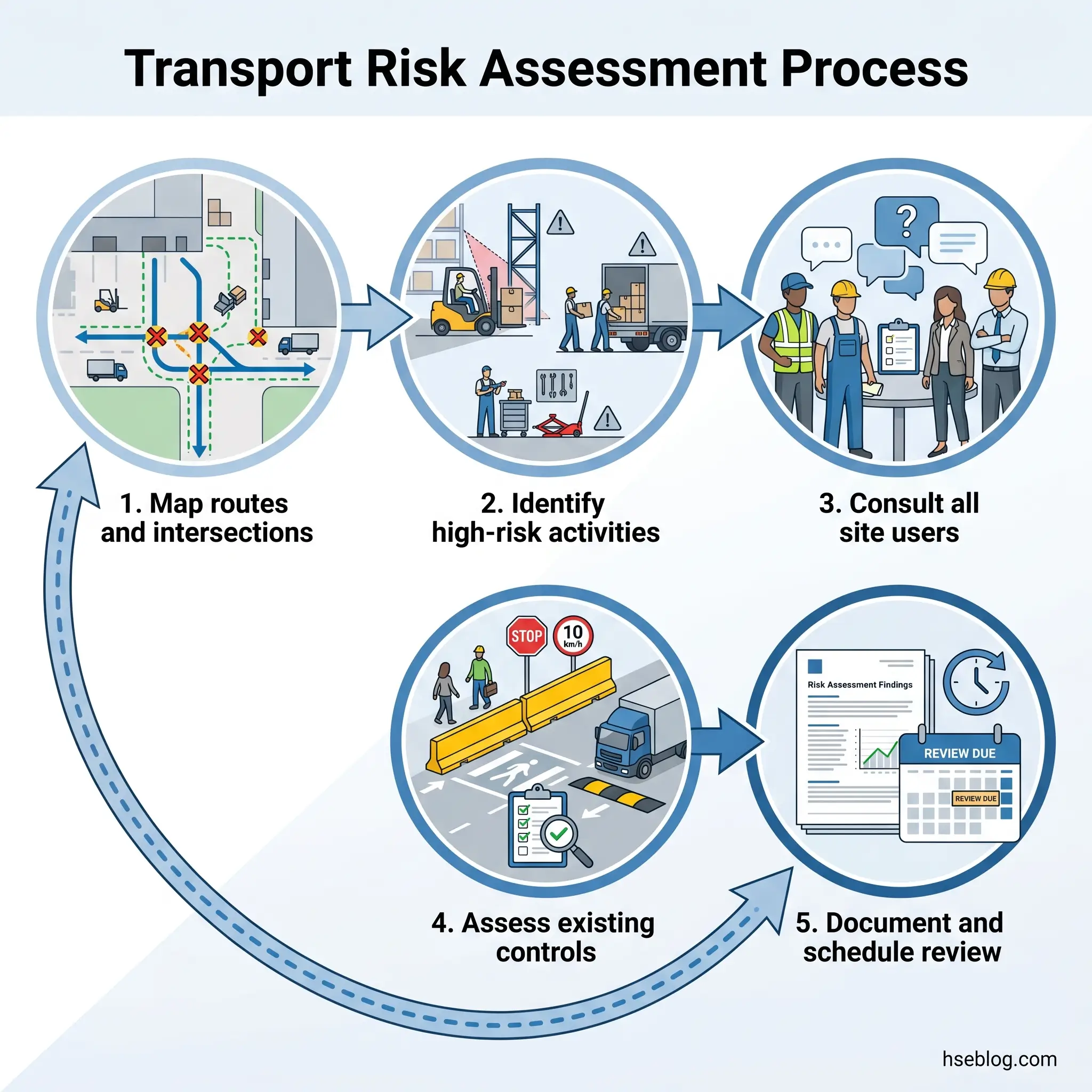
A transport-specific risk assessment follows these steps:
- Map vehicle and pedestrian routes on a current site plan. Mark every point where vehicle paths and pedestrian paths intersect. Include delivery vehicle routes, forklift operating areas, pedestrian access to welfare facilities, car parking access, and emergency evacuation routes. The intersections are where risk concentrates.
- Identify high-risk activities beyond routine circulation. Arriving and departing transport, reversing, coupling and uncoupling trailers, sheeting, vehicle maintenance, and refuelling each introduce hazards not present during normal forward travel. Shift-change periods — when maximum pedestrian movement coincides with vehicle operations — are a high-risk window that is routinely underassessed.
- Consult operators, pedestrians, visiting drivers, and contractors. The people who use the site daily observe hazards that management walkarounds miss. Visiting drivers who attend multiple sites can offer comparative insight into what works and what creates confusion. This consultation is a legal requirement under the Safety Representatives and Safety Committees Regulations 1977 and the Health and Safety (Consultation with Employees) Regulations 1996 in the UK.
- Assess the adequacy of existing controls against the specific hazards identified. Are pedestrian-vehicle segregation measures physical or merely painted lines? Are speed limits posted and enforced, or posted and ignored? Is lighting adequate at all hours the site operates, including dawn, dusk, and night shifts? Are sightlines clear at every junction and crossing point?
- Document findings and establish a review schedule. The assessment is a living document. It must be reviewed after any incident or near-miss, after any change to site layout, after the introduction of new vehicles or equipment, and at a minimum annually.
Watch For: Risk assessments conducted only during daytime hours. Many workplace transport incidents occur during early-morning or late-evening operations when lighting conditions, staffing levels, and driver fatigue profiles are materially different.
The Safe Site, Safe Vehicle, Safe Driver Framework
HSE's guidance document HSG136 — Workplace Transport Safety: An Employers' Guide — organises transport controls into three pillars: safe site, safe vehicle, safe driver. This framework is not legally binding, but following it constitutes recognised good practice and demonstrates compliance with the underlying statutory duties. It also provides a practical structure that prevents organisations from over-investing in one pillar while neglecting another — a common pattern where driver training receives heavy attention while site layout remains fundamentally unsafe.
Designing a Safe Site: Layout, Segregation, and Traffic Management
Site design is the highest-leverage intervention in workplace transport safety because it addresses the root cause — people and vehicles sharing the same space — rather than relying on individuals to behave correctly every time. A well-designed site removes the opportunity for error. A poorly designed site creates hazards that no amount of training or PPE can fully compensate for.
Pedestrian-vehicle segregation is the priority control. Separate entrances and exits for people and vehicles, physical barriers such as guardrails and bollards along pedestrian routes, and designated crossing points with clear sightlines constitute the minimum. HSE's guidance on separating pedestrians and vehicles details the practical requirements for achieving effective separation across different site types.
One-way traffic systems eliminate the need for reversing — the single most dangerous vehicle movement. Where one-way flow is combined with drive-through loading bays, the two highest-risk activities (reversing and loading/unloading) are both controlled through layout design before any procedural or behavioural intervention is needed.
Crossing points must be located where pedestrians actually need to cross, not where it is most convenient to place them. They require clear visibility in both directions, adequate lighting, and — on complex sites with high vehicle volumes — physical controls such as traffic lights or raised crossings. Speed management through humps, road narrowing, and enforced speed limits contributes to safer crossings, though speed humps must be designed carefully to avoid destabilising vehicles or their loads.
Traffic management plans are the documented system that communicates all of these arrangements to every person on site. The plan must cover vehicle routes, pedestrian routes, speed limits, parking arrangements, loading/unloading procedures, and the rules for visiting drivers and contractors. A plan that exists only in a document on the safety manager's shelf is not a plan — it is paperwork. Effective traffic management plans are physically visible through signage, road markings, barriers, and site induction briefings.
Audit Point: Observe vehicle and pedestrian movements during the busiest period of the working day, then compare what you see to what the traffic management plan describes. The gap between the two is the measure of the plan's effectiveness.
Visiting drivers — delivery drivers, contractors, waste collection — present a specific challenge. They arrive unfamiliar with the site layout, may not speak the site's primary language, and are often under time pressure. Under Section 3 of the Health and Safety at Work etc. Act 1974 (UK), the site operator owes a duty to non-employees affected by the undertaking. This means the employer cannot transfer responsibility for a visiting driver's safety by claiming the driver works for another company. Site induction, clear signage, designated reporting points, and — where necessary — escorted routes are proportionate controls.
Ensuring Safe Vehicles: Selection, Maintenance, and Safety Features
Vehicle suitability begins at procurement. The vehicle must match the task, the load, the terrain, and the operating environment. Using a counterbalance forklift designed for flat warehouse floors on an uneven outdoor yard creates overturn risk that no operating procedure can fully control. Selecting electric or LPG-powered vehicles for indoor use eliminates exhaust fume exposure — a hazard that diesel-powered equipment introduces into enclosed spaces.
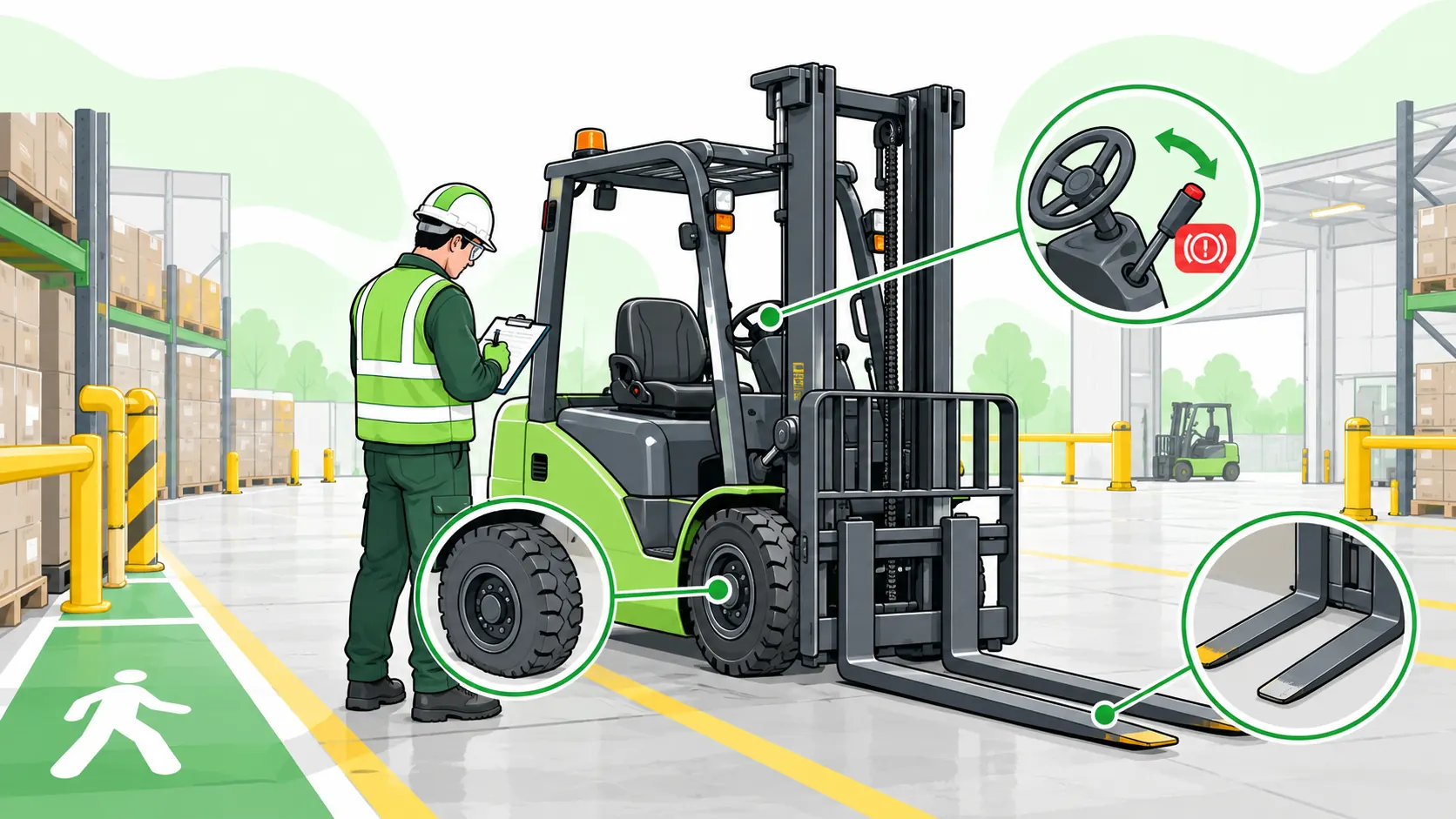
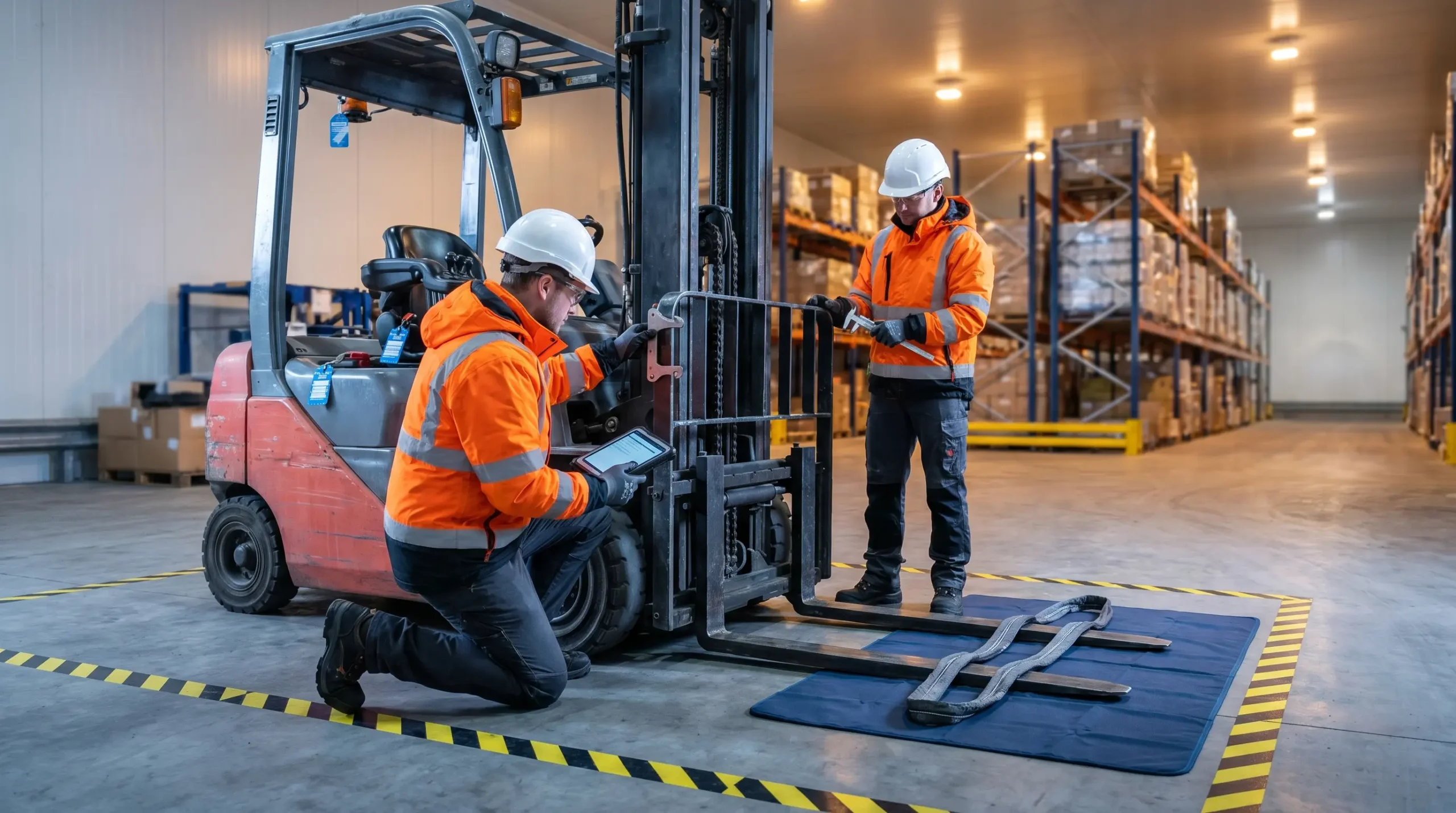
Pre-use inspections are a daily requirement. Under PUWER 1998 (UK), work equipment must be maintained in a safe condition and inspected at intervals appropriate to the risk. OSHA's powered industrial truck standards similarly require operators to examine trucks before placing them in service. A pre-use check covers brakes, steering, tyres, lights, mirrors, horn, hydraulics, safety devices, and — critically — that all safety systems are active and not defeated.
The most common finding in post-incident investigation is not that the vehicle was mechanically defective. It is that a safety system was functional yet defeated, overridden, or simply not used. Seat belts disconnected. Reversing alarms silenced because they were "annoying." Speed limiters bypassed. Verifying that safety systems are present is not the same as confirming they are active and used — and the distinction between those two checks separates effective vehicle management from box-ticking.
Roll-over protective structures (ROPS) and seat belts operate as a paired system on forklifts. ROPS prevents the cab from crushing the operator during an overturn, but only if the operator remains within the protective envelope — which requires wearing the seat belt. An operator who is thrown from or jumps out of a ROPS-equipped forklift during an overturn loses the protection entirely.
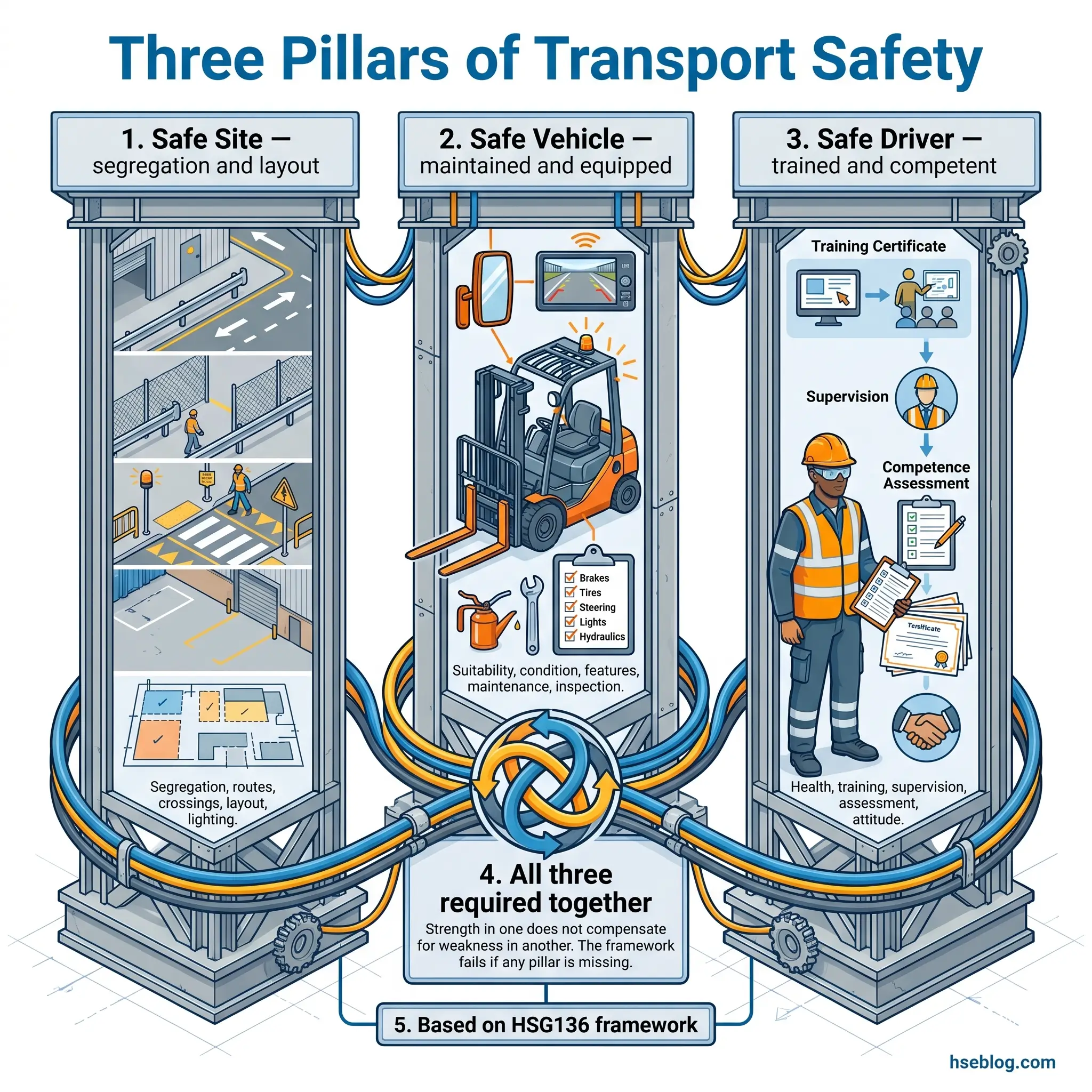
Building Safe Drivers: Training, Competence, and Supervision
Forklift operator training carries specific regulatory requirements that differ by jurisdiction. In the US, OSHA 29 CFR 1910.178(l) mandates a three-part training process: formal instruction (lecture, discussion, written material), practical training (demonstrations and exercises), and an evaluation of the operator's performance in the workplace. Refresher training and evaluation must occur at least every three years — or sooner following an accident, a near-miss, observed unsafe operation, or assignment to a different truck type. OSHA's powered industrial trucks safety page details the full compliance requirements.
In the UK, the Approved Code of Practice L117 sets the standard for rider-operated lift truck training. Unlike OSHA's prescriptive three-year cycle, the UK approach is less specific on timing but requires employers to ensure ongoing competence through monitoring and reassessment. Industry practice typically falls between three and five years for formal refresher training, with continuous observation and feedback between assessments. Both jurisdictions set the minimum operating age for forklifts at 18.
The gap between "trained" and "competent" is where most driver-related incidents originate. Training certifies that information was delivered. Competence requires ongoing observation that trained behaviours are actually being performed under real working conditions — including under time pressure, during night shifts, and when supervisors are not watching. A driver who passed a training course two years ago but has since developed habits that compromise safety is trained but not competent. The legal duty is competence, not certification.
Supervision extends beyond permanent employees to every driver operating on site. Visiting and contract drivers who arrive without familiarity with the site's traffic management plan, speed limits, or pedestrian areas require specific attention. Fatigue management, distraction policies, and recognition of time-pressure as a human-factors risk complete the driver safety picture.
What Are the Legal Requirements for Workplace Transport Safety?
Workplace transport safety obligations are established by statute across all major jurisdictions, though the specific requirements, training standards, and enforcement mechanisms differ. Employers must identify which legislation applies to their operation based on location, industry sector, and the types of vehicles in use. The summary below covers the primary frameworks; it is not exhaustive, and specific compliance questions should be directed to qualified legal counsel in the applicable jurisdiction.
Regulatory content here reflects general HSE professional understanding of UK, US, and EU requirements as of 2025–2026. It is not legal advice. Specific compliance questions, enforcement situations, or prosecution risk should be directed to qualified legal counsel in the applicable jurisdiction.
In the United Kingdom, the overarching duty sits under the Health and Safety at Work etc. Act 1974. Section 2 requires employers to ensure, so far as is reasonably practicable, the health, safety, and welfare of employees. Section 3 extends this duty to non-employees. Regulation 17 of the Workplace (Health, Safety and Welfare) Regulations 1992 specifically requires traffic routes to be organised for safe circulation of pedestrians and vehicles, with suitable separation. PUWER 1998 governs vehicle maintenance, suitability, and operator training. The Management of Health and Safety at Work Regulations 1999 mandate risk assessment. HSG136 provides the guidance framework.
Regulation 17 is deceptively simple in its wording — it requires traffic routes that allow safe circulation. But its breadth means that virtually every aspect of workplace transport falls within its scope: layout, segregation, surface condition, lighting, signage, gradient, width. Prosecution under this single regulation is common. In 2023, Sunrise Poultry Farms was fined £233,000 after a 19-year-old worker — employed for only two weeks — was fatally crushed by an HGV due to inadequate pedestrian segregation, constituting a breach of Regulation 17 (WorkNest / HSE enforcement records, 2023).
In the United States, OSHA's general duty clause (Section 5(a)(1) of the OSH Act) provides the baseline obligation. The most detailed vehicle-specific standard is 29 CFR 1910.178, covering powered industrial trucks — design, maintenance, operating rules, and the formal training requirements discussed above. For non-forklift vehicles, OSHA relies on the general duty clause and published guidance rather than a prescriptive standard.
In the EU, the Framework Directive 89/391/EEC establishes the employer's duty to assess risks and implement preventive measures. The Workplace Directive 89/654/EEC requires workplaces to meet minimum safety standards including safe traffic routes. The EU-OSHA workplace transport safety e-guide synthesises these requirements into practical guidance covering site design, lift trucks, and traffic management.
The following table summarises key differences across jurisdictions:
| Requirement | UK | US (OSHA) | EU |
|---|---|---|---|
| Risk assessment obligation | Mandatory — Management Regs 1999 | General duty clause; recommended | Mandatory — Directive 89/391/EEC |
| Pedestrian segregation | Regulation 17 — safe circulation required | No prescriptive standard; general duty | Directive 89/654/EEC — safe routes |
| Forklift training standard | ACoP L117 — ongoing competence | 29 CFR 1910.178(l) — 3-part process, 3-year refresher | Member state implementation |
| Vehicle inspection | PUWER 1998 — maintained, inspected | Pre-shift inspection required | Directive 2009/104/EC (use of work equipment) |
| Enforcement / penalties | Unlimited fines; imprisonment possible | Citations; penalties up to $165,514 per wilful violation (2025) | Member state enforcement |
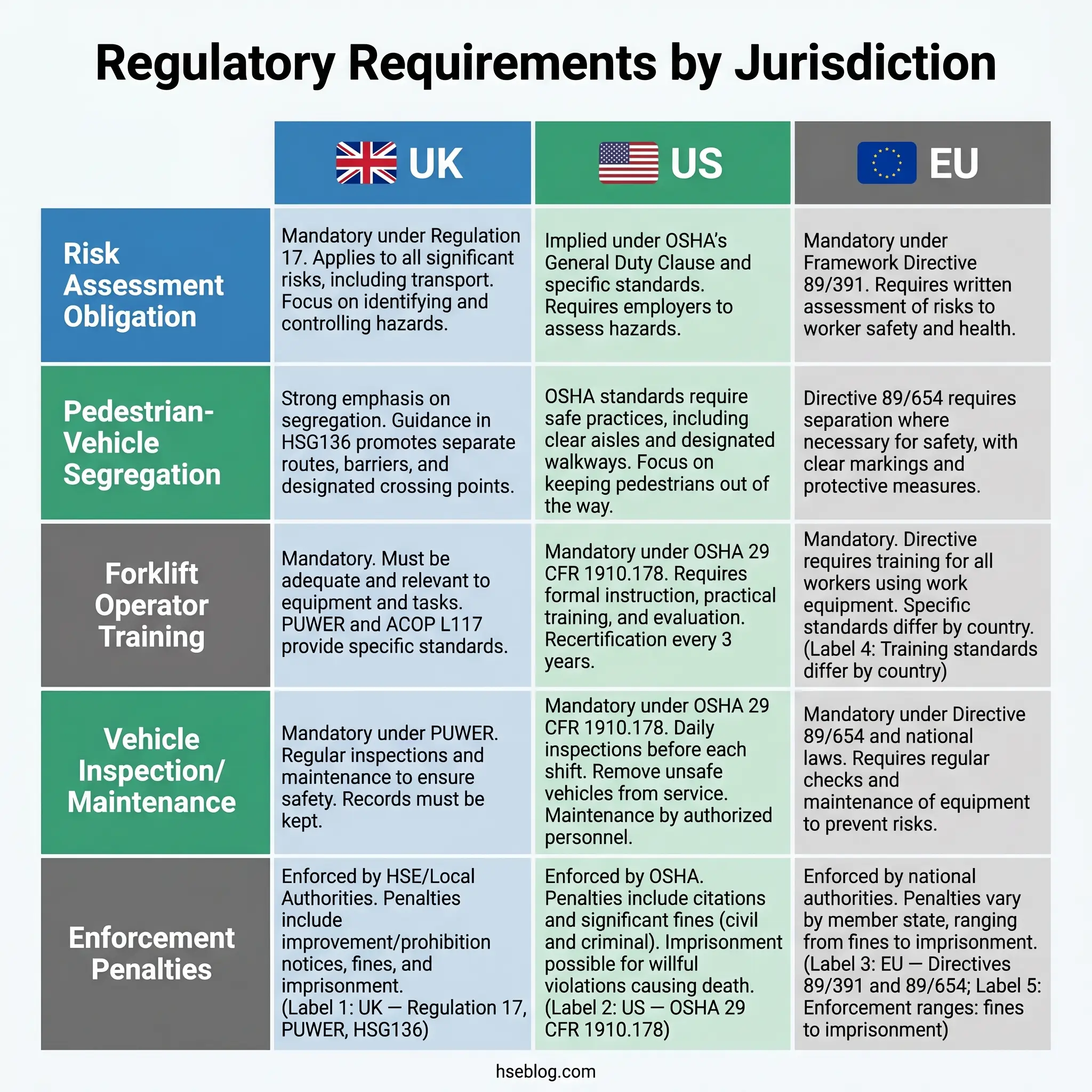
Managing Specific High-Risk Operations
General transport controls provide the foundation, but certain operations demand additional safe systems of work tailored to their specific risk profile. These are the activities where generic guidance fails and site-specific assessment becomes non-negotiable.
Reversing and Manoeuvring Operations
Where reversing cannot be eliminated through layout design, the residual controls must be formalised in a written safe system of work. A trained banksman or signaller — positioned where they can see the full reversing area and where the driver can see them — operates within an agreed signal protocol. The banksman must have a safe position to stand and a clear escape route. An untrained person waving their arms behind a reversing vehicle is not a banksman — they are a second potential victim.
Exclusion zones, enforced by physical barriers where practicable, prevent pedestrians from entering the reversing area. Reversing cameras, ultrasonic sensors, and radar-based detection systems provide the driver with information they cannot obtain from mirrors alone, but they supplement the safe system — they do not replace it. When multiple aids are combined (banksman plus camera plus sensors plus audible alarm), the operating protocol must specify which takes priority and what the driver does if signals conflict.
Loading, Unloading, and Securing Loads
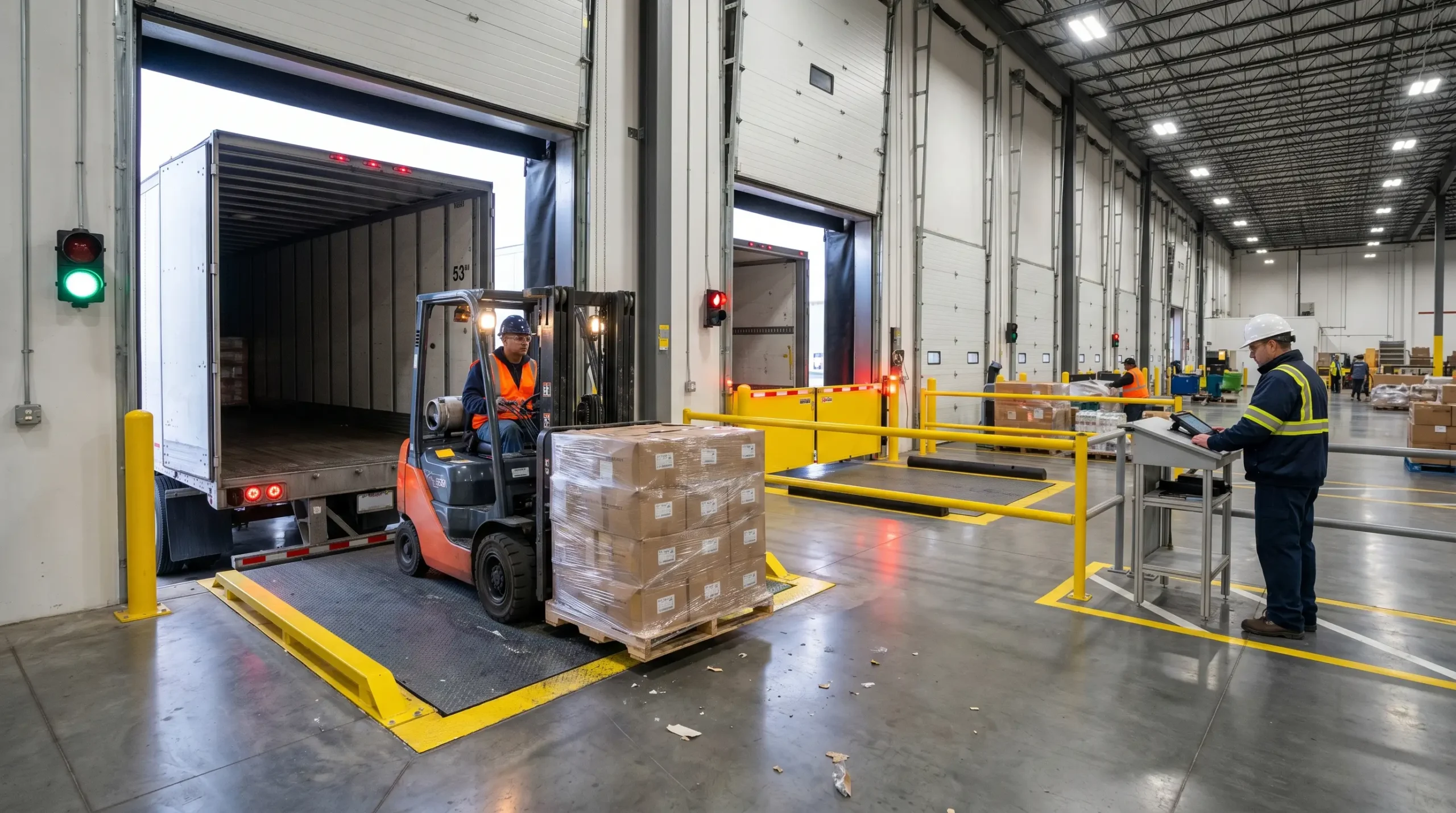
Loading bay design determines the baseline safety of every loading and unloading operation. Vehicle restraint systems prevent premature departure — a fatal scenario where a vehicle pulls away while a worker is still on the trailer or between the vehicle and the dock. Dock levellers bridge the gap between the loading dock and the vehicle floor. Adequate lighting inside trailers and at the dock face prevents trips, falls, and manual handling injuries caused by poor visibility.
Load securing is governed by the specific load type, vehicle type, and journey profile. For sheeting and unsheeting of flatbed vehicles, the key hazard is a fall from the trailer deck — typically a height of 1.5 to 2.5 metres onto a hard surface. Where workers must access trailer tops, fall prevention through gantry systems, safety harnesses, or mechanical sheeting systems takes priority over fall protection nets or soft-landing systems.
Coupling, Uncoupling, and Multi-Site Deliveries
Coupling and uncoupling of trailers creates a crushing hazard in the space between the tractor unit and the trailer. A clear procedure — engine off, keys removed, wheels chocked, parking brake engaged — must be followed before anyone enters the space between vehicles. The procedure must account for the possibility that a second driver moves the adjacent vehicle, and physical controls (barriers, locks) are more reliable than relying on communication alone.
Multi-site deliveries present a compounding risk: drivers visit sites they may never have seen before, with unfamiliar layouts, unmarked pedestrian areas, and variable standards of traffic management. The receiving site's duty to provide induction and clear instructions is critical, but the driver's own employer also bears responsibility for ensuring the driver is trained to assess unfamiliar sites and refuse to proceed when conditions are unsafe.
Workplace Transport Safety Technology and Emerging Solutions
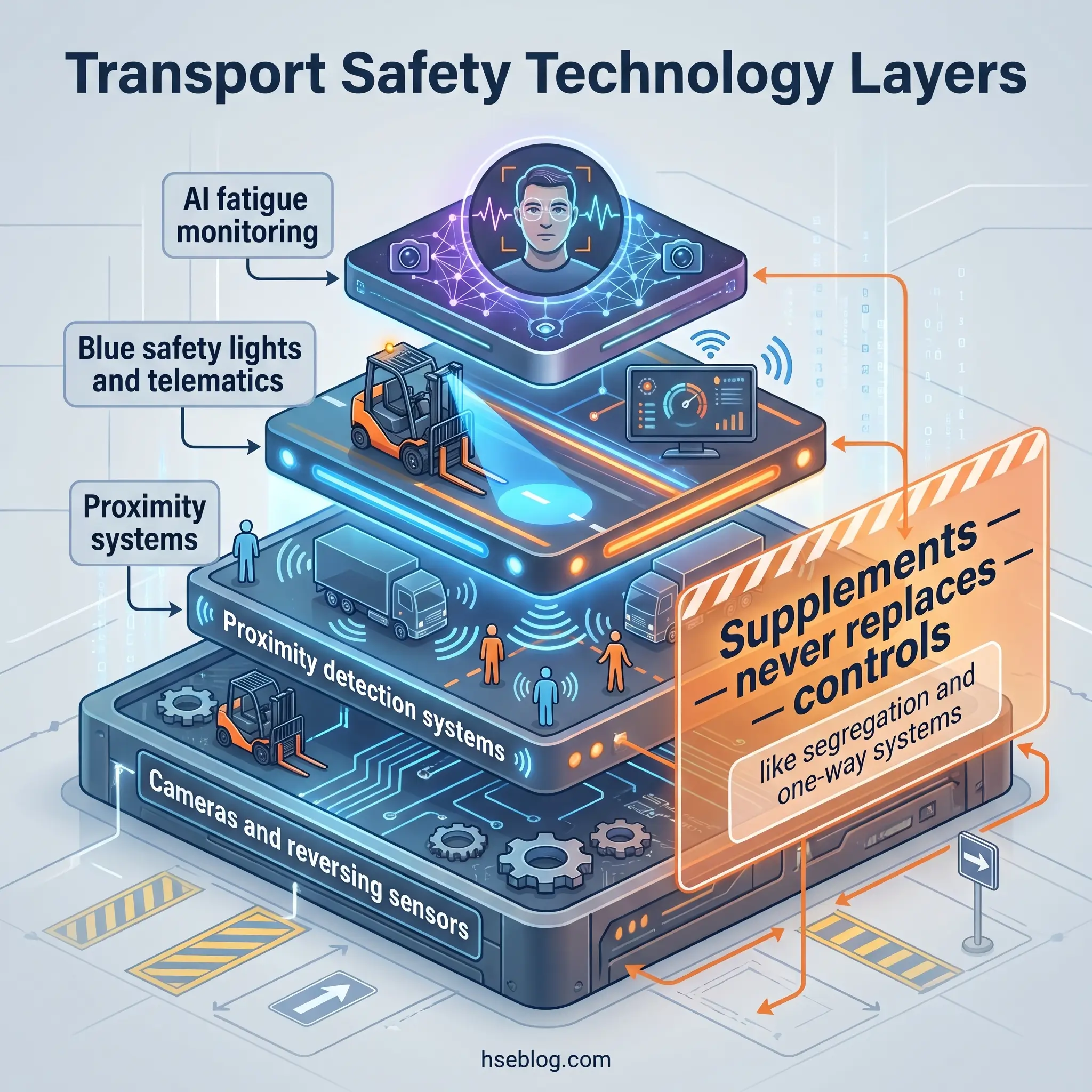
Technology in workplace transport safety functions as an additional control layer — supplementing, never replacing, the engineering and management controls that form the primary defence. The value of any technology lies not in the hardware but in its integration into a management system with defined response protocols.
Proximity warning and detection systems use RFID tags, ultra-wideband (UWB) positioning, or radar to detect when a pedestrian enters a vehicle's danger zone. The system alerts the driver, the pedestrian, or both — through audible alarms, vibrating tags, or automatic vehicle speed reduction. The technology is mature and effective, but adoption follows a predictable failure pattern: organisations install systems and then fail to act on the data. Alarms trigger frequently, operators learn to ignore them, and alert fatigue sets in within weeks. The fix is calibration — setting detection zones at distances that reflect genuine danger rather than normal proximity — combined with a response protocol that specifies what the driver must do when an alert activates.
Blue and red forklift safety lights project a coloured beam onto the floor ahead of or behind a forklift, providing a visual warning to pedestrians before the vehicle itself is visible — particularly useful at blind corners, aisle intersections, and doorways. These are low-cost, low-maintenance additions that address a specific visibility gap.
360-degree camera systems give operators a bird's-eye composite view of the vehicle's surroundings, eliminating the blind spots that conventional mirrors cannot cover. Telematics and in-vehicle monitoring systems (IVMS) record speed, harsh braking, impact events, and — in more advanced systems — operator behaviour such as seat belt usage and forward-facing camera footage. This data enables trend analysis across a fleet rather than reactive investigation after a single incident.
AI-assisted fatigue detection — through wearable devices or in-cab camera systems that monitor eye closure, head position, and micro-sleep indicators — is an emerging technology with genuine potential in operations involving long shifts, repetitive routes, or night work. The technology is still maturing, and privacy considerations around continuous biometric monitoring require transparent policies and worker consultation.
Autonomous guided vehicles (AGVs) and autonomous mobile robots (AMRs) introduce a different risk profile. They eliminate driver error but create new hazards at the human-machine interface: pedestrians who assume the AGV will always stop, maintenance staff who enter the operating envelope without following lockout procedures, and edge cases where sensor limitations cause unexpected behaviour. The safety case for AGVs must address these failure modes specifically, not simply assume that removing the human driver removes all risk.
Field Test: For any technology you are evaluating, ask two questions before procurement. First: what is the defined response protocol when the system activates? If the answer is "the driver decides," the system will fail. Second: who reviews the data the system generates, and what action do they take? If nobody reviews it, you have installed an expensive data logger, not a safety system.
Building a Workplace Transport Safety Management System
Individual controls — segregation, training, maintenance, technology — become effective only when connected within a management system that provides structure, assigns responsibility, monitors performance, and drives improvement. Without that system, controls degrade. Barriers get removed for "temporary" access that becomes permanent. Training records expire without triggering refresher assessments. Near-miss reports accumulate in a spreadsheet that nobody analyses.
A transport safety policy — integrated within the organisation's overall health and safety policy — establishes the commitment, scope, and accountability structure. Roles and responsibilities must be assigned with specificity: who owns the traffic management plan, who authorises changes to vehicle routes, who conducts pre-use vehicle inspections, who manages visiting driver induction, who reviews near-miss data.
Worker consultation is both a legal requirement in most jurisdictions and a practical necessity. Drivers, pedestrians, warehouse operatives, loading staff, and maintenance crews observe hazards and near-misses that management walkarounds miss. Consultation mechanisms — safety committees, toolbox talks, anonymous reporting channels — must be genuine, not performative. If workers report hazards and nothing changes, reporting stops.
Monitoring and review close the loop. Inspection schedules for vehicle routes, crossing points, barriers, signage, lighting, and surface condition should be documented and followed. Near-miss reporting — often the richest source of leading-indicator data in transport safety — requires a system that analyses reports for patterns rather than filing them individually. The management system element most often missing is this feedback loop: near-miss data is collected but not analysed for trends, and incident investigations identify the immediate cause but not the systemic conditions that allowed that cause to exist.
Review triggers include: any transport-related incident or near-miss, any change to site layout, introduction of new vehicles or equipment, changes to shift patterns or operating hours, feedback from workers or visiting drivers, and — at a minimum — an annual comprehensive review. The HSE's latest workplace fatal injury report provides annual benchmarking data that organisations can use to assess whether their risk profile aligns with national trends.
Frequently Asked Questions
What is the difference between workplace transport and work-related road risk?
Workplace transport covers vehicle movements within a workplace — warehouses, yards, depots, construction sites, farms. Work-related road risk covers driving on public roads for work purposes. Different regulatory frameworks apply to each. RIDDOR in the UK excludes road traffic accidents from workplace injury statistics. The controls, the reporting duties, and the responsible regulators are distinct, which means organisations need separate management arrangements for each.
Do I need a traffic management plan for a small workplace?
Every workplace where vehicles and pedestrians interact should have a proportionate traffic management plan — even a small depot receiving a handful of deliveries per day. The scale and formality should match the complexity and risk, but the core elements remain the same: defined vehicle routes, defined pedestrian routes, separation measures, speed management, and rules for visiting drivers. A single-page plan with a site sketch is proportionate for a simple site; the obligation is to manage the risk, not to produce a lengthy document.
How often should forklift operators be retrained?
OSHA 29 CFR 1910.178(l) requires refresher training and evaluation at least every three years, or sooner after an accident, near-miss, observed unsafe operation, or assignment to a different truck type. UK ACoP L117 does not prescribe a fixed interval but requires ongoing competence monitoring; industry practice typically falls between three and five years for formal reassessment. In both jurisdictions, the emphasis is on continuous competence — not a one-time certification event.
Who is responsible for visiting driver safety on my site?
The site operator retains the legal duty. Under Section 3 of the Health and Safety at Work etc. Act 1974 (UK), employers must protect non-employees affected by their undertaking. OSHA's general duty clause creates a parallel obligation in the US. The employer cannot transfer this responsibility by arguing that the visiting driver is self-employed or works for a different company. Practical measures include site induction, clear signage, designated reporting points, and — where site complexity warrants — escorted vehicle routes.
Can pedestrian-vehicle segregation be achieved in a small warehouse?
Full physical segregation may not be feasible in every workspace, but partial segregation is always achievable. Separate personnel doors distinct from vehicle access points, floor markings delineating pedestrian zones, timed access arrangements where vehicles and pedestrians use shared areas at different times, and physical bollards at critical pinch points all contribute. Where segregation remains incomplete, supplementary controls — proximity warning systems, enforced speed limits, designated crossing points, and high-visibility clothing — become essential rather than optional.
Is a banksman legally required for reversing operations?
No blanket legal requirement for a banksman exists in either UK or US law. The need for a trained signaller is determined by the risk assessment. Where reversing cannot be eliminated and other aids — CCTV, sensors, mirrors — are insufficient to manage the residual risk, a banksman operating within an agreed safe system becomes a necessary control. If used, banksmen must be specifically trained, positioned safely with an escape route, and operating an agreed signal protocol understood by the driver.
Conclusion
The industry consistently gets one thing wrong about workplace transport safety: it treats it as a driver problem. Invest in training. Issue certifications. Remind operators to check their mirrors. Meanwhile, the site layout funnels pedestrians across vehicle routes, the reversing alarm has been silenced because the night shift complained, and visiting drivers navigate without induction because "they're only here for ten minutes." The published fatality data tells the same story year after year — the people who die are overwhelmingly not the drivers. They are the pedestrians, the loading staff, the new workers, and the visitors who had no control over the vehicle that killed them.
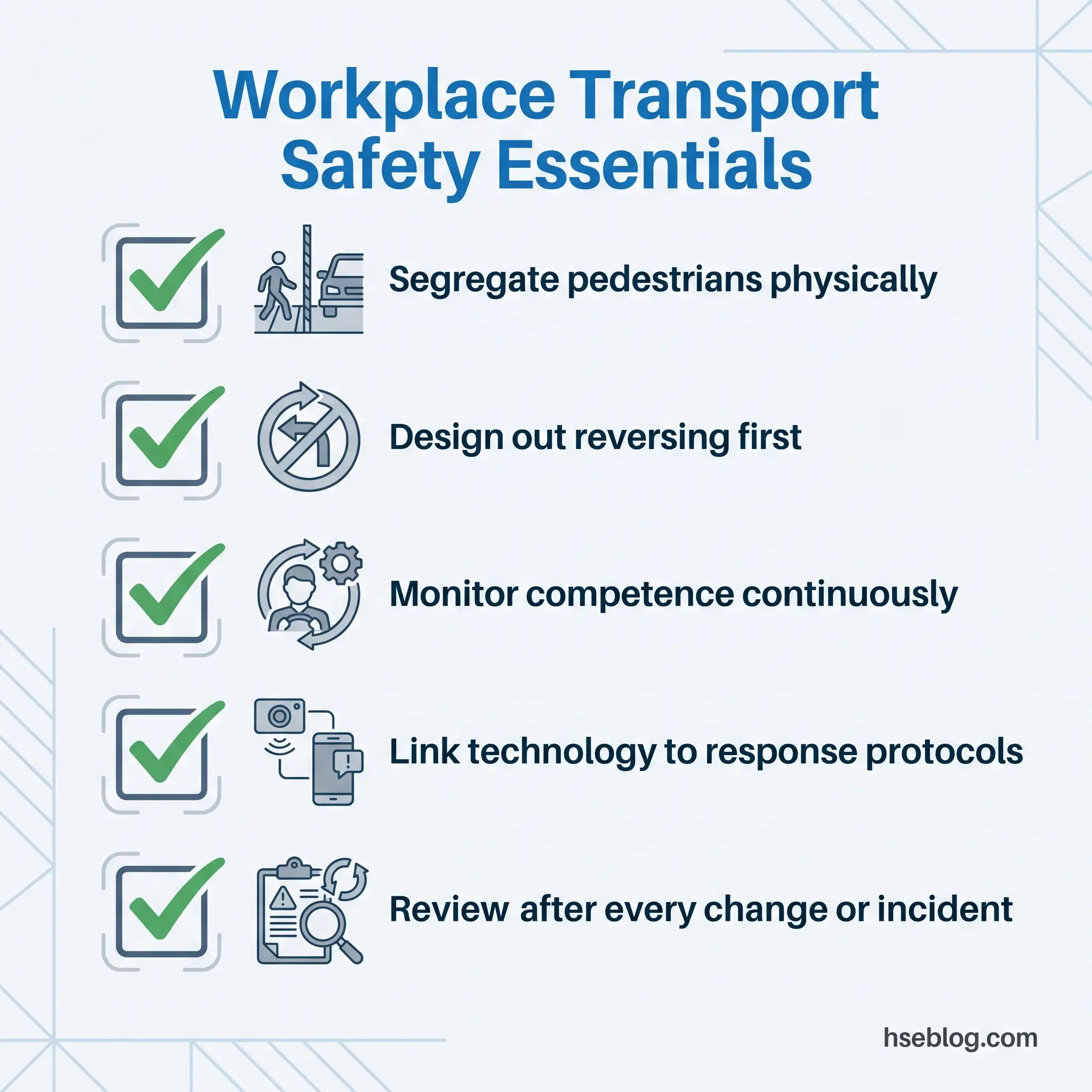
The highest-impact change any organisation can make is to shift attention from the driver to the site. Segregation through physical barriers, elimination of reversing through one-way design, and controlled crossing points address the conditions that produce incidents — not the behaviour of individuals who are asked to operate safely within fundamentally unsafe conditions. The 2024/25 HSE data showing 14 struck-by-vehicle deaths and the 2024 BLS data showing transportation as 38.2% of US occupational fatalities confirm that this problem is neither solved nor receding.
Workplace transport safety, at its core, asks one question of every site operator: have you designed a workplace where a moment of inattention — by a driver, a pedestrian, a visiting contractor — does not result in death? If the honest answer is no, the traffic management plan, the training records, and the technology installations are addressing the wrong problem.