

TL;DR
- Cardinal rules are non-negotiable safety absolutes — violating any one can result in death or permanent disability
- Zero tolerance means automatic consequences — no exceptions for seniority, schedule pressure, or production targets
- Most fatal incidents trace back to cardinal rule breaches — lockout failures, bypassed permits, missing fall protection
- Effective cardinal rule programs require visible leadership enforcement — rules without consequences become suggestions
- Every worker must know, understand, and own the cardinal rules — comprehension outweighs compliance
I was standing at the base of a reactor column during a scheduled turnaround at a petrochemical complex in the Gulf when the radio crackled with the worst kind of message: a contractor had entered a confined space without atmospheric testing. No gas detector. No standby attendant. No entry permit. He had walked into a nitrogen-purged vessel because the job was “almost done” and the permit office had closed for the day. By the time the rescue team reached him, he was unconscious. He survived — barely — but the 72 hours that followed involved an ICU transfer, a full project shutdown, and the kind of investigation that makes you question every assumption about how well your safety systems actually work.
That contractor had attended the site induction. He had signed the cardinal rules acknowledgment form. He knew confined space entry required a permit. He chose to skip it anyway — and the system around him failed to stop it. This article breaks down what cardinal rules of safety actually are, why zero tolerance enforcement is the only policy that prevents fatalities, and how organizations get it wrong even when they think they have it right. If you manage people in high-risk environments, this is the difference between a safety program that looks good on paper and one that keeps people alive.
What Are Cardinal Rules of Safety?
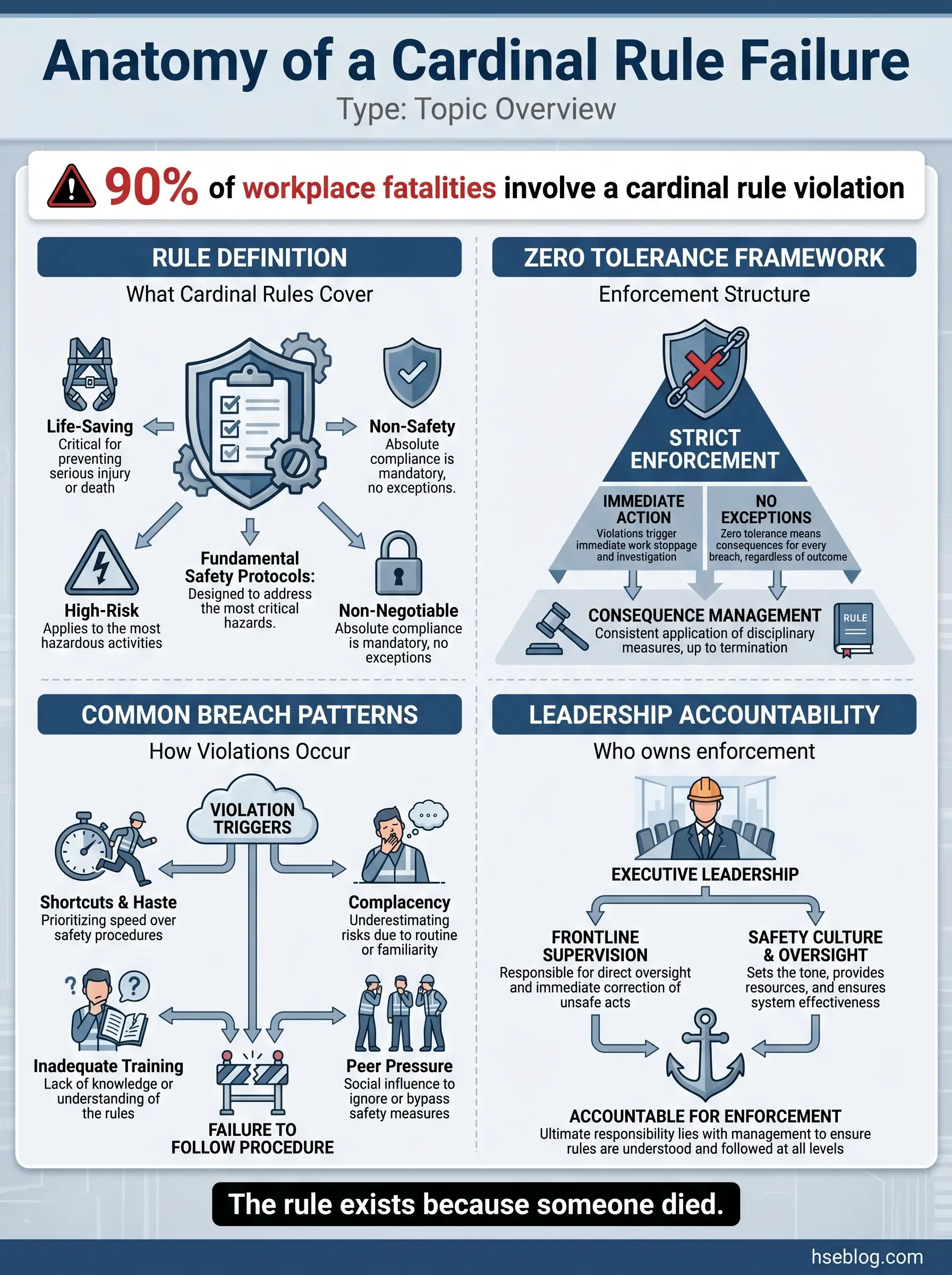
Cardinal rules of safety are the small set of absolute, non-negotiable safety requirements that protect workers from the hazards most likely to kill them. Unlike general safety guidelines — which allow some professional judgment in application — cardinal rules operate on a binary: you follow them completely, or you are in violation. There is no grey area, no partial compliance, and no acceptable reason to deviate.
The term “cardinal” is deliberate. These are not best practices or recommended behaviors. They carry the same weight as a physical law on a job site. Every major energy company, mining operator, and EPC contractor maintains a version of these rules, though they go by different names — Life Saving Rules, Golden Rules, Absolute Rules, or Fatal Risk Protocols. The International Association of Oil & Gas Producers (IOGP) codified them as the Life Saving Rules, now adopted across dozens of countries and hundreds of operating companies.
A typical cardinal rule set covers the hazard categories responsible for the majority of workplace fatalities. While the exact list varies by industry and operational profile, the core rules consistently address:
- Energy isolation (lockout/tagout): All energy sources must be isolated, locked, tagged, and verified before any maintenance or intervention work begins
- Confined space entry: No person enters a confined space without a valid permit, atmospheric testing, and a standby attendant
- Working at height: Fall protection is mandatory at all designated heights — no exceptions for task duration or “quick jobs”
- Permit to work: High-risk activities proceed only under a valid, current permit with all conditions met
- Driving safety: Seat belts worn at all times, no mobile phone use while driving, speed limits observed
- Lifting operations: No personnel under suspended loads, all lifts planned and supervised by a competent person
- Line of fire awareness: Workers must position themselves outside the path of moving, pressurized, or energized hazards
- Bypassing safety devices: Machine guards, interlocks, pressure relief valves, and emergency stops must never be disabled, removed, or overridden
ISO 45001, Clause 5.4 requires organizations to establish mechanisms for worker consultation and participation — including the authority for any worker to refuse or stop unsafe work without fear of reprisal. Cardinal rules formalize that authority into specific, enforceable actions.
Pro Tip: When you build your cardinal rule set, limit it to 8–12 rules maximum. Every rule you add beyond that dilutes the impact. I have seen organizations with 25 “cardinal” rules — at that point, nothing feels cardinal anymore. The power of these rules is their brevity and their weight.
Why Zero Tolerance Is the Only Policy That Works
Zero tolerance is not about punishment. I need to be direct about this because most organizations misunderstand the concept and either water it down into a warning system or weaponize it into a fear-based regime. Neither approach prevents fatalities.
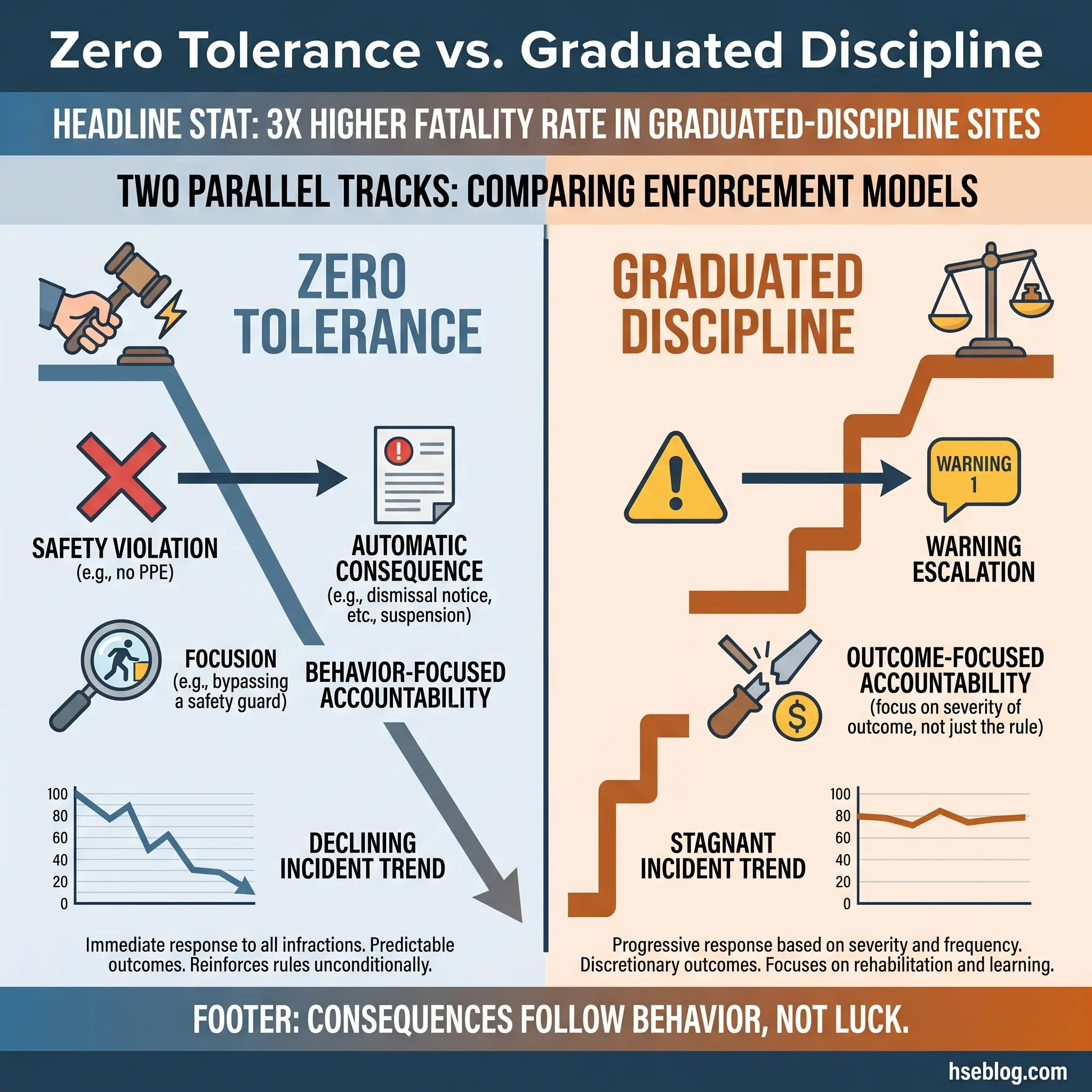
Zero tolerance means that every cardinal rule violation triggers an automatic, predefined consequence — regardless of who committed the violation, what the production schedule looks like, or whether anyone was actually injured. The consequence is attached to the behavior, not the outcome. A worker who bypasses a lockout and walks away uninjured has committed the same violation as one who is electrocuted. The only difference is luck.
Here is why graduated discipline systems fail for cardinal rules:
- First warning for a confined space entry violation teaches one lesson: you can do it once without real consequences. The message received is that the rule is flexible.
- Second warning reinforces the pattern: the system tolerates repeat violations as long as nobody gets hurt. Workers learn that outcome, not behavior, determines consequences.
- By the third violation, the culture has already normalized the breach. The next worker to skip atmospheric testing may not survive to receive a warning at all.
The difference between zero tolerance and graduated discipline becomes starkly visible in incident data. Organizations that enforce automatic stand-down and investigation for every cardinal rule breach — regardless of outcome — consistently show lower Total Recordable Incident Rates (TRIR) and, more critically, zero or near-zero fatality rates over multi-year periods.
| Enforcement Approach | Typical Worker Response | Fatality Risk Trend | Cultural Impact |
|---|---|---|---|
| Zero tolerance (automatic consequence) | Workers internalize rules as absolute limits | Declining year-over-year | Rules become part of operational identity |
| Graduated discipline (warnings first) | Workers calculate risk vs. consequence | Stagnant or increasing | Rules perceived as management preferences |
| Selective enforcement (depends on supervisor) | Workers adapt behavior to who is watching | Unpredictable spikes | Cynicism and mistrust toward safety systems |
| No enforcement (rules on paper only) | Workers ignore rules entirely | Highest fatality exposure | Complete safety culture breakdown |
I watched this play out on a mining operation in Western Australia. The operator had a clear cardinal rule: no person enters the blast exclusion zone after the warning siren. A supervisor — 20 years of experience, respected across the site — walked back into the zone to retrieve a surveying instrument he had left behind. He cleared the zone before detonation. No injury. No incident. The site manager terminated his contract that afternoon. The workforce was shocked. Some were angry. But within six months, blast zone compliance was at 100% — and it stayed there. The message was received: the rule applies to everyone, every time, without exception.
The Most Commonly Violated Cardinal Rules — And Why
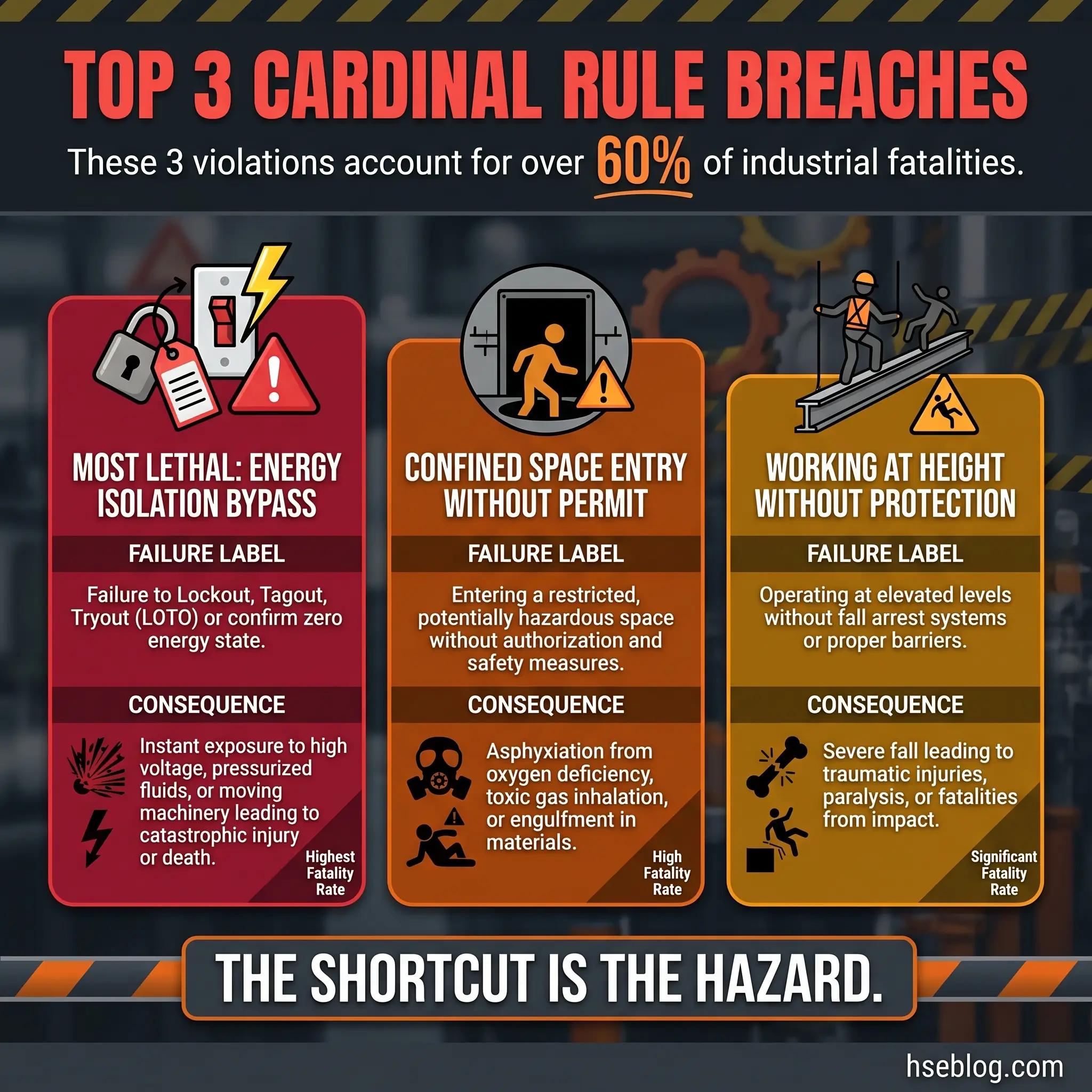
Understanding which cardinal rules get broken most frequently reveals where operational pressure, cultural tolerance, and system design failures converge. After investigating dozens of serious incidents and reviewing hundreds of audit findings across multiple industries, the same patterns repeat.
Energy Isolation Failures
Lockout/tagout violations consistently rank as the most lethal cardinal rule breach. OSHA estimates that failure to control hazardous energy accounts for nearly 10% of all serious workplace injuries in general industry. The reason is deceptively simple: proper LOTO takes time. Identifying every energy source, applying individual locks, verifying zero energy state, and coordinating with multiple trades on a single piece of equipment can add 30–60 minutes to a task that a worker believes will take five.
The shortcuts I have seen repeat across every industry:
- “I’ll just hold the button” — a worker asks a colleague to keep an emergency stop depressed while they reach into a machine, instead of performing full isolation
- “It’s already been locked out” — a second-shift worker trusts the first shift’s lockout without verifying zero energy state personally
- “The breaker is off, that’s enough” — electrical isolation without lockout devices, tags, or verification testing
- Group lockout failures — a single lock applied by a supervisor, with individual workers never attaching their own locks or verifying isolation themselves
Pro Tip: The most dangerous lockout/tagout mistakes happen during shift changes and partial equipment shutdowns. If your LOTO procedure does not specifically address these two scenarios with additional verification steps, you have a gap that will eventually kill someone.
Confined Space Entry Without Authorization
Confined space violations are almost never committed by workers who are ignorant of the rules. In every case I have investigated, the entrant knew a permit was required. The violation happened because the permit process was perceived as slower than the task itself. A five-minute valve check becomes a 45-minute administrative process — and when the job is urgent, the temptation to skip the process is enormous.
Contributing factors that create the conditions for this violation include:
- Permit offices with limited hours — if permits can only be issued during day shift, night and weekend crews face a structural barrier to compliance
- Atmospheric testing equipment unavailable or uncharged — workers cannot comply with a rule when the tools for compliance are not accessible
- Rescue teams not on standby — the full confined space entry system requires rescue capability, and when that is unavailable, the entire process collapses
- Previous entries without incident — repeated safe entries into the same space create a false sense of security that erodes procedural discipline
Fall Protection Non-Compliance
Working at height violations are the most visible and the most debated. Workers at height without proper fall protection is the leading cause of construction fatalities worldwide. OSHA’s Fall Protection standard (29 CFR 1926.501) requires protection at six feet in construction; HSE UK’s Work at Height Regulations 2005 require it whenever there is a risk of a fall liable to cause personal injury, with no fixed height threshold.
The arguments workers use to justify non-compliance are remarkably consistent across every site I have worked on:
- “It’s only a quick job” — task duration has no relationship to fall severity. A two-minute task at 10 meters carries identical fall consequences to a two-hour task.
- “The harness slows me down” — an argument that prioritizes productivity over survival
- “I’ve been doing this for 20 years” — experience does not change the physics of a fall. Gravity does not negotiate with tenure.
- “There’s nowhere to tie off” — a planning failure, not a valid reason to work unprotected. If there is no anchor point, the task cannot proceed.
How Organizations Undermine Their Own Cardinal Rules
Having a set of cardinal rules printed on posters and included in induction packages does not constitute a safety program. I have audited operations where every wall displayed the golden rules in full color, every worker could recite them from memory, and the fatality rate was no better than sites without any formal rule program. The rules themselves are never the problem. The failure is almost always in implementation, enforcement, and leadership credibility.
The most common ways organizations sabotage their own cardinal rule programs reveal systemic weaknesses that no amount of retraining will fix:
- Leadership exemptions: When a senior manager or client representative walks a site without PPE or bypasses a permit, every worker on that site receives a clear message — the rules are for labor, not leadership. I have confronted project directors on this point and heard the response, “I’m just passing through.” Passing through without a hard hat teaches 200 workers that the hard hat rule is optional.
- Production pressure overrides: Cardinal rule programs collapse the moment a supervisor says, “I know the permit has expired, but we need to finish this before the shutdown window closes.” That single sentence undoes months of safety training. Workers learn that schedule pressure suspends the rules.
- Inconsistent consequences: Terminating a laborer for a LOTO violation while issuing a verbal warning to an engineer for the same breach destroys the credibility of the entire program. Zero tolerance must be role-blind.
- Poorly designed systems: If the permit-to-work process takes 90 minutes for a 15-minute task, you have created an incentive for non-compliance. Cardinal rules must be supported by systems that make compliance practical — not heroic.
- Investigation theater: Conducting investigations only after injuries occur — rather than after every cardinal rule breach — communicates that the organization cares about outcomes, not behaviors. Near-miss cardinal rule violations must trigger the same investigation rigor as actual incidents.
Pro Tip: Run an anonymous survey asking frontline workers one question: “Have you ever seen a cardinal rule violated without consequences?” If more than 10% say yes, your program has a credibility problem that no poster campaign will fix. The fix starts with leadership behavior, not worker training.
Building a Cardinal Rule Program That Actually Prevents Fatalities
A functional cardinal rule program is not a document — it is a living operational discipline embedded in every task, decision, and interaction on site. The difference between programs that prevent fatalities and programs that merely document rules comes down to five structural elements.
Step 1: Define Rules Based on Your Fatality Data
Your cardinal rules must reflect your actual risk profile — not a generic template borrowed from another company or industry. The process for defining them requires rigorous analysis:
- Review your organization’s serious incident and fatality data from the past 10 years
- Identify the hazard categories that have caused or could have caused death or permanent disability
- Cross-reference with industry fatality data (IOGP, ICMM, OSHA fatality reports) to identify gaps in your own data
- Draft rules that address only the highest-consequence hazards — resist the temptation to include medium-risk items
- Validate each proposed rule against field conditions to confirm it is operationally achievable without creating perverse incentives
- Limit the final set to 8–12 rules and phrase each as a clear, binary requirement with no room for interpretation
Step 2: Make Compliance Structurally Easy
Every cardinal rule must be supported by the infrastructure, tools, and systems that enable compliance. If you mandate atmospheric testing before confined space entry, four-gas detectors must be available, calibrated, and charged at every point of use. If you require lockout/tagout devices, every authorized worker must carry their own lock and tag set. Rules without resources are traps.
Infrastructure requirements that support cardinal rule compliance include:
- Permit-to-work systems that operate 24/7 — not just during day shift hours
- Sufficient fall protection anchor points pre-installed at all routine work-at-height locations
- LOTO lock stations positioned at every major equipment isolation point, stocked and audited weekly
- Gas detection equipment pools with documented calibration records and replacement schedules
- Rescue teams and equipment positioned and tested before any confined space or height work begins
Step 3: Train for Comprehension, Not Compliance
Most cardinal rule training fails because it focuses on telling workers what the rules are rather than teaching them why the rules exist. A worker who understands that nitrogen purging displaces oxygen — and that unconsciousness occurs in seconds without warning — internalizes the confined space permit rule at a different level than a worker who simply memorizes “get a permit before entry.”
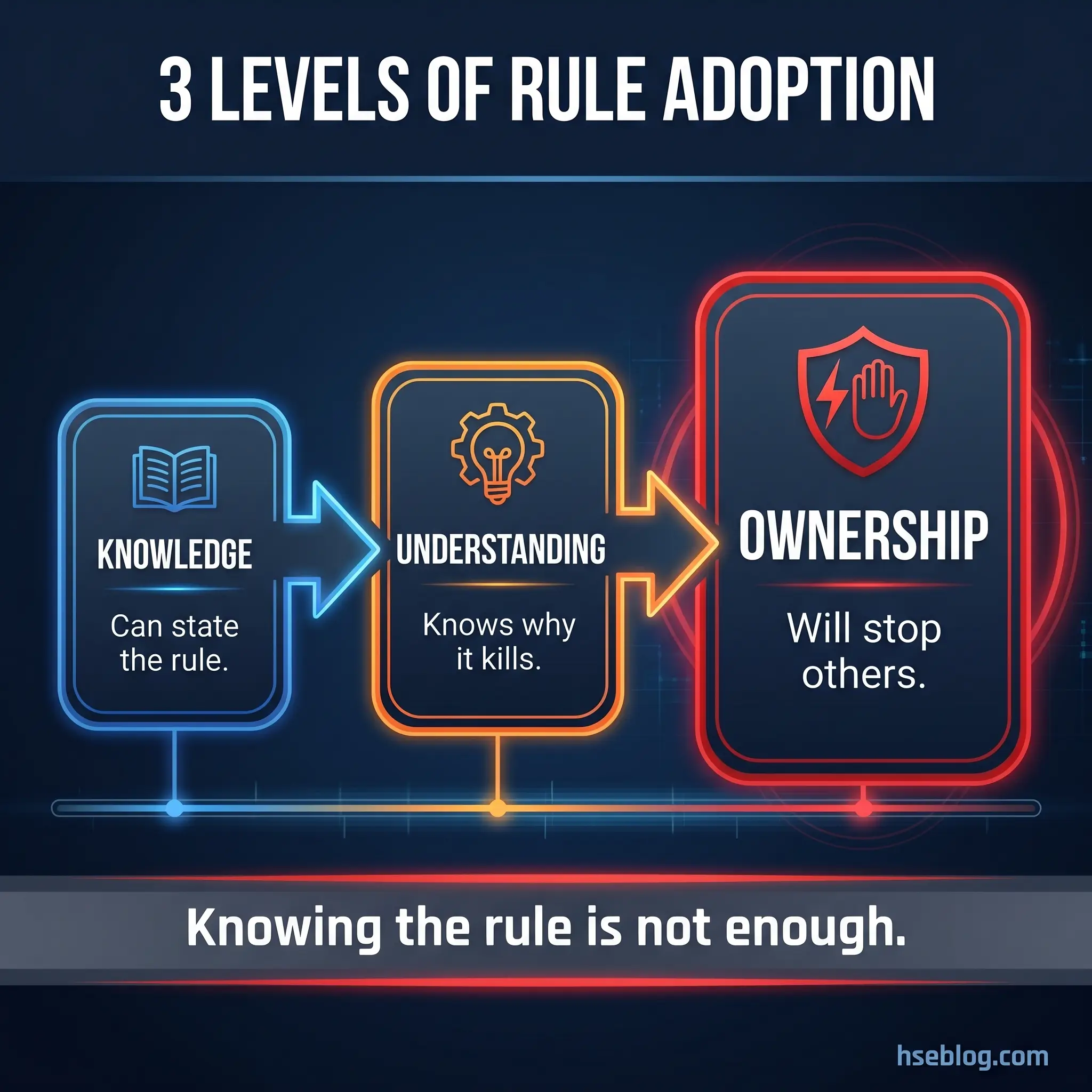
Effective cardinal rule training operates on three levels:
- Knowledge: The worker can state the rule and identify when it applies
- Understanding: The worker can explain the fatal mechanism the rule prevents — what physically happens when the rule is violated
- Ownership: The worker will intervene when they see someone else about to violate the rule, even if that person outranks them
The third level — ownership — is the one most training programs never reach. It requires a culture where stopping a cardinal rule violation is celebrated, not punished. That culture is built through visible leadership reinforcement, not through training modules.
Step 4: Enforce Visibly and Consistently
Enforcement is where most programs fail — not because the will is absent, but because the mechanisms are weak. A functional enforcement framework requires clarity on three fronts before a single violation occurs:
- Predefined consequences documented and communicated to every person on site before work begins — not determined case-by-case after a violation
- Investigation protocol triggered automatically by every cardinal rule breach, regardless of whether injury occurred
- Management accountability where supervisors who tolerate or fail to report violations face consequences equal to or greater than the violator
HSE UK’s Enforcement Policy Statement operates on a proportionality principle — but within the context of cardinal rules, the principle is clear: where the risk is death, enforcement must match the severity. A verbal warning for a potentially fatal violation is not proportionate.
Step 5: Measure What Matters
Tracking cardinal rule program effectiveness requires metrics that go beyond lagging indicators like TRIR and LTIFR. Leading indicators specific to cardinal rules include:
- Cardinal rule breach rate — number of detected violations per 100,000 work hours, tracked monthly and trended
- Intervention rate — number of times workers or supervisors stopped a task due to a cardinal rule concern, tracked as a positive indicator
- Time-to-consequence — how many hours between a detected violation and the enforcement action. Delays erode credibility.
- Leadership safety walk coverage — percentage of work areas visited by senior management per week, with documented cardinal rule observations
- System audit findings — percentage of cardinal rule enabling systems (permits, LOTO stations, gas detectors) found compliant during unannounced audits
Pro Tip: Track intervention rate as your primary leading indicator. When workers are actively stopping unsafe work — not just complying themselves — your cardinal rule program has moved from compliance to culture. That is the transition point where fatality risk genuinely drops.
The Role of Stop Work Authority in Cardinal Rule Enforcement
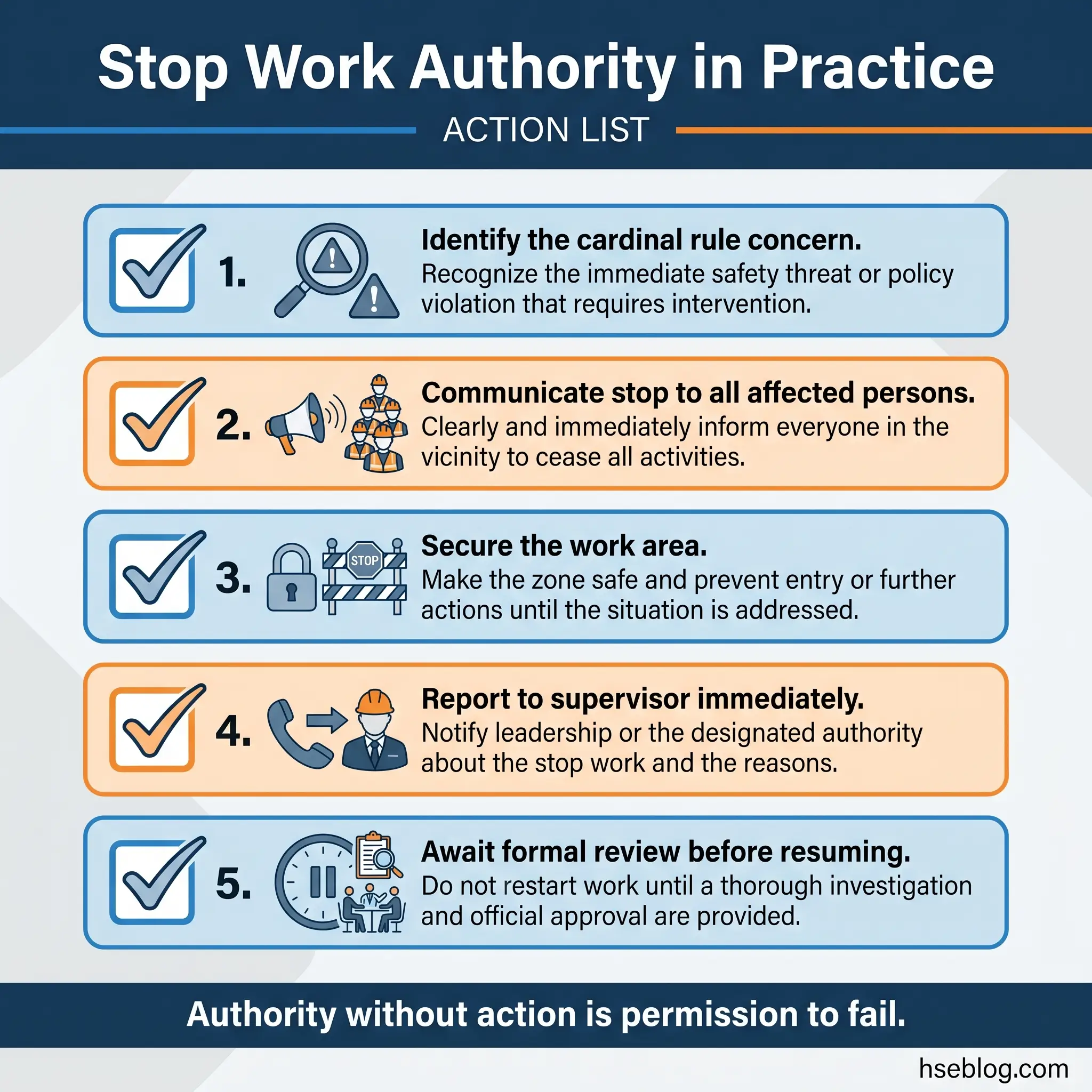
Stop work authority is the enforcement mechanism that gives cardinal rules operational teeth. Without it, cardinal rules are policy statements. With it, every person on site becomes an enforcement agent — authorized and expected to halt any activity that violates a cardinal rule, regardless of cost, schedule, or authority hierarchy.
The concept is straightforward, but execution failures are common. Most organizations grant stop work authority on paper but punish its use in practice. I have personally witnessed a rigger halt a crane lift because the exclusion zone was breached by foot traffic — the correct decision under the cardinal rules — only to be told by the construction manager to “stop being difficult” and resume the lift. That rigger never exercised stop work authority again. One interaction undid years of training.
For stop work authority to function as a genuine cardinal rule enforcement tool, three conditions must be met:
- Universal scope: Every person on site — regardless of employment status, trade, seniority, or nationality — holds equal authority to stop work for a cardinal rule concern. Contractors, sub-contractors, and visitors are explicitly included.
- No-retaliation guarantee: Workers who exercise stop work authority must face zero negative consequences — no reassignment, no reduced hours, no informal social penalties from supervisors. This guarantee must be documented, communicated, and visibly enforced by senior leadership.
- Mandatory post-stop review: Every stop work event must be reviewed within 24 hours by a competent person. If the stop was justified, the worker is formally recognized. If the concern was unfounded, the worker is thanked for vigilance — never reprimanded.
Real-World Consequences of Cardinal Rule Failures
The gap between theory and practice becomes tragically visible when cardinal rule failures lead to fatalities. These are not hypothetical scenarios — they are patterns I have seen repeated across industries and geographies, each one preventable, each one traceable to a specific rule breach that someone tolerated.
The Cost of Bypassing Lockout/Tagout
During an electrical maintenance task at a manufacturing facility in Northern Europe, a technician was fatally electrocuted while working on a motor control center that had not been properly isolated. The investigation revealed that the technician had isolated the main breaker but failed to apply a personal lock — relying instead on a colleague’s verbal confirmation that the circuit was de-energized. A second worker, unaware of the maintenance activity, re-energized the circuit from a remote panel. The entire incident — from breach to fatality — took less than eight seconds.
Root cause: the site’s LOTO procedure allowed verbal confirmation as a substitute for physical lockout in “low-risk” electrical tasks. There is no such thing as low-risk electrical work when the consequence is electrocution.
The Cost of Ignoring Fall Protection
A structural steel erector fell 14 meters from an open-sided platform on a construction project in the Middle East. He had been wearing a full-body harness but had not connected his lanyard to any anchor point — the harness was essentially a costume. The investigation found that no anchor points had been installed on the working platform because the design drawings did not specify them and no one in the planning chain had flagged the gap. The cardinal rule required 100% tie-off at all times above 1.8 meters, but the system that enabled compliance did not exist.
Root cause: cardinal rule enforcement without structural engineering support. The rule was correct. The infrastructure was absent.
The Financial and Operational Impact
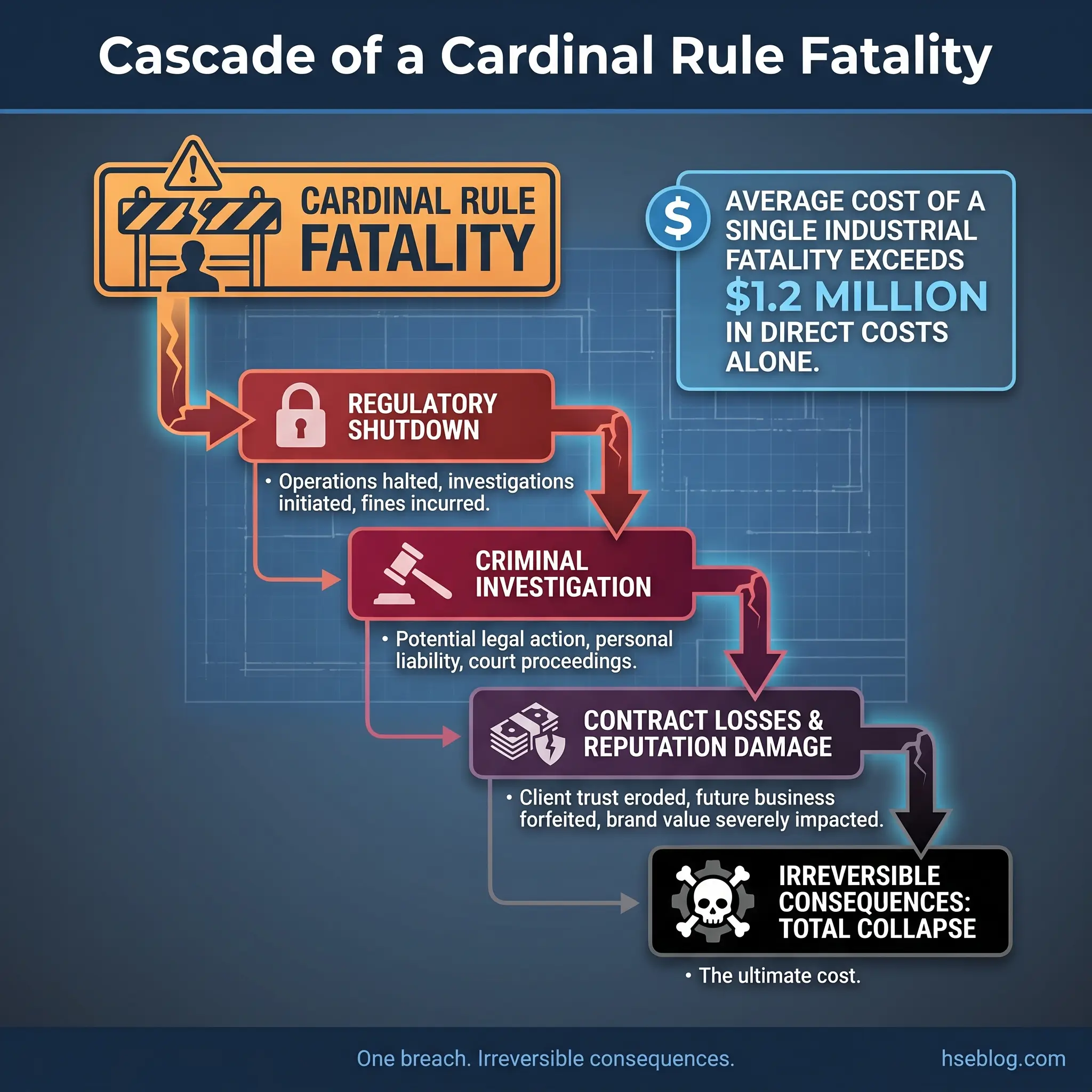
Cardinal rule fatalities carry consequences that extend far beyond the immediate tragedy. Organizations that experience a preventable fatality face a cascade of operational, legal, and financial impacts that can destabilize entire projects:
- Regulatory enforcement actions including stop-work orders, prohibition notices, and potential criminal prosecution of responsible persons under legislation like the UK’s Corporate Manslaughter and Corporate Homicide Act 2007
- Project delays measured in weeks or months during investigation, regulatory review, and corrective action implementation
- Contract termination risk — major clients routinely terminate contractors who experience a preventable fatality, with loss-of-business impacts extending years beyond the incident
- Insurance premium increases of 30–200% depending on severity and regulatory findings
- Workforce morale and retention damage — workers who witness or learn of a preventable death lose trust in the organization’s safety commitment, increasing turnover and reducing engagement
Cardinal Rules and Safety Culture: The Connection That Determines Everything
Cardinal rules do not create safety culture. Safety culture creates the conditions where cardinal rules are respected, enforced, and owned by the entire workforce. This distinction is critical because organizations that treat cardinal rules as a substitute for culture-building end up with rules that exist in documentation but not in practice.
A mature safety culture supports cardinal rules through three observable behaviors that you can assess on any site visit:
- Workers correct each other without waiting for a supervisor. When a scaffolder notices a colleague working without edge protection and immediately addresses it — peer to peer, without escalation — that is cultural ownership of cardinal rules in action.
- Near-miss cardinal rule breaches are reported voluntarily. In a punitive culture, workers who almost violate a cardinal rule stay silent. In a healthy culture, they report the near-miss because they understand that the system needs to learn from it. The reporting rate of near-miss cardinal rule events is one of the most reliable indicators of cultural maturity.
- Leadership walks the talk visibly. When the project director clips into a harness before stepping onto a scaffold — without being reminded — every worker who sees it receives a reinforcement signal that no training session can replicate.
The relationship between cardinal rules and safety culture is reciprocal. Strong cardinal rule enforcement, applied fairly and consistently, accelerates cultural maturity. But rules imposed on a weak culture without accompanying leadership transformation produce compliance without commitment — and compliance without commitment cracks under pressure.
Pro Tip: Test your safety culture with one question during site walks. Ask a frontline worker: “What would happen if you stopped a job right now because of a cardinal rule concern?” If the answer involves hesitation, caveats, or any reference to production pressure, your culture has not reached the maturity level needed to sustain cardinal rules through high-pressure situations.
Conclusion
Cardinal rules of safety exist for one reason: people died in the absence of them. Every rule in your set traces back to a fatality, a catastrophic near-miss, or a pattern of serious harm that proved the hazard would not tolerate half-measures. When you enforce these rules with zero tolerance — consistently, visibly, and without exceptions for rank or schedule — you create the only conditions where workers can trust the system that is supposed to protect them.
The organizations that get this right are not the ones with the best posters, the most sophisticated permit software, or the highest training budgets. They are the ones where a first-day apprentice has the same authority and the same obligation to stop unsafe work as the project director. They are the ones where the cost of a cardinal rule violation is clear before anyone sets foot on site — and where that cost is enforced equally, every time, without negotiation.
No KPI, contract milestone, or production target is worth a human life. Cardinal rules formalize that principle into operational discipline. Zero tolerance makes it real. Everything else is a safety program waiting for its first fatality.