
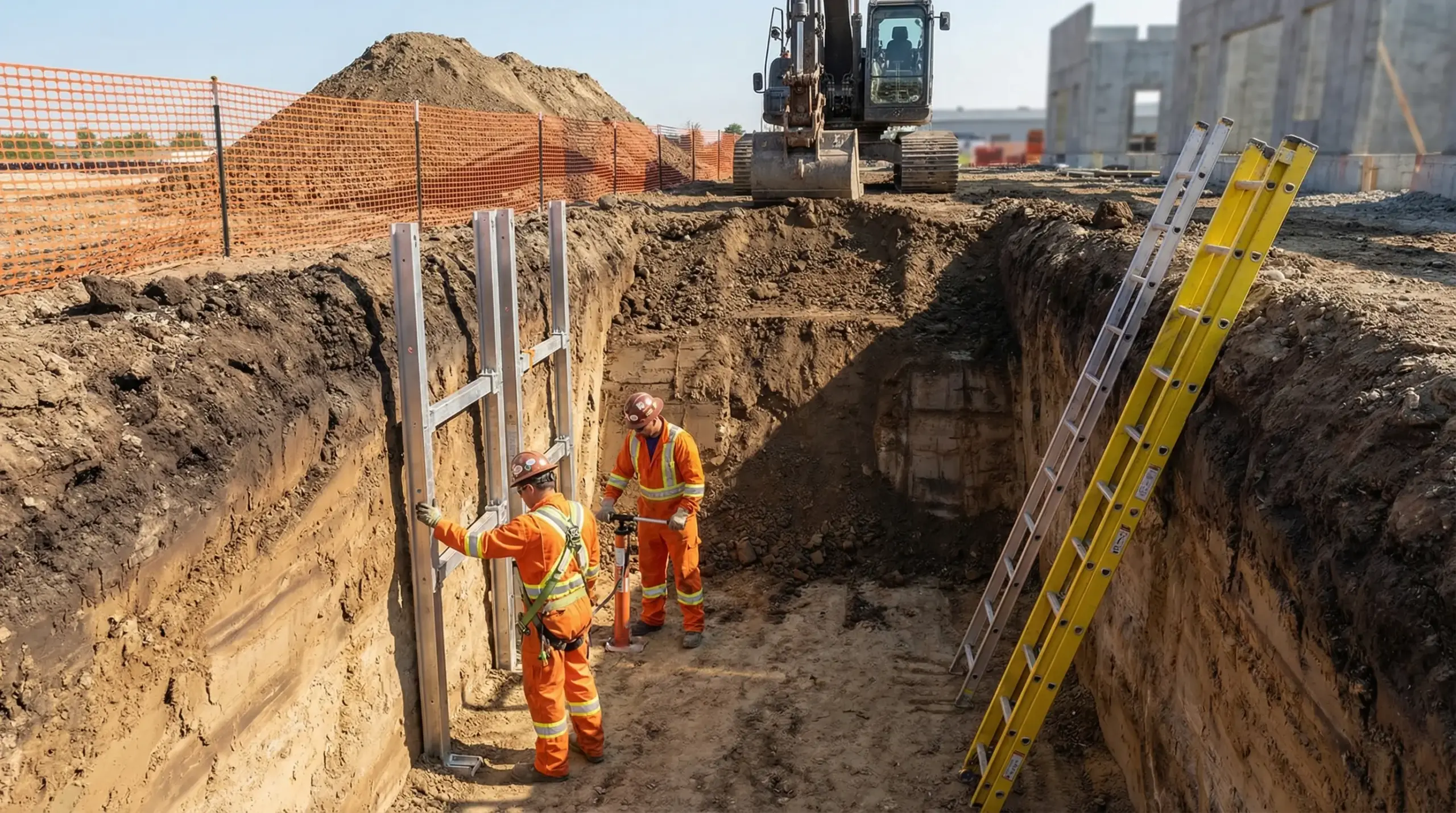
I was called to a residential infrastructure project where a 2.4-meter utility trench had collapsed onto a worker twenty minutes before I arrived. The trench had no shoring, no sloping, no benching — just vertical walls cut into wet clay after two days of rain. The crew had been digging and laying pipe in unprotected trenches for three weeks without incident, and that false confidence had become the norm. By the time the rescue team extracted the worker from under approximately 1.5 cubic meters of saturated soil, he had suffered crush injuries to his pelvis and lower spine. He survived, but never returned to construction work. The foreman’s explanation was one I had heard before: “We’ve always done it this way and nothing ever happened.”
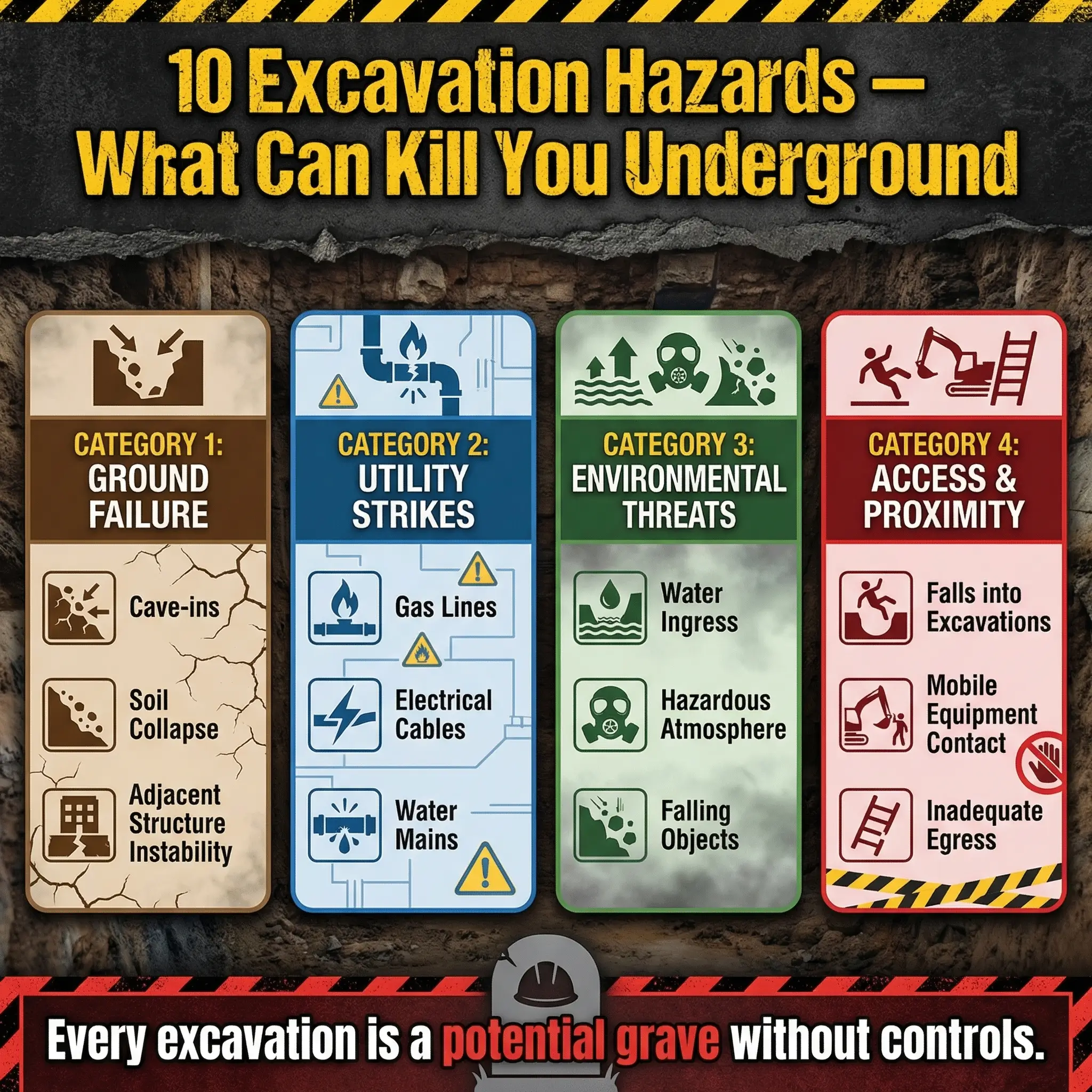
Excavation work remains one of the deadliest activities in the construction industry worldwide. According to OSHA data and international incident records, trench collapses alone account for dozens of fatalities annually — and the actual number is higher when unreported incidents across developing regions are included. What makes excavation hazards particularly lethal is their speed: a cubic meter of soil weighs between 1,200 and 1,800 kilograms, and a trench wall can collapse in under a second, giving the worker zero time to react. This article covers the 10 most common excavation hazards encountered on real construction sites and the proven control measures that prevent them — drawn from years of site inspections, incident investigations, and contractor safety management across infrastructure, pipeline, and civil engineering projects.
TL;DR
- Cave-ins kill more excavation workers than any other hazard — and nearly every fatal trench collapse traces back to missing or inadequate protective systems that should have been installed before anyone entered the excavation
- Soil classification is not optional guesswork — a competent person must test and classify soil type before selecting sloping, benching, or shoring systems, because the wrong protection for the soil condition is as dangerous as no protection at all
- Underground utility strikes cause explosions, electrocutions, and chemical releases — yet most occur because contractors skip the locate-and-mark process or rely on outdated drawings instead of verified ground surveys
- Atmospheric hazards inside excavations are invisible and fast-acting — oxygen displacement, toxic gas accumulation, and flammable vapor intrusion can incapacitate a worker in seconds, especially in excavations near landfills, fuel systems, or industrial operations
- Every excavation over 1.5 meters (5 feet) deep requires engineered controls, daily inspections, and a rescue plan before entry — treating shallow trenches as low-risk is the single most common site-level mistake that leads to fatalities
What Makes Excavation Work So Dangerous
Excavation hazards are uniquely lethal because they combine unpredictable ground conditions with confined working spaces, heavy equipment operating at the edge, and time pressure that tempts crews to skip protective measures. Unlike most construction hazards where a failure gives some margin for escape, a trench wall failure buries a worker instantly under hundreds or thousands of kilograms of soil.
The core danger factors that separate excavation from other construction activities include:
- Speed of failure: A trench wall collapse happens in less than one second — there is no warning sound, no gradual movement, and no time to step aside once the soil releases
- Weight of soil: One cubic meter of dry soil weighs approximately 1,200–1,500 kg; saturated clay can exceed 1,800 kg per cubic meter — enough to cause fatal crush injuries from even a partial collapse
- Invisible hazards below grade: Gas pockets, contaminated groundwater, severed utility lines, and oxygen-depleted atmospheres exist below ground with no visible warning signs from the surface
- False confidence from repetition: Crews who dig trenches daily without incident develop normalized risk tolerance — the most dangerous mindset in excavation work, because soil conditions change with weather, vibration, surcharge loads, and time
OSHA 29 CFR 1926 Subpart P requires that all excavations be assessed for hazards before worker entry, and that protective systems be installed in any trench 5 feet (1.5 meters) or deeper — or in shallower trenches where the competent person identifies conditions that could cause a collapse.
Pro Tip: The single most reliable predictor of an excavation incident is the absence of a designated competent person on site. If nobody has been formally assigned to inspect the excavation daily and after every rainfall, equipment vibration event, or change in soil conditions — the excavation is already out of compliance before anyone enters it.
Hazard 1 — Cave-Ins and Trench Collapse
Cave-ins are the leading cause of death in excavation work globally, and every fatal cave-in I have investigated shares the same root cause profile: unprotected trench walls in soil that the crew assumed was “stable enough.” The physics are unforgiving. Soil is not a solid structure — it is a mass of particles held together by moisture, cohesion, and friction. Remove the lateral support by cutting a vertical wall, and you create a failure plane that can release without warning.
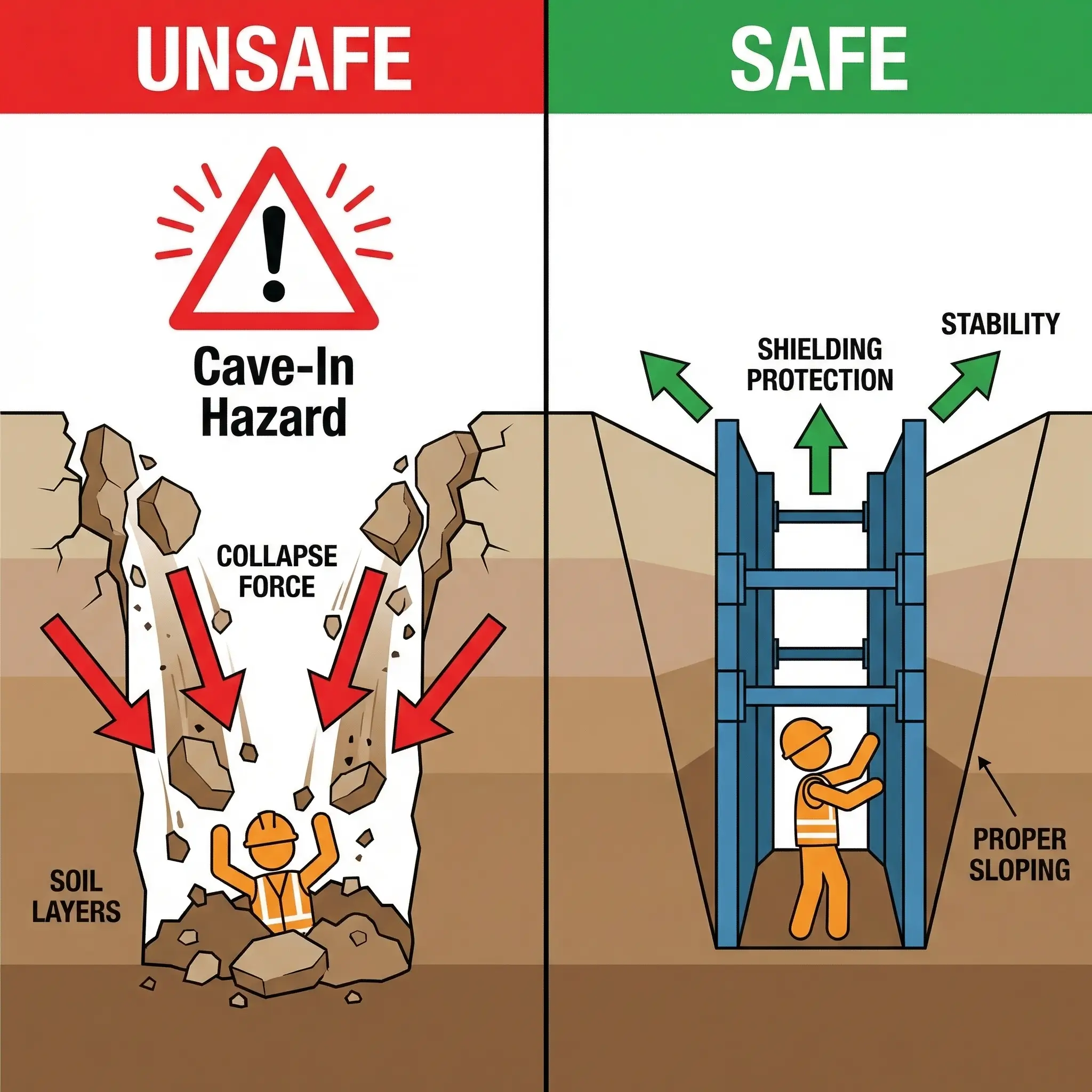
The conditions that trigger cave-in failures on real sites follow predictable patterns:
- Recent rainfall or water table changes that saturate the soil, add weight, and reduce cohesion — the single most common trigger in every incident report I have reviewed
- Vibration from heavy equipment operating too close to the trench edge, creating dynamic loads that exceed the soil’s shear strength
- Surcharge loads from stockpiled spoil, materials, or vehicles placed within the failure zone adjacent to the excavation
- Previously disturbed or backfilled ground that has lower cohesion than undisturbed native soil — common on urban sites with prior utility installations
- Extended open time where a trench remains open for hours or days, allowing progressive drying, cracking, and loss of surface tension in cohesive soils
Control Measures for Cave-In Prevention
Preventing cave-ins requires a layered approach that starts with soil classification and ends with continuous monitoring throughout the excavation’s open duration. No single control is sufficient on its own.
The following protective systems must be selected and implemented based on competent person assessment and soil classification results:
- Classify the soil using visual and manual testing methods (pocket penetrometer, thumb test, ribbon test, dry strength test) to determine Type A, B, or C classification per OSHA Subpart P Appendix A — this determines every subsequent protection decision
- Select the protective system — sloping to the angle of repose for the soil type (¾:1 for Type A, 1:1 for Type B, 1½:1 for Type C), benching only for Type A or B cohesive soils, or shoring/shielding systems engineered for the depth and soil conditions
- Install the protection before any worker enters — never allow “just a quick look” or “only for a minute” without full protection in place
- Keep spoil and materials at least 0.6 meters (2 feet) from the trench edge to prevent surcharge loading on the failure zone
- Inspect the excavation at the start of every shift, after every rain event, and after any change in conditions — document every inspection with the competent person’s signature
Pro Tip: On a pipeline project in the Gulf, I implemented a “red zone” marking system using spray paint — a red line 1.5 meters back from every trench edge where no equipment, material, or personnel could stand. Compliance was immediate because the visual boundary was impossible to ignore. Simple, cheap, and it eliminated surcharge violations overnight.
Hazard 2 — Hazardous Atmospheres in Excavations
Most construction crews do not think of excavations as confined spaces — and that misunderstanding has killed workers. Any excavation deeper than 1.2 meters where a worker’s head drops below grade level can accumulate hazardous atmospheres, especially near landfills, fuel storage facilities, industrial sites, sewer lines, or areas with decaying organic material. I investigated an incident at an urban utility excavation where a worker lost consciousness 90 seconds after descending into a 2-meter trench adjacent to an old fuel station. Hydrocarbon vapors had migrated through the soil from a legacy underground storage tank and pooled in the trench bottom at concentrations above the lower explosive limit.
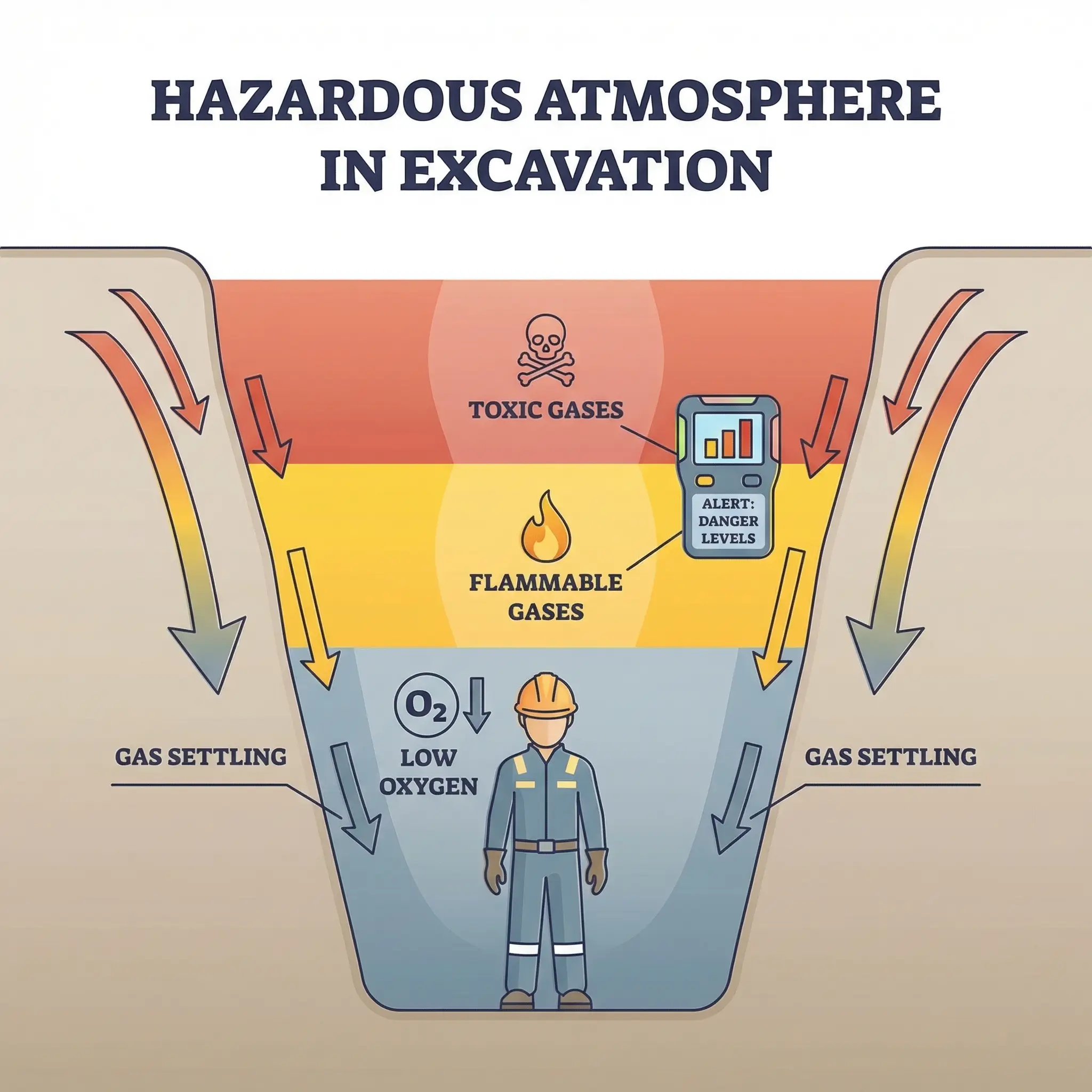
The atmospheric hazards that develop in excavations share common characteristics with confined space atmospheres:
- Oxygen displacement below the 19.5% safe threshold, caused by soil gas infiltration (methane, CO₂), bacterial decomposition, or displacement by heavier-than-air gases pooling at the trench bottom
- Toxic gas accumulation — hydrogen sulfide (H₂S) from decaying organic matter or sewer proximity, carbon monoxide (CO) from nearby combustion engines, or volatile organic compounds (VOCs) from contaminated soil
- Flammable vapor intrusion from leaking gas lines, fuel systems, or chemical spills that create explosive atmospheres in the excavation
- Welding and cutting fumes when hot work is performed inside the excavation without adequate ventilation
Atmospheric Control Measures
Atmospheric testing and ventilation are the two non-negotiable controls for any excavation where hazardous atmosphere potential exists. The approach must be proactive — testing after a worker reports feeling dizzy means you have already failed.
- Pre-entry atmospheric testing using a calibrated 4-gas detector (O₂, LEL, H₂S, CO) before any worker descends into an excavation deeper than 1.2 meters in any area with potential contamination
- Continuous monitoring with the detector at the worker’s breathing zone level — not clipped to a belt at waist height where readings do not reflect what the worker is actually inhaling
- Mechanical ventilation using forced-air blowers positioned to supply fresh air to the excavation bottom and push contaminated air upward and out
- Engine and equipment exclusion zones — no combustion engines running within 3 meters of an open excavation to prevent CO accumulation
- Confined space entry procedures activated for any excavation where atmospheric testing shows readings outside safe limits, including attendant, rescue plan, and communication protocols
Under OSHA 1926.651(g), when the competent person has reason to believe a hazardous atmosphere exists or could develop, atmospheric testing must be conducted before entry, and emergency rescue equipment must be available.
Hazard 3 — Underground Utility Strikes
Striking an underground utility line during excavation is one of the most preventable yet most frequently occurring excavation incidents across every region I have worked in. A gas main strike can cause an explosion. An electrical cable strike can electrocute the operator and anyone in contact with the machine or wet ground. A water main strike can flood the excavation in minutes, undermining trench walls and triggering a cave-in. A fiber optic or communications strike shuts down critical infrastructure. Every one of these has happened on projects I have been involved with.
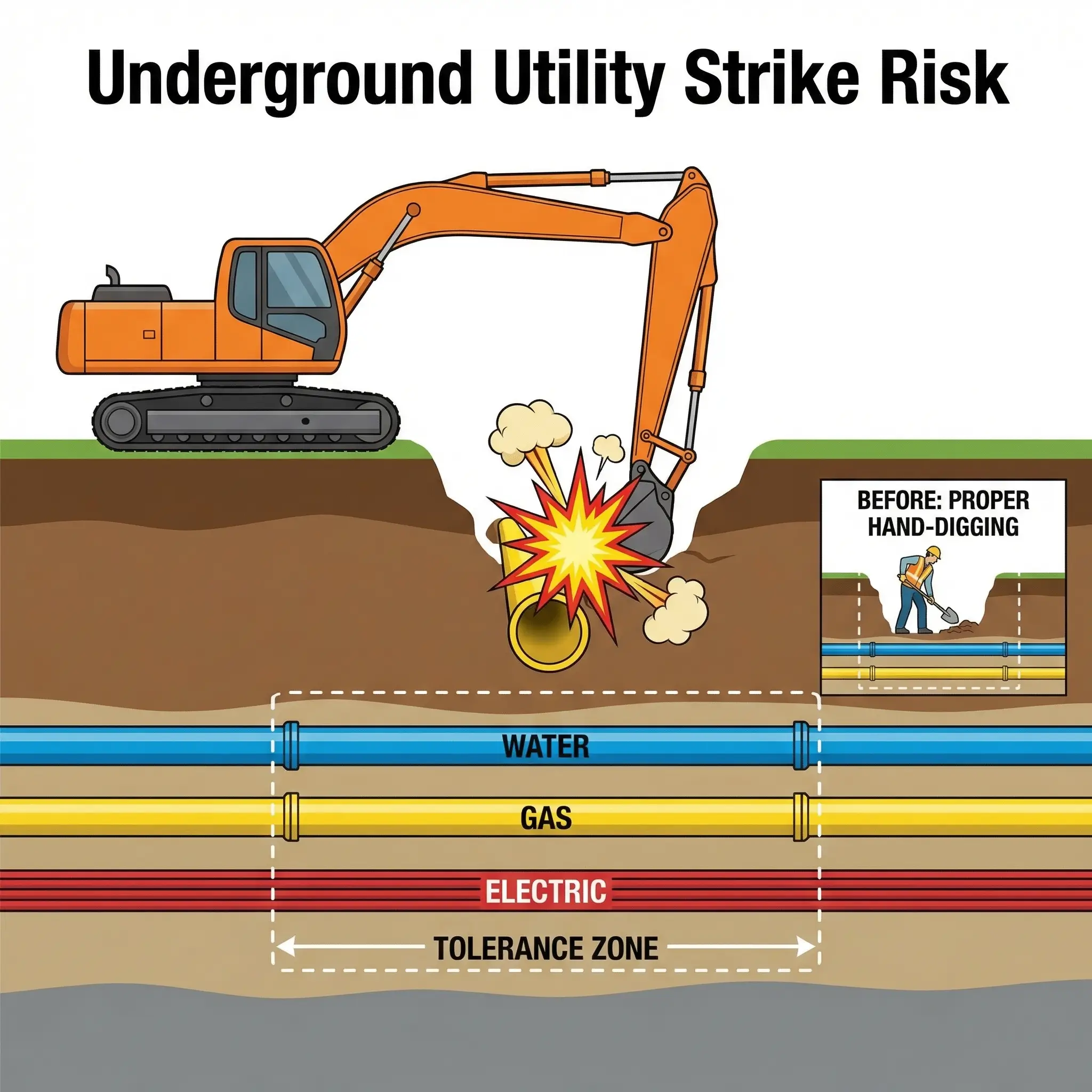
The root causes behind utility strikes are remarkably consistent:
- Failure to request utility locates before digging — the most basic and most commonly skipped step
- Reliance on outdated or inaccurate as-built drawings that do not reflect actual installation positions, depth changes, or subsequent modifications
- Mechanical excavation within the tolerance zone around marked utilities instead of hand-digging or vacuum excavation as required
- Unmarked or abandoned utilities that do not appear in any records — particularly common on brownfield sites, old industrial areas, and urban redevelopment projects
- Depth assumptions based on standard burial depths that do not account for ground level changes, erosion, or previous earthworks
Utility Strike Prevention Measures
The prevention sequence for utility strikes follows a strict hierarchy that I enforce on every excavation project — no shortcuts, no assumptions, no exceptions.
- Contact the national or regional utility locate service (e.g., 811 in the US, or equivalent one-call systems) a minimum of 48–72 hours before any ground disturbance — document the request and reference number
- Verify locate markings on site against available records, and physically confirm that all expected utilities have been marked — if any service is missing, do not proceed until it is resolved
- Hand-dig or vacuum excavate within the tolerance zone (typically 0.5–1 meter on either side of the marked utility) — no mechanical excavation is permitted within this zone
- Use ground-penetrating radar (GPR) or electromagnetic locators on sites with complex or unknown utility corridors, abandoned services, or unreliable records
- Conduct a pre-dig briefing with the excavator operator and all crew members identifying every marked utility, the tolerance zones, and the emergency response procedure for each utility type
Pro Tip: On a hospital campus expansion project in Northern Europe, we discovered three unmapped steam lines and an abandoned high-voltage cable during GPR survey — none appeared on any drawing. The GPR survey cost €4,000 and took one day. A single utility strike would have cost weeks of delay and potentially a fatality. That ratio is not even close.
Hazard 4 — Falls Into Excavations
Open excavations are fall hazards — a fact that sounds obvious until you see how many sites leave trenches and pits unguarded overnight, during shift changes, or along pedestrian routes. A fall of 2 meters into a hard trench bottom onto exposed pipe, rebar, formwork, or compacted soil causes serious injuries including spinal fractures, head trauma, and impalement. I have seen three separate incidents where workers walking near unbarricaded excavations stepped into trenches in low-light conditions — two resulted in hospitalization.
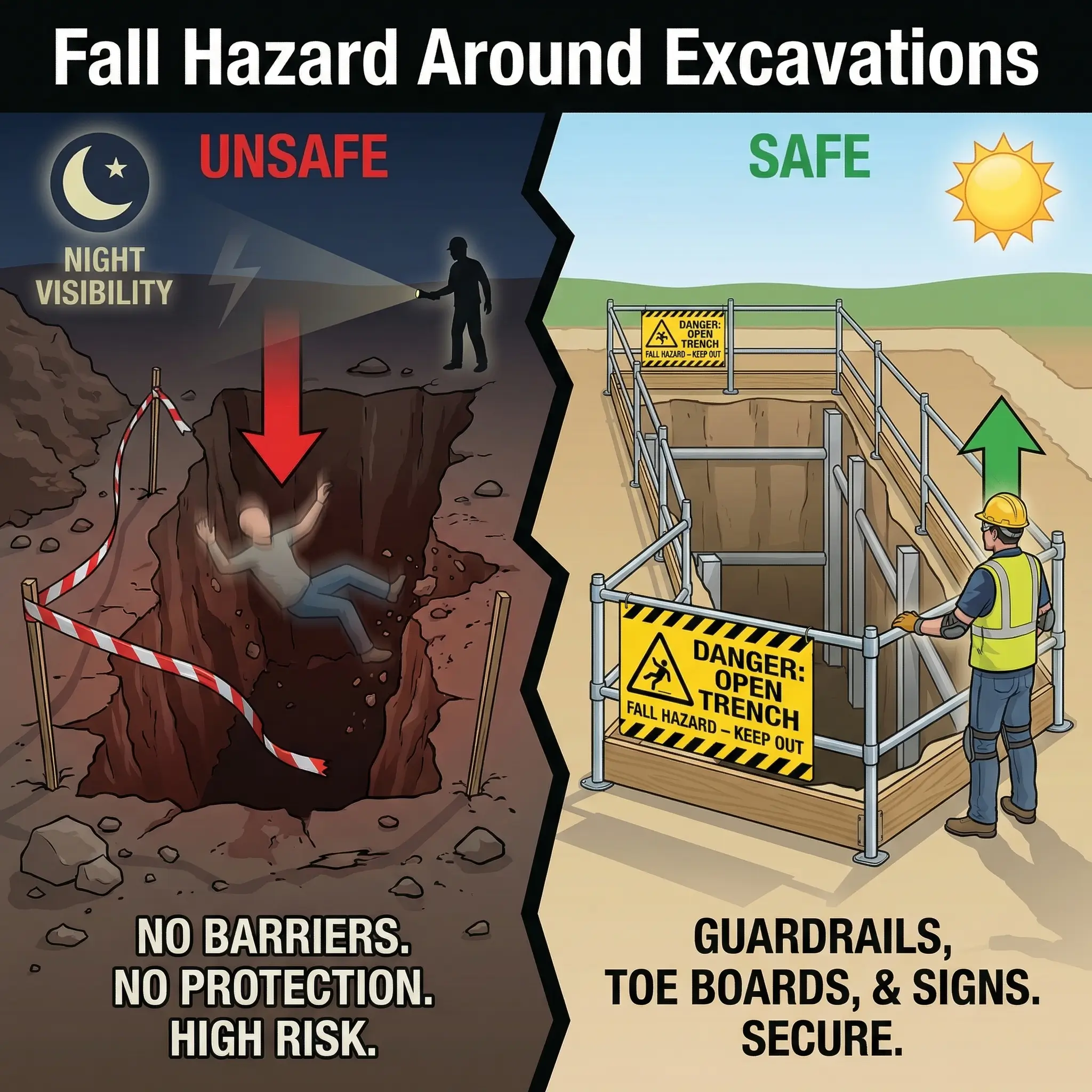
The conditions that create fall-into-excavation risks are present on almost every site:
- Missing or inadequate edge protection — no guardrails, no barriers, or only hazard tape that provides zero physical resistance
- Nighttime and low-visibility conditions where excavation edges are invisible to workers and the public
- Pedestrian and vehicle traffic routes adjacent to unprotected excavations without physical separation
- Inadequate access/egress points that force workers to climb soil walls or jump across narrow trenches instead of using designated entry points
Fall Prevention Controls
Preventing falls into excavations requires both physical barriers and procedural controls — barriers alone fail when displaced, and procedures alone fail when ignored.
- Install rigid guardrails or physical barriers at the perimeter of every excavation deeper than 1.2 meters — not hazard tape, not traffic cones, but solid barriers capable of preventing a person from falling in
- Cover all excavation openings (manholes, service pits, trench crossings) with rated steel plates or timber covers secured against displacement — mark every cover with “EXCAVATION BELOW” signage
- Provide safe access and egress via ladders, ramps, or stairways within 7.5 meters of every worker in the excavation — per OSHA 1926.651(c)(2)
- Install warning lighting (solar-powered LED barriers or reflective markers) around excavation perimeters that will remain open during non-working hours or reduced visibility
- Designate crossing points where pedestrian or vehicle routes must cross excavation lines — with rated bridge plates and edge protection
Hazard 5 — Water Accumulation and Flooding
Water inside an excavation is not just an inconvenience — it is an active hazard multiplier. Water saturates trench walls and reduces their shear strength, increasing cave-in risk exponentially. Standing water conceals trench bottom hazards. Flowing water can undermine shoring or shield systems. And rapid water ingress from a broken water main or sudden rainfall can fill an excavation faster than a worker can escape. On a coastal infrastructure project in Southeast Asia, a tidal groundwater surge flooded a 3-meter sheet-piled excavation during a night shift, trapping two workers who could not reach the ladder in time. Both were rescued, but the incident shut down the project for two weeks.
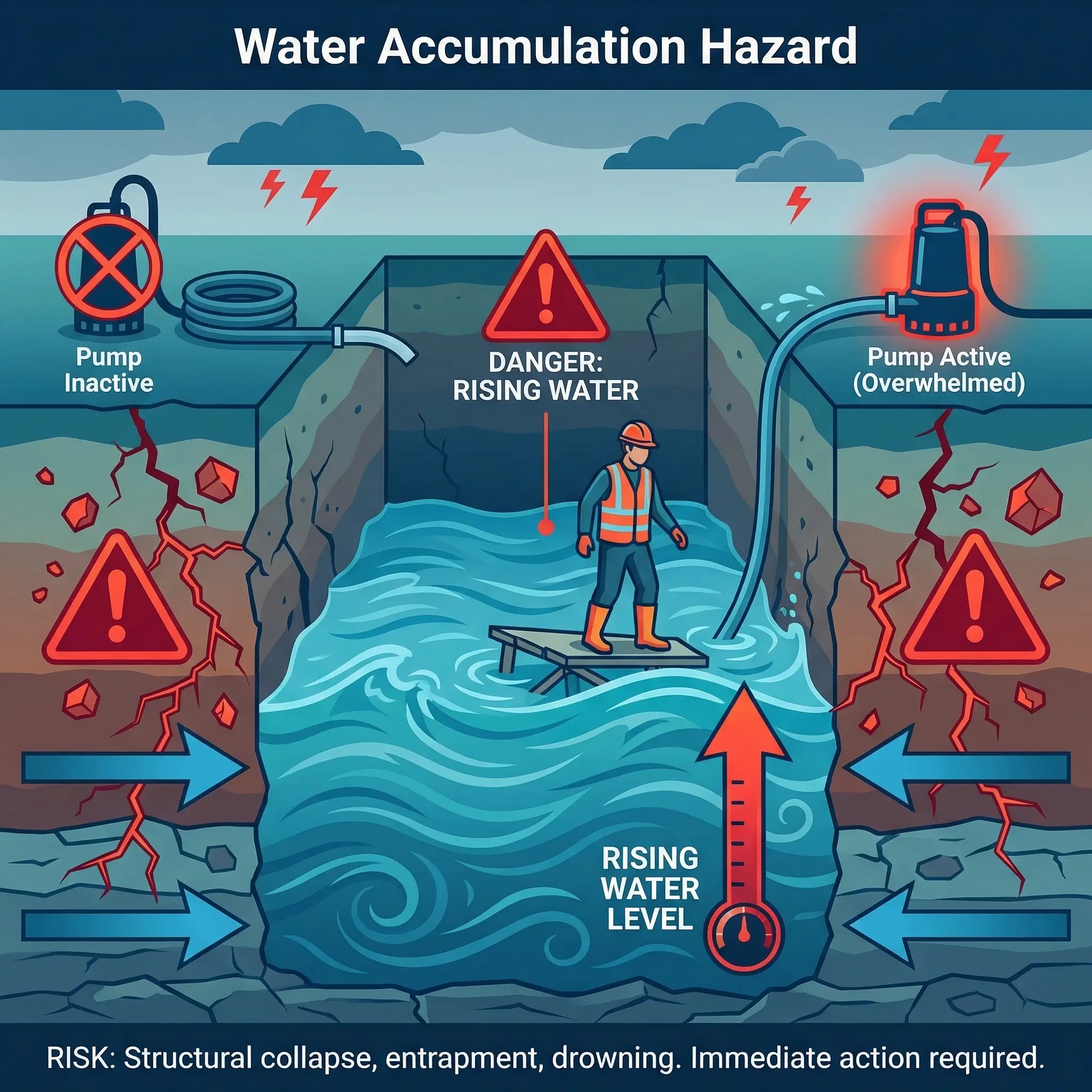
The sources of water accumulation in excavations include:
- High water table or perched groundwater that seeps through trench walls continuously
- Rainfall and surface runoff entering the excavation from surrounding ground, especially where grading directs water toward the excavation
- Broken water mains or utility lines struck during excavation or adjacent works
- Tidal or seasonal water table fluctuations on coastal or floodplain sites
Water Management Controls
Effective water management requires both prevention and active removal, and the approach must be planned before excavation begins — not improvised when water appears.
- Dewatering systems (well points, sump pumps, header systems) designed and installed based on geotechnical data before excavation reaches the water table — not as a reactive measure after flooding occurs
- Surface water diversion using grading, berms, and drainage channels to direct rainfall and runoff away from excavation edges
- Continuous pump operation with backup capacity — a single pump failure during rainfall should never be capable of flooding the excavation
- Competent person re-inspection after every water accumulation event, specifically assessing trench wall stability before allowing re-entry
- Prohibition of worker entry into excavations with uncontrolled water accumulation until the water source is identified and managed
| Water Source | Primary Control | Backup Control | Re-entry Requirement |
|---|---|---|---|
| High water table | Well points / header dewatering | Sump pumps with float switches | Competent person inspection |
| Surface runoff | Grading and perimeter berms | Drainage channels and silt barriers | Wall stability check |
| Broken utility | Isolate supply immediately | Emergency pumping and shoring check | Full re-assessment of all systems |
| Tidal fluctuation | Tidal schedule-based work planning | Sheet piling with sealed joints | Wait for water level to recede + inspection |
Hazard 6 — Falling Objects and Equipment Into Excavations
Workers inside an excavation are exposed to objects falling from the surface — tools, materials, spoil, concrete blocks, pipes, and equipment that can cause fatal head injuries from even moderate heights. The hazard is compounded by the fact that workers in a narrow trench have virtually no room to dodge. During a sewer installation project, I witnessed a section of ductile iron pipe roll off a stockpile and drop 2.5 meters into a trench, missing a worker by less than a meter. The pipe weighed over 200 kg. The stockpile was within 0.3 meters of the trench edge — a violation of every standard on every project I have ever managed.
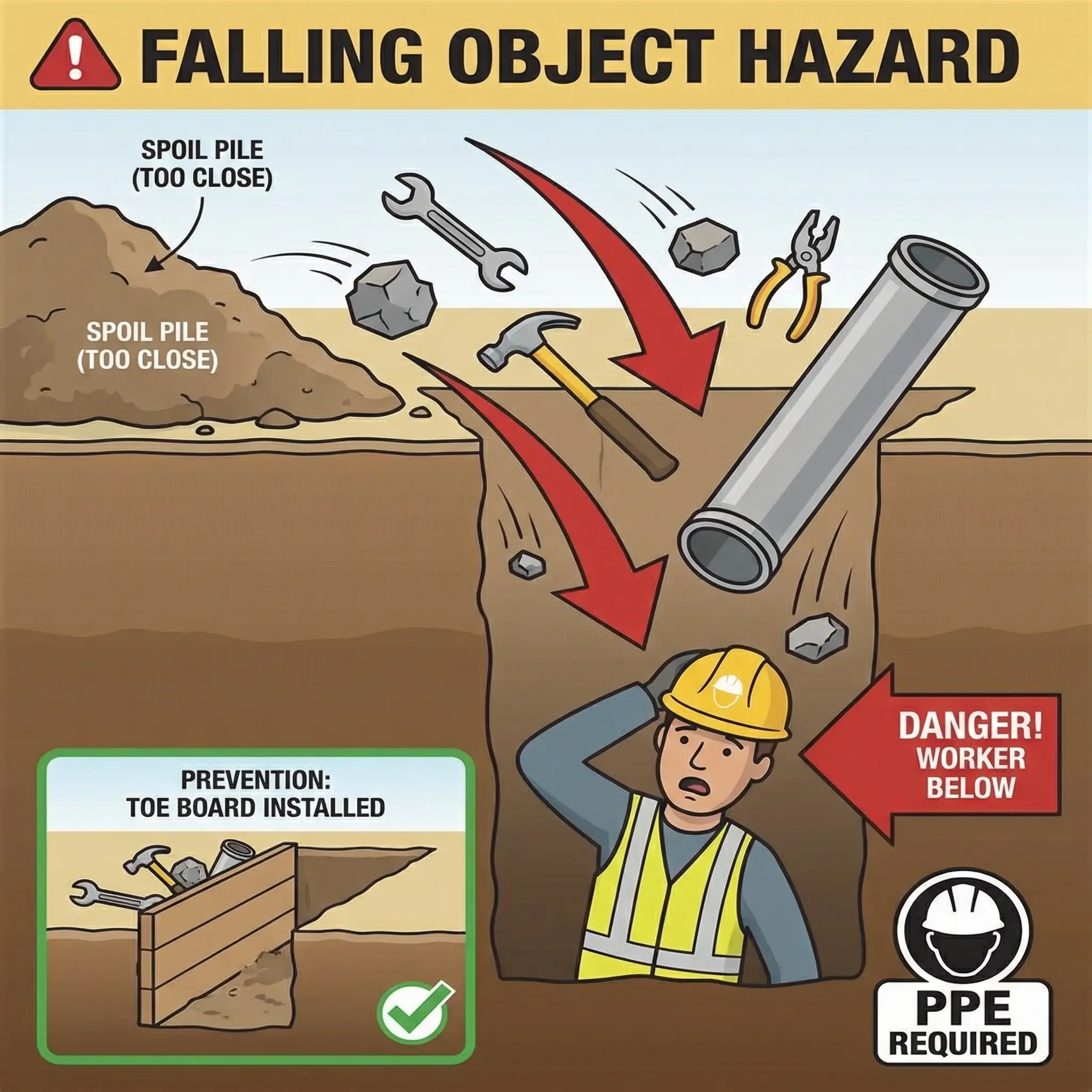
The most frequent falling object scenarios in excavation work include:
- Spoil piles placed too close to the trench edge that spill loose material into the excavation during machine operations or wind
- Tools and materials left unsecured at the excavation edge that get kicked, knocked, or vibrated into the trench
- Pipe, conduit, and structural materials staged adjacent to the excavation without adequate securing or setback distance
- Excavator bucket and crane load movements over occupied excavation areas without exclusion zones
Falling Object Prevention
The controls for falling objects in excavations are straightforward, low-cost, and have no acceptable reason for non-compliance:
- Maintain the 0.6-meter (2-foot) setback for all spoil, materials, and equipment from the excavation edge — enforce this with physical markers or painted lines
- Install toe boards on guardrail systems to prevent tools and small materials from rolling under the guardrail into the excavation
- Use overhead protective structures (canopies or netting) when excavation work occurs below active work areas or material staging zones
- Mandate hard hats for all workers inside every excavation — no exceptions, regardless of depth or perceived risk level
- Implement exclusion zones under crane and excavator swing paths — no worker may occupy the excavation beneath a suspended load or active bucket operation
Hazard 7 — Proximity to Mobile Equipment
Excavators, backhoes, dump trucks, compactors, and cranes operating adjacent to occupied excavations create struck-by and crush hazards that rank among the top excavation-related fatality types globally. The operators have limited visibility — blind spots on a standard tracked excavator can conceal a worker standing within 3 meters of the machine on the counterweight side. I have personally stopped jobs where excavator operators were swinging loaded buckets directly over workers in the trench below, with no spotter, no communication, and no exclusion zone.
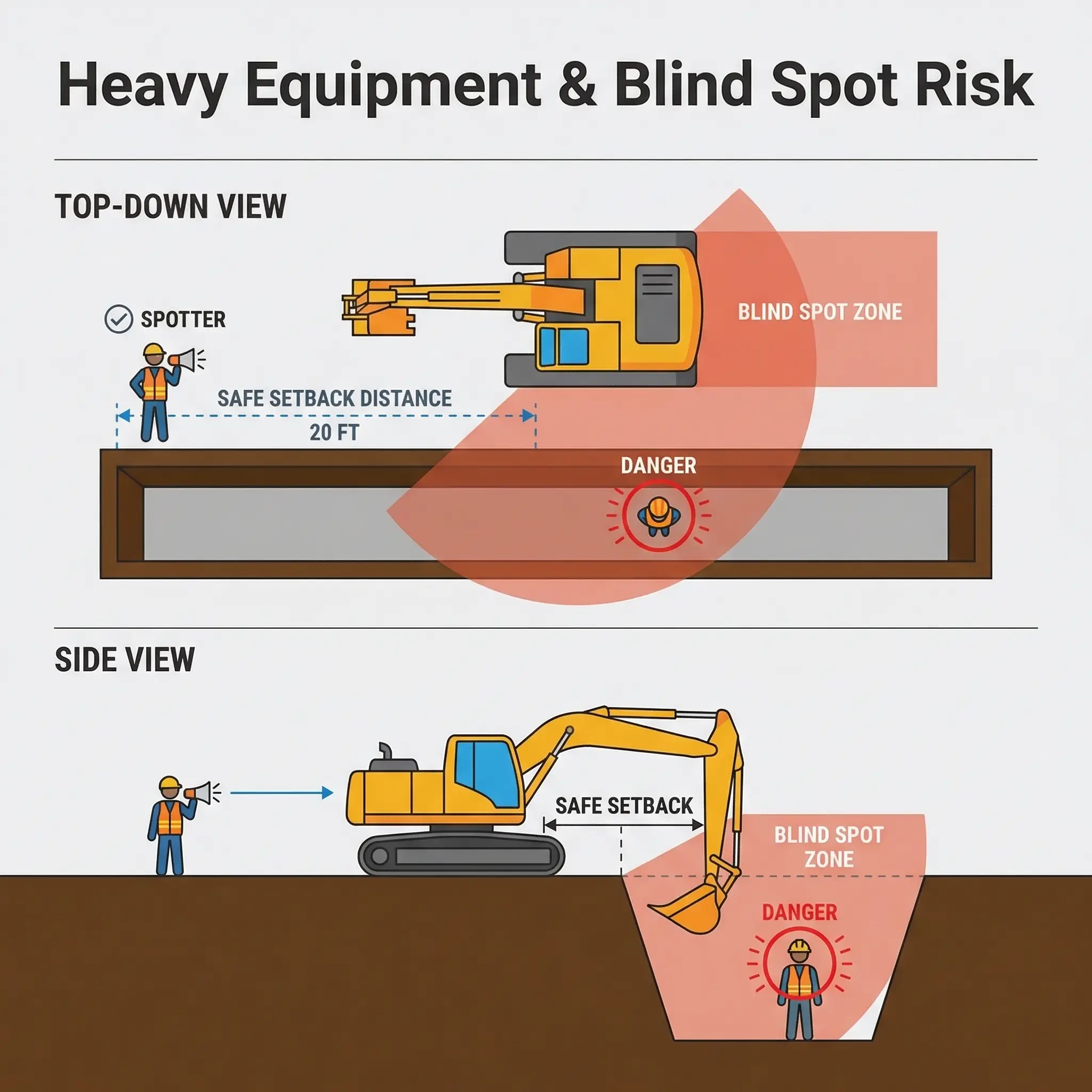
The risk factors that make mobile equipment proximity hazardous near excavations are specific and controllable:
- Operator blind spots that conceal workers at the excavation edge or inside the trench during slewing, reversing, or bucket operations
- Vibration-induced cave-ins from heavy equipment operating too close to the trench edge, transmitting dynamic loads into the soil that exceed its shear capacity
- No physical separation between equipment travel paths and excavation perimeters — relying on operator awareness alone is not a control
- Inadequate communication between the ground crew in the excavation and equipment operators on the surface, especially in high-noise environments
Mobile Equipment Controls Near Excavations
Controlling mobile equipment hazards near excavations requires physical barriers, procedural rules, and active communication — no single element is sufficient.
- Establish minimum setback distances for all mobile equipment from excavation edges — typically 1.5 times the excavation depth, or as specified by the geotechnical assessment
- Use stop blocks, berms, or wheel chocks to physically prevent vehicles from approaching closer than the designated setback
- Assign a dedicated spotter for all equipment operations adjacent to occupied excavations — the spotter’s sole function is communication with the operator and monitoring the exclusion zone
- Prohibit swing-over operations where excavator or crane loads pass over workers in the excavation — either clear the excavation or reposition the equipment
- Install proximity detection systems on equipment operating in congested excavation areas — technology supplements but does not replace human spotters and physical barriers
Pro Tip: On a highway underpass project, I required all excavator operators to physically walk the excavation perimeter at the start of every shift and mark the setback line with the ground crew present. It added five minutes per shift and eliminated every single near-miss involving equipment encroachment for the remaining 14 months of the project.
Hazard 8 — Adjacent Structure Instability
Excavating near existing structures — buildings, retaining walls, roads, utility vaults, bridge abutments — can undermine their foundations and cause partial or complete collapse into the excavation. This hazard is especially critical in urban environments where excavation work occurs within meters of occupied buildings and active roadways. On a metro tunnel access shaft project, I documented progressive cracking in an adjacent warehouse wall that appeared within 48 hours of excavation reaching 4 meters depth. The structure had shallow strip foundations that the geotechnical survey had not accurately assessed. Work was stopped, temporary propping was installed, and the excavation method was redesigned — a near-miss that could have caused a structural collapse onto the shaft crew.
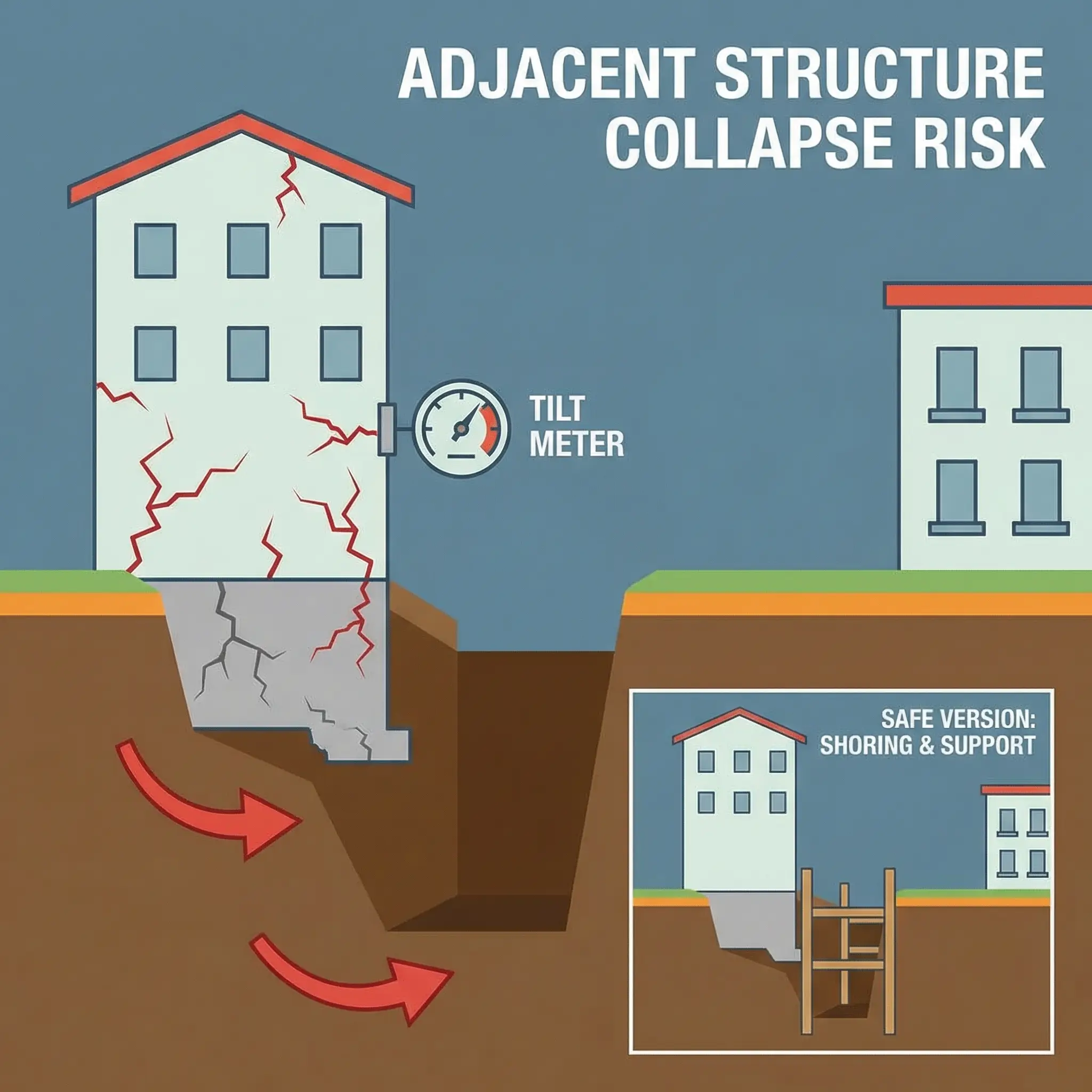
The factors that create adjacent structure instability during excavation include:
- Removal of lateral earth support that existing foundations rely on for stability — particularly shallow foundations on granular soils
- Vibration from excavation equipment causing settlement or displacement of nearby structural foundations
- Dewatering operations that lower the water table beneath adjacent structures, causing consolidation settlement
- Surcharge loading from excavated spoil or equipment placed between the excavation and the adjacent structure, adding load to already-stressed ground
Controls for Adjacent Structure Protection
Protecting adjacent structures during excavation requires a systematic approach that starts during the planning phase — not after cracks appear.
- Pre-excavation structural survey of all buildings and structures within the zone of influence (typically 1.5–2 times the excavation depth) — document existing cracks, settlement, and condition with photographs and measurements
- Geotechnical assessment of foundation types, depths, and soil conditions for all adjacent structures — this determines the excavation method and support requirements
- Underpinning or temporary propping of structures at risk before excavation reaches critical depth — not as a reactive measure after movement is observed
- Monitoring instrumentation (tilt meters, settlement markers, crack gauges) installed on adjacent structures with defined trigger levels and action plans
- Controlled excavation sequences — excavate in short sections with immediate support installation rather than long open-cut methods that remove large volumes of lateral support simultaneously
Hazard 9 — Inadequate Access and Egress
If a worker cannot get out of an excavation quickly, every other hazard becomes more dangerous. Inadequate egress transforms a manageable water ingress event into a drowning, a partial wall slump into a burial, and a utility gas release into an asphyxiation. I have inspected excavations on three different continents where the only way in and out was climbing the soil face or being lifted by the excavator bucket — both of which I have stopped immediately as serious safety violations.
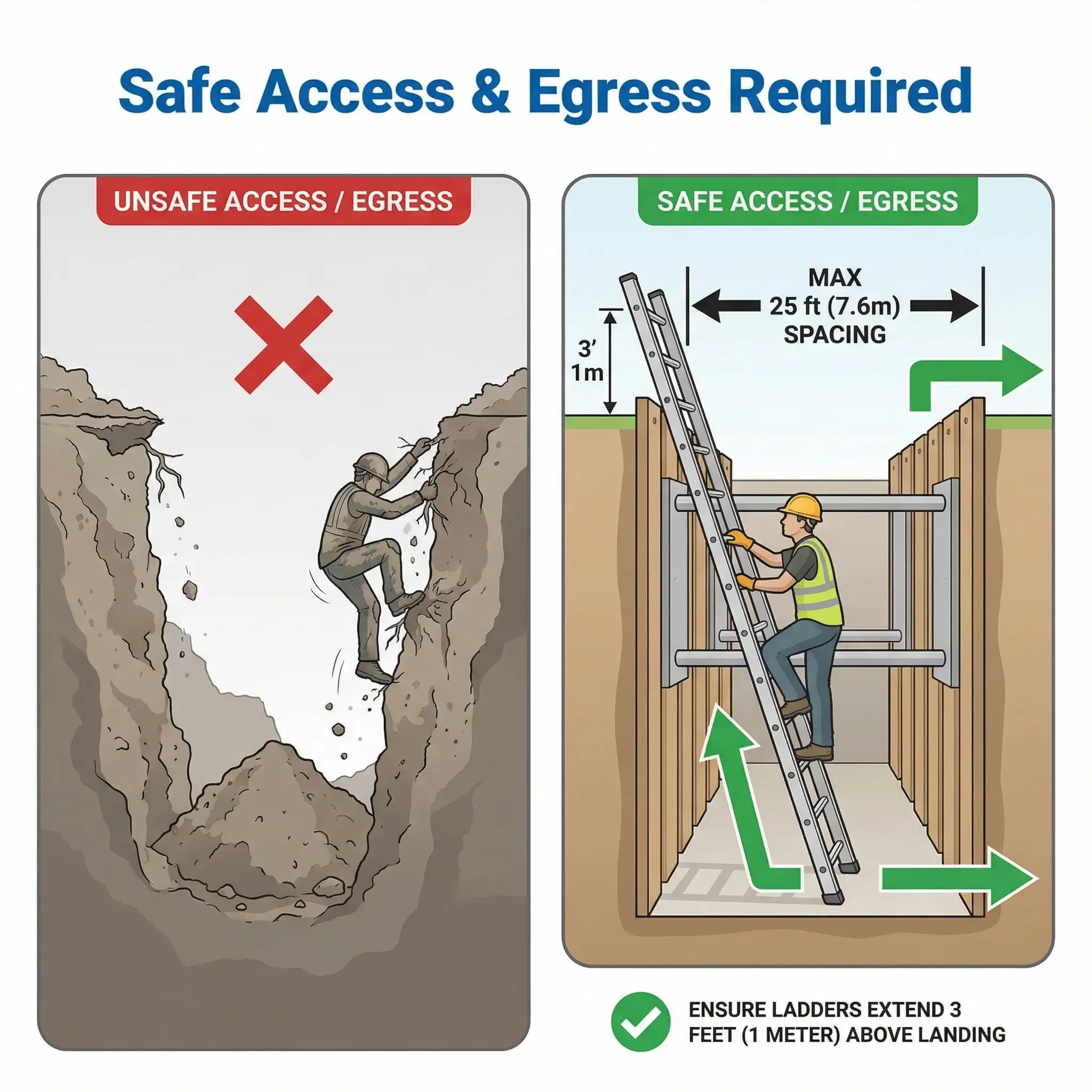
The common egress deficiencies I encounter on excavation sites include:
- No ladder provided in the excavation — workers climb spoil slopes, soil faces, or shoring frames
- Ladders placed too far apart — OSHA requires a ladder, ramp, or stairway within 7.5 meters (25 feet) of every worker in the excavation
- Ladders not extending above the excavation edge — the standard requires a minimum 1 meter (3 feet) above the top of the excavation to provide a secure handhold during exit
- Single egress point only — if that point is blocked by a collapse, equipment, or water, workers are trapped
- Egress routes not communicated to all workers during the pre-entry briefing
Egress Requirements and Controls
The following egress controls are mandatory for every excavation and must be verified during every competent person inspection:
- Provide a ladder, ramp, or stairway within 7.5 meters of every worker’s position in the excavation — measure this from the worker’s actual work location, not from the nearest trench end
- Extend all ladders at least 1 meter above the excavation edge and secure them against displacement — an unsecured ladder that shifts during an emergency exit is not a control
- Provide at least two egress points in excavations longer than 15 meters — one at each end of the occupied section
- Inspect egress systems daily as part of the competent person’s excavation inspection — confirm ladder condition, secure footing, and unobstructed access
- Include egress locations in every pre-entry briefing — every worker must know where the nearest exit is before descending
Hazard 10 — Lack of Competent Person Oversight
The absence of a qualified competent person is not one hazard among many — it is the single systemic failure that enables all other excavation hazards to occur unchecked. Every excavation fatality report I have reviewed identifies either the absence of a competent person or the failure of the designated person to perform their duties as a primary or contributing cause. The competent person is the human control measure that makes every technical control effective.
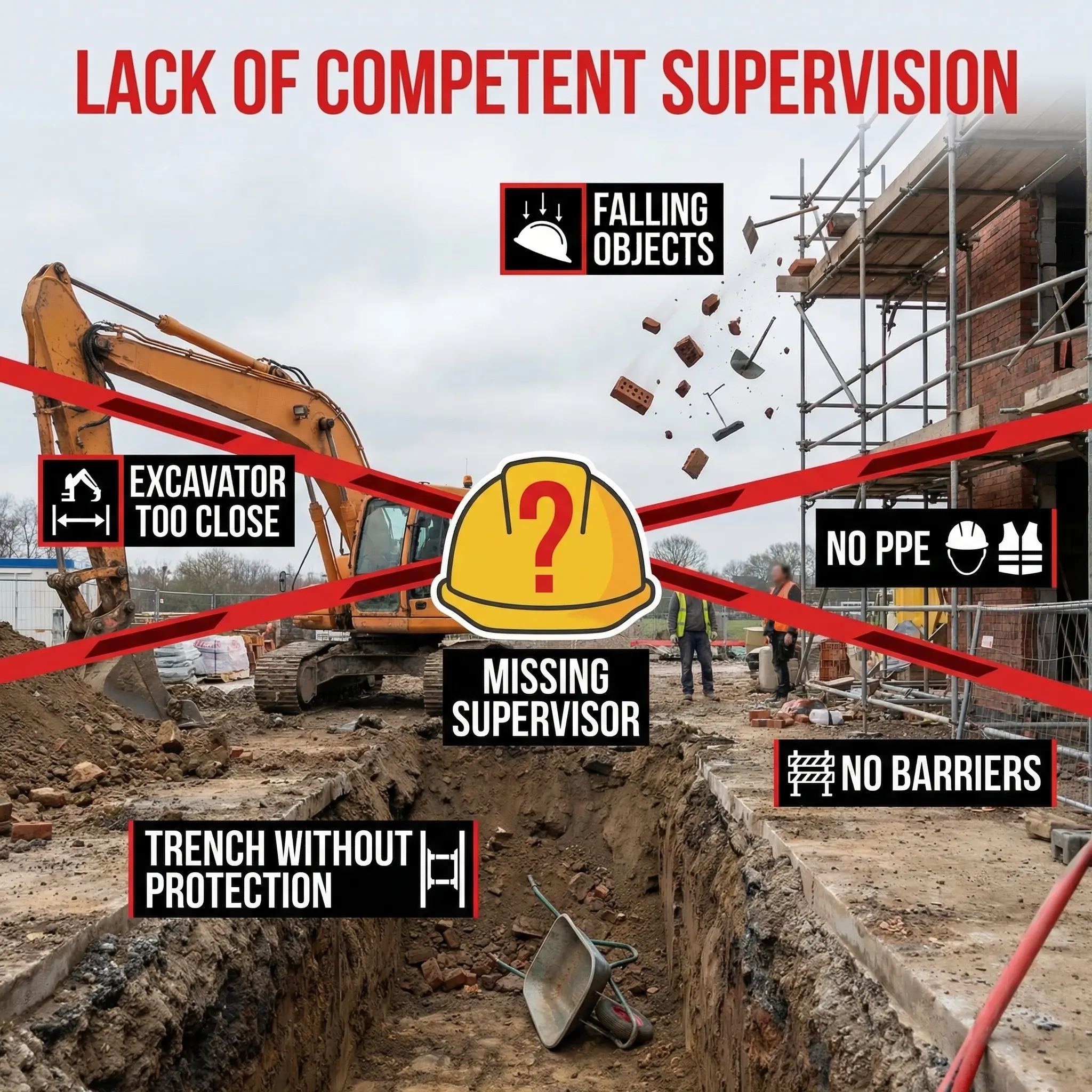
Under OSHA 1926.650(b), a competent person is defined as someone capable of identifying existing and predictable hazards, and authorized to take prompt corrective measures to eliminate them. In practice, this means someone who can classify soil, select protective systems, identify deteriorating conditions, and stop work — with the authority to enforce those decisions without needing management approval.
The failures in competent person oversight that I see repeatedly on excavation sites include:
- No competent person assigned — the role is assumed to belong to “someone” without formal designation, training verification, or task allocation
- Competent person assigned but not qualified — a supervisor given the title without the soil classification training, protective system knowledge, or inspection experience to perform the role
- Competent person assigned but not empowered — the individual knows the hazard exists but lacks the authority or management backing to stop work without retaliation or production pressure
- Inspections not conducted or not documented — the competent person “walks by” the excavation but does not perform a systematic, documented assessment
- No re-inspection after condition changes — rainfall, equipment vibration, surcharge loading, or extended open time changes the excavation conditions, but no follow-up assessment occurs
Building an Effective Competent Person Program
An effective competent person program does not just assign a name to a role — it builds capability, authority, and accountability into the excavation safety system.
- Formal training and certification in soil classification, protective system selection, atmospheric hazard recognition, and excavation inspection procedures — verify competency through practical assessment, not just attendance
- Written authority to stop work included in the project safety plan and communicated to all site management and subcontractors — the competent person’s stop-work authority must be unconditional
- Documented daily inspections using a standardized excavation inspection checklist that covers soil conditions, protective system integrity, egress, water accumulation, surcharge loads, utility proximity, atmospheric conditions, and edge protection
- Trigger-based re-inspections mandated after any rainfall, vibration event, surcharge change, or visual indication of wall movement — not just at the start of each shift
- Management accountability for ensuring the competent person has the time, resources, and support to perform their function — production pressure must never override safety authority
Common Site-Level Mistakes That Enable Excavation Fatalities
After investigating and reviewing dozens of excavation incidents across multiple industries and regions, the same fundamental mistakes appear with disturbing consistency. These are not technical failures — they are management, supervision, and culture failures that allow known hazards to go uncontrolled.
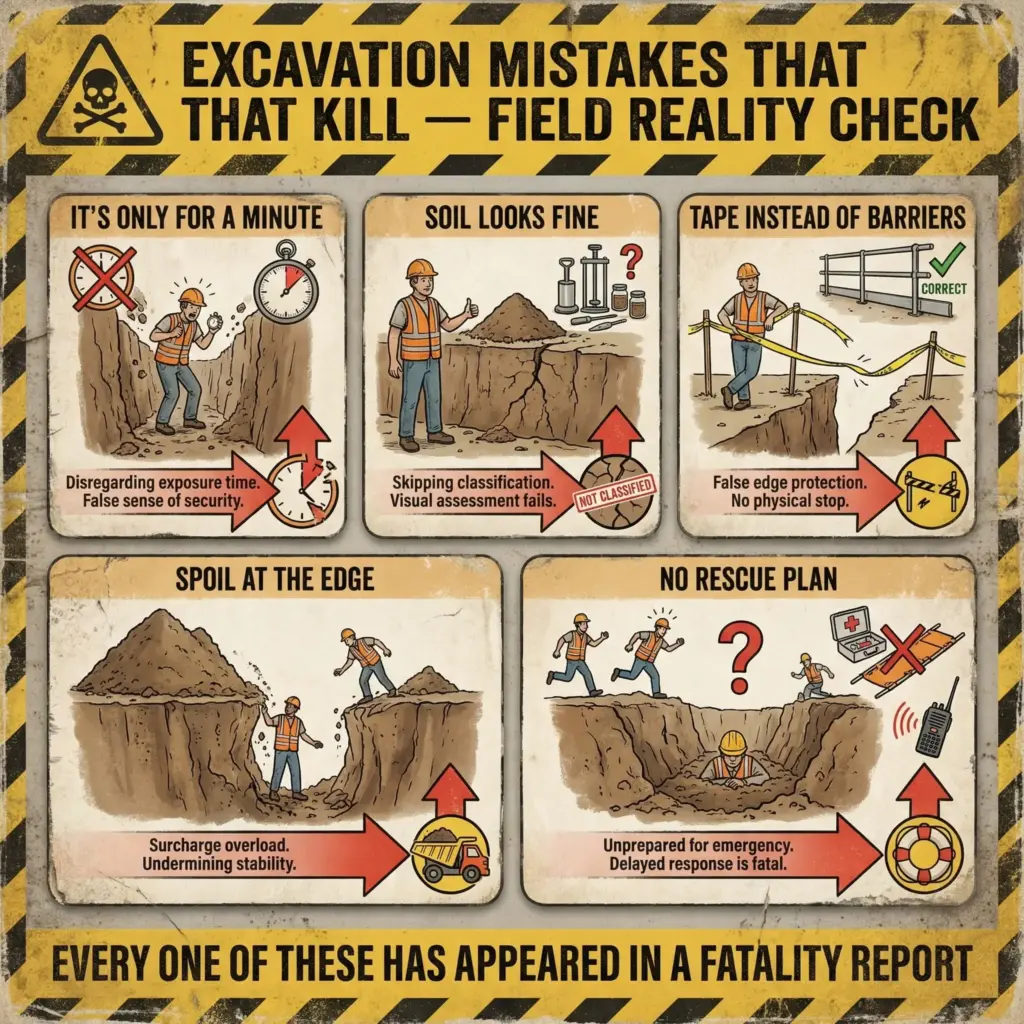
The most common and most dangerous site-level mistakes in excavation safety include:
- “It’s only for a minute” — the belief that brief exposure to an unprotected excavation is acceptable because the duration is short. Soil does not check a stopwatch before collapsing.
- Treating all soil as stable — skipping soil classification because the ground “looks solid” or “has always been fine here.” Visual inspection alone cannot determine soil type or failure potential.
- Using hazard tape as edge protection — plastic tape is a visual marker, not a barrier. It prevents nothing and creates a false sense of security.
- Stockpiling spoil at the trench edge — the most common surcharge violation on every excavation site I have inspected. The weight destabilizes the very wall it sits on.
- No rescue plan — shoring is installed, the ladder is in place, but nobody has considered what happens if a collapse actually occurs. Who calls rescue? Where is the equipment? How long is the response time?
- Production pressure overriding safety — the schedule demands the trench is open and pipe is laid today, and the competent person inspection, shoring installation, or dewatering setup is treated as an obstacle to production rather than a prerequisite for it
Pro Tip: I maintain a “zero entry” rule on every project I manage: no human being enters any excavation for any reason until the competent person has completed and signed the daily inspection, all protective systems are installed and verified, egress is confirmed, and atmospheric testing is completed where required. No exceptions for supervisors, engineers, inspectors, or clients. The excavation does not care about your title.
The Hierarchy of Controls Applied to Excavation Hazards
Applying the hierarchy of controls to excavation work reveals a clear pattern — the most effective interventions happen before the excavation is opened, and the least effective are the ones most commonly relied upon on poorly managed sites.
| Hierarchy Level | Excavation Application | Effectiveness |
|---|---|---|
| Elimination | Re-route the utility or service to avoid excavation entirely; use trenchless technology (HDD, pipe bursting, microtunneling) | Highest — removes the hazard completely |
| Substitution | Replace deep open-cut methods with sheet piling, secant piling, or mechanical shielding that minimizes open trench exposure | High — reduces exposure significantly |
| Engineering Controls | Sloping, benching, shoring, trench shields, dewatering systems, guardrails, rated covers | High — physically controls the hazard |
| Administrative Controls | Competent person inspections, permits, safe work procedures, exclusion zones, training, daily briefings | Moderate — depends on human compliance |
| PPE | Hard hats, high-visibility vests, safety boots, gloves, respiratory protection where atmospheric hazards exist | Lowest — last line of defense only |
The critical lesson from this hierarchy is that PPE and administrative controls — which are the most commonly implemented on under-resourced projects — sit at the bottom of effectiveness. A hard hat does not prevent a cave-in. A toolbox talk does not replace shoring. Engineering controls and elimination strategies must be the primary investment.
Regulatory Framework for Excavation Safety
Understanding the regulatory framework is essential not just for compliance, but because these standards represent decades of incident data distilled into minimum safety requirements. The major excavation safety regulations apply across most international jurisdictions with minor variations.
The key regulatory requirements that every excavation project must satisfy include:
- OSHA 29 CFR 1926 Subpart P (Excavations) — the foundational US standard covering competent person requirements, soil classification, protective systems (sloping, benching, shoring, shields), access/egress, water management, and atmospheric hazards.
- HSE UK regulations including the Construction (Design and Management) Regulations 2015 and relevant Approved Codes of Practice for excavation safety.
- ISO 45001:2018 — the occupational health and safety management system standard that provides the framework for excavation risk assessment, hazard identification, and operational control within a structured management system
- IFC/World Bank EHS Guidelines — applicable to international development and EPC projects, requiring excavation safety measures consistent with international good practice
Key Regulatory Principle: Every standard referenced above shares a common requirement — a competent person must inspect every excavation daily and after any condition change, and protective systems must be in place before worker entry. Compliance with this single principle prevents the majority of excavation fatalities.
Conclusion
Excavation work compresses an extraordinary number of lethal hazards into a small physical space — cave-ins, atmospheric threats, utility strikes, falls, drowning, falling objects, equipment proximity, structural instability, and the ever-present risk of being trapped underground with no way out. Every one of these hazards is well-documented, well-understood, and has proven control measures that work reliably when implemented. The uncomfortable reality is that excavation fatalities almost never result from unknown or unforeseeable hazards. They result from known hazards that were left uncontrolled because someone decided the risk was acceptable, the schedule was more important, or the protection could wait.
The 10 hazards covered in this article are not a theoretical list — they are the recurring findings from real incident investigations, real site inspections, and real enforcement actions across construction and infrastructure projects worldwide. The control measures are equally real and field-tested. Soil classification works. Shoring works. Atmospheric testing works. Competent person inspections work. What does not work is hoping the trench stays open long enough to get the job done without protection.
If there is one principle that governs excavation safety above all others, it is this: no excavation is routine, and no trench is too shallow to kill. The moment a crew treats an excavation as just another hole in the ground, the conditions for a fatality are already in place. Protect the excavation first, then put people in it — never the other way around. The soil does not negotiate, and it does not give second chances.