
TL;DR
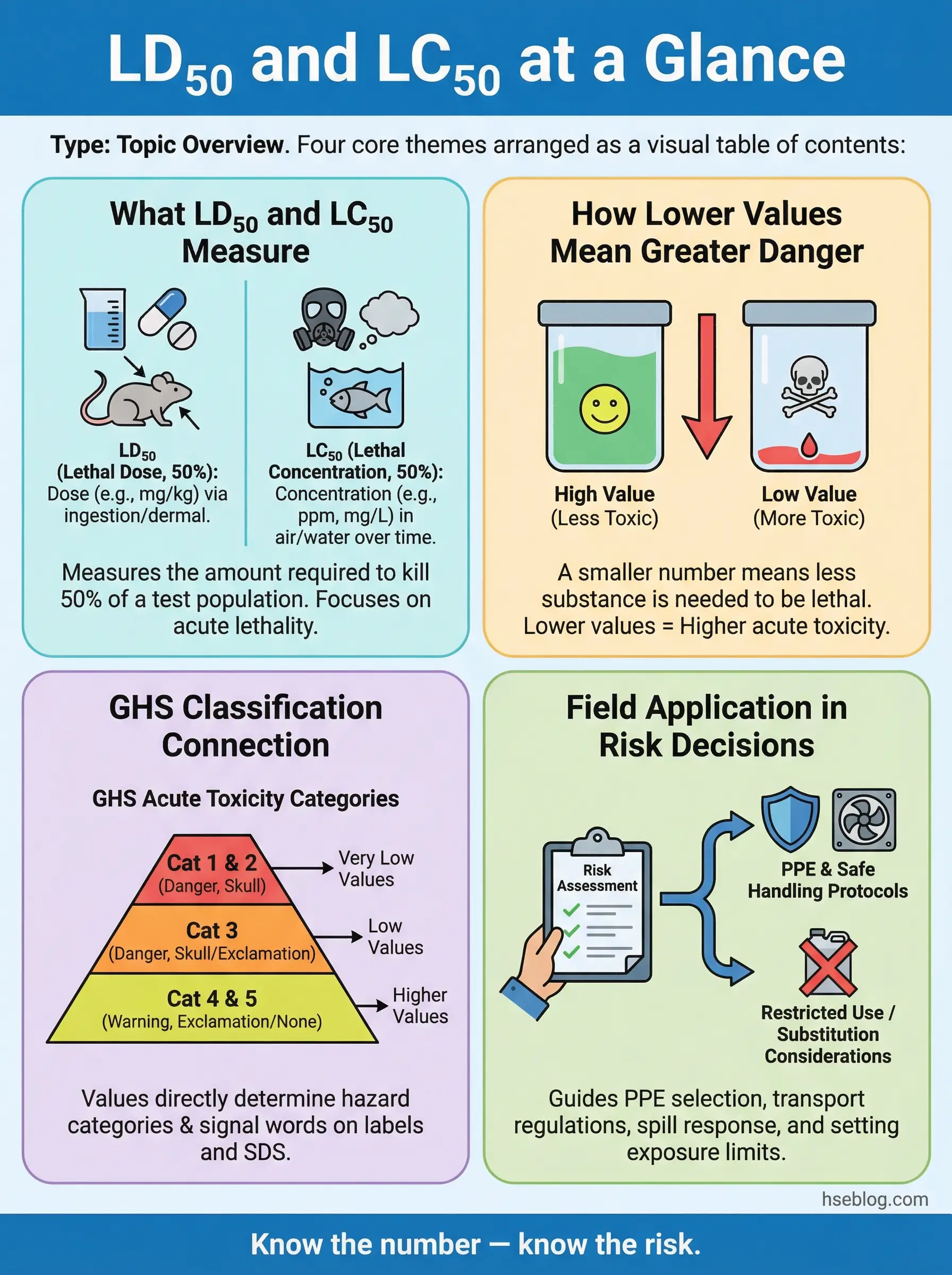
- LD₅₀ measures acute oral or dermal toxicity — the dose that kills 50% of a test population, expressed in mg/kg body weight.
- LC₅₀ measures inhalation toxicity — the airborne concentration lethal to 50% of test subjects over a set exposure period.
- Lower LD₅₀ or LC₅₀ values mean higher toxicity — a substance with an LD₅₀ of 5 mg/kg is far deadlier than one at 5,000 mg/kg.
- GHS acute toxicity categories use LD₅₀ and LC₅₀ directly to classify chemicals and determine hazard pictograms on Safety Data Sheets.
- Field professionals use these values daily — in COSHH assessments, emergency response, chemical storage decisions, and PPE selection.
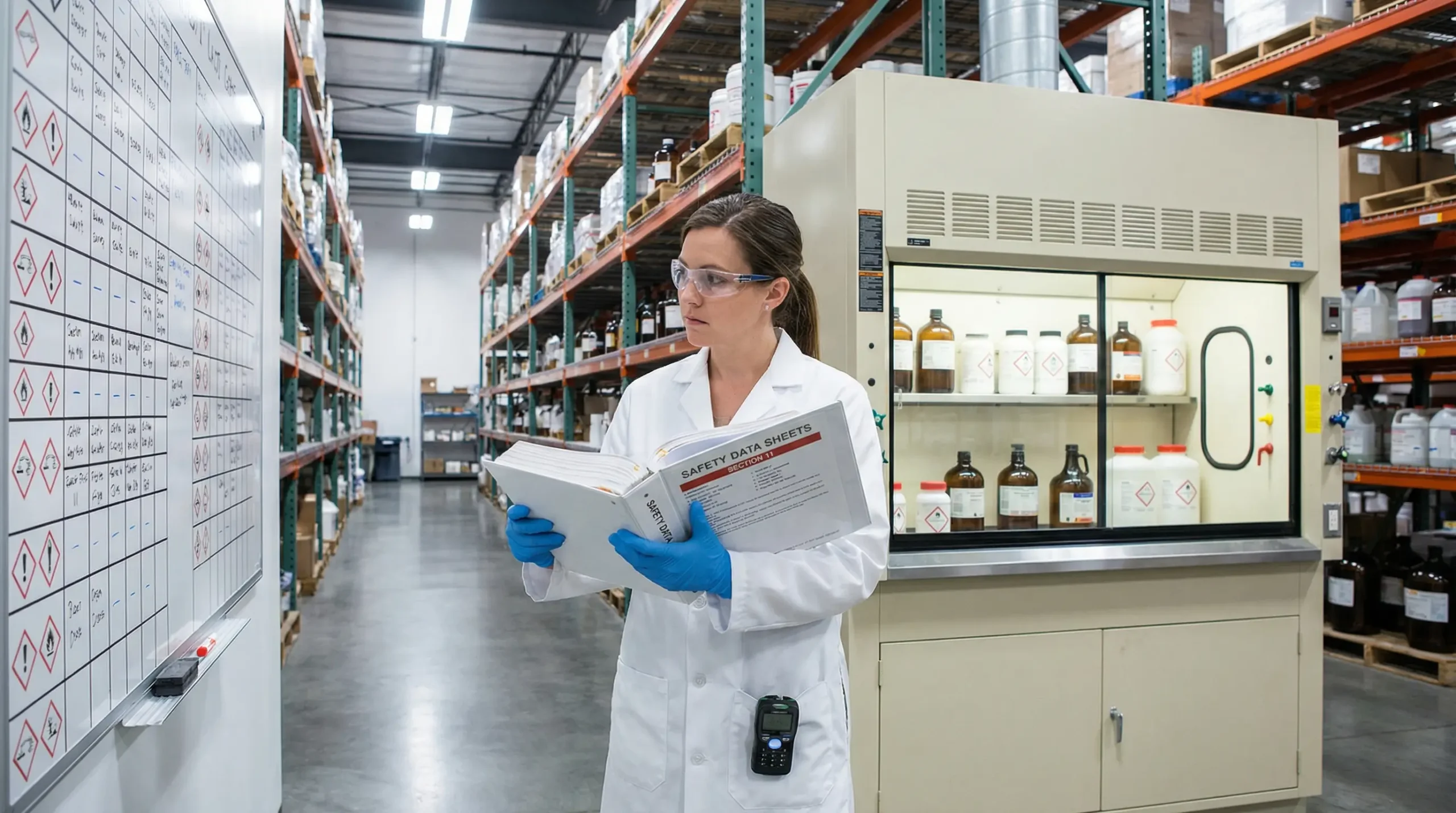
I was reviewing a Safety Data Sheet for a cleaning solvent on a refinery turnaround when a supervisor asked me what the LD₅₀ number in Section 11 actually meant. He had been signing COSHH assessments for three years. He knew the chemical was harmful — the skull-and-crossbones pictogram told him that much. But the number itself, 450 mg/kg (oral, rat), meant nothing to him. He had no frame of reference for whether that made the solvent mildly dangerous or capable of killing a worker from a single accidental ingestion.
That conversation stuck with me because it exposed a gap that runs through our entire profession. LD₅₀ and LC₅₀ values appear on every Safety Data Sheet, drive every GHS acute toxicity classification, and underpin every permissible exposure limit we enforce on site. Yet most safety officers treat them as background data — numbers they see but never interpret. This article breaks down what LD₅₀ and LC₅₀ actually measure, how to read them, how regulatory frameworks use them to classify chemical hazards, and how field professionals can apply this knowledge to make sharper risk decisions every day.
What Is LD₅₀ and What Does It Measure?
LD₅₀ — Lethal Dose 50 — is the single dose of a substance, delivered by a specific route, that causes death in 50% of a test animal population. It is the foundational metric in acute toxicology and the primary number used worldwide to rank how poisonous a chemical is when swallowed or absorbed through the skin. The value is expressed in milligrams of substance per kilogram of body weight (mg/kg), which allows direct comparison between substances regardless of the test animal’s size.
Understanding the components of an LD₅₀ value requires more than memorizing the definition. Each element of the data point carries practical meaning for field professionals:
- “Lethal Dose” refers to a single exposure event — not chronic, repeated contact. This is a one-time dose that produces death within a defined observation period, typically 14 days.
- “50” is the statistical midpoint. It does not mean half the exposed workers will die. It means that in a controlled laboratory study, that dose killed half the test subjects. Some subjects died at lower doses, others survived at higher ones.
- “mg/kg body weight” normalizes the dose to body mass. A 70 kg worker requires a proportionally larger absolute quantity of a substance to reach the equivalent LD₅₀ dose than a 10 kg test animal. This scaling matters in emergency toxicology.
- Route of exposure changes the number entirely. The same chemical will have different LD₅₀ values for oral ingestion versus dermal absorption versus injection. The SDS typically reports oral and dermal LD₅₀ values separately.
OSHA, the European Chemicals Agency (ECHA), and the GHS all rely on LD₅₀ data as the primary criterion for classifying a substance’s acute toxicity category — which in turn determines labeling, PPE requirements, storage restrictions, and emergency response protocols.
Pro Tip: When reviewing a Safety Data Sheet, always check which route of exposure the LD₅₀ refers to. An oral LD₅₀ of 500 mg/kg might suggest moderate toxicity, but the same chemical could have a dermal LD₅₀ of 50 mg/kg — making skin contact the far greater field risk.
What Is LC₅₀ and How Does It Differ from LD₅₀?
LC₅₀ — Lethal Concentration 50 — measures inhalation toxicity specifically. While LD₅₀ quantifies how much substance must enter the body (as a dose), LC₅₀ quantifies the airborne concentration of a gas, vapor, or dust that kills 50% of test subjects when they breathe it over a defined period. The unit is milligrams per liter of air (mg/L) or parts per million (ppm), and the standard exposure duration is four hours.
The distinction between LD₅₀ and LC₅₀ is not just academic — it reflects the reality that inhalation hazards behave fundamentally differently from ingestion or skin absorption hazards:
- LC₅₀ is concentration-dependent, not dose-dependent. A worker does not need to swallow or touch anything. They simply need to breathe contaminated air at a sufficient concentration for a sufficient duration.
- Exposure duration matters critically. An LC₅₀ reported at 4 hours means the test subjects breathed that concentration continuously for four hours. Shorter or longer exposures produce different mortality rates at the same concentration.
- Physical form affects the value. LC₅₀ is reported separately for gases (ppm), vapors (mg/L), and dusts/mists (mg/L). A substance with a low LC₅₀ as a vapor might have a different profile as a dust.
- Temperature and ventilation change real-world risk. A chemical with a high vapor pressure generates dangerous airborne concentrations faster, especially in confined spaces or hot environments.
I learned this distinction the hard way during an emergency response to a chemical spill inside a process building at a petrochemical facility in the Gulf. The substance had a relatively high oral LD₅₀ — around 2,000 mg/kg — which the operations team interpreted as “low toxicity.” But its LC₅₀ for vapor was 3.5 mg/L at 4 hours. In the enclosed, poorly ventilated building, the vapor concentration exceeded that threshold within minutes. We evacuated the area and required supplied-air breathing apparatus for the response team. The oral toxicity number had given the crew a false sense of security.
How to Read and Interpret LD₅₀ and LC₅₀ Values
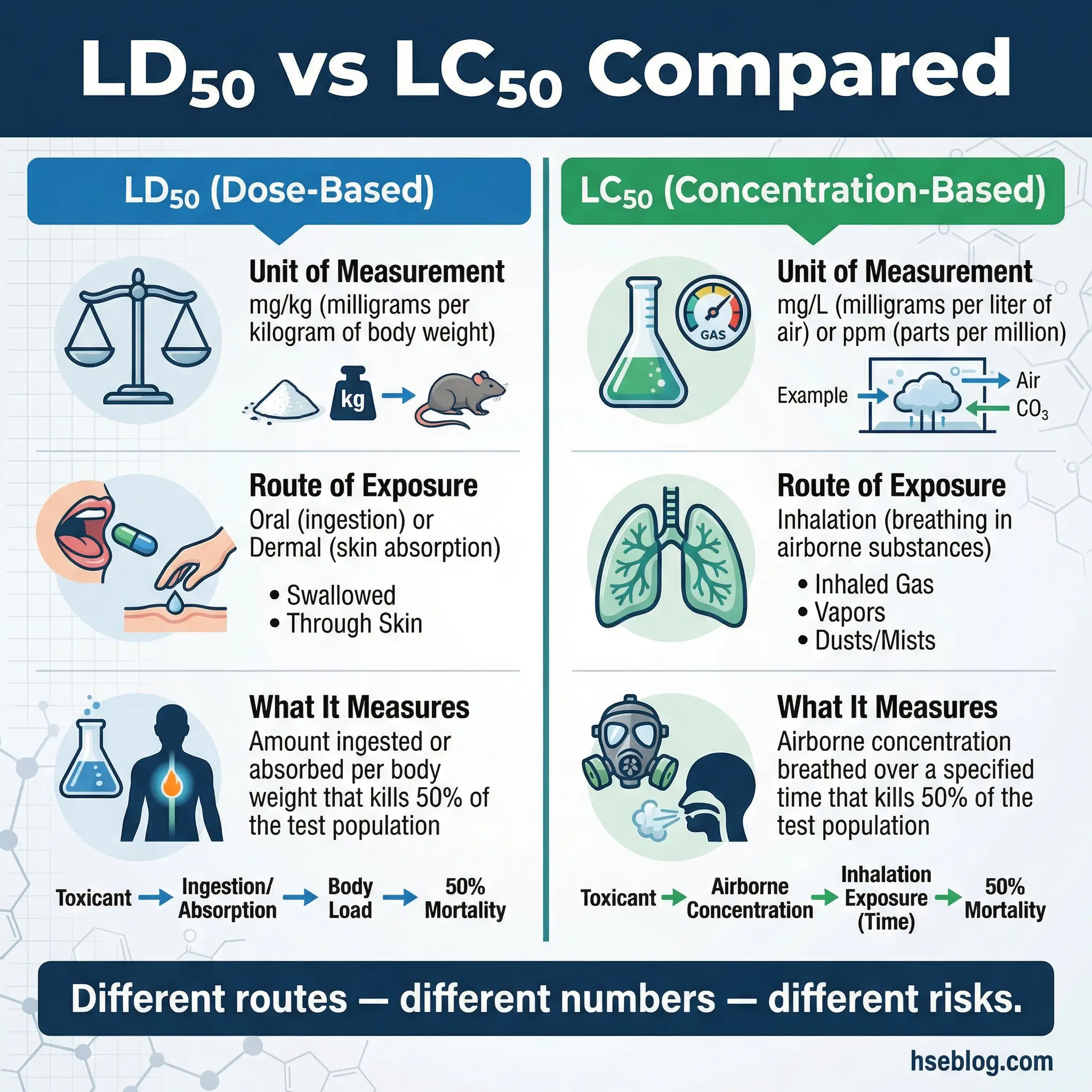
The single most important rule in toxicology data interpretation is counterintuitive for people encountering it the first time: lower numbers mean greater danger. A substance with an LD₅₀ of 1 mg/kg is extraordinarily toxic — only a tiny amount can kill. A substance with an LD₅₀ of 15,000 mg/kg is practically non-toxic in acute terms. The inverse relationship between the number and the hazard trips up supervisors and workers who instinctively associate bigger numbers with bigger risks.
The following reference table anchors these values to practical toxicity categories that field professionals can use when reviewing Safety Data Sheets or conducting risk assessments:
| LD₅₀ (Oral, mg/kg) | Toxicity Classification | Real-World Context |
|---|---|---|
| ≤ 5 | Extremely toxic | A taste can kill — e.g., certain organophosphate pesticides |
| 5 – 50 | Highly toxic | A few drops to a teaspoon — e.g., some industrial cyanides |
| 50 – 300 | Moderately toxic | A teaspoon to an ounce — e.g., some chlorinated solvents |
| 300 – 2,000 | Slightly toxic | An ounce to a pint — e.g., some common cleaning solvents |
| 2,000 – 5,000 | Practically non-toxic | Large quantities required — e.g., table salt (3,000 mg/kg) |
| > 5,000 | Relatively harmless (acute) | Very large quantities — e.g., sucrose (~30,000 mg/kg) |
Several critical nuances apply when interpreting these values in field conditions:
- Species matters. LD₅₀ and LC₅₀ are derived from animal studies — typically rats or rabbits. Human sensitivity can vary significantly. Some substances are far more toxic to humans than their rat LD₅₀ would suggest.
- LD₅₀ says nothing about chronic toxicity. A substance with a high LD₅₀ (low acute toxicity) can still cause cancer, organ damage, or reproductive harm from repeated low-dose exposures. Benzene is a classic example — its oral LD₅₀ of approximately 930 mg/kg classifies it as only moderately toxic acutely, yet it is a confirmed human carcinogen.
- Individual variability exists. Age, body weight, hydration status, liver function, concurrent medications, and pre-existing conditions all affect how a specific person responds to a given dose.
- Synergistic effects are invisible in LD₅₀ data. Workers on industrial sites rarely encounter a single chemical in isolation. Mixed exposures can amplify toxicity far beyond what individual LD₅₀ values predict.
Pro Tip: Never use LD₅₀ or LC₅₀ alone to determine safe handling procedures. These values describe lethality — they tell you nothing about irritation, sensitization, organ damage, or chronic disease at sub-lethal doses. Always cross-reference Section 11 (Toxicological Information) with Section 8 (Exposure Controls) and Section 2 (Hazards Identification) of the Safety Data Sheet.
How GHS Uses LD₅₀ and LC₅₀ to Classify Chemical Hazards
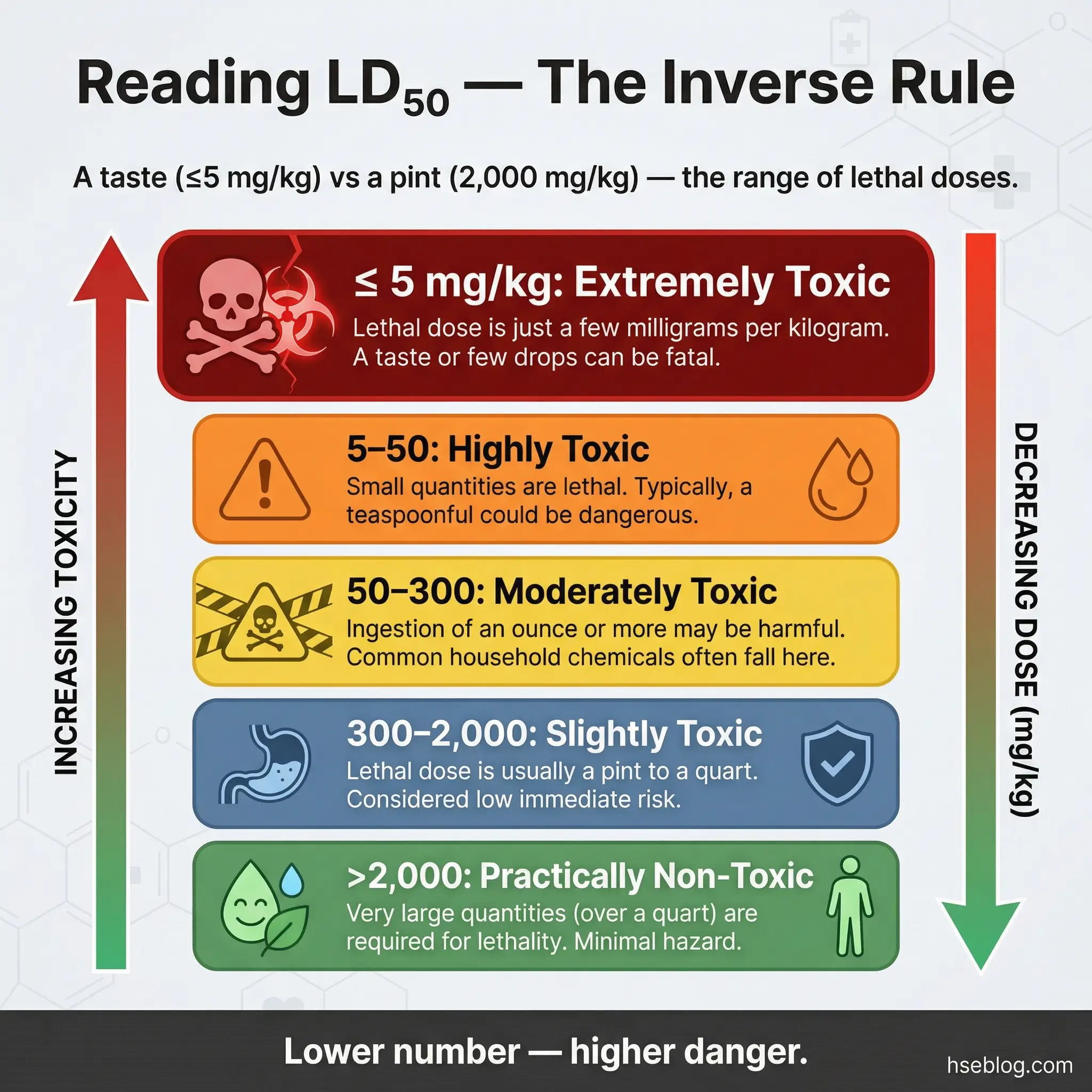
The Globally Harmonized System of Classification and Labelling of Chemicals (GHS) converts raw LD₅₀ and LC₅₀ data into the standardized acute toxicity categories that appear on every chemical label and Safety Data Sheet worldwide. This is where toxicological data stops being a laboratory number and starts driving real decisions — what pictogram goes on the container, what signal word is required, what PPE must be worn, and how the substance must be stored and transported.
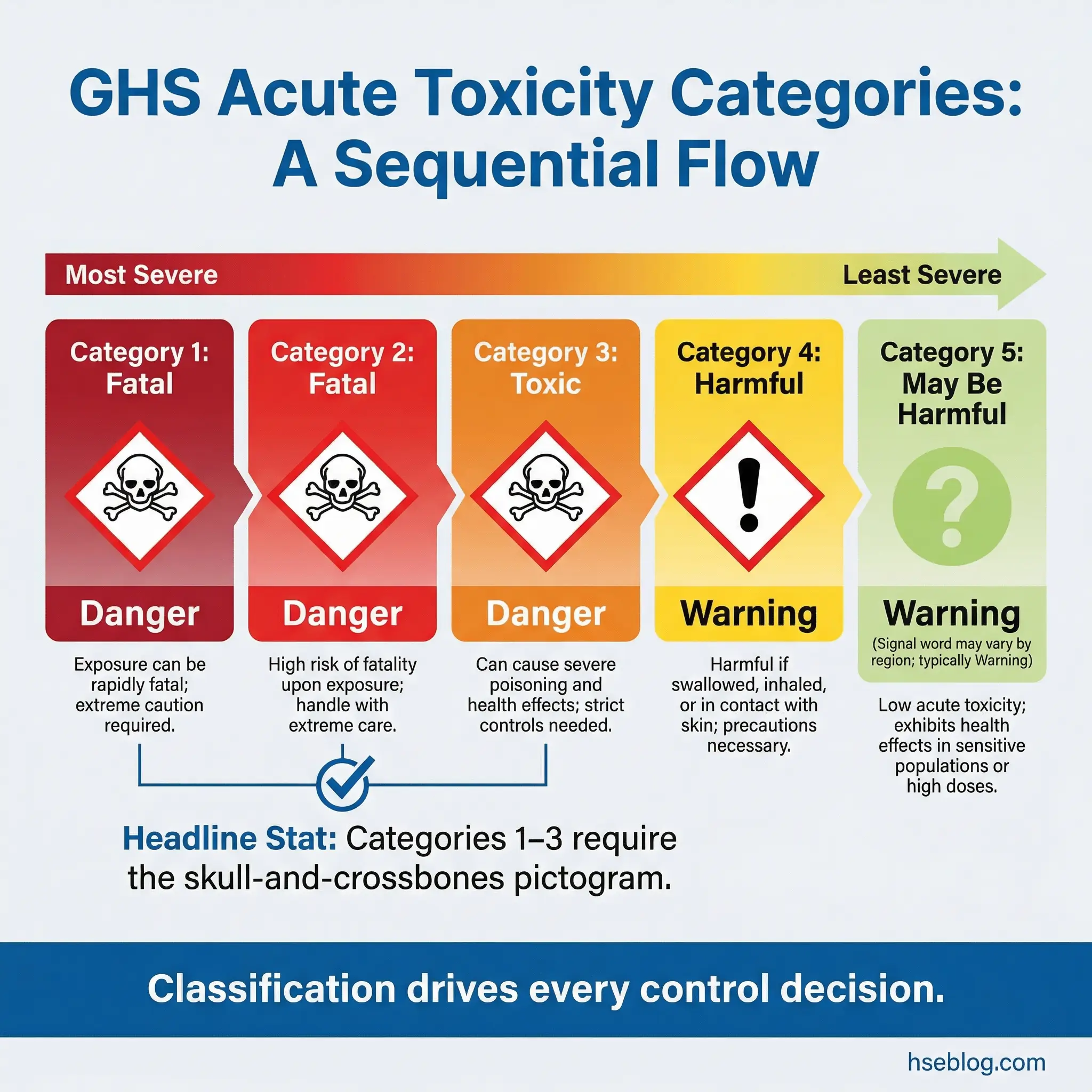
GHS assigns five acute toxicity categories, with Category 1 being the most severe. The classification is based directly on LD₅₀ and LC₅₀ value ranges:
| GHS Category | Signal Word | Oral LD₅₀ (mg/kg) | Dermal LD₅₀ (mg/kg) | Inhalation LC₅₀ — Gases (ppm) | Inhalation LC₅₀ — Vapors (mg/L) | Inhalation LC₅₀ — Dusts/Mists (mg/L) |
|---|---|---|---|---|---|---|
| 1 | Danger | ≤ 5 | ≤ 50 | ≤ 100 | ≤ 0.5 | ≤ 0.05 |
| 2 | Danger | 5 – 50 | 50 – 200 | 100 – 500 | 0.5 – 2.0 | 0.05 – 0.5 |
| 3 | Danger | 50 – 300 | 200 – 1,000 | 500 – 2,500 | 2.0 – 10.0 | 0.5 – 1.0 |
| 4 | Warning | 300 – 2,000 | 1,000 – 2,000 | 2,500 – 20,000 | 10.0 – 20.0 | 1.0 – 5.0 |
| 5 | Warning | 2,000 – 5,000 | 2,000 – 5,000 | — | — | — |
Several field-relevant points emerge from this classification system:
- Categories 1–3 carry the “Danger” signal word and the skull-and-crossbones pictogram (GHS06). These substances demand the highest level of engineering controls, respiratory protection, and emergency preparedness.
- Category 4 uses the “Warning” signal word and the exclamation mark pictogram (GHS07). Many common industrial solvents and cleaning chemicals fall here — substances that are harmful but not acutely lethal in small quantities.
- Category 5 is optional under GHS. Some regulatory jurisdictions do not adopt it. Substances in this range have low acute toxicity but may still warrant precautions.
- The route-specific thresholds vary significantly. A substance classified as Category 4 by oral route might be Category 2 by inhalation. This is why Safety Data Sheets must report acute toxicity data for each relevant route separately.
During an audit of a chemical warehouse at a manufacturing facility in Central Europe, I found seventeen containers with outdated labels that predated GHS implementation. The hazard classifications on those labels were based on the old EU system — and three of the chemicals had been reclassified to a more severe GHS category based on updated LD₅₀ data. The emergency response plan for that warehouse was built on the wrong toxicity assumptions. We stopped operations until every container was relabeled and the emergency plan revised.
Under the GHS, a substance’s acute toxicity category — derived directly from LD₅₀ and LC₅₀ data — determines the hazard pictogram, signal word, hazard statement, and precautionary statements that must appear on every label and Safety Data Sheet.
How LD₅₀ and LC₅₀ Data Drive Field Decisions
Toxicological data is only useful if it changes behavior on site. In practice, LD₅₀ and LC₅₀ values influence a wide range of decisions that safety professionals make daily — often without consciously connecting those decisions back to the underlying toxicology. The following areas represent the most direct operational applications.
COSHH and Chemical Risk Assessments
Every COSHH assessment or chemical risk assessment begins with identifying the hazard severity of the substance involved. LD₅₀ and LC₅₀ values provide the quantitative foundation for that severity rating, which in turn determines the level of control required:
- High-toxicity substances (GHS Categories 1–2) demand engineering controls as the primary barrier — closed-loop systems, local exhaust ventilation, or total enclosure. PPE becomes the last line of defense, not the first.
- Moderate-toxicity substances (GHS Category 3) typically require a combination of ventilation, administrative controls, and appropriate PPE selected based on the route of exposure indicated by the LD₅₀ and LC₅₀ data.
- Low-toxicity substances (GHS Categories 4–5) still require risk assessment — but the control measures may be simpler, such as general ventilation and basic skin protection.
Pro Tip: When conducting COSHH assessments, compare the LC₅₀ against the substance’s vapor pressure and the workspace ventilation rate. A substance with a moderate LC₅₀ but very high vapor pressure can reach dangerous airborne concentrations in minutes — especially in confined spaces or during hot work.
PPE Selection and Respiratory Protection
The route of exposure reflected in LD₅₀ and LC₅₀ data directly dictates PPE selection. Getting this wrong is one of the most common failures I encounter during site audits:
- Low dermal LD₅₀ → Chemical-resistant gloves with verified breakthrough time, splash-proof coveralls, and face/eye protection become mandatory. Standard nitrile gloves that are adequate for Category 4 solvents may provide insufficient protection against a Category 1 substance.
- Low LC₅₀ (inhalation) → Respiratory protective equipment must match the substance’s physical form and concentration. Air-purifying respirators with appropriate cartridges may suffice for Category 3–4 vapors in ventilated spaces, but supplied-air breathing apparatus is required for Category 1–2 substances or confined space entry.
- Both routes presenting high toxicity → Full chemical PPE ensembles with supplied-air systems. I have seen sites issue half-face respirators for substances with LC₅₀ values below 1 mg/L. That is an inadequate control that could prove fatal.
Emergency Response Planning
LD₅₀ and LC₅₀ values shape the urgency, scale, and protective measures required in chemical emergency response. During spill response planning, toxicology data determines evacuation distances, decontamination requirements, and the level of protection for response teams:
- Substances with LC₅₀ below 0.5 mg/L (vapors) require immediate area evacuation, upwind assembly, and response only by personnel in full Level A chemical protective suits with self-contained breathing apparatus.
- Substances with oral LD₅₀ below 50 mg/kg require stringent decontamination protocols — even trace skin contact during cleanup could result in a lethal absorbed dose.
- Mixed-chemical environments demand that responders plan for the most toxic substance present. During a multi-chemical spill in a tank farm I responded to in Southeast Asia, the initial focus was on the largest volume spill (a Category 4 solvent). A much smaller leak from an adjacent line carrying a Category 1 substance was initially overlooked. That smaller leak was the actual life-safety threat.
Chemical Storage and Segregation
LD₅₀ and LC₅₀ data feed directly into chemical storage decisions. Higher-toxicity substances require segregated storage, restricted access, and often dedicated ventilation systems:
- Category 1–2 substances should be stored in locked, ventilated cabinets or rooms with access restricted to trained, authorized personnel only.
- Incompatible chemicals with high toxicity ratings demand physical separation — not just distance within the same room. A reaction between two stored chemicals could generate a product with an LC₅₀ far lower than either parent substance.
- Quantities matter. Storing large volumes of a Category 3 substance can present equivalent risk to smaller quantities of a Category 1 substance if a release event occurs in an enclosed area.
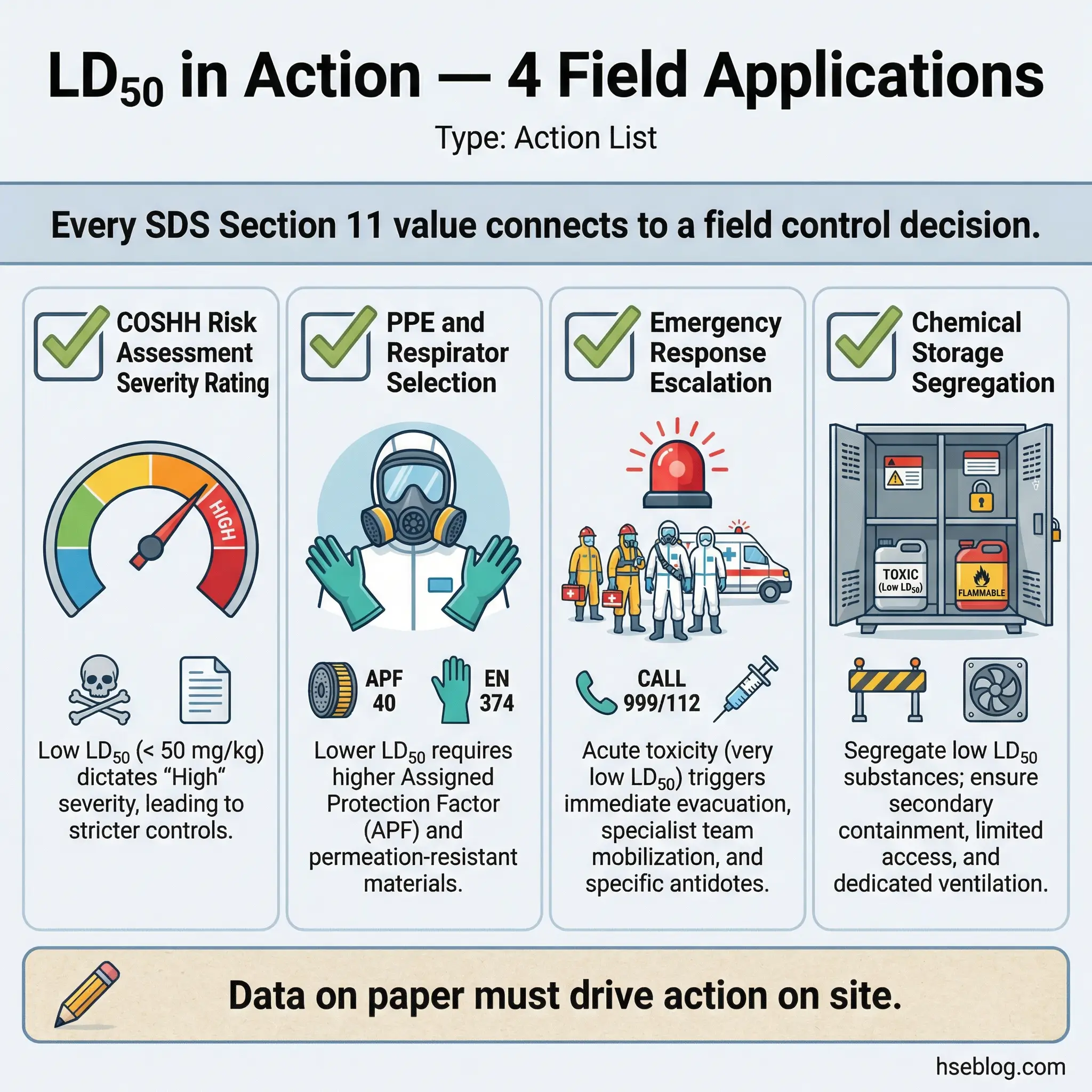
[INFOGRAPHIC: “LD₅₀ in Action — 4 Field Applications” — Type: Action List. Four application areas arranged as a visual checklist: “COSHH Risk Assessment Severity Rating,” “PPE and Respirator Selection,” “Emergency Response Escalation,” and “Chemical Storage Segregation.” Headline stat: Every SDS Section 11 value connects to a field control decision. Footer: “Data on paper must drive action on site.” Branding: Display “hseblog.com” in small, clean text at the bottom-right corner.]
Common Mistakes When Using LD₅₀ and LC₅₀ Data
Even experienced professionals fall into predictable traps when interpreting toxicological data. These mistakes lead to under-protection, incorrect risk assessments, and — in the worst cases — avoidable exposures. Over the past decade, I have encountered every one of these errors during audits, incident investigations, and training sessions.
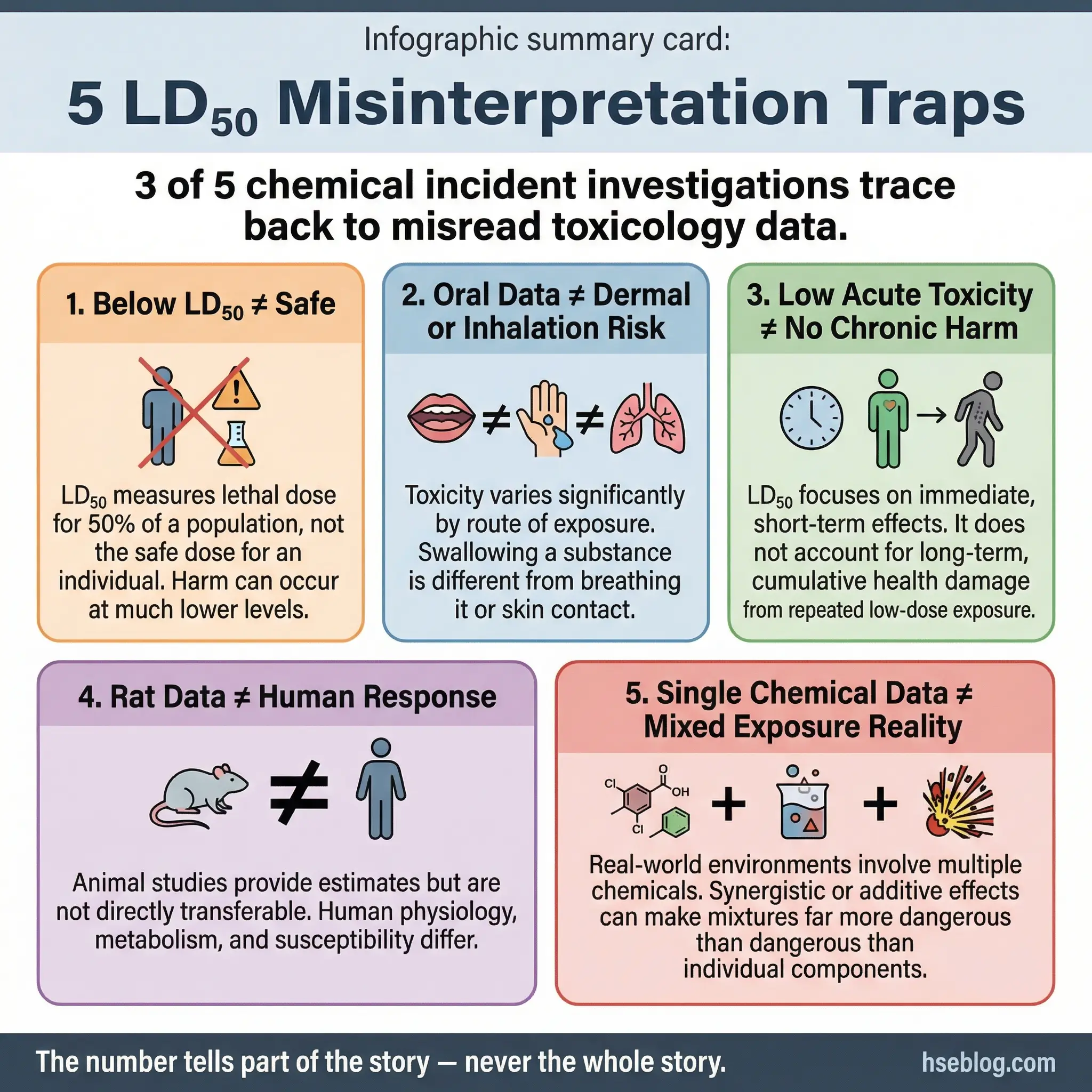
The following patterns represent the most frequent and most dangerous misapplications of LD₅₀ and LC₅₀ data:
- Treating LD₅₀ as a “safe threshold.” Workers and supervisors sometimes assume that any dose below the LD₅₀ is harmless. In reality, the LD₅₀ is the dose that kills half the test population — significant illness, organ damage, and death occur at doses well below that threshold. Some test subjects died at fractions of the LD₅₀.
- Ignoring the route of exposure. A substance may have a high oral LD₅₀ but an extremely low dermal LD₅₀ or LC₅₀. Selecting controls based only on the oral value — which often appears most prominently on the SDS — can leave the actual dominant exposure route uncontrolled.
- Equating low acute toxicity with overall safety. This is the benzene trap. A substance with a relatively high LD₅₀ can still be a carcinogen, mutagen, reproductive toxin, or sensitizer. LD₅₀ measures only acute lethality — it says nothing about what happens after months or years of sub-lethal exposure.
- Applying animal data directly to humans without adjustment. LD₅₀ data comes from rodent studies. Human metabolism, body surface area, organ sensitivity, and detoxification capacity differ. Some substances are orders of magnitude more toxic to humans than their rat-derived LD₅₀ would suggest.
- Ignoring synergistic and additive effects. Industrial workplaces rarely involve single-chemical exposures. Two substances that are individually Category 4 can produce combined effects equivalent to Category 2 when exposure occurs simultaneously. Standard LD₅₀ data does not account for this.
- Failing to update risk assessments when LD₅₀ data is revised. Toxicological databases are updated as new studies emerge. A substance that was classified as Category 4 a decade ago may have been reclassified to Category 3 based on more recent data. Risk assessments built on outdated values are built on false assumptions.
Pro Tip: During COSHH reviews or toolbox talks, avoid telling workers a chemical is “low toxicity” based solely on its LD₅₀. Instead, describe it as “low acute lethality by [specific route]” and remind them that chronic effects, sensitization, and combined exposures require separate consideration.
Where to Find LD₅₀ and LC₅₀ Data on a Safety Data Sheet
Safety Data Sheets follow the 16-section GHS format globally. LD₅₀ and LC₅₀ values appear primarily in Section 11 (Toxicological Information), but related context that helps interpret those values is distributed across several other sections. Knowing where to look — and what to cross-reference — turns the SDS from a filing obligation into a risk decision tool.
The following SDS sections contain toxicologically relevant data that field professionals should review together, not in isolation:
- Section 2 — Hazards Identification: Lists the GHS acute toxicity category (derived from LD₅₀/LC₅₀), the signal word, the hazard pictogram, and the hazard statements. This is where the LD₅₀ data translates into the label the worker actually sees on the container.
- Section 8 — Exposure Controls / Personal Protection: Provides occupational exposure limits (OELs, PELs, TLVs) that define the maximum allowable airborne concentration for ongoing work — far below the LC₅₀ lethality threshold. This section bridges the gap between acute toxicity data and daily work exposure management.
- Section 9 — Physical and Chemical Properties: Contains vapor pressure, boiling point, and volatility data. Combined with LC₅₀, this tells you how quickly a spilled liquid generates hazardous airborne concentrations.
- Section 11 — Toxicological Information: The primary location for LD₅₀ and LC₅₀ values, reported by route (oral, dermal, inhalation) and test species. Also lists target organs, sensitization potential, carcinogenicity classification, and mutagenicity data — the chronic effects that LD₅₀ alone does not capture.
- Section 14 — Transport Information: Transport classification is partly driven by acute toxicity data. Packing Group I corresponds to GHS Category 1–2 substances, Packing Group II to Category 3, and Packing Group III to Category 4.
The 16-section SDS format mandated by GHS ensures that LD₅₀ and LC₅₀ data is not presented in isolation — it is contextualized by hazard classification, exposure limits, physical properties, and transport requirements across multiple interrelated sections.
Conclusion
LD₅₀ and LC₅₀ values are not abstract laboratory numbers — they are the quantitative foundation on which every chemical hazard classification, every GHS label, every COSHH assessment, and every PPE selection decision rests. When a Safety Data Sheet reports an oral LD₅₀ of 25 mg/kg, it is telling you that a volume smaller than a teaspoon could be a lethal dose for a human. When an LC₅₀ of 0.3 mg/L appears for a vapor, it is telling you that a single breath in a confined space could be fatal. Those numbers demand respect — and they demand comprehension from every professional who encounters them.
The gap between having the data and understanding the data is where preventable exposures occur. I have investigated incidents where the SDS was on the shelf, the LD₅₀ was printed right there in Section 11, and nobody in the crew knew what it meant or how it connected to the controls they were supposed to follow. That gap is not a worker competency problem — it is a training and leadership failure.
Every chemical substance on your site has a story written in its toxicological data. Read the LD₅₀ and LC₅₀ values. Understand the route. Check the GHS category. Cross-reference the exposure limits. Then build your controls around what the data actually tells you — not around assumptions, convenience, or habit. The workers breathing that air and handling those containers are counting on you to get it right.