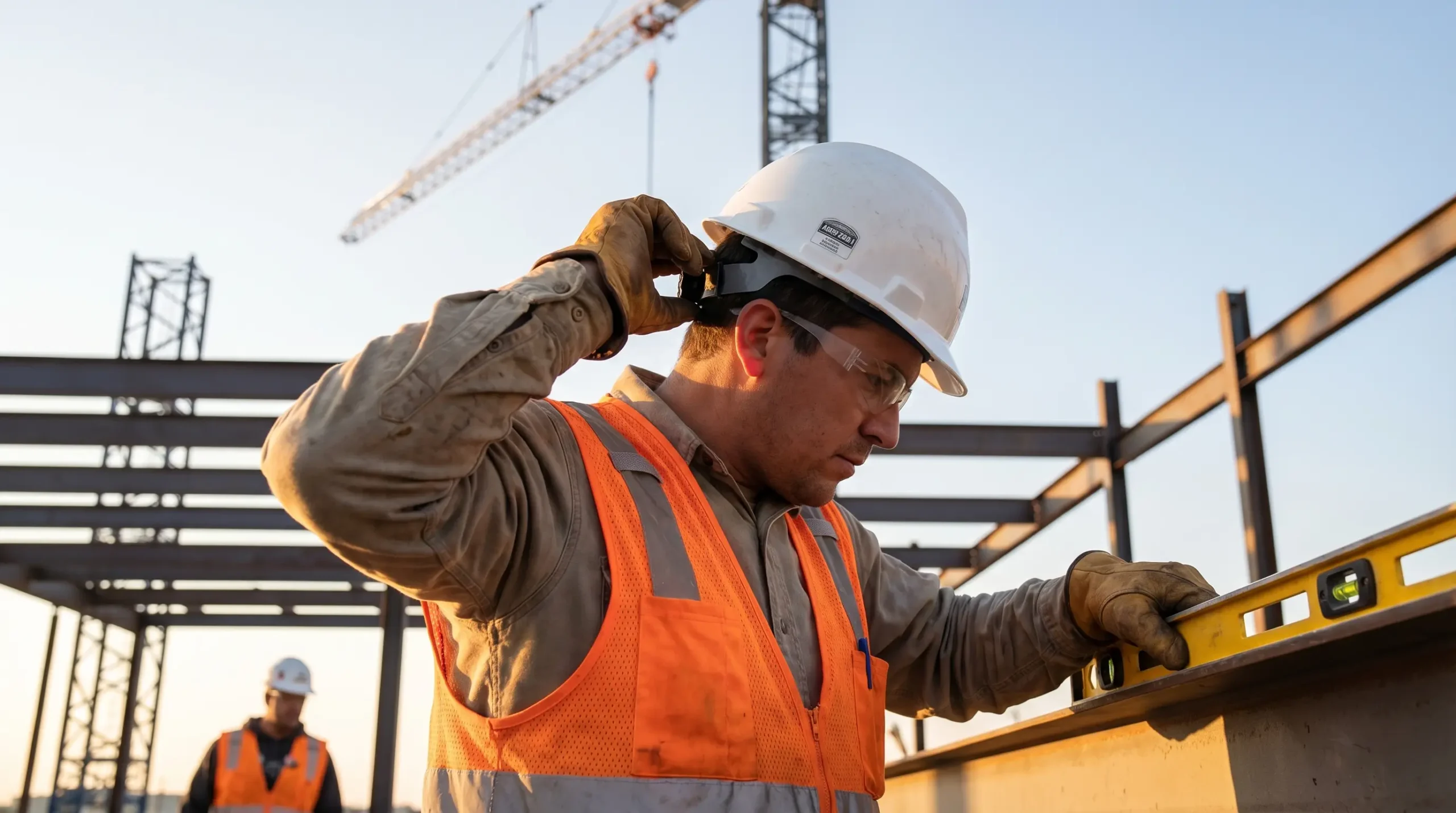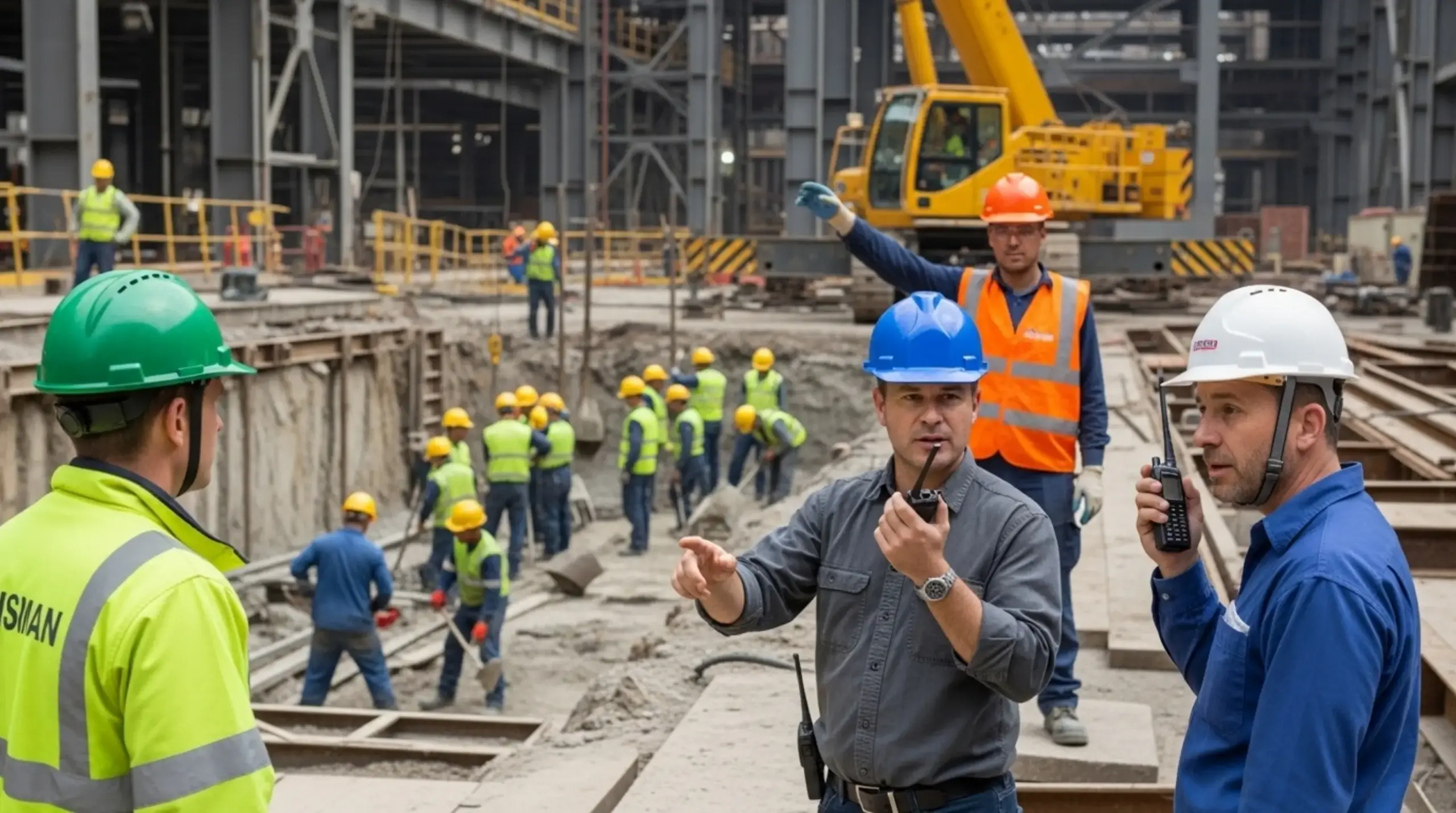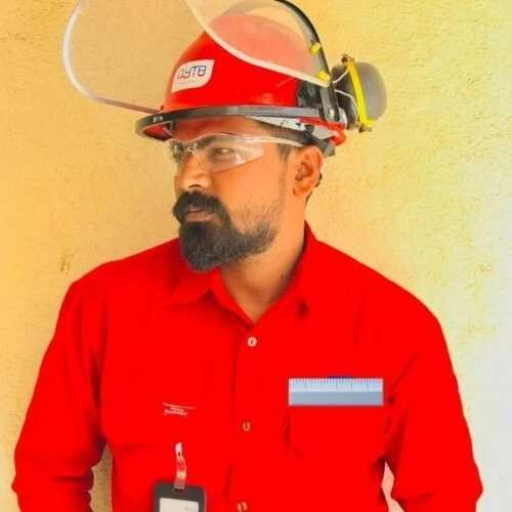
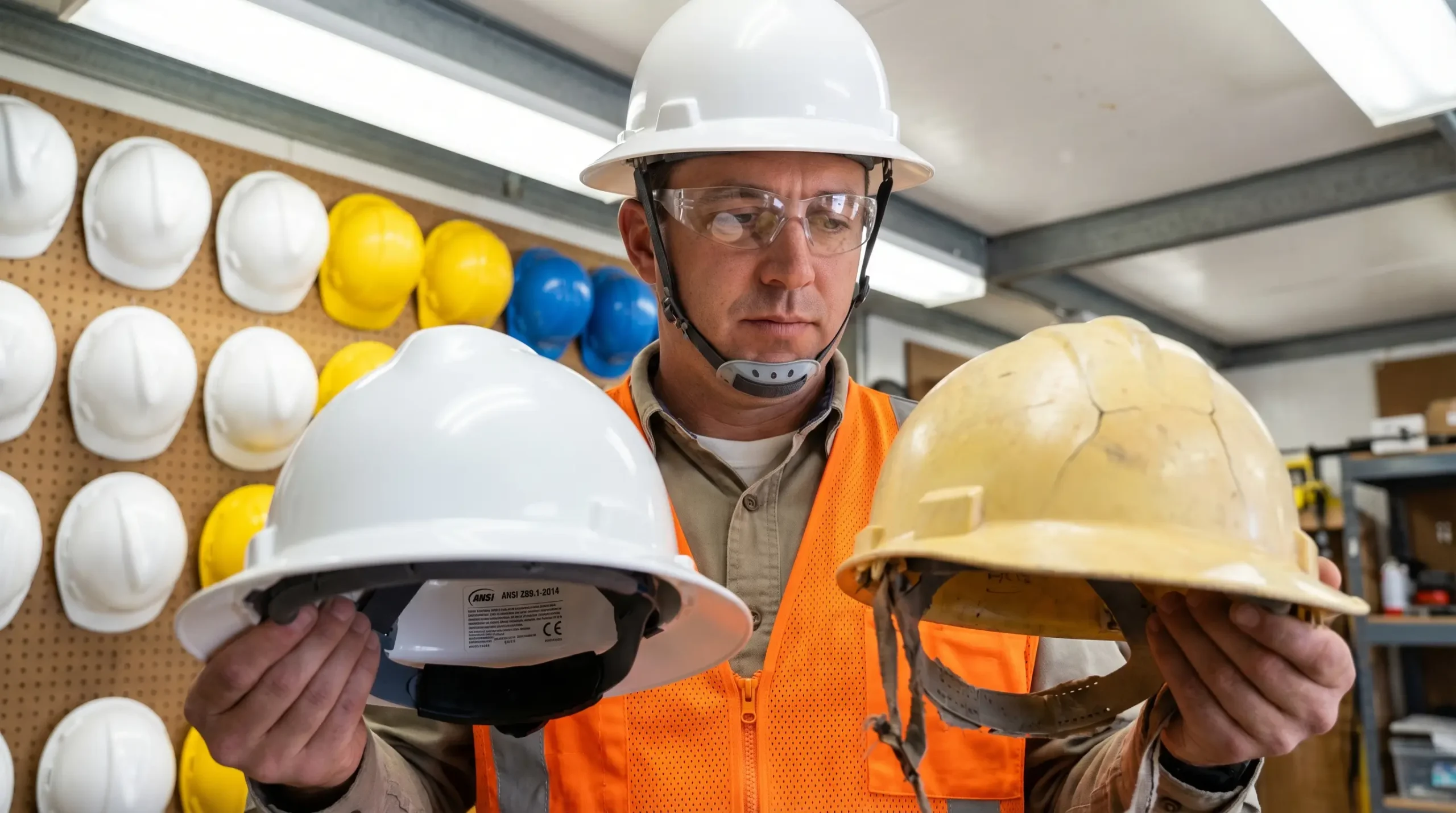
I was halfway through a PPE compliance audit at a heavy civil construction project — bridge abutment work, overhead crane lifts, structural steel going up — when I pulled a hard hat off a rack in the tool crib. The shell was faded, the suspension webbing had lost its elasticity, and the date stamp inside read 2014. The site supervisor told me every hard hat on-site was "OSHA compliant." When I asked which ANSI edition they were certified to, he stared at me like I'd spoken a different language.
That gap — between knowing that OSHA requires hard hats and understanding what ANSI actually demands of them — is one of the most common compliance blind spots I encounter. It shows up on construction sites, in manufacturing plants, and across oil and gas facilities. OSHA sets the legal obligation. ANSI defines the technical performance. Confuse the two, and you end up with helmets on heads that protect against nothing. This article breaks down the OSHA and ANSI hard hat requirements side by side, explains where they overlap, where they diverge, and what you need to get right in the field.
What OSHA Requires for Hard Hat Protection
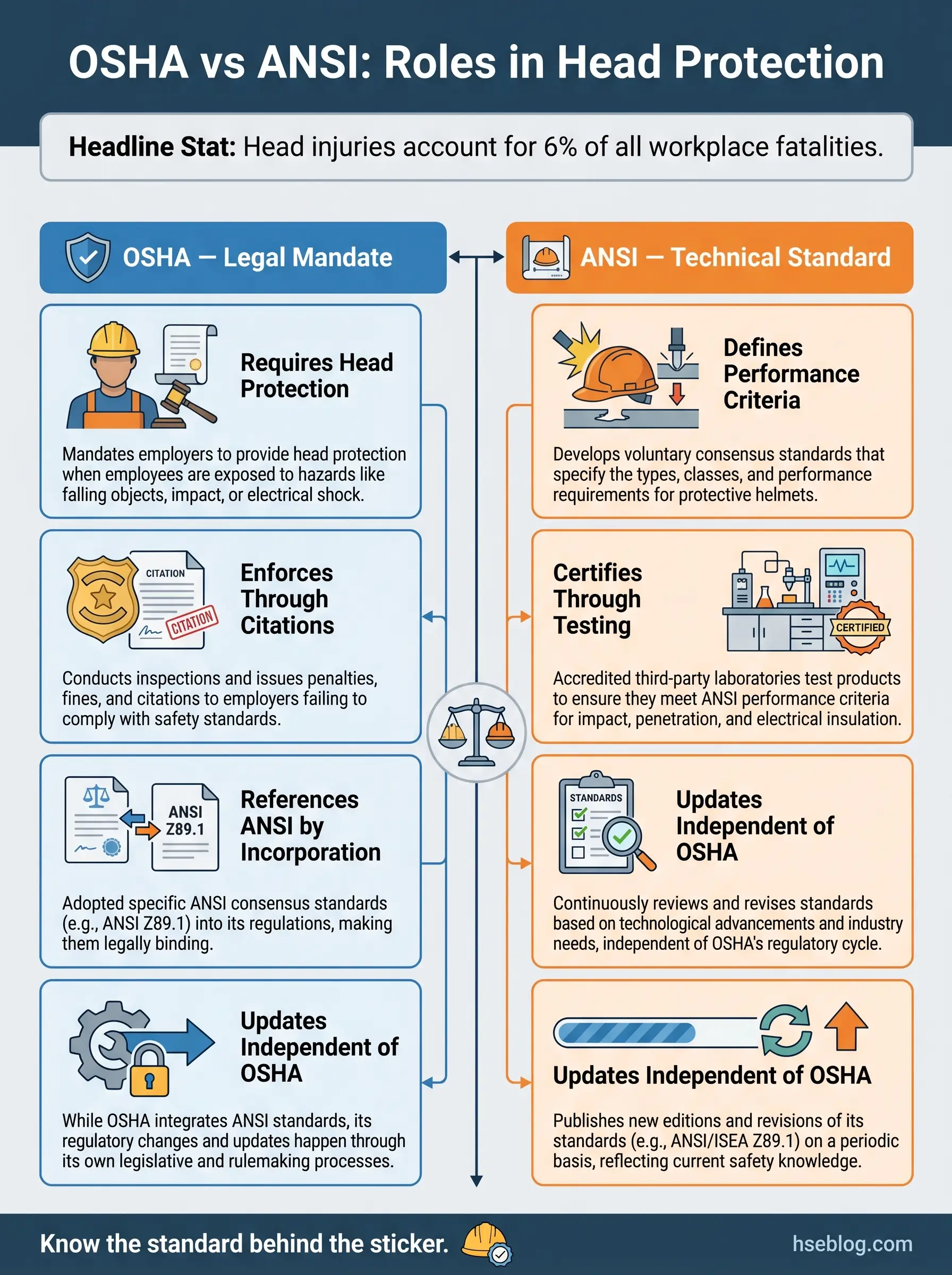
OSHA does not design hard hats, test hard hats, or certify hard hats. What OSHA does is establish the legal duty for employers to protect workers from head hazards — and then point to ANSI standards as the benchmark those hard hats must meet.
The core regulatory requirements come from two primary standards, depending on whether you're in general industry or construction:
- 29 CFR 1910.135 (General Industry): Requires employers to ensure each affected employee wears a protective helmet when working in areas where there is a potential for head injury from falling objects, or from striking against fixed objects or electrical conductors.
- 29 CFR 1926.100 (Construction): Mirrors the general industry requirement but applies specifically to construction sites. Employees exposed to possible head injury from impact, falling or flying objects, or electrical shock and burns must be provided with protective helmets.
- 29 CFR 1910.132(d) (Hazard Assessment): Before selecting any PPE — including hard hats — employers must perform a workplace hazard assessment to identify sources of head hazards. This assessment must be documented and certified in writing.
- OSHA's incorporation by reference: Both 1910.135 and 1926.100 reference ANSI Z89.1 as the consensus standard that hard hats must meet. OSHA has accepted multiple editions — 1986, 1997, 2003, 2009, and 2014.
"Protective helmets purchased after July 5, 1994, shall comply with ANSI Z89.1-1986, or shall be demonstrated to be equally effective." — OSHA 29 CFR 1926.100(b)
Pro Tip: During an OSHA inspection, the compliance officer won't just check if workers are wearing hard hats. They'll verify the ANSI marking on the shell, the condition of the suspension, and whether the employer's hazard assessment matches the Type and Class of hard hat provided. Missing any of these triggers a citation under the General Duty Clause or the specific PPE standard.
What ANSI/ISEA Z89.1 Actually Specifies
While OSHA creates the legal obligation, ANSI/ISEA Z89.1 is the standard that defines exactly how a hard hat must perform. Every manufacturer designing and selling hard hats in the U.S. market builds to this standard — and every safety professional selecting head protection must understand its classification system.
The current edition is ANSI/ISEA Z89.1-2014 (reaffirmed 2019), which replaced earlier editions and introduced tighter performance criteria. The standard classifies hard hats along two axes — Type and Class — and each combination addresses a different hazard profile.
Type Classification: Where the Impact Protection Applies
The Type classification determines the area of the head that is protected against impact. This is a critical distinction that many site teams overlook when requisitioning helmets.
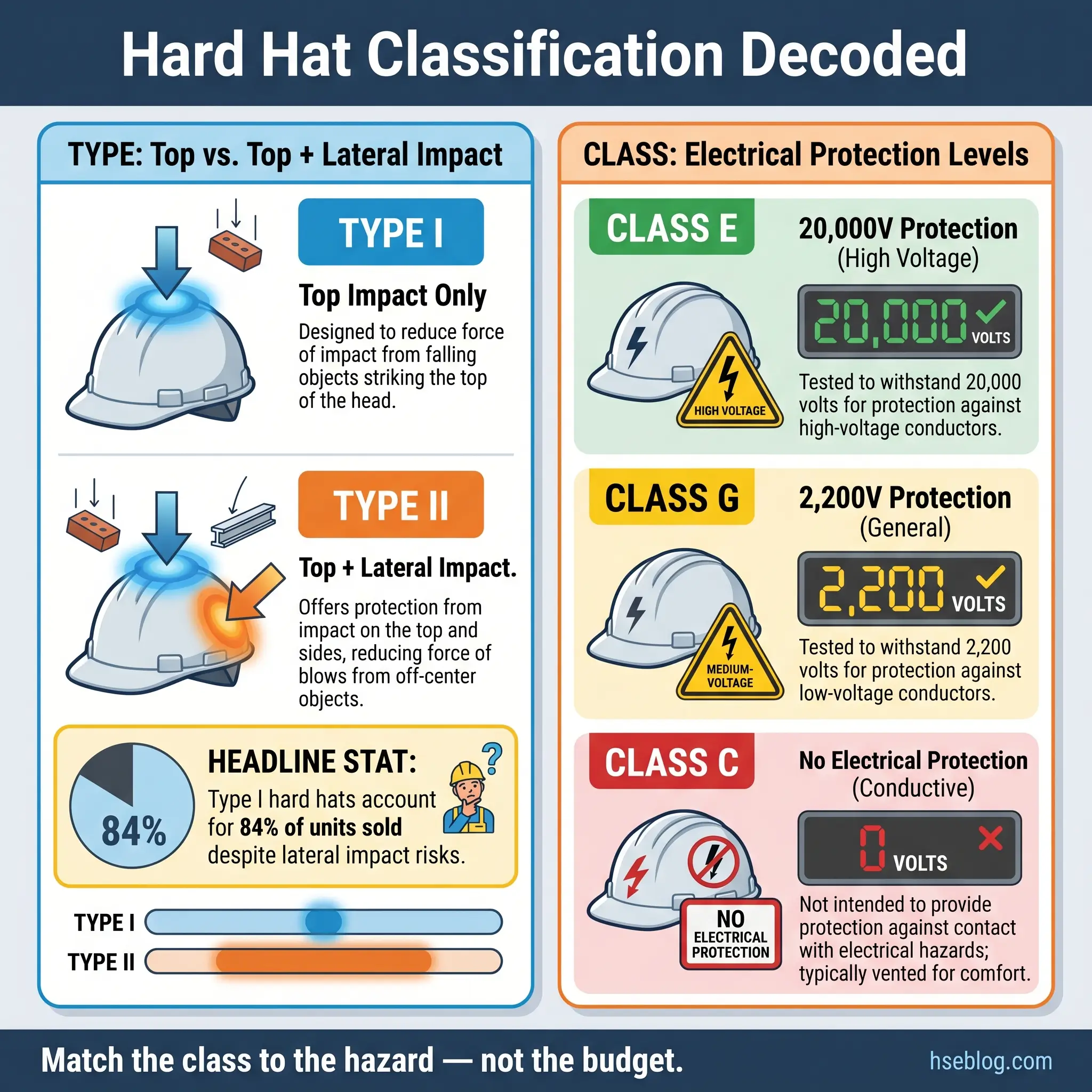
- Type I: Designed to reduce the force of impact to the top of the head only. These are the traditional hard hat shape — the dome absorbs a blow from directly above. They do not protect the sides, front, or back from lateral impact.
- Type II: Designed to reduce the force of impact to both the top and sides of the head, including the front and back. Type II hard hats have energy-absorbing foam liners and a full-brim or vented shell design that distributes lateral forces.
I've investigated two incidents where workers wearing Type I hard hats suffered serious lateral head injuries — one from a swinging load at a port facility, another from a side-impact strike against a steel beam during structural erection. Both workers had "compliant" hard hats. Both were wearing the wrong Type for the hazard.
Class Classification: Electrical Protection Rating
The Class system addresses how much electrical protection the hard hat shell provides. This is not about whether the hat is "electrical" — it's about the voltage the shell can withstand without conducting current to the wearer.
- Class E (Electrical): Tested to withstand up to 20,000 volts (phase to ground). Required for workers exposed to high-voltage conductors. This is the most protective electrical class.
- Class G (General): Tested to withstand up to 2,200 volts (phase to ground). Suitable for most construction and general industry applications where low-voltage exposure exists.
- Class C (Conductive): Provides no electrical protection. Used in environments where electrical contact is not a risk — such as bump protection in warehouse or manufacturing settings where overhead clearance is the primary concern.
Pro Tip: I've seen procurement teams default to Class G across entire projects because it's the mid-range option. But on a project with live overhead conductors or high-voltage switchgear nearby, Class G falls short — Class E is the only compliant choice. Always cross-reference the electrical hazard assessment before approving the purchase order.
OSHA vs ANSI: Where the Standards Overlap and Diverge
Understanding the relationship between OSHA and ANSI is where most compliance programs either succeed or fall apart. These are not competing standards — they are complementary layers. But the nuances between them create real enforcement gaps on job sites.
The following table breaks down the key differences and overlaps between the two frameworks:
| Criteria | OSHA (29 CFR 1910/1926) | ANSI/ISEA Z89.1-2014 |
|---|---|---|
| Nature | Federal regulation — legally enforceable | Voluntary consensus standard — adopted by reference |
| Scope | Mandates when head protection is required | Defines how head protection must perform |
| Type/Class system | References ANSI classifications | Establishes Type I/II and Class E/G/C |
| Testing protocols | Does not specify test methods | Specifies impact attenuation, penetration resistance, flammability, and electrical insulation tests |
| Edition accepted | Accepts 1986, 1997, 2003, 2009, and 2014 editions | Current edition: 2014 (reaffirmed 2019) |
| Enforcement | OSHA compliance officers issue citations | No enforcement mechanism — compliance is manufacturer-driven |
| Hazard assessment | Requires employer-conducted assessment (1910.132(d)) | Does not address workplace assessment — focuses on product performance |
| Accessories & modifications | Permits accessories if they don't compromise protection | Requires accessories to be tested with the specific shell model |
| Reverse wearing | Permits if manufacturer certifies reverse-wear compliance | Requires specific testing and marking for reverse-wear approval |
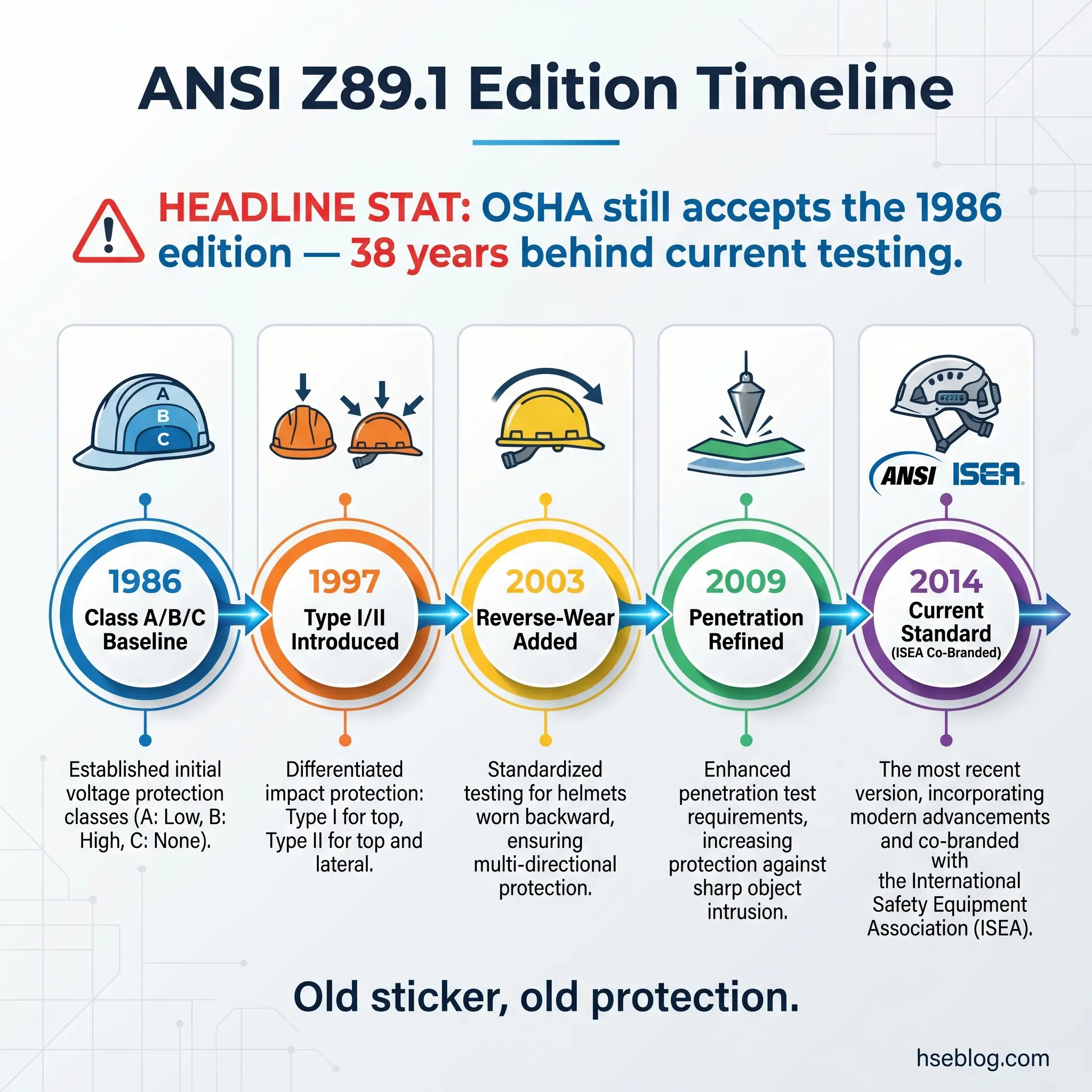
One divergence that catches employers off guard is the edition issue. OSHA still accepts the 1986 edition of ANSI Z89.1, which predates the modern Type/Class naming convention. Under the 1986 edition, hard hats were classified as Class A, Class B, and Class C — a completely different system. If your site has old-stock helmets with Class A/B markings, they may technically satisfy the minimum OSHA reference but fall short of the current ANSI performance criteria.
"The fact that OSHA accepts older editions does not mean older helmets meet current best practice. It means the minimum legal floor is lower than the current engineering ceiling." — A principle I repeat in every PPE audit debrief.
ANSI Z89.1 Performance Testing: What Hard Hats Must Survive
ANSI doesn't just classify hard hats — it subjects them to a battery of destructive tests that determine whether they earn their Type and Class markings. Understanding these tests matters because they define the limits of what your hard hat can and cannot protect against.
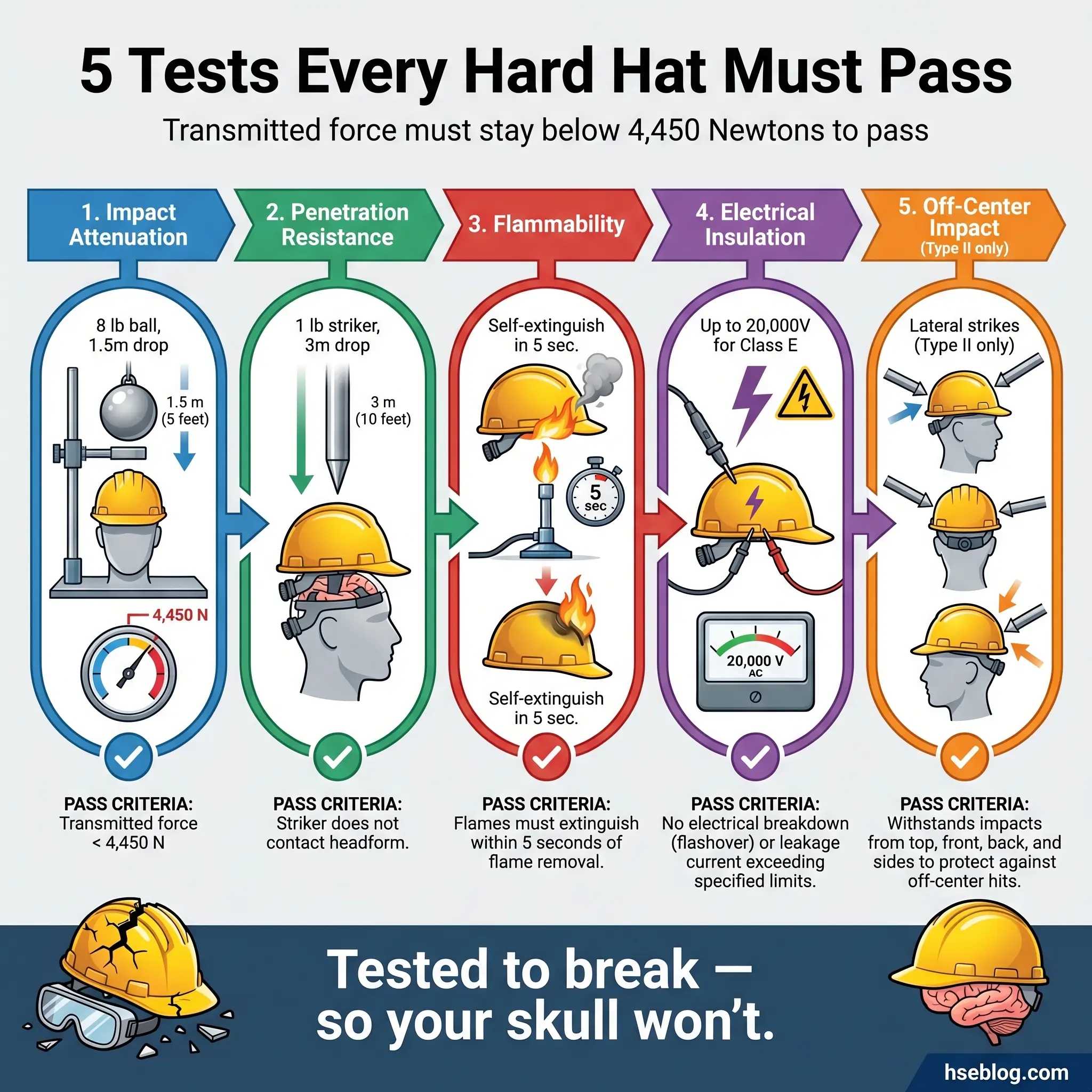
Every hard hat bearing the ANSI/ISEA Z89.1 marking has passed the following test categories:
- Impact attenuation (force transmission): A 3.6 kg (8 lb) steel ball is dropped from 1.5 meters onto the hard hat mounted on a headform. The transmitted force must not exceed 4,450 Newtons (1,000 lbf). This measures how effectively the shell and suspension absorb and distribute energy.
- Penetration resistance: A 0.45 kg (1 lb) pointed steel striker is dropped from 3 meters onto the hard hat. The striker must not contact the headform surface. This tests the shell's ability to resist puncture from sharp falling objects — bolts, rebar, hand tools.
- Flammability: The shell is exposed to a flame source for a specified duration. The material must self-extinguish within five seconds and must not drip burning material. This prevents the hard hat from becoming a secondary hazard during a fire or hot-work situation.
- Electrical insulation (Class E and G only): Class E shells are subjected to 20,000 volts for three minutes with no current leakage exceeding specified limits. Class G shells undergo the same test at 2,200 volts. Class C hard hats skip this test entirely.
- Off-center impact (Type II only): Type II hard hats undergo additional lateral impact tests at the front, rear, and sides of the shell. The transmitted force must remain below defined thresholds at each test point.
Pro Tip: The penetration test uses a standardized striker, not a real bolt or rivet. On a steel erection site, a loose bolt falling 20 meters generates forces that exceed the test parameters. Hard hats reduce severity — they don't guarantee immunity. I brief every crew on this reality during site inductions.
Common Field Mistakes With OSHA and ANSI Hard Hat Compliance
Across hundreds of site inspections and PPE audits, I've cataloged a consistent pattern of compliance failures related to hard hats. These aren't obscure edge cases — they are recurring, widespread mistakes that expose workers to unprotected head hazards and expose employers to OSHA citations.
The following issues appear with alarming regularity, even on sites that consider themselves "safety-first" operations:
- Using Type I hard hats in lateral impact environments: Workers on structural steel projects, demolition sites, and confined overhead spaces face lateral and oblique strike risks. A Type I hard hat provides zero lateral protection. The hazard assessment should drive Type II selection in these environments — but many programs default to Type I because it's cheaper and more familiar.
- Ignoring hard hat expiration: ANSI Z89.1 does not specify a fixed expiration date, but most manufacturers recommend replacing shells every five years from date of issue and suspensions every twelve months. I routinely find hard hats on-site that are eight or ten years old with brittle shells and degraded UV-exposed material.
- Drilling holes or modifying the shell: Workers drill ventilation holes, attach unapproved accessories, or paint shells with solvent-based paint. Any modification that isn't tested and approved by the manufacturer voids the ANSI certification and makes the hard hat non-compliant.
- Wearing the hard hat backward without reverse-wear certification: Not every hard hat is tested for reverse wearing. ANSI Z89.1 requires specific marking ("R" or "reverse donning") on helmets approved for backward use. Wearing a non-certified hard hat backward eliminates the brim's deflection protection and changes the suspension geometry.
- Storing hard hats on vehicle dashboards or rear window ledges: Prolonged UV exposure from sunlight degrades high-density polyethylene shells. I've failed hard hats during compression checks that looked fine visually but crumbled under thumb pressure after chronic sun exposure.
- Mixing old Class A/B/C markings with current Type/Class system: Sites running older inventory alongside new procurement often have both legacy Class A hard hats and current Class G hard hats in the same tool crib. Workers and supervisors don't realize these represent different testing eras and potentially different protection levels.
- Failing to document the hazard assessment: OSHA 29 CFR 1910.132(d) requires a written certification of the PPE hazard assessment. I've seen sites where hard hats were correctly selected but the assessment was never documented — resulting in citations even though the PPE itself was appropriate.
How to Select the Right OSHA- and ANSI-Compliant Hard Hat
Selecting head protection is not a procurement decision — it's a risk decision. The hard hat you choose must match the specific hazards identified in your workplace assessment, not the one that arrived cheapest on the vendor's quote.
The selection process I follow on every project starts with the hazard profile and works outward to the product specification:
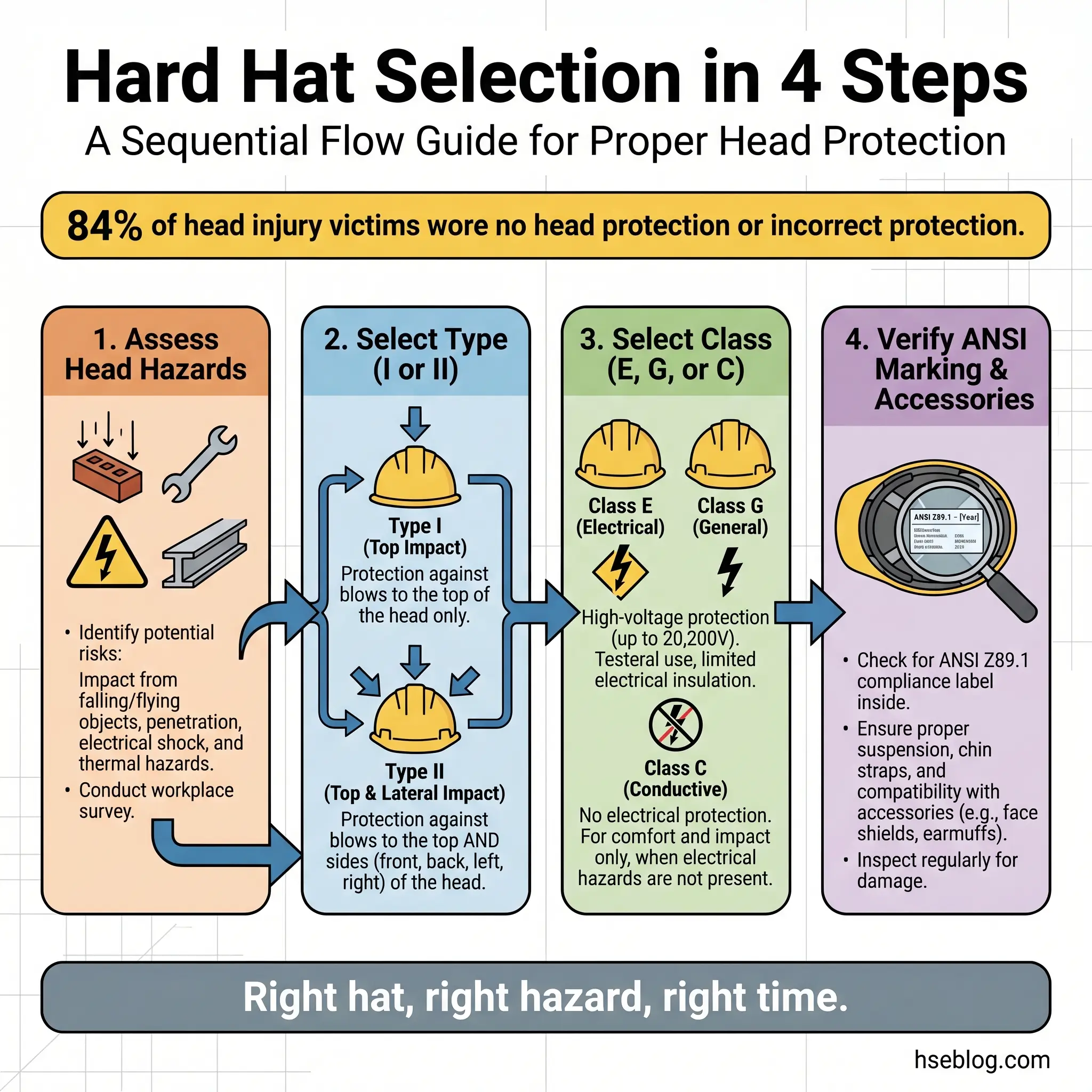
- Conduct and document the PPE hazard assessment per 29 CFR 1910.132(d). Identify all sources of head hazard — falling objects, fixed overhead obstructions, electrical conductors, lateral impact risks, chemical splash, and thermal exposure.
- Determine the required Type based on impact direction. If the assessment identifies only top-of-head impact risk (falling tools, overhead loads), Type I is sufficient. If lateral, front, or rear impacts are possible (steel erection, demolition, confined work, areas with swinging loads), Type II is mandatory.
- Determine the required Class based on electrical exposure. No electrical hazard = Class C is acceptable. Low-voltage environments (under 2,200V) = Class G minimum. High-voltage work or proximity to energized conductors = Class E required.
- Verify the ANSI edition marking on the product. Ensure the hard hat bears the ANSI/ISEA Z89.1-2014 marking (or later reaffirmation). Avoid procuring older-edition stock unless you have a documented justification.
- Confirm accessory compatibility with the manufacturer. If workers need face shields, earmuffs, chin straps, or headlamps, verify that the specific accessory model has been tested with the specific hard hat model. Untested combinations void the certification.
- Establish replacement schedules and track issuance dates. Record the manufacturing date and issuance date for every hard hat. Set calendar reminders for shell and suspension replacement intervals per the manufacturer's guidance.
The ANSI Z89.1 Edition History and OSHA Acceptance Timeline
The relationship between ANSI editions and OSHA acceptance is a source of real confusion — especially on large projects with mixed inventory from multiple procurement cycles. Understanding which editions OSHA recognizes, and what changed between them, prevents compliance gaps hiding in plain sight.
Each major edition of the standard brought measurable improvements to head protection requirements:
- ANSI Z89.1-1986: The baseline edition still referenced by OSHA. Used the old Class A (general), Class B (electrical), and Class C (no electrical) system. No Type I/II distinction existed. Impact and penetration tests were less stringent than current editions.
- ANSI Z89.1-1997: Introduced the modern Type I/Type II and Class E/G/C naming convention. Added lateral impact testing for Type II hard hats. Tightened flammability criteria.
- ANSI Z89.1-2003: Added reverse-donning requirements and marking ("R" designation). Updated test headform specifications. Improved clarity on accessory testing responsibilities.
- ANSI Z89.1-2009: Refined penetration and impact criteria. Addressed high-visibility color requirements. Enhanced guidance on cold-weather performance.
- ANSI/ISEA Z89.1-2014 (reaffirmed 2019): Current edition. ISEA (International Safety Equipment Association) co-branded the standard. Strengthened off-center impact criteria for Type II. Clarified shell material degradation guidance. Added chin strap performance requirements.
OSHA accepts all five editions. But accepting an older edition and recommending it are different things entirely. A 1986-edition hard hat on a 2025 construction site is legal — and inadequate.
Pro Tip: During procurement reviews, I flag any hard hat that doesn't carry the 2014 marking. If a supplier quotes product certified only to the 1997 or 2003 edition, I send it back. The cost difference between editions is negligible. The protection difference is not.
Hard Hat Inspection and Maintenance Under OSHA and ANSI
Neither OSHA nor ANSI Z89.1 specifies a mandatory daily inspection protocol by name — but both create an enforceable expectation of ongoing maintenance. OSHA's General Duty Clause (Section 5(a)(1)) and the PPE condition requirements under 1910.132 make it clear: issuing a hard hat that is damaged, degraded, or improperly maintained is a citable offense.
Every hard hat inspection I require on my sites follows this field-proven sequence:
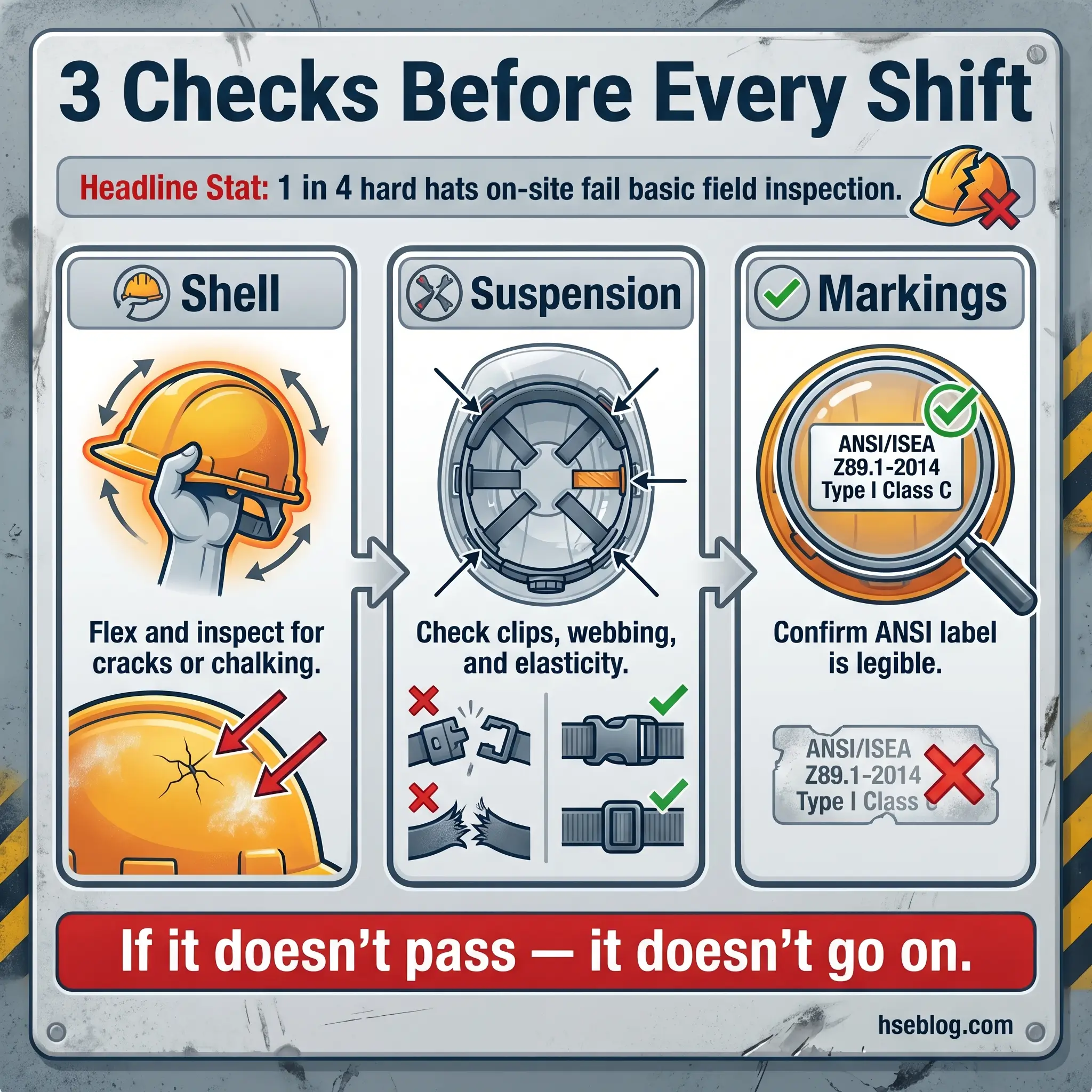
- Visual shell check: Examine the outer shell for cracks, dents, gouges, chalking (white powdery surface indicating UV degradation), and discoloration. Any visible crack — no matter how small — means immediate replacement.
- Flex test (compression check): Grip the shell on opposite sides and gently compress inward about 25 mm (1 inch). A compliant shell flexes and springs back. If the shell stays deformed, cracks, creaks audibly, or feels brittle, it has lost structural integrity.
- Suspension inspection: Check every attachment point where the suspension clips into the shell. Inspect the webbing and headband for fraying, cuts, chemical contamination, and loss of elasticity. A failed suspension means the energy-absorbing system is compromised — the shell becomes a decorative bowl.
- Sweatband and comfort pad check: While not structural, degraded sweatbands cause workers to wear hard hats loosely or tilted, reducing protection. Replace sweatbands at the first sign of hardening or deterioration.
- Marking verification: Confirm the ANSI/ISEA Z89.1 marking, Type, Class, and manufacturer name are still legible on the interior. If markings have worn off, the hard hat cannot be verified as compliant during an audit.
- Replace the shell if it has sustained any impact — even if no visible damage is present. The internal energy absorption may be spent.
- Replace the suspension at least every 12 months under normal use, or sooner if visually degraded.
- Replace the entire hard hat if it has been exposed to chemical splash, solvent contact, or extreme heat beyond the manufacturer's rated range.
When Bump Caps Are Not a Substitute for Hard Hats
One of the most persistent field errors I correct is the use of bump caps in environments that require ANSI-rated hard hats. Bump caps look like hard hats to the untrained eye, but they are fundamentally different products designed for entirely different hazards.
The critical differences that every supervisor needs to understand include:
- Bump caps protect against minor bumps from fixed objects — low overhead pipes, cabinet edges, vehicle door frames. They are designed for environments where workers might strike their head against a stationary object at walking speed.
- Bump caps are NOT tested to ANSI Z89.1. They do not undergo impact attenuation, penetration resistance, or electrical insulation testing. They carry no Type or Class rating.
- OSHA does not recognize bump caps as compliant head protection under 29 CFR 1910.135 or 1926.100. If a hazard assessment identifies falling object risk, electrical exposure, or any impact hazard beyond minor bumps, a bump cap is a violation.
- The visual similarity creates a dangerous false equivalence. I've walked sites where half the crew wore hard hats and the other half wore bump caps — and the supervisor didn't know the difference. From ten meters away, they look identical.
Pro Tip: If you aren't sure whether a bump cap is acceptable for a particular work zone, apply this test: could any object fall onto the worker's head from above? If the answer is anything other than a definitive "no," the answer is a hard hat — not a bump cap.
Conclusion
The distinction between OSHA requirements and ANSI specifications is not academic — it's the difference between legal compliance on paper and actual protection on a worker's head. OSHA tells you when head protection is required. ANSI tells you what that head protection must survive. Miss either half, and your program has a gap that no safety poster can close.
Every hard hat decision starts with the hazard assessment — not the vendor catalog. Type I or Type II. Class E, G, or C. Current ANSI edition or legacy stock. These are not interchangeable options; they are specific answers to specific hazards. Getting them wrong means a worker absorbs an impact their helmet was never designed to handle.
I've held hard hats that saved lives — cracked shells with the dent still visible from the bolt that would have killed someone. And I've held hard hats that failed because they were the wrong Type, the wrong Class, or ten years past their replacement date. The standard exists to prevent the second outcome. Use it.