
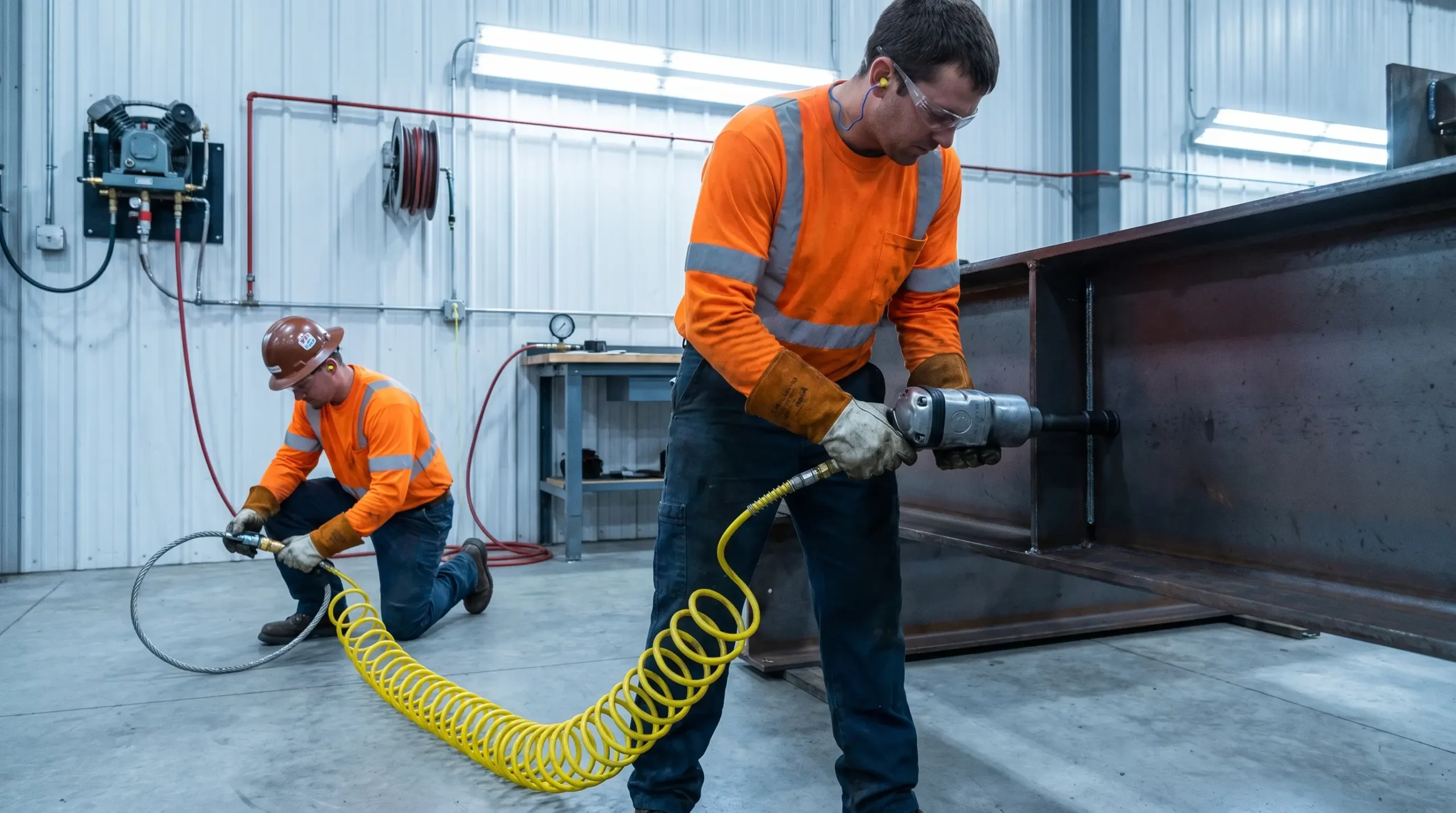
TL;DR: Pneumatic Tool Safety in Numbers
- ~37,000 — annual US emergency department visits from nail gun injuries, work-related and consumer combined (NIOSH/CDC)
- 2 of 5 — residential carpentry apprentices injured by a nail gun across a four-year training window (OSHA)
- 30 psi — OSHA static dead-end cleaning-pressure limit under 29 CFR 1910.242(b); frequently misinterpreted as a supply-line limit
- 2.5 / 5 m/s² A(8) — EU Exposure Action Value and Exposure Limit Value for hand-arm vibration (Directive 2002/44/EC); no equivalent binding US standard exists
- ~2× injury risk — contact-trigger nail guns compared to sequential-trigger nail guns (NIOSH)
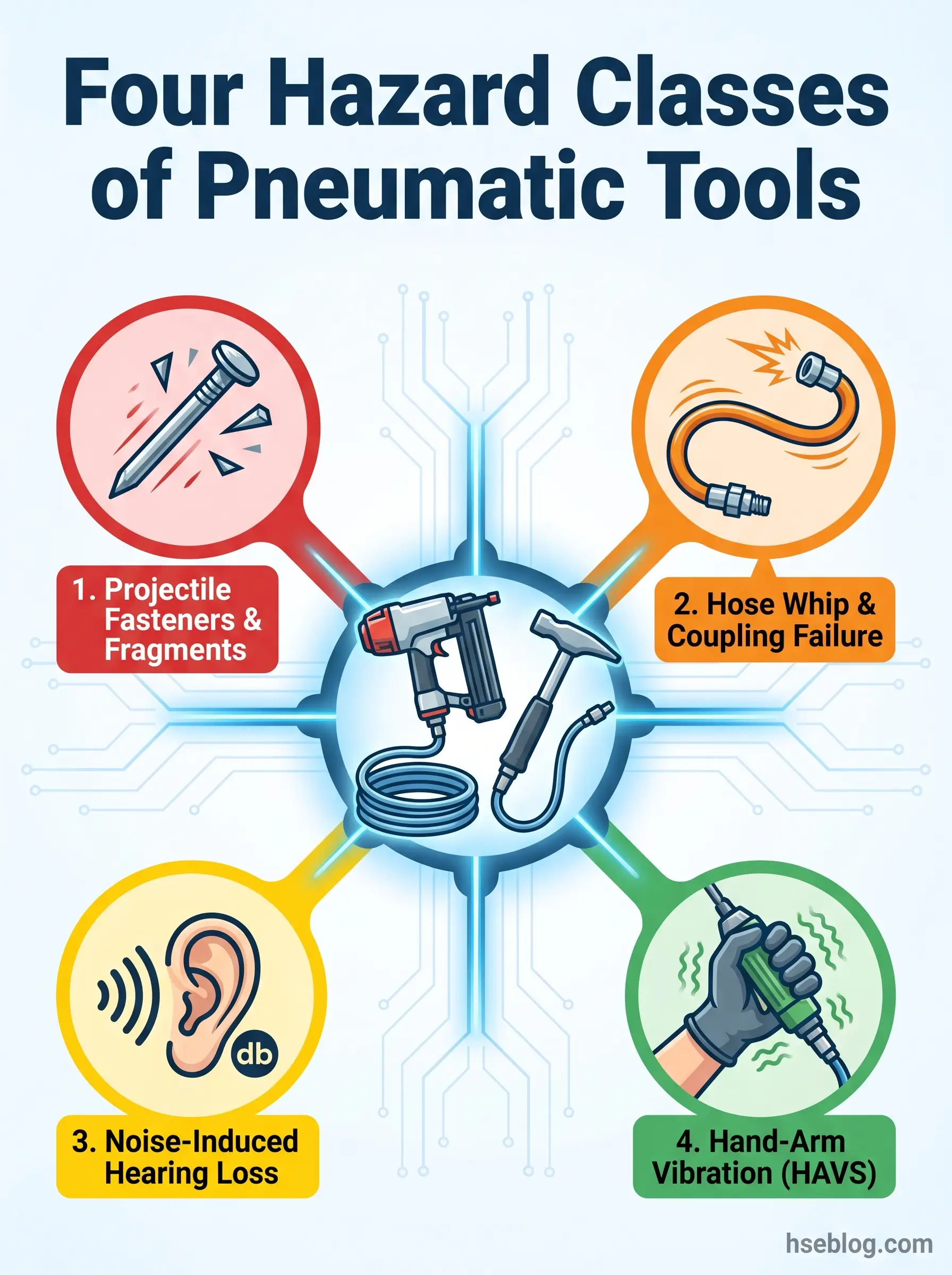
Pneumatic tool safety covers four hazard classes — projectile fasteners, hose whip from pressurised connections, noise exposure, and hand-arm vibration — managed through the hierarchy of controls. Substitution (sequential-trigger nail guns, low-vibration models), engineering controls (retainers, whip checks, regulators), administrative controls (pre-use inspection, training), and PPE together close the risk. EU vibration limits fill the OSHA gap.
Between 1985 and 2012, the OSHA Federal and State investigation database logged 258 serious and fatal pneumatic nail gun incidents. Every one of the fatalities was recorded in the construction industry (Lowe et al., 2016, peer-reviewed publication). NIOSH estimates roughly 37,000 emergency department visits a year from nail gun injuries across work and consumer settings (NIOSH/CDC). Those figures belong to one tool category. Add chipping hammers, grinders, impact wrenches, jackhammers, and the long tail of compressed-air equipment, and the pneumatic family becomes one of the most-injured tool groups on a modern worksite.
The hazard profile is wide. A pressurised hose at 90 psi carries enough stored energy to whip with lethal force when a coupling blows. Compressed air above 30 psi can breach skin and trigger an air embolism. Percussive tools transmit vibration that destroys microcirculation in the fingers over time. This article sets out the specific hazards pneumatic tools create, the controls that work in practice, and the regulatory expectations across OSHA, HSE UK, and EU frameworks — with a working safety professional’s read on where the published standards and field reality diverge.
What Are Pneumatic Tools and Why Do They Demand Elevated Caution?
Pneumatic tools convert compressed air pressure into mechanical work. A compressor charges a reservoir, regulated air travels through a hose to the tool, and internal valving cycles that pressure into rotation, percussion, or fastener drive. The family includes nail and staple guns, impact wrenches, die grinders, chipping hammers, jackhammers, riveters, sanders, drills, and blow guns. They appear in framing carpentry, structural steelwork, shipbuilding, automotive assembly, foundry operations, concrete demolition, and general maintenance.
The operational appeal is real. Pneumatic tools run cooler than electric motors on long duty cycles, tolerate wet conditions that compromise mains-powered alternatives, and deliver high power-to-weight ratios for impact fastening. In certain classified atmospheres they are the only practical option where electric sparking is unacceptable — though this requires specifically rated equipment, not any standard pneumatic tool off the shelf.
The caution they demand comes from three properties electric tools do not share. Energy is stored outside the tool in a pressurised hose and reservoir; a disconnection event releases that energy violently. Fastener-driving tools can propel projectiles with enough force to penetrate cured concrete. Percussive pneumatic tools generate vibration magnitudes that dwarf equivalent electric tools, because the firing mechanism itself is an impact event.
A consistent pattern in HSE practice: pneumatic tools are treated as “simpler” than electric tools because there is no plug, no battery, no circuit. That reasoning inverts the actual risk ranking. The lethality profile of a contact-trigger nail gun exceeds most portable electric tools on a construction site. Training and procurement choices need to reflect that, not the other way around.
Key Hazards Associated with Pneumatic Tools
The pneumatic hazard profile is not a single risk. It is four related but distinct hazard classes, each with its own mechanism, consequence, and failure pattern. Treating them as one generic “tool hazard” is the quickest way to under-control the ones that matter most.
Projectile and Struck-By Hazards
The ejection hazard covers three mechanisms. Fasteners leave fastener-driving tools at the operator’s command — or unintentionally through ricochet or blow-through. Tool attachments such as chisel bits, drill bits, and grinding wheels can detach when retainers fail or are missing. Workpiece fragments fly when grinding, chipping, or riveting strikes brittle materials like cast iron, concrete, or hardened steel.
Nail guns dominate the published injury data. NIOSH places annual US emergency department visits from nail gun injuries at roughly 37,000 (NIOSH/CDC). The Lowe et al. analysis of OSHA investigations from 1985 to 2012 identified 258 serious or fatal incidents, with 100% of fatalities recorded in construction (Lowe et al., 2016). Trigger mechanism is the single strongest predictor of injury risk: NIOSH evidence puts contact-trigger injury rates at approximately twice those of sequential-trigger models (NIOSH Science Bulletin on nail guns and consensus standards).
A consistent failure pattern across published investigation reports: safety devices are bypassed for speed. Chisel retainers get removed because they slow bit changes. The work-contact element on a contact-trigger nail gun gets taped or defeated outright for “bump nailing.” The operator gains seconds and loses the engineered safety margin the tool manufacturer designed in.
Watch For: Contact-trigger nail guns where the work-contact element moves stiffly, shows tape residue, or has been modified. That is the tool most likely to fire unintentionally. Sequential-actuation conversion kits exist for most major brands — factor them into any pre-mobilisation tool audit.
Compressed Air Pressure Hazards
Compressed air behaves as a stored-energy system. Released against skin, the consequences are not trivial. Air above roughly 30 psi can penetrate through a minor break in the skin, causing subcutaneous emphysema; larger volumes entering the bloodstream cause air embolism, a potentially fatal event. The eyes and ear canal are particularly vulnerable. OSHA published the 30 psi threshold in 29 CFR 1910.242(b) in recognition of exactly this mechanism.
The practical reading of that clause: the 30 psi limit applies to static, dead-end nozzle pressure — the pressure measured when airflow is fully blocked — not to supply line pressure. Supply lines commonly run 90–120 psi. Compliance is achieved by fitting a nozzle that vents to atmosphere even when pressed against a solid surface, so dead-end pressure never exceeds the limit. This is one of the most misunderstood OSHA clauses in general industry. Many workers believe the line itself must be below 30 psi, which would render most pneumatic tools inoperable.
Overpressure and underpressure both carry operational risk. A regulator drift of 10–15 psi above set point on a tool rated at 90 psi accelerates wear, increases recoil, and in some tools raises the risk of fastener blow-through. Underpressure produces the opposite failure: the tool stalls, the operator leans body weight into the work, and musculoskeletal strain on wrists and shoulders climbs sharply.
Hose Whip and Connection Failure Hazards
A disconnected pressurised hose becomes a kinetic weapon. At 90 psi in a ½-inch line, the stored energy released through a failed coupling can send the hose end travelling fast enough to fracture bone or rupture an eye. The hazard grows with line diameter: a ¾-inch supply hose carries several times the stored volume of a ⅜-inch tool hose.
Common coupling failures include worn quick-disconnects with loose detent balls, mismatched fitting profiles (industrial versus automotive interchange is a recurring site problem), cross-threaded NPT fittings that seat incorrectly, and damaged or missing O-rings. Each failure mode is slow to develop and easy to miss in a pre-use check unless the inspector looks specifically at the coupling geometry rather than the fitting as a whole.
The primary control is the whip check — a steel cable restraint spanning the coupling that contains the hose if the connection lets go. Whip checks sit in the category of engineering controls that are universally recommended and inconsistently applied. On short-duration jobs where a hose is connected for fifteen minutes of work, the whip check is often skipped on the logic that exposure time is too short to matter. That logic fails at the first coupling release, which does not respect scheduling.
Noise Exposure Hazards
Pneumatic tools are among the loudest hand tools in regular use. Jackhammers commonly exceed 100 dB(A) at the operator position, pneumatic grinders run 90–100 dB(A), chipping hammers sit in the same range, and even fastener drivers register 95–105 dB(A) at the report. Noise-induced hearing loss is cumulative, irreversible, and one of the most under-diagnosed occupational diseases.
Regulatory thresholds vary by jurisdiction. OSHA sets the Permissible Exposure Limit at 90 dB(A) as an 8-hour time-weighted average under 29 CFR 1910.95, with the hearing conservation programme action level at 85 dB(A). The UK Control of Noise at Work Regulations 2005 set a lower action value — 80 dB(A) lower exposure action value and 85 dB(A) upper exposure action value, with an 87 dB(A) exposure limit value. EU Directive 2003/10/EC aligns with the UK framework.
The compounding problem on a pneumatic worksite is that multiple tools operate simultaneously, pushing combined exposure well above single-tool measurements. Dosimetry — not sound-level spot readings — is the only reliable way to characterise exposure on a multi-tool site.
Hand-Arm Vibration and Ergonomic Hazards
Hand-arm vibration syndrome (HAVS) is the pneumatic hazard most underestimated in day-to-day practice. Prolonged exposure to vibration transmitted through tool handles damages the vascular, neurological, and musculoskeletal structures of the fingers, hands, and forearms. The earliest clinical signs are episodic finger blanching on cold exposure — Raynaud’s phenomenon, commonly called vibration white finger — followed by sensory and grip-strength loss, and in advanced stages irreversible tissue damage.
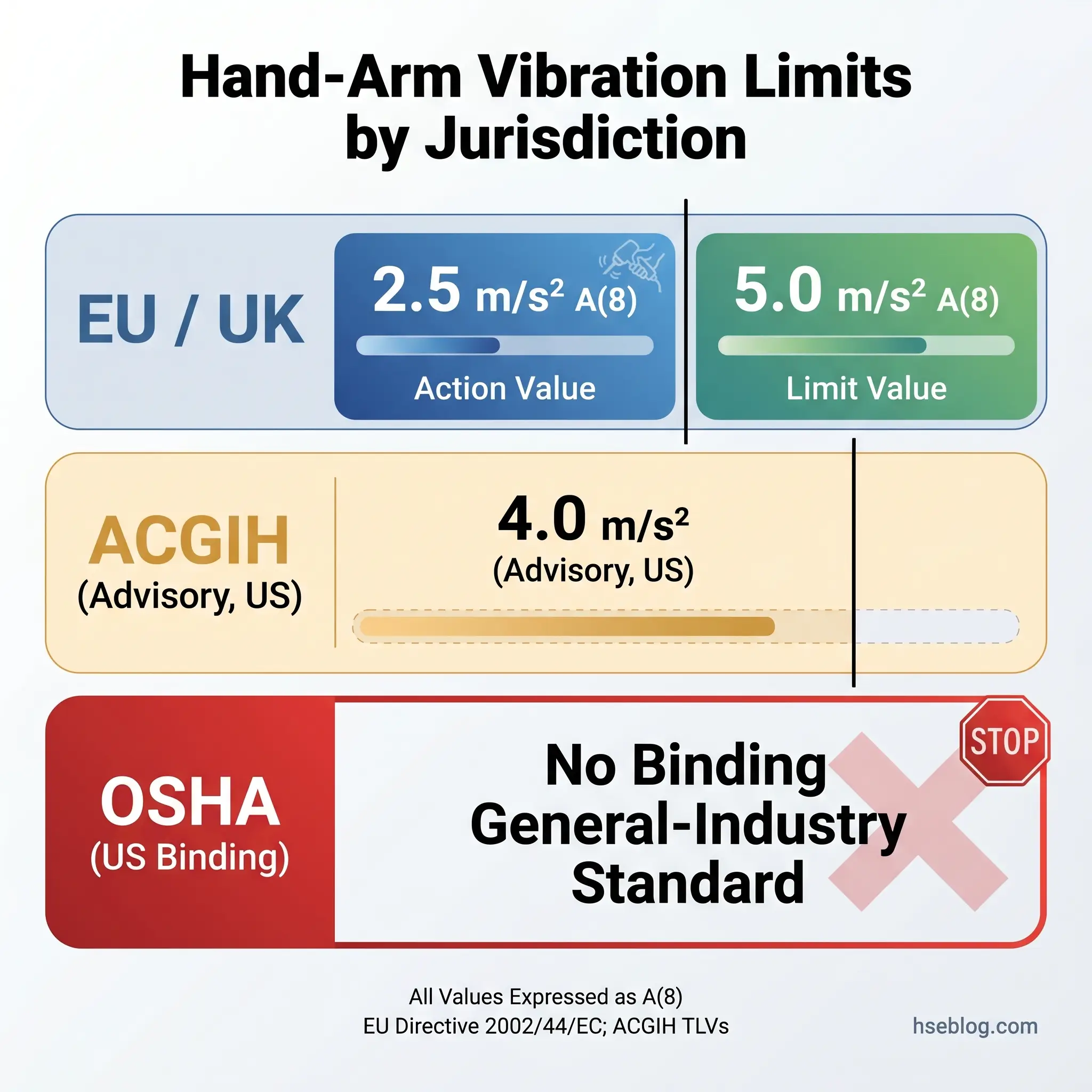
Safety+Health Magazine, citing occupational vibration consultant Donald Wasserman, estimated approximately 2 million US workers exposed to hand-arm vibration (Safety+Health Magazine, 2015). EU Directive 2002/44/EC sets binding exposure values: an Exposure Action Value of 2.5 m/s² A(8) and an Exposure Limit Value of 5 m/s² A(8). Exceeding the EAV triggers mandatory risk assessment, exposure-reduction programmes, and health surveillance. Exceeding the ELV is prohibited.
Jurisdiction Note: OSHA has no binding general-industry standard for hand-arm vibration exposure. The ACGIH Threshold Limit Value broadly aligns with EU values but is advisory, not enforceable. On any international project, the EU/UK framework should govern — it reflects the current state of medical knowledge and closes a genuine regulatory gap in the US system.
Manufacturer-declared vibration values are generated under ISO 28927 test conditions, which rarely match field use. A chipping hammer declared at 7 m/s² in test conditions may read 12–15 m/s² on real material, particularly on hard concrete or when the bit is worn. Daily exposure calculations based solely on declared values can understate actual exposure by a factor of two or more. Field-measured values should govern where the work justifies the measurement effort.
Hierarchy of Control Measures for Pneumatic Tool Hazards
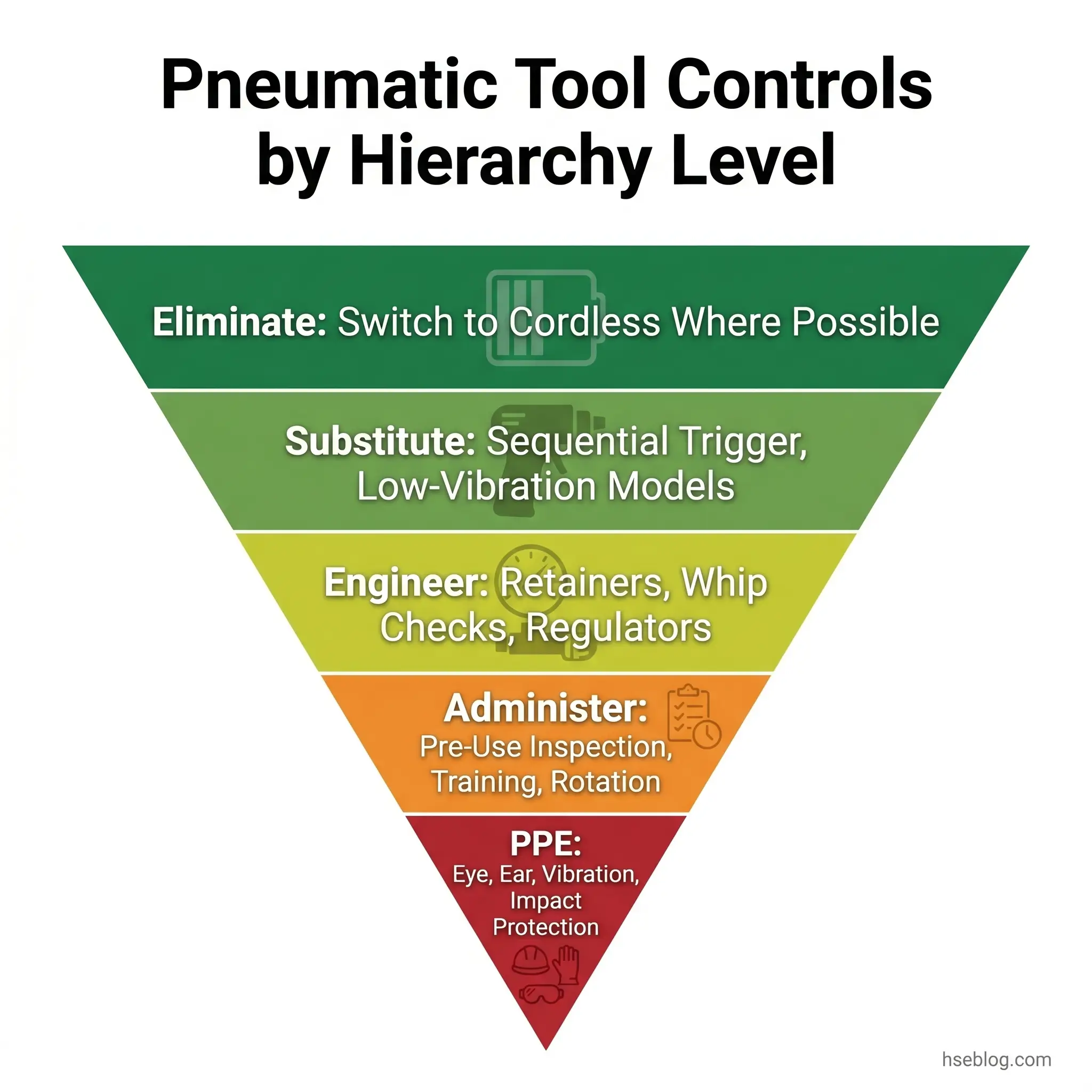
Most pneumatic tool safety content presents controls as an unranked checklist. That flattens the hierarchy of controls into a list of equal-seeming precautions and obscures where the real leverage sits. On live sites, the interventions are not equal. Substitution and engineering controls carry far more weight than PPE, which is a last line of defence in any risk control system.
This section organises controls using the hierarchy — elimination, substitution, engineering, administrative, PPE — applied specifically to pneumatic tool hazards rather than generically restated.
This article provides general HSE knowledge. Life-critical operations involving pneumatic tools in energised systems, confined spaces, explosive atmospheres, or height work must be planned and supervised by a competent person with relevant training, jurisdiction-specific authorisation, and site-specific risk assessment. The information here does not replace that. Recognised training pathways include NEBOSH, IOSH, OSHA Outreach, and equivalent regional programmes.
Elimination and Substitution Controls
The most impactful question is the first one: does this task require a pneumatic tool at all? Battery-powered fastener drivers have closed the performance gap with pneumatic nailers for most residential framing and finish applications. Cordless impact wrenches now match or exceed pneumatic torque in the sizes used for general mechanical work. Where the compressed air infrastructure itself creates risk — hoses routed across access ways, tools powered in cramped spaces — elimination by switching to cordless alternatives removes the hazard category entirely.
Where a pneumatic tool must be used, substitution within the category delivers the next-largest gain. Sequential-actuation triggers substitute directly for contact-actuation triggers on nail guns, halving the injury risk (NIOSH). Low-vibration tool models with internal isolation mounts or counterbalanced mechanisms substitute for older percussive designs, cutting measured vibration exposure by 30–50% on comparable work. These substitutions require procurement involvement. HSE professionals who control only the “how” of tool use but not the “which” of tool purchase miss the highest-leverage intervention in the entire hierarchy.
Engineering Controls
Engineering controls for pneumatic tools fall into three groups: tool-integrated safety features, air-supply system controls, and worksite controls.
Tool-integrated features include safety clips and chisel retainers on chipping hammers and impact tools that prevent attachment ejection; chip guards on grinding wheels and chipping hammers that intercept fragmented debris; work-contact elements on fastener drivers that require contact with the material before firing; dead-man triggers that shut off the tool instantly on release; and speed governors on grinders that prevent disc overspeed.
Air-supply controls include pressure regulators set to the tool manufacturer’s rated operating pressure and verified against a calibrated reference; relief valves protecting the downstream system; excess-flow valves required by 29 CFR 1926.302(b)(7) on hoses exceeding ½-inch inside diameter, to shut off airflow if the hose ruptures; whip checks or safety cables restraining every pressurised coupling; and in-line filters and moisture separators that protect tool internals from contamination-induced failure.
Worksite engineering controls include barrier screens protecting bystanders from flying debris, enclosure of noisy operations where feasible, and ventilation for dust-generating pneumatic tasks such as concrete chipping, where respirable silica is a parallel hazard.
Administrative Controls and Safe Work Practices
Administrative controls work only when they are actually executed. The pre-use inspection is the canonical example — universally prescribed, inconsistently performed. The most common failure is inspecting the tool but not the hose or the regulator, which means the highest-energy component of the system (the supply) goes unchecked.
A practical pre-use sequence covers:
- Regulator — pressure set to tool manufacturer’s rated value; gauge undamaged and responding
- Hose — full-length visual check for cuts, abrasion, bulges, kinks, soft spots; coupling profile match and seating
- Whip check — installed at every coupling under pressure
- Tool body — housing intact; trigger free-moving and returning; work-contact element free-moving and undefeated
- Retainers and guards — safety clips, chisel retainers, chip guards present and functional
- Fasteners or attachments — correct type, undamaged, correctly loaded
- Workspace — fastener ejection line clear; bystanders outside the fan arc
Audit Point: When auditing pneumatic operations, ask to see the regulator reading with the tool triggered. A regulator that shows correct pressure at rest but drops sharply under tool load is failing. This is not a standard line on most inspection forms, but it catches a common wear pattern that static pre-use checks miss.
Other administrative controls include operator training that is tool-specific rather than generic, manufacturer instruction review before first use, posted warning signage in active work areas, strict prohibition of pointing compressed air at any person or using it to clean clothing or skin, disconnecting tools from the air supply when changing attachments or leaving the tool unattended, hose management to keep walkways clear, and rotation between pneumatic and non-pneumatic tasks to limit vibration and noise dose accumulation.
Personal Protective Equipment (PPE) Requirements
PPE for pneumatic tool work is matched to the specific hazard. The table maps the primary PPE categories to the hazards they address and the standards they are specified against.
| PPE Category | Hazard Addressed | Applicable Standard |
|---|---|---|
| Impact-rated eye protection | Projectile fasteners, workpiece fragments | ANSI Z87.1 (US); EN 166 (EU) |
| Face shield (over safety glasses) | High-energy fragmentation (grinding, chipping) | ANSI Z87.1; EN 166 |
| Hearing protection (plugs/muffs) | Noise exposure 85 dB(A) and above | ANSI S3.19 / EN 352 |
| Anti-vibration gloves | Hand-arm vibration (partial attenuation) | ISO 10819 |
| Safety footwear (toe + metatarsal) | Dropped pneumatic tools | ASTM F2413 (US); EN ISO 20345 (EU) |
| Respiratory protection | Silica, metal, or wood dust from cutting/grinding | NIOSH-approved; EN 149 |
| Head protection | Struck-by in construction contexts | ANSI Z89.1; EN 397 |
Anti-vibration gloves certified to ISO 10819 provide measurable attenuation at medium-to-high frequencies but are far less effective at the low frequencies generated by percussive tools such as chipping hammers and jackhammers. Treating gloves as a HAVS solution overstates what they actually do. The exposure management path — shorter duty cycles, lower-vibration tools, job rotation — delivers the real reduction. Gloves are a supplementary control, not a substitute for dose management.
What Are the OSHA and Regulatory Requirements for Pneumatic Tool Safety?
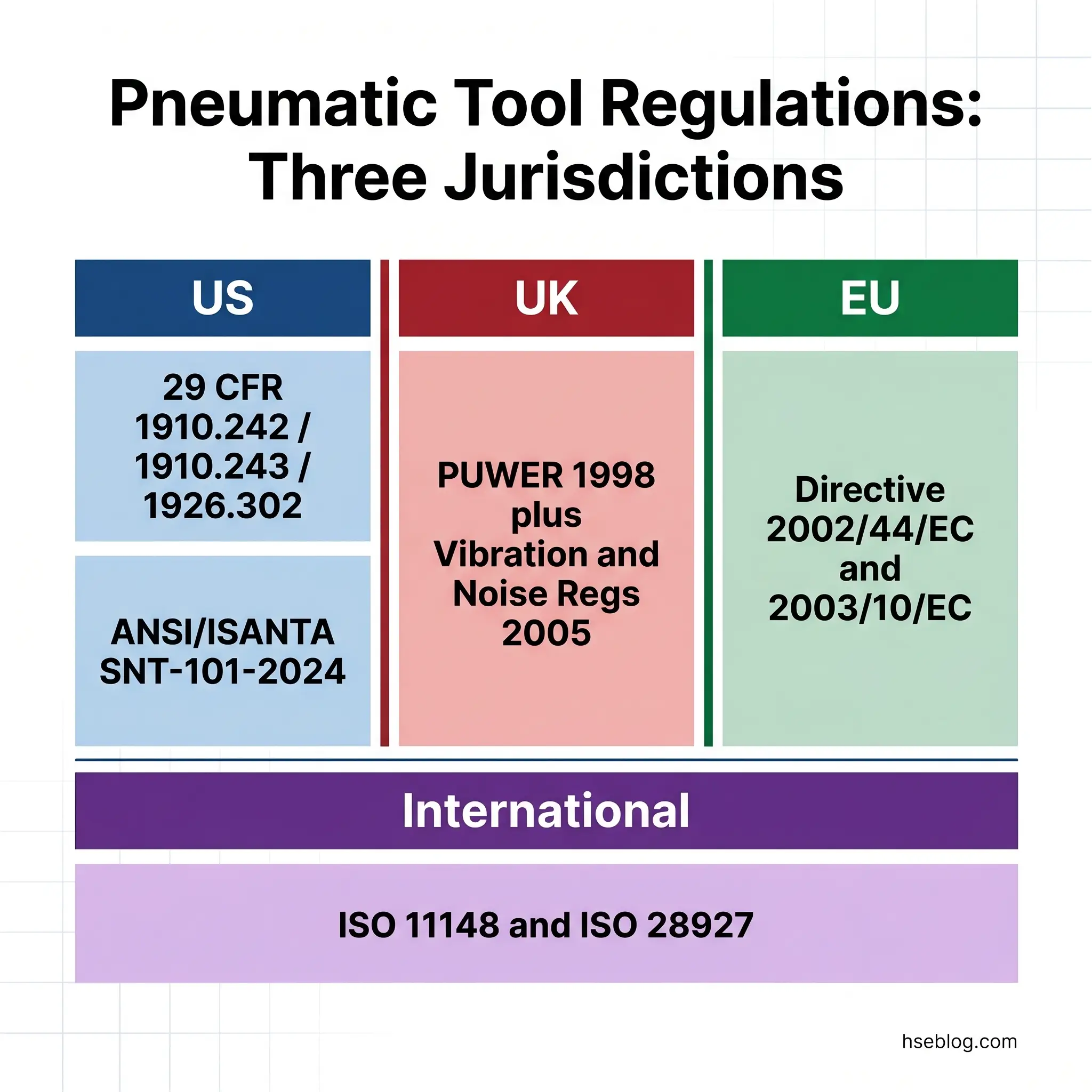
The regulatory landscape for pneumatic tools spans multiple jurisdictions with overlapping and sometimes divergent requirements. A safety professional working across US, UK, and EU sites needs to know where each framework binds and where it leaves gaps.
United States — OSHA. The field procedure most aligned with 29 CFR 1910.242(b) caps static dead-end cleaning pressure at 30 psi and requires chip guarding and PPE. 29 CFR 1910.243(a) requires that pneumatic tools operating above 100 psi and driving nails, rivets, or staples incorporate a device preventing ejection of fasteners unless the muzzle is pressed against the work surface. When work sits under the construction standard, 29 CFR 1926.302(b) adds the requirement that pneumatic tools be secured to hoses by positive means (beyond friction fit alone) and specifies safety clips and excess-flow valves on larger hoses.
United States — ANSI. ANSI/ISANTA SNT-101-2024 was approved by the ANSI Board of Standards Review in September 2024 and became effective September 19, 2025. It is the current consensus standard for portable compressed-air-actuated fastener driving tools, specifying trigger mechanism requirements, work-contacting element requirements, and pressure-rating conventions. Sites cited under 29 CFR 1910.243 that reference “good engineering practice” typically show compliance against SNT-101.
United Kingdom — HSE. The Provision and Use of Work Equipment Regulations 1998 (PUWER) require that all work equipment, including pneumatic tools, be suitable, maintained, inspected, and used only by trained persons. The Pressure Systems Safety Regulations 2000 apply where the compressed air system meets defined thresholds, triggering written scheme-of-examination requirements. The Control of Vibration at Work Regulations 2005 transpose the EU Vibration Directive into UK law — EAV 2.5 m/s² A(8), ELV 5 m/s² A(8), with health surveillance mandatory where exposure exceeds the EAV. The Control of Noise at Work Regulations 2005 set noise exposure action values of 80 and 85 dB(A) and an exposure limit value of 87 dB(A).
European Union. Directive 2002/44/EC sets hand-arm vibration values binding across member states. Directive 2003/10/EC sets noise exposure values. ISO 11148 (non-electric portable hand-held tools — safety requirements, multiple parts) and ISO 28927 (vibration emission test methods) are the international consensus standards underpinning tool-level compliance.
Canada. CCOHS guidance provides a non-regulatory framework — the fact sheet was updated in 2025 to reflect current practice on vibration, hose handling, and compressed air cleaning. Enforceable requirements sit at provincial level through provincial Occupational Health and Safety acts, which generally align with OSHA-style structures but with vibration and noise provisions varying by province.
A pattern worth naming: OSHA’s pneumatic tool standards (29 CFR 1910.242 and 1910.243) have seen minimal substantive revision since the 1970s. Safety professionals relying only on the CFR text miss the current state of knowledge about nail gun trigger types, hand-arm vibration exposure, and consensus-standard updates. The functional compliance baseline is OSHA plus current ANSI, NIOSH guidance, and — for vibration — EU/UK values applied voluntarily.
Pneumatic Nail Gun Safety: A Closer Look at the Highest-Risk Tool
Roughly 37,000 US emergency department visits a year are attributable to nail gun injuries (NIOSH/CDC). Among all pneumatic tool categories, nail guns carry the most developed injury-prevention evidence base — which means the safety decisions available are well-grounded, if they are actually made.
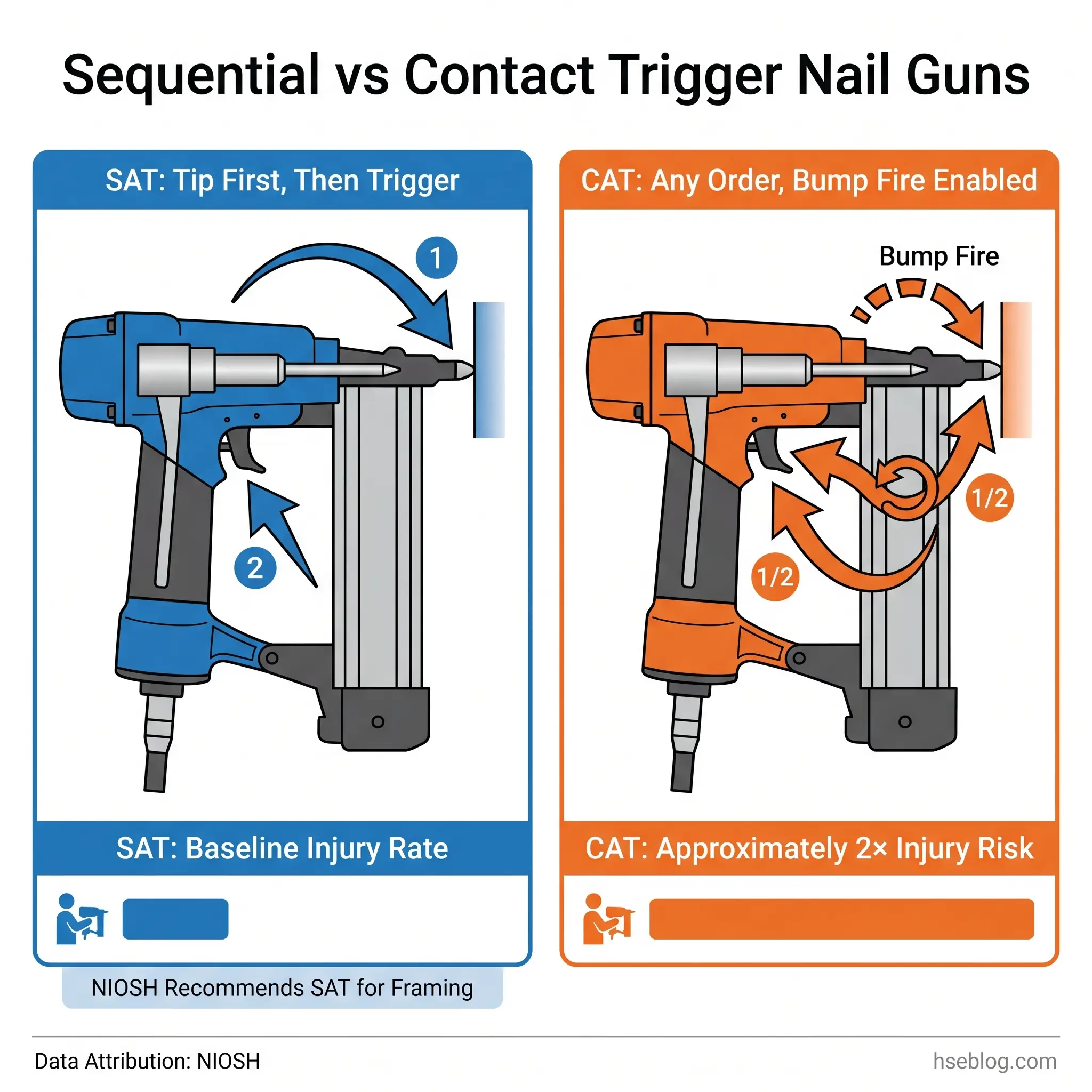
Trigger type is the decisive variable. Sequential Actuation Triggers (SAT) and Contact Actuation Triggers (CAT) differ in firing sequence in a way that translates directly to injury risk.
A Sequential Actuation Trigger requires the work-contact element to be depressed against the workpiece first, then the trigger pulled — in that order — to fire a fastener. Each subsequent fastener requires the full sequence to be repeated. Bump-firing is impossible.
A Contact Actuation Trigger fires whenever both the trigger and work-contact element are depressed, regardless of order. A worker can hold the trigger down and “bump” the nose against the material to fire rapidly — the production technique that gives contact triggers their speed advantage and their injury profile.
| Attribute | Sequential (SAT) | Contact (CAT) |
|---|---|---|
| Firing logic | Tip contact → trigger, each fastener | Trigger and tip in any order |
| Bump firing | Not possible | Possible and common |
| Production speed | Slower | Faster |
| Injury risk | Baseline | Approximately 2× SAT |
| NIOSH position | Recommended for framing | Not recommended |
| Typical applications | All residential and light commercial framing | Limited specialist applications |
NIOSH and OSHA jointly published Nail Gun Safety: A Guide for Construction Contractors, identifying seven consistent risk factors across the injury record: inadequate training, unintended nail discharge from double-fire or recoil, nail penetration through the lumber striking a second worker, ricochet, missing or inadequate PPE, bypassed safety mechanisms, and awkward body positioning during firing. OSHA’s nail gun safety guidance summarises the Lipscomb-referenced cohort finding that 2 out of 5 residential carpentry apprentices experienced a nail gun injury over a four-year training period. Apprentice-phase exposure to contact triggers embeds habits that persist into the journeyman career.
The trigger-type decision is the single highest-leverage safety choice in pneumatic nail gun operations. It is also frequently made by procurement on price and availability, not by safety professionals on risk evidence. When HSE involvement begins before tool purchase rather than after first injury, contact-trigger incidents drop measurably.
Inspection, Maintenance, and Storage of Pneumatic Tools
Tool degradation rarely presents as a single catastrophic failure. It shows up as a trigger that sticks slightly, a regulator that creeps 5 psi above set point, a coupling that requires extra force to seat, a hose surface that hardens and cracks under flex. Workers accommodate these incremental changes and the deviance normalises — until the failure becomes acute, usually at the moment with the highest energy in the system.
Daily pre-use inspection focuses on the fast-change items: hose integrity, coupling seating, retainer presence, trigger function, pressure setting, and attachment condition. Defects found at pre-use check mean tag-out and removal from service, not “use it carefully.”
Scheduled maintenance follows the tool manufacturer’s service interval, which for most pneumatic tools is expressed in operating hours. Typical intervals cover lubrication (most pneumatic tools require in-line or manual lubrication — dry operation shortens tool life sharply and increases vibration output), O-ring and seal replacement, valve inspection, and, for precision tools, recalibration of torque or pressure settings.
Hose inspection deserves its own attention. Hoses fail from the outside in: UV exposure, ozone cracking, abrasion against edges, chemical contact with hydrocarbons, and kink-fatigue at coupling junctions. A hose showing any surface cracking, bulging, soft spots under pressure, or coupling wear is removed from service, not repaired. Field repairs to rubber air hoses are not a recognised practice.
Air quality affects both tool life and operator safety. In-line filters remove particulates; moisture separators prevent internal corrosion and winter freeze-up; lubricators provide atomised lubricant at the tool inlet. Compressor intake air should be drawn from an area free of hydrocarbon vapours, exhaust gases, and airborne contaminants — particularly where the compressed air may be used for any breathing-air application, which requires Grade D air quality per OSHA 29 CFR 1910.134(i).
Storage means disconnecting the tool from the air supply, placing it on a rack or in a case that protects the work-contact element and attachments, and keeping hoses on reels or racks away from direct heat, sunlight, and sharp edges. Storing tools connected and pressurised is a common shortcut that shortens seal life and creates a coupling-failure risk in an unattended environment.
Frequently Asked Questions
Conclusion
The honest question for anyone responsible for pneumatic tool safety is not whether the tools are hazardous — the published injury record has answered that. The question is whether current controls are actually working for the specific hazard each tool presents. Is the nail gun your framing crew uses a contact trigger because that is what the purchase order specified, or because the risk evidence was considered? Does the pre-use inspection check the regulator under load, or only at rest? Is the daily vibration exposure for your chipping hammer operators calculated against declared values or against measured values from the material they actually work on?
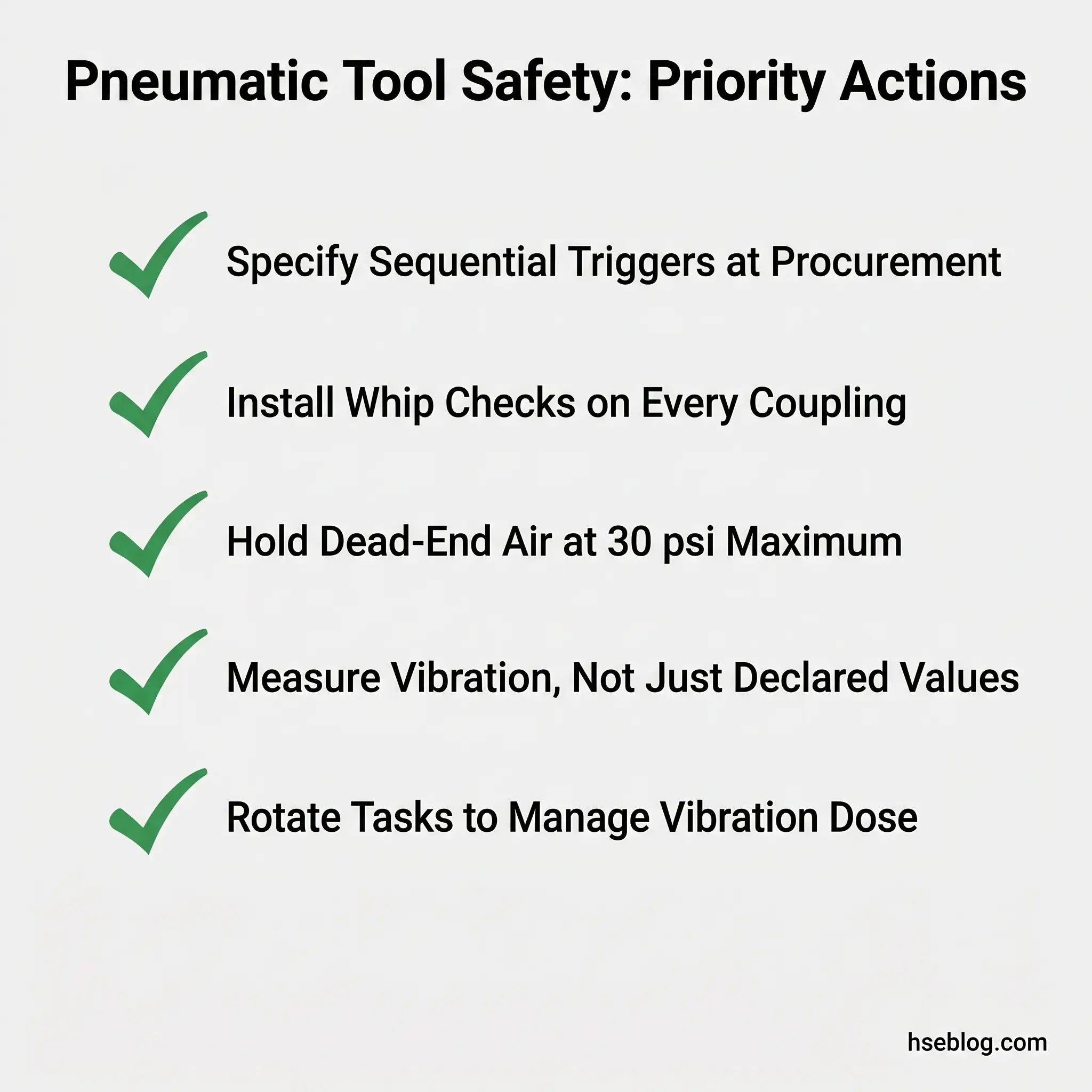
Pneumatic tool safety fails in specific, repeating patterns — retainers removed for speed, whip checks skipped on short jobs, the 30 psi rule applied to supply pressure instead of dead-end pressure, anti-vibration gloves relied on as a HAVS solution. Each failure has a known control that works when it is executed. The work of the safety professional is not re-discovering the controls. It is making sure the decisions that determine which controls apply — tool procurement, inspection scope, exposure management, trigger-type specification — are made on the evidence rather than on inherited habit.
The standards already exist: 29 CFR 1910.242 and 1910.243, ANSI/ISANTA SNT-101-2024, PUWER 1998, the Control of Vibration at Work Regulations 2005, EU Directive 2002/44/EC. Pneumatic tool safety is not a knowledge problem anymore. It is an execution problem, and execution is the one part of the system the professional on site actually controls.