
TL;DR
- 100 ready-to-use toolbox talk topics organized by hazard category so you never run out of daily briefing material
- Relevant across industries: covers general safety, fire, electrical, chemical, working at height, PPE, ergonomics, and environmental hazards
- Pick based on site conditions: match the topic to the day’s tasks, weather, recent incidents, or audit findings
- Five minutes saves lives: a focused daily toolbox talk reduces incident rates more than any poster or policy document ever will
- Delivery matters as much as content: engage the crew with questions, real examples, and two-way conversation
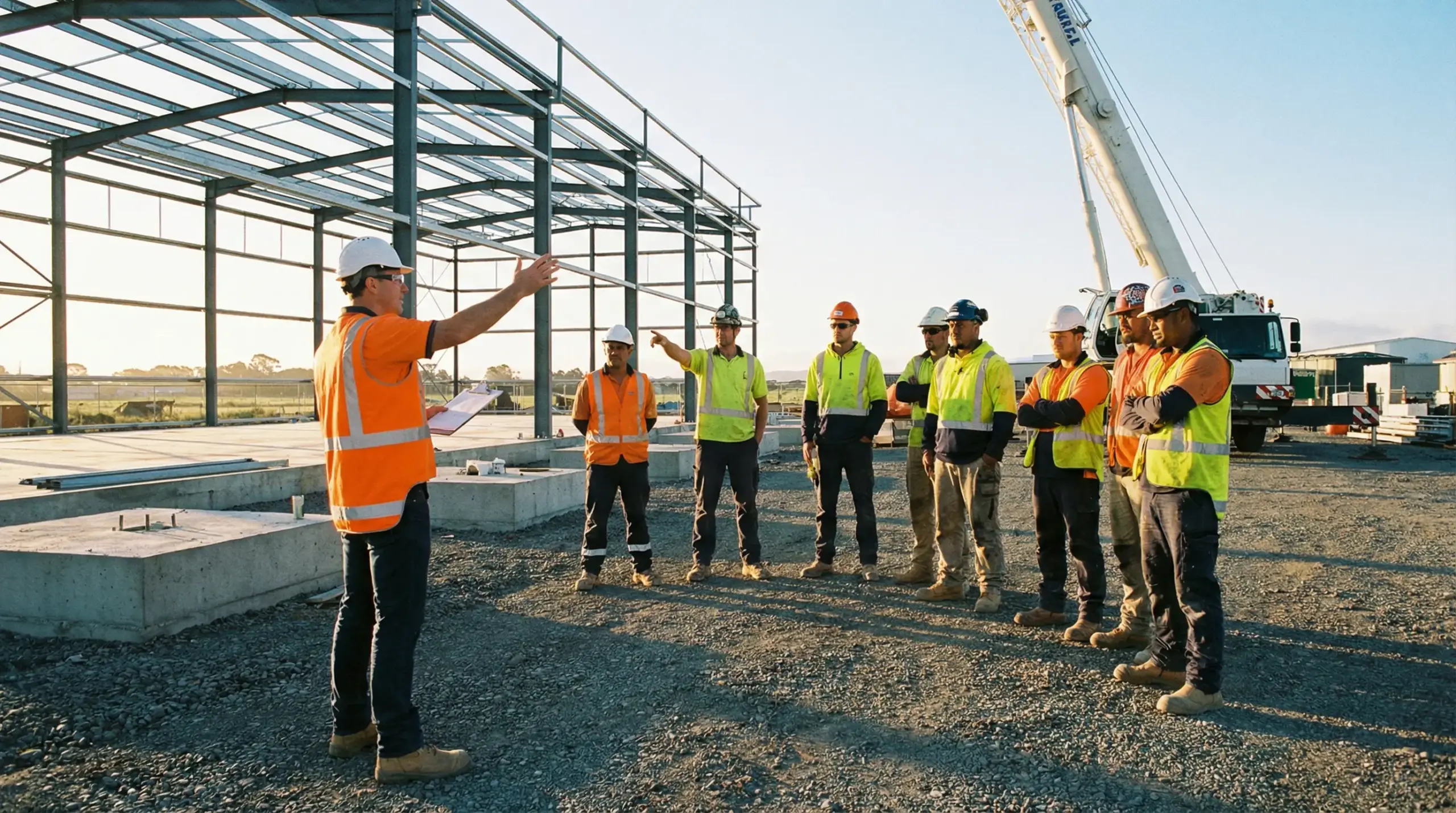
I was standing on a fabrication yard in the Gulf when the site superintendent pulled me aside after a morning briefing. “We’ve been doing toolbox talks for six months,” he said. “Same five topics on rotation. The crews tune out before I finish the first sentence.” I watched the next morning’s talk — slips, trips, and falls, read word-for-word from a laminated card. Fifteen workers stared at their boots. Nobody asked a question. Nobody retained a thing. That project recorded three lost-time injuries in the following two weeks.
The problem was never the crew. The problem was running out of relevant safety topics and defaulting to repetition. A toolbox talk that recycles the same material every week stops being a safety intervention and starts being background noise. This article gives you 100 field-tested safety topics for daily toolbox talk sessions — organized by hazard category, ready to deploy, and broad enough to keep your briefings fresh for months. Whether you manage a construction site, a manufacturing floor, a warehouse, or a petrochemical plant, these topics will keep your daily safety conversations sharp, specific, and genuinely useful.
What Makes a Daily Toolbox Talk Effective
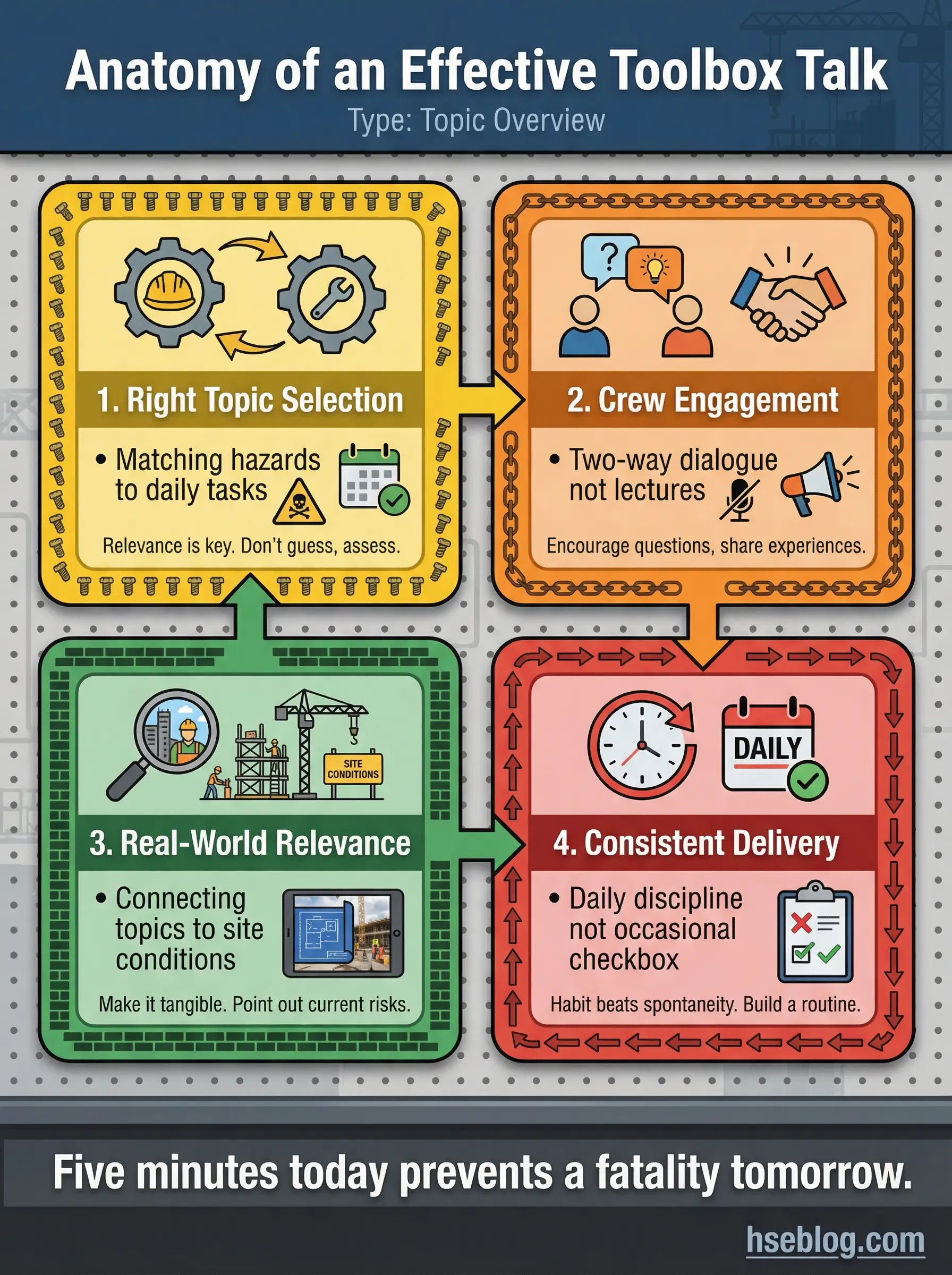
A daily toolbox talk is a short, focused safety briefing — typically five to fifteen minutes — delivered to a work crew before tasks begin. Its purpose is to raise awareness of a specific hazard, reinforce a control measure, or remind workers of a procedure directly relevant to the day’s work. OSHA’s voluntary guidelines and HSE UK’s Managing for Health and Safety framework both emphasize that regular, topic-specific safety communications at the crew level reduce workplace incidents more effectively than annual training sessions alone.
The difference between a toolbox talk that changes behavior and one that wastes everyone’s time comes down to three things: topic relevance, delivery engagement, and follow-through. A talk about heat stress on a freezing December morning in Northern Europe adds nothing. A talk about excavation hazards when your crew is pouring concrete adds nothing. The right topic, matched to the right conditions, delivered with genuine conviction — that combination is where incident prevention actually happens.
- Relevance: The topic must connect to what the crew will physically do that day or what conditions they will face
- Brevity: Five to ten minutes. Beyond that, attention drops and retention collapses
- Interaction: Ask questions. Invite crew members to share their own experiences. A monologue is not a safety conversation
- Documentation: Record the topic, date, attendees, and any concerns raised. This matters for compliance and for tracking patterns
- Follow-up: If a toolbox talk identifies a new risk or concern, act on it. Nothing kills credibility faster than asking for input and ignoring it
“The most effective safety communication happens closest to the work.” — HSE UK, Managing for Health and Safety (L65)
Pro Tip: Keep a logbook of which topics you’ve covered each month. I’ve audited sites that repeated the same six topics for an entire quarter because nobody tracked what had already been discussed. A simple spreadsheet prevents this entirely.
100 Safety Topics For Daily Toolbox Talk — Organized By Category
What follows is the full list of 100 safety topics for daily toolbox talk sessions. I’ve organized them into ten categories based on hazard type and operational relevance. Each category reflects real hazards I’ve encountered across construction, oil and gas, manufacturing, logistics, and infrastructure projects. Pick one topic per day, match it to your site conditions, and rotate through the categories to keep your briefings varied.
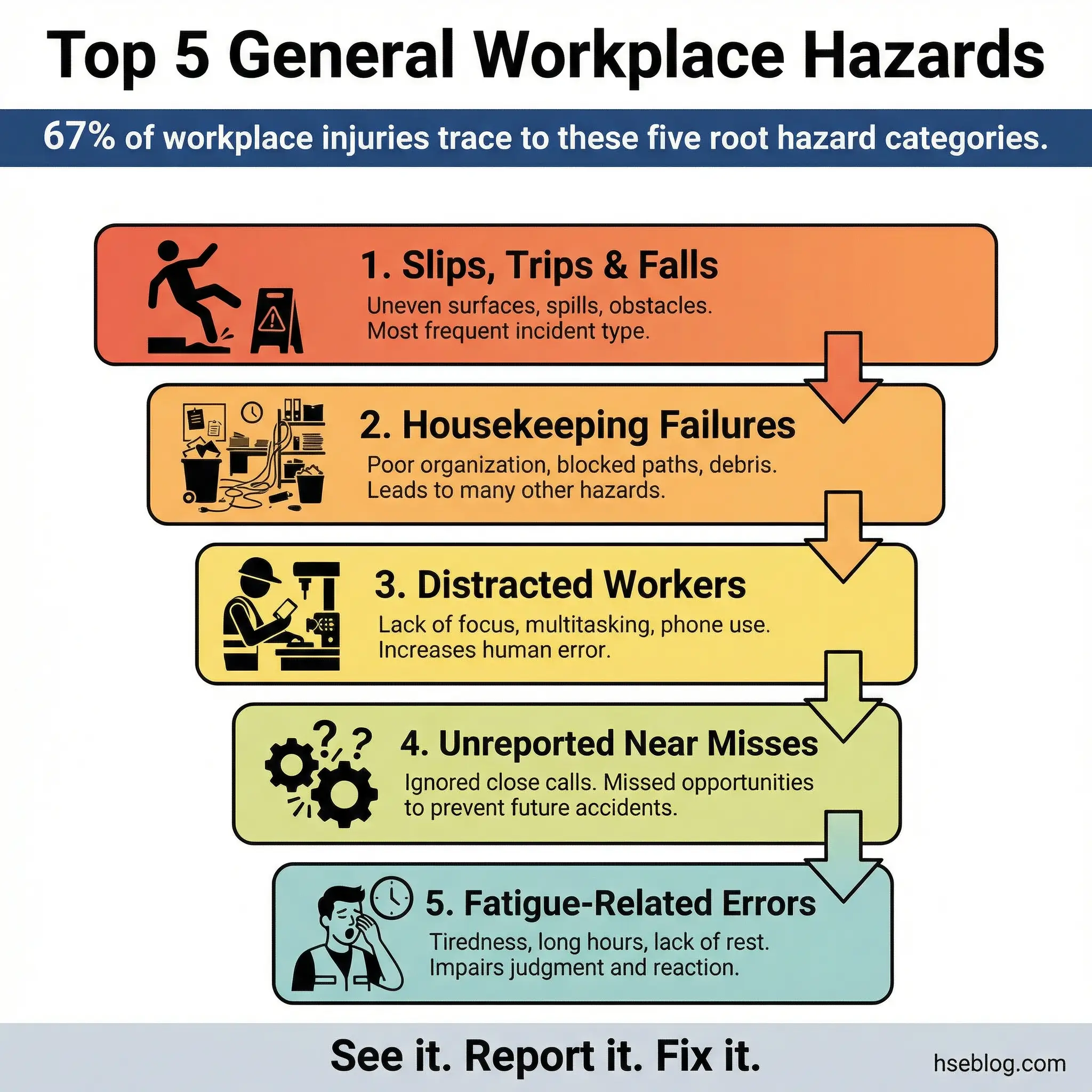
General Workplace Safety (Topics 1–15)
These foundational topics apply to virtually every worksite, regardless of industry. They cover the universal hazards and behaviors that show up in incident reports across every sector I’ve worked in — from a logistics hub in Western Europe to a pipeline project in Central Asia.
- 1. Slips, trips, and falls — the single most common cause of workplace injury across all industries
- 2. Housekeeping and workplace tidiness — cluttered walkways and unmanaged waste create chain-reaction hazards
- 3. Situational awareness — recognizing hazards before they escalate, staying alert to changing conditions
- 4. Reporting near misses — why every unreported near miss is a future incident waiting to happen
- 5. Workplace safety signs and their meanings — ensuring every worker understands prohibition, warning, mandatory, and safe condition signs
- 6. Correct use of access routes and walkways — designated paths exist for a reason
- 7. Mobile phone distractions on site — a growing cause of struck-by and fall incidents
- 8. Line of fire hazards — positioning yourself outside the path of moving objects, equipment, and energy release
- 9. Workplace violence and harassment prevention — psychological safety is occupational safety
- 10. Fatigue and its impact on safe work — drowsy workers make the same errors as impaired workers
- 11. Shortcuts that create hazards — why skipping steps to save time costs lives
- 12. New and young worker safety orientation — inexperienced workers are overrepresented in incident statistics
- 13. Buddy system and lone worker safety — never assume someone else is watching
- 14. Safety observation and reporting — how to identify and communicate hazards constructively
- 15. Workplace stress and mental health awareness — recognizing signs of distress in yourself and your crew
Working at Height Safety (Topics 16–25)
Falls from height remain the leading cause of fatality in construction worldwide. During a shutdown project at a refinery in Southeast Asia, I watched a scaffolder step onto a platform with no guardrails because the previous crew had removed them to pass materials. He was three meters up. One misstep from a life-changing injury. Every one of these topics traces back to a real incident or near miss I’ve either investigated or prevented.
- 16. Fall protection requirements and when they apply — understanding trigger heights across OSHA and HSE UK frameworks
- 17. Scaffold inspection before use — never trust a scaffold someone else erected without verifying it yourself
- 18. Ladder safety and the 4-to-1 rule — incorrect ladder angle causes more falls than ladder defects
- 19. Harness inspection and correct donning — a harness that isn’t fitted correctly is a false sense of security
- 20. Guardrail and edge protection standards — the first line of defense against falls
- 21. Fragile roof and skylight hazards — surfaces that look solid but aren’t
- 22. Mobile elevated work platforms (MEWPs) safe operation — operator competency and ground conditions
- 23. Dropped object prevention — what falls from height doesn’t only include people
- 24. Rescue planning for fall arrest — if someone is suspended in a harness, you have minutes before suspension trauma sets in
- 25. Working near open edges and floor openings — temporary covers must be secured, marked, and load-rated
Pro Tip: I always ask one question during a working at height toolbox talk: “If your colleague fell right now, what’s your rescue plan?” The silence that usually follows tells me more than any audit checklist.
Fire Safety and Emergency Response (Topics 26–35)
Fire doesn’t wait for your emergency plan to be ready. On a construction site in the Middle East, an acetylene cylinder leak during hot work turned a routine welding task into a full evacuation in under ninety seconds. The crew responded well — because they had practiced the exact scenario in a toolbox talk three days earlier. These topics prepare your crew to prevent, recognize, and respond to fire emergencies.
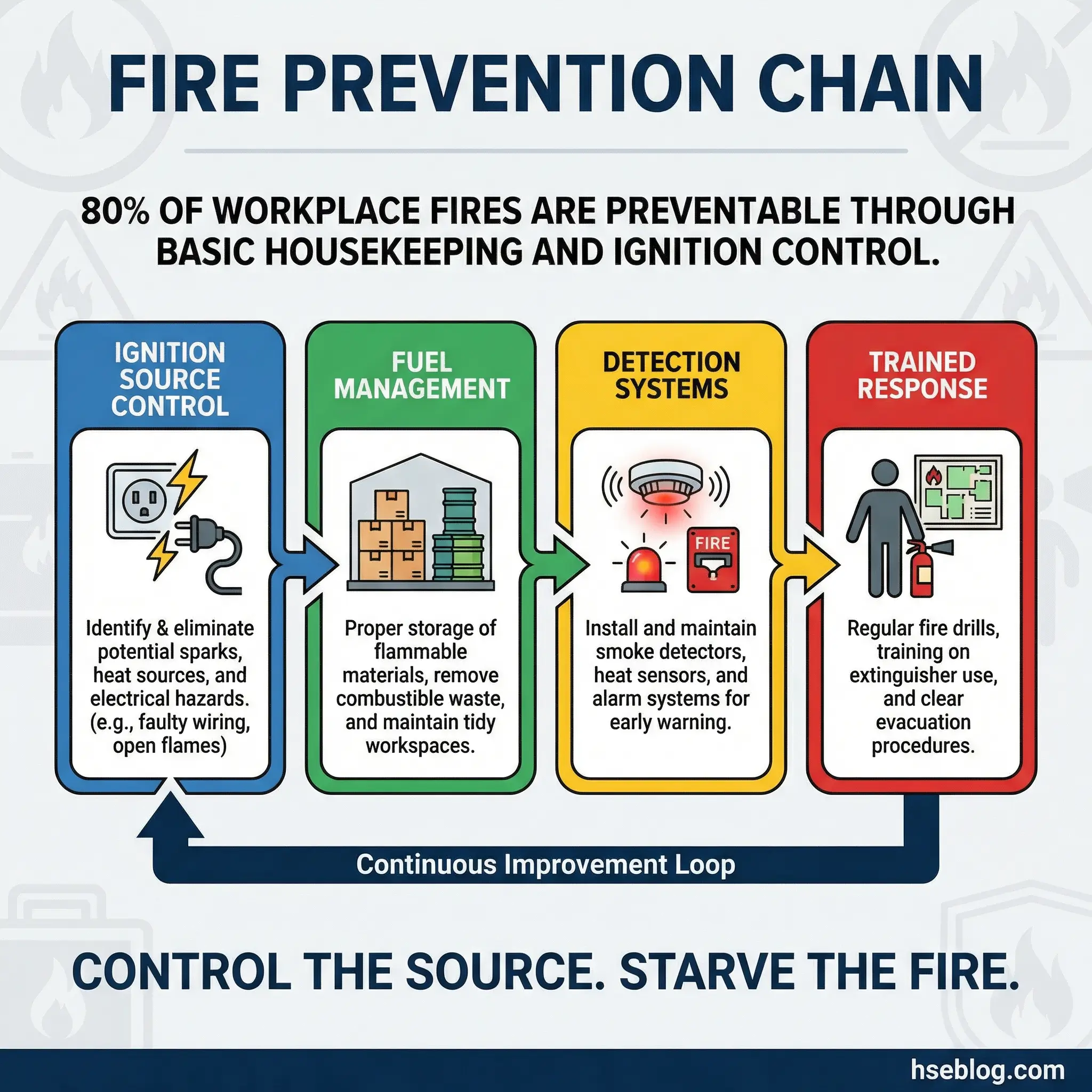
- 26. Fire triangle and how fires start — understanding fuel, heat, and oxygen to prevent ignition
- 27. Fire extinguisher types and correct selection — using a water extinguisher on an electrical fire makes the situation worse
- 28. Hot work permit requirements — every hot work task needs a permit, a fire watch, and verified isolation
- 29. Emergency evacuation procedures and assembly points — know your route before you need it
- 30. Fire alarm recognition and response — distinguishing real alarms from tests and knowing when to evacuate immediately
- 31. Flammable liquid storage and handling — proper containment, grounding, and quantity limits
- 32. Smoking policies and designated areas — ignition source control in all operational zones
- 33. Emergency response roles and responsibilities — who does what when the alarm sounds
- 34. Fire drill lessons and improvement actions — debriefing after drills is where real improvement happens
- 35. Electrical fire causes and prevention — overloaded circuits, damaged cables, and improvised wiring
Electrical Safety (Topics 36–45)
Electrical hazards are silent killers. I investigated a fatality at a manufacturing facility where a maintenance technician bypassed a lockout/tagout procedure to “save time” on a motor replacement. The motor was still energized. These topics cover the practical electrical hazards that appear across every industry — not just for electricians, but for every worker who interacts with powered equipment.
- 36. Lockout/tagout (LOTO) procedures — the single most critical control for electrical energy isolation
- 37. Electrical isolation verification — test before you touch, every time, no exceptions
- 38. Extension cord safety and inspection — damaged cords are a leading cause of electrical shock and fire
- 39. Ground fault circuit interrupters (GFCIs) — why they matter in wet or damp environments
- 40. Overhead power line awareness — maintaining safe clearance distances during crane and equipment operations
- 41. Arc flash hazards and protective boundaries — understanding incident energy levels and required PPE
- 42. Portable electrical equipment inspection — visual checks before every use
- 43. Temporary electrical installations on construction sites — compliance requirements that protect lives
- 44. Battery charging safety — hydrogen gas accumulation, ventilation, and correct charging procedures
- 45. Cable management and trip/shock prevention — routing cables safely to avoid both electrical and physical hazards
Pro Tip: During a lockout/tagout toolbox talk, I bring an actual isolation lock and tag to the briefing. Letting workers physically handle the equipment makes the procedure tangible and memorable — far more effective than reading a procedure from a screen.
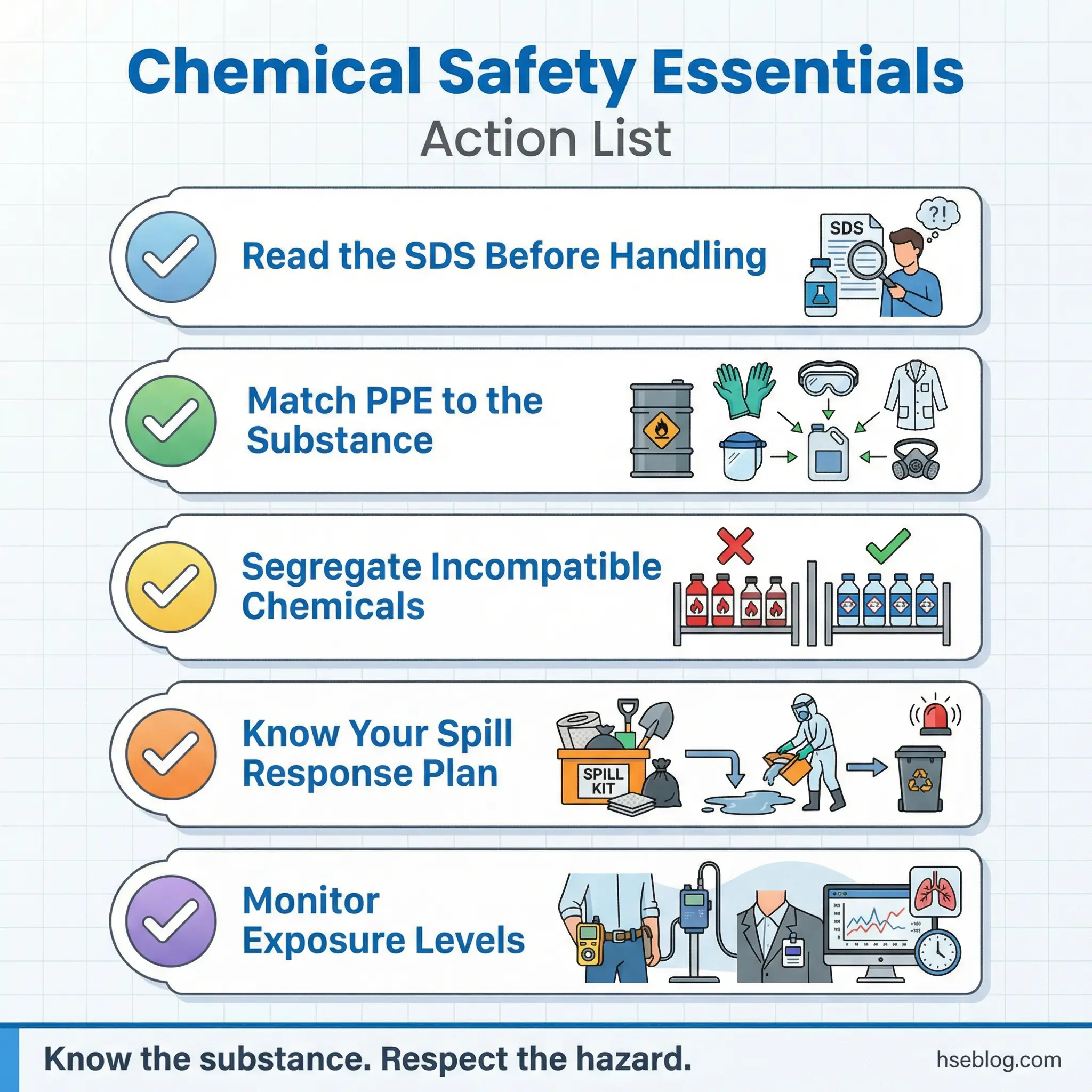
Chemical and Hazardous Substance Safety (Topics 46–55)
Chemical hazards demand respect because their effects are often invisible and delayed. On a petrochemical project, I encountered a pipe fitter who had been working near a low-level hydrogen sulfide leak for two hours without noticing — the gas had gradually dulled his sense of smell, which is exactly how H₂S exposure works. These topics build chemical awareness from the ground up.
- 46. Safety Data Sheets (SDS) — how to read and use them — the most underused safety document on most sites
- 47. Chemical labeling and GHS pictograms — understanding hazard classification at a glance
- 48. Correct PPE for chemical handling — matching glove type, respirator cartridge, and eye protection to the specific substance
- 49. Chemical spill response procedures — containment first, cleanup second, reporting always
- 50. Hydrogen sulfide (H₂S) awareness — recognizing exposure symptoms and evacuation triggers
- 51. Safe storage and segregation of chemicals — incompatible chemicals stored together cause reactions
- 52. COSHH assessments and their purpose — understanding exposure controls for hazardous substances
- 53. Respiratory protection selection — why one respirator type doesn’t fit all chemical exposures
- 54. Hazardous waste handling and disposal — proper classification, containment, and disposal procedures
- 55. Compressed gas cylinder safety — storage, handling, transport, and leak detection
Personal Protective Equipment (Topics 56–65)
PPE is the last line of defense — never the first. I’ve stopped work on sites where supervisors treated PPE as the primary control instead of applying the hierarchy of controls properly. A hard hat does not make a dropped object hazard acceptable. These topics cover correct selection, use, inspection, and the mindset shift that PPE requires.
- 56. Hierarchy of controls — where PPE actually fits — understanding why elimination, substitution, and engineering controls come first
- 57. Head protection selection and inspection — hard hat types, impact ratings, and replacement criteria
- 58. Eye and face protection for specific tasks — matching safety glasses, goggles, or face shields to the actual hazard
- 59. Hearing protection and noise exposure awareness — when to use earplugs vs. earmuffs and understanding exposure limits
- 60. Respiratory protection fit testing — a respirator that doesn’t seal properly provides zero protection
- 61. Hand protection and glove selection — cut-resistant, chemical-resistant, heat-resistant: the task dictates the glove
- 62. Foot protection and safety footwear standards — steel toe vs. composite toe and when metatarsal guards are needed
- 63. High-visibility clothing requirements — reflective standards for roadwork, low-light environments, and vehicle interaction zones
- 64. Fall protection PPE — harnesses, lanyards, and connectors — inspection, selection, and compatibility
- 65. PPE care, maintenance, and replacement criteria — damaged PPE is worse than no PPE because it creates false confidence
“PPE is the last barrier between the worker and the hazard. When it fails, nothing else stands between them.” — ISO 45001, Clause 8.1.2
Manual Handling and Ergonomics (Topics 66–72)
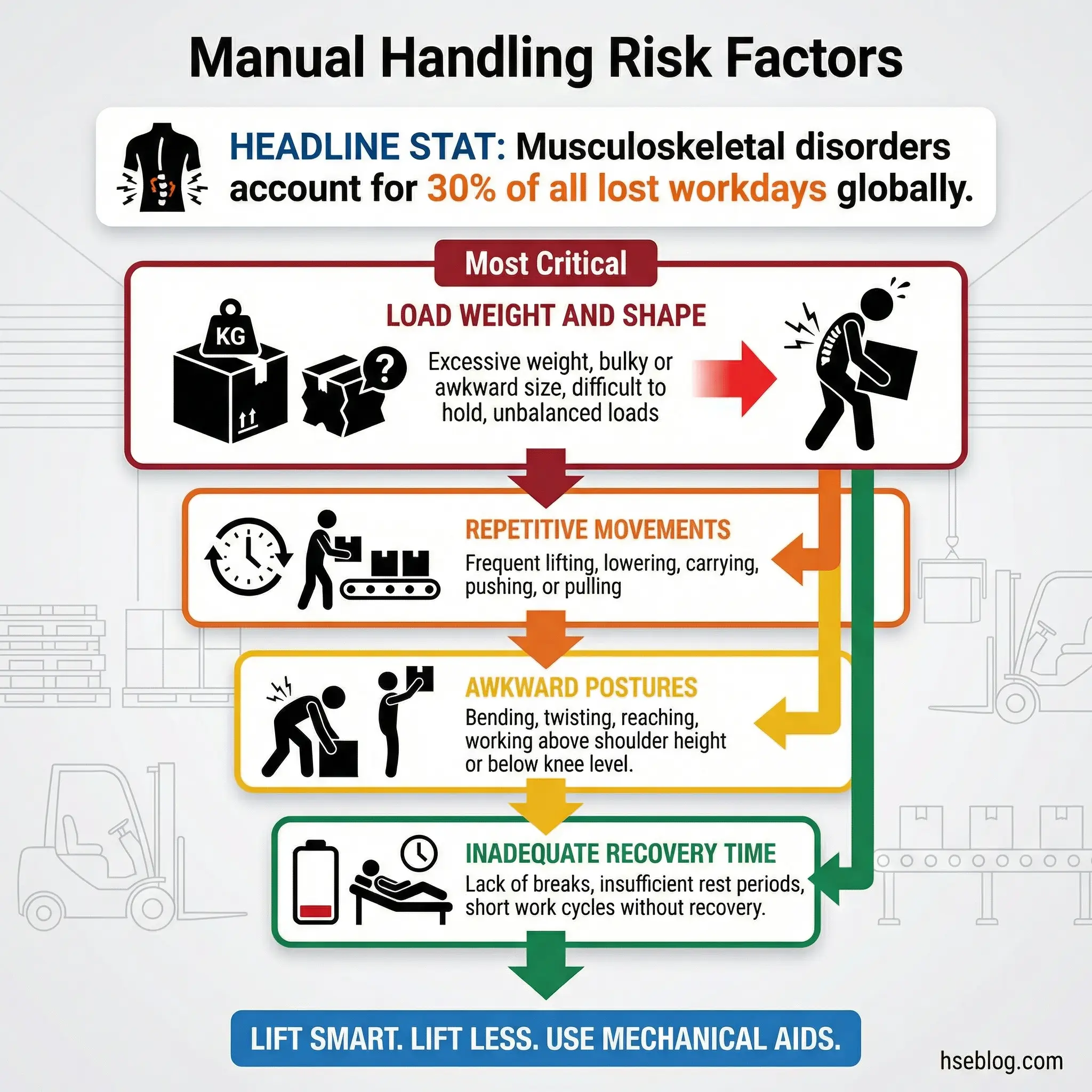
Musculoskeletal disorders account for more lost workdays than any other injury category. I’ve reviewed compensation claims where a single improper lift caused a back injury that ended a worker’s career. These topics address the daily biomechanical stresses that accumulate across every shift.
- 66. Safe manual lifting technique — the fundamentals of posture, grip, load assessment, and route planning
- 67. Team lifting and coordinated handling — communication protocols for multi-person lifts
- 68. Repetitive strain injury prevention — micro-breaks, task rotation, and workstation adjustment
- 69. Pushing and pulling loads safely — force application, wheel condition, and gradient awareness
- 70. Ergonomic workstation setup — monitor height, chair adjustment, keyboard positioning for office and control room workers
- 71. Back injury prevention strategies — stretching routines, load weight awareness, and when to use mechanical aids
- 72. Vibration exposure and HAVS awareness — hand-arm vibration syndrome from prolonged power tool use
Vehicles, Transport, and Logistics Safety (Topics 73–80)
Vehicle-pedestrian interaction is one of the most lethal hazard combinations on any worksite. During a warehouse audit in Northern Europe, I found that forklift operators were reversing through pedestrian zones without spotters because “they always check their mirrors.” Three near-miss reports in the previous month told a different story. These topics address the movement of vehicles, equipment, and materials.
- 73. Forklift pre-start inspection and safe operation — daily checks that prevent tip-overs and mechanical failures
- 74. Pedestrian and vehicle segregation — physical barriers, designated walkways, and crossing points
- 75. Reversing vehicle hazards — banksmen, cameras, proximity alarms, and exclusion zones
- 76. Loading and unloading safety — dock safety, load securing, and trailer restraint systems
- 77. Seatbelt use in all site vehicles — the simplest control that’s still routinely ignored
- 78. Defensive driving principles for site vehicles — speed limits, right-of-way, and adverse condition adjustments
- 79. Crane operation and lift planning — load calculations, exclusion zones, and communication protocols
- 80. Journey management planning — fatigue, route risk, and emergency provisions for off-site travel
Environmental and Health Hazards (Topics 81–90)
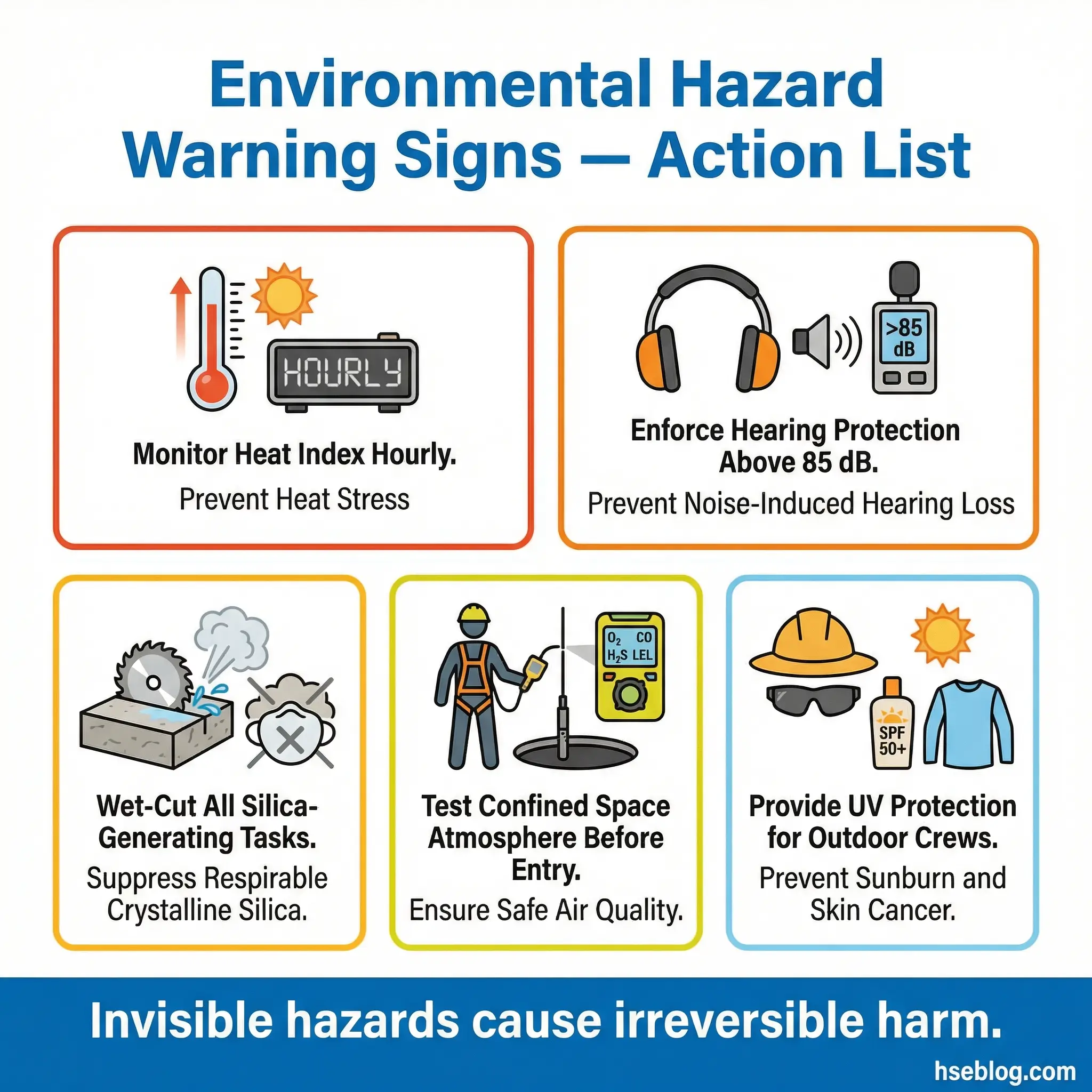
Environmental hazards often don’t announce themselves with flashing lights and alarms. Noise creeps up over years. Dust accumulates in lungs silently. Heat exhaustion progresses through stages that workers often misread as simple tiredness. These topics cover the chronic and acute environmental exposures that require sustained awareness.
- 81. Heat stress recognition and prevention — WBGT monitoring, hydration schedules, and acclimatization protocols
- 82. Cold stress and hypothermia awareness — recognizing early symptoms and wind chill factors
- 83. Noise exposure and hearing conservation — daily exposure limits and the irreversibility of hearing damage
- 84. Dust and silica exposure control — wet methods, LEV systems, and RPE selection
- 85. Working in confined spaces — atmospheric testing, entry permits, and rescue readiness
- 86. Biological hazards in the workplace — bloodborne pathogens, mold, legionella, and infectious agent controls
- 87. UV radiation and sun exposure protection — outdoor workers face skin cancer risk that most safety programs ignore
- 88. Waste management and environmental compliance — segregation, containment, and disposal procedures
- 89. Water hazards and drowning prevention — work near water requires specific risk assessment and rescue provisions
- 90. Substance abuse awareness and impairment recognition — identifying signs of impairment that compromise everyone’s safety
Permits, Procedures, and Management Systems (Topics 91–100)
These topics address the systems-level controls that hold everything else together. I’ve seen sites with excellent PPE compliance and terrible permit-to-work discipline — and the permit failures produced the serious incidents. Procedural controls aren’t bureaucracy. They’re engineered barriers against catastrophic failure.
- 91. Permit-to-work systems and their purpose — understanding why permits exist and what they actually control
- 92. Job safety analysis (JSA) before task commencement — identifying task-specific hazards before work begins
- 93. Risk assessment fundamentals — likelihood, severity, and the practical application of the risk matrix
- 94. Incident reporting and investigation basics — what to report, how to preserve evidence, and why blame-free reporting matters
- 95. Emergency action plan review — does every worker know their role, their route, and their assembly point?
- 96. Toolbox talk effectiveness and engagement — a meta-topic for discussing how to improve the talks themselves
- 97. Contractor safety management — ensuring third-party workers meet the same safety standards as direct employees
- 98. Change management and safety implications — new equipment, new processes, and new personnel all introduce new risks
- 99. Safety leadership at every level — safety ownership doesn’t stop at the HSE department
- 100. Lessons learned from recent incidents — using real events (anonymized) to drive crew discussion and prevention
Pro Tip: Topic 100 is the most powerful toolbox talk topic you can deliver. Sharing a real incident — what happened, what failed, what we’d do differently — generates more engagement and behavior change than any generic safety topic ever will.
How to Select the Right Toolbox Talk Topic Each Day
Choosing a topic isn’t random. The most effective safety supervisors I’ve worked with follow a simple selection logic that takes less than two minutes each morning. Match the topic to what’s actually happening on site, and the talk becomes a genuine safety intervention rather than a compliance exercise.
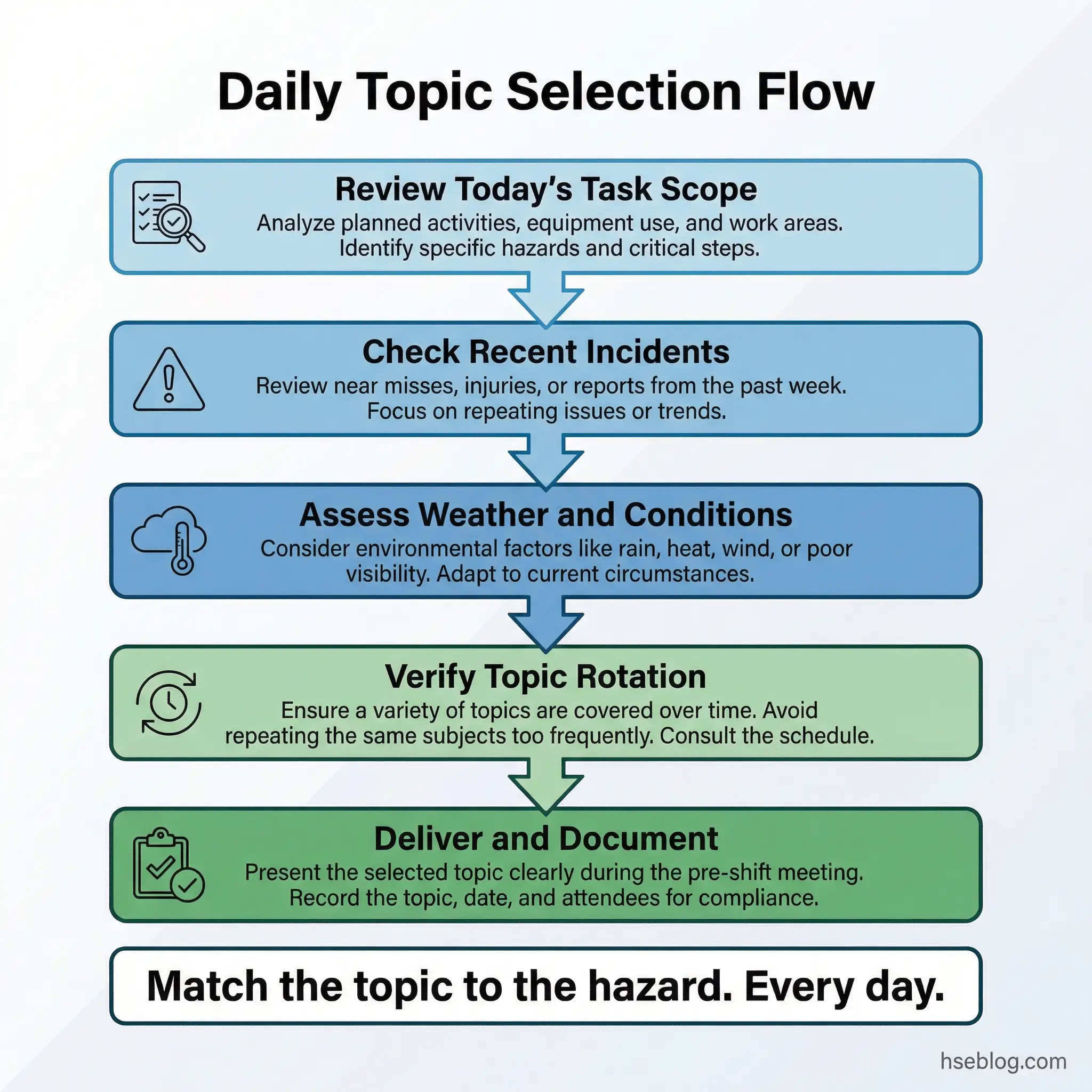
The following decision framework has worked consistently across every project type I’ve managed:
- Check the day’s work scope — what tasks are planned? Select a topic that directly relates to the highest-risk activity
- Review recent incidents or near misses — if something happened yesterday, talk about it today while it’s still fresh
- Consider environmental conditions — heat, cold, rain, wind, low visibility, and seasonal hazards all drive topic selection
- Check your rotation log — avoid repeating topics within the same month unless conditions demand it
- Respond to audit findings — if an inspection flagged a gap, reinforce the relevant topic in the next briefing
Common Mistakes That Undermine Toolbox Talk Effectiveness
I’ve audited toolbox talk programs across dozens of sites, and the same failure patterns repeat with striking consistency. The content itself is rarely the issue — it’s how the content gets delivered and managed that determines whether it prevents injuries or becomes wallpaper.
These are the mistakes I encounter most frequently:
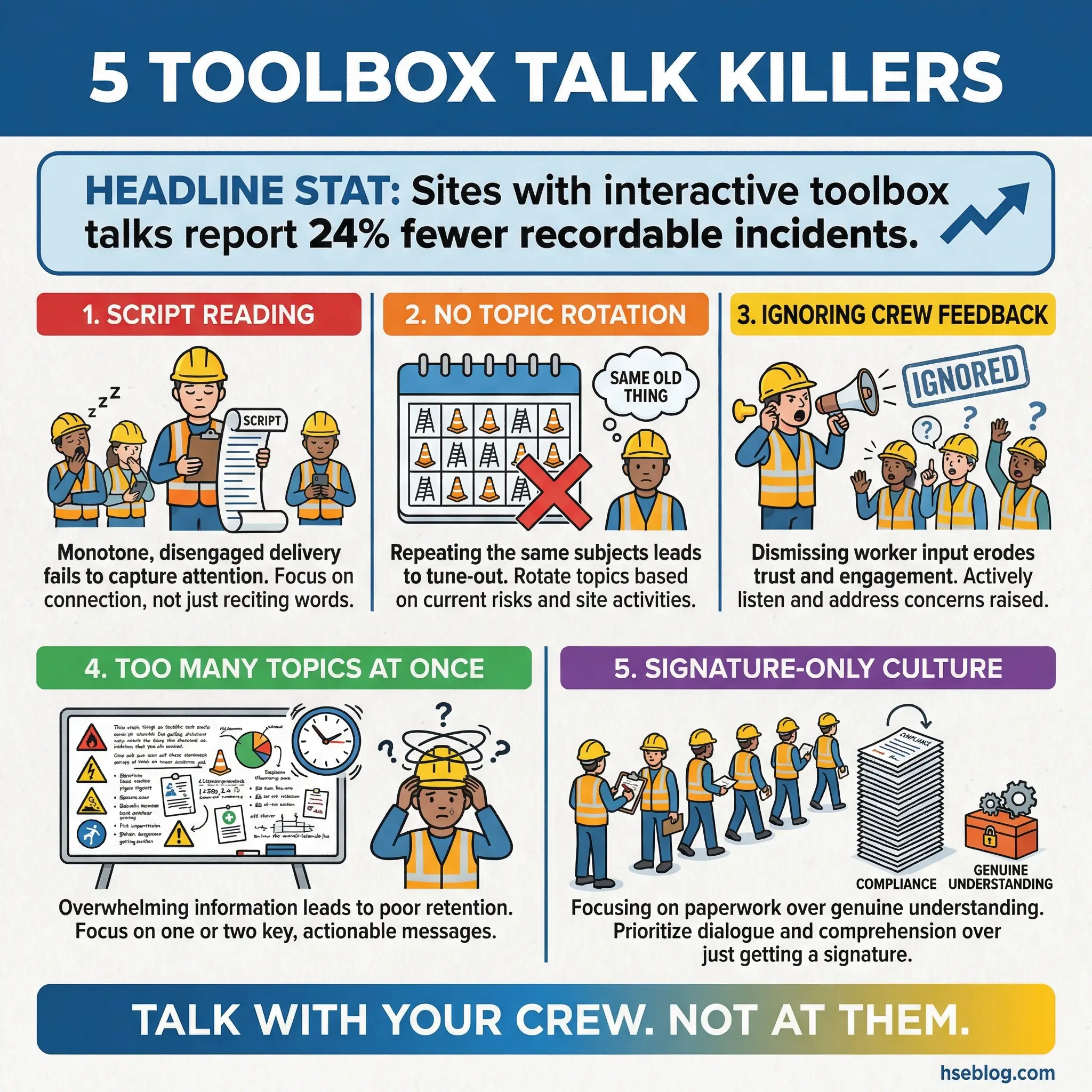
- Reading from a script word-for-word: Workers stop listening within thirty seconds. Use notes as a reference, not a teleprompter
- Delivering talks in noisy or uncomfortable locations: If the crew can’t hear you or they’re standing in direct sun, they’re focused on discomfort, not content
- No follow-up on issues raised: When a worker raises a hazard concern during a toolbox talk and nothing changes, trust evaporates permanently
- Covering too many topics at once: One topic per talk. If you try to cover three hazards in five minutes, the crew retains none of them
- Treating the talk as a signature exercise: Passing around an attendance sheet without genuine discussion turns safety into paperwork theater
- Same presenter every day: Rotate delivery among supervisors and experienced workers. Different voices maintain engagement
“A toolbox talk isn’t a box to tick. It’s a conversation to have.” — Field principle from a multinational EPC project safety director
| Mistake | Impact | Fix |
|---|---|---|
| Script reading | Crew disengages immediately | Use bullet-point notes and speak naturally |
| No topic rotation | Repetition breeds complacency | Track topics monthly in a spreadsheet |
| Skipping follow-up | Erodes trust in the safety process | Close every concern within 48 hours |
| Monologue delivery | Zero crew participation | Ask at least two questions per talk |
| Poor timing or location | Low retention and attendance issues | Start before shift, in a comfortable area |
Pro Tip: Record the number of questions or comments from the crew during each toolbox talk. If three consecutive talks generate zero interaction, the delivery method needs to change — not the topic.
Conclusion
One hundred safety topics for daily toolbox talk sessions is more than enough to keep your briefings fresh, relevant, and engaging for an entire operational year. The real challenge was never finding topics — it’s having the discipline to select the right one each morning, deliver it with conviction, and act on the feedback your crew gives you. Every topic on this list traces back to a real hazard that has caused real injuries on real worksites. None of them are theoretical.
The sites with the strongest safety records I’ve worked on share one common trait: they treat the daily toolbox talk as the most important five minutes of the shift. Not the most expensive control. Not the most complex system. Five minutes of focused, relevant, honest conversation between a supervisor and a crew that trusts each other. That consistency compounds over weeks and months into a culture where workers identify hazards before they materialize and speak up before someone gets hurt.
Safety topics for daily toolbox talk sessions are not a content library to file away. They are a daily practice. Use them. Rotate them. Adapt them to your site. And when a crew member shares a concern during a talk, treat it as the gift it is — because the alternative is finding out about that hazard through an incident investigation report.