
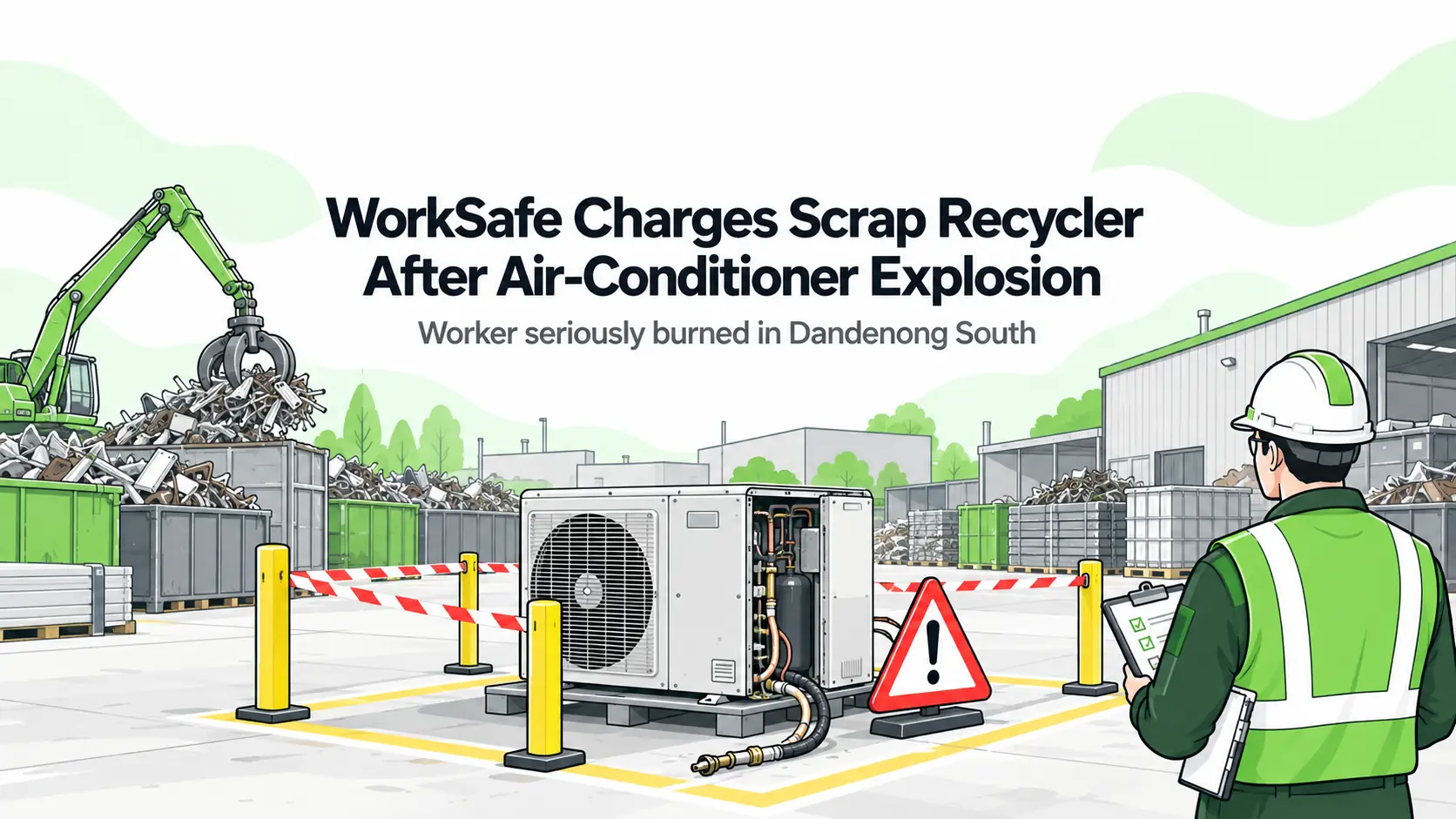
DANDENONG SOUTH, VICTORIA, AUSTRALIA — WorkSafe Victoria has charged scrap recycling company Eco Scrap Pty Ltd after an explosion seriously injured a worker at its Dandenong South site.
According to the regulator's announcement on 15 October 2026, the 35-year-old worker was decommissioning an air-conditioning unit when gas escaped and ignited. The worker sustained serious burns to his hands, legs and face. The public announcement did not specify when the incident occurred.
What WorkSafe alleges
Eco Scrap faces one charge under section 21(1) of Victoria's Occupational Health and Safety Act 2004. WorkSafe alleges the company failed to provide and maintain a working environment that was safe and without risks to health.
The regulator also alleges a breach of section 21(2)(a), saying the company failed to provide and maintain a safe system of work. In particular, WorkSafe says there should have been a documented standard operating procedure to ensure refrigerant was removed from air-conditioning units before they were scrapped.
The case is listed for a filing hearing at Melbourne Magistrates' Court on 19 October 2026. The allegations have not yet been determined by a court, and no conviction or penalty has been recorded in the announcement.
Why air-conditioner decommissioning needs controlled work
End-of-life air-conditioning equipment can retain refrigerant and pressure even when a unit appears disconnected or ready for disposal. Damaging, cutting or dismantling a charged system may release gas or liquid, and some modern refrigerants are flammable.
Workers involved in receiving, sorting or processing this equipment therefore need controls that begin before the unit reaches a shredder or dismantling station. HSEBlog's guidance on HVAC safety hazards and control measures explains the broader electrical, chemical and mechanical risks associated with this work. The site's guide to handling compressed gases safely also outlines precautions relevant to pressurised systems.
HSE Blog analysis: controls for scrap and recycling sites
HSE Blog analysis: The charge highlights a process-safety issue that can arise at the boundary between equipment servicing and waste processing. A safe system should make it clear who is competent and authorised to identify refrigerants, recover the contents, verify that pressure has been removed and release a unit for scrapping.
Depending on the equipment and site, practical controls may include:
- quarantining incoming air-conditioning units until their condition and refrigerant status are verified;
- using competent and appropriately licensed people for refrigerant recovery and decommissioning;
- documenting isolation, recovery, verification and release steps in a task-specific procedure;
- controlling ignition sources and separating decommissioning work from general scrap processing;
- marking units that are confirmed safe for dismantling and preventing unverified equipment from entering cutting or shredding operations; and
- providing spill, fire, first-aid and emergency-response arrangements suited to the refrigerants and equipment handled.
These points are preventive analysis, not findings about Eco Scrap beyond the allegations published by WorkSafe. Employers should base site controls on equipment information, applicable refrigerant rules and a task-specific risk assessment. General principles for managing these risks are also covered in HSEBlog's workplace chemical safety guide.
Case status and sources
The prosecution is at an early stage. WorkSafe's charge sets out allegations that will be tested through the court process.
Sources: WorkSafe Victoria media release, 15 October 2026; insuranceNEWS.com.au report, 15 October 2026.
Source
WorkSafe Victoriaworksafe.vic.gov.au